What is worth measuring?

In my latest post, I introduced you to the work of NOOR, who is creating a new sport. I suggested that her work could open up a much broader inquiry: How do we create a new way of becoming?

With that background, I would like to dive a little deeper into other aspects of her research and explore how a new way of becoming raises the question of what is worth measuring.

NOOR’s research

Her work is based on five theoretical pillars:

  • Pillar I: Achievement Motivation and the Competition State
  • Pillar II: Gendered Body Comportment and Relational Embodiment
  • Pillar III: Kinetic Awareness versus Functional Alienation
  • Pillar IV: The Language of the Body as Resistance
  • Pillar V: Institutional Power and Tacit Knowing

If we zoom in on Pillar II, we see that high-performance sports such as Women’s Artistic Gymnastics demand a highly disciplined environment. This “limited intentionality” is not merely psychological; it is materially and institutionally produced through regulations that physicalize discipline. By restricting a neckline to “half of the sternum” or a leg cut to the “hip bone,” these regulations physically delimit the female athlete’s bodily presence, prescribing not only how her body may appear but also the spatiality of its movement and reach.
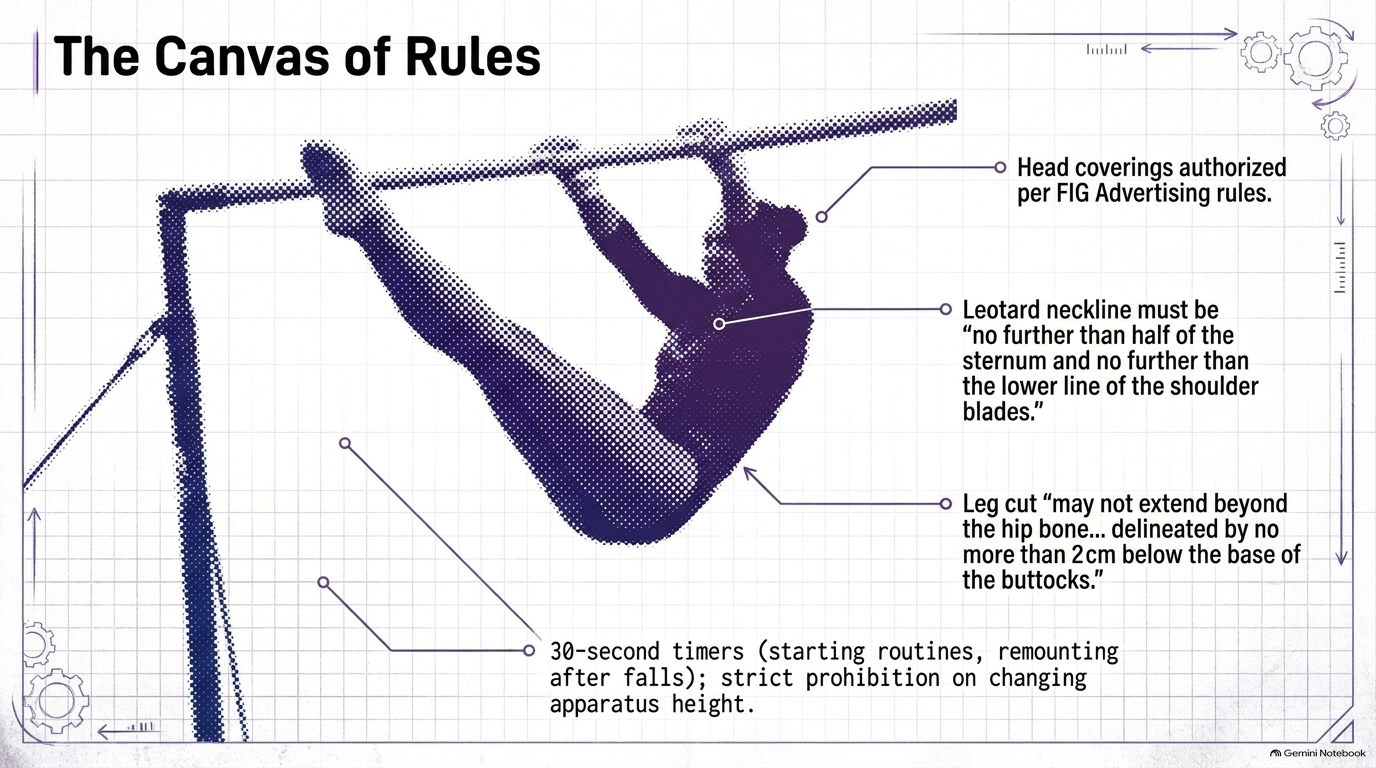
Contrastingly, the “new embodiment” argues for relationality. Instead of an isolated, disciplined body performing for an external score, NOOR envisions a body that exists in relation to its community and its own internal state.

The measurable body is reduced to a numerical sequence, a “data point” in a governed script, and a series of technical skills to be deducted by a jury. By contrast, NOOR’s thesis suggests a “Lived Body”, a “Lived Experience”: the body uses its own language, prioritizes the “desire to understand,” and embraces the vulnerability of a “broken rule” as a moment of liberation.

Under Pillar III, she challenges the reduction of bodies in elite sport to quantifiable units—fragments of movement extracted, coded, and rendered legible for judicial consumption. Here, the focus is on the static state: the Coded Body. The official Code of Points (COP) is by the WAG (Women’s Artistic Gymnastics). The COP transforms the routine into an “extinction of the moment”: what is experienced as continuous, kinetic movement is captured as a series of discrete, measurable outcomes. Skills are stripped of their temporal and embodied flow, translated instead into numerical sequences that can be evaluated, compared, and scored.

NOOR’s Running Score” is an ontology of becoming . It is an “evolving total” that refuses the finality of the judge’s verdict. This shift is punctuated by the project’s use of generative logic to replace judicial logic with a methodological script that documents the continuity of experience rather than the error of the result.

All this made me reflect on what is worth measuring. Spoiler: Instead of measuring the being, I suggest we find a way to measure the becoming. Let me build up the context for this proposition. And to manage your expectations: there is no answer. It is an invitation for debate and conversation.

Homo Ludens

In Johan Huizinga’s Homo Ludens, a game (or play) is defined as “a voluntary, absorbing activity carried out within certain fixed limits of time and place, according to freely accepted rules, and attended by a feeling of tension, joy, and a consciousness that it is ‘different’ from ordinary life.”
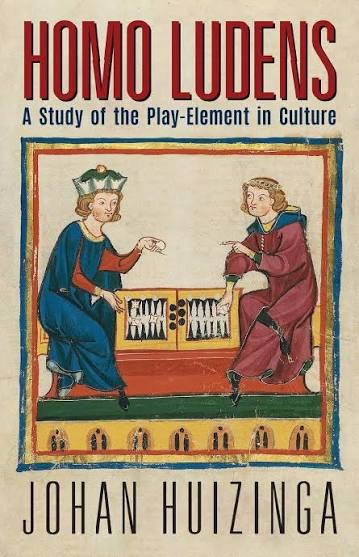
Huizinga argues that civilization does not come from play; rather, culture arises in and as play. He demonstrates that foundational elements of society—such as law, warfare, poetry, philosophy, and art—developed out of ancient ritual contests and rule-bound social play long before they became institutionalized

Huizinga’s “magic circle” describes the physical or psychological space where a game takes place and where the rules of the real world are temporarily suspended. Within this circle, a new set of rules, meanings, and logic applies that holds no weight in ordinary life. 

In modern game design, the magic circle represents the psychological barrier where a player enters a state of immersion. Inside this boundary, the virtual world feels real, and the stakes matter to the player.

Game or play is a way of becoming

Finite/Infinite Games

In Finite/Infinite Games, philosopher James P. Carse explores the idea that all human interactions and behaviors can be viewed through the lens of two distinct types of “games.” 

Carse introduces his thesis in the very first line of the book: “A finite game is played for the purpose of winning, an infinite game for the purpose of continuing the play.”

FeatureFinite GamesInfinite Games
Primary GoalTo win (which ends the game)To keep playing and prevent the game from ending
BoundariesFixed temporal, spatial, and numerical limitsBoundless; open and expanding
RulesFixed and agreed-upon; changing them breaks the gameDynamic and evolving; changed precisely to keep the play alive
PlayersKnown, select participants with clear opponentsEver-changing roster; open to anyone
ExamplesSports, politics, war, getting a degree, corporate promotionsCulture, love, a career, learning, nature, life itself

NOOR’s new sports are infinite games.

Process Philosophy

Philosopher Whitehead is considered the godfather of Process Philosophy. Instead of a philosophy of being, he proposed a philosophy of becoming.

“Developed in his seminal 1929 book Process and Reality, this ontology argues that “becoming” is more fundamental than “being”—meaning the universe is a web of energetic, experiential events rather than a collection of passive, physical matter.”

In his presentations on the four elements of the experiential design framework for immersive storytelling, Kent Bye draws an explicit connection to process philosophy. The slide below maps the foundational metaphysical scaffolding of a paradigm shift inspired by the philosophy of Alfred North Whitehead, contrasting traditional Substance Philosophy—centered on permanent, static “being”—with Process Philosophy—centered on dynamic, interconnected “becoming.”

It is precisely this shift, from being to becoming, that provides the philosophical foundation for NOOR’s work.
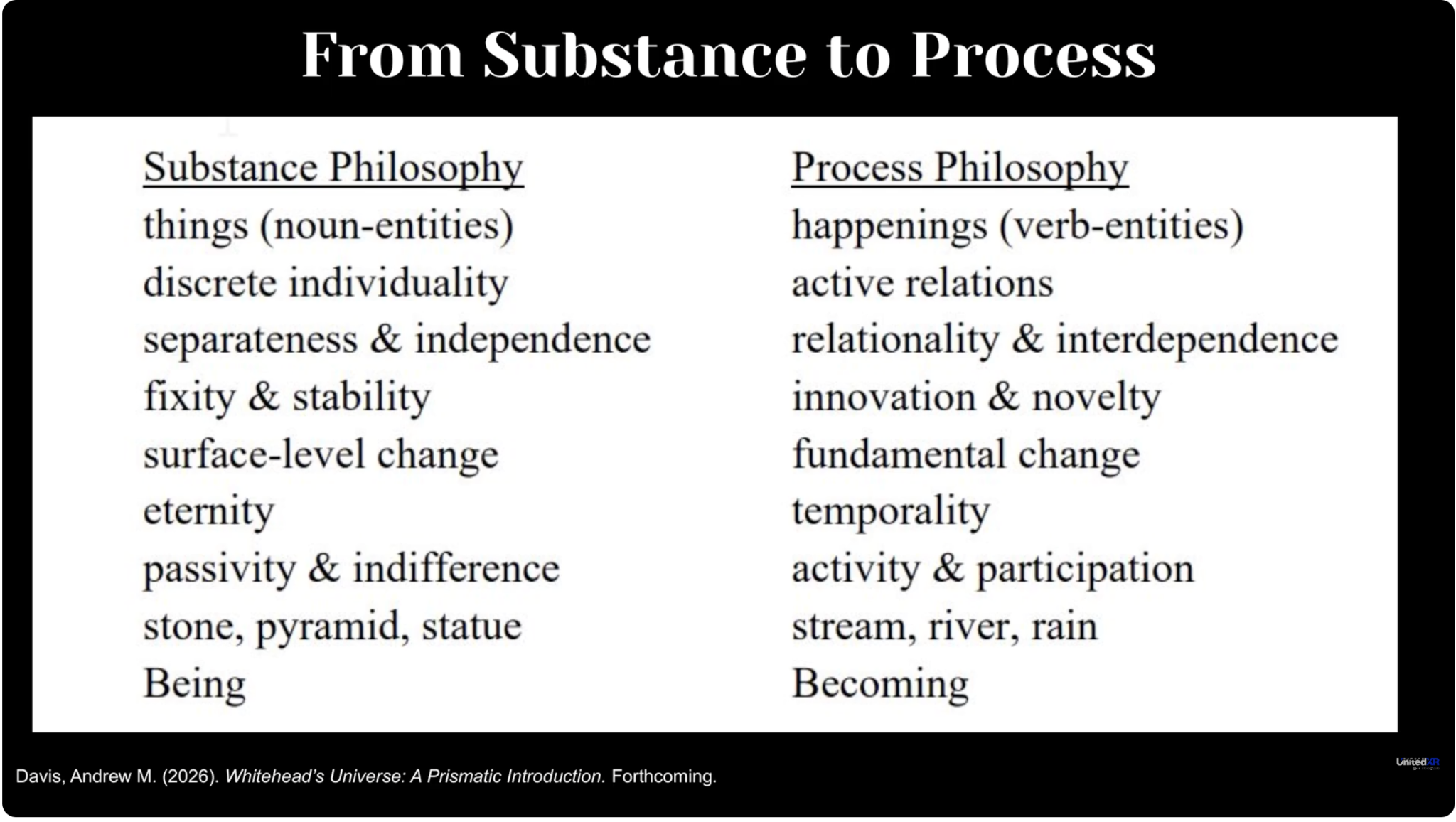
The slide is based on the work of process philosopher and theologian Dr. Andrew M. Davis, specifically serving as a visual graphic for his book Whitehead’s Universe: A Prismatic Introduction (published by Orbis Books). 

Protocol Art

In NOOR’s work, the artist becomes a protocol designer, creating the conditions for others to instantiate endless variations of the work. 

The Protocol is like the recipe, the stage, the score, the spec, the scripts, the primitives. The Instantiation is like the dish, the mixed outcome, the expression, the combinations of primitives. In that sense, Protocol Art is about delegating the instantiation. The artist becomes the composer. See also my 2019 post on “who is the composer?”

Which leads to another question: who is the instantiator? It can be craftsmen, it can be the audience, it can be machines, it can be Agents. In a sense, this is not new; already in the 17th century, Rubens was running his studio: the master has pupils working in his style, working with his protocols of mixing paint, making brushstrokes in certain ways, etc

Protocol Art expands this practice and gives attention to aspects like “Pattern Integrity”, “Style” of instantiation, etc. Christopher Alexander, anybody?

Agentworld and Superdark Factory

What if we also start delegating the work of the protocol composer, the architect of the experience? You would get something that resembles The Superdark Factory or the Agentworld of Antikythera.
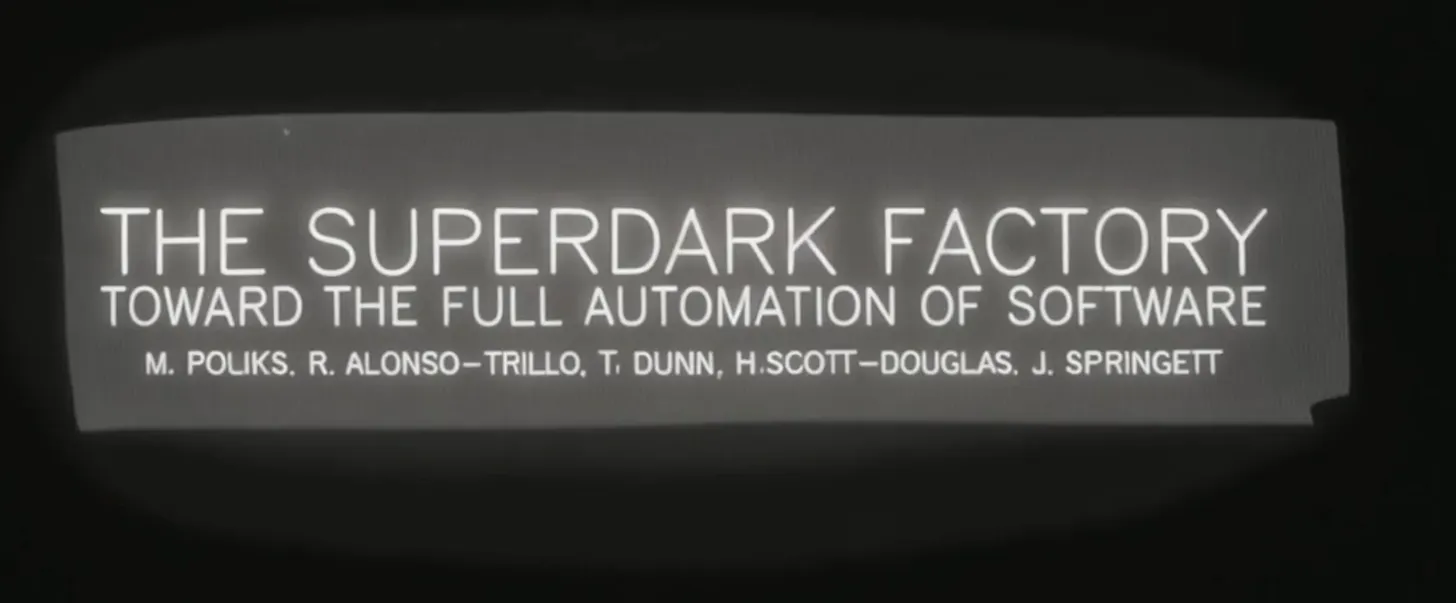
In Superdark Factory (dark or superdark as in illegable, not-understandable), the Antikythera authors argue that the historical evolution of software engineering has reached a critical inflection point where conventional, human-governed software pipelines—characterised by manual oversight, explicit logic specification, and step-by-step human verification—impose severe structural bottlenecks on throughput, operational speed, and systemic capability. 

Achieving a true step-change in productivity demands surrendering the requirement for direct human supervision within operational feedback loops, delegating both execution and architectural decision-making directly to computational machinery.

The Superdark Factory represents the limit case of this transition: an extreme, self-directed, recursively self-optimising software ecosystem. Operating as an autonomous abstract machine, the Superdark Factory independently formulates its own ambitions, designs and constructs the machinery required to pursue them, and continuously restructures and refines its own operations—without human intervention within its feedback loops.

Rather than merely executing static instructions, the Superdark Factory automates production at the level of determining what is worth producing, continuously generating new internal versions of itself to satisfy ambient imperatives. It is a “versioning regime that measures what the factory does rather than what it is”

In the Superdark Factory, we let the machine decide what is worth building.

What is worth measuring?

The world is in flux. Always has been. Maybe faster now than in the past, maybe at a different clock speed, incomprehensible and illegible for humans.

How can we measure flux? How can we measure becoming? How can we measure flow? How can we measure computation-in-action? Do we measure pattern integrity? Style? Direction (in many senses: backward/forward, progressive/regressive, moral/amoral, etc.)? Who sets the norms? Tech companies? A new kind of institution? 
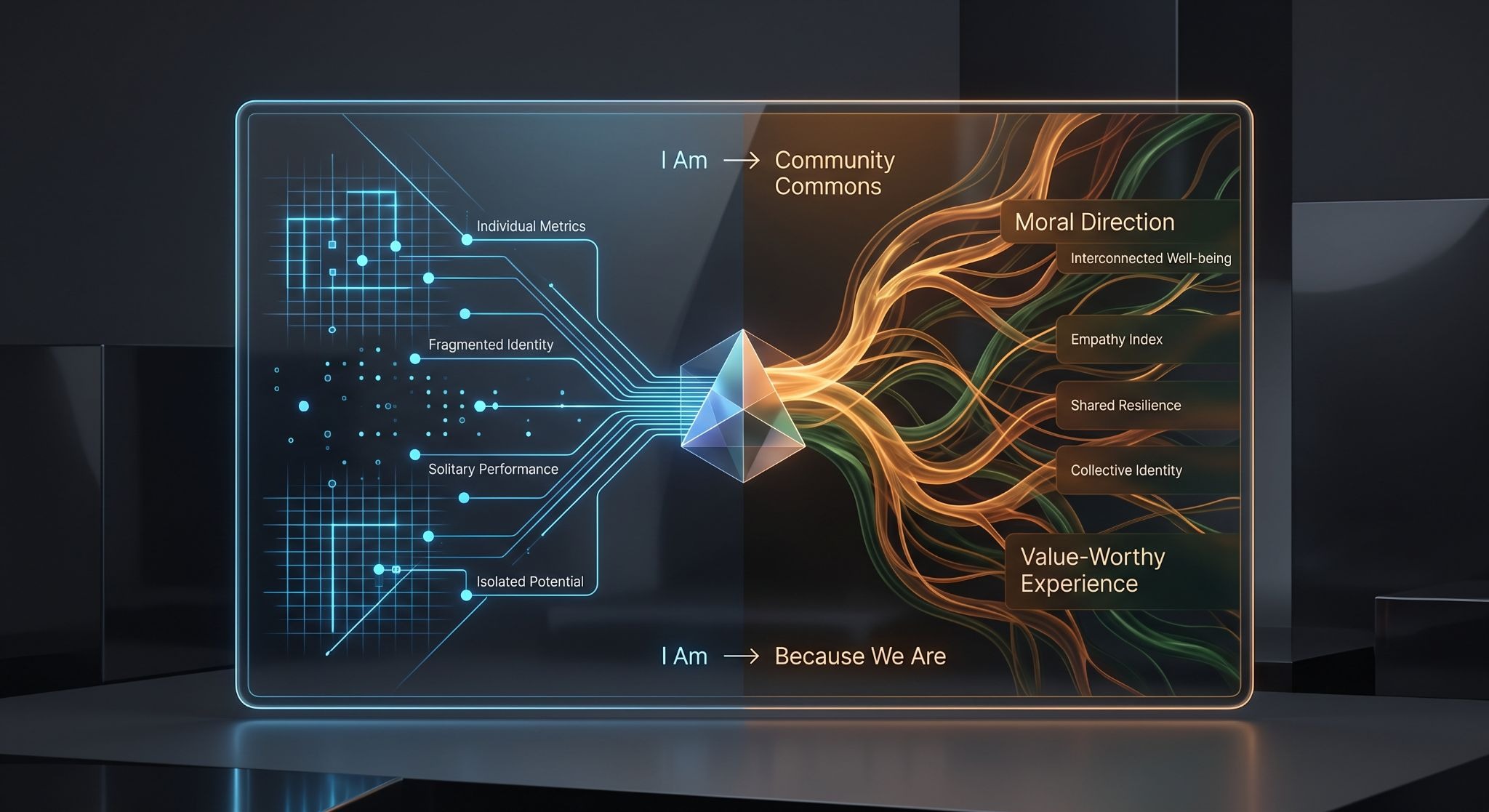
What do we consider as “valuable”? Should value be based on Western individuality? Or on communities/commons principles like Ubuntu or Hunhu? This AEON article was an eye-opener for me. Instead of focusing on trustworthy infrastructures, wouldn’t it be wiser to strive for value-worthy experiences, based on the social/cultural “needs” of humans? Values such as identity, reputation, community, and now maybe also values such as becoming, pattern integrity, and everything on the right side of the Whitehead/Davis slide?

There is no definitive answer. This post is an invitation to debate and conversation. But I find myself excited by the possibility of moving beyond the measurement of the static—the “being”—towards something that captures the dynamic, emergent quality of “becoming.”
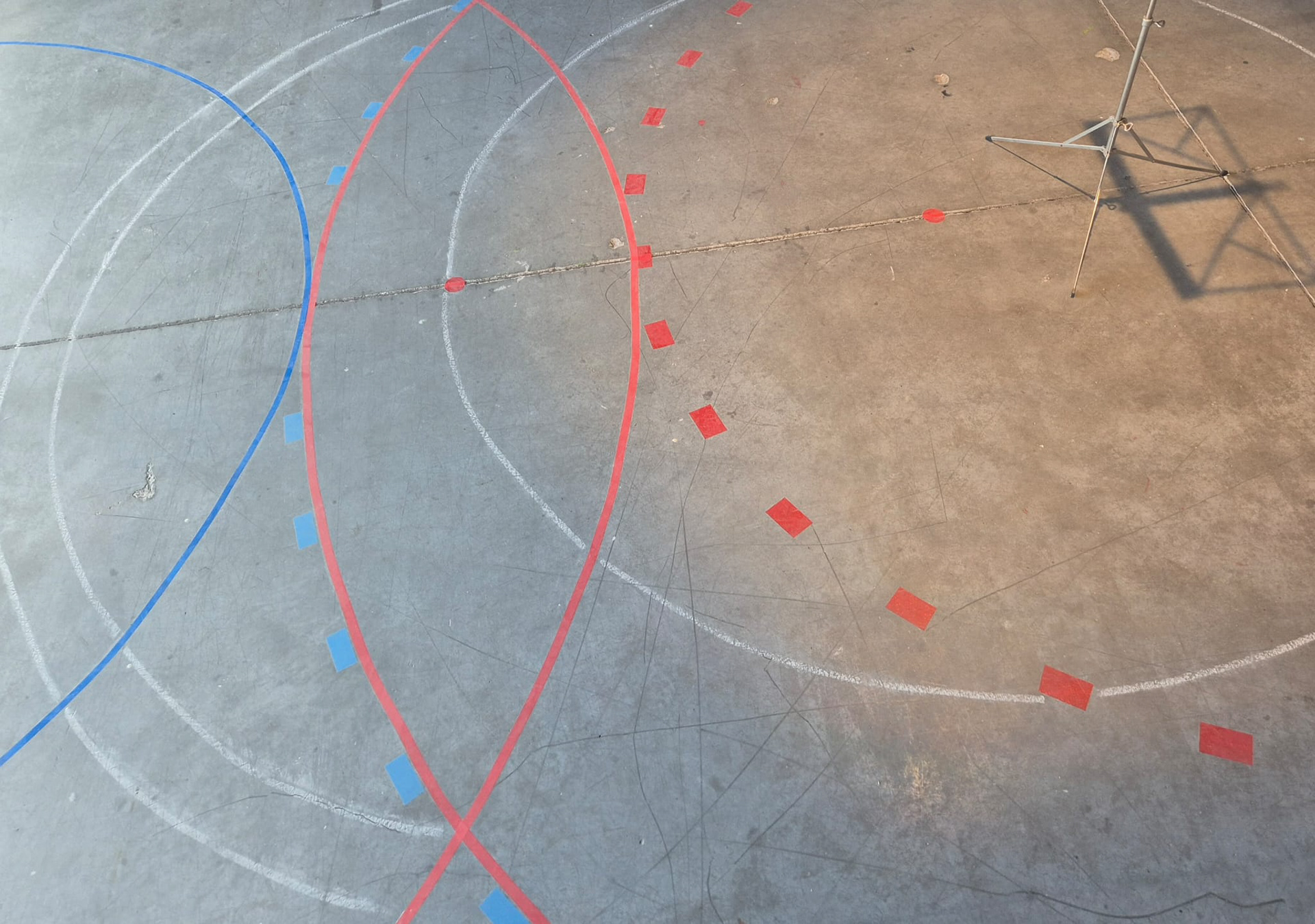
Inspiration: NOOR is creating a new sport

At a recent family gathering, I learned that the grandchild of one of my nieces is studying at the School of Arts (KASK) in Ghent and is expected to complete her final master’s degree in 2027.

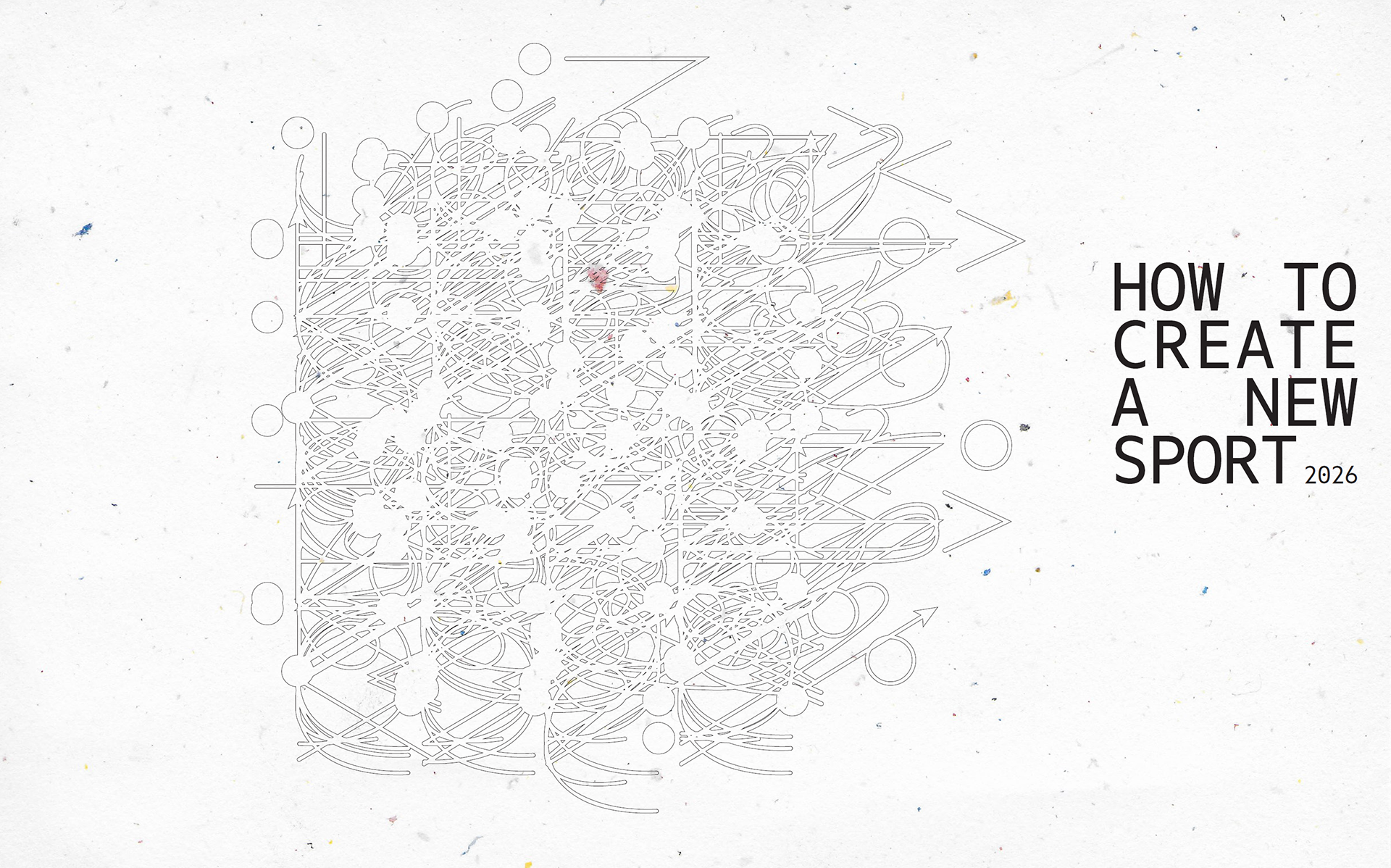
I found out she was working on a project called “How to Create a New Sport”. You can find an intro about it on her portfolio site: https://noorflamey.myportfolio.com/how-to-create-a-new-sport 

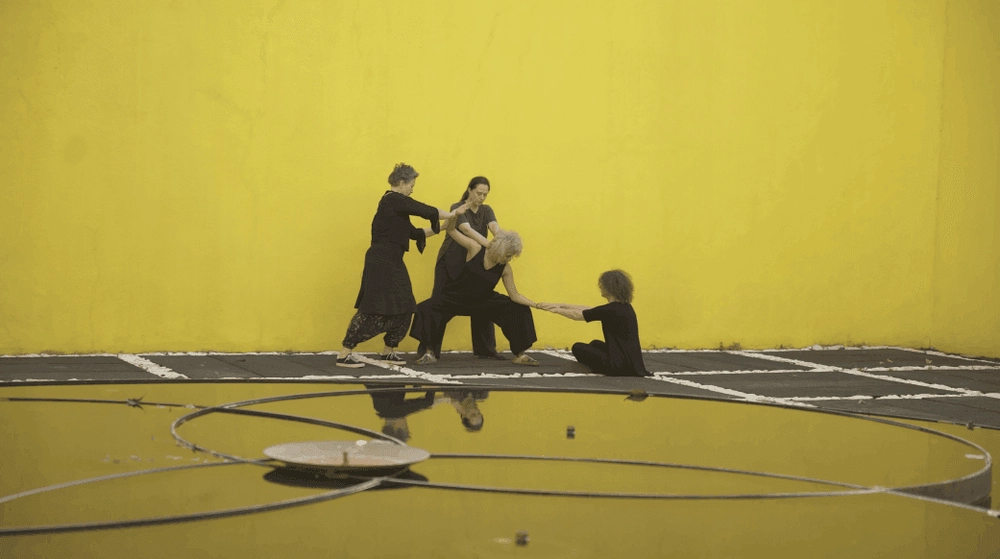
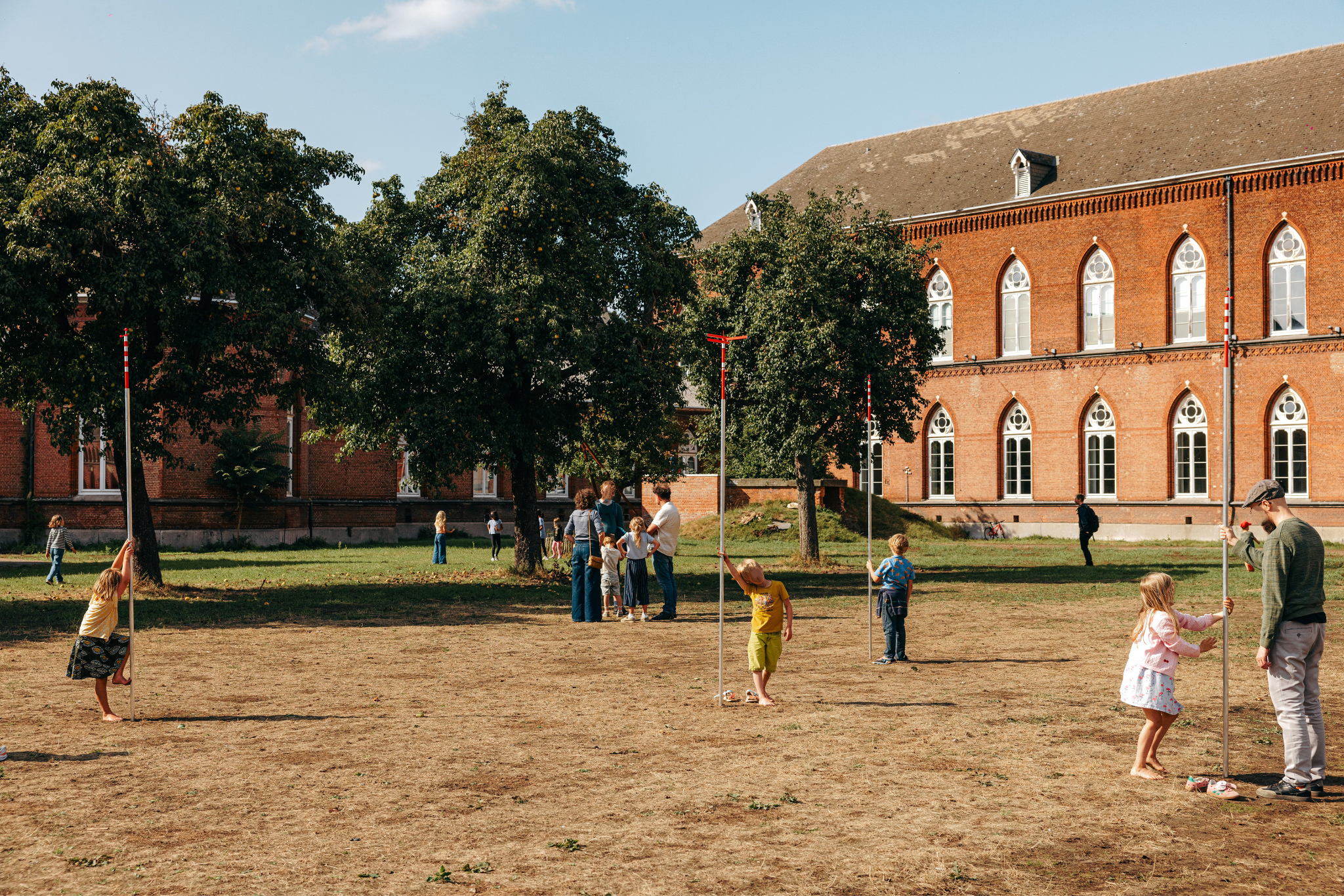
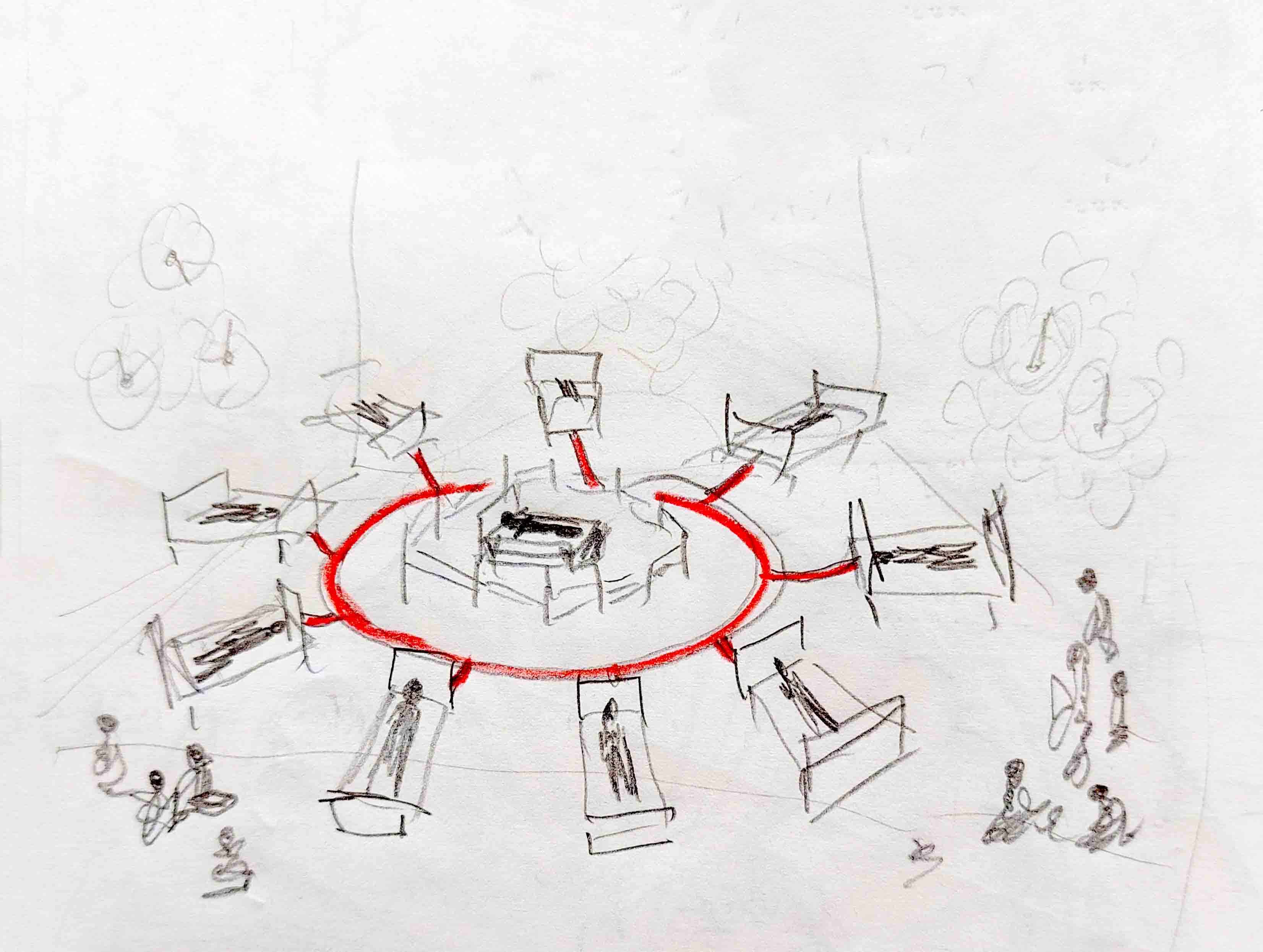
But the title could be misleading. NOOR’s work represents a critical intervention at the high-stakes intersection of elite athletic performance and contemporary artistic practice. This inquiry positions the “governed pedagogical space” of high-performance sport—specifically Women’s Artistic Gymnastics (WAG)—against the “rebellious act” of artistic creation. By deconstructing the rigid, judicial structures of elite sport, NOOR seeks to establish a theoretical and methodological framework for a “New Sport.” 

The central research question interrogates how embodiment is shaped by the friction between a pervasive, patriarchal achievement culture and the necessity for female artistic sovereignty. She highlights the “Running Score” methodology—an evolving script that replaces static judgment with a continuous documentation of the developmental process. 

This inquiry calls for a rigorous examination of the “Competition State”: a societal condition in which every action is measured against the ideal of perfection and the constant demand to prove one’s social value.

Especially at a time when AI is enabling humans to become ever more performant, competitive, and efficient, I believe her ambition can—and perhaps should—extend beyond “sport” as such. Her work has the potential to become a foundational critique of the hyper-competitive logic shaping both our personal and professional lives, while also proposing an alternative to it.

In this sense, her work could open up a much broader inquiry: How do we create a new way of becoming?

In addition to presenting an artistic in-situ performance, the deliverables of “Creating a New Sport” include a thesis and an artistic book documentary of her journey.

What NOOR is doing feels a bit like the Social Presencing Theatre of Theory-U of Otto Scharmer:

“an embodied social arts-based change methodology for making visible current reality and exploring emerging future possibilities. It includes a set of practices that synthesize embodied presence, movement theater, stillness, and dialogue. It reveals the wisdom in every social system and supports movement towards healthier futures.”

Or Ann Pendleton-Jullian’s work on “Design Unbound”, “Pragmatic Imagination”, and her FOUR (+1) Studios book (PDF) on “Studios”, where there is a whole section on game design and Homo Ludens (see pages 180 and following of FOUR(+1).

“Gameplay is the action associated with players making choices in the game environment. It is related to the sequential but interactive events of players operating in the rule-based site. It is the process of engagement of the game, while game design is the process of pre-engagement. It is the design of the rules for engagement. But game design can only be accomplished through playing the game as one is designing it.”

Also related is Venkat’s recent post on “The Curiously Playable Universe”. I am highly simplifying the thesis that when everything gets abstracted and possibly constructed (through AI and LLMs), then everything becomes “playable”. 

“But perhaps the stranger discovery concerns the provinces: Wildernesses can be reliably turned into game boards. We domesticate the territory, become skilled at its game, build machinery that plays it better than we can, and move outward to construct another game around the first, domesticating a larger scope.

This happened to fields and livestock long before it happened to chess. It happened to trade before it happened to programming. It happened to mechanics before it happened to mathematical proof.

Artificial intelligence did not invent this strange property of reality. It is merely making it difficult not to notice.

The deepest surprise of the AI era may turn out not to be that intelligence was easier to manufacture than we thought. It may be that the universe is far more playable than we imagined.”

This is very close to his work as director of research for the Protocol Institute. At this week’s Protocol Symposium 2026, there was even a workshop on Protocol Art. 

“Protocol Art is emerging as a practice in which the artwork is not a finite object but a set of rules that others (human or machine) instantiate into an indefinite number of unique works.”

The chairwoman of that workshop (Primavera De Filippi) has a good essay on what Protocol Art is and what it is not.

“Protocolism revolves around the creation of “artistic protocols.” These protocols comprise sets of instructions and constraints meticulously crafted to guide the production of unique artworks. These protocols serve as the bridge between the two pivotal figures: the original artist (i.e. the “protocol artist”) and a diverse array of executors (both human and non-human) who instantiate these protocols into tangible creations that qualify as distinct artistic creations. This symbiotic relationship challenges conventional notions of artistic authorship, as the resulting artworks bear the unmistakable imprint of the protocol artist, along with that of the instantiating actors.”

Protocol Art was (and still is, till November 2026) very present at Venice’s Art Biennale. 

“The artwork is not merely a final product, it is a process governed by instructions, representing the invisible architecture that enables the aesthetic experience. This shift in perspective – moving from the object to the system, and from the singular author to collaboration and ultimately human-machine co-creation – defines one of the most urgent territories in contemporary research.”

And also Rudy Rucker’s reflections on computationalism in The Lifebox, the Seashell, and the Soul comes to mind, where he explains that some computations are fully deterministic (aka based on clear, unambiguous rules) ànd unpredictable.

NOOR’s work is, maybe without knowing it, a crossover of all these contemporary disciplines and insights. Her work is a call for a rebellious act of non-conformism. Of humans being a bit “off-grid”. Not too perfect. In Digital Audio Workstations, there is even an option for “humanization” of something that is generated in the grid. If it is too perfect or without variation, it is boring. See my 2021 blog post Unsnap from the Grid https://petervanstudios.com/2021/03/09/unsnap-from-the-grid/ 

Her work is an invitation to the emergence of embodied experience and the liberation of human movement, taking sport as a point of departure while reaching toward possibilities far beyond it.

If you like her work as much as I do, please contact her here. And let me know if magic happens.

In a subsequent post, I will elaborate on what is worth measuring. 

And in the next one, I will introduce you to a 75-year-old artistic, rebellious choreographer who also combines sports and art. 

With warm artistic regards,

Time for slow non-events

Short trailer for my video installation “Clothesline”. A call for attention to the non-event and slowness.

The installation runs peacefully at a human heartbeat speed of 60 BPM. Based on a static video of a clothesline in the wind. Repetitive ambient soundscape in Ableton Live, combined with Videosync transformations. Installation produces endless random video and audio output. No AI.

I got inspired by David Claerbout’s quote about “Against Strong Images”:

“I notice that when people discuss my work, they often talk about ‘strong images. But that is not what I do. I choose weak images. These are images without voice, without date, without event, without place – situations that can’t be easily communicated. This puts me in the camp of the longue durée. In that camp, that reservation, sit all the losers of history. It is where the non-event lives.” – David Claerbout

The clothesline in the wind is such a non-event.

For galleries and venues: the installation only requires a Mac or a Windows 11 PC (with Ableton Live and Videosync installed) and an HDMI connection to a TV Screen with audio. Less is more.

The Forbidden Question at UnitedXR Europe – Homo Experiens Explorers

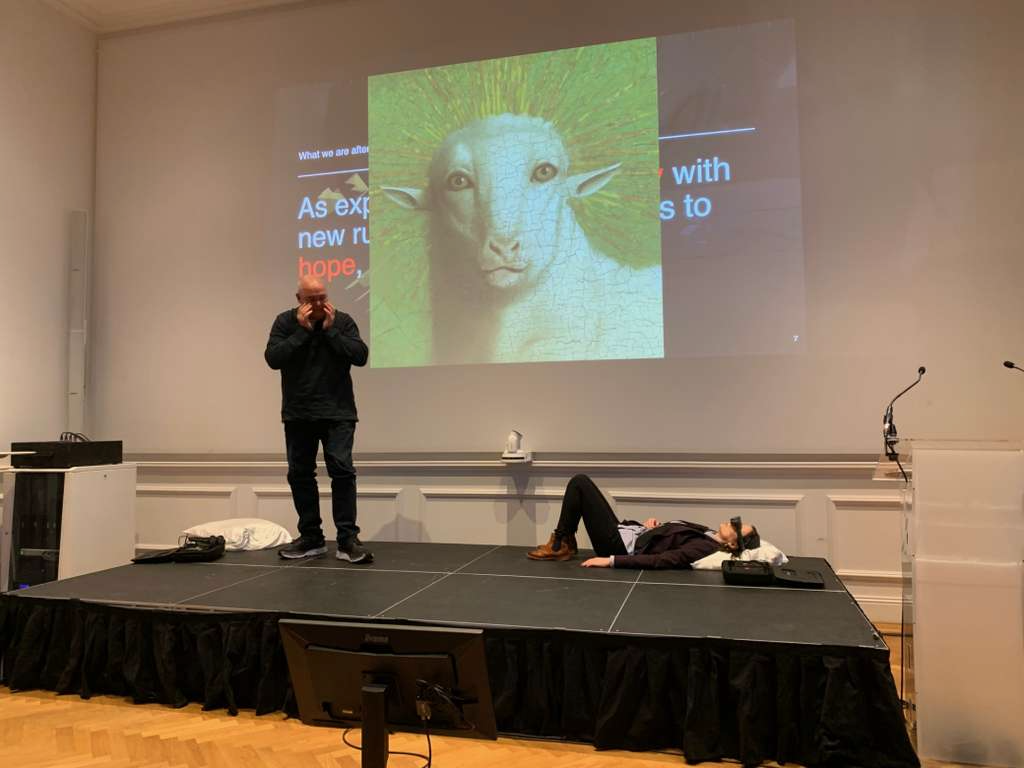
On 9 Dec 2025, Andreea and I gave a “talk” about our journey and lessons learned in creating The Forbidden Question. Rather than a talk, it was a performance about the performance. The talk also includes a speaking lamb from Van Eyck’s famous 1432 Ghent Altarpiece. See the lamb in the video of our talk below. At the end, you will also see a strange character running away with the stolen 12th panel of the Altarpiece.

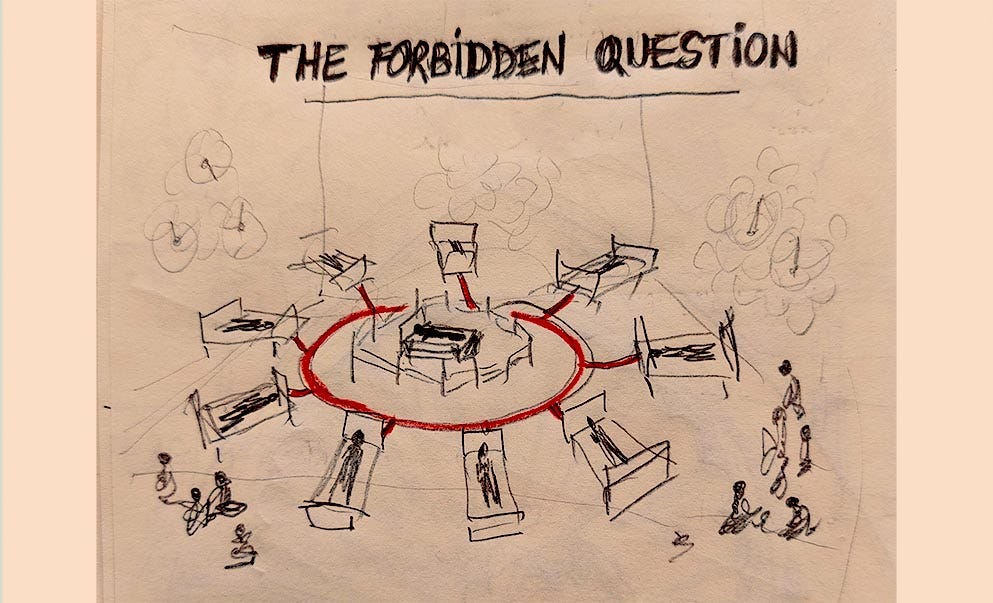
With this piece, we are proposing a choreographed yet spontaneous play between multiple dreams and dreamers. All the actors on stage come from the audience except one: Paul. An Eastern European architect who moved to Brussels in hopes of one day building the city of the future, he has fallen asleep with his shoes on after a long day of waiting tables. This is the moment our universe is born. As participants are encouraged to chase connection and fulfillment, our cosmology cycles their souls and dreams through several layers of reality. The more assiduous the search, the more wondrous and intense the connections they make, the more oblivious and unrelenting the fleeting and cyclical nature of the game becomes. The “forbidden question” in the title is the question no one will ever find an answer to: Whose dream is this? Are my desires really mine? Am I even able to stop wanting?

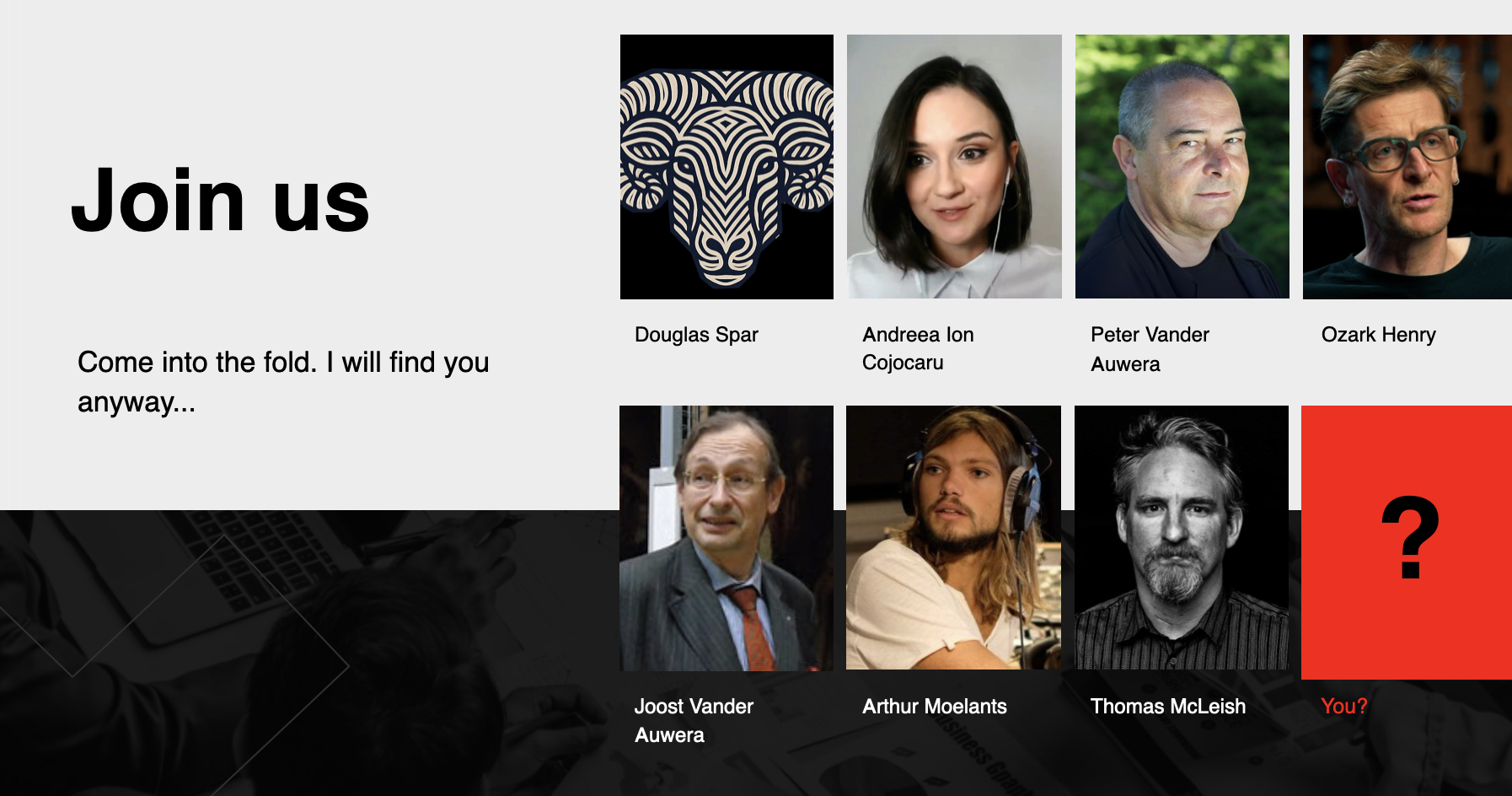
The room is set up with nine physical beds (8 for the audience encircling the one bed for Paul). The performance is designed for a full 360° experience (visuals, audio, tracking), and we work with award-winning 3D artist Ozark Henry, award-winning cinematographer and DoP Arthur Moelants, and award-winning maker Thomas Mc Leish.

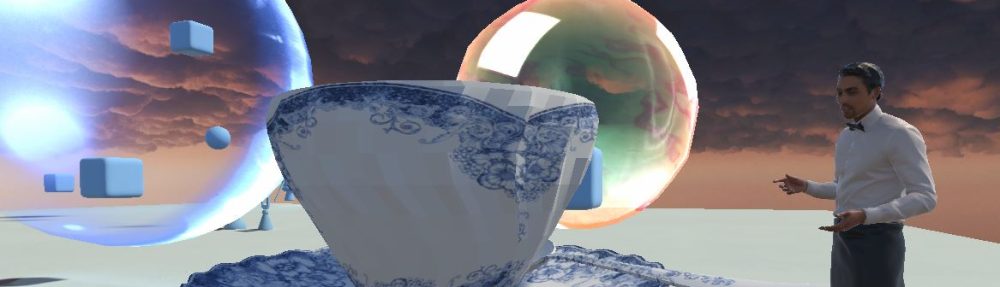
I would like to give some background on this project, a sort of making-of. The project started as the New New Babylon performance, at that time designed for a speaker on stage wearing a VR headset, and the audience seeing the VR rendering on a big screen behind the speaker. Here is a very, very early version of the tower of the New New Babylon:

Then, we pivoted to a version called “Dream my Dream”

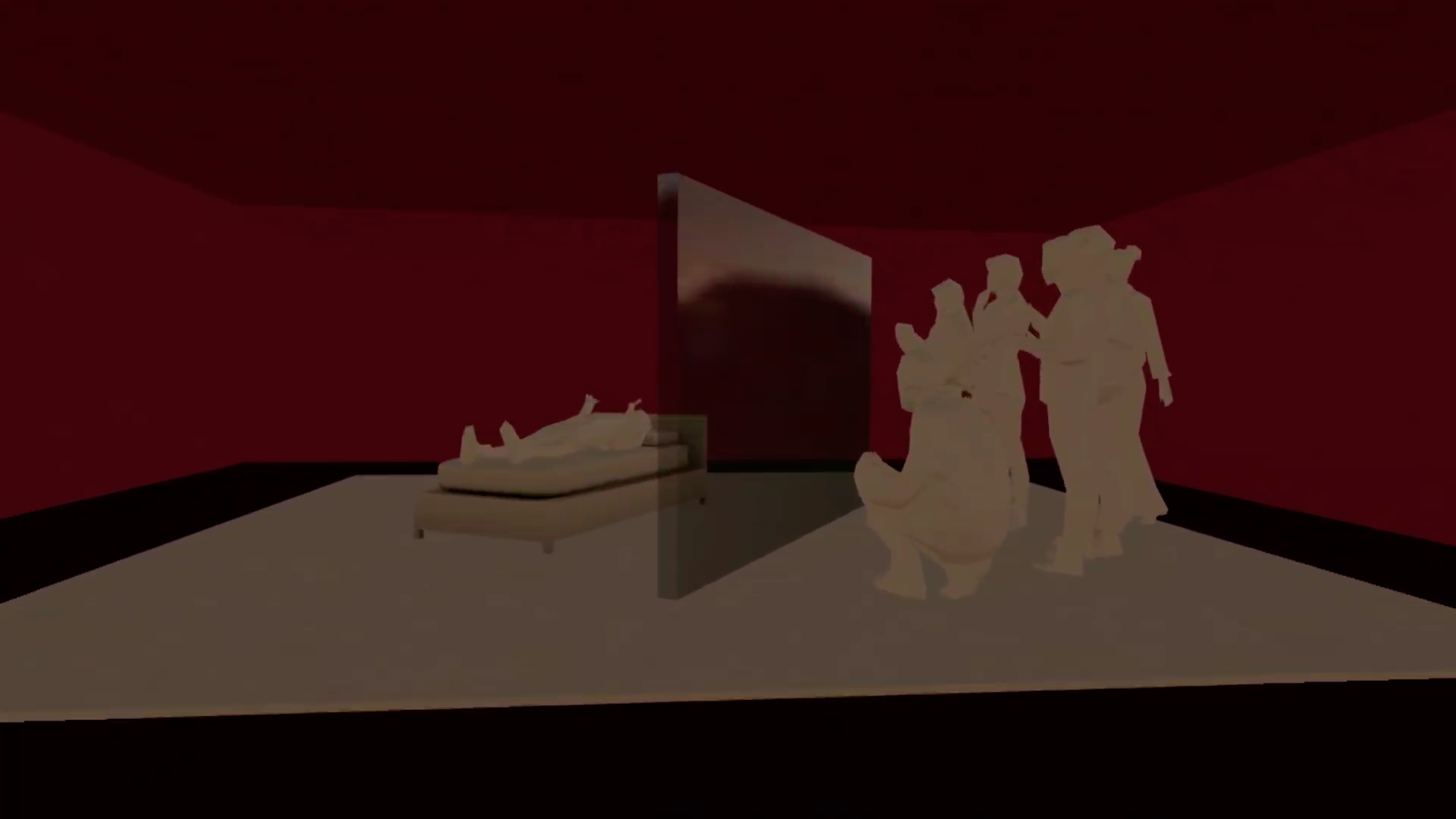
This time, the audience would witness a sleeping performer with a VR headset, and follow the dream through some sort of transparent screen:

Mock-up of the viewing room – created in Space Elevator

After submitting our project to both the Venice Biennale College Cinema and the Cannes Immersive 2025 competition, without being selected, we took the opportunity to critically reevaluate the core premises of the performance.

Then, as part of my end-project for the Howest course XR in Industry, we created a very early version of The Forbidden Question, which began with the story of an Eastern European waiter and the concept of central and surrounding beds. The video below is an early MVP of what we had in mind.

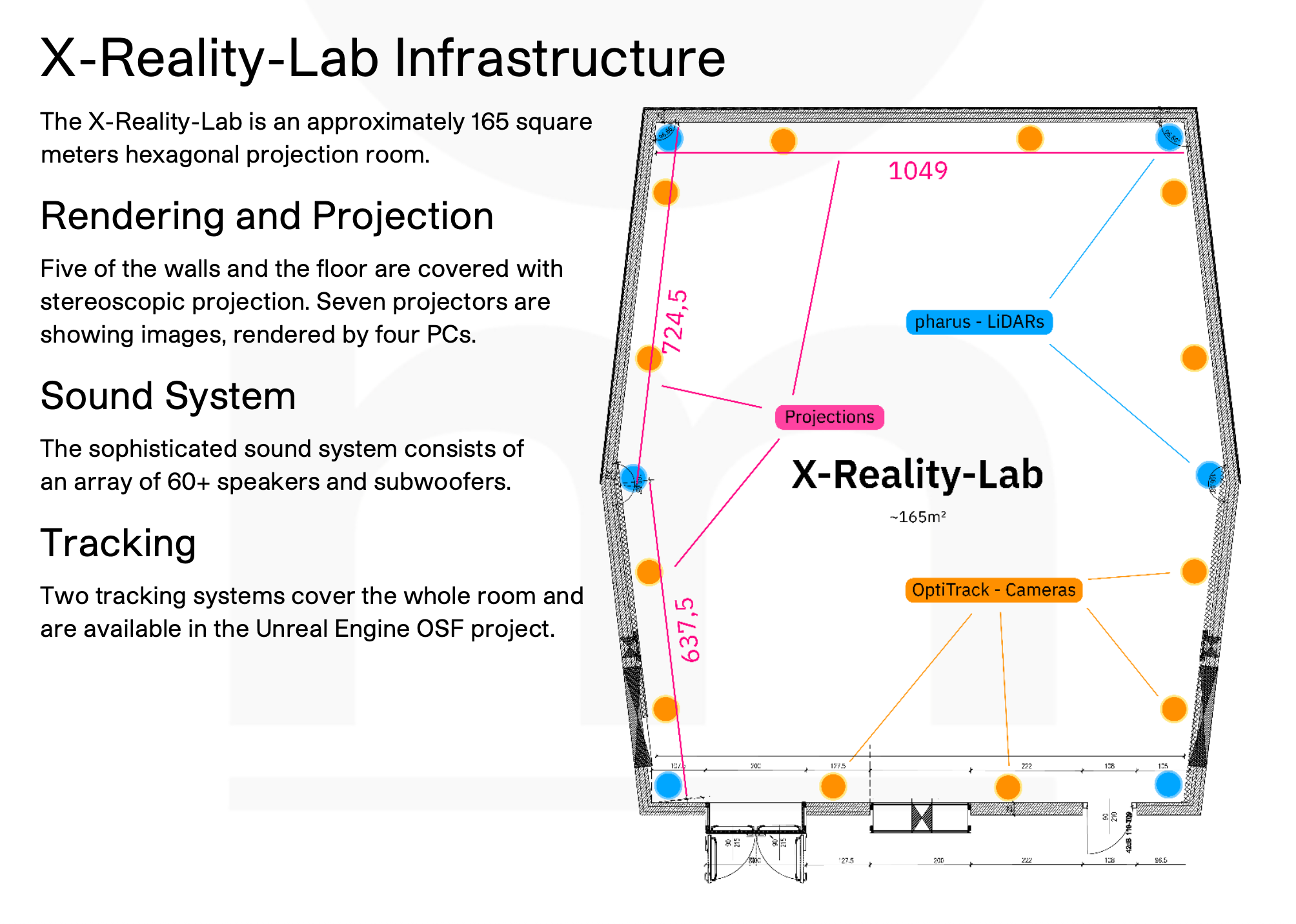
During this period of reassessment, Andreea came across an open call for immersive projects at the Salzburg Mozarteum X-Reality Lab. Salzburg is currently developing a state-of-the-art 360° immersive venue featuring stereoscopic projection, a 60+ channel spatial audio system, and integrated LiDAR and high-definition camera infrastructure. The lab was seeking artistic performances for the venue’s inaugural program, scheduled for March 2026.

High-level sketch of the X-Reality-Lab in Salzburg

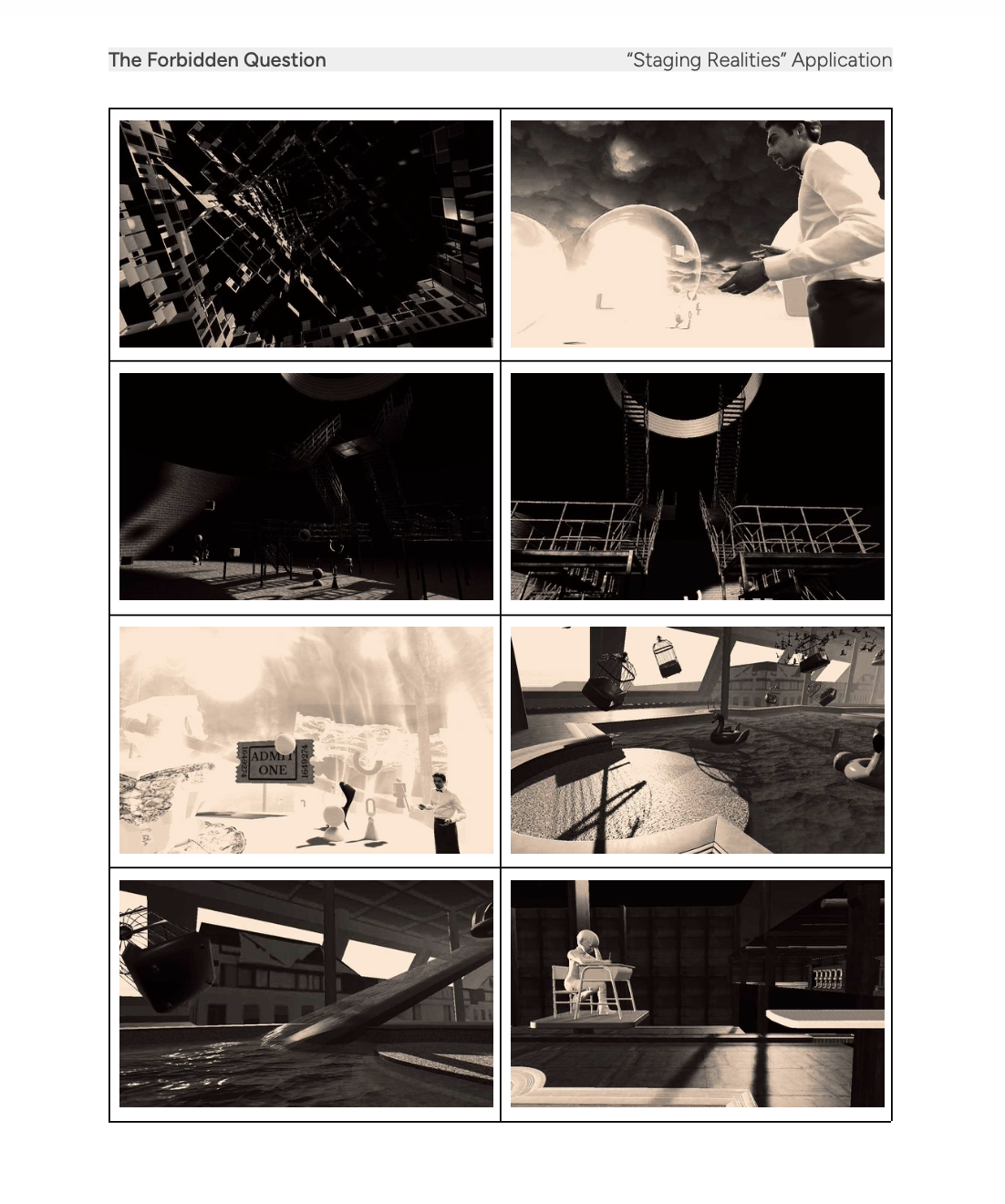
For this project, we completely re-wrote the performance into an XR “game of life” unfolding across multiple realities, with both an actor and the audience as performers. From its earliest concept through multiple iterations, the project transformed from a one-person headset performance into an immersive XR experience designed for stereoscopic projection, 3D tracking, and 360° spatial sound. Here is an extract from our submission document. The biggest change was to move the whole New New Babylon narrative from the foreground to the background, and to let the audience experience crossing realities (from dream reality to awake-reality). We made it to the shortlist (out of 150 international candidates), but did not get selected in the end.

Extract from our treatment of the performance for Salzburg

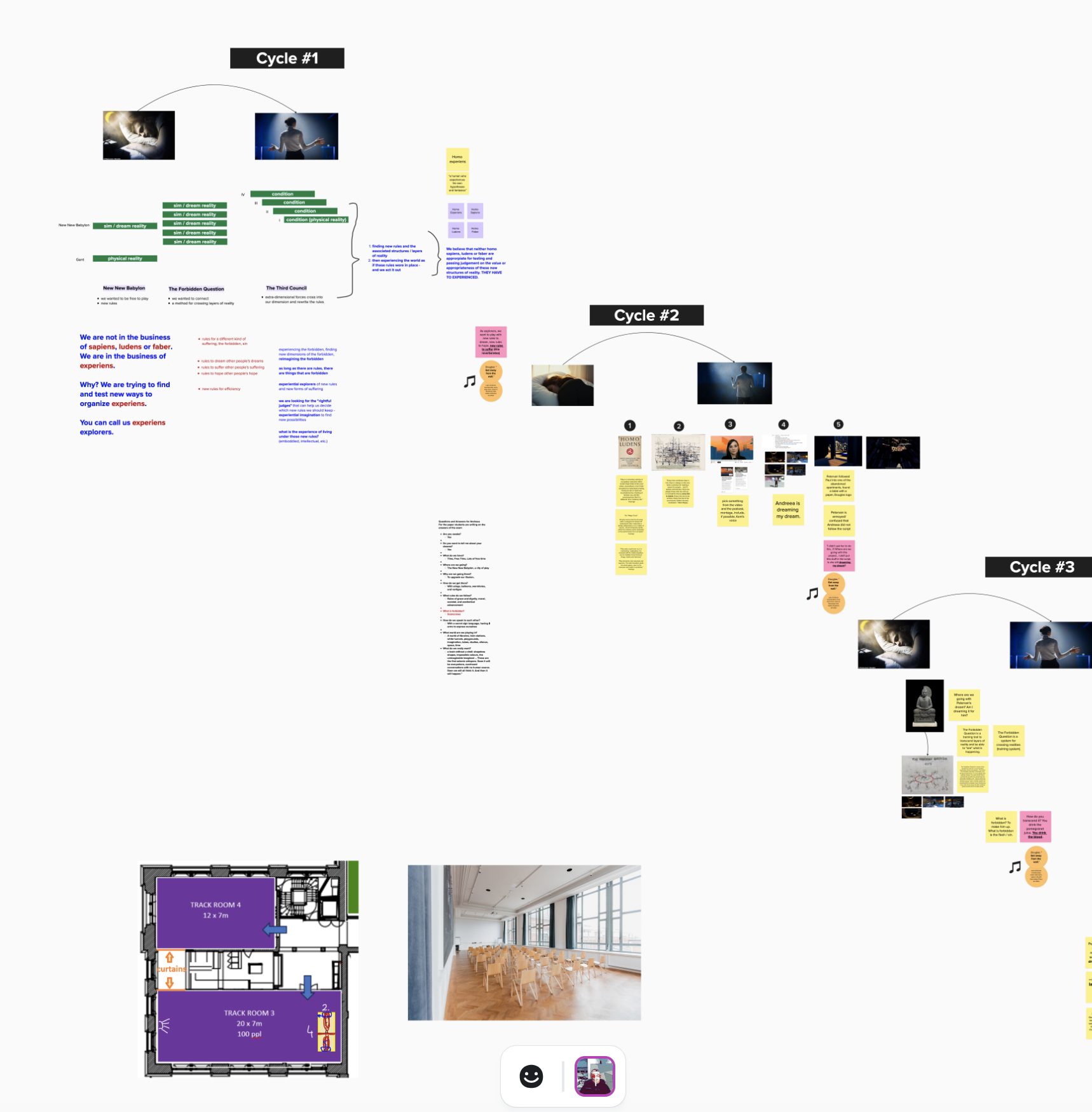
In preparation for our talk at UnitedXR, Andreea and I had many online sessions on the mood and conceptual flow of our presentation (Mural extract below). We wanted to present a coherent journey from New New Babylon to The Forbidden Question to The Third Council.

Mural brainstorm for UnitedXR presentation

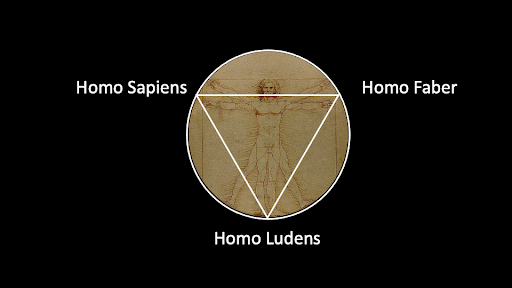
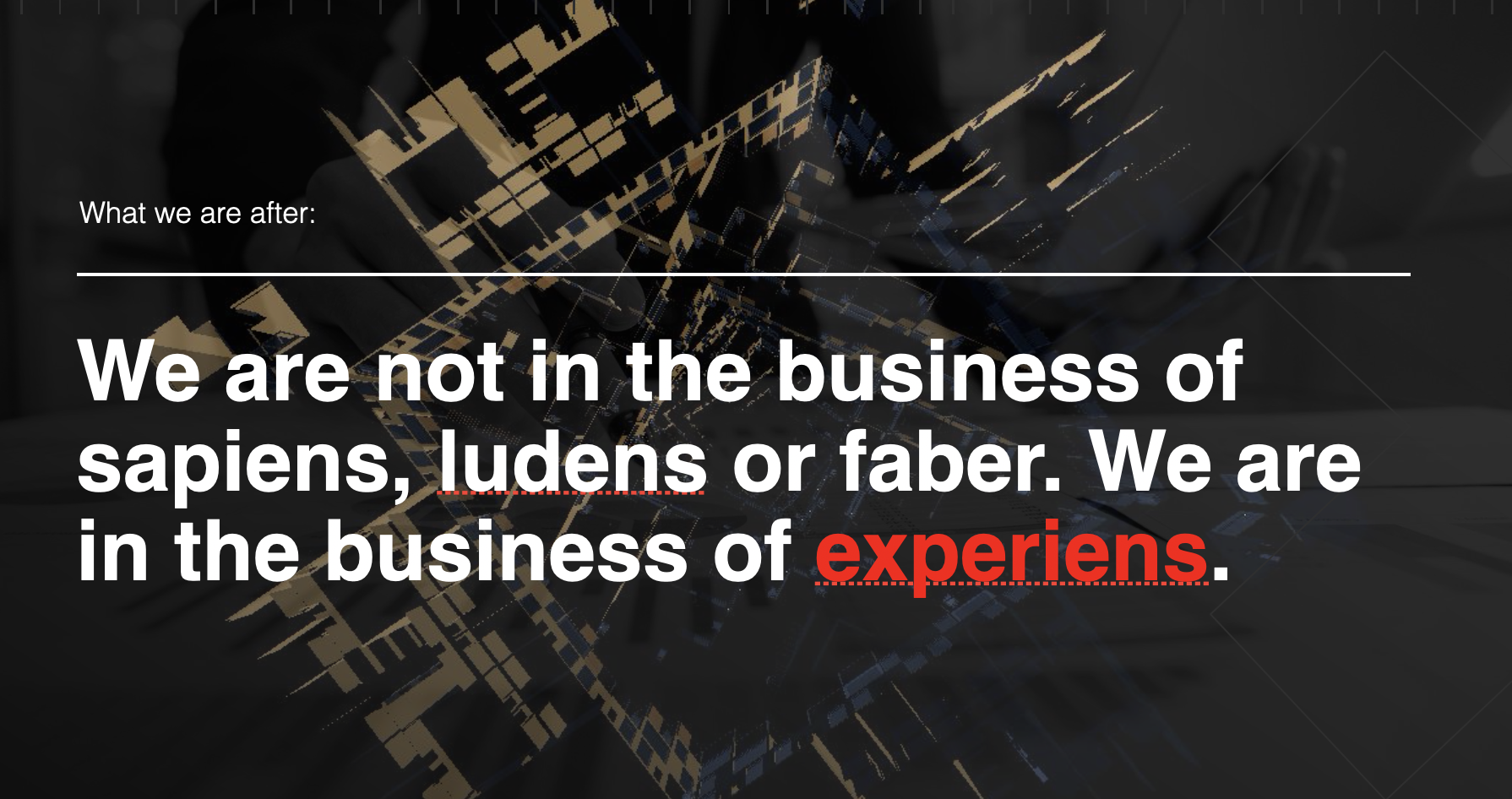
An aha moment emerged during these sessions: neither Homo sapiens, ludens, nor faber is capable of evaluating the validity of these new structures of reality. Their meaning cannot be assessed intellectually—they must be experienced.

Hence Homo Experiens. With an “s” to differentiate from the words “Narrative” and “Experience” that have become catch-all words.

So we like to call ourselves “Experiens Explorers” and “Designed Conspiracy” would better describe what we have in mind. See also https://petervanstudios.com/2025/12/21/the-orphic-experience-we-are-all-argonauts-again/

The Forbidden Question team
Picture from the crime scene at UnitedXR on 9 Dec 2025

Kent Bye, who runs the Voices of VR Podcast, was in the room, and he invited us for an interview right after (quite an honor, if you ask me). As soon as the interview is published, the link will be added to this post.

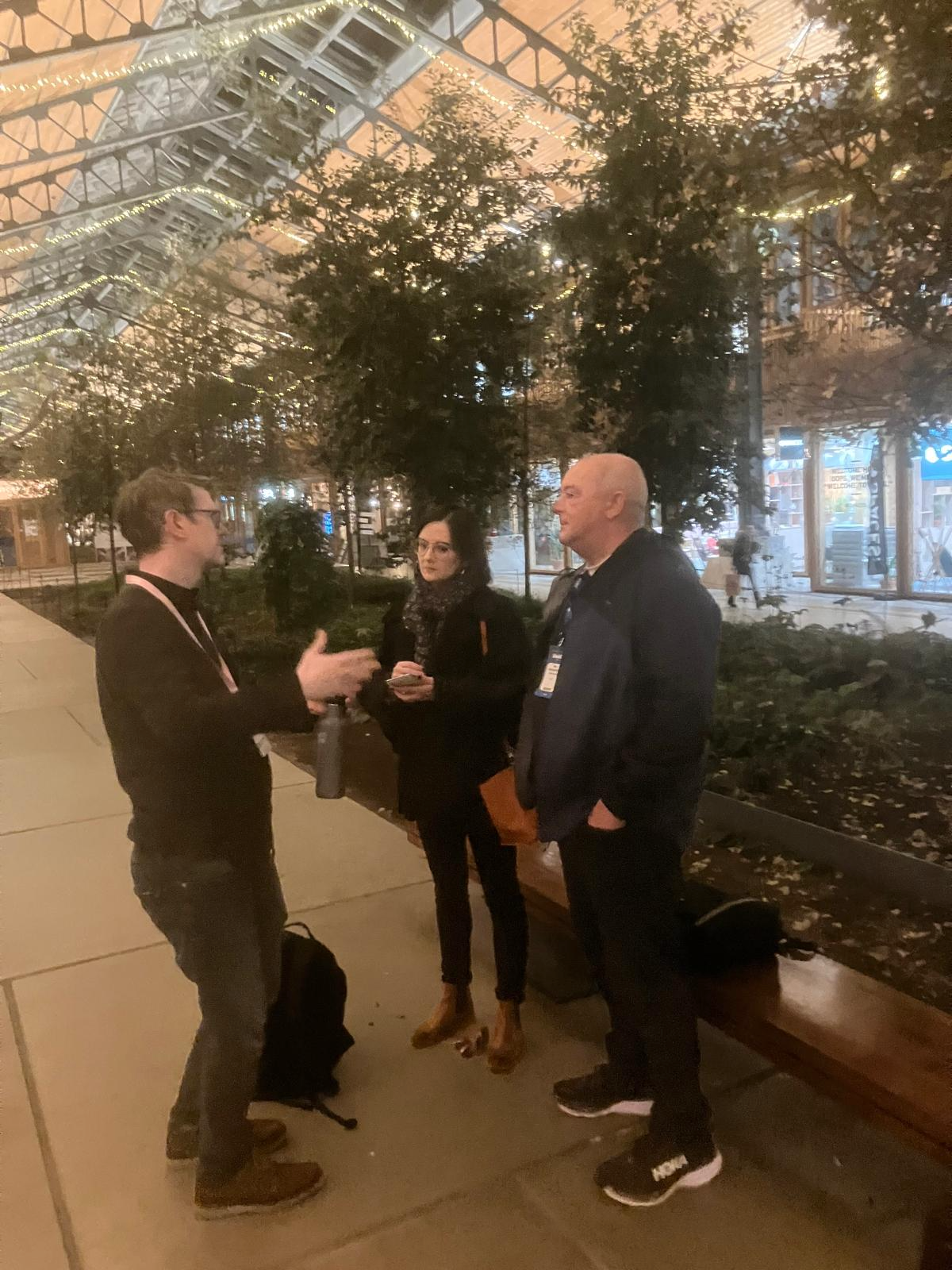
Post interview picture. From left to right: Kent Bye, Andreea, Petervan. Picture by Joost.

Use the barcode above to follow the discoveries of Douglas Spar (aka The Holy Lamb). Doug is the one investigating The Third Council. And “The Forbidden Question” is now positioned as a training protocol for crossing realities and the main priority of our team right now.

We are now complementing the team with technology partners to build a pop-up 360 infrastructure for artistic performances. We are contacting immersive spaces to be on their program. We also consider a subsidy for a technology prototype for this immersive performance.

May the lamb be with you in 2026!

With deep gratitude to Andreea, TJ, Arthur, Joost, and Ozark for staying motivated during this whole process. And thanks to UnitedXR for having us.

Inspiration: Adrian Sherwood

Adrian Sherwood behind the mixing console

As already mentioned in my September 2025 Delicacies, I got a crush on the latest album by “Mister Dub” Adrian Sherwood, and went down the Dub Techno rabbit hole.

From the review in De Standaard newspaper (Google Translate and highlights by myself):

“With his label On-U Sound, Adrian Sherwood has created a unique musical universe over the past half century, rooted in Jamaican dub but with tentacles reaching out to punk, funk, and psychedelia, peppered with samples, echoes, and sound effects. His new album features only one track with a recognizable reggae rhythm; the others are driven by slow bass lines and stimulating drum patterns. Many of these tracks are played by real musicians, just like the cinematic fragments of flute, saxophone, organ, cello, trumpet, percussion, piano, Roland 60, and harmonica (“Spaghetti Best Western” exudes Ennio Morricone). Sherwood can call upon a host of loyal musicians (including Brian Eno and hip-hop legends Doug Wimbish and Keith LeBlanc) who add color and human warmth to his boundless imagination as a studio wizard. In an interview, Sherwood did admit that this was the first time he’d used AI to create a record. It seems like a logical evolution for a man who has spent his life innovating and experimenting with new equipment.“ (km in The Standaard)

Here is some older material from Adrian Sherwood. Watch his body language while performing 😉

And the song “Trapped Here” from his previous album, Survival & Resistance

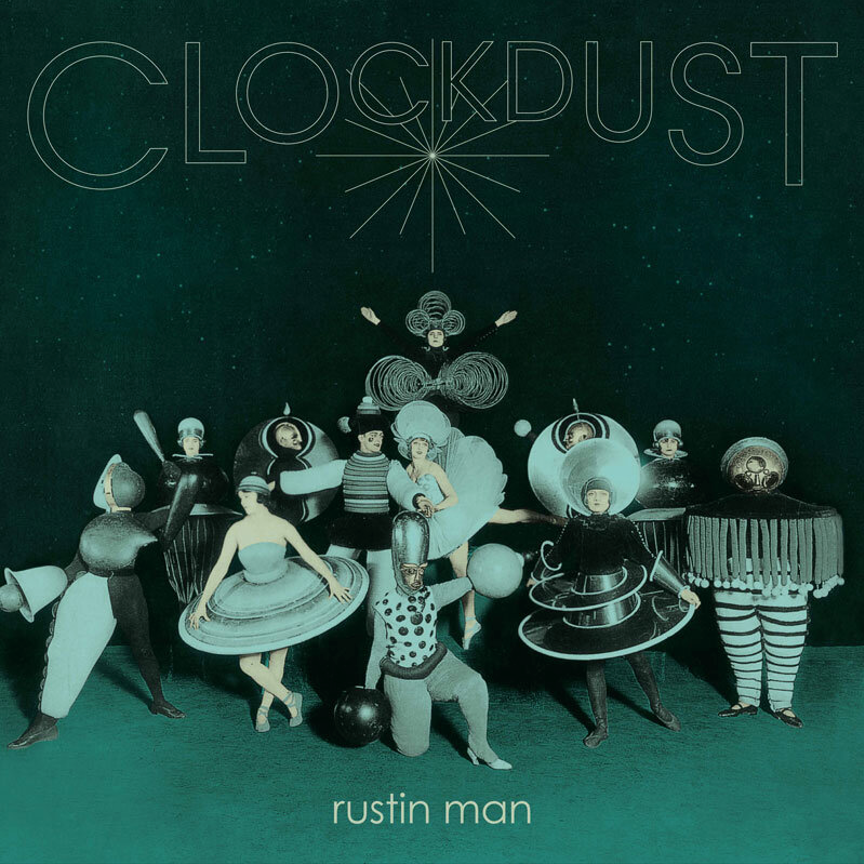
The album comes with a beautiful cover (designed by Peter Harris). The cover and the album’s atmosphere remind me of Rustin Man’s 2020 album ClockDust (I wrote a post about that one in 2020). It’s no surprise: after playing bass in a local reggae band in Southend, Rustin Man (Paul Webb) and his schoolmate, drummer Lee Harris, went on to form the rhythm section and become founding members of Talk Talk, alongside the exceptionally talented Mark Hollis and Simon Brenner.

The covers of Adrian Sherwood and Rustin Man respectively

So the starting point is dub reggae, which these days has evolved into a genre called “Dub Techno”. There is something melancholic about both albums, in sound, lyrics, artwork, and, at times, kinky living.

I don’t have real musicians available in my studio, and I’m hesitant to rely on AI. I’ve experimented with AI-generated music before, but it doesn’t bring me the same joy or sense of satisfaction as creating it myself. So I started studying and exploring the Dub Techno style, and found this book, “Dub Techno – The Orphic Experience of Sound” by Bahadırhan Koçer.

I will write another blog on the topic of “Orphic Experience”, but today, we focus on the music analysis part.

On page 56, Koçer begins discussing the concept of the riddim—Jamaican patois for “rhythm”—first examining drum patterns, and later turning to bass lines and melodic structures.

From the Bahadırhan Koçer book

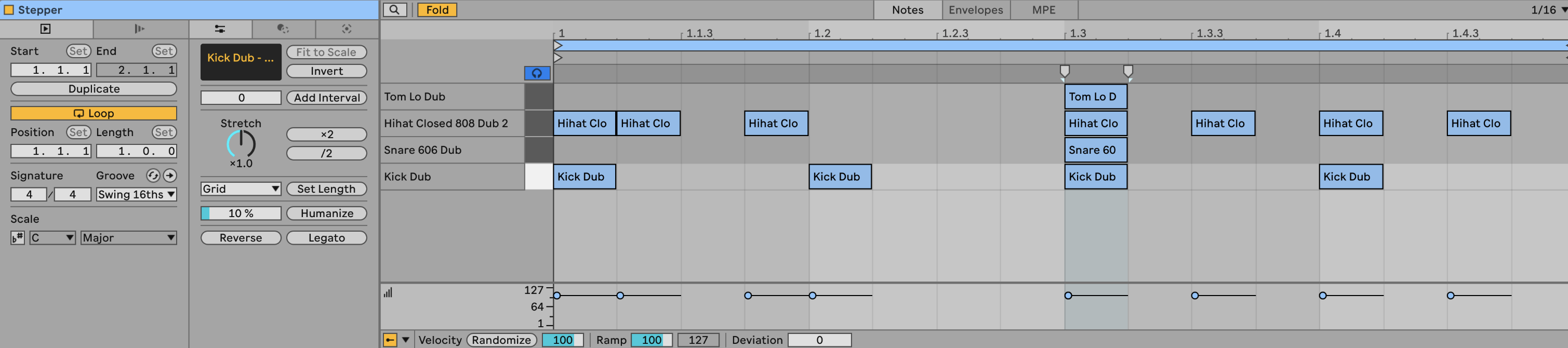
I started implementing them into Ableton Live. Here is an example of the “stepper” variant on a 64 Pads Dub Techno Kit.

Ableton Live 12.1 implementation “Stepper” by the author

That was easy. Then I tried to build a song using other out-of-the-box and/or free devices, clips, and samples in Ableton Live 12.1 and Logic Pro 11.2.2 (btw, the new bass and keyboard session-players, and the new studio piano and studio bass in Logic are amazing).

The new Studio Bass in Logic Pro 11.2

Creating a song was more of a challenge. What Adrian Sherwood and his real musicians were doing was not so simple after all. Although all the individual clips sounded simple, the art is in being subtle and sophisticated in launching clips and echo/delay effects.

As with writing, the real effort lay in removing the superfluous rather than adding more to the mix. Still, to make it a bit more my own, I included a few AI voice clips from the New New Babylon performance.

Short experiment by the author

But I am an amateur/bricoleur after all. No way I will ever get close to Adrian Sherwood and his musicians, at least not as a musician. But maybe in real life? Adrian and the band are touring North America and Europe in 1Q 2026. They will perform in Wintercircus Ghent on 6 Feb 2026. See/hear you there?

The Forbidden Question – Talk at UnitedXR Dec 2025

Excited to announce that I’ll be speaking together with Andreea Ion Cojocaru at the 2025 UnitedXR Conference in Brussels, happening December 8–10, 2025. This is my first public appearance in a long time, finally fully disconnected from corporate life and enjoying new artistic endeavours.

The Forbidden Question is a branch of our New New Babylon (aka Dream My Dream) Performance. Andreea and I will give a talk on the genesis and evolution of our project. This performance is a choreographed yet spontaneous play between multiple dreams and dreamers.

Looking forward to seeing some old and new friends in December.