Human Powered Vehicles

As promised in my blog on NOOR’s work, here is another angle at the magic symbiosis between sports, arts, and technology. 

Today, I would like you to meet Marc Bogaerts, a 75-year old rebellious choreographer and artistic director who has worked with more than 50 dance, opera, and circus companies worldwide. He is renowned for his fondness for creating unconventional combinations on stage and drawing inspiration from a wide range of subjects. Many of his projects combine several styles – e.g., opera, ballet, stationary art, ballroom dancing, ice dancing, breakdancing, and nouveau circus – to build bridges between different types of physical expression. Have a look at his portfolio, bio, and achievements on his website Bogaerts Productions. He used to travel the world, with home base in Berlin and Antwerp. He has now retreated – but not retired – into a home container on a farm somewhere in the middle of nowhere in Flanders. 

Like NOOR, he also combines sports and art. I have been in regular conversations with Marc since 2022. Now, I believe the time has come to share some exciting opportunities around a concept he invented: Human Powered Vehicles (HPVs). Marc is very intense. He radiates energy. Here he is:

There are many ways to approach this, and Marc generously gave me the ground-idea to explore possibilities in the artistic/entertainment scene. Marc just promoted me as his artistic curator for the Arts and Culture domain.

What are Human Powered Vehicles?

In the past, Marc worked for Cirque du Soleil, renowned for its spectacular shows featuring predominantly gymnastic acrobats. But in Marc’s vision, gymnastics is “only” one of some 120 sports that can be combined with art and technology. This broader concept led to the idea of Cirque des Sports. Human Powered Vehicles are one expression of that vision.

Human Powered Vehicles (HPVs) are spectacular, eye-catching phygital vehicles powered by human movement, with electric power (E-power) providing additional support when needed. Designed as a symbiosis of sport, art, science, and green technology, they can embody Olympic disciplines—for example, the running, swimming, and cycling elements of the Triathlon HPV. At the same time, HPVs can function as highly visible marketing platforms, artistic expressions, and powerful tools for social and environmental campaigns.

Physical human energy is captured and translated into real-time data. That data then drives a range of advanced digital, visual, and physical effects, turning human effort into an immersive, highly visible experience.

All HPVs are built around one central, unifying principle: human emotion.

Below are a concept video, created two years ago, and a behind-the-scenes video showing how we brought the concept to life.

Status of the project

A small-scale prototype has been built.  It has been deployed at several events. The prototype is large enough to host the three athletes to power the system.
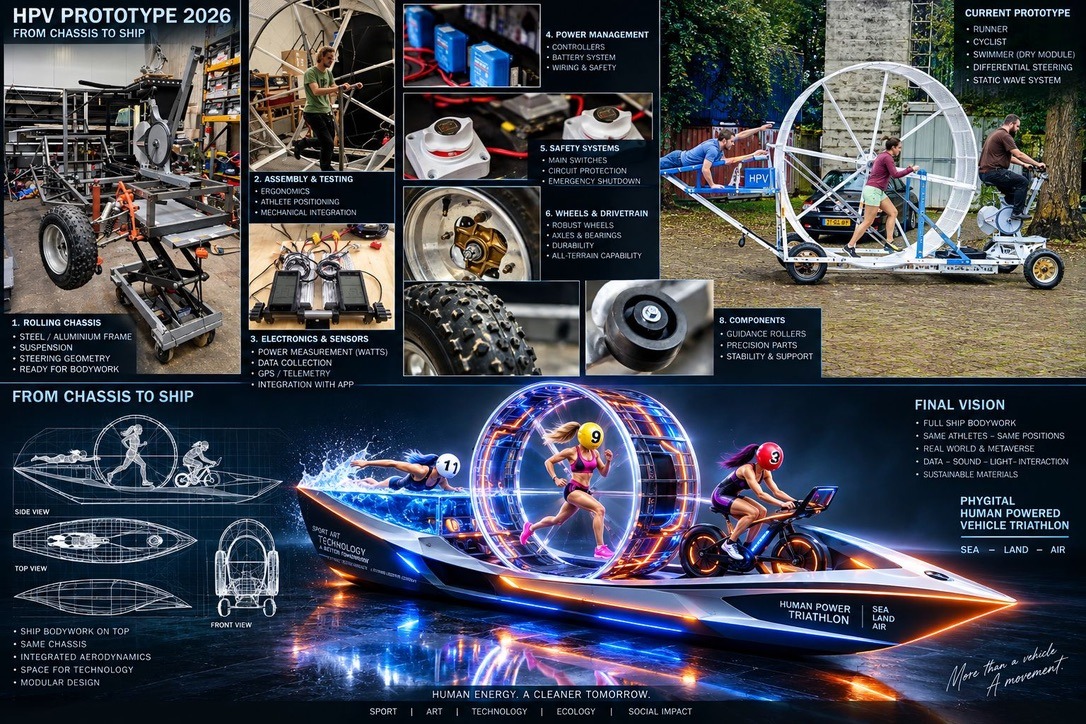
Now that the prototype has proven the technical feasibility, we believe we are ready to start building the full-scale monumental HPV.

Opportunities

The Human Powered Vehicle (HPV) is framed as much more than a vehicle—it is a “travelling multi-sensory living laboratory” and an “ark of human innovation”. By combining physical human effort, real-time biometric data, clean energy, and immersive technology, the HPV opens up 10 distinct fields of opportunity:

  • Sports Promotion & “Sportainment” 
  • Green Mobility & Clean Energy Innovation
  • Multi-Sensory Experiential Marketing & Phygital Events
  • Corporate Sponsorship & Brand Visibility Engine
  • Gamification, Web3 & Global Digital Twin Networks
  • Social Causes, Peace Diplomacy & Global Awareness
  • Youth Empowerment & Urban Community Building
  • Academic R&D, Biomechanics & Neurotechnology
  • Orthopedic Technology, Rehabilitation & Veterans Support
  • Interactive Museums & “Cobot Art” Co-Creation

What are we looking for?

We are looking for passionate partners willing to bring the vision of HPVs and the ark of human innovation to life.

  • Persons, institutions, and artists who want to integrate the HPVs into their creations
  • Venues, museums, galleries, etc. interested in organizing expos about the history and making-of of HPVs (there are beautiful maquettes, drawings, and animations that are artistic in their own right). The prototype in itself can be exposed as an artistic creation.
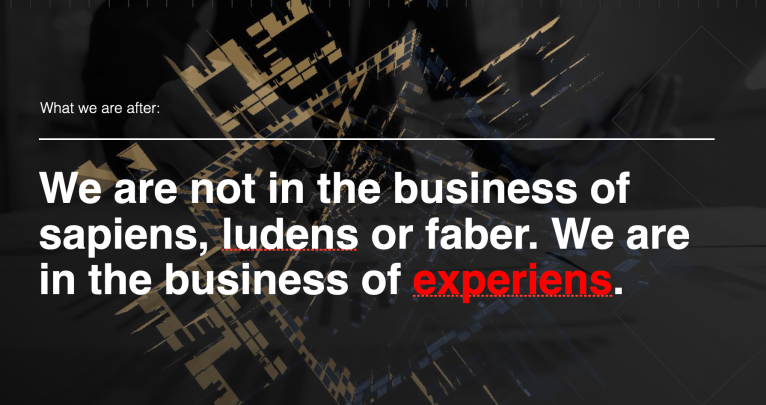
  • Any organisation willing to explore a trinity of some kind. Can be the trinity of the three sports of triathlon, but also other trinities such as the trinity of Home Sapiens, Homo Faber, and Homo Ludens; the trinity of the past, the present, and the future; the trinity of space, time, and place.

We are also looking for partners that can help us with part 2 of the project:

  • Creating the monumental version of the HPVs
  • Adding the digital layers
  • Integrating  into existing productions
  • Creating the humanly unthinkable

If interested, please contact me via the usual channels.
Petervan’s Ride – September 2026

Petervan’s Musical Ride September 2026 – 51 songs. Recent releases from Amelie Lens, Oscar Later, and Lambrini Girls. Oldies from Alana Dante, Red Zebra, and Silver Apples. Play in shuffle mode to increase the surprise factor. Enjoy!

Petervan’s Delicacies – August 2026

“Delicacies” is my incoherent, irregular, unpredictable collection of interesting sparks I came across online. Handpicked by a human, no robots, no AI. A form of tripping, wandering, dérivé, with some loosely undefined theme holding them together. Delicacies have no fixed frequency: I hit the publish button when there is enough material. That can be after a week or after 3 months. No pressure, literally. Enjoy!

Some highlights from this edition:

If you prefer the full firehose, check out the Substack link: https://petervan.substack.com/p/petervan-delicacies-186

Vluchtig/Fleeting – Poem

Vluchtig

Vluchtig. Als ether.

Als een tweet op het wee wee wee.

Vervlogen nog voor geboren.

Vervlogen illusies in een mist van leegheid.

Vluchtig als een angstig dier.

Op zoek naar voedsel vol betekenis.

Fleeting

Fleeting. Like ether.

Like a tweet on the wee wee wee.

Vanished even before being born.

Vanished illusions in a mist of emptiness.

Fleeting as a frightened animal.

In search of food full of meaning.

Petervan’s Ride – August 2026

Petervan’s Musical Ride August 2026 – 37 songs only. Recent releases from ICA, De Staat, and Squirrel Flower. Oldies from William Orbit, Grauzone, and Andrew Wheaterall. Lots of experimental as well. Play in shuffle mode to increase the surprise factor. Enjoy

New New Babylon Project – Sep 2026 update

For a general introduction to the New New Babylon Project, please check out the project page.

We are now in the grant phase. The deliverables for this phase are:

  • An AI-Based Analysis of Supporting, Contradictory, and Complementary Resources
  • An artistic XR rendering of a New New Babylon on top of an existing city or city district
  • Art Expo (minimum Online, ideally IRL) 
  • Art Book

I am trying to get the first two done, or at least well-developed, by year-end.

AI-based Analysis

I have been experimenting with Google’s NotebookML – now Gemini Notebook. I uploaded some 70 resources about:

  • Constant’s New Babylon from 1950ies
  • 21st-century criticism of his work
  • Architectural reflections about urbanism
  • Urbanism and memory research from the Protocol Institute
  • Some cybernetics material related to Gordon Pask and his conversational protocol

Gemini Notebook generated the following summary, but it seems to miss the cybernetics material – at least in this summary – but this is probably due to the 50-source limit under the free plan.

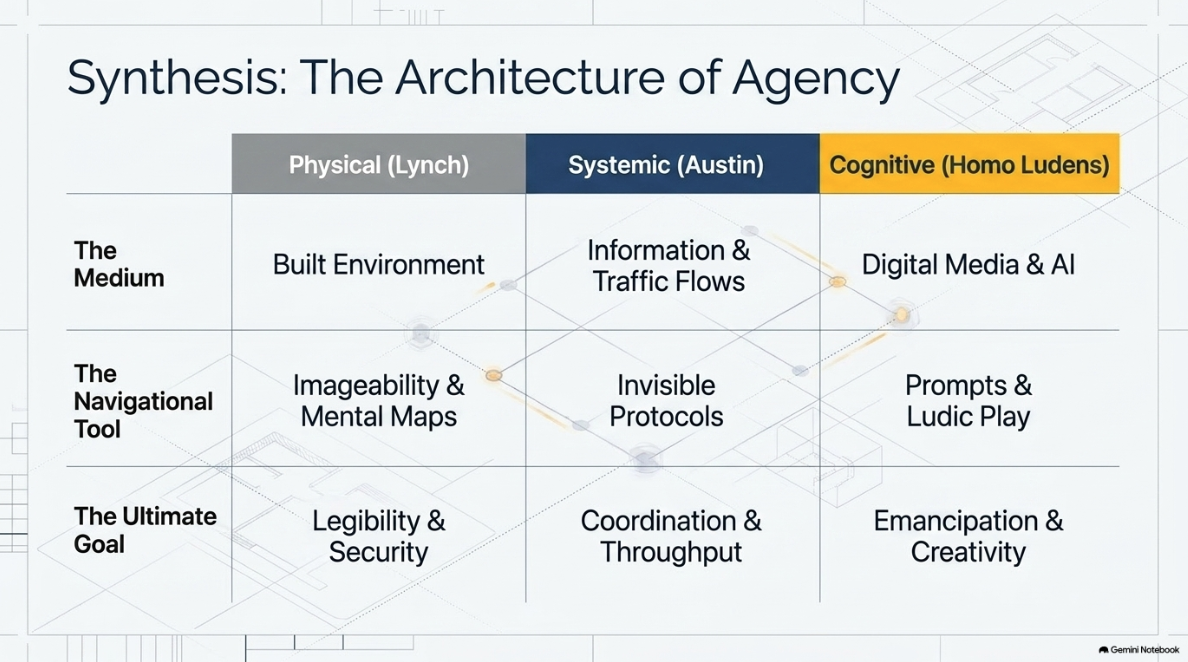
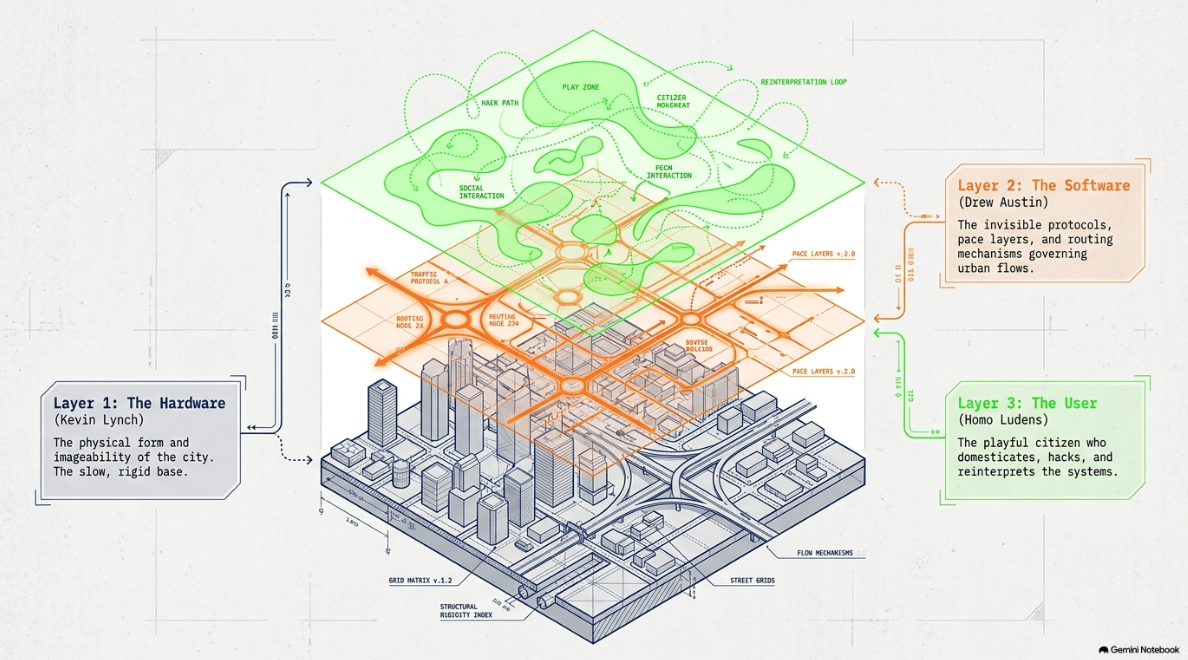
“These sources explore the intersection of urban design, digital media, and human identity, primarily focusing on how play and structured environments shape our perception of the world. Kevin Lynch introduces “imageability” to describe how clear physical layouts, such as paths and landmarks, help residents build mental maps and feel emotionally secure. Building on this, Valerie Frissen and others examine “Homo Ludens 2.0,” a concept where digital connectivity and gamification allow users to experiment with their identities within virtual landscapes. Drew Austin bridges these ideas by analysing protocols, like the urban street grid, which act as invisible “software” managing the tension between rigid infrastructure and fluid human behaviour. Together, the texts suggest that whether through physical architecture or digital platforms, the rules and forms governing our surroundings profoundly influence how we navigate, create, and relate to one another. Overcoming protocol failure or urban chaos requires a deeper understanding of these interactive systems and their impact on the human experience.”

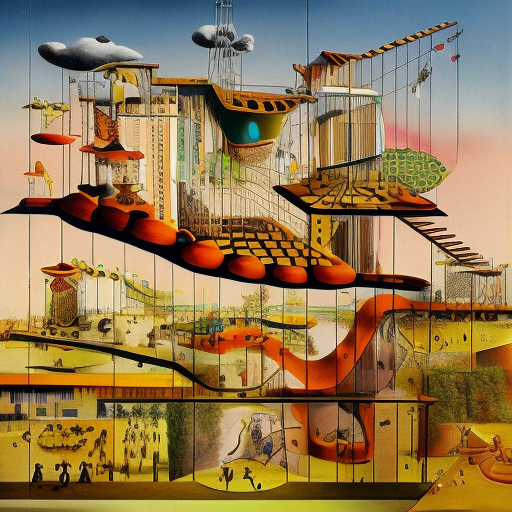
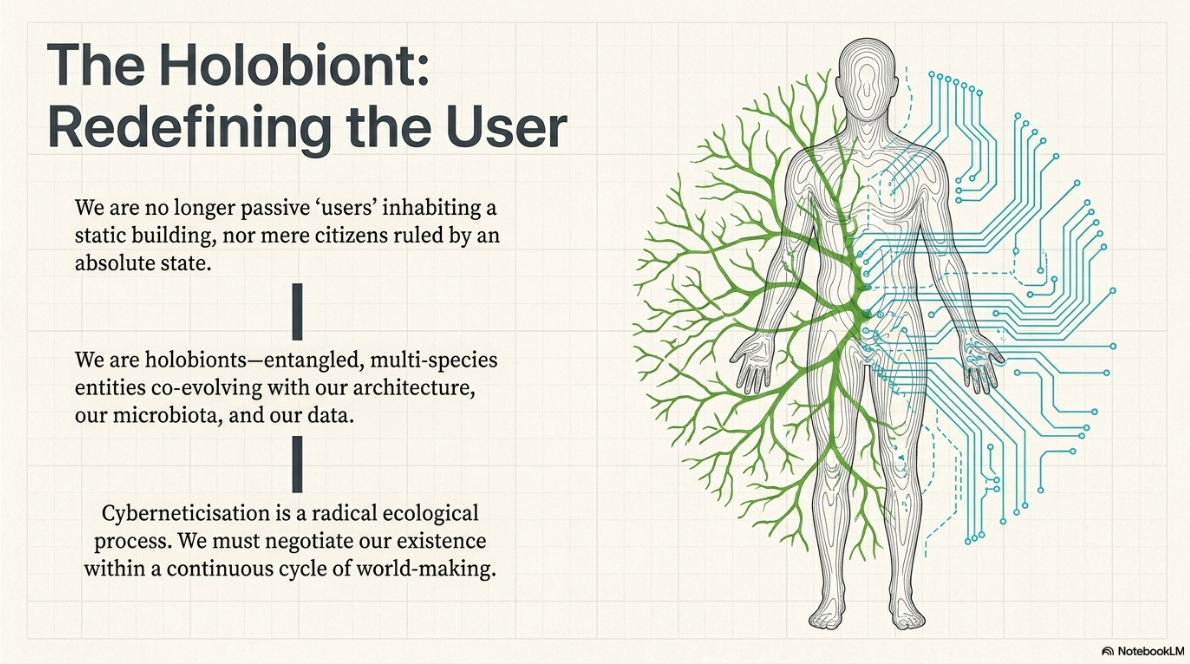
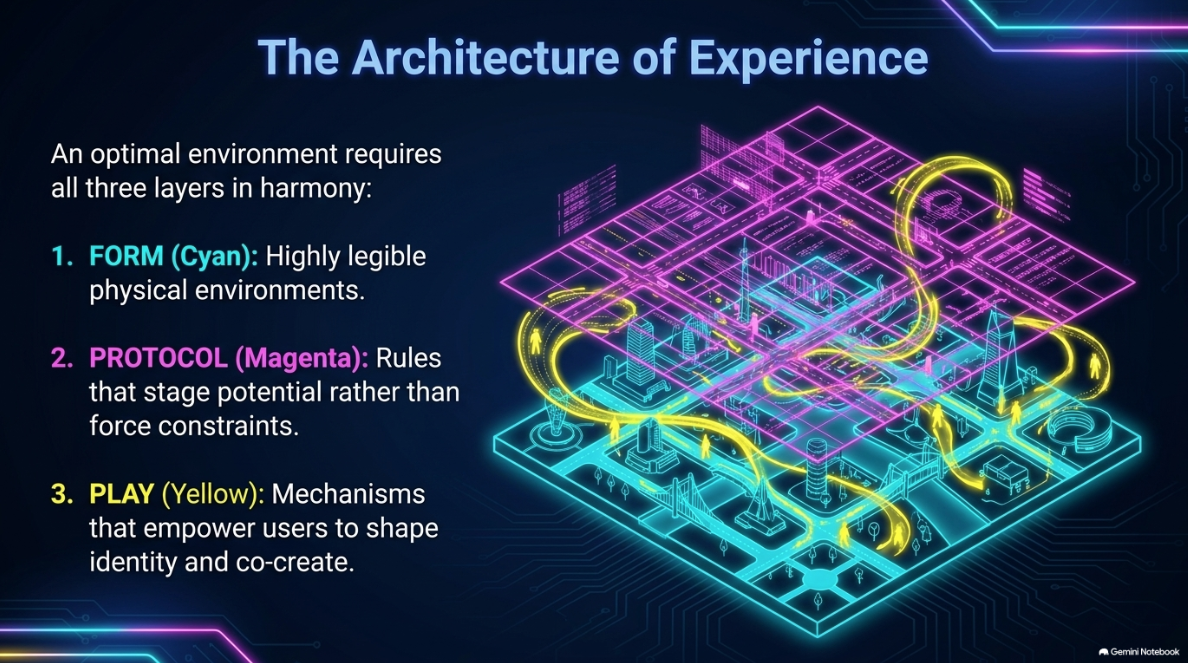
Gemini Notebook generated some very interesting reports, slides, visuals, and blog posts that I will share on this blog in the coming weeks. Below are some teasers.

The last one – “The Architecture of Experience” – is particularly interesting, as it goes well with the work I have been doing with Andreea Ion Cojocaru on “Home Experience”. See also our joint talk for UnitedXR Europe in December of last year.

Artistic XR rendering test case Ghent

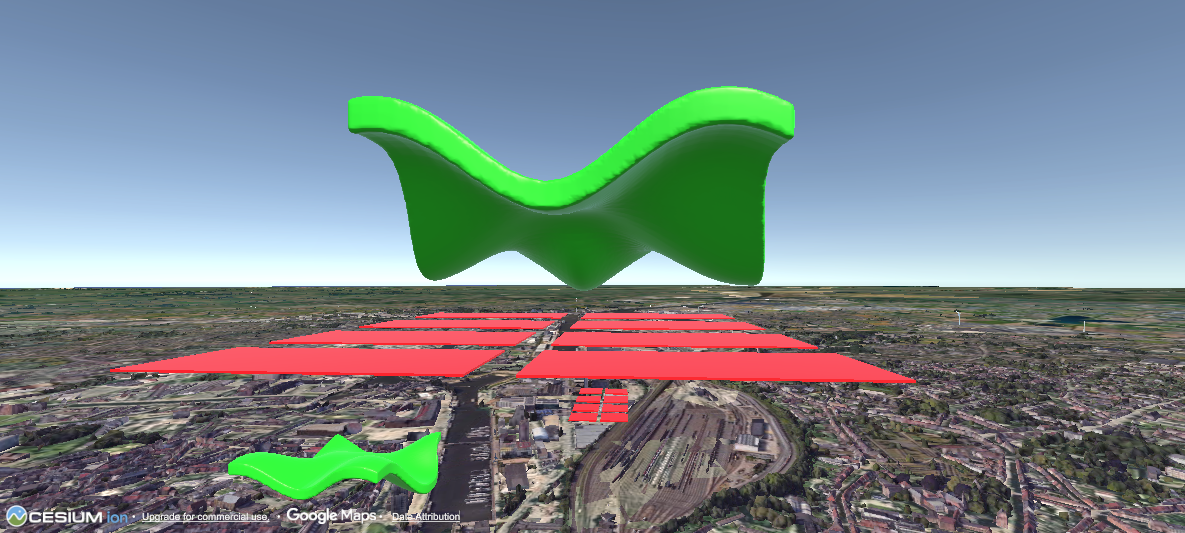
The idea here is to virtually create a layer – the city of play – above the city of Ghent (could be any city in the world). I am experimenting with the Cesium open platform for creating powerful 3D geospatial applications. Testing in both the Unity and Unreal Engines. The plan is for the layered city of play to be composed of self-sculpted shapes, created in Blender or Nomad Sculpt. Ideally with 3D audio on top, but that is a nice-to-have. An alternative would be to leverage the material of Spectracities.

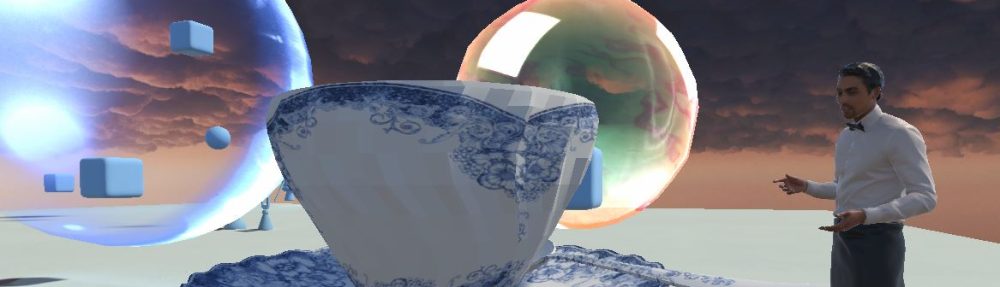
Shapes on top of Ghent – Unity Engine – © 2026 Petervan Studios
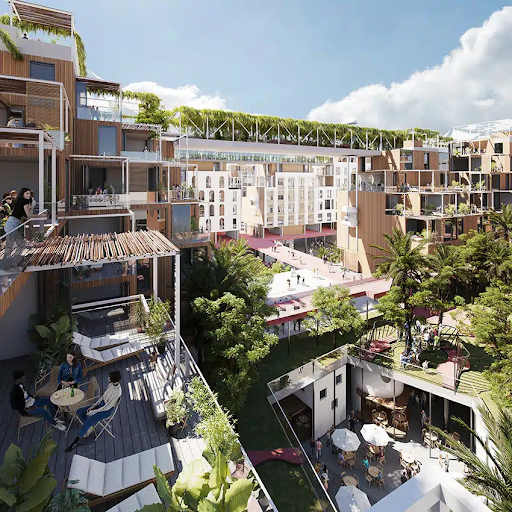
With the courtesy of Spectracities

Open Call

If you think this is interesting and want to contribute to the project – in money or in kind – drop me a note. Feel free to comment. To stay updated, subscribe to the blog.

Warmest,

My cousin Joost about Art and AI: less with more

This is a repost of a LinkedIn article by Josie Gibson, summarizing a call about Art and AI with my cousin Joost, former senior curator at the Royal Museum of Fine Arts in Brussels. Joost is an expert in the paintings of the Old Masters, and he also serves as a Vice President of the UNESCO International Committee on the History of Art. He continues to lead groundbreaking collaborative projects like the Jordaens Van Dyck Panel Paintings art historical initiative.

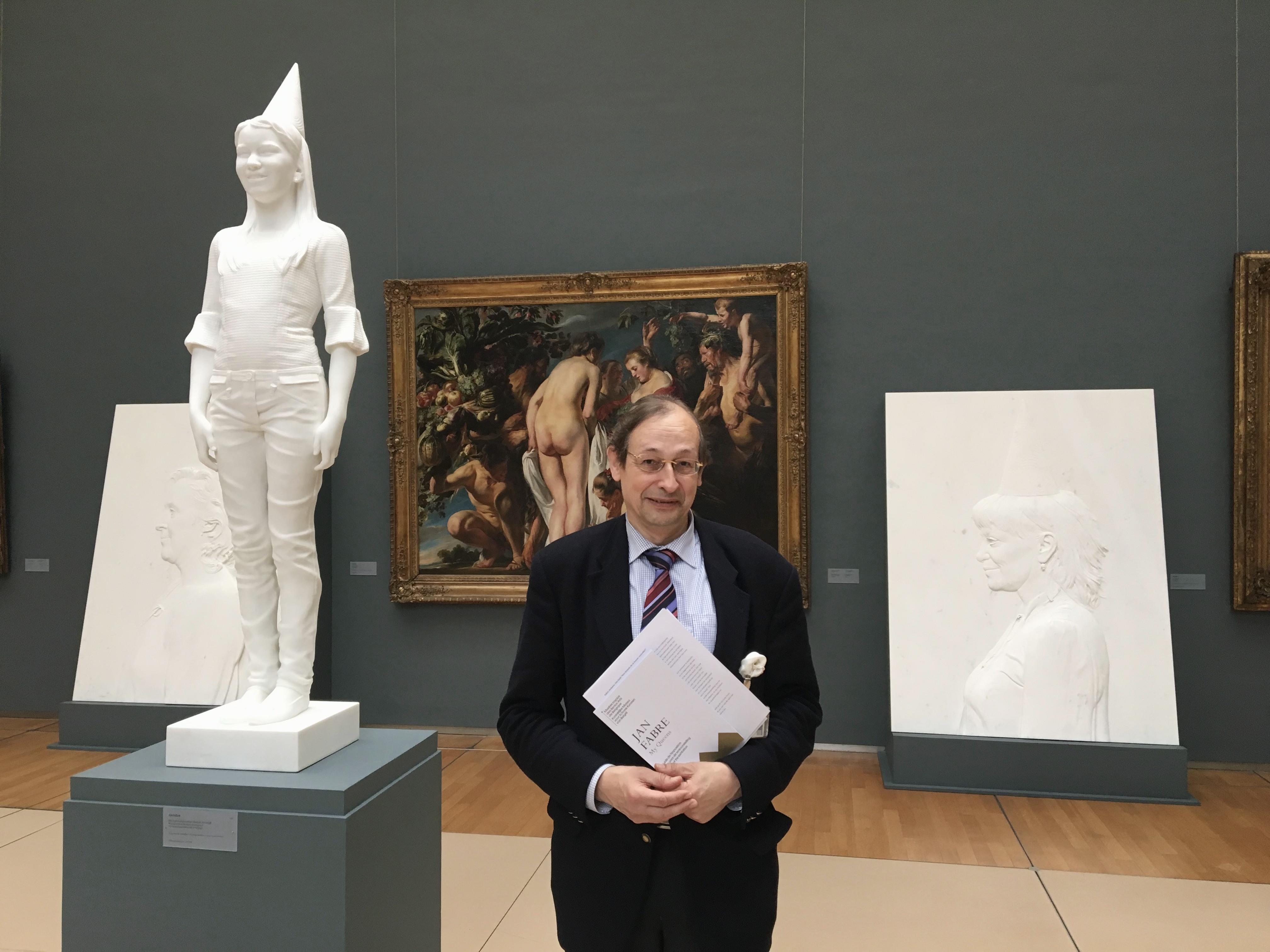
Joost in front of a Jordaens and Carrara marble bas-reliefs from Jan Fabre’s My Queens, an expo he curated for the Royal Museum of Fine Arts in Brussels in 2018

How do new tools and technologies shape how we see ourselves and create meaning? Art has long been at the jagged edge of adaptation, but with its velocity and reach, artificial intelligence (AI) is challenging art and art-making in new and unique ways, according to Joost Vander Auwera, leading art historian and cultural researcher. 
 
In a riveting session of The Catalyst Network, we were treated to insights from live debates across the art world on issues such as provenance, ownership, authenticity, identity and ethics in the AI era.
 
Joost’s opening comment sums up where we find ourselves: ‘Art is at the centre of (these debates) because it focuses on the difference between AI and the human mind. It’s created, art… by a human being who knows mortality, life, memory, embodied experience and existential responsibility. This is something AI does not have.’
 
I was invited to share some of my experiments with creative tools, including AI, exploring how they have supported art-making and performance, as well as reflecting on the current limitations of these technologies.

Example of endlessly repeating audio/video installation by Petervan

Historical context matters. ‘Originality’ in the 17th century was very different to how we think about it today, Joost points out. Then it wasn’t uncommon for artists to create several versions of the same painting, and when they had a major painting in the studio, it might be reworked to adapt to a new style and market. ‘We have to not take what we see now,’ he cautions, ‘as being absolute in art.’

Art is at the forefront of society and social memory and evolves with the times, public tastes, and tools. There are, however, universal elements in how we experience art. 

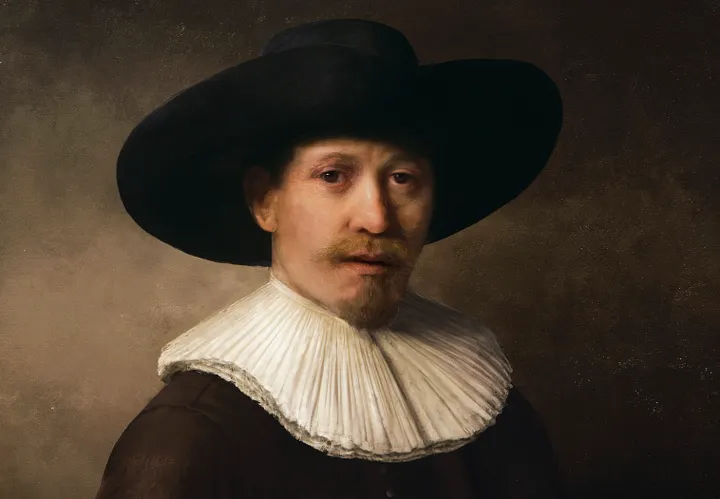
Joost recalled one early experiment where all Rembrandt’s paintings were loaded into an AI application to produce a ‘new’ Rembrandt. ‘The painting they created had all the stylistic aspects of Rembrandt, for sure, but it is a boring painting.’ He pointed out the AI Rembrandt was the common denominator of the previous paintings of Rembrandt, the opposite of what Rembrandt does: more with less. So, a real Rembrandt is ‘more with less’, and AI is ‘less with more’.

The Next Rembrandt – created by AI in 2011

These artists mastered the techniques then went beyond, capturing an essence of human experience that’s currently beyond the reach of AI. 
 
That said, AI is making quantum leaps, and Joost highlighted the need for (human) critical thinking to combat the shadow sides of technology. A brilliant conversation on how we create collective memories and why it matters.

Original text by Josie Gibson, slightly adapted and complemented by some images by Petervan

Petervan’s Ride – July 2026

Petervan’s Musical Ride July 2026 – 52 songs. Mostly recent releases, including those by The Rolling Stones, Madonna, and Rhythm & Sound. Oldies from The Scene, Kavinsky, and Right Said Fred. Lots of experimental as well. Play in shuffle mode to increase the surprise factor. Enjoy

Petervan’s Delicacies #185 > May-July 2026

“Delicacies” is my incoherent, irregular, unpredictable collection of interesting sparks I came across online. Handpicked by a human, no robots, no AI. A form of tripping, wandering, dérivé, with some loosely undefined theme holding them together. Delicacies have no fixed frequency: I hit the publish button when there is enough material. That can be after a week or after 3 months. No pressure, literally. Enjoy!

Some highlights from this edition:

If you prefer the full firehose, check out the Substack link: https://petervan.substack.com/p/petervan-delicacies-185