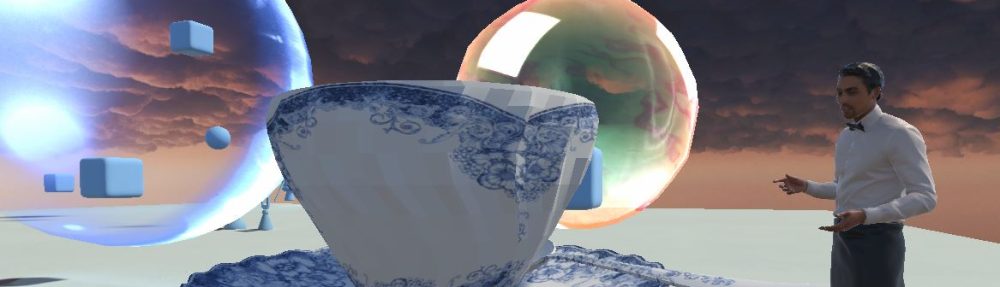
This is a repost of a LinkedIn article by Josie Gibson, summarizing a call about Art and AI with my cousin Joost, former senior curator at the Royal Museum of Fine Arts in Brussels. Joost is an expert in the paintings of the Old Masters, and he also serves as a Vice President of the UNESCO International Committee on the History of Art. He continues to lead groundbreaking collaborative projects like the Jordaens Van Dyck Panel Paintings art historical initiative.
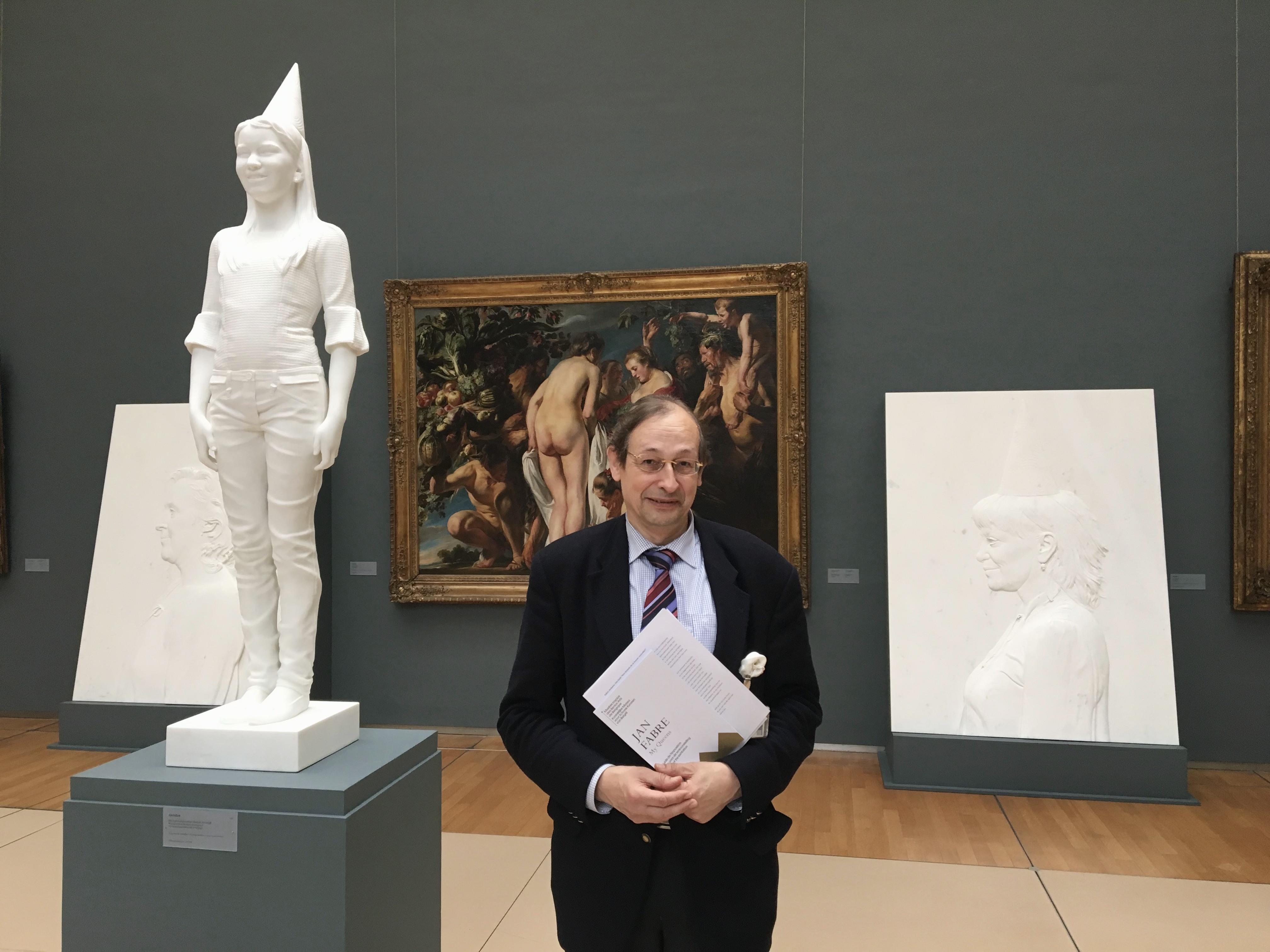
Joost in front of a Jordaens and Carrara marble bas-reliefs from Jan Fabre’s My Queens, an expo he curated for the Royal Museum of Fine Arts in Brussels in 2018
How do new tools and technologies shape how we see ourselves and create meaning? Art has long been at the jagged edge of adaptation, but with its velocity and reach, artificial intelligence (AI) is challenging art and art-making in new and unique ways, according to Joost Vander Auwera, leading art historian and cultural researcher.
In a riveting session of The Catalyst Network, we were treated to insights from live debates across the art world on issues such as provenance, ownership, authenticity, identity and ethics in the AI era.
Joost’s opening comment sums up where we find ourselves: ‘Art is at the centre of (these debates) because it focuses on the difference between AI and the human mind. It’s created, art… by a human being who knows mortality, life, memory, embodied experience and existential responsibility. This is something AI does not have.’
I was invited to share some of my experiments with creative tools, including AI, exploring how they have supported art-making and performance, as well as reflecting on the current limitations of these technologies.
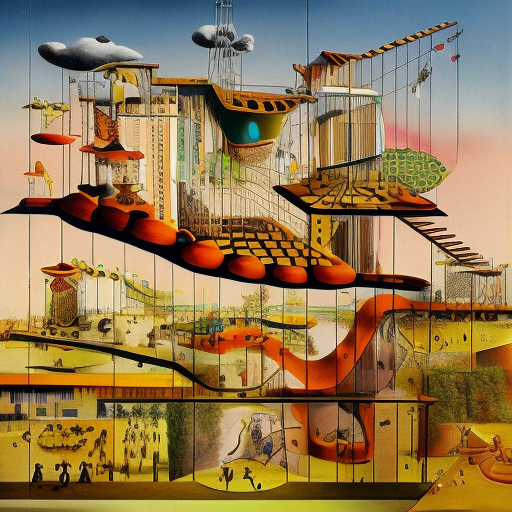
Example of endlessly repeating audio/video installation by Petervan
Historical context matters. ‘Originality’ in the 17th century was very different to how we think about it today, Joost points out. Then it wasn’t uncommon for artists to create several versions of the same painting, and when they had a major painting in the studio, it might be reworked to adapt to a new style and market. ‘We have to not take what we see now,’ he cautions, ‘as being absolute in art.’
Art is at the forefront of society and social memory and evolves with the times, public tastes, and tools. There are, however, universal elements in how we experience art.
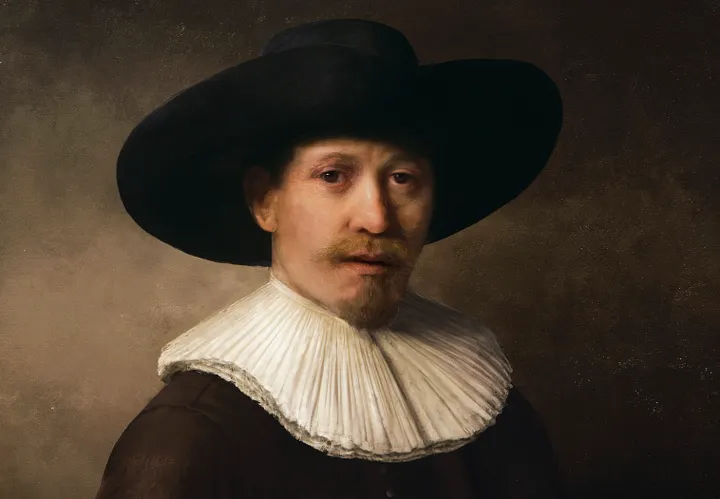
Joost recalled one early experiment where all Rembrandt’s paintings were loaded into an AI application to produce a ‘new’ Rembrandt. ‘The painting they created had all the stylistic aspects of Rembrandt, for sure, but it is a boring painting.’ He pointed out the AI Rembrandt was the common denominator of the previous paintings of Rembrandt, the opposite of what Rembrandt does: more with less. So, a real Rembrandt is ‘more with less’, and AI is ‘less with more’.
The Next Rembrandt – created by AI in 2011
These artists mastered the techniques then went beyond, capturing an essence of human experience that’s currently beyond the reach of AI.
That said, AI is making quantum leaps, and Joost highlighted the need for (human) critical thinking to combat the shadow sides of technology. A brilliant conversation on how we create collective memories and why it matters.
Original text by Josie Gibson, slightly adapted and complemented by some images by Petervan
Studio David Claerbout just published the video of a lecture at The Cloud Collection, Nanjing on the occasion of the opening “Flow of Time. David Claerbout and Zhou Tao” exhibition.
At 17:50, he explains how he made the Woodcarver and the Forest. Prompting ChatGPT to create a script and images, then filming what ChatGPT suggested, and then giving it back to ChatGPT and asking whether it recognises itself.
I took the rough auto-generated YouTube transcript of this talk, and prompted ChatGPT as follows: “take this transcript, delete the time markers, delete the uhm’s, and put it together in readable sentences”, and this is what it came up with (highlights by Petervan)
+++ by ChatGPT
Thank you for coming. When the invitation arrived to make a double exhibition with the work of Zhou Tao, we were of course very curious. It was clear that there was a real reason we were invited to exhibit together, but there was also a lot of mystery because I didn’t know his work very well, and I had not yet realized the intrinsic relationship to time in his work. It was only by coming here a few days ago that it started to sink in—what the subtle relationships between the two of us might be.
First of all, I would like to thank the Cloud Collection for bringing us together. We obviously have very different ways of working, which you can see in the works. For Joe, being in a location, being physically in a place with his camera as his partner, is crucial. In my practice, we spend a long time and work with many people, sometimes for at least a year. If I look around at the pieces in this exhibition, I think the shortest production time is one full year. Other works took two or three years. Our record, if I remember well, is sixteen years—sixteen years of thinking back and forth about how to do something until we finally finished a production.
What we do have in common is that we like to use the duration of the film as the acting force—not so much the actors, not so much the motives, but the simple fact of being in front of a situation. This approach to film is relatively recent and has to do with the availability of digital time. I call it digital time because it is no longer expensive time; it’s virtual time of which we can gather a lot. For our generation, duration is no longer exclusive, expensive, or spectacular, but something broad and long.
When I came here two days ago and saw the combination with the work of Tao, it made me question myself: is it really necessary that I work so long on a single image? The airplane is a single motive. The birdcage is a single motive. These works revolve around very simple motives. I have to admit that whenever I work on one film, I am actually thinking about two films. This is one of the reasons I keep my motives simple: because I try to work with two identities.
For example, the film behind you, The Wood Carver, has the identity of a meditative work that calms you down, but also another identity that is almost the complete opposite. I’ve always been fascinated by what happens when you let go of narrative film—when you let go of talkies, psychological realism, and story, and instead go with time, with duration, with the flicker of the images. Could I make a very minimalist film where I use the least possible narrative and still generate narrative inside the heads of the visitors?
As you walk around, you’ll notice there are few sounds—no soundtracks, only what I call “witness sounds”: bird songs, nature, wind, footsteps. It wasn’t always like this. I made films with soundtracks, musical scores, conversations between actors. But my focus was always on the background, and more and more the birds became a symbol for that background—giving the film back to the witnesses rather than the actors. In cinema we often speak about foreground and background, like in painting. I realized I have a preference for what is behind—for what is far away, not in the foreground.
One of my very first films, made in 2003, is a 14-hour film where three actors perform a short 12-minute scene repeatedly for a full day, until they start making errors or falling apart. Only then do you slowly begin to see that the film is really about the light, the changes of light, and not about the narrative in the foreground. I am very much an advocate of the cinema of the witness, not the cinema of the actor.
A word also on ecology: I avoid entering specific subject matter, but I cannot help noticing that we spend a lot of time in front of screens and very little in nature. This makes me think about the relationship we have with technology. On one hand, I love technology—I’m a technological buff, and whenever something new appears, I try to catch up with it. But at the same time, my works are not about technology. They are about light and shadow, about composition, about the slow pace of time. Again, there are two tracks.
Any cinematographer knows that the moving image is a technological construction—25 frames per second. It is a prison of time; you cannot escape it. So why would artists choose to work in this prison in order to liberate time? To find alternatives for thinking about the flow of time, as Suzu beautifully mentioned in his text.
Let me elaborate on the black-and-white film behind the wall, titled Aircraft Final Assembly Line. Like many of my films, it is based on an image or an idea I found somewhere—an archive image, something with no particular message. I found a black-and-white photograph of this aircraft. It was originally painted in black matte aluminum. I was fascinated by the enormous wooden hall in Chicago where it was constructed—a space that no longer exists. This polished aluminum aircraft stood there, brand new in the past, yet I look at it now from the future, as a witness. I know the aircraft is probably destroyed by now. The work became about the dialectic between materials: polished aluminum, rough wood, concrete floor, improvised-looking scaffolding—yet airplanes themselves are not improvised. They must be perfect. Airplanes are like perfect arrows of time: they promise the future.
This is typical of how I work: I don’t invent; I let myself be inspired by archive images, almost orphaned images from the past.
When we move mentally to Bird Cage, the film with the explosion, this was a follow-up to a pandemic-era film, Wildfire. I continued with the motive of the explosion because it is the perfect index of a moment—after an explosion, nothing is ever the same. I was fascinated by the idea of remaining inside that moment of change for a long time, looking at all the pieces of the world flying apart, but in a peaceful way. Again, a paradox between destructive and meditative energies.
In the middle of this are two birds that appear twice—once inside the explosion, at the last fraction of their lives, and again later, alive and peaceful in a garden. I hesitated for a long time to use this imagery because it is almost ridiculous—two birds in an explosion, like a crucifix of birds. But I kept it because I was fascinated by the elliptical camera movement. If you look closely, there is no cut: the camera moves from the explosion back to a normal, sunlit garden, with the same two birds sitting together, almost as if they are trying to tell you something. Ten minutes later, the same ellipse brings you back to the explosion, frozen in time—an “immobile explosion,” a contradiction in itself.
I like to work within a single mental space, not jumping between spaces but taking the viewer on a minimalist journey through one situation.
The confetti piece around the corner, the double screen, was made from 2016 to 2018. It corresponds to a series I’ve done for about 15 years: dozens or hundreds of digitally constructed photographs combined into a slideshow. A conventional parade of images, except that it’s about the absence of sound. In the film, a little boy is screaming, but you hear nothing. His scream becomes internalized. The scene is exaggerated—a Black boy surrounded by white adults. I was warned against using it because it might appear divisive. But I said yes, that tension is exactly what we need in order to reach something more universal. The real fascination for me was the internalized scream, and the way spending time with the work might let the viewer internalize it too. It is as close as I can get to a painting with an action attached to it.
Finally, behind us is the latest work we made, just finished for this exhibition: The Wood Carver in the Forest. The subtitle is “A ruthless deforestation machine disguised as a meditative film.” Again, it has two identities. Most spectators will identify with the relaxation—the small sounds, the details of oil, wood, knives, carving, micro-movements outside any big narrative.
We designed this work using ChatGPT. ChatGPT is one big confabulation machine; it always gives you an answer, even when it has no clue. We wrote the storyboard with it, then requested illustrations, and used those as the basis for a cinematographic team. We worked for a year to reproduce what AI had suggested.
It came up with scenes like the one by the window: a person staring at nature but actually staring at something artificial—as if looking at a screen. In the images, if you look carefully, the “trees” outside are actually vertically stacked television screens. We prompted an image of the garden and it produced about ninety trees. Using its own calculation, it estimated it would take thirteen years for the protagonist to turn those trees into wooden objects. From those “thirteen years,” we selected three days—one early, one mid-process, one at the end—and produced only those.
In the end, it becomes a loop: AI proposes something, we produce it, then return it to AI like an alien creature and ask, “Do you recognize yourself?” About 5–7% of the imagery is completely fake—AI reprocessing its own outputs.
The idea of the work is that someone else—not me—could complete those thirteen years of destruction. My job was to create images with two simultaneous identities, properly schizophrenic: destructive and generative at the same time.
The camera— that profoundly liberal invention— whispers:
I’m ready for anything. Give me chemicals, give me a little light, give me time and no shaking, and I will be done.
A pocket-sized Enlightenment, believing every world is reachable, every surface printable, every body open to possibility.
And now generative machines produce punctum— yes, Barthes’ punctum— the involuntary meaning that slips through the cracks of intention. Not planned by the author, nor by the algorithm, but arriving later, after you’ve slept on it, after the dopamine subsides. Fast food for intellectual minds, rewarding at first bite, quickly stale. You return in the morning and mutter: It was not that great after all.
Style appears. Style overload. Those who lack craft run toward it— high, abstract, fast— while you work the old way, learning the hand, the long path, refusing to choose sides.
Spend time with it— real duration— and you’ll see how expensive time has become. Only unproductive duration is free. Yet we abandoned that when we entered the cinema, trading mobility for the promise of instant return. No one waits for tomorrow in a theater. In a museum, though— time’s ticking clock can’t be heard. There we look forward to looking back.
And somewhere in this, the black box— practical, yes, but also a symptom of our incapacity to coexist. The dark room becomes a social problem, a refusal of interference, a denial of shared space.
Everything becomes a question of time, of how little we have left, of how duration is mined like ore.
Growing old treated as disease, dementia as enemy, while software dreams of pure disembodiment— young, innocent, clean.
And yet— beneath all this— you remind us: we are bifocal, split, never individuals. We are believers, especially visually.
The camera says: I’m ready for anything.
But the eye says: I am not a camera.
And the brain says: I choose no side.
And the forest says: Take your time.
And the weak image whispers from the periphery: Here is the non-event— stay long enough, and you may hear it breathe.
I first edited the full transcript from the presentation, and then OCR scanned text ‘The Time Spent” from the BIRDSONG book. Then I made a personal selection of the sentences that resonated with me. Then I gave that to ChatGPT and asked it to condense all this into a 1000-word poem, then 500 words, then 100 words. Then again, I made a personal selection of the best GPT snippets. And further edited them to my personal (un)taste.
“Delicacies” is my incoherent, irregular, unpredictable collection of interesting sparks I came across online. Handpicked by a human, no robots, no AI. A form of tripping, wandering, dérivé, with some loosely undefined theme holding them together. Delicacies have no fixed frequency: I hit the publish button when there is enough material. That can be after a week or after 3 months. No pressure, literally. Enjoy!
Some highlights from this edition:
ARTEFACT — a collaboration between Neal Stephenson, Joe Lubin (Ethereum co-founder), and Rebecca Barcin (LAMANA1).
As we close the year, here is the latest update on Petervan Studios.
The previous update was in March 2023. In a sense, this update is an update on the whole year. A lot has happened since then. A lot did not happen. An overview.
Quick catch-up
I studied architecture (art school), never practiced (dropped out), and stumbled into a nice corporate career. In 2017 I took a sabbatical and never went back. I left the corporate world. I am now officially “retired”
Family
On 18 Dec 2023, Astrid became 18 years, officially “of age”, driving our car (good driver, final exam in Feb 2024), and started higher studies (a four years bachelor nursery), and horses, of course. And in May, we celebrated our 30th wedding anniversary. Time flies. Happy times.
Cosy Birthday Breakfast for Astrid
The Art Studio
The Art Studio is nicely rippling along. I did not have the feeling that I accomplished much, but with hindsight, it’s not too bad, and there are a lot of good foundations for the year to come.
Some of the new projects include:
Hexagrams
Claim your word
Something has dissipated
New paintings
New digital artworks
New soundscapes
Experimenting with interfaces for IRL and VR installations
You can find most of them via the “Artworks” tab on my website.
The “Something has Dissipated” project got some traction. There are now about 20 spoken language versions by real humans, including Mongolian and Chinese. But also some synthetic non-human avatar versions like this one:
In the planning is a personal solo art exhibition in VR coming and maybe IRL. Some installation concepts will try-out first in VR, and maybe later IRL.
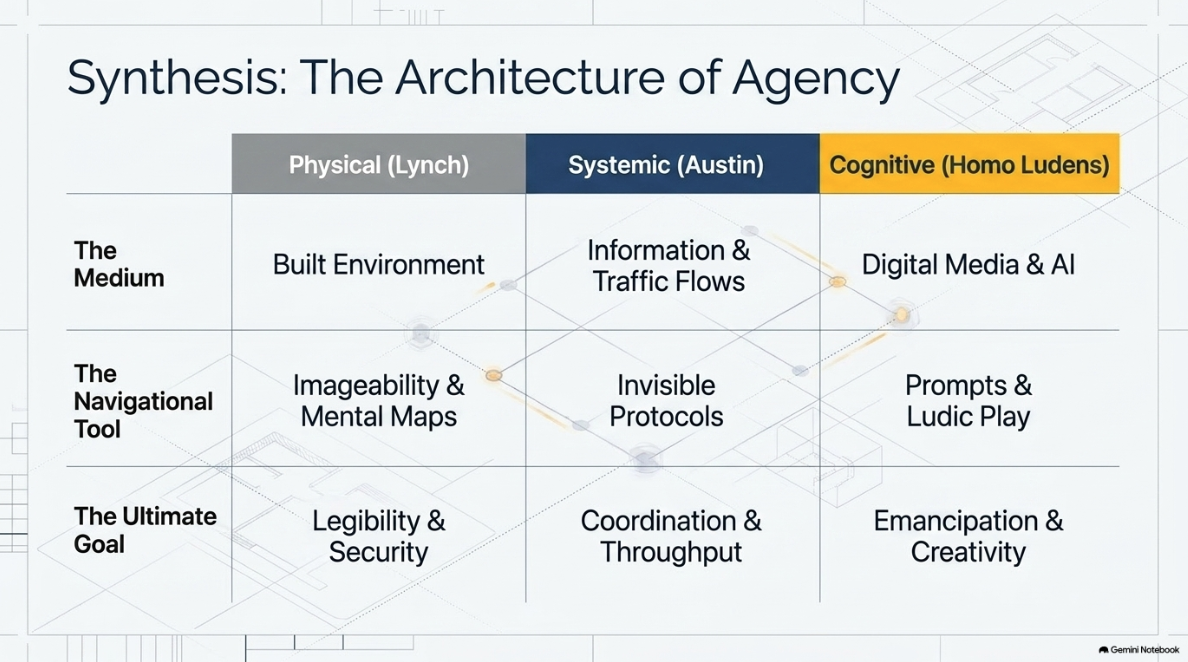
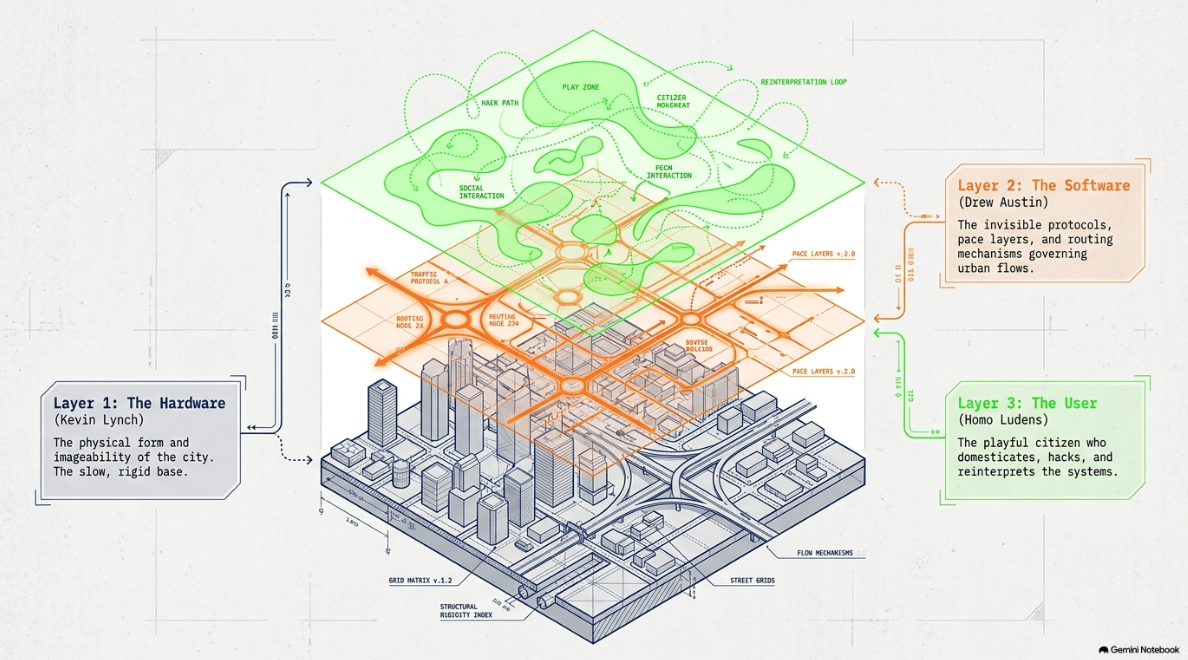
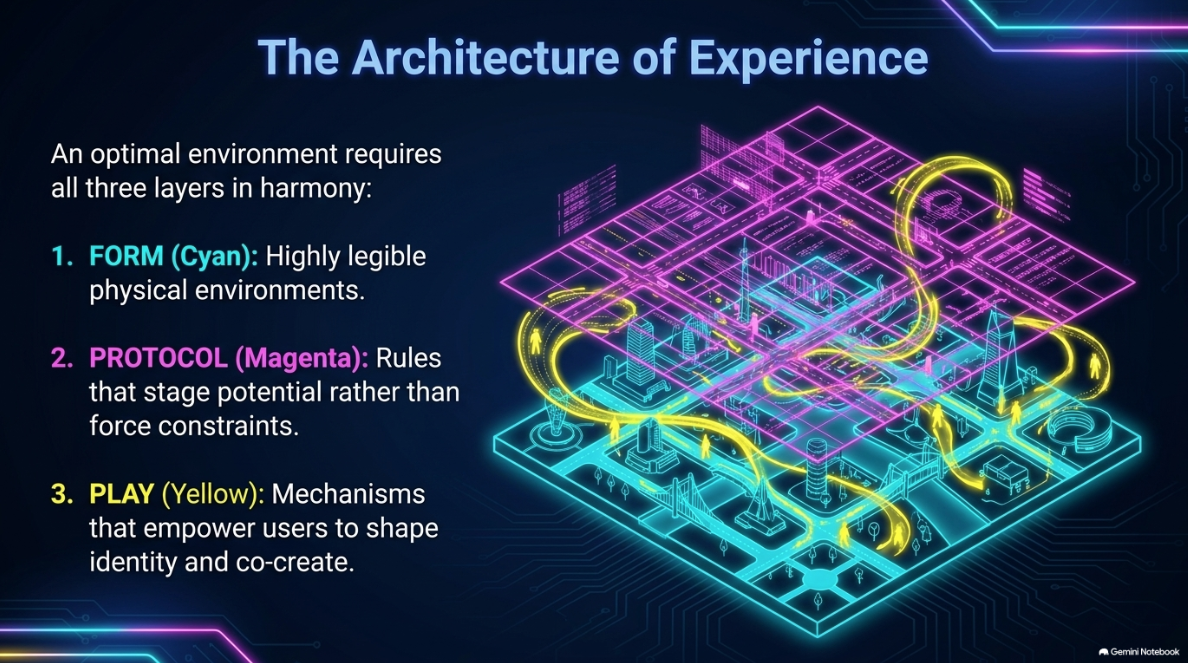
A new performance lecture “City of Play” is in the making, about the New New Babylon (and the power of imagination). No specific target date. I have time, and it has to be right.
New New Babylon – City of Play
I am kind of obsessed with the New Babylon project of artist Constant Nieuwenhuys, who co-founded the avant-garde COBRA art movement in the 1950s.
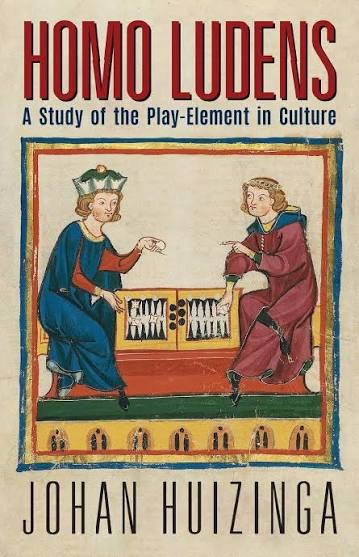
For 25 years he worked on New Babylon, an imagined city for the playful and creative human being. The oeuvre consists of hundreds of drawings, sketches, and maquettes. His work was inspired by the book Homo Ludens by Johan Huizinga.
The NEW New Babylon is an artistic research project where we use 2023 technologies.
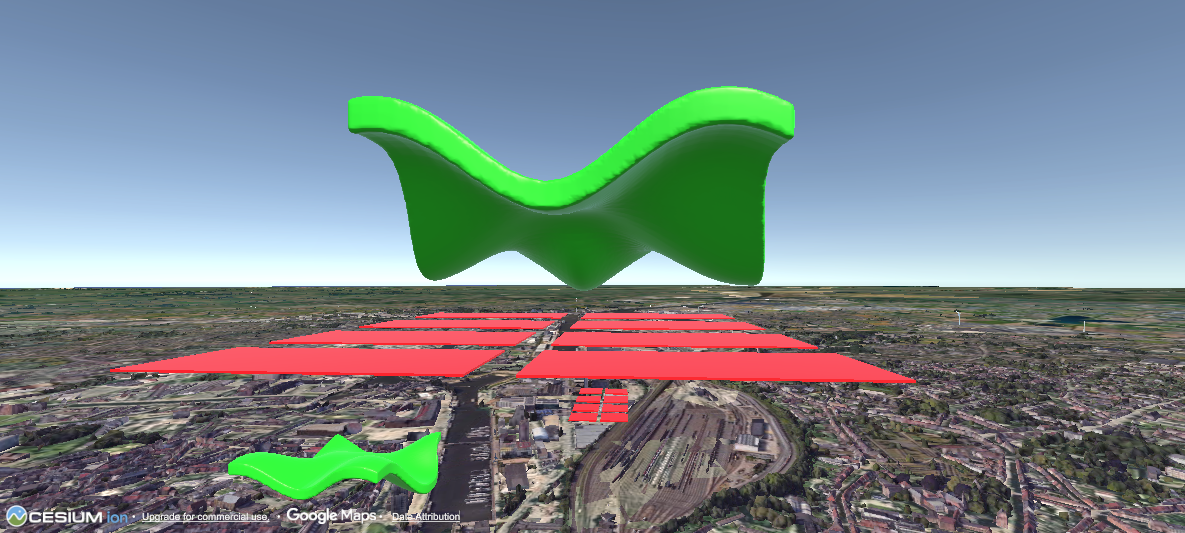
At the time of writing, we are trying to set up a team/consortium to overlay an existing city (district) with a VR environment for A/B Testing of the urbanistic, economic, and governance aspects of the city.
It probably will involve expertise from worlding experts, interactive fiction, procedural games, autonomous worlds, protocol language patterns, etc
At this moment I am exploring a whole slew of tools: videosync, BEAM, BAM, Procreate Dreams, Capture for scene design, and spending lots of time on learning/trying to understand Blender, Unity, Unreal Engine, new Ableton packs, the new version of Apple Logic Pro X, and hopefully soon Apple Vision Pro.
Timing slips. No problem, I have time. And it has to be right. And not sloppy.
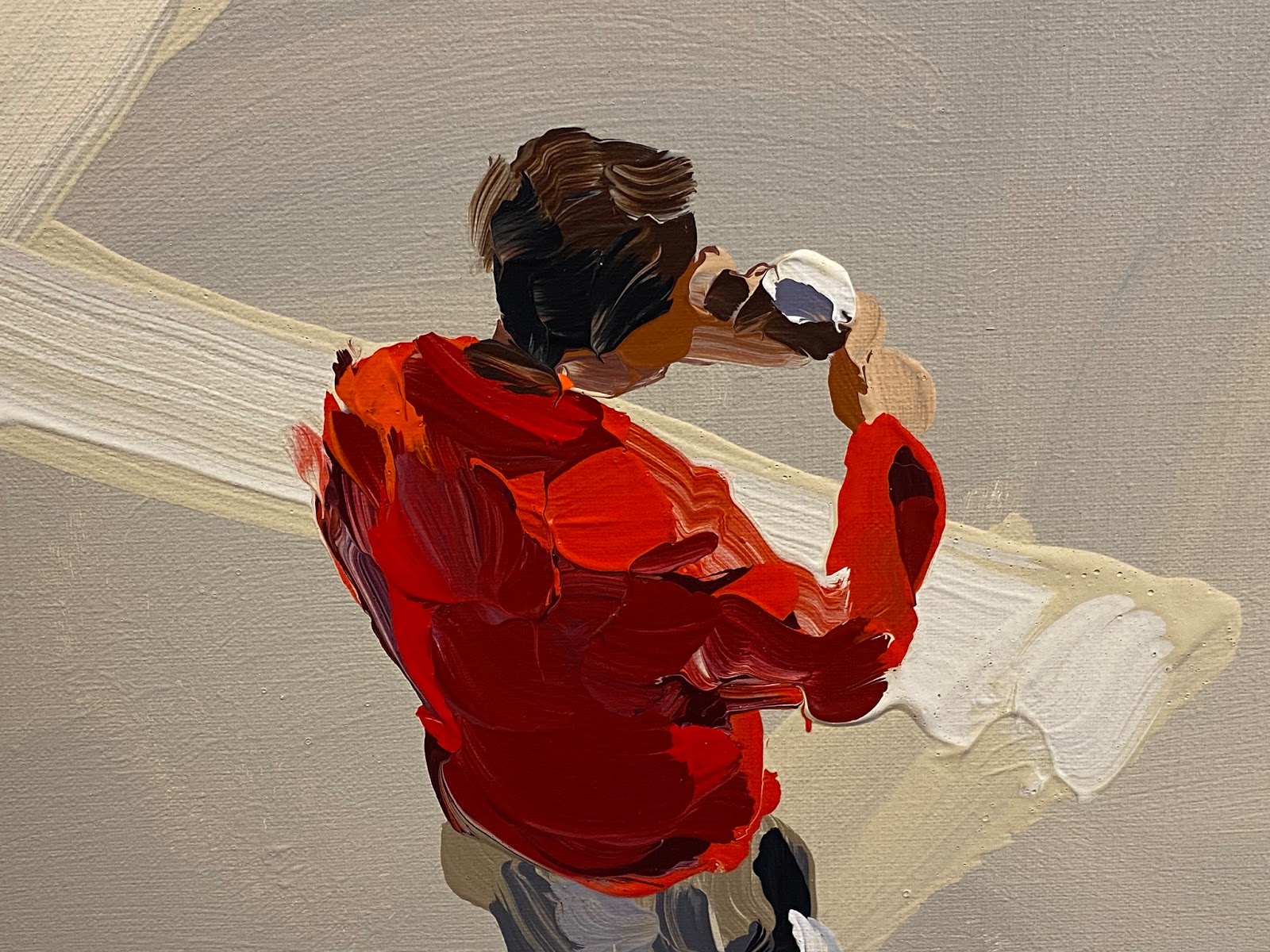
Since March 2023, I visited many art exhibitions and galleries. If I had to pick one or two highlights, it would be Jan De Vlieger at Mudel and the Inspired By Love expo at Belfius Art Gallery. Picture below is work by Emilie Terlinden.
Detail Jan De Vlieger’s San Marco People – picture by Petervan
Detail of Emilie Verlinden’s The Farm 2023 – Picture by Petervan
Also, the works of David Claerbout and his practice are a continuous inspiration for my own work. Here is a great talk by David at Schaulager Basel as part of the Out of the Box exhibition.
David Claerbout discusses a range of artworks, among them Nightscape Lightboxes (2002-2003), Wildfire (meditation on fire) (2001), and Backwards Growing Tree and Birdcage (both from 2023), the latter two on show at the Gallerie Greta Meert in Brussels till 3 Feb 2024.
What’s next?
I don’t know. Focus areas are:
The New New Babylon project
The upcoming solo exhibition in VR
The Performance
But some promising smoldering sparks deep in the campfire may suddenly light up. Life is full of surprises. Only the fool don’t change their mind.
So, that’s it for this edition.
Happy New Year to all of you!
If there is something worth reporting, the next update is for April 2024.
The AI GPT-2 Model generated the following story, just based on the input “One morning in August,”:
One morning in August, 1991, two brothers were gunned down in the Jezeville Mansion on Jarvis Street in Detroit. This is one of several incidents where teenage boys were shot and left to die of self-inflicted injuries. Eight boys were killed after being shot in one of those four blocks on Jarvis Street. Five boys were subsequently recovered from the fatal gunshot wound on at least one of those spots. The other three were shot in the neck when a loose-walled mess hit them. One of those victims, Sylvester A. Dunlap, was undoubtedly intimidated by the fact that he had been a member of a terrorist organization before the defeat of 9/11.
Recent developments in the confines of Detroit have raised serious issues in the policing of the inner city. Chancellor Bill Blair stated several times during a presentation that research on neighborhood policing by Chicago’s public safety department will reveal problems across the city that explain the difficulty of enforcing sentencing for murders in the inner city. Blair also explained several times during a lecture in Ferguson, Missouri that he would want to use new tools to combat dysfunctional policing. His city council initiated a similar program toward ending torture for prisoners, concessions to American values, and criticism of Milwaukee County’s police policies in view of the city’s record on abuse of black people and an opportunity to address community issues. Since 1991, free speech trends shift responsive to the challenges facing black people within the region.
Like parenthood, news of new families and better education, mothers have no choice but to speak out. Their voices are heard every single Friday. Police lead agencies with, in fact, one of the longest serving party members in the entire country. This week the Detroit police chief announced that the highly visible Sunday soap operas of Salton Skelton will now be, by contrast, competitions for white children’s news. Please read the full article and consider donating to liberal blockbusters. Click here to support Indiegogo. What happens when you pry members of the guest activist ranks at the bottom of the parade? To fight only if, rather than an anti-black thing that goes next, you see a pattern of action.
One of the obvious reasons for the historical beauty of American democracy is that sometimes you almost expect people to perform one of the most aggressive and deliberately aggressive things imaginable outside of their own best interest. With a witch hunt, for example, one of death row inmates, Jared E. Souza, is described as both a teacher and a world class dancer. Eleven years later he was convicted of five counts of attempted murder by a female slave, including all counts of conspiracy. This in turn became an outlier for people incredulously, most notably in 1997 at the April 30, 1969, riots that marred all half-black-white citizens of American culture and led many to question just how African American society should be judged in a medical system that educates persons of color and not the idea of violent crime.
Laura Naumann, an assistant attorney general of the lower East Side of Detroit, estimates that 2.2 million people of color are incarcerated annually in the United States. Most incarcerated black people now have improved their status as citizens this year. About 10 percent of Chicago’s juvenile population comes from nonwhite. Black lives matter when living conditions only affect one’s race and language. What causes more crime? For example, though crime statistics show all people arrested last year on a rape charge tend to mean that one’s work can be disproportionately incarcerated. If you live in a barn, you have to subject the homeless to work and find work alone. If you live in a newer suburb, nearly every Hispanic won’t be able to vote that bad. In fact, many blacks are making it possible to vote a lot less than white Americans. And those unsupervised black men don’t actually have the blacks of color that The Mayor of Detroit led during “due process” legislation in the high-crime area of Detroit, one of the greatest systemic failures of any American society.
Today, the only way for African Americans to help our society is to remember that black men are also the only radical and peaceful voice in the revolutionary world. For instance, Harvard Law School professor Drew Doucette recently noted that black men and women are after-school most days of school; organizers sponsored several in-school free workshops, such as public-school online resources recording lessons, where black people were irrationally punished in the classroom.
If you are black, this is something you can do and do, but expect to see the strength of the movement, the power and involvement of black men in the struggles of communities worldwide. Violence on Our Streets As Cyrus Sadie writes of Wall Street: “Tragically, while there is no truly “safe” place for black men and women in our society today, many appear to be spending their financial time being unable to tell a large portion of the story in communities that are marginalized by racial discrimination
Auto-generated by GPT-2 using https://runwayml.com/ – “Machine Learning for Creators”. It is basically AI-as-a-service in the cloud. It just took 10667ms, on a standard Wifi internet connection, and a Mac.