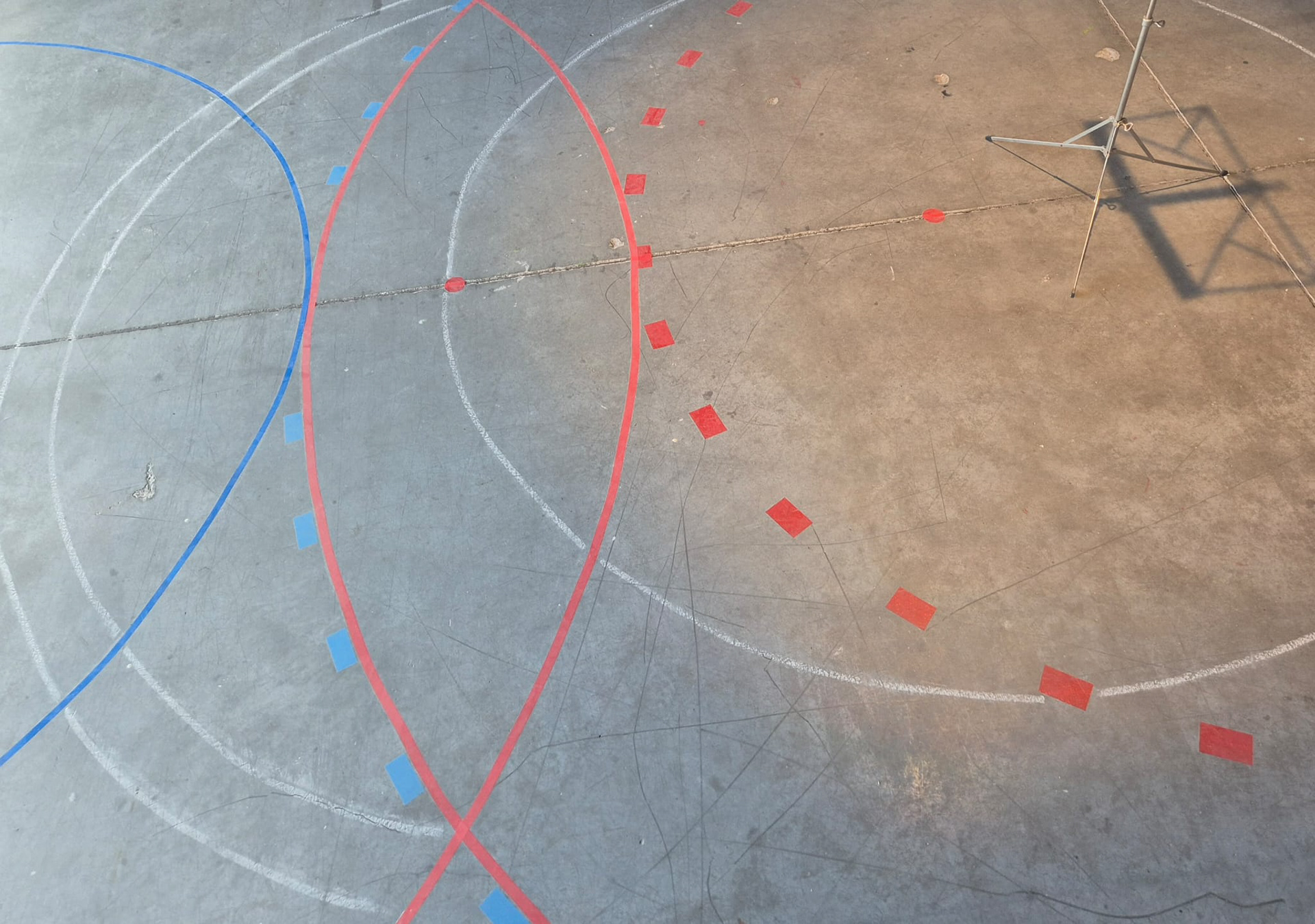
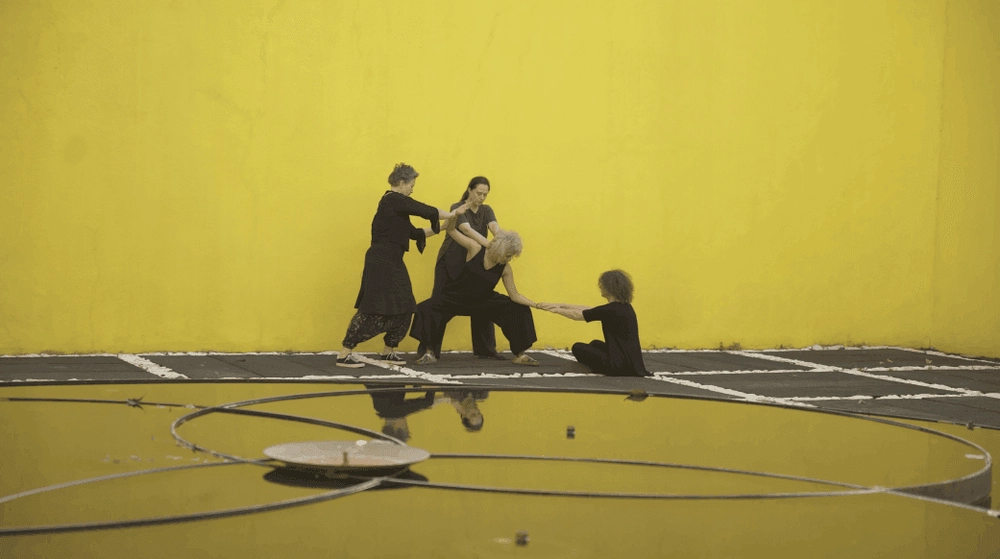
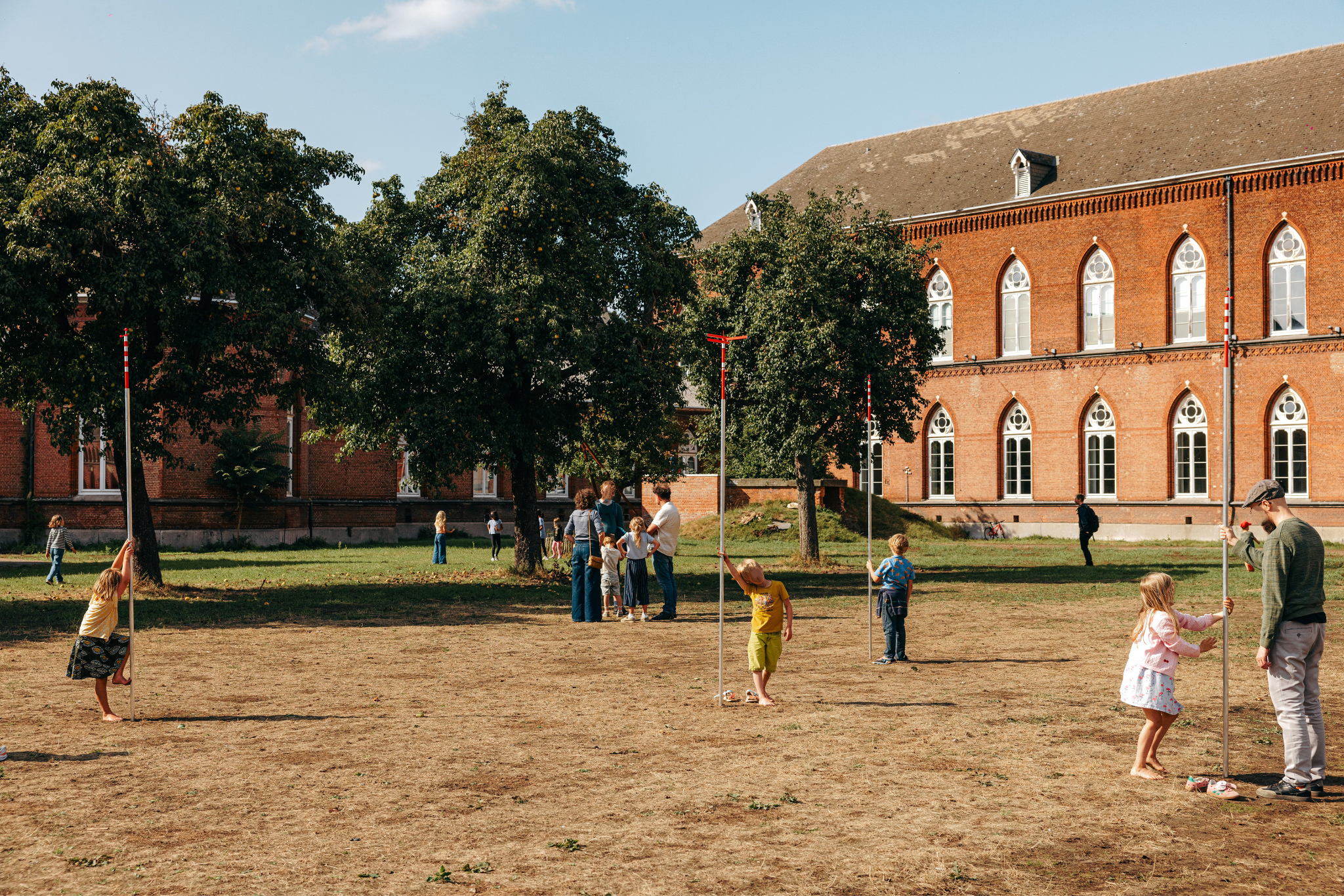
As promised in my blog on NOOR’s work, here is another angle at the magic symbiosis between sports, arts, and technology.
Today, I would like you to meet Marc Bogaerts, a 75-year old rebellious choreographer and artistic director who has worked with more than 50 dance, opera, and circus companies worldwide. He is renowned for his fondness for creating unconventional combinations on stage and drawing inspiration from a wide range of subjects. Many of his projects combine several styles – e.g., opera, ballet, stationary art, ballroom dancing, ice dancing, breakdancing, and nouveau circus – to build bridges between different types of physical expression. Have a look at his portfolio, bio, and achievements on his website Bogaerts Productions. He used to travel the world, with home base in Berlin and Antwerp. He has now retreated – but not retired – into a home container on a farm somewhere in the middle of nowhere in Flanders.
Like NOOR, he also combines sports and art. I have been in regular conversations with Marc since 2022. Now, I believe the time has come to share some exciting opportunities around a concept he invented: Human Powered Vehicles (HPVs). Marc is very intense. He radiates energy. Here he is:
There are many ways to approach this, and Marc generously gave me the ground-idea to explore possibilities in the artistic/entertainment scene. Marc just promoted me as his artistic curator for the Arts and Culture domain.
What are Human Powered Vehicles?
In the past, Marc worked for Cirque du Soleil, renowned for its spectacular shows featuring predominantly gymnastic acrobats. But in Marc’s vision, gymnastics is “only” one of some 120 sports that can be combined with art and technology. This broader concept led to the idea of Cirque des Sports. Human Powered Vehicles are one expression of that vision.
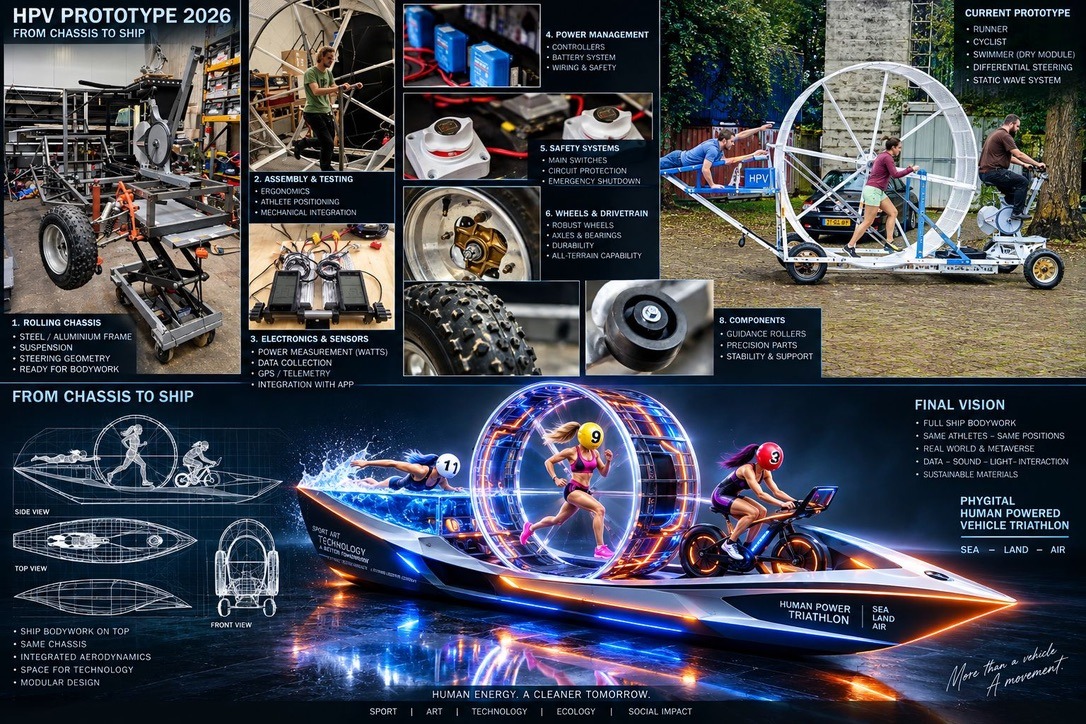
Human Powered Vehicles (HPVs) are spectacular, eye-catching phygital vehicles powered by human movement, with electric power (E-power) providing additional support when needed. Designed as a symbiosis of sport, art, science, and green technology, they can embody Olympic disciplines—for example, the running, swimming, and cycling elements of the Triathlon HPV. At the same time, HPVs can function as highly visible marketing platforms, artistic expressions, and powerful tools for social and environmental campaigns.
Physical human energy is captured and translated into real-time data. That data then drives a range of advanced digital, visual, and physical effects, turning human effort into an immersive, highly visible experience.
All HPVs are built around one central, unifying principle: human emotion.
Below are a concept video, created two years ago, and a behind-the-scenes video showing how we brought the concept to life.
Status of the project
A small-scale prototype has been built. It has been deployed at several events. The prototype is large enough to host the three athletes to power the system.
Now that the prototype has proven the technical feasibility, we believe we are ready to start building the full-scale monumental HPV.
Opportunities
The Human Powered Vehicle (HPV) is framed as much more than a vehicle—it is a “travelling multi-sensory living laboratory” and an “ark of human innovation”. By combining physical human effort, real-time biometric data, clean energy, and immersive technology, the HPV opens up 10 distinct fields of opportunity:
Orthopedic Technology, Rehabilitation & Veterans Support
Interactive Museums & “Cobot Art” Co-Creation
What are we looking for?
We are looking for passionate partners willing to bring the vision of HPVs and the ark of human innovation to life.
Persons, institutions, and artists who want to integrate the HPVs into their creations
Venues, museums, galleries, etc. interested in organizing expos about the history and making-of of HPVs (there are beautiful maquettes, drawings, and animations that are artistic in their own right). The prototype in itself can be exposed as an artistic creation.
Any organisation willing to explore a trinity of some kind. Can be the trinity of the three sports of triathlon, but also other trinities such as the trinity of Home Sapiens, Homo Faber, and Homo Ludens; the trinity of the past, the present, and the future; the trinity of space, time, and place.
We are also looking for partners that can help us with part 2 of the project:
Creating the monumental version of the HPVs
Adding the digital layers
Integrating into existing productions
Creating the humanly unthinkable
If interested, please contact me via the usual channels.
Petervan’s Musical Ride September 2026 – 51 songs. Recent releases from Amelie Lens, Oscar Later, and Lambrini Girls. Oldies from Alana Dante, Red Zebra, and Silver Apples. Play in shuffle mode to increase the surprise factor. Enjoy!
With that background, I would like to dive a little deeper into other aspects of her research and explore how a new way of becoming raises the question of what is worth measuring.
NOOR’s research
Her work is based on five theoretical pillars:
Pillar I: Achievement Motivation and the Competition State
Pillar II: Gendered Body Comportment and Relational Embodiment
Pillar III: Kinetic Awareness versus Functional Alienation
Pillar IV: The Language of the Body as Resistance
Pillar V: Institutional Power and Tacit Knowing
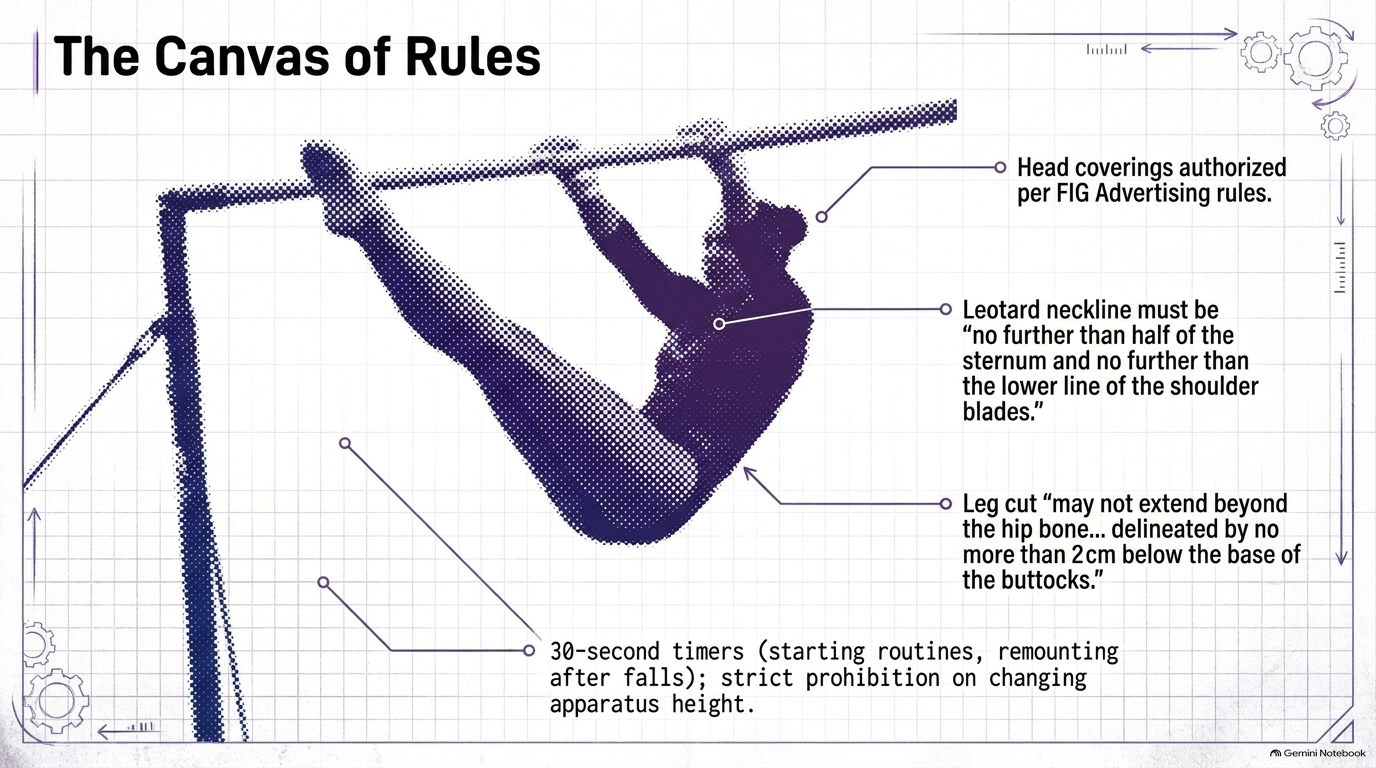
If we zoom in on Pillar II, we see that high-performance sports such as Women’s Artistic Gymnastics demand a highly disciplined environment. This “limited intentionality” is not merely psychological; it is materially and institutionally produced through regulations that physicalize discipline. By restricting a neckline to “half of the sternum” or a leg cut to the “hip bone,” these regulations physically delimit the female athlete’s bodily presence, prescribing not only how her body may appear but also the spatiality of its movement and reach.
Contrastingly, the “new embodiment” argues for relationality. Instead of an isolated, disciplined body performing for an external score, NOOR envisions a body that exists in relation to its community and its own internal state.
The measurable body is reduced to a numerical sequence, a “data point” in a governed script, and a series of technical skills to be deducted by a jury. By contrast, NOOR’s thesis suggests a “Lived Body”, a “Lived Experience”: the body uses its own language, prioritizes the “desire to understand,” and embraces the vulnerability of a “broken rule” as a moment of liberation.
Under Pillar III, she challenges the reduction of bodies in elite sport to quantifiable units—fragments of movement extracted, coded, and rendered legible for judicial consumption. Here, the focus is on the static state: the Coded Body. The official Code of Points (COP) is by the WAG (Women’s Artistic Gymnastics). The COP transforms the routine into an “extinction of the moment”: what is experienced as continuous, kinetic movement is captured as a series of discrete, measurable outcomes. Skills are stripped of their temporal and embodied flow, translated instead into numerical sequences that can be evaluated, compared, and scored.
NOOR’s Running Score” is an ontology of becoming . It is an “evolving total” that refuses the finality of the judge’s verdict. This shift is punctuated by the project’s use of generative logic to replace judicial logic with a methodological script that documents the continuity of experience rather than the error of the result.
All this made me reflect on what is worth measuring. Spoiler: Instead of measuring the being, I suggest we find a way to measure the becoming. Let me build up the context for this proposition. And to manage your expectations: there is no answer. It is an invitation for debate and conversation.
Homo Ludens
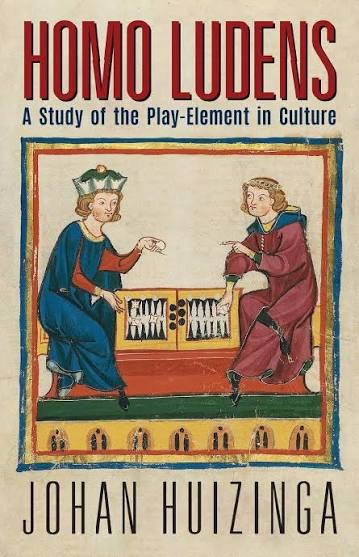
In Johan Huizinga’s Homo Ludens, a game (or play) is defined as “a voluntary, absorbing activity carried out within certain fixed limits of time and place, according to freely accepted rules, and attended by a feeling of tension, joy, and a consciousness that it is ‘different’ from ordinary life.”
Huizinga argues that civilization does not come from play; rather, culture arises in and as play. He demonstrates that foundational elements of society—such as law, warfare, poetry, philosophy, and art—developed out of ancient ritual contests and rule-bound social play long before they became institutionalized
Huizinga’s “magic circle” describes the physical or psychological space where a game takes place and where the rules of the real world are temporarily suspended. Within this circle, a new set of rules, meanings, and logic applies that holds no weight in ordinary life.
In modern game design, the magic circle represents the psychological barrier where a player enters a state of immersion. Inside this boundary, the virtual world feels real, and the stakes matter to the player.
Game or play is a way of becoming
Finite/Infinite Games
In Finite/Infinite Games, philosopher James P. Carse explores the idea that all human interactions and behaviors can be viewed through the lens of two distinct types of “games.”
Carse introduces his thesis in the very first line of the book: “A finite game is played for the purpose of winning, an infinite game for the purpose of continuing the play.”
Feature
Finite Games
Infinite Games
Primary Goal
To win (which ends the game)
To keep playing and prevent the game from ending
Boundaries
Fixed temporal, spatial, and numerical limits
Boundless; open and expanding
Rules
Fixed and agreed-upon; changing them breaks the game
Dynamic and evolving; changed precisely to keep the play alive
Players
Known, select participants with clear opponents
Ever-changing roster; open to anyone
Examples
Sports, politics, war, getting a degree, corporate promotions
Culture, love, a career, learning, nature, life itself
NOOR’s new sports are infinite games.
Process Philosophy
Philosopher Whitehead is considered the godfather of Process Philosophy. Instead of a philosophy of being, he proposed a philosophy of becoming.
“Developed in his seminal 1929 bookProcess and Reality, this ontology argues that “becoming” is more fundamental than “being”—meaning the universe is a web of energetic, experiential events rather than a collection of passive, physical matter.”
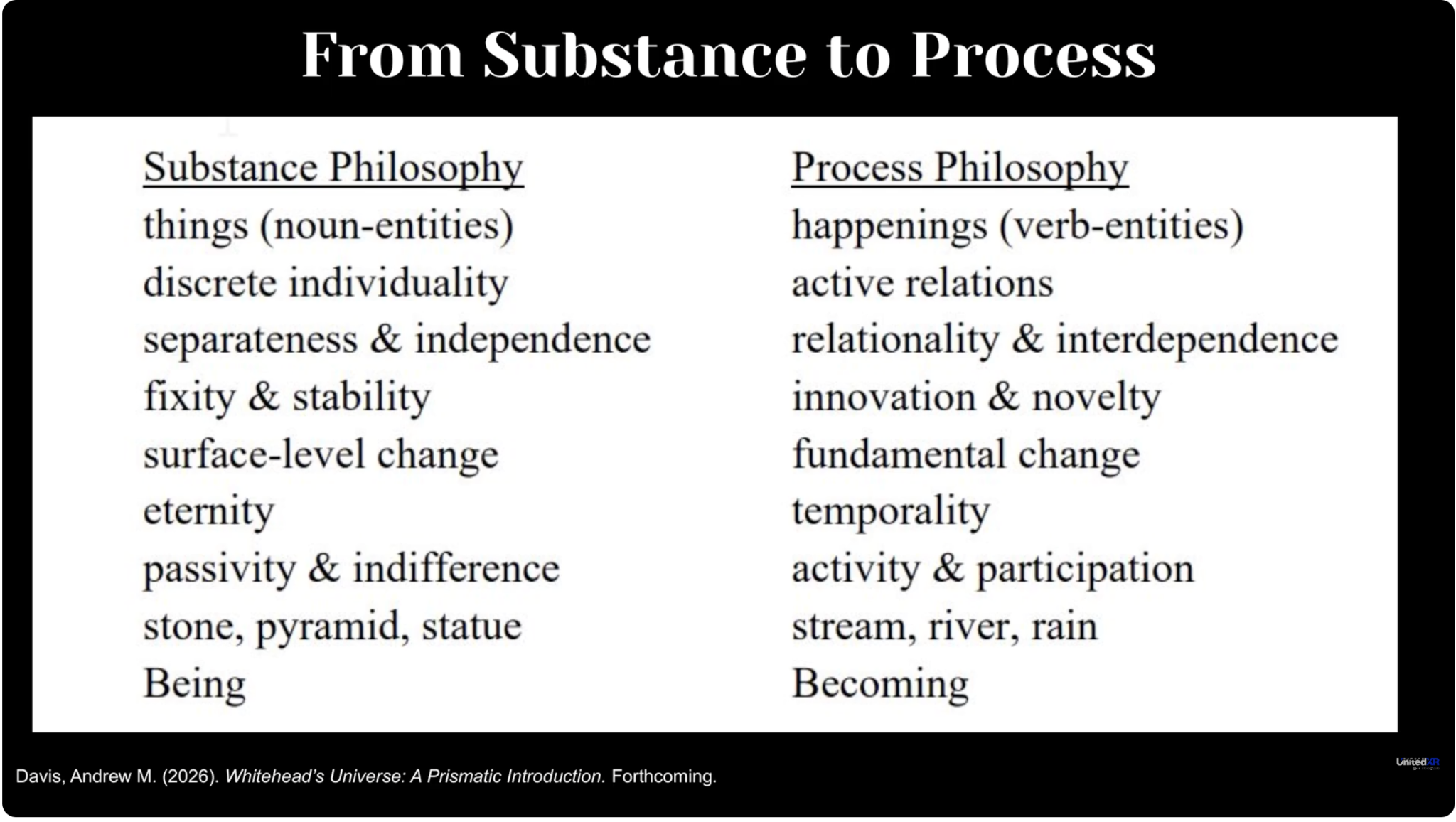
In his presentations on the four elements of the experiential design framework for immersive storytelling, Kent Bye draws an explicit connection to process philosophy. The slide below maps the foundational metaphysical scaffolding of a paradigm shift inspired by the philosophy of Alfred North Whitehead, contrasting traditional Substance Philosophy—centered on permanent, static “being”—with Process Philosophy—centered on dynamic, interconnected “becoming.”
It is precisely this shift, from being to becoming, that provides the philosophical foundation for NOOR’s work.
The slide is based on the work of process philosopher and theologian Dr. Andrew M. Davis, specifically serving as a visual graphic for his book Whitehead’s Universe: A Prismatic Introduction (published by Orbis Books).
Protocol Art
In NOOR’s work, the artist becomes a protocol designer, creating the conditions for others to instantiate endless variations of the work.
The Protocol is like the recipe, the stage, the score, the spec, the scripts, the primitives. The Instantiation is like the dish, the mixed outcome, the expression, the combinations of primitives. In that sense, Protocol Art is about delegating the instantiation. The artist becomes the composer. See also my 2019 post on “who is the composer?”
Which leads to another question: who is the instantiator? It can be craftsmen, it can be the audience, it can be machines, it can be Agents. In a sense, this is not new; already in the 17th century, Rubens was running his studio: the master has pupils working in his style, working with his protocols of mixing paint, making brushstrokes in certain ways, etc
Protocol Art expands this practice and gives attention to aspects like “Pattern Integrity”, “Style” of instantiation, etc. Christopher Alexander, anybody?
Agentworld and Superdark Factory
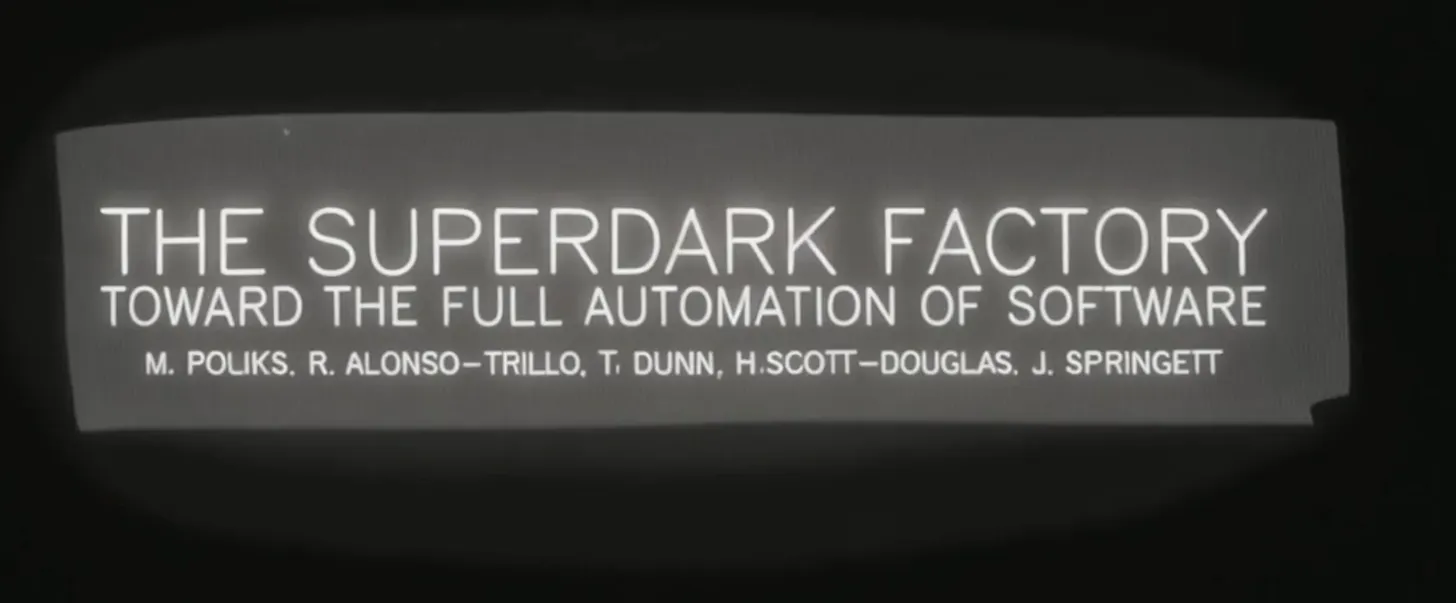
What if we also start delegating the work of the protocol composer, the architect of the experience? You would get something that resembles The Superdark Factory or the Agentworld of Antikythera.
In Superdark Factory (dark or superdark as in illegable, not-understandable), the Antikythera authors argue that the historical evolution of software engineering has reached a critical inflection point where conventional, human-governed software pipelines—characterised by manual oversight, explicit logic specification, and step-by-step human verification—impose severe structural bottlenecks on throughput, operational speed, and systemic capability.
Achieving a true step-change in productivity demands surrendering the requirement for direct human supervision within operational feedback loops, delegating both execution and architectural decision-making directly to computational machinery.
The Superdark Factory represents the limit case of this transition: an extreme, self-directed, recursively self-optimising software ecosystem. Operating as an autonomous abstract machine, the Superdark Factory independently formulates its own ambitions, designs and constructs the machinery required to pursue them, and continuously restructures and refines its own operations—without human intervention within its feedback loops.
Rather than merely executing static instructions, the Superdark Factory automates production at the level of determining what is worth producing, continuously generating new internal versions of itself to satisfy ambient imperatives. It is a “versioning regime that measures what the factory does rather than what it is”
In the Superdark Factory, we let the machine decide what is worth building.
What is worth measuring?
The world is in flux. Always has been. Maybe faster now than in the past, maybe at a different clock speed, incomprehensible and illegible for humans.
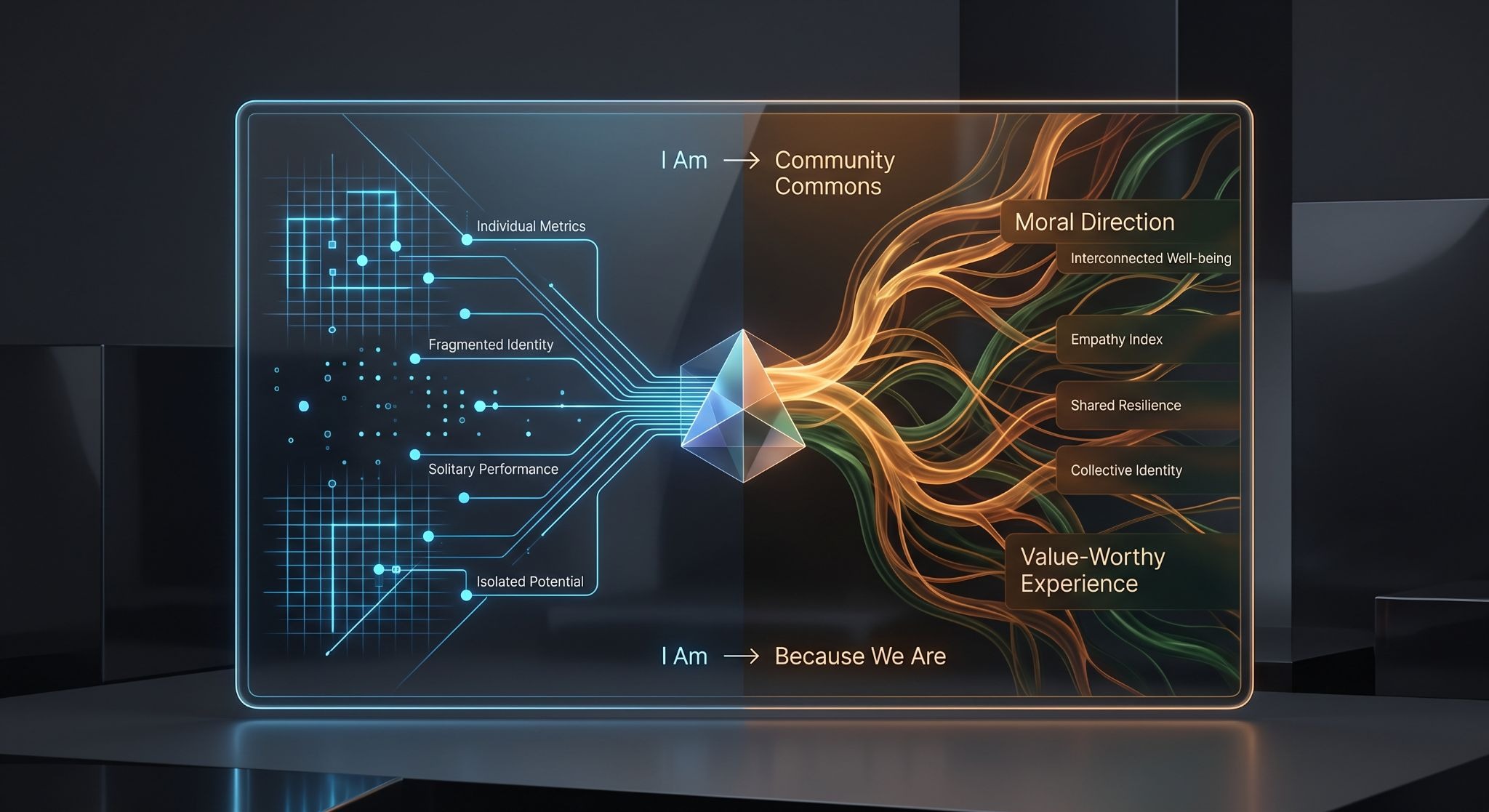
How can we measure flux? How can we measure becoming? How can we measure flow? How can we measure computation-in-action? Do we measure pattern integrity? Style? Direction (in many senses: backward/forward, progressive/regressive, moral/amoral, etc.)? Who sets the norms? Tech companies? A new kind of institution?
What do we consider as “valuable”? Should value be based on Western individuality? Or on communities/commons principles like Ubuntu or Hunhu? This AEON article was an eye-opener for me. Instead of focusing on trustworthy infrastructures, wouldn’t it be wiser to strive for value-worthy experiences, based on the social/cultural “needs” of humans? Values such as identity, reputation, community, and now maybe also values such as becoming, pattern integrity, and everything on the right side of the Whitehead/Davis slide?
There is no definitive answer. This post is an invitation to debate and conversation. But I find myself excited by the possibility of moving beyond the measurement of the static—the “being”—towards something that captures the dynamic, emergent quality of “becoming.”
At a recent family gathering, I learned that the grandchild of one of my nieces is studying at the School of Arts (KASK) in Ghent and is expected to complete her final master’s degree in 2027.
But the title could be misleading. NOOR’s work represents a critical intervention at the high-stakes intersection of elite athletic performance and contemporary artistic practice. This inquiry positions the “governed pedagogical space” of high-performance sport—specifically Women’s Artistic Gymnastics (WAG)—against the “rebellious act” of artistic creation. By deconstructing the rigid, judicial structures of elite sport, NOOR seeks to establish a theoretical and methodological framework for a “New Sport.”
The central research question interrogates how embodiment is shaped by the friction between a pervasive, patriarchal achievement culture and the necessity for female artistic sovereignty. She highlights the “Running Score” methodology—an evolving script that replaces static judgment with a continuous documentation of the developmental process.
This inquiry calls for a rigorous examination of the “Competition State”: a societal condition in which every action is measured against the ideal of perfection and the constant demand to prove one’s social value.
Especially at a time when AI is enabling humans to become ever more performant, competitive, and efficient, I believe her ambition can—and perhaps should—extend beyond “sport” as such. Her work has the potential to become a foundational critique of the hyper-competitive logic shaping both our personal and professional lives, while also proposing an alternative to it.
In this sense, her work could open up a much broader inquiry: How do we create a new way of becoming?
In addition to presenting an artistic in-situ performance, the deliverables of “Creating a New Sport” include a thesis and an artistic book documentary of her journey.
“an embodied social arts-based change methodology for making visible current reality and exploring emerging future possibilities. It includes a set of practices that synthesize embodied presence, movement theater, stillness, and dialogue. It reveals the wisdom in every social system and supports movement towards healthier futures.”
Or Ann Pendleton-Jullian’s work on “Design Unbound”, “Pragmatic Imagination”, and her FOUR (+1) Studios book (PDF) on “Studios”, where there is a whole section on game design and Homo Ludens (see pages 180 and following of FOUR(+1).
“Gameplay is the action associated with players making choices in the game environment. It is related to the sequential but interactive events of players operating in the rule-based site. It is the process of engagement of the game, while game design is the process of pre-engagement. It is the design of the rules for engagement. But game design can only be accomplished through playing the game as one is designing it.”
Also related is Venkat’s recent post on “The Curiously Playable Universe”. I am highly simplifying the thesis that when everything gets abstracted and possibly constructed (through AI and LLMs), then everything becomes “playable”.
“But perhaps the stranger discovery concerns the provinces: Wildernesses can be reliably turned into game boards. We domesticate the territory, become skilled at its game, build machinery that plays it better than we can, and move outward to construct another game around the first, domesticating a larger scope.
This happened to fields and livestock long before it happened to chess. It happened to trade before it happened to programming. It happened to mechanics before it happened to mathematical proof.
Artificial intelligence did not invent this strange property of reality. It is merely making it difficult not to notice.
The deepest surprise of the AI era may turn out not to be that intelligence was easier to manufacture than we thought. It may be that the universe is far more playable than we imagined.”
“Protocol Art is emerging as a practice in which the artwork is not a finite object but a set of rules that others (human or machine) instantiate into an indefinite number of unique works.”
“Protocolism revolves around the creation of “artistic protocols.” These protocols comprise sets of instructions and constraints meticulously crafted to guide the production of unique artworks. These protocols serve as the bridge between the two pivotal figures: the original artist (i.e. the “protocol artist”) and a diverse array of executors (both human and non-human) who instantiate these protocols into tangible creations that qualify as distinct artistic creations. This symbiotic relationship challenges conventional notions of artistic authorship, as the resulting artworks bear the unmistakable imprint of the protocol artist, along with that of the instantiating actors.”
“The artwork is not merely a final product, it is a process governed by instructions, representing the invisible architecture that enables the aesthetic experience. This shift in perspective – moving from the object to the system, and from the singular author to collaboration and ultimately human-machine co-creation – defines one of the most urgent territories in contemporary research.”
And also Rudy Rucker’s reflections on computationalism in The Lifebox, the Seashell, and the Soul comes to mind, where he explains that some computations are fully deterministic (aka based on clear, unambiguous rules) ànd unpredictable.
NOOR’s work is, maybe without knowing it, a crossover of all these contemporary disciplines and insights. Her work is a call for a rebellious act of non-conformism. Of humans being a bit “off-grid”. Not too perfect. In Digital Audio Workstations, there is even an option for “humanization” of something that is generated in the grid. If it is too perfect or without variation, it is boring. See my 2021 blog post Unsnap from the Grid https://petervanstudios.com/2021/03/09/unsnap-from-the-grid/
Her work is an invitation to the emergence of embodied experience and the liberation of human movement, taking sport as a point of departure while reaching toward possibilities far beyond it.
If you like her work as much as I do, please contact her here. And let me know if magic happens.
“Delicacies” is my incoherent, irregular, unpredictable collection of interesting sparks I came across online. Handpicked by a human, no robots, no AI. A form of tripping, wandering, dérivé, with some loosely undefined theme holding them together. Delicacies have no fixed frequency: I hit the publish button when there is enough material. That can be after a week or after 3 months. No pressure, literally. Enjoy!
About Architectures of Possibility – a long and great essay by Ana Brzezinska on what immersive design can learn from the Great Reform, architectural utopias, and the lost optimism of the 20th century.
Petervan’s Musical Ride August 2026 – 37 songs only. Recent releases from ICA, De Staat, and Squirrel Flower. Oldies from William Orbit, Grauzone, and Andrew Wheaterall. Lots of experimental as well. Play in shuffle mode to increase the surprise factor. Enjoy
We are now in the grant phase. The deliverables for this phase are:
An AI-Based Analysis of Supporting, Contradictory, and Complementary Resources
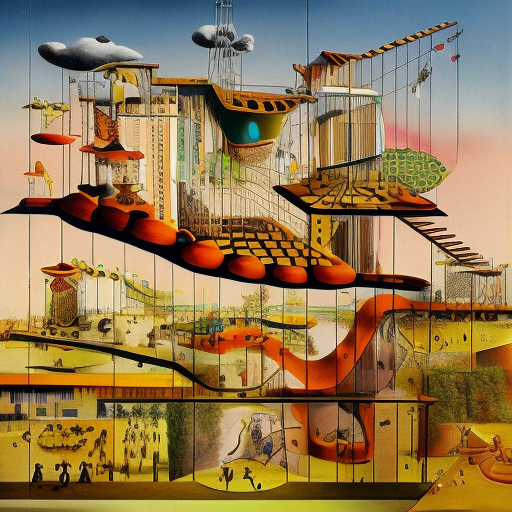
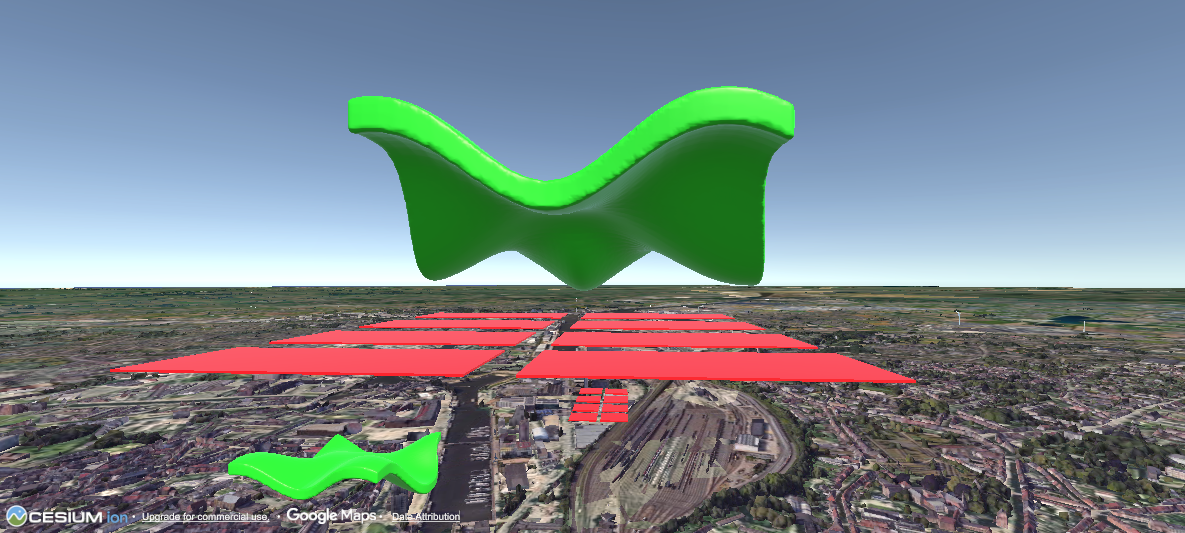
An artistic XR rendering of a New New Babylon on top of an existing city or city district
Art Expo (minimum Online, ideally IRL)
Art Book
I am trying to get the first two done, or at least well-developed, by year-end.
AI-based Analysis
I have been experimenting with Google’s NotebookML – now Gemini Notebook. I uploaded some 70 resources about:
Constant’s New Babylon from 1950ies
21st-century criticism of his work
Architectural reflections about urbanism
Urbanism and memory research from the Protocol Institute
Some cybernetics material related to Gordon Pask and his conversational protocol
Gemini Notebook generated the following summary, but it seems to miss the cybernetics material – at least in this summary – but this is probably due to the 50-source limit under the free plan.
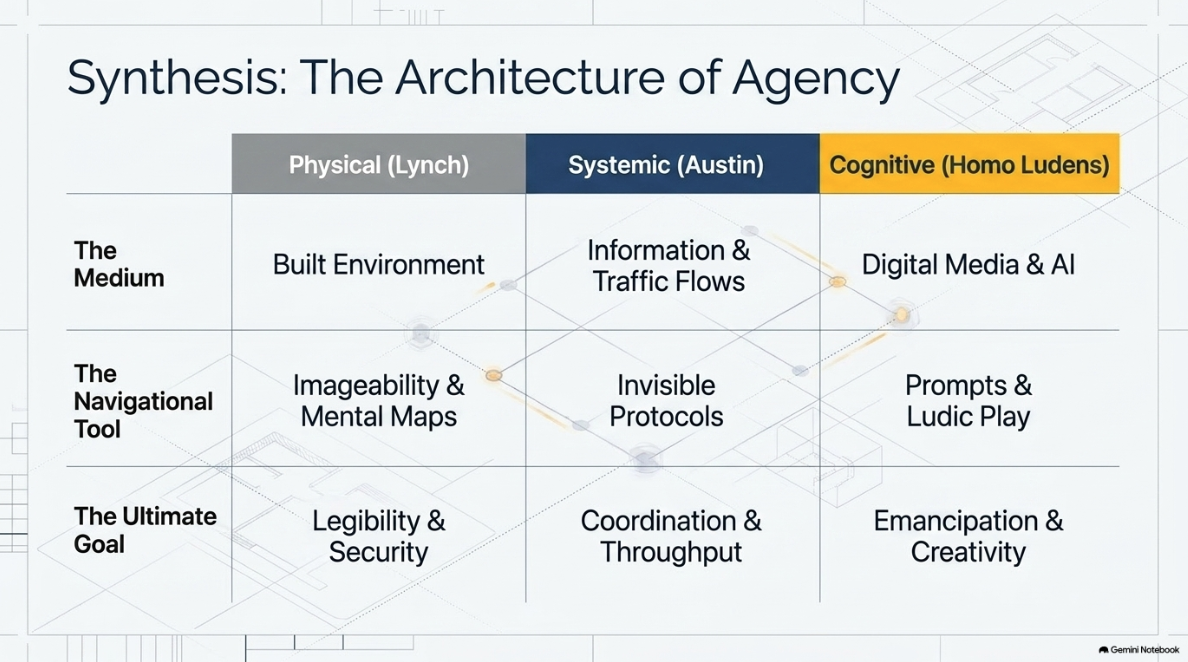
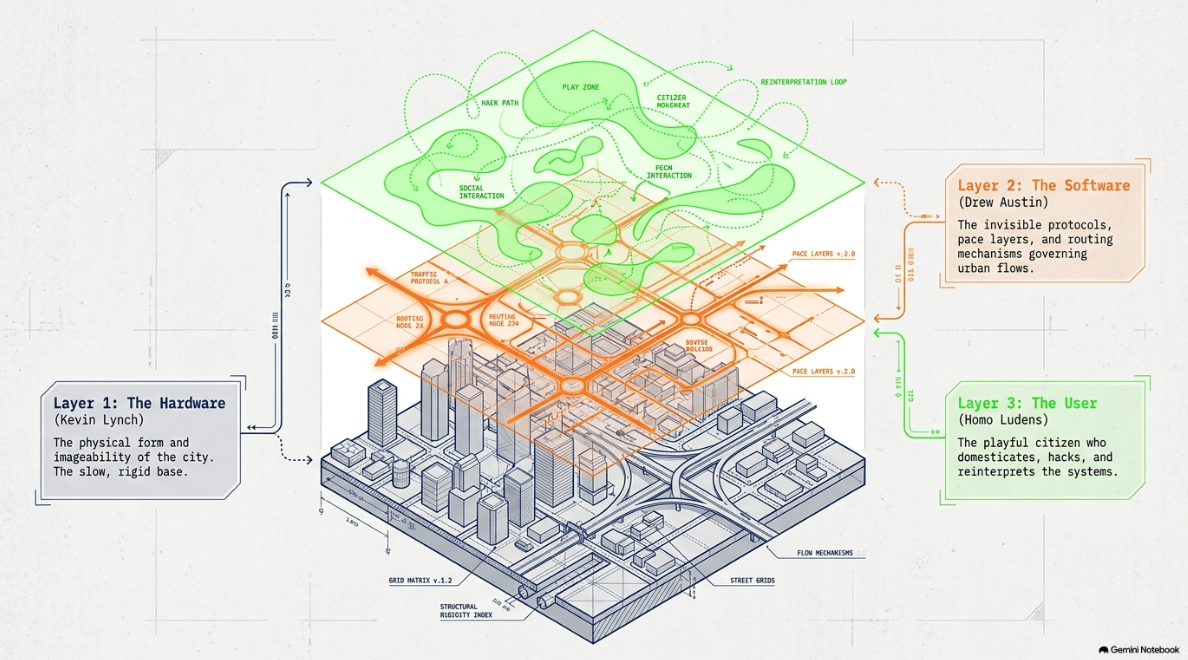
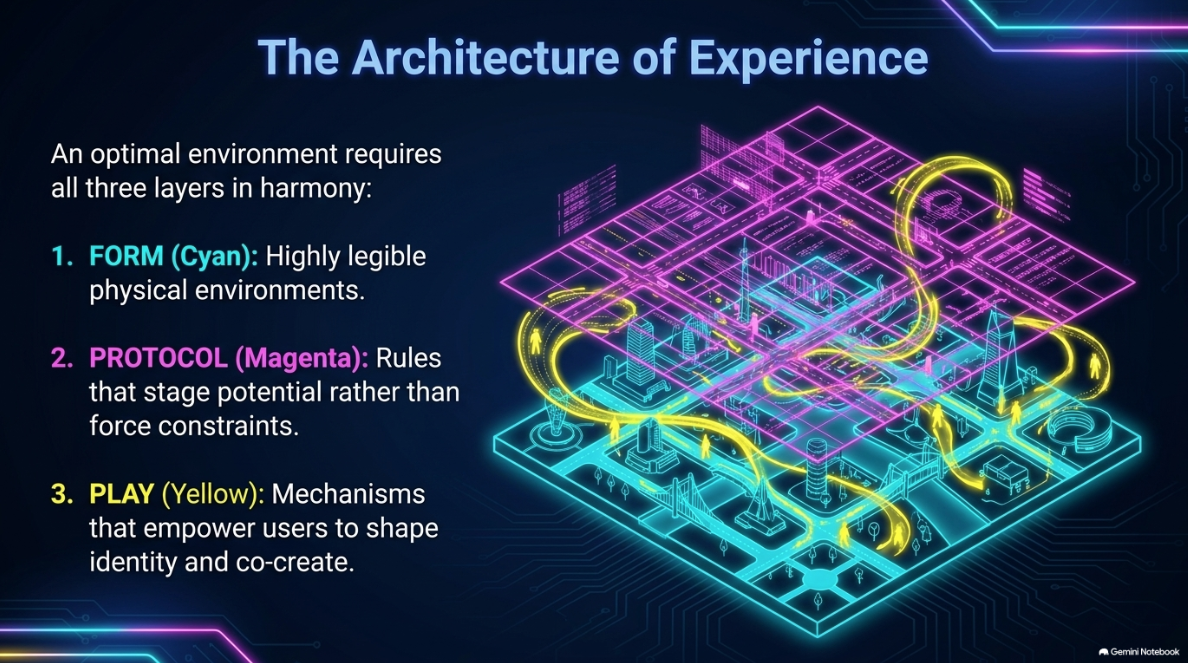
“These sources explore the intersection of urban design, digital media, and human identity, primarily focusing on how play and structured environments shape our perception of the world. Kevin Lynch introduces “imageability” to describe how clear physical layouts, such as paths and landmarks, help residents build mental maps and feel emotionally secure. Building on this, Valerie Frissen and others examine “Homo Ludens 2.0,” a concept where digital connectivity and gamification allow users to experiment with their identities within virtual landscapes. Drew Austin bridges these ideas by analysing protocols, like the urban street grid, which act as invisible “software” managing the tension between rigid infrastructure and fluid human behaviour. Together, the texts suggest that whether through physical architecture or digital platforms, the rules and forms governing our surroundings profoundly influence how we navigate, create, and relate to one another. Overcoming protocol failure or urban chaos requires a deeper understanding of these interactive systems and their impact on the human experience.”
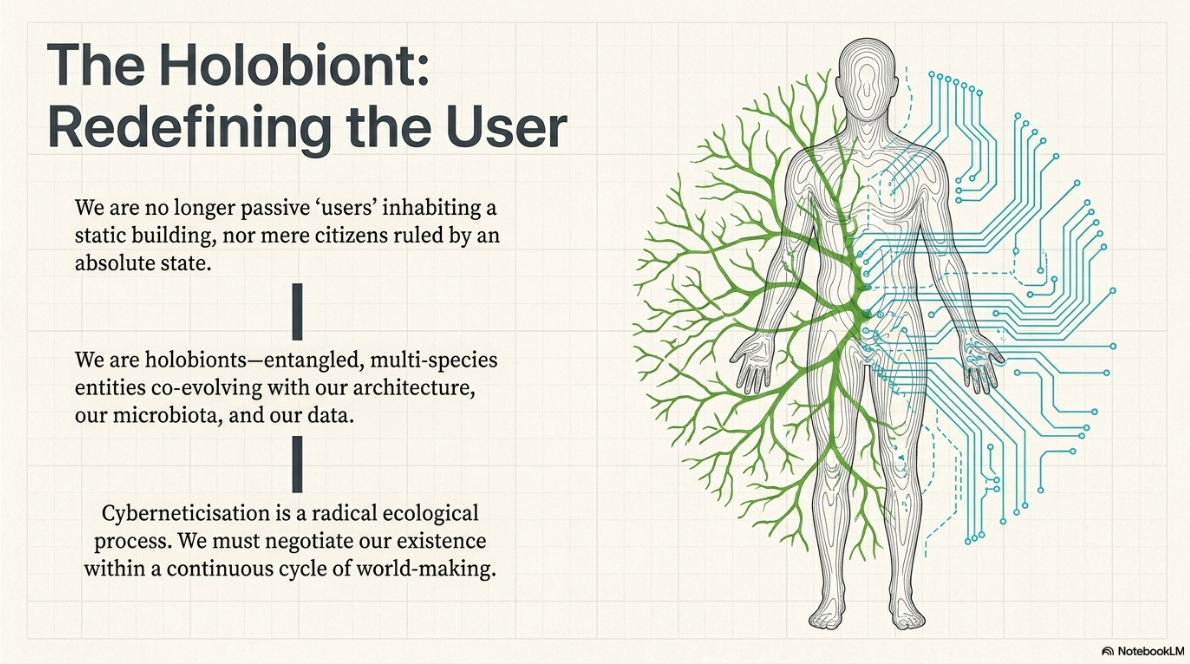
Gemini Notebook generated some very interesting reports, slides, visuals, and blog posts that I will share on this blog in the coming weeks. Below are some teasers.
The idea here is to virtually create a layer – the city of play – above the city of Ghent (could be any city in the world). I am experimenting with the Cesium open platform for creating powerful 3D geospatial applications. Testing in both the Unity and Unreal Engines. The plan is for the layered city of play to be composed of self-sculpted shapes, created in Blender or Nomad Sculpt. Ideally with 3D audio on top, but that is a nice-to-have. An alternative would be to leverage the material of Spectracities.
If you think this is interesting and want to contribute to the project – in money or in kind – drop me a note. Feel free to comment. To stay updated, subscribe to the blog.
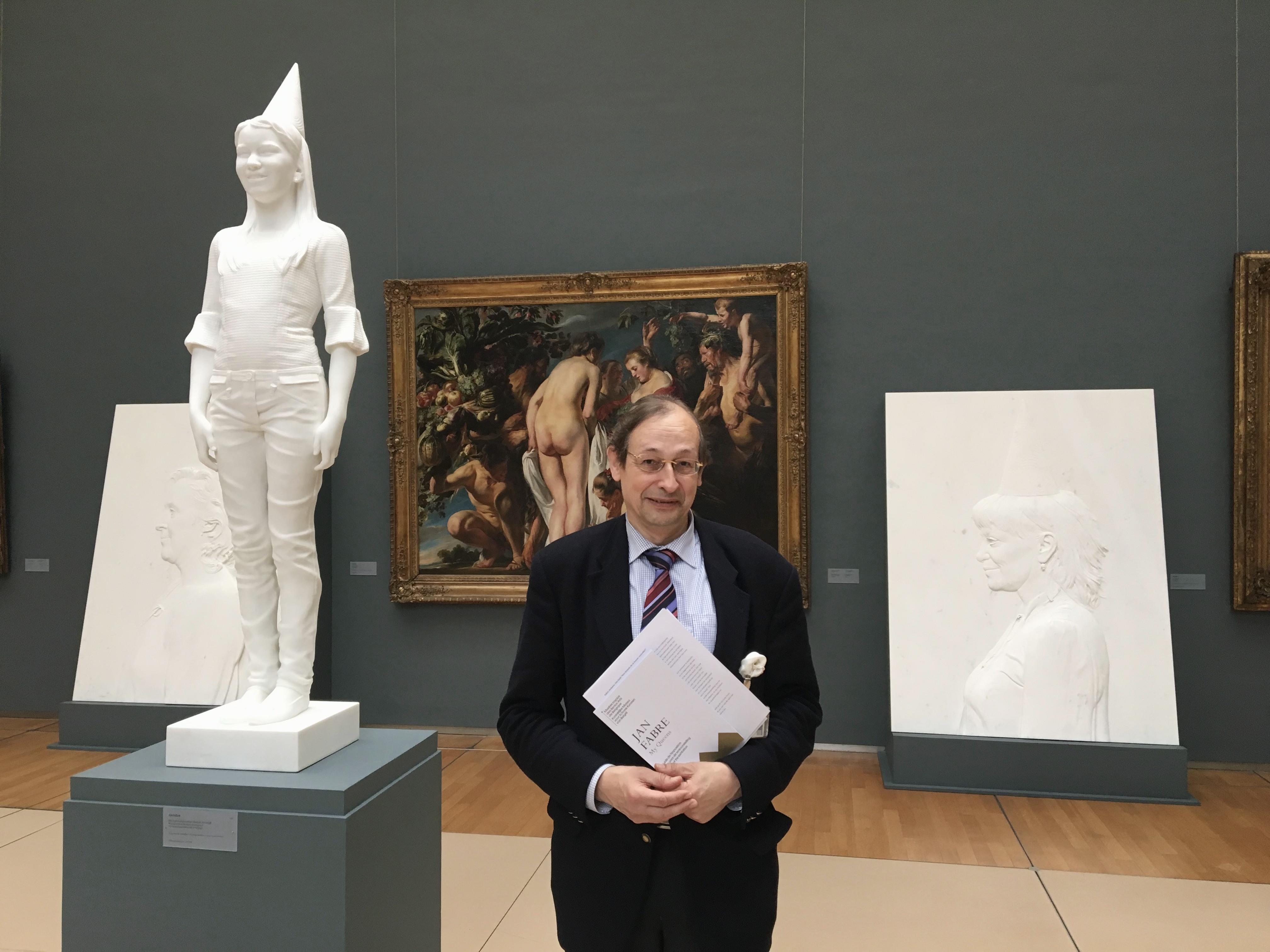
This is a repost of a LinkedIn article by Josie Gibson, summarizing a call about Art and AI with my cousin Joost, former senior curator at the Royal Museum of Fine Arts in Brussels. Joost is an expert in the paintings of the Old Masters, and he also serves as a Vice President of the UNESCO International Committee on the History of Art. He continues to lead groundbreaking collaborative projects like the Jordaens Van Dyck Panel Paintings art historical initiative.
Joost in front of a Jordaens and Carrara marble bas-reliefs from Jan Fabre’s My Queens, an expo he curated for the Royal Museum of Fine Arts in Brussels in 2018
How do new tools and technologies shape how we see ourselves and create meaning? Art has long been at the jagged edge of adaptation, but with its velocity and reach, artificial intelligence (AI) is challenging art and art-making in new and unique ways, according to Joost Vander Auwera, leading art historian and cultural researcher.
In a riveting session of The Catalyst Network, we were treated to insights from live debates across the art world on issues such as provenance, ownership, authenticity, identity and ethics in the AI era.
Joost’s opening comment sums up where we find ourselves: ‘Art is at the centre of (these debates) because it focuses on the difference between AI and the human mind. It’s created, art… by a human being who knows mortality, life, memory, embodied experience and existential responsibility. This is something AI does not have.’
I was invited to share some of my experiments with creative tools, including AI, exploring how they have supported art-making and performance, as well as reflecting on the current limitations of these technologies.
Example of endlessly repeating audio/video installation by Petervan
Historical context matters. ‘Originality’ in the 17th century was very different to how we think about it today, Joost points out. Then it wasn’t uncommon for artists to create several versions of the same painting, and when they had a major painting in the studio, it might be reworked to adapt to a new style and market. ‘We have to not take what we see now,’ he cautions, ‘as being absolute in art.’
Art is at the forefront of society and social memory and evolves with the times, public tastes, and tools. There are, however, universal elements in how we experience art.
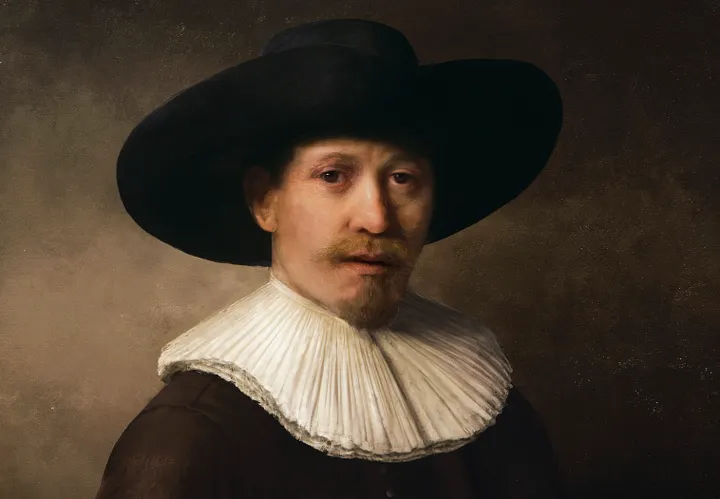
Joost recalled one early experiment where all Rembrandt’s paintings were loaded into an AI application to produce a ‘new’ Rembrandt. ‘The painting they created had all the stylistic aspects of Rembrandt, for sure, but it is a boring painting.’ He pointed out the AI Rembrandt was the common denominator of the previous paintings of Rembrandt, the opposite of what Rembrandt does: more with less. So, a real Rembrandt is ‘more with less’, and AI is ‘less with more’.
The Next Rembrandt – created by AI in 2011
These artists mastered the techniques then went beyond, capturing an essence of human experience that’s currently beyond the reach of AI.
That said, AI is making quantum leaps, and Joost highlighted the need for (human) critical thinking to combat the shadow sides of technology. A brilliant conversation on how we create collective memories and why it matters.
Original text by Josie Gibson, slightly adapted and complemented by some images by Petervan