
In my latest post, I introduced you to the work of NOOR, who is creating a new sport. I suggested that her work could open up a much broader inquiry: How do we create a new way of becoming?
With that background, I would like to dive a little deeper into other aspects of her research and explore how a new way of becoming raises the question of what is worth measuring.
NOOR’s research
Her work is based on five theoretical pillars:
- Pillar I: Achievement Motivation and the Competition State
- Pillar II: Gendered Body Comportment and Relational Embodiment
- Pillar III: Kinetic Awareness versus Functional Alienation
- Pillar IV: The Language of the Body as Resistance
- Pillar V: Institutional Power and Tacit Knowing
If we zoom in on Pillar II, we see that high-performance sports such as Women’s Artistic Gymnastics demand a highly disciplined environment. This “limited intentionality” is not merely psychological; it is materially and institutionally produced through regulations that physicalize discipline. By restricting a neckline to “half of the sternum” or a leg cut to the “hip bone,” these regulations physically delimit the female athlete’s bodily presence, prescribing not only how her body may appear but also the spatiality of its movement and reach.
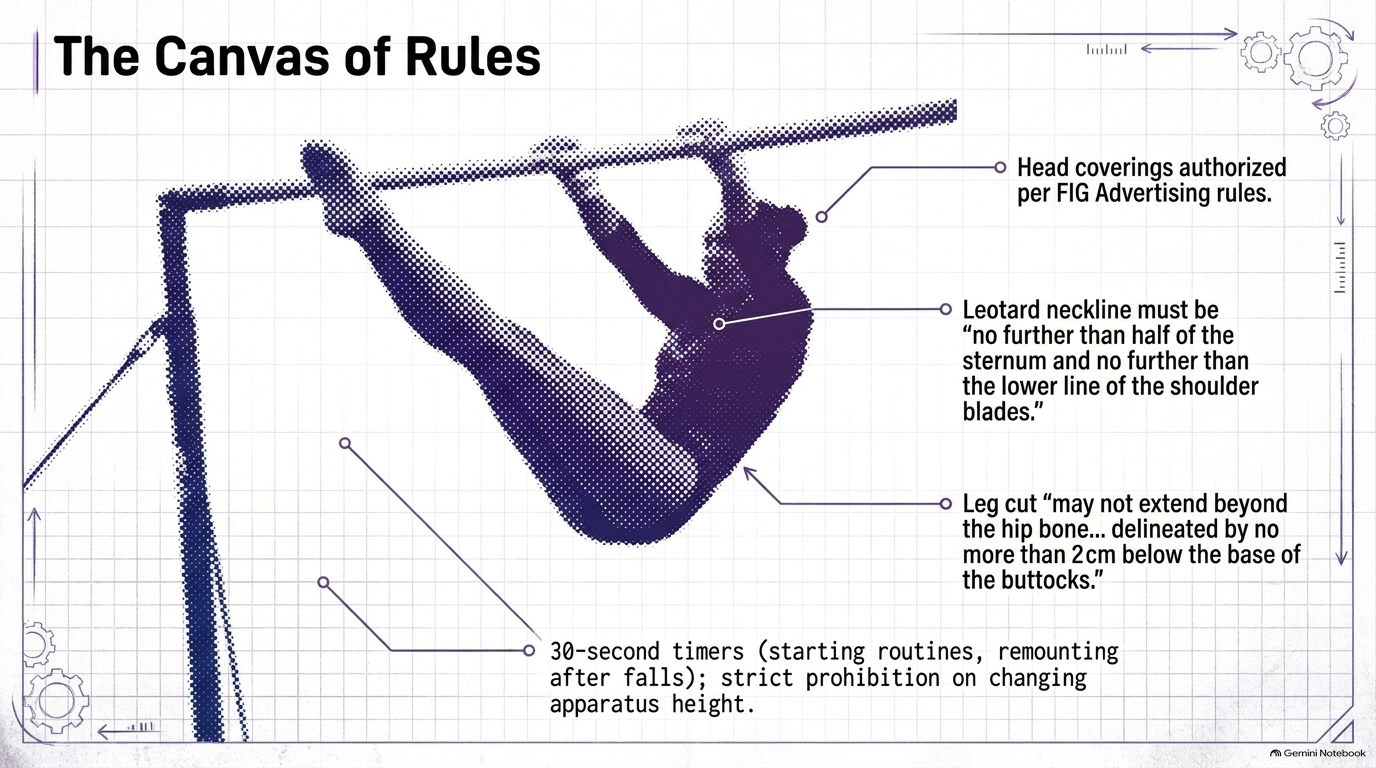
Contrastingly, the “new embodiment” argues for relationality. Instead of an isolated, disciplined body performing for an external score, NOOR envisions a body that exists in relation to its community and its own internal state.
The measurable body is reduced to a numerical sequence, a “data point” in a governed script, and a series of technical skills to be deducted by a jury. By contrast, NOOR’s thesis suggests a “Lived Body”, a “Lived Experience”: the body uses its own language, prioritizes the “desire to understand,” and embraces the vulnerability of a “broken rule” as a moment of liberation.
Under Pillar III, she challenges the reduction of bodies in elite sport to quantifiable units—fragments of movement extracted, coded, and rendered legible for judicial consumption. Here, the focus is on the static state: the Coded Body. The official Code of Points (COP) is by the WAG (Women’s Artistic Gymnastics). The COP transforms the routine into an “extinction of the moment”: what is experienced as continuous, kinetic movement is captured as a series of discrete, measurable outcomes. Skills are stripped of their temporal and embodied flow, translated instead into numerical sequences that can be evaluated, compared, and scored.
NOOR’s Running Score” is an ontology of becoming . It is an “evolving total” that refuses the finality of the judge’s verdict. This shift is punctuated by the project’s use of generative logic to replace judicial logic with a methodological script that documents the continuity of experience rather than the error of the result.
All this made me reflect on what is worth measuring. Spoiler: Instead of measuring the being, I suggest we find a way to measure the becoming. Let me build up the context for this proposition. And to manage your expectations: there is no answer. It is an invitation for debate and conversation.
Homo Ludens
In Johan Huizinga’s Homo Ludens, a game (or play) is defined as “a voluntary, absorbing activity carried out within certain fixed limits of time and place, according to freely accepted rules, and attended by a feeling of tension, joy, and a consciousness that it is ‘different’ from ordinary life.”
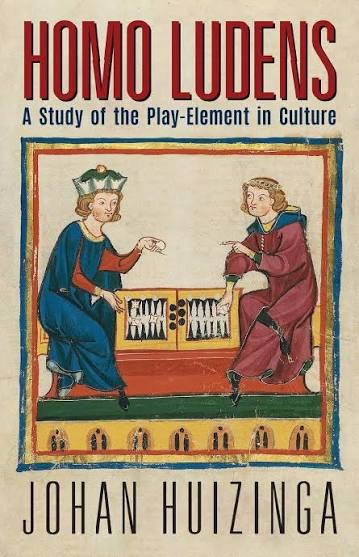
Huizinga argues that civilization does not come from play; rather, culture arises in and as play. He demonstrates that foundational elements of society—such as law, warfare, poetry, philosophy, and art—developed out of ancient ritual contests and rule-bound social play long before they became institutionalized
Huizinga’s “magic circle” describes the physical or psychological space where a game takes place and where the rules of the real world are temporarily suspended. Within this circle, a new set of rules, meanings, and logic applies that holds no weight in ordinary life.
In modern game design, the magic circle represents the psychological barrier where a player enters a state of immersion. Inside this boundary, the virtual world feels real, and the stakes matter to the player.
Game or play is a way of becoming
Finite/Infinite Games
In Finite/Infinite Games, philosopher James P. Carse explores the idea that all human interactions and behaviors can be viewed through the lens of two distinct types of “games.”
Carse introduces his thesis in the very first line of the book: “A finite game is played for the purpose of winning, an infinite game for the purpose of continuing the play.”
| Feature | Finite Games | Infinite Games |
| Primary Goal | To win (which ends the game) | To keep playing and prevent the game from ending |
| Boundaries | Fixed temporal, spatial, and numerical limits | Boundless; open and expanding |
| Rules | Fixed and agreed-upon; changing them breaks the game | Dynamic and evolving; changed precisely to keep the play alive |
| Players | Known, select participants with clear opponents | Ever-changing roster; open to anyone |
| Examples | Sports, politics, war, getting a degree, corporate promotions | Culture, love, a career, learning, nature, life itself |
NOOR’s new sports are infinite games.
Process Philosophy
Philosopher Whitehead is considered the godfather of Process Philosophy. Instead of a philosophy of being, he proposed a philosophy of becoming.
“Developed in his seminal 1929 book Process and Reality, this ontology argues that “becoming” is more fundamental than “being”—meaning the universe is a web of energetic, experiential events rather than a collection of passive, physical matter.”
In his presentations on the four elements of the experiential design framework for immersive storytelling, Kent Bye draws an explicit connection to process philosophy. The slide below maps the foundational metaphysical scaffolding of a paradigm shift inspired by the philosophy of Alfred North Whitehead, contrasting traditional Substance Philosophy—centered on permanent, static “being”—with Process Philosophy—centered on dynamic, interconnected “becoming.”
It is precisely this shift, from being to becoming, that provides the philosophical foundation for NOOR’s work.
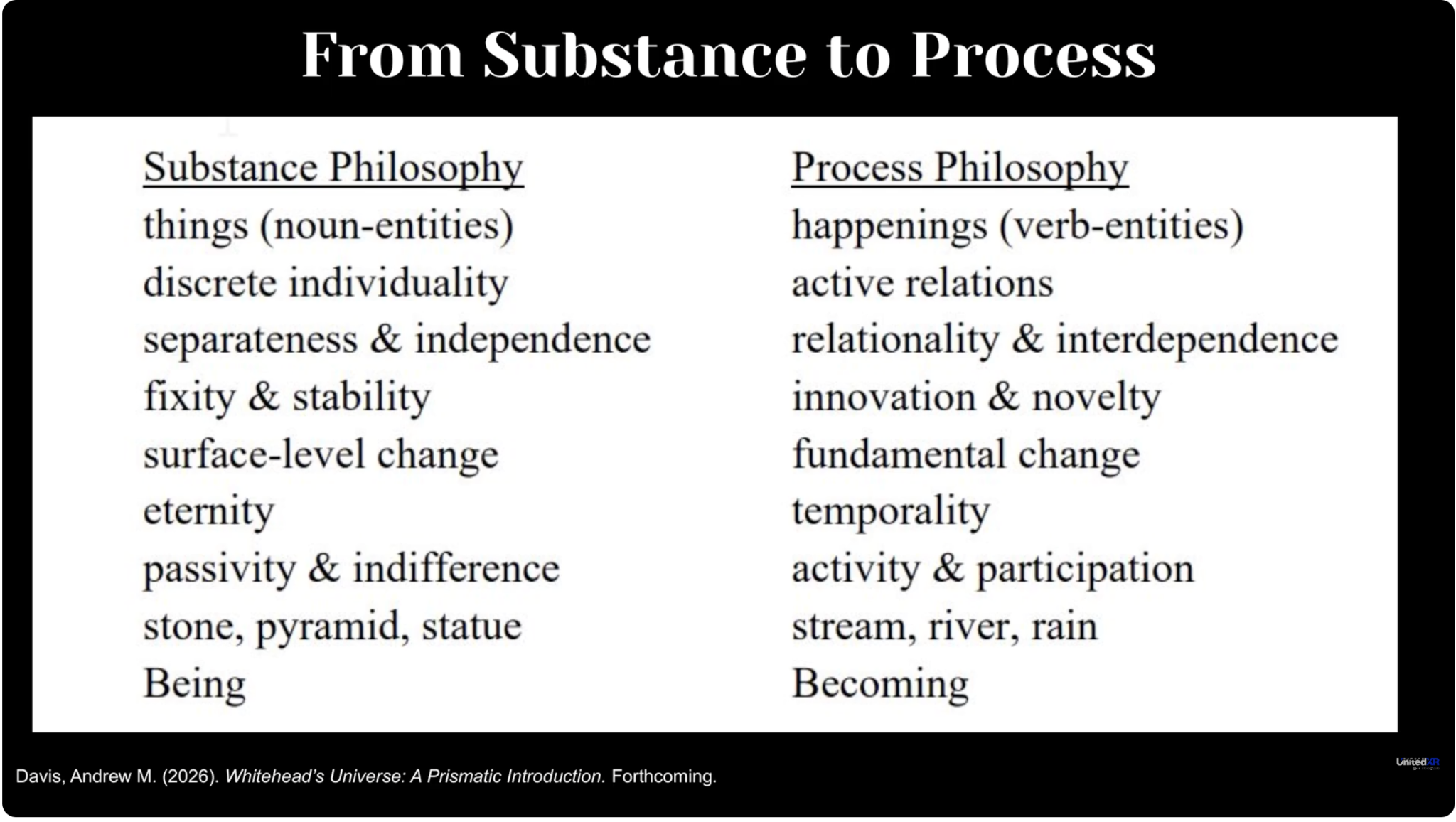
The slide is based on the work of process philosopher and theologian Dr. Andrew M. Davis, specifically serving as a visual graphic for his book Whitehead’s Universe: A Prismatic Introduction (published by Orbis Books).
Protocol Art
In NOOR’s work, the artist becomes a protocol designer, creating the conditions for others to instantiate endless variations of the work.
The Protocol is like the recipe, the stage, the score, the spec, the scripts, the primitives. The Instantiation is like the dish, the mixed outcome, the expression, the combinations of primitives. In that sense, Protocol Art is about delegating the instantiation. The artist becomes the composer. See also my 2019 post on “who is the composer?”
Which leads to another question: who is the instantiator? It can be craftsmen, it can be the audience, it can be machines, it can be Agents. In a sense, this is not new; already in the 17th century, Rubens was running his studio: the master has pupils working in his style, working with his protocols of mixing paint, making brushstrokes in certain ways, etc
Protocol Art expands this practice and gives attention to aspects like “Pattern Integrity”, “Style” of instantiation, etc. Christopher Alexander, anybody?
Agentworld and Superdark Factory
What if we also start delegating the work of the protocol composer, the architect of the experience? You would get something that resembles The Superdark Factory or the Agentworld of Antikythera.
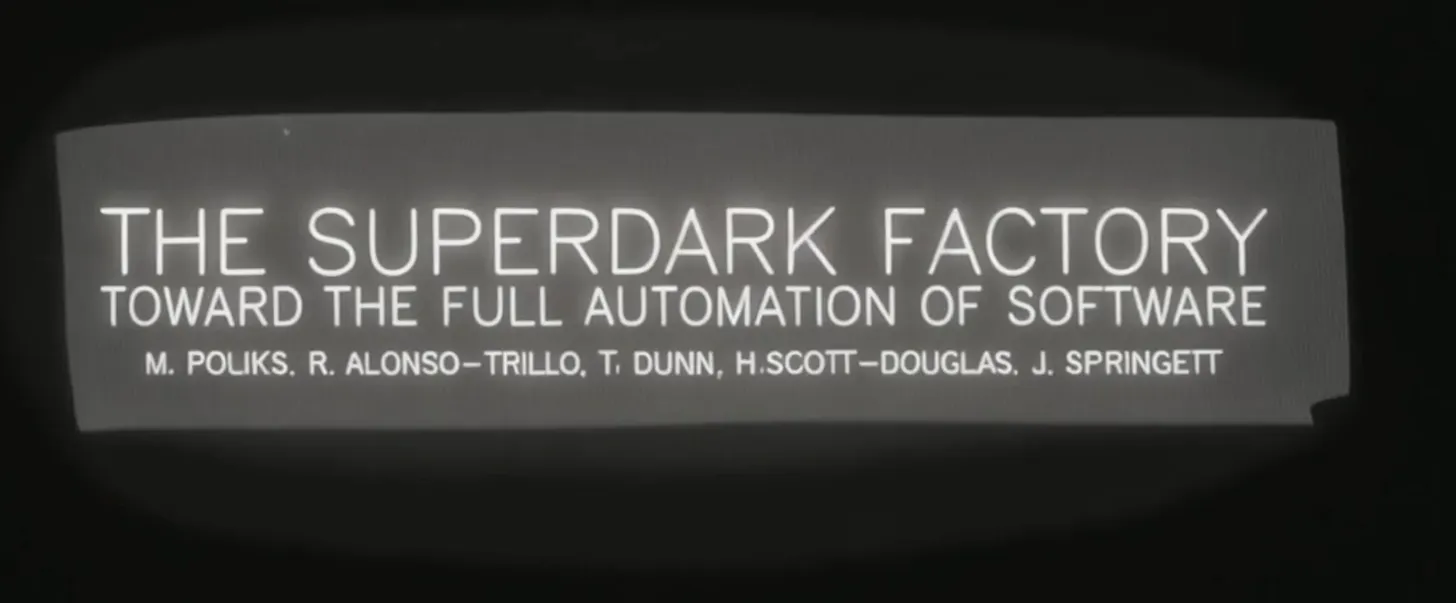
In Superdark Factory (dark or superdark as in illegable, not-understandable), the Antikythera authors argue that the historical evolution of software engineering has reached a critical inflection point where conventional, human-governed software pipelines—characterised by manual oversight, explicit logic specification, and step-by-step human verification—impose severe structural bottlenecks on throughput, operational speed, and systemic capability.
Achieving a true step-change in productivity demands surrendering the requirement for direct human supervision within operational feedback loops, delegating both execution and architectural decision-making directly to computational machinery.
The Superdark Factory represents the limit case of this transition: an extreme, self-directed, recursively self-optimising software ecosystem. Operating as an autonomous abstract machine, the Superdark Factory independently formulates its own ambitions, designs and constructs the machinery required to pursue them, and continuously restructures and refines its own operations—without human intervention within its feedback loops.
Rather than merely executing static instructions, the Superdark Factory automates production at the level of determining what is worth producing, continuously generating new internal versions of itself to satisfy ambient imperatives. It is a “versioning regime that measures what the factory does rather than what it is”
In the Superdark Factory, we let the machine decide what is worth building.
What is worth measuring?
The world is in flux. Always has been. Maybe faster now than in the past, maybe at a different clock speed, incomprehensible and illegible for humans.
How can we measure flux? How can we measure becoming? How can we measure flow? How can we measure computation-in-action? Do we measure pattern integrity? Style? Direction (in many senses: backward/forward, progressive/regressive, moral/amoral, etc.)? Who sets the norms? Tech companies? A new kind of institution?
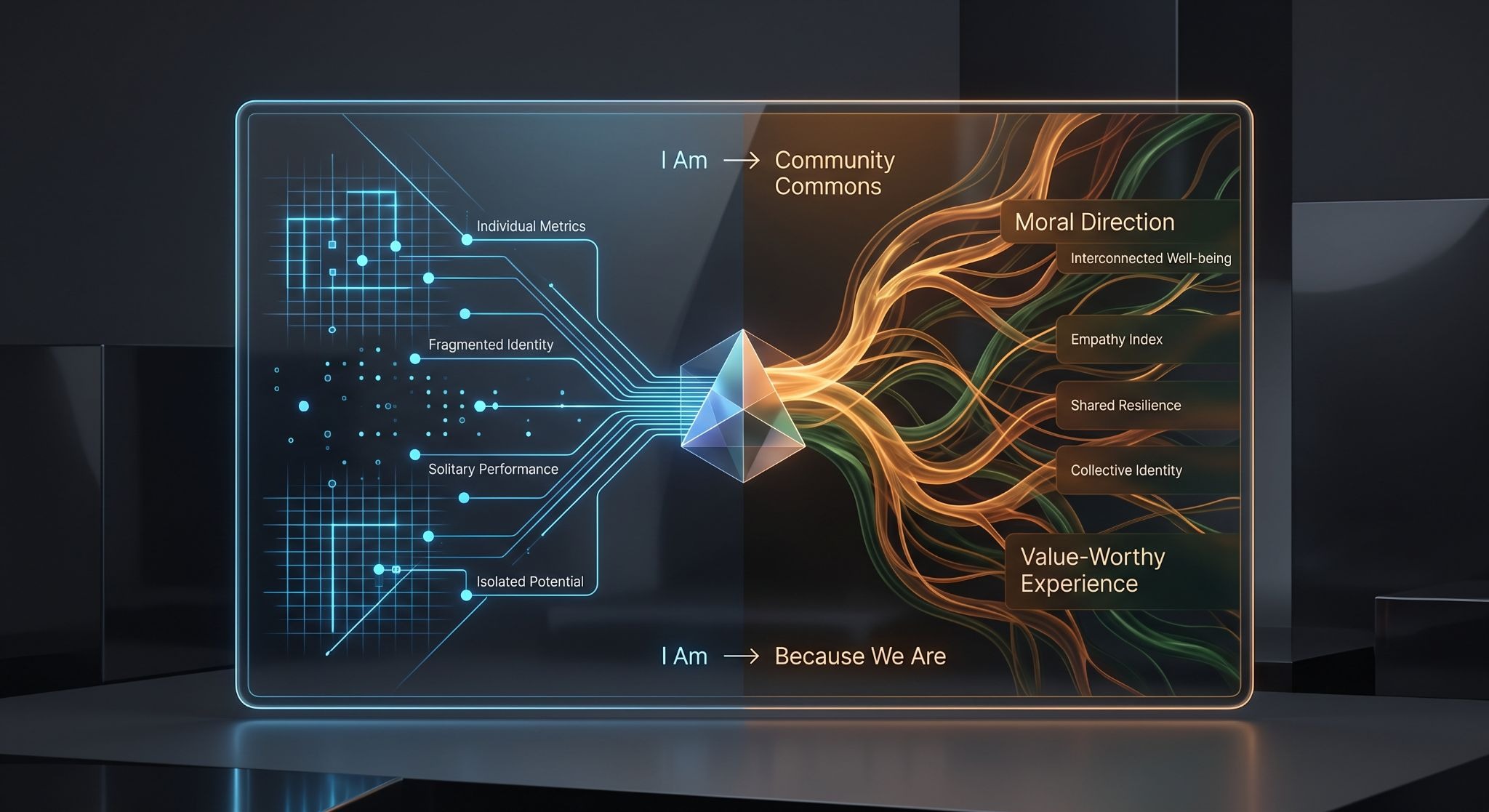
What do we consider as “valuable”? Should value be based on Western individuality? Or on communities/commons principles like Ubuntu or Hunhu? This AEON article was an eye-opener for me. Instead of focusing on trustworthy infrastructures, wouldn’t it be wiser to strive for value-worthy experiences, based on the social/cultural “needs” of humans? Values such as identity, reputation, community, and now maybe also values such as becoming, pattern integrity, and everything on the right side of the Whitehead/Davis slide?
There is no definitive answer. This post is an invitation to debate and conversation. But I find myself excited by the possibility of moving beyond the measurement of the static—the “being”—towards something that captures the dynamic, emergent quality of “becoming.”


Pingback: Inspiration: NOOR is creating a new sport | Petervan Studios