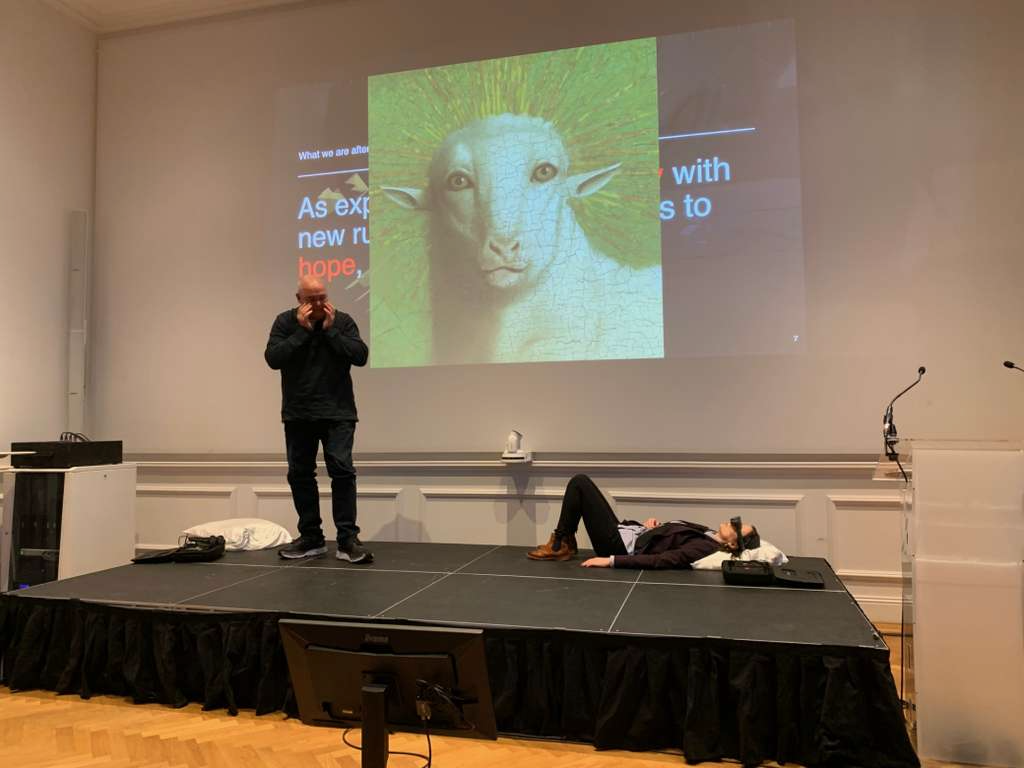
On 9 Dec 2025, Andreea and I gave a “talk” about our journey and lessons learned in creating The Forbidden Question. Rather than a talk, it was a performance about the performance. The talk also includes a speaking lamb from Van Eyck’s famous 1432 Ghent Altarpiece. See the lamb in the video of our talk below. At the end, you will also see a strange character running away with the stolen 12th panel of the Altarpiece.
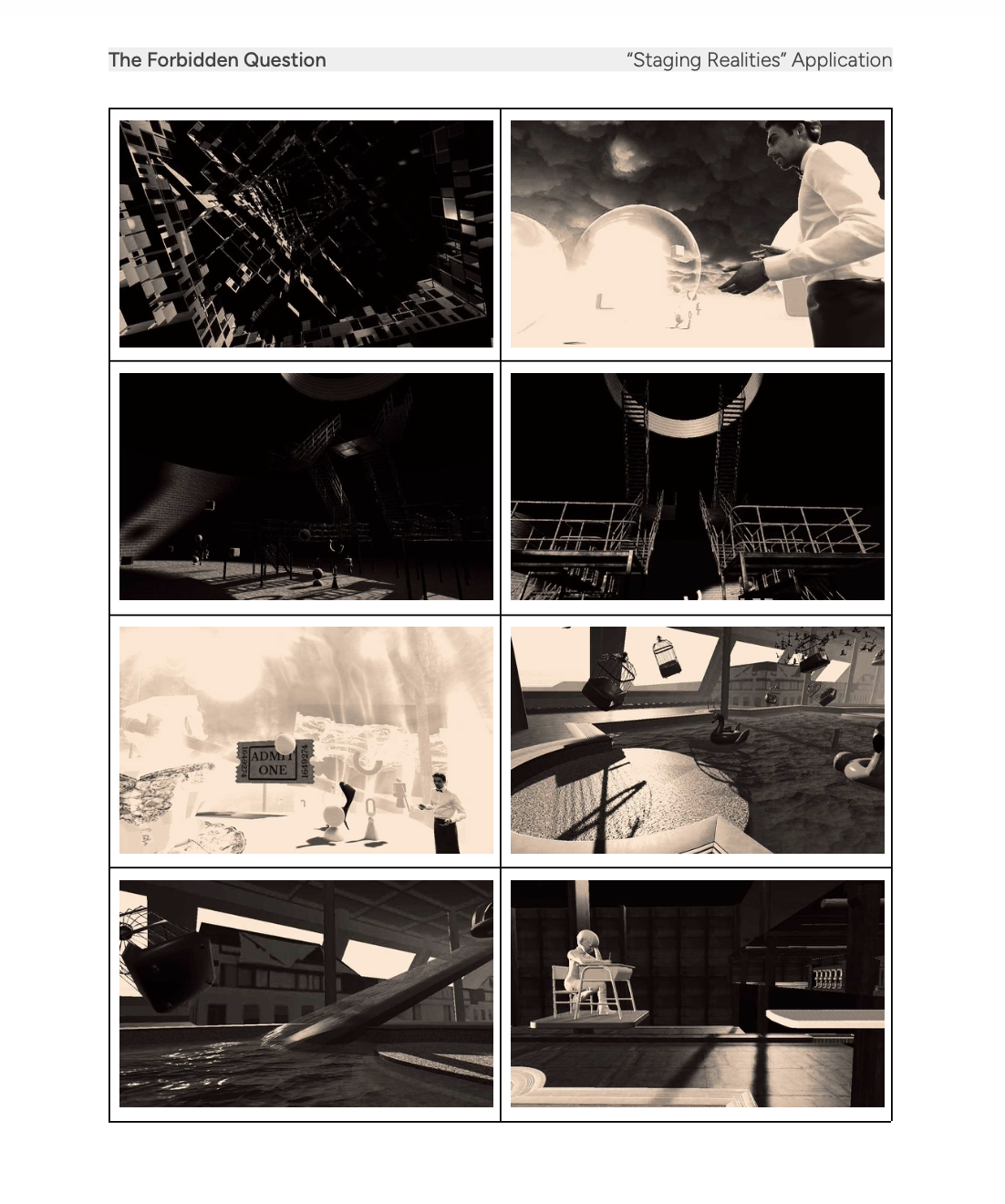
With this piece, we are proposing a choreographed yet spontaneous play between multiple dreams and dreamers. All the actors on stage come from the audience except one: Paul. An Eastern European architect who moved to Brussels in hopes of one day building the city of the future, he has fallen asleep with his shoes on after a long day of waiting tables. This is the moment our universe is born. As participants are encouraged to chase connection and fulfillment, our cosmology cycles their souls and dreams through several layers of reality. The more assiduous the search, the more wondrous and intense the connections they make, the more oblivious and unrelenting the fleeting and cyclical nature of the game becomes. The “forbidden question” in the title is the question no one will ever find an answer to: Whose dream is this? Are my desires really mine? Am I even able to stop wanting?
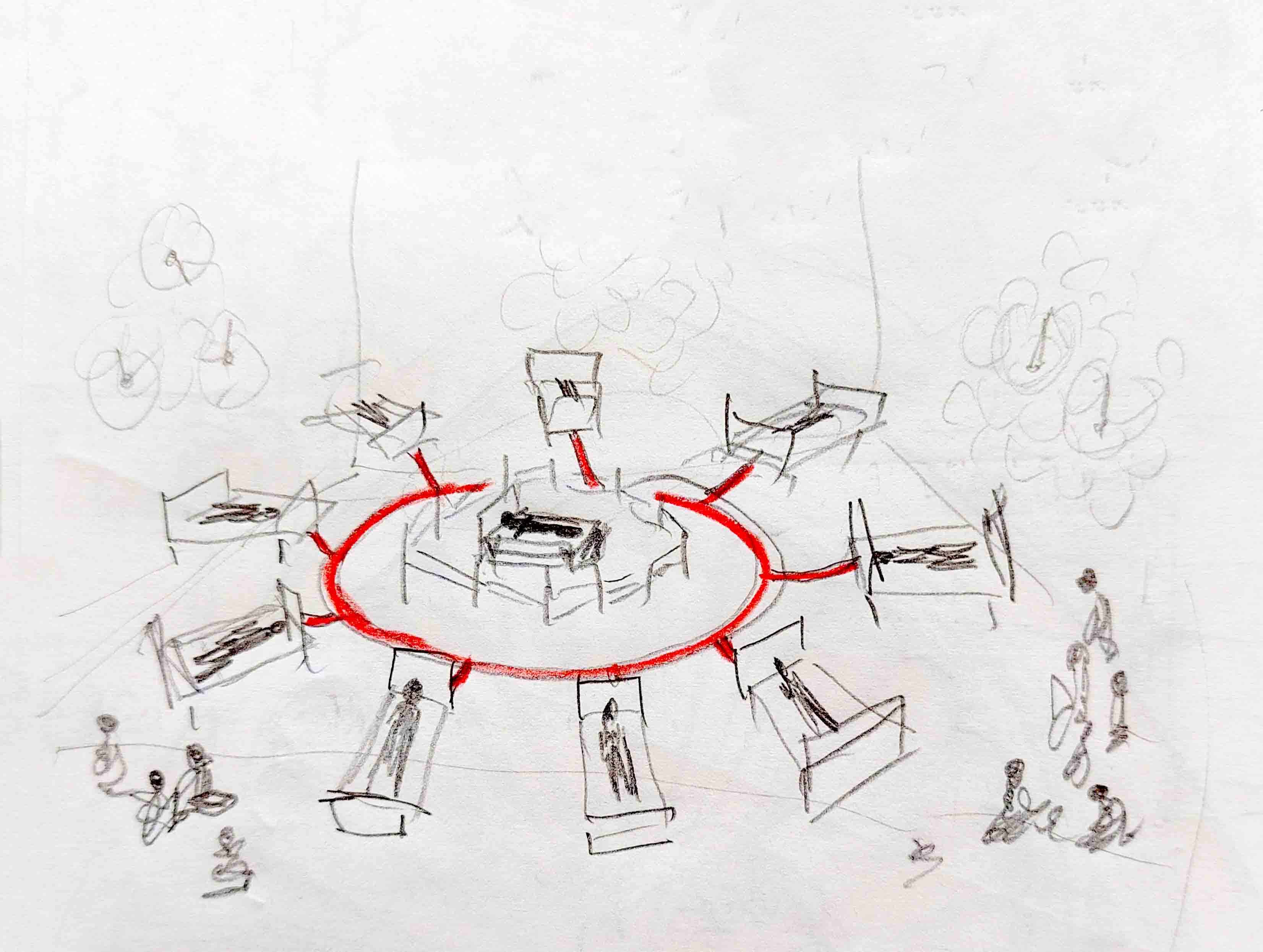
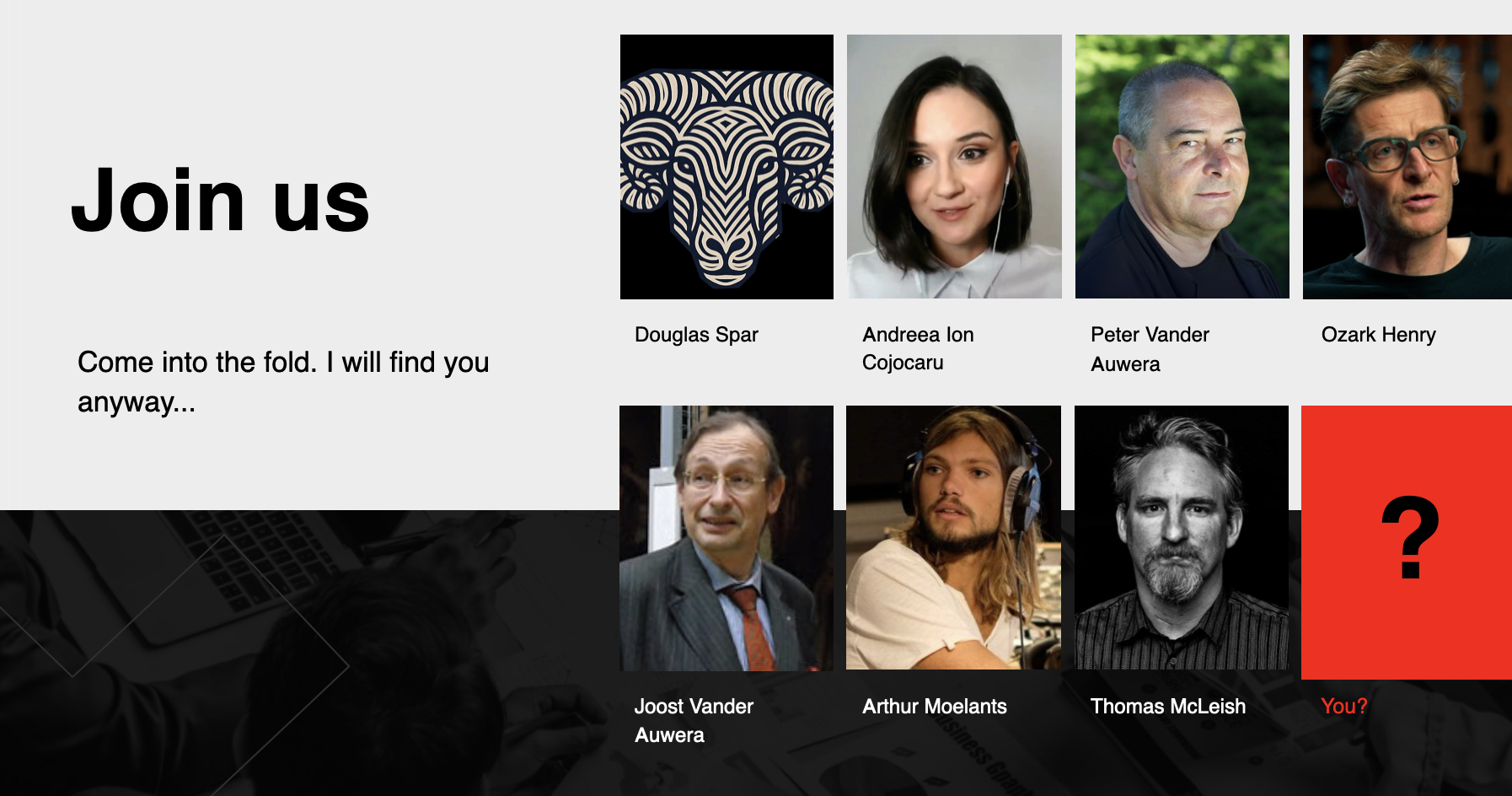
The room is set up with nine physical beds (8 for the audience encircling the one bed for Paul). The performance is designed for a full 360° experience (visuals, audio, tracking), and we work with award-winning 3D artist Ozark Henry, award-winning cinematographer and DoP Arthur Moelants, and award-winning maker Thomas Mc Leish.
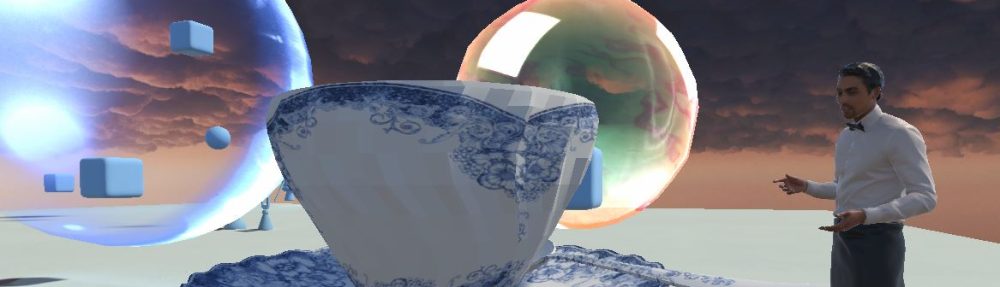
I would like to give some background on this project, a sort of making-of. The project started as the New New Babylon performance, at that time designed for a speaker on stage wearing a VR headset, and the audience seeing the VR rendering on a big screen behind the speaker. Here is a very, very early version of the tower of the New New Babylon:
Then, we pivoted to a version called “Dream my Dream”
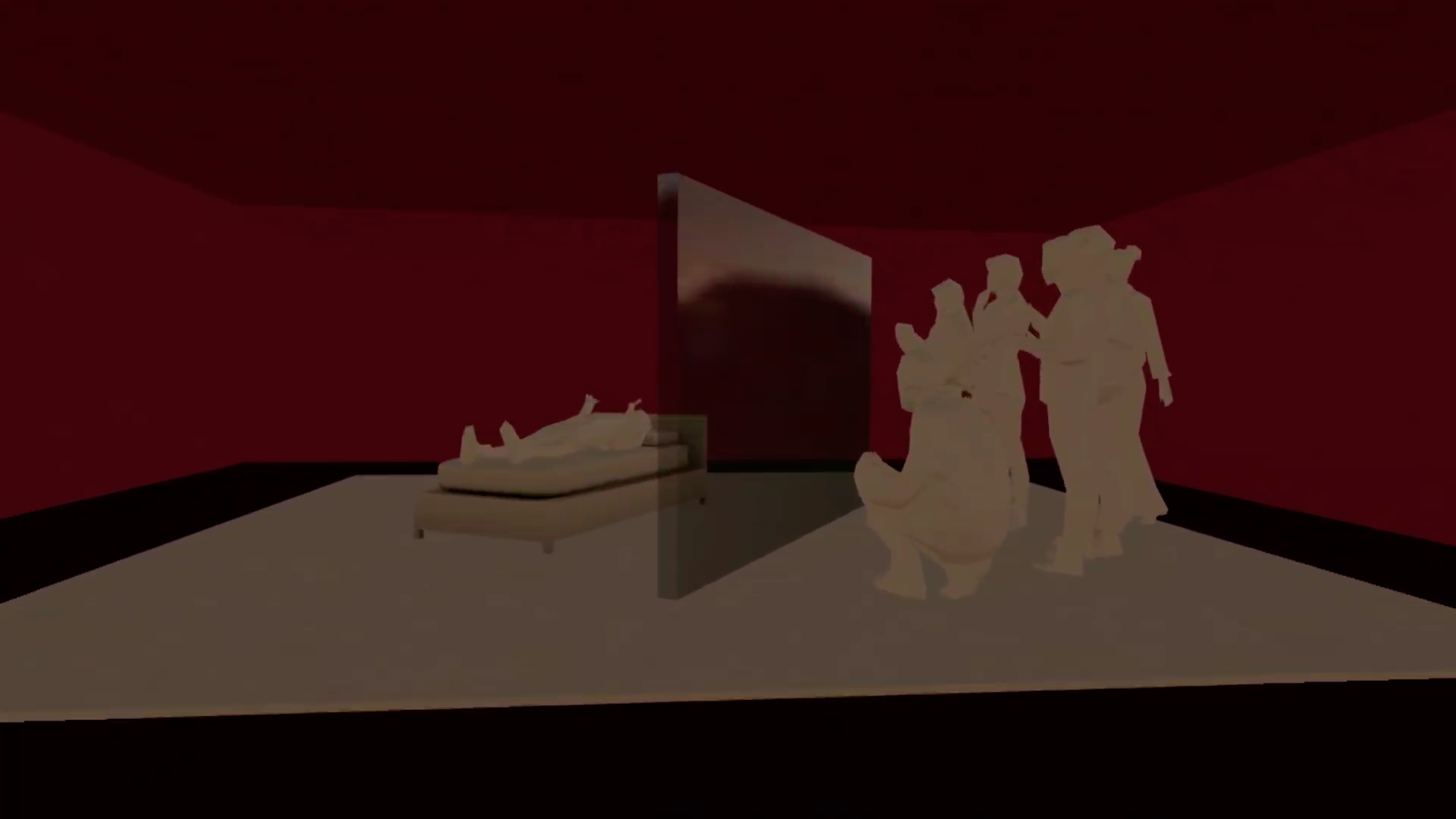
This time, the audience would witness a sleeping performer with a VR headset, and follow the dream through some sort of transparent screen:
Mock-up of the viewing room – created in Space Elevator
After submitting our project to both the Venice Biennale College Cinema and the Cannes Immersive 2025 competition, without being selected, we took the opportunity to critically reevaluate the core premises of the performance.
Then, as part of my end-project for the Howest course XR in Industry, we created a very early version of The Forbidden Question, which began with the story of an Eastern European waiter and the concept of central and surrounding beds. The video below is an early MVP of what we had in mind.
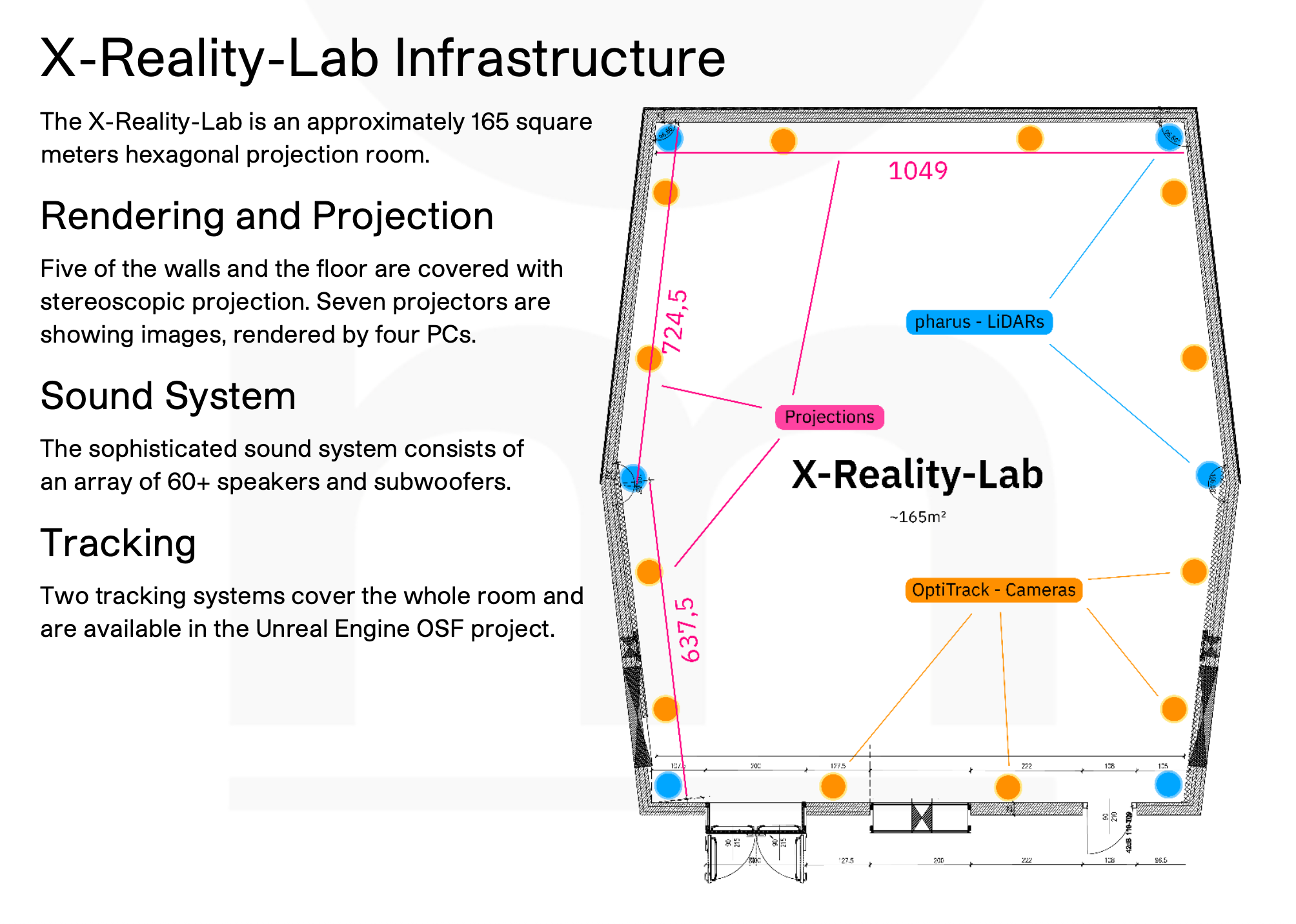
During this period of reassessment, Andreea came across an open call for immersive projects at the Salzburg Mozarteum X-Reality Lab. Salzburg is currently developing a state-of-the-art 360° immersive venue featuring stereoscopic projection, a 60+ channel spatial audio system, and integrated LiDAR and high-definition camera infrastructure. The lab was seeking artistic performances for the venue’s inaugural program, scheduled for March 2026.
High-level sketch of the X-Reality-Lab in Salzburg
For this project, we completely re-wrote the performance into an XR “game of life” unfolding across multiple realities, with both an actor and the audience as performers. From its earliest concept through multiple iterations, the project transformed from a one-person headset performance into an immersive XR experience designed for stereoscopic projection, 3D tracking, and 360° spatial sound. Here is an extract from our submission document. The biggest change was to move the whole New New Babylon narrative from the foreground to the background, and to let the audience experience crossing realities (from dream reality to awake-reality). We made it to the shortlist (out of 150 international candidates), but did not get selected in the end.
Extract from our treatment of the performance for Salzburg
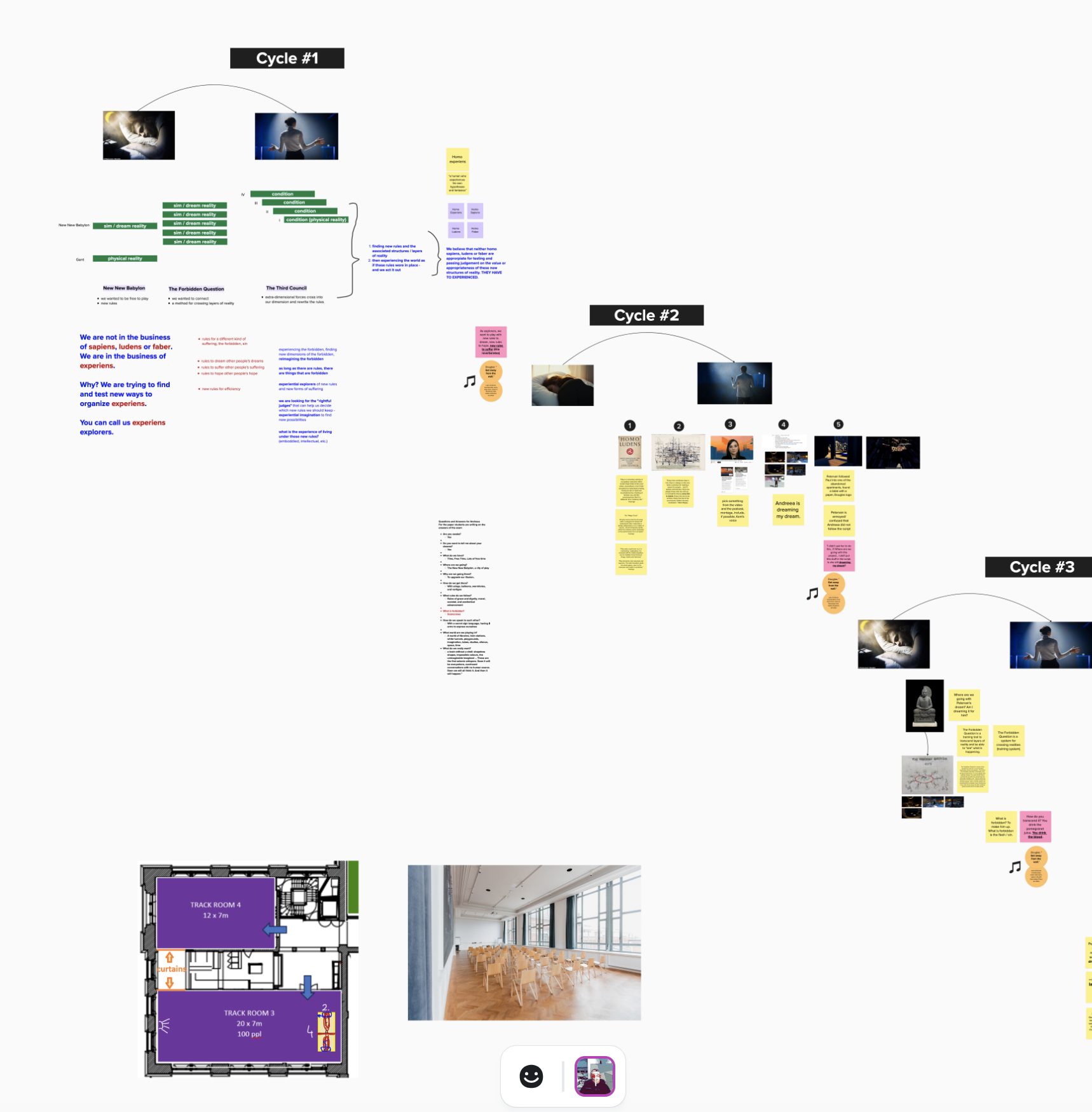
In preparation for our talk at UnitedXR, Andreea and I had many online sessions on the mood and conceptual flow of our presentation (Mural extract below). We wanted to present a coherent journey from New New Babylon to The Forbidden Question to The Third Council.
Mural brainstorm for UnitedXR presentation
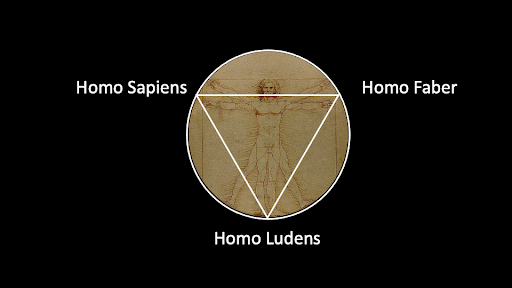
An aha moment emerged during these sessions: neither Homo sapiens, ludens, nor faber is capable of evaluating the validity of these new structures of reality. Their meaning cannot be assessed intellectually—they must be experienced.
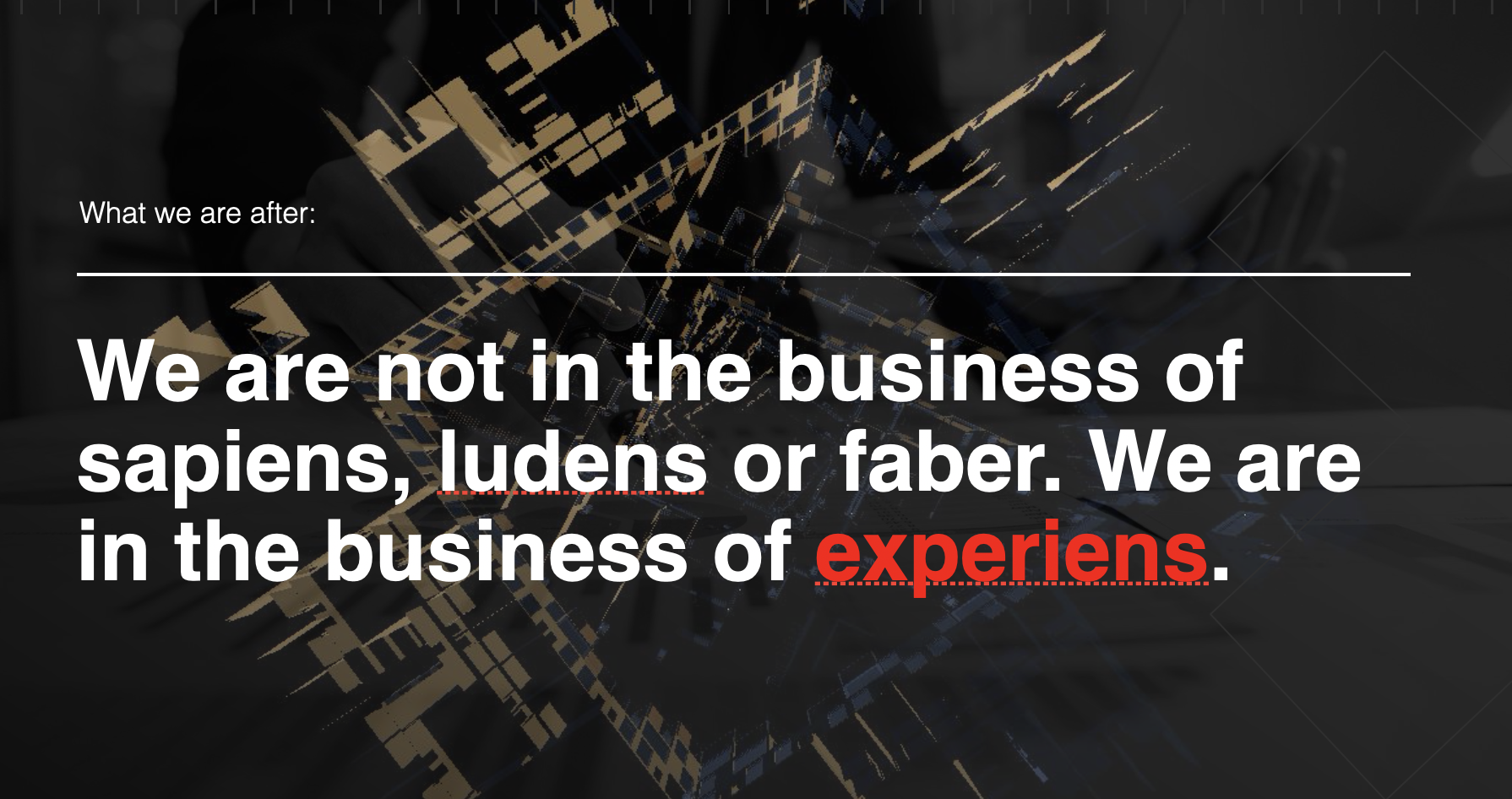
Hence Homo Experiens. With an “s” to differentiate from the words “Narrative” and “Experience” that have become catch-all words.
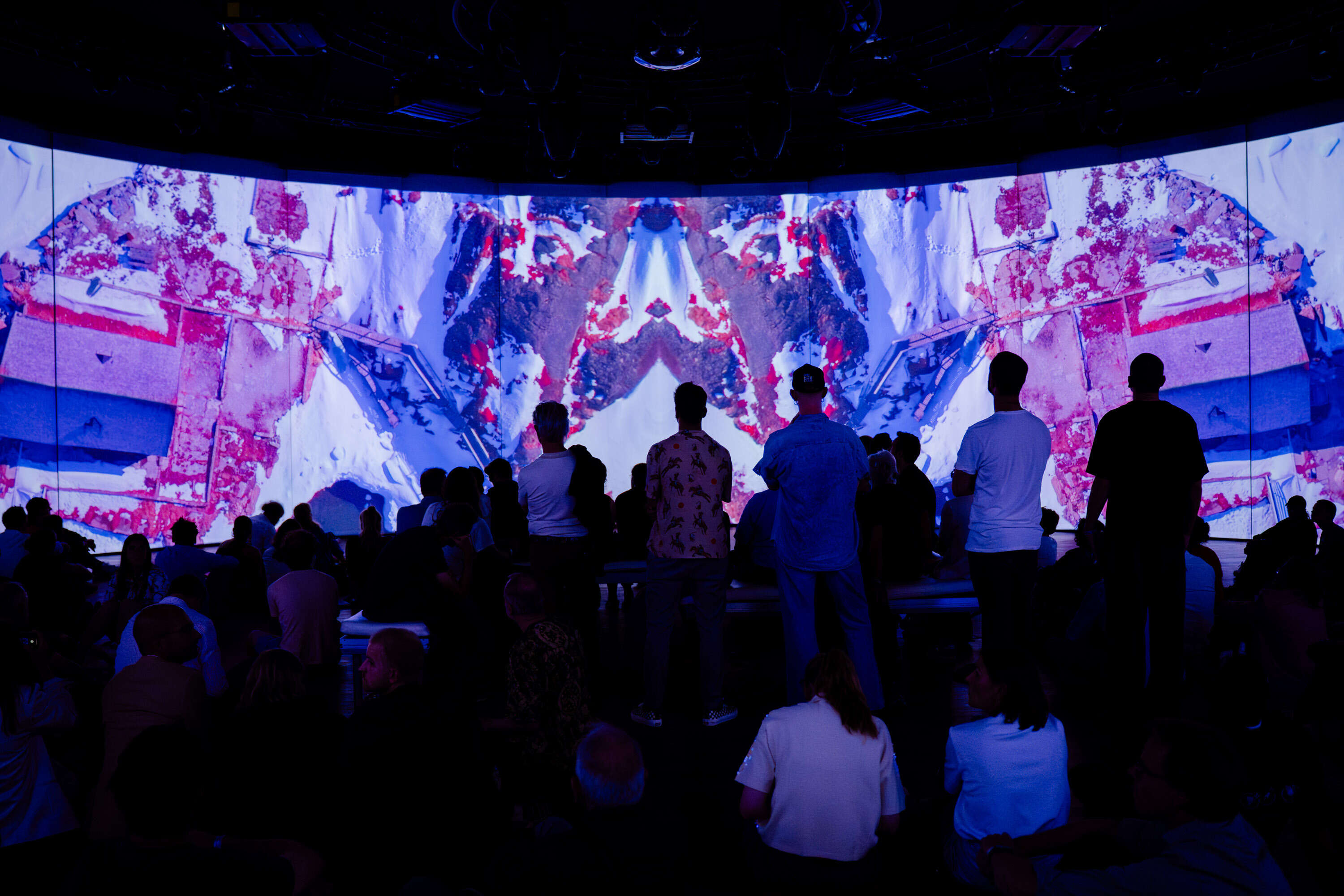
The Forbidden Question teamPicture from the crime scene at UnitedXR on 9 Dec 2025
Kent Bye, who runs the Voices of VR Podcast, was in the room, and he invited us for an interview right after (quite an honor, if you ask me). As soon as the interview is published, the link will be added to this post.
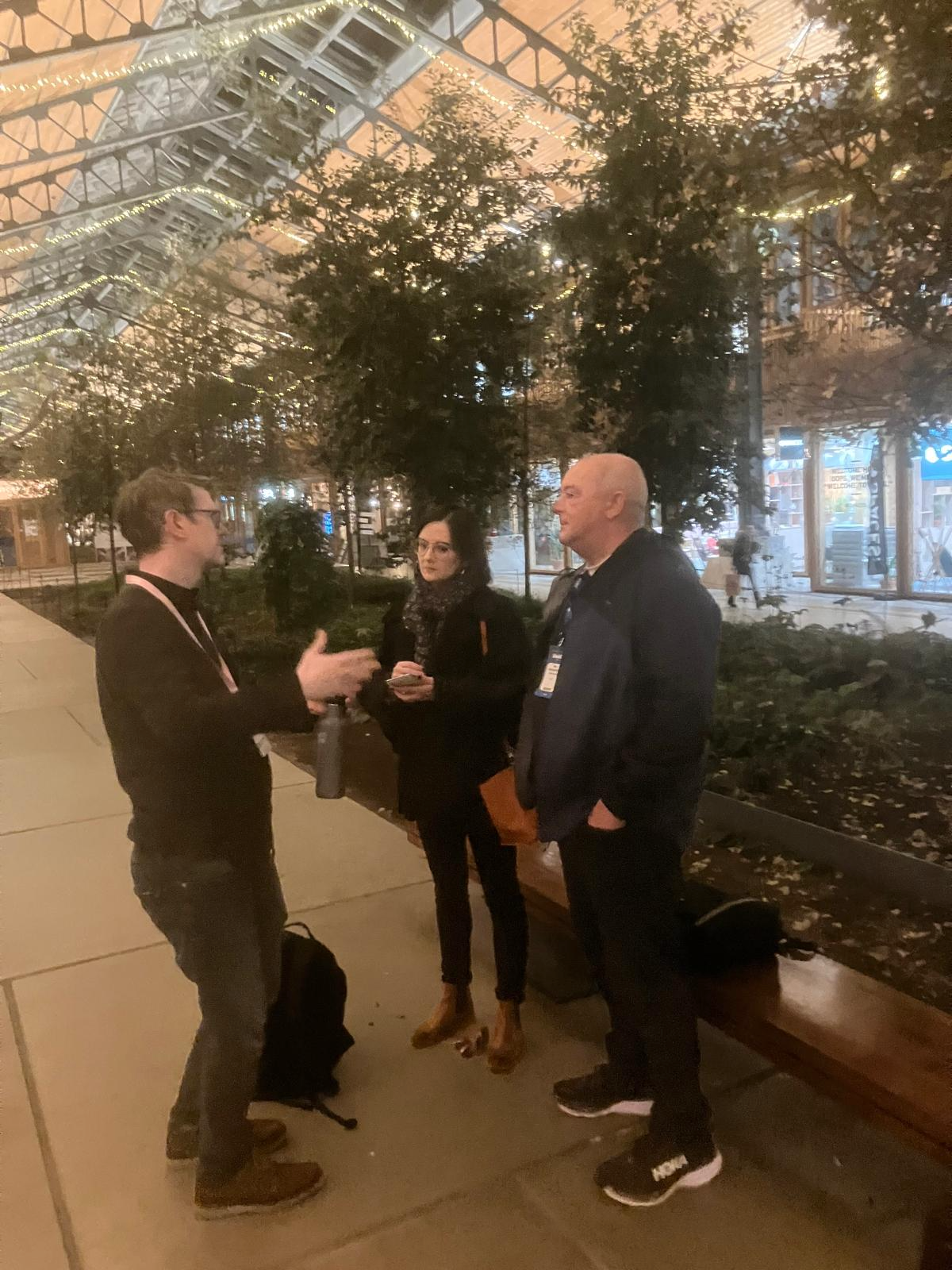
Post interview picture. From left to right: Kent Bye, Andreea, Petervan. Picture by Joost.
Use the barcode above to follow the discoveries of Douglas Spar (aka The Holy Lamb). Doug is the one investigating The Third Council. And “The Forbidden Question” is now positioned as a training protocol for crossing realities and the main priority of our team right now.
We are now complementing the team with technology partners to build a pop-up 360 infrastructure for artistic performances. We are contacting immersive spaces to be on their program. We also consider a subsidy for a technology prototype for this immersive performance.
May the lamb be with you in 2026!
With deep gratitude to Andreea, TJ, Arthur, Joost, and Ozark for staying motivated during this whole process. And thanks to UnitedXR for having us.
As promised in that post, the most compelling part of the book appears in its opening chapters, where he introduces “The Orphic Experience.”
The short summary is in the video below, from 0:59 to 2:23. The latter part of the video is about the three key elements of dub-techno: spontaneous repetition, atmosphere, and embracing noise.
TL;DR: The orphic experience uses music to alter perception, evoke deep emotions, and influence the listener’s state of mind. It creates a unique space and time for introspection and reflection.
Let me unpack this in stages: first the “orphic” aspect, then the “experience” element, and finally a synthesis.
Orphic
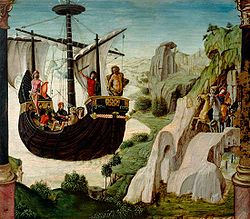
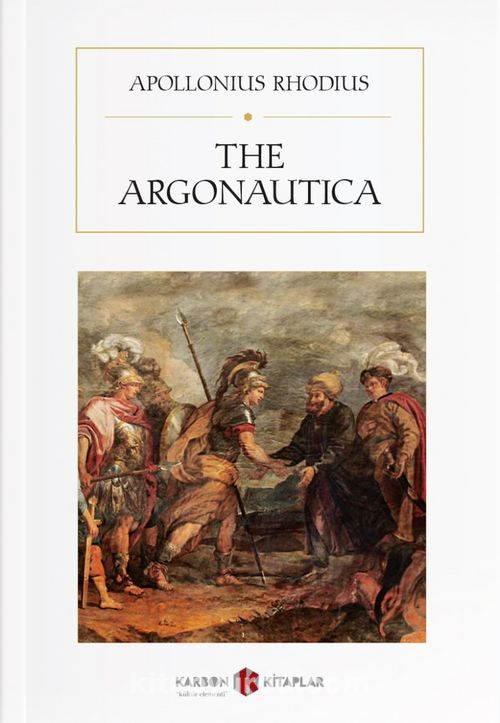
The “orphic” part originates from Orpheus, a character in the ancient Greek poem Argonautica, dating back to the 3rd century BC. The Argonauts are travellers on the boat Argo and are on a quest for the golden fleece. Somewhere along the route, sirens are trying to seduce the boatsmen. Still, Orpheus – a talented singer/musician on the boat – can shield the boatsmen from the Sirens’ temptations through his celestial, beautiful songs and voice. In other words, he was a noise canceller avant la lettre.
Some salient quotes from Bahadırhan Koçer:
The orphic experience, therefore, refers to the transformative way sound and media technologies can be used to control one’s sonic environment, creating a personalized auditory space that shields individuals from the overwhelming stimuli of modern life.
It is conceivable to argue that the nature of this transformation lies fundamentally in a shift from communal to individual listening.
The protected space needed for “sensory and emotional self-care”
In this sense, orphic experience can be seen as a way of escaping from the demands of the real world and constructing a self-contained, artificial reality.
By carefully curating their auditory environment and creating a personalized soundtrack to their lives, the individual can signal their taste and distinction to others, and distinguish themselves from those who do not possess the same level of cultural capital.
The “orphic” concerns the creation of a protected, isolated space in which the rules constraining clear thought can be suspended.
Experience
The second part is about “experience”. The words “Narrative” and “Experience” have become catch-all words. Washed-out. Weak. And they all suggest a passive audience.
Also here, a David Claerbout quote is appropriate:
“I think the recent proliferation of black boxes for film and video-art is not just a practical solution to a problem of sound and light interference, but also reflects an incapability to coexist. This can become apparent in large group exhibitions, where media installations appear strong when they are shown by themselves in a small or large dark space, but they easily collapse when shown in a social space where people move about and interact. The black box is a social phenomenon, for me it is a problem.” Ulrichs, David, ‘David Claerbout. Q/A, in: Modern Painters, May 2011, pp. 64-66
“Designed Conspiracy” would be better to describe what I have in mind. With an active audience. Or even better, where there is no stage hosting the expert speaker and no passive audience just leaning back in chairs, incapable of truly internalising knowledge.
I imagine us inside a 360° immersive room: a six-metre-high LED screen, full 360 Dolby Atmos sound, LiDAR tracking, and high-definition cameras—paired with exceptional content and facilitation. A complete experience in a box, ready to tour and deploy anywhere in the world. Am I exaggerating? Maybe not. I’ve just met someone who is building exactly this.
Synthesis
Obviously, I am using all of the above as a metaphor to try to explain what I do with my artistic interventions, provocations, and interruptions. These qualities inform my work/play. Whether that is soundscapes, installations, performances, or group expeditions.
Now that we have our protected, isolated space and a designed conspiracy, it is time to play the music. Music is the content. Content is the music.
Experiencing our music – individually or as part of a group – can feel like a trip, a trance, like digital psychedelics.
The music/content is presented in the right space, with the appropriate emotional and psychological atmosphere—the backdrop, if you will—inviting and sustaining safety, interest, curiosity, awe, and growth.
The rhythm is softer, slower, quieter vs. harder, faster, louder.
We embrace – and even design – flaws and imperfections, spontaneous repetition, and noise, inviting the participants to connect with being human, and to internalise the content at an embodied level of sensory experience.
We design with fifty shades of sophistication: avant-garde activism shaped by counterculture, driven by intention and direction. We build a relational infrastructure capable of holding shared ambitions, carrying a map as a symbol of movement, of becoming. These are maps that make meaning—shifting the question from the adolescent “Where are we going?” to the more deliberate “What direction do we want?”
We are all Argonauts again. We are experiens-explorers. We want to create the right spaces and conditions for debating the new rules and the associated structures of reality, then acting them out as if those rules were in place. As explorers, we want to play with new rules to dream, new rules to hope, but also – not to sound too cheesy or utopian – new rules to suffer and cope with what is evil and sin. In that sense, we become all part of a shared conspiracy.
We are not in the business of homo sapiens, ludens, or faber, but in the business of homo experiens.
With thanks to my co-conspirators Josie and Andreea, for challenging me over and over again
The camera— that profoundly liberal invention— whispers:
I’m ready for anything. Give me chemicals, give me a little light, give me time and no shaking, and I will be done.
A pocket-sized Enlightenment, believing every world is reachable, every surface printable, every body open to possibility.
And now generative machines produce punctum— yes, Barthes’ punctum— the involuntary meaning that slips through the cracks of intention. Not planned by the author, nor by the algorithm, but arriving later, after you’ve slept on it, after the dopamine subsides. Fast food for intellectual minds, rewarding at first bite, quickly stale. You return in the morning and mutter: It was not that great after all.
Style appears. Style overload. Those who lack craft run toward it— high, abstract, fast— while you work the old way, learning the hand, the long path, refusing to choose sides.
Spend time with it— real duration— and you’ll see how expensive time has become. Only unproductive duration is free. Yet we abandoned that when we entered the cinema, trading mobility for the promise of instant return. No one waits for tomorrow in a theater. In a museum, though— time’s ticking clock can’t be heard. There we look forward to looking back.
And somewhere in this, the black box— practical, yes, but also a symptom of our incapacity to coexist. The dark room becomes a social problem, a refusal of interference, a denial of shared space.
Everything becomes a question of time, of how little we have left, of how duration is mined like ore.
Growing old treated as disease, dementia as enemy, while software dreams of pure disembodiment— young, innocent, clean.
And yet— beneath all this— you remind us: we are bifocal, split, never individuals. We are believers, especially visually.
The camera says: I’m ready for anything.
But the eye says: I am not a camera.
And the brain says: I choose no side.
And the forest says: Take your time.
And the weak image whispers from the periphery: Here is the non-event— stay long enough, and you may hear it breathe.
I first edited the full transcript from the presentation, and then OCR scanned text ‘The Time Spent” from the BIRDSONG book. Then I made a personal selection of the sentences that resonated with me. Then I gave that to ChatGPT and asked it to condense all this into a 1000-word poem, then 500 words, then 100 words. Then again, I made a personal selection of the best GPT snippets. And further edited them to my personal (un)taste.
As already mentioned in my September 2025 Delicacies, I got a crush on the latest album by “Mister Dub” Adrian Sherwood, and went down the Dub Techno rabbit hole.
From the review in De Standaard newspaper (Google Translate and highlights by myself):
“With his label On-U Sound, Adrian Sherwood has created a unique musical universe over the past half century, rooted in Jamaican dub but with tentacles reaching out to punk, funk, and psychedelia, peppered with samples, echoes, and sound effects. His new album features only one track with a recognizable reggae rhythm; the others are driven by slow bass lines and stimulating drum patterns. Many of these tracks are played by real musicians, just like the cinematic fragments of flute, saxophone, organ, cello, trumpet, percussion, piano, Roland 60, and harmonica (“Spaghetti Best Western” exudes Ennio Morricone). Sherwood can call upon a host of loyal musicians (including Brian Eno and hip-hop legends Doug Wimbish and Keith LeBlanc) who add color and human warmth to his boundless imagination as a studio wizard. In an interview, Sherwood did admit that this was the first time he’d used AI to create a record. It seems like a logical evolution for a man who has spent his life innovating and experimenting with new equipment.“ (km in The Standaard)
Here is some older material from Adrian Sherwood. Watch his body language while performing 😉
And the song “Trapped Here” from his previous album, Survival & Resistance
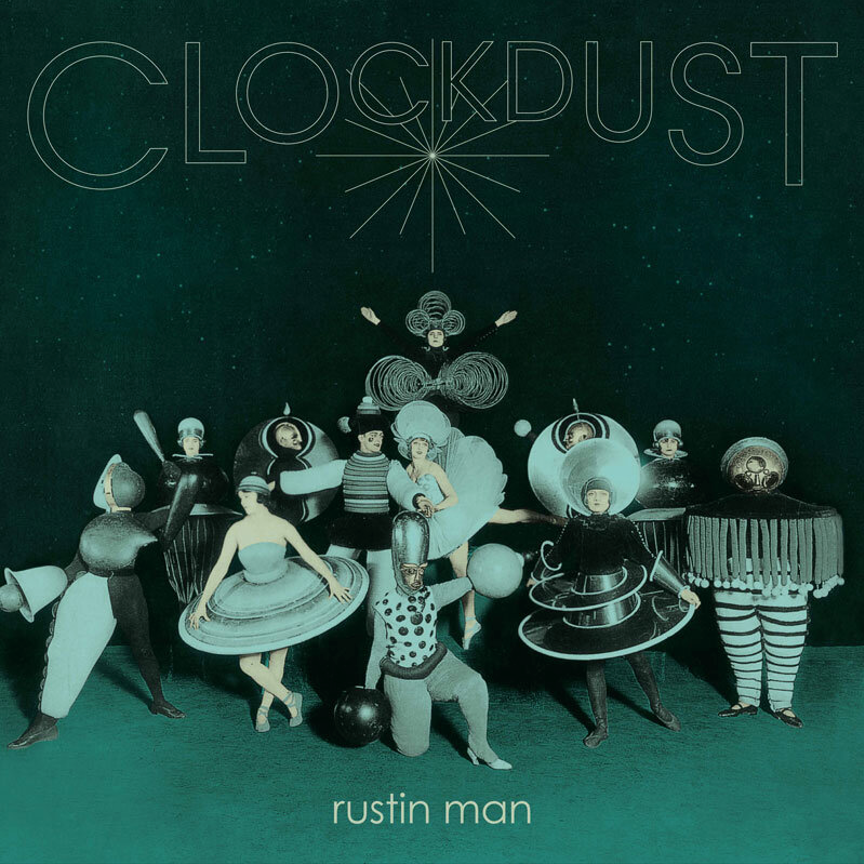
The album comes with a beautiful cover (designed by Peter Harris). The cover and the album’s atmosphere remind me of Rustin Man’s 2020 album ClockDust (I wrote a post about that one in 2020). It’s no surprise: after playing bass in a local reggae band in Southend, Rustin Man (Paul Webb) and his schoolmate, drummer Lee Harris, went on to form the rhythm section and become founding members of Talk Talk, alongside the exceptionally talented Mark Hollis and Simon Brenner.
The covers of Adrian Sherwood and Rustin Man respectively
So the starting point is dub reggae, which these days has evolved into a genre called “Dub Techno”. There is something melancholic about both albums, in sound, lyrics, artwork, and, at times, kinky living.
I don’t have real musicians available in my studio, and I’m hesitant to rely on AI. I’ve experimented with AI-generated music before, but it doesn’t bring me the same joy or sense of satisfaction as creating it myself. So I started studying and exploring the Dub Techno style, and found this book, “Dub Techno – The Orphic Experience of Sound” by Bahadırhan Koçer.
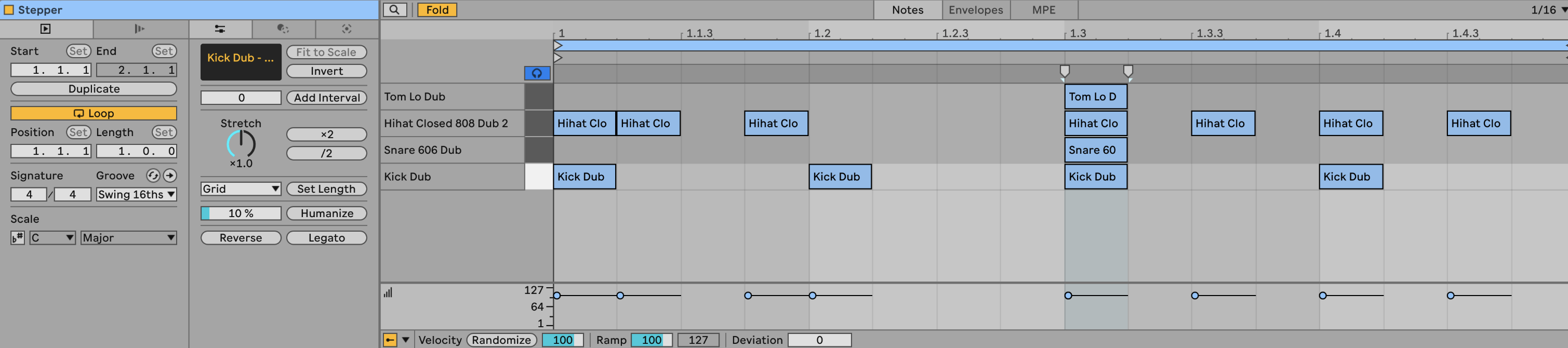
On page 56, Koçer begins discussing the concept of the riddim—Jamaican patois for “rhythm”—first examining drum patterns, and later turning to bass lines and melodic structures.
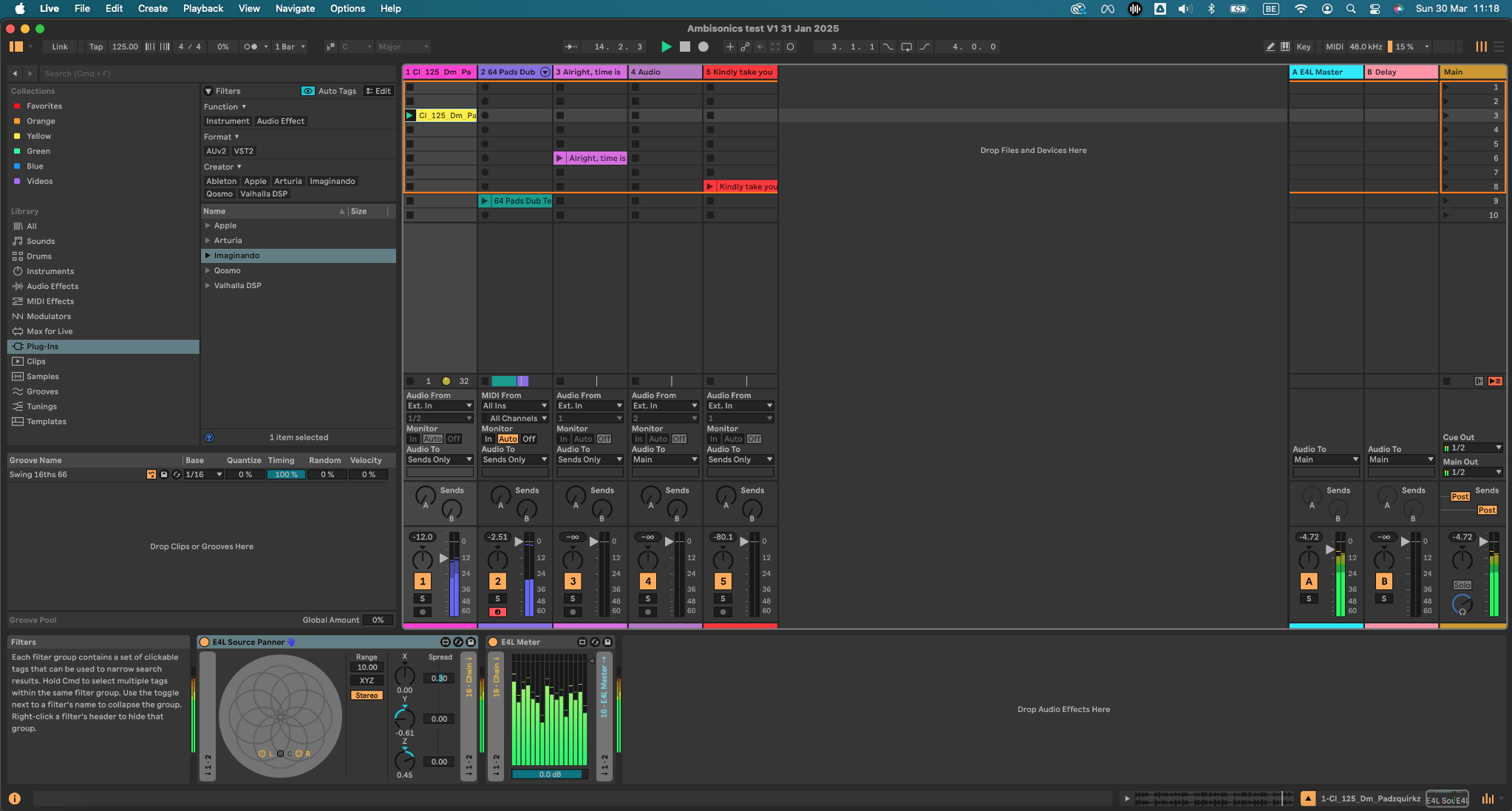
I started implementing them into Ableton Live. Here is an example of the “stepper” variant on a 64 Pads Dub Techno Kit.
Ableton Live 12.1 implementation “Stepper” by the author
That was easy. Then I tried to build a song using other out-of-the-box and/or free devices, clips, and samples in Ableton Live 12.1 and Logic Pro 11.2.2 (btw, the new bass and keyboard session-players, and the new studio piano and studio bass in Logic are amazing).
The new Studio Bass in Logic Pro 11.2
Creating a song was more of a challenge. What Adrian Sherwood and his real musicians were doing was not so simple after all. Although all the individual clips sounded simple, the art is in being subtle and sophisticated in launching clips and echo/delay effects.
As with writing, the real effort lay in removing the superfluous rather than adding more to the mix. Still, to make it a bit more my own, I included a few AI voice clips from the New New Babylon performance.
Short experiment by the author
But I am an amateur/bricoleur after all. No way I will ever get close to Adrian Sherwood and his musicians, at least not as a musician. But maybe in real life? Adrian and the band are touring North America and Europe in 1Q 2026. They will perform in Wintercircus Ghent on 6 Feb 2026. See/hear you there?
I went to the premiere exhibition of David Claerbout’s The Woodcarver and the Forest at the Castle of Gaasbeek. I went by bike, for me, a two-hour ride each way, on a warm sunny day through the Pajottenland, the region southwest of Brussels where I spent the first 25 years of my life. Cycling up and down its rolling hills stirred deep emotions and memories of my youth. This is the land of Bruegel, of Geuze and Lambic beer, of Remco Evenepoel. It is also, unmistakably, my land.
Before arriving at the castle, visitors walk about 15 minutes from the entrance through a carefully tended, forest-like domain. The path itself already feels like part of the experience, drawing you gradually into a slower, quieter, almost meditative state.
A top-level garden modelled on castle gardens from the 18th and 19th centuries. A strong example of living cultural heritage. Take a stroll through this magnificent Garden of Eden, with the old-model fruit repository, the beehives, and a wonderful view of Gaasbeek Castle and the Pajottenland.
I lingered in the garden for some time, sitting on a bench and gazing at another bench across the way, the two connected by a loofgang—a leafy tunnel formed by pear trees. I simply sat in silence, doing nothing. Eventually, I walked through the shaded passage to the other side, before making my way to the castle. In hindsight, the video I captured carries an unintended sense of suspense.
Once inside the castle, visitors are guided along a signposted route. Along the way, I captured this video of sunlight filtering through stained glass, casting vibrant patterns onto the wooden, carpeted floor.
The Claerbout installation awaits at the very end, rising three stories high beneath the roof.
From the brochure:
This work is Claerbout’s latest creation and presents itself as an intimate portrait of a reclusive young man. Do you feel the meditative effect of the slow, repetitive movements and their sound?
Specific audiovisual stimuli – such as soft sounds or rhythmic movements – can evoke feelings of relaxation and inner calm. This phenomenon is known as ASMR (Autonomous Sensory Meridian Response) and forms the foundation of this work
The Woodcarver and the Forest is an open film, which is completed using generative artificial intelligence. As a spectator, our experience also remains open and unfinished, partly due to the long duration of the work.
This reveals the dual nature of the film: an interplay between pleasure and sorrow, beauty and destruction.
“I want people to keep watching for hours or at least to settle into that idea of extended time, knowing that they will never be able to see everything.”
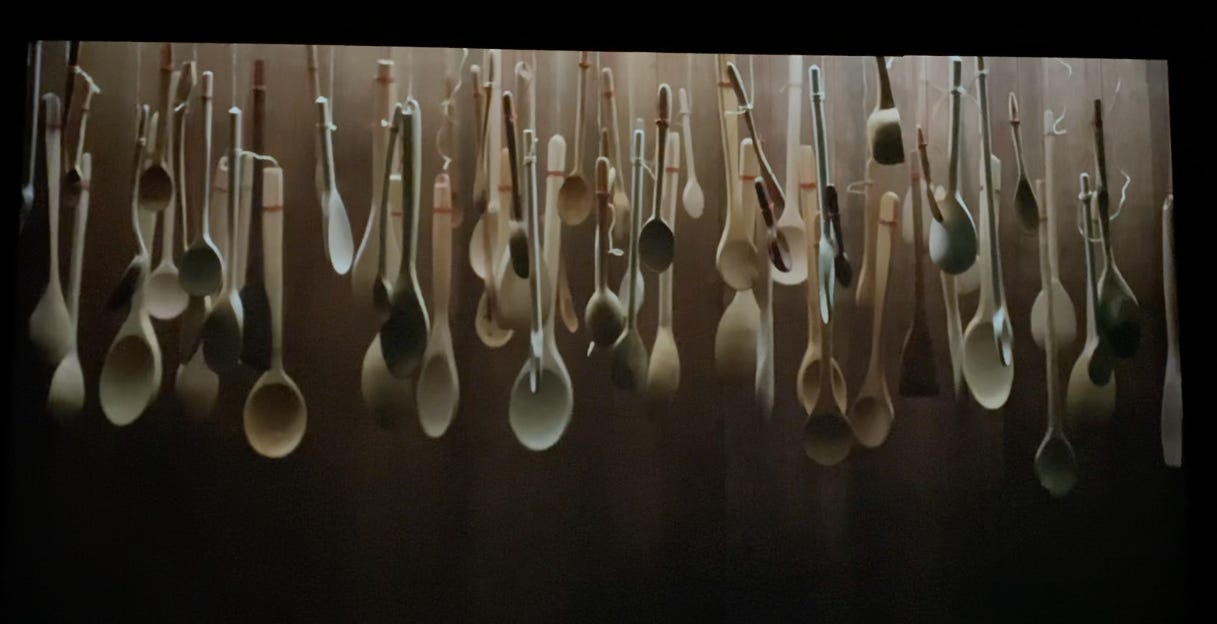
Still from Claerbout’s video installation – picture by @petervan
I sat in there for more than one hour. It put me in some state of limbo about my own work and where I want to go next. Following Google’s Gemini AI, it means “to be in an uncertain, undecided, or forgotten state where nothing can progress or be resolved, similar to being caught between two stages or places.”
I am a big fan of David Claerbout. See previous entries on this blog here. The Woodcarver gave me the chance to revisit some of Claerbout’s earlier works and conversations, while also helping me reconnect with the artistic drive within myself.
Here is a more recent talk by David Claerbout
Some interesting quotes
Change your mind-set ànd your eye-set, from inquisitive to open-ended
The Brain does not choose sides; it does not know how to
And around minute 18, he gets into a very interesting schema of “former” AI technologies. He really got me when he says “the camera is a profoundly liberal invention” and later “around the 2000s, we start to think of visual culture as a assemblage, the coordinate system is back, and a coordinate system knows exactly where you are it has exact points in space it can find you back and instead of a liberal body in a world that could be anything anywhere it changes into a pinpointing in a space that so we we get a gathering of coordinates and we’re no longer free”
In closing, he shares reflections on recent readings that explore AI, vision, and the language of thought.
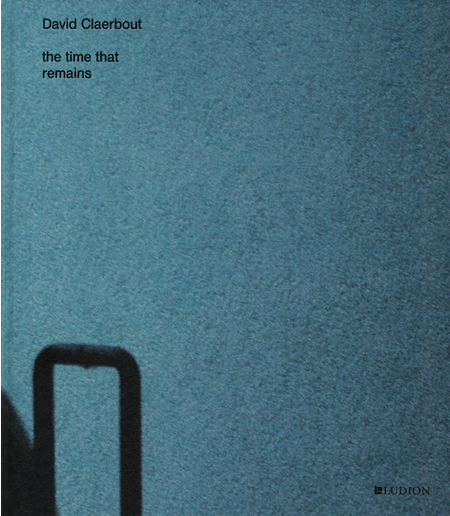
After watching the video, I visited the University of Ghent library—you can get a visitor’s pass as a non-student for €15 per year, granting access to all of the university’s libraries! There, I picked up the book The Time That Remains, a title that resonated with me on two levels: first, the concept of time, so ever-present in Claerbout’s work; and second, the realization that I am approaching my seventieth birthday, prompting me to reflect increasingly on the time I have left and how I want to spend it—especially in my artistic practice, if I can even call my tinkering that.
From the intro:
This publication marks the welcome collaboration between internationally acclaimed Belgian artist David Claerbout and two European institutions: Wiels, Brussels and Parasol unit, in London. The publication accompanies Claerbout’s exhibition opening at Parasol unit, on 30 May 2012; but it also provides a highly appreciated documentation for Wiels, which held a solo exhibition of Claerbout’s work, The Time that Remains, in 2011.
It’s from 2012, but the content is, well, timeless.
Some quotes/insights from that book.
“I think the recent proliferation of black boxes for film and video-art is not just a practical solution to a problem of sound and light interference, but also reflects an incapability to coexist. This can become apparent in large group exhibitions, where media installations appear strong when they are shown by themselves in a small or large dark space, but they easily collapse when shown in a social space where people move about and interact. The black box is a social phenomenon, for me it is a problem.” Ulrichs, David, ‘David Claerbout. Q/A, in: Modern Painters, May 2011, pp. 64-66
+++
“Time is invested into something that will prove to be valuable and productive. By consequence duration’ becomes increasingly expensive. But duration can only be free if it is unproductive.”
+++
“Cinema, YouTube and film-festivals demand the prolonged physical immobility of the viewer. Music, exhibitions or a walk in the park don’t.“
My sense of being in limbo stems from a hesitation: to move further into abstraction rather than figuration, toward longer forms rather than shorter ones, toward meditative sound and video landscapes rather than straightforward documentary. It also comes from my struggle to resist the banality of social media—where time is squandered on addictive, bite-sized fragments of content that ultimately feel useless.
I believe I know the answer, yet I dare not leap just yet.
Spring update on Petervan Studios. The previous update was one year ago! It is not that nothing happened. A lot has happened since then. Let’s have a look at what’s on/in my head.
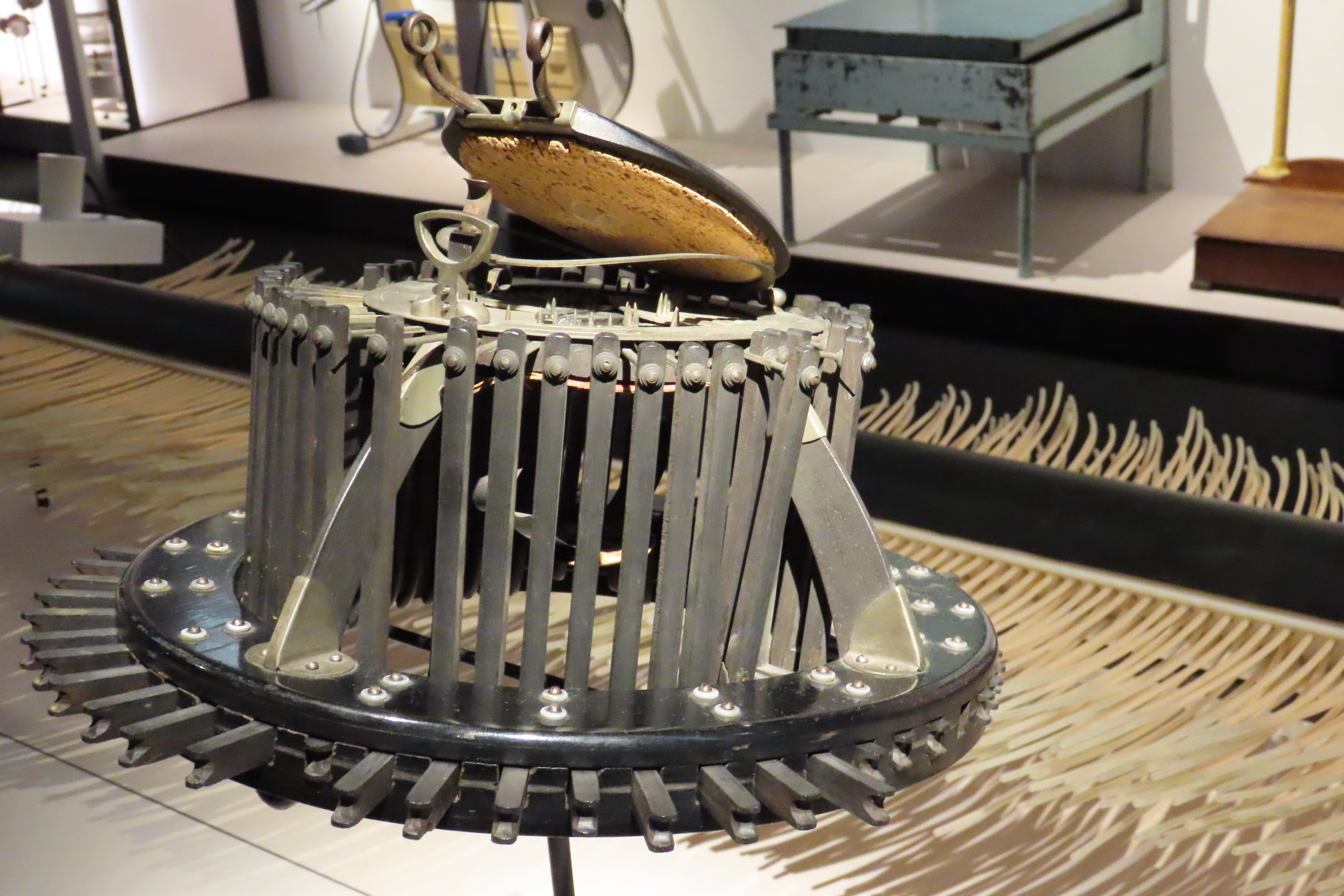
Head measuring device – seen in GUM Science Museum – Wunderkammer of Truth
General Status
Since February 2024, I have disconnected from all social media, including FB, Twitter, and LinkedIn: You won’t find me there anymore
There have been fewer conversations, but the remaining contacts have become true friends, project & sparring partners.
It is challenging to find budgets for anything that even smells artistic.
On the family front, there was both joy and grief. Joy: Astrid passed the entry exam and started her bachelor’s at the Faculty of Veterinary Medicine of the University of Ghent. Grief: My mother-in-law passed away on 1 June 2024. She was a saint. The mourning set some of the tone for the rest of the year. Join me in wishing my father-in-law, my wife Mieke, and my daughter Astrid strength in dealing with this loss.
Green Green Grass of Hope – Bicycle ride 26 Oct 2024
The Art Studio
The main focus of the art studio was digital. I did a deep dive into what I would call “immersive software”. A deep dive means spending a lot of time in the Unity Editor, following numerous online courses, and doing a lot of little experiments.
Example of Ableton Live with Envelop for Live 3D Source Panner
An example of a simple VCV Rack set-up
Static example from Wave Unstable rule in CAPOW software by Rudy Rucker
Although not intended this way, most of the knowledge and skills acquired culminated in the first and subsequent versions of the New New Babylon performance, giving leeway to other projects. Some of these projects are detailed below.
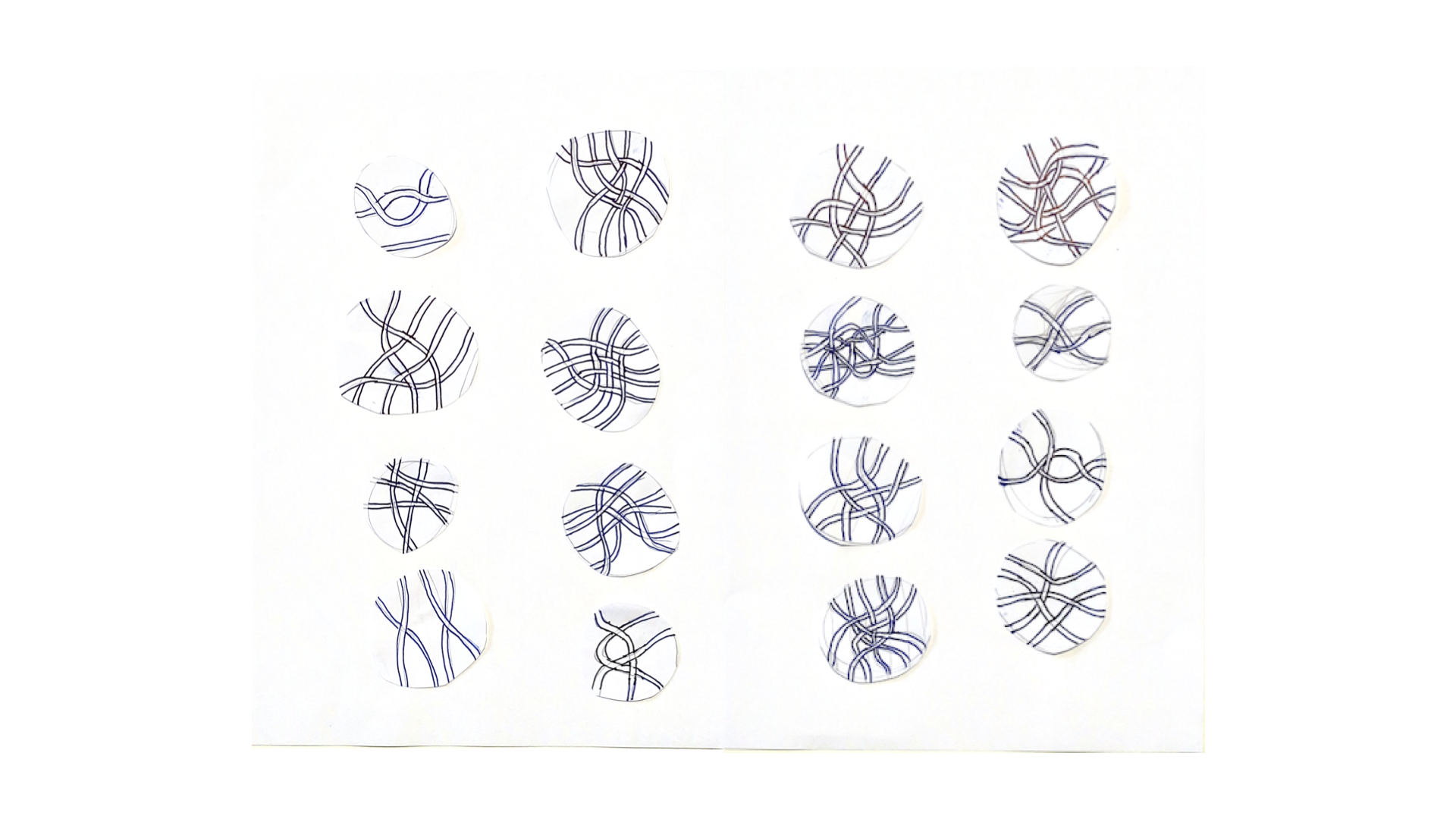
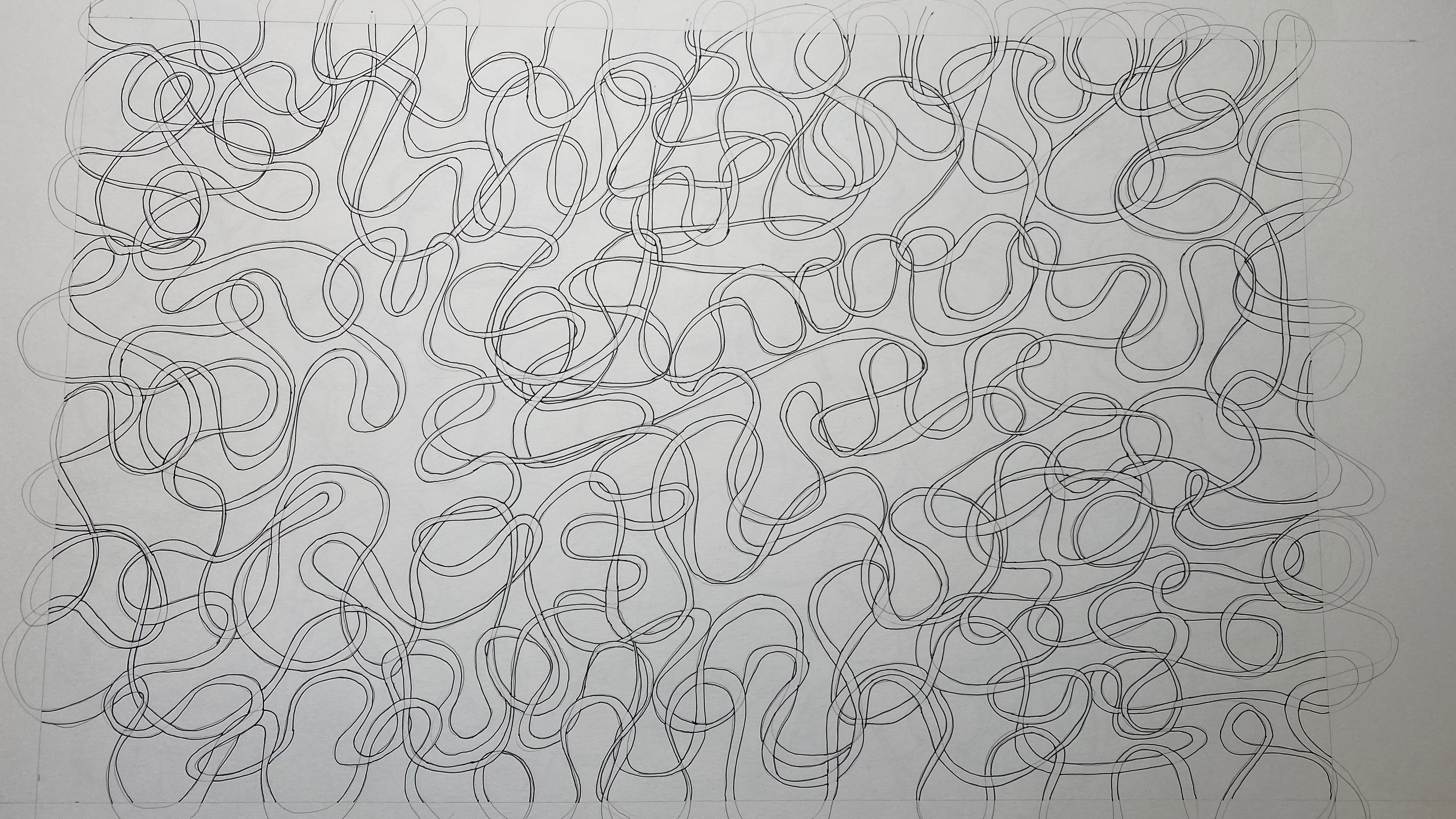
I did make some analog work, mainly pencil and Chinese ink on paper, and very little with paint on canvas.
Together with some friends, we submitted a SoP24 Protocol Improvement Grant proposal for Conversation Protocols for Humans and Machines. Unfortunately, our team did not make it to the 2024 season of the Summer of Protocols. There were 130 candidates and only 5 residencies available. We learned a lot in preparing the submission material.
Toolmaking for Spatial Intelligence
Followed DigitalFutures Workshop “Toolmaking for Spatial Intelligence” and got my certificate
Masterclass XR in Industry
I am following the Masterclass XR in the Industry (an online course with some on-site assignments) at the Howest Academy in Kortrijk (with Digital Arts & Entertainment as one of the best game schools in the world) and HITLab (Human Interface Technology Lab) until June 2025.
5) Visualizing the unseen (IOT data visualization/digital twin)
6) Virtual control (interaction with machines/robots via XR)
Performances
Performance: Claim Your Cybernetic Word – 17 June 2024
I was invited to do an online performance for the 60th-anniversary conference of the American Society for Cybernetics.
Attendees were encouraged to participate actively by offering cybernetic terminology. We discussed for example the Paskian Knobs required to steer randomness and the style of the outcome. The session resulted in more than 300 generated words. They were consolidated in an on-the-spot generated word cloud. We also created an AI-generated cybernetic song.
Resulting world cloud
Performance: What Makes Us Human? – 28 August 2024
The Cybernetic performance uses a new format for delivering and creating content in some dream-state flow. I showed it to Josie Gibson from the Catalyst Network, who invited me to create a similar online workshop “What Makes Us Human?”
This performance is an engaging, immersive, and poetic screen-foray crafted to elicit compelling language embodying The Catalyst Network’s human dimensions. Attendees are encouraged to offer catalyst and humanistic terminology, visually depicted in an immersive cloud-like interactive video installation and a bespoke soundscape. The session opens with an artistic cinematic dream sequence. Through facilitated brainstorming sessions with the audience, participants can fine-tune word generation. The session closes with a cinematic catalyst song outro “A Woven World of Humans”.
Trailer:
Performance: New New Babylon
This has been my main focus over the last months, and that paid off: I made good progress on this performance. This performance is now available for virtual and physical on-stage delivery.
The New New Babylon performance is a 45-60 minute immersive experience, divided into six chapters—Awakening, Stepping, Flying, Gliding, Folding, and Vertigo. Each chapter explores different facets of the New New Babylon concept, blending art and interaction. Audience members are invited to actively participate, engaging with interactive elements that promote a sense of community and shared creativity. The performance integrates rich soundscapes, video projections, visual art, poetry, masks, VR, and stage props to create a multisensory journey.
To get here, I have spent loads of time in Unity Editor (a software tool to create 2D, 3D and VR environments, well known in the game development industry), did some in-depth reading on modern urbanism, registered for a masterclass “XR in the Industry”, and partnered with NUMENA, a renowned interdisciplinary creative studio from Germany, specializing in award-winning spatial design and programming.
For the next iteration, we plan an API-supported LLM infrastructure to enable live interactions with AI Agents. We aim to facilitate real-time exploration of historical New Babylon research resources during on-stage and online sessions. This infrastructure is currently being developed by Thomas McLeish, Adjunct Lecturer – at Berkeley Master of Design, and master creator of the 2018 replica of the Colloquy of Mobiles. Arthur Moelants – a talented young cinematographer and immersive audio expert from Flanders – also joined our project.
We submitted the performance as a candidate for the Venice Biennale College 2025, but we did not make it.
Performance Dream My Dream
The team decided to re-work the New New Babylon performance into a live experience that does not require any hardware (headsets) for the audience. We have renamed the performance to “Dream My Dream”
Trailer
17 Minute Video simulation of the performance
Dream My Dream is an immersive performance experience in six dream states: Awakening, Stepping, Flying, Gliding, Folding, and Vertigo. A live VR performer embodies an architect-researcher and dreams about the New New Babylon, a speculative future society transformed and eroded by automation, artificial intelligence, and digital technology. The dream explores profound and universal questions about the essence of existence. The audience is invited to interpret the dream in their own unique way.
This artistic performance has a poetic, gentle, and profoundly human touch, evoking a dreamy, Magritte-like surrealism. The atmosphere is calm and harmonious, steering from Sci-Fi or dystopian themes toward a non-aggressive, understated, and subtly utopian vision.
We submitted “Dream My Dream” to the Cannes Festival Immersive 2025 competition but did not make it to the final ten.
We are now revisiting the synopsis and tagline of this performance and making some adaptations to the treatment with the ultimate goal of premiering at one of the major film/immersive festivals.
Artistic Research Project: New New Babylon
The performance is one of the deliverables of the main artistic research project. There has been renewed interest from several parties interested in partnering on the main New New Babylon project.
We are looking for a team/consortium to overlay an existing city (district) with a VR environment for A/B Testing of the urbanistic, economic, and governance aspects.
The deliverables of Phase-1, the Vision-Phase, are:
A beta version of an Urbanistic Artistic Rendering VR Environment, inspired by an existing or planned City or Real Estate project
Artistic Performance (minimum Online, ideally IRL), see above
Art Expo (minimum Online, ideally IRL)
Art Book
Stealth
A new project, very embryonic, written and directed together with Andreea Ion Cojocura, complemented by my cousin (a 17th-century art expert) and a world-renowned artist as the MC.
The project is an experimental alternate reality experience about the nature of flesh, human suffering, and technological advances. It seeks to find an answer to the question: “Who are the new Gods that can deliver us from suffering?”
It is a surreal experience to see the truth. It happens over a three-year timeline. Unfolding in real time, the project involves participants in the preparation, execution, and aftermath of the fictitious latest ecumenical council.
The multi-year project entails a prelude phase as a mockumentary in 360 video, audio, and VR, followed by an in-person council, concluding in new canons and summarising mockumentary.
At the moment of writing, we are finalising the pitch.
A theory of space/time dimensions
The analog gnarly curved art projects, the 3D software learnings, the few conversations, a couple of computation and math books about flat and 3D dimensions (see books section below in this blog), and especially the Stealth project led me to fantasize about a multi-dimensional (not multiverse) world that is suddenly revealed and that changes everything we know about science.
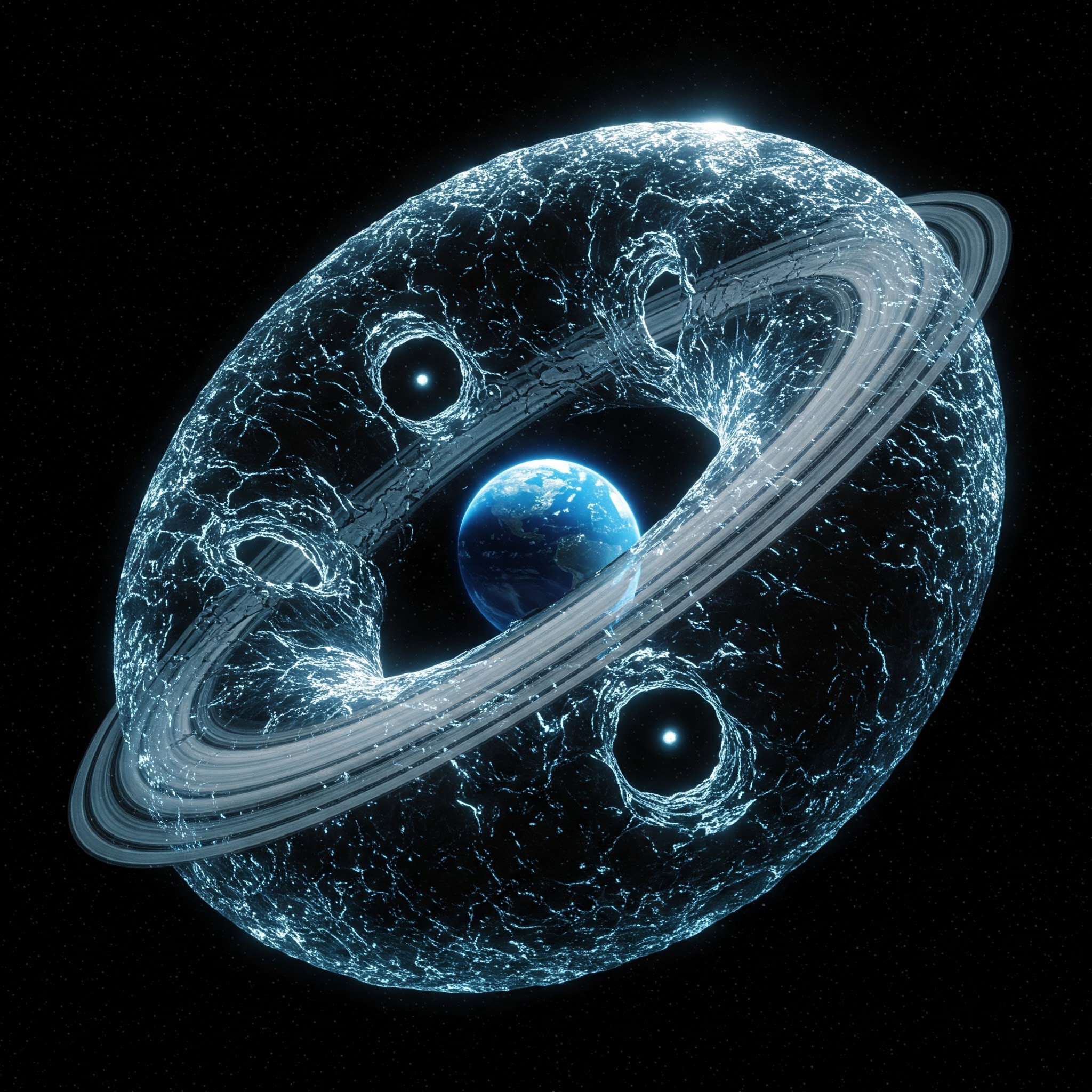
One of the fantasies envisions a world encircled by a Saturn-like ring of knowledge-infused water, unveiling stereoscopic windows into higher and lower dimensions of time and space—if such concepts even exist.
Don’t take anything here too seriously. To quote Rudy Rucker: “I am a science fiction writer and the secret of science fiction is pile on the bullshit and keep a straight face”
Delicacies
“Delicacies” is my incoherent, irregular, unpredictable collection of interesting sparks I came across online. Handpicked by a human, no robots, no AI. A form of tripping, wandering, dérivé, with some loosely undefined theme holding them together. Delicacies have no fixed frequency: I hit the publish button when there is enough material. That can be after a week or after 3 months. No pressure, literally.
Check out the May, June, September 2024, and February 2025 editions here.
Books
Highlights:
Geometry, Relativity and the 4th Dimension – by Rudy Rucker (1977)
Art, Technology, Consciousness: Mind@Large – by Roy Ascott (2000)
Love & Math – by Edward Frenkl (2013)
Behave – by Robert Sapolsky (2017)
Mind in Motion – by Barbara Tversky (2019)
Soft City – by David Sim (2019)
and re-reading The Lifebox, the Seashell, and the Soul – by Rudy Rucker (second edition 2016)
As we are turning the pages from old to new, I thought of writing one of those old-school blog posts, more for the fun of writing it – and hopefully you reading it – rather than trying to make a point or breakthrough. Although pages, pointed pencils, and breaking through are definitely topics in these reflections about The Scaffold being a wormhole. Hope you enjoy this rabbit hole.
A brain worm in my head is obsessing about wormholes being an excellent metaphor or not for bending cognitive spaces to our own particular navigational needs.
An ear worm or brain worm is usually defined as a “catchy or memorable piece of music or saying that continuously occupies a person’s mind even after it is no longer being played or spoken about.”.
Unfortunately, in slang, it means “a persistent delusion or obsession; a deeply-ingrained or unquestioned idea”.
I leave it to my readers to assess whether my thoughts belong to the former or the latter.
The wormhole metaphor popped up during one of my catch-up calls with partners in crime about The Scaffold, our transdisciplinary learning studio for the never-normal.
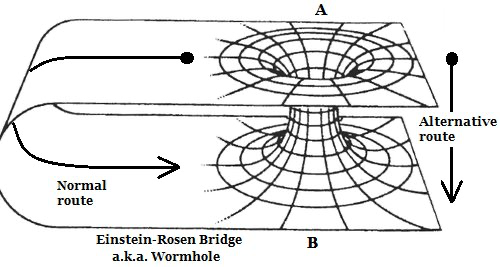
The Scaffold is a wormhole, an unorthodox way of going faster from A to B.
Here is where Dr Romilly explains about the wormhole to Cooper in the film Interstellar:
I love the paper sheet and pencil metaphor to suggest this alternative route towards your imaginable futures.
Easier said than done: if The Scaffold is indeed a wormhole, what do we need in place to create the wormhole? What is the nature of the plane being folded?
The plane could be looked at as the social fabric for thinking together, thinking in synch. It is another tool or system to facilitate coordinated behaviour. The plane becomes a graph-mind, as explained in Venkat Rao’s Graph-Mind-Notebook series.
Punching the right line through the plane is difficult, and comes with great responsibility, and only few people can do this. These punchers are usually born like this, and often not welcome or seen as inappropriate in corporate environments.
It takes a huge effort to instigate experiences that break away from the normal. Humans are hardwired to believe what they hear/already know. Their brains are wired to look for mirror neurons, and this not only at the cognitive cortex, but also at the motor cortex, visual cortex, other cortexes…
How do you break away into the territory of experimental imagination, as described by Ann Pendleton in Pragmatic Imagination? You could use LSD trips to create experiences that are as strong as giving birth to a baby. Seriously, how to make the hole is a very serious proposition.
You have to first identify the consistency of assumptions of the plane, then have different strategies for drilling the hole, and a list of tools to drill the hole.
I always thought – and still do – that using artists is a natural human way to resonate beyond the cognitive, textual level. Artists – not as entertainment, but as prime contributors to the content and the narrative – can bring us in a state of different reality.
It is about human presence in multiple realities, in form ànd feeling, in space ànd time. It resembles to dance, or rather choreography.
“Dance/choreography is dancing of the second order, meta-dancing, or better, it is an investigation of dancing.”
Alva Noe in his book The Entanglement
“We will soon live life across multiple realities. Each with its own physical laws, bodies & affordances. The only common denominators? Space, time and human presence.”
Andreea Ion Cojocaru
How to make holes is also a matter of nuance, of deciding how much dissonance you want, you can have, what’s beyond your comfort zone, although we know from Niels Pflaeging that there is no such thing as a comfort zone.
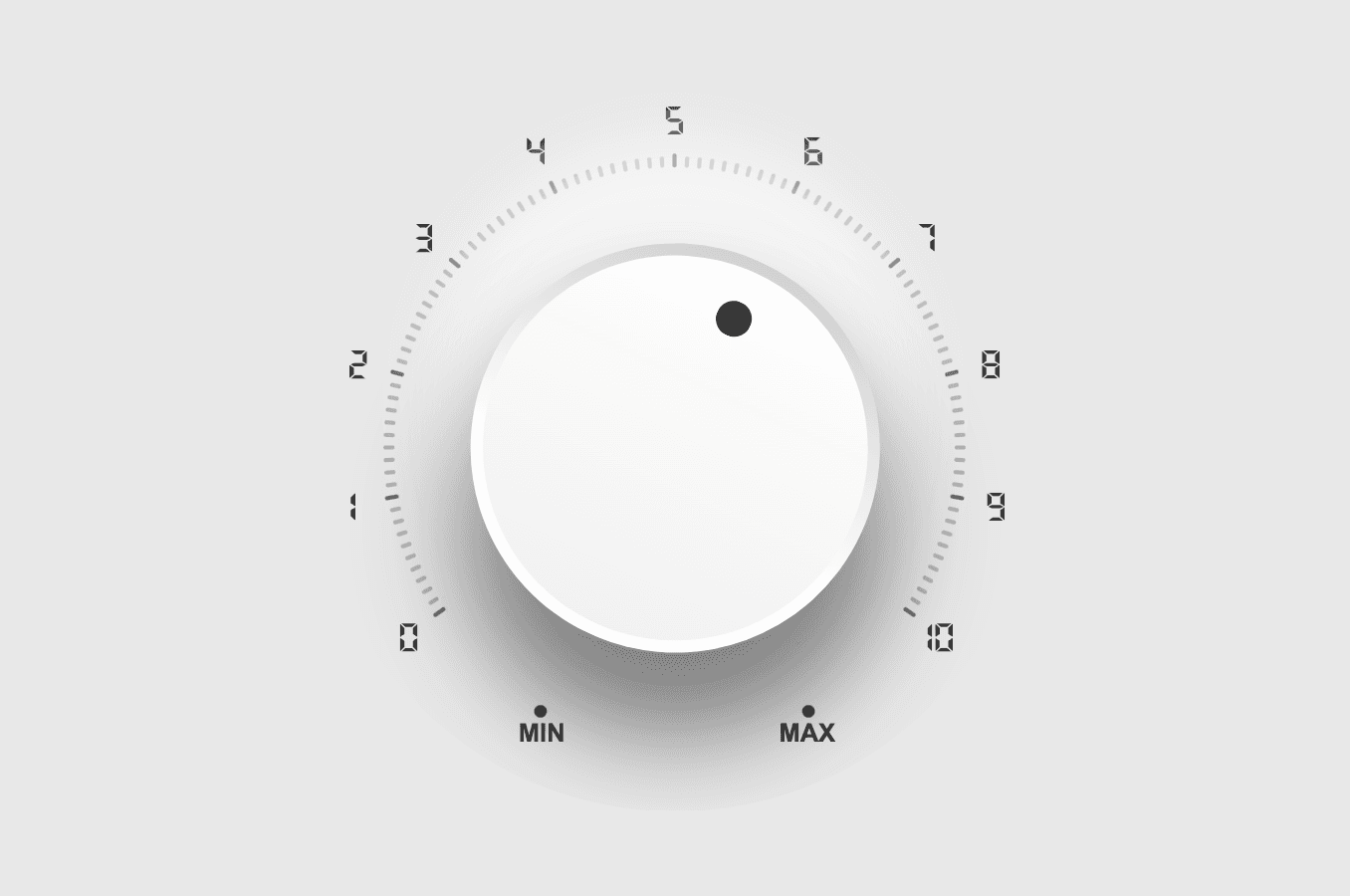
Imagine a dial/slider of dissonance
Who turns the dial? Who is the orchestrator/composer/juggler of place, space, and time? Who is the mapper/weaver of ideas? Who curates the team of transdisciplinarians in a coherent impactful learning experience?
What I find so interesting about Die Hard—in addition to unironically enjoying the film—is that it cinematically depicts what it means to bend space to your own particular navigational needs.
This mutational exploration of architecture even supplies the building’s narrative premise: the terrorists are there for no other reason than to drill through and rob the Nakatomi Corporation’s electromagnetically sealed vault.
Die Hard asks naive but powerful questions: If you have to get from A to B—that is, from the 31st floor to the lobby, or from the 26th floor to the roof—why not blast, carve, shoot, lockpick, and climb your way there, hitchhiking rides atop elevator cars and meandering through the labyrinthine, previously unexposed back-corridors of the built environment?
Geoff Manaugh
The Scaffold as a wormhole is about going through previously unexposed back-corridors where all is malleable.
This will scare the hell out of many. The disclaimer deserves a warning to be prepared to be discomforted, even to expect existential angst. Such disclaimer also imposes a duty of extreme care to the designer of such experience.
Interestingly, and to stay in the world of film and imagination, the quote “Innovate or die” is sometimes attributed to Robert Iger, the CEO of the Walt Disney Company.
In that sense, the title of this blog post could as well have been
“Die Hard and Innovate”
With thanks to Andreea, Marti, JMS, Josie, and Venkat for planting these brainworms in my head.
As we close the year, here is the latest update on Petervan Studios.
The previous update was in March 2023. In a sense, this update is an update on the whole year. A lot has happened since then. A lot did not happen. An overview.
Quick catch-up
I studied architecture (art school), never practiced (dropped out), and stumbled into a nice corporate career. In 2017 I took a sabbatical and never went back. I left the corporate world. I am now officially “retired”
Family
On 18 Dec 2023, Astrid became 18 years, officially “of age”, driving our car (good driver, final exam in Feb 2024), and started higher studies (a four years bachelor nursery), and horses, of course. And in May, we celebrated our 30th wedding anniversary. Time flies. Happy times.
Cosy Birthday Breakfast for Astrid
The Art Studio
The Art Studio is nicely rippling along. I did not have the feeling that I accomplished much, but with hindsight, it’s not too bad, and there are a lot of good foundations for the year to come.
Some of the new projects include:
Hexagrams
Claim your word
Something has dissipated
New paintings
New digital artworks
New soundscapes
Experimenting with interfaces for IRL and VR installations
You can find most of them via the “Artworks” tab on my website.
The “Something has Dissipated” project got some traction. There are now about 20 spoken language versions by real humans, including Mongolian and Chinese. But also some synthetic non-human avatar versions like this one:
In the planning is a personal solo art exhibition in VR coming and maybe IRL. Some installation concepts will try-out first in VR, and maybe later IRL.
A new performance lecture “City of Play” is in the making, about the New New Babylon (and the power of imagination). No specific target date. I have time, and it has to be right.
New New Babylon – City of Play
I am kind of obsessed with the New Babylon project of artist Constant Nieuwenhuys, who co-founded the avant-garde COBRA art movement in the 1950s.
For 25 years he worked on New Babylon, an imagined city for the playful and creative human being. The oeuvre consists of hundreds of drawings, sketches, and maquettes. His work was inspired by the book Homo Ludens by Johan Huizinga.
The NEW New Babylon is an artistic research project where we use 2023 technologies.
At the time of writing, we are trying to set up a team/consortium to overlay an existing city (district) with a VR environment for A/B Testing of the urbanistic, economic, and governance aspects of the city.
It probably will involve expertise from worlding experts, interactive fiction, procedural games, autonomous worlds, protocol language patterns, etc
At this moment I am exploring a whole slew of tools: videosync, BEAM, BAM, Procreate Dreams, Capture for scene design, and spending lots of time on learning/trying to understand Blender, Unity, Unreal Engine, new Ableton packs, the new version of Apple Logic Pro X, and hopefully soon Apple Vision Pro.
Timing slips. No problem, I have time. And it has to be right. And not sloppy.
Since March 2023, I visited many art exhibitions and galleries. If I had to pick one or two highlights, it would be Jan De Vlieger at Mudel and the Inspired By Love expo at Belfius Art Gallery. Picture below is work by Emilie Terlinden.
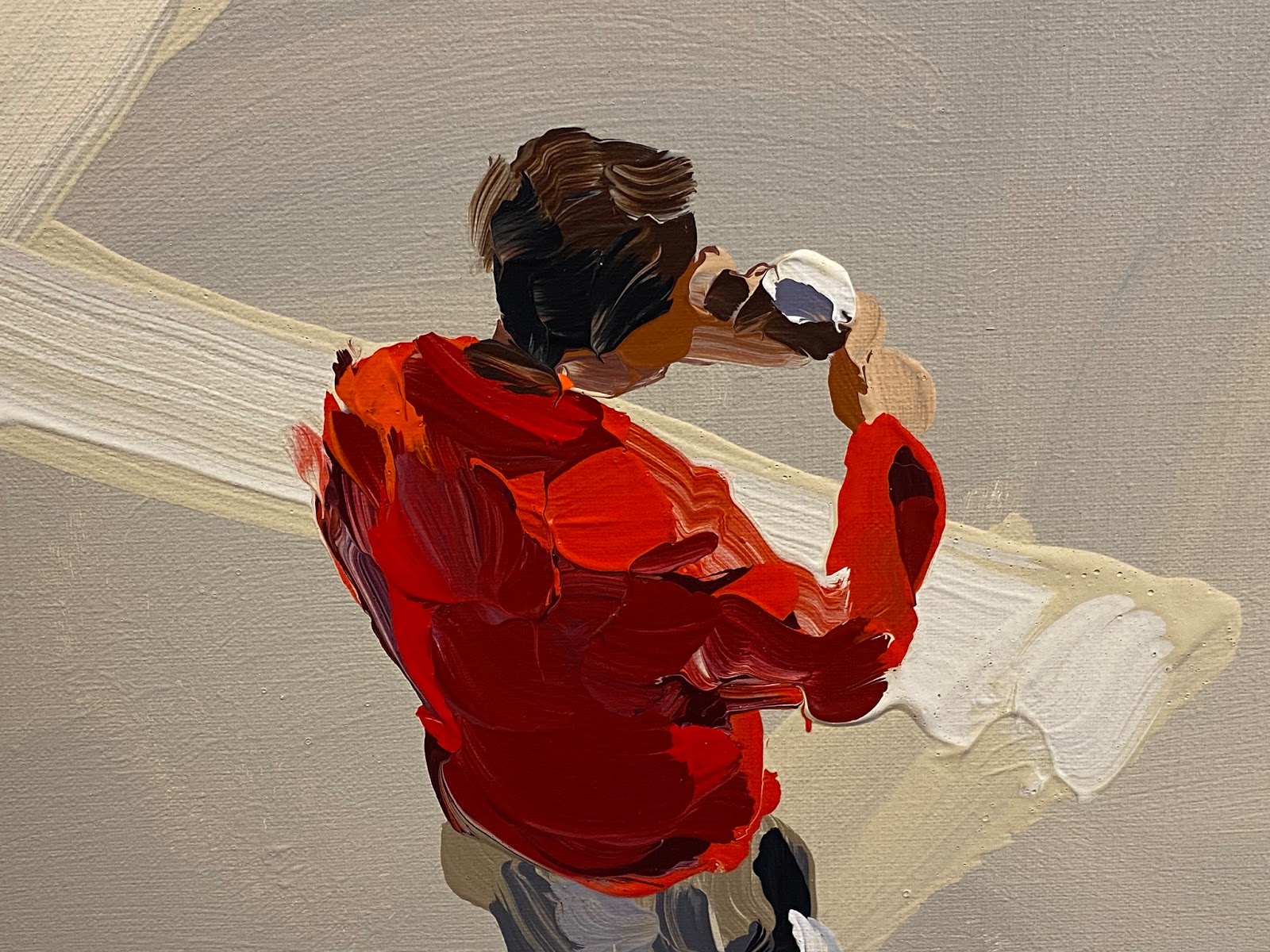
Detail Jan De Vlieger’s San Marco People – picture by Petervan
Detail of Emilie Verlinden’s The Farm 2023 – Picture by Petervan
Also, the works of David Claerbout and his practice are a continuous inspiration for my own work. Here is a great talk by David at Schaulager Basel as part of the Out of the Box exhibition.
David Claerbout discusses a range of artworks, among them Nightscape Lightboxes (2002-2003), Wildfire (meditation on fire) (2001), and Backwards Growing Tree and Birdcage (both from 2023), the latter two on show at the Gallerie Greta Meert in Brussels till 3 Feb 2024.
What’s next?
I don’t know. Focus areas are:
The New New Babylon project
The upcoming solo exhibition in VR
The Performance
But some promising smoldering sparks deep in the campfire may suddenly light up. Life is full of surprises. Only the fool don’t change their mind.
So, that’s it for this edition.
Happy New Year to all of you!
If there is something worth reporting, the next update is for April 2024.
It is rare that I read a book twice. “Making Art Work” byPatrick McCray is one of them. A book that sends you back to the future of the 50ies, a period in some sense similar to today, where we are again in a cold/warm war context, but where interesting collaborations between art, engineers, scientists, entrepreneurs, and technologists make their appearance as well. Fortunately, it was not all doom then, and neither is it today.
The book is also a huge inspiration for The Scaffold, the transdisciplinary learning studio for the never-normal that I am trying to give birth in different constellations.
In the book, the author Patrick McGray looks at artists-engineers collaborations with a very specific lens: where usually art books glorify the artists, Making Art Work looks at the engineers that made the transdisciplinary artworks work. Hence the title “Making Art Work”.
One of the key insights in these transdisciplinary collaborations is the evolution from “What do I want?” to “What do we have?” Usually, the artist comes in with what she/he wants and asks the engineers to make that happen. This approach leads to a lot of misunderstandings and frustrations. A better take is to start with the question to the engineers “What do you have?” and let the artists play and be creative with what is already there.
The book is a treasure of other gems, anecdotes, and more in-depth research of the life and work of folks like Frank Malina (rocket engineer turned artist), Billy Klüver (laser-beam engineer turned curator/impresario), Jean Tingeley (artwork/machined that destroyed itself). These were also crazy times with Andy Warhol, John Cage, Robert Rauschenberg, Marcel Duchamp, and many others.
Jean Tingeley – Hommage to New York, 1960 – The New York Times – Photographer unknown
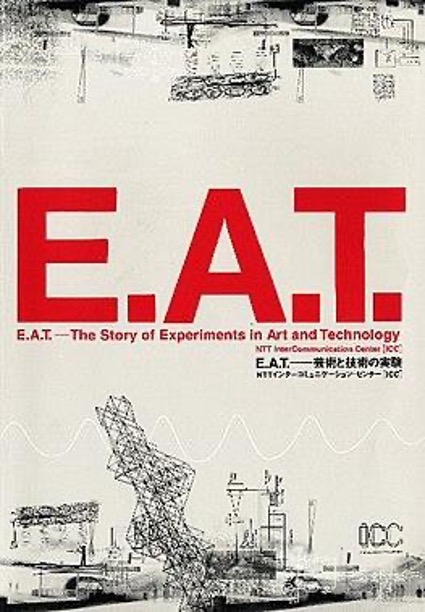
There was so much going on at E.A.T. and the best way to get a sense of the depth and breadth of their work is by reading the book, or sitting down, relaxing, and enjoying this +1hour video about the initiative, narrated by Julie Martin, at that time “Director of Experiments” at E.A.T., and in this video really charming and full of humor.
Not only is her title cool, but the title reflects the core E.A.T. ethos which was all about experiments. The outcome was deemed less important than the journey of the experiment.
The becoming is more important that the state of the thing.
In my earlier post “Apple Just Upgraded the Illusion”, I already touched upon process philosophy as “a way out of what is today seen as overly deterministic thinking about technology and time, and clears the road for thinking about digital technologies and digital selves not as objects but as processes and becoming“
“Projects that did not get realized are as interesting as projects that are”
Julie Martin talks about reverberating beyond careers and personal lives, cultivating a sense of play, disciplinary hybrids, “artrapreneurship”, and taking purposeful risks in order to explore new boundaries in both art and science. How cool is that!
The precursor of E.A.T. was an amazing one-time event “9 Evenings: Theatre and Engineering” one of the first large-scale collaborations between artists and engineers and scientists, held in the 69th Regiment Armory in New York, a huge empty space that was transformed into a theatrical performance space in five days.
E.A.T. was also the main contractor/curator for the content at the PepsiCo Pavillion at the World Fair Japan in 1970.
I love the subtitle “50 years on, artists and engineers staged one of the most ambitious and expensive multimedia events – and infuriated their corporate backers”
Here are some pictures from that article:
Both “9 Weeks” and the “Pepsi Pavillion” highlight the importance of space in orchestrating new skills and behaviors. Space as a language. Space as in spatial computing. Space as in spatial thinking, spatial creation.
In re-reading the book “Making Art Work” and writing this post, I suddenly realized that most of my work is about “Making Space Work”, or even better “Making Content Work”. A practice where most of the work is an experiment. Where the becoming and the performance in space are more important than the resulting artifacts.
Performance by the performers on-stage, but also by the participants. Their journey becomes an experiment as well, a curious meandering through an endless labyrinth, letting them connect the dots and do the meaning-making, rather than considering the audience as passive consumers of content that need to be hand-held, directed, and manipulated by and in a scripted non-malleable “show”.
As I mentioned several times before, my practice is not in the entertainment business, my practice is in the learning “bildung” process. These methods are underpinning my work in the area of interventions, provocations, and interruptions. In other words, all my work is about similar forms of artistic and aesthetic expression and experience in the co-creation of content. These methods also led to a new vocabulary and a new set of aesthetics to describe and share what I do and why I do it.
I feel like I am painting with content. Making content work. I am hungry to unleash this creative energy in some big space, together with technologists, scientists, artists, and entrepreneurs.
The initial title of this post was “Let’s upgrade the illusion”, but that’s what Apple just did with the announcement of the Vision Pro. And I mean that in the positive sense, not as a criticism.
The quote “Let’s upgrade the illusion” comes from a keynote by Deepak Chopra during the December 2022 retreat of Nishith Desai Associates (NDA), a leading Legal & Tax Consulting company from India, with offices worldwide. It is in itself interesting to see a Legal & Tax Consulting company exclusively focused on new technologies like AI, XR, Nano, Bio, etc.
The event was hosted in NDA’s gorgeous campus “The Imaginarium”, a true infrastructure for imagination, pitched by the CEO as a “private infrastructure for the public good”. How cool is that?
But back to that keynote titled “The nature of reality, what is real?” – We jump in after 2 min:
Deepak kicks off by stating that everything is real if you are truly immersed in it: whatever you experience is an illusion. If everything is an illusion anyway, let’s then upgrade the illusion. To do so, says Deepak, ideas have to manifest. Therefore we need imagination.
Imagination is about EVERY experience, all senses, not only visual, Deepak goes on. And then he really got me when he explained:
“That what imagineS is consciousness, awareness, soul. That what imagineS has no form, no location in time or space, no boundary, and therefore is infinite. That what is imagineD has form, has location.”
This opens a field of possibilities, or better, a field of what can be imagined.
I agree with Peter Hinssen when he says that the Vision Pro is not an iPhone moment but an Apple LISA moment:
“I don’t agree with those who say that the Apple Vision Pro launch is a new iPhone moment. I believe it’s an Apple Lisa moment. The Apple Lisa was a true milestone in the history of personal computing. Just like the Lisa, the Apple Vision Pro is a technological marvel that is too expensive (for now) to join the mainstream but is setting completely new standards for the industry.”
Back to Deepak. In a second talk at the same event about “The Future of Wellbeing”, he kindly notices that scientists measure experiences, and artists have experiences. That scientists identify with Quanta, and artists with Qualia. “Qualia is a unit of experience”.
What if we would measure the success of the Vision Pro on its potential to dramatically increase our units of experience, expanding our notions and understandings of what is real.
This reminds me of David Chalmers’ book “REALITY+”, a philosophical masterpiece that basically states that any good illusion is indistinguishable from real.
Let’s mix this with the insights of another philosopher Mark Coeckelbergh in his new book “Digital Technologies, Temporality, and the Politics of Co-Existence”, a mouthful, I know. Prof. Dr. Mark Coeckelbergh is a full Professor of Philosophy of Media and Technology at the Philosophy of Department of the University of Vienna.
In this book, Coeckelbergh makes a plea for process philosophy:
“Process philosophy shows a way out of what is today seen as overly deterministic thinking about technology and time, and clears the road for thinking about digital technologies and digital selves not as objects but as processes and becoming“
He also introduces the concepts of embodied technologies and “technoperformances.”
Performances emphasize the role of humans and the social but also bodily and kinetic character of our (co-)existence with digital technologies… As I have proposed in Moved by Machines and related work, the term performance can be used to conceptualize our dealings with technologies, including digital technologies. As we use digital technologies and are involved in technoperformances, we move and are choreographed, we act and are directed. To conceptualize the important role technologies and media play, we can say that we do not only use technologies in order to move, but that technologies also move us and direct us. The medium is not only the message but also the performance.
Andreea passionately talks about the potential of XR to instigate and discover emergent behaviours, about rubbery environments in continuous change, putting change at the heart of everything. And also about performance, like in art performance, a live creative process that takes you on an embodied, visceral journey with direct interaction with public. A process relational approach: me and the building (the environment) going dancing for a while. Love that – dancing with your spacial environment: where the end result is less important than the process, the experience itself.
Ken Bye has btw very deep thoughts about the impact of AR/VR/XR on presence, immersive storytelling, and experiential design. Watch his May 2022 Brussels talk on YouTube here. I encourage you to watch the whole thing, it will reset your assumptions about virtual reality.
The core of his talk is about this quadrant, looking at AR/VR/XR in terms of four types of presences.
One could also say the four types of “illusions” of what is real and what creates and influences your learnings and behaviors.
“Apple DID debut a killer app. It’s embodied interaction *done well*. It doesn’t matter how simple it is. Experiencing space smoothlessly react to you in any form is exhilarating, addictive magic. The killer app is spatial UX as its own content. The novelty resides at the neural level, where a tiny delay or flicker makes a world of difference in how information is processed, and when and how the feeling of magic and awe is released.”
Besides the fact that the Vision Pro and anything related to it is just a gorgeous piece of technological perfection – “you can lick it” would Steve Jobs say – it deeply integrates spacial vision and embodied experience. That’s why I belief Apple just upgraded the illusion.
Update: I added a link to @BrettKing’s The Futurist Podcast on the Apple Vision Pro with @missmetaverse @Scobleizer, and @BrianRoemmele . This Podcast gives you a really good sense of the revolutionary aspects of the Apple Vision Pro. Enjoy!
























 Petervan Studios