The Forbidden Question at UnitedXR Europe – Homo Experiens Explorers

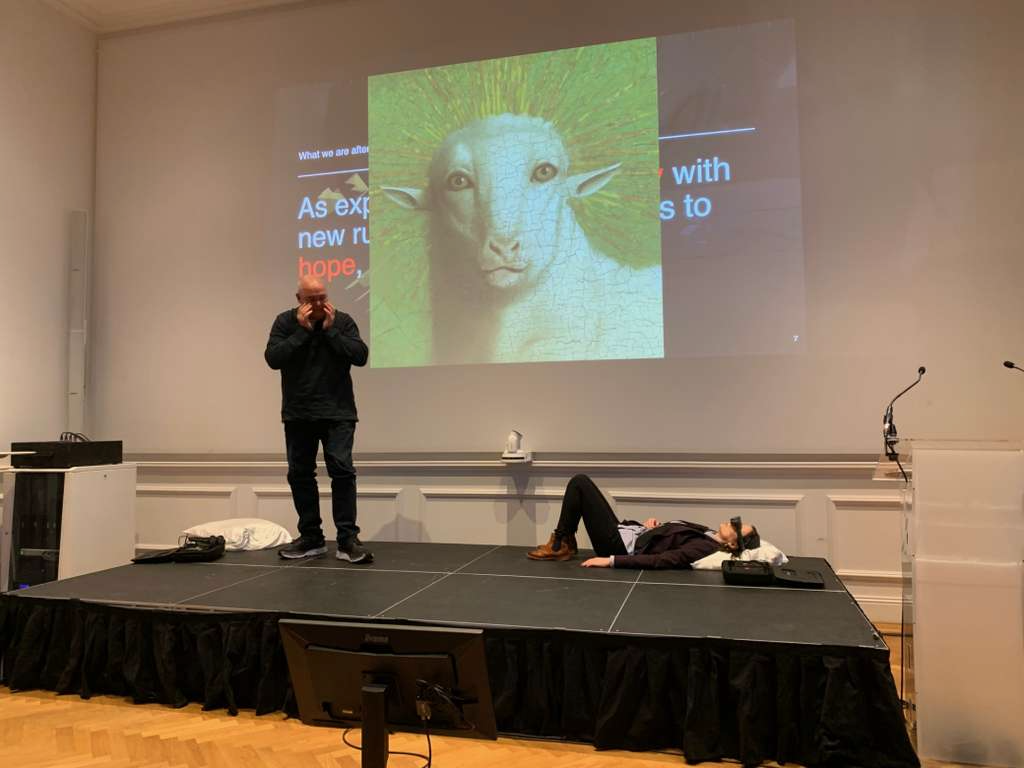
On 9 Dec 2025, Andreea and I gave a “talk” about our journey and lessons learned in creating The Forbidden Question. Rather than a talk, it was a performance about the performance. The talk also includes a speaking lamb from Van Eyck’s famous 1432 Ghent Altarpiece. See the lamb in the video of our talk below. At the end, you will also see a strange character running away with the stolen 12th panel of the Altarpiece.

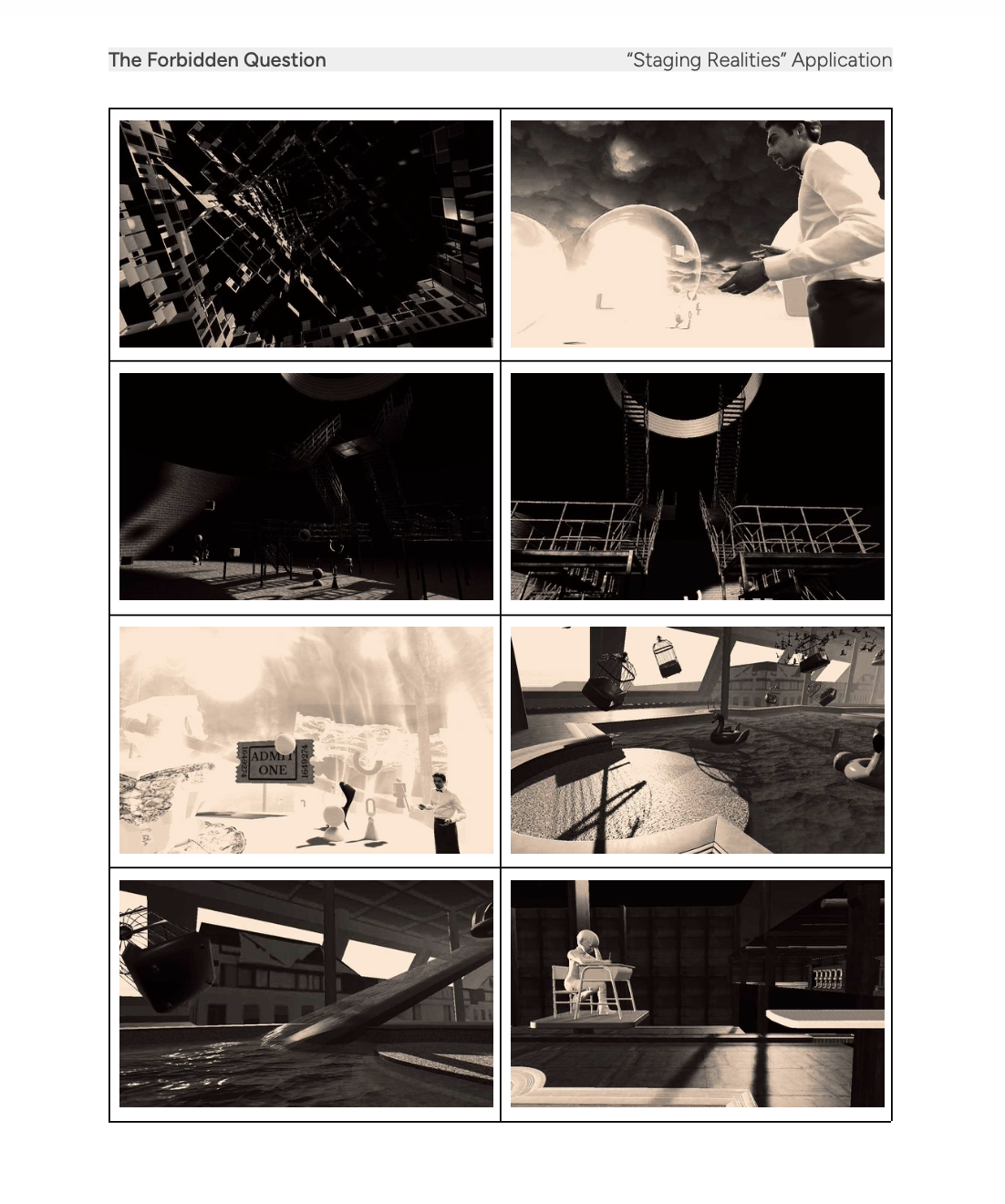
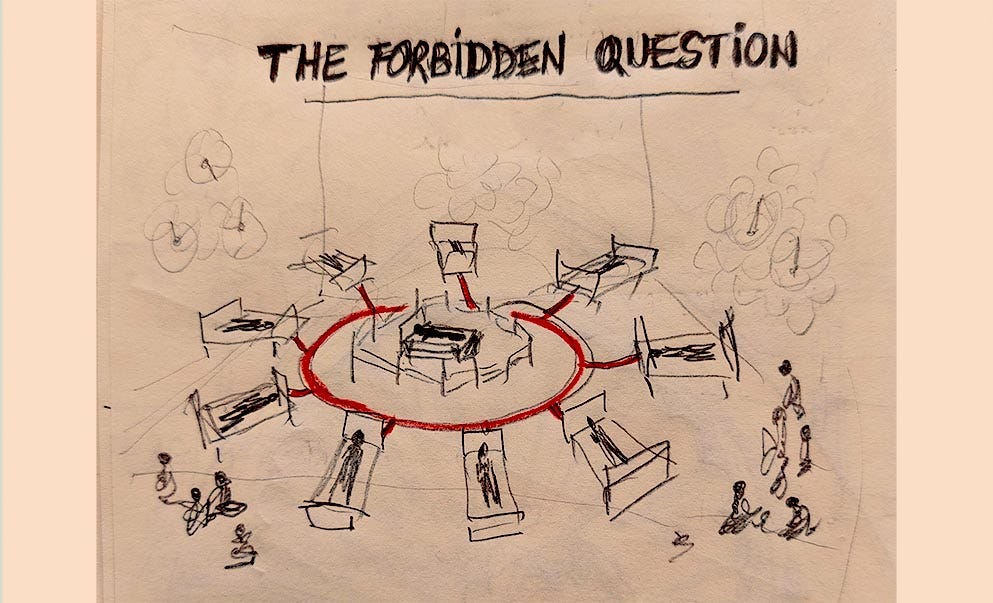
With this piece, we are proposing a choreographed yet spontaneous play between multiple dreams and dreamers. All the actors on stage come from the audience except one: Paul. An Eastern European architect who moved to Brussels in hopes of one day building the city of the future, he has fallen asleep with his shoes on after a long day of waiting tables. This is the moment our universe is born. As participants are encouraged to chase connection and fulfillment, our cosmology cycles their souls and dreams through several layers of reality. The more assiduous the search, the more wondrous and intense the connections they make, the more oblivious and unrelenting the fleeting and cyclical nature of the game becomes. The “forbidden question” in the title is the question no one will ever find an answer to: Whose dream is this? Are my desires really mine? Am I even able to stop wanting?

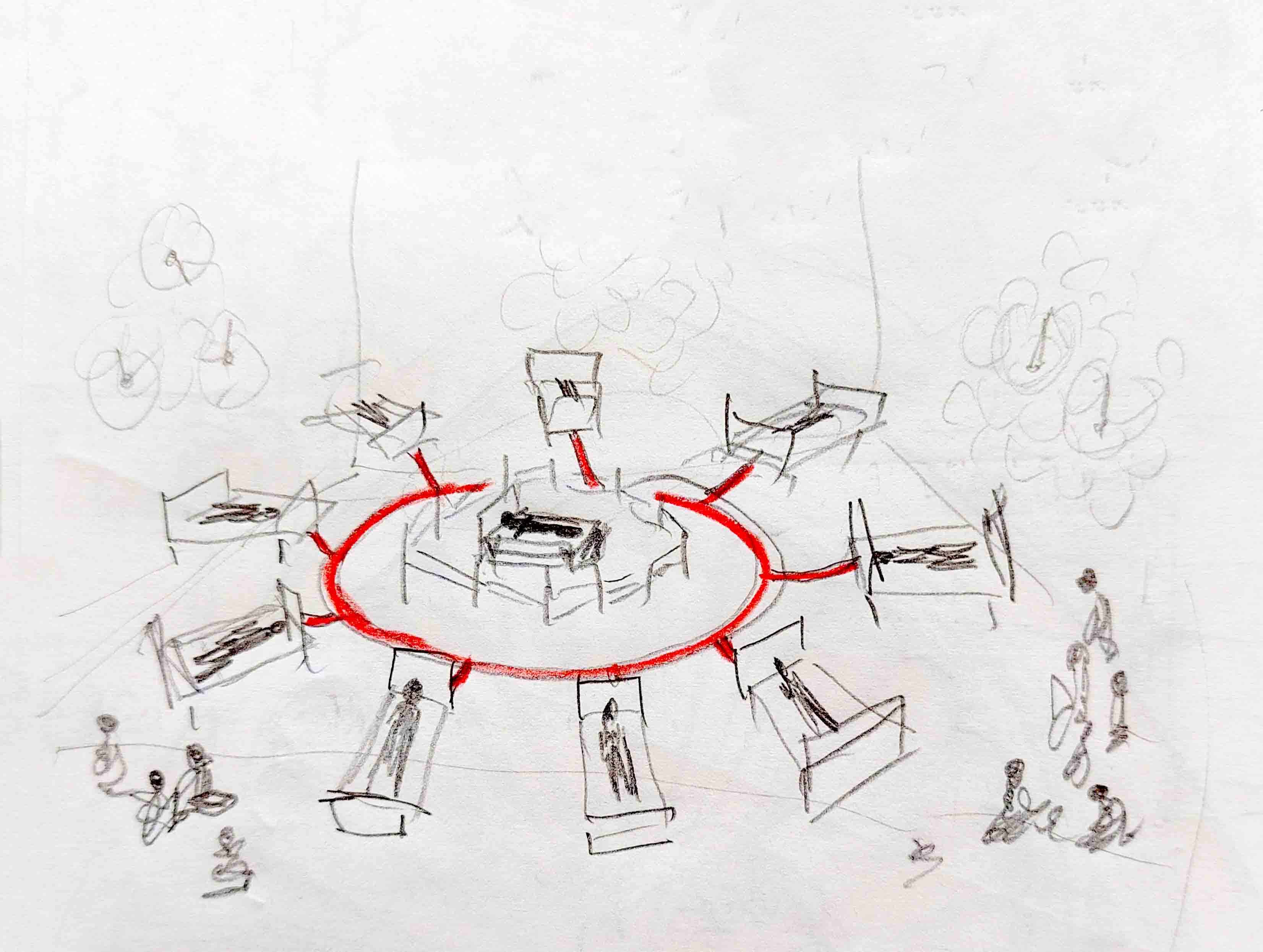
The room is set up with nine physical beds (8 for the audience encircling the one bed for Paul). The performance is designed for a full 360° experience (visuals, audio, tracking), and we work with award-winning 3D artist Ozark Henry, award-winning cinematographer and DoP Arthur Moelants, and award-winning maker Thomas Mc Leish.

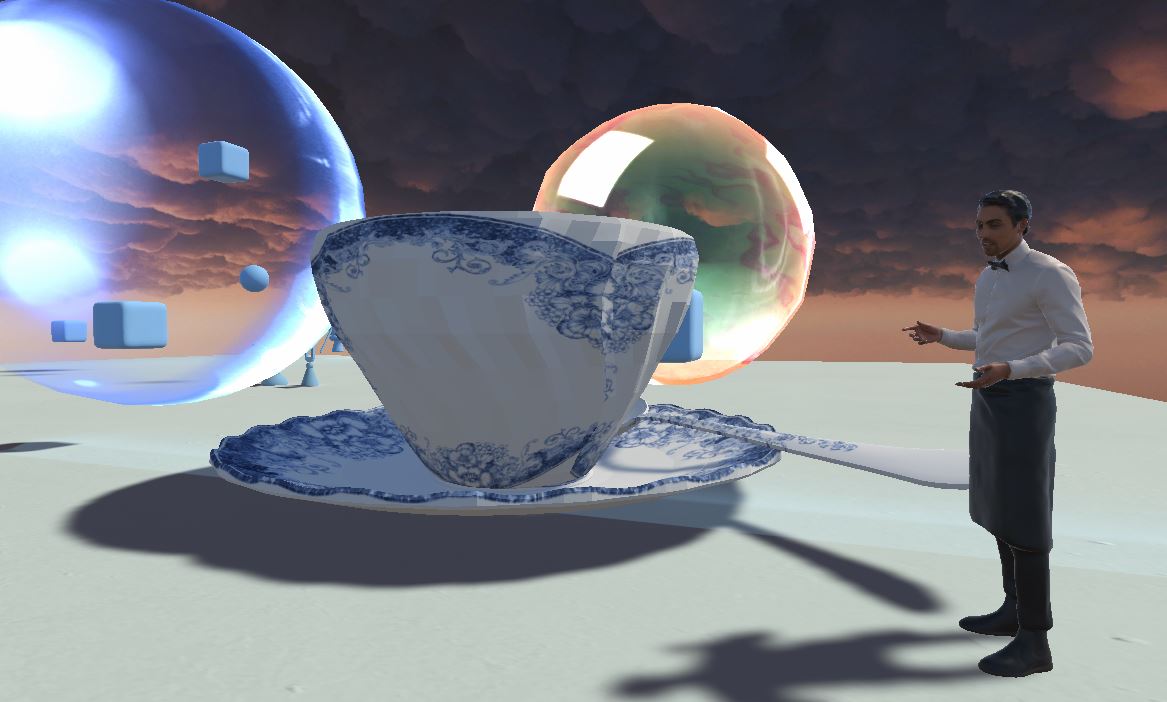
I would like to give some background on this project, a sort of making-of. The project started as the New New Babylon performance, at that time designed for a speaker on stage wearing a VR headset, and the audience seeing the VR rendering on a big screen behind the speaker. Here is a very, very early version of the tower of the New New Babylon:

Then, we pivoted to a version called “Dream my Dream”

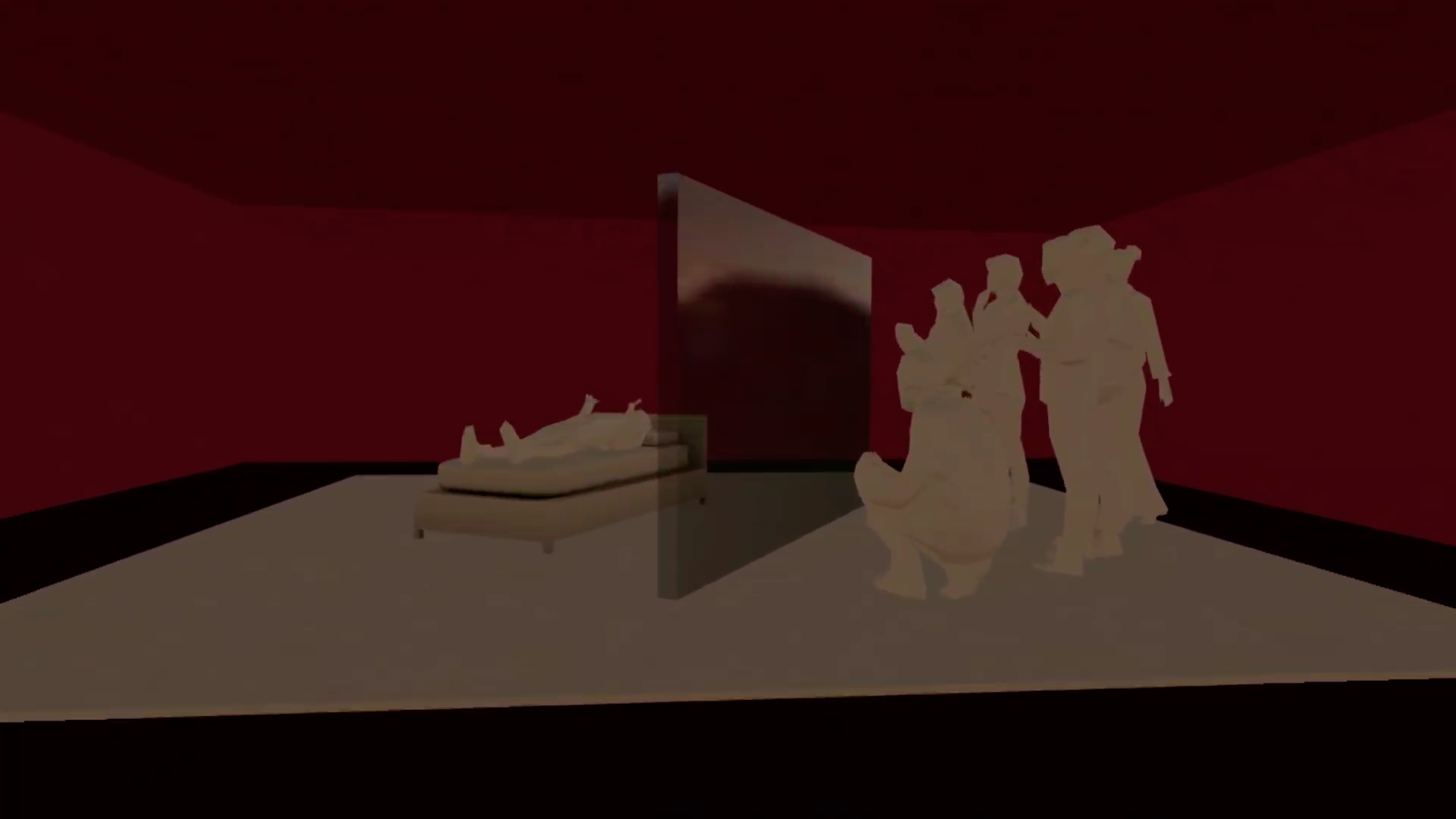
This time, the audience would witness a sleeping performer with a VR headset, and follow the dream through some sort of transparent screen:

Mock-up of the viewing room – created in Space Elevator

After submitting our project to both the Venice Biennale College Cinema and the Cannes Immersive 2025 competition, without being selected, we took the opportunity to critically reevaluate the core premises of the performance.

Then, as part of my end-project for the Howest course XR in Industry, we created a very early version of The Forbidden Question, which began with the story of an Eastern European waiter and the concept of central and surrounding beds. The video below is an early MVP of what we had in mind.

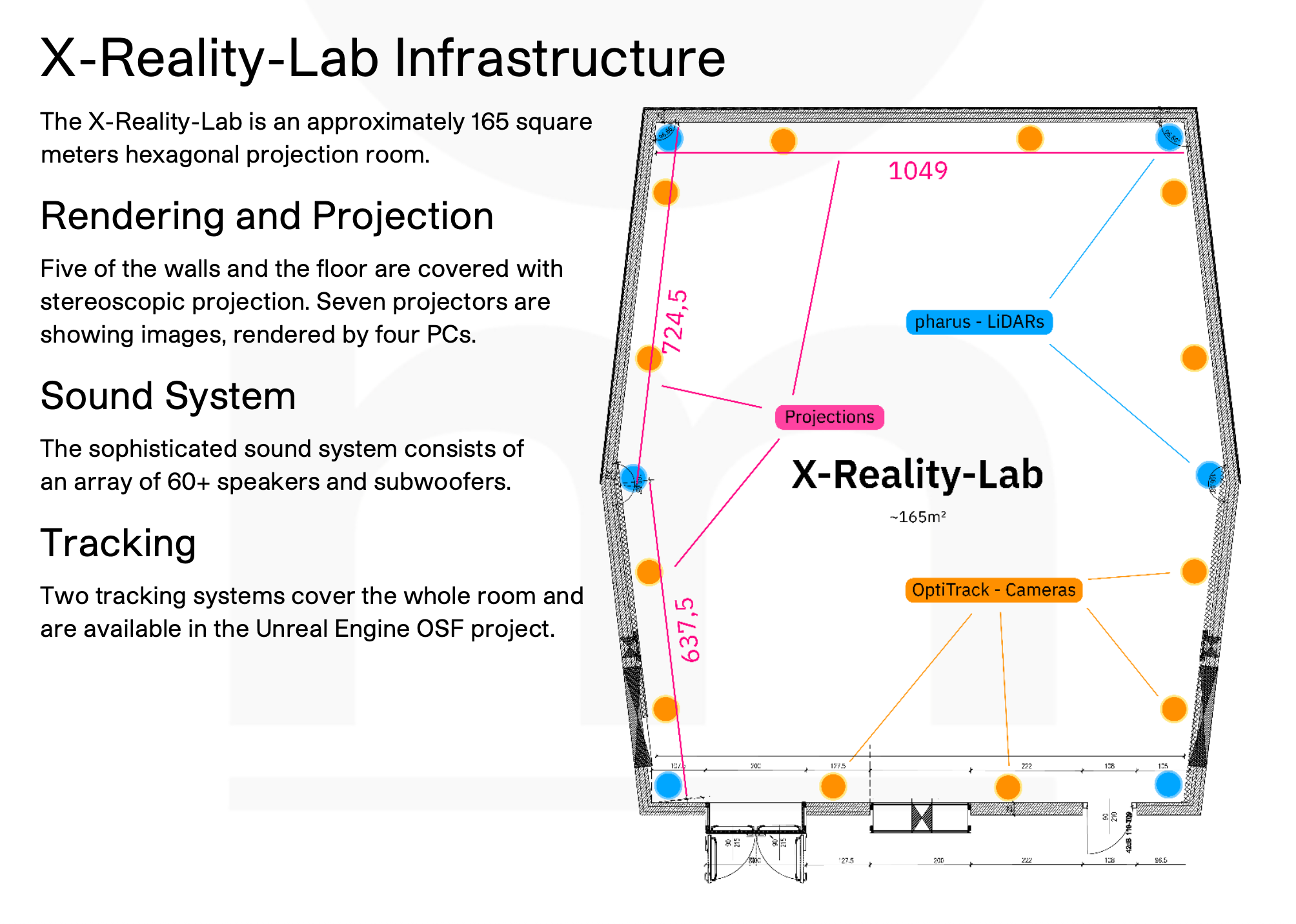
During this period of reassessment, Andreea came across an open call for immersive projects at the Salzburg Mozarteum X-Reality Lab. Salzburg is currently developing a state-of-the-art 360° immersive venue featuring stereoscopic projection, a 60+ channel spatial audio system, and integrated LiDAR and high-definition camera infrastructure. The lab was seeking artistic performances for the venue’s inaugural program, scheduled for March 2026.

High-level sketch of the X-Reality-Lab in Salzburg

For this project, we completely re-wrote the performance into an XR “game of life” unfolding across multiple realities, with both an actor and the audience as performers. From its earliest concept through multiple iterations, the project transformed from a one-person headset performance into an immersive XR experience designed for stereoscopic projection, 3D tracking, and 360° spatial sound. Here is an extract from our submission document. The biggest change was to move the whole New New Babylon narrative from the foreground to the background, and to let the audience experience crossing realities (from dream reality to awake-reality). We made it to the shortlist (out of 150 international candidates), but did not get selected in the end.

Extract from our treatment of the performance for Salzburg

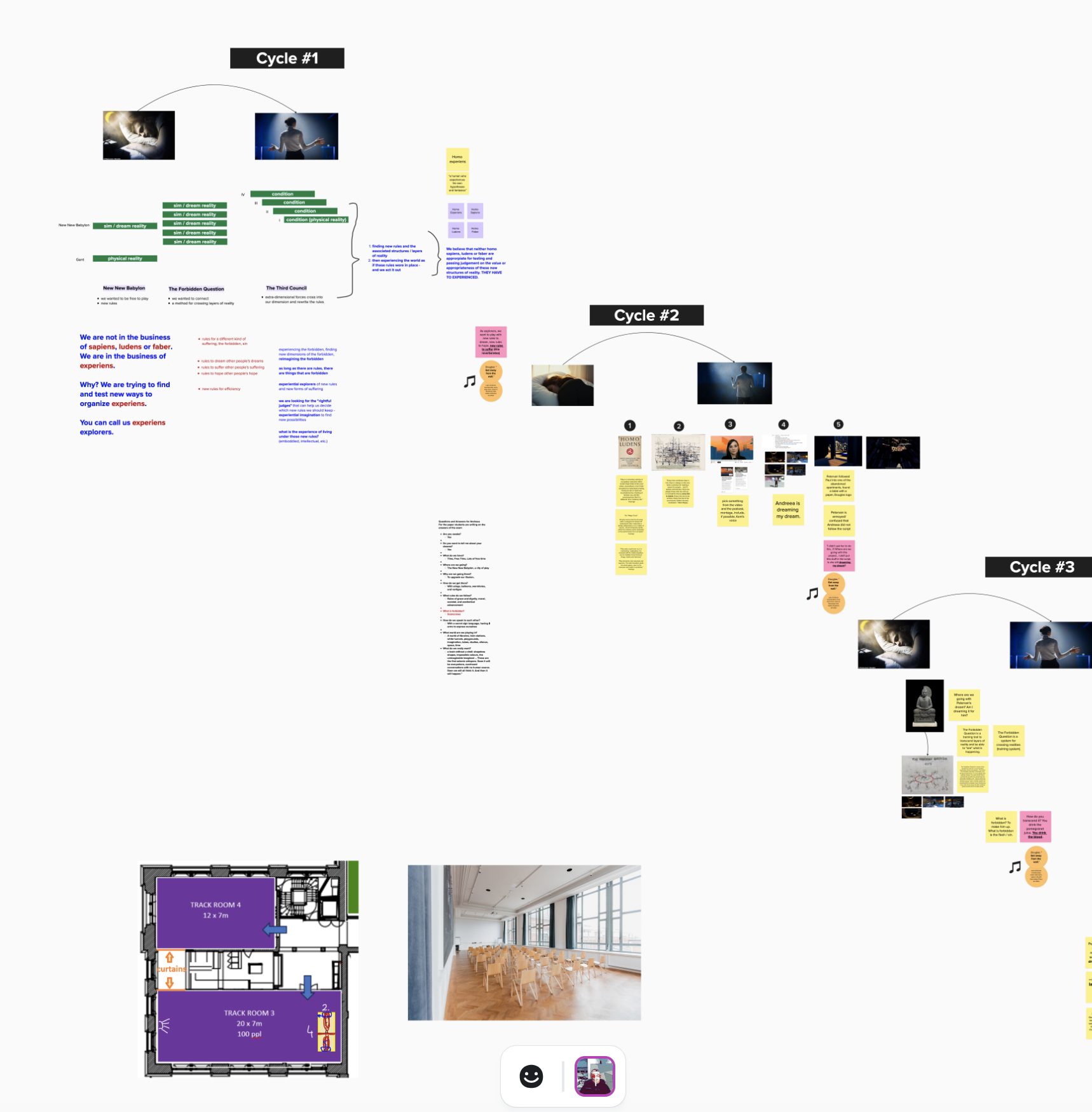
In preparation for our talk at UnitedXR, Andreea and I had many online sessions on the mood and conceptual flow of our presentation (Mural extract below). We wanted to present a coherent journey from New New Babylon to The Forbidden Question to The Third Council.

Mural brainstorm for UnitedXR presentation

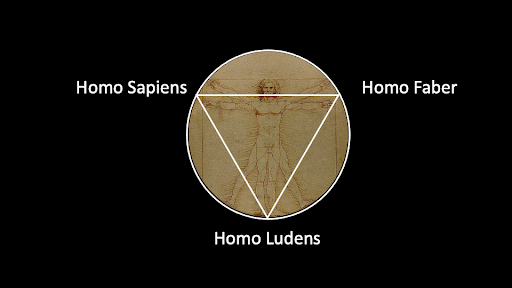
An aha moment emerged during these sessions: neither Homo sapiens, ludens, nor faber is capable of evaluating the validity of these new structures of reality. Their meaning cannot be assessed intellectually—they must be experienced.

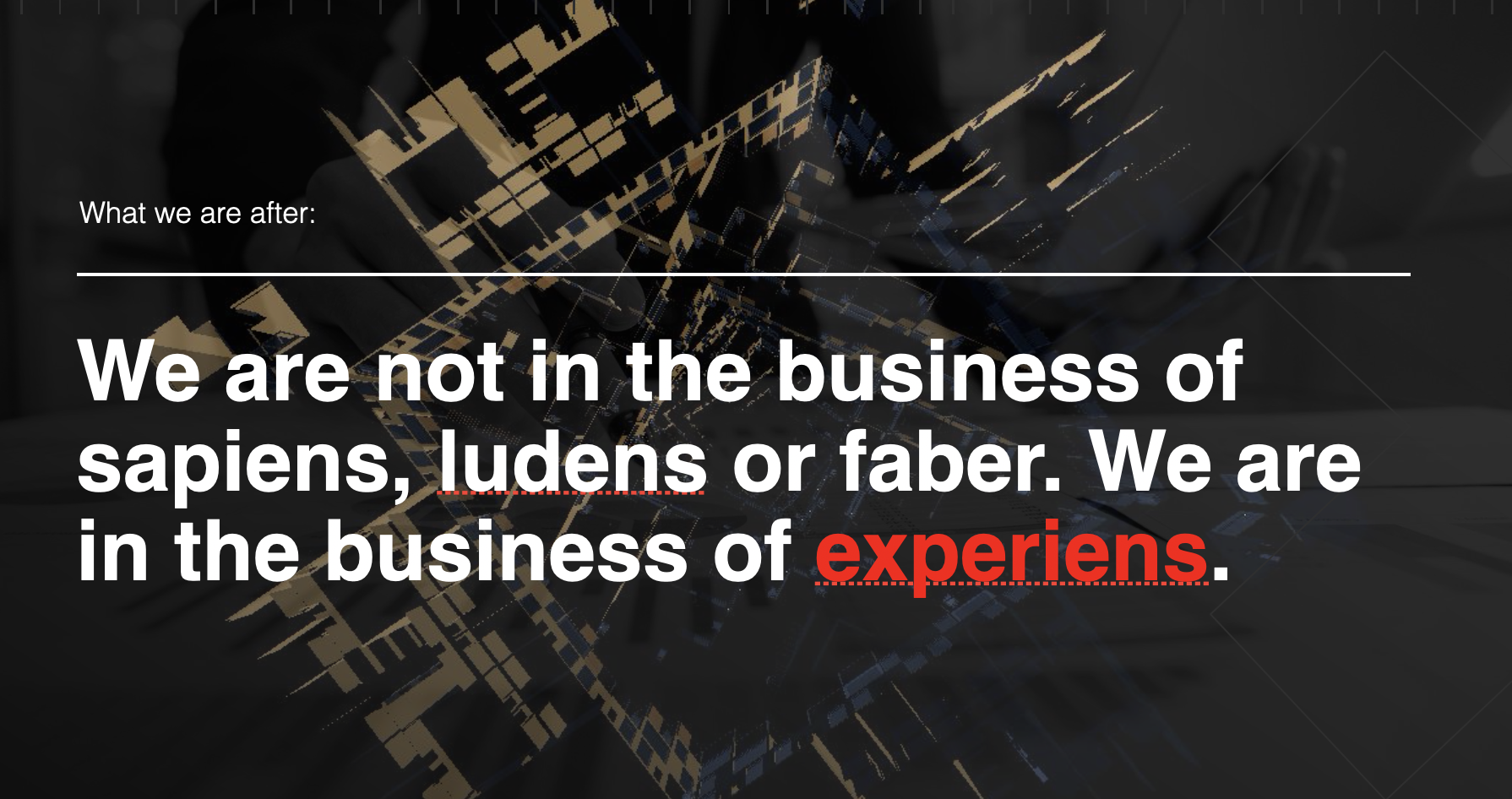
Hence Homo Experiens. With an “s” to differentiate from the words “Narrative” and “Experience” that have become catch-all words.

So we like to call ourselves “Experiens Explorers” and “Designed Conspiracy” would better describe what we have in mind. See also https://petervanstudios.com/2025/12/21/the-orphic-experience-we-are-all-argonauts-again/

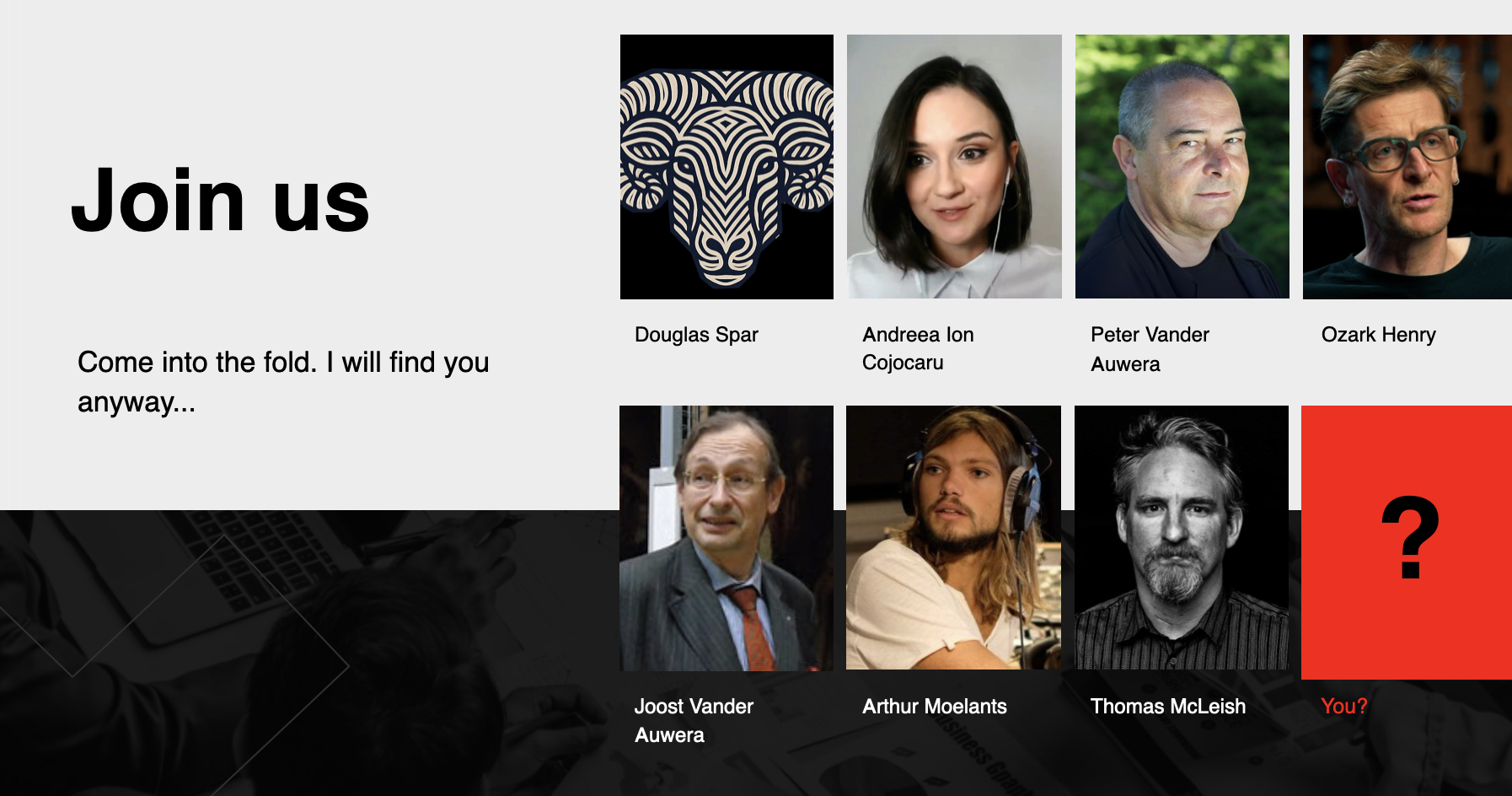
The Forbidden Question team
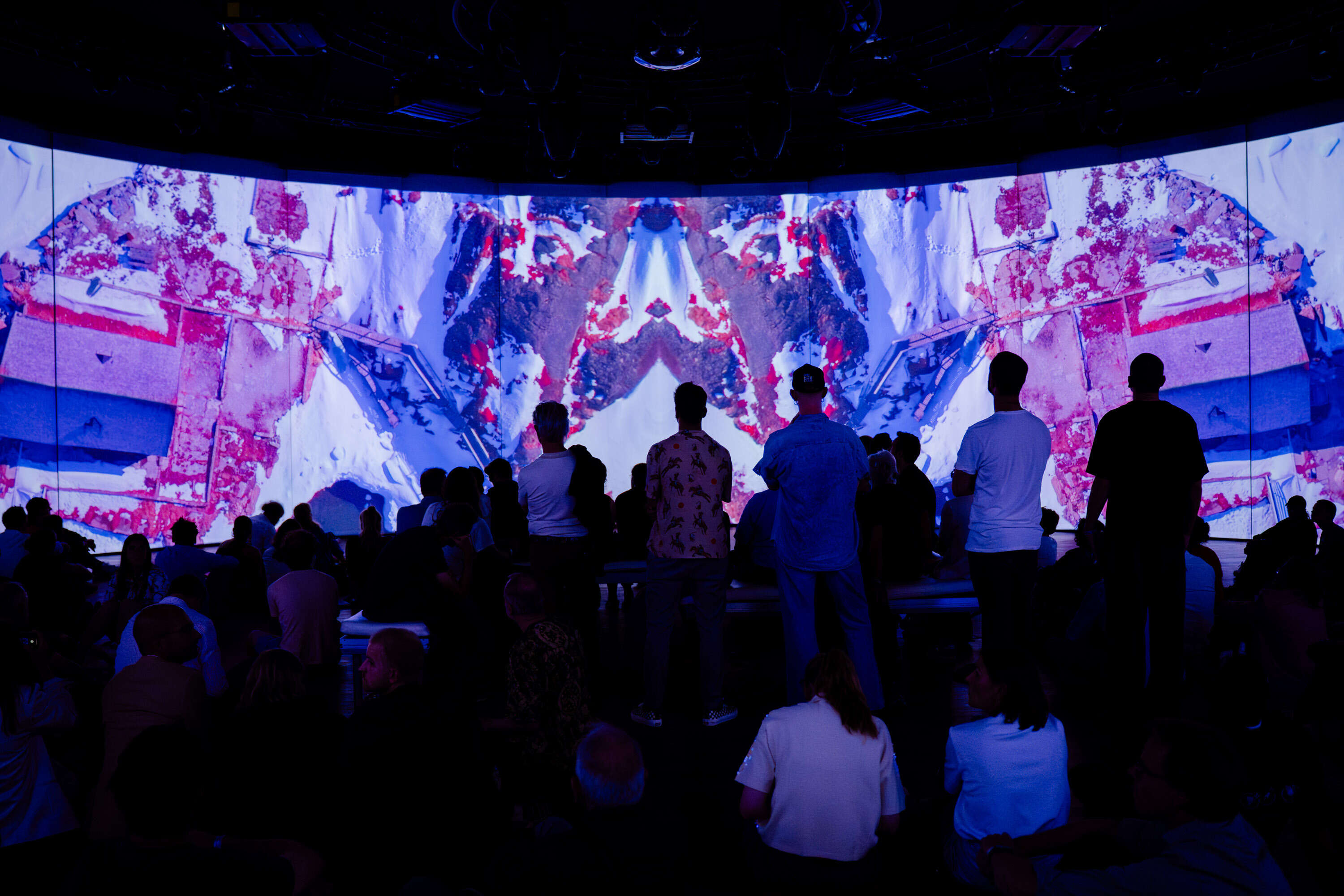
Picture from the crime scene at UnitedXR on 9 Dec 2025

Kent Bye, who runs the Voices of VR Podcast, was in the room, and he invited us for an interview right after (quite an honor, if you ask me). As soon as the interview is published, the link will be added to this post.

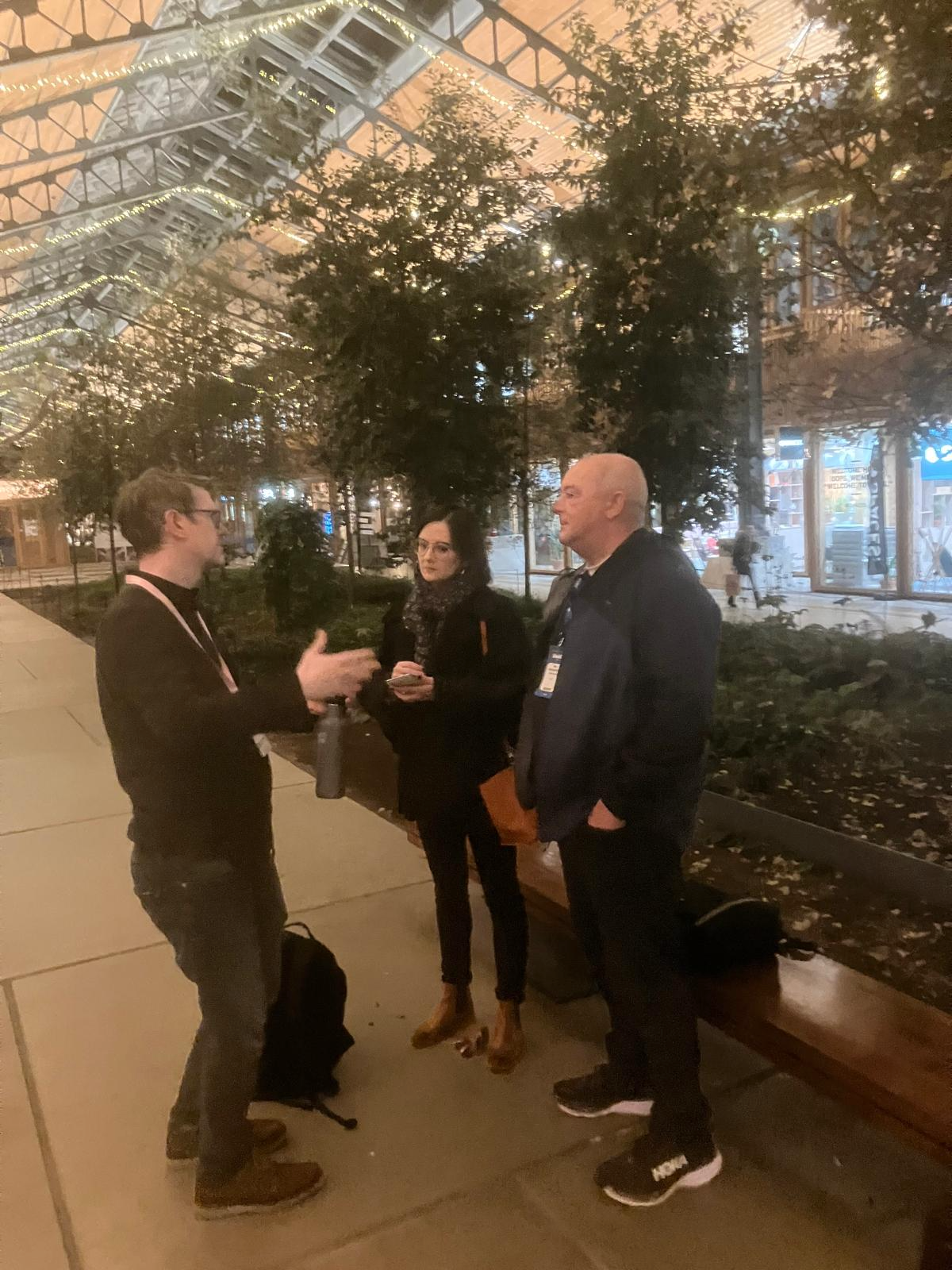
Post interview picture. From left to right: Kent Bye, Andreea, Petervan. Picture by Joost.

Use the barcode above to follow the discoveries of Douglas Spar (aka The Holy Lamb). Doug is the one investigating The Third Council. And “The Forbidden Question” is now positioned as a training protocol for crossing realities and the main priority of our team right now.

We are now complementing the team with technology partners to build a pop-up 360 infrastructure for artistic performances. We are contacting immersive spaces to be on their program. We also consider a subsidy for a technology prototype for this immersive performance.

May the lamb be with you in 2026!

With deep gratitude to Andreea, TJ, Arthur, Joost, and Ozark for staying motivated during this whole process. And thanks to UnitedXR for having us.

The Orphic Experience: We are all Argonauts again

In my post about Dub-Techno artist Adrian Sherwood, I referred to the book “Dub Techno – The Orphic Experience of Sound” by Bahadırhan Koçer to describe my sound experiments with dub.

As promised in that post, the most compelling part of the book appears in its opening chapters, where he introduces “The Orphic Experience.”

The short summary is in the video below, from 0:59 to 2:23. The latter part of the video is about the three key elements of dub-techno: spontaneous repetition, atmosphere, and embracing noise.

TL;DR: The orphic experience uses music to alter perception, evoke deep emotions, and influence the listener’s state of mind. It creates a unique space and time for introspection and reflection.

Let me unpack this in stages: first the “orphic” aspect, then the “experience” element, and finally a synthesis.

Orphic

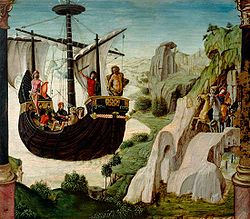
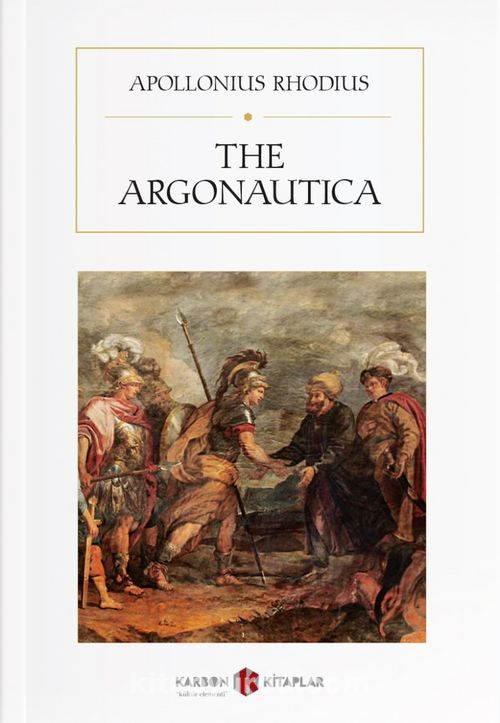
The “orphic” part originates from Orpheus, a character in the ancient Greek poem Argonautica, dating back to the 3rd century BC. The Argonauts are travellers on the boat Argo and are on a quest for the golden fleece. Somewhere along the route, sirens are trying to seduce the boatsmen. Still, Orpheus – a talented singer/musician on the boat – can shield the boatsmen from the Sirens’ temptations through his celestial, beautiful songs and voice. In other words, he was a noise canceller avant la lettre.

Some salient quotes from Bahadırhan Koçer:

The orphic experience, therefore, refers to the transformative way sound and media technologies can be used to control one’s sonic environment, creating a personalized auditory space that shields individuals from the overwhelming stimuli of modern life.

It is conceivable to argue that the nature of this transformation lies fundamentally in a shift from communal to individual listening.

The protected space needed for “sensory and emotional self-care”

In this sense, orphic experience can be seen as a way of escaping from the demands of the real world and constructing a self-contained, artificial reality.

By carefully curating their auditory environment and creating a personalized soundtrack to their lives, the individual can signal their taste and distinction to others, and distinguish themselves from those who do not possess the same level of cultural capital.

The “orphic” concerns the creation of a protected, isolated space in which the rules constraining clear thought can be suspended.

Experience

The second part is about “experience”. The words “Narrative” and “Experience” have become catch-all words. Washed-out. Weak. And they all suggest a passive audience.

Also here, a David Claerbout quote is appropriate:

I think the recent proliferation of black boxes for film and video-art is not just a practical solution to a problem of sound and light interference, but also reflects an incapability to coexist. This can become apparent in large group exhibitions, where media installations appear strong when they are shown by themselves in a small or large dark space, but they easily collapse when shown in a social space where people move about and interact. The black box is a social phenomenon, for me it is a problem.” Ulrichs, David, ‘David Claerbout. Q/A, in: Modern Painters, May 2011, pp. 64-66

“Designed Conspiracy” would be better to describe what I have in mind. With an active audience. Or even better, where there is no stage hosting the expert speaker and no passive audience just leaning back in chairs, incapable of truly internalising knowledge.

I imagine us inside a 360° immersive room: a six-metre-high LED screen, full 360 Dolby Atmos sound, LiDAR tracking, and high-definition cameras—paired with exceptional content and facilitation. A complete experience in a box, ready to tour and deploy anywhere in the world. Am I exaggerating? Maybe not. I’ve just met someone who is building exactly this.

Synthesis

Obviously, I am using all of the above as a metaphor to try to explain what I do with my artistic interventions, provocations, and interruptions. These qualities inform my work/play. Whether that is soundscapes, installations, performances, or group expeditions.

Now that we have our protected, isolated space and a designed conspiracy, it is time to play the music. Music is the content. Content is the music.

Experiencing our music – individually or as part of a group – can feel like a trip, a trance, like digital psychedelics.

The music/content is presented in the right space, with the appropriate emotional and psychological atmosphere—the backdrop, if you will—inviting and sustaining safety, interest, curiosity, awe, and growth.

The rhythm is softer, slower, quieter vs. harder, faster, louder.

We embrace – and even design – flaws and imperfections, spontaneous repetition, and noise, inviting the participants to connect with being human, and to internalise the content at an embodied level of sensory experience.

We design with fifty shades of sophistication: avant-garde activism shaped by counterculture, driven by intention and direction. We build a relational infrastructure capable of holding shared ambitions, carrying a map as a symbol of movement, of becoming. These are maps that make meaning—shifting the question from the adolescent “Where are we going?” to the more deliberate “What direction do we want?”

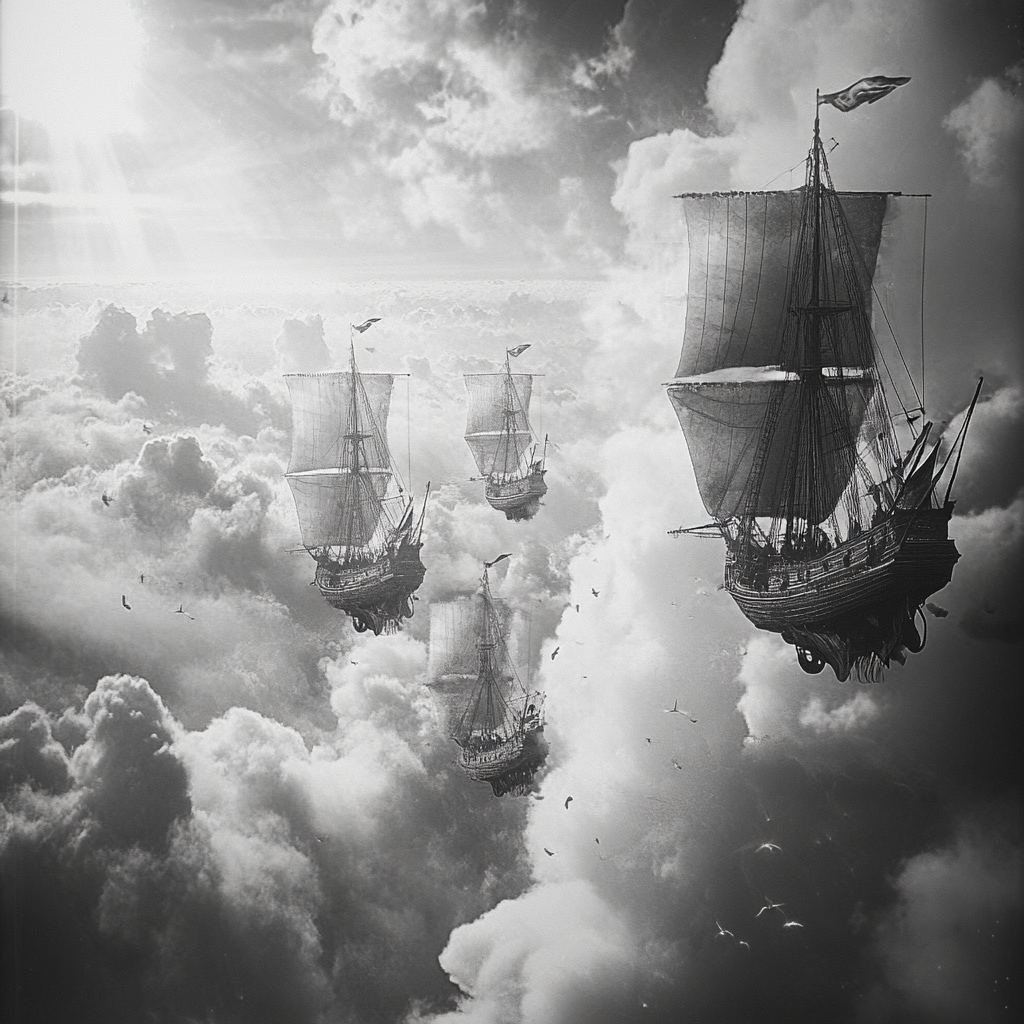
We are all Argonauts again. We are experiens-explorers. We want to create the right spaces and conditions for debating the new rules and the associated structures of reality, then acting them out as if those rules were in place. As explorers, we want to play with new rules to dream, new rules to hope, but also – not to sound too cheesy or utopian – new rules to suffer and cope with what is evil and sin. In that sense, we become all part of a shared conspiracy.

We are not in the business of homo sapiens, ludens, or faber, but in the business of homo experiens.

With thanks to my co-conspirators Josie and Andreea, for challenging me over and over again

The Weak Image Speaks

The camera—
that profoundly liberal invention—
whispers:

I’m ready for anything.
Give me chemicals, give me a little light,
give me time and no shaking,
and I will be done.

A pocket-sized Enlightenment,
believing every world is reachable,
every surface printable,
every body open to possibility.

And now generative machines produce punctum—
yes, Barthes’ punctum—
the involuntary meaning that slips through
the cracks of intention.
Not planned by the author,
nor by the algorithm,
but arriving later,
after you’ve slept on it,
after the dopamine subsides.
Fast food for intellectual minds,
rewarding at first bite,
quickly stale.
You return in the morning and mutter:
It was not that great after all.

Style appears.
Style overload.
Those who lack craft run toward it—
high, abstract, fast—
while you work the old way,
learning the hand,
the long path,
refusing to choose sides.

Spend time with it—
real duration—
and you’ll see how expensive time has become.
Only unproductive duration is free.
Yet we abandoned that when we entered the cinema,
trading mobility for the promise of instant return.
No one waits for tomorrow in a theater.
In a museum, though—
time’s ticking clock can’t be heard.
There we look forward to looking back.

And somewhere in this,
the black box—
practical, yes,
but also a symptom
of our incapacity to coexist.
The dark room becomes a social problem,
a refusal of interference,
a denial of shared space.

Everything becomes a question of time,
of how little we have left,
of how duration is mined
like ore.

Growing old treated as disease,
dementia as enemy,
while software dreams
of pure disembodiment—
young, innocent, clean.

And yet—
beneath all this—
you remind us:
we are bifocal,
split,
never individuals.
We are believers,
especially visually.

The camera says:
I’m ready for anything.

But the eye says:
I am not a camera.

And the brain says:
I choose no side.

And the forest says:
Take your time.

And the weak image
whispers from the periphery:
Here is the non-event—
stay long enough, and you may hear it breathe.

+++

The text above is an artistic experiment inspired by the insights David Claerbout shared in his presentation Reclaiming Our Agency and in BIRDSONG, the publication accompanying the premiere of The Woodcarver and the Forest at the Castle of Gaasbeek in August 2025.

I first edited the full transcript from the presentation, and then OCR scanned text ‘The Time Spent” from the BIRDSONG book. Then I made a personal selection of the sentences that resonated with me. Then I gave that to ChatGPT and asked it to condense all this into a 1000-word poem, then 500 words, then 100 words. Then again, I made a personal selection of the best GPT snippets. And further edited them to my personal (un)taste.

Inspiration: Adrian Sherwood

Adrian Sherwood behind the mixing console

As already mentioned in my September 2025 Delicacies, I got a crush on the latest album by “Mister Dub” Adrian Sherwood, and went down the Dub Techno rabbit hole.

From the review in De Standaard newspaper (Google Translate and highlights by myself):

“With his label On-U Sound, Adrian Sherwood has created a unique musical universe over the past half century, rooted in Jamaican dub but with tentacles reaching out to punk, funk, and psychedelia, peppered with samples, echoes, and sound effects. His new album features only one track with a recognizable reggae rhythm; the others are driven by slow bass lines and stimulating drum patterns. Many of these tracks are played by real musicians, just like the cinematic fragments of flute, saxophone, organ, cello, trumpet, percussion, piano, Roland 60, and harmonica (“Spaghetti Best Western” exudes Ennio Morricone). Sherwood can call upon a host of loyal musicians (including Brian Eno and hip-hop legends Doug Wimbish and Keith LeBlanc) who add color and human warmth to his boundless imagination as a studio wizard. In an interview, Sherwood did admit that this was the first time he’d used AI to create a record. It seems like a logical evolution for a man who has spent his life innovating and experimenting with new equipment. (km in The Standaard)

Here is some older material from Adrian Sherwood. Watch his body language while performing 😉

And the song “Trapped Here” from his previous album, Survival & Resistance

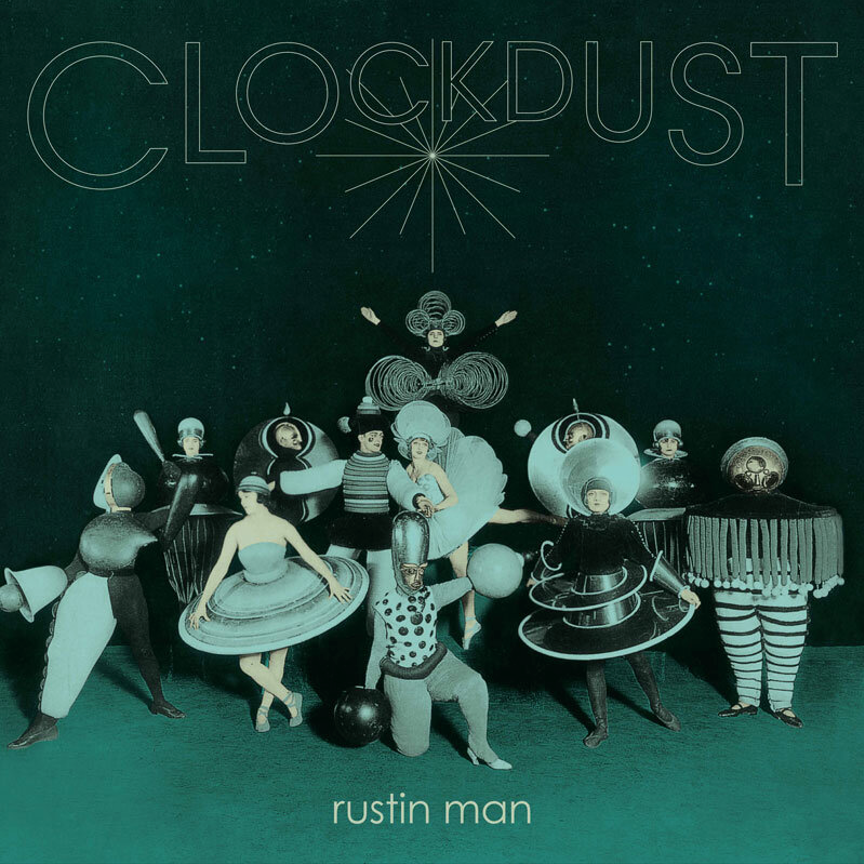
The album comes with a beautiful cover (designed by Peter Harris). The cover and the album’s atmosphere remind me of Rustin Man’s 2020 album ClockDust (I wrote a post about that one in 2020). It’s no surprise: after playing bass in a local reggae band in Southend, Rustin Man (Paul Webb) and his schoolmate, drummer Lee Harris, went on to form the rhythm section and become founding members of Talk Talk, alongside the exceptionally talented Mark Hollis and Simon Brenner.

The covers of Adrian Sherwood and Rustin Man respectively

So the starting point is dub reggae, which these days has evolved into a genre called “Dub Techno”. There is something melancholic about both albums, in sound, lyrics, artwork, and, at times, kinky living.

I don’t have real musicians available in my studio, and I’m hesitant to rely on AI. I’ve experimented with AI-generated music before, but it doesn’t bring me the same joy or sense of satisfaction as creating it myself. So I started studying and exploring the Dub Techno style, and found this book, “Dub Techno – The Orphic Experience of Sound” by Bahadırhan Koçer.

I will write another blog on the topic of “Orphic Experience”, but today, we focus on the music analysis part.

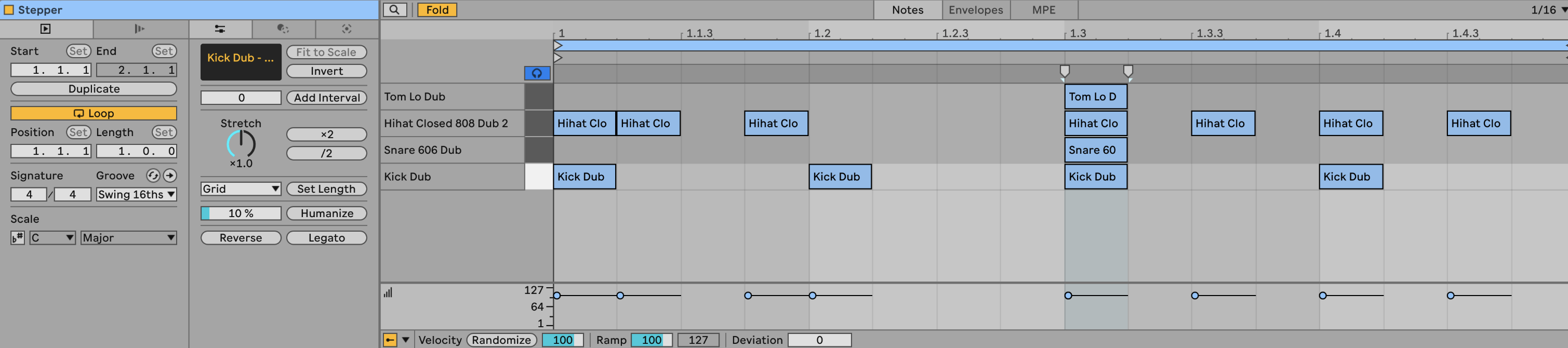
On page 56, Koçer begins discussing the concept of the riddim—Jamaican patois for “rhythm”—first examining drum patterns, and later turning to bass lines and melodic structures.

From the Bahadırhan Koçer book

I started implementing them into Ableton Live. Here is an example of the “stepper” variant on a 64 Pads Dub Techno Kit.

Ableton Live 12.1 implementation “Stepper” by the author

That was easy. Then I tried to build a song using other out-of-the-box and/or free devices, clips, and samples in Ableton Live 12.1 and Logic Pro 11.2.2 (btw, the new bass and keyboard session-players, and the new studio piano and studio bass in Logic are amazing).

The new Studio Bass in Logic Pro 11.2

Creating a song was more of a challenge. What Adrian Sherwood and his real musicians were doing was not so simple after all. Although all the individual clips sounded simple, the art is in being subtle and sophisticated in launching clips and echo/delay effects.

As with writing, the real effort lay in removing the superfluous rather than adding more to the mix. Still, to make it a bit more my own, I included a few AI voice clips from the New New Babylon performance.

Short experiment by the author

But I am an amateur/bricoleur after all. No way I will ever get close to Adrian Sherwood and his musicians, at least not as a musician. But maybe in real life? Adrian and the band are touring North America and Europe in 1Q 2026. They will perform in Wintercircus Ghent on 6 Feb 2026. See/hear you there?

The Forbidden Question – Talk at UnitedXR Dec 2025

Excited to announce that I’ll be speaking together with Andreea Ion Cojocaru at the 2025 UnitedXR Conference in Brussels, happening December 8–10, 2025. This is my first public appearance in a long time, finally fully disconnected from corporate life and enjoying new artistic endeavours.

The Forbidden Question is a branch of our New New Babylon (aka Dream My Dream) Performance. Andreea and I will give a talk on the genesis and evolution of our project. This performance is a choreographed yet spontaneous play between multiple dreams and dreamers.

Looking forward to seeing some old and new friends in December.

3C – Peeling Layers – Episode #1

For the past few months, I’ve been co-working on a new, still embryonic project—co-written and co-directed with Andreea Ion Cojocaru, enriched by the expertise of my cousin Joost, a PhD art historian, and further shaped through the collaboration of several contributing artists.

Until now, I have only shared this project with a few people. Many of them suggested that I start documenting “the making of” our project, so this blog post will serve as the first episode.

Our project takes the form of an experimental alternate reality experience that explores the nature of flesh, human suffering, and the role of technology. At its core lies a question both ancient and urgent: Who are the new gods that might deliver us from suffering?

The project ultimately strives toward the organization of a Third Council on this topic, which we call simply: 3C

Our approach weaves together mysterious, multi-layered storytelling and conspiracies across several digital and non-digital platforms. Different strands and overlapping narratives unfold in various locations—one of them being Ghent.

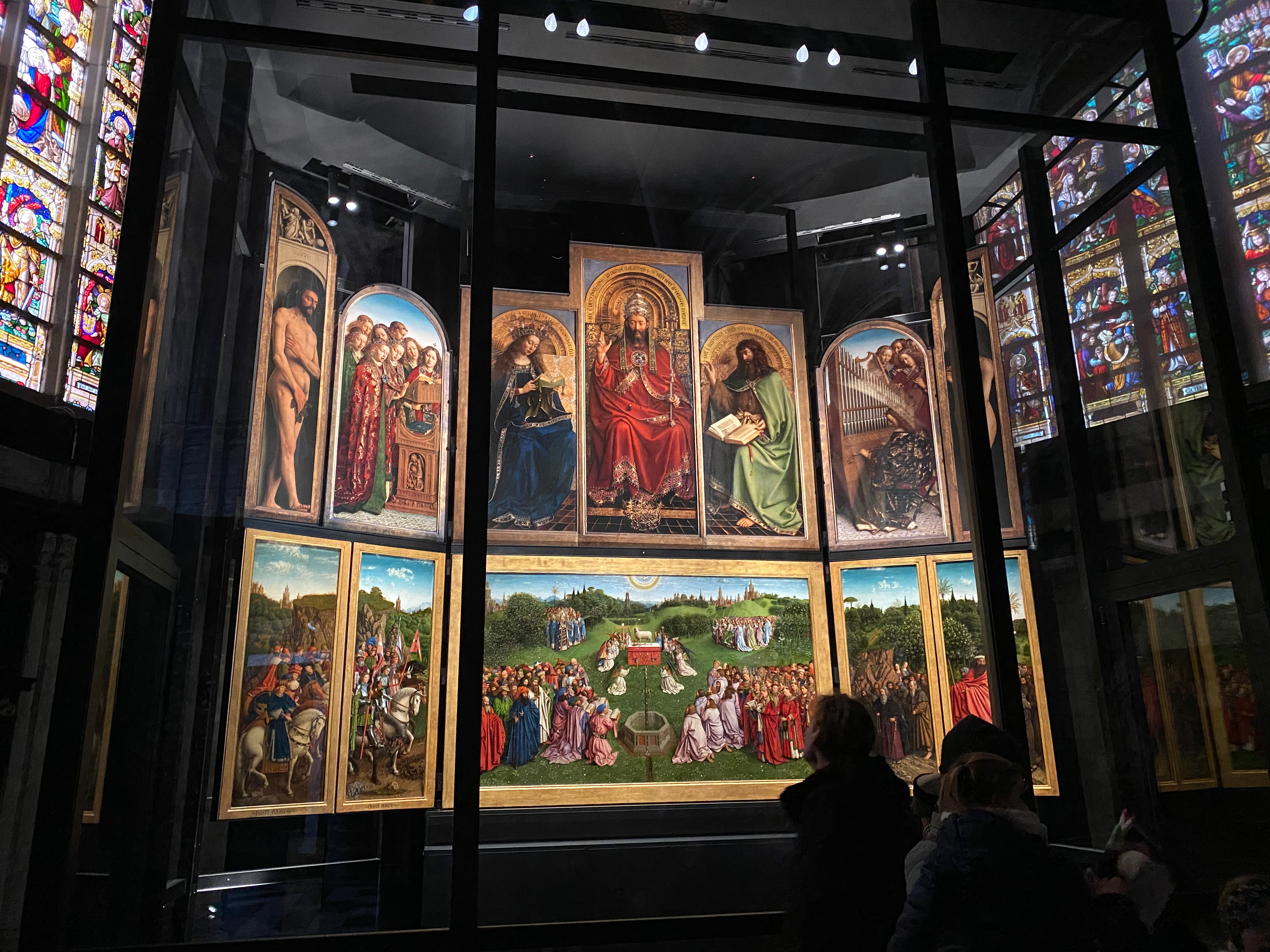
This Ghent storyline begins with the renowned Mystic Lamb Altarpiece by the brothers Van Eyck. Commissioned by the Vijd family, the altarpiece was unveiled on 6 May 1432, coinciding with the baptism of Philip the Good’s son. Countless volumes have been written about this extraordinary work. An accessible introduction can be found on The Ghent Altarpiece site. For deeper study, Closer to Van Eyck offers breathtaking HD detail and analysis, and of course, there is always the comprehensive overview on Wikipedia.

The Mystic Lamb Altarpiece – Picture by the author

After a meticulous and highly professional restoration, conservators peeled away later layers of paint to reveal the original brilliance of the Van Eyck brothers. Today, the restored masterpiece can be admired behind bulletproof glass in Saint Bavo Cathedral, Ghent.

At a certain stage of our project, we began to wonder: was there ever an actual altar placed in front of the painting? I turned to my cousin, the art historian, and he replied:

“There has already much research been done on the original disposition of the Ghent Altarpiece  e.g. by Dr. Elisabeth Dhanens and even considering the combination of that polyptich with sculpture, but non of the hypotheses has completely convinced the specialists. The oldest existing images of the chapel are too young to obtain a precise idea of the original situation. As in such chapels it was the rule that a yearly mass for the souls of the deceased and portrayed patrons was said by a chaplan, normally (a altar focs chapel being smaller than a main altar in the main church building) would have been foreseen. But we do not have an idea how it looked like.”

I wanted to buy the book by Dr. Elisabeth Dhanens, but like many art publications, it was prohibitively expensive, so I went instead to the Arts Library at the University of Ghent and borrowed a copy there.

In our project, the peeling away of layers from the Mystic Lamb becomes a metaphor for a deeper, more abstract process: the peeling away of layers of reality itself.

The Altarpiece also carries a built-in narrative advantage—its own entanglement in conspiracy. On 11 April 1934, one of its twelve panels, The Righteous Judges, was stolen and has never been recovered. This theft has inspired countless books, theories, and websites. Among them, the Righteous Judges site offers both a clear overview and an excellent timeline of the events.

On June 3, 2025, I undertook a short trip to Ghent, exploring the neighborhood in search of clues about the lost panel. Along the way, I recorded a compact photo-video documentary to capture my findings.

Here is one of the pictures: a café next to the cathedral called “De Rechters/The Judges”

Our project is multi-dimensional and undeniably ambitious. We’ve prepared a solid funding pitch, but if we wait for financial backing before taking any action, nothing may ever materialize. So instead, we’ve decided to start sharing small glimpses of the project—a slow drip-feed—and watch to see what resonates and what gets picked up.

But is there an audience for this? We hope, but don’t know. Perhaps only an audience of one. Kevin Kelly recently wrote an insightful piece on that very idea.

“From now on, the default destiny for most art will be for an audience of one, and it will abide in the memory of those who generate it. While some of this co-generated work might find its larger audience and some very tiny fraction of it might even become a popular hit, its chief value will be in the direct, naked pleasure of co-making of it.”
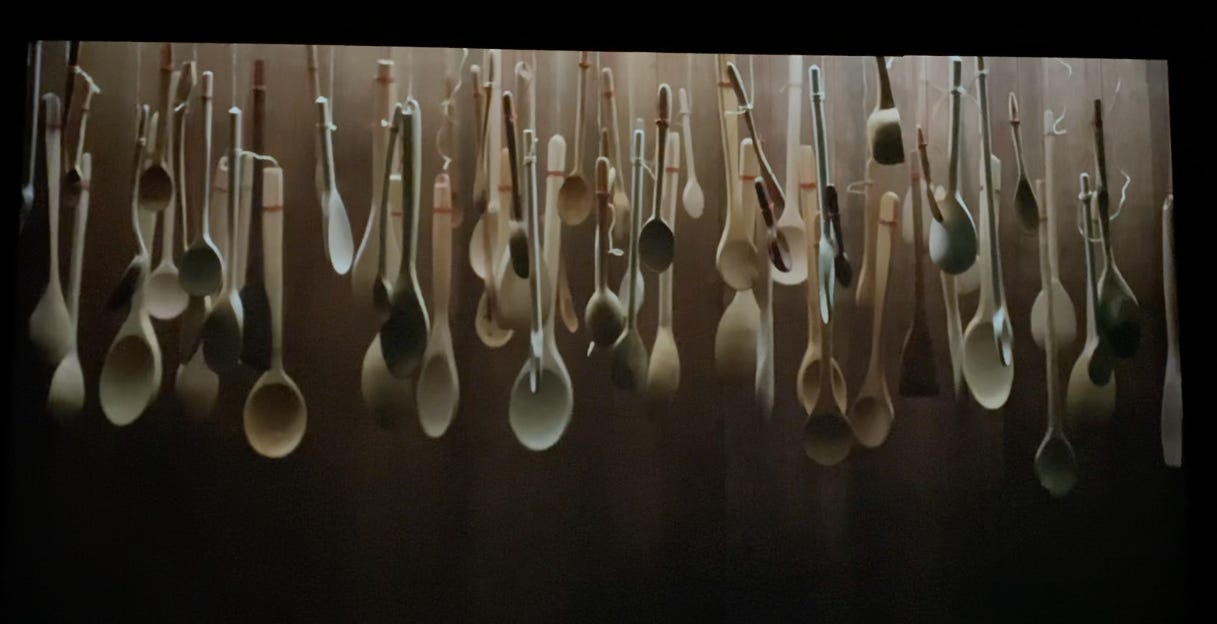
That’s very much our mindset—our “eye-set” too: as long as we enjoy creating, we’ll keep going.

On the more playful side, Ghent offers several signposted bicycle tours inspired by the Mystic Lamb Altarpiece and the story of the stolen panel. One of them is intriguingly titled “VermoedelEyck daar / Probably ThEyck” I plan to try it out soon and capture some photos and videos to share later.

In Limbo or Not? – A Timeless Day at the Castle of Gaasbeek

Picture @petervan

I went to the premiere exhibition of David Claerbout’s The Woodcarver and the Forest at the Castle of Gaasbeek. I went by bike, for me, a two-hour ride each way, on a warm sunny day through the Pajottenland, the region southwest of Brussels where I spent the first 25 years of my life. Cycling up and down its rolling hills stirred deep emotions and memories of my youth. This is the land of Bruegel, of Geuze and Lambic beer, of Remco Evenepoel. It is also, unmistakably, my land.

Before arriving at the castle, visitors walk about 15 minutes from the entrance through a carefully tended, forest-like domain. The path itself already feels like part of the experience, drawing you gradually into a slower, quieter, almost meditative state.

There is also a 2-hectare Museum Garden.

Picture © Fabrice Debatty

A top-level garden modelled on castle gardens from the 18th and 19th centuries. A strong example of living cultural heritage. Take a stroll through this magnificent Garden of Eden, with the old-model fruit repository, the beehives, and a wonderful view of Gaasbeek Castle and the Pajottenland.

I lingered in the garden for some time, sitting on a bench and gazing at another bench across the way, the two connected by a loofgang—a leafy tunnel formed by pear trees. I simply sat in silence, doing nothing. Eventually, I walked through the shaded passage to the other side, before making my way to the castle. In hindsight, the video I captured carries an unintended sense of suspense.

Once inside the castle, visitors are guided along a signposted route. Along the way, I captured this video of sunlight filtering through stained glass, casting vibrant patterns onto the wooden, carpeted floor.

The Claerbout installation awaits at the very end, rising three stories high beneath the roof.

From the brochure:

This work is Claerbout’s latest creation and presents itself as an intimate portrait of a reclusive young man. Do you feel the meditative effect of the slow, repetitive movements and their sound?

Specific audiovisual stimuli – such as soft sounds or rhythmic movements – can evoke feelings of relaxation and inner calm. This phenomenon is known as ASMR (Autonomous Sensory Meridian Response) and forms the foundation of this work

The Woodcarver and the Forest is an open film, which is completed using generative artificial intelligence. As a spectator, our experience also remains open and unfinished, partly due to the long duration of the work.

This reveals the dual nature of the film: an interplay between pleasure and sorrow, beauty and destruction.

Still from Claerbout’s video installation – picture by @petervan

I sat in there for more than one hour. It put me in some state of limbo about my own work and where I want to go next. Following Google’s Gemini AI, it means “to be in an uncertain, undecided, or forgotten state where nothing can progress or be resolved, similar to being caught between two stages or places.”

I am a big fan of David Claerbout. See previous entries on this blog here. The Woodcarver gave me the chance to revisit some of Claerbout’s earlier works and conversations, while also helping me reconnect with the artistic drive within myself.
Here is a more recent talk by David Claerbout

Some interesting quotes

Change your mind-set ànd your eye-set, from inquisitive to open-ended

The Brain does not choose sides; it does not know how to

And around minute 18, he gets into a very interesting schema of “former” AI technologies. He really got me when he says “the camera is a profoundly liberal invention” and later “around the 2000s, we start to think of visual culture as a assemblage, the coordinate system is back, and a coordinate system knows exactly where you are it has exact points in space it can find you back and instead of a liberal body in a world that could be anything anywhere it changes into a pinpointing in a space that so we we get a gathering of coordinates and we’re no longer free” 

In closing, he shares reflections on recent readings that explore AI, vision, and the language of thought.

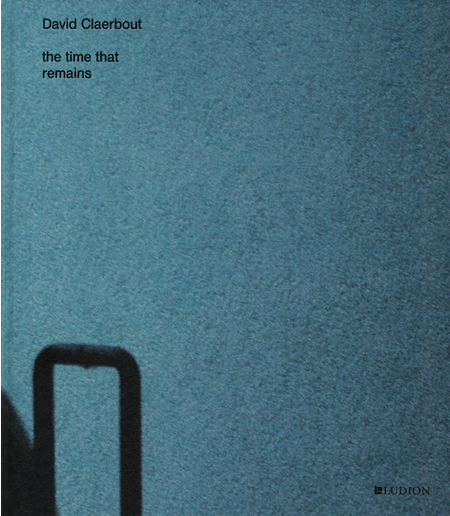
After watching the video, I visited the University of Ghent library—you can get a visitor’s pass as a non-student for €15 per year, granting access to all of the university’s libraries! There, I picked up the book The Time That Remains, a title that resonated with me on two levels: first, the concept of time, so ever-present in Claerbout’s work; and second, the realization that I am approaching my seventieth birthday, prompting me to reflect increasingly on the time I have left and how I want to spend it—especially in my artistic practice, if I can even call my tinkering that.

From the intro:

This publication marks the welcome collaboration between internationally acclaimed Belgian artist David Claerbout and two European institutions: Wiels, Brussels and Parasol unit, in London. The publication accompanies Claerbout’s exhibition opening at Parasol unit, on 30 May 2012; but it also provides a highly appreciated documentation for Wiels, which held a solo exhibition of Claerbout’s work, The Time that Remains, in 2011.

It’s from 2012, but the content is, well, timeless.

Some quotes/insights from that book.

I think the recent proliferation of black boxes for film and video-art is not just a practical solution to a problem of sound and light interference, but also reflects an incapability to coexist. This can become apparent in large group exhibitions, where media installations appear strong when they are shown by themselves in a small or large dark space, but they easily collapse when shown in a social space where people move about and interact. The black box is a social phenomenon, for me it is a problem.” Ulrichs, David, ‘David Claerbout. Q/A, in: Modern Painters, May 2011, pp. 64-66

+++

Time is invested into something that will prove to be valuable and productive. By consequence duration’ becomes increasingly expensive. But duration can only be free if it is unproductive.”

+++

Cinema, YouTube and film-festivals demand the prolonged physical immobility of the viewer. Music, exhibitions or a walk in the park don’t.

My sense of being in limbo stems from a hesitation: to move further into abstraction rather than figuration, toward longer forms rather than shorter ones, toward meditative sound and video landscapes rather than straightforward documentary. It also comes from my struggle to resist the banality of social media—where time is squandered on addictive, bite-sized fragments of content that ultimately feel useless.

I believe I know the answer, yet I dare not leap just yet.

Who will be the one to give me a gentle nudge?

Is this still needed?

Petervan Studios – April 2025 Update

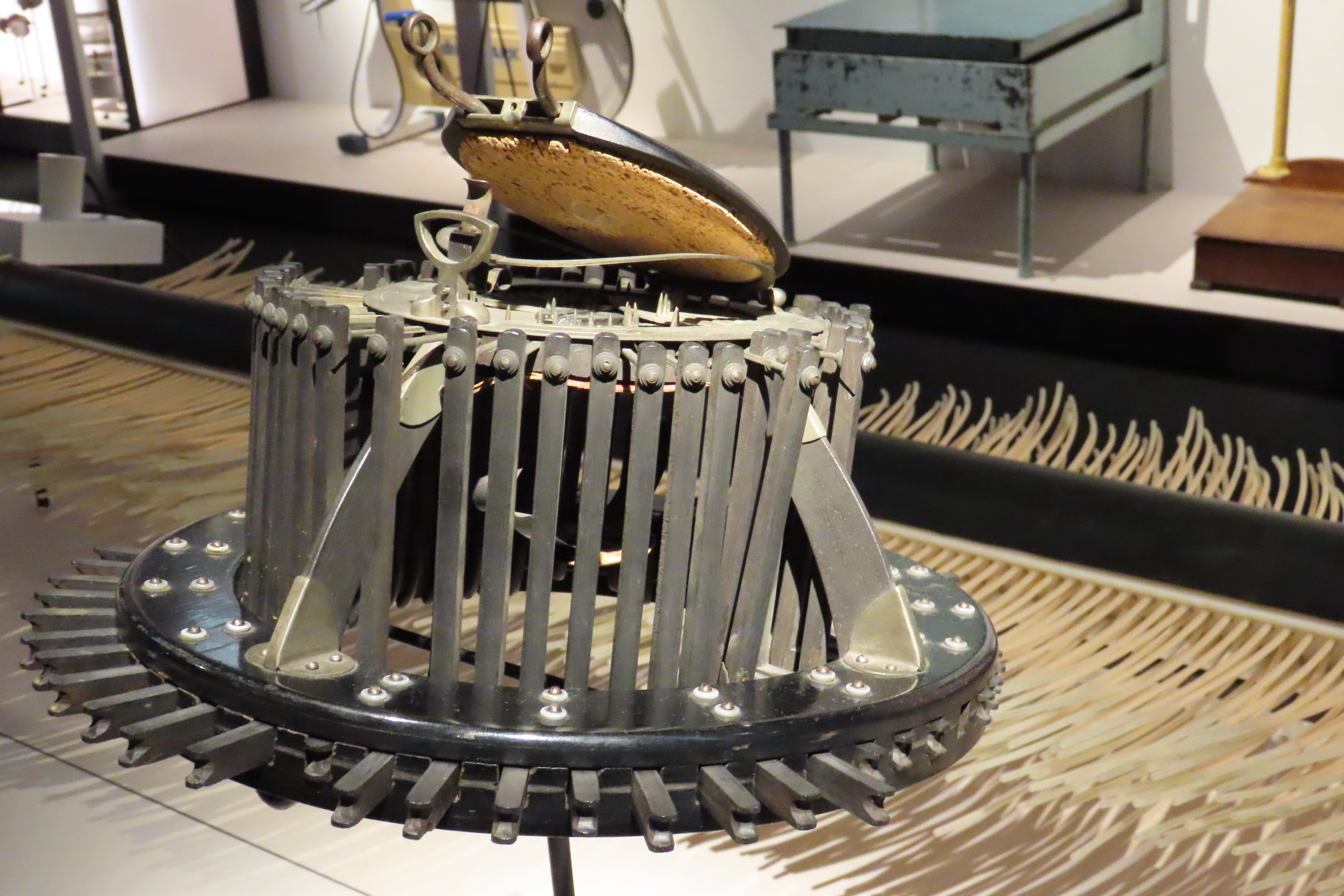
Head measuring device – seen in GUM Science Museum – Wunderkammer of Truth

General Status

Green Green Grass of Hope – Bicycle ride 26 Oct 2024

The Art Studio

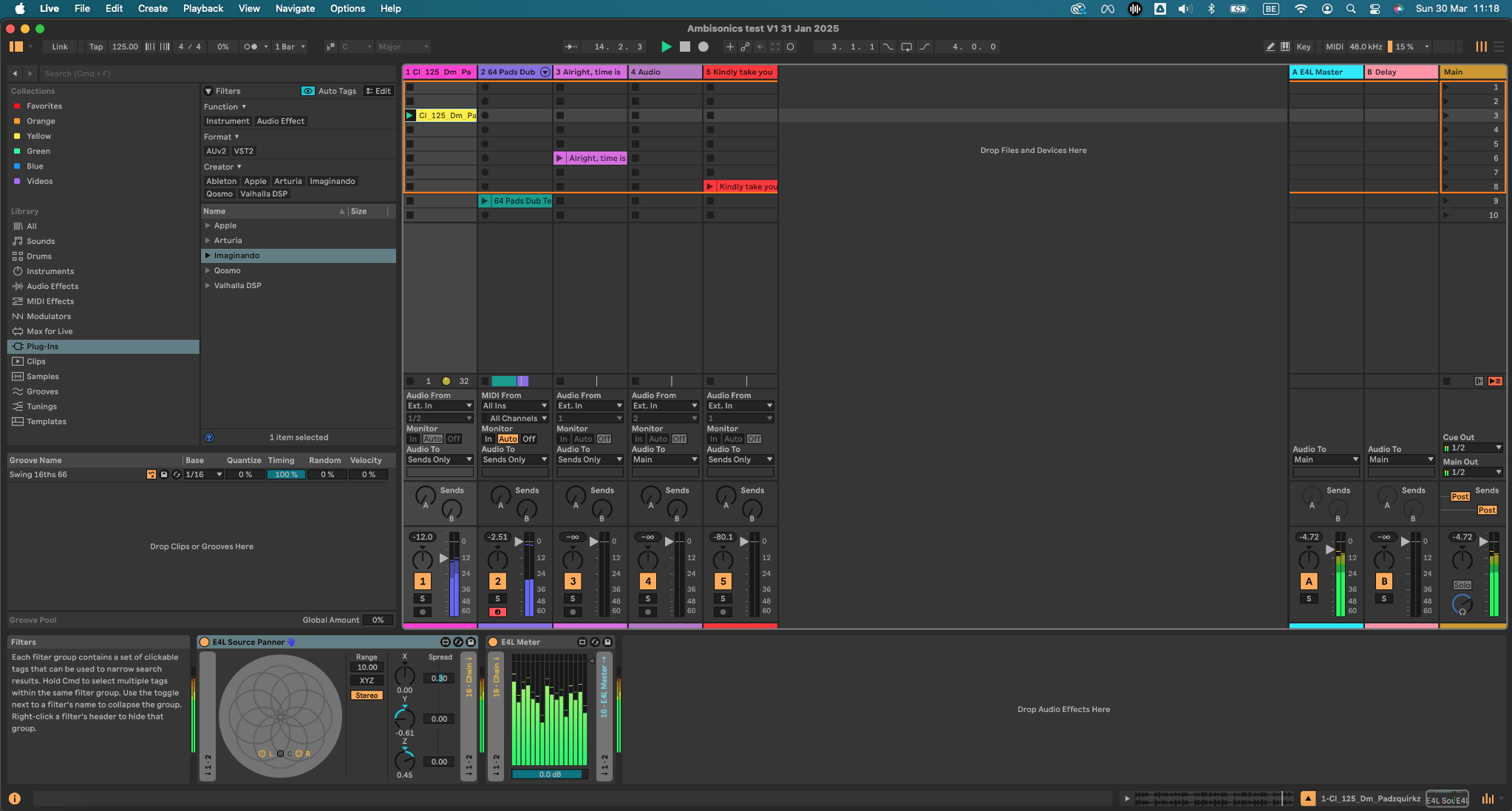
Example of Ableton Live with Envelop for Live 3D Source Panner

An example of a simple VCV Rack set-up

Static example from Wave Unstable rule in CAPOW software by Rudy Rucker

Petervan Studios © 2025 – Seaside – Acryl on Canvas – 80x100cm

Crop from Curves work Anni Albers – Gouache on paper – ca 1955

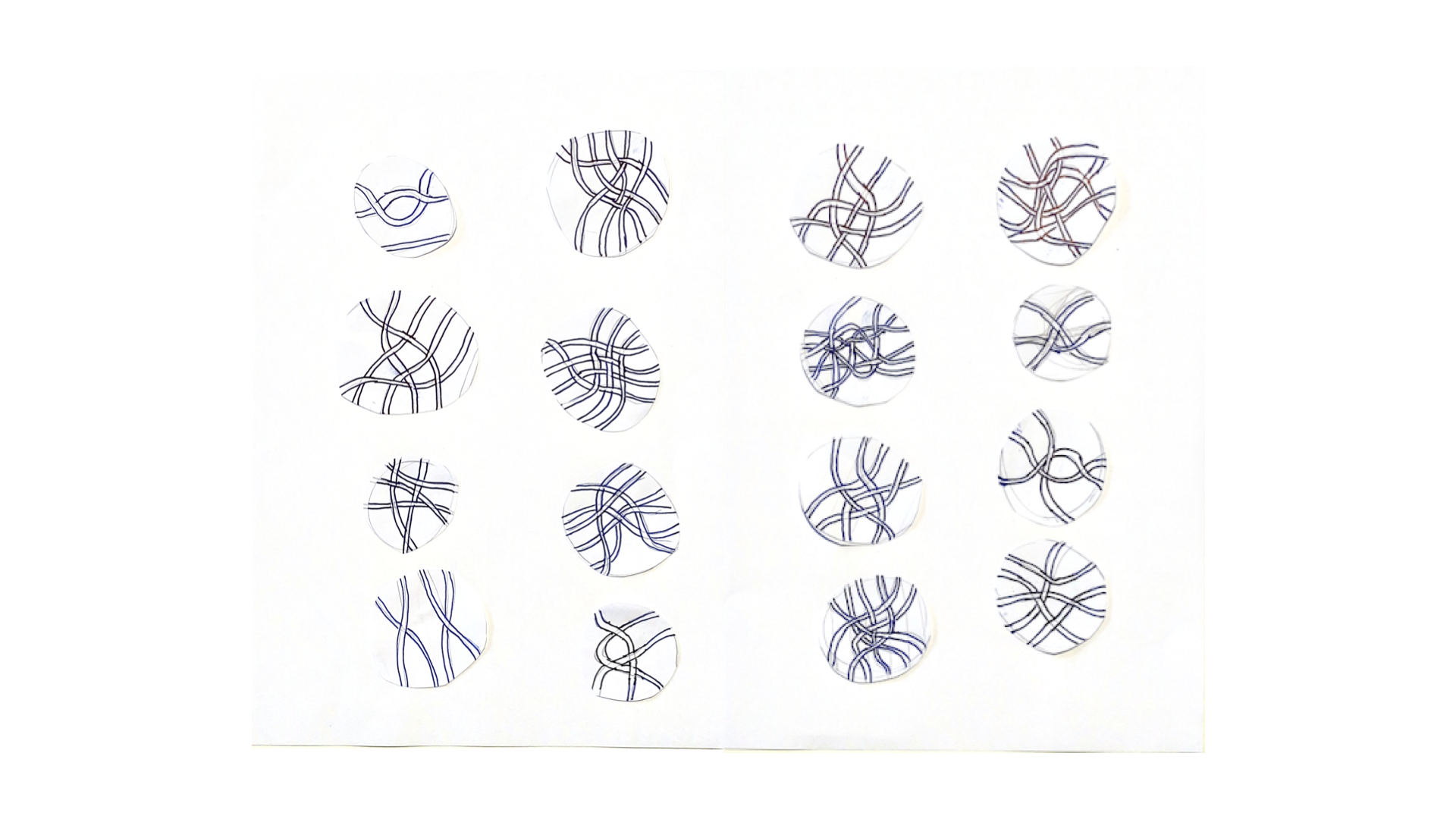
Petervan Studios © 2025 – Braid Amulets – Chinese Ink on A4 printer paper

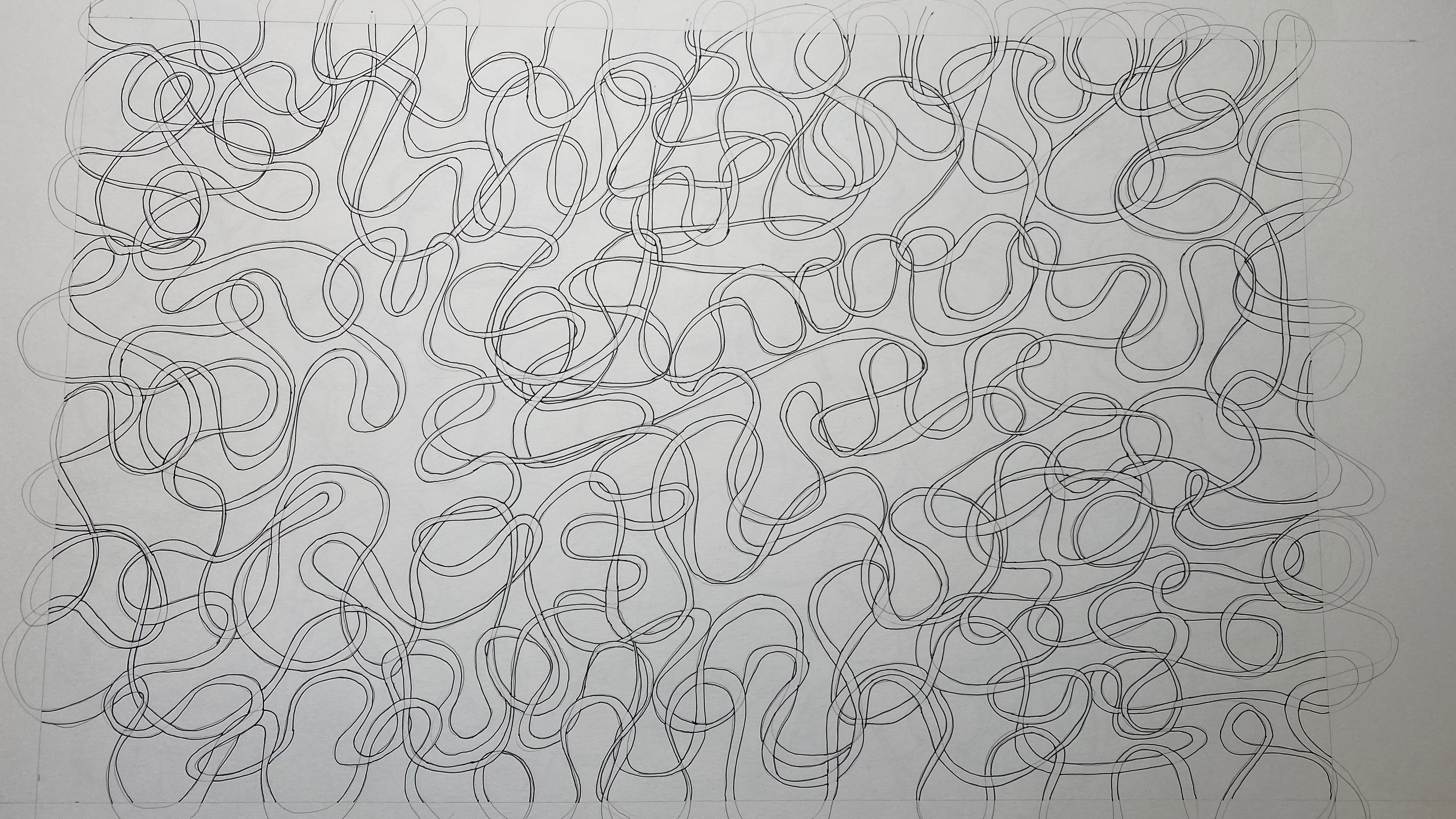
Petervan Studios © 2025 – Gnarly Curves – Chinese Ink on Steinbach A1 paper

Petervan Studios © 2025 – Gnarly Curves – Digital in Procreate iPad

Back to School

Summer of Protocols 2024 (SoP24)

Toolmaking for Spatial Intelligence

Masterclass XR in Industry

1) Unity Essentials

2) Enhanced reality use cases

3) Enabling remote expertise (remote assistance)

4) Augmented inspection (BIM/3D concept visualization)

5) Visualizing the unseen (IOT data visualization/digital twin)

6) Virtual control (interaction with machines/robots via XR)

Performances

Performance: Claim Your Cybernetic Word – 17 June 2024

Resulting world cloud

Performance: What Makes Us Human? – 28 August 2024

Trailer: 

Performance: New New Babylon

Performance Dream My Dream

Trailer

17 Minute Video simulation of the performance

Artistic Research Project: New New Babylon

  • A beta version of an Urbanistic Artistic Rendering VR Environment, inspired by an existing or planned City or Real Estate project
  • Artistic Performance (minimum Online, ideally IRL), see above
  • Art Book

Stealth

A theory of space/time dimensions

Concept drawing by Petervan Studios © 2025

Image generated by Gemini 2.0

Delicacies

Books

  • Geometry, Relativity and the 4th Dimension – by Rudy Rucker (1977)
  • Love & Math – by Edward Frenkl (2013)
  • Behave – by Robert Sapolsky (2017)
  • Mind in Motion – by Barbara Tversky (2019)
  • Soft City – by David Sim (2019)
  • and re-reading The Lifebox, the Seashell, and the Soul – by Rudy Rucker (second edition 2016)

For other books I am reading, see my GoodReads.

Exhibitions

SMAK – Ghent – Tarek Atoui

Sarah De Vos – detail – Galerie Sofie Van de Velde

What’s next?

  • The “Dream My Dream” performance 
  • The New New Babylon project
  • The Stealth Project
  • XR in the Industry Masterclass

Brand new performance “The New New Babylon”

I am super-excited to announce the general availability of my brand new performance “The New New Babylon”. Here is the trailer:

The New New Babylon performance is an immersive experience, divided into six chapters—Awakening, Stepping, Flying, Gliding, Folding, and Vertigo. Each chapter explores different facets of the New New Babylon concept, blending art and interaction. Audience members are invited to actively participate, engaging with interactive elements that promote a sense of community and shared creativity. To create a multisensory journey, the performance integrates rich soundscapes, video projections, visual art, poetry, masks, VR, and stage props. It’s a brand new format to deliver content, quite different from more traditional keynotes and talks.

This artistic performance has a poetic, gentle, and profoundly human touch, evoking a dreamy, Magritte-like surrealism. The atmosphere is calm and harmonious, steering away from Sci-Fi or dystopian themes toward a vision that is non-aggressive, understated, and subtly utopian.

Designed for corporate and institutional clients, art galleries, and museums, the performance’s content, materials, and timing can be adapted to suit specific needs. The performance can also be organized as an online or in-situ workshop format.

VR-Frame from ACT3 – Flying

The performance is now available for both online and on-stage presentations, with options for bespoke adaptations or commissions. If you’re interested, feel free to reach out!

The next step is to create a fully immersive VR headset performance with live interactions with AI voices. Already available are six Unity VR packages, each designed for distinct VR spaces in the performance, including specific controller actions that control both on-stage and in-VR lighting, and different camera angles. These packages are tailored to support the various acts of the performance. These Unity packages are developed by NUMENA, a renowned interdisciplinary creative studio from Germany, specializing in award-winning spatial design and programming.

We are also developing an API-supported LLM infrastructure to enable live interactions with AI Agents. Our goal is to facilitate real-time exploration of historical New Babylon research resources during on-stage and online sessions. This infrastructure is currently being developed by Thomas McLeish, Adjunct Lecturer – Berkeley Master of Design, and master creator of the 2018 replica of the Colloquy of Mobiles.

VR-Frame from ACT4 – Gliding

And here is an extract from ACT4 of Petervan’s New New Babylon Performance.

VR-Scene from ACT4 – Gliding

And as the cherry on top: alongside a talented young cinematographer from Flanders, I’ll be applying for one of just twelve coveted spots in the 9th edition of the Venice Biennale College Cinema – Immersive program (BCC-I).

The performance is one of the deliverables of my more ambitious transdisciplinary Artistic Research Project, where I am imagining and scaffolding a City of Play through different formats. These formats can be analog and digital artwork and productions, digital overlays, sketches, performance lectures, writings, poems, blogs, installations, soundscapes, recordings, documentaries, spaces, time capsules, curations, events, group experiences, immersions, expeditions, and exhibitions.

Performance “Claim Your Cybernetic Word”

A new Petervan performance lecture “Claim Your Cybernetic Word” is in the making, to be delivered 100% remotely during the 60th anniversary of the American Society for Cybernetics in mid-June 2024.

Extract from Petervan Performance “Claim Your Cyberbetic Word”

Below is the official abstract of that session:

An engaging conversational workshop crafted to elicit compelling language that embodies the human elements within cybernetics. Attendees will be encouraged to participate actively by offering cybernetic terminology, which will be visually depicted in an immersive cloud-like interactive video installation accompanied by a bespoke soundscape. The session opens with an artistic cinematic cybernetic dream sequence. Through facilitated brainstorming sessions with the audience, participants will have the ability to fine-tune word generation. They will discuss the Paskian Knobs required to steer randomness and the style of the outcome. The session closes with a cinematic cybernetic song outro. The total duration is between 45-60 minutes. This session will be delivered remotely with remote interactions with the audience. An experience room is available for on-site participants, allowing them to engage collectively in this conversational setting.  Please access the session 10 minutes before the starting hour, as the performance already starts during the virtual walk-in of the audience when visual and auditory segments set the stage for the experience.

Some friends who have seen an early dry-run version describe it as an “immersion” or “a trip”.