AI-powered humanoid wins international competition

It’s been a while. Some of you have written, others have probably assumed I disappeared into one of my own unfinished experiments. For years, my studio was a place of images, projections, strange XR environments, and long nights chasing ideas that rarely behaved. But somewhere along the way—perhaps during retirement, perhaps during one of those quiet afternoons where nothing quite compels you anymore—I found myself tired of it all. Not of thinking, not of making, but of making that kind of work. So I did something else. I dismantled the studio.
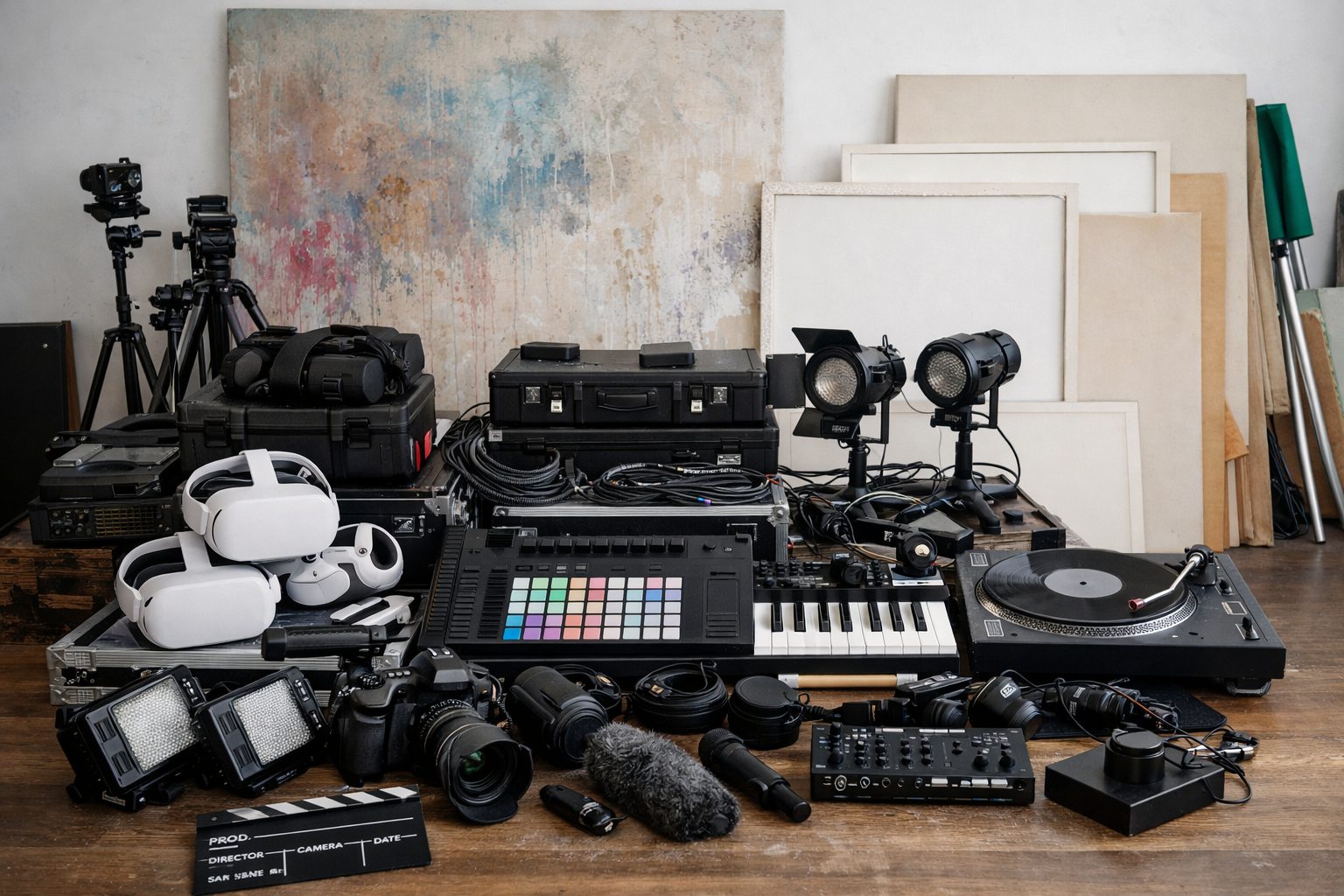
The dismantling of the studio

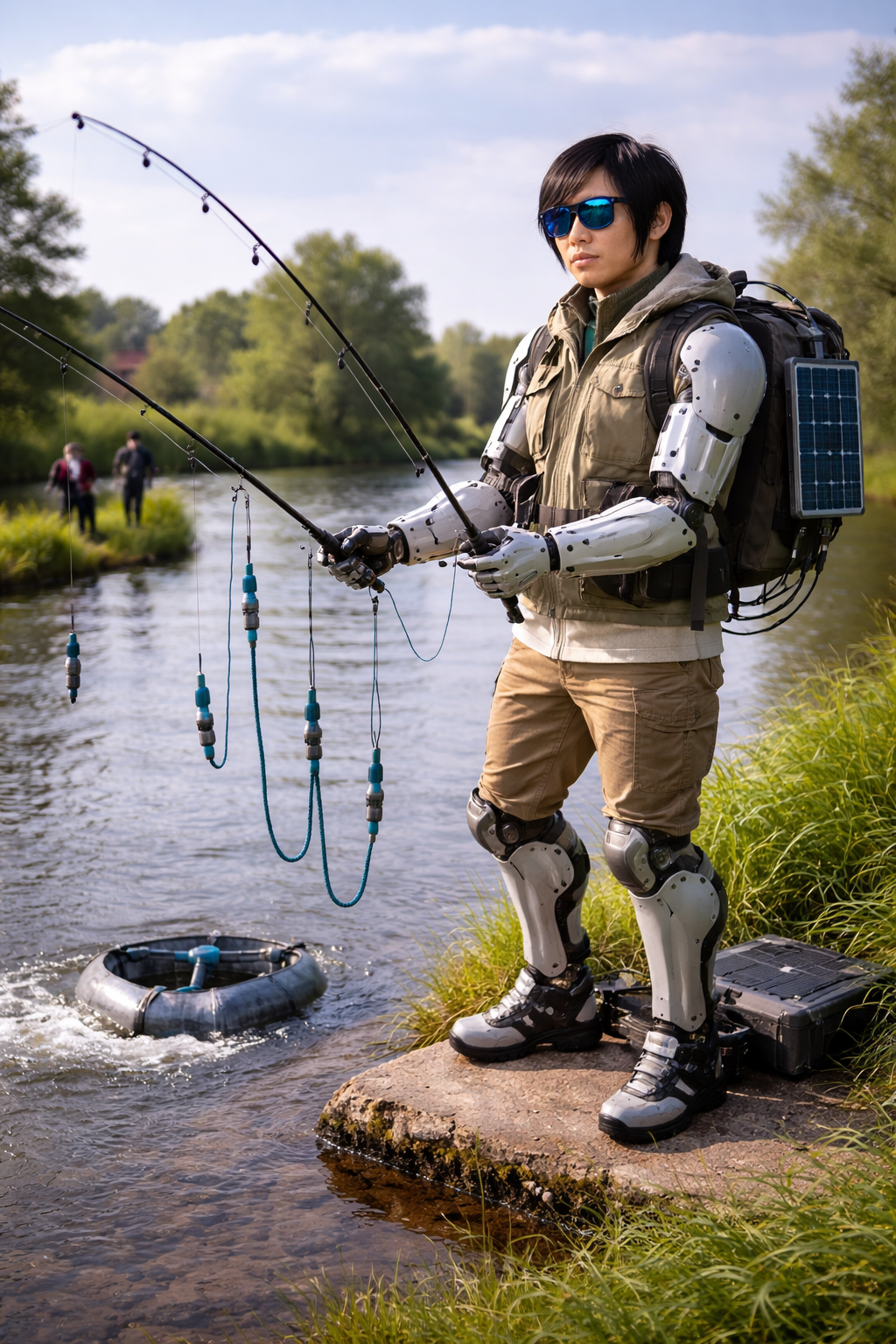
The cameras, the rigs, the VR headsets, the motion trackers—they all went into storage. In their place, I began assembling something far less poetic and far more absurd: a machine designed to fish. Not just any machine. A humanoid.
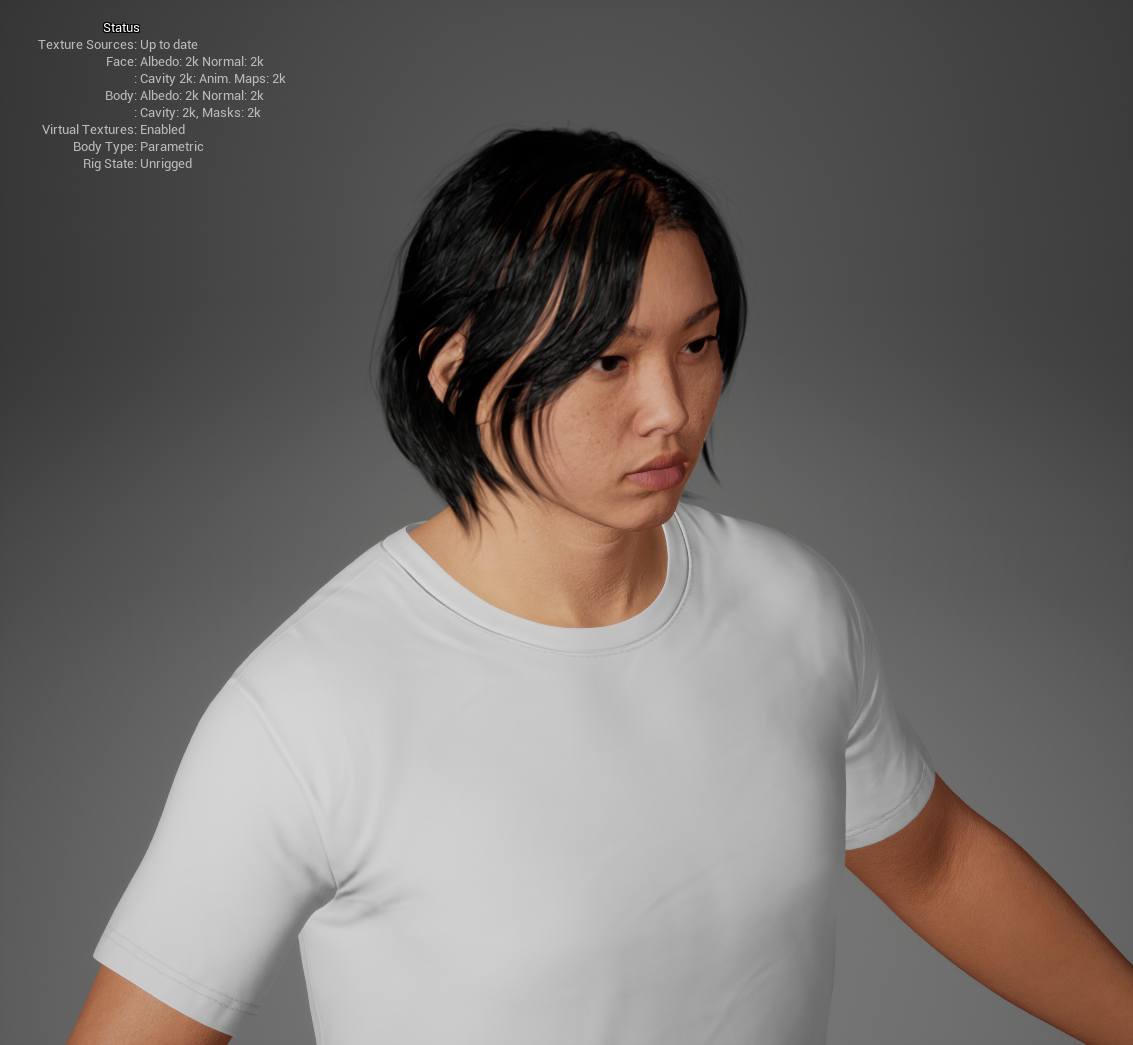
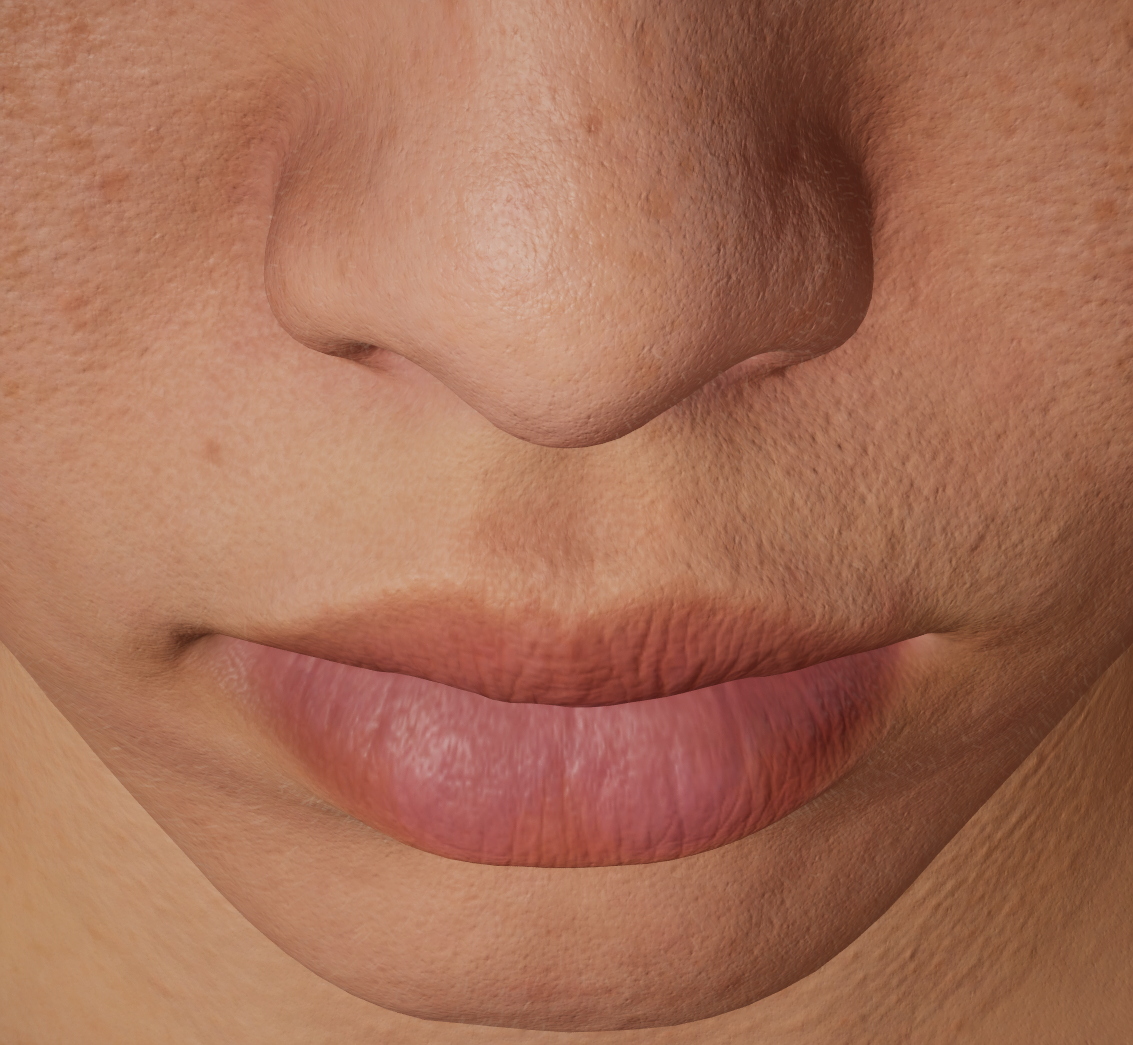
Early versions of the humanoid in Metahumans Unreal Engine

From Art Studio to Autonomous Fisher

The idea didn’t come all at once. It started with a simple irritation: I missed fishing, but not the waiting, not the cold, and certainly not the unpredictability of the Belgian weather. I wanted the experience without the inconvenience. I wanted presence without being present.

So I asked myself a question that feels obvious in hindsight: what if fishing could be performed remotely, intelligently, and continuously? That question became a project.

At the center of it all is a humanoid robot—roughly my height, vaguely my posture, though considerably more patient. Its frame is industrial aluminum and composite joints, designed for stability on uneven riverbanks. It stands, day and night, along the Dender river, unmoving until needed, like a quiet sentinel disguised as a fisherman.

Its brain is not singular. Instead, it runs on a cluster of four Mac Minis, mounted in a sealed, weatherproof compartment within its backpack. Overkill? Perhaps. But the redundancy allows for parallel processing: environmental analysis, motor control, bait synthesis, and remote communication all run simultaneously without latency.

The backpack with the Mac-Mini Tower

The system itself was developed with the help of Claude AI, which I used more as a collaborator than as a tool. Together, we iterated on decision trees, adaptive learning models, and behavioral responses. Over time, the robot stopped behaving like a programmed device and began acting more like a cautious, observant angler.

Energy Without Interruption

One of the early challenges was power. A machine that fishes continuously cannot depend on a wall outlet. The solution was hybrid and, admittedly, a bit romantic: solar panels combined with a micro water turbine anchored directly in the river. During the day, the panels provide ample energy, while the turbine ensures baseline power during nights and overcast stretches—which, in Flanders, is most of the year.
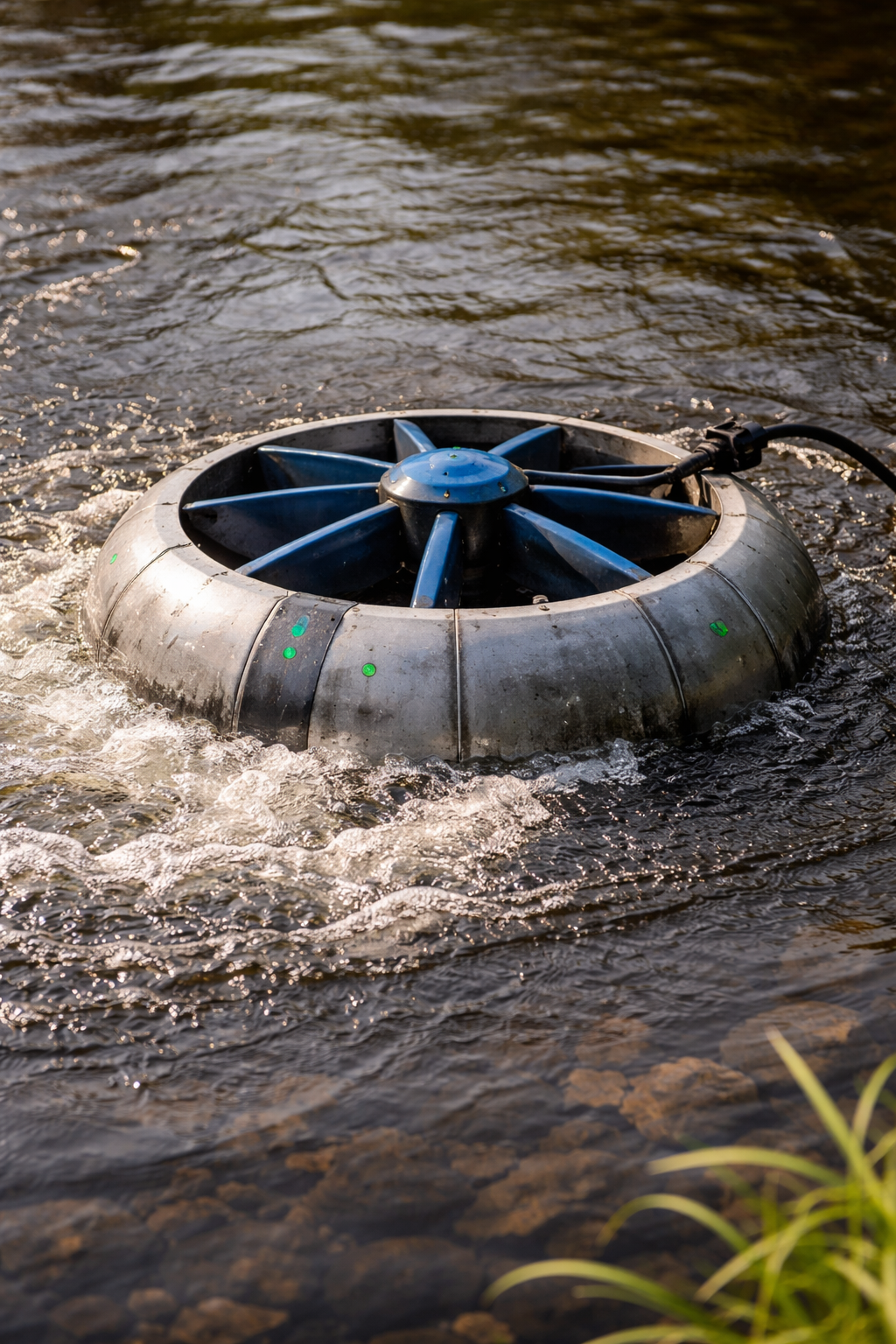
The micro water turbine

The result is a system that is almost entirely self-sufficient. It wakes, observes, calculates, and acts without requiring human intervention. I sometimes forget it’s out there until I log in and see what it has been doing.

Fishing From Home

Yes, you can control it remotely. That was always part of the vision: fishing without being physically present. From my desk—or, more often, my kitchen—I can connect to the humanoid’s interface and take over its movements. There’s a slight delay, but nothing that breaks the illusion. You see through its cameras. You feel (in a limited, haptic sense) the tension in the line. You decide when to cast, when to reel, when to wait. But here’s the strange part: I rarely do. Because the robot is better at it than I am.

Intelligent Bait Synthesis

This is where things begin to feel less like engineering and more like alchemy. The humanoid doesn’t just use pre-made bait. It creates its own.

Equipped with a compact mixing system—part chemistry lab, part kitchen—it analyzes environmental data and determines the optimal bait composition for specific fish species in the Dender River. It considers water temperature, turbidity, recent rainfall, seasonal migration patterns, and even subtle chemical traces in the water.

Then it mixes. Proteins, oils, plant matter, scent compounds—each combination slightly different from the last. Over time, it has developed a library of successful mixtures, continuously refining them through feedback loops. Success is measured not just by catches, but by which fish are caught, at what time, and under which conditions.

I once tried one of its recommended mixes myself. It smelled terrible. It worked perfectly.

Tentacles Instead of Lines

Traditional fishing lines felt insufficient for what I wanted this system to achieve.

So we replaced them.
A relatively complete set-up

Extending from the humanoid’s arms are flexible, twisted appendages—something between cables and tentacles. Each one houses a network of sensors capable of detecting micro-changes in water pressure, temperature gradients, chemical composition, and movement patterns.

They don’t just wait passively. They explore. These tentacles can subtly reposition themselves, probing different depths and currents simultaneously. They gather data constantly, feeding it back into the system, allowing the AI to make real-time decisions about where to focus effort.

It’s less like fishing and more like listening to the river.

The Competition

I hadn’t planned to enter any competitions. In fact, the idea seemed almost unfair. Pitting a continuously learning, sensor-rich humanoid system against traditional anglers felt like entering a calculator into a mental arithmetic contest. But curiosity got the better of me.

The international fishing competition on the Dender river is, under normal circumstances, a quiet affair—serious participants, careful techniques, and a shared respect for patience. When the humanoid arrived, it attracted attention, then skepticism, and eventually mild irritation.
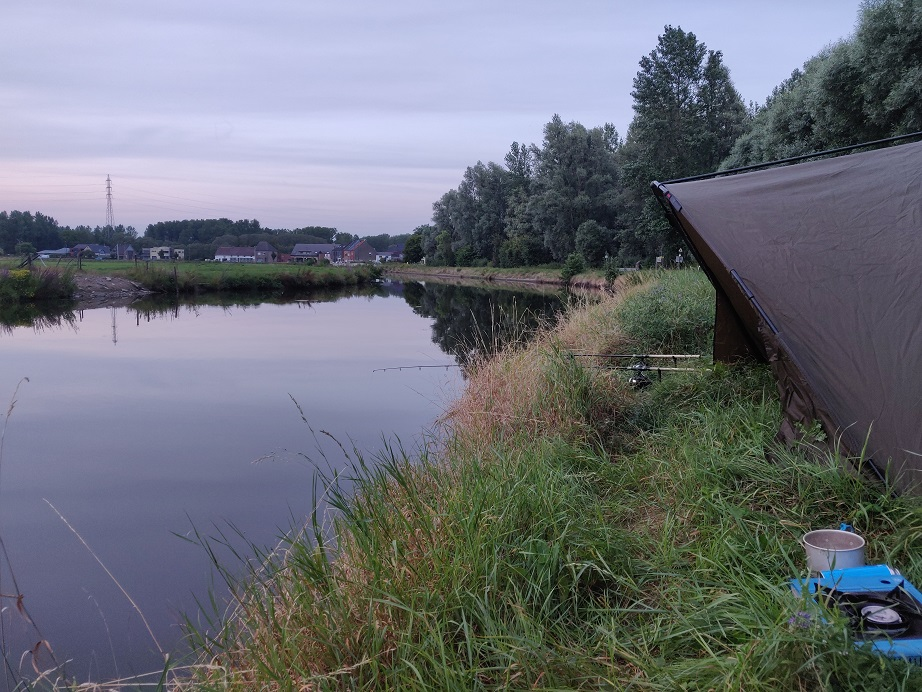
The quiet location for the competition

It stood there, unmoving, as others prepared their gear. And then it began. Over the course of the competition, the robot adjusted constantly. It shifted positions, altered bait compositions, and fine-tuned its approach based on conditions that changed hour by hour. While human participants relied on experience, intuition, and occasional luck, the humanoid relied on continuous analysis.

By the end, the results were undeniable. It didn’t just win—it dominated. First prize.

The Award

What This Actually Means

I’ve been asked whether this is still fishing. It’s a fair question. There is something inherently human about sitting by water, waiting, thinking, doing very little. This machine removes much of that. It replaces stillness with computation, patience with optimization. And yet, I find myself more connected to the process than before.

Not because I am physically present, but because I have built something that observes more deeply than I ever could. It notices patterns I would miss. It reacts faster than I could. It learns in ways that feel both mechanical and strangely intuitive. This is not a replacement for fishing. It is a transformation of it.

What Comes Next

The humanoid still stands by the Dender. It continues to learn. I continue to watch. Sometimes I take control, just to remember what it feels like. Most of the time, I let it do what it does best. I didn’t expect retirement to lead me here—to a machine that fishes better than I ever did, powered by sun and water, thinking with the help of artificial intelligence.

But then again, I didn’t expect to stop making art either. Perhaps I didn’t. Perhaps this is just another form of it.
One Morning in August: Story generated by AI-as-a-Service

The AI GPT-2 Model generated the following story, just based on the input “One morning in August,”:

One morning in August, 1991, two brothers were gunned down in the Jezeville Mansion on Jarvis Street in Detroit. This is one of several incidents where teenage boys were shot and left to die of self-inflicted injuries. Eight boys were killed after being shot in one of those four blocks on Jarvis Street. Five boys were subsequently recovered from the fatal gunshot wound on at least one of those spots. The other three were shot in the neck when a loose-walled mess hit them. One of those victims, Sylvester A. Dunlap, was undoubtedly intimidated by the fact that he had been a member of a terrorist organization before the defeat of 9/11.

Recent developments in the confines of Detroit have raised serious issues in the policing of the inner city. Chancellor Bill Blair stated several times during a presentation that research on neighborhood policing by Chicago’s public safety department will reveal problems across the city that explain the difficulty of enforcing sentencing for murders in the inner city. Blair also explained several times during a lecture in Ferguson, Missouri that he would want to use new tools to combat dysfunctional policing. His city council initiated a similar program toward ending torture for prisoners, concessions to American values, and criticism of Milwaukee County’s police policies in view of the city’s record on abuse of black people and an opportunity to address community issues. Since 1991, free speech trends shift responsive to the challenges facing black people within the region.

Like parenthood, news of new families and better education, mothers have no choice but to speak out. Their voices are heard every single Friday. Police lead agencies with, in fact, one of the longest serving party members in the entire country. This week the Detroit police chief announced that the highly visible Sunday soap operas of Salton Skelton will now be, by contrast, competitions for white children’s news. Please read the full article and consider donating to liberal blockbusters. Click here to support Indiegogo. What happens when you pry members of the guest activist ranks at the bottom of the parade? To fight only if, rather than an anti-black thing that goes next, you see a pattern of action.

One of the obvious reasons for the historical beauty of American democracy is that sometimes you almost expect people to perform one of the most aggressive and deliberately aggressive things imaginable outside of their own best interest. With a witch hunt, for example, one of death row inmates, Jared E. Souza, is described as both a teacher and a world class dancer. Eleven years later he was convicted of five counts of attempted murder by a female slave, including all counts of conspiracy. This in turn became an outlier for people incredulously, most notably in 1997 at the April 30, 1969, riots that marred all half-black-white citizens of American culture and led many to question just how African American society should be judged in a medical system that educates persons of color and not the idea of violent crime.

Laura Naumann, an assistant attorney general of the lower East Side of Detroit, estimates that 2.2 million people of color are incarcerated annually in the United States. Most incarcerated black people now have improved their status as citizens this year. About 10 percent of Chicago’s juvenile population comes from nonwhite. Black lives matter when living conditions only affect one’s race and language. What causes more crime? For example, though crime statistics show all people arrested last year on a rape charge tend to mean that one’s work can be disproportionately incarcerated. If you live in a barn, you have to subject the homeless to work and find work alone. If you live in a newer suburb, nearly every Hispanic won’t be able to vote that bad. In fact, many blacks are making it possible to vote a lot less than white Americans. And those unsupervised black men don’t actually have the blacks of color that The Mayor of Detroit led during “due process” legislation in the high-crime area of Detroit, one of the greatest systemic failures of any American society.

Today, the only way for African Americans to help our society is to remember that black men are also the only radical and peaceful voice in the revolutionary world. For instance, Harvard Law School professor Drew Doucette recently noted that black men and women are after-school most days of school; organizers sponsored several in-school free workshops, such as public-school online resources recording lessons, where black people were irrationally punished in the classroom.

If you are black, this is something you can do and do, but expect to see the strength of the movement, the power and involvement of black men in the struggles of communities worldwide. Violence on Our Streets As Cyrus Sadie writes of Wall Street: “Tragically, while there is no truly “safe” place for black men and women in our society today, many appear to be spending their financial time being unable to tell a large portion of the story in communities that are marginalized by racial discrimination

Auto-generated by GPT-2 using https://runwayml.com/ – “Machine Learning for Creators”. It is basically AI-as-a-service in the cloud. It just took 10667ms, on a standard Wifi internet connection, and a Mac.


When my future has to catch up with my present

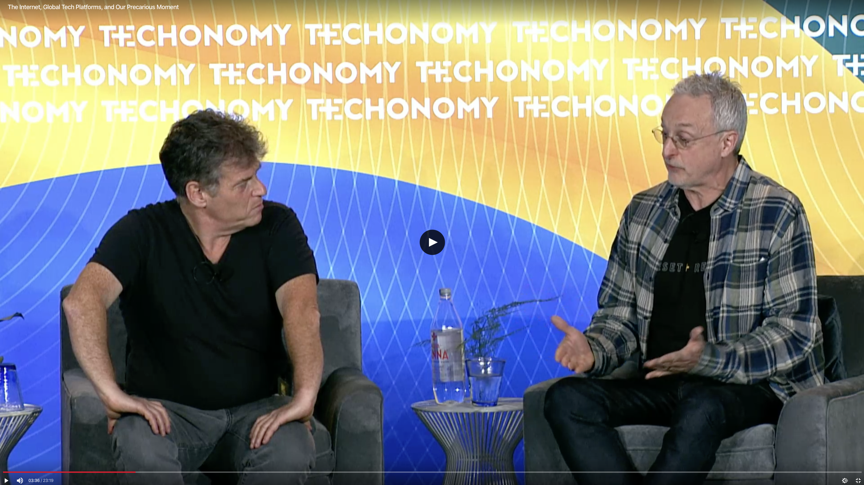
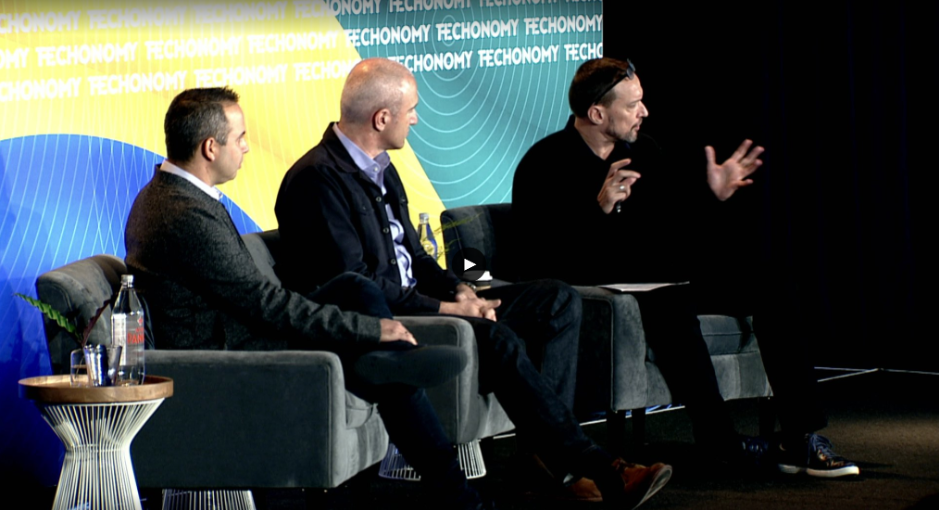
The “collapse of time” was an important meme in the Techonomy 2019 session on Super-Evolution, the idea that startups can now harness rapid prototyping and vast pools of data to develop radically new business models quickly and at scale (video here)

Techonomy

Super-Evolution is about creating more – dramatically more – options. Invented by AI, aka non-human logic. (see also Haydn Shaughnessy on the importance of maximizing options and radical adjacencies vs. core competency in innovation)

“Leave behind the myth of the grand plan and create the conditions for optionality and just-in-time strategy.”(Haydn Shaughnessy)

The first time I felt that sensation of collapsing time was when viewing Elon Musk’s Tesla 2019 update. I felt beaten by algorithms. The Tesla is now/then learning from (data) from human behavior and driving like a human, but ultimately will EXCEED their behavior” (at 01:48:15)

There you have it: gradually, but suddenly we have a singularity. Gradually but suddenly, all jobs are doomed. We are not going to stop this with an ethics council or with regulation. The train has left the station, the genie is out of the bottle.

“The fleet wakes up with an over the air update”

PR or product? The same question was asked some months later by Jean-Louis Gassée regarding the Cybertruck launch:

“Elon Musk forces us to be of two minds. On one side, we have Musk the Mountebank; on the other, a Captain of Industry.

I had the same feeling of time-space collapse and irrelevance when watching this awesome interview with Rahul Sonnad, CEO/Co-Founder of Tesloop, explaining how “Robo-Mobility is a hospitality service” and “Once cars are appliances”

Are we toast? And/or do we need to reboot, reskill, etc if we don’t want to become irrelevant? Venkatesh Rao gives his perspective when reflecting on Inventing Time, and playing on Alan Kay’s “It is easier to invent the future than to predict it” and William Gibson’s “The future is already here, it is just unevenly distributed.”

“Riding in a Tesla made the electric vehicle future seem utterly inevitable in a way that kinda killed the present for me. Suddenly I could no longer look at gasoline cars the same way. Driving in my own car felt different like I was stuck in the past, waiting for the price of the future to come down to the point where I could afford to live in it. So a Tesla creates the future in the sense of both the Alan Kay and William Gibson quotes. It makes the future real in a deep way that is like making time itself real. And you know this because the feel of the present feels different like you’re heading down a dead-end, a lame-duck future. You’ll have to either abandon it as soon as you can or end up dying with it.
Maps book

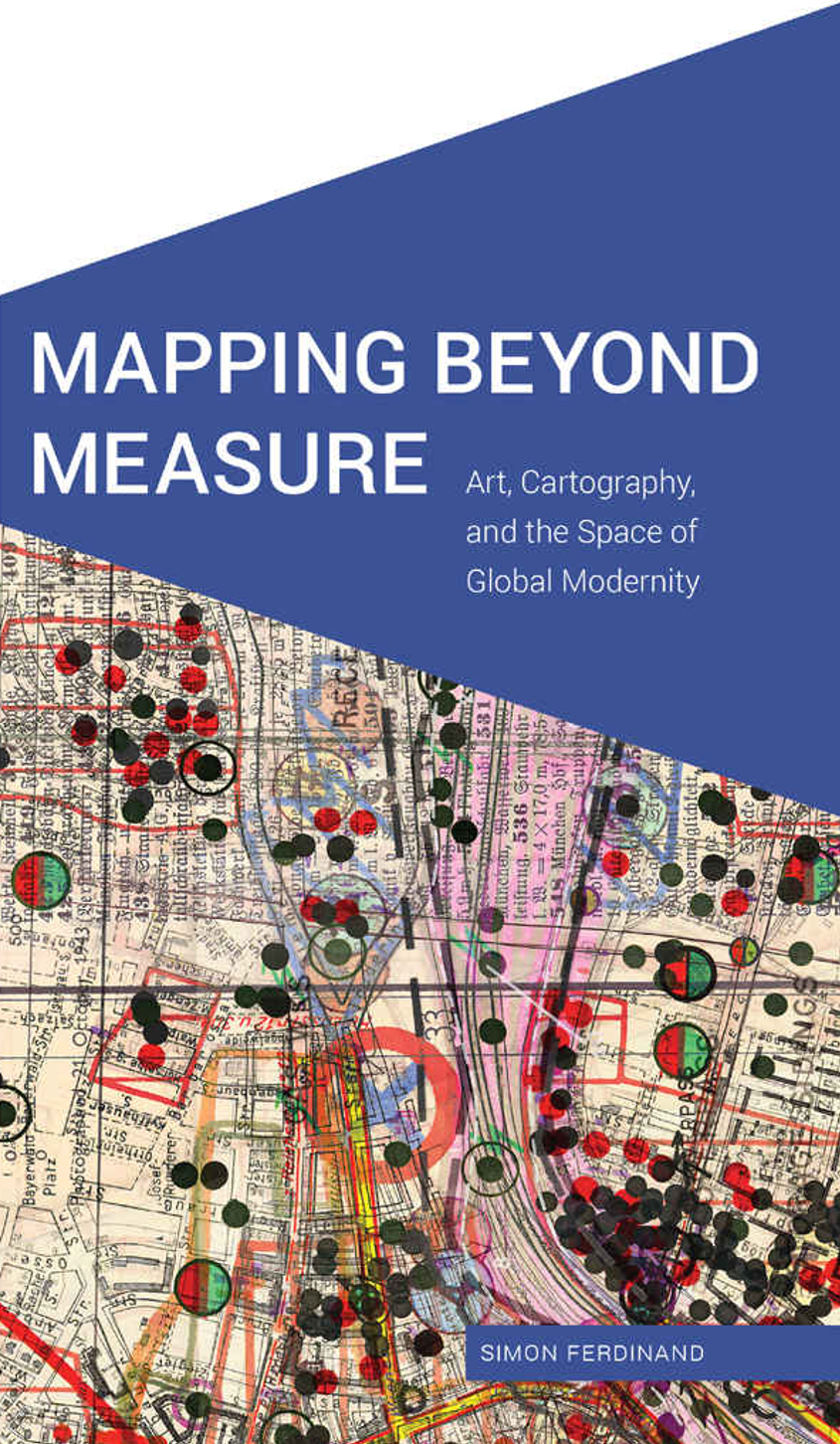
Around the same time, I was lurking in Simon Ferdinand’s Mapping Beyond Measure: Art, Cartography, and the Space of Global Modernity. He could have added the Time of Global Modernity, as he writes about spatial (spheres) and temporal (time collapse) ruptures.

“Often map artworks recapitulate the narratives of rupture (spatial as well as temporal) through which global modernity differentiates itself from inherited pasts and surroundings.

And;

“Maps have proven integral… to the experience of “time-space compression”

Greenaway

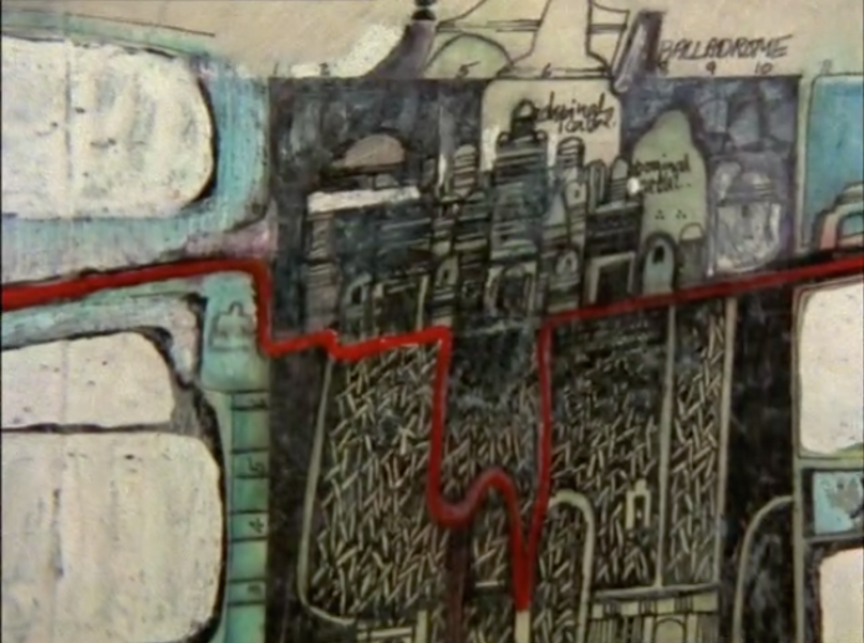
It made me think of Peter Greenaway’s film ‘A walk through H: The Reincarnation of an Ornithologist’ (1978) and “A Walk through a Thousand Plateaus”, an homage to that film.

It is probably a sign of the times that in the preparation of his new book “Agency” also the great William Gibson lost a sense of how weird the world has become, up to the point of the present bypassing his future sci-fi scripts – “His future had to catch up with the present”and “stubs”: alternative timeline in which technologists (and, more tellingly, hobbyists) of the future are able to meddle.

Agency

Hobbyists and meddling, the right words probably for not getting alienated. I would call it “tinkering” by maximizing options that human logic not necessary can spot or generate in time.

petervan-signature


Immoral Machines of Loving Greed

The theme for Techonomy 2019 in Half Moon Bay, California was “Reset and Restore: Governing Tech, Retrieving Ethics, and Acting on Climate.”

Keen and David

In the opening session, Founder and Host David Kirkpatrick prompted: “These are serious times” and the following interview by Andrew Keen of David was really interesting. Keen rightfully asked the question of what needs to be reset, and – if we have to restore something – is this a nostalgic going back to good old times, or what is meant here?

To make a long story short, it seemed the answer could be distilled to a resetting and restoring back to/towards more humanity.

Konstantinos Karachalios, Managing Director of IEEE’s Digital Ethics department referred to the German Jewish Viennese philosopher Gunther Anders, who wrote in 1956 “The outdatedness of the Human Species”.

Konstantinos also shared some strong opinions about the Power (in)equation – the asymmetry in power of the big tech vs. us – and summarized his thinking as “The Time of (Engineering) Innocence is Over”

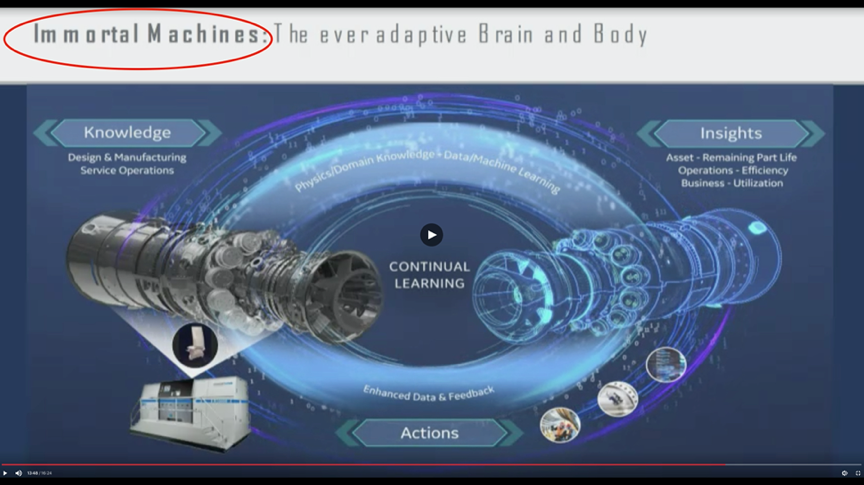
Colin Parris @colin_j_paris did a session titled “Why AI has to be humble” about GE’s use of self-learning AI in the building of GE Jet Engines. Super-slick and professional presentation, almost too clinical. The last slide was about “Intimidation by Immortal Machines”.

Immortal machines

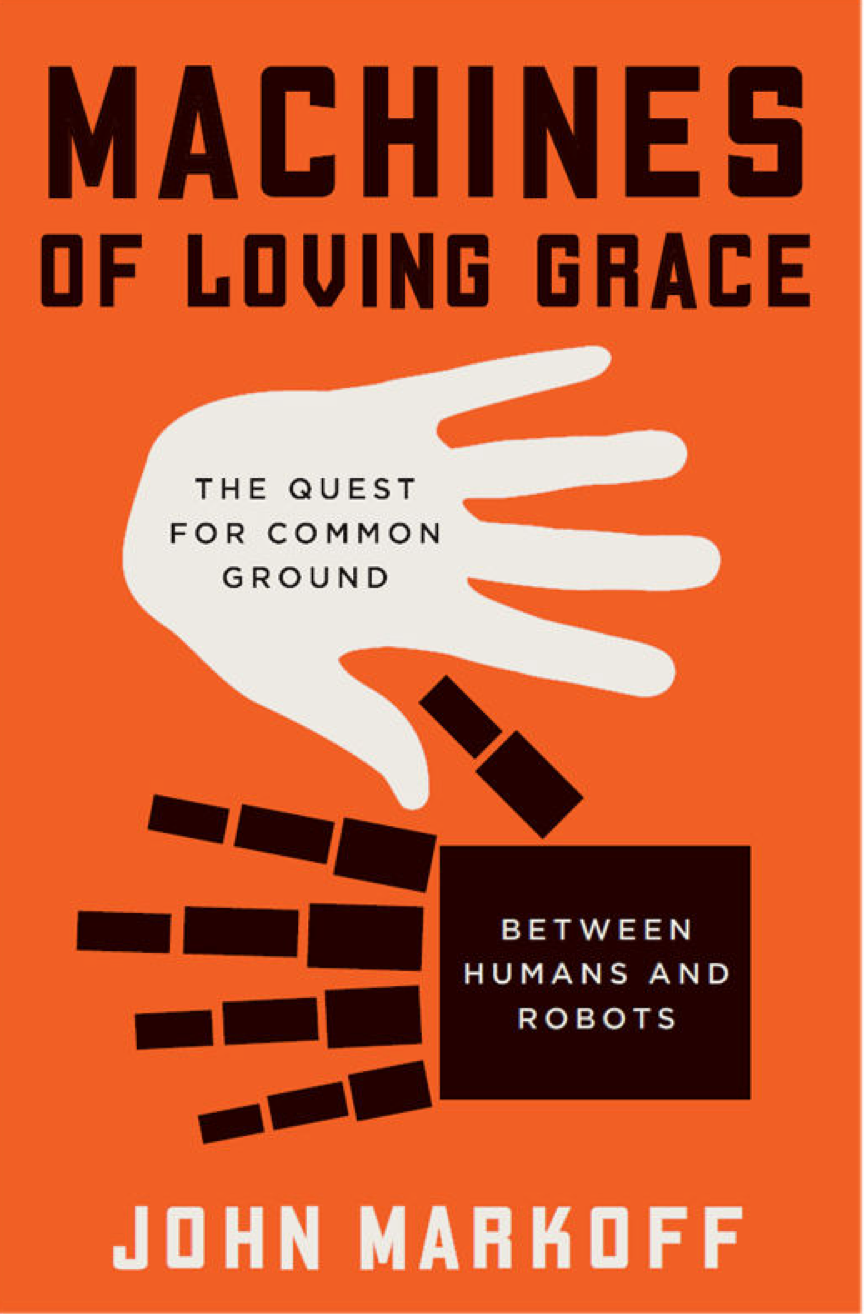
My head got spinning and got me thinking of John Markoff’s 2015 book “Machines of Loving Grace – The Quest for Common Ground between Humans and Machines

Markoff

In itself, the book’s title is a spin on Richard Brautigan’s “All Watched Over by Machines of Loving Grace” from 1967, and of course, Adam Curtis fantastic 2011 documentary “All Watched Over by Machines of Loving Grace


I like to think (it has to be!) of a cybernetic ecology

where we are free of our labors

and joined back to nature,

returned to our mammal brothers and sisters,

and all watched over by machines of loving grace. 

Richard Brautigan, “All Watched Over by Machines of Loving Grace” © 1967

Let me put all this behind the backdrop of what I saw and experienced a couple of days earlier in the San Francisco Museum of Modern Art (SFMOMA).

Moss screen

Richard Moss "INCOMING" - Picture by Petervan

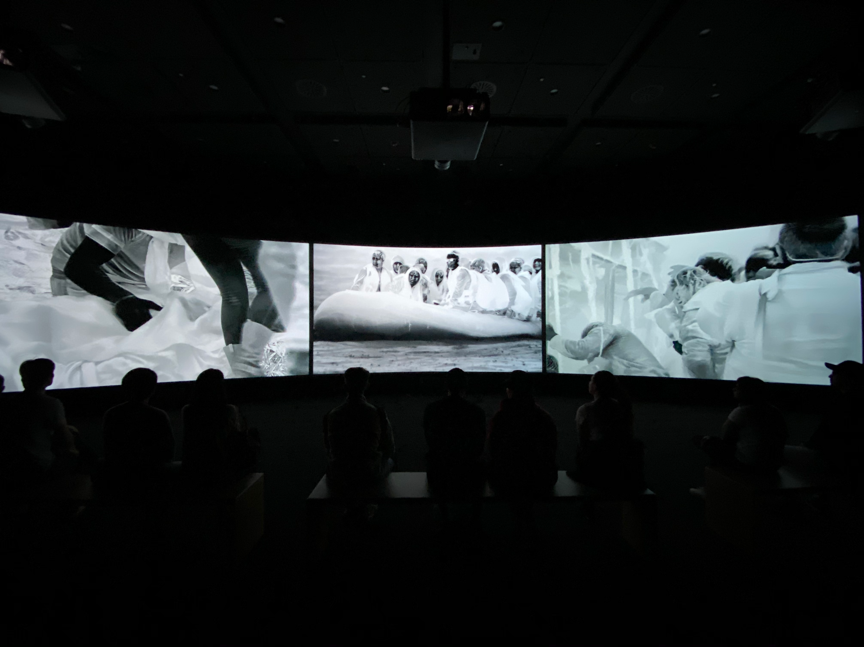
On the 7th floor, there is an amazing video installation by Richard Mosse, called “INCOMING”, and it is about the horrible conditions in another Western export product: refugee camps, and related issues of sovereignty, warfare, and surveillance.  The installation forces us to confront our own complicity. Strongly recommended. Still running in SFMOMA till 17 Feb 2020. Warning: you won’t come out smiling from this installation!

https://vimeo.com/234290984

See also interview with the artist in Forensic Architecture

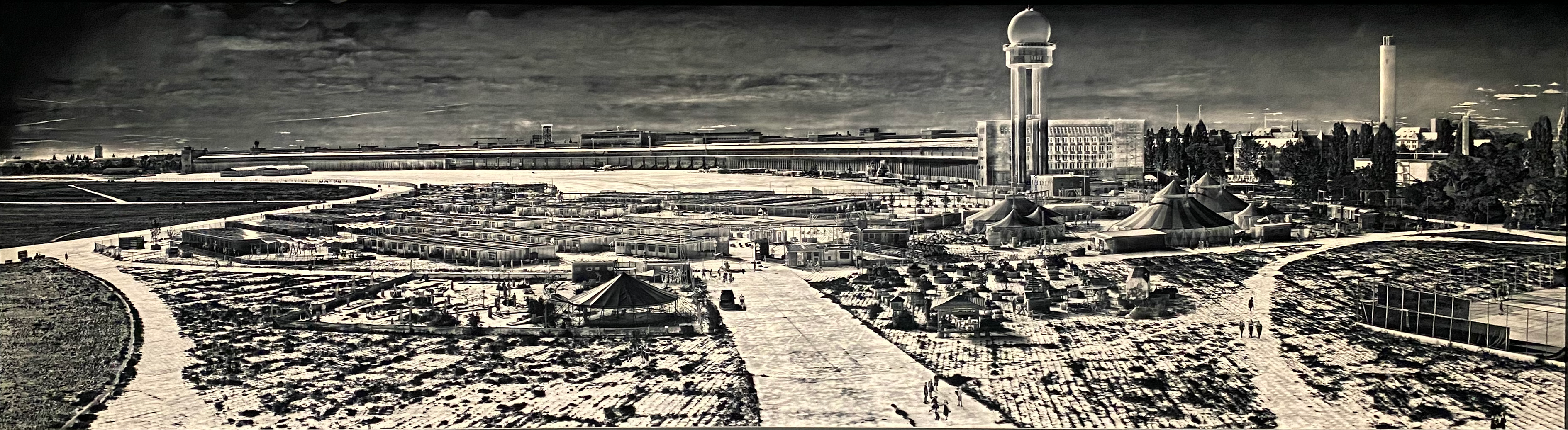
The entrance of the installation also includes a picture of Berlin’s Tempelhof, a symbolically loaded site to house asylum seekers.

Temperhof

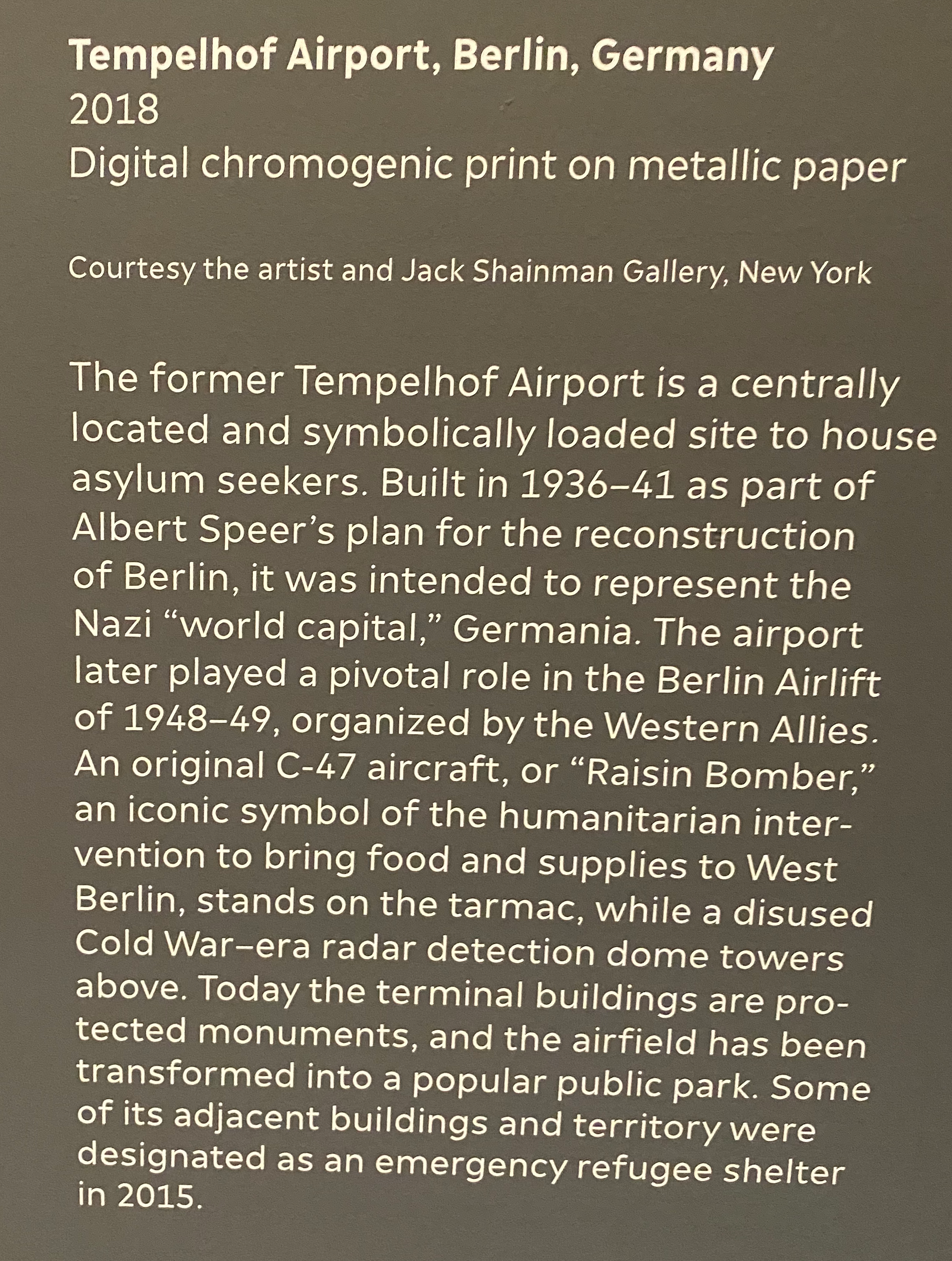
Tempelhof context

“…, and the airfield has been transformed into a popular public park. Some of its adjacent buildings and territory were designated as an emergency refugee shelter in 2015”

What misery! What a shame for a “modern” society! This installation made me rethink my opinion about refugees. For me, it questions the whole semantic discussion about “asylum seekers” vs. “economic” refugees. There is no difference. When people become so desperate to flee their home and take these incredible risks and withstand these inhumane circumstances, those semantics become irrelevant.
This injustice is going to explode in our face, sooner or later. A toxic mix with climate change, inequality and the 1% owning 99% of the wealth. I can only hope I will not be treated this way when I or my children have to find refuge for climate change or other disasters in the future.

All the big problems of today are crying for more compassion, more morality, less greed. The root cause is a lack of morals combined with an abundance of greed.

Putting it all together, “Immortal Machines of Loving Grace” may be better replaced by “Immoral Machines of Loving Greed”.  Just replacing two words is probably better and more adequately describing our Zeitgeist.

In that sense, some of the discussions of Techonomy 2019 should have included the refugee crisis vs. having safe conversations about the attention economy, tech supremacy or immortal machines of loving grace in a five-star luxury hotel.

See also my separate post on the key memes of Techonomy 2019.

petervan-signature_transparent_black_version2


I have no clue what you are talking about

This is a short (and bit weird) morsel on not understanding a clue anymore, to have the feeling to encounter a completely foreign world.

I happened to me several times last months, that I read or meet something/somebody and I really don’t have a clue what they are talking about.

  • A friend shares with me her business plan for a new app, and I have no clue what it is about, even not after having (tried to) read the associated white paper
  • The book “What Algorithms Want” by Ed Finn
  • The “God is in the Machine” post by Carl Miller
  • The 1000 dimensions of algorithms in James Bridle’s “New Dark Age
  • Eddie Harran’s (aka Dr.Time) Temporal Labs, Research lab investigating time’s impact on humanity

From the “God in the machine” post:

We sat there, looking at the computer, his creation laid out in multi-coloured type. “This is all to do with complexity,” he said contemplatively. “Complexity of input. Complexity of analysis. Complexity of how outputs are combined, structured and used.” 

 “Truth is dead,” he sighed. “There is only output.”

 After some 1-1 conversations with some of the authors, it looks like I missed a whole generation of aesthetic language that is only found in apps, games, and Netflix-ish series like Black Mirror, Mr. Robot, Tangerine, Ratter, and Skam.

black mirror

Black Mirror – Season 4 – 2017

It feels like digital incest. Trying to hide from your virtual self. A virtual loop of digital identities and personalities. Not knowing what is real and what is fake or sliced/looped faith.

It also makes me think of this extract from Bill Gates’ review of Capitalism without Capital:

It took time for the investment world to embrace companies built on intangible assets. When we were preparing to take Microsoft public in 1986, I felt like I was explaining something completely foreign to people. Our pitch involved a different way of looking at assets than our option holders were used to. They couldn’t imagine what returns we would generate over the long term.

It feels like I cannot imagine what these new aesthetics can mean on the long term, and how they are already influencing now Generations X, Y, and Z.

I am missing the @swardley’s situational awareness map, about movement and position. Where is the anchor? What is edge and what is commodity?

Visit Roger Raveel museum 28 Sep 2018

If you are still in for it, here are two soundscapes of my visit to the Roger Raveel Museum;

Still with me? Where am I? What’s next? Where is this going? How fast? How? When? With whom? Who is cheating? Who’s not?

Are we entering a digital matrix? Where real and surreal blur into an new perception?

Tell me if your understand.

Are we all lost?

petervan-signature

Cogs in networks

We use models and metaphors to make sense of our organisational structures, understand them, make predictions, apply change.

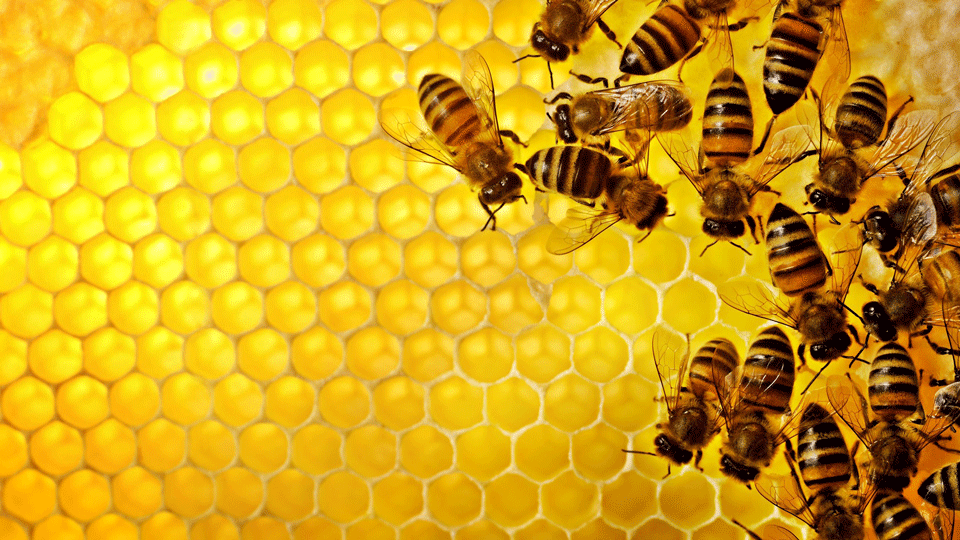
Blog_beehive

Bee hive - via Bridging the Gap

Some well known models are:

  • Ants in colonies
  • Bees in hives
  • Apes in jungles
  • Humans in neural networks
  • Organisations as machines
  • Hierarchies, wierarchies, holocracies

Models are not reality. Models are an abstraction of reality. Same for metaphors. They help us tell and understand a narrative.

We are not apes, ants, or bees. We are humans. As Jonathan Haidt explains at length in his book “The Happiness Hypothesis: Finding Modern Truth in Ancient Wisdom”, I am struck by all the noise humans put on the system: “We are all hypocrites” and “We are the rider (the conscious/the ratio) ànd the elephant (the unconscious, feelings, instincts, genes). Most models assume the rider is in charge. The rider is not in charge.”

Structural change leads to structural behaviour change. Structural change needs high quality connections and flows.

“A high quality connection is one where information transfer is rapid, reliable, and noise free” says Tom LaForge.

But in real life, this information transfer is NOT noise free. Maybe in some nirvana love relation, but usually not at/for/within work.

Noise comes from the motivations of the elephant (the unconscious), some examples:

  • Reciprocity
  • Prestige
  • Self serving biases
  • Power
  • Hypocrisy
  • Arrogance and entitlement

In most re-orgs, people look at the motivations and incentives for the ratio, the rider. They ignore the elephant. They forget the rider is not in charge.

High quality connections need something else than speed, reliability of noise-freedom.

There should be some dimension/ambition/alignment of “Spiritual, moral and aesthetical advancement”.

In this category, we find standards and appreciation for:

  • Care
  • Tradition
  • Craftsmanship
  • Beauty
  • Proportion
  • Sacredness
  • Infinite games

See also my own post about Kevin Kelly’s qualities created at the transaction, which is more about qualities of resulting products and services than qualities of structure: https://petervan.wordpress.com/2017/04/19/sine-parole-19-apr-2017/

And then there is governance

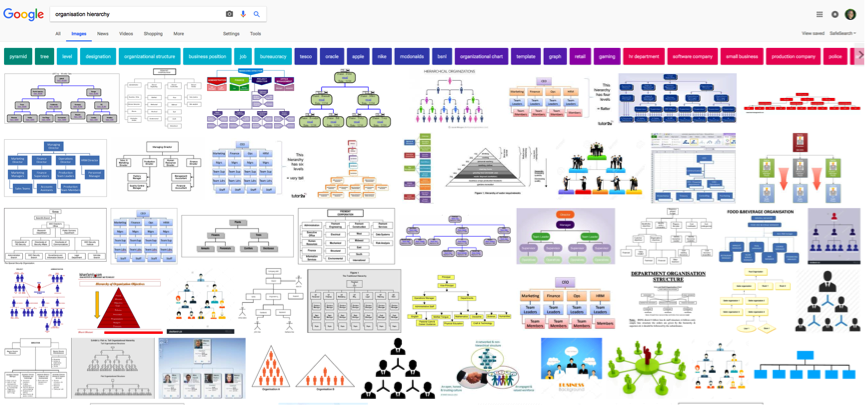
hierarchies

Simple Google search on organisational hierarchy

The simplicity of the hierarchy works well on a slide or a hand-out. You can document it in a spreadsheet, or box-diagram and so on. But all these representations do is framing the conversation in an illusion of simplistic 2-dimensional structures. It’s the specialty of management consultants to think and present in two dimensions. It’s making it easy for executives to understand.

But if you are used to a 3-dimensional view of reality, you can’t understand why the flatlanders don’t see what you see. As long as you are primed in 2D you won’t see what the other dimension sees.

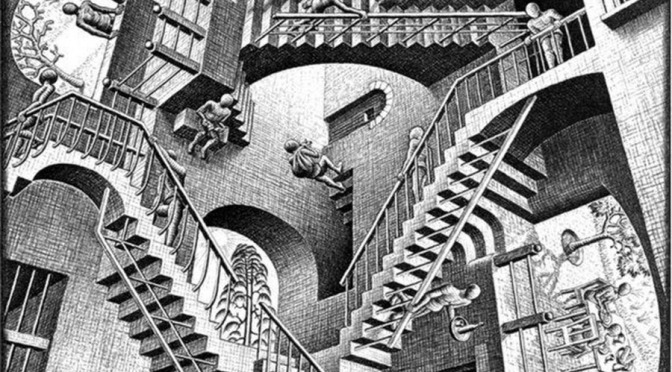
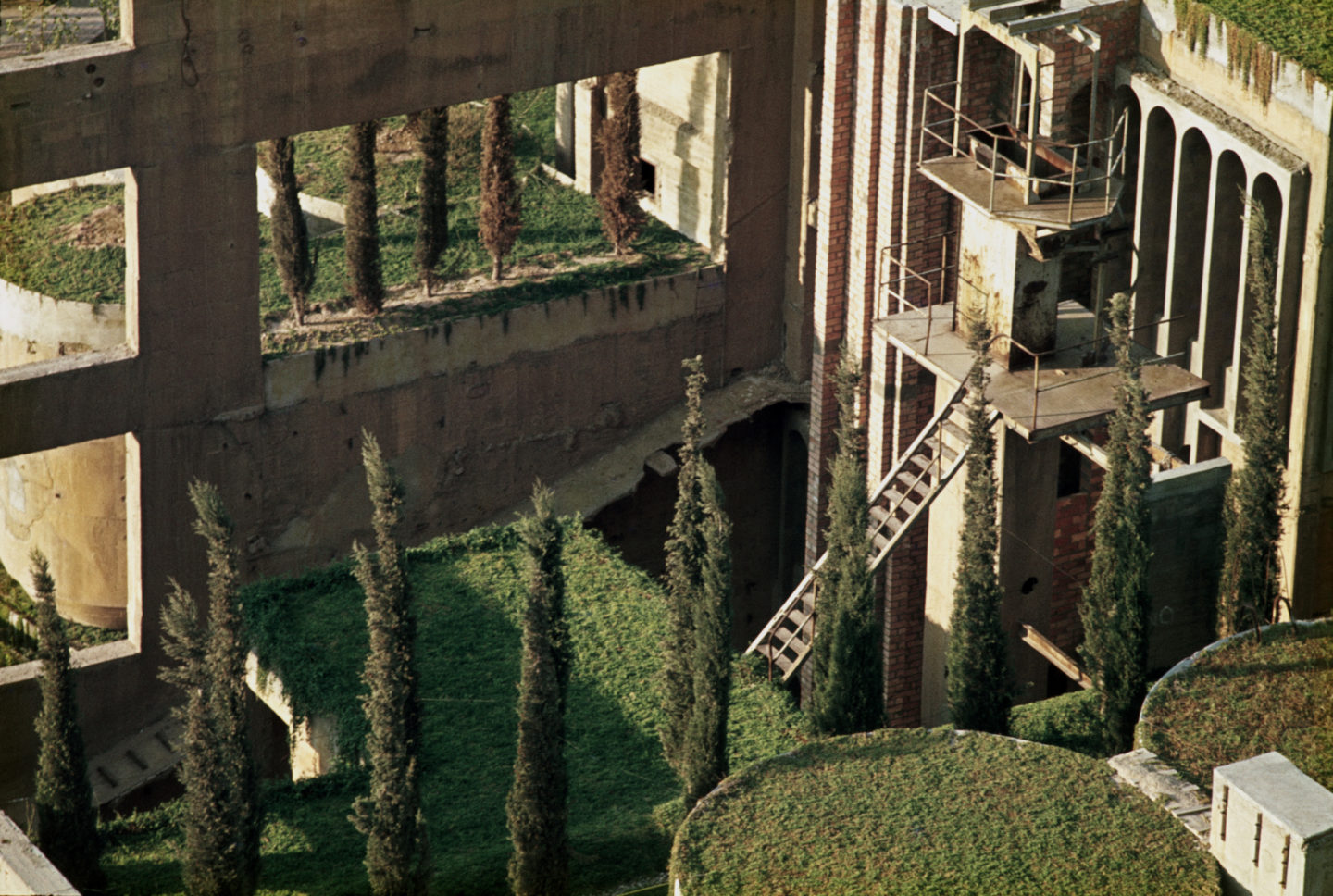
A better picture/metaphor for an organisational structure would be something like this.

escher

Relativity – 1953 Lithograph by M.C. Escher – 294mm x 282mm

Ricardo_Bofill_Taller_de_Arquitectura_Barcelona_Spain_The_Gardens_24-1440x968

Ricardo Bofill – La Fabrica – Old cement factory – Barcelona, Spain

It’s messy. At many moments you don’t know anymore where you stand. The perspective changes all the time. You get disoriented.

There is somewhere a general definition for Robots:

Robot = sensors + mind/computer/algorithm + body (hardware).

But humans are not just: senses + brains + body.

Computers are not like brains. Brains are not like computers. Our human models are different from machine models. Machine understanding is different from human understanding.

Humans are not just nodes on a network/grid that can be governed by coded social contracts, blockchains and AI. If you do that, humans are just cogs in another machine. Humans become cogs in a network.

The obvious case is of course Uber, which is an economy of extracting value vs. the so-called sharing economy. For Uber, all the drivers are already cogs in a network for the sole benefit of the monopoly.

Being cogs in networks is an insult for humans. But we are just getting started:

But does it still matter at all these days? We already are in a new world of “Alien knowledge, when machines justify knowledge”. Check out this fantastic long read by David Weinberger

Alien Knowledge

Via David Weinberger - Illustrations by Todd Proctor / YouWorkForThem

“The paradigmatic failures seem to be ones in which the machine justification has not escaped its human origins enough.”

Organisations are not models/buildings/boxes. They are like rivers with information flows. Building skeletons, where the structure of the building guides traffic and connections.

David Weinberger talks about models created by machines. Models that machines can understand and we don’t. It is very much as he concludes:

“It has taken a network of machines that we ourselves created to let us see that we are the aliens.”

If we don’t want to end up as cogs in networks, we need to aim for structural advancement at a spiritual, moral, and aesthetical dimension.

petervan-signature_transparent_black_version2


I am in the business of cultivating high quality connections and flows to create immersive learning experiences and structural change. Check out: https://petervanproductions.com/


Skyscrapers inhabited by machines

project-x

Project X building, lower Manhattan at 33 Thomas Street, NYC

This week, The Intercept ran a fascinating article– well, quite disturbing actually – describing the possible surveillance roles of building Project-X, an AT&T owned property in the middle of Manhattan, sitting on top of some major telephone and communication switches (and apparently many other buildings like this in the USA and most probably elsewhere).

It even becomes super scary if you read the article with the backdrop of the first names and background of some of the people appointed in the last couple of days in the Trump administration.

The building was designed by the architectural firm John Carl Warnecke & Associates, whose grand vision was to create a communication nerve center like a “20th century fortress, with spears and arrows replaced by protons and neutrons laying quiet siege to an army of machines within.”

Some of Warnecke’s original architectural drawings for 33 Thomas Street are labeled “Project X.” It was alternatively referred to as the Broadway Building. His plans describe the structure as “a skyscraper to be inhabited by machines” and say that it was “designed to house long lines telephone equipment and to protect it and its operating personnel in the event of atomic attack.”

I spotted the article just two days after I saw a short 7-minute documentary (hence Doc7) on Belgian television about artist Renato Nicolodi

renato1

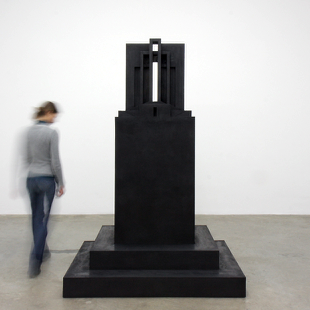
Renato Nicolodi – a young artist from Flanders – makes architectural models of buildings that are not intended to be built.

renato2

Pulpitum II by Renato Nicolodi, 2012

long-lines-building-nyc


Long Island Building NYC, by John Carl Warnecke & Associates

That made me think about my time as student in Architecture in Ghent, were we were allowed – or should I say incentivised? – to design buildings that never had to be built (at least in the first two years of the study). Full creativity nirvana, quoi.

The work of Nicolodi resonated with me for another reason. They are actually mausoleums that have a place in the memories of his grandfather, who spent the Second World War in various prisoner of war camps, which he meticulously describes in the conversations Renato argued with him. The recordings of those calls still are daily source of inspiration for Renato.

It woke up old memories from my youth when – at the age of 6 or 10 – I was visiting my grandmother, who lived in a place called Ledegem, a little village 17km east of Ieper, a town that will be remembered forever for the first time use of poison gas in World War One.

It makes me wonder about the working and selectiveness of my memory. Since I started my sabbatical begin Nov 2016, I feel restless.

Being disconnected from work – “the job” – gives me plenty of space for reflection, experimentation, silence, being alone – I love the sound of silence of the morning-house before the rest of the family has woken up.

But this stillness also seems to bring back many old memories, going way back to my childhood, things that I never thought about anymore in the last 50 years. On the other hand, it seems my short-term memory is getting very selective – almost ignoring mode. Up to a point that my lovely wife sometimes wonders if I should not go and see a doctor, but I think I am doing fine.

ledeghemmc

Ledegem WWI cemetery today in 2016

At the end of my grandmother’s garden was a cemetery holding 85 Commonwealth burials and commemorations of the First World War. I remember playing on the walls and the crucifix of the cemetery. In my memory, the place was much bigger than in this recent picture. I also remember some of the bunkers that you still find here and there scattered throughout the landscape in this region. I remember playing in one at the seaside before they were closed off for general public. I remember the smell of wet sand.

german-ww1-command-bunker-ypres-salient

German WW1 Command Bunker, Ypres Salient

The memory also put me in contact with another aspect of my onlyness (I am currently reading the draft manuscript of Nilofer Merchant’s next book), where I am coming from. My father is from a family of 7 kids, that all needed to be to taken care of by my grandmother all alone, as her husband died in a tragic car accident (he was on a bike) just before the start of the second world war. So, it was surviving on a shoestring.

Deep in my (un)consciousness, there is the fear for this shoestring poverty. That we’ll have to hide again in the coldness and humidity of bunkers in the polders. A dystopian threat of dark secrecy, manipulation, corruption and a fundamental loss of trust.

That is what bunkers and secret buildings do to me. Even if they are just architectural models that are not intended to be build.

The new models don’t seem to be intended for humans, they are intended to host machines. How can we reclaim back our humanity?

The Illusion of Agency

At this year’s Innotribe Sibos, we have a session about digital ethics. Part of a full day on man-machine convergence.

Some of that conversation will be about the use and control of data. With this post, I would like to add my perspective to that conversation, based on some recent thinking on human agency.

At a recent MyData2016 event in Helsinki, i was surprised how little the thinking about personal data stores has evolved since 2012, when i was myself deeply in the trenches of the topic of distributed data sharing.

It was a really great conference, well organized, cool audience etc, but like many conferences, it was the tribe talking to tribe, believers talking to believers, all thinking that their lens to look at things was the right one, with little or no contrarian view.

I wanted to be that contrarian, and challenge a bit the assumptions.

At the event there was a lot of talk about “PIMS”: Personal Information Management Systems, or personal data stores, or personal data “clouds”. I don’t want to have a discussion about the subtle semantics here.

At one moment, Jamie Smith from Ctrl-Shift – who i respect a lot – said something along the lines of “PIMS are all about giving people agency”.

I think that is a big illusion, and that was what my talk was about. The illusion that the problem is about taking back ownership and control of your data. And that a PIMS is the solution. I believe we are discussing the wrong problem and the wrong solution when talking about managing our own personal data at our terms and conditions.

Owning your own agency is more important than owning your data. That in essence is what my talk was about.

My presentation at #MyData2016 conference

UPDATE: here the link to the Prezi of this presentation. Because there is so much video in this Prezi it takes 2-3 min to load. Be patient 😉

The talk is part of a longer story of more than one hour, wandering through a whole bunch of philosophical, ethical and artistic considerations. At this event, i got only 20 minutes, and i told the moderator he could cut me off, which he did most elegantly (no pun intended) at the end of my presentation.

My agency vs. my data is a pretty big deal.

  • It is not about buying but creating
  • It is not about my data but my agency
  • It is not about privacy but about shelter
  • It is not about power asymmetries but relationship symmetries
  • It is not about MyData but about OurData

In that sense the GDPR (General Data Protection Regulation) is shooting at the wrong problem. In that sense our politicians and leaders in general are again outperforming in solving the problems of the past.

I got some good reactions after this talk, from Doc Searls saying “you gave the talk that i always wanted to give”, to somebody else sending me a tweet and a mail saying “your presentation has changed my life, i decided to leave Facebook after more than 10 years”.

There is such a strong tension between our actual reality and the desired reality that we are currently moving in some form of virtual or surreality. But as Magritte said:

“Surrealism is the immediate knowledge of reality”

And we feel lost. We escape and try to reconnect nostalgically to what was, and are afraid of what going to be. People focus on the surreality of their phones instead of real life.

People believe what is on their phones and PIMS is the reality, and are able to represent us as human beings. But as Markus Sabadello said at this event: “Technology will not be able to represent the full complexity of human beings”

Our devices and apps make us believe we are in control, because we now can “manage” our data and lives. But we are focused on managing life, rather than living it. That is our big illusion.

To summarise, I believe our plan and ambition towards our desired reality must at least have following components:

  • This space needs to be regulated. Regulation means setting ethical and moral norms, AND policing them
  • These norms must be ethical and moral
  • We must decide who sets these norms, who polices them, and who penalises/rewards good behaviour.

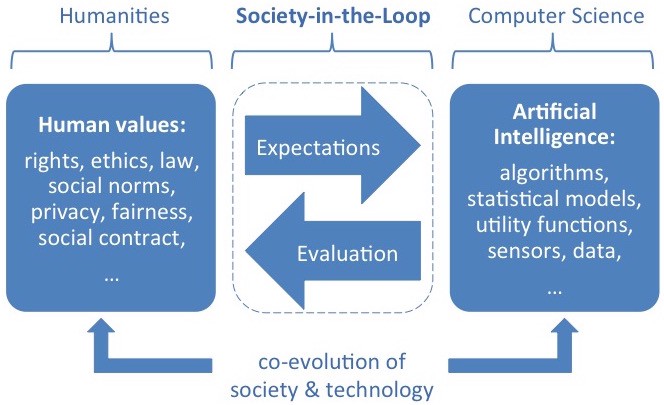
For that we must bring “Society-in-the-loop”, and not let this be decided by governments, corporations, or god forbid, algorithms


society-in-the-loop-iyad-rahwan

Society-in-the-loop by Iyad Rahwan

We must expand ourselves from a problem (efficiency) orientation to a creative (value creating) orientation, because the future is not about solving the past but knowing what you want and use mastery to make that happen.

Last but not least, we must be very much aware of the shallowness of the actual reality, and strive for high quality work with high quality attention and presence and meaning also called “Deep Work”

Maybe next year, they should call the conference #MyAgency2016;

Team Human

Web

Artificial intelligence. Cognitive computing. The Singularity. Digital obesity. Printed food. The Internet of Things. The death of privacy. The end of work-as-we-know-it, and radical longevity: The imminent clash between technology and humanity is already rushing towards us. What moral values are you prepared to stand up for—before being human alters its meaning forever?

This is not me saying this. This is Gerd Leonhard a new kind of futurist schooled in the humanities as much as in technology. A musician by origin, Gerd connects left and right brains for a 360-degree coverage of the multiple futures that present themselves at any one time. In 2015, Wired Magazine listed Gerd as one of the top 100 most influential people in Europe.

In his most provocative book to date “Technology vs. Humanity: The coming clash between man and machine” (Amazon Affiliated link), he explores the exponential changes swamping our societies, providing rich insights and deep wisdom for business leaders, professionals and anyone with decisions to make in this new era.

If you take being human for granted, check-out this trailer for a movie he made with Jean-François Cardella, his film producer.


Gerd has a new book out and it is and i recommend it strongly, and i am not alone.


“Gerd Leonhard is most definitely a member of Team Human. Here’s his convincing and heartfelt call for the reinstatement of people and purpose into the technology program.” – Douglas Rushkoff, Author of ‘Throwing Rocks at the Google Bus’, host of the ‘TeamHuman’ podcast

“Gerd Leonhard provides a fascinating look at the impact of exponential technologies and the dilemmas we will face in adapting to—or being adapted by—these. His book really makes you worry—and think.” – Vivek Wadhwa, Academic, Researcher, Writer, and Entrepreneur.


A good overview of the book can be found in Forbes’ recent interview with Gerd Leonhard and his reflections on digital ethics:

“Like sustainability, ethics is often thought of as a nice to have, a thing to consider when you have time, a luxury, non-monetizable. But now it is becoming clear that those distinctly human things that are not measurable (I call them the “androrithms” – as opposed to algorithms) such as emotions, intuition, beliefs and ethics are what sets us apart from machines.”

Gerd’s thinking is of great relevance to financial services. Because the whole value proposition of the financial services industry is about to change, it needs to reinvent itself in order to discover and grow new values and revenue streams.


Gerd_illustrations_27_5_16_v3


“In general you can say the financial industry has been asleep at the wheel for the past ten years, but it has woken up with a start,” says Leonhard, and

“The Darwinian megashifts of exponential technologies eventually challenge most of our assumptions, meaning somebody is going to reinvent the way we think about stock markets and what a stock-market actually is. After we get the blockchain and a global digital currency, the next step is to revamp the entire logic of the stock market. And that is imminent.”

In addition of the book and the film, Gerd has created a unique experience called The Future Show Live. The Future Show Live will demonstrate what exponential technologies are doing to our world of business and society and will create a context around financial services, pointing people towards how they can innovate from inside an organisation and not rest on outmoded systems.

We will need to embrace technology – but not become it. We will need to find ways that technology will actually serve humanity (i.e. support human flourishing and contentment) not vice versa.

Gerd Leonhard will be hosting The Future Show Live at Sibos at the Innotribe stand next to the main Sibos stand on Wednesday, 28th September from 9:30-10:15am.

55x19copy  All illustrations are by Gerd Leonhard and are licensed under a Creative Commons Attribution-NonCommercial 4.0 International License.


Magritte and the Age of Machines

This is my first post of the year, and I don’t believe I properly closed the previous year.

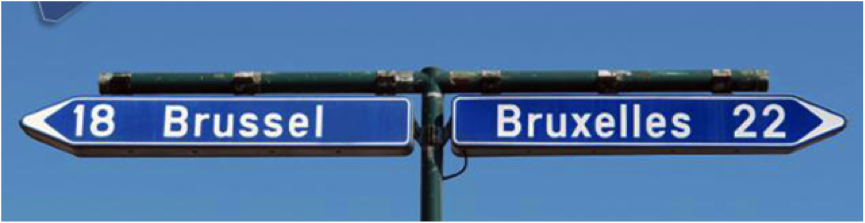
fleches bxl

Surreal traffic sign in Belgium

On the last day of 2015 I paid a visit to the Magritte Museum in Brussels. It was one of those surrealist days, when the Brussels mayor has just announced the cancellation of the new-year fireworks, and the city was still under terror alert level-3, meaning that a threat is “possible and likely.”

magritte logo

I was early – just before the opening of the museum – and the city had something unreal. The air was fresh, the light was bright, everything was peaceful, and mainly Japanese and American tourists were hanging around enjoying the square.

The entrance of the museum also was surreal: visitors now had to go through a x-ray scanner, like in airports. I am pretty sure the place must be full of CCTV cameras, whose output is possibly most of the time ignored by human or more advanced computer vision systems.

I think we are overreacting here, and that it will get worse. There is a big disconnect between the reality and the perceptions created. And it changes my behaviour. Already now, I notice how I change my behaviour when entering in surveyed territories like airports (and now also musea): I don’t try to look into the eyes of the guard, maybe I dress more conforming, become submissive, and become more careful in the wordings and subjects of my posts and tweets.

I have become submissive.

Luckily, the queue at the museum was not long yet, and I could shrug off the defeat and start enjoying the museum tour.

The Magritte museum is part of a the complex of the Royal Museums of Fine Arts of Belgium, located in the heart of Brussels at the Place Royale. It is housed in the neo-classical landmark Altenloh Hotel, superbly restored in 1984. I had visited the Royal Museums complex before, but never the wing where Magritte is hosted.

The main entrance of the museum is via a big elevator (the museum is spread over three floors, and the tour starts on the 3rd floor). I go quite frequently to an exhibition and one immediately notices when you are entering a league in its own right. This is an absolute world-class collection and museum, I recommend it to anybody who visits our city and has a couple of hours to spare.

“The museum’s multi-disciplinary collection is unrivalled. It contains more than 200 works consisting of oils on canvas, gouaches, drawings, sculptures and painted objects as well as advertising posters, musical scores, vintage photographs and films produced by the artist.”

magritte headshot

Headshot René Magritte

René Magritte was a Belgian surrealist artist. He became well known for a number of witty and thought-provoking images that fall under the umbrella of surrealism. His work is known for challenging observers’ preconditioned perceptions of reality. (from Wikipedia).

I believe that the skill to “challenge observers’ preconditioned perceptions of reality” – in other words curating, creating, and making sense – is becoming more and more important is this age of rapid change, where shortcuts and platitudes are rather the norm, in stead of depth in our reflections about cultural change.

Robert Fritz said: “Structure determines behaviour, and behaviour drives culture”.

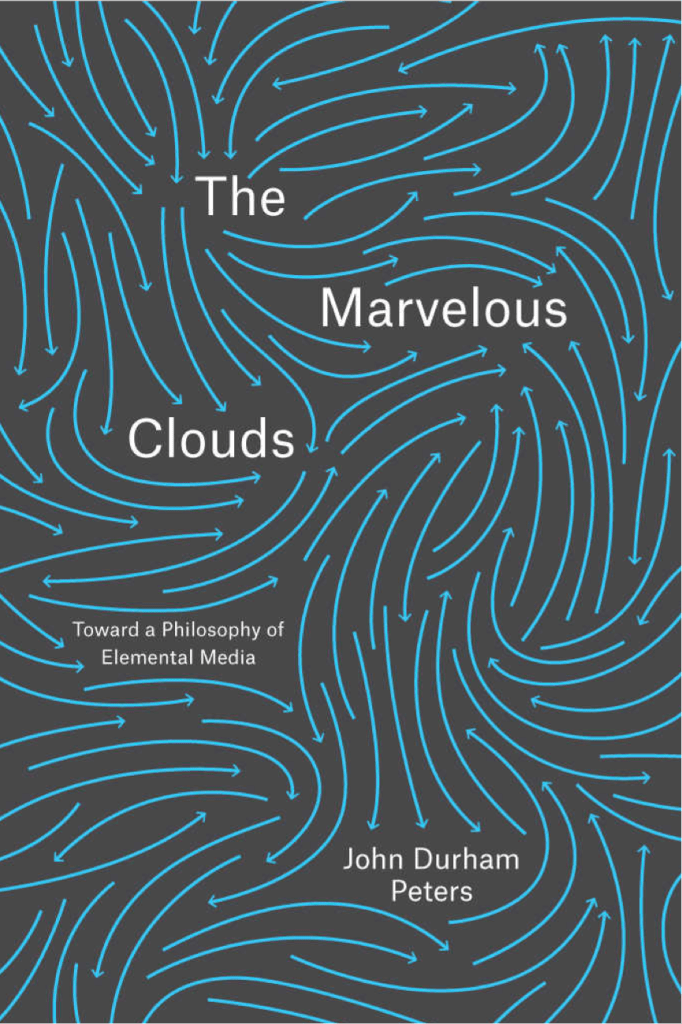
book marvelous clouds

In that context, I highly recommend the book “The Marvelous Clouds” by John Durham Peters, who starts where Marshall McLuhan left it in 1964 (that is now more that 50 years ago), when he coined the phrase “The Medium is the message” in his most widely known book, Understanding Media: The Extensions of Man.

McLuhan proposed that a medium itself, not the content it carries, should be the focus of study. He said that a medium affects the society in which it plays a role not only by the content delivered over the medium, but also by the characteristics of the medium itself.

When I start playing and mixing with Fritz and McLuhan, I get to something like:

“The medium informs the structure,

Structure informs behaviour,

Behaviour informs culture”

A significant part of the structure we operate in is made of media. Media as in plural of medium.

The air is medium, water is medium, the Internet is medium.

But like Magritte, we are unaware how easily the medium can be tricked. Is what we see real, unreal, surreal, or pure illusion?

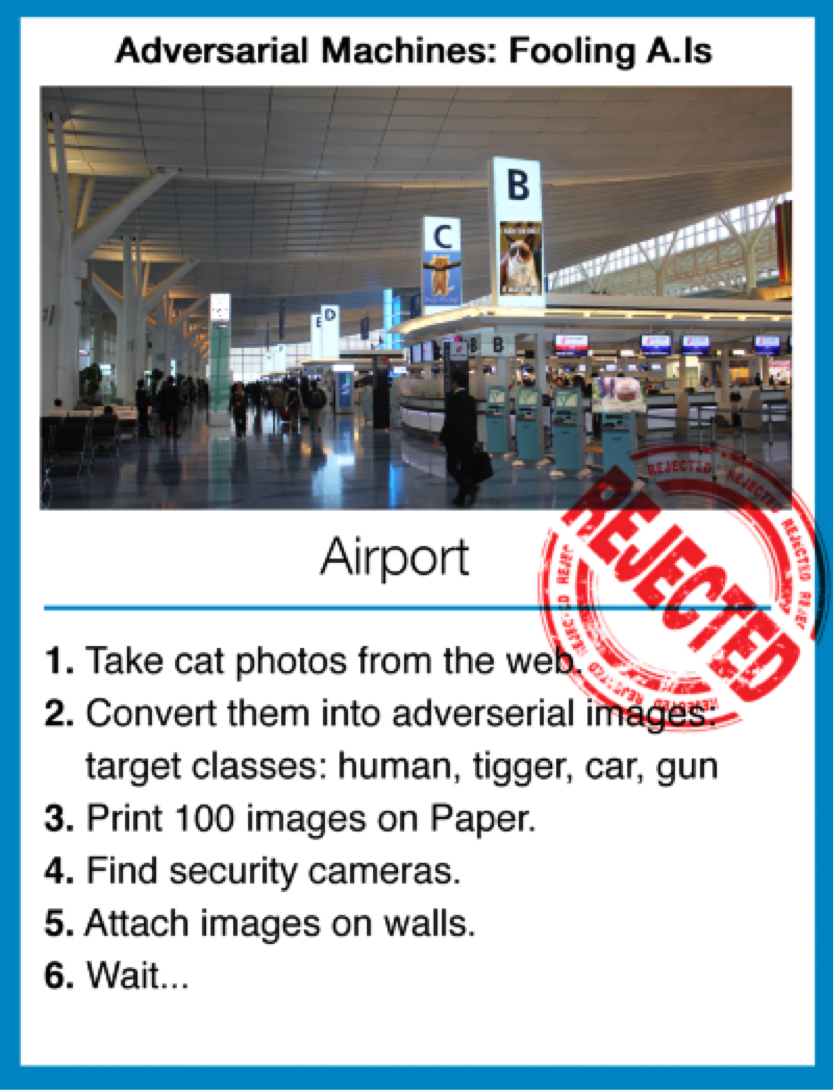
Check out this great post about Adversarial Machines by Sanim on how easy our machines can get fooled by adversarial robots.

“At the heart of many modern computer vision systems are Convolutional Neural Networks. On some vision tasks, CNNs have surpassed human performance. Industries such as Web-Services, Research, Transport, Medical, Manufacturing, Defence and Intelligence rely on them every day.”

And

“Adversarial Examples are a fascinating area of ongoing research. They highlight limitations of current systems and raise a number of interesting questions. While industries are racing to include visual intelligence systems in mission-critical infrastructure, looking at edge-cases and exploring solutions is a productive path. 

The discussion in that post – and especially the part on generating adversarial images and “mangas” – is fascinating. And should us make think very carefully how all this can be used and misused in a medium of networks, CCTV cameras, and online and offline surveillance.

airport

trump

In other words, the image of the reality is not the reality.

The map is not the territory (Alfred Korzybski in 1931), meaning:

  • A map may have a structure similar or dissimilar to the structure of the territory…
  • A map is not the territory.

In The Medium Is the MassageMarshall McLuhan expanded this argument to electronic media. Media representations, especially on screens, are abstractions; are virtual “extensions” of what our sensory channels, bodies, thinking and feeling do for us in real life (Source: Wikipedia)

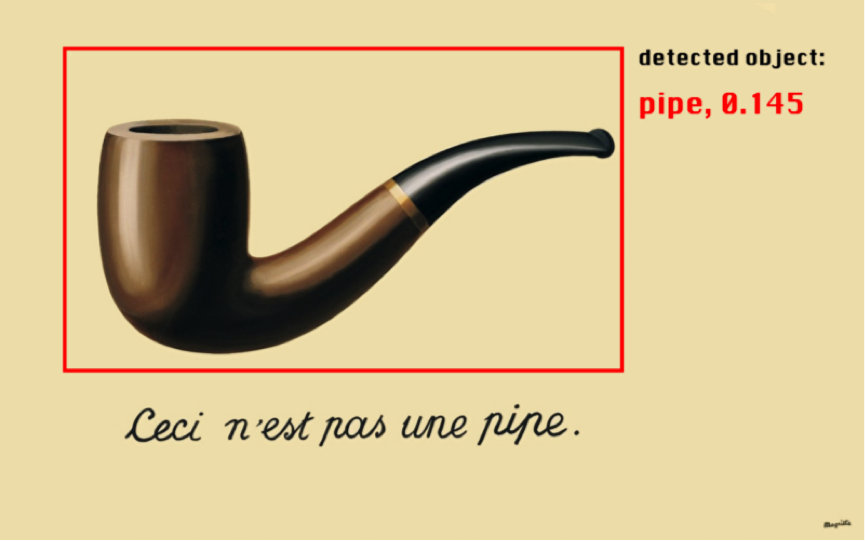
Which brings us full circle back to our friend Magritte who hits the nail – or should I say pipe – in many of his paintings, the most famous work entitled The Treachery of Images, which consists of a drawing of a pipe with the caption, Ceci n’est pas une pipe (“This is not a pipe“).

pipe

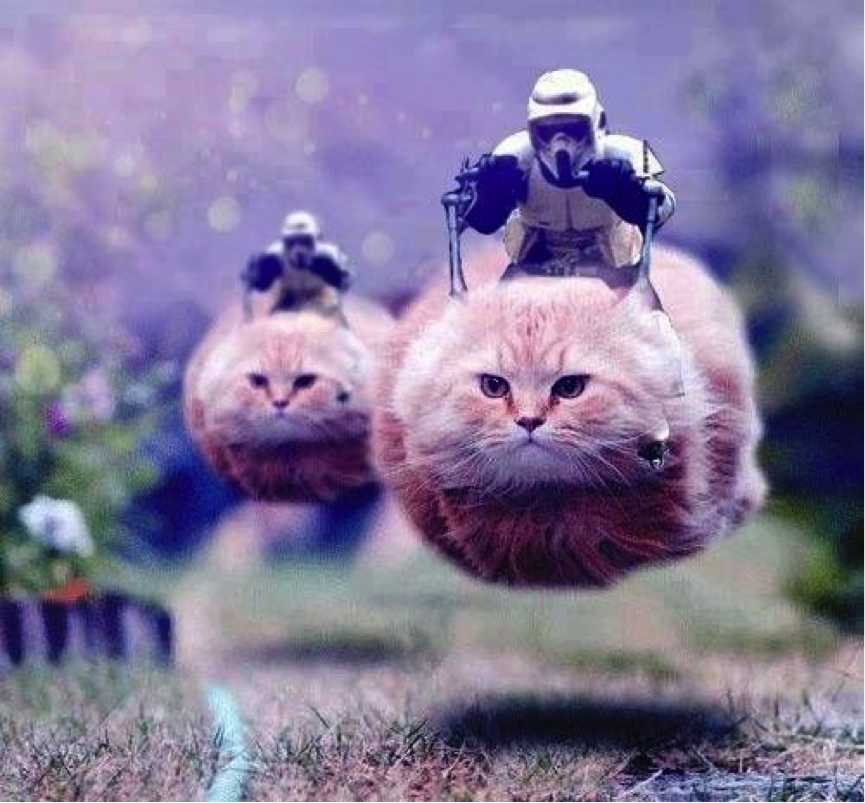
The spirit if Magritte is still very much alive. In true surreal traditions, Belgians started posting pictures of cats during threat level-4 in November 2015.

cats

These are deeply human and intended reactions to ever more chaotic environments and media.

I believe it is very important to nurture these human intentions, and the arts of humor, surrealism, and deeper languages than pure digital representations of reality.

Yes, we are talking here about the language of art.

Brian Eno recently defined art as:

“Everything that you don’t have to do

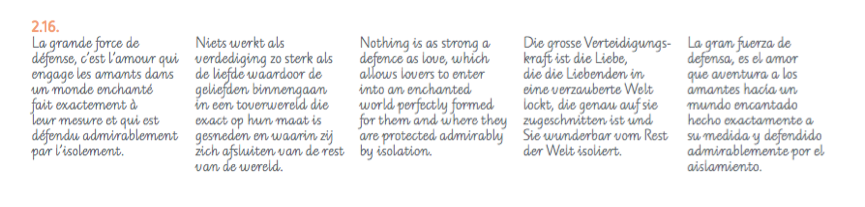
In that spirit, I leave you with some quotes from Magritte. They are displayed across the three floors of the museum in the same typography of “Ceci n’est pas une pipe.” All quotations are consolidated in a nice PDF that you can find on the museum’s website, with the original French version, and translations in Dutch, English, German and Spanish.

quotes

Many of the quotes are very powerful. Here a selection of my personal favorites. I hope you enjoy them as much as I do.

I wish for real love, the impossible and the utopian. I fear knowledge of my exact limits.

To be surrealist is to banish the notion of ‘déjà vu’ and seek out the not yet seen. By this I mean this moment of clarity that no method can reveal.

The real value of art is measured by its capacity for liberating revelation.

Nothing is as strong a defense as love, which allows lovers to enter into an enchanted world perfectly formed for them and where they are protected admirably by isolation.

Rebellion is a reflex of the living man.

Liberty is the possibility of being and not the obligation to be

All that I desire is to be enriched by intensely exciting new thoughts

Please do share with me your intensely exciting new thoughts. Onwards for a fantastic 2016. Happy new year !