The Forbidden Question at UnitedXR Europe – Homo Experiens Explorers

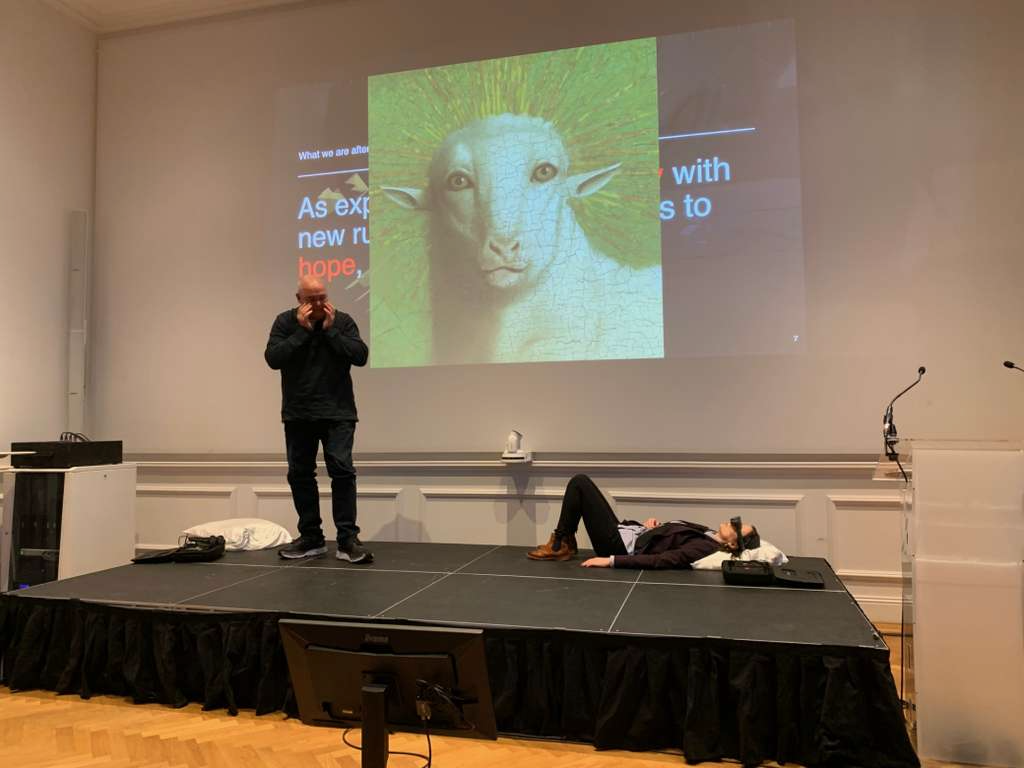
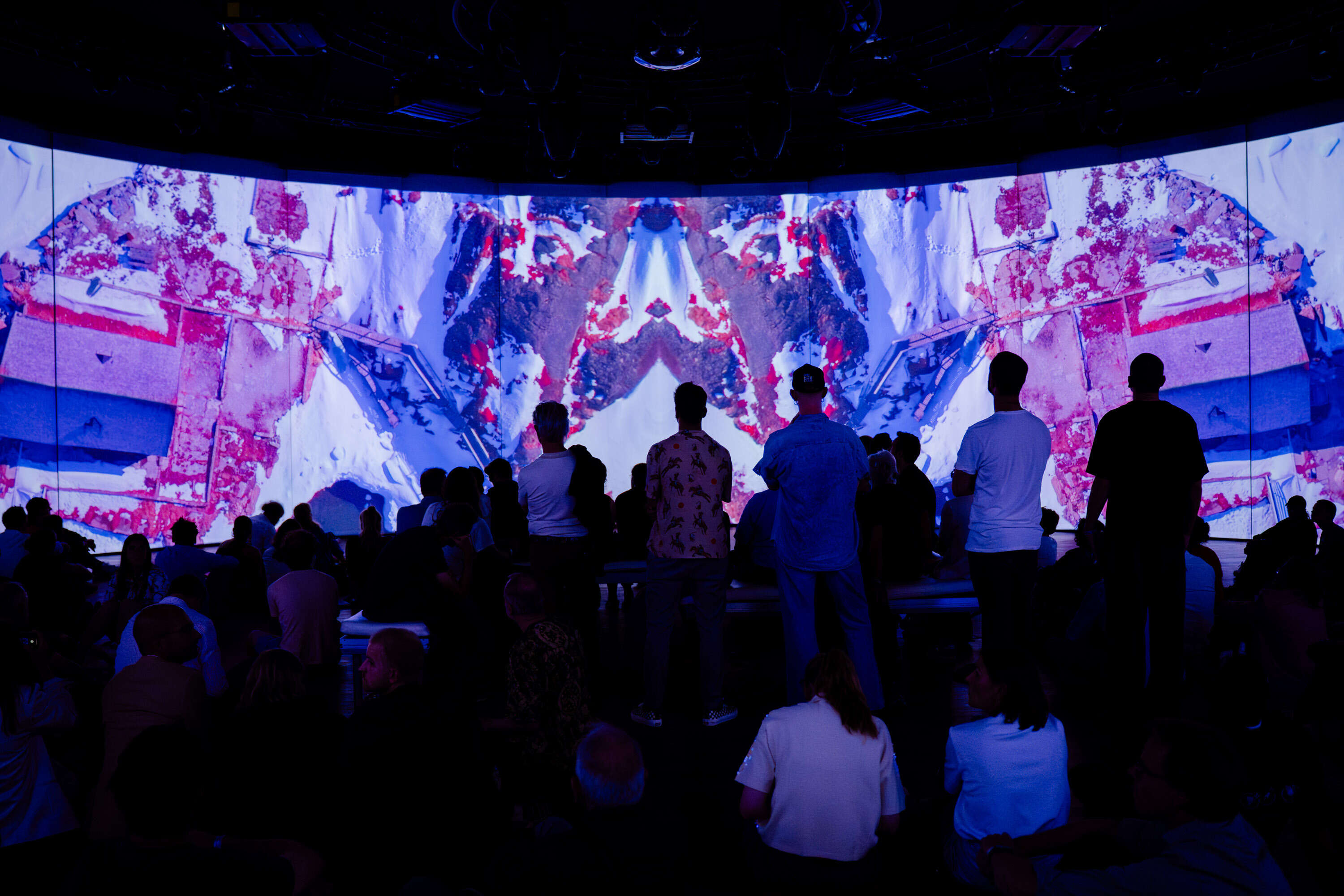
On 9 Dec 2025, Andreea and I gave a “talk” about our journey and lessons learned in creating The Forbidden Question. Rather than a talk, it was a performance about the performance. The talk also includes a speaking lamb from Van Eyck’s famous 1432 Ghent Altarpiece. See the lamb in the video of our talk below. At the end, you will also see a strange character running away with the stolen 12th panel of the Altarpiece.

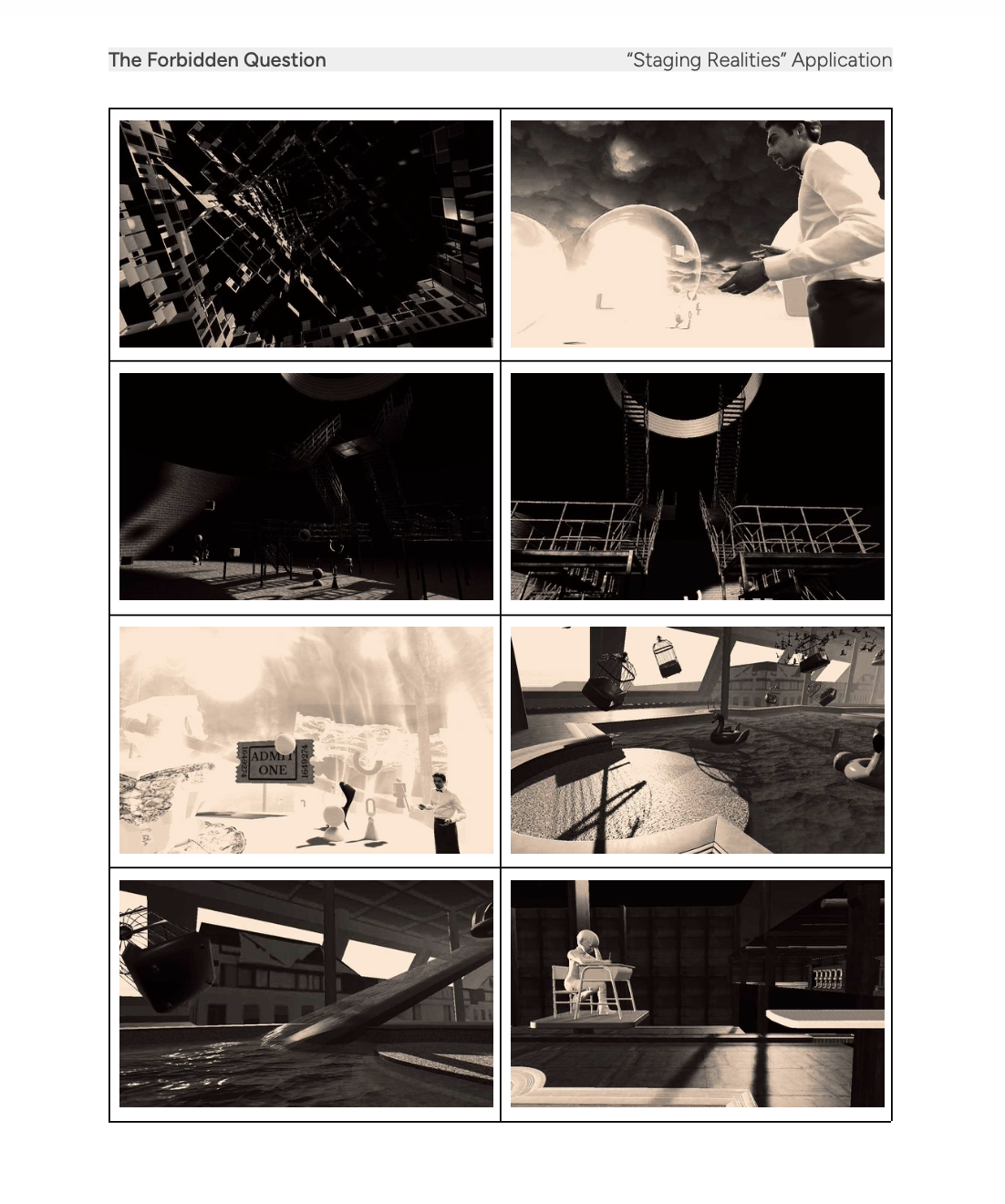
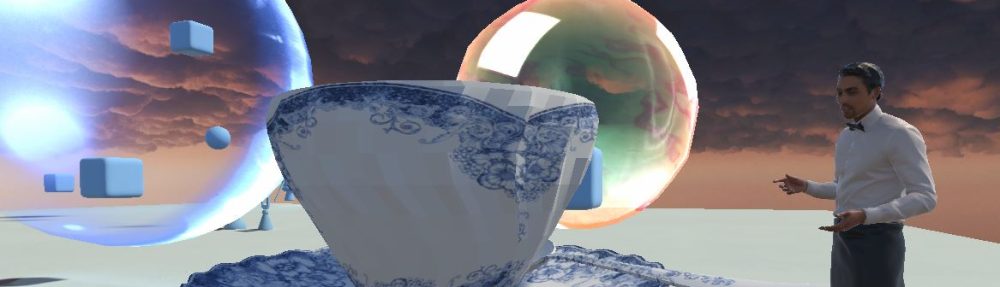
With this piece, we are proposing a choreographed yet spontaneous play between multiple dreams and dreamers. All the actors on stage come from the audience except one: Paul. An Eastern European architect who moved to Brussels in hopes of one day building the city of the future, he has fallen asleep with his shoes on after a long day of waiting tables. This is the moment our universe is born. As participants are encouraged to chase connection and fulfillment, our cosmology cycles their souls and dreams through several layers of reality. The more assiduous the search, the more wondrous and intense the connections they make, the more oblivious and unrelenting the fleeting and cyclical nature of the game becomes. The “forbidden question” in the title is the question no one will ever find an answer to: Whose dream is this? Are my desires really mine? Am I even able to stop wanting?

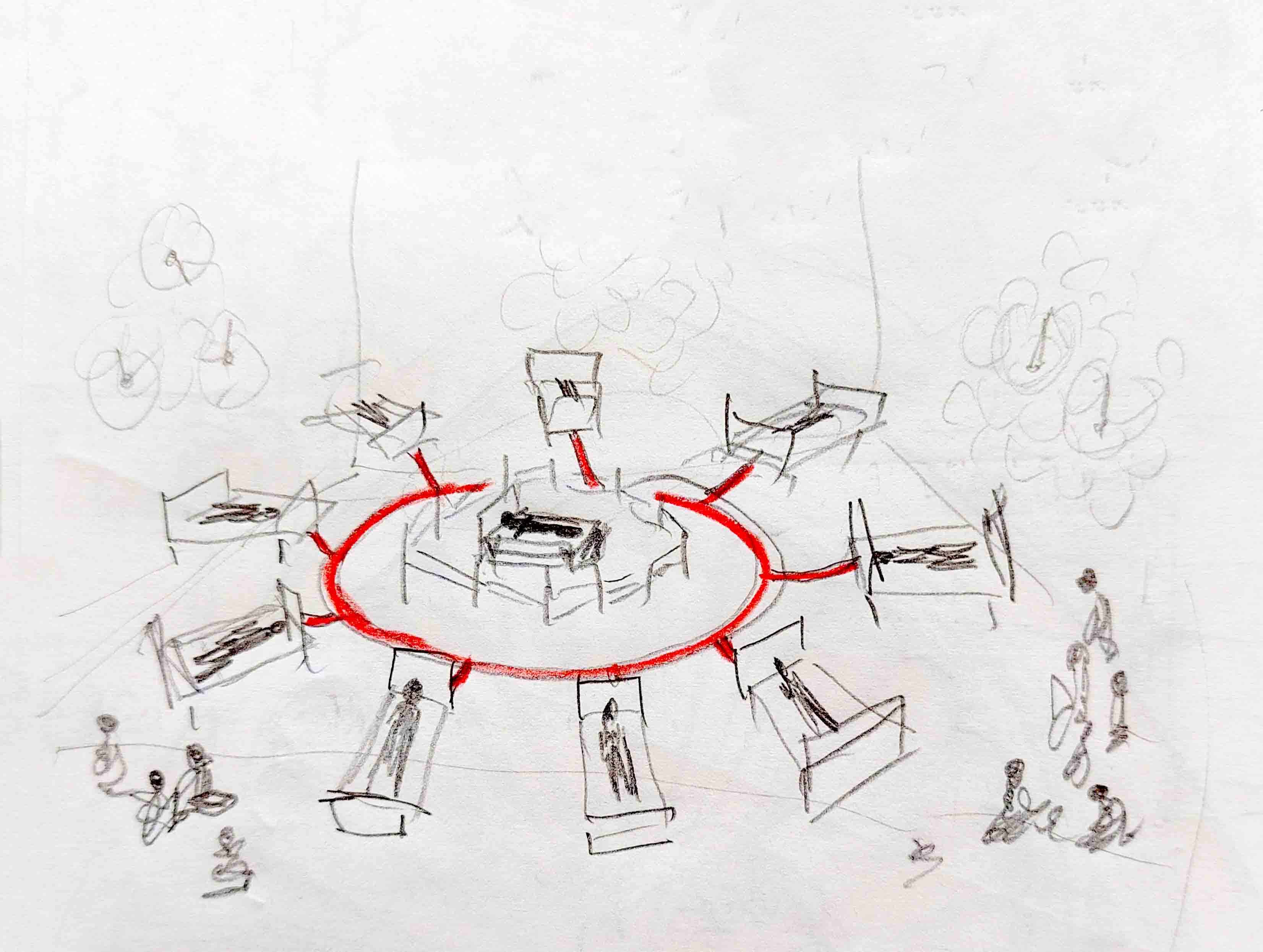
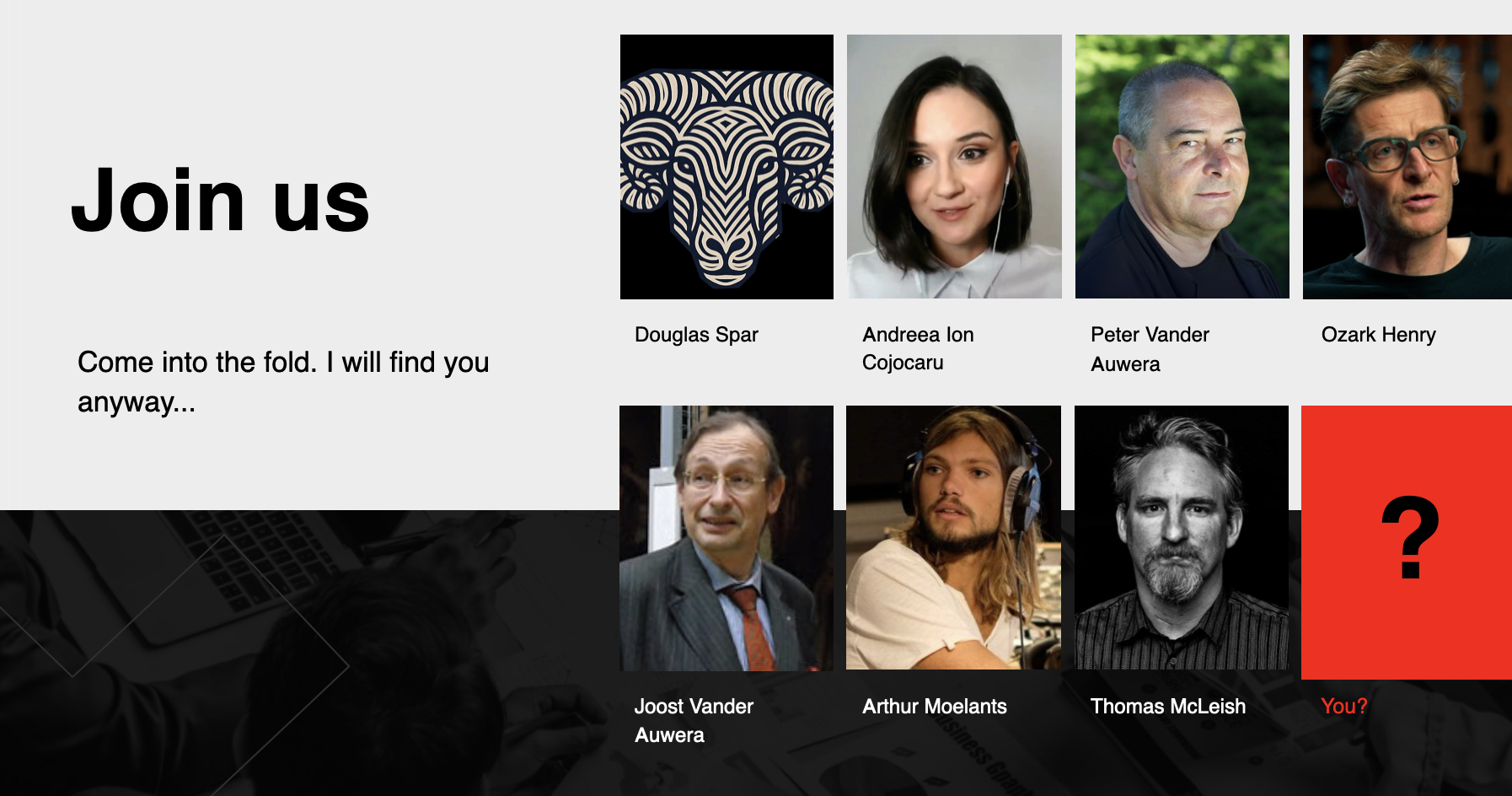
The room is set up with nine physical beds (8 for the audience encircling the one bed for Paul). The performance is designed for a full 360° experience (visuals, audio, tracking), and we work with award-winning 3D artist Ozark Henry, award-winning cinematographer and DoP Arthur Moelants, and award-winning maker Thomas Mc Leish.

I would like to give some background on this project, a sort of making-of. The project started as the New New Babylon performance, at that time designed for a speaker on stage wearing a VR headset, and the audience seeing the VR rendering on a big screen behind the speaker. Here is a very, very early version of the tower of the New New Babylon:

Then, we pivoted to a version called “Dream my Dream”

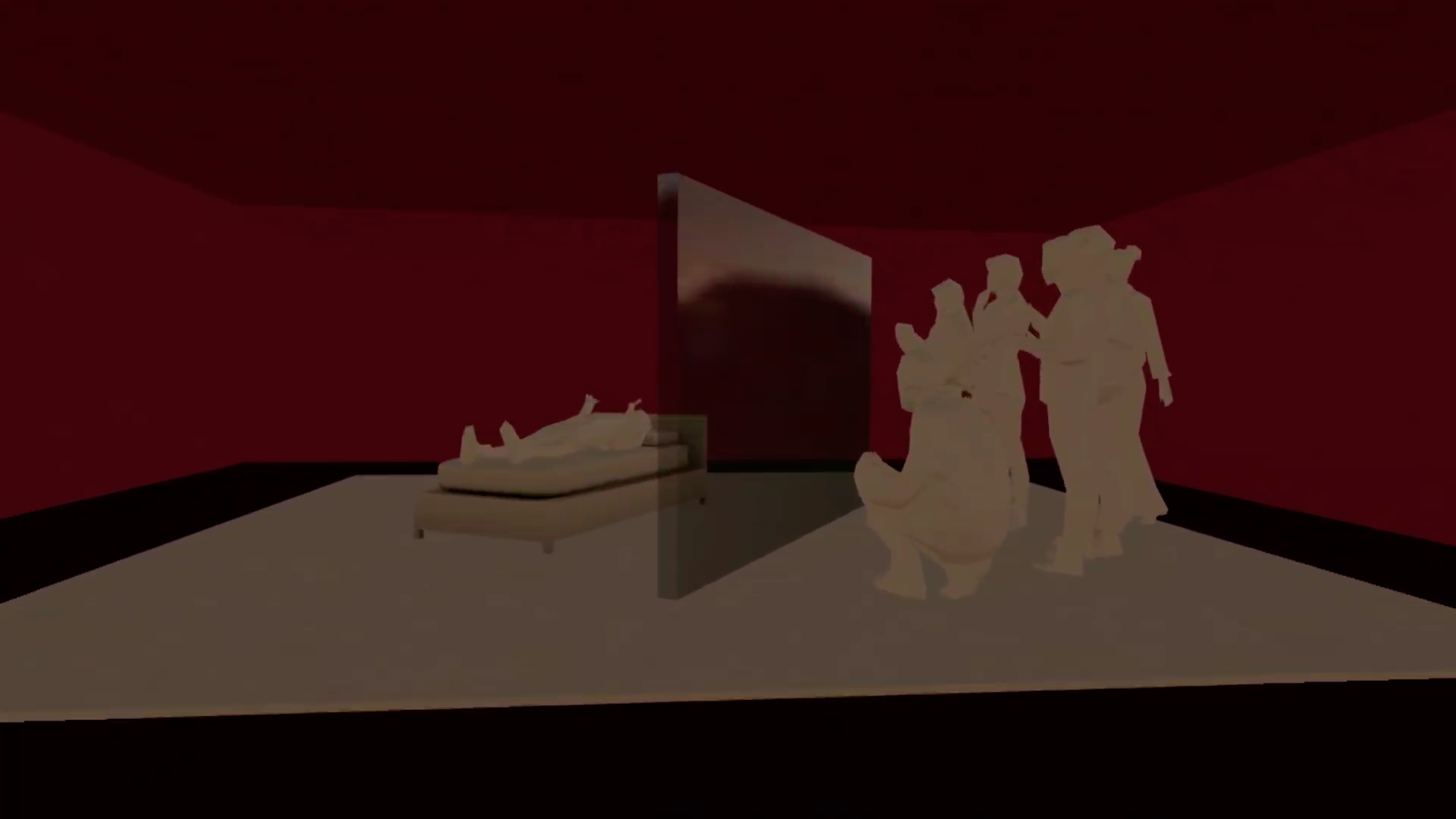
This time, the audience would witness a sleeping performer with a VR headset, and follow the dream through some sort of transparent screen:

Mock-up of the viewing room – created in Space Elevator

After submitting our project to both the Venice Biennale College Cinema and the Cannes Immersive 2025 competition, without being selected, we took the opportunity to critically reevaluate the core premises of the performance.

Then, as part of my end-project for the Howest course XR in Industry, we created a very early version of The Forbidden Question, which began with the story of an Eastern European waiter and the concept of central and surrounding beds. The video below is an early MVP of what we had in mind.

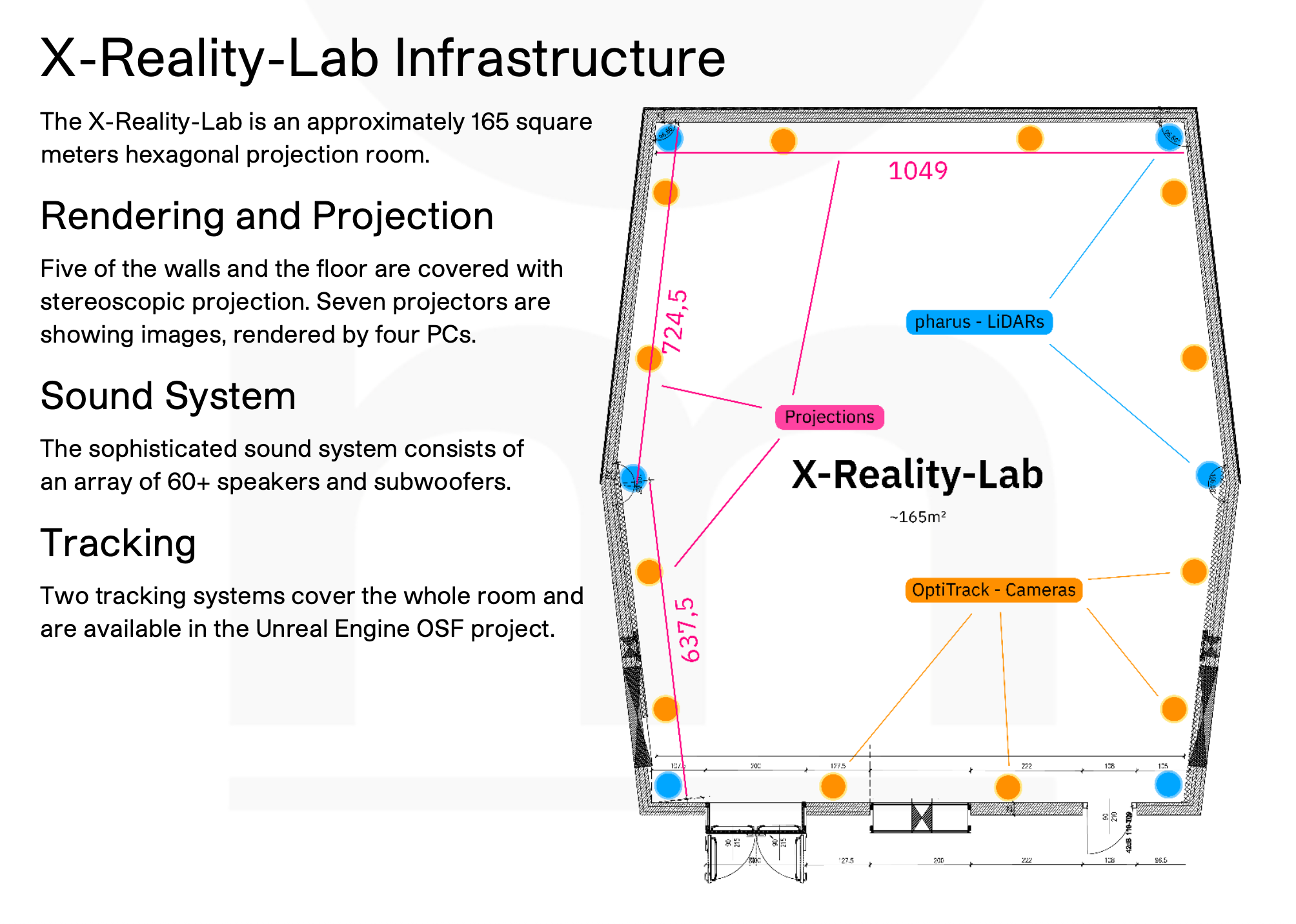
During this period of reassessment, Andreea came across an open call for immersive projects at the Salzburg Mozarteum X-Reality Lab. Salzburg is currently developing a state-of-the-art 360° immersive venue featuring stereoscopic projection, a 60+ channel spatial audio system, and integrated LiDAR and high-definition camera infrastructure. The lab was seeking artistic performances for the venue’s inaugural program, scheduled for March 2026.

High-level sketch of the X-Reality-Lab in Salzburg

For this project, we completely re-wrote the performance into an XR “game of life” unfolding across multiple realities, with both an actor and the audience as performers. From its earliest concept through multiple iterations, the project transformed from a one-person headset performance into an immersive XR experience designed for stereoscopic projection, 3D tracking, and 360° spatial sound. Here is an extract from our submission document. The biggest change was to move the whole New New Babylon narrative from the foreground to the background, and to let the audience experience crossing realities (from dream reality to awake-reality). We made it to the shortlist (out of 150 international candidates), but did not get selected in the end.

Extract from our treatment of the performance for Salzburg

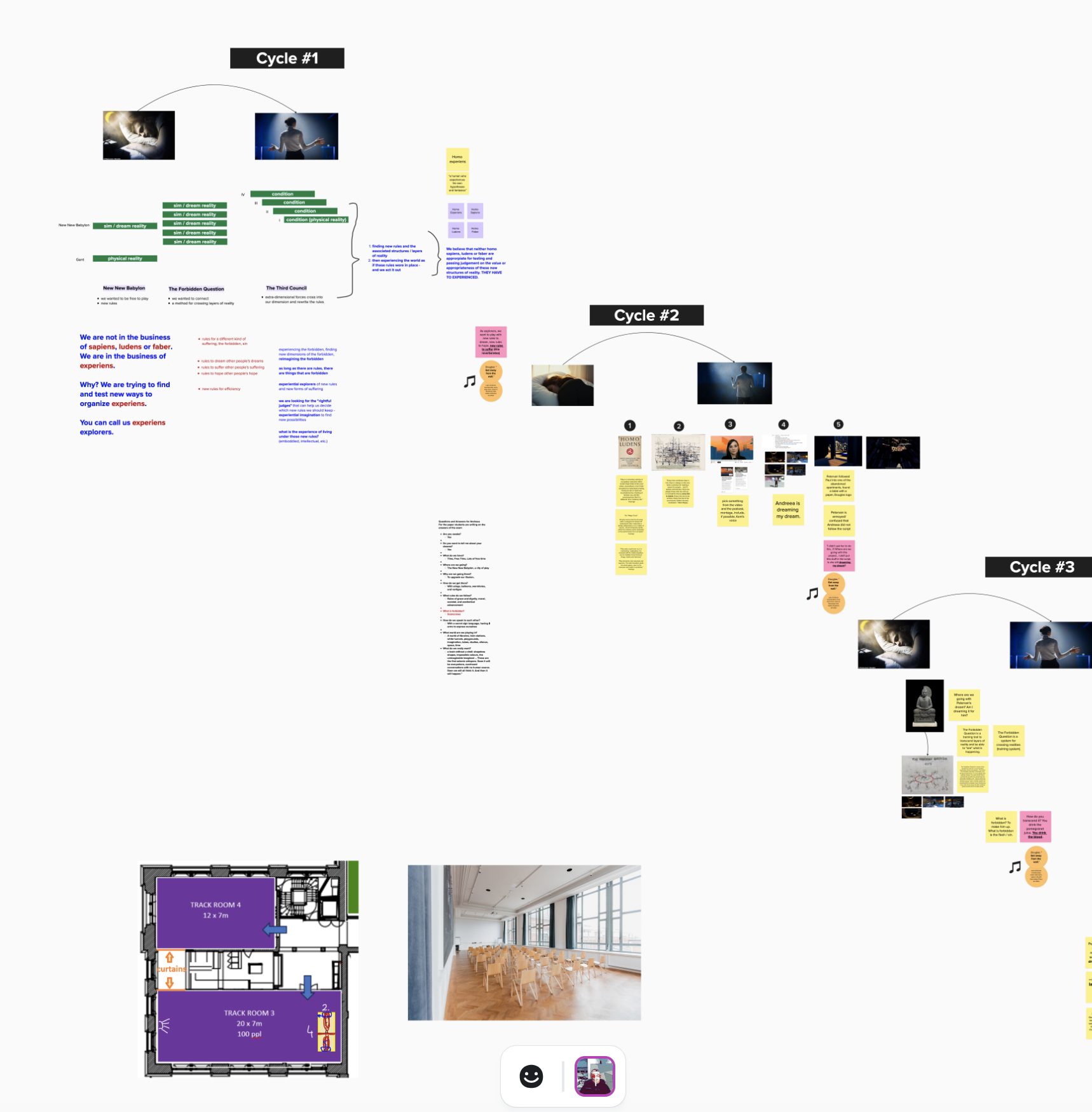
In preparation for our talk at UnitedXR, Andreea and I had many online sessions on the mood and conceptual flow of our presentation (Mural extract below). We wanted to present a coherent journey from New New Babylon to The Forbidden Question to The Third Council.

Mural brainstorm for UnitedXR presentation

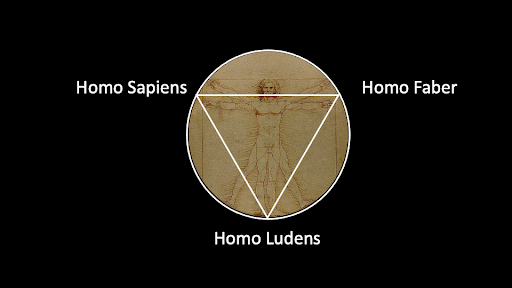
An aha moment emerged during these sessions: neither Homo sapiens, ludens, nor faber is capable of evaluating the validity of these new structures of reality. Their meaning cannot be assessed intellectually—they must be experienced.

Hence Homo Experiens. With an “s” to differentiate from the words “Narrative” and “Experience” that have become catch-all words.

So we like to call ourselves “Experiens Explorers” and “Designed Conspiracy” would better describe what we have in mind. See also https://petervanstudios.com/2025/12/21/the-orphic-experience-we-are-all-argonauts-again/

The Forbidden Question team
Picture from the crime scene at UnitedXR on 9 Dec 2025

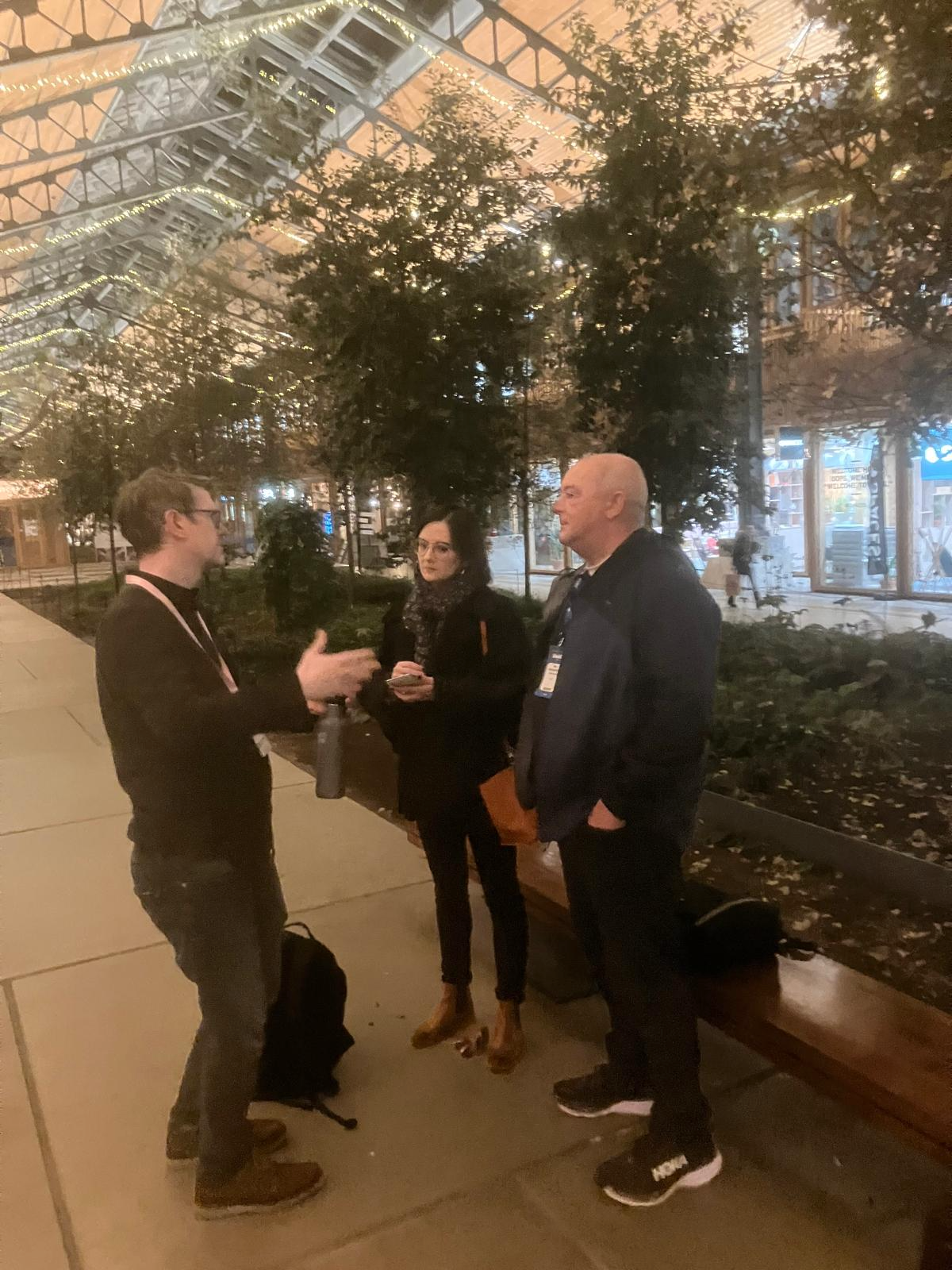
Kent Bye, who runs the Voices of VR Podcast, was in the room, and he invited us for an interview right after (quite an honor, if you ask me). As soon as the interview is published, the link will be added to this post.

Post interview picture. From left to right: Kent Bye, Andreea, Petervan. Picture by Joost.

Use the barcode above to follow the discoveries of Douglas Spar (aka The Holy Lamb). Doug is the one investigating The Third Council. And “The Forbidden Question” is now positioned as a training protocol for crossing realities and the main priority of our team right now.

We are now complementing the team with technology partners to build a pop-up 360 infrastructure for artistic performances. We are contacting immersive spaces to be on their program. We also consider a subsidy for a technology prototype for this immersive performance.

May the lamb be with you in 2026!

With deep gratitude to Andreea, TJ, Arthur, Joost, and Ozark for staying motivated during this whole process. And thanks to UnitedXR for having us.

Petervan’s Delicacies – Nov 2025 > Jan 2026

“Delicacies” is my incoherent, irregular, unpredictable collection of interesting sparks I came across online. Handpicked by a human, no robots, no AI. A form of tripping, wandering, dérivé, with some loosely undefined theme holding them together. Delicacies have no fixed frequency: I hit the publish button when there is enough material. That can be after a week or after 3 months. No pressure, literally. Enjoy!

Some highlights from this edition:

If you prefer the full firehose, check out the Substack link: https://petervan.substack.com/p/petervan-delicacies-182

Petervan’s Ride – December 2025

Petervan’s Musical Ride December 2025 – only 39 songs. As usual, mostly several recent releases, including those by Selah Sue, Tackhead, and Tsar B. Oldies from Chris Rea, Gary Claill, and The Durutti Column. Play in shuffle mode to increase the surprise factor. Enjoy!

The Orphic Experience: We are all Argonauts again

In my post about Dub-Techno artist Adrian Sherwood, I referred to the book “Dub Techno – The Orphic Experience of Sound” by Bahadırhan Koçer to describe my sound experiments with dub.

As promised in that post, the most compelling part of the book appears in its opening chapters, where he introduces “The Orphic Experience.”

The short summary is in the video below, from 0:59 to 2:23. The latter part of the video is about the three key elements of dub-techno: spontaneous repetition, atmosphere, and embracing noise.

TL;DR: The orphic experience uses music to alter perception, evoke deep emotions, and influence the listener’s state of mind. It creates a unique space and time for introspection and reflection.

Let me unpack this in stages: first the “orphic” aspect, then the “experience” element, and finally a synthesis.

Orphic

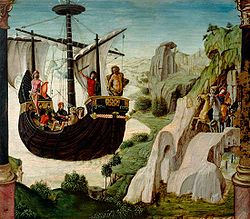
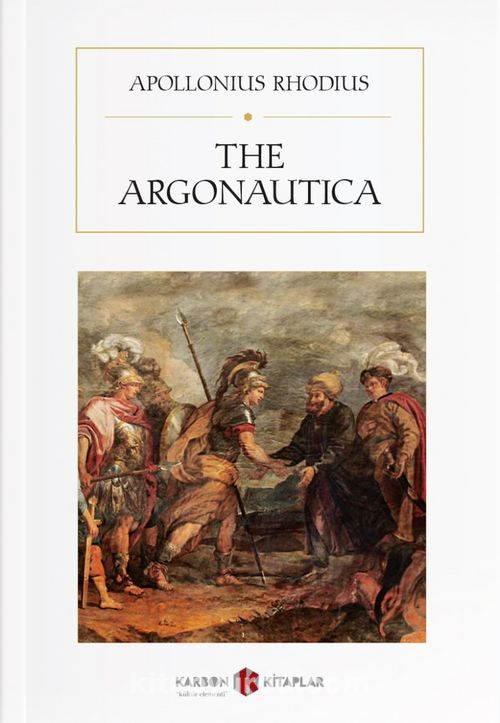
The “orphic” part originates from Orpheus, a character in the ancient Greek poem Argonautica, dating back to the 3rd century BC. The Argonauts are travellers on the boat Argo and are on a quest for the golden fleece. Somewhere along the route, sirens are trying to seduce the boatsmen. Still, Orpheus – a talented singer/musician on the boat – can shield the boatsmen from the Sirens’ temptations through his celestial, beautiful songs and voice. In other words, he was a noise canceller avant la lettre.

Some salient quotes from Bahadırhan Koçer:

The orphic experience, therefore, refers to the transformative way sound and media technologies can be used to control one’s sonic environment, creating a personalized auditory space that shields individuals from the overwhelming stimuli of modern life.

It is conceivable to argue that the nature of this transformation lies fundamentally in a shift from communal to individual listening.

The protected space needed for “sensory and emotional self-care”

In this sense, orphic experience can be seen as a way of escaping from the demands of the real world and constructing a self-contained, artificial reality.

By carefully curating their auditory environment and creating a personalized soundtrack to their lives, the individual can signal their taste and distinction to others, and distinguish themselves from those who do not possess the same level of cultural capital.

The “orphic” concerns the creation of a protected, isolated space in which the rules constraining clear thought can be suspended.

Experience

The second part is about “experience”. The words “Narrative” and “Experience” have become catch-all words. Washed-out. Weak. And they all suggest a passive audience.

Also here, a David Claerbout quote is appropriate:

I think the recent proliferation of black boxes for film and video-art is not just a practical solution to a problem of sound and light interference, but also reflects an incapability to coexist. This can become apparent in large group exhibitions, where media installations appear strong when they are shown by themselves in a small or large dark space, but they easily collapse when shown in a social space where people move about and interact. The black box is a social phenomenon, for me it is a problem.” Ulrichs, David, ‘David Claerbout. Q/A, in: Modern Painters, May 2011, pp. 64-66

“Designed Conspiracy” would be better to describe what I have in mind. With an active audience. Or even better, where there is no stage hosting the expert speaker and no passive audience just leaning back in chairs, incapable of truly internalising knowledge.

I imagine us inside a 360° immersive room: a six-metre-high LED screen, full 360 Dolby Atmos sound, LiDAR tracking, and high-definition cameras—paired with exceptional content and facilitation. A complete experience in a box, ready to tour and deploy anywhere in the world. Am I exaggerating? Maybe not. I’ve just met someone who is building exactly this.

Synthesis

Obviously, I am using all of the above as a metaphor to try to explain what I do with my artistic interventions, provocations, and interruptions. These qualities inform my work/play. Whether that is soundscapes, installations, performances, or group expeditions.

Now that we have our protected, isolated space and a designed conspiracy, it is time to play the music. Music is the content. Content is the music.

Experiencing our music – individually or as part of a group – can feel like a trip, a trance, like digital psychedelics.

The music/content is presented in the right space, with the appropriate emotional and psychological atmosphere—the backdrop, if you will—inviting and sustaining safety, interest, curiosity, awe, and growth.

The rhythm is softer, slower, quieter vs. harder, faster, louder.

We embrace – and even design – flaws and imperfections, spontaneous repetition, and noise, inviting the participants to connect with being human, and to internalise the content at an embodied level of sensory experience.

We design with fifty shades of sophistication: avant-garde activism shaped by counterculture, driven by intention and direction. We build a relational infrastructure capable of holding shared ambitions, carrying a map as a symbol of movement, of becoming. These are maps that make meaning—shifting the question from the adolescent “Where are we going?” to the more deliberate “What direction do we want?”

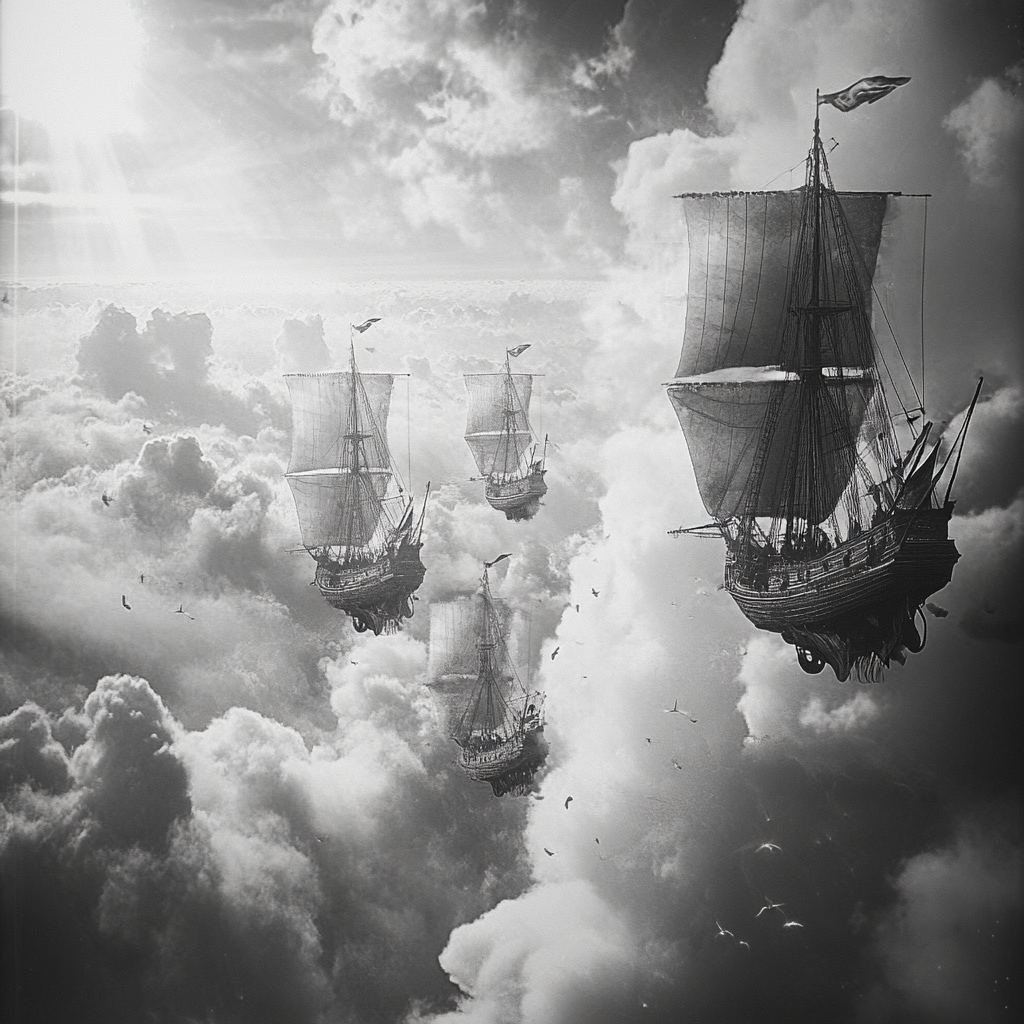
We are all Argonauts again. We are experiens-explorers. We want to create the right spaces and conditions for debating the new rules and the associated structures of reality, then acting them out as if those rules were in place. As explorers, we want to play with new rules to dream, new rules to hope, but also – not to sound too cheesy or utopian – new rules to suffer and cope with what is evil and sin. In that sense, we become all part of a shared conspiracy.

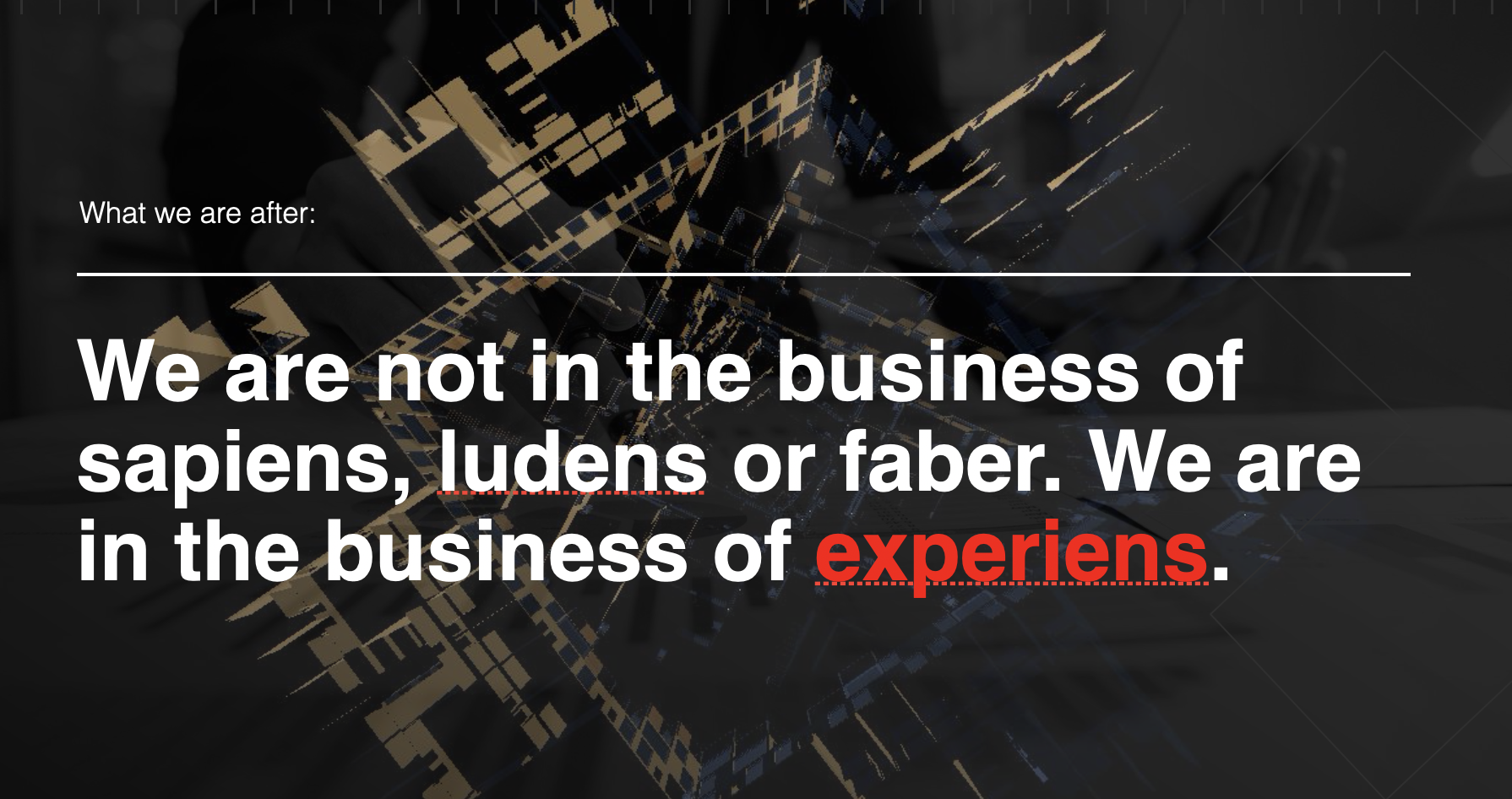
We are not in the business of homo sapiens, ludens, or faber, but in the business of homo experiens.

With thanks to my co-conspirators Josie and Andreea, for challenging me over and over again

Petervan’s Delicacies – November 2025

“Delicacies” is my incoherent, irregular, unpredictable collection of interesting sparks I came across online. Handpicked by a human, no robots, no AI. A form of tripping, wandering, dérivé, with some loosely undefined theme holding them together. Delicacies have no fixed frequency: I hit the publish button when there is enough material. That can be after a week or after 3 months. No pressure, literally. Enjoy!

Some highlights from this edition:

If you prefer the full firehose, check out the Substack link: https://petervan.substack.com/p/petervan-delicacies-181

Petervan’s Ride – November 2025

Petervan’s Musical Ride November 2025 – 60+ songs. As usual, mostly several recent releases, including those by Rosalia, Portland, and Ozark Henry. Oldies from Toni Di Bart, Jimmy Cliff, and Brutus. Play in shuffle mode to increase the surprise factor. Enjoy!

The Weak Image Speaks

The camera—
that profoundly liberal invention—
whispers:

I’m ready for anything.
Give me chemicals, give me a little light,
give me time and no shaking,
and I will be done.

A pocket-sized Enlightenment,
believing every world is reachable,
every surface printable,
every body open to possibility.

And now generative machines produce punctum—
yes, Barthes’ punctum—
the involuntary meaning that slips through
the cracks of intention.
Not planned by the author,
nor by the algorithm,
but arriving later,
after you’ve slept on it,
after the dopamine subsides.
Fast food for intellectual minds,
rewarding at first bite,
quickly stale.
You return in the morning and mutter:
It was not that great after all.

Style appears.
Style overload.
Those who lack craft run toward it—
high, abstract, fast—
while you work the old way,
learning the hand,
the long path,
refusing to choose sides.

Spend time with it—
real duration—
and you’ll see how expensive time has become.
Only unproductive duration is free.
Yet we abandoned that when we entered the cinema,
trading mobility for the promise of instant return.
No one waits for tomorrow in a theater.
In a museum, though—
time’s ticking clock can’t be heard.
There we look forward to looking back.

And somewhere in this,
the black box—
practical, yes,
but also a symptom
of our incapacity to coexist.
The dark room becomes a social problem,
a refusal of interference,
a denial of shared space.

Everything becomes a question of time,
of how little we have left,
of how duration is mined
like ore.

Growing old treated as disease,
dementia as enemy,
while software dreams
of pure disembodiment—
young, innocent, clean.

And yet—
beneath all this—
you remind us:
we are bifocal,
split,
never individuals.
We are believers,
especially visually.

The camera says:
I’m ready for anything.

But the eye says:
I am not a camera.

And the brain says:
I choose no side.

And the forest says:
Take your time.

And the weak image
whispers from the periphery:
Here is the non-event—
stay long enough, and you may hear it breathe.

+++

The text above is an artistic experiment inspired by the insights David Claerbout shared in his presentation Reclaiming Our Agency and in BIRDSONG, the publication accompanying the premiere of The Woodcarver and the Forest at the Castle of Gaasbeek in August 2025.

I first edited the full transcript from the presentation, and then OCR scanned text ‘The Time Spent” from the BIRDSONG book. Then I made a personal selection of the sentences that resonated with me. Then I gave that to ChatGPT and asked it to condense all this into a 1000-word poem, then 500 words, then 100 words. Then again, I made a personal selection of the best GPT snippets. And further edited them to my personal (un)taste.

Petervan’s Delicacies – October 2025

“Delicacies” is my incoherent, irregular, unpredictable collection of interesting sparks I came across online. Handpicked by a human, no robots, no AI. A form of tripping, wandering, dérivé, with some loosely undefined theme holding them together. Delicacies have no fixed frequency: I hit the publish button when there is enough material. That can be after a week or after 3 months. No pressure, literally. Enjoy!

Some highlights from this edition:

If you prefer the full firehose, check out the Substack link: https://petervan.substack.com/p/petervan-delicacies-180

Petervan’s Ride – October 2025

Petervan’s Musical Ride October 2025 – 40+ songs. As usual, we have a lot of recent releases, including The Charlatans, Monza, and Brandi Carlile. Oldies from Rhythm & Sound, Patti Smith, and Norman Greenbaum. Play in shuffle mode to increase the surprise factor. Enjoy!

Inspiration: Adrian Sherwood

Adrian Sherwood behind the mixing console

As already mentioned in my September 2025 Delicacies, I got a crush on the latest album by “Mister Dub” Adrian Sherwood, and went down the Dub Techno rabbit hole.

From the review in De Standaard newspaper (Google Translate and highlights by myself):

“With his label On-U Sound, Adrian Sherwood has created a unique musical universe over the past half century, rooted in Jamaican dub but with tentacles reaching out to punk, funk, and psychedelia, peppered with samples, echoes, and sound effects. His new album features only one track with a recognizable reggae rhythm; the others are driven by slow bass lines and stimulating drum patterns. Many of these tracks are played by real musicians, just like the cinematic fragments of flute, saxophone, organ, cello, trumpet, percussion, piano, Roland 60, and harmonica (“Spaghetti Best Western” exudes Ennio Morricone). Sherwood can call upon a host of loyal musicians (including Brian Eno and hip-hop legends Doug Wimbish and Keith LeBlanc) who add color and human warmth to his boundless imagination as a studio wizard. In an interview, Sherwood did admit that this was the first time he’d used AI to create a record. It seems like a logical evolution for a man who has spent his life innovating and experimenting with new equipment. (km in The Standaard)

Here is some older material from Adrian Sherwood. Watch his body language while performing 😉

And the song “Trapped Here” from his previous album, Survival & Resistance

The album comes with a beautiful cover (designed by Peter Harris). The cover and the album’s atmosphere remind me of Rustin Man’s 2020 album ClockDust (I wrote a post about that one in 2020). It’s no surprise: after playing bass in a local reggae band in Southend, Rustin Man (Paul Webb) and his schoolmate, drummer Lee Harris, went on to form the rhythm section and become founding members of Talk Talk, alongside the exceptionally talented Mark Hollis and Simon Brenner.

The covers of Adrian Sherwood and Rustin Man respectively

So the starting point is dub reggae, which these days has evolved into a genre called “Dub Techno”. There is something melancholic about both albums, in sound, lyrics, artwork, and, at times, kinky living.

I don’t have real musicians available in my studio, and I’m hesitant to rely on AI. I’ve experimented with AI-generated music before, but it doesn’t bring me the same joy or sense of satisfaction as creating it myself. So I started studying and exploring the Dub Techno style, and found this book, “Dub Techno – The Orphic Experience of Sound” by Bahadırhan Koçer.

I will write another blog on the topic of “Orphic Experience”, but today, we focus on the music analysis part.

On page 56, Koçer begins discussing the concept of the riddim—Jamaican patois for “rhythm”—first examining drum patterns, and later turning to bass lines and melodic structures.

From the Bahadırhan Koçer book

I started implementing them into Ableton Live. Here is an example of the “stepper” variant on a 64 Pads Dub Techno Kit.

Ableton Live 12.1 implementation “Stepper” by the author

That was easy. Then I tried to build a song using other out-of-the-box and/or free devices, clips, and samples in Ableton Live 12.1 and Logic Pro 11.2.2 (btw, the new bass and keyboard session-players, and the new studio piano and studio bass in Logic are amazing).

The new Studio Bass in Logic Pro 11.2

Creating a song was more of a challenge. What Adrian Sherwood and his real musicians were doing was not so simple after all. Although all the individual clips sounded simple, the art is in being subtle and sophisticated in launching clips and echo/delay effects.

As with writing, the real effort lay in removing the superfluous rather than adding more to the mix. Still, to make it a bit more my own, I included a few AI voice clips from the New New Babylon performance.

Short experiment by the author

But I am an amateur/bricoleur after all. No way I will ever get close to Adrian Sherwood and his musicians, at least not as a musician. But maybe in real life? Adrian and the band are touring North America and Europe in 1Q 2026. They will perform in Wintercircus Ghent on 6 Feb 2026. See/hear you there?