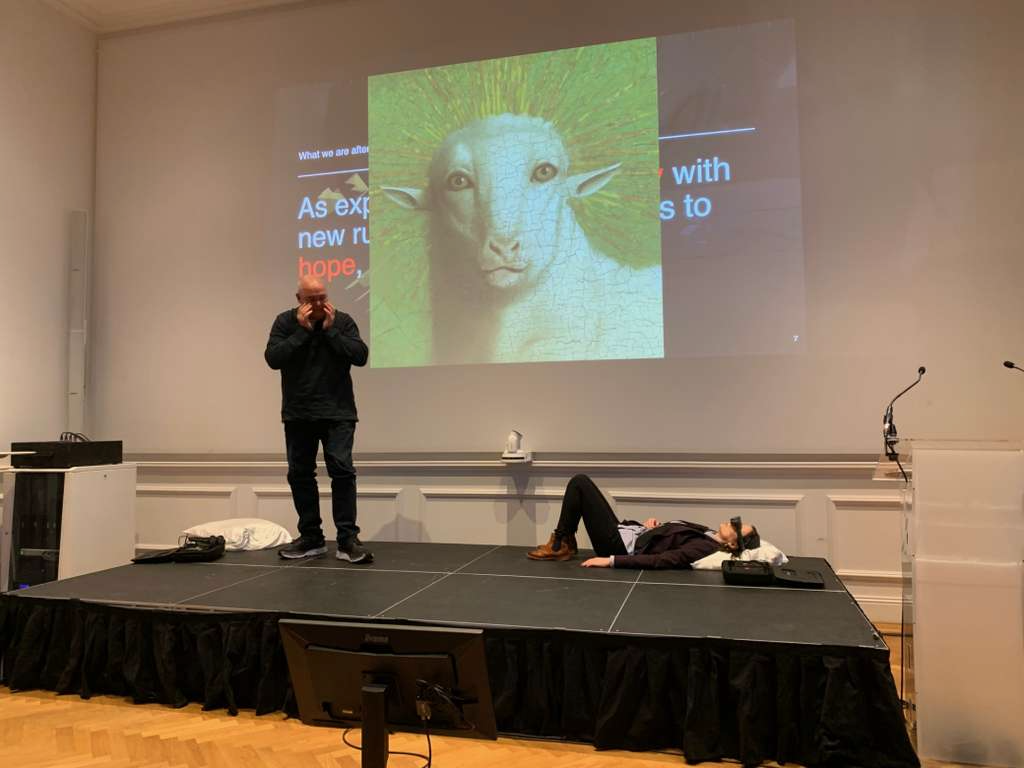
On 9 Dec 2025, Andreea and I gave a “talk” about our journey and lessons learned in creating The Forbidden Question. Rather than a talk, it was a performance about the performance. The talk also includes a speaking lamb from Van Eyck’s famous 1432 Ghent Altarpiece. See the lamb in the video of our talk below. At the end, you will also see a strange character running away with the stolen 12th panel of the Altarpiece.
With this piece, we are proposing a choreographed yet spontaneous play between multiple dreams and dreamers. All the actors on stage come from the audience except one: Paul. An Eastern European architect who moved to Brussels in hopes of one day building the city of the future, he has fallen asleep with his shoes on after a long day of waiting tables. This is the moment our universe is born. As participants are encouraged to chase connection and fulfillment, our cosmology cycles their souls and dreams through several layers of reality. The more assiduous the search, the more wondrous and intense the connections they make, the more oblivious and unrelenting the fleeting and cyclical nature of the game becomes. The “forbidden question” in the title is the question no one will ever find an answer to: Whose dream is this? Are my desires really mine? Am I even able to stop wanting?
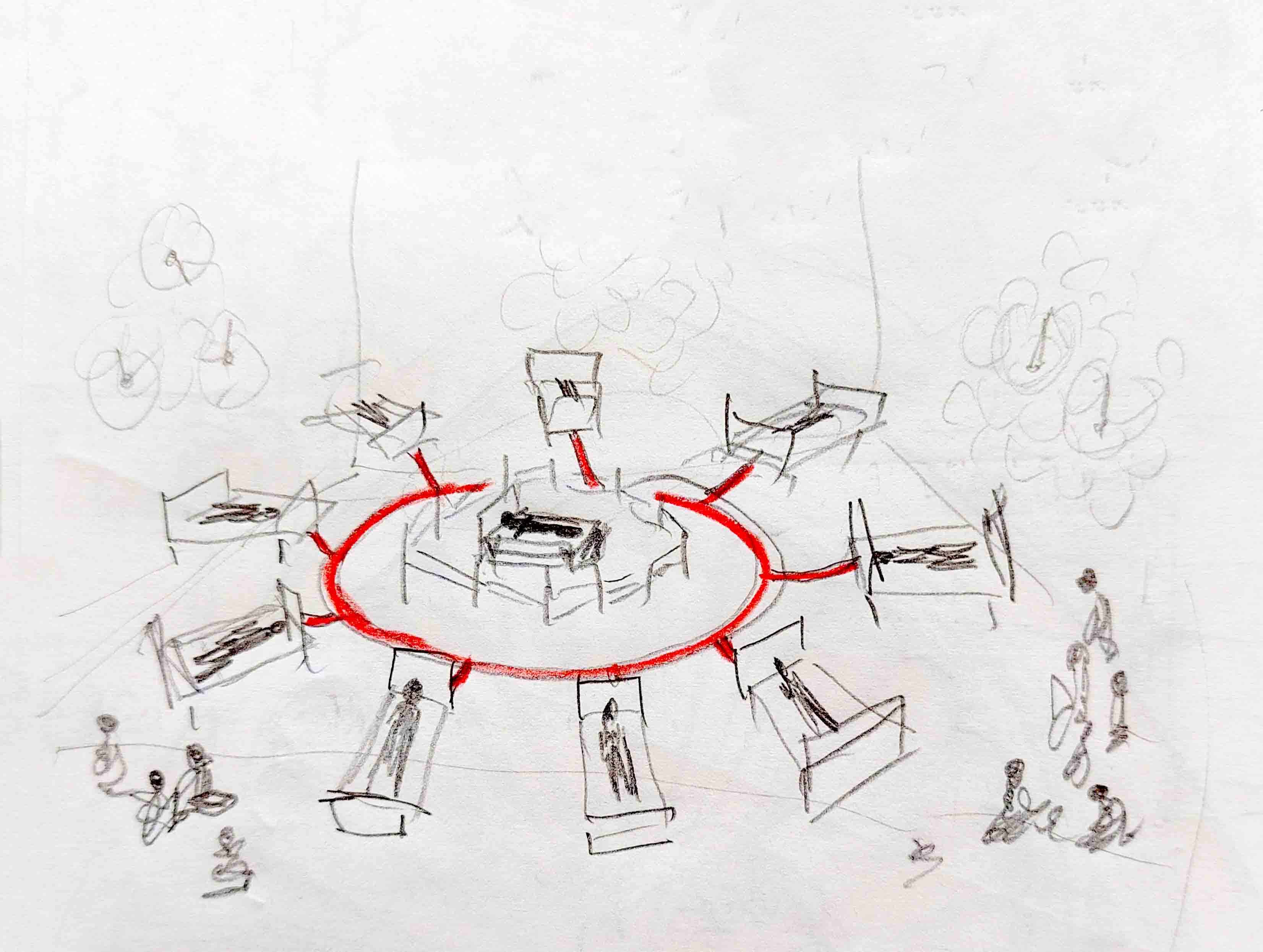
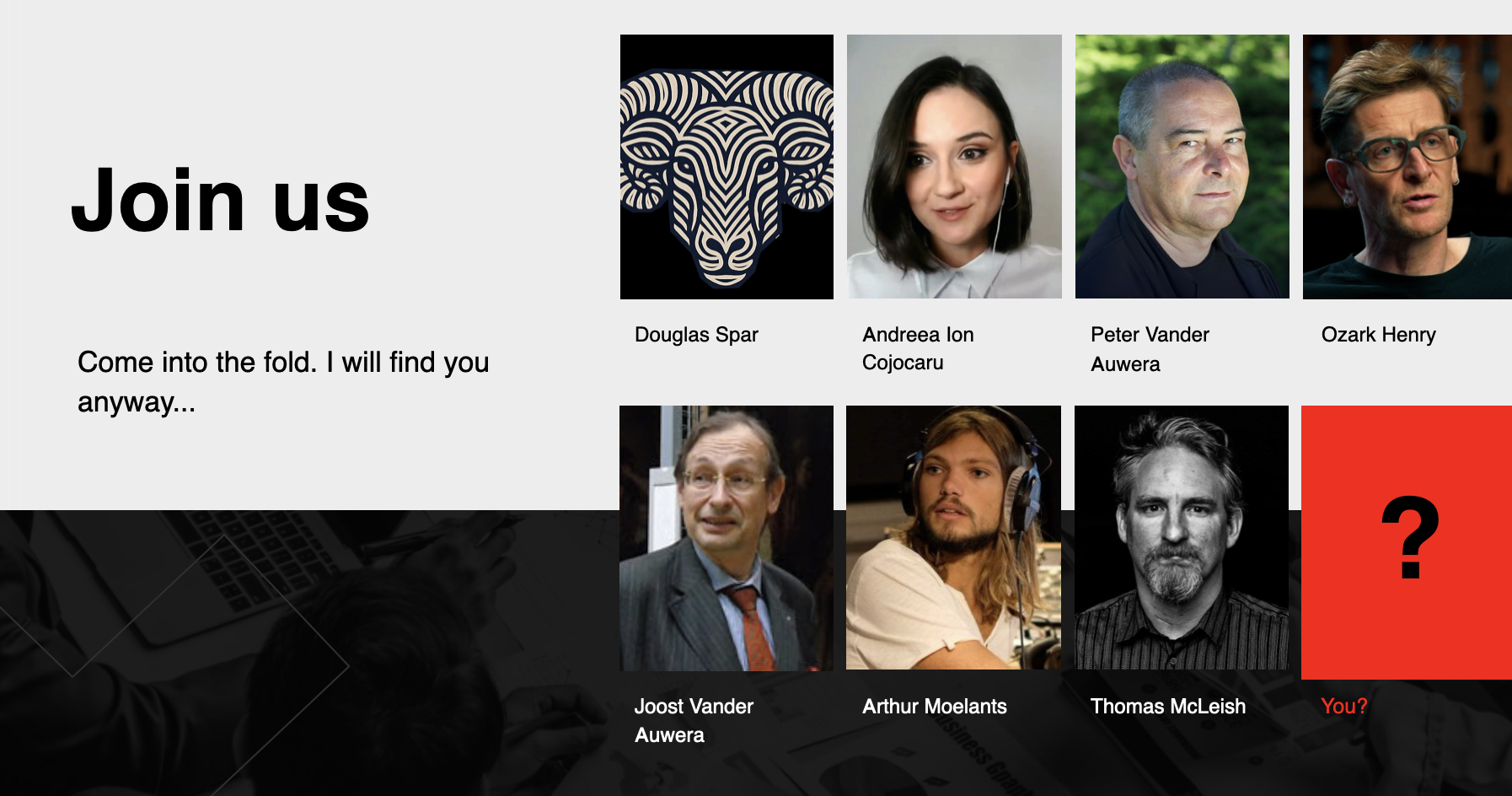
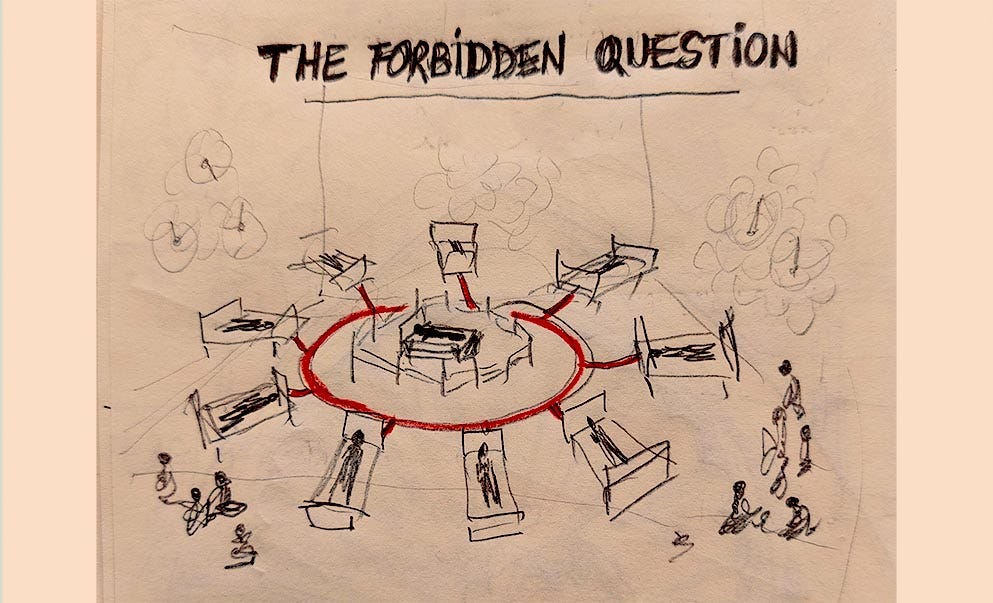
The room is set up with nine physical beds (8 for the audience encircling the one bed for Paul). The performance is designed for a full 360° experience (visuals, audio, tracking), and we work with award-winning 3D artist Ozark Henry, award-winning cinematographer and DoP Arthur Moelants, and award-winning maker Thomas Mc Leish.
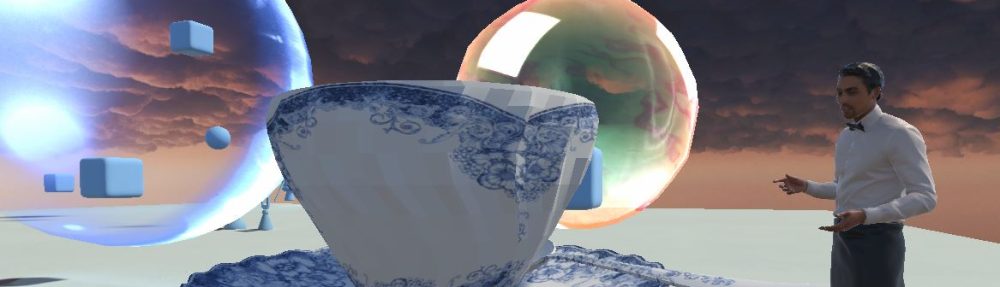
I would like to give some background on this project, a sort of making-of. The project started as the New New Babylon performance, at that time designed for a speaker on stage wearing a VR headset, and the audience seeing the VR rendering on a big screen behind the speaker. Here is a very, very early version of the tower of the New New Babylon:
Then, we pivoted to a version called “Dream my Dream”
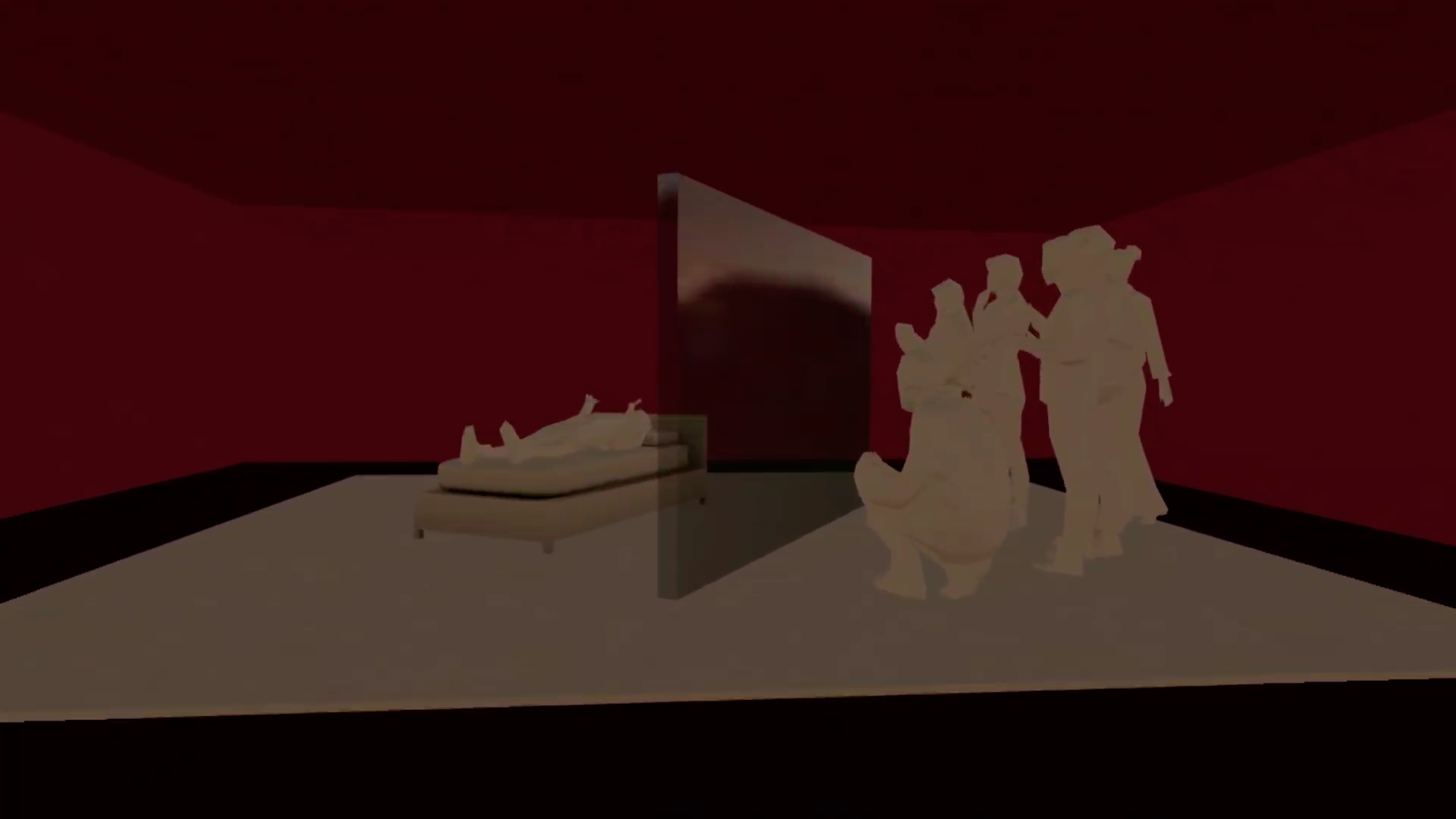
This time, the audience would witness a sleeping performer with a VR headset, and follow the dream through some sort of transparent screen:
Mock-up of the viewing room – created in Space Elevator
After submitting our project to both the Venice Biennale College Cinema and the Cannes Immersive 2025 competition, without being selected, we took the opportunity to critically reevaluate the core premises of the performance.
Then, as part of my end-project for the Howest course XR in Industry, we created a very early version of The Forbidden Question, which began with the story of an Eastern European waiter and the concept of central and surrounding beds. The video below is an early MVP of what we had in mind.
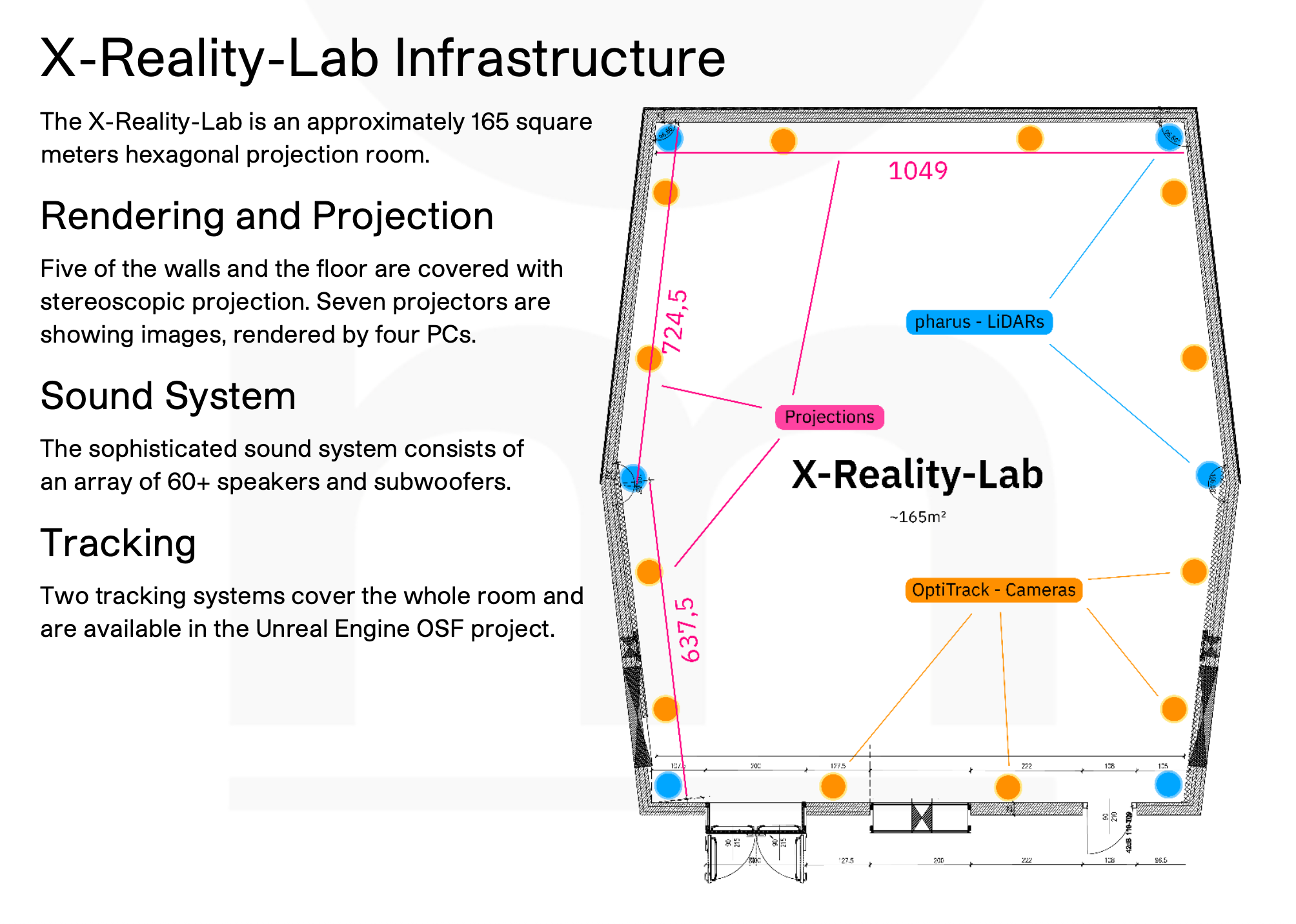
During this period of reassessment, Andreea came across an open call for immersive projects at the Salzburg Mozarteum X-Reality Lab. Salzburg is currently developing a state-of-the-art 360° immersive venue featuring stereoscopic projection, a 60+ channel spatial audio system, and integrated LiDAR and high-definition camera infrastructure. The lab was seeking artistic performances for the venue’s inaugural program, scheduled for March 2026.
High-level sketch of the X-Reality-Lab in Salzburg
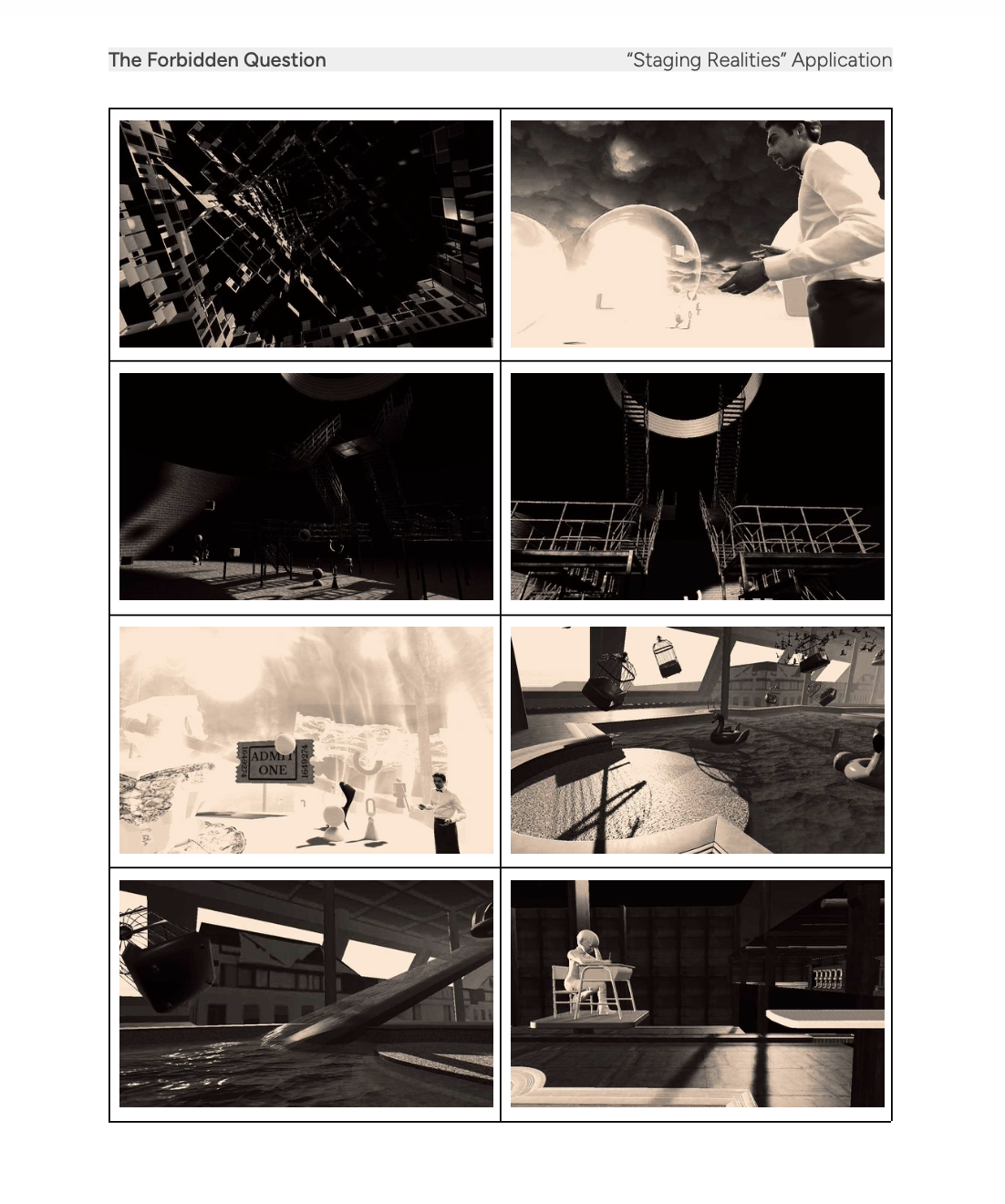
For this project, we completely re-wrote the performance into an XR “game of life” unfolding across multiple realities, with both an actor and the audience as performers. From its earliest concept through multiple iterations, the project transformed from a one-person headset performance into an immersive XR experience designed for stereoscopic projection, 3D tracking, and 360° spatial sound. Here is an extract from our submission document. The biggest change was to move the whole New New Babylon narrative from the foreground to the background, and to let the audience experience crossing realities (from dream reality to awake-reality). We made it to the shortlist (out of 150 international candidates), but did not get selected in the end.
Extract from our treatment of the performance for Salzburg
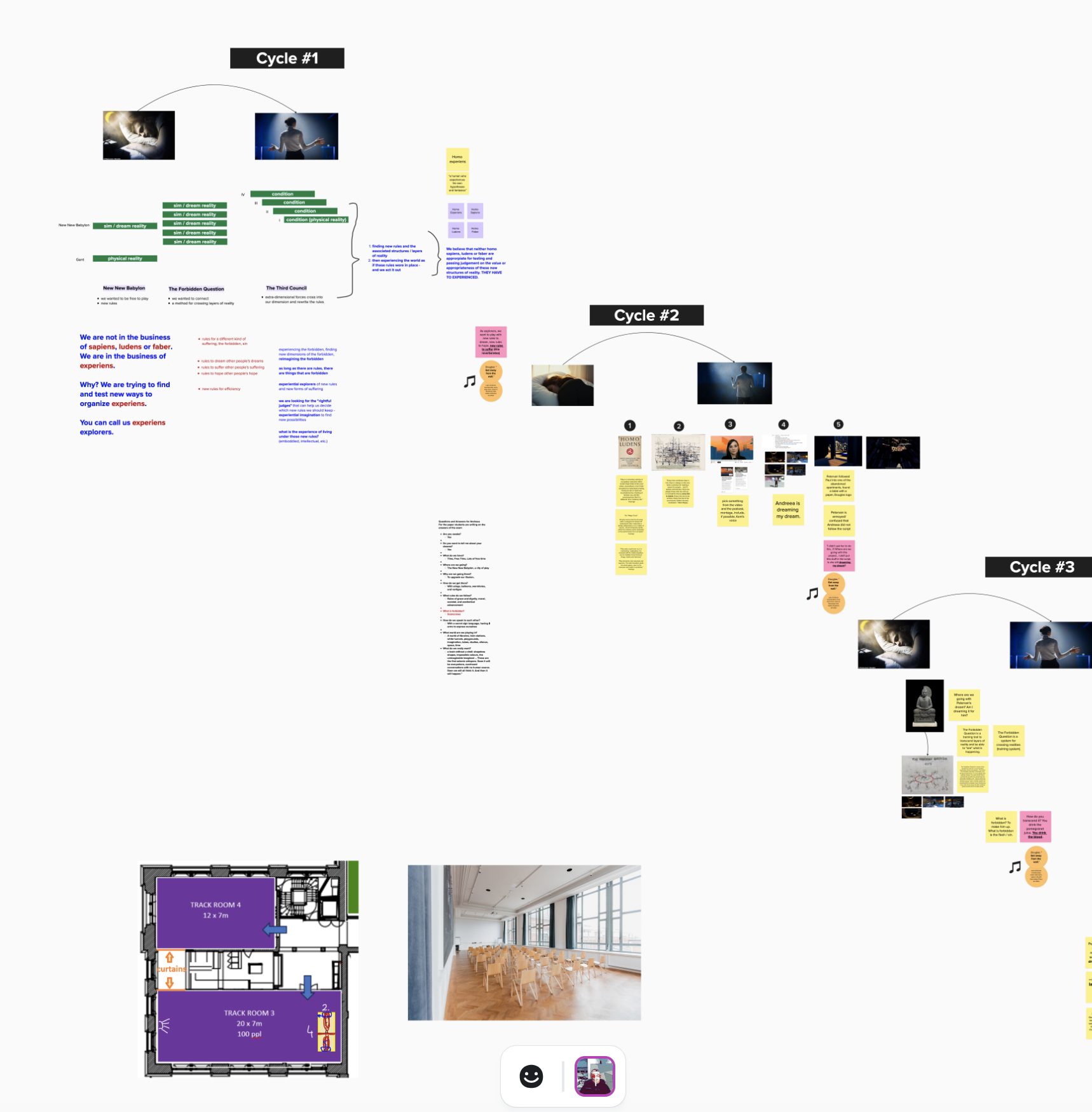
In preparation for our talk at UnitedXR, Andreea and I had many online sessions on the mood and conceptual flow of our presentation (Mural extract below). We wanted to present a coherent journey from New New Babylon to The Forbidden Question to The Third Council.
Mural brainstorm for UnitedXR presentation
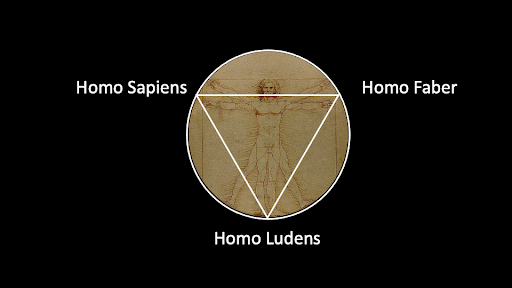
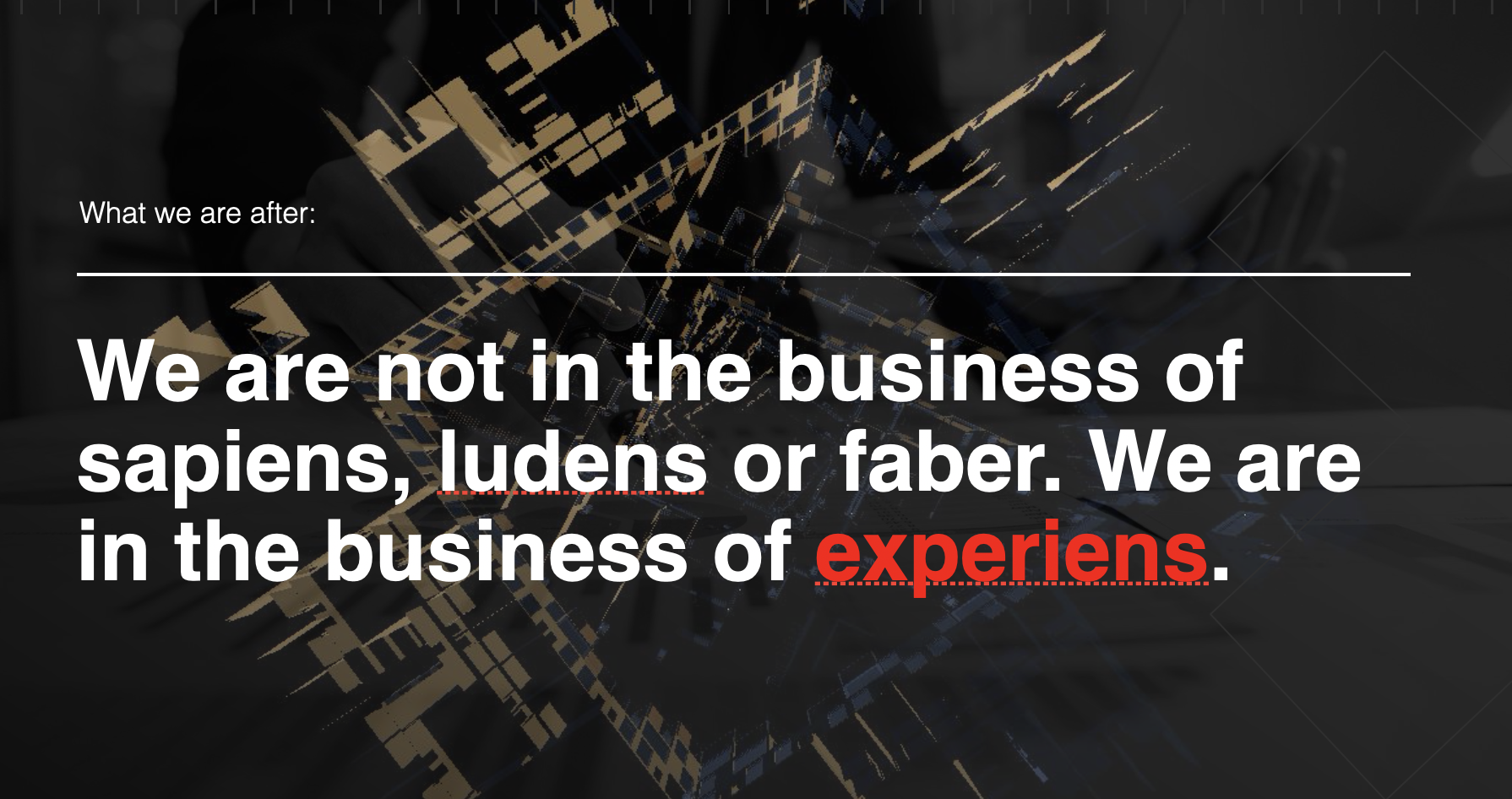
An aha moment emerged during these sessions: neither Homo sapiens, ludens, nor faber is capable of evaluating the validity of these new structures of reality. Their meaning cannot be assessed intellectually—they must be experienced.
Hence Homo Experiens. With an “s” to differentiate from the words “Narrative” and “Experience” that have become catch-all words.
The Forbidden Question teamPicture from the crime scene at UnitedXR on 9 Dec 2025
Kent Bye, who runs the Voices of VR Podcast, was in the room, and he invited us for an interview right after (quite an honor, if you ask me). As soon as the interview is published, the link will be added to this post.
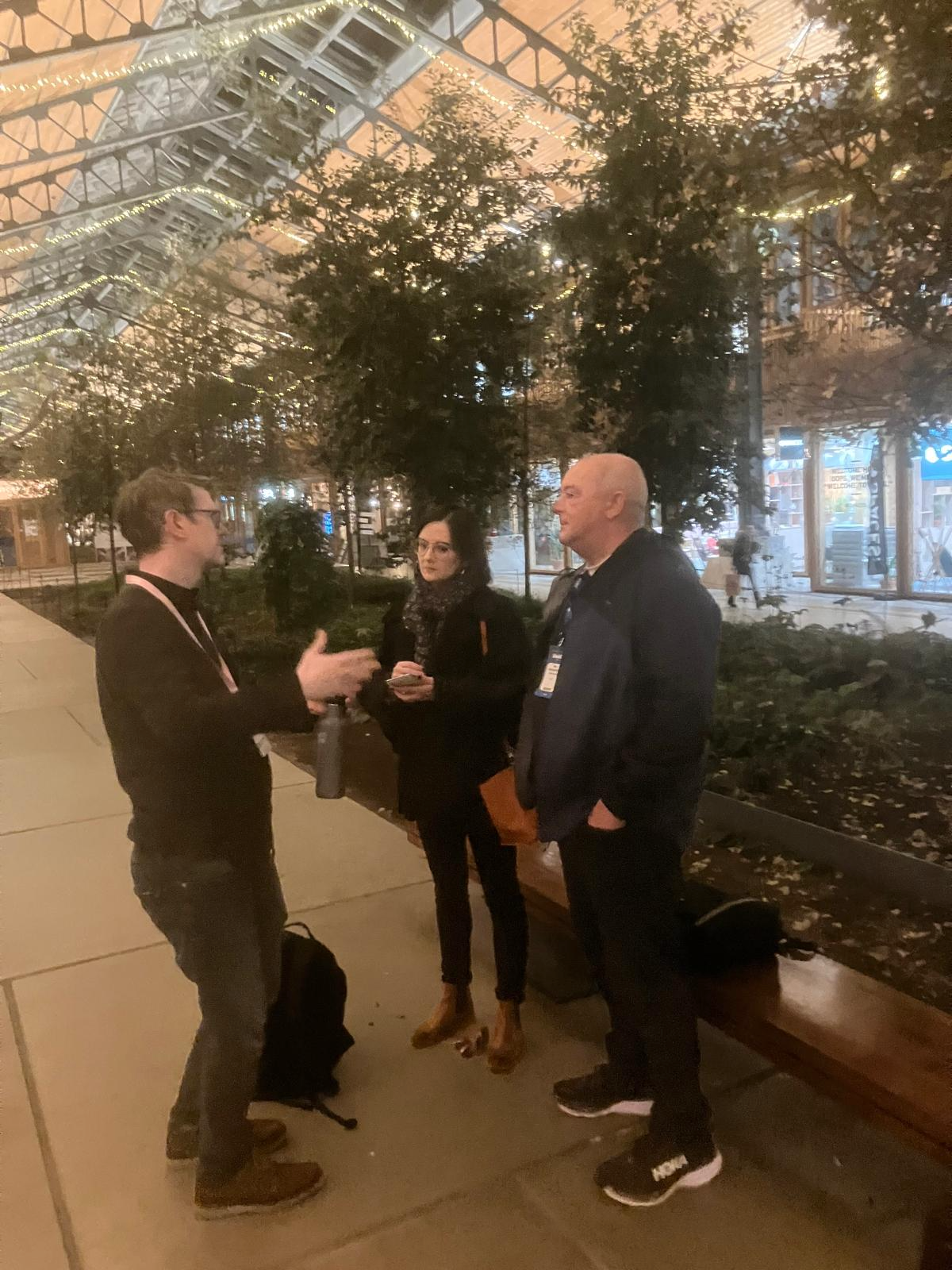
Post interview picture. From left to right: Kent Bye, Andreea, Petervan. Picture by Joost.
Use the barcode above to follow the discoveries of Douglas Spar (aka The Holy Lamb). Doug is the one investigating The Third Council. And “The Forbidden Question” is now positioned as a training protocol for crossing realities and the main priority of our team right now.
We are now complementing the team with technology partners to build a pop-up 360 infrastructure for artistic performances. We are contacting immersive spaces to be on their program. We also consider a subsidy for a technology prototype for this immersive performance.
May the lamb be with you in 2026!
With deep gratitude to Andreea, TJ, Arthur, Joost, and Ozark for staying motivated during this whole process. And thanks to UnitedXR for having us.
“Delicacies” is my incoherent, irregular, unpredictable collection of interesting sparks I came across online. Handpicked by a human, no robots, no AI. A form of tripping, wandering, dérivé, with some loosely undefined theme holding them together. Delicacies have no fixed frequency: I hit the publish button when there is enough material. That can be after a week or after 3 months. No pressure, literally. Enjoy!
Some highlights from this edition:
ARTEFACT — a collaboration between Neal Stephenson, Joe Lubin (Ethereum co-founder), and Rebecca Barcin (LAMANA1).
As already mentioned in my September 2025 Delicacies, I got a crush on the latest album by “Mister Dub” Adrian Sherwood, and went down the Dub Techno rabbit hole.
From the review in De Standaard newspaper (Google Translate and highlights by myself):
“With his label On-U Sound, Adrian Sherwood has created a unique musical universe over the past half century, rooted in Jamaican dub but with tentacles reaching out to punk, funk, and psychedelia, peppered with samples, echoes, and sound effects. His new album features only one track with a recognizable reggae rhythm; the others are driven by slow bass lines and stimulating drum patterns. Many of these tracks are played by real musicians, just like the cinematic fragments of flute, saxophone, organ, cello, trumpet, percussion, piano, Roland 60, and harmonica (“Spaghetti Best Western” exudes Ennio Morricone). Sherwood can call upon a host of loyal musicians (including Brian Eno and hip-hop legends Doug Wimbish and Keith LeBlanc) who add color and human warmth to his boundless imagination as a studio wizard. In an interview, Sherwood did admit that this was the first time he’d used AI to create a record. It seems like a logical evolution for a man who has spent his life innovating and experimenting with new equipment.“ (km in The Standaard)
Here is some older material from Adrian Sherwood. Watch his body language while performing 😉
And the song “Trapped Here” from his previous album, Survival & Resistance
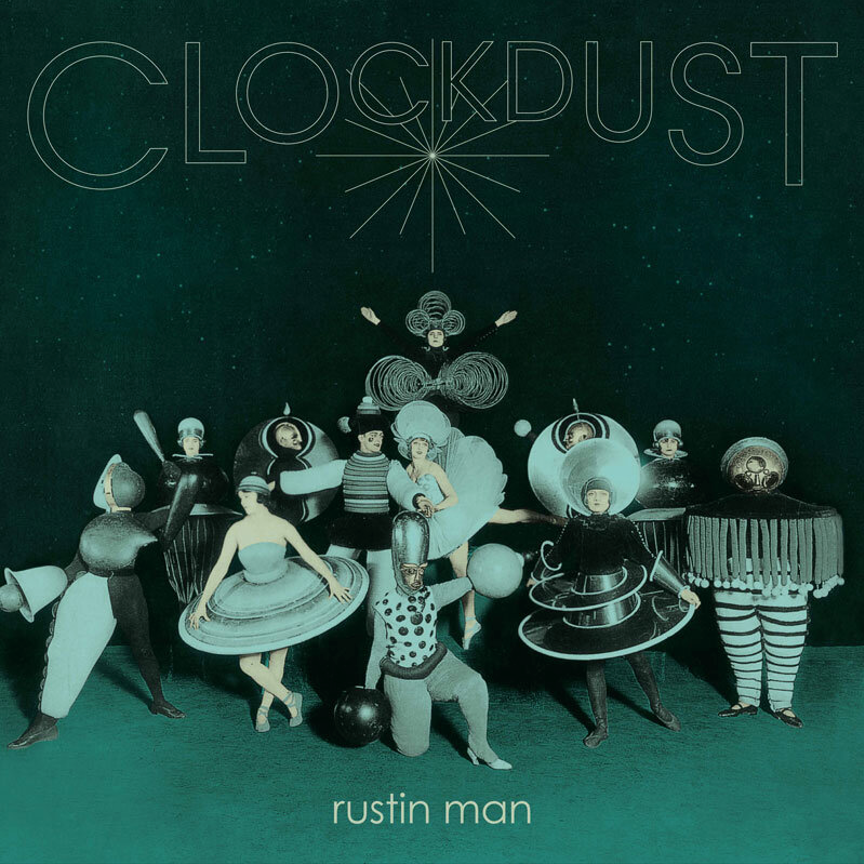
The album comes with a beautiful cover (designed by Peter Harris). The cover and the album’s atmosphere remind me of Rustin Man’s 2020 album ClockDust (I wrote a post about that one in 2020). It’s no surprise: after playing bass in a local reggae band in Southend, Rustin Man (Paul Webb) and his schoolmate, drummer Lee Harris, went on to form the rhythm section and become founding members of Talk Talk, alongside the exceptionally talented Mark Hollis and Simon Brenner.
The covers of Adrian Sherwood and Rustin Man respectively
So the starting point is dub reggae, which these days has evolved into a genre called “Dub Techno”. There is something melancholic about both albums, in sound, lyrics, artwork, and, at times, kinky living.
I don’t have real musicians available in my studio, and I’m hesitant to rely on AI. I’ve experimented with AI-generated music before, but it doesn’t bring me the same joy or sense of satisfaction as creating it myself. So I started studying and exploring the Dub Techno style, and found this book, “Dub Techno – The Orphic Experience of Sound” by Bahadırhan Koçer.
On page 56, Koçer begins discussing the concept of the riddim—Jamaican patois for “rhythm”—first examining drum patterns, and later turning to bass lines and melodic structures.
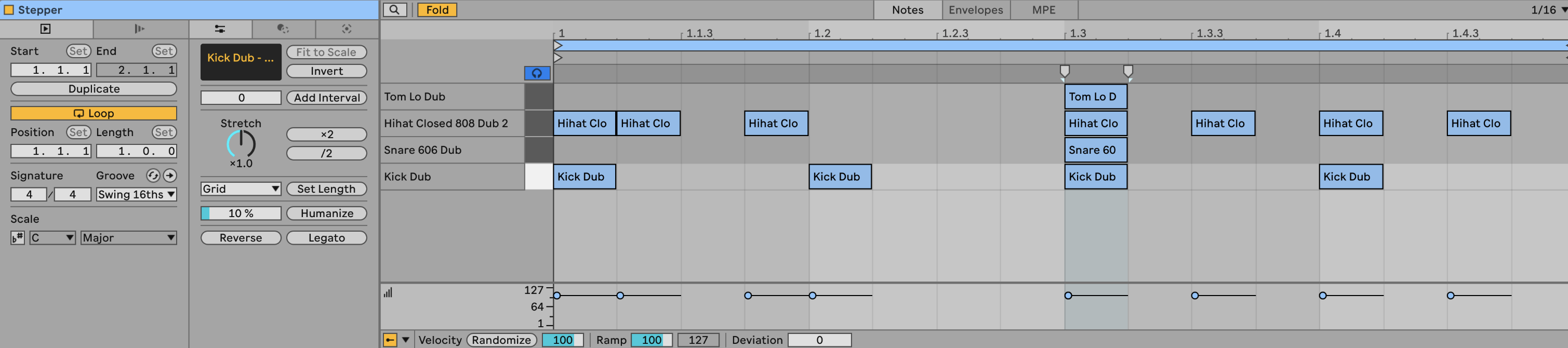
I started implementing them into Ableton Live. Here is an example of the “stepper” variant on a 64 Pads Dub Techno Kit.
Ableton Live 12.1 implementation “Stepper” by the author
That was easy. Then I tried to build a song using other out-of-the-box and/or free devices, clips, and samples in Ableton Live 12.1 and Logic Pro 11.2.2 (btw, the new bass and keyboard session-players, and the new studio piano and studio bass in Logic are amazing).
The new Studio Bass in Logic Pro 11.2
Creating a song was more of a challenge. What Adrian Sherwood and his real musicians were doing was not so simple after all. Although all the individual clips sounded simple, the art is in being subtle and sophisticated in launching clips and echo/delay effects.
As with writing, the real effort lay in removing the superfluous rather than adding more to the mix. Still, to make it a bit more my own, I included a few AI voice clips from the New New Babylon performance.
Short experiment by the author
But I am an amateur/bricoleur after all. No way I will ever get close to Adrian Sherwood and his musicians, at least not as a musician. But maybe in real life? Adrian and the band are touring North America and Europe in 1Q 2026. They will perform in Wintercircus Ghent on 6 Feb 2026. See/hear you there?
Excited to announce that I’ll be speaking together with Andreea Ion Cojocaru at the 2025 UnitedXR Conference in Brussels, happening December 8–10, 2025. This is my first public appearance in a long time, finally fully disconnected from corporate life and enjoying new artistic endeavours.
The Forbidden Question is a branch of our New New Babylon (aka Dream My Dream) Performance. Andreea and I will give a talk on the genesis and evolution of our project. This performance is a choreographed yet spontaneous play between multiple dreams and dreamers.
Looking forward to seeing some old and new friends in December.
As part of the research for my immersive projects and performances, I am trying to better understand the visual and audio aspects of XR experiences. In that context, I attended the Immersive Music Day at PXL in Hasselt, Belgium, organized by the PXL Music Research team. The full program, schedule, and lineup are here.
It is a relatively small-scale event (I guess about 100 PAX), which is great as it enables networking with the participants and the speakers. The event was held at a location with great immersive audio infrastructure (3 rooms with full 360 sound set-up). For the rest, it was a no-frills event with super-friendly staff and good food at breakfast and lunch.
Example of an immersive music room set-up
I was also pleasantly surprised by the mix of ages, ranging from fresh-faced high school students to seasoned audio veterans and legends, plus corporate fossils like myself. That kind of diversity usually signals that something truly interesting is about to unfold.
But the best part was the content and the speakers.
If there was an intended or unintended theme, it would be the subjective aspects of the immersive experience (how sound “feels”, or about the experiential coherence of auditive, visual, and spatial input) vs. the technological aspects of immersive sound (like precise localisation of sound in space). But I am sure that in some other sessions, the content was quite nerdy, up to the detailed coded and mathematical aspects of encoders/decoders.
Here are a few notes and reflections from the sessions I attended.
Immersive Space – An Agent for Creating and Experiencing Music
Program synopsis: Humans have sensory capabilities for recognizing their presence and immersion in space. Music ideally matches these capabilities by presenting dynamic, tonal, harmonic, and rhythmic structures in sound. Musicians use space to generate and blend sounds of ensemble, to hide and reveal musical voices, to dramatize perspectives, and to harness emotion in music making and listening. The talk explores immersive space as a modern technological tool for augmenting people’s experience of music
CIRMMT Dome with 32 speakers
Notes:
I had never considered immersive sound as a medium for live music performance—being physically present in one space while listening to live musicians through a 360° sound system that simulates the acoustics of an entirely different environment. Wieslaw talked about auditory “fingerprints” of spaces. This goes way beyond sound effects like reverb that simulate the reverb of a cathedral. No, this fingerprint captures the full acoustic character of a space—every corner, every height, every nuance. And there are plug-ins available that let you import this detailed acoustic profile directly into consumer-level digital audio workstations like Logic Pro and others.
This allows performing artists to shape and test their artistic expression for a specific space, like the San Francisco Cathedral, or lets the audience experience the music as if they were actually there, immersed in that very acoustic environment.
Altering the Immersive Potential: The Case of the Heilung Concert at Roskilde Festival
Speakers: Birgitte Folmann, Head of Research, Sonic College, and Lars Tirsbæk, Consultant in Sound & Emerging Technologies, Educator 3D audio, Sonic College
Program synopsis: Immersive concert experiences are often described as specific, emotionally moving, dynamic, and complex – qualities that require experimental and interdisciplinary methods to be meaningfully understood. In this talk, we explore the immersive and engaging potential of live concerts through the lens of the Heilung performance at Roskilde Festival. Drawing on anthropological fieldwork and insights into the technical systems that supported the experience, we discuss how a deeper understanding of immersion can inform both artistic and technological development to enhance future audience experiences
Notes:
The talk was about the Heilung Concert at Roskilde Festival in 2024, in a festival tent holding about 17,000 people. Details about the technical set-up by Meyer Sound here.
What struck me was that the concert wasn’t branded as an “immersive” experience—there was no expectation set in advance. Yet, the immersion began the moment people entered the tent: birdsong filled the air, subtly blurring the line between environment and performance. It reminded me of my Innotribe days, where we also paid close attention to how people entered a space. After all, arrival and departure are integral parts of both the performance and the scenography.
The first part of the talk by Lars was about the technical challenges of delivering a 360 immersive sound experience in such a huge space. The second part by Birgitte was about the anthropological and subjective aesthetic experience of immersive music by the audience. Her slogan, “Aesthetics is a Verb” is great t-shirt material. They also talked about the “attunement” of the audience to the experience, and that you can’t fight the visuals: for example, when the drums play on the front stage, having the 360 sound coming from behind you does not work for the human brain.
Their team is now starting to document the findings of their field research. More to come.
Designing the Live Immersive Music Experience
Speaker: Paul Geluso, Music Assistant Professor, Director of the Music Technology Program – NYU Steinhardt University
Program synopsis: Paul Geluso’s work simultaneously encompasses theoretical, practical, and artistic dimensions of immersive sound recording and reproduction. His first book, “Immersive Sound: The Art and Science of Binaural and Multi-channel Audio,” published by Focal Press-Routledge, has become a standard textbook in its field. Geluso will share his research experience while providing exclusive previews of interviews and insights with featured immersive audio masters from his forthcoming book, “Immersive Sound II: the Design and Practice of Binaural and Multi-Channel Experiences” set to be published in fall of 2025. This presentation will also included discussions on his 3DCC microphone technique, a 3D Sound Object speaker design capable of holophonic sound playback, and his work on in-air sound synthesis and other site-specific immersive sound experience building techniques.
Notes:
Paul Geluso is God. Some years ago, he published “Immersive Sound: The Art and Science of Binaural and Multi-channel Audio,” considered by audiophiles as “The Bible”. He is also good friends with Flanders’ best artist, Piet Goddaer aka Ozark Henry,who specializes in immersive sound and music.
Ozark Henry in his studio
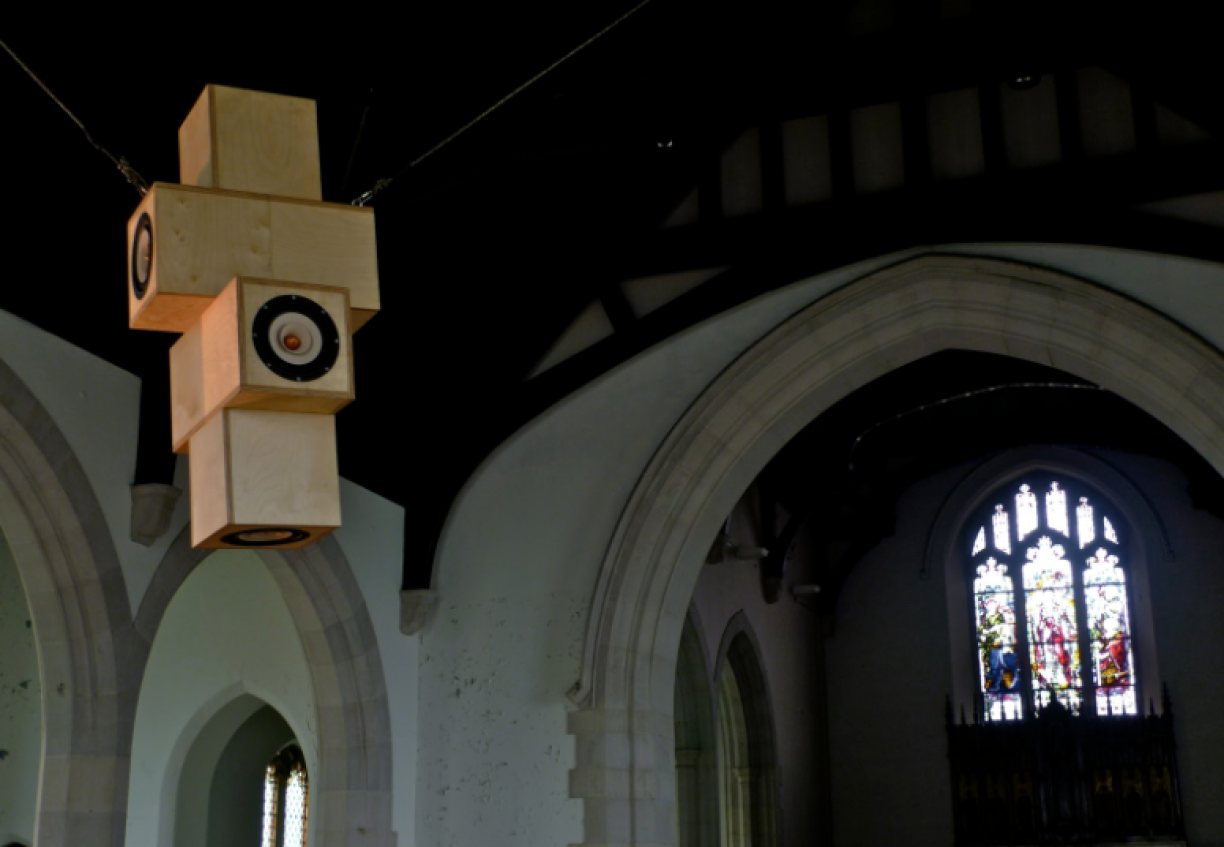
Paul took us on a journey of his research on immersive recording (making custom made 3D microphones and codes) and playback (making his own “Ambi-Speaker Objects”.
Paul Geluso’s immersive 3D Sound Object (Ambi-Speaker)
This was more of a backdrop for his upcoming book. While his first book was more about the how – the technology to record and playback immersive music – his new book will focus on the why – in essence, about leading with the story and the artistic intent. He hopes the new book will be out in 2025.
I had the chance to have a short 1-1 conversation with Paul, who seemed interested in our immersive performance ideas, which was exciting to know.
Subjective Evaluation of Immersive Microphone Techniques for Drums
Speaker: Arthur Moelants, Researcher PXL-Music
Program synopsis: When presenting a group of listeners with four immersive microphone techniques in two songs, will they always choose the most objectively correct one? An experiment with drum recordings in different acoustics and musical contexts challenges the assumption that objective parameters like ICTD and ICLD should always determine the best choice. While non-coincident techniques often score better in these metrics, listener preferences can shift depending on the musical context, as other techniques offer different sonic and practical qualities that might benefit the production more.
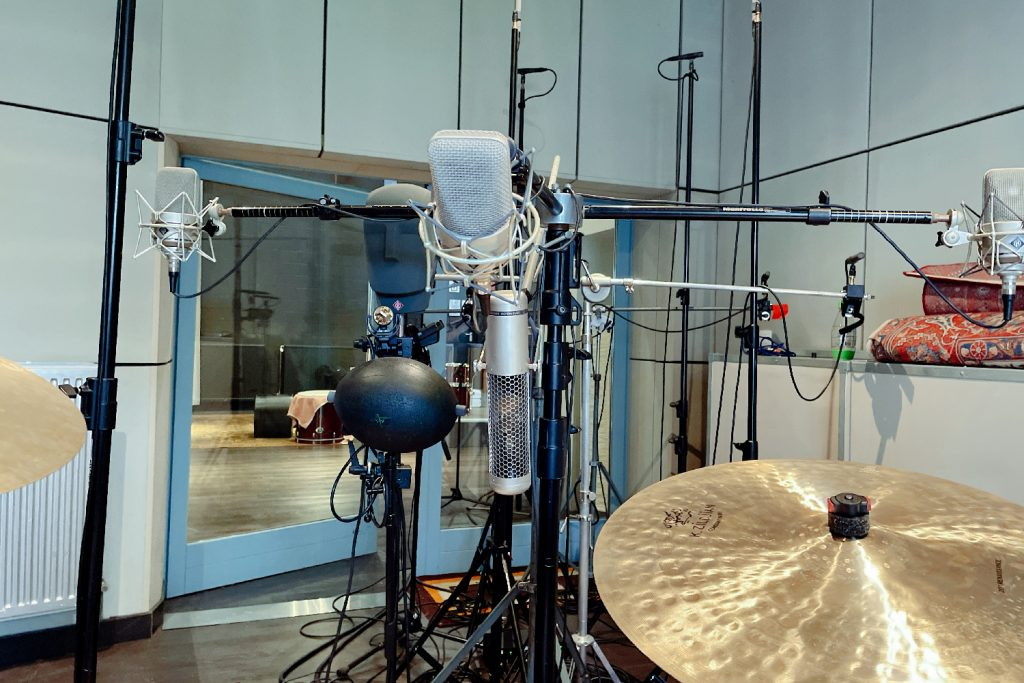
A microphone set-up for drums
Notes:
Arthur is part of my team for our immersive performances, like The New New Babylon, where he acts as both a cinematographer and immersive music expert. He is a member of the PXL-Music Research team. I was curious to see how he’d handle public speaking and delivery, and he did not disappoint. I’m always impressed by how some young professionals manage to blend deep, almost nerd-level technical expertise with polished communication and presentation skills.
His talk was about his research on the subjective experience of drums, and how that experience differs depending on the recording technique and on the context of the drums as part of a song. I really like the simple graphics of his slides to explain some quite technical aspects of immersive music. Not an easy talk to deliver as he was also giving live demos on a 360 system to let us hear the subtle differences.
Spring update on Petervan Studios. The previous update was one year ago! It is not that nothing happened. A lot has happened since then. Let’s have a look at what’s on/in my head.
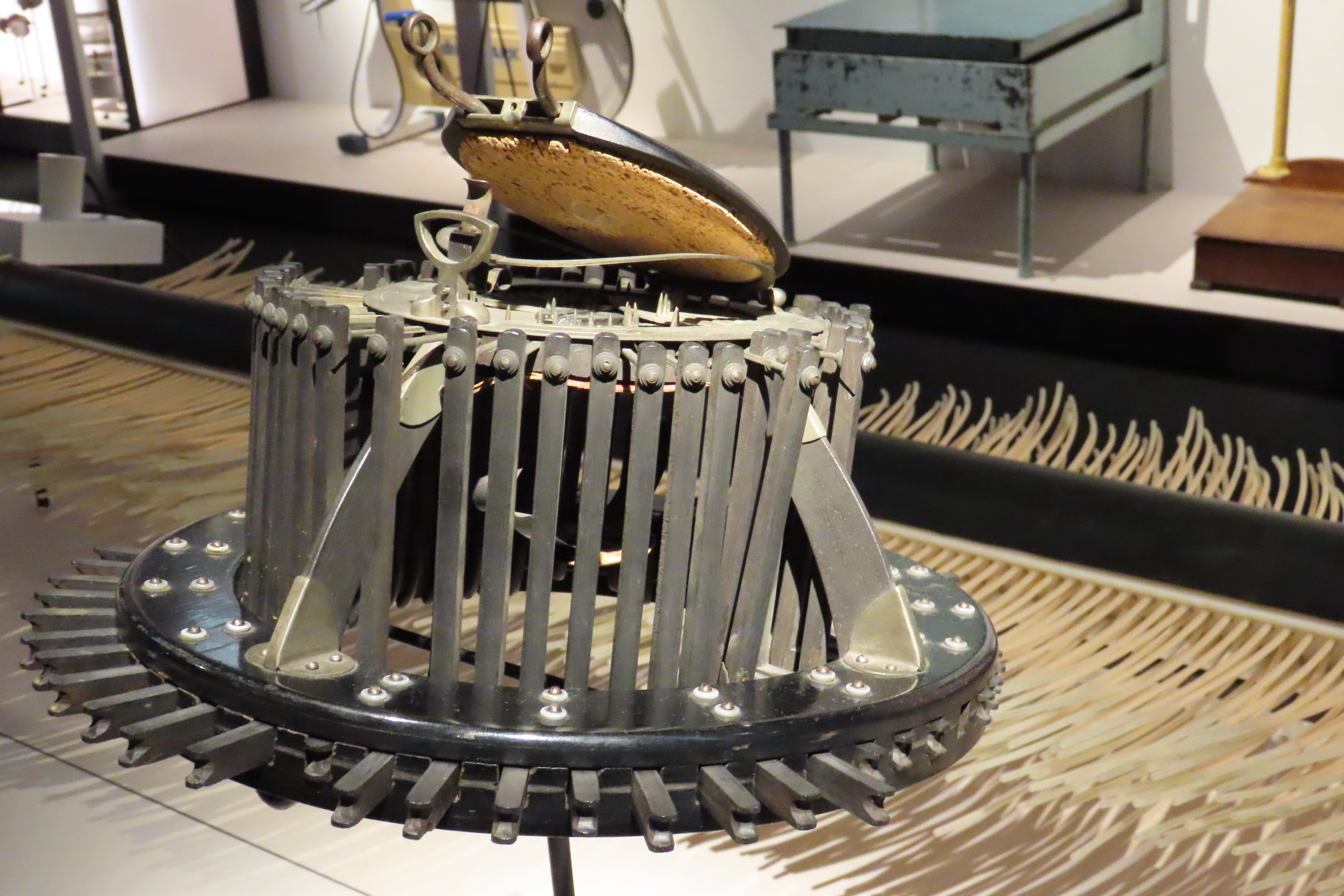
Head measuring device – seen in GUM Science Museum – Wunderkammer of Truth
General Status
Since February 2024, I have disconnected from all social media, including FB, Twitter, and LinkedIn: You won’t find me there anymore
There have been fewer conversations, but the remaining contacts have become true friends, project & sparring partners.
It is challenging to find budgets for anything that even smells artistic.
On the family front, there was both joy and grief. Joy: Astrid passed the entry exam and started her bachelor’s at the Faculty of Veterinary Medicine of the University of Ghent. Grief: My mother-in-law passed away on 1 June 2024. She was a saint. The mourning set some of the tone for the rest of the year. Join me in wishing my father-in-law, my wife Mieke, and my daughter Astrid strength in dealing with this loss.
Green Green Grass of Hope – Bicycle ride 26 Oct 2024
The Art Studio
The main focus of the art studio was digital. I did a deep dive into what I would call “immersive software”. A deep dive means spending a lot of time in the Unity Editor, following numerous online courses, and doing a lot of little experiments.
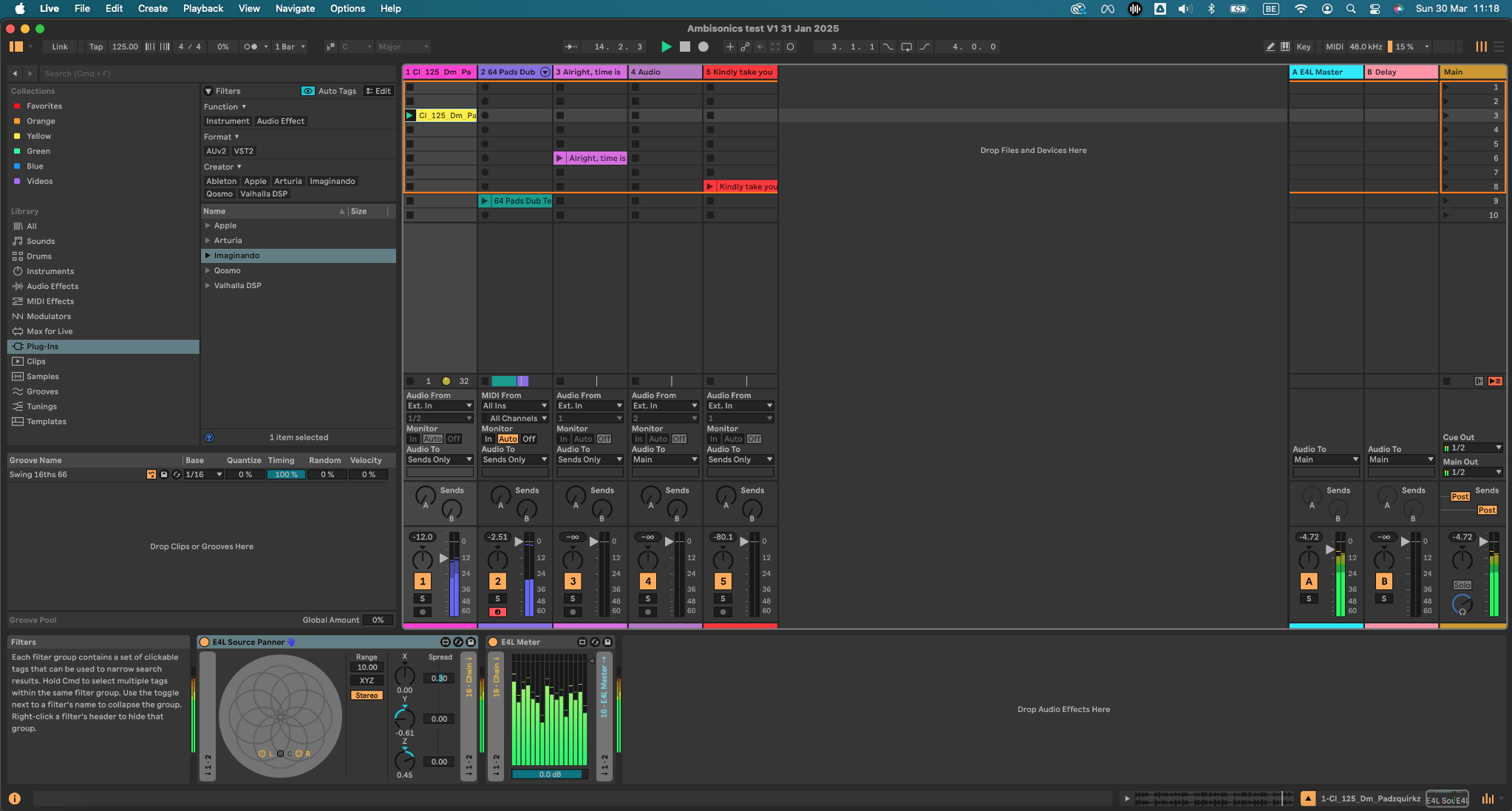
Example of Ableton Live with Envelop for Live 3D Source Panner
An example of a simple VCV Rack set-up
Static example from Wave Unstable rule in CAPOW software by Rudy Rucker
Although not intended this way, most of the knowledge and skills acquired culminated in the first and subsequent versions of the New New Babylon performance, giving leeway to other projects. Some of these projects are detailed below.
I did make some analog work, mainly pencil and Chinese ink on paper, and very little with paint on canvas.
Together with some friends, we submitted a SoP24 Protocol Improvement Grant proposal for Conversation Protocols for Humans and Machines. Unfortunately, our team did not make it to the 2024 season of the Summer of Protocols. There were 130 candidates and only 5 residencies available. We learned a lot in preparing the submission material.
Toolmaking for Spatial Intelligence
Followed DigitalFutures Workshop “Toolmaking for Spatial Intelligence” and got my certificate
Masterclass XR in Industry
I am following the Masterclass XR in the Industry (an online course with some on-site assignments) at the Howest Academy in Kortrijk (with Digital Arts & Entertainment as one of the best game schools in the world) and HITLab (Human Interface Technology Lab) until June 2025.
5) Visualizing the unseen (IOT data visualization/digital twin)
6) Virtual control (interaction with machines/robots via XR)
Performances
Performance: Claim Your Cybernetic Word – 17 June 2024
I was invited to do an online performance for the 60th-anniversary conference of the American Society for Cybernetics.
Attendees were encouraged to participate actively by offering cybernetic terminology. We discussed for example the Paskian Knobs required to steer randomness and the style of the outcome. The session resulted in more than 300 generated words. They were consolidated in an on-the-spot generated word cloud. We also created an AI-generated cybernetic song.
Resulting world cloud
Performance: What Makes Us Human? – 28 August 2024
The Cybernetic performance uses a new format for delivering and creating content in some dream-state flow. I showed it to Josie Gibson from the Catalyst Network, who invited me to create a similar online workshop “What Makes Us Human?”
This performance is an engaging, immersive, and poetic screen-foray crafted to elicit compelling language embodying The Catalyst Network’s human dimensions. Attendees are encouraged to offer catalyst and humanistic terminology, visually depicted in an immersive cloud-like interactive video installation and a bespoke soundscape. The session opens with an artistic cinematic dream sequence. Through facilitated brainstorming sessions with the audience, participants can fine-tune word generation. The session closes with a cinematic catalyst song outro “A Woven World of Humans”.
Trailer:
Performance: New New Babylon
This has been my main focus over the last months, and that paid off: I made good progress on this performance. This performance is now available for virtual and physical on-stage delivery.
The New New Babylon performance is a 45-60 minute immersive experience, divided into six chapters—Awakening, Stepping, Flying, Gliding, Folding, and Vertigo. Each chapter explores different facets of the New New Babylon concept, blending art and interaction. Audience members are invited to actively participate, engaging with interactive elements that promote a sense of community and shared creativity. The performance integrates rich soundscapes, video projections, visual art, poetry, masks, VR, and stage props to create a multisensory journey.
To get here, I have spent loads of time in Unity Editor (a software tool to create 2D, 3D and VR environments, well known in the game development industry), did some in-depth reading on modern urbanism, registered for a masterclass “XR in the Industry”, and partnered with NUMENA, a renowned interdisciplinary creative studio from Germany, specializing in award-winning spatial design and programming.
For the next iteration, we plan an API-supported LLM infrastructure to enable live interactions with AI Agents. We aim to facilitate real-time exploration of historical New Babylon research resources during on-stage and online sessions. This infrastructure is currently being developed by Thomas McLeish, Adjunct Lecturer – at Berkeley Master of Design, and master creator of the 2018 replica of the Colloquy of Mobiles. Arthur Moelants – a talented young cinematographer and immersive audio expert from Flanders – also joined our project.
We submitted the performance as a candidate for the Venice Biennale College 2025, but we did not make it.
Performance Dream My Dream
The team decided to re-work the New New Babylon performance into a live experience that does not require any hardware (headsets) for the audience. We have renamed the performance to “Dream My Dream”
Trailer
17 Minute Video simulation of the performance
Dream My Dream is an immersive performance experience in six dream states: Awakening, Stepping, Flying, Gliding, Folding, and Vertigo. A live VR performer embodies an architect-researcher and dreams about the New New Babylon, a speculative future society transformed and eroded by automation, artificial intelligence, and digital technology. The dream explores profound and universal questions about the essence of existence. The audience is invited to interpret the dream in their own unique way.
This artistic performance has a poetic, gentle, and profoundly human touch, evoking a dreamy, Magritte-like surrealism. The atmosphere is calm and harmonious, steering from Sci-Fi or dystopian themes toward a non-aggressive, understated, and subtly utopian vision.
We submitted “Dream My Dream” to the Cannes Festival Immersive 2025 competition but did not make it to the final ten.
We are now revisiting the synopsis and tagline of this performance and making some adaptations to the treatment with the ultimate goal of premiering at one of the major film/immersive festivals.
Artistic Research Project: New New Babylon
The performance is one of the deliverables of the main artistic research project. There has been renewed interest from several parties interested in partnering on the main New New Babylon project.
We are looking for a team/consortium to overlay an existing city (district) with a VR environment for A/B Testing of the urbanistic, economic, and governance aspects.
The deliverables of Phase-1, the Vision-Phase, are:
A beta version of an Urbanistic Artistic Rendering VR Environment, inspired by an existing or planned City or Real Estate project
Artistic Performance (minimum Online, ideally IRL), see above
Art Expo (minimum Online, ideally IRL)
Art Book
Stealth
A new project, very embryonic, written and directed together with Andreea Ion Cojocura, complemented by my cousin (a 17th-century art expert) and a world-renowned artist as the MC.
The project is an experimental alternate reality experience about the nature of flesh, human suffering, and technological advances. It seeks to find an answer to the question: “Who are the new Gods that can deliver us from suffering?”
It is a surreal experience to see the truth. It happens over a three-year timeline. Unfolding in real time, the project involves participants in the preparation, execution, and aftermath of the fictitious latest ecumenical council.
The multi-year project entails a prelude phase as a mockumentary in 360 video, audio, and VR, followed by an in-person council, concluding in new canons and summarising mockumentary.
At the moment of writing, we are finalising the pitch.
A theory of space/time dimensions
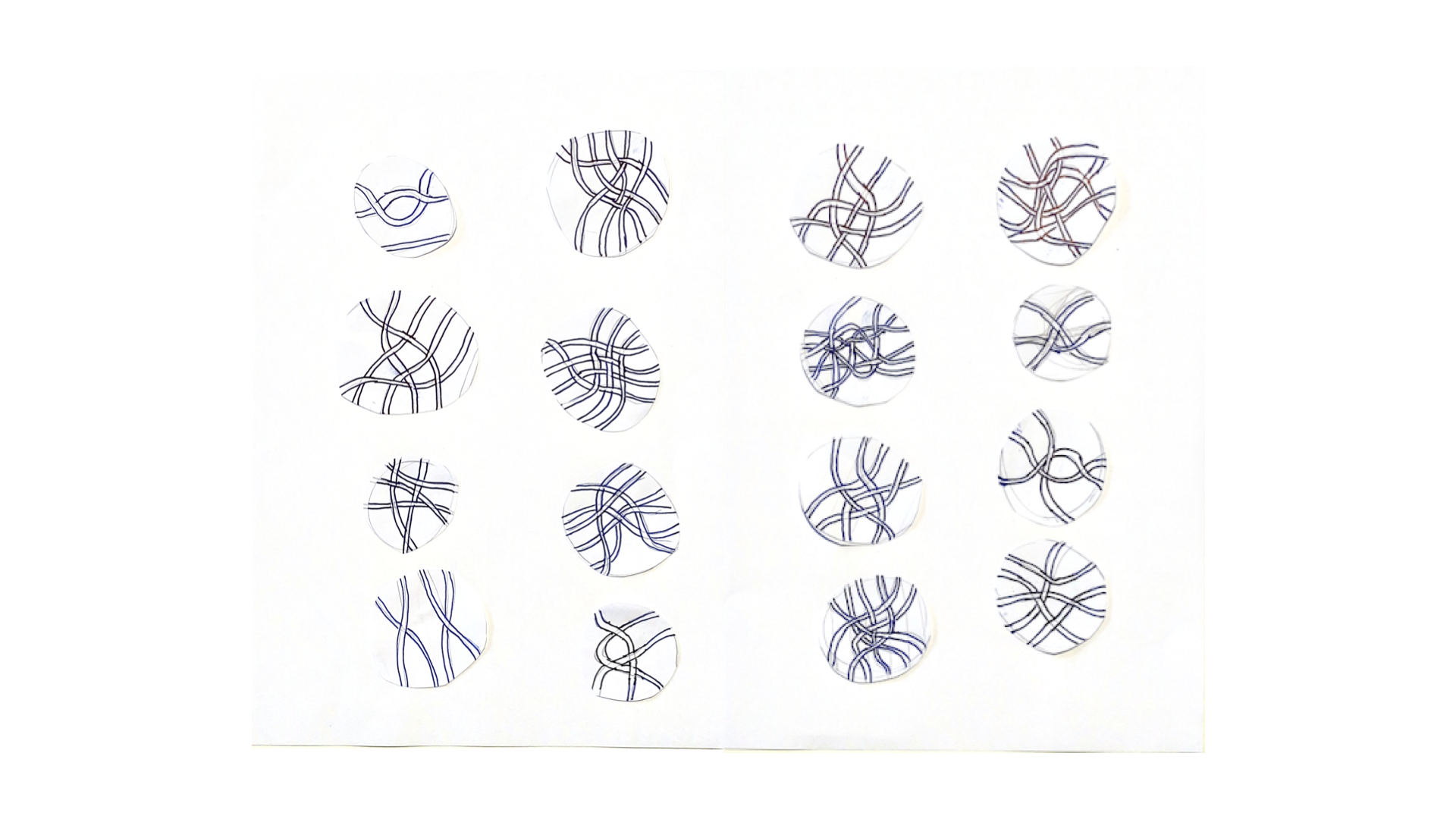
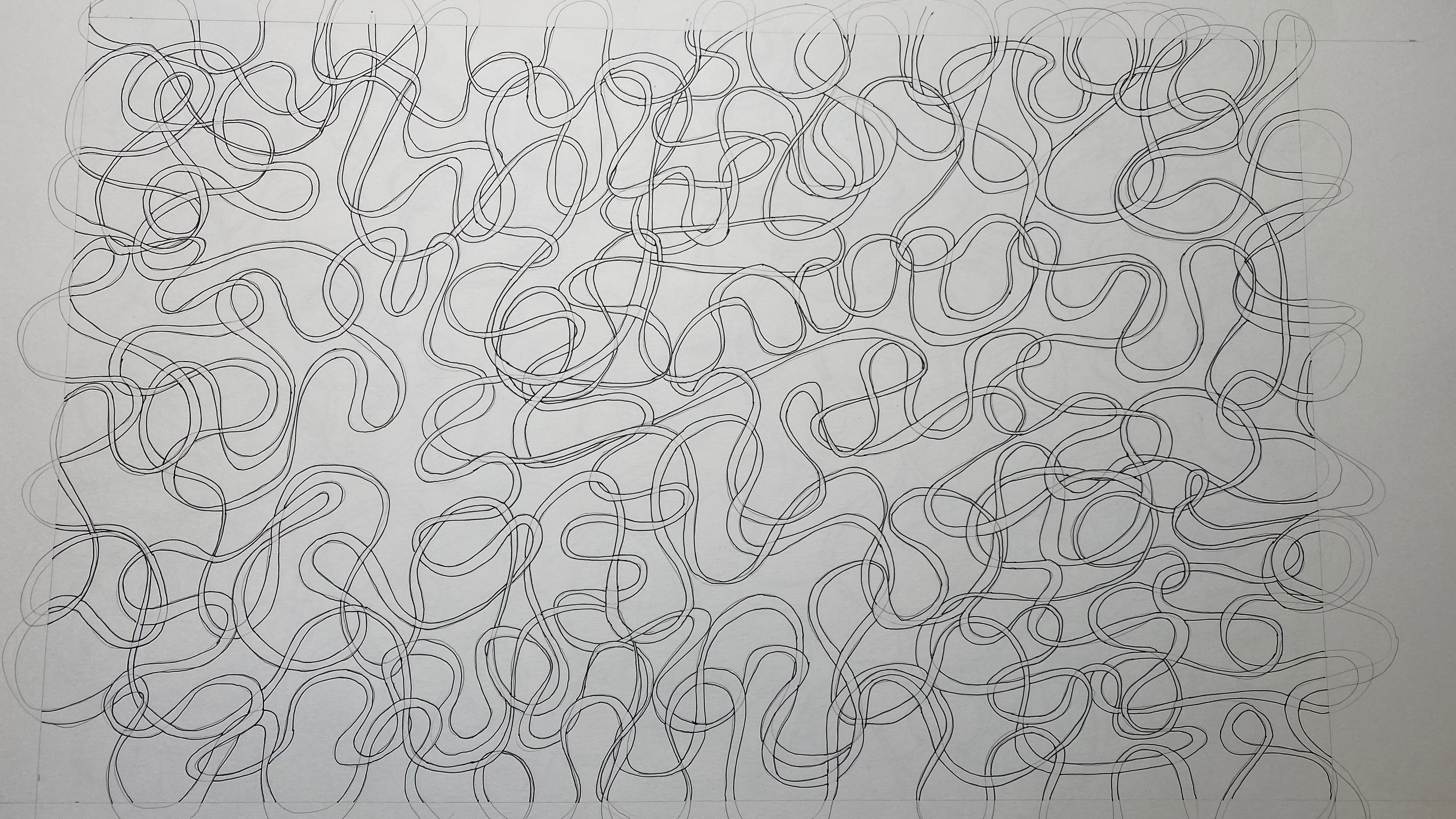
The analog gnarly curved art projects, the 3D software learnings, the few conversations, a couple of computation and math books about flat and 3D dimensions (see books section below in this blog), and especially the Stealth project led me to fantasize about a multi-dimensional (not multiverse) world that is suddenly revealed and that changes everything we know about science.
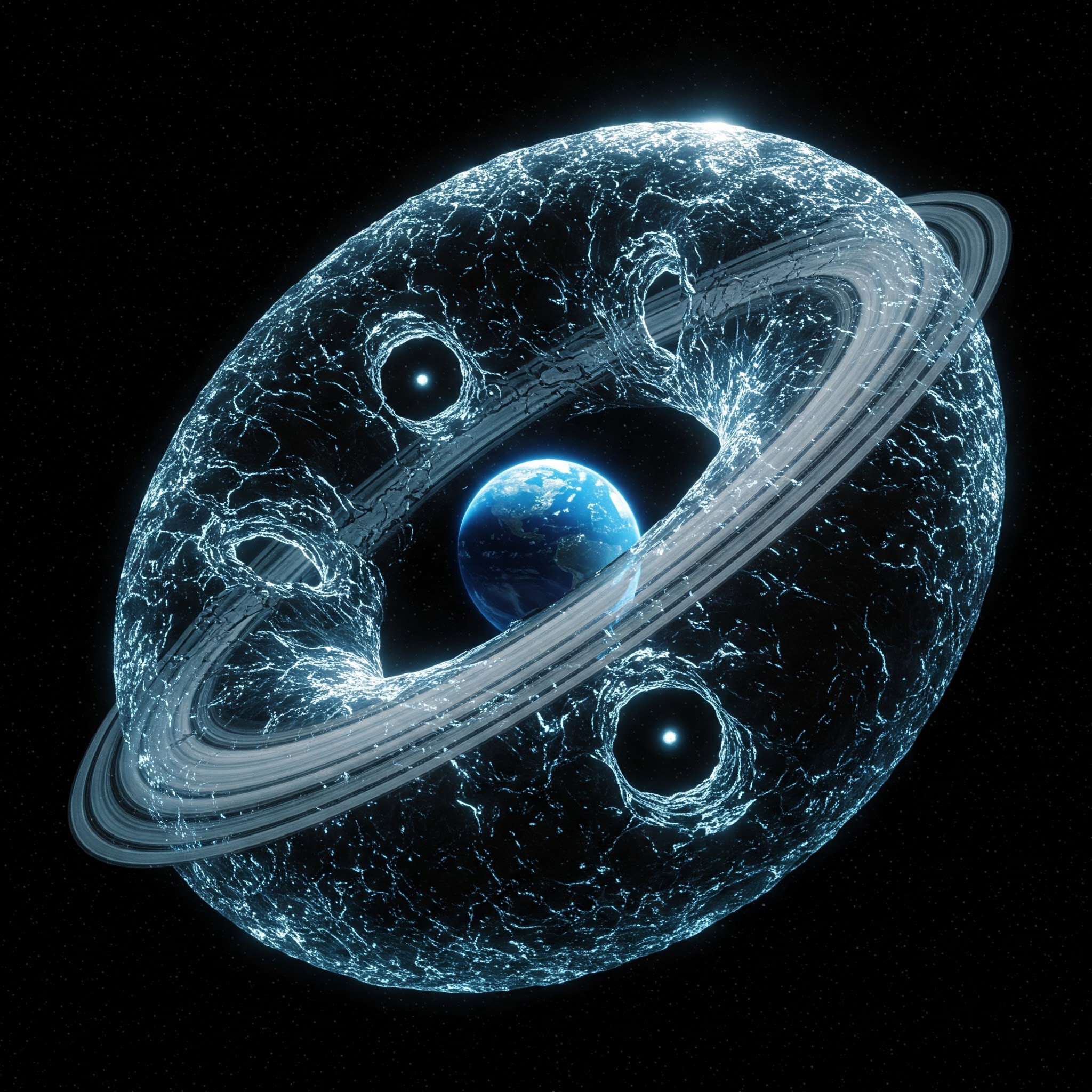
One of the fantasies envisions a world encircled by a Saturn-like ring of knowledge-infused water, unveiling stereoscopic windows into higher and lower dimensions of time and space—if such concepts even exist.
Don’t take anything here too seriously. To quote Rudy Rucker: “I am a science fiction writer and the secret of science fiction is pile on the bullshit and keep a straight face”
Delicacies
“Delicacies” is my incoherent, irregular, unpredictable collection of interesting sparks I came across online. Handpicked by a human, no robots, no AI. A form of tripping, wandering, dérivé, with some loosely undefined theme holding them together. Delicacies have no fixed frequency: I hit the publish button when there is enough material. That can be after a week or after 3 months. No pressure, literally.
Check out the May, June, September 2024, and February 2025 editions here.
Books
Highlights:
Geometry, Relativity and the 4th Dimension – by Rudy Rucker (1977)
Art, Technology, Consciousness: Mind@Large – by Roy Ascott (2000)
Love & Math – by Edward Frenkl (2013)
Behave – by Robert Sapolsky (2017)
Mind in Motion – by Barbara Tversky (2019)
Soft City – by David Sim (2019)
and re-reading The Lifebox, the Seashell, and the Soul – by Rudy Rucker (second edition 2016)
I am super-excited to announce the general availability of my brand new performance “The New New Babylon”. Here is the trailer:
The New New Babylon performance is an immersive experience, divided into six chapters—Awakening, Stepping, Flying, Gliding, Folding, and Vertigo. Each chapter explores different facets of the New New Babylon concept, blending art and interaction. Audience members are invited to actively participate, engaging with interactive elements that promote a sense of community and shared creativity. To create a multisensory journey, the performance integrates rich soundscapes, video projections, visual art, poetry, masks, VR, and stage props. It’s a brand new format to deliver content, quite different from more traditional keynotes and talks.
This artistic performance has a poetic, gentle, and profoundly human touch, evoking a dreamy, Magritte-like surrealism. The atmosphere is calm and harmonious, steering away from Sci-Fi or dystopian themes toward a vision that is non-aggressive, understated, and subtly utopian.
Designed for corporate and institutional clients, art galleries, and museums, the performance’s content, materials, and timing can be adapted to suit specific needs. The performance can also be organized as an online or in-situ workshop format.
VR-Frame from ACT3 – Flying
The performance is now available for both online and on-stage presentations, with options for bespoke adaptations or commissions. If you’re interested, feel free to reach out!
The next step is to create a fully immersive VR headset performance with live interactions with AI voices. Already available are six Unity VR packages, each designed for distinct VR spaces in the performance, including specific controller actions that control both on-stage and in-VR lighting, and different camera angles. These packages are tailored to support the various acts of the performance. These Unity packages are developed by NUMENA, a renowned interdisciplinary creative studio from Germany, specializing in award-winning spatial design and programming.
We are also developing an API-supported LLM infrastructure to enable live interactions with AI Agents. Our goal is to facilitate real-time exploration of historical New Babylon research resources during on-stage and online sessions. This infrastructure is currently being developed by Thomas McLeish, Adjunct Lecturer – Berkeley Master of Design, and master creator of the 2018 replica of the Colloquy of Mobiles.
VR-Frame from ACT4 – Gliding
And here is an extract from ACT4 of Petervan’s New New Babylon Performance.
The performance is one of the deliverables of my more ambitious transdisciplinary Artistic Research Project, where I am imagining and scaffolding a City of Play through different formats. These formats can be analog and digital artwork and productions, digital overlays, sketches, performance lectures, writings, poems, blogs, installations, soundscapes, recordings, documentaries, spaces, time capsules, curations, events, group experiences, immersions, expeditions, and exhibitions.
Here is the latest update on Petervan Studios. The previous update was in December 2023. A lot has happened since then. A lot did not happen. Here is an overview.
Winter and Spring
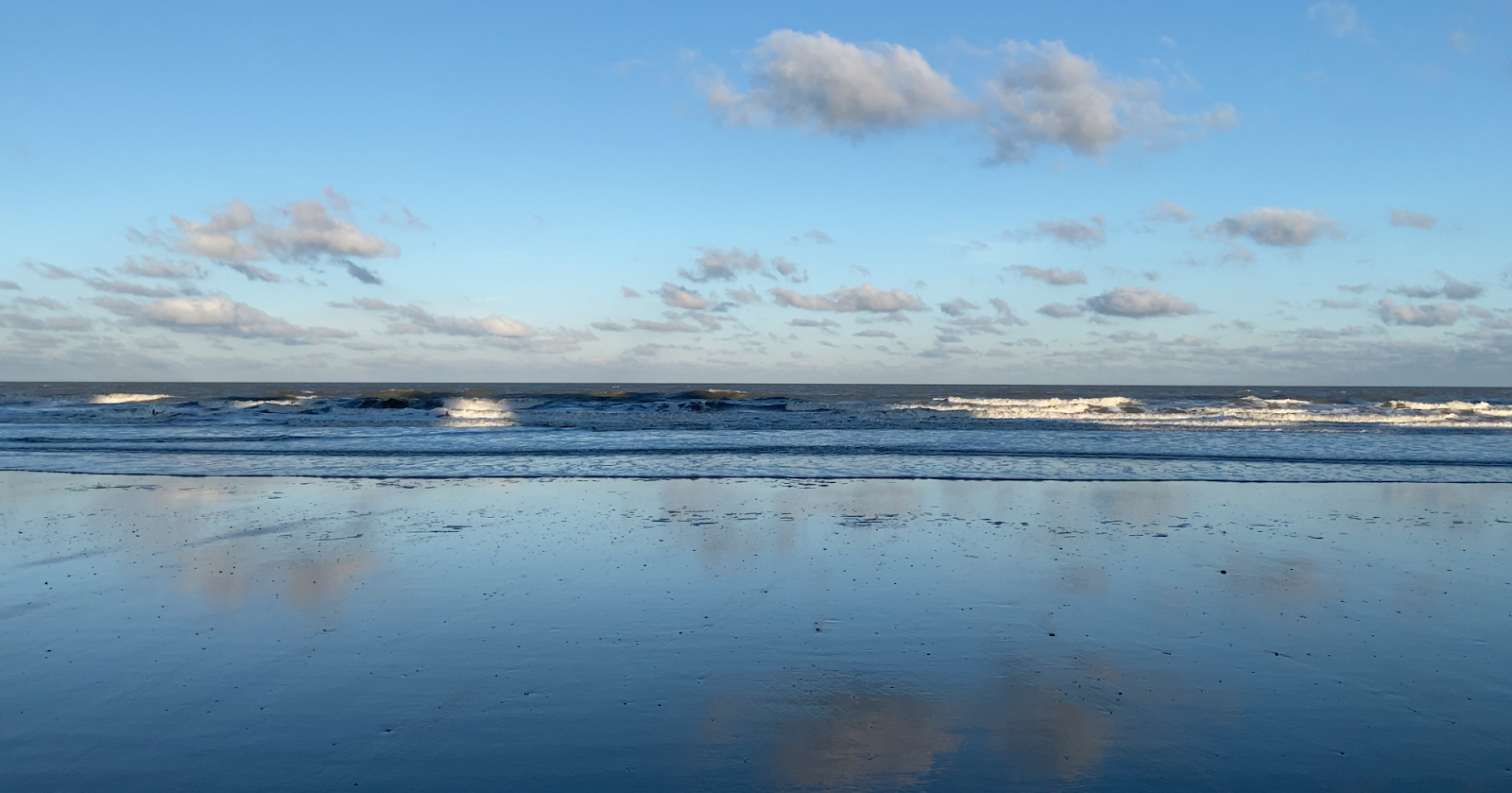
Open skies at sea – Middelkerke – 19 Jan 2024 – Frame from Petervan video
Early blossoms in the garden – 20 Mar 2024 – Picture by Petervan
Family
Joy: Astrid now has a driver’s license: on the one hand, this means I don’t have a car anymore, on the other hand no more taxi service and that is a great luxury. And she took up again her dream of becoming a doctor or a veterinarian. For that, she studies daily to pass the entry exam at Ghent University beginning July 2024. And of course, horses forever 😉 Happy times.
Grief: my mother in law is not well. Mieke and I are trying to help where possible. Difficult times.
The Art Studio
Only a little happens in the Art Studio. Some paintings and sketches. And some soundscape experiments, playing around with the latest Ableton Live and Apple Logic Pro versions.
Also found a good AI service for song generation, called Suno AI. Below is a song generated by prompting Suno AI, based on a rap poem by Dr. Paul Pangaro in a cybernetic manuscript for a 1989 book proposal that never got published. Mind you, the title of the book was “New Order From Old: The Rise of Second-Order Cybernetics and Its Implications for Machine Intelligence”
Magritte Synaptic Gap – Image prompted by Petervan in DALL-E
You can find most of them via the “Artworks” tab on my website.
I participated in The Stability.AI residency at the HUG Innovation Laboratory between 8 Jan and 18 Feb 2024. Did not get out of it what I expected. And Stability AI is getting quite “unstable” since the fall down of its CEO.
I am also playing around in Numena’s Space Elevator VR App, and start imagining what sort of VR performances would be possible. Here is an example that is in the VR elevator wall of the project that feels like a Magritte VR experience. For transport, I used the fly mode of the application.
There is also some progress in the “Claim Your Word” project, A collaborative art project to curate words that never make it into a McKinsey presentation. In essence, all words that make us human. In March 2024, I added a whole set of additional words, resulting in the following updated word cloud:
If you want to suggest additional non-McKinsey words, go to the form on the project webpage above.
Still in the planning is a personal solo art exhibition in VR and maybe IRL. Some installation concepts will be tried first in VR, and maybe later in IRL.
The performance lecture “City of Play”, about the New New Babylon (and the power of imagination) is on hold.
However, a new one is in the making “Cybernetic Magritte”, where I share the story of my novice Cybernetic discoveries and learnings, and only use my artwork as visuals, my compositions as soundscapes, and my poetry. Target date: June 2024 and subject to closing the last funding gap.
Cybernetic Virgin
Somewhere in January 2024, I got infected by the cybernetic virus. Here is the video that got me down the rabbit hole
Here is Dr. Paul Pangaro (President of the American Society for Cybernetics), who talks about the remake of Gordon Pask’s Colloquy of Mobiles, an installation illustrating his Conversation Theory based on cybernetic principles.
For somebody active in many innovation initiatives during my career, it is remarkable that I never got exposed to cybernetics. In that sense, I am a “Cybernetic Virgin”, looking with open eyes at the great cybernetic minds of the 50ies and 60ies.
Since January, I have devoured massive amounts of cybernetic originals and absorbed as much as I can. This has an impact on my previous plans, whether art-related or intervention-related.
In the meantime, I had a couple of conversations with Dr. Paul Pangoro, and I would not be surprised if one or more projects will follow.
Summer of Protocols
The Summer of Protocols (SoP) is an ongoing research and evangelism effort that aims to catalyze broad interest in the study of protocols as a first-class concept for thinking about the world. It is led by Venkatesh Rao and funded by the Ethereum Foundation.
The results of the first (2023) SoP are now published on their brand-new site. The research and delivery format are all very well done.
This is about protocols in the widest sense: from communication protocols to protocols for washing hands, or protocols for artificial memory or addressable spaces.
Have a look at one of Venkat’s great talks about this project
Together with some friends, we submitted a SoP24 Protocol Improvement Grant proposal for Conversation Protocols for Humans and Machines. Let’s cross our fingers!
KMSKB – Imagine 100 Years of Surrealism – 15 Mar 2024
BOZAR – Histoire de ne pas rire – 15 Mar 2024
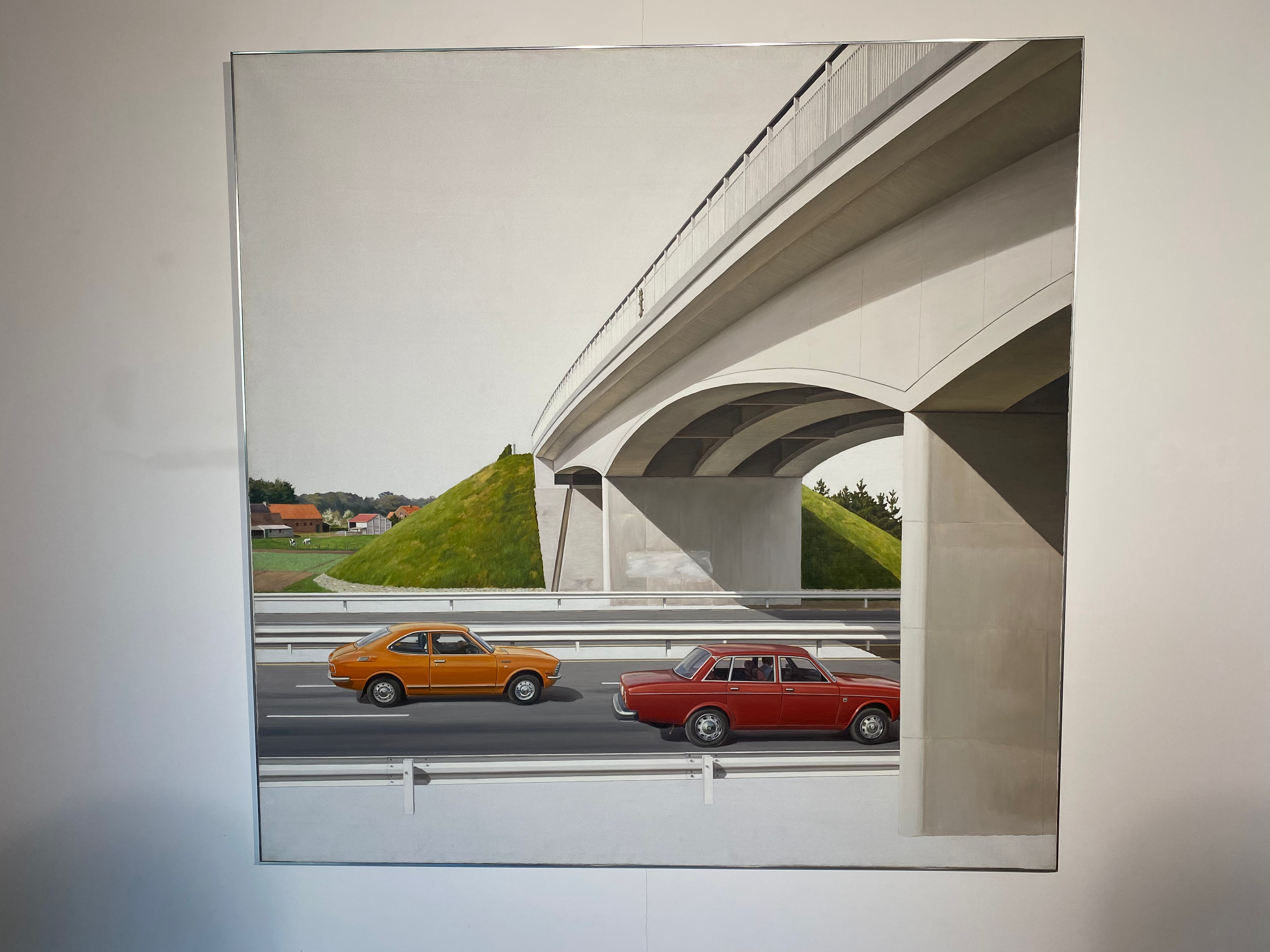
Hyper-realism – Along the E5 Highway – Antoon De Clerck – Picture by Petervan
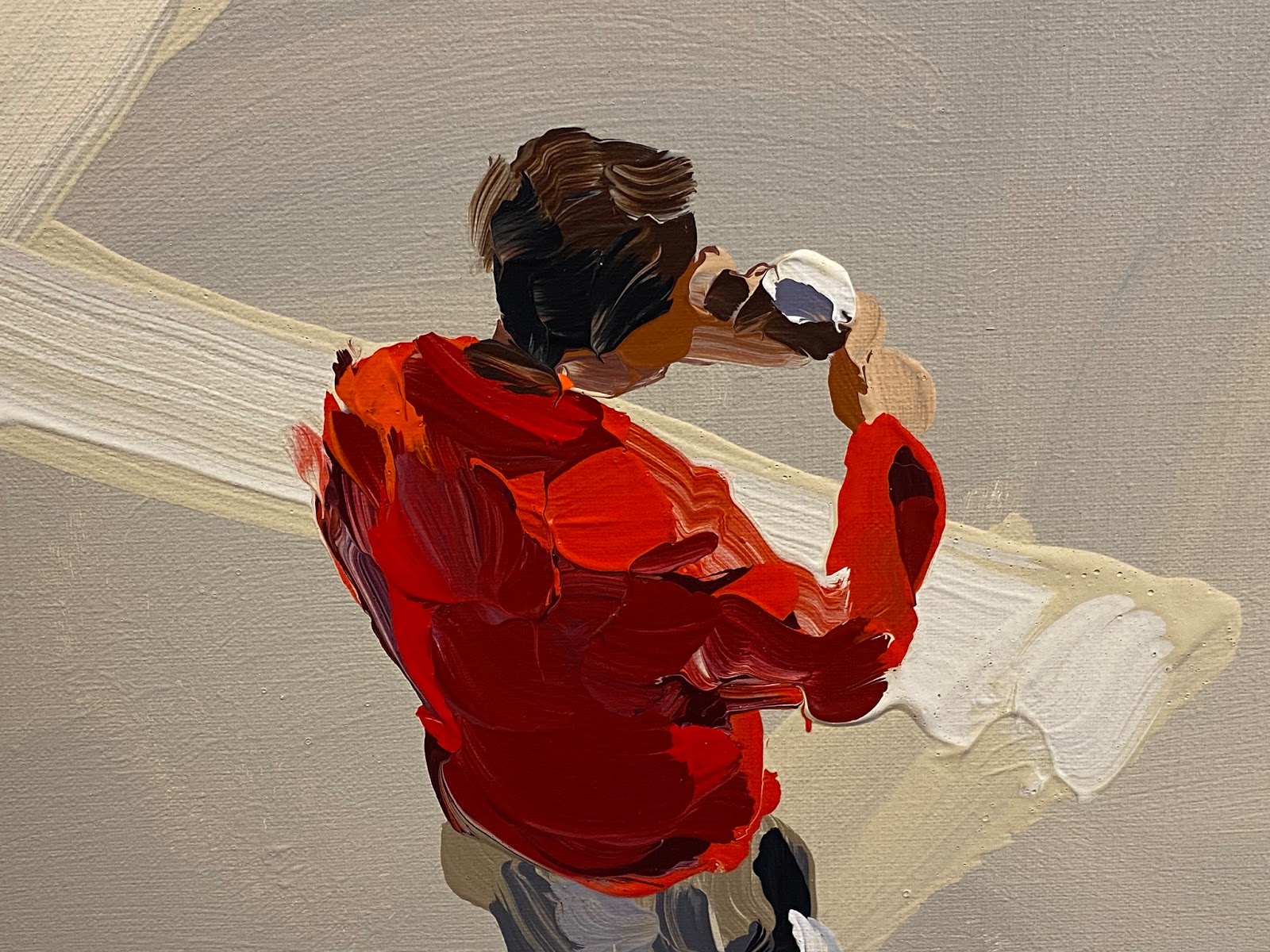
Detail “Les Grand Voyages” – Rene Magritte – Oil on Canvas – Picture by Petervan
Social Media
Somewhere in the beginning of February 2024, I deleted all my social media accounts: Twitter, Facebook, LinkedIn, Bluesky, Mastodon, etc – ALL of them. I only kept my Instagram to sporadically share some images.
I felt there was so much noise, that it was not worth my time anymore to daily scan all the new streams for something interesting. I am now subscribed to only a very limited number of newsletters on Medium and Substack.
I also found conversations got much more interesting when I scheduled some quality time in catchup calls.
The best way to contact me is now via email or WhatsApp.
What’s next?
I don’t know. Focus areas are:
The Summer of Protocols
The Cybernetic Performance
The New New Babylon project
So, that’s it for this edition.
If there is something worth reporting, the next update is for July 2024.
As we close the year, here is the latest update on Petervan Studios.
The previous update was in March 2023. In a sense, this update is an update on the whole year. A lot has happened since then. A lot did not happen. An overview.
Quick catch-up
I studied architecture (art school), never practiced (dropped out), and stumbled into a nice corporate career. In 2017 I took a sabbatical and never went back. I left the corporate world. I am now officially “retired”
Family
On 18 Dec 2023, Astrid became 18 years, officially “of age”, driving our car (good driver, final exam in Feb 2024), and started higher studies (a four years bachelor nursery), and horses, of course. And in May, we celebrated our 30th wedding anniversary. Time flies. Happy times.
Cosy Birthday Breakfast for Astrid
The Art Studio
The Art Studio is nicely rippling along. I did not have the feeling that I accomplished much, but with hindsight, it’s not too bad, and there are a lot of good foundations for the year to come.
Some of the new projects include:
Hexagrams
Claim your word
Something has dissipated
New paintings
New digital artworks
New soundscapes
Experimenting with interfaces for IRL and VR installations
You can find most of them via the “Artworks” tab on my website.
The “Something has Dissipated” project got some traction. There are now about 20 spoken language versions by real humans, including Mongolian and Chinese. But also some synthetic non-human avatar versions like this one:
In the planning is a personal solo art exhibition in VR coming and maybe IRL. Some installation concepts will try-out first in VR, and maybe later IRL.
A new performance lecture “City of Play” is in the making, about the New New Babylon (and the power of imagination). No specific target date. I have time, and it has to be right.
New New Babylon – City of Play
I am kind of obsessed with the New Babylon project of artist Constant Nieuwenhuys, who co-founded the avant-garde COBRA art movement in the 1950s.
For 25 years he worked on New Babylon, an imagined city for the playful and creative human being. The oeuvre consists of hundreds of drawings, sketches, and maquettes. His work was inspired by the book Homo Ludens by Johan Huizinga.
The NEW New Babylon is an artistic research project where we use 2023 technologies.
At the time of writing, we are trying to set up a team/consortium to overlay an existing city (district) with a VR environment for A/B Testing of the urbanistic, economic, and governance aspects of the city.
It probably will involve expertise from worlding experts, interactive fiction, procedural games, autonomous worlds, protocol language patterns, etc
At this moment I am exploring a whole slew of tools: videosync, BEAM, BAM, Procreate Dreams, Capture for scene design, and spending lots of time on learning/trying to understand Blender, Unity, Unreal Engine, new Ableton packs, the new version of Apple Logic Pro X, and hopefully soon Apple Vision Pro.
Timing slips. No problem, I have time. And it has to be right. And not sloppy.
Since March 2023, I visited many art exhibitions and galleries. If I had to pick one or two highlights, it would be Jan De Vlieger at Mudel and the Inspired By Love expo at Belfius Art Gallery. Picture below is work by Emilie Terlinden.
Detail Jan De Vlieger’s San Marco People – picture by Petervan
Detail of Emilie Verlinden’s The Farm 2023 – Picture by Petervan
Also, the works of David Claerbout and his practice are a continuous inspiration for my own work. Here is a great talk by David at Schaulager Basel as part of the Out of the Box exhibition.
David Claerbout discusses a range of artworks, among them Nightscape Lightboxes (2002-2003), Wildfire (meditation on fire) (2001), and Backwards Growing Tree and Birdcage (both from 2023), the latter two on show at the Gallerie Greta Meert in Brussels till 3 Feb 2024.
What’s next?
I don’t know. Focus areas are:
The New New Babylon project
The upcoming solo exhibition in VR
The Performance
But some promising smoldering sparks deep in the campfire may suddenly light up. Life is full of surprises. Only the fool don’t change their mind.
So, that’s it for this edition.
Happy New Year to all of you!
If there is something worth reporting, the next update is for April 2024.























 Petervan Studios