The Orphic Experience: We are all Argonauts again

In my post about Dub-Techno artist Adrian Sherwood, I referred to the book “Dub Techno – The Orphic Experience of Sound” by Bahadırhan Koçer to describe my sound experiments with dub.

As promised in that post, the most compelling part of the book appears in its opening chapters, where he introduces “The Orphic Experience.”

The short summary is in the video below, from 0:59 to 2:23. The latter part of the video is about the three key elements of dub-techno: spontaneous repetition, atmosphere, and embracing noise.

TL;DR: The orphic experience uses music to alter perception, evoke deep emotions, and influence the listener’s state of mind. It creates a unique space and time for introspection and reflection.

Let me unpack this in stages: first the “orphic” aspect, then the “experience” element, and finally a synthesis.

Orphic

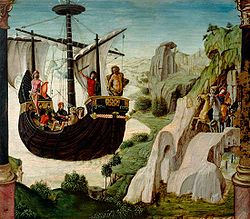
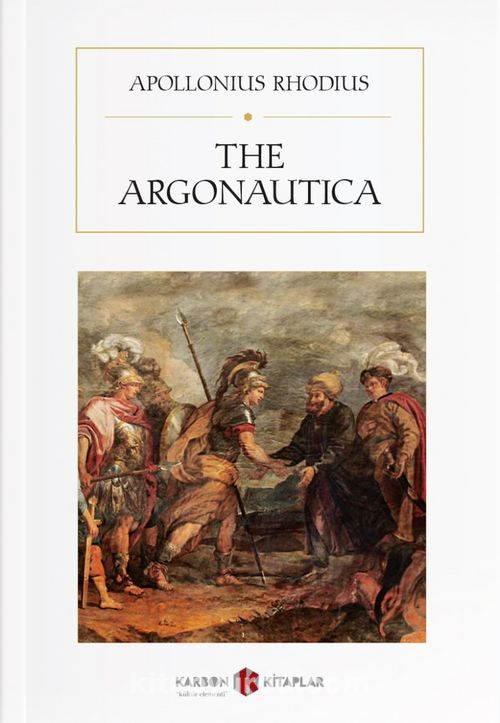
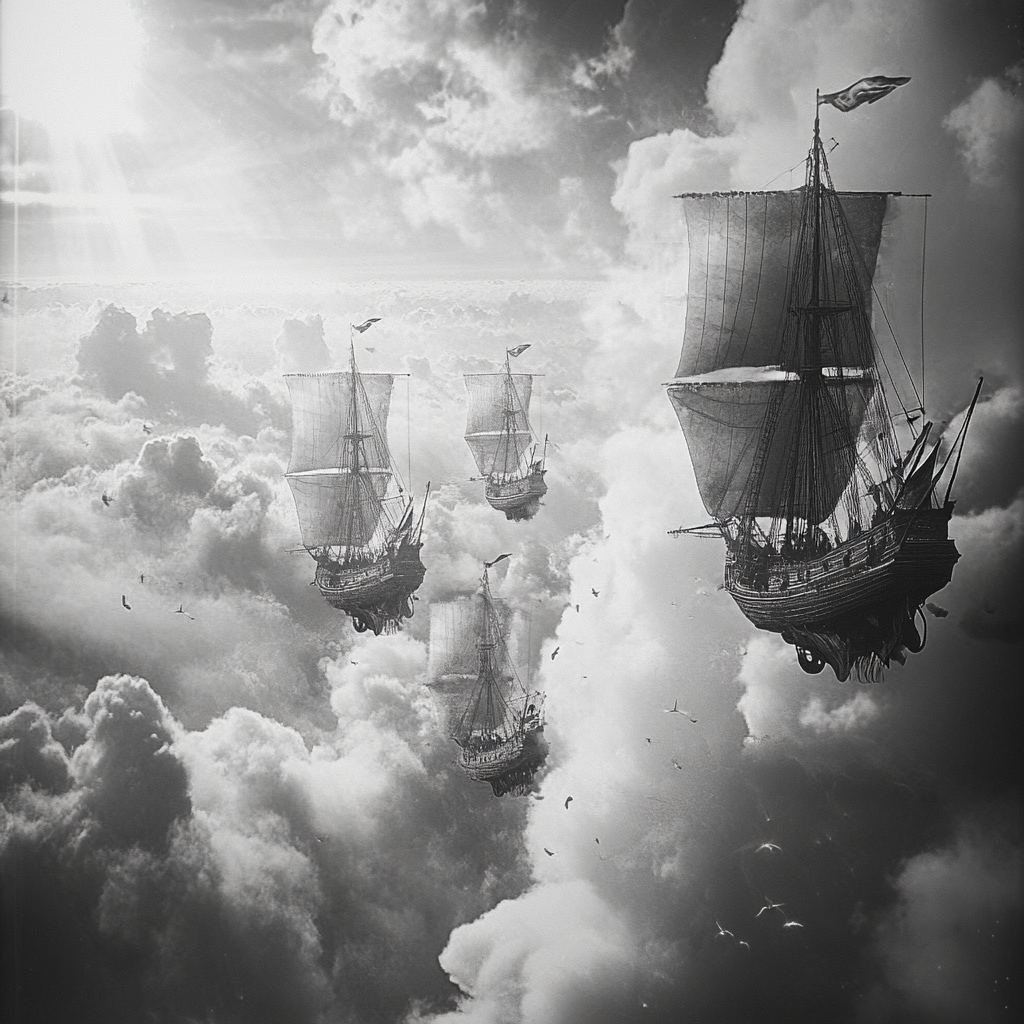
The “orphic” part originates from Orpheus, a character in the ancient Greek poem Argonautica, dating back to the 3rd century BC. The Argonauts are travellers on the boat Argo and are on a quest for the golden fleece. Somewhere along the route, sirens are trying to seduce the boatsmen. Still, Orpheus – a talented singer/musician on the boat – can shield the boatsmen from the Sirens’ temptations through his celestial, beautiful songs and voice. In other words, he was a noise canceller avant la lettre.

Some salient quotes from Bahadırhan Koçer:

The orphic experience, therefore, refers to the transformative way sound and media technologies can be used to control one’s sonic environment, creating a personalized auditory space that shields individuals from the overwhelming stimuli of modern life.

It is conceivable to argue that the nature of this transformation lies fundamentally in a shift from communal to individual listening.

The protected space needed for “sensory and emotional self-care”

In this sense, orphic experience can be seen as a way of escaping from the demands of the real world and constructing a self-contained, artificial reality.

By carefully curating their auditory environment and creating a personalized soundtrack to their lives, the individual can signal their taste and distinction to others, and distinguish themselves from those who do not possess the same level of cultural capital.

The “orphic” concerns the creation of a protected, isolated space in which the rules constraining clear thought can be suspended.

Experience

The second part is about “experience”. The words “Narrative” and “Experience” have become catch-all words. Washed-out. Weak. And they all suggest a passive audience.

Also here, a David Claerbout quote is appropriate:

I think the recent proliferation of black boxes for film and video-art is not just a practical solution to a problem of sound and light interference, but also reflects an incapability to coexist. This can become apparent in large group exhibitions, where media installations appear strong when they are shown by themselves in a small or large dark space, but they easily collapse when shown in a social space where people move about and interact. The black box is a social phenomenon, for me it is a problem.” Ulrichs, David, ‘David Claerbout. Q/A, in: Modern Painters, May 2011, pp. 64-66

“Designed Conspiracy” would be better to describe what I have in mind. With an active audience. Or even better, where there is no stage hosting the expert speaker and no passive audience just leaning back in chairs, incapable of truly internalising knowledge.

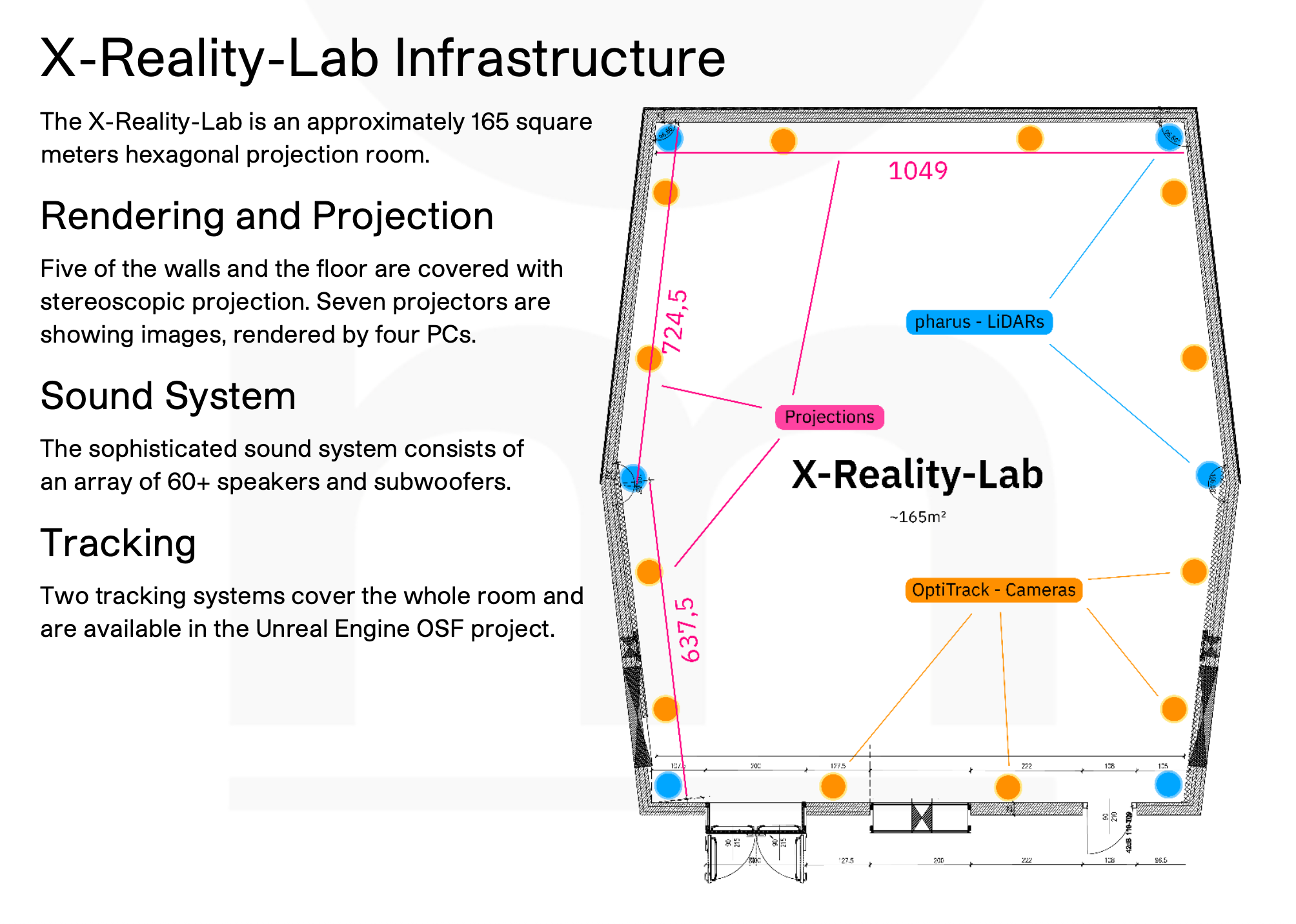
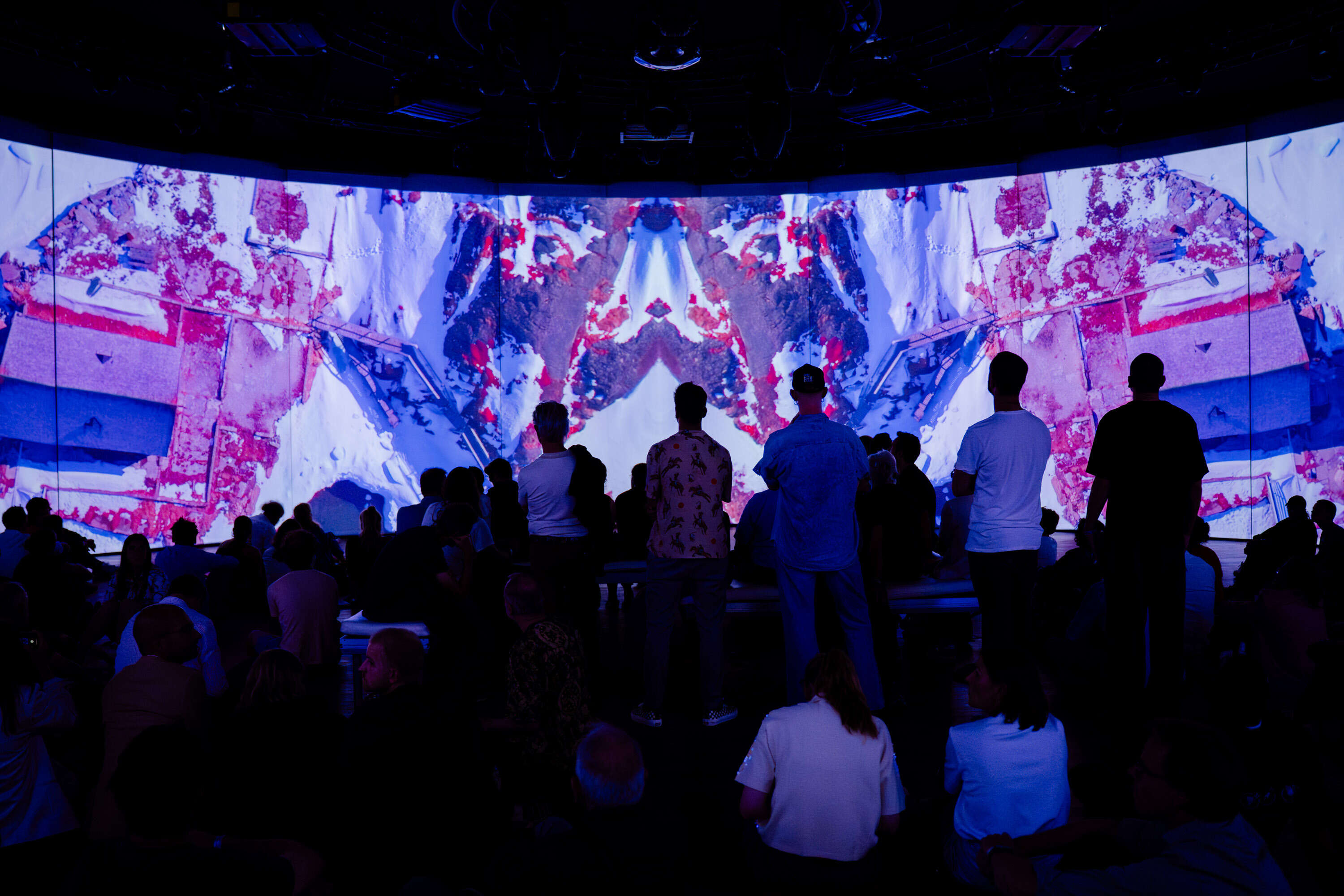
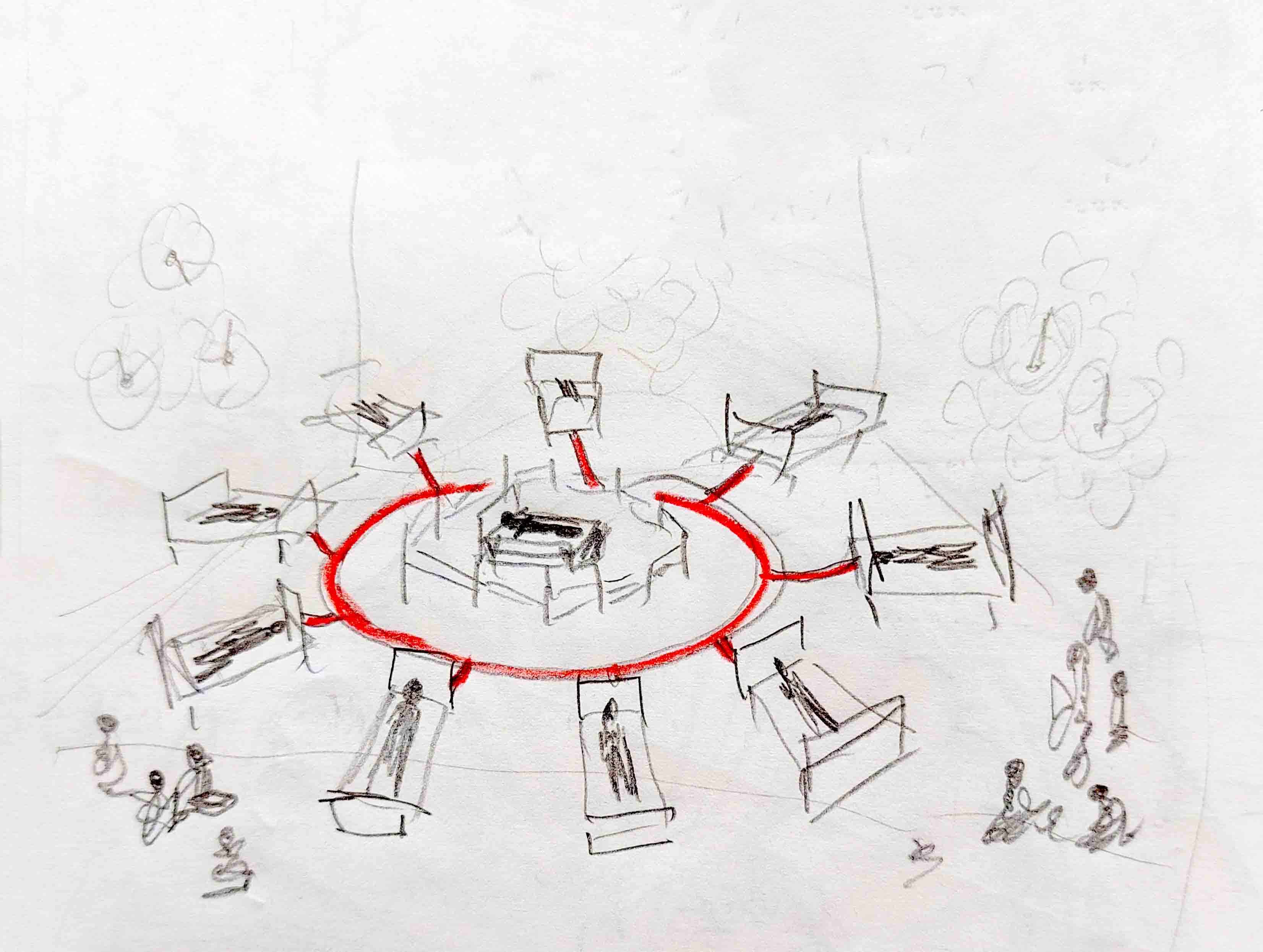
I imagine us inside a 360° immersive room: a six-metre-high LED screen, full 360 Dolby Atmos sound, LiDAR tracking, and high-definition cameras—paired with exceptional content and facilitation. A complete experience in a box, ready to tour and deploy anywhere in the world. Am I exaggerating? Maybe not. I’ve just met someone who is building exactly this.

Synthesis

Obviously, I am using all of the above as a metaphor to try to explain what I do with my artistic interventions, provocations, and interruptions. These qualities inform my work/play. Whether that is soundscapes, installations, performances, or group expeditions.

Now that we have our protected, isolated space and a designed conspiracy, it is time to play the music. Music is the content. Content is the music.

Experiencing our music – individually or as part of a group – can feel like a trip, a trance, like digital psychedelics.

The music/content is presented in the right space, with the appropriate emotional and psychological atmosphere—the backdrop, if you will—inviting and sustaining safety, interest, curiosity, awe, and growth.

The rhythm is softer, slower, quieter vs. harder, faster, louder.

We embrace – and even design – flaws and imperfections, spontaneous repetition, and noise, inviting the participants to connect with being human, and to internalise the content at an embodied level of sensory experience.

We design with fifty shades of sophistication: avant-garde activism shaped by counterculture, driven by intention and direction. We build a relational infrastructure capable of holding shared ambitions, carrying a map as a symbol of movement, of becoming. These are maps that make meaning—shifting the question from the adolescent “Where are we going?” to the more deliberate “What direction do we want?”

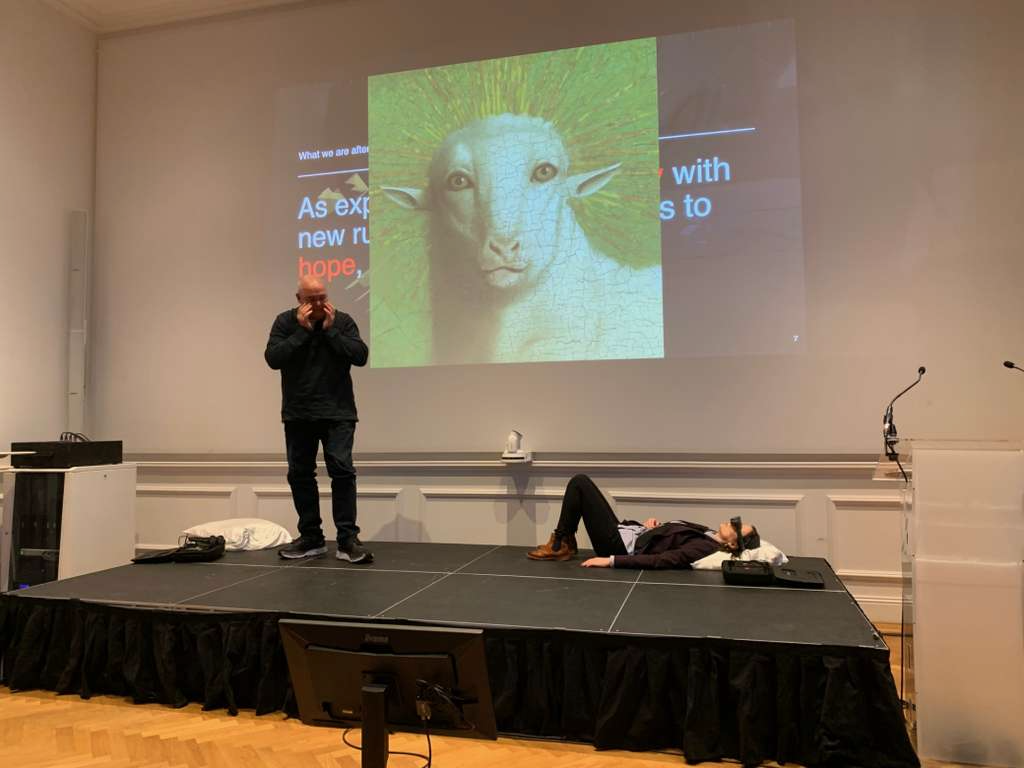
We are all Argonauts again. We are experiens-explorers. We want to create the right spaces and conditions for debating the new rules and the associated structures of reality, then acting them out as if those rules were in place. As explorers, we want to play with new rules to dream, new rules to hope, but also – not to sound too cheesy or utopian – new rules to suffer and cope with what is evil and sin. In that sense, we become all part of a shared conspiracy.

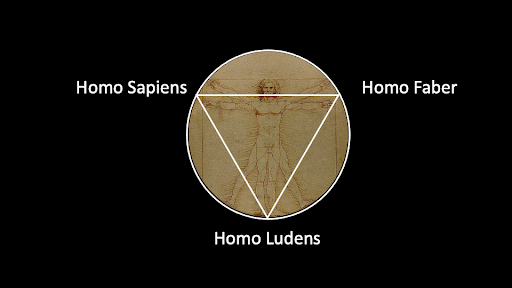
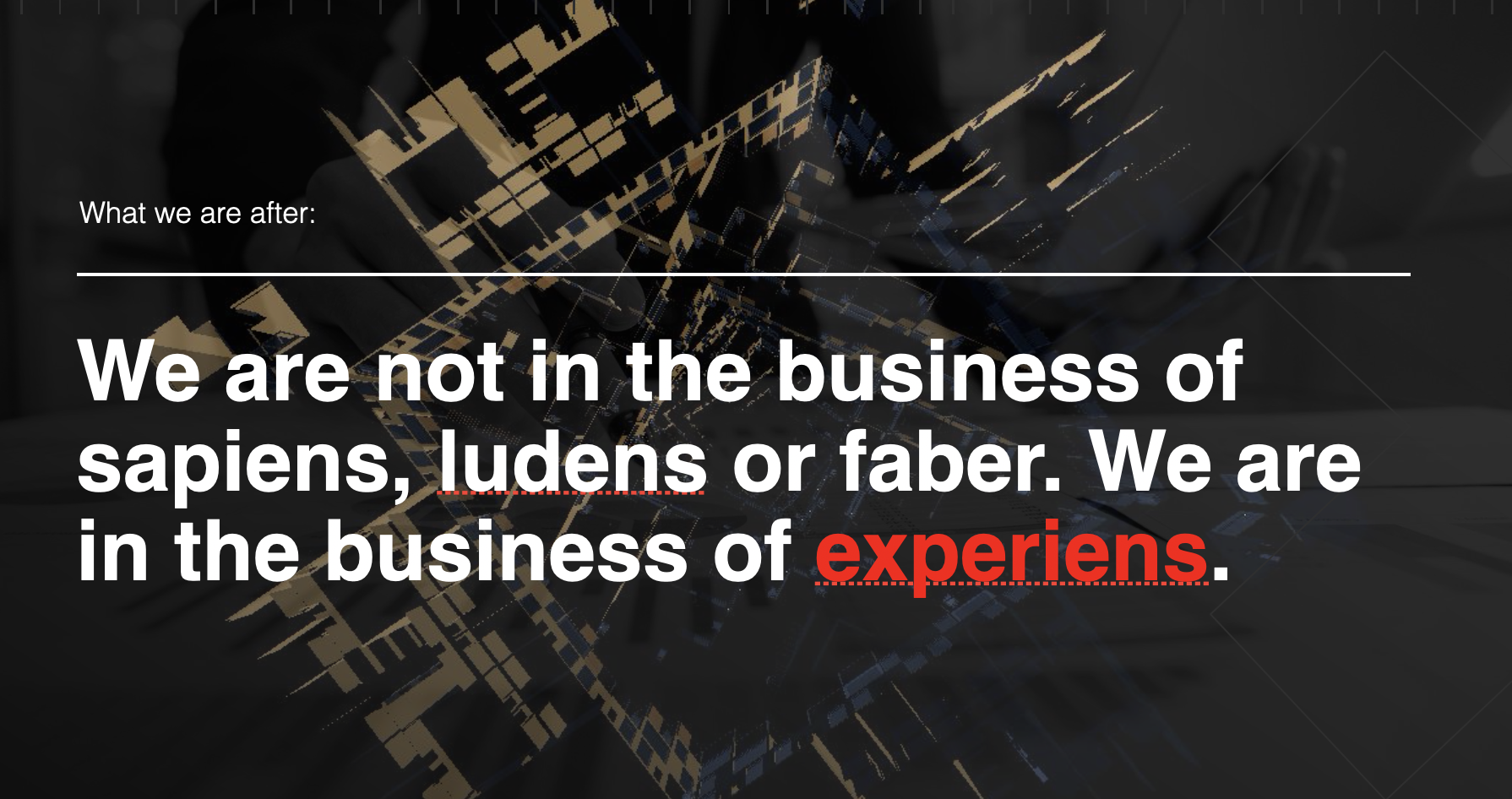
We are not in the business of homo sapiens, ludens, or faber, but in the business of homo experiens.

Petervan’s Delicacies – October 2025

“Delicacies” is my incoherent, irregular, unpredictable collection of interesting sparks I came across online. Handpicked by a human, no robots, no AI. A form of tripping, wandering, dérivé, with some loosely undefined theme holding them together. Delicacies have no fixed frequency: I hit the publish button when there is enough material. That can be after a week or after 3 months. No pressure, literally. Enjoy!

Some highlights from this edition:

If you prefer the full firehose, check out the Substack link: https://petervan.substack.com/p/petervan-delicacies-180

3C – Peeling Layers – Episode #1

For the past few months, I’ve been co-working on a new, still embryonic project—co-written and co-directed with Andreea Ion Cojocaru, enriched by the expertise of my cousin Joost, a PhD art historian, and further shaped through the collaboration of several contributing artists.

Until now, I have only shared this project with a few people. Many of them suggested that I start documenting “the making of” our project, so this blog post will serve as the first episode.

Our project takes the form of an experimental alternate reality experience that explores the nature of flesh, human suffering, and the role of technology. At its core lies a question both ancient and urgent: Who are the new gods that might deliver us from suffering?

The project ultimately strives toward the organization of a Third Council on this topic, which we call simply: 3C

Our approach weaves together mysterious, multi-layered storytelling and conspiracies across several digital and non-digital platforms. Different strands and overlapping narratives unfold in various locations—one of them being Ghent.

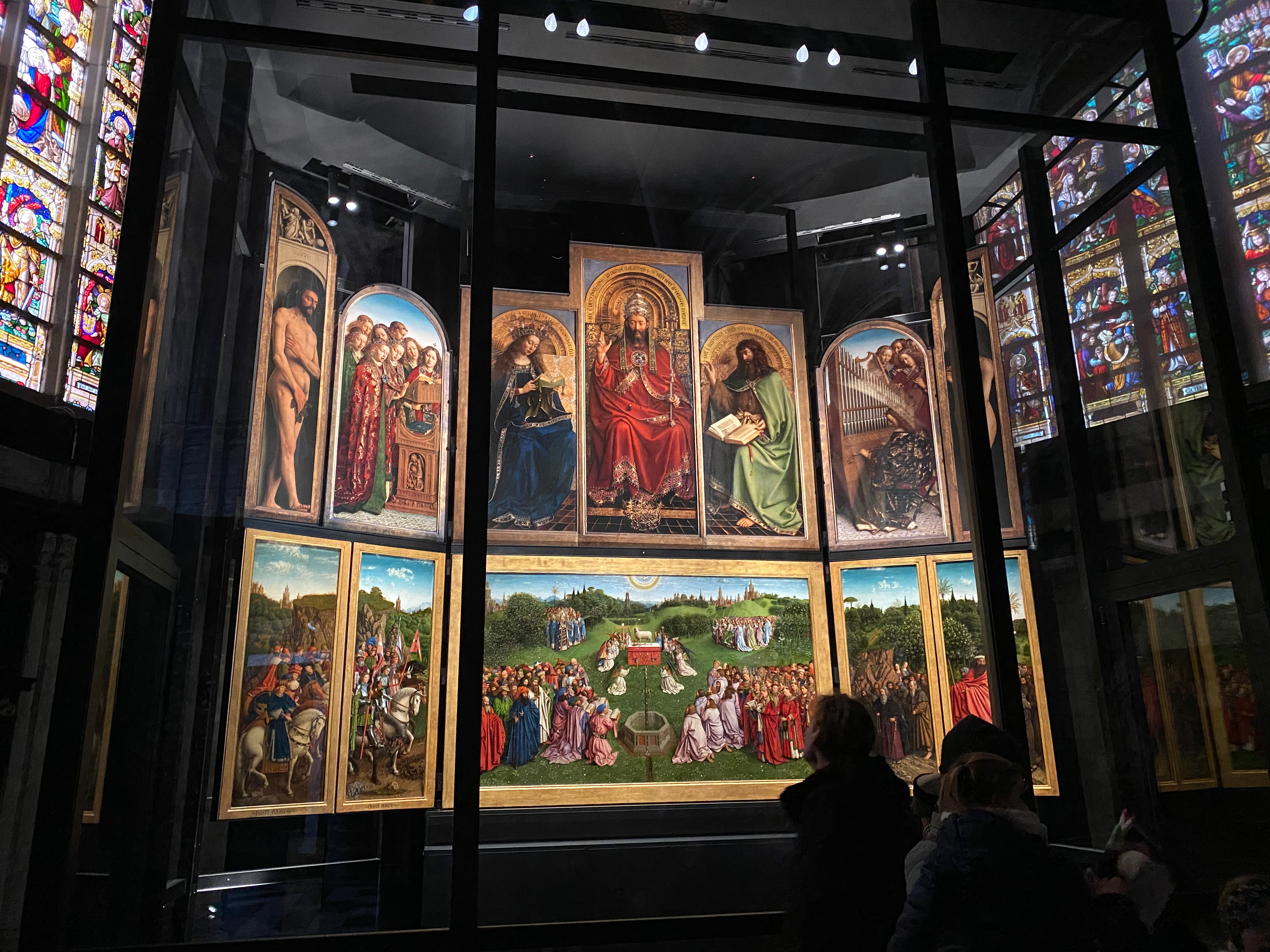
This Ghent storyline begins with the renowned Mystic Lamb Altarpiece by the brothers Van Eyck. Commissioned by the Vijd family, the altarpiece was unveiled on 6 May 1432, coinciding with the baptism of Philip the Good’s son. Countless volumes have been written about this extraordinary work. An accessible introduction can be found on The Ghent Altarpiece site. For deeper study, Closer to Van Eyck offers breathtaking HD detail and analysis, and of course, there is always the comprehensive overview on Wikipedia.

The Mystic Lamb Altarpiece – Picture by the author

After a meticulous and highly professional restoration, conservators peeled away later layers of paint to reveal the original brilliance of the Van Eyck brothers. Today, the restored masterpiece can be admired behind bulletproof glass in Saint Bavo Cathedral, Ghent.

At a certain stage of our project, we began to wonder: was there ever an actual altar placed in front of the painting? I turned to my cousin, the art historian, and he replied:

“There has already much research been done on the original disposition of the Ghent Altarpiece  e.g. by Dr. Elisabeth Dhanens and even considering the combination of that polyptich with sculpture, but non of the hypotheses has completely convinced the specialists. The oldest existing images of the chapel are too young to obtain a precise idea of the original situation. As in such chapels it was the rule that a yearly mass for the souls of the deceased and portrayed patrons was said by a chaplan, normally (a altar focs chapel being smaller than a main altar in the main church building) would have been foreseen. But we do not have an idea how it looked like.”

I wanted to buy the book by Dr. Elisabeth Dhanens, but like many art publications, it was prohibitively expensive, so I went instead to the Arts Library at the University of Ghent and borrowed a copy there.

In our project, the peeling away of layers from the Mystic Lamb becomes a metaphor for a deeper, more abstract process: the peeling away of layers of reality itself.

The Altarpiece also carries a built-in narrative advantage—its own entanglement in conspiracy. On 11 April 1934, one of its twelve panels, The Righteous Judges, was stolen and has never been recovered. This theft has inspired countless books, theories, and websites. Among them, the Righteous Judges site offers both a clear overview and an excellent timeline of the events.

On June 3, 2025, I undertook a short trip to Ghent, exploring the neighborhood in search of clues about the lost panel. Along the way, I recorded a compact photo-video documentary to capture my findings.

Here is one of the pictures: a café next to the cathedral called “De Rechters/The Judges”

Our project is multi-dimensional and undeniably ambitious. We’ve prepared a solid funding pitch, but if we wait for financial backing before taking any action, nothing may ever materialize. So instead, we’ve decided to start sharing small glimpses of the project—a slow drip-feed—and watch to see what resonates and what gets picked up.

But is there an audience for this? We hope, but don’t know. Perhaps only an audience of one. Kevin Kelly recently wrote an insightful piece on that very idea.

“From now on, the default destiny for most art will be for an audience of one, and it will abide in the memory of those who generate it. While some of this co-generated work might find its larger audience and some very tiny fraction of it might even become a popular hit, its chief value will be in the direct, naked pleasure of co-making of it.”

That’s very much our mindset—our “eye-set” too: as long as we enjoy creating, we’ll keep going.

On the more playful side, Ghent offers several signposted bicycle tours inspired by the Mystic Lamb Altarpiece and the story of the stolen panel. One of them is intriguingly titled “VermoedelEyck daar / Probably ThEyck” I plan to try it out soon and capture some photos and videos to share later.

In Limbo or Not? – A Timeless Day at the Castle of Gaasbeek

Picture @petervan

I went to the premiere exhibition of David Claerbout’s The Woodcarver and the Forest at the Castle of Gaasbeek. I went by bike, for me, a two-hour ride each way, on a warm sunny day through the Pajottenland, the region southwest of Brussels where I spent the first 25 years of my life. Cycling up and down its rolling hills stirred deep emotions and memories of my youth. This is the land of Bruegel, of Geuze and Lambic beer, of Remco Evenepoel. It is also, unmistakably, my land.

Before arriving at the castle, visitors walk about 15 minutes from the entrance through a carefully tended, forest-like domain. The path itself already feels like part of the experience, drawing you gradually into a slower, quieter, almost meditative state.

There is also a 2-hectare Museum Garden.

Picture © Fabrice Debatty

A top-level garden modelled on castle gardens from the 18th and 19th centuries. A strong example of living cultural heritage. Take a stroll through this magnificent Garden of Eden, with the old-model fruit repository, the beehives, and a wonderful view of Gaasbeek Castle and the Pajottenland.

I lingered in the garden for some time, sitting on a bench and gazing at another bench across the way, the two connected by a loofgang—a leafy tunnel formed by pear trees. I simply sat in silence, doing nothing. Eventually, I walked through the shaded passage to the other side, before making my way to the castle. In hindsight, the video I captured carries an unintended sense of suspense.

Once inside the castle, visitors are guided along a signposted route. Along the way, I captured this video of sunlight filtering through stained glass, casting vibrant patterns onto the wooden, carpeted floor.

The Claerbout installation awaits at the very end, rising three stories high beneath the roof.

From the brochure:

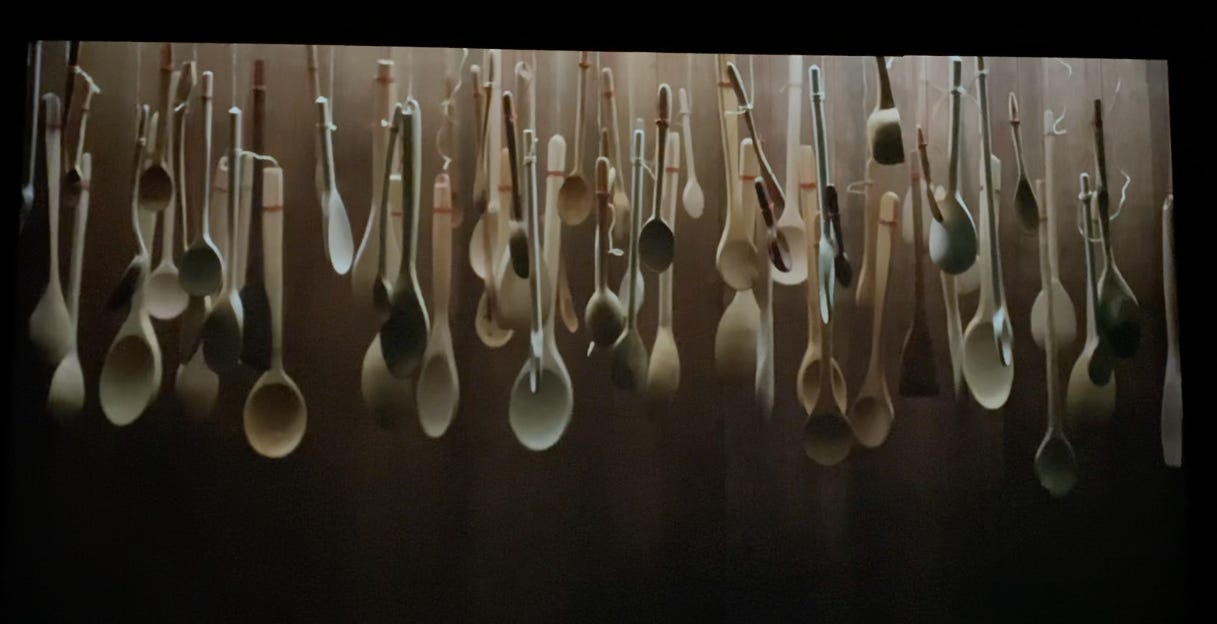
This work is Claerbout’s latest creation and presents itself as an intimate portrait of a reclusive young man. Do you feel the meditative effect of the slow, repetitive movements and their sound?

Specific audiovisual stimuli – such as soft sounds or rhythmic movements – can evoke feelings of relaxation and inner calm. This phenomenon is known as ASMR (Autonomous Sensory Meridian Response) and forms the foundation of this work

The Woodcarver and the Forest is an open film, which is completed using generative artificial intelligence. As a spectator, our experience also remains open and unfinished, partly due to the long duration of the work.

This reveals the dual nature of the film: an interplay between pleasure and sorrow, beauty and destruction.

Still from Claerbout’s video installation – picture by @petervan

I sat in there for more than one hour. It put me in some state of limbo about my own work and where I want to go next. Following Google’s Gemini AI, it means “to be in an uncertain, undecided, or forgotten state where nothing can progress or be resolved, similar to being caught between two stages or places.”

I am a big fan of David Claerbout. See previous entries on this blog here. The Woodcarver gave me the chance to revisit some of Claerbout’s earlier works and conversations, while also helping me reconnect with the artistic drive within myself.

Here is a more recent talk by David Claerbout

Some interesting quotes

Change your mind-set ànd your eye-set, from inquisitive to open-ended

The Brain does not choose sides; it does not know how to

And around minute 18, he gets into a very interesting schema of “former” AI technologies. He really got me when he says “the camera is a profoundly liberal invention” and later “around the 2000s, we start to think of visual culture as a assemblage, the coordinate system is back, and a coordinate system knows exactly where you are it has exact points in space it can find you back and instead of a liberal body in a world that could be anything anywhere it changes into a pinpointing in a space that so we we get a gathering of coordinates and we’re no longer free” 

In closing, he shares reflections on recent readings that explore AI, vision, and the language of thought.

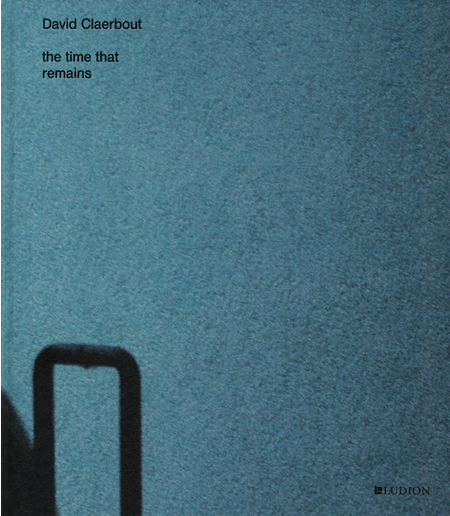
After watching the video, I visited the University of Ghent library—you can get a visitor’s pass as a non-student for €15 per year, granting access to all of the university’s libraries! There, I picked up the book The Time That Remains, a title that resonated with me on two levels: first, the concept of time, so ever-present in Claerbout’s work; and second, the realization that I am approaching my seventieth birthday, prompting me to reflect increasingly on the time I have left and how I want to spend it—especially in my artistic practice, if I can even call my tinkering that.

From the intro:

This publication marks the welcome collaboration between internationally acclaimed Belgian artist David Claerbout and two European institutions: Wiels, Brussels and Parasol unit, in London. The publication accompanies Claerbout’s exhibition opening at Parasol unit, on 30 May 2012; but it also provides a highly appreciated documentation for Wiels, which held a solo exhibition of Claerbout’s work, The Time that Remains, in 2011.

It’s from 2012, but the content is, well, timeless.

Some quotes/insights from that book.

I think the recent proliferation of black boxes for film and video-art is not just a practical solution to a problem of sound and light interference, but also reflects an incapability to coexist. This can become apparent in large group exhibitions, where media installations appear strong when they are shown by themselves in a small or large dark space, but they easily collapse when shown in a social space where people move about and interact. The black box is a social phenomenon, for me it is a problem.” Ulrichs, David, ‘David Claerbout. Q/A, in: Modern Painters, May 2011, pp. 64-66

+++

Time is invested into something that will prove to be valuable and productive. By consequence duration’ becomes increasingly expensive. But duration can only be free if it is unproductive.”

+++

Cinema, YouTube and film-festivals demand the prolonged physical immobility of the viewer. Music, exhibitions or a walk in the park don’t.

My sense of being in limbo stems from a hesitation: to move further into abstraction rather than figuration, toward longer forms rather than shorter ones, toward meditative sound and video landscapes rather than straightforward documentary. It also comes from my struggle to resist the banality of social media—where time is squandered on addictive, bite-sized fragments of content that ultimately feel useless.

I believe I know the answer, yet I dare not leap just yet.

Who will be the one to give me a gentle nudge?

Is this still needed?

PXL Immersive Music Day 24 Apr 2025 – Conference notes

As part of the research for my immersive projects and performances, I am trying to better understand the visual and audio aspects of XR experiences. In that context, I attended the Immersive Music Day at PXL in Hasselt, Belgium, organized by the PXL Music Research team. The full program, schedule, and lineup are here.

It is a relatively small-scale event (I guess about 100 PAX), which is great as it enables networking with the participants and the speakers. The event was held at a location with great immersive audio infrastructure (3 rooms with full 360 sound set-up). For the rest, it was a no-frills event with super-friendly staff and good food at breakfast and lunch.

Example of an immersive music room set-up

I was also pleasantly surprised by the mix of ages, ranging from fresh-faced high school students to seasoned audio veterans and legends, plus corporate fossils like myself. That kind of diversity usually signals that something truly interesting is about to unfold.

But the best part was the content and the speakers.

If there was an intended or unintended theme, it would be the subjective aspects of the immersive experience (how sound “feels”, or about the experiential coherence of auditive, visual, and spatial input) vs. the technological aspects of immersive sound (like precise localisation of sound in space). But I am sure that in some other sessions, the content was quite nerdy, up to the detailed coded and mathematical aspects of encoders/decoders.

Here are a few notes and reflections from the sessions I attended.

Immersive Space – An Agent for Creating and Experiencing Music

Speaker: Wieslaw Woszczyk, Director of the McGill Recording Studios and the Laboratory of Virtual Acoustics Technology at the Schulich School of Music of McGill University.

Program synopsis: Humans have sensory capabilities for recognizing their presence and immersion in space. Music ideally matches these capabilities by presenting dynamic, tonal, harmonic, and rhythmic structures in sound. Musicians use space to generate and blend sounds of ensemble, to hide and reveal musical voices, to dramatize perspectives, and to harness emotion in music making and listening. The talk explores immersive space as a modern technological tool for augmenting people’s experience of music

CIRMMT Dome with 32 speakers

Notes:

I had never considered immersive sound as a medium for live music performance—being physically present in one space while listening to live musicians through a 360° sound system that simulates the acoustics of an entirely different environment. Wieslaw talked about auditory “fingerprints” of spaces. This goes way beyond sound effects like reverb that simulate the reverb of a cathedral. No, this fingerprint captures the full acoustic character of a space—every corner, every height, every nuance. And there are plug-ins available that let you import this detailed acoustic profile directly into consumer-level digital audio workstations like Logic Pro and others.

This allows performing artists to shape and test their artistic expression for a specific space, like the San Francisco Cathedral, or lets the audience experience the music as if they were actually there, immersed in that very acoustic environment.

Altering the Immersive Potential: The Case of the Heilung Concert at Roskilde Festival

Speakers: Birgitte Folmann, Head of Research, Sonic College, and Lars Tirsbæk, Consultant in Sound & Emerging Technologies, Educator 3D audio, Sonic College

Program synopsis: Immersive concert experiences are often described as specific, emotionally moving, dynamic, and complex – qualities that require experimental and interdisciplinary methods to be meaningfully understood. In this talk, we explore the immersive and engaging potential of live concerts through the lens of the Heilung performance at Roskilde Festival. Drawing on anthropological fieldwork and insights into the technical systems that supported the experience, we discuss how a deeper understanding of immersion can inform both artistic and technological development to enhance future audience experiences 

Notes:

The talk was about the Heilung Concert at Roskilde Festival in 2024, in a festival tent holding about 17,000 people. Details about the technical set-up by Meyer Sound here.

What struck me was that the concert wasn’t branded as an “immersive” experience—there was no expectation set in advance. Yet, the immersion began the moment people entered the tent: birdsong filled the air, subtly blurring the line between environment and performance. It reminded me of my Innotribe days, where we also paid close attention to how people entered a space. After all, arrival and departure are integral parts of both the performance and the scenography.

The first part of the talk by Lars was about the technical challenges of delivering a 360 immersive sound experience in such a huge space. The second part by Birgitte was about the anthropological and subjective aesthetic experience of immersive music by the audience. Her slogan, “Aesthetics is a Verb” is great t-shirt material. They also talked about the “attunement” of the audience to the experience, and that you can’t fight the visuals: for example, when the drums play on the front stage, having the 360 sound coming from behind you does not work for the human brain.

Their team is now starting to document the findings of their field research. More to come.

Designing the Live Immersive Music Experience

Speaker: Paul Geluso, Music Assistant Professor, Director of the Music Technology Program – NYU Steinhardt University

Program synopsis: Paul Geluso’s work simultaneously encompasses theoretical, practical, and artistic dimensions of immersive sound recording and reproduction. His first book, “Immersive Sound: The Art and Science of Binaural and Multi-channel Audio,” published by Focal Press-Routledge, has become a standard textbook in its field. Geluso will share his research experience while providing exclusive previews of interviews and insights with featured immersive audio masters from his forthcoming book, “Immersive Sound II: the Design and Practice of Binaural and Multi-Channel Experiences” set to be published in fall of 2025. This presentation will also included discussions on his 3DCC microphone technique, a 3D Sound Object speaker design capable of holophonic sound playback, and his work on in-air sound synthesis and other site-specific immersive sound experience building techniques. 

Notes:

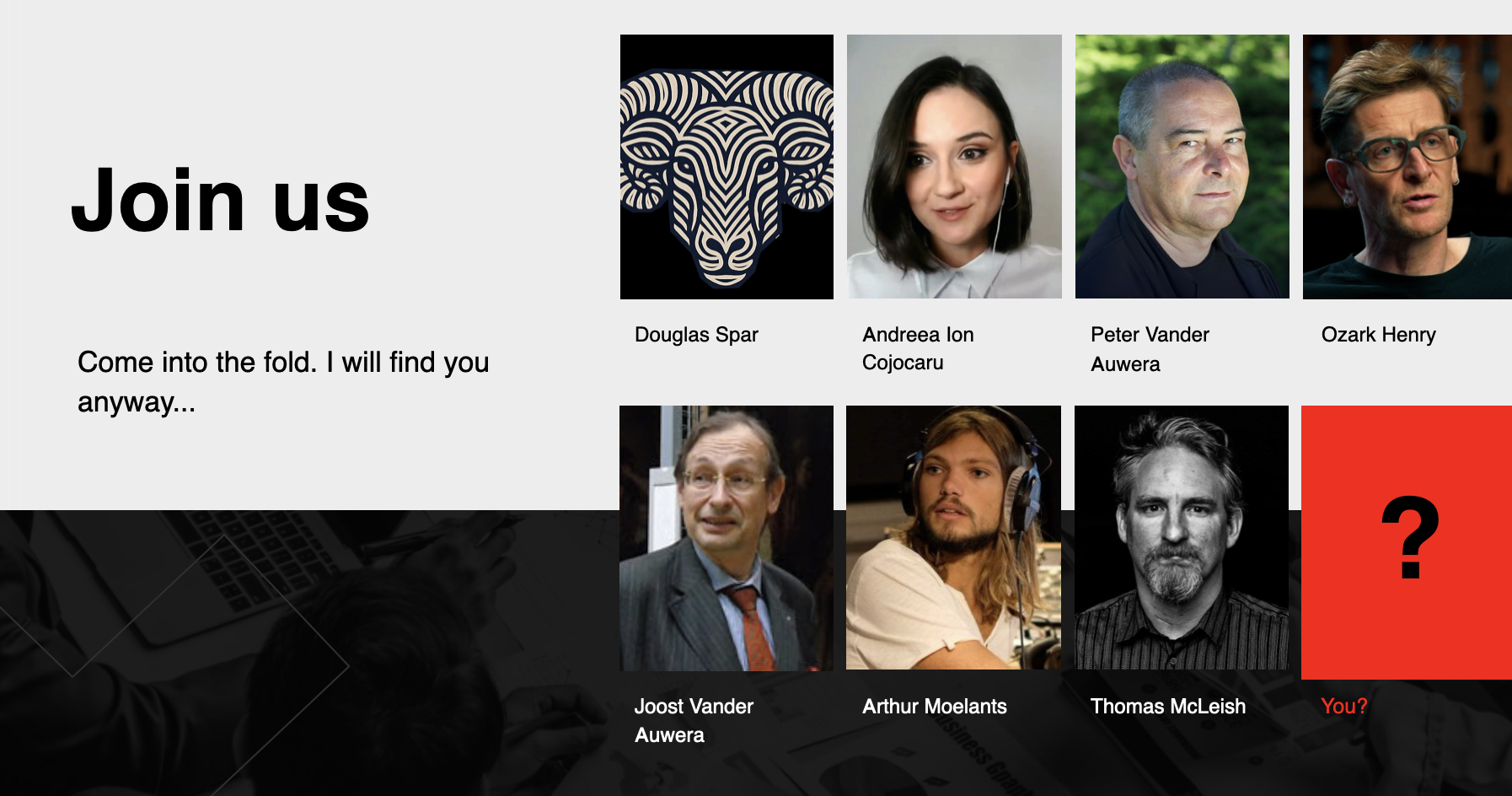
Paul Geluso is God. Some years ago, he published “Immersive Sound: The Art and Science of Binaural and Multi-channel Audio,” considered by audiophiles as “The Bible”. He is also good friends with Flanders’ best artist, Piet Goddaer aka Ozark Henry, who specializes in immersive sound and music.

Ozark Henry in his studio

Paul took us on a journey of his research on immersive recording (making custom made 3D microphones and codes) and playback (making his own “Ambi-Speaker Objects”.

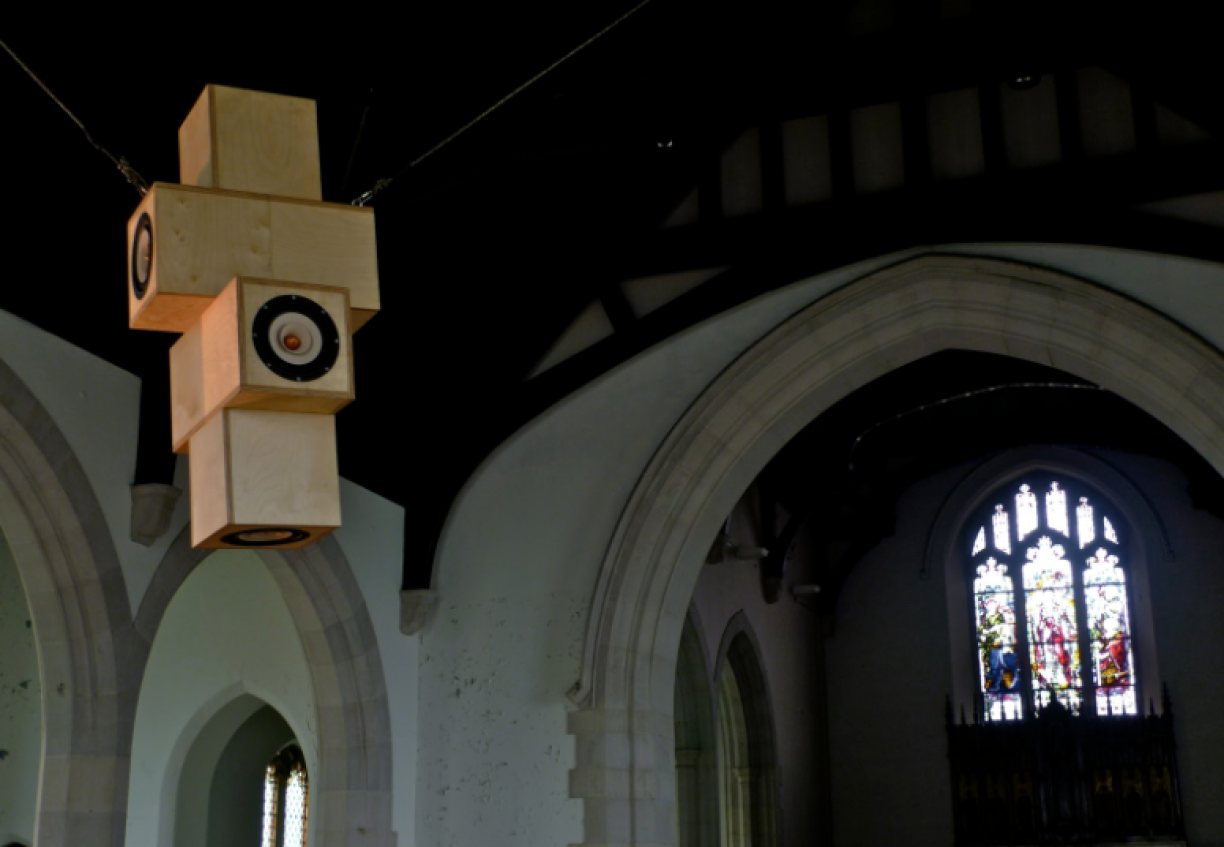
Paul Geluso’s immersive 3D Sound Object (Ambi-Speaker)

This was more of a backdrop for his upcoming book. While his first book was more about the how – the technology to record and playback immersive music – his new book will focus on the why – in essence, about leading with the story and the artistic intent. He hopes the new book will be out in 2025.

I had the chance to have a short 1-1 conversation with Paul, who seemed interested in our immersive performance ideas, which was exciting to know.

Subjective Evaluation of Immersive Microphone Techniques for Drums

Speaker: Arthur Moelants, Researcher PXL-Music

Program synopsis: When presenting a group of listeners with four immersive microphone techniques in two songs, will they always choose the most objectively correct one? An experiment with drum recordings in different acoustics and musical contexts challenges the assumption that objective parameters like ICTD and ICLD should always determine the best choice. While non-coincident techniques often score better in these metrics, listener preferences can shift depending on the musical context, as other techniques offer different sonic and practical qualities that might benefit the production more.

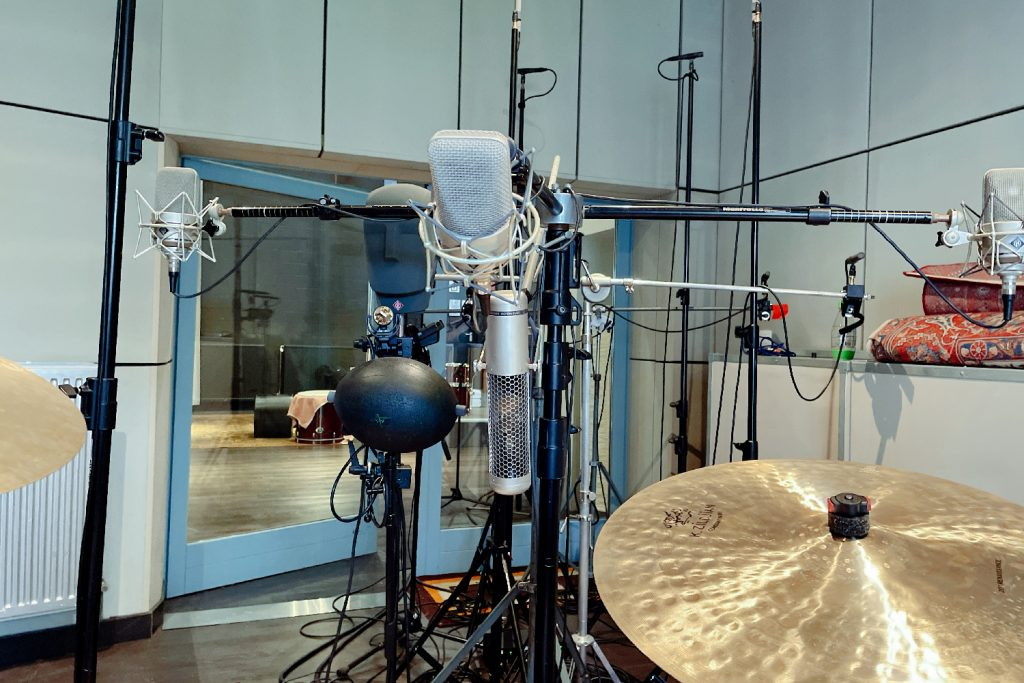
A microphone set-up for drums

Notes:

Arthur is part of my team for our immersive performances, like The New New Babylon, where he acts as both a cinematographer and immersive music expert. He is a member of the PXL-Music Research team. I was curious to see how he’d handle public speaking and delivery, and he did not disappoint. I’m always impressed by how some young professionals manage to blend deep, almost nerd-level technical expertise with polished communication and presentation skills.

His talk was about his research on the subjective experience of drums, and how that experience differs depending on the recording technique and on the context of the drums as part of a song. I really like the simple graphics of his slides to explain some quite technical aspects of immersive music. Not an easy talk to deliver as he was also giving live demos on a 360 system to let us hear the subtle differences.

That’s it. Hope you enjoyed these notes

Warmest,