Future of Money TV – Kickstarter guest post by Heather Vescent

Futurist and past Innotribe member, Heather Schlegel aka @heathervescent, has announced an ambitious project: The Future of Money TV Series. Happy to offer her a guest post on my Petervan blog. We had great times together, and she is worth your attention.
 
While working with Innotribe, Heather created 3 scenario films and 2 documentaries: http://www.youtube.com/user/innotribefilms. Happy to let Heather explain herself what she is up to with this new project:
FoM Heather

Heather: “While working for Innotribe, I was struck by the impact my films had on people. When I showed them at SXSW and other conferences, people would come up to me afterwards and tell me how the visions in my films changed their perspective. Over and over I saw people’s ideas about the future change after watching my films. It’s this response that inspired me to develop a TV series around the future of money.


The Future of Money TV Series explores the evolution of money by interviewing experts in financial innovation and showing futuristic reenactments of plausible scenarios based on facts and theories. I developed the TV series to share positive visions with a global audience to increase optimism about the future.


An international distributor green lit the project in May and has agreed to distribute the series internationally IF I can raise $35K to shoot the expert interviews. To raise the money, I launched a Kickstarter. I need your support to make it happen. I’ve spent years of love, sweat and tear on this project. Please back it.


This is her first Kickstarter and while it’s off to an excellent start – raising $12,000 of her $35,000 goal – your support is critical.


Watch the teaser and back the project – any level helps:

http://www.kickstarter.com/projects/heathervescent/future-of-money-tv-series


It’s been covered on Laughing Squid: http://laughingsquid.com/future-of-money-a-docu-series-that-explores-the-positive-forces-in-the-evolution-of-money/


Breaking Banks: http://www.voiceamerica.com/episode/73153/and-the-next-big-thing-is


Houston Futures: http://www.houstonforesight.org/?p=3315

Innotribe at Sibos Dubai – What a week it was!

flags

It took us about a week to recuperate from another “Grand Cru edition” of Innotribe at Sibos 2013 in Dubai. This edition would not have been possible without the dedication of the speakers, the production team of Georges P. Johnson, the volunteers from other SWIFT departments – we call them “our heroes” –, the Sibos team and the support of  Head of Sibos Sven Bossu @svenbossu, and last but not least the Innotribe team itself: a big thank you to all of you!

team2013

The awesome Innotribe team in Dubai, from left to right: Innes, Ashley, Muche, Mela, Ioana, Domi, Dana, Peter, and Nek.

The 2013 has been been very well covered by press, special editions of magazines like the Informilo and HP publications, the Sibos Issues editions and of course on Innotribe.com.

So, I won’t do a chronological overview of what happened in the different sessions, but rather try to synthesize the overall experience. Because that’s what Innotribe at Sibos is all about: memorable immersive learning experiences.

Our design principles were two-fold: staying away from polarizing positions, and building capabilities, especially in the area of non-linear thinking. Indeed, this approach was needed to cope with the velocity of change that we are witnessing in and outside our industry.
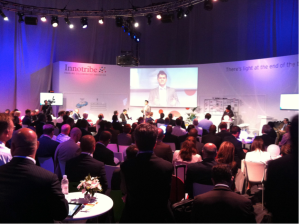
space

However, the word “change” does probably not reflect the scale and impact of what we are going through. Some our speaker-igniters called for the application of “network warfare” techniques to be able to stay agile and resilient in this environment. Others suggested that our change is evolving from simple “disruption” to plain “phasing”.

We also started measuring what is worth measuring. Robert Kennedy was quoted: “GDP measures everything, except that which makes life worthwhile”. What are the intangible assets that will help us better evaluate the full holistic worth of organizations and institutions, both internal and external intangibles? I believe we are seeing the first attempts here to start applying systems thinking in the context of the financial landscape.

Our 2013 Startup Challenge resulted in two winners to be truly proud of: KlickEx, Top Startup 2013, a regulated clearing service for Central and Commercial Banks, and Waratek, Top Innovator 2013, cutting infrastructure costs using patented Java Virtualization. For more on the Startup Challenge, see blog post by Nektarios.

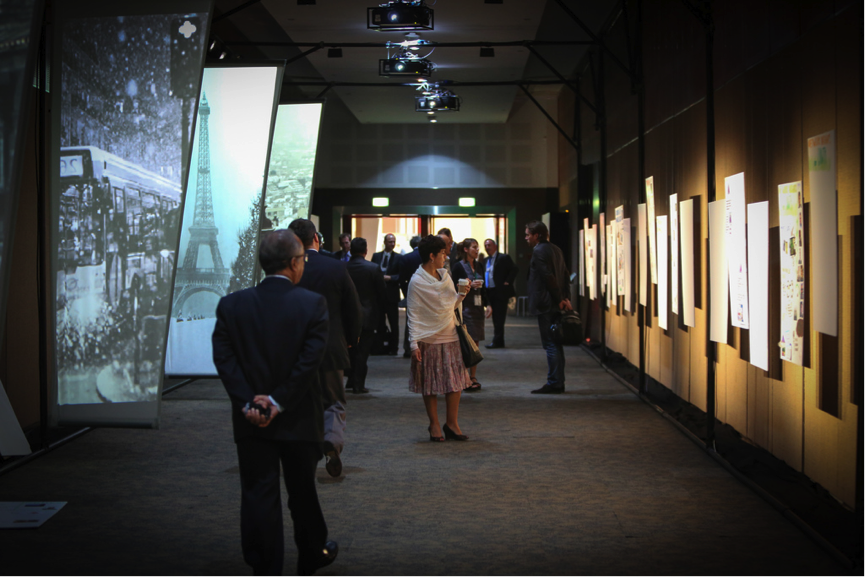
As if our main Innotribe program was not enough, our team designed together a wonderful Tunnel-experience; you can really consider it as a second program within the Innotribe event.

tunnel

And just to go the extra mile, our team and speakers were also involved in the design and delivery of parallel sessions in the Standards Forum, the Diversity session, the sessions for the Chairmen of the National Member Groups, and the “Young Leaders” session that is looking into the future of Sibos itself.

We must have done something right, looking at the raving comments everywhere 😉

Daniel Erasmus from Digital Thinking Network sent us a very kind mail:

“Congrats on another successful Innotribe, the maturing of the facilitation team, development of the formats and anchoring inside the SWIFT community. As always I budgeted too much time to spend the whole week with the “tribe” and loved every minute of it! Not only have you managed to make it interesting for the attendees, but also for the speakers. That is a high bar for such a salty list ;-)”

And Haydn Shaughnessy, author of “The Elastic Enterprise” commented:

“I hope you have recovered from the rigors of Innotribe/Sibos – which I found the best run conference I have attended”

Thank you, thank you for this encouraging feedback. It is the result of a year’s preparation by the team, weekly conference calls with the production company starting four months before D-Day, many prep calls with the speakers, and loads of blood, sweat and tears behind the scenes. Innotriber Dominik tweeted oh so rightly about the warzone backstage.

tweet domi

warzone

backstage


As in all previous years, this undertaking is an emotional, mental, and physical drain/test for the team. For about 10 days on-site, many of us stayed in the catacombs of the conference center from 7:30am till 2:30am. It forces the team to go through the ups and downs of working together very intensely for more than a week in the same physical space. The whole point is to go through this together. And we come out of it together, all with our own scarves and plumes. We had some guests and newcomers in the team: the impact on them is deep. But “Once been there, you don’t want to go back”. For some of us, it will be difficult to go back to our “normal” working environments. Innotribe is a drug: that is good and scary at the same time, as many of us neglect our own physical and emotional well being.

For me, it’s my 5th edition, so I know more or less what’s coming. Delivering something like Innotribe at Sibos is like giving birth to a big baby. It also comes with some form of Post-Natal depression. I coped better with it compared to previous years, but am getting aware how much we ask from our colleagues and collaborators, and that some post-event sanity is needed.

We put the bar very high. We want to let our audience discover new insights in an immersive learning experience. We want to touch people in an authentic way. We want to create intensities, insightful, rich and with serenity. We also wanted to reflect this authenticity in our closing plenary. No gimmicks, but sincere, tender, kind and humanizing reflections on a week that rocked you all intellectually and emotionally.

We believe the tone of our closing was spot-on. Testimony if this is well reflected in the article on page 8 of the Sibos Issues Wrap-Up edition http://www.sibos.com/docs/SibosIssues_wrapup.pdf:

“Okay, so it’s time for the Innotribe closing plenary, which is called ‘Around the campfire’. We come into the Innotribe Space, which is lit with a dim amber glow from above, and we sit down on one of the beanbags that surrounds the “camp fire” – a stack of Innotribe’s decision-making crystal balls. Or should we take one of the chairs circled around the beanbags? There’s faint, meditative music in the background, and on the display screens, a photograph of young boys, their faces lit by a real campfire, out late at night, sharing an adventure. This is Innotribe. Anything could happen. What happens is that Innotribe’s Innes MacLeod picks up a guitar. He strums a few notes, starts to sing. “The dawn is breaking, the light is shining through.” Mr MacLeod is a talented musician. There are crayons. Markers. Postcards. The song ends, and J P Rangaswami,  chief scientist, Salesforce, comes forward into the circle to give us his impressions of  Innotribe’s week in Dubai.”

innes

This edition also felt different, with Matteo and Kosta not being part of the team anymore. We missed them, but are proud of the new opportunities they are onboarding and wishing them well from the deepest of our hearts.

But even without them, we are bullish about the future of Innotribe. We also want to ensure them that what we will protect and nurture the soul of what we started together. Reflecting back on the first five years of Innotribe, I would like to summarize that soul as follows:

“Innotribe’s soul is about people taking agency. Innotribe is a movement. It’s a culture, emerging from some specific behaviors. It’s a tribe of enthusiastic people hungry for change. Positive change. Not an anarchist tribe, but a tribe of people who care for the companies they work for and want them to succeed in the 21st century of hyper-connectivity. Innotribe is deeply value and purpose driven. It has an ambition for progress, looking forward. We fight mediocrity, and applaud critical thinking. Innotribe is a reflection zone. Where new ideas are tossed, curated, discussed, made actionable. We want to give the best of ourselves. For doing good. For creating human connections between people. For letting people discover their hidden talents and powers. For taking people on a path of discovery, individual and collective relevance. We want everybody in the company and industry to think, to be and act responsible to increase value and wealth creation. Moving from ego-systems and creating eco-systems filled with meaning. Innotribe is a place where belonging is more important than fitting in. Innotribe is about leading from the emergent future, in support and co-creation with our markets and regions. Innotribe is a tribe for leading by being.”

graffity team

Just after the SibosTV “summary of the week”, JP synthesized the week very well. What he had seen at Innotribe was human integration, infrastructure integration, and innovation integration.

“As human beings, we came together well,” says Rangaswami. “By the time it came to innovation, I was seeing a coming together I don’t think I have ever seen before. That suits could stand on the same stage as jeans…”

But let’s be careful not to judge our work only on these externalities, as I believe the “jeans and suites” is a signal for human integration at a much deeper level that the vestimentary one.

“There is an institutional ownership of infrastructure by the incumbent. That set of conversations seemed to involve a separation from the consumer infrastructure represented by mobile tools. We’re getting there on values and innovation, but we haven’t got there on infrastructure.”

For me, the biggest insight of the week was to see the interest of bankers in topics such as creative thinking and visual expression. Like in previous year, the critics challenged us programming this sort of topics. They proved to be wrong: there is indeed a great hunger in our community to re-connect with our wholeness, our oneness, and our full human being. We all are growing a higher sensory awareness and maturity. In case you did not know yet: bankers are humans too, and that is probably our biggest hope for the future.

Last word to J P Rangaswami with some hints for next year’s Boston edition:

“For too many years, the talk has been about the business case. There are two ways you can do this: cut costs or increase revenue. Think of the untapped markets, the financially excluded. There is an abundance of new ways to connect to those markets. Use them. Go for growth!”
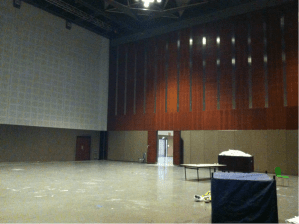
empty room

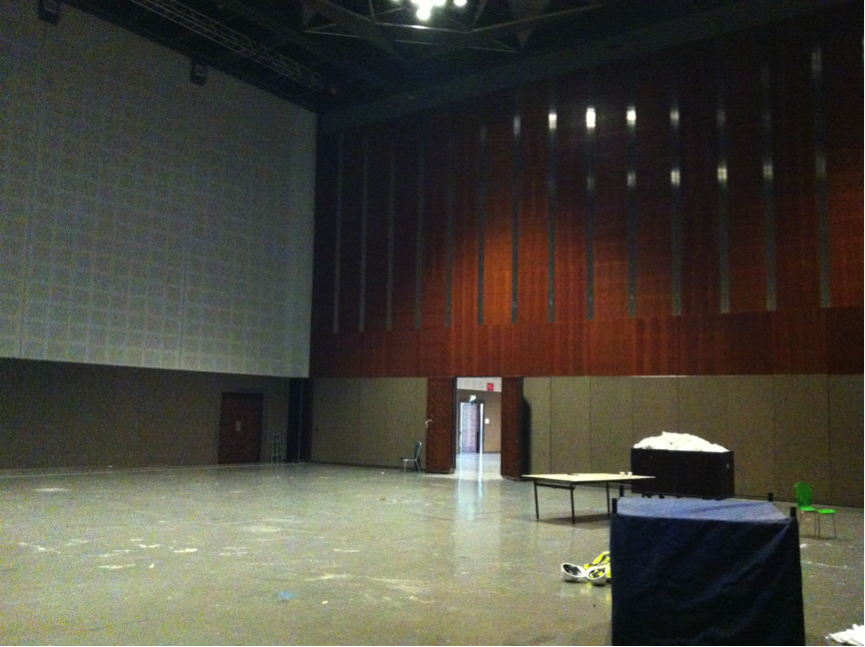
As the dust of the 2013 edition has settled (above a picture of the room one day after the event, as if it never happened), the quest for 2014 has already started…

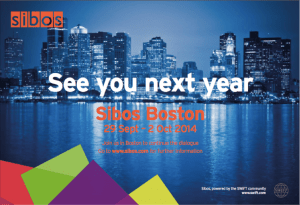
Once again, we start from an empty page, and since a couple of weeks already, the architect’s brushes and pencils are painting on the blank canvas, eager to be inspired by your feedback and enthusiasm. See you all in Boston, 29 sep – 2 Oct 2014.
boston

By @petervan from the Innotribe team.

Innotribe at Sibos 2013 – Big Data Track

Here is the third weekly update related to our 5th edition of Innotribe at Sibos in Dubai from 16-19 Sep 2013.

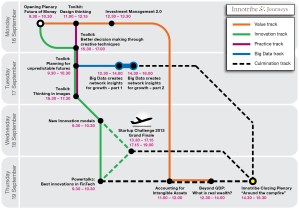
As you probably know by now, we’ve designed our programme like a metro map. Just like the underground or subway, it’s up to you to decide which “track” to follow, depending on your expertise, interests, learning objectives, and availability.

Innotribe_TubeMap-01

In this week’s post, we’d like to walk you through the Big Data Track at Innotribe@Sibos 2013.

Big Data track

Big Data is an industry trend that the Innotribe team has been monitoring for some time now. We had session about Big Data at Innotribe Sibos Toronto in 2011 and Innotribe Sibos Osaka in 2012.

People, businesses and devices are hyper-connected through highly pervasive networks, creating unimaginable amounts of information. What if we could tap into the intelligence and insights buried in these networks to devise better strategies for growth? This new environment will require extraordinary insight and adaptability.

This year, we’ll explore how you and your organization can derive new insights through Network Analytics from all the data that surrounds us.

Toolkit: Planning for Unpredictable Futures

Location: Innotribe Space

Day: Tuesday 17 Sep 2013

Time: 09:30 – 10:30

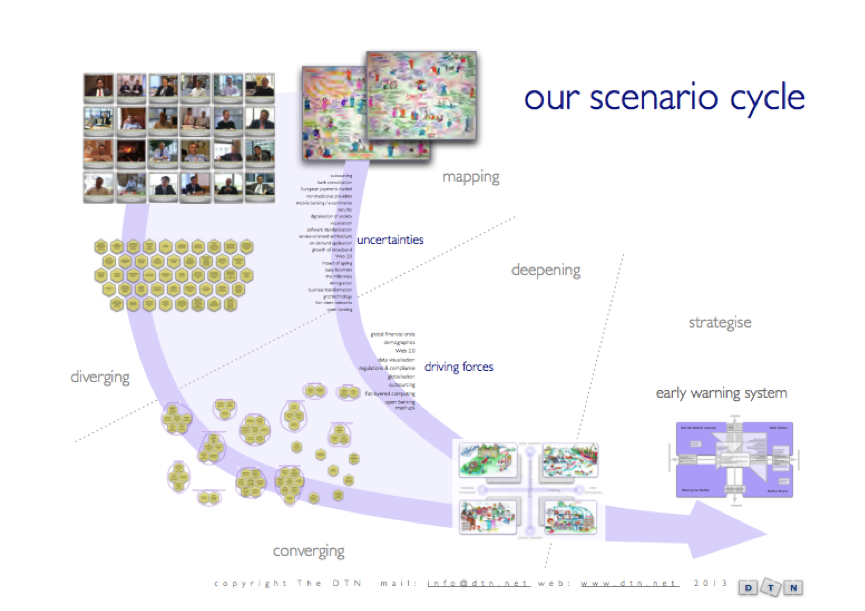
Another “Toolkit” session: an immersive learning experience to help you internalize the basic principles of scenario thinking in support of better future planning. This session will lead into the Network Insights session later that day.

scenario

Daniel Erasmus – one of the world’s most renowned experts on Scenario Thinking – will give an in-depth introduction to this methodology that helps making better decisions and sense of an unpredictable future.

After the intro, Fabian will relate this back to why this is relevant for our community.

We have designed a practical interactive exercise to familiarize the audience with scenarios of high impact, but low probability; this is all about getting comfortable with uncertainties in business.

Speakers:

  • Daniel Erasmus, Owner, Digital Thinking Network. Daniel brings the unique combination of scenario thinking and big data.
  • Fabian VandenReydt, Head of Securities Markets and Core Business Development at SWIFT

Big Data creates network insights for growth – Part-1 – What is Data?

Location: Innotribe Space

Day: Tuesday 17 Sep 2013

Time: 12:30 – 14:00

This is a highly interactive session, where we will let the audience discover the expanded definitions of what we mean with “data”. We will cover following dimensions:

  • What do we call data?
  • How do we see/visualise data?
  • How do we analyse data, how do we draw conclusions?
  • How do we layer data and apply pattern recognition?

We will close this part-1 highlighting the domains of applicability for our business: Fraud, Risk Management, Growth opportunities, etc. We will then move into part-2 about tools that can help spot us unknown growth opportunities or unknown threats.

Big Data creates network insights for growth – Part-2 – Overview of tools for growth.

Location: Innotribe Space

Day: Tuesday 17 Sep 2013

Time: 14:30 – 16:00

After having set the scene in the two previous sessions (“Planning for Unpredictable Sessions from 09:30 – 10:30am” and “What is Data? From 12:30 – 14:00pm”), we will demonstrate how different analytics and big data tools can be used to identify growth opportunities or unknown threats.

Newsconsole

In a very engaging story telling format, you will see demos, videos, animations and other explorations of the latest state-of-the-art tool for big data analytics and visualization. This is a high-paced session with 7 different showcases.

Speakers for Part-1 and Part-2 are:

  • Neil Bartlett, CTO And Head of Development of Risk Analytics, IBM
  • Daniel Erasmus, Owner, Digital Thinking Network
  • Matthew Gordon, Forward Deployed Engineer, Palantir
  • Walid Jelassi, Transformation Consultant, HP
  • Simon Small, Founding Director, Arria
  • Kimmo Soramaki, Founder & CEO, Financial Network Analytics
  • Michael Warner, CEO, Quantum4D
  • Special commentator: Fabian Vandenreydt

More information about the Innotribe@Sibos 2013 programme can be found in our programme Brochure (PDF flyer), on Sibos.com and of course Innotribe.com. The full Innotribe 2013 speaker list with bios is here.

By @petervan from the Innotribe Team

Innotribe at Sibos 2013 – Innovation Track

As from now, we offer you weekly updates related to our 5th edition of Innotribe at Sibos in Dubai from 16-19 Sep 2013.

As you probably know by now, we’ve designed our programme like a metro map. Just like the underground or subway, it’s up to you to decide which “track” to follow, depending on your expertise, interests, learning objectives, and availability.

Innotribe_TubeMap-01

In this week’s post, we’d like to walk you through the Innovation Track at Innotribe@Sibos 2013.

We’ll move away from the traditional polarizing discussions such as old vs. new, startups vs. incumbents, incremental vs. disruptive, close vs. open, core vs. non-core and we will help you discover the richness of the options in the middle of the extremes and help you identify which model to best apply in your company. All examples will have specific relevance to financial services.

The track will open with disruptions impacting the traditional banking model. We will also offer you some practice sessions about new non-linear ways of thinking to help you succeed in the ever faster changing world. The track continues with a session that offers deep insights into what else is out there beyond open innovation. The track ends on Thursday morning with a selection of “Power Talks” illustrating how new players are already significantly disrupting banking – and not just the fringes of our industry, but already heading for the core with early signs of scale. We’re not talking about the distant future, but what’s happening right now!

Future of Money

Location: Innotribe Space

Day: Monday 16 Sep 2013

Time: 09:30 – 10:30

This session is also part of the Value track.

We had a post about that last week: http://innotribe.com/2013/08/05/the-value-track-explained/ 

Toolkit: Better decision-making through creative techniques

Location: Innotribe Space

Day: Monday 16 Sep 2013

Time: 15:30 – 17:00

Decision-making is “making sense” of things. This raises issues of what criteria we bring to decisions when contexts change. Most of economic history industry has been driven by new developments in sense awareness.

decision making

This context changes are very significant because what digital does is alter decision-contexts. It makes us have to respond to more changes, more often and make more decisions in a more delegated way, against a backdrop of criteria that we are having to capture and describe.

This is a “Toolkit” session: an immersive learning experience to help you internalize the basic principles of creative thinking to help improve judgment and decision-making. The audience will learn to internalize the difference between linear and non-linear decision taking, complemented with practice exercises based on creative decision-making based on colour, word, and sound.

We will setup 3 separate experimentation stations:

  • Art school with Dave
  • Word school with Haydn
  • Music school with Petervan

Speakers

  • Dave Gray, Author, The Connected Company: Dave is world authority in visual thinking
  • Haydn Shaughnessy, Author, The Innovation Lifestyle. Haydn is a deep thinker and expert on innovation.

Toolkit: Planning for Unpredictable Futures

Location: Innotribe Space

Day: Tuesday 17 Sep 2013

Time: 09:30 – 10:30

Another “Toolkit” session: an immersive learning experience to help you internalize the basic principles of scenario thinking in support of better future planning. This session will lead into the Network Insights session later that day. We will detail this session in the upcoming blog post on the Big Data track.

Speaker:

  • Daniel Erasmus, Owner, Digital Thinking Network. Daniel brings the unique combination of scenario thinking and big data.
  • Fabian VandenReydt, Head of Securities Markets and Core Business Development at SWIFT

Toolkit: Thinking in Images

Location: Innotribe Space

Day: Tuesday 17 Sep 2013

Time: 16:30 – 17:30

Visualization is increasingly used in business and science to simplify complexity: a picture is worth a thousand words. Drawing is a natural process for thinking, exploring ideas and learning. Every child enjoys drawing — but at some point in our lives we learn that drawing is the province of artists. We begin to say things like:

  • “I’m no artist”
  • “I can’t draw a straight line”
  • “I can’t draw a stick figure”

This is a fallacy. You can draw, and when you were a kid you knew it. You just forgot. It’s time to remember what it was like to draw as a child — and to rediscover the joy of exploring ideas and learning without boundaries. It’s time to forget that you don’t know how to draw. Play isn’t just for fun. It’s how we learn. You can practice your visual thinking skills and have fun at the same time. Enjoy yourself, and take some new abilities back to work with you.

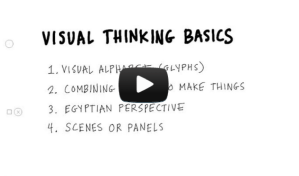
Visual thinking basics

The room will be set-up like a classroom, with the audience as students. Like a Zen-master with his disciples, Dave Gray – one of the masters in the field of visual thinking – will help his students discover step by step their hidden power of visual expression.

New Innovation Models

Location: Innotribe Space

Day: Wednesday 18 Sep 2013

Time: 09:30 – 10:30

new innovation models

Our speakers will first give you a fascinating overview on what’s new in innovation models: from “castle and sandbox” one way of doing Open Innovation, to incremental innovation, disruptive innovation, narrow innovation, Jugaad innovation, Reverse innovation, Shanzai innovation (copycatting), computational innovation, radical adjacencies, and algorithmic innovation.

After the intro, we offer you two immersive learning experiences:

  • Copycatting feels like a taboo in innovation. What if we could get rid of these taboos, and innovate again like kids? In this exercise we will actually train you to copycat, by copying one of the newcomers in payments space. In the coming days, we will also publish here and on swift.com an op-ed by Jaspar Roos, based on a research he did on copycatting.
  • Crowd-source everything. We will practice how to involve crowds in innovation decision-making: how can a crowd shape a product? How can we crowd-develop, crowd-manage and crowd-design for example. You will be invited to pick one of your existing processes and crowd-source it. Also here, an article based on Haydn’s research on crowd-activities will be published soon.

Speakers

  • Jaspar Roos, Chief Inspiration Officer, ABN AMRO Dialogues FutureIdeas.eu and Ventur.es
  • Haydn Shaughnessy, Author, The Innovation Lifestyle

Powertalks: Best innovations in Fintech

Location: Innotribe Space

Day: Thursday 19 Sep 2013

Time: 09:30 – 10:30

Inspired by TED Power Talks, we have invited some awesome innovators from the financial industry to present real, live innovations, which are in the market and starting to scale. In other words, this is not about Star Trek, but actual innovations, where the “rubber meets the road”.

startrek

  • Patrick Griffin, Head of Business Development of OpenCoin, the organization that first built the Ripple protocol. A Ripple is a unit of the native currency that exists in the Ripple network. The Ripple network is a peer-to-peer payment network. It enables free payments to merchants, consumers and developers, and to send and receive money in dollars, euros, yen or Bitcoin without having to do extra work for foreign exchange transactions and without charge backs. Ripple is also an open source protocol created for anyone to build on top of or use.
  • Kristoffer Lawson, Co-Founder & Chief Evangelist, Holvi. Kris will talk about Holvi’s upcoming European launch and his work as initiator of the Popup Society movement: setting up a company, forming a team and building a product, all within 48 hours. In true popup fashion many of these ideas die immediately, but not all. Some have gone on to become great companies.
  • Jaspar Roos will showcase some of the latest innovations in financial services his teams build over the last year in his different roles as Chief Inspiration Officer, ABN AMRO, Dialogues, FutureIdeas.eu and Ventur.es
  • Manu Sporny, Founder/CEO, Digital Bazaar and Chairman PaySwarm will share what happens if payments get commoditized to the level of the W3C protocol? Manu spends most of his time creating open standards and open technology that will integrate payments into the core architecture of the Web. His vision is to democratize finance, making the financial tools that are only available to large organizations today, available to everyone on the Web.

Closing Plenary Innotribe: “Around the campfire”

Location: Innotribe Space

Day: Thursday 19 Sep 2013

Time: 14:30 – 15:30

campfire

Later in the afternoon on Thursday – at 14:30pm – we will all join the Closing Plenary Innotribe: “Around the campfire”, where we will share the lessons, tools and techniques learned during the week. We are very proud to confirm our two tribal wise men:

  • JP Rangaswami (Chief Scientist of Salesforce.com and direct report of Marc Benioff) and;
  • Andrew Davis (Global Head of e-Commerce Strategy and Innovation, HSBC).

More information about the Innotribe@Sibos 2013 programme can be found in our programme Brochure (PDF flyer), on Sibos.com and of course Innotribe.com. The full Innotribe 2013 speaker list with bios is here.

By @petervan from the Innotribe Team

Innotribe at Sibos 2013 – Value Track

As from now, we offer you weekly updates related to our 5th edition of Innotribe at Sibos in Dubai from 16-19 Sep 2013.

As you probably know by now, we’ve designed our programme like a metro map. Just like the underground or subway, it’s up to you to decide which “track” to follow, depending on your expertise, interests, learning objectives, and availability.

Innotribe_TubeMap-01

In this week’s post, we’d like to walk you through the Value Track at Innotribe@Sibos 2013.


The Value track will explore different aspects of the great value discussion:

  • What is the future model of banking?
  • What is wealth beyond money?
  • Can everything be measured?
  • And are we even measuring the right things?
  • Can we valuate companies based on their intangible assets?
  • How does all this drive happiness and well-being?

Future of Money – Opening Plenary

Location: Innotribe Space

Day: Monday 16 Sep 2013

Time: 09:30 – 10:30

In this session, we will identify how the current model is being disrupted and how the impact on cost and revenues. We will co-create the corporate banking business model of the future, using the Business Model Canvas methodology of Alex Osterwalder.

Innotribe co-founder Mariela Atanassova (Mela) recently posted a great article on this subject on the American Banker blog “BankThink” as part of their series “The Future Model of Banking”.

To guide us, we have invited six awesome speakers, each highlighting one dimension of disruption of the existing corporate to banking model:

  • Scott Bales, Chief Mobile Officer, Moven will focus on Social and Mobile;
  • Dave Gray, Author, The Connected Company will focus on organizational change and how his principles lead to “The Connected Bank”;
  • Hank Uberoi, CEO, Earthport and Dan Marovitz, Founder & CEO, Buzzumi and previously Head of Product Management, Global Transaction Banking at Deutsche Bank will articulate what has changed in infrastructure;
  • Patrick Murck, General Counsel, Bitcoin Foundation will ignite us on transparency and transaction costs;
  • We are in discussions with a major bank, which has experimented with hybrid business models in the Corporate to Banking space.

Two host moderators will guide you through this exercise and will ensure a deep interaction between audience and speakers in an exciting TV Studio type format. One moderator (Udayan Goyal, Partner and Co-Founder of the Anthemis Group) will work the stage; the other moderator (Chris Skinner, Chairman of The Financial Services Club) will work the audience.

Design Thinking

Location: Innotribe Space

Day: Monday 16 Sep 2013

Time: 11:00 – 12:15

This is a “Toolkit” session: an immersive learning experience to help you internalize the basic principles of design thinking with hands-on practical activities. We will practice process step by step the different stages of design-full thinking and apply them to examples from the financial industry:

  • Human observation, particularly using extreme users to inspire idea
  • Looking at a larger context – analogies from other fields; examine interaction touch points
  • Multidisciplinary teams
  • Experimentation, prototyping
  • Engaging others in the process to build enthusiasm for your idea

Speakers: We have invited two world-class experts to guide you through this process:

  • Vince Voron recently joined Dolby Labs as their VP, Executive Creative Director. He has more than 20 years of marketing design experience from two of the world’s most iconic brands: Apple and Coca-Cola. At Apple, he developed and led the human factors and color teams responsible for iMacs, PowerBooks, iPods and the iPhone. As head of Industrial Design at Coca-Cola, he led the form and user interface design for the Coca-Cola Freestyle platform.
  • James Moed is the leader of IDEO’s work in financial service design across Europe. In that role he advises clients and design teams, combining observations of human behaviour with inspiration from other services, new business models, and emerging technologies.

Investment Management 2.0

Location: Innotribe Space

Day: Monday 16 Sep 2013

Time: 12:30 – 13:30

In the financial industry “shareholder value” and “profit maximization” are still very much the main criteria for investment. Nevertheless, new investment trends are emerging as a result of global changes and new ways of thinking,.  Investors are starting to look for criteria beyond maximizing profit, shareholder value and pure financial return – many of which are based on ‘intangible assets’.

To put all this in context, we strongly recommend Otto Scharmer’s latest book “Leading from the Emerging Future: From Ego-System to Eco-System Economies” (Amazon Associates Link).

otto

This session is designed to be highly interactive, applying the design thinking methodology to investment management.  The session is designed as a political campaign debate, where two protagonists will prompt the discussion through at times provocative statements and trying to convince the audience of their deep insights.

During this debate, we will look into following aspects:

  • Definitions of intangible assets, how to account for them and how to invest in them.
  • What role do financial markets play/should play, and their future “design principles”
  • We will paint a broader evolutionary context and the role of technology in all this;
  • Leading into transparency, self-empowerment and permissive organizations

Each of the protagonists will then detail their personal actions for change.

Speakers:

  • Mary Adams, Founder of Smarter Companies, expert in accounting for intangible assets
  • Stephen Richards, Principal of Ability Capital Solutions, who is launching a Pension Investment Fund, based on crowdsourced recommendations for investment by the pension beneficiaries.

Accounting for Intangible Assets

Location: Innotribe Space

Day: Thursday 19 Sep 2013

Time: 11:00 – 12:00

Is it possible to make investment decisions based on intangible assets? In this session, you will learn that the financials used as a measuring stick are being generated out of a new kind of factory, a new kind of infrastructure. Most of investment and asset managers understand this intuitively.

We will give you practical hands-on exercises to empower you with a vocabulary and a framework that helps you change what you do and how you evaluate companies.

Speakers:

  • Mary Adams, Founder of Smarter Companies, expert in accounting for intangible assets

Beyond GDP – What is real wealth?

Location: Innotribe Space

Day: Thursday 19 Sep 2013

Time: 12:30 – 14:00

Happiness Indicators like Bhutan’s Gross National Happiness, the OECD’s Better Life Index, and the UK’s Happy Planet Index are already helping the world define well-being and wealth beyond money. The H(app)athon Project www.happathon.com wants to go one step further by “hacking happiness”, and shifting how the world’s view of value can move beyond the lens of GDP.

Innotribe has partnered with The H(app)athon Project to co-deliver this customized,  super-interactive, not-to-be-missed game experience, where several imaginary countries based on new economies will work together to increase their collective progress. We have gone full-blown for the design of this session, with light and sound-scapes to immerse you 100% in this real live experiment, where you are the subject of research 😉

The results of this experiment will be fed into the development of the Happathon mobile app that will be launched in March 2014.

Speakers:

  • John Havens, Founder, The Happathon Project.

Closing Plenary Innotribe: “Around the campfire”

Right after the Happathon session – at 14:30pm – we will all join the Closing Plenary Innotribe: “Around the campfire”, where we will share the lessons, tools and techniques learned during the week. We are very proud to confirm our two tribal wise men:

  • JP Rangaswami (Chief Scientist of Salesforce.com and direct report of Marc Benioff) and;
  • Andrew Davis (Global Head of e-Commerce Strategy and Innovation, HSBC).

More information about the Innotribe@Sibos 2013 programme can be found in our programme Brochure (PDF flyer), on Sibos.com and of course Innotribe.com

By @petervan from the Innotribe Team

Drowning in Data, Banks Must Learn to Surf

The question every bank should ask itself is: “Am I a creator or a remover of friction?”

John Hagel hit the nail on the head in a recent Harvard Business Review blog post: The cost and difficulty of coordinating activities across entities, on a global scale, is far lower now.” Today’s hyper-connectivity not only makes it possible to coordinate across entities in a more efficient way, it also causes a deep disintermediation of players that were able to maintain their monopolies through sheer scale and power.

A really good example of this is Uber.com, the well-publicized peer-to-peer limousine and taxi service directly connecting drivers and customers, disintermediating completely the dispatching taxi companies that proved to be the friction in the system.

The same phenomenon is now happening everywhere, including in banking, as we see the advent of more peer-to-peer (mobile) payment systems.

Besides disintermediation, we have disintegration. What we witness is the end of highly vertically integrated organizations, and the birth of organizations whose chief strength is to pick and choose best-in-class functionality from outsiders and mix and match those with their own internal world-class capabilities. For that to happen, you need a decomposition of previously highly integrated functions into smaller chunks (for example risk management, payments, securities, reference data, even identity and trust) and the ability to expose those functions through application programming interfaces. Externalizing your core competencies has become an economic imperative.

Sean Park from the Anthemis Group suggested all this five years ago. Back then, you still could create a competitive advantage with these methods. Today you are a plain loser if you do not have this in place yet.

So if all this is commonplace, what’s the next big disruption? In my opinion it’s peer-to-peer, the ability of two or more entities to share data and do business without a central orchestrator. P2P changes everything. It changes product and service offerings, it changes how companies are organized; it fundamentally changes the business models we are used to. This is very quickly leading to a “fragmentation of everything”: the fragmentation of work, of applications, of hierarchies, of states.

camel

To illustrate how deep the change is, I’d like to use the metaphor of a camel in the ocean. The camel is the bank, and the water is data. Until now, the camel was carrying its own water through the desert. Now the camel is in the ocean, surrounded by data. We will require a new kind of species that can survive in this data ocean, can cope with the advent of trillions of nodes on the grid, all hyper-connected, hyper-fragmented and 100% distributed.

The world needs a new kind of bank, way beyond a money-bank, probably a “trusted data bank” that can help human beings store, change and transact data, and in doing so create new authentic value. Not just gimmicks, tricks, quick wins, or dirty fixes.

We seem to live in a “perpetual crisis,” jumping from one incident to another, where there is no room anymore for building a story with a beginning, middle, and an end; no room for reflection, no room to assess and, like a surfer, scan the waves of change on the surface of the data ocean. It’s like the camel is under water, drowning in tactics and ad-hoc firefighting, incapable of interpreting the tsunami of change.

The world enters a level of complexity that cannot be addressed anymore by conventional, binary, linear thinking. We need new tools, capabilities, and more non-linear ways of thinking, to be prepared to open up for more options. These new tools are about forecasting and assessing in different ways, deciding our options in different ways, ambitious design thinking with focus on what needs to be achieved versus what is the problem to be solved, and richer ways of expressing our options through visual thinking and other techniques.

This is way beyond the flashy designs of hyper-tech branches and “punchy-music-cool-sexy” apps or product videos.

The bank of the future is a humanizing bank,

where “I am not my device” and where the focus is on relationships, intimacy, depth, and human connection – supported by technology. It’s about deep human behavior, about deep culture change. But that does not happen through top-down instruction. What is needed is viral change at scale of specific behaviors, seeded and nurtured bottom-up from deep within the fabric of the organization.

Behavior creates culture,

and not the other way around.

Cross-posted on American Banker

Innotribe at Sibos Dubai 2013 – introduction of “Journeys”

Cross-Posted from Innotribe.com > original blog post by Dominik Debuyser @ddebuyser from the Innotribe Team

It’s the fifth year of our flagship ‘Innotribe at Sibos’ event, we’ve decided to do things a little differently.

Our theme? There is light at the end of the tunnel’, and with an actual tunnel to travel down to enter our space in Dubai, we’ve designed our programme like a metro map.

Just like the underground or subway, it’s up to you to decide which “track” to follow, depending on your expertise, interests, learning objectives, and availability.

Our metro-map is an overview of the different tracks available; “toolkits” are practical sessions where you’ll learn new methods of thinking; in other sessions  you’ll be able to apply the new techniques you’ve learned. It’s your journey, so you can hop on and off the Innotribe train at specific switching stations of your choice.

Value track

The Value track will explore different aspects of the great value discussion

  • What is wealth beyond money?
  • Can everything be measured?
  • And are we even measuring the right things?
  • Can we valuate companies based on their intangible assets?

We will look at different dimensions impacting traditional banking business models, ending with being part of an amazing life research project to crowdsource wellbeing.

Innovation track

With sessions that offer deep insights into what is happening in the world of innovation, moving away from polarizing discussions such as open vs closed, incremental vs disruptive, the Innovation track will explore what else is out there beyond open innovation.

The track ends on Thursday morning with a selection of “Power Talks” illustrating how new players are already significantly disrupting banking – and not just the fringes of our industry, but already heading for the core with early signs of scale.

We’re not talking about the distant future, but what’s happening right now!

Practice track

The world has entered a level of complexity that cannot be addressed anymore by conventional, binary and linear thinking. We need new tools, capabilities, and ways of thinking. We need to prepare, plan and be open to new options. These new tools are about forecasting, assessing, and making decisions in different ways, ambitious design thinking with focus on what needs to be achieved, and richer ways of expressing our options through visual thinking and other techniques.

Sessions labelled as “toolkits” in the Practice track are practical sessions to really get ‘hands on’ with these new methods of thinking.

Big Data track

Big Data is an industry trend that we’ve been monitoring for some time now. People, businesses and devices are hyper-connected through highly pervasive networks, creating unimaginable amounts of information.

What if we could tap into the intelligence and insights buried in these networks to devise better strategies for growth? This new environment will require extraordinary insight and adaptability.

This time, we’ll explore how you and your organisation can derive new insights  through Network Analytics  from all the data that surrounds us.

The Startup Challenge Finale

The Innotribe Startup Challenge 2013 introduces the world’s most promising FinTech and Financial Service startups to the global community of financial institutions, venture capitalists, angels and influencers actively investing in innovation.

It is the Grand Finale of Innotribe’s 2013 regional challenges in the Americas, EMEA and APAC.  The ten winning startups and five innovators, selected from hundreds of interesting candidates, will compete in front of a live audience and professional panel of judges for a cash prize of 50,000 USD.

Awe, suspense and excitement guaranteed!

Culmination track

All of the tracks lead to the same destination –  the Innotribe Closing Plenary, during which we’ll create a unique ‘campfire’ moment to gather and share our key learnings of the week; what we like and dislike, and which topics should be explored further.
With interactive sessions, immersive learning, mini-talks, demos and more, join us at Innotribe at Sibos to co-discover, co-create and co-deliver solutions for our future.

Innotribe_TubeMap-01

Innotribe@Sibos2013 Agenda

Download the PDF version of the metro map here

Are you getting excited yet?
‘Cause we are!

Innotribe at Sibos Dubai 2013 – Start Campaign

It’s been five years since we launched Innotribe@Sibos, and once again we have put together a comprehensive programme; a spectacular series of memorable, highly-interactive immersive learning experiences.

This year, we’re taking a slightly different approach, by moving away from presenting topics to building actual capabilities. The reality and speed of change in our industry needs new ways of thinking, so we’ll help you adapt, address and respond to situations which simply cannot be tackled using traditional linear thinking. It’s time to move beyond polarizing conversations to providing a forum for critical dialogue, leading to a richer set of choices and better decision-making.

Our 2013 Innotribe program introduces the concept of “journeys”.  Just like the metro or underground, you can build your “journey” along different coloured lines or tracks, depending on your expertise, interests, learning objectives, and availability. The Innotribe metro-map gives you an overview of the different tracks available; sessions labelled as “toolkits” are practical sessions to learn new methods of thinking, and in other sessions you can apply the knowledge and methods you’ve learned to our industry. It’s your journey, so you can hop on and off the Innotribe train at specific switching stations of your choice.

Innotribe_TubeMap-01

Set just off the concord, the main thoroughfare between the exhibition and conference rooms, the Innotribe Space will be accessible through a long tunnel. This stand-alone tunnel will submerge you in a lively, cool, artsy atmosphere with a whole range of content linked to the sessions taking place in the Innotribe space.

The tunnel will also serve as a backdrop to various installations showing advanced applications such as augmented reality, context-aware spaces and much more. Each day will have a different theme using visuals, music and artistic styles to create unique atmospheres. We’ll have live performances (music) and art installations, and during the breaks, you’ll be able to listen to short sessions, power talks or demos. The Innotribe Space itself feels like a “studio”, especially designed to co-discover, co-create and co-deliver solutions for our future.

Our program would not be complete without the third edition of the Innotribe Startup Challenge 2013 and a tribal closing session “around the campfire”.

With your help, we can make this year’s slogan “There is light at the end of the tunnel” a reality. Come, join us, and help us shape a new future at Sibos in Dubai.

Dystopian Futures

On 10-12 June 2013, I was invited as a panel participant to the ISACA Insights World Congress. It was the second time in two weeks – the previous time was during a session at the Amplify Festival – that the panel was asked by the moderator what the future would look like in 2040. At Amplify the question was around the future of work. At ISACA, the question was even more open ended.

untitled-by-allison-mcd-on-flickr

Although nobody of course knows what the future will hold, and everything I say on this topic is almost wrong by definition, I believe I surprised my audience with my very dystopian view on the future.

Many seem to believe that the future will be “bright”, with lots of possibilities for hyper-collaboration, in open and shared spaces, where serendipities happen every minute, where hierarchies don’t exist anymore, sort of love-and-peace in a sharing collaborative back-to-Woodstock environment.

woodstock-poster-for-sale

That may be the case in 2020, but I think the picture will be less rosy in 2040. Already today, algorithms trade in matter of milliseconds, a real-time world that we as humans can’t even grasp, let only survive. Where those algorithms now work for stock trading companies, by 2040 we will most probably be “augmented” – at best – by our personal algorithms.

It will not be a nice picture to look forward to: by that time, we will be totally ruled by robots and algorithms, and we will have to fight – assisted by our “devices” – for that very last minute of work in a crowded world marketplace where we will have to compete at rates of 1.5$ per hour. And this for probably high-skilled tasks, as the rest will be taken over by robots: a “Present Shock” of technological presence, a world undone of human presence, a very disturbing place where we are ruled by algorithms working on our behalf, where betting on peoples future is the new normal, where siren server masters raise interest fees on the mortgage of the personal success/failure of the data slaves.

The Singularity will have happened, but in quite a different way, in a way that technology owns us, eats us, swallows us, not a singularity of jolly happy people being more intelligent or augmented. A world of technology versus machines, where technology will dictate what it wants from us (See also Kevin Kelly “What Technology Wants” – with Kelly being the technology optimist he is – and Jaron Lanier “Who Owns the Future?”).

What we have witnessed during the last weeks’ revelations represents a true tipping point. Where we still may have had the illusion that we could empower ourselves, take charge, we will be at best be empowered by other powers: a new dystopian world where authoritarian technology rules, an authoritarian singularity, where we are reduced to data slaves of the new data masters.

As part of the Digital Asset Grid (DAG) project (an Innotribe project stopped after its incubation phase, and given back to the community), I have written in the past about the “Catastrophic Complexity” that is emerging right now through the explosion of the number of nodes on the grid, ànd the explosion of data. Where these data are more and more stored by “Siren Servers” – a metaphor used by Jaron Lanier – and where the DAG proposed a 100% distributed model of data storage in personal or corporate clouds, but with a choice of appropriate Trust Models, so that we don’t end up in another worldwide west. Indeed, with the advent of trillions of nodes on the grid, we will require a new kind of species, a new kind of architecture, but more importantly a new type of governance.

camel

I am also getting more and more disturbed by a sort of “over-glorification of technology. This may be surprising as a “Techonomist”, where the belief is that technology will enable a new philosophy for progress – I still believe that – but we need some solid healthy criticism in the debate.

techonomy

When I read this week in The Guardian – a quality newspaper, right? – about the “gadgetry and behavior concepts for the 21 century” and the related comments that these are “super important” new behaviors, I believe we are missing the point; we need to counterbalance all this excitement with way more attention for humanizing our businesses.

I am afraid we are slipping into an “Authoritarian Surveillance State” as described in Washington Post, or even a “Techtarian State” as articulated by Stan Stalnaker in The Huffington Post.

To understand what’s really going on, let’s looks at some understreams that cause the waves of change at the surface. I have split them in technological and more societal changes:

  • Technological:
    • SMAC: Social, Mobile, Analytics, Cloud
    • Platforms and APIs leading towards the end of highly vertically integrated organizations, and where the new skill becomes horizontal sourcing of pin-point functionality
    • Explosion and loss of control of data.
    • Explosion of Cyber-threats
    • Our identity schemes not keeping up with the sheer explosion of nodes, hampering our security, as the internet was never built with identity in mind
    • Disintermediation through hyper-connectivity (example Über)
  • Societal
    • Erosion of Privacy
    • Platform, everything as a service
    • New economies (P2P, Sharing, Reputation,…)
    • New expression of value, currencies, assets, cred, influence, reputation,
    • Crowdsourcing everything (credit cards, funding, investing, lending, mapping, reputation, …)

We probably most underestimate this trend of crowd-everything. There is something deeper going on: this is really about the use of external power to scale; think platform, using crowds as change accelerators, like developers for building on your APIs, but now through users. Google recently acquired Waze for 1B$ !.

waze

The industrial scale application of crowd is very much a “Singularity University Meme”, says Haydn Shaughnessy in Forbes.  Crowd-recording, crowd-sensing, crowd-data collection, more eyes and ears and sensors, through Waze, through Glasses, etc. It’s clear some parties want way more data to be available,  searchable, to be monetized, with us working like slaves to provide all these data for free. We evolve from democracy to “crowdocracy”.

Our near future will witness the “fragmentation of everything”: the fragmentation of work, of applications, of hierarchies, and states giving in to power data houses, data guerillas, pods, and cells.

We will see the “asymmetry of everything”: asymmetry of transparency, of search and computing power, of concentration of data. This will lead to power unbalances, to surveillance mania, to loss of freedom of speech. Already now the recent developments makes me more selective on what I tweet and share. The only way out is a 100% distributed system, but I am afraid that it is already too late for that and that our future is already owned by Jaron Lanier’s “Siren Servers”

We already see the “exceptionalism of everything”, where the exceptions become the norm: events such as stock exchange black swans become the norm. We take for granted the exceptional qualities of uber-people like Marissa Mayer, Zuckerberg, and other “heroes”.

We are “attacked by everything”: our secrecy is attacked by Wikileaks, our privacy by Siren-Servers, our security by cyber-attacks, our value creation by thousands of narrow innovations at the speed of light. All this happens at the speed of light, at “Un-Human” speeds, runs on a different clock, lives in another world.

We seem to live in a “perpetual crisis”, jumping from one incident to another, where there is no room anymore for building a story with a begin, middle, and an end; no room for reflection, no room to assess and scan the waves of change on the surface of the data ocean.

The world enters into a complexity

that cannot be addressed anymore

by conventional binary linear thinking.


We need new tools, capabilities, and ways of thinking, more non-linear, be prepared to open up for more options. These new tools are about forecasting and assessing in different ways (scenario thinking), decide our options in different ways, design thinking in context with intent and within constraints, and richer ways of expressing our options through visual thinking and other techniques more leveraging the human senses of color, sound, smell, trust, sensuality, presence.

We have come at a point where our only options out are a revolution of the data slaves and evolving as a new kind of species in the data ocean, trying to preserve what makes us human.

I have no clue how we can avoid this dystopia, but we will need a new set of practices for value creation; where data slaves dare to stand up and call for a revolution; where value creation and tax declarations go way beyond being compliant with the law; where we see the emergence of ethically responsible individuals and organizations. But it will be very difficult to turn back the wheel that has already been set in motion several decades ago.

Spiral Networks

When_the_stars_align_LG

Some days, stars are perfectly aligned, and sudden insights create these wonderful aha-experiences. A couple of weeks ago, I was sitting together with Philippe Coullomb and Charles Collingwood-boots, co-founders of www.wheretofromhere.asia and initiators of the Sydney chapter of Corporate Rebels United.

They shared their work about “Patches and Nodes”, a G+ Community of change agents determined to nurture and drive systemic transformation in Asia Pacific.

We aim to inspire inclusive transformation by facilitating the emergence of new models for value creation, new mindsets for doing business, and new behaviors for the workplace”

They had prepared a deck (the same one they used for the Rebel Jam on 30-31 May 2013 > WebEx recording here). The key slide in there is the following:

system of systems

It’s a fantastic slide that helps us understand that big change in systems requires “systemic innovation” and a sort “graph thinking”. The circle with the colored dots represents your company. Within that company, different silos work together in some form or – in some cases – not at all.

But companies do not operate in isolation. They are part of a system, and when other actors in the system have counterproductive behavior, which may neutralize completely the efforts you are doing in your own box.

My epiphany happened, when I started looking at this drawing not as a “flat” 2D map, but as something 3-dimensional, like a galaxy of stars, where there is no middle. Every point in the graph is the starting point of a journey.

It suddenly reminded me of the great graph thinking we had done during the Digital Asset Grid (DAG) project. It revived the thinking of “We are all nodes in the Grid”.

The lens of the DAG and the lens of Patches and Nodes started to align. Focal lenses getting aligned, like stars line up in a constellation.

Starting to form “formations” and “digital maps”,

almost like network cartography

Where had I heard this sort of things before? Oh yes, it was during our work on “Network Insights”, where Kimmo Soramäki from www.fna.fi showed us another type of network cartography for financial network analytics.

fna graps

Like in the demo on the FNA site, I imagined how I could zoom in and out of the graph, to get deeper insights and greater levels of detail, like a spiral crawling itself through richer and more complete quality experiences and ambitions. The spiral reminded me of myself as a 7 year old – the same age as my daughter now – drawing of spirals on the chalkboard of my class,…

a form of creativity

that was forbidden

and consequently punished 

swirl

And from a far distant memory, the inspiration from Don Becks “Spiral Dynamics” came back into focus.

spiral dynamics

From the spiral swirl on the chalkboard, via the spiral zooms into 3D graphs, it suddenly felt that I was where I always was meant to be. Not in a fatalistic way, but as a natural evolution and maturing during the different steps of my life.

Spiral Networks, Spiral Dynamics, and Dynamic Fluid Systems were all terms that made me realize that change programs don’t change anything substantial unless it systems change.

With thanks to Fabian Tilmant (@fabnet_be) for pointing me to this video on The Fibonacci Spiral in the song Lateralus by Tool

I had evolved, spiraled out…

…from the polarizing, poor and static discussions of black vs. white into something that felt more like a trajectory, from passively undergoing change to influencing and (co)-creating my own future. I had realized that we needed quality time for reflecting and – like a surfer – scanning coming waves of change and pick the best ones for a great ride. I had realized that to survive in this perpetual crisis, we needed quality time for scenario thinking, where it is about imagining some – not necessarily all – possible futures, hypothesizing, and defining what to do if those futures would happen.

The “Patches and Nodes” drawing suddenly started to make a lot of sense, not only as a way to solve ad-hoc problems in the system, but as a way of making viral change happen system wide and pro-actively, powered by the group pressure of credible and influential system partners.

All sorts of concepts started to spread themselves like viruses through my brain:

Could this be a way

to propel us forward

into a state of collective progress and prosperity?

What if we could seed “activism” into the patches and nodes, a different type of “creators of change”, from solvers of problems and answering known questions to creating a new reality/framework for deep system value creation? Could it lead to “Spiral Network Activists” like agents in “Systems of Endearment”?

Suddenly Corporate Rebels took a whole new dimension of System Rebels, Change agents for society, for systems, System Activists, a powerful group of “Unreasonable people”, together stronger than alone, like the components of Bucky’s geodesic domes.

“How can we catalyse a number of tangible and distinct but yet consistent and convergent initiatives across the board to initiate a self-reinforcing movement?”

book unreasonable

I double-checked the “The power of unreasonable people” by Jon Elkington (Amazon Associated Link), and I noticed that that other Corporate Rebel – Laurent Ledoux – had a summary slide of Jon’s “unreasonable people” in his Rebel Jam talk.

unreasonable copy

But I wanted to go further than trying to measure the un-measurable, and go on a quest of what is worth measuring, measuring that which makes life worthwhile. Like Robert Kennedy 40 years go in his speech about the GDP, that does measure everything but what makes life worthwhile.

To create sustainable deep system change like in Nike’s Launch2020 initiative, using my advocacy and advancement of ideas toward a state of prosperity.

I suddenly realized we could use this model as a way to create deep viral behavior change, not only on companies, but also in systems of patches and nodes.

cultural dynamics

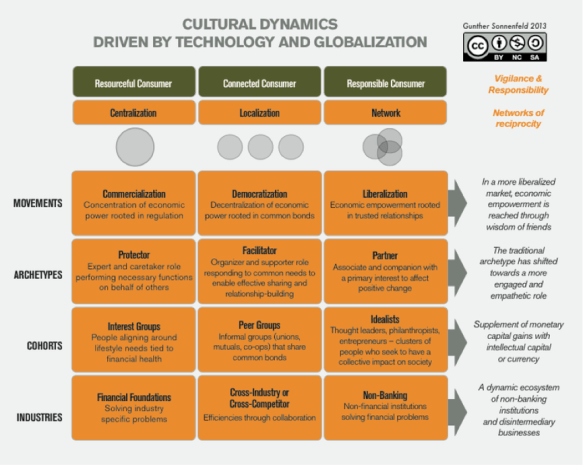
Where we go from spiral dynamics to cultural dynamics, as so magically described in the milestone post about Consumer Activism by Gunter Sonnenfeld (@goonth), describing new types of movements, archetypes, cohorts, and industries. Where Jennifer Sertl added this wonderful dimension of “frequencies” to the mix of nodes on the grid, where each of us is liberated to sing their own song, in our own frequency and at our own rhythm,

to make reverb and resonate the system at large

And where the pleasure comes from pure sharing of your mind-spins, without wanting to make a statement. A form of digital poetry just for the pleasure of play of words; and like in “Mavericks in a corporate world”, finding pleasure in just being human and developing and nurturing the capability to be touched by beauty, a picture, by mastery and harmony; developing a richer palette of responses, judgment, choice and appreciation. And to accept and enjoy that we are incurable romantics, and act from that true self.