Mavericks in a corporate world

On 6 June 2013, I presented “Open Innovation Systems – Maverick Ventures in a Corporate World” during the Amplify Festival in Sydney. The Livestream of the talk is available here:

livestream


This blog post is documenting the genesis of that talk, therefore not really or only a transcript, but passing the same messages through the medium of writing rather than speaking, hopefully even improving the clarity of purpose and intention of the talk.


scribe

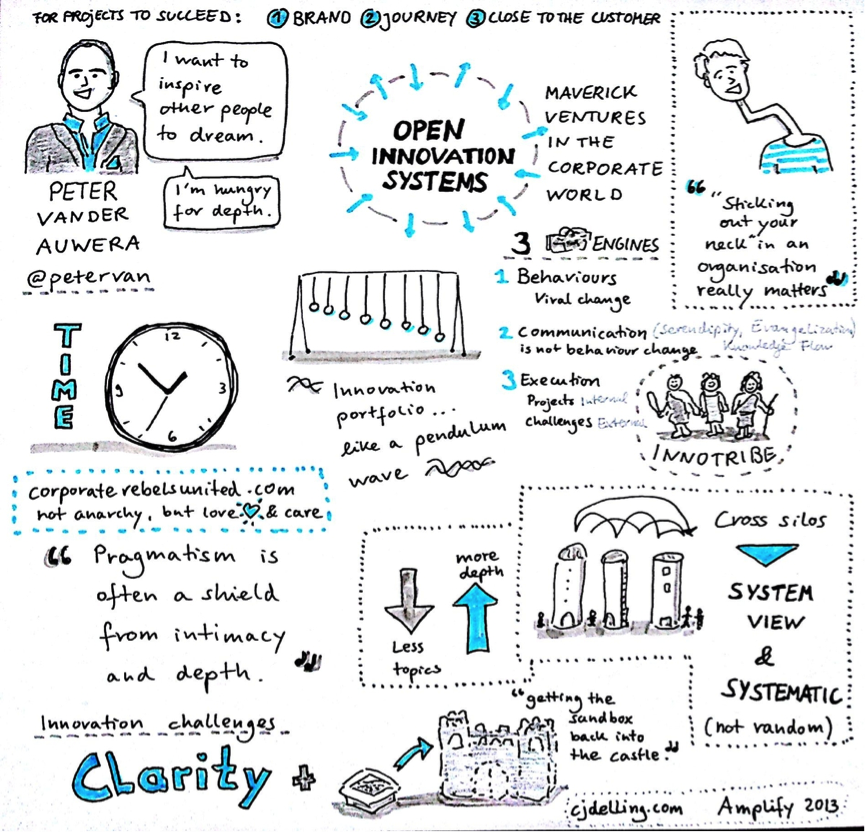
Thanks to @cjdelling for this wonderful scribe, made live during the talk.

There were many triggers for this talk, but the two most important ones were Douglas Rushkoff’s latest book “Present Shock” (Amazon Associates Link) – a book that left a deep impression on me – and a conversation with Haydn Shaughnessy, that I already somewhat documented in my blog post “The Bridge”

digital-human

Rushkoff hits the nail when he says “Time Divides” and “Time is digital in character”. Just try to sense the different human experience when looking at 15 seconds of digital time vs. 15 sec on of analog time. In the analog world, there is flow, continuity, and formation. But we have started to accept a new normal where we have to make choices between extremes: black/white, On/Off, Digital/Human, etc. When being presented with the options left/right, we forget we can also go up and down.

“The lack of options is the opposite of freedom of choice,”

says Rune Kvist Olsen.

In an innovation context the limited choices presented are incremental/disruptive, core/non-core, internal/external, castle/sandbox.

There must be a richer better way to have conversations about innovation. I am getting sick of the 1-2 minute conversations where you have to make your case in a tweet. Sick of the 18 min TED talks, where there is no critical dialogue but only glorification of technology as the sole source for progress.

I am hungry for depth

For intimacy and human connection. I am on a quest for depth. A quality space in time and location where free deep thinking is again appreciated. Where we discuss not in limited silos about limiting options. Where life flows like water in oceans, in currents and rhythms, in waves of pendulums with different amplitudes influencing each other as Perpetua Mobile, spiralling as convergent systems into beauty and harmony with a direction of progress.

A space with doors wide open for new world-views  where we create knowledge and resource flows (are they the same?), with new thinking: visual thinking, design thinking, systems thinking, and scenario thinking.

A space where bravery and maverick behaviour are not merely tolerated but accepted and encouraged as the new norm for deep viral change. You may call them whatever you want: mavericks, outliers, beyonders, rebels, catalysts of change.

With Innotribe we have created an end-to-end framework, based on the Open Innovation principles of Prof. Henry Chesbrough. That it is an end-to-end framework is not always fully appreciated. Sometimes, the work of Innotribe is reduced to its most visible component, the “events”. And also there, the superficial world with lack of depth and intimacy only sees the externalities of the events, the cheerleader-feel of the facilitators and masters of ceremony, thereby completely ignoring the deep immersive learning experiences and techniques applied and intended.

Superficiality kills depth

But even if the full breadth of the Innotribe work would be appreciated, we are not done. There is more, much more to be done. I would like to re-set the bar. I am getting convinced we have to move into systemic and systematic innovation. It was Haydn Shaughnessy who opened my eyes and gave me the first insights that there is an evolution of Open Innovation possible, way beyond corporate garages, towards a model where innovation is deeply baked-in into the fabric of the organization. Haydn has just published a report on this on GigaOm Pro titled “Rethinking innovation: how to manage ideas systematically” (registration required). There, Haydn introduces “lean innovation”, “algorithmic innovation”, and “radical adjacencies”, which we already knew from his book “The Elastic Enterprise”. (Amazon Associates Link). Haydn will be with us at Innotribe Sibos in Dubai in September to share the results of his research in the domain.

Where “systemic” assumes system-wide approach. Not only within the silo of a department, or in non-communicating black/white, internal/external innovations vessels, but across silos, across vessels. If not, failure is almost built-in, because the two camps engage in finite games, whereas we should play infinite games where we do not look for a winner (and by definition also loser), but where the journey of the whole systems towards progress is the goal (read also James Carse’s “Finite and Infinite Games” – Amazon Associates Link).

In the first case – the finite games – we may be seduced by the means, but I am for sure not attracted by the end-game. We have to move across the corporate boundaries, and become “system activists”. My next blog will describe this new form of corporate activism in more detail.

nike launch

A great example is Nike’s Launch2020 Project, creating system wide transformation, in partnership with MIT, NASA, and Government.

Where “systematic” stands for planned, organized, designed, focused, and not random. Repeatable. Scalable. The best example I have seen so far is Vodaphone: they have deeply investigated the trends that impact their business; they have documented the needs (not the asks) or their (potential) customers, and made solid customer segmentation. Then they apply pattern recognition across these three layers, and are hyper-focused on where they want to spend their innovation efforts, resources, and budgets.

In general, it also seems to be that many organizations are very focused on product, service, and process innovation, or the latest buzzword “business model innovation”. Probably because that is what we know, what we feel comfortable with. It’s our comfort zone. We have been trained for years in thinking rationally about our businesses, decomposing, fragmenting every process in sub-tasks that can be mapped, followed, and measured. Up to a level that we don’t see the forest for the trees.

3 engines

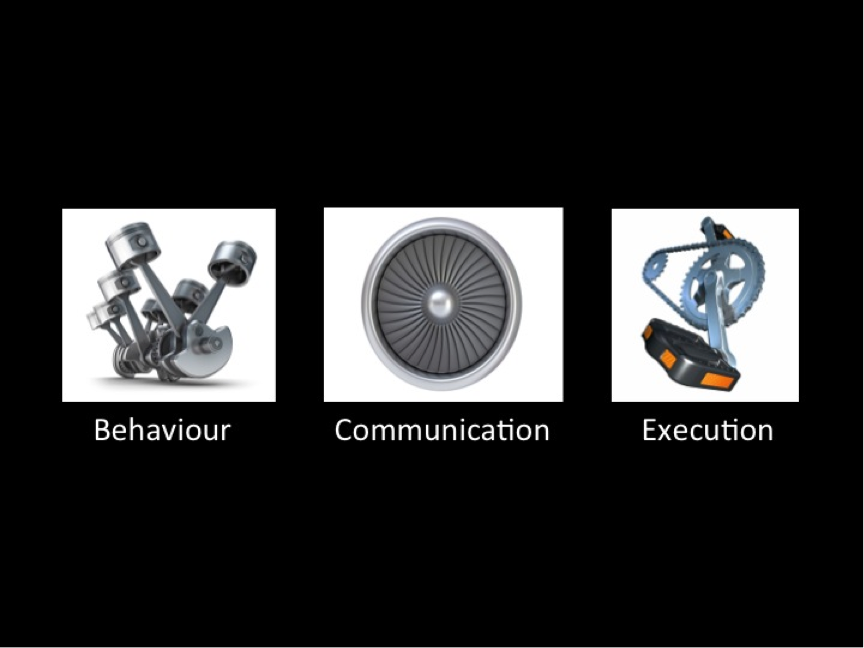
What we need are 3 type of engines:

  • A communication engine, with the ultimate goal of being a serendipity machine, an evangelization machine, and a knowledge flow platform;
  • An execution engine, with a good balance/portfolio/consistency between internal and external innovation
  • But all those changes are lipstick on a pig, if they are not deeply embedded in sustained behavioural change in every vain of the company.

What we really need to focus on is the third engine of behaviour change. Deep viral behaviour change. Because behaviour drives culture and not the other way around. And let that change spread like a virus through our organizations and systems. So it is getting copied and amplified through our hyper-connectivity networks. Where leadership becomes leadingship, and backstage leaders act as distributed coaching nodes in the corporate grid.

In the end, it is about being human and developing and nurturing the capability to be touched by beauty, a picture, by mastery and harmony. And to develop a richer palette of judgment, choice and appreciation.

Yes, there is some form of romanticism here; shall we call ourselves business romantics? It’s the nature of this beast, to be an incurable romantic.

Incurable Romantics

It’s what I am as human. I cannot and do not want to settle for the sterility of digital zeros and ones, for cogs in cubicles executing standard processes that anyway do not match anymore our fast changing world.

I want to send, propel and amplify positive vibes and frequencies to all the nodes in our grids. I want to reverb and resonate, and inspire you all to dream. To dream big and be unreasonable and go for the impossible. I want to me and you to get alive and get a life. I want us to be mavericks and rebels in a corporate world.

10 questions to self-assess your innovation efforts

The fantastic Amplify festival in Sydney has just come to an end. What a week! The curation for this event by Annalie Killian (@maverickwoman) from AMP was just outstanding. It is very rare to such a rich set of speakers coming together for one week.

Amplify logo

This is even more exceptional if you’d know that this is a bi-annual fest exclusively targeted at employees from AMP. What a great innovation effort to bring the outside in, to expose corporate staff to the vibrant world of innovation at the edges of their own ecosystem!

Every company should copy-cat this approach.

As I listened to the different speakers talking about technology breakthroughs, innovation efforts, transformation efforts, and behaviour change programs, i felt a growing discomfort inside myself with the seemingly over-glorification of technology as a cure to solve all world problems, and the un-balance with business humanising insights.

At the same time, I started wondering how much of all this really lead to substantial changes and actual products and services shipped, with real value add reaching the customers on a sustainable basis.

Every time I meet innovators in a corporate environment, I ask the question: “what is your biggest innovation challenge?” Most of the time the initial answer is an embarrassing silence, and at best the answer is foggy and lacking clarity of vision and intention.

It made me think: what is it that makes companies’ innovation real? What is it that lets people with the holy fire flourish or die in our organisations? What is the authenticity of all this innovation work?

authenticity for sale

Illustration by @gapingvoid

With some very rare exceptions, all companies have innovation in their annual reports, part of their corporate branding exercise, even part of their mission. And many companies have actually dedicated central or distributed innovation resources and budgets in place. The happy few have even started or are starting with Corporate Garages (see “The New Corporate Garage” by @scottdanthony).

jobs_and_wozniak_1975

Image courtesy Apple Computer

However, in many cases this is window dressing and innovation seems to be mere “lipstick on a pig”. This creates disappointment, frustration, and a sense of illusion, and leads to disengagement of the staff at large.

In order to help organisations self-assess how real their innovation is, I started pulling together 10 questions. Depending on the number of 1) and 2) answers to the questions below, you will be able to find out for yourself where you stand, and hopefully will allow you to start a “straight talk” conversation within your organisations on the best way forward. The more I think about this, the more i am getting convinced that the key to succes is based on high quality alignement of vision and intention at all levels, and the irradiation of “stories” that seem to perpetuate in corporate environments.

The questions are organised per influence group of your organisation or give some insights in your real appetite for change and experimentation. Just tick 1) or 2) for your answer and add up the numbers at the end of the exercise.

  1. Board level
    1. 80%+ of your Board is really – in a pro-active, visible and public way – supporting innovation, or
    2. 50% of your Board are in essence against innovation and want you to focus on the core and the other 50% just “tolerate it”, close their eyes and trust their CEO not to do too disturbing things that can harm the company’s reputation.
  2. Strategy level
    1. Is innovation a dedicated chapter at the beginning of your strategy documents, or
    2. Is innovation merely a paragraph at the end?
  3. CEO level:
    1. Does your CEO deeply embody the desire to change and disrupt in an integer, consistent and authentic way, or
    2. Do you notice in the tone during the all-hands sessions almost an embarrassment when she takes the word innovation in her mouth?
  4. Executive Committee level: Are your executives aligned on innovation or not? Just do this mind-experiment: What do you really think would happen if you pop-in by surprise at the next Exec Meeting and ask each Exec to list the top-3 alignments on innovation:
    1. Would you hear one strong consistent message of alignment and genuine enthusiasm, or
    2. Many voices of disagreement and vagueness, and an urge to move on to the business of the day?
  5. Level-1 / Level-2  (Senior and Middle Management)
    1. Do they see innovation as the instrument by excellence to make bridges between the edge and the core, to transform your industry, brand, and network with the deep desire to challenge the status quo, or
    2. Do they look at innovation as the people who burn money, travel a lot, do not innovate in the core, a special bunch that never blends in, and is always “out there”?
  6. Your colleagues in general:
    1. Are they looking at the innovation team as a group of people that brings value, creates excitement, infuses new energy, creativity and enthusiasm, or
    2. Are they complaining about having to stay in their cubicles while the innovators have fun?
  7. Sandbox projects
    1. Do you have a process in place to force forward consciously at least 1-2 “big bad ideas” per year into the mainstream business, in other words do you have an innovation portfolio approach, or
    2. Are more than 99% of sandbox projects killed before ever getting a chance to get materialised in real products and services, because not fitting the strategy or no immediate revenue potential?
  8. Sandbox or playground
    1. Is your sandbox considered as a real space for experimentation and organizational learning, or
    2. Is your sandbox just tolerated as a children’s playground as long as it does not disturb the core and does not challenge existing power balances?
  9. When the going gets tough – in time of cost cutting:
    1. Do you observe a conscious choice to remain flat or even further invest in innovation for the long term, or
    2. Do you observe random flat cost cutting across all departments or – even worse – bigger cuts in innovation?
  10. Daring to be great
    1. Is their a process to identify your Corporate Catalysts and to plant them into the fabric of the organization to create viral change from within, or
    2. Have most of those that dared to be great, and had the courage to stick out their necks during the last 2 years been made silent or laid-off as part of cost-cutting, efficiency or other re-organization initiatives?

Let’s be conservative or even kind in your self-assessment:

  • If you have answered more than half of the questions with 1) there is a chance that your innovation is real. Focus on the execution of your innovations, and the shipping of value adding products and services into the marketplace;
  • If you have more 2) answers, you probably live in an innovation illusion and it means you have more work to do in laying a solid foundation of belief across the organisation  Avoid throwing the baby out with the bath water.  Push for clarity in the vision and intention of your innovation efforts, and focus first on deep bottom-up viral behaviour change activities, as behaviour drives culture and not the other way around. And remember; you will need passion, perseverance, and patience to succeed.

In other words, turn on the B.S. detector and ask yourself the question: is your innovation a real strategic choice or just a tick-box to satisfy your feel-good-moments. And plan your actions accordingly.

Disruptive times call for positive, creative disruptors: Rebel Jam Update

UPDATE: you can find the links to the recordings of all the Rebel Jam talks here:

https://docs.google.com/spreadsheet/ccc?key=0At_G3sEqOh0YdFQ1T3ZUYWFUNW1aR1pLN3JNV0pIbUE&usp=sharing

It’s easy to be an innovator and entrepreneur in start-up. Not so inside large organizations — companies, government agencies, healthcare systems.  The competencies and mindset you need to create change and succeed are different for rebels inside the organization.

The good news is that in today’s hyper-connected world we have the possibility to join forces – across distances and time zones – and create a critical mass of change agents capable of accelerating innovation & transformation globally

That’s why we’re holding a free, online 24-hour Rebel Jam with fascinating speakers, inspiring entertainment and provocative discussions every hour, with hosts from Europe, North America and Asia.  Our aim: empower the rebel to be able to create positive change, understanding the considerable risks and challenges that will arise.

On May 30-31, 2013, Rebels at Work and Corporate Rebels United will hold a 24 hour on-line Rebel Jam via WebEx. All you’ll need is to be able to connect to the Internet and clear your calendar.

You can tune in any time – or all 24 hours if you’re one of the crazy ones – to learn from Rebels about:

  • What has helped them to be successful?
  • Setbacks and obstacles they’ve experienced and how they’ve navigated through them.
  • Habits that help them stay creative, positive and respected.

There will be time after each speaker for questions and conversations to encourage as much learning and camaraderie as possible in an online way. We’ll also be inviting performers and artists to share and perform their work with us to fill our rebel spirits, and just have some fun.

The conference kicks off on May 30 at noon in Europe; 6 a.m. North America East Coast; 3 a.m. North America Pacific, and 8 p.m. Sydney. 

Here is the attendee information for the Webcast:

https://ciscosales.webex.com/ciscosales/onstage/g.php?t=a&d=207449320

Event password: rebeljam

You can register via the Rebel Jam Eventbrite site here: http://rebeljam.eventbrite.com/

The online rebel jam is a joint effort of Rebels at Work, and Corporate Rebels United  and being sponsored by Cisco IBSG who is contributing both speakers and the WebEx collaboration and communication platform that enables this global virtual event

The latest program overview is available in the following Google Doc:

https://docs.google.com/spreadsheet/ccc?key=0At_G3sEqOh0YdDIzbTN1M2FSQUxUT2xKOFh6aUNoTVE#gid=0

Some cities are setting up local events to follow and participate in the WebEx Rebel Jam.

–       Brussels:

–       Other cities to be announced

You can tweet about and during the event with Twitter hashtag #rebeljam

For more about corporate rebels, check out some of these posts, research reports, and videos:

9 Lessons from Rune on Leadingship

Since my post “The End of Leadership”, the topic of Leadership vs. Leadingship keeps buzzing in my head. I further elaborated on the topic in a subsequent post “Leading from the Edge”.  As many of my readers know, the inspiration muze for these posts was Rune Kvist Olsen from Norway.

tumblr_mk56n9nE7b1rse1ipo1_500

Rune is fine-tuning the concept by sending regular comments to those posts. He now has collected and gathered his writings from February and March into 9 lessons for Leadingship.

Rune lives a bit isolated in a self-designed and self-built house on a lake in Norway. A bit disconnected from technology and social media and all the rest, but probably more humanly connected than many of us hyper-connected digital stress rabbits.

It is a pleasure to respond with a wholeheartedly “yes” to Rune’s request to post his lessons on my blog as a guest post. It is probably his only voice to the world.

It’s a long read, and you need your attention and intention with you when reading, but Rune has developed such a rich language to articulate the differences between Leadership and Leadingship that I find it always worthwhile to immerse myself in his thinking.

So, here they are, the 9 lessons for Leadingship. Red and italic highlights by myself.

+++ Start of 9 lessons from Rune on Leadingship – Feb/March 2013 +++

Lesson-1: The consistency in interactions between personal conceptions of reality and the influence of personal power in the organization.

The general conceptual principle: We are envisaging the reality as we are our self, and not as the reality is in it self. The particular conceptual principle: We are seeing the reality in our organization based on Who we are as persons and What we have as persons.

The organizational design principle: Our reality conceptions at work varies and fluctuates with our specific and factual organizational circumstances.

1. The reality conceived from a Leadership point of view:

As superior persons appointed to leadership positions we see the reality from above and downward. We are envisaging the reality based on our position and rank as superiors and will understand, interpret, explain and defend our conceptions and perceptions of the reality context accordingly to his respective circumstance of power over subordinates below.

The superior person in a leadership position is given the power to determine and ascertain the correct version and view of the truth and the power to enforce the authoritative description of the reality.

The subordinate person must accept and comply to the version of the true reality conception established by the ruling order with loyalty and obedience, with the purpose of sustaining one owns job and work.

The reality conception powered by Leadership is based on What we are and have by the virtue of positions and ranks.

2. The reality conceived from a Leadingship point of view:

The power of Leadingship is based on the principle that everyone in the organization are entitled and authorized personal power within a respective field of work, and entrusted with individual freedom and personal responsibility in making autonomous decisions.

Everyone are relating as equals and peers and are envisaging their reality context from a similar point of view (neither upwards or downwards – but sideward’s) from the same platform of out looking the organizational reality.

A shared reality conception between individual human beings occurs when individuals are able to understand that other’s conception of reality can be as real, true and valuable as their own conceptions and perceptions.

The common awareness that our reality are composed of a myriad of different views, conceptions and opinions, are the dynamical cord that are linking and connecting us together through our individual personalities in shaping our common identity as a working community.

The reality conception powered by Leadingship is based on Who we are as individual human beings based on our personal competence and capacity in doing our respective jobs.

Lesson-2: The Truth powered by Leadership versus Leadingship:

A. The Truth powered by Leadership:

The Subjective and Superior Truth as a matter of an Objective Supremacy Fact. The superior leadership person sees and rules the truth, and the subordinate person is told and ruled by this commanding truth:

If and when a superior person in a leadership position don’t  like, disagrees and disputes a critical and controversial report from subordinates, the superior person will most likely terminate and close the matter, and file the case in the archive as invalid, unreliable and unaccountable. The subordinates will be labeled as disobedient, disloyal, dishonest and not trustworthy.

B. The Truth powered by Leadingship:

Subjectivity is a personal matter as an individual expression of reality conception. Objectivity is a collective matter as a result of shared understanding amongst the people involved.

When people have gained the personal force to operate and function independently and entrusted the liberty to take responsibility of actions as equals and peers, they have at that moment of conscious state of mind attained enough personal confidence and will force to accept and trust the reality description of others without fear, rejection, condemnation, denunciation. damnation and contempt.

Lesson-3: The consequence of a polarized reality conception powered by Leadership versus a shared reality conception powered by Leadingship.

1. The Leadership reality conception directed downwards and upwards:

  • Mastering hegemony by monopolizing the truth.
  • Colliding values and believes.
  • Minimizing, discrediting and ridiculing alternative statements as rhetorical and semantical matters (depriving and renouncing confronting aspects their authority in being serious and real).
  • Conflicting priorities.
  • Contradicting truthfulness.
  • Compromising reliability and credibility.
  • Alienation by separation.
  • Ruling by dividing, conquering and domination.
  • Verticalization of relationships.

2. The Leadingship reality conception directed sideward’s:

  • Sharing by beneficial benevolence.
  • Communication by leveling.
  • Collaboration by coordination.
  • Corporation by complementation.
  • Connecting by integration.
  • Equalizing by reciprocally.
  • Horizontalization of relationships.

The structure in organizing, managing and leading work and people are a consequential reflector of the structuring of power as the premise shaper of the reality design in the organization.

Lesson-4: The necessity and essentiality of substituting and replacing obsolescent and anachronistic believes and dogma (f.ex: Leadership) with new and alternative options and solutions (f.ex: Leadingship) – which are not part of the illness and disease that inflicts and infects the mental health of the human mind in contemporary organizational life.

The excellent and brilliant statement of Buckminster Fuller says everything about the necessity in creating alternative options (model, concept, system, structure) when dealing with obsolescent matters opposing and counteracting new future realities:

“You never change things by fighting the existing reality. To change something, build a new model that makes the existing model obsolete.”

The power and force embedded in the concept of Leadingship enables us in moving beyond existing mental boundaries in reaching the emergent future of a new workplace reality, where everyone are relating equally and mutually on the same level of co-existence.

At that point of evolution in the state of mind of the individual human being, we have released the chain of control and command from someone above to lead and others below to be led. This significant action have made the existing model of Leadership for Someone superfluous by compensating this obsolescent dogma with a new model of Leadingship for Everyone.

Lesson-5: Notorious governing administrative mechanisms and ruling Leadership techniques in enforcing silencing, subjugation and subordination in the workplace – in relation to Leadingship practice.

The purpose of well known and famous governing mechanisms administered by the system and ruling leadership techniques applied by the superior (leader, boss, supervisor, controller, director etc.) person in charge, is quieting and silencing people against advocating personal, individual and collective concerns, anxieties and worries about their work, working conditions and working contracts. The intention of such subtitle and often concealed leadership action, are enforcing, protecting and preserving the interest of the power holding and the powerbase that ensures supreme privileges and advantages for the people in charge in leadership positions.

In practicing Leadingship everyone must take responsibility and operate independently because there are none to command and control, and subsequently there is an absence of manipulative mechanisms and techniques of silencing people to muteness. One main purpose behind Leadingship is to take each other seriously and not dismiss controversial, challenging and critical arguments as invalid.

There are some factual and actual factors (mechanisms/techniques) applied by superiors above in governing/ruling subordinates below by legitimate leadership strategies and tactics:

1. Dismantling the existing workplace setting.
2. Dispersing/dissolving the working group.
3. Exiling persons from the workplace (office/station).
4. Removing access to working instruments.
5. Depriving of tasks and functions.
6. Redrawing authorization, certification and security clearance.
7. Degradation/depromotion downwards.
8. Excluding/out locking from job.
9. Expelling from department.
10.Relocation to another physical setting.
11.Discharging/firing from job.
12.Dismissing/teminating contract
13.Disgraced/dishonored professional reputation.

Revealing and exposing pretentions, intentions and reasons behind the monumentation and cementation of the Truth of Reputation by the correct version of history description, is the only option in establishing transparency and prevent future veiling of manipulated truth powered by Leadership.

I will end this enigmatic lesson with a statement from some years ago:

“The truth is only threatened by its own essence when revealed as a deception and falsehood in concealing the real and sincere intentions and reasons behind a manipulative action in preserving the status quo.”.

Lesson-6: Identifying and mapping the consequences of institutionalizing the correct version of the Truth by the legitimate and authorized act of either superiority or equality in the organization.

Evidencing the Truth of reality by Leadership versus Leadingship. Our conception of reality becomes our truth depending on how we are letting and accepting the reality being described and interpreted by someone keeping the power based on (leadership) position, or by everyone sharing the power based on experience and knowledge (leadingship competence).

The act of indentifying the common reality experienced by everyone individually in the organization, can be done by proposing relevant questions in revealing and exposing the real truth about powering, organizing, managing and leading work and people:

  1. Can you envision a workplace where all people are powered with authority by their own abilities to operate and function independently and responsible?
  2. Can you envision a workplace without superiors and subordinates where some people have power to dominate, control and command others in the act of subjugating them to subordination?
  3. Can you envision a workplace reality where the power to make and take decisions is linked exclusively to personal competence (in contrast to position and rank)?
  4. How are your present workplace powered, organized, managed and led?
  5. What are the intentions and reasons behind the existing structuring of power in your organization?
  6. What would you regard as the most important, crucial and vital assets and requirements in changing your workplace to a reality where everyone have equal access to personal freedom and individual responsibility?
  7. How can you contribute in addressing issues at work that you need to resolve in creating a transparent and ethical social conscience amongst the people in your organization?

The strategic option in this organizational context is either staying behind by maintaining and conserving Leadership for Someone or moving beyond by initiating and implementing Leadingship for Everyone.

Lesson-7: Why Leadership versus Leadingship are interconnected opposite poles in a dynamical learning progression interfacing each other through reciprocal  interdependency and mutual influentially.

A key to a dualistic relationship between diametrical contrasting opponents is challenging each other by their opposing differences and inequalities, lies in the insight, knowledge and experience of how the essence on one specific entity is shaped and formed in the relation to its absolute contrast.

For example to understand white we must understand black, god versus bad, nice versus evil, sharing versus keeping, cold versus warm etc. Our conceptions and perceptions are constructed by this code of symbiotic dualism. Subsequently the insight and understanding of Leadingship is found in the knowledge of Leadership. The simple pedagogical motto is therefore: ”Knowing the one by knowing the other and visa versa”.

The paradigm of dualism unites separation and integration as two opposite aspects of the same matter, both contradicting and presupposing each other at the same time in a dynamic and progressive process of attraction and repulsion. The pedagogical flow are the initiating energy behind all human learning as a composition of mutual interaction and interference between distinctive reciprocal components. These influencing factors generates a synergic and symbiotically impact of unified consciousness by the momentum of learning.

In balancing and harmonizing a dualistically process between opposite poles that are contesting the essence and nature of each other constantly, we must establish counterbalance that are enabling the potential and options of alternative choices granting us the freedom to choose. In choosing and selecting one specific option, we must at the same time be aware of alternative options.

Alternative options gives of the freedom of choice, while absence of alternative options will be forcing us to submit to the only given solution at hand.

The lack of options is the opposite of freedom of choice.

In balancing and harmonizing our choice in organizing, managing and leading work and people, the option of Leadingship contra Leadership is significant and essential in sustaining the free will and the freedom of choice. Subsequently the counterbalance of interconnected opposite poles in a learning perspective, is substantial in generating “learning of the one” by the “learning of the other” and visa versa.

We learn our self in relation to others by questioning What, Why and How we our self can perform, accomplish, achieve and pursue our intentions and purposes.

We are not truly learning by letting others tell us what to do. Learning from others are just reproduction and copying old learning’s. Others can help us to learn, but the learning is ours to do within our self.

Learning is a personal process done inside the human embodiment. By internalizing and processing all types of inputs from outside and inside, we will be molding our impressions to distinct emotions and thoughts that can transpire to learning’s that enables specific actions. By converting the learning’s to actions, we are creating competence as we are testing our theories into practical operations for our self and others.

Competence is a individual and personal matter that never can be conveyed and transferred to other people, because of the nature of the process as a personal matter inside the individual person. Everyone must do their job and learn by themselves from birth to death. However we can share and exchange our knowledge and experiences so that others can internalize and process their own impressions, and later can convert their thoughts into competent expressive actions.

Learning as a dualistic matter is all about learning and understanding One Self through the relationship to others in true and affectionate mutuality of susceptibility and receptivity. In this way we learn by challenging and questioning the truth conveyed by others, and instead be searching for our own personal truth in becoming authentic individuals.

Lesson-8: The Learning Design of Leadership versus the Learning Design of Leadingship.

The vital and crucial questions are:

1. Am I my self able in taking responsibility for my own learning or not?

2. Am I the person who know best what I need to learn most and in a way that suits me best?

Answers to these questions will be determining and forming the applied learning design principles regarding which force of power that will be ruling and governing our learning process and learning lessons. The selected force of power will have two alternative options of choice:

1. My inner self capacity in taking care of my learning responsibility.
2. Someone outside my self who is assigned my tutor and appointed my superior being considered as best qualified.

I. The Leadership Learning Design:

Someone above as the superior authoritative person in charge is telling, instructing, training others below as subordinates what to do, why to do it and how to do it.

The learning belief is that the person in the leadership position has the best knowledge and competence to determine what is best for the people below in performing their jobs, while the subordinate person is not personally equipped and endowed with the adequate and sufficient talent in taking care of one owns learning in an independent and responsible manner.

This difference in preference and reference signalize the distinction between trust and distrust in people and in the emphasizing of the significance of position and rank. This differences in conception of who to trust as superior and who to mistrust as inferior, are the main reasons that someone is valued and regarded as best qualified to leadership positions and subsequently most trustworthy in taking care of others learning.

The leadership learning design principle is focused on organizing learning as a system of teaching, training and education from top down the hierarchical ladder by the appointed person in charge of the facilitation training program in employee education. The superiors themselves are summoned to exclusive Leadership programs in learning the design principles of organizing, managing and leading the subordinates below.

II. The Leadingship Learning Design:

Everyone are considered qualified in taking care of their own learning actions as trusted equals and peers based on their respective competence and personal characteristics in adding value to the common good and the corporate benefit.

The learning belief is that everyone are doing their learning from inside themselves based on personal choice of individual development. The learning must be subjected to personal choice and processes in order to evolve as a personal matter of competent individual actions. People will be operating independently and responsible in generating their learning and be converting their learning into applicative competencies.

The leadingship learning design principle is to situate and arrange necessary space for personal learning and collective sharing of individual learning, where the internalized learning outcome from everyone can be coordinated and integrated as a collective force of organizational competence. The leadingship design of learning is focused on organizing learning as a consecutive process of learning by experiencing progress and regress in personal achievements, and by reflection on continuous improvements in personal accomplishments.

The Leadingship programs of training and education are inclusive for everyone since everyone are learning by themselves together with others all the way through their working life and private life.

The ultimate choice of the Design principle of Learning is subsequently a choice between either Leadership learning program for Someone or Leadingship learning program for Everyone.

Lesson-9: As in Heaven – So on Earth. Leading and Learning through parallel perspectives of Reality.

In this time of solemn and holy reverential sentiment to come for the celebration of the Easter holiday, I would like to summarize my posted lessons in both an earthly perspective as a spiritual perspective. I will be starting this angling approach with the spiritual part in relevance to the theme; Leading and learning in parallel perspectives of reality, by making a connection between references to spiritual experiences extracted from conveyed interviews with persons under superconscious hypnosis.

The distinguished author and scientist Dr. Michael Newton has uncovered the mysteries of our state of being in the spirit world, and has written several books covering experiences from living human beings who convey reports from their spiritual realm. The texts of Dr. Newton gives a fascinating and an intriguing insight of how a parallel reality such as the spiritual world, could be organized, managed and led. The following statement is quotations from the book; “Destiny of Souls”:

“While in a superconscious state during deep hypnosis, my subjects tell me that in the spirit world no soul is looked down upon as having less value that any other soul. We are all in a process of transformation to something greater than our current state of enlightenment. Each of us is considered uniquely qualified to make some contribution toward the whole, no matter how hard we are struggling with our lessons. If this was not true we would not have been created in the first place. (page 6)… Advancement through the taking of personal responsibility does not involve dominance or status ranking but rather a recognition of potential. They see integrity and personal freedom everywhere in their life between lives. (page 7)”.

A rather solemn and reverential statement at this time of sentimental and ceremonial reflection and contemplation, I would say. In either way these words of Dr. Newton can perhaps give us a touch in raising our senses in expanding our perspectives of existential matter.

I will be ending this lesson with an earthly part in relevance to the theme; Leading and learning in parallel perspectives of reality. The earthly duality of values and believes states the overture:

“Someone are leading others and others are led by someone” powered by Leadership versus “Everyone are leading themselves together with others” powered by Leadingship.

At the moment when the majority of people are deprived their power of self-decision and ranked below as subordinates with superiors in charge, the structuring of power is shaped vertical and organized hierarchical. At this momentum of subjugation by subordination, someone is appointed the authority of leading others by the virtue of their superior position and rank, and others are subjugated to be led by the virtue of their corresponding inferior position and rank. This way of organizing, managing and leading work and people represent the rule of Leadership where the organization is adopting and adapting Leadership for Someone.

At the moment of revelation of the apparently devastating and damaging consequences of Leadership for Someone for the human energy and spirit in the workplace, where the majority of people are subdued to inferiority and subjugated to subordination, people will at the moment of despair understand that this vertical and hierarchical way of organizing is obsolete and destructive regarding human engagement at work.

The mantra of Leadership for Someone would at this point be at its breaking point of revolution, and ripe and ready for replacement by the essence of Leadingship for Everyone.

The essence of Leadingship for Everyone is that all people are enabled the authority of self-decision at work. At this moment of transformation in the way we operate as free individual human beings, the structuring of power is shaped horizontal and organized egalitarian with people sharing power, exchanging resources and complementing each other in unified actions.

This way of organizing, managing and leading work and people, represent the era of a humanized work life, where the organization is adopting and adapting the vision of Leadingship for Everyone.

At this moment of truthfulness including and equalizing Everyone and Everybody in the organization, we are in a way aligned with the spiritual vision of leading and learning beyond our own comprehension of reality.

+++ End of 9 lessons from Rune on Leadingship – Feb/March 2013 +++

The Future is Analogue

Last week, I attended the PurpleBeach launch event (check out the twitter stream at #purplebeachlaunch). It’s one of those events that got me again into hyper-reflection mode.

Purplebeacj

I was not really sure what the launch was about – initially I thought it was about the launch of a new consultancy firm – but once on site, it looked like being an experiment driven by Annemie Ress about “People Innovation”. Annemie had been heading HR and people efforts at eBAY, PayPal and Skype and I think she was not sure yet herself where this happening was going to land. She was maybe taken a bit by surprise by the number of folks who signed up for this invitation-only event – and in some way I liked a lot the authenticity of her and the team, being and staying open and curious about what could emerge from a gathering of about 180 folks of quite diverse “plumage”.

I got invited via MJ Petroni, owner and founder of Causeit.org. I met MJ last year when he and his team coached the Innotribe team on making quality team alignments and intentions. Petroni is mentored by Mark Bonchek, PhD, former SVP of Networks and Communities at Sears, now heading his own consultancy Orbit about pulling customers and communities in “orbit” around your brand. Enough credentials to follow-up on the invitation and checkout the event that took place in Audi Quattro Rooms, West-Side of London.

quattro rooms

Day one started with some strange mix of “quite-ok” talks about mobile, big data, digital identity, trends, leadership, HR, and the blurred zone between HR and Marketing.

In essence, the glue binding the different activities was “business humanization” and “people innovation”. The basic premise that innovation in organizations does not happen without people rediscovering themselves in their full being, a rich combination of left/right brain activities, and greater levels of personal awareness.

And yes, there was some strange Californian “wu-wu”, “mindfulness”, “well-being” and poetry and artistic performance elements as well. After all, we were on the “beach”, a place where you can relax, be idle, and be open to whatever comes your way.

Day one was ok, but not more than that: I was more or less familiar already with the content presented, and was in search for the new insight, the new synthesis, the new “AHA” moment. Alas, I waited in vain for the muse to inspire me.

But Day-2 kicked off by a great discussion about being “on”-line all the time, after a presentation by a trends watcher about future trends, micro work, etc. The presenter was depicting a future of always-on, nowism and “on-ism”, a future where you have to check your smart-device or sensor every second to capture that 5 minute chunk of work on a worldwide marketplace for mechanical turks.

In the following panel, Doug MacCallum (ex eBay but still advisor to the CEO of eBAY and non-executive Director on the board of Ocado) couldn’t hold it anymore:

“What a horror! I don’t want to live in a future like that. People need their time off to reflect and recalibrate. This is a dystopian future”

Doug MacMallum almost got a standing ovation for his intervention, and just the fact he got the ovation is a proof of how deep “presentism” is disturbing our human lives. It was like some sort of relief going through the room.

He went on describing a practice of Executives not sending mails in the weekend, to respect their own free time and that of their collaborators. Great initiative, but I have seen such promises before, and in some occasions the executive is preparing her emails during the weekend, queuing them up, and releasing them on Monday morning, so you have your inbox loaded with fresh instructions and work (sic).

present shock

It made me think of Douglas Rushkoff’s latest book “Present Shock” (Amazon Associates Link), about the fragmentation of everything, including work and value, and the addiction that arises when you are not able anymore to step out of the digital time, back into analog time, where you still have some sense of time fluidity, rhythm, and relative perspective.

Penelope Trunk, co-founder of Brazen Careerist, recently wrote a great article in Quartz. I like the section on refusing to present your-self in a linear way:

Agents represent workers who pick and choose projects that match them rather than signing on for indefinite amounts of time. The Harvard Business Review calls this supertemping. Business Week calls it going Hollywood.

It’s about a deep desire for story and narrative, context, being part of something, being for the long haul.

But unfortunately, we are getting fragmented disassembled

UPDATE: @MayaDroeschler retweeted my post and linked it with metaphysics of pure presence, referring to the the work of the philosopher Jacques Derrida who introduced the concept of deconstructivism, and who also influenced architecture (in the form of deconstructivism). This is the space of famous architects like Peter EisenmanFrank GehryZaha HadidCoop HimmelblauRem KoolhaasDaniel Libeskind, and Bernard Tschumi. Readers who know me, understand that Maya touched my sensitive chord of love for architecture. Picture below from Frank Gehry’s Guggenheim Museum in Bilbao.

gmb_bilbao_690x235

But I got distracted 😉 The Quartz article also mentions new “modern” practices of young people selling stocks in themselves. This is about investing in – or probably better called “betting” on humans.

A “good” example is Upstart, a start-up opening their site with the slogan “The Start-Up is You.’’

Upstart

Upstart was founded by a group of ex-Googlers, including Dave Girouard, who spent 8 years at Google where he was President of Google Enterprise and VP of Apps.

I can’t help it, but this starts smelling like slavery to me. You already knew that you were the “product” of Siren Servers like Facebook, Google, your bank, your insurance company, your health company; they are getting your data for free and can monetize it without compensation of the data originator. It’s getting worse now: we are now entering an era where one owns the life of another human being, worse even, takes options in somebody’s future and betting on it.

Jaron Lanier has recently published a great book about this “Who owns the Future?” (Amazon Associated Link)

Who owns the future

I feel really sorry for otherwise very smart people Eric Schmidt, Peter Thiel, Khosla Ventures, Marc Benioff and other moguls for putting 5.9M USD in the last capital round of Upstart. I believe they are forgetting something very important here. This is in essence a form of digitizing of what it means to be a human being, digitizing the being into binary data blips, forgetting the rich set of emotions, senses and creativity we all can bring to the table. We are more than data present in the moment. We are part of a narrative, a story, an analog context.

Our “presentism”, just having that safety option to do that quick email check in the week-end, to check that Twitter status, the Klout and other scores are probably symptoms of something deeper going on: just having that capability is for some people already reducing the anxiety of loosing out on something.

Somebody shouted from the audience “But we are loosing the obvious!” – meaning loosing of being humans – and then a couple of “minutes” later, the quote of the day:

“The Future is Analogue”

I really believe it’s about loosing or sustaining our analogue human identity. Identity is contextual and one context is the time framework we want to function in. I’d prefer to live in the analogue time context; the way Doug Rushkoff described it: “What do we want: the long now or the short forever?”

This lead to my first “Aha” experience at the event: an experience about identity. As somebody quite active online, I try to be – and believe I am – the same person on-line or off-line. I don’t believe I have a different persona online of off-line. But online, I feel more the need to amplify myself  and my outgoing data streams, and at the same time trying the amplify and maximize the incoming streams of new data. But there is too much info out there, I feel indeed this anxiety to miss out on something. I also sense higher degrees of narcissism on-line, narcissism in the sense of self-amplification and promotion. What does that do with my identity? I think I am pretty the same online as in the real world… But “shaping” my online identity raises deep questions on who I am: as an individual, in a group, in the world at large.

Ron Shevlin @rshevlin, author of Snarketing 2.0 sent out this tweet on 28 Apr 2013:

“If identity is the new money,

schizophrenics have it made.”

It was in this mood of identity reflections when I entered a conversation with another Purplebeach participant: Jefferson Cann from Extraordinary Leadership, a soft-spoken gentleman bringing the topic of intimacy into the debate.

The word “intimacy” worked like a red flag on me. I explained Jeff how I was trying to stabilize/discover/re-discover my identity. His feedback was that he was not sure that one needs to fix/stabilize your identity.

“By fixing, you close yourself for being open to the moment, for the intimacy with the moment. The intimacy of the moment INCLUDES identity, so that the identity can flow, can evolve. In that sense, I hope that your MBTI of 10 years ago is not the same as your MBTI of this year, which would mean you have not evolved.”

This coming together of intimacy and purpose gave lead to my second big insight of the week, the second “Aha” moment.

My readers know that I am sick of the 10 min, 15 min, 18 min pitches and talks. I am hungry for depth, for richness of conversations, for going beyond scratching the surface. One of the reasons why I keep writing these long posts 😉

The insight was that my hunger for depth is really a hunger for intimacy, the hunger for human connection, also on professional environments.

What does it really mean when a manager tells you: “You know, I am a pragmatic man, two feet on the ground, so can you please pitch me your story in one minute, and at the same time tell me what the ROI for the next 2 years will be?”

I suddenly realized that this famous pragmatism and two-feet-on-the-ground is probably a shield to hide from depth, from intimacy. It is a shield against the present that can even be used in Machiavellic ways to include/exclude people from connection. It’s a deep sign of uncertainty and insecurity, the fear of losing control, fear of human contact, the fear of opening up, the fear people will discover there is no substance, and fearing/knowing you cannot compete on content. It’s the fear of having to acknowledge that your leadership power only comes from your position in the hierarchy and not from who you really are.

As Glenn Llopis recently wrote in Forbes about “The 5 Things Leaders are thinking with not talking about”:

Leaders must find a new sense of maturity within themselves to address and navigate these new workplace issues with greater clarity, focus and intention. Leaders must be more proactive in coming to grips with today’s new normal.   In doing so, they must face their greatest fears head-on and get on with the business at hand.  The marketplace, the workplace and those whom they serve demand it.   Until they do, here are five things leaders are thinking, but not talking enough about: 

  • I don’t have all the answers
  • I have difficulty relating to the younger generation
  • Diversity makes me uncomfortable
  • I am uncertain about the future
  • My leadership skills are not relevant


It looks like we are witnessing murder by modernity: murder of the human connectedness through the avoidance of intimacy. It looks like most of us – including our leaders – and not ready from the new normal. We need to send our leaders to “Purplebeaches”, so they find again time to reflect, to enjoy depth, to open up and embrace connections between fellow human beings.

UPDATE: as a real example of synchronicity, Jennifer Sertl just posted this awesome video about being human.


Some interesting insights:

  • There is no off/on button for feeling an emotion
  • How are we teaching people what is human vs. what is technical
  • We have to re-enforce the usefulness of being human
  • You can’t take care of yourself if your are at the same time taking care of a tribe
  • Everything you do becomes part of a data piece
  • Playing a higher personal – private – game
  • Our ability to have empathy is impacted by technology

“We are loosing the obvious: what we are loosing is our ability to scenario plan, our ability to gain perspective, our ability to know ourselves, and our ability to empathise. Those four things is what separates us from the gadgets”

Life is not digital. The future is one of analogue connection.

Innotribe Workshop “Network Insights for Growth” on 14 May 2013

On 14 May 2013, the Innotribe team is organising an exclusive invitation-only Innotribe Workshop at Level39, Canary Warf, London. The topic of this workshop is “Network Insights for business growth”.

Innotribe_logo

This workshop is targeted at senior strategists who would like to discover how big data and scenario thinking can lead to early warning systems and new network insights to assist in business growth strategies.

Your organisation is indeed hyper-connected with your business partners. You are not alone. Billions of connected business, people, applications and devices and in future far more sensors, and transactions now add up to create unimaginable amounts of information. This new environment will require extraordinary insights and adaptability: It is as if we are a species from dry land that has to learn to live in the ocean. Already now, we swim in a sea of data and the sea level, so to speak, is rising rapidly. This new environment requires a new design for companies and network insights, representing both threats and opportunities.

networks and oceans

The networks that we are part of can be looked at as dynamic fluid systems: the infrastructure of pipes creates a hyper-connected environment. The end-points in networks can be different entities: financial institutions, corporates, and market infrastructures, etc. And physically wired networks can host many different functional sub-ecosystems: some represent major traffic highways, others are more hub-to-hub topologies, others function as pure peer-to-peer exchanges. These different entities and sub-ecosystems also influence each other: they create “ripple effects” up and downstream, as well as “currents” that create significant interdependencies, like ocean currents.

During this exclusive invitation-only Innotribe workshop, we will explore the following topics:


  • What if you could get deep intelligence about what’s going on in these fluid networks in real-time?
  • How could that inform your growth strategies, long term scenario planning and policies?
  • What if you could combine quantitative and qualitative network intelligence streams, and combine them with scenario thinking into real insights and possible early warning systems?
  • How can you use network insights to inform your future scenario planning and strategies for growth?
  • How we use these insights for better informed risk management policies?


“Network Insights for Growth” will be organized in the authentic Innotribe-way. We will bring together thought leaders in highly interactive conversations, facilitated by the renowned Innotribe team. In this year’s Innotribe events and workshops, we also try to limit the number of subjects covered, so we can experience deeper conversations and insights.

Level39 Logo

This “Network Insights for Growth” event will he held at and in collaboration with Level39, Europe’s largest accelerator space, where technology, accelerator and innovation companies are being invited from around the world to come and run their startup and accelerator programs, in one of the most inspiring spaces in London. Situated in the heart of one of the most advanced ‘smart cities’ in Europe, Level39 occupies the entire 39th floor of Canary Wharf’s iconic One Canada Square.

level39 room

We will start at 10:00am UK on 14 May 2013 with planned closure of the workshop around 4pm UK. With plenty of informal networking opportunities and informal conversations during the networking breaks and lunch. This event is free-of-charge.

If you like to attend this exclusive workshop, please contact me and I will get you your personal invitation. Number of seats is limited.

Looking forward to continue our critical dialogue in London on 14 May 2013.

Detailed program:

10:00 – 10:15                       Welcome and Introduction

  • Fabian Vandenreydt – Head of Markets Management and Core Business Development –  SWIFT


10:15 – 11:45                       5 different lenses (15 min talks by)


11:45 – 12:00                       Break

12:00 – 13:00                       Interactive workshop

13:00 – 14:00                       Lunch

14:00 – 14:30                       Taking Stock

14:30 – 15:30                       2nd Interactive Workshop

15:30 – 16:00                       Conclusions, next steps and wrap-up

We plan to continue the conversation on this topic during this year’s Innotribe@sibos in September 2013 in Dubai. During the May workshop in London, we hope to establish a solid baseline as a stepping stone for our in-depth sessions on “Scenario Thinking” and “Network Insights” in Dubai. Earlier this week, i posted a preview of our 2013 Innotribe Sibos program.


Innotribe Sibos Dubai 16 – 19 Sep 2013: preview

This year, our annual flagship event Innotribe@Sibos celebrates its fifth anniversary. Running throughout Sibos week, the event offers a comprehensive programme exploring a range of topics crucial to the financial industry.

Slide32

Innotribe@Sibos in Dubai will once again bring together a powerful combination of world experts to participate in an exciting mix of keynote sessions, case studies, and interactive immersive discussions and learning experiences.

Last year in Osaka, the Innotribe space was a fantastic spacious tent in the middle of the conference patio. It just looked gorgeous! This year, we have a really big conference room accessible from the main conference area through a tunnel. The tunnel will be a magical transition between the more traditional Sibos environment and the subterranean Innotribe Space. The tunnel will also serve as an area for exposition, informal gathering and special multimedia experiences. I have seen some early designs for the space and tunnel, and it all has a very “clubby” feeling to it. It made me think of clubs of the 80’ies with a Vive-la-Fête feeling to it. Just play the video/music below while you read the rest of the post: you’ll get into the rythm 🙂

The space and the tunnel are part of the experience, and therefore the tagline for this year’s Innotribe@Sibos is

“There is light at the end of the tunnel”

creating a positive inspiring environment, looking into the future with a mindset of progress, hope and purpose.

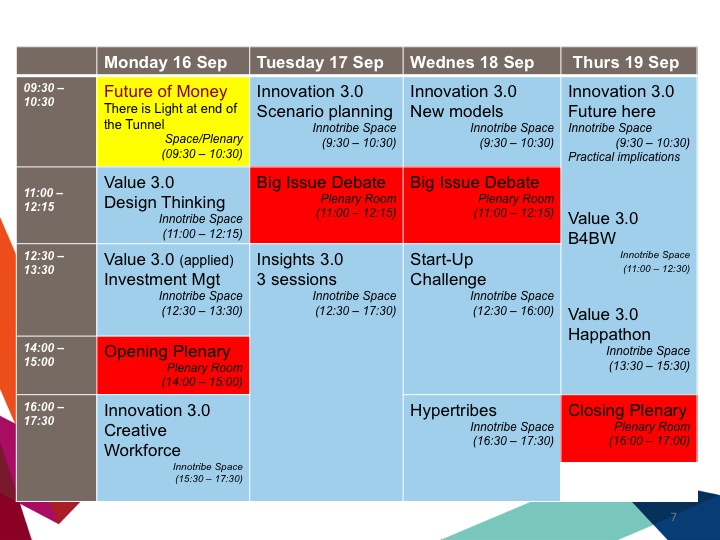
Programme

Building on the feedback we’ve received over the last few years, we have tried to observe the following principles in the design of this year’s programme:

  • Less topics, but more depth;
  • Keep the freshness and relevance of the themes and topics;
  • Keep the uniqueness of the Innotribe format: highly interactive and immersive group learning experiences;
  • Discovery, awareness, future oriented;
  • A healthy mix of technology and non-technology subjects (societal impact);
  • Introducing the concept of “journeys”, so that you can follow a track from A-Z as a learning curve, or pick and choose depending on your familiarity and expertise with the topic;
  • Our ambition remains to co-discover, co-design, co-create and co-deliver.

Slide05

We have selected four major themes that will be:

Value/Wealth 3.0

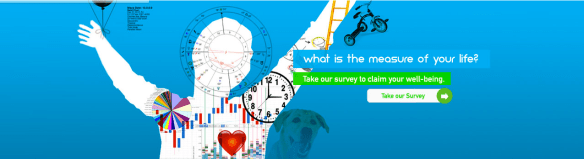
  • Continuing from previous conversations on The Future of Money, Banks for a Better World, Social Business, and the great re-definition of wealth and well-being. New are topics on Design Thinking, Investment Management 2.0 and Intangible Assets. We have also partnered with www.happathon.com to crowdsource a global measure of well-being versus wealth.

happathon

Innovation 3.0

  • Or the re-invention of innovation. In many organisations, the discussion about innovation is hampered by a low quality and polarizing dialogue; incremental vs disruptive, core vs non-core, internal vs external. We can do better: there is a simple line running from where companies were and the processes they needed thirty years ago to a highly externalized enterprise that carries new rules and needs new processes.
  • We will also discuss new models from other industries and emerging markets – Jugaad, Shanzai, Reverse Innovation – and inject new thinking modes like design thinking, scenario thinking, business model thinking.
  • Last but not least, we will engage you in an interactive game/experience to discover a day in the lifetime of a creative banker.

Start-me-up 3.0

  • Whereas the previous two streams are maybe more conceptual, this stream is all about actual innovations, where the “rubber meets the road”.
  • In “The future is already here”, we have invited some awesome speakers that will shake the tree and showcase some mind-blowing innovations in financial industry.
  • We will also discuss the outcome and ways forward for the “Hypertribes” model, a possible new way to accelerate innovation for the industry at large.
  • This stream culminates in the Grand Finale of the Innotribe Start-Up Challenge 2013.

Network Insights 3.0

  • The networks that we are part of can be looked at as dynamic fluid systems. What if you could tap into the intelligence buried in these data currents?
  • What about combining quantitative and qualitative data streams that lead to early warning systems for growth and resilience that can inform future scenario thinking? Could these new technologies lead to new insights for better informed risk management policies?
  • Topics include network cartography, natural language generation, fraud detection, and pattern recognition.

Throughout the week, we will use the tunnel as a hospitality and exposition zone, with fascinating demos about artificial intelligence, augmented reality and multi-media interactivity. And as usual, the whole program is peppered with a whole range of props, humour and fun.

Slide07

startup

The Innotribe Startup Challenge 2013 introduces the world’s most promising FinTech and financial services start-ups to the global community of financial institutions, venture capitalists, angels and influencers actively investing in innovation. Innotribe@Sibos will host the Grande Finale of the 2013 Challenge, following regional showcases in the America, EMEA and APAC.  From a total of more than 200 candidates, the 15 very best start-ups of 2013 will compete in front of a live audience and professional judge panel for a cash price of 50,000 USD.

ISDC banner Mela white bkg

Who should attend?

Innotribe@Sibos is open to all who come to Dubai. It brings together strategists, business and technology leaders, trend-setters and trend-watchers, and thinkers interested in taking action and shaping the future. In short, anyone keen to find out how the world is changing and what that means for our industry.

Why attend?

Join us to discover new business and technology trends; share and discuss ground-breaking ideas for co-investment; and challenge each other to build theoretical concepts into tangible prototypes in professionally facilitated workshops.

Conclusion

Innotribe at Sibos 2013 will celebrate its fifth edition with four days of intense inspiration and interactive immersive learning experiences. This is the place to get inspired, where you can share and discuss ground-breaking ideas, connect with great people, challenge each other in professionally facilitated workshops, and most of all… have fun.

Innotribe is about being infected

by irresistible contagious enthusiasm

of open-minded, curious

and passionate people

enthusiasm

You can follow the progress of our program on the Sibos website as speaker announcements continue between now and September. Follow our daily tweets at http://twitter.com/innotribe or visit the website to find out more about  all Innotribe-related sessions at Sibos: www.sibos.com

We look forward to seeing you in Dubai!

Slide33

By @petervan from the Innotribe team

Cross-Posted on Innotribe Blog

www.sibos.com

www.innotribe.com

Twitter: @innotribe and @petervan

White Summer

Every now and then, we are reminded that life is not eternal. I am typing this during a lazy Sunday afternoon: the first real day of spring after a way too long winter. Yesterday, it was still cold, windy and humid: i was attending the funeral of my uncle Gustave who passed away at the age of 82 after a long disease.

Death, birth and marriage are probably the only occasions i come into a church. Like at the funeral of my uncle Roger, the holy mass was sober, simple, and bringing back plenty of memories of my childhood.

gustave

My uncle Gustave was bold. He was about one head smaller than me. I remember how we had fun every time we met and I bended forward to kiss him hello on his bold forehead.

Gustave was a man of “Joie de vivre”, liked a good glass of wine or spirit, and could enjoy from time to time a good quality cigar. He got in love with France, Paris, the French Riviera, the Cote d’Azur, the big French chansonniers in the 60’ies. It was therefore no coincidence that his goodbye included this classic from Joe Dassin “Et si tu n”existais pas” (subtitles in French and English in below video)

I started dreaming away to this “Vive la Fête” and “Vive la Vie” crazy period. And could lively remember the scandal atmosphere of Saint-Tropez, Brigitte Bardot, Serge Gainsbourg, many others…

brigitte_bardot_medium map.of.riviera serge gainsbourg and brigitte bardot

Every of these memories reminds me that we only live once, and we should remember every day the “Carpe Diem” mantra. We plan and live as if there never comes an end to it. Until we are hit by a disease, accident, or one of our loved ones passes away.

But we should not wait until mourning knocks on our door. Every moment can be one of wonder and marvel. Even in the darkest winter times.

My 7 year old daughter reminds me everyday of the sparkling discoveries of life. She starts to play with words, at times feeling like poetry. Just a couple of weeks ago, winter had created a thick snow carpet in our garden; it was a bright sunny day, blue sky. She looked out of the window with he clear brown eyes, and whispered softly: “Look daddy, it’s white summer”. Wow! White Summer…

white summer

Seeing the white summer through darkness. I would like to be in that state of wonder every single moment of my life. Remind me when i don’t. It’s probably the best tribute to my uncle Gustave.

Amplify Festival 2013: Shift Happened > Transformation Required

Amplify Festival of Innovation & Thought Leadership-powered by AMP and now is Australia’s largest business innovation gathering of world-leading experts, entrepreneurs and thought leaders.

amplify
Theme

Amplify Festival 2013 is themed: Shift Happened > Transformation Required. It will explore the irreversible shifts triggered by the triple revolution of digital, social and mobile technologies and the implications for business models and business transformation, including the Future of Work.


Who attends

Now in its 10th year, Amplify is both AMP’s internal catalyst for change AND open to the public. Already 12 CEOs and 24 C-suite executives from Australia, Singapore, Japan, and China’s leading corporations have snatched up the limited number of tickets (only 80) reserved for business leaders of the Asia-Pacific region.


Please don’t keep this a secret- your clients and friends will love you for passing on this opportunity to deeply engage with today’s business transformation challenges!

International cast of 35

Check out the depth of international thought leaders around Emerging Trends and Disruptive Technologies, Skills for the Future, Business Model Transformation; Enterprise Systems, Multi-channel Immersive experiences and Organisational Change that will be speaking at Amplify Festival.

People like Lucy Marcus ( From Reuters’ “In the Boardroom with Lucy Marcus”); Jason Pontin ( Editor-in-Chief MIT Technology Review); Saul Kaplan ( Founder Business Innovation Factory) , Peter Vander Auwera ( Founder Corporate Rebels and Innovation Catalyst for SWIFT’s Innotribe); Howard Lindzon ( Founder & CEO Stocktwits), JP Rangaswami (Chief Scientist Salesforce) ; Sherwood Neiss (Founder & CEO Crowd Capital); John Heinsen ( Digital Producer OSCARS), Michael Schrage ( MIT Media Lab) , to name but a few of the international cast of 35!
Tickets

The full programme can be viewed and tickets purchased via the website at http://www.amplifyfestival.com.au

The Early Bird (Festival pass) offer closes 15 April. We also offer day passes, breakfasts, workshops, our ever popular $10 event, The Bright Sparks Pitch Night for PhD Students and free access to the EXPO in Sydney on 7 June.

Call to action

This is going to be the biggest ever Amplify! If you are a leader in a large corporation today, can you afford NOT to be there?

Cheers!

Annalie Killian
AMP Director of Innovation & Amplify Festival,
Twitter: @Amplifyfest @Maverickwoman

Rebel Jam

HOLD THE DATE May 30 – 31: 24-hour online rebel jam


Innovation-exploding-head

Only creative rebel thinkers would hold a free, online 24-hour Rebel Jam with new speakers, inspiring entertainment and provocative discussions every hour, with hosts from Europe, North America and Asia.

There’s such a global groundswell of interest in how rebels can positively change business, government, education, healthcare and the world itself, that we thought it was time for rebels to share their stories and practices with as many people in the world as possible, in the easiest, least expensive way.

All you’ll need is to be able to connect to the Internet and clear your calendar.  Thanks to the generosity of Cisco, which is providing WebEx technology to us, we are able to do this jam free of charge.

You can tune in any time – or all 24 hours if you’re one of the crazy ones – to learn from thought leaders and Rebels about:

  • What are the big shifts that require our organizations to respond in fundamentally different ways to achieve dramatically higher levels of velocity
  • What has helped Rebels to be successful?
  • Set backs and obstacles Rebels experienced and how they’ve navigated through them.
  • Habits that help them stay creative, positive and respected.

There will be time after each speaker for questions and conversations to encourage as much learning and camaraderie as possible in an online way. We’ll also be inviting performers and artists to share and perform their work with us to fill our rebel spirits, and just have some fun.

The conference kicks off on May 30 at noon in Europe/6 a.m. North America East Coast; 3 a.m. North America Pacific, and 8 p.m. Sydney.

If you’re interested in speaking or performing, please contact Peter (p.vanderauwera@gmail.com) from Corporate Rebels United or Lois Kelly (lkelly@foghound.com) from Rebels at Work. We will soon reach out to thought leaders, rebels, and performers and provide an updated 24h schedule of activities.

So for the time being, HOLD THE DATES!

24h Rebels Jam: a joint initiative of Corporate Rebels United and Rebels At Work