
For the eighth consecutive year, Innotribe@Sibos will introduce the latest innovation trends, whilst delivering thought-provoking content designed to challenge your assumptions.
The tagline for the 2016 edition is:
Be inspired. Be provoked.
The future is happening now
The tagline itself is inspired by a quote of Brian Eno in an interview in December 2015 with Steven Johnson about art, music, punch lines, and culture in general: “I don’t want to be entertained, I want to be provoked.”
Main programme directions:
Like every year, we aim to re-invent ourselves again, so we can offer a compelling program surpassing the excitement of our 2015 edition. The main themes for this year are:
- Disruption re-defined – disruption patterns and emergent technologies
- The modern organization – towards an autonomous connected workforce
- Man-Machine convergence – tension between data, things, and humanism
- Platform co-operativism – platform principles for the 21st Century
Like last year, Innotribe puts innovation center stage at Sibos, and will provide a forum for critical dialogue where all Sibos delegates will get the opportunity to:
- Attend the “Future of Money” session, positioned as a Big Issue Debate in the Plenary room for the first time this year
- Meet some of the most forward thinking leaders in distributed ledger technology and cyber-security
- Explore what it means to be a modern organisation and understand how man and machine can work together
- Understand the different patterns of disruption and how incumbents can react to them
- Help define the principles for platform cooperation in more distributed ecosystems
- Explore collaboration with a wide range of FinTech hubs from different continents, with a specific focus on the Swiss ecosystem Gain insights on the new technologies developed by the startup community in Africa and Latin America through sessions dedicated to the winners of the 2016 Innotribe Startup Challenge

“We are not in the events business, we are in the business of creating high quality feedback loops, to create immersive learning experiences”
You will also notice that for many sessions we chose for the long format. Where the rest of the conference scene is going for short – almost tweet-style one-liner formats, we believe there is a need for longer explorations of topics and a sense and desire for more than superficial sound-bite like conversations. Immersiveness requires time, and it is – just like our attention – one of the more precious but also more scarce resources of our era.
Like in previous years, this immersive experience is enabled by the awesome production team under the leadership of Ben Hawkins, Executive Producer GPJ, and by the super sharp facilitators and designers of Collective Next, lead by Principal Hamilton Ray.
Transversal themes: Instigators, day anchors, transversal week anchors, DLT and Cyber Rapporteurs:
Like last year, we will have day-anchor persons, to guide you through the programme and to make a wrap up of the learning at the end of each day.
You may have noticed that at Innotribe we don’t have any DLT/blockchain sessions this year: indeed, we covered this subject extensively at previous editions, and many of our colleagues from banking, securities, standards, market infrastructures and SWIFT Lab have now sessions on DLT/blockchain in their main conference sessions.
This is exactly how we saw Innotribe at Sibos from the beginning: a space where we create awareness of what is cooking at the edges of our ecosystem, topics and trends that will enter mainstream in a couple of years.
So, this year, we will have DLT/blockhain as a transversal theme:
- We will have a transversal week anchor person in Innotribe for all our sessions where DLT may be one of the many technologies covered
- We will also have a DLT Rapporteur, who will follow all non-Innotribe DLT sessions at Sibos and report back in our Innotribe “DLT and Cyber wrap-up of the week” session at the end of the week.
Same for the other transversal theme at Sibos: cyber-security. In addition to a number of cyber specific sessions at Innotribe,
- We will have a transversal week anchor person in Innotribe for all our sessions where Cyber-security may be relevant.
- We will also have a Cyber Rapporteur, who will follow all non-Innotribe Cyber sessions at Sibos and report back in our Innotribe “DLT and Cyber wrap-up of the week” session at the end of the week.
Like in previous years, we will add some salt and pepper to the conversations by integrating “instigator”: business or technical experts that will act as soundboard and provocateurs for our key speakers.
We will also experiment with some new formats, combining visual immersive experiences, facilitation, design, and video blends to resonate with our audience beyond the pure cognitive experience.
Different locations
We will be at different locations this year:
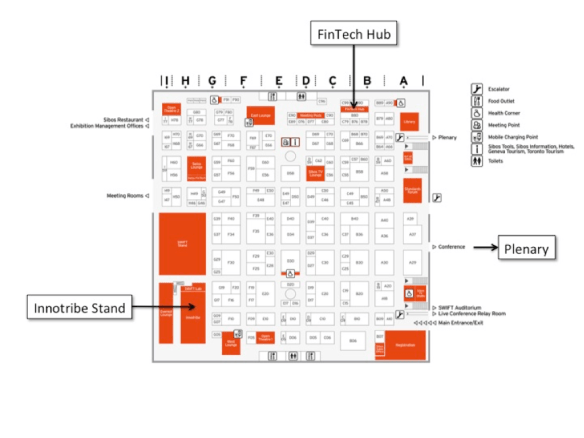
Main location: Innotribe stand (G16 next to main SWIFT Stand)
We will be located right next to the main Swift stand on the exhibition floor, and have increased our capacity with at least 50%. The design of our stand will be a combination of industrial on the outside but human on the inside, to reflect the tension between technological disruption and the need for higher qualities of human attention. All our sessions, except of Future of Money will take place here. Future of Money will be in the main Plenary Room.
Our Innotribe stand last year in Singapore


Inside our stand last year in Singapore
The big LED screen will be back, it just will be bigger, better, and even with a 4x better resolution than last year;-)
And of course, we’ll have our connoisseur coffee corner back, last year rated as the place to be to savour the best coffee of the whole event. Really.
As several of our speakers have published recent books about their insights, there also will be numerous book-signing opportunities throughout the week.
Can’t show the design of the 2016 Innotribe stand, yet. We want to keep it as a surprise for Sibos delegates, but if we can give you a hint: last year’s nick-name for our stand/space was “the blender”, this year people who have seen it describe the space as “the coliseum”.

Just make sure you make it in time for the different Innotribe sessions, as last year all Innotribe sessions were overflow, and about 50% of all Sibos delegates attended one or more of our sessions. This year we have catered for overflow capacity in the mezzanine overseeing the Innotribe stand.
Location #2: The Fintech Hub (Stand B80)
We have tried to group together a number of FinTech Hubs who have rented a booth in this area. We have create a mini-stage and meeting area so you can meet the winners of the 2016 Innotribe Startup Challenge in Africa and Latin America: Bitso, Destacame, Hello Paisa, Quotanda, The Sun Exchange, and WeCashUp.
Location #3: The Sibos Plenary Room
The Future of Money’s premiere was at Innotribe Sibos 2011 in Toronto. Since then the session has become a brand on its own, and we are proud that for its fifth edition, this session is now promoted as a full-blown Sibos Big Issue Debate in the main Plenary room of Sibos. Monday 26 Sep 2016, at 2pm that is.
Location #4: Salle communale des Délices
Last year we experimented with an informal networking event for anybody who feels connected to the FinTech ecosystem, and you seemed to have liked it.
The Innotribe Networking event is back this year on Wednesday 28 Sep 2016, starting at 7pm in a location that is only 10 min walk away from the Sibos PalExpo conference center. We’ll have:
- A short welcome by the network event sponsors
- In the theme of the day, a Woman-Machine convergence with Beatie Wolfe and Live Band
- Excellent food and drinks (informal standing dinner)
- Lots of informal networking
This is an free networking event, but please RSVP via this registration site. For Sibos delegates, we’ll have postcard-style invitations available at the conference center.
Who should attend?
Innotribe is open to all Sibos delegates. Throughout the Sibos week, Innotribe will be the centre of expertise on innovation for the benefit of all relevant stakeholders, including business analysts, strategists, product managers, innovation managers, transaction bankers, securities managers, corporates, standards experts, payment professionals, regulators, and policy makers.
Resources:
- On-line searchable Innotribe Sibos programme
- High Level PDF Flyer
- An upcoming Innotribe branded Magazine with interviews with some of our keynote speakers
In the coming weeks, we will pump-up our communications volume, and prepare a preview blog post per Innotribe day, revealing and contextualizing our amazing speaker and instigator line-up for this year. Follow us on Twitter: for the latest announcements: @Innotribe, #Innotribe, @Sibos, #Sibos
As you can see, all engines are on, and we are looking forward to meeting you all again at this year’s Innotribe Sibos 2016 from 26-29 Sep 2016 in PalExpo, Geneva.
It should be obvious that Innotribe Sibos is only possible through the great collaboration with the Sibos team, deep involvement of the Innotribe team, and a number of world-class contractors for the professional execution of all this.
Deeply grateful,
Your architect and content curator for Innotribe@Sibos, @petervan