This is episode-2 of the calm conversation with Josie Gibson from The Catalyst Network, inspired by Robert Poynton’s book “Pause – You are not a To-Do list“. The approach is simple: we both read chapter-2 of the book and highlight three sentences, and mark the words that resonate most. These sentences and words are the triggers for a very slow-paced conversation on whatever comes our way. No tricks, no gimmicks, just a gentle and calm wandering and meandering of minds.
It is an opening which allows, enables, permits or invites all sorts of other possibilities.
It (pause) has more to do with rhythm than pace, it is more a question of timing than time.
‘How you pause says something about who you are.
And here are my three sentences:
These are very gentle, generous verbs: allow, enable, permit, invite.
When you press the pause button on a machine it stops. But when you press the pause button on human beings, they start.
At the end of a talk or meeting, instead of hammering home his ‘message’, he will ensure he leaves a space, which he gives back to the room, so that someone else can have the final say. This is an act of openness and generositythat people notice and appreciate. A pause can be a gift.
We covered a wide range of topics from grace, protocol, courage, bravery, expansion, and building a time-space machine, to Designing Freedom – Stafford Beer (PDF), the Overton Window of freedom, the Nooscope (Knowledge Scope device), comparing human and machine pause and activity, and even the 5 gaits of the Icelandic horse.
We ended with a discussion on Rhythm, Pace, and Tempo, and that’s where will pick up in episode-3, in 3-4 weeks from now.
My musical ride compiled from April 2020 releases, here and there some classics from previous decades. A lot of good new stuff in this one. Works best if you play in shuffle mode. Enjoy!
An irregular, unpredictable, incoherent, unfocused set of mind-sparks that got me thinking. Only 2 weeks since the previous edition, but it feels like the harvest of a full month. Handpicked, no robots. Minimalism in curation. Enjoy!
If you can’t get enough of these and want more than 5 articles, you can hang on to the firehose, the extended version of Petervan’s Delicacies in REVUE. Subscribe here: https://www.getrevue.co/profile/petervan
Let’s try something new here: a “mood-scape”, documenting a personal mood/world using words, visuals, and sound. And inviting you to build new worlds by participating on a 1-1 basis. Although “new” is relative: the term moodscape was initially coined in the seventies, and mixing media can hardly be labeled new or novel. But having a “calm” conversation may sound like an anachronism in these times where time itself is collapsing, where time itself has become exponential.
I immediately fell in love with the melancholic, nostalgic, slow pace sound of the album, in my opinion, a perfect soundscape for the disorienting times we live in. There is some sort of homesickness here, knowing deep inside that we have already said goodbye to a golden era, and era that I sometimes refer to as the Bowie-Era.
I added a couple of Clockdust songs to my Spotify March 2020 Ride playlist, and one of the songs happened to sit next to David Bowie’s Lazarus song from his Blackstar album. To make a long story short, I created a sub-set of the playlist, containing the songs that I felt best reflected my March 2020 “Mood”. There is one coming for April as well 😉
I suggest you let it play in the background in shuffle-mode whilst reading this blog post, as I believe it may augment what I am trying to share.
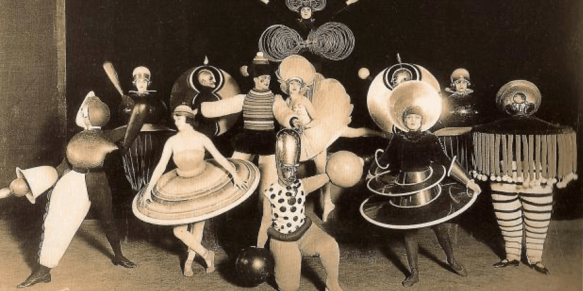
The cover is a picture from Oskar Schlemmer’s Triadisches Ballett (Triadic Ballet), a choreography with costumed actors transformed into geometrical representations of the human body.
There is also this wonderful video testimony of one of the early performances of that choreography
The video sent me back in time – clockdust time – when I was a 6-year old schoolboy. For the very first time in my life, I stood – proudly – in front of a huge whiteboard in the classroom – it was a blackboard with white chalk – and we were invited by the teacher to properly write the letters of the alphabet with white chalk on this blackboard.
It must have been my early creative juices, but I could not withhold myself drawing big white spirals instead of well-formed a’s and b’s, etc. on that black-black blackboard. Result: punishment and the lesson learned that a classroom is not a place for creativity and imagination.
In vain, the seeds were sown, and spirals, spheres, labyrinths, maps, and foams became – with hindsight – an obsession. I love the endlessness, and the recursiveness of these shapes and forms. Especially double, entangled spirals or labyrinths get me going…
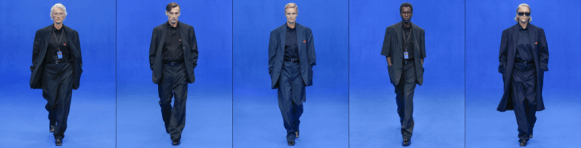
This high-end Balenciaga Summer 2020 production, with music from BFRND, is a perfect timestamp of our times. Grim black coats, at times almost German SS uniform like Arial race,… our sleepwalking into fascism. One thinks The Matrix, hard as stone, sharp as a knife, and greyed out faces. Will we take the Red or Blue pill? Blue for sure is the backdrop for what Balenciaga call “Power Dressing”.
Balenciaga Summer 20 reimagines dressing for work: power dressing, no matter what one does as a job. Looks transform a wearer in the way a uniform can. Unlike their archetypes, though, garments and accessories are made using unconventional processes.
They talk about New Fashion Uniforms, Seamless Tailoring, New Trompe L’oeil, Super Plissé, Pillow Parkas, Fetish Gownsn, and Wearable Ballroom dresses.
Models of various career tracks interpret and play on beauty standards of today, the past, and the future.
Enter Masks, a new book by James Curcio, about Bowie and other artists of artifice. I spotted the book in a guest post by James Curcio on Ribbonfarm’s always excellent blog.
The difference between a king and a beggar, a soldier and a murderer remains in the realm of performance, a kind of farcical mummers trick that we agree to play along with, if often unconsciously.
The bulk of the book is about Bowie’s unique conceptual art, his capability to create new coherent worlds and identities. I miss Bowie.
The post and book also refer to French philosopher Jean Baudrillard’s book Simulacra and Simulation, apparently required reading for the actors of The Matrix before filming. According to Wikipedia, Baudrillard is “best known for his analyses of media, contemporary culture, and technological communication, as well as his formulation of concepts such as simulation and hyperreality.”
It cannot be happenstance that I find a reference to Simulacra and Simulation in “Design Unbound”, fantastic two-volume work on “Designing for Emergence in a White Water World”, by John Seely Brown and Ann M. Pendleton-Jullian, a print-only MIT Press publication. Chapter 14 is about “World Building”: “much more than just the setting for a story, word building creates coherent contexts that stories become to inhabit”
This is very much avant-garde, feels a lot like Cobra world-building practices like New Babylon by Constant Nieuwenhuis.
I feel like I am drifting into a thin timeline, and time is slipping through my fingers like clockdust. A shaken gravity, with no reference framework, unable to make U-turns, and affront reality with an open mind, heart, and will.
I need a new backdrop, a new backstory to make or break sense. I want to liberate myself from the harness of fixed time and space. An opening-up that leads to more vulnerability – and less power dress. With proximity, intimacy, and closeness – like the closeness and blissfulness that is evoked in “Two Sleepy People” in the March 2020 Mini-Ride.
In that sense, the from/to framing of before and after COVID-19 is misleading. I believe we have to start thinking of ourselves as analog/digital assets whose state is updated in real-time ànd asynchronously, our lives continuously evolving through space and time. We are indeed astronauts, in need of coherent world-building and navigating clockdust till eternity.
I have time. You have time. Both clock-time (Chronos) and experienced-time (Kairos). Ping me if you want to continue the conversation. I’d love to hear where your clockdust has settled these days.
Recently, I discovered two books by Robert Poynton. One is about “Pause“, the other book is about “Improvisation“. Together with Josie Gibson from The Catalyst Network, we started some 1-1 calls to share what these books trigger for us and our communities. We decided to start a small experiment: we read a chapter of the book, schedule a 1-1 call to let flow our minds, record it, and share it with our communities, and see what happens. Very down to earth, no tricks, no gimmicks, just a gentle and calm wandering and meandering of minds from two opposite sides of this earth. One person from Melbourne, Australia and one from Aalst, Belgium; one person in autumn, one in spring.
These are very calm conversations; so best is to take a pause, install yourself in a quiet corner and enjoy!
An irregular, unpredictable, incoherent, unfocused set of mind-sparks that got me thinking. This time, Delicacies has a Corona-lockdown. I was trying to avoid yet another collection of COVID-19 articles; I am sure you have found plenty of sources on that subject. Instead, this edition of Delicacies hopefully brings some form of antidote, some oxygen, some sort of poetic pause. Handpicked, no robots. Minimalism in curation. Enjoy!
New and improved culture map by Simon Wardley, adding anchors for “WE” and “ME”. I would love to see Simon adding the morally right or wrong options.
About ritual and rites de passage. Poetic reflection by White Owl aka Fiona Tribe.
About the uneasy conjunction of the normal and abnormal that daily life so often produces; a kind of spatial whistling in the dark. Don’t forget to read the epilogue. By Irit Rogoff.
If you can’t get enough of these and want more than 5 articles, you can hang on to the firehose, the extended version of Petervan’s Delicacies in REVUE. Subscribe here: https://www.getrevue.co/profile/petervan




 Petervan Studios