Mid November 2019, I was once more lucky enough to attend the 9th edition of Techonomy, in my opinion, one of the best tech conferences and networking events in the world.
The event is set up as a three-day retreat at The Ritz-Carlton on the shores of Half Moon Bay, CA. The format is pretty straightforward: many fireside chats, some presentations, and some early morning workshops. Content leads and is focused on tech, business, and social progress. Full program here. All live video streams here.
The theme for Techonomy 2019 was “Reset and Restore: Governing Tech, Retrieving Ethics, and Acting on Climate” with an awesome list of speakers and instigators.
Here is – in more or less random order – a set of tweetable memes that I collected at #Techonomy19:
Can technology help us listen vs. sharing/shouting?
From giving fish > learn to fish > create fishing schools
Only the Walmarts can save us from Trump
by addressing the root cause of big problems such as healthcare
The hierarchy not always wins
There has to be some kind of return (on investment). Why?
Real-Time Crime Solving vs. Real-Time Health Development
Real-Time Evil Control vs. Real-Time Good Amplification
5G Beam Forming
Precision Economy
Computing moving back to the edge
Trust is consistency over time
Transparency vs. Clarity
Your digital twin is not you real me; it is just a model of me
All companies are connection machines
I will not work on fully autonomous weapons
Voice First
The Time of Engineering Innocence is Over
Privacy is Dead vs. Anonymity is Dead
The Absolute does not Exist
Worry and Concern are two different things
The State (country) is done
Welcome a future of 2,000 “Nations” aka Superminds
I have been thinking about “digital” (identity) for a while. Way back in 2003, I got infected by the digital identity virus at Microsoft in a research project related to the launch of the Belgian Electronic Identity (eID) card, a project that led to executive sponsorship of Mr. Bill Gates himself and meeting forward thinkers like Kim Cameron and many others smart people at Microsoft Research.
Later, as the project leader of the Digital Asset Grid (a prototype research project at my previous employer SWIFT/Innotribe), we were investigating distributed sharing of data by independent trusted nodes (one would call that blockchain these days).
Future Scenario from the Digital Asset Grid
Filmed & Produced by Heather Vescent
The project never survived the prototype stage, and although the project was really about sharing any kind of data (and not only personal data), it gave me a seat at the WEF Personal Data experts group. I stayed in touch with many of them and tried to follow the space.
Then in 2012, I wrote a blog post titled The Cambrian Explosion of Everything, still one of my most read and commented posts since the start of this blog.
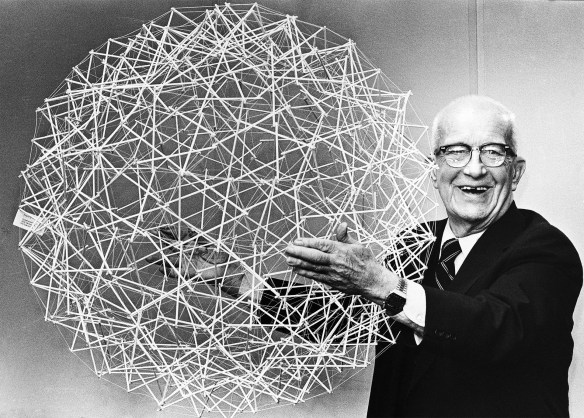
I kept being fascinated by the subject and developed a metaphor where the user would own their data, as if the user would be encapsulated in a Buckminster Fuller sort of sphere, and would be able to share different facets of their outer sphere (their data) and be in control of who they share it with and in what particular transaction context.
That is, in essence, the VRM concept (Vendor Relationship Management), a set of tools that would give users the tools to manage their vendor relationships, just like vendor manage their customers with CRM (Customer Relationship Management) tools.
My thoughts have definitely evolved since then, especially because I always felt there was a mismatch in trying to mimic 2D identity concepts of the off-line world into the more complex 3D online world. The only thing people were trying to do was to create a digital equivalent of a physical real-world identity card, basically only a representation of an account number, or a social security number, or a government-issued ID.
Identity reduced to a number sitting on a chip of a smart card. It always felt so limiting, and with hindsight plain wrong.
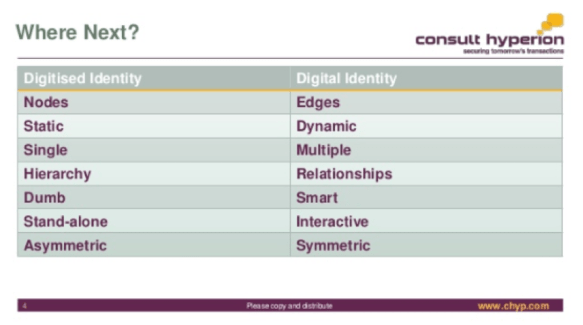
The eID card was and still is nothing more than a “digitized” identity. The Belgian government recently decided to add a digital fingerprint to the card. Besides a privacy nightmare, this move won’t help: the card will remain static, dumb, stand-alone, etc and a misnomer in a multidimensional on-line world.
What if we pushed our thinking about true digital identity? What metaphors would help us understand what is needed? What is the new and future context for this?
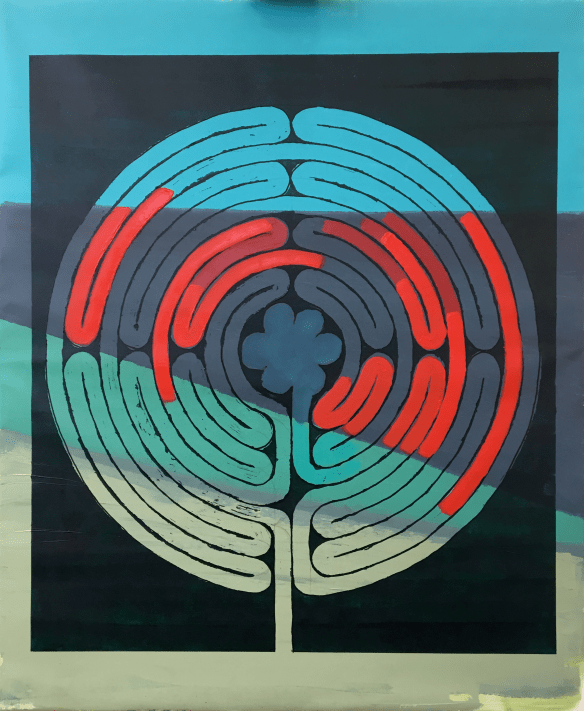
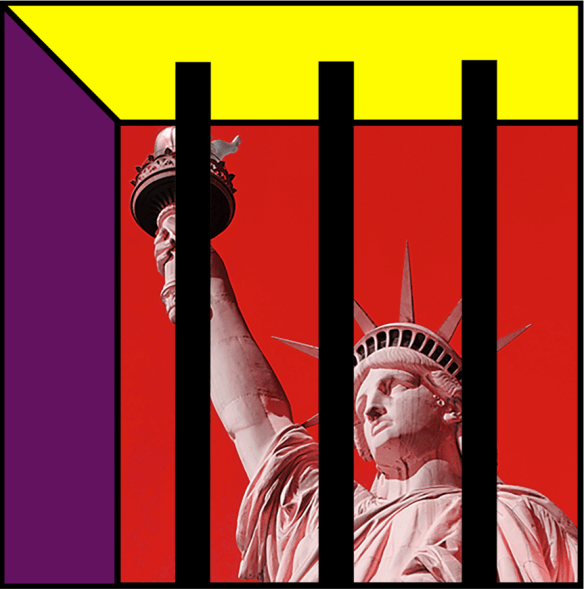
Some of my new metaphors are inspired by my recent artwork on prison cells and labyrinths. I am thinking about identity and data sharing in terms of “signatures”, “maps”, and “labyrinths”.
In essence, I believe we have to expand all dimensions of entities, data, and transaction context. In addition, we need to become more aware of a different type of scale. We have to start thinking about trillions of entities, sharing all types of data in real-time transaction contexts.
I believe that somewhere in 2012-2013 we lost the time window for VRM in its implementation as personal data stores in the cloud. There is so much data out there now (at FB, Google, your bank, your retailer, your hospital, etc.) that it is an illusion we will ever get back control over it. And even if we would be able to do that, the idea of a user taking the pain to pull the levers of control of their personal data locker is just ridiculous.
Open Banking and PSD2 may give us a hunch: what sort of new services would be possible to develop if banks (and by extension retailers, FB, etc) were forced by regulation to open and share their data. Not new services like a personal data store (PSD), but something more integrated with the daily experience.
For example, I don’t use my credit card to make payments, I use it to buy stuff. The credit card just works under the hood to give me a convenient buying experience. What would be the equivalent services enabling an experience like “I just buy stuff” when Open Banking and PSD2 live up to their promises?
We have to expand our dimensions
Many are confused by the privacy focus on personal data sharing. By now, I tend to agree that privacy does not exist online. I think privacy only exists in the off-line world and in the unspoken word/thought, not in what is being shared (intentionally or non-intentionally)
“In an all-sharing world, what we don’t share will define us. The secret will be irrelevant because it is not on the network. It will be the part of us that matters.”
The DAG/Holochain/Solid/etc projects of this world won’t solve this. I don’t know what would solve it. I don’t know whether there is a problem to be solved.
“It can not work because we can’t own information”, says also David Brin.
The more critical question is “What kind of world do we want to live in?”, as in Apple’s CEO Tim Cook’s speech to the EU in Nov 2018.
He talks about “Human-centered technology” in the era of surveillance and misinformation. It is a call for regulation of the platforms and their relation with (mainly) personal entities. I believe we have to expand this.
The Cambrian Explosion of Identity has ramifications beyond platform-human relationships.
In an upcoming series of blog posts, I will expand the following dimensions:
The 2018 Music Festival season is almost over, and the pattern of “experience” is all over the place. To be honest, I can’t hear the word “experience” anymore. Because most of them are fake, or fantasy at best.
Tomorrowland 2018 Aftermovie
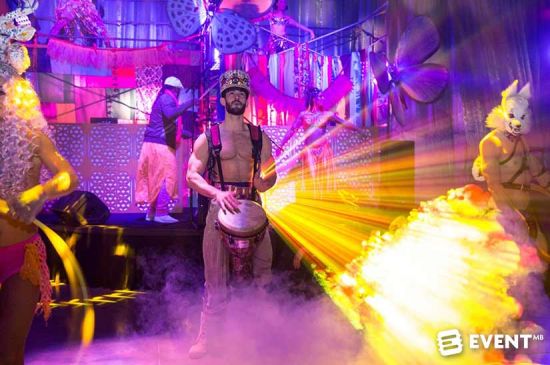
Whether you look at videos from the Dimitri Vegas World Madness Tour, the Alcatraz Hard Rock & Metal Festival, or the Tomorrowland 2018 aftermovie (with almost 3 Million views!), it is all the same: the Disneyland-for-adults-landscape-escapes, the rude language, the circus artists, the booze, the drugs, and the illusion of beautiful people only (except Alcatraz) horrify me. And now there is bigger than big, the Sziget Festival in Hungary. Check-out the photo tab on their site. And then there is lower than low: the Belgian Camping Kitch Festival with this year’s them “Your Marginal Alter-Ego” (parental advice). All of the same decadence at scale.
And it starts dripping over into the corporate event scene. Have a look at the Event Manager Blog: plenty of ideas to make a great event.
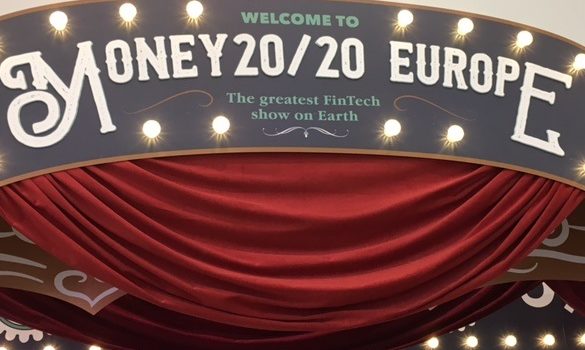
Dimitri Vegas may be born in Willebroek (Antwerp, Belgium) but he could as well be originating from Las Vegas. This Las Vegas style/experience was also showing into this year’s Money2020Europe event (they started their event-as-a-business in Las Vegas anyway 😉
And it’s all about scale: 5,000 people, 10,000 people, 100,000 people, … labelled as event-as-experience but deep inside as event-as-a-money-business. We have lost all sense of intimacy.
Besides the enormous challenge and expense of crowd control, these are super expensive productions, just to create fake, to escape from reality into fake nature, fake fountains, with rosy girls with flower in their hairs, hands forming loving hearts, glitter, fake smoke, huge fireworks, confetti machines, heat, sweat, groping, etc.
It feels like the New-Orleans Bourbon Street vulgarity becomes the new norm. You know the norms when somebody calls you a dog.
Picture from Bestival (sic) 2018 – via The Guardian
Fake-ness has of course for long already permeated news and corporate communications talk, and has now also invaded fake scientific reports, fake reviews, fake attention, many of them algorithmically organised by robots.We are now all part of the New Dark Age that is so well described in James Bridles highly recommended latest book.
And it feels the fantasies become bigger and more fantastic the more reality fails at fulfilling the needs. Fantasy compromises on real fulfilment of real needs. The more the audience’s reality is distorted, the more they find comfort in fantasy experiences.
Fake trumps reality.
Nobody seems interested anymore in authentic décor, grace, purity of mind and body, with an intention to create wonder for their guests. Or are there still folks out there, who look for being dipped in a silver cleaner, and rediscover their bright shininess, the newness under the accretions of time, habit and fantasy?
My cousin recently reported from his vacation in the Austrian forests and nailed it:
“What people are looking for artificially is always present there naturally”.
“But that is not logic!” she cried out about my latest creation. “I don’t care in logic!” I responded. “I am in the business of the irrational…”
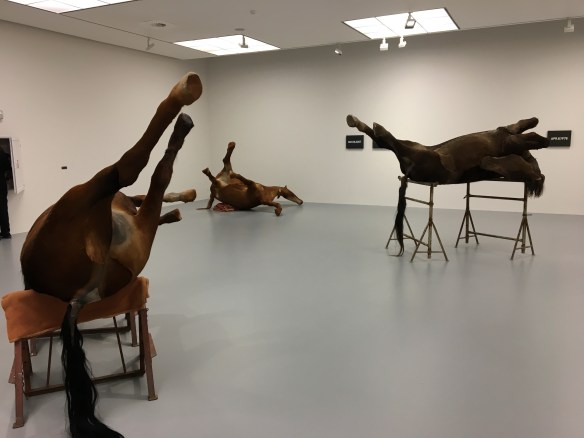
Horses by Berlinde De Bruyckere in Mukha
Part of Sanguine/Bloedrood exhibition on Baroque
I have something with – or better against – logic, facts, being normal. I am not really interested in doing things that are logic. They feel dry, life-less, un-emotional, un-spiritual, un-aesthetic, and too-efficient.
With the focus on facts (real or alternative), metrics and logic we witness the loss of the subjective.
I was looking back into my “open threads” file – a collection of reflections, thoughts, interesting articles, links etc. – and found back this great quote from T Bone Burnett’s speech at the 2016 AmericanaFest.
T Bone Burnett by Anna Webber for Americana Music Association
“Technology does only one thing- it tends toward efficiency. It has no aesthetics. It has no ethics. Its code is binary. But everything interesting in life- everything that makes life worth living- happens between the binary. Mercy is not binary. Love is not binary. Music and art are not binary. You and I are not binary.”
In other words, technology, and by extension facts, logic, and AI, miss the notion of heart, mind, and spirit.
Apparently Japanese have a word for this unity: “kohoro”. This Quartz article points to the real difference between man and machine.
“The human heart is rich in intuition; it possesses attributes such as illogicality, hunger for novelty, creativity, infinity and openness. Computer simulation is deterministic (closed); it lacks diversity and is an embodiment of dryness. I believe that this is the decisive difference between computers and human beings.”
Sculpture by Thea Gvetadze in MUKHA, Antwerp
There is also a much darker side to the illusion of facts. Or when the devil manages at convincing people that only his facts are the real facts. Joe Edelman wrote a great post “Five days with the devil” about that about a year ago. With hindsight, this is such an important insight: how the devil of facts kills how humans interact:
By offering the to-do list, he reduced all values to logistical goals.
By replacing flirting and discovery with an enhanced coordination, he re-cast collaboration as a trade for goals, rather than a mutual exploration of values.
By offering us acute perception, the devil stole our ability to discover value in our environment. He convinced us only facts were real.
By offering us empathy and understanding, he removed our capacity to protect each other, which depends on recognising values.
By preventing us from sharing reasons, he cut us off from us certain social processes: from deliberation about values, from co-discovery of values. It’s exactly these social processes, which make our choices meaningful.
“He convinced us only facts were real.” Read that sink in for a moment. It’s like someone says, “Don’t believe what you hear or see, only believe my facts are real”.
Facts ignore that what cannot be measured, what is at level of meaning, beyond sense-making. It would be better to capture information, knowledge and insight at a more condensed level. Like in an artefact: an eternal repository of high quality information captured before its entropic death.
In his excellent book (Amazon link) “Strange Tools. Art and Human Nature”, Alva Noë confirms:
“What is at stake is not the facts. What is at stake is how we assimilate, make sense of and finally evaluate the facts”
In other words, the future is not about facts. The future is in the victory of the subjective, the nuance and the romance.
Spoiler: there is nothing in this post that is business, FinTech, Blockchain or AI related.
General
It has been a quiet couple of weeks since my previous update of Jan 2018. I am getting used to the post-employee rhythm of the day: art, garden, chickens, biking. My day schedule is getting close to “the perfect day” as described in Freed From Desire.
The Artschool project
Most of my artwork is related to the Hot Dogs Tonight (HDT) project. If you want an intro on HDT, check out my previous post.
As the HDT is at times so geometrical and becoming a real obsession – and to assure you and myself that I am not completely flipping – I sometimes alternate with more organic work like this:
But back to HDT: Marie-Ange, one of my teachers at academy, introduced me to PVL, who had been experimenting a lot with painting on canvasses that themselves where prints on canvas.
When he heard about one of the sub-projects of HDT, he suggested me to go fully digital and print on canvas instead of painting on printed canvas. He sounded like a perfectionist: nothing below 750 dpi, always use high quality print shops, only use Adobe Photoshop, etc
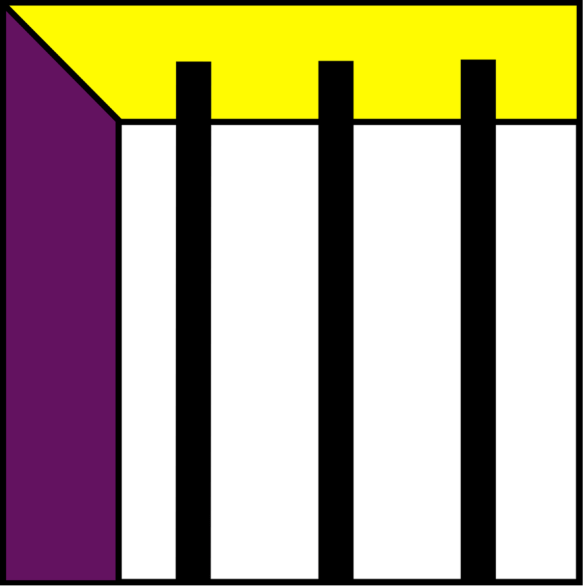
So I “perfected” the prison window to this reference shape (all formats, colours, line weights, etc are now documented for different sizes…)
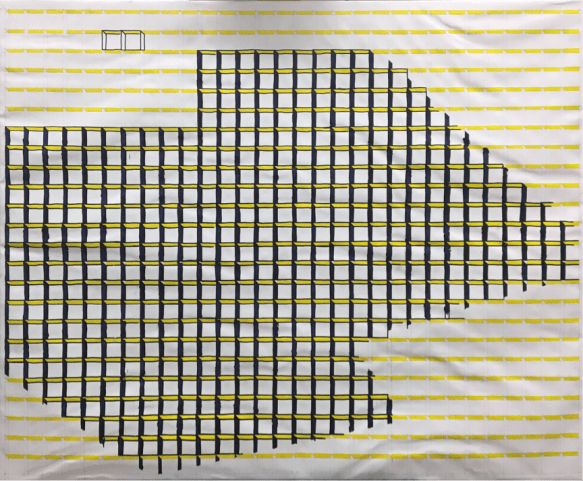
I also tried a bigger painting (120x100cm), with 720 little prison windows. The yellow went fine, but for some reason the purple paint started creeping under the mask tape, and I lost the precision of the preparatory work. I tried to hide the imperfections with carbon black acryl markers, but made it worse (although some disagree).
I should have tested these new markers a couple of times on test surfaces before applying it to the 720 HDT canvas. Also the canvas started undulating after applying and re-applying so much tape. Again, some good lessons learned in addition of having become some semi-expert in mask taping.
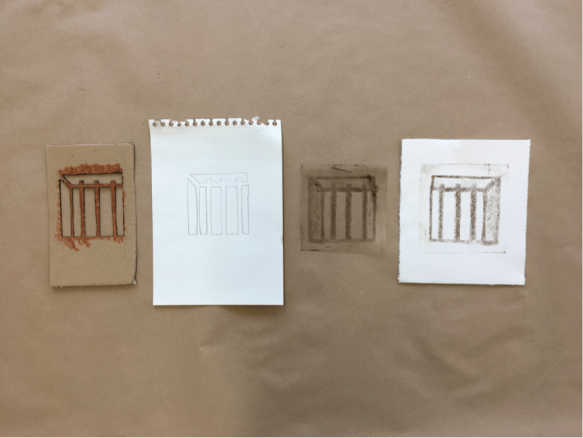
I also started to prefer the shape without the prison bars: hoping less is really becoming more. I experimented with different settings, formats, colours, with/without lines, taped lines, acryl marker lines, etc.
This time using very cheap 20x20cm canvasses from the local Action-store (discounter)
People seem to be intrigued by the HDT work, and it can serve many different (post-fact confabulated) narratives. Some narratives that seem to tick/stick:
Golden Cage: the life of employees with all the perks and stocked fridges, but still living and operating as self imposed inmates, loosing all sense of agency, and keeping quiet and obeying whatever real or imaginary authority. I can imagine HDT full-size installations with different insides/outsides to let the visitor experience what they missed by staying inside the cage.
The whole theme of surveillance, sous-veillance and the prison guard’s option to open the window at will, or worse overlooking all the prisoners in Jeremy Bentham’s Panopticon, so well put into the social media context in Andrew Keen’s Digital Vertigo. Keen has btw a new book out “How to fix the future”. The look from within the prison cell, seeing the sunshine outside. The look from outside, seeing the cheap light bulb inside.
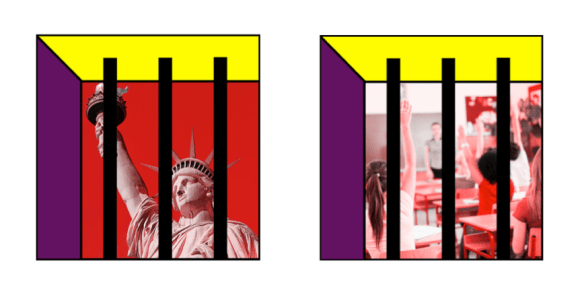
Trumpism: Americans seem to be frustrated with it. There seems to be a sort of complacency that leads to statements like “As long as it does not burn in my house”. Your own house has become a prison cell and/or refuge. “Liberty in Prison” seems to appeal to that, as well as the baseball hat referring to some other possibilities than America First. Same for all the shootings in schools, schools being experienced as danger zones: Schools behind bars.
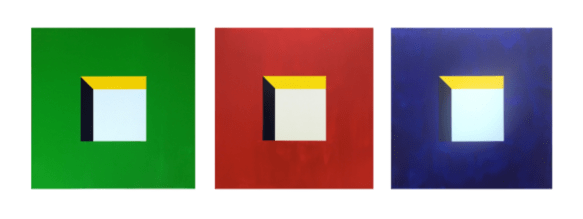
The HDT shape can also be seen as some sort of code, a symbol, an icon, a tag, a font, a sign-of-the-times. I have used it as part of the design of the world clock installation, or contrast experiences in Green/Red/Blue. For the world clock, I also have a more complex design with gyroscopes and smartphone holders, and a smartphone app to take pictures/selfies from behind the prison window.
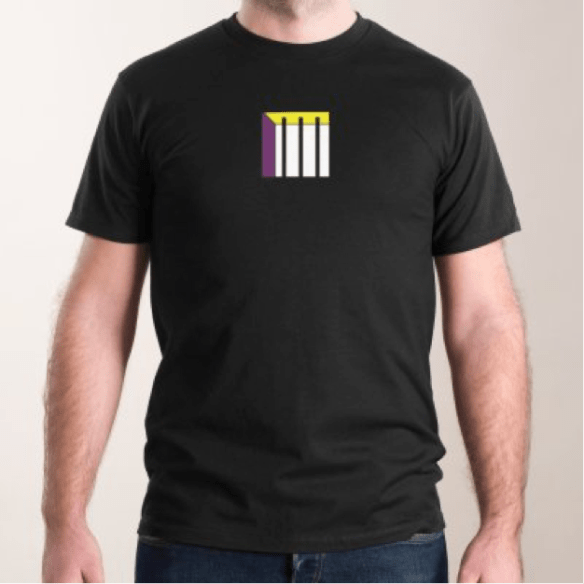
The algorithms of the online print shops pointed me to cross-sell offerings for all sorts of merchandise. I have now received designs for T-shirts, baseball caps, notebooks, mugs, pencils, stickers, etc
I could not resist and ordered the black T-shirt, and it did arrive nicely in my mailbox two days after uploading my JPEG file to the print shop. The caps are not ordered yet. Still hesitating for white caps, or red caps to make the link with “Make America Great Again” and to find some alternative tagline. Could be something with “resist” or “released” or ???
The HDT project unleashes many other ideas. Some folks refer to the Blue Dog Phenomenon by George Rodrigue or the OBEY memes of Shepard Fairey, who recently even started covering huge apartment blocks with his memes. I have no idea where HDT will lead me. It just happened to me. There is no plan. Let’s celebrate happenstance.
My academy teachers told me there are enough ideas now, and it’s time to “execute” and make some of the existing work “presentable”:
Most of my canvasses are stitched on wooden panels. After a while, especially with a lot of tape-work, they start undulating. I need to get some of them properly framed (or do it myself) so they look somewhat “neat”.
I have load of digital work and try-outs. My teachers say that that work is worth seeing as well. This could include printing some of my digital designs on high quality paper and presenting them in some kind of gift box that people can browse through
New tools
I completed my studio with the following new tools:
Photoshop: re-doing the excellent on-line courses on lynda.com by Deke McClelland
I am playing with the idea of making available the Prison Window in different formats (PSD, JPEG, etc) and inviting other creative folks to have a go with it and sharing their results with the community. I will probably do a separate post with invitations and assignments for that.
I will probably start simple with some Google-Doc folders, but wondering if any cloud platform already exists to do just that. Also interested on any models for licensing and compensation models for collaborating artists. You never know somebody wants to buy this stuff. Just ping me if you know of any platform or models that can serve my needs. I will be eternally grateful 😉
The Pigs & Chickens Project
Just a moniker for my garden project. And for this edition just some pictures will do.
About Trump: “As long as it is not burning in my house” and “The destruction of complacency”
About time: “Future Memories”
About employees: “Self imposed inmates”
Social media disconnect
As in “the perfect day”, I am now almost completely disconnected. I have unsubscribed from almost all mailing lists. I am down to about 2 emails per day and of course an empty email box. My mobile can only take calls and text messages. 3G is disabled. I have stopped tweeting, FB-ing, etc. I put a blocker on my browser (https://blocksite.co/) on my laptop and mobile and it does what you’d expect it to do. I feel I have more agency with my time. I am enjoying the physical and emotional silence.
What’s next?
During Apr – June 2018, the plan is to work on:
Hot Dogs Tonight, with a focus on wooden 3D objects, and more rough and bigger scale projects
There were some interesting posts the last couple of weeks; all indicating that there is something fundamentally wrong with how organisations measure people’s performance.
Petervan artwork – detail of 2016 painting on performing
Acryl on Canvas
Céline Schillinger shared Influencers are not influencers anymore, highlighting that the number of followers is not an adequate measure for influence anymore (has never been),
And of course Thinkers50 Future Thinker Award winner Nilofer Merchant on why the metric matters.
I could add numerous examples of other organisations I met where the people are merely serving the system, not the company or its customers anymore.
Whether it is lean, daily standups, filling the boxes of an archaic ERP system, personal improvement programs, re-orientation processes, competencies management, performance appraisals, or innovation ideations, acceleration and incubation programs.
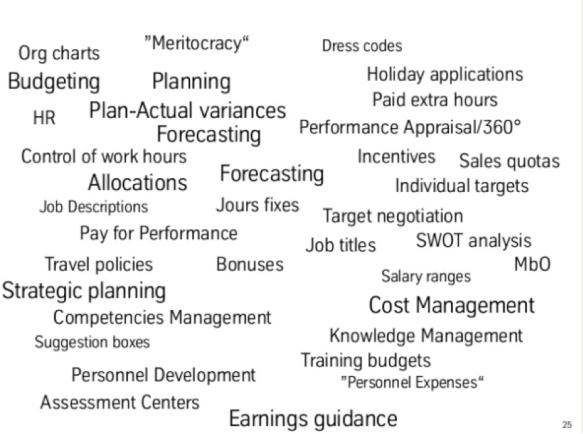
Niels Pflaeging used to have a slide he called “the bullshit slide”:
Take a step back and you will see that people act consciously and intelligently (overall), to other things than the change itself. They may resist loss of status and power – which is quite intelligent. They may resist injustice, stupidity and being changed. Which is also intelligent. The change may also cause need for learning that is not properly addressed. And these are the things that we have to deal with in change: power structures, status, injustice, consequence, our own stupidity, top-down command-and-control, and learning.
In other words, people don’t resist change, they resist bullshit.
As Niels’ slide shows, the bullshit is omni-present and something structural that needs to be fixed. Only structural change will change the behaviour and culture in your company, all the rest is tactical and innovation theater.
People have good antennas for this; they all feel deeply that they have become self-made self-imposed inmates of the golden cage, forced more than half of their working time doing the wrong thing: filling the forms, the quarterly updates, pushing up and watering down information and ideas upwards the hierarchy and doing nothing else but complying with the organisations’ processes. We are getting audited you know! It’s the process, stupid!
They all share that disjoint between one’s personal expectations of success and impact and corporate or even individual metrics.
I recently had a catch-up call with a friend in the Bay Area, and she was worried she’d become too conservative, she was staying too long with one company (18 months now, 2 years in a job seems to be a career in Silicon Valley…), and worrying all the time whether she was making the most significant impact.
We seem to have been brainwashed that our happiness, fulfilment or whatever you want to call this nirvana state is all about “realising your full potential”, some decades ago the mantra of one of the big tech companies.
I think this is exhausting. You will never reach your full potential and you will always be out for the next big thing. It will never stop. You will never be satisfied.
IMO, maximum impact is the wrong metric. We have to get rid of (comparative) scores in general: they are not real anyway – always ready to trick or comply with the system – and they are always about ticking the boxes about past performance. They don’t add value, at best the measure past value.
We need something that measures our individual progress – individual as opposed to comparing with others. Measuring our progress in building new, future capabilities. Measuring future value potential. Am I better at this than last month? Have I learned something new this week? Etc.
Scores are after the fact. They are confabulating. They are past-performance indicators.
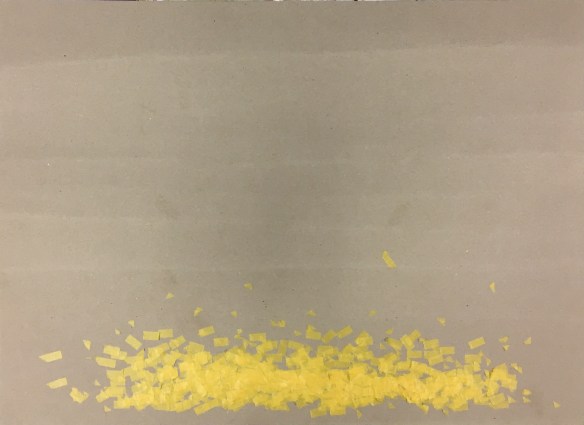
Petervan artwork – Left overs of tape cutting – Feb 2017
We need some future capabilities indicators, showing our own individual continuous learning and cultivation of new skills. Our capacity to making-the-right-cut for the future.
Haydn Shaughnessy once coined the term KCI – Key Capability Indicators. I liked that a lot. At that time, the term was in the context of organisational innovation indicators. I wonder what individual learning indicators would look like.
My input was a “pick-and-choose” list of bullet points. You can find the full list below. My input date was 27 Nov 2016. We are now two months later, and I captured some articles/announcements related to some these bullet points. And I added at the end some additional observations. All of this should be taken with more than a grain of salt, as I dimmed my focus on FinTech since starting my Petervan Productions sabbatical on 1 Nov 2016, and don’t read/research as much as before.
As always, these are 100% my personal opinions. Sometimes provocative, sometimes innocent, sometimes the cynical view of a 60 year old incumbent, but hopefully at times contrarian and inspiring. Here we go:
+++ start 27 Nov 2016 input
In general, 2017 will be the year of illusion, delusion, and distraction for and by FinTech.
Blockchain/DLT/etc will prove itself as one of the biggest distractions of this era in that it does not solve any existing problem, maybe it solves some future problems to be identified, but with a price to pay: the price of fundamental process re-engineering. Very few will be up to this task which involves community management and regulation.
In 2017, subject to pressures on the bottom-line and macro-political forces, banks will witness massive lay-offs and disinvestments in FinTech innovation labs and initiatives. These initiatives will be re-branded as research efforts, focused solely on incremental improvements in the core business lines.
FinTech will manifest itself as a techno fantasy, drawing attention away from the real problems to be tackled: cyber-security, trust and identity, which only can be solved through laser focused industry and government efforts. No single company can solve these on their own, and self-serving patenting will be counterproductive to industry-wide success.
In the US, the Trump administration will out-regulate innovation to protect the financial institutions fiefdoms and their control of money. But despite the Trumpian rhetoric and “opportunities” for financial institutions to start playing their old extraction-value games, financial institutions will be challenged by citizen uproar to give back to society.
Despite all these negative predictions, volume and frequency of FinTech investments will dramatically increase. Like in other industries, a 100M$ Fund will be considered as peanuts. Like in traffic jams, investments become bigger and last longer. Like traffic jams, ROI will be difficult to impossible to resolve.
What I am missing in many predictions is that most are just extrapolations of existing trends. They ignore the fact that the trend can just die or become a commodity where prices trend towards zero.
What I am missing is the creative/opportunity orientation (what do you want) vs. the reactive/responsive orientation (what problem are you trying to solve).
The way we think about change, disruption, and transformation) or whatever you want to call it) is going to be completely different in 5 years time. The speed of change is so big that our thinking is getting disrupted. The underestimated and ignored exponential power in all of this is the “power of networks”. I have another post in preparation for that, but in the meantime I would invite you to get familiar with following books and thinkers:
The Seventh Sense: Power, Fortune, and Survival in the Age of Networks, by Joshua Cooper Ramo
Whiplash: How to Survive Our Faster Future, by Joi Ito
The Inevitable: Understanding the 12 Technological Forces That Will Shape Our Future, by Kevin Kelly
Trillions: Thriving in the Emerging Information Ecology, by Peter Lucas, Joe Ballay and Mickey McManus (already from 2012, but so advanced in its thinking)
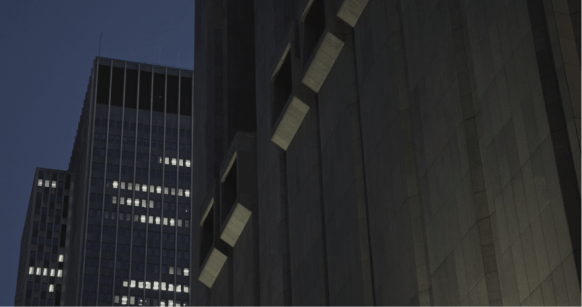
Project X building, lower Manhattan at 33 Thomas Street, NYC
This week, The Intercept ran a fascinating article– well, quite disturbing actually – describing the possible surveillance roles of building Project-X, an AT&T owned property in the middle of Manhattan, sitting on top of some major telephone and communication switches (and apparently many other buildings like this in the USA and most probably elsewhere).
It even becomes super scary if you read the article with the backdrop of the first names and background of some of the people appointed in the last couple of days in the Trump administration.
The building was designed by the architectural firm John Carl Warnecke & Associates, whose grand vision was to create a communication nerve center like a “20th century fortress, with spears and arrows replaced by protons and neutrons laying quiet siege to an army of machines within.”
Some of Warnecke’s original architectural drawings for 33 Thomas Street are labeled “Project X.” It was alternatively referred to as the Broadway Building. His plans describe the structure as “a skyscraper to be inhabited by machines” and say that it was “designed to house long lines telephone equipment and to protect it and its operating personnel in the event of atomic attack.”
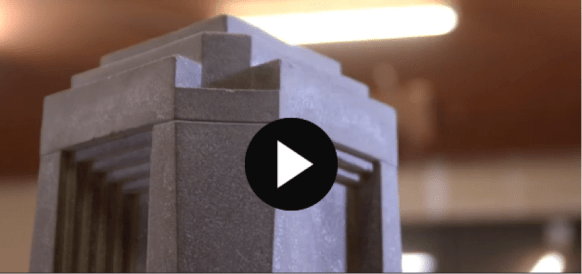
I spotted the article just two days after I saw a short 7-minute documentary (hence Doc7) on Belgian television about artist Renato Nicolodi
Renato Nicolodi – a young artist from Flanders – makes architectural models of buildings that are not intended to be built.
Pulpitum II by Renato Nicolodi, 2012
Long Island Building NYC, by John Carl Warnecke & Associates
That made me think about my time as student in Architecture in Ghent, were we were allowed – or should I say incentivised? – to design buildings that never had to be built (at least in the first two years of the study). Full creativity nirvana, quoi.
The work of Nicolodi resonated with me for another reason. They are actually mausoleums that have a place in the memories of his grandfather, who spent the Second World War in various prisoner of war camps, which he meticulously describes in the conversations Renato argued with him. The recordings of those calls still are daily source of inspiration for Renato.
It woke up old memories from my youth when – at the age of 6 or 10 – I was visiting my grandmother, who lived in a place called Ledegem, a little village 17km east of Ieper, a town that will be remembered forever for the first time use of poison gas in World War One.
It makes me wonder about the working and selectiveness of my memory. Since I started my sabbatical begin Nov 2016, I feel restless.
Being disconnected from work – “the job” – gives me plenty of space for reflection, experimentation, silence, being alone – I love the sound of silence of the morning-house before the rest of the family has woken up.
But this stillness also seems to bring back many old memories, going way back to my childhood, things that I never thought about anymore in the last 50 years. On the other hand, it seems my short-term memory is getting very selective – almost ignoring mode. Up to a point that my lovely wife sometimes wonders if I should not go and see a doctor, but I think I am doing fine.
Ledegem WWI cemetery today in 2016
At the end of my grandmother’s garden was a cemetery holding 85 Commonwealth burials and commemorations of the First World War. I remember playing on the walls and the crucifix of the cemetery. In my memory, the place was much bigger than in this recent picture. I also remember some of the bunkers that you still find here and there scattered throughout the landscape in this region. I remember playing in one at the seaside before they were closed off for general public. I remember the smell of wet sand.
German WW1 Command Bunker, Ypres Salient
The memory also put me in contact with another aspect of my onlyness (I am currently reading the draft manuscript of Nilofer Merchant’s next book), where I am coming from. My father is from a family of 7 kids, that all needed to be to taken care of by my grandmother all alone, as her husband died in a tragic car accident (he was on a bike) just before the start of the second world war. So, it was surviving on a shoestring.
Deep in my (un)consciousness, there is the fear for this shoestring poverty. That we’ll have to hide again in the coldness and humidity of bunkers in the polders. A dystopian threat of dark secrecy, manipulation, corruption and a fundamental loss of trust.
That is what bunkers and secret buildings do to me. Even if they are just architectural models that are not intended to be build.
The new models don’t seem to be intended for humans, they are intended to host machines. How can we reclaim back our humanity?
Windows at Brussels Airport after suicide bombings on 22 March 2016. CreditPool photo by Frederic Sierakowski, in NYT article “Je Suis Sick of This”
In the aftermath of the terrible Brussels terrorists attacks, I encourage you to watch the full 1h50m LiveStream of the “A Conversation on Privacy” of just a couple of days ago.
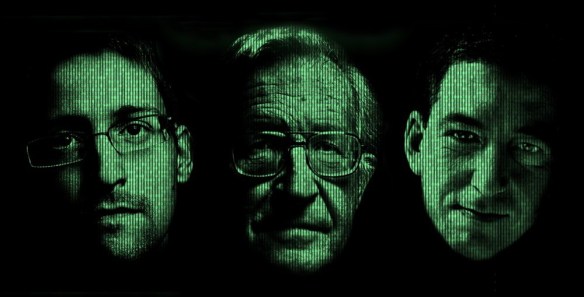
The conversation was positioned/framed as “The balance between national security and government intrusion on the rights of private citizens” and featured renowned linguist and MIT professor Noam Chomsky, NSA whistleblower Edward Snowden, and Intercept co-founding editor Glenn Greenwald. Nuala O’Connor, president and CEO of the Center for Democracy and Technology, was the moderator.
It is clear from the reactions of the public in a full house Centennial Hall of the University of Arizona College of Social and Behavioural Sciences in Tucson Arizona that Chomsky, Greenwald and Snowden were playing a home match, but that should not underplay some of the key points they were making.
There are basically four big chapters in this conversation:
What is privacy, and the effects of mass surveillance (nobody in its right mind is questioning targeted surveillance)
The Brussels and other attacks and the (in)-efficacy of mass surveillance
The FBI – Apple case
The role of journalism
I am looking forward to a full transcript of this conversation, in the meantime I made the following bulleted notes:
On privacy
When discussing privacy and security, are we discussing security of State, Corporations, or Citizens?
The statement “if you don’t have anything to hide, you have nothing to fear” does not cut it at all:
Everybody needs to be able to think and explore in a space where you are not subject to other people’s judgment, where you can make decisions as result of your own agency
People are starting to self-sensor, curtailing their own speech
Privacy is the right to enjoy the products of our own intellect
Privacy is the fountainhead of all other rights
Privacy is the right to a free mind, without having your ideas being pre-judged before they are fully formed
If no privacy, you live as a collective, in a state of reaction to your environment
“I don’t care about privacy because I have nothing to hide, is about the same as saying I don’t care about freedom of speech because I have nothing to say”
Rights are designed for those who are vulnerable. “Not caring about a right (because it does not apply to you) is probably the most anti-social thing I can imagine.”
Rights exist to protect the minority against the majority. Even if the majority does not care about privacy (or any other right), that majority view is irrelevant
Silicon Valley companies still don’t care about your privacy. What they fear is users would give their data to somebody else
The “Digital Self” is unhealthy, creates a sense of intimacy that is fraudulent, leads to very superficial interactions amongst people
Should there be state secrets at all? Governments classify EVERYTHING as Secret or Top Secret, because of their unwillingness for transparency
The elites decides on our behalf.
The elites change as quickly as possible the conversation to the theoretical risk of having a free press
Almost NOTHING is concerned with the security of the population; the population is the enemy, and they are not supposed to know what the government or corporates are doing
The (US) does not want you to know that the real battle is about world domination of the US doctrine
The trade off between security and privacy is is a false dichotomy
It leads to the illusion of democracy
On the European attacks:
Mass surveillance does not have ANY concrete results against terrorism
“When you collect everything, you understand nothing”, “you are blinded by the noise”
But if mass surveillance does not work for terrorism, it must work for something… What is it good for then? It is about setting and policing our policies and marking anything that is not conforming as suspicious
The resources are misallocated to mass surveillance in stead of addressing the route causes
On the Apple – FBI case
The FBI “wants it all” – all communications between human beings – in other words “wants to kill privacy”. They want access to everything, even your private conversations in between the safe four walls of your home.
Orwell interpretation “if you live in a society where you are always being watched, you loose freedom”. But that was an interpretation. What Orwell really wrote was “… a world where we COULD be watched at any moment…”
In such a world, you have to act AS IF you were being watched all the time, not knowing of the surveillance device is operating, watching you, or if somebody on the other side is doing something with the information collected
Who should be permitted to hold secrets: The citizens ? The governments? The corporations?
The content of San Bernardino calls already HAVE been given to the authorities (through the service providers)
By unlocking the phone, they would now also have access to the metadata
“Private citizens” should have full transparency on “Public officials”
The emerging culture is the opposite: Public officials’ activities becoming more and more opaque, and Private citizens’ activities becoming more public
On Journalism
“What is non-objective is significant” with respect to journalism and framing
A lot of journalistic framing follows from their own obedience to the framework of conformity that they learned at our best schools in the world (Oxford, Cambridge, etc.)
We have to continue to reveal things that should never have been concealed in the first place
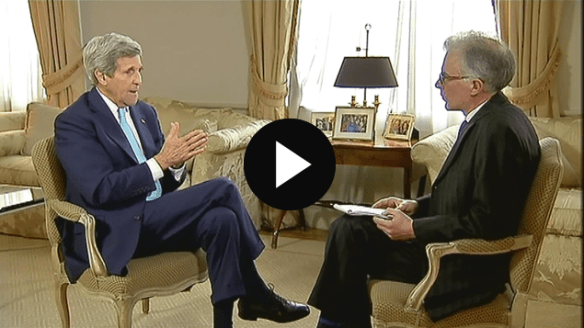
The theme of that interview was “the need for an integrated system of information exchange to increase security”, and that some countries have reservations to such systems – specifically referring in to Edward Snowden.
Some extracts of what John Kerry said (i tried hard not to put things out of context):
“It is fair to say that in a number of countries, partly because of mister Edward Snowden, and the history, people had a reservation about doing some of these things, because they felt that might be an invasion of privacy”.
“I don’t worry about my privacy. The fact that I am getting on an airplane – if I were not flying in a military airplane now, but if I am flying in a civilian airplane which I was doing as a senator – I don’t care if they know if I am on that plane; because I am obeying the law.”
“So I think people have to relax a little bit and understand that there are plenty of ways to protect your privacy without creating greater danger in society at large.”
“I do know that you (Belgium) have a federal system, I know you have a fairly decentralized system,…. And I remember the difficulties we had in the US between federal authority, state authority, and local authority and the movement of information. So, we’ve streamlined much of that now.”
“It is up to Belgium to decide what it should do, but I would urge Belgium and all European countries to create a more integrated flow of information so that we can protect ourselves more effectively”
“And I would say to every citizen that there is a way to do that and still protect people’s legitimate privacy. There is absolutely a way to do that, and we’ve proven it and we’ve lived with it.”
To be honest, I could not believe my ears when watching this interview. If you have done a little bit of homework on the topic of privacy, you would also revolt against some of these platitudes which are in the same category as “If you have nothing to hide, you have nothing to fear”. The journalist in case missed the opportunity to give pushback to Kerry and to offer a more comprehensive framing of the issues on the table.
It seems to me that the underlying theme in all of this is a cultural tipping point from “when public controls private” to “when private controls public”.
Which of course stands in stark contrast with the idealistic visions of a fully distributed society: also that is a big illusion, because in any system where there is power to be re-distributed, some bigger players like governments and corporations will try to take advantage and create monopolies.
One could discuss what “control” means in this context, and I believe it is related to setting, dictating, manipulating and policing our set of norms and behaviours.
Although the conversation in Tucson is addressing mainly the way western (read US) politics are ran, the whole reasoning is applicable to any other belief system that evolves towards totalitarianism.
The only solution that seems plausible is by having our political leaders transfer even more responsibility for problem-solving, from matters of welfare to matters of warfare, to Silicon Valley.
This might produce immense gains in efficiency but would this also not aggravate the democratic deficit that already plagues our public institutions? Sure, it would – but the crisis of democratic capitalism seems so acute that it has dropped any pretension to being democratic; hence the proliferation of euphemisms to describe the new normal (with Angela Merkel’s “market-conformed democracy” probably being the most popular one).
The “need for an integrated system of information exchange to increase security” leads to a corporate and government surveillance state. Artificial intelligence tech firms and powerhouses start penetrating every segment of industry, also financial services.
The issue is whether they collectively imprison people in digital infrastructures that increasingly undermine personal agencyand replace it with coded, inflexible bureaucracy; or whether they truly offer forms of ‘democratisation’.
I start calling this “The Illusion of Agency” and it will be the topic of one of my upcoming talks and associated blog posts.
There are several ways our policy makers can react to the attacks:
One way is to chose for confrontation: to step up reaction and retaliation, enforcing this way the agenda set by the attackers to undermine our way of living. Hitting back includes these “integrated systems” and the access to encrypted data as suggested in the British Investigatory Powers Bill. See also great NYT article on this topic
Another way is to use our resources to address the route causes of all this: the disrespect and straight military attacks by the western powers on non-western cultures and economies, not in the interest of the security of their populations but in an attempt to protect the economical and power interests of an elite.
But as public becomes more and more private, and private becomes public, and knowing who is in power, I am rather pessimistic and afraid that they – not we – will chose for the confrontation.
In the meantime – as I said in the beginning of this post – I invite you to listen to the full conversation on privacy, so you get some other perspectives than the obvious and populist ones you can pick up in the mainstream press and television news programs.
As usual – when listening to an interesting talk – I scribble notes on my notepad, pausing the video after every interesting sentence, and end up with some sort of transcript, somewhat personalized because using my own sense-making lens and bias.
Some snapshots:
Before the law enforced monopoly, now technology enforces monopoly
From creative destruction to destructive destruction
A software company is a company extracting value from the working economy (transactions between people) and converts it into capital (static bags of shares and stock prices), converting land and labor into capital.
Creating real value, that’s the suckers’ place (of being gamed). Playing the game is the place where you want to be
Central currency is the embedded operating system
Should we optimize for growth or optimize for humans?
Jobs!, Jobs!, Jobs! Let’s pretend we are on acid for a minute ;-). Who really wants a “job”?
Most companies, after reaching max growth, go for steady state, the flow of money
Uber drivers are doing R&D for automatic cars. They don’t have a platform cooperative
Family businesses are focused on the long term, are generational, are even willing to help other create value.
From a growth model of business to a flow model of business
Optimize for the velocity of money (not for being static, stocked in troves)
We don’t need banks to authenticate
The bank was made to extract value out of our transactions
About Bitcoin/Blockchain (at minute 37): “what are they programming for?” Bitcoin creates trust? No, Bitcoin SUBSTITUTES trust
In the end, we have to re-program the social expectations of each other
There is some chance that the P2P economy may happen, that the extraction economy comes to its end, with interesting experiments
We see hybrid models to fund pizzeria, 50% Crowd, 50% bank
The bank as facilitator of local community development
From platform monopolies to platform cooperatives
Facilitating exchange of value between people instead of extracting value from people’s labor.
We need a full-blown renaissance, and we are in it…
From Perspective painting to the hologram and the fractal
From the individual hero to collectivism
From the printing press to the computer
From enclosing the commons to retrieving the commons
From divisional science to the science of whole-ism
Land, Labor, and Capital as PARTNERS in an economy
I want (platform) cooperatism to be confrontational, it has to make a difference in the world
How different is the current moment? If different at all….
The key for cooperatives success is access to capital
Platform Cooperativism is possibly an answer to Platform Capitalism. Harold Jarche recently articulated very well what platform capitalism is really about: the extraction of value from many for the benefit of a few.
“The emerging economy of platform capitalism includes companies like Amazon, Facebook, Google, and Apple. These giants combined do not employ as many people as General Motors did. But the money accrued by them is enormous and remains in a few hands.”
And just a couple of days ago, David Bollier had a great post pointing to a new report on Platform Cooperativism by Trebor Scholz, one of the organizers of the Nov 2015 conference where Rushkoff spoke. Full report (PDF) report here.
“In the report, Scholz notes that the gig economy financializes resources that were previously outside of the market. Our cars, our apartments, our private time – all can now be monetized through corporate platforms and made subordinate to market forces. In effect, this new system is “embedding extractive processes into social interactions” and “extending the deregulated free market into previously private areas of our lives,” writes Scholz.”
Platform Cooperativism is a choice we have in the Industrial-Human Paradox. The WEF makes a lot of noise about “The 4th Industrial Revolution”, semi celebrating forms platform capitalism like the Uberization of everything, and robots eating our jobs.
It feels to me that sort of thinking starts feeling more as entertainment rather than independent thinking and provocation.
As Douglas Rushkoff said and provoked elsewhere: we don’t need to fix the system. The system just works fine for what it was designed for: extracting value.
Otto Scharmer articulated very well the symptoms of the broken system:
Ecological divide
Social divide
Spiritual divide
We don’t need to fix the existing system, we need another system. We need radical ideas for the new century: platform cooperatism could be the answer. But a lot needs to change.
Still inspired by Scharmer, we need to improve the quality of how we engage with each other, the way we debate, dialogue, coordinate, organize. We need to take into account the quality of the context. We need to go from experiments and prototypes to models that can scale and be transformative. And that needs to happen at an institutional level.
In his ULabs, Otto Scharmer has identified two missing conditions for this to happen:
Enabling infrastructures that bring together the right set of players into a system
Move from abstract coordination mechanisms (like hierarchy, markets or organized interest groups) to co-creating ecosystems
In the middle of the great transition from centralized to decentralized to fully distributed systems, we have a choice: we can copycat the models of platform capitalism leading almost by nature to a few monopolists who take it all, or we can choose for a construct that has in mind the flourishing of the whole, of the cooperative.
Somebody has to take up the role of the commons for financial services, where the end-goal is not to maximize profit and shareholders value, but the interest of the community and the maximalisation of flow between all the stakeholders.























 Petervan Studios