Petervan’s First Solo Art Exhibition Opens

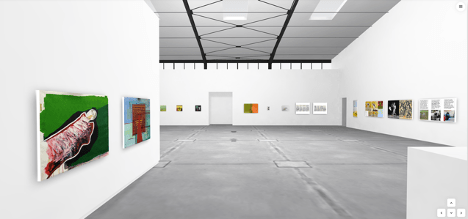
I am excited to announce and invite you to Petervan Virtual Solo, my first solo exhibition of some recent artwork. 

Showroom

A collection of sketches – paintings – soundscapes – videos – 3D sculptures – digital sketches – AI warpings – poems – fairy tales – timecapsules

To visit Petervan Virtual Solo, go to https://artspaces.kunstmatrix.com/en/exhibition/1553528/petervan-virtual-solo

Screenshot 2020-06-22 at 08.27.47

The exhibition runs from 1 July 2020 till 31 August 2020 and is open 24/7

Here is a link to the online catalog; you can select specific works, and – if interested – click the “Send Request” button. PDF of the catalog available upon request.

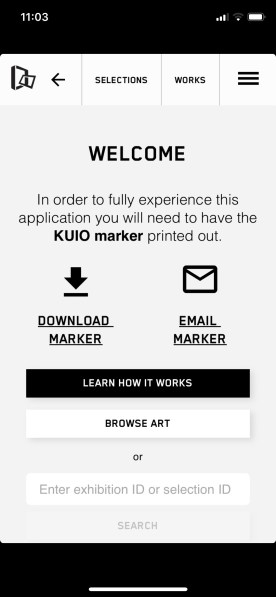
You can also experience these and other artworks in Augmented Reality to get a feel on how these works would fit in your living room: https://augmented.kunstmatrix.com/en/node/1489. You first have to download the KUOI App on your smartphone/tablet, download the barcode, and use ID code 1489

IMG_2297

The Opening Vernissage will also be virtual: the format chosen is a video “TimeCapsule” with introductory words by my cousin Joost Vander Auwera (Senior Curator Royal Museums of Fine Arts of Belgium https://en.wikipedia.org/wiki/Joost_Vander_Auwera) and Chris Vanbeveren (Peter’s art coach at the Academy of Visual Arts in Ghent). The TimeCapsule will be released on 15 July 2020 and you will find it for viewing and download on my webpage https://petervan.wordpress.com/

That is also where you can stay informed. Please subscribe to my website and you’ll get an email notification when there is news.

Screenshot 2020-06-26 at 08.46.58

With gratitude:

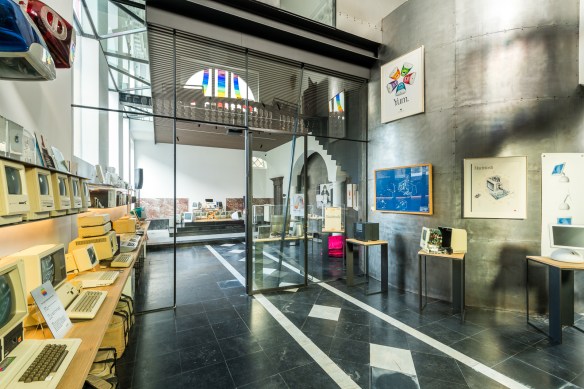
To my family, my mentors, and coaches of the art academies of Overijse and  Ghent; Joost, Chris, and Frank for the help with the TimeCapsule; my supporters, and everybody who kept/keeps encouraging me to follow my artistic instincts. Special thanks to Peter Hinssen and Cathy Boesmans: our initial plan was to have a real live exhibition in the AppleChapple in Mater, Oudenaarde, Belgium. We were all set to go, but we had to change our plans due to Covid-19. We will be back with some art-videos running in the vintage Mackintoshes.

AppleChapple-016web

That’s it! Enjoy the exhibition! I am looking forward to our next encounter, virtually or in real life.

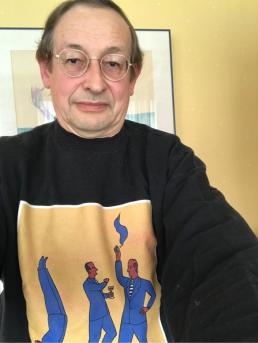
With warm artistic regards,

petervan-signature


Ik wil je graag uitnodigen op Petervan Virtual Solo, mijn eerste solo tentoonstelling van recente kunstwerken.

Showroom

Een collectie schetsen – schilderijen – klankborden – videos – 3D sculpturen – Digitale schetsen – AI verbuigingen – gedichten – sprookjes – tijdscapsules

Je kan Peter’s virtuele tentoonstelling hier bezoeken: https://artspaces.kunstmatrix.com/en/exhibition/1553528/petervan-virtual-solo

Screenshot 2020-06-22 at 08.27.47

De tentoonstelling loopt van 1 Juli 2020 tot 31 Augustus 2020, en is open 24/7.

Hier is een link naar de on-line catalogus van deze tentoonstelling; je kan werken aanklikken en indien interesse is er een “Send Request” knop om mij te contacteren. De PDF van de catalogus is beschikbaar op eenvoudig verzoek.

Deze en andere werken kan je ook als Augmented Reality ervaren en testen hoe een bepaald werk past in jouw ruimte. Ga near https://augmented.kunstmatrix.com/en/node/1489 en download eerst de KUOI App op je smartphone/tablet, download de barcode, en gebruik ID code 1489

IMG_2297

Ook de Opening Vernissage zal virtueel zijn: een video TijdsCapsule met inleiding door mijn neef Joost Vander Auwera (Senior Curator Koninklijk Musea van Schone Kunsten van België https://en.wikipedia.org/wiki/Joost_Vander_Auwera) en Chris Vanbeveren (Peter’s kunst coach schilderen aan de Academie voor Beeldende Kunsten in Gent). De TijdsCapsule zal gelanceerd worden op 15 Juli 2020 en je zal deze kunnen bekijken en downloaden via mijn website https://petervan.wordpress.com/. Je kan je daar ook inschrijven: je krijgt dan automatisch een email als er nieuws is.

Screenshot 2020-06-26 at 08.46.58

Met dank aan:

Mijn familie, mijn mentoren en coaches van the kunstacademies van Overijse en Gent; Joost, Chris, Frank voor de TijdsCapsule, mijn fans, en iedereen die mij bleef en blijft  aanmoedigen om mijn artistieke instincten te volgen. Extra dankwoord voor Peter Hinssen en Cathy Boesmans: ons initieel plan was om de tentoonstelling te laten doorgaan in de AppleChapple in Mater, Oudenaarde, Belgium. Alles stond in de startblokken, maar Covid-19 heeft daar anders over beslist. Uitstel is geen afstel: we komen terug met een aantal art-videos op de vintage Mackintoshes.

AppleChapple-016web

Dat is het zowat. Geniet van de tentoonstelling. Ik kijk uit naar onze volgende ontmoeting of gesprek, virtueel of in levenden lijve. 

Met warme artistieke groet,

petervan-signature

Moodscape-1 – Clockdust Astronauts

Clockdust cover

Cover of Rustin Man's "Clockdust" Album

Let’s try something new here: a “mood-scape”, documenting a personal mood/world using words, visuals, and sound. And inviting you to build new worlds by participating on a 1-1 basis. Although “new” is relative: the term moodscape was initially coined in the seventies, and mixing media can hardly be labeled new or novel. But having a “calm” conversation may sound like an anachronism in these times where time itself is collapsing, where time itself has become exponential.

It started with discovering Rustin Man’s new album “Clockdust”. Rustin Man was in a previous life better known as Paul Webb, the bass player of the band Talk Talk. Check out his about page.

Listen to Night In Evening City

I immediately fell in love with the melancholic, nostalgic, slow pace sound of the album, in my opinion, a perfect soundscape for the disorienting times we live in. There is some sort of homesickness here, knowing deep inside that we have already said goodbye to a golden era, and era that I sometimes refer to as the Bowie-Era.

I added a couple of Clockdust songs to my Spotify March 2020 Ride playlist, and one of the songs happened to sit next to David Bowie’s Lazarus song from his Blackstar album. To make a long story short, I created a sub-set of the playlist, containing the songs that I felt best reflected my March 2020 “Mood”. There is one coming for April as well 😉

I suggest you let it play in the background in shuffle-mode whilst reading this blog post, as I believe it may augment what I am trying to share.

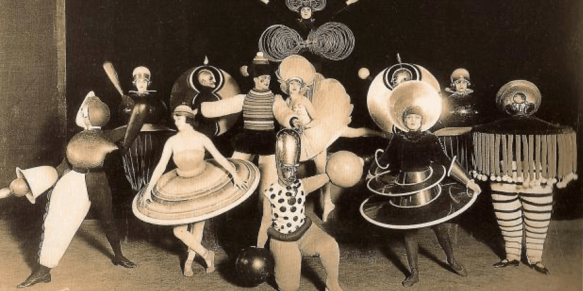
The cover is a picture from Oskar Schlemmer’s Triadisches Ballett (Triadic Ballet), a choreography with costumed actors transformed into geometrical representations of the human body.

ballet black white

Ballet colour

There is also this wonderful video testimony of one of the early performances of that choreography

The video sent me back in time – clockdust time – when I was a 6-year old schoolboy. For the very first time in my life, I stood – proudly – in front of a huge whiteboard in the classroom – it was a blackboard with white chalk – and we were invited by the teacher to properly write the letters of the alphabet with white chalk on this blackboard.

It must have been my early creative juices, but I could not withhold myself drawing big white spirals instead of well-formed a’s and b’s, etc. on that black-black blackboard. Result: punishment and the lesson learned that a classroom is not a place for creativity and imagination.

In vain, the seeds were sown, and spirals, spheres, labyrinths, maps, and foams became – with hindsight – an obsession. I love the endlessness, and the recursiveness of these shapes and forms. Especially double, entangled spirals or labyrinths get me going…

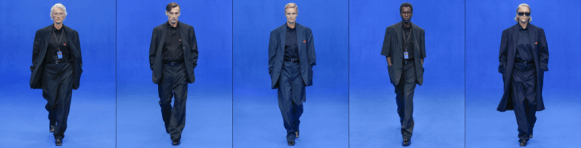
This high-end Balenciaga Summer 2020 production, with music from BFRND, is a perfect timestamp of our times. Grim black coats, at times almost German SS uniform like Arial race,… our sleepwalking into fascism. One thinks The Matrix, hard as stone, sharp as a knife, and greyed out faces. Will we take the Red or Blue pill? Blue for sure is the backdrop for what Balenciaga call “Power Dressing”.

balenciaga moods

Balenciaga Summer 20 reimagines dressing for work: power dressing, no matter what one does as a job. Looks transform a wearer in the way a uniform can. Unlike their archetypes, though, garments and accessories are made using unconventional processes.

They talk about New Fashion Uniforms, Seamless Tailoring, New Trompe L’oeil, Super Plissé, Pillow Parkas, Fetish Gownsn, and Wearable Ballroom dresses.

Models of various career tracks interpret and play on beauty standards of today, the past, and the future.

Enter Masks, a new book by James Curcio, about Bowie and other artists of artifice. I spotted the book in a guest post by James Curcio on Ribbonfarm’s always excellent blog.

maskhrfinal-82106-290x400

The difference between a king and a beggar, a soldier and a murderer remains in the realm of performance, a kind of farcical mummers trick that we agree to play along with, if often unconsciously.

The bulk of the book is about Bowie’s unique conceptual art, his capability to create new coherent worlds and identities. I miss Bowie.

The post and book also refer to French philosopher Jean Baudrillard’s book Simulacra and Simulation, apparently required reading for the actors of The Matrix before filming. According to Wikipedia, Baudrillard is “best known for his analyses of media, contemporary culture, and technological communication, as well as his formulation of concepts such as simulation and hyperreality.”

It cannot be happenstance that I find a reference to Simulacra and Simulation in “Design Unbound”, fantastic two-volume work on “Designing for Emergence in a White Water World”, by John Seely Brown and Ann M. Pendleton-Jullian, a print-only MIT Press publication. Chapter 14 is about “World Building”: “much more than just the setting for a story, word building creates coherent contexts that stories become to inhabit”

This is very much avant-garde, feels a lot like Cobra world-building practices like New Babylon by Constant Nieuwenhuis.

I feel like I am drifting into a thin timeline, and time is slipping through my fingers like clockdust. A shaken gravity, with no reference framework, unable to make U-turns, and affront reality with an open mind, heart, and will.

I need a new backdrop, a new backstory to make or break sense. I want to liberate myself from the harness of fixed time and space. An opening-up that leads to more vulnerability – and less power dress. With proximity, intimacy, and closeness – like the closeness and blissfulness that is evoked in “Two Sleepy People” in the March 2020 Mini-Ride.

In that sense, the from/to framing of before and after COVID-19 is misleading. I believe we have to start thinking of ourselves as analog/digital assets whose state is updated in real-time ànd asynchronously, our lives continuously evolving through space and time. We are indeed astronauts, in need of coherent world-building and navigating clockdust till eternity.

I have time. You have time. Both clock-time (Chronos) and experienced-time (Kairos). Ping me if you want to continue the conversation. I’d love to hear where your clockdust has settled these days.

petervan-signature

Refik Anadol – Beautiful Speculations and Data Dramatisations

This post is a semi-transcript of a fantastic talk “Space in the mind of a machine” by media artist Refik Anadol. My post is not intended as a literal transcript, but rather as a collection of – often poetic – idea clusters of Refik’s talk. None of the ideas are mine, I just tried to condense it and brush some highlights.

The talk was given on 4 December 2019 at the Southern California Institute of Architecture (SCI-ARC). The website of SCI-ARC itself is nirvana for all beauty and art lovers out there, and worth spending a virtual visit of a couple of hours.

The talk was transformative for me, in the sense that it made me realize we truly have entered a new reality and a witnessing the dawn of a new area, full of beauty, poetry, and artistic interventions that create alertness and aliveness similar to the 16th-century renaissance.

After a long intro, his talk starts at 2:46


Criticizing the idea of canvas

Dimensional explorations

Augmented structures

“Design is a solution to a problem; art is a question to a problem” – John Maeda

Humans, Machines, and Environments in a symbiotic relationship

Can a building dream?

“Life can only be understood backward, but it must be lived forward” – Kierkegaard

The data that we leave behind us

Data “dramatization” vs. Data Visualisation

The invisible space of Wi-Fi, 4G, radio signals, etc.

A poetic exploration of invisible datasets

Data Paintings

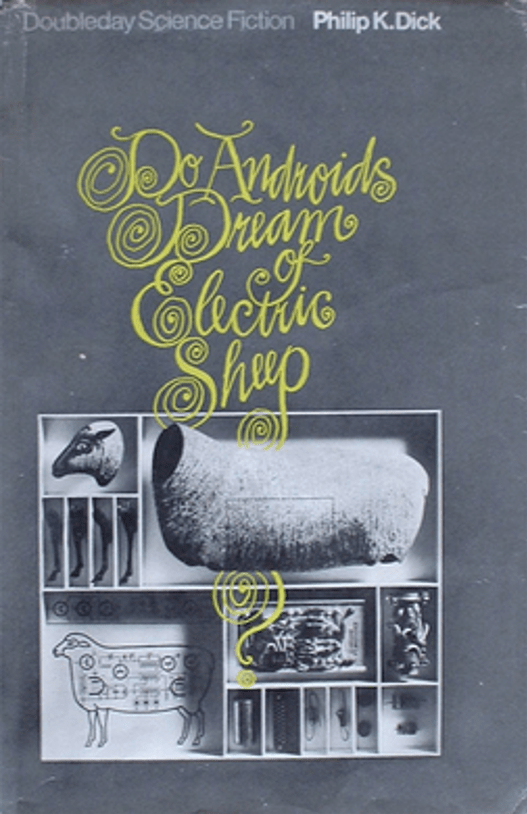
At a certain moment, Refik Anadol quotes Philip K. Dick, author of the 1968 science fiction book “Do Androids Dream of Electric Sheep”, later retitled Blade Runner, and basis for the 1982 initial version of the film.

Electric Sheep

Quote Philip Dick

This inspires Refik Anadol to seed the following insight:

A simulation is that which does not stop when the stories go away

Stories are responsible for our human desire for resolution

But the simulation is only responsible for its own laws and initializing conditions

A simulation has no moral, prejudice of meaning

Like nature it just is

There is some poetry hidden in this abstraction of data

Exploring data sets that have this quality of meditation

The architect as an operating systems designer, a beautiful “speculation”

Quote Blaise

Finding the moment of remembering

Finding the moment of entering a dream state

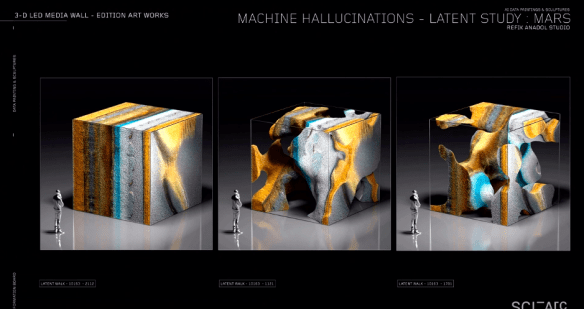
“Machine Hallucinations”

Collective memories of spaces

To make the invisible visible

Hallucination narrators

Dream narrators

The Selfies of the Earth

Machine Hallucinations

Refik is asking questions that are not just a fancy-fications of a bunch of algorithms

petervan-signature


Spacial Trash and Patrimony

Another rabbit hole bringing together some reflections on creativity, demolition, patrimony, and poetic ruination, as so often in this blog inspired by architectural insights and metaphors.

bouwmeester

My attention was triggered by an article in the Jan 11, 2020 weekend edition of De Standaard, a Flemish newspaper. The article was about landscaping, and more specifically “ontharding” (I would literally translate it as “softening”). In this case, softening that what was hardened in the first place. Abandoned and neglected residential and industrial sites, where the soil is still covered by the concrete and rubbish of empty buildings.

It was part of a study supported by the “Vlaamse Bouwmeester”. “Bouwmeester” means “master of building”, “bau-meister”. The term is ill-translated into “Flemish Government Architect” on the official website. The full study can be found here (PDF in Dutch).

The core mission of the Flemish Government Architect is to promote the architectural quality of the built environment. The Flemish Government Architect and his team advise public patrons in the design and realization of buildings, public space, landscape and infrastructure. In addition, the Flemish Government Architect stimulates the development of visions and reflection, with an emphasis on interdisciplinary and cross-sectoral initiatives. The Flemish Government Architect acts as an advisor to the entire Flemish Government.

In short, the article and the study plea for restoring public space by the demolition of 1/5th of hardened space/surface in the Flemish landscape by 2050.

I had a flashback to “Cradle to Cradle”, the 2002 book that alerted me for the first time to a possible vision of sustainable production and architecture. The idea at that time was that reducing waste was just not good enough, and to be sustainable we needed to add value back into the system. As an evolution, the article about the softening of landscape goes one step further: from reducing waste to creating open space by the demolition of vacancy.

“Sloop geeft blijk van falen” – “Demolition evidences failure”

It was happenstance that I was reading around the same time Dan Hill’s 2015 book “Dark matter and trojan horses. A strategic design vocabulary”. I will come back to this book in subsequent posts.

Dan Hill was/is looking for (open) spaces as well, quoting ex-FC Barcelona football player and current Al-Sadd (Quatar) football team coach Xavi Hernández:

 “Think quickly, look for spaces. That’s what I do: look for spaces. All day. I’m always looking. All day, all day. Here? No. There? No. People who haven’t played don’t always realise how hard that is. Space, space, space. It’s like being on the PlayStation. I think ‘shit, the defender’s here, play it there’. I see the space and pass. That’s what I do.”

Already more than 20 years ago, architect Cedric Price was arguing for demolish-able buildings with open re-usable spaces.

fun palace

Cedric Price’s Fun Palace – inspiration for Centre Pompidou in Paris

OK – I confess – as from that moment I went down the rabbit hole and saw demolition and abandoned architecture everywhere. Like in this recent Guardian article, arguing the case for fully demountable buildings.

“We have to think of buildings as material depots,” says Thomas Rau , a Dutch architect who has been working to develop a public database of materials in existing buildings and their potential for reuse… He has developed the concept of “material passports”, a digital record of the specific characteristics and value of every material in a construction project, thereby enabling the different parts to be recovered, recycled and reused.

But there is also something poetic about abandonment, up to the point where we could consider keeping these ruins and equipping them with sensors to listen to patrimony.

In his beautifully reflective post “Instrumental Revelation and the Architecture of Abandoned Physics Experiments”, Geoff Manough introduces the concept of “poetic ruination.

Like menhirs, these abandoned seismic sensors could now just stand there, silent in the landscape, awaiting a future photographer such as Grigoryants to capture their poetic ruination.

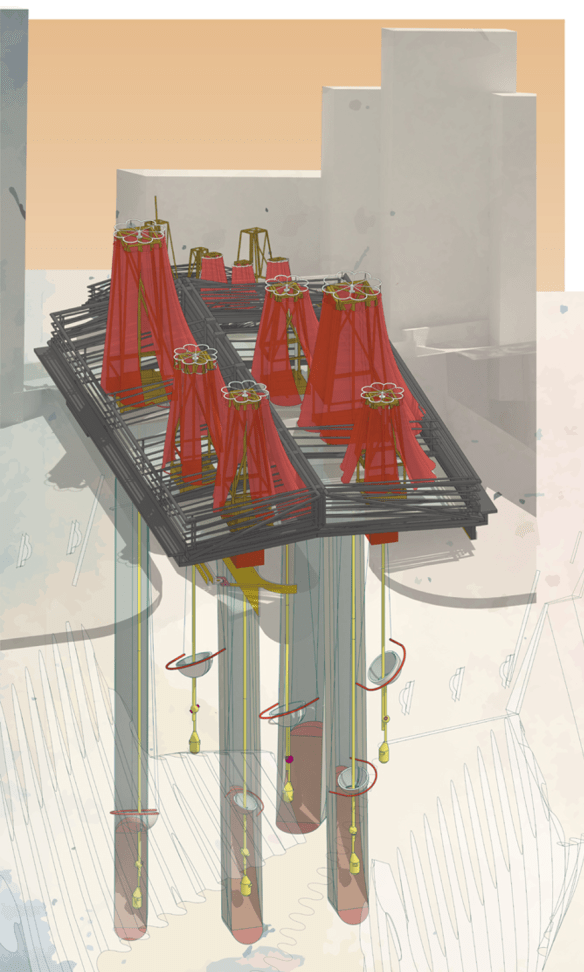
Lebbeus Woods was inspiration to Geoff Manough and London-based architects Smout Allen for the project L.A. Recalculated:

Woods depicts an entire city designed and built as an inhabitable scientific tool. Everywhere there are “oscilloscopes, refractors, seismometers, interferometers, and other, as yet unknown instruments, measuring light, movement, force, change.” Woods describes how “tools for extending perceptivity to all scales of nature are built spontaneously, playfully, experimentally, continuously modified in home laboratories, in laboratories that are homes.”

Instead of wasting their lives tweeting about celebrity deaths, residents construct and model their own bespoke experiments, exploring seismology, astronomy, electricity, even light itself.

seismic sensors

Seismic Counterweights
From L.A. Recalculated by Smout Allen and BLDGBLOG

Like architects think about (industrial) sites listening through sensors to seismic undercurrents, I started wondering whether we could not use this metaphor to reflect about our organizational structures; structures not only as hierarchical structures but the more encompassing set of system rules and patterns of an organization – I referred to it before as organizational patrimony.

How can we listen to and signal about the pulse of this organizational patrimony? How can we be aware of it, appreciate it, respect it, and build upon it in our rebellious acts of creative destruction?

I imagine a cohort of humans – like a colony of ants – having 24/7 sensors and laboratories everywhere in organizations; in every office, cubicle, meeting room, coffee corner, etc. And I don’t mean robotic sterile sensors feeding AI models. I mean real humans, measuring, documenting and signaling patrimonial changes in the structure of corporate structure, so they can send early warnings of experiments that have become useless and therefore have to be ruinated, or – in the worst-case – signal cases of patrimonial breakdown and demolition. In search of the material depot and passport of our organizations.

petervan-signature


The End of Experience

EX-perience is “out”, IN-tervention is “in”

When I talk about “experience”, I mean:

  • The new hype of artistic “experiences” at art exhibits
  • “Experiences” at events
  • The “experience” of driving a car
  • The “experience” in whatever, like tasting chocolate, as promoted in advertisements

It is almost always about “entertainment”, easy/easier/more convenient consumption, not forcing you to learn a new (or old/existing) language.

CycleGAN - December 22nd 2019 at 3.16.22 PM

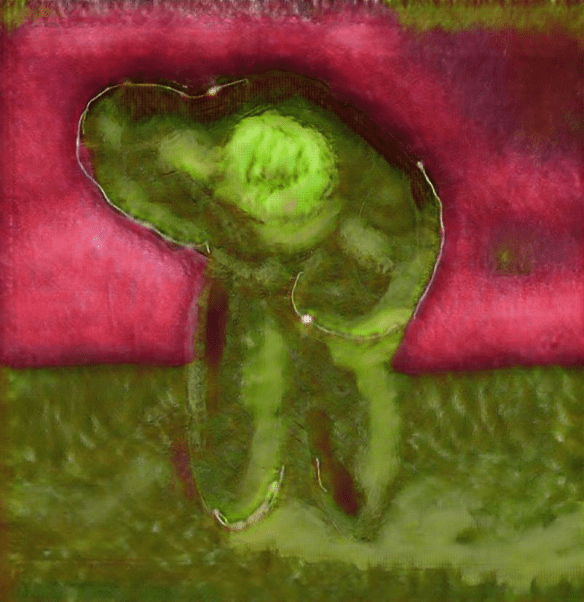
Petervan Artwork © 2020 – Canvas through CycleGAN cloud AI model


When I talk about “intervention”, I mean:

  • Provoking
  • Asking questions
  • Challenging assumptions
  • Planting speculations
  • Through visceral (sensorial) triggers
  • Creating better “resonances”
  • Playing your harmonics, like harmonics in music
  • Hearing the real-real sound (like in Neil Young Archives)

Formats can be analog and digital artwork, performances, events, retreats, writings, poems, blogs, installations, exhibitions, immersions, soundscapes, recordings, documentaries, time capsules, AI warps, and fairy tales 😉

Interventions help us rediscover what is real, what resonates, what makes us go into frequency, what moves us, etc. And all this with a direction, with an intention: to enable spiritual, moral and aesthetical advancement at systems’ scale.

petervan-signature

New Babylon – New Frisco – New Cobra – New city to play

During my visit to SFMOMA on 15 Nov 2019, I was standing on the terrace of the 7th Floor looking North-East into Natoma Street, and wondering what the curved-walled building on the left was about.

SFMOMA

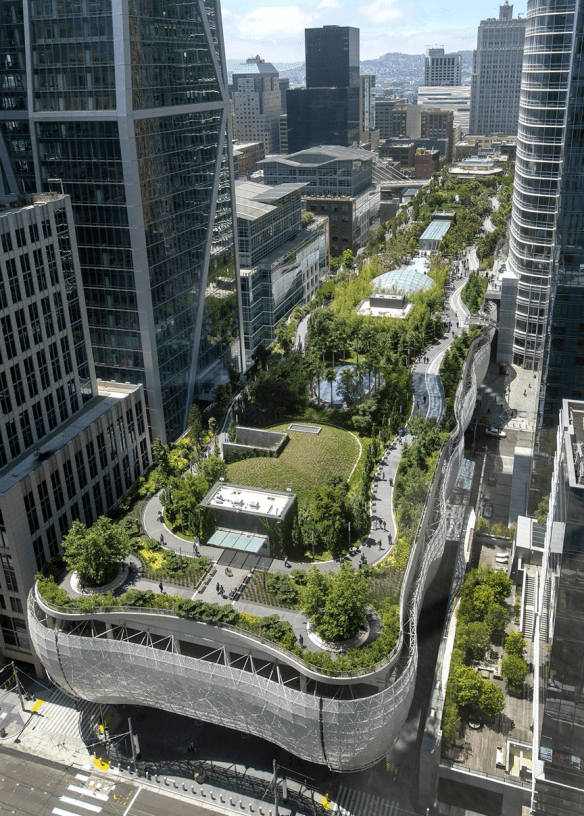
I did not pay much attention until I was reminded of this view in this article about floating utopias in The New-Yorker of 11 Dec 2019. Below is a view from the other side, probably taken from the Providian Financial rooftop on Beale Street, looking South-West. At the far end, you may recognize the SFMOMA building. The building in the front is Salesforce Park, a lush rooftop arcadia of rolling meadows.

Salesforce Park

Salesforce Park.Photograph by Karl Mondon / The Mercury News / Getty

The article in The New-Yorker is about the utopian, surveilled and orchestrated architecture in the middle of the astonishing inequality of homeless people in all the other streets of San Francisco:

Taxpayer-funded, corporately branded, suspended above the homeless, the park is an irresistible metaphor for the city’s socioeconomic tensions. It also feels like a bid, or a prayer, for a certain vision of its future.

Salesforce Park as a model for the rest of San Francisco—vertical, expansive, ecologically minded, expensive, sponsored, and surveilled.

“I feel totally orchestrated,” Cranz said, placing her hand on the railing separating us from the plant life. “I’m acutely aware of how managed everything is.”

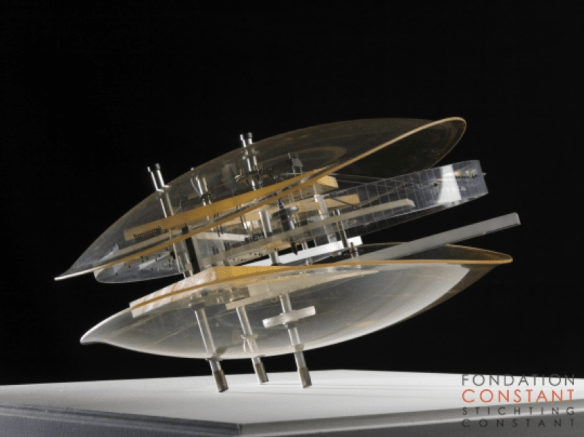
Shuttle Constant

Two days later, I bumped on-line into the magical world of the Dutch artist Constant Nieuwenhuis and especially his Magnus opus “New Babylon”, another utopia, a city designed to respond to Homo Ludens’ need for playing, for adventure, and for mobility.


In New Babylon there are no single houses

The whole city is one immense covered collective house

A house with countless rooms, halls and corridors,

In which one can roam for days or weeks,

But where one can also find

Small spaces for privacy

New Babylon is a labyrinth

Inexhaustible in its variations

A palace with a thousand rooms

timeline art

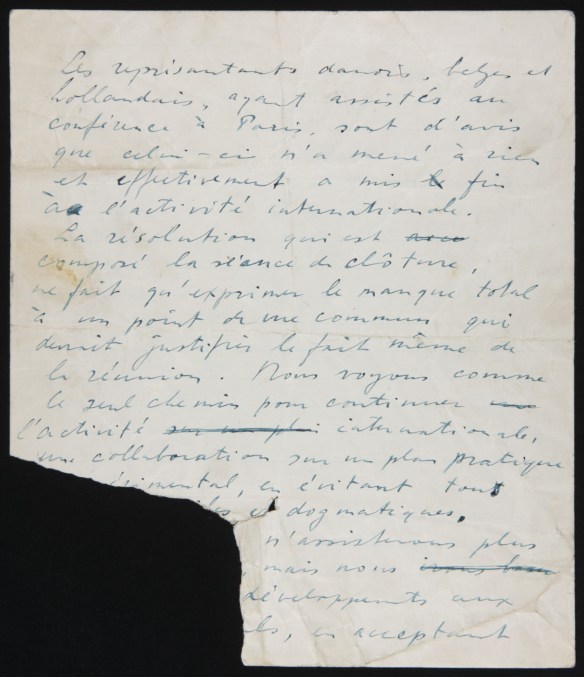
Constant was one of the founders of Cobra, an avant-garde art movement established on 8 Nov 1948. The movement only existed for three years, but forever changed the landscape of postwar European art. Cobra was perhaps the last avant-garde movement of the twentieth century. Constant was the author and co-signee of the initial COBRA Manifesto “La Cause était entendue” – “The Case was Settled”.

Les représentants belges, danois et hollandais à la conférence du Centre Internatiopnal de Documentation sur l’Art d’Avant-Garde à Paris jugent que celle-ci n’a mené à rien.

La résolution qui a été votée à la séance de cloture ne fait qu’exprimer le manque total d’un accord suffisant pour justifier le fait même de la réunion.

Nous voyons comme le seul chemin pour continuer l’activité internationale une collaboration organique expérimentale qui évite toute théorie stérile et dogmatique.

Aussi décidons-nous de ne plus assister aux conférences dont le programme et l’atmosphère ne sont pas favorable à un développement de notre travail.

Nous avons pu constater, nous, que nos façons de vivre, de travailler, de sentir étaient communes ; nous nous entendons sur le plan pratique et nous refusons de nous embrigader dans une unité théorique artificielle. Nous travaillons ensemble, nous travaillerons ensemble.

C’est dans un esprit d’efficacité que nous ajoutons à nos expériences nationales une expérience dialectique entre nos groupes. Si, actuellement, nous ne voyons pas ailleurs qu’entre nous d’activité internationale, nous faisons appel cependant aux artistes de n’importe quel pays qui puissent travailler – qui puissent travailler dans notre sens.

Paris, le 8 novembre 48.

Cobra Manifesto page-1

Cobra Manifesto - Image from Beinecke Digital Collections

After reading “Homo Ludens – A Study of the Play-Element in Culture” by Johan Huizinga, Constant develops the idea for a futuristic city. He develops this idea by drawing maps, writing texts, building constructions, and models.

Homo Ludens

Constant worked for almost 20 years on New Babylon (1959-1974). Today, there is a foundation to preserve and promote the art collection and intellectual legacy of the artist.

From Wikipedia:

The goal was the creating of alternative life experiences, called ‘situations’

Perched above ground, Constant’s megastructures would literally leave the bourgeois metropolis below and would be populated by homo ludens–man at play.

In the New Babylon, the bourgeois shackles of work, family life, and civic responsibility would be discarded. The post-revolutionary individual would wander from one leisure environment to another in search of new sensations. Beholden to no one, he would sleep, eat, recreate, and procreate where and when he wanted. Self-fulfillment and self-satisfaction were Constant’s social goals. Deductive reasoning, goal-oriented production, the construction and betterment of a political community–all these were eschewed.

It is obvious that a person free to use his time for the whole of his life, free to go where he wants, when he wants, cannot make the greatest use of his freedom in a world ruled by the clock and the imperative of a fixed abode. As a way of life Homo Ludens will demand, firstly, that he responds to his need for playing, for adventure, for mobility, as well as all the conditions that facilitate the free creation of his own life.

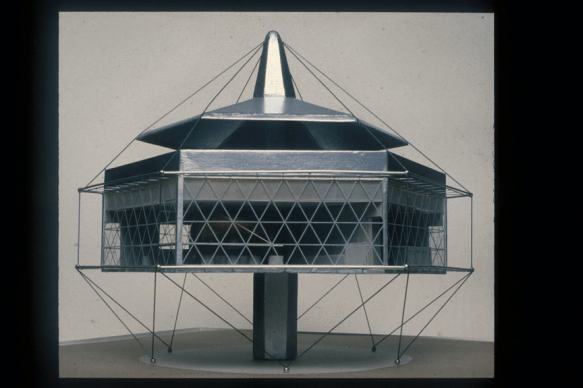
Some of the constructs in Constant’s vision reminded me of the sketches and models of Buckminster Fuller’s Dimaxyon House of 30 years earlier).

Dymaxion House

Buckminster Fuller, Dimaxyon House, Chicago, USA, 1927

Constant passes away in Utrecht on August 1st, 2005, at home with his wife Trudy van der Horst. He is buried at Zorgvlied in Amstelveen on August 6th. On his grave:

In art freedom manifests itself in its highest form.
The creative imagination.
Art creates an image of the world that didn’t exist before.
No. More than that.
An image that was unthinkable before.

I’d love to see a 21st-century version of Cobra, a collective of artists, thinkers, creators, tinkerers, and experimentalists, leading into a movement of fresh thinking. Not necessarily and exclusively an art-movement, but an all-encompassing societal-movement, with more time and air and oxygen for our children to play, where they naturally can grow into what they are best at, with a renewed freshness and renaissance, a new corporate and societal spring, celebrating the power of imagination and creativity, as a response to our dull political landscape of non-zero games.

A new New Babylon, a new city to play, a new avant-garde propelling us into the highest forms of freedom.

petervan-signature


The lessons of Fiorella

This is a supplement to my post about the end-of-year assignment Art and Culture at the Academy of Visual Arts in Ghent.

Dutch version here.

Dear Fiorella,

Your lessons were always fun for me. You speak in poetic and philosophical words and sentences. I have written them all down and someday I will publish an anthology of them. Chris and Inge advised me to use them as inspirations for my paintwork.

Here are a few examples of sentences and statements that flow from your mouth:

THE CHESSBOARD IS EMOTIONLESS

A GOOD ARTWORK DOES NOT GIVE ANSWERS

THE INTENSITY OF SLOWNESS

BEING BROKEN IS A STATE OF BEING

WORKING WITH CLAY DOESN’T MAKE NOISE

WE CAN ONLY SEE EMPTYNESS WHEN WE FILL IT

THERE SHE LIES IN ALL HER GREATNESS

LYING IN DEATH

360 POSSIBLE VIEWS

IN RELATIONSHIP WITH THE ENVIRONMENT

AND KEEPING TRACK OF THEM IN OUR HEAD

“THE PARCOURS”

CREATION OF THE POSSIBILITIES

TO LET THE IMAGE EMERGE

BLOCKING OF THE VISUAL BRAIN

WHEN IS SOMETHING BECOMING TIRING?

WHEN YOU CANNOT DETERMINE YOUR OWN TEMPO

YOU CAN TAKE A SMALL STEP

TAKING A HUGE SPACE AT THE SAME TIME

THE BRAIN IS LIKE AN OFFICE

A HOUSE WITH ROOMS

SOMETIMES YOU NEED OTHER KEYS

With gratefulness,

petervan-signature


De lessen van Fiorella

Dit is een aanvulling op mijn post over de eindejaarsopdracht Kunst en Cultuur aan de Academie voor Beeldende Kunsten in Gent.

Dutch version. English translation here.

Fiorella,

Je lessen waren voor mij altijd genieten. Je spreekt in poëtische en filosofische woorden en zinnen. Ik heb ze allemaal opgeschreven en ooit publiceer ik een bloemlezing van ze. Chris en Inge hebben me aangeraden om ze te gebruiken als inspiraties voor mijn schilderwerk.

Hier zijn een paar voorbeelden van zinnen en statements die zo uit je mond vloeien:

HET SCHAAKBORD IS EMOTIELOOS

EEN GOED KUNSTWERK GEEFT GEEN ANTWOORD

DE INTENSITEIT VAN DE TRAAGHEID

BREUK IS EEN STAAT VAN ZIJN

MET KLEI BEZIG ZIJN MAAKT GEEN LAWAAI

WE KUNNEN EEN LEEGTE PAS ZIEN ALS WE ZE VULLEN

DAT LIGT DAAR IN ZIJN GROOTSHEID

DOOD TE LIGGEN

360 MOGELIJKE STANDPUNTEN

IN RELATIE MET DE OMGEVING

EN DIE IN ONS HOOFD HOUDEN

“HET PARCOURS”

CREATIE VAN DE MOGELIJKHEDEN

OM HET BEELD TE LATEN ONTSTAAN

BLOKKEREN VAN HET VISUELE BREIN

WANNEER WORDT HET VERMOEIEND?

ALS JE JE EIGEN TEMPO NIET MEER KAN BEPALEN

JE KAN EEN KLEINE STAP ZETTEN

EN DAARDOOR EEN ENORME RUIMTE INNEMEN

DE HERSENEN ZIJN ALS EEN BUREAU

EEN HUIS MET KAMERS

SOMS HEB JE ANDERE SLEUTELS NODIG

In dankbaarheid,

petervan-signature


Year-end assignment “Art and Culture” – Ghent Academy – Fiorella Stinders

Dutch version here.

Last year I had the pleasure of attending the Art and Culture classes at the Academy of Visual Arts in Ghent. The teacher is Fiorella Stinders, who conveys her enthusiasm for art to us in a very poetic way.

At the end of the academic year, we were given an assignment: applying what we had learned about looking at art. We were allowed to choose two works from an imposed list by Fiorella, and a third work that we had chosen ourselves, but that we had seen in real life (not in a catalog or photo).

I am happy to share my contribution in this post. First in Dutch, and then as a separate post in English (a translation by Google Translate, with only minor edits).

A separate blog post follows with a number of the poetic statements of Fiorella that have stayed with me. My coaches at the academy (Chris, Inge, Koen, Annick, many thanks btw!) have suggested that I use these quotes as inspiration for the next academic year.

Two selected works from the Fiorella list

Four Fairies – Michael Borremans

Borremans

A painting – oil on canvas – in a fairly large format (110x150cm). Striking is the large diagonal table oil stain in which the figures seem to be sinking. The void left at the bottom was intentionally left open by the artist. The brown-grey background works as a support surface.

We look from the top down. The colors of the figures are rather neutral, in the sense of not being dominant. There is a surreal peace from the work. The painter uses Claire-obscure effects, especially the shadows against the wall in the background. The mirroring of the hands on the black surface is subtly suggested. It is also the reflection that evokes the black oil effect. The vertical drop of paint has been deliberately retained and accentuates the verticality of a table or of a bath in a stone or concrete base.

There is a depth in the work; the composition is more central horizontally, but vertical light above the center. A diagonal from bottom left to top right.

The work has a certain lightness in color but a certain darkness in the subject. The brush strokes are fast, rhythmic. Shadows and light spots are suggested in a “simple” way: look at the light spot on the black pull of the woman at the very back.

The work is clearly figurative, but not photo-realistic. Depth and light are indicated. When I zoom in on the photo in deep close-up, the self-confident brush strokes of the artist become clear: the light reflections in the hairstyles, the patterns on the green dress, the light-darkness of the left. An inspiration for my own evolution towards the next year painting at the academy.

In some figures I sometimes recognize the silhouette of the artist’s skull, wondering if he has tried to suggest a self-portrait of four schizophrenic transgender identities. The figures are busy with something – something with their hands – but it is not exactly clear what they are doing.

From the work alone I cannot determine whether the artist wants to communicate a message. For me, it evokes themes of devotion, dignity, humility, and also ignoring a dark reality peeking around the corner. It seems like a report or a snapshot of a surreal dream.

The role of the spectator is passively looking; there is no participation as in a performance for example. The viewer views the work from the front. There is no 3D aspect as with a spatial work.

Ali’s Boat – by Saik Kwaish – video animation

Artist website: http://sadik.nl/

Video animation of +/- 6:30 minutes. Used material: charcoal and pencil (I think) on paper. Further information searched on the artist’s website. http://sadik.nl/ali-boat

The video is part of a larger set of videos, sketches, drawings, etc. Inspiring in itself on how the theme of the boat/letter is worked out and internalized in almost infinite variations and can give rise to a total exhibition: nothing has to be thrown away!

The perception of the video is, of course, different from that of a 2D image, as this also includes the aspect of time and storytelling. Rhythm becomes important. Music is supportive and determines the atmosphere.

The atmosphere of the video is rather dark, sad, and melancholic. The “light” of the video is grey. A lot of things move and flow at the same time: the face, the background, the boat that transforms into a bird and back. The tears and the rain. With the eye as a permanent anchor in the composition.

The meaning of this video animation has to do with fleeing and immigrating. The paradox of escaping the misery, while at the same time detaching the identity of your youth and the oddity of the new destiny. The universal desire for happiness, peace and security. The desire and awareness of travel – such as being on the road – for a better future. The image as an expression of this desire where words fall short.

The artist invites us to judge rather than condemn the alien “problem” from a more empathic point of view.

The artist makes a clear link to his own identity and immigration past.

The spectator is invited to participate and reflect emotionally.

Self-selected work

delvoye

Wim Delvoye – As seen in the Royal Museum for Fine Arts in Brussels on 11 April 2019.

Title: Dunlop Geomax 100/90)19 57M 720° 2X – Made in 2013

Based on the catalog, this work is apparently made from polished and patinated stainless steel, made from 3D prints. And then painted and chromed. When viewing the work in real life I did not know this, and I really thought that the artist had somehow twisted together existing wheels with rubber tires. The intended illusion was already successful.

I have viewed the work as part of the larger Delvoye exhibition, giving the work more context. I was enchanted and fascinated by the twisted crucifixes and truck cathedrals. On another side of the room, there were large truck tires carved out like lattice. The lighting of the whole was precise: the dark backgrounds and bases, and the laser-sharp lighting of the subjects themselves.

As in a claire-obscure painting, the artist plays with contrasting dark (matte) and light (shiny) chrome surfaces and shows he is a master in the intertwining of torsion and movement. This work – and the retrospective exhibition as a whole – provided a broader view of the work and the identity of the artist. Suddenly the provocateur of the tattooed pigs and the cloaca turns into an accomplished craftsman, artist, messenger, and questioner.

I suspect the artist is trying to make us doubt between real and unreal. It is probably not the intention of the artist, but he allows me to make the link with our online world where it is becoming increasingly difficult to distinguish real from unreal (example: fake news), or to sustain the illusion of control of personal freedom and choice in a world that is increasingly driven by artificial intelligence and algorithms. The human “androrhythms” – evoked by the artist – are a relief because they move away from the binary “if-then” computer logic.

This speculative and virtual connection with the world can be perfectly linked to a physical relationship and connection: a relationship bent and twisted time and space.

The spectator is invited to step around the work and to investigate and explore the interweaving of spokes and tires from both close and remote.

petervan-signature

Eindejaarsopdracht “Kunst en Cultuur” – Academie Gent – Fiorella Stinders

In Dutch – English version here.

Ik had het afgelopen jaar het genoegen de lessen Kunst en Cultuur te mogen volgen aan de Academie voor Beeldende Kunsten in Gent. Lesgeefster is Fiorella Stinders, die op een bijzonder poëtische manier ons haar enthousiasme voor kunst overbrengt.

Op het einde van het academiejaar kregen we een opdracht: toepassen wat we geleerd hadden over kijken naar kunst. We mochten twee werken kiezen uit een opgelegde lijst van Fiorella, en een derde werk dat we zelf hadden gekozen, maar dat we wel in het echt (niet in een catalogus of foto) hadden gezien.

Ik deel met veel plezier mijn bijdrage in deze post. Eerst in het Nederlands, en dan als een aparte post in het Engels (een vertaling door Google Translate, slechts minimaal bijgewerkt).

Er volgt nog een aparte blog post met een aantal van de poëtische uitspraken van Fiorella die me zijn bijgebleven. Mijn coaches op de academie (Chris, Inge, Koen, Annick, veel dank hierbij) hebben me gesuggereerd om deze als inspiratie te gebruiken voor volgend academiejaar.

Twee gekozen werken van de lijst van Fiorella

Four Fairies – Michael Borremans

Borremans

Een schilderij – olie op doek – in redelijk groot formaat (110x150cm). Opvallend is de grote diagonale tafel-olie-vlek in dewelke de figuren lijken te verzinken. De gelaten leegte onderaan is bewust open gelaten door de kunstenaar. De bruingrijze achtergrond werkt als een steunvlak.

We kijken van boven naar beneden. De kleuren van de figuren zijn eerder neutraal, in de zin van niet overheersend. Er straalt een surreële rust uit van het werk. De schilder gebruikt Claire-obscure effecten, vooral de schaduwen tegen de muur op de achtergrond. De spiegeling van de handen op het zwarte oppervlak is subtiel gesuggereerd. Het is ook de spiegeling die het zwarte olie-effect oproept. De verticale verf-druppel is bewust behouden en accentueert het verticale van een tafel of van een bad in een stenen of betonnen sokkel.

Er zit een diepte in het werk, de compositie is horizontaal eerder centraal, maar verticaal licht boven het centrum. Een diagonaal van links onder naar recht boven.

Het werk heeft een zekere licht-heid qua kleur maar een zekere donkerte in het onderwerp. De toetsen zijn vlug, ritmisch. Schaduwen en lichtvlekken worden op een “eenvoudige” manier gesuggereerd, kijk vooral naar de lichtvlek op de zwarte pull van de vrouw helemaal achteraan.

Het werk is duidelijk figuratief, maar niet fotorealistisch. Diepte en licht worden aangegeven. Als ik inzoom op de foto in diepe close-up, worden de zelfzekere toetsen van de kunstenaar duidelijk: de lichtspiegelingen in de kapsels, de patronen op de groene jurk, het licht-donker van de gelaten. Een inspiratie voor mijn eigen evolutie naar het volgende schilder jaar toe.

In sommige figuren herken ik soms het silhouet van de schedel van de kunstenaar, me afvragend of hij een zelfportret van vier schizofrene transgender identiteiten heeft proberen te suggereren. De figuren zijn bezig met iets – iets met hun handen – maar het is niet precies duidelijk wat ze aan het doen zijn.

Vanuit het werk alleen kan ik niet bepalen of de kunstenaar en boodschap wil meedelen. Bij mij roept het thema’s op van devotie, deftigheid, gedeisdheid, een negeren ook van een donkere werkelijkheid die om de hoek gluurt. Het lijkt een verslag of een momentopname van een surreële droom.


De rol van de toeschouwer is passief kijkend, er is geen participatie als in een performance bijvoorbeeld. De toeschouwer bekijkt het werk frontaal. Er is geen 3D aspect zoals bij een ruimtelijk werk.

Ali’s Boat – by Saik Kwaish – video animation

Artist website: http://sadik.nl/

Video animatie van +/- 6:30 minuten. Gebruikt materiaal: houtskool en potlood (denk ik) op papier. Verdere informatie opgezocht op de website van de kunstenaar. http://sadik.nl/ali-boat

De video is deel van een groter geheel van video’s, schetsen, tekeningen, enz. Op zich inspirerend hoe het thema van de boot/brief op een bijna oneindig variaties wordt uitgewerkt en geïnternaliseerd, en aanleiding kan geven tot een totaal tentoonstelling: niets moet worden weggegooid!

Uiteraard is de waarneming van video anders dan die van een 2D beeld. Omdat hier ook het aspect van tijd en storytelling komt bij kijken. Ritme wordt belangrijk. Muziek is ondersteunend en bepalend voor de sfeerzetting.

De sfeer van de video is eerder donker, droevig, en melancholisch. Het “licht” van de video grijs. Er beweegt en vervloeit veel terzelfdertijd: het gezicht, de achtergrond, de boot die transformeert in vogel en terug. De tranen en de regen. Met het oog als vast anker in de compositie.

De betekenis van deze video animatie heeft te maken met het vluchten en immigreren. De paradox van het ontvluchten van de miserie, en tegelijkertijd onthechten van de identiteit van je jeugd en het bevreemdende van de nieuwe bestemming. Het universeel verlangen naar geluk, vrede en geborgenheid. Het verlangen en bewustzijn naar reis – zoals in op-weg-zijn – naar een betere toekomst. Het beeld als uitdrukking van dit verlangen waar woorden te kort schieten.

De kunstenaar nodigt ons uit om het vreemdelingen “probleem” vanuit een meer empathisch standpunt te beoordelen eerder dan te veroordelen.

De kunstenaar legt hiermee een duidelijke link naar zijn eigen identiteit en immigratie verleden.

De toeschouwer wordt uitgenodigd om emotioneel te participeren en te reflecteren.

Zelf gekozen werk

delvoye

Wim Delvoye – Gezien in het Koninklijk Museum voor Schone Kunsten in Brussel op 11 April 2019.

Naam van het werk: Dunlop Geomax 100/90)19 57M 720° 2X – Gemaakt in 2013

Op basis van de catalogus, is dit werk blijkbaar gemaakt van gepolijst en gepatineerd roestvrij staal, gemaakt van 3D prints. En daarna beschilderd en verchroomd. Bij het bekijken van het werk in het echt wist ik dit niet, en dacht ik echt dat de kunstenaar bestaande wielen met rubber banden op een of andere manier verwrongen in elkaar gevlochten had. De bedoelde illusie was alvast geslaagd.

Ik heb het werk bekeken als deel van de grotere Delvoye tentoonstelling, waardoor het werk meer context kreeg. Ik was betoverd en gefascineerd door de verdraaide kruisbeelden en vrachtwagen-kathedralen. Aan een andere zijde van de ruimte stonden als kant uitgekerfde grote banden. De belichting van het geheel was precies: de donker gelaten achtergronden en sokkels, en de laser scherpe belichting van de onderwerpen zelf.

Zoals in een claire-obscure schilderij, speelt de kunstenaar met contrasterende donkere (matte) en lichte (blinkende) verchroomde vlakken en toont zich een meester in de vervlechting van torsie en beweging. Dit werk – en de overzichtstentoonstelling als een geheel – geven een ruimere kijk op het werk en de identiteit van de kunstenaar. Plots ontpopt de provocateur van de getatoeëerde varkens en de cloaca zich tot een volleerd ambachtsman, kunstenaar, boodschapper en vragensteller.

Ik vermoed dat de kunstenaar ons probeert te doen twijfelen tussen echt en onecht. Het is allicht niet de bedoeling van de kunstenaar, maar hij laat mij daardoor de link maken met onze online wereld waar het ook steeds moeilijker wordt om echt van onecht te onderscheiden (voorbeeld: fake news), of om de illusie van persoonlijke keuzevrijheid en controle hoog te houden in een wereld die meer en meer aangestuurd wordt door artificiële intelligentie en algoritmes. De menselijke – door de kunstenaar geëvoceerde – “androritmes” zijn in zijn werk een verademing doordat ze afstappen van de binaire als-dan computer logica.

Deze speculatieve en virtuele verbondenheid met de wereld kan perfect gekoppeld worden aan een fysische relatie en connectie: die van de ge- en verbogen tijd en ruimte.

De toeschouwer wordt uitgenodigd om rond het werk te stappen en de vervlechting van spaken en banden van zowel dichtbij als vanop afstand te onderzoeken en te verkennen.

petervan-signature