
Petervan Artwork © 2021 – Horses Series
The top one is acryl on canvas 60x50cm – others are digital experiments in Procreate


Petervan Artwork © 2021 – Horses Series
The top one is acryl on canvas 60x50cm – others are digital experiments in Procreate

This post is part of a series of essays bundled under “Travelling without moving”.
Intro of that series can be found here.
The plan/ambition with this series: to share where I have been the last year, what I learned, where I am going, and what is required.
The broader quest is to discover what is required to enable real change.
After the Play-Post of begin Jan 2021, we continue with “Anxious” in a post-VUCA world.
BANI is what is next after VUCA.
Already in 2018, Jamais Cascio coined the term BANI. See my post from Aug 2019 and Jamais’ update from April 2020.
BANI stands for Brittleness, Anxious, Non-Linear, and Incomprehensible.
Let’s focus on the “A” of BANI.
I suggested that the preferred response to Anxiousness was empathy or agency.
But that felt too open ended.
Empathy with what, and agency in what kind of world?
And was it forward or backward looking?
A possible world or a preferred world?
I went back to the most common definition for anxious:
“being worried about what may happen or have happened”
Like a rabbit caught in the headlights, some people are so frightened or nervous that they do not know what to do. They sometimes remain still because they do not know where the light comes from or which way to go.

Another reaction is to fake that you know what to do, especially if you are in the spotlight for one reason or another. In other words, to bluff yourself out of an anxious situation.
Imagine a workshop where the top executives of a firm are sitting on the first VIP row of a theatre (in COVID-times, it would be a massive Zoom session with all the employees being able to look over the shoulder of their executives).
All the employees are sitting in the rows behind the VIP row to witness how their executives manage a difficult situation, or even more frightening, being able to see inside the heads of those who bluff to know, don’t blink an eye, and confidently steer their troops in the wrong direction, efficiently of course.
Remaining still or bluffing strong are most probably not the wisest responses to anxiety.
A better response would have to do with orientation or some kind of possibility mapping.
I assume many of my readers are familiar with Joseph Voros’ Future Cone.

Great background explanation by Joseph Voros here.
These days, you can buy out-of-the-box possibility mapping workshops from some of the big-4 and many boutique consultancies. Some of them already fully COVID-proof online, with Miro boards of future cones, chatrooms, Clubhouse conversations, Slack and other real-time streams.
But all this online-first coolness can also be distracting. What I am exploring is some kind of new genre, where we also inject artists to resonate with and for the content at a non-cognitive level, not as entertainment, but with an aesthetic that is demonstrative, not just a gimmick overlay.
An aesthetic that has a sense of stillness and serenity that makes the effort and work real, beyond perception and reason, with an anchoring in humanistic relevance.
Without falling for the temptation to add such toolkit to a “Pot-Pourri” of other coolness, as a tapas-bar, a Chinese menu to choose from.
What is missing in the “Pot-Pourri” is a sense of agency, a sense for direction and choice. Choice as in opinion, and direction as in judgment and daring to step forward with preference.
If not, the online-first future cones become a surrogate for analog Post-It-driven brainstorms, just mapping future concepts on the dimensions of possible, plausible, probable, and impossible.
The crux is daring to address the preferrable future. Because that is using the map beyond seeing better what is and what could be. It is using the map for standing for an opinion, a direction, most probably in the space of moral, spiritual, and aesthetical advancement.
That’s of course a more difficult sell.
But for now, let’s summarise, not as a conclusion, but more as a beacon in our developing story that a possible response to anxiousness is possibility mapping with the courage to set direction and preference.
Next time we’ll talk about “Unbound” – Unbound from thingness that is.
Hope you stay on board.
Warmest,
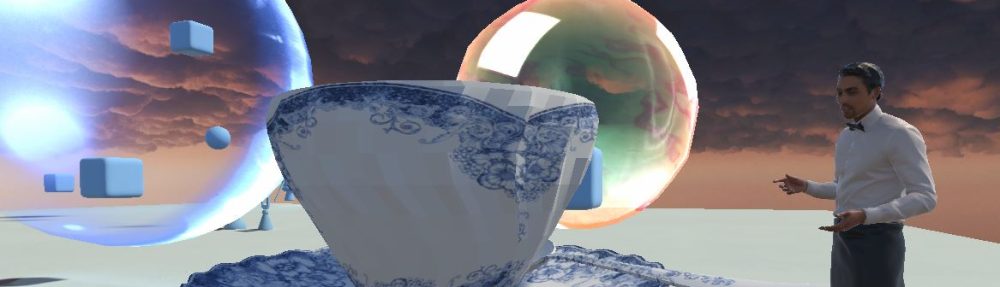
I am excited to announce the launch of one of my new channels: Petervan’s Pirate TV – Art-Tribe Edition
The first episode will premiere on YouTube on 1 Dec 2020 at 09:30am Los Angeles – 12:30pm New York – 6:30pm Brussels – 1:30am Hong Kong (next day)
The YouTube live chat will be open for feedback, critique and encouragements.
I suggest you set the YouTube reminder so you don’t miss the premiere and the live chat.
The video will remain available for viewing after the Premiere event
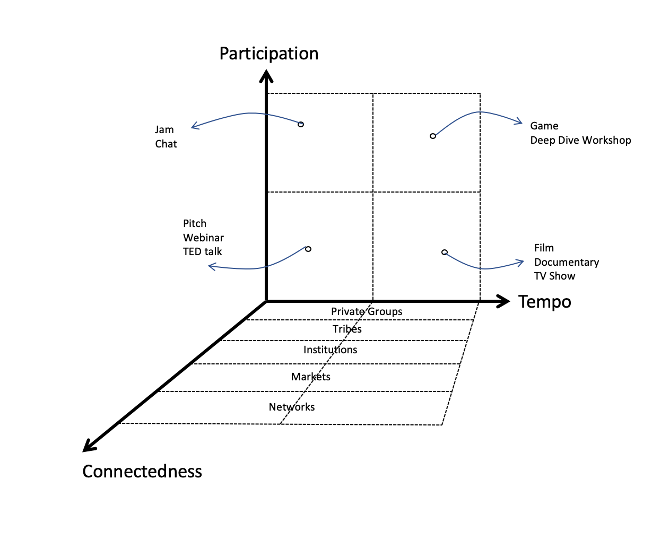
Pirate TV is a new genre that sits somewhere between a vlogcast, documentary, film, and TV show. In the events ambition cube, this sits in the lower right quadrant for a tribe-connectedness.
Current plan is to have two editions: one more business related (the Biz-Tribe Edition), and one more artistic related (the Art-Tribe Edition).
The Art-Tribe Edition launches on 1 Dec 2020, the Biz-Tribe Edition will launch on 2 Feb 2021.
As I strongly believe that magic happens at the cross-section of artists, scientists, engineers, and business people, I expect that sooner or later the two editions will start to blend.
Art-Tribe Edition is intended as a platform for artists in conversation with Petervan.
The artist-in-residence for this first episode is Frank Poncelet.

Frank Poncelet is an independent Artist/Director/Producer who graduated from “The Academy for Visual Arts” in Ghent in 2017. While he has no intention of pursuing professional animation in the future, he enjoys the process and will continue to make animations and VFX shorts. After his Graduation film “A Night On Gor”. He worked for One year on an Animation Mashup “Bug’s Club” inspired by “Hell’s Club” from Antonio Maria Da Silva AMDSFILMS. In 2017/2018). Frank Also Produced his short sci-fi film “Alpha” in 2019. Currently Frank is working on video art using Neural Style Transfer techniques and on a sequel to “Alpha”.
I hope you will enjoy this first episode. Here is the trailer:
The soundtrack of the trailer is here:
If you are an artist, and you are interested to have your work shared and discussed on this channel, please contact me privately.
Warmest,
This post is part of a series of essays bundled under “Travelling without moving”. Intro of that series can be found here.
My 2020 journey started with a Direct Message via Twitter from Mark Storm on Feb 8, 2020 a couple of weeks before the first formal lockdown in Belgium on 13 Mar 2020

Mark says “Maybe you will find this an interesting essay about Mark Rothko. Have a great Sunday, Mark”
Thanks for sharing, Mark! And yes, I found it interesting, in as much that I choose it as the start of this series 😉
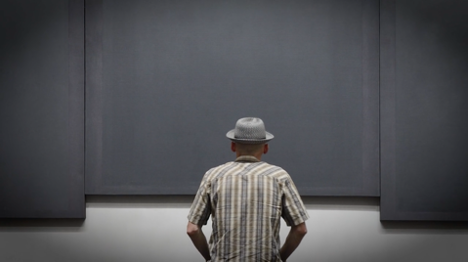
Here is the direct link (Dutch only) to the Rothko essay (PDF) by Dutch philosopher Joke J. Hermsen. The essay is about the effect of stillness on an audience in front of a Rothko painting. It is an ode to Kairos (time as experience) as opposed to Chronos (time as clock-time).

Some highlight from the essay:
Het onmenselijke geweld van de oorlog bracht hem ertoe een laatste zoektocht naar de kern van menselijkheid te ondernemen: ‘Ik wil mensen daarheen brengen waar ze hun menselijkheid weer kunnen ervaren.’ En dat kan volgens hem alleen als een kunstwerk ‘tijdloze momenten schept’, die de mens tot een nieuwe ervaring van zichzelf en vervolgens tot een nieuw inzicht over de wereld kan inspireren.
The inhumane violence of the war had induced him into a last quest for the essence of humanity: “I want to lead people to a place where they can experience their humanity again”. And he believes that is only possible when a piece of art “creates timeless moments”, inspiring men to a new experience of himself and subsequently new insights about the world.
Er bestaan geen goede schilderijen die over niets gaan
There are no good painting that are about nothing
Om ‘te kunnen worden die je bent’, dienen de oude waarheden en inzichten als het ware opgeschort te worden. Het is een ervaring die door Nietzsche ook wel extatisch wordt genoemd, omdat het letterlijk een uitstaan naar is, kortom een zich openstellen voor en zich overgeven aan het onbekende. Rothko spreekt in dit geval van ‘transcendentale ervaringen’
In order “to be able to become who you are”, old truths and insights need to be postponed. Nietzsche labelled such experiences as ecstatic – literally standing-out – opening up to and surrendering to the unknown. Rothko speaks in this case of “transcendental experiences”
Deze ‘transcendentale ervaring’ wordt door Rothko een ‘tijdloos moment’ genoemd, omdat deze niet aan de klok gebonden tijd als het ware haaks staat op of inbreekt in de as van de lineaire tijd.
This “transcendental experience” is called a “timeless moment” by Rothko, because this non-clocked time is at odds with or breaks into the axis of linear time.
De identiteit van de toeschouwer wordt voor een moment doorbroken, waardoor hij de indruk heeft niet langer tegenover het werk te staan, maar er door omringd of opgezogen te worden
The spectator’s identity is momentarily broken, giving him the impression that he is no longer facing the work, but is surrounded or absorbed by it
The essay encouraged me to go and buy Joke Hermsen’s book “Stil De Tijd – Pleidooi voor een langzame toekomst”, as far as I know only available in Dutch.

The suggested translation for the title is “Stop the clocks – Manifesto for a Slow Future”, although I feel that “plea” is probably a better translation than “manifesto”, and I would have translated “Stil De Tijd” as “Silence the clocks”. I wrote about time in the past, and in this post from May 2018, I already mentioned Joke Hermsen.
Here are some of my notes/highlights/moods from the book.
Tijd schept ruimte
Time shapes space
Verlangen te realiseren wat er nog niet is.
Desire to realise what is not
Opnieuw zien we hier hoe zowel het wachten als het openlaten van de tijd en het opschorten van betekenisgeving aan de oorsprong staan van de creativiteit en het denken.
Again, we see how waiting as well as leaving space for time and the suspension of giving meaning are at the source of creativity and thinking
Het wachten (attente) is voor Blanchot dan ook het vrijleggen van een ander soort aandacht (attention), die zich niet op het reeds bekende van de verwachting richt, maar op het onbekende, het onverwachte, het nog niet ingevulde.
The waiting (attente) is for Blanchot the release of another sort of attention (attention), not pointing towards the known knows of the expectation, but towards the unknown, the unexpected, what has not yet been filled in.
Picasso: ‘Ik zoek niet – ik vind.’ Over dat onderscheid tussen zoeken en vinden, zegt Picasso: ‘Zoeken, dat is uitgaan van het oude in een willen vinden van het reeds bekende in het nieuwe. Vinden, dat is het volledig nieuwe. Alle wegen zijn open, en wat gevonden wordt, is onbekend. Het is een waagstuk, een avontuur.’
Picasso: “I don’t search – I find”. About that difference between searching and finding, Picasso says: “Searching is starting from the past, in an effort to find the already known in the future. Finding, that’s what’s completely new. Alle options are open, and what is being found, is unknown. It is a venture, an adventure”
Belangeloze aandacht
Disinterested attention
Last highlight:
Die creativiteit wordt aangewakkerd als we ons bij tijd en wijle aan het regime van de klok kunnen onttrekken en ons durven overgeven aan ervaringen die haaks staan op het gestaag voorttikken van de wijzers. Wachten, vervelen, luieren, mijmeren, nadenken en nietsdoen, zijn vormen van ontvankelijke passiviteit waarmee men in deze rusteloze, door de economie opgedreven tijden misschien weinig applaus zal oogsten, maar die in vrijwel alle hier opgenomen essays noodzakelijk bleken voor de mens en voor de wereld om niet te verstarren en te verharden.
That creativity is encouraged when we can detach us from time to time from the regime of the clock and dare to surrender to the experiences that are orthogonal to the ongoing ticking of the moving clock-hands. Waiting, being bored, idle, musing, reflecting and doing nothing, are all forms of receptive passivity that are not really appreciated by the inflated time of the economy, but that are essential in all essays of this publication, essential for the humans and the world in order not to fossilize, become rigid, petrify and harden.
I make similar reflections during my bike tours in nature, asking myself who is the real me, what is my original rhythm, finding my own rhythm, re-finding myself.
During one of those tours, I spotted a path to my right, with no signage, leading into some small woods and boskets. A small hesitation, but in a blink, I decided to turn right, right into the unknown.
Only a couple of minutes later, I found myself in an open space, in the middle of the green, in almost complete silence, and saw this snail sunbathing under a parasol of green leave.

The silence and nature had made me soft, with indeed a disinterested attention, but active attention anyway, not passive.
After years of – at times – hectic corporate life, and after a semi-pause of about four years, I realized it was only now that I started to cool down, to wind down. It was only now that I started to enjoy that state of detachment from Chronos time, detachment from anything, actually.
It should therefore not come as a surprise that my next essay in this series will be about… pause.

It’s almost one year (!) since my previous Dec 2019 update. And what a year it was/still is! I basically stayed home for the whole period and had zero travel since Oct 2019.
I am publishing this on the day Belgium is entering its second Covid-19 lockdown. A forced pause-marathon starting on my 63th birthday on 1 Nov till at least mid-Dec 2020. But I am afraid the effort will have to run until deep into 2021 and I am preparing for it as an “interval of possibility”.
An interval of possibility is a temporal framing to see better what is and what can emerge. There is indeed still so much to read, to learn, to experiment, to play with. So many contexts to be architected. So many interesting people to (re)connect with (at least virtually). So much opportunity for spiritual, moral, and aesthetical advancement! Expect me to be quite generative in the coming weeks and months.
The Artschool Project
The Artschool academy year started again in Sep 2020, and I subscribed for a two-year curriculum labeled “specialization”.
“Professionalization” is probably a better title for what it is: a focus on getting the (art)work done, commitment, and ambition. We’ll learn to discover our own visual language starting from our personal frames and themes with the ambition to develop our own artistic maturity and identity. This is about personal reflection, self- and group-critique, evaluation, and research. About creative identity and creative disposition. And about how to create a portfolio, develop contacts with galleries, presenting your own work, setting up your own expo, etc.
From an artistic medium point of view, my main focus will remain painting on canvas, but I will keep experimenting with other (mainly digital) media.
I shared most of my recent work via my Facebook page, or on this blog under the heading “Sine Parole”. I also started selecting more straightforward subjects, such as vases, landscapes, cows, fruit, and everyday objects. In many cases the obvious and what is in front of you is interesting enough. Here is an example of some apples from our mini orchard:

The upcoming Cow project
I have something with cows (pun intended). I met many during my summer bike tours. It feels it is going to become yet another a thematic series, like the prison windows, or the birds, or the boxers.


One option is to create a cow-sign-language and typography, or maybe see how I can get them generated through in-the-cloud AI neural networks.

Exhibitions
Last year, I visited some art exhibitions, including:
There were many more, but due to Covid-19, many musea were closed or had restrictions.

My own exhibition
I ran my first solo (100% virtual) exhibition during summer. Some unexpected fans actually bought some of my works. Thank you: this is very encouraging. For those who don’t know: I also do commissioned work. If interested – in buying or commissions – please send me a private message.

Some vernissage impressions here.
Outdoors
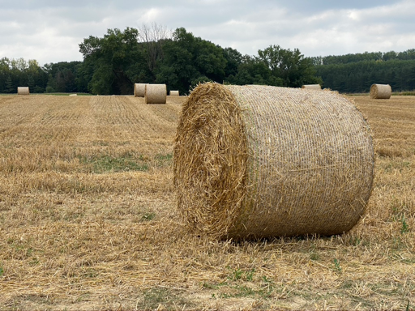
We had a great summer in Flanders. Since the start of the first lockdown on 13 March 2020 we had good to excellent weather till mid-September 2020. Plenty of opportunity for being outdoors, with the occasional bike tour or walk.
Freelance
Covid-19 is not kind to freelancers, especially if you target what some people call the “event industry”. With the exception of a small gig in 2020, I basically got no work since October 2019. Contact me in private if you’d like to hire me for “interesting” work.
BANI
Already in 2018, Jamais Cascio coined the term BANI. See my post from Aug 2019 and Jamais’ update from April 2020. As mentioned before, I am working with some partners on a virtual multimedia workshop based on this framework, with a specific focus on possible responses. We have an amazing cast on-board, and it looks that we’ll be able to make some announcements soon.
Design Unbound
I am blown away and intrigued by the insights in Design Unbound: Designing for Emergence in a White Water World. This is about having agency in a world that is constantly shifting under you. It is so refreshing after all those business-, management-, leadership-, and self-help-books. It has become a healthy addiction: I am basically reading and re-reading and deeply internalizing everything that Ann Pendleton has written in the last couple of years.
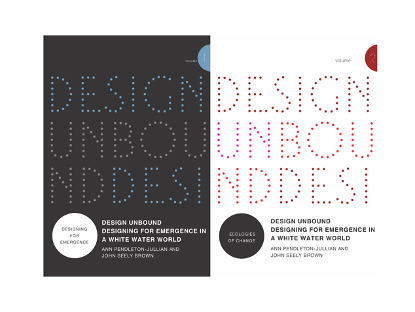
We are building a team to design and deliver a corporate curriculum on this topic. Stay tuned on the “we” and the “curriculum”.
Pirate TV
Most online events and conferences suck. I have some ideas on how to be more ambitious. See my earlier post on the ambition cube for virtual events.

I got the chance to do a commission for a client on this concept and we – the client, the team, myself – learned a lot on what works and what not.
There are now two Pirate TV channels in the pipeline: one more business focused and one more “artsy”.
New toys
For Pirate TV, I wanted to become more fluent in video and sound creation. As there was nothing else to do due to Covid-19, I followed some online courses on Ableton Live, Final Cut Pro, and Logic Pro X.
These are such rich software environments. Also, their user interfaces make me think differently: thinking in layers, connections, patterns, and harmonies.
Studio Oxygen project
An idea that has been hanging around since 2018, actually.
People are exhausted. Tired of online meetings. Tired of being locked up in their houses. Tired of all the negative news. People crave for oxygen. People crave for small safe groups where they can share, critique, ideate, play.
With a small on-line collective, we plan to come together regularly online to have slow-paced conversations on a topic/seed that I plant. The seed can be the chapter of a book, an object, a poem, a job well done, or a failing forward.
With a no-frills focus on quality content, we hope these sparks of inspiration will give you “oxygen for the mind”.
Traveling Without Moving project
This will be a series of posts documenting my mental and philosophical journey in 2020.
Some spoiler keywords: silence, pause, play, anxiety, unbound, truth, inappropriateness, genre, and yellow.
Traveling Without Moving (TMW) is also somewhat related to Studio Oxygen and Pirate TV
Books
Check out my GoodReads: https://www.goodreads.com/user/show/3085594-peter-auwera
Some highlights:
Also don’t forget Robert Poynton’s “Do Pause”. Together with Josie Gibson we made 8 podcast episodes, one for each chapter in this book. The last episode is here.
Petervan Rides
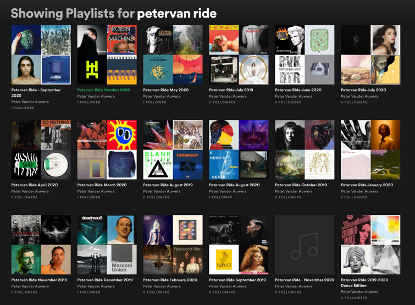
Since July 2019, I publish every month a Spotify List with new releases combined with some oldies from the 60ies, 70ies, and beyond. Search for “Petervan Ride” and select “playlists”. Subjective selection of course, as driven only by my personal taste (or lack thereof).
So, what’s next?
I will officially retire from corporate life as from 1 Dec 2020. Not that I plan to stay idle, on the contrary. Within limits, I will stay available for interesting freelance work – I call it “paid play” – and plan to stay very focused on my artwork.
The plan for the coming months is to work/play on (random order):
So, that’s it for this edition. If there is something worth reporting, next update is for Apr 2021.
#STAYSAFE
#STAYCONNECTED
Warmest,


As promised, here is the TimeCapsule video for the virtual opening vernissage of my first solo exhibition.
Subtitles are available in NL/UK
With contributions by my cousin Joost Vander Auwera (Senior Curator – Royal Museums of Fine Art of Belgium, Brussels), Chris Vanbeveren (my Art Painting coach – Academy for Visual Arts, Ghent, Belgium), Frank Poncelet (synthesizer soundscape, co-student Digital Visual Arts, Ghent, Belgium), and John Oliver from Interior Truth. With lots of gratitude.
Background music credits: by Meydän – Tracks: Pure Water, Under Water, Please Wake Up https://freemusicarchive.org/music/Me…
All other artwork, video, soundscape, poems, video editing by Petervan. Produced with standard tools like iMovie and YouTube Studio.
I am inviting video artists to do something more interesting with the raw material of this TimeCapsule. Contact me privately if interested.
Joost and Chris were so kind to write and record introductory words for the opening keynotes. Below some extracts and links to the full versions. The TimeCapsule video includes slightly edited versions of the full versions in NL/UK.

“Petervan has a special sensitivity in his art for the image that captures. And he knows how to maintain this in a multitude of styles and media. This is evident from this solo exhibition. He greatly appreciates what his teachers teach him and that decorates him.”
“He constantly experiments, but his images keep capturing attention, in a wide variety of form languages”

“Peter likes to work with different materials and techniques and since a few months he also expresses himself with digital imaging. In that context, we can definitely speak of “mixed media”. There are even initiatives and ideas to give this a three-dimensional character. We can only encourage it. In his exhibition we see that diversity. There are “grid structures”, paintings with collage-like aspects, idiosyncratic representations of man, interiors, models like I already mentioned, geometric and organic.”
“I think we can safely say that Peter is a thinker in images.”
And Frank Poncelet – in his daily life Operations Architect at the Xplore Group, but here as co-student of the Digital Visual Arts Media Lab of the Academy in Ghent – made a soundscape for the TimeCapsule with his synthesizers. Check out his YouTube Channel Frame Per Second Animation). I selected his video “Pellicule”. I am sure the Corporate Rebels out there will find inspiration in this compilation.
Also included in this TimeCapsule is a recording made by John Oliver from Interior Truth: what he does is interesting – silent witnessing videos of artists. Check him out.

Short version here, and the long version here
My testimonial about this experience:
The silence witnessing approach is refreshing. John creates a virtual space for permission. Permission to be silent, to open-up, to reflect, to adjust, to pause, to dream, and to imagine. He skilfully listens and watches in silence, trying to discern the different stories interwoven in the recording, picking one, and editing it in a high-quality video testimony that respects the integrity of the moment.
Personally, I chose to share stories that were informed from recent reflections, rather than stepping over the lines of my own vulnerability. I know it, and I have no regrets of not exposing my worst shadows to a broader audience. I think it is good for any artist/creative to have a witnessing moment like this, to discover and articulate better what is driving the artistic process. Bravo!
The showroom of the exhibition is open until 31 August 2020. You can get in via this link.
I got some very encouraging feedback after the launch on 1 July 2020, for which I am very grateful. So, more artwork is coming. I just subscribed for another two years at the Academy for Visual Arts in Ghent: a series of 2 specialization years on painting with the aim to professionalise my practice. And cherry on the cake, two artworks already sold: “Blue Boat” and “Five Guys on the Beach”. Feels like the start of a new career.
Enjoy!
Petervan, in de wereld Peter Vander Auwera, heeft na een rijke en gevarieerde carrière in de bedrijfswereld zijn blikveld omgegooid na de openbaring van intense schoonheid in een tentoonstelling van Dries Van Noten, één van de sterktehouders van de Belgische modescène.
Ik ben zijn neef, zelfs met ouders die broers en zusters van elkaar waren, dus van het pure DNA uit bekeken en als kunsthistoricus van beroep, zou ik mij bij uitstek in de artistieke wereld van mijn neef moeten kunnen verplaatsen en mijn best moeten doen om toch objectief te blijven.
Laat ik vooreerst stellen dat ik het moedig vind om het prestige en de renumeratie van het bedrijfsleven definitief de rug toe te keren. En ook wel de rat-race kan ik vermoeden, als ik luister naar Peter’s nieuwe ideale dag in zijn video “Interior Truth”. Wel vaker heb ik (oud-) collega’s ontmoet die na studies die uitzicht boden op een zeker bestaan en het helpen instaan voor een gezin, op latere leeftijd de spijt voelden om niet hun artistieke passie te hebben gevolgd. Maar bij Peter is die wending anders en radicaler, hoewel de artistieke gevoeligheid al bleek bij zijn aanvankelijke keuze voor architectuurstudies.
Peter(van) heeft een bijzondere gevoeligheid in zijn kunst voor het beeld dat pakt. En dat weet hij vol te houden in een veelheid van stijlen en media. Dat blijkt duidelijk uit deze solo-tentoonstelling. Hij heeft veel waardering voor wat zijn leraars hem bijbrengen en dat siert hem. Hij experimenteert voortdurend, maar zijn beelden slagen er telkens in weer de aandacht vast te houden, in een grote verscheidenheid van vormentaal
Terecht benadrukt hij het belang van schoonheid in ons aardse bestaan, van de kunst als vrijhaven in het leven en van ongebondenheid als leidraad van een betekenisrijke innerlijke beleving. Het is Ernst Gombrich die in 1960 in zijn “Art and Illusion. A Study in the Psychology of Pictorial Representation”, de ogen opende voor het fundamentele inzicht dat de kunst niet de realiteit weergeeft als door een venster, maar dat wij omgekeerd de realiteit zien doorheen wat wij als kunst in ons beeldgeheugen hebben opgeslagen. Het essentiële belang van schoonheid als zodanig voor een betekenisvol leven, is al eerder voor het eerst magistraal verwoord in de filosofie van de 18de eeuw en de verlichting, met Immanuel Kant als lichtend voorbeeld, omdat bij hem de esthetische faculteit bij de mens het sluitstuk werd van zijn filosofie – dus van het zoeken naar betekenis – na zijn analyse van het juiste weten en het juiste handelen. Sindsdien is het begrip schoonheid in de kunst wel wat ondergesneeuwd en in de hedendaagse kunst kreeg ook expressieve lelijkheid haar adelbrieven.
De kunst als vrijhaven voor de kunstenaar en haar publiek blijft een kostbaar goed en dient helaas continu verdedigd, zowel in communistisch-marxistisch als kapitalistisch gefundeerde maatschappijen, dus ook na de vruchteloze afkondiging van het einde van de ideologieën en zelfs van de geschiedenis.
Dat management-theorieën op probleemoplossingen mikken en kunst puur creatief is, daar heb vanuit mijn achtergrond als kunsthistoricus wel kritische bedenkingen bij: kunstenaars hebben in de kunstgeschiedenis wel degelijk vele opeenvolgende artistieke problemen aangepakt, van de beheersing van de perspectief tot de vraag van Adorno of poëzie nog wel mogelijk is na de nazi-uitroeiïngskampen? Maar het oplossingen zoeken gebeurt in de kunst wel op een specifiek wijze: door het continu reageren tijdens het evoluerende creatieproces zelf en niet vanuit een vooraf geformuleerde probleemstelling. Picasso formuleerde het zo: “Chercher ne signifie rien en peinture. Ce qui compte, c’est trouver.” En ook nog:”Tout ce qui peut être imaginé est réel.”.
Om met een zeer toepasselijk inzicht van Einstein te besluiten : “Imagination is more important than knowledge. For knowledge is limited, whereas imagination embraces the entire world, stimulating progress, giving birth to evolution.”
Joost Vander Auwera
Brussel, 28 Juni 2020
English translation by Google:
Petervan, in the world Peter Vander Auwera, after a rich and varied career in the business world, has changed his vision after the revelation of intense beauty in an exhibition of Dries Van Noten, one of the strength holders of the Belgian fashion scene.
I am his cousin, even with parents who were siblings, so from the pure DNA and as an art historian by profession, I should be able to put myself in my cousin’s artistic world and try my best to nevertheless remain objective.
First of all, let me say that I find it courageous to definitively abandon the prestige and the remuneration of business. I can also suspect the rat race when I listen to Peter’s new ideal day in his video “Interior Truth”. I have often met (former) colleagues who, after studies that offered prospects of a certain existence and helping to provide for a family, felt the regret at a later age for not having followed their artistic passion. But with Peter, this turn is different and more radical, although the artistic sensitivity was already evident in his initial choice for architectural studies.
Petervan has a special sensitivity in his art for the image that captures. And he knows how to maintain this in a multitude of styles and media. This is evident from this solo exhibition. He greatly appreciates what his teachers teach him and that decorates him. He constantly experiments, but his images keep capturing attention, in a wide variety of formal language
He rightly emphasizes the importance of beauty in our earthly existence, of art as a free haven in life and of unboundedness as a guideline for a meaningful inner experience. It is Ernst Gombrich who, in 1960, in his “Art and Illusion. A Study in the Psychology of Pictorial Representation ”, opened our eyes to the fundamental insight that art does not represent reality as through a window, but conversely, we see reality through what we have stored in our image memory as art. The essential importance of beauty as such for a meaningful life has already been articulated for the first time in the philosophy of the 18th century and enlightenment, with Immanuel Kant as a shining example, because in him the aesthetic faculty in man became the final piece of his philosophy – thus of the search for meaning – after his analysis of the right knowing and the right action. Since then, the term beauty has been neglected in art, and expressive ugliness has also received its nobility in contemporary art.
Art as a free haven for the artist and its public remains a precious commodity and unfortunately has to be constantly defended, both in communist-Marxist and capitalist-based societies, including after the fruitless proclamation of the end of ideologies and even of history.
The fact that management theories aim at problem-solving and art is purely creative, has critical reservations from my background as an art historian: artists have tackled many successive artistic problems in art history, from controlling perspective to Adorno’s question if poetry is still possible after the Nazi extermination camps? But the search for solutions happens in art in a specific way: by continuously responding during the evolving creation process itself and not from a pre-formulated problem statement. Picasso put it this way: “Chercher ne signifie rien en peinture. Ce qui compte, c’est trouver. ” And also: “Tout ce qui peut être imaginé est réel.”.
To conclude with a very appropriate insight from Einstein: “Imagination is more important than knowledge. For knowledge is limited, whereas imagination embraces the entire world, stimulating progress, giving birth to evolution. ”
Joost Vander Auwera
Brussels, June 28, 2020
Peter Vanderauwera is één van die uitzonderlijke studenten schilderkunst aan de Academie voor Beeldende Kunst Gent, die professionele bezigheden en artistieke activiteiten, combineert met elkaar.
Werkzaam in de internationale ‘event’ sector duiken installatoire elementen op op de podia waar hij neerstrijkt en waarvan we de grondslag dikwijls kunnen terugvinden in zijn schilderijen. Het dankbare daaraan vind ik dat Peter de functionaliteit van zijn creaties kent en gebruikt.
Bij Peter is er geen strikte scheiding tussen toegepaste kunsten en vrije kunsten. Gelukkig maar. Ze staan in een even waardigheid naast elkaar. Peter is er zich erg van bewust dat de uiterlijke aspecten waarin een lezing gehouden wordt bepalend is voor de manier waarop de toehoorders de inhoud zullen ontvangen. Een lezing met zijn spreker wordt onderdeel van een beeldende installatie.
Peter is begeesterd. Dat blijkt des te meer wanneer je een gesprek aangaat met hem en je hem de tijd geeft om uit te weiden over online lezingen. Ik, als zijn leraar schilderkunst, heb dan ook nog eens het voorrecht om zulke gesprekken met Peter te kunnen voeren ten midden van zijn beeldend werk. Het universum van Peter openbaart zich op die manier.
Zijn productie is omvangrijk en divers. Het gaat van modeltekenen over figuratie tot minimalistisch abstract. Een hele gevarieerde waaier die vertelt over de zoektocht waarin Peter momenteel verkeert. Waarbij wij als begeleiders dan meteen in de verleiding komen voor een dikwijls geformuleerde stelling: het zoeken, het proces is belangrijker dan het doel, het product.
Peter werkt graag met verschillende materialen en technieken en sinds enkele maanden drukt hij zich ook uit met digitale beeldvorming. In die context kunnen we zonder meer spreken van ‘mixed media’. Er zijn zelfs aanzetten en ideeën om dit ook een drie dimensionaal karakter te geven. We kunnen het alleen maar aanmoedigen. In zijn tentoonstelling zien we die diversiteit. Er zijn ‘grid structures’, schilderijen met collageachtige aspecten, eigenzinnige weergaven van de mens, interieurs, modellen zoals ik al vernoemde, geometrisch en organisch.
Ik denk dat we rustig kunnen stellen dat Peter een denker in beelden is.
Chris Vanbeveren.
Gent, 27 Juni 2020
English translation by Google:
Peter Vanderauwera is one of those exceptional painting students at the Academy of Fine Art Ghent, who combines professional activities and artistic activities. Working in the international ‘event’ sector, installation elements emerge on the stages where he lands and of which we often find the basis in his paintings. I am grateful that Peter knows and uses the functionality of his creations. With Peter, there is no strict distinction between applied arts and liberal arts. Fortunately. They stand side by side in equal dignity. Peter is very aware that the external aspects in which a lecture is given determine the way in which the audience will receive the content. A lecture with his speaker becomes part of a visual installation.
Peter is passionate. This is all the more evident when you enter into a conversation with him and give him time to elaborate on online lectures. I, as his painting teacher, have the privilege of having such conversations with Peter in the midst of his visual work. The universe of Peter thus reveals itself.
His production is extensive and diverse. It ranges from model drawing to figuration to minimalist abstract. A very varied range that tells about the quest that Peter is currently in. In which we, as supervisors, are immediately tempted by an often formulated statement: the search, the process is more important than the goal, the product.
Peter likes to work with different materials and techniques and since a few months he also expresses himself with digital imaging. In that context, we can definitely speak of “mixed media”. There are even initiatives and ideas to give this a three-dimensional character. We can only encourage it. In his exhibition we see that diversity. There are “grid structures”, paintings with collage-like aspects, idiosyncratic representations of man, interiors, models like I already mentioned, geometric and organic.
I think we can safely say that Peter is a thinker in images.
Chris Vanbeveren.
Gent, 27 June 2020
 Petervan Studios