
Sine Parole – 14 Oct 2020
Reply


As promised, here is the TimeCapsule video for the virtual opening vernissage of my first solo exhibition.
Subtitles are available in NL/UK
With contributions by my cousin Joost Vander Auwera (Senior Curator – Royal Museums of Fine Art of Belgium, Brussels), Chris Vanbeveren (my Art Painting coach – Academy for Visual Arts, Ghent, Belgium), Frank Poncelet (synthesizer soundscape, co-student Digital Visual Arts, Ghent, Belgium), and John Oliver from Interior Truth. With lots of gratitude.
Background music credits: by Meydän – Tracks: Pure Water, Under Water, Please Wake Up https://freemusicarchive.org/music/Me…
All other artwork, video, soundscape, poems, video editing by Petervan. Produced with standard tools like iMovie and YouTube Studio.
I am inviting video artists to do something more interesting with the raw material of this TimeCapsule. Contact me privately if interested.
Joost and Chris were so kind to write and record introductory words for the opening keynotes. Below some extracts and links to the full versions. The TimeCapsule video includes slightly edited versions of the full versions in NL/UK.

“Petervan has a special sensitivity in his art for the image that captures. And he knows how to maintain this in a multitude of styles and media. This is evident from this solo exhibition. He greatly appreciates what his teachers teach him and that decorates him.”
“He constantly experiments, but his images keep capturing attention, in a wide variety of form languages”

“Peter likes to work with different materials and techniques and since a few months he also expresses himself with digital imaging. In that context, we can definitely speak of “mixed media”. There are even initiatives and ideas to give this a three-dimensional character. We can only encourage it. In his exhibition we see that diversity. There are “grid structures”, paintings with collage-like aspects, idiosyncratic representations of man, interiors, models like I already mentioned, geometric and organic.”
“I think we can safely say that Peter is a thinker in images.”
And Frank Poncelet – in his daily life Operations Architect at the Xplore Group, but here as co-student of the Digital Visual Arts Media Lab of the Academy in Ghent – made a soundscape for the TimeCapsule with his synthesizers. Check out his YouTube Channel Frame Per Second Animation). I selected his video “Pellicule”. I am sure the Corporate Rebels out there will find inspiration in this compilation.
Also included in this TimeCapsule is a recording made by John Oliver from Interior Truth: what he does is interesting – silent witnessing videos of artists. Check him out.

Short version here, and the long version here
My testimonial about this experience:
The silence witnessing approach is refreshing. John creates a virtual space for permission. Permission to be silent, to open-up, to reflect, to adjust, to pause, to dream, and to imagine. He skilfully listens and watches in silence, trying to discern the different stories interwoven in the recording, picking one, and editing it in a high-quality video testimony that respects the integrity of the moment.
Personally, I chose to share stories that were informed from recent reflections, rather than stepping over the lines of my own vulnerability. I know it, and I have no regrets of not exposing my worst shadows to a broader audience. I think it is good for any artist/creative to have a witnessing moment like this, to discover and articulate better what is driving the artistic process. Bravo!
The showroom of the exhibition is open until 31 August 2020. You can get in via this link.
I got some very encouraging feedback after the launch on 1 July 2020, for which I am very grateful. So, more artwork is coming. I just subscribed for another two years at the Academy for Visual Arts in Ghent: a series of 2 specialization years on painting with the aim to professionalise my practice. And cherry on the cake, two artworks already sold: “Blue Boat” and “Five Guys on the Beach”. Feels like the start of a new career.

Enjoy!
Petervan, in de wereld Peter Vander Auwera, heeft na een rijke en gevarieerde carrière in de bedrijfswereld zijn blikveld omgegooid na de openbaring van intense schoonheid in een tentoonstelling van Dries Van Noten, één van de sterktehouders van de Belgische modescène.
Ik ben zijn neef, zelfs met ouders die broers en zusters van elkaar waren, dus van het pure DNA uit bekeken en als kunsthistoricus van beroep, zou ik mij bij uitstek in de artistieke wereld van mijn neef moeten kunnen verplaatsen en mijn best moeten doen om toch objectief te blijven.
Laat ik vooreerst stellen dat ik het moedig vind om het prestige en de renumeratie van het bedrijfsleven definitief de rug toe te keren. En ook wel de rat-race kan ik vermoeden, als ik luister naar Peter’s nieuwe ideale dag in zijn video “Interior Truth”. Wel vaker heb ik (oud-) collega’s ontmoet die na studies die uitzicht boden op een zeker bestaan en het helpen instaan voor een gezin, op latere leeftijd de spijt voelden om niet hun artistieke passie te hebben gevolgd. Maar bij Peter is die wending anders en radicaler, hoewel de artistieke gevoeligheid al bleek bij zijn aanvankelijke keuze voor architectuurstudies.
Peter(van) heeft een bijzondere gevoeligheid in zijn kunst voor het beeld dat pakt. En dat weet hij vol te houden in een veelheid van stijlen en media. Dat blijkt duidelijk uit deze solo-tentoonstelling. Hij heeft veel waardering voor wat zijn leraars hem bijbrengen en dat siert hem. Hij experimenteert voortdurend, maar zijn beelden slagen er telkens in weer de aandacht vast te houden, in een grote verscheidenheid van vormentaal
Terecht benadrukt hij het belang van schoonheid in ons aardse bestaan, van de kunst als vrijhaven in het leven en van ongebondenheid als leidraad van een betekenisrijke innerlijke beleving. Het is Ernst Gombrich die in 1960 in zijn “Art and Illusion. A Study in the Psychology of Pictorial Representation”, de ogen opende voor het fundamentele inzicht dat de kunst niet de realiteit weergeeft als door een venster, maar dat wij omgekeerd de realiteit zien doorheen wat wij als kunst in ons beeldgeheugen hebben opgeslagen. Het essentiële belang van schoonheid als zodanig voor een betekenisvol leven, is al eerder voor het eerst magistraal verwoord in de filosofie van de 18de eeuw en de verlichting, met Immanuel Kant als lichtend voorbeeld, omdat bij hem de esthetische faculteit bij de mens het sluitstuk werd van zijn filosofie – dus van het zoeken naar betekenis – na zijn analyse van het juiste weten en het juiste handelen. Sindsdien is het begrip schoonheid in de kunst wel wat ondergesneeuwd en in de hedendaagse kunst kreeg ook expressieve lelijkheid haar adelbrieven.
De kunst als vrijhaven voor de kunstenaar en haar publiek blijft een kostbaar goed en dient helaas continu verdedigd, zowel in communistisch-marxistisch als kapitalistisch gefundeerde maatschappijen, dus ook na de vruchteloze afkondiging van het einde van de ideologieën en zelfs van de geschiedenis.
Dat management-theorieën op probleemoplossingen mikken en kunst puur creatief is, daar heb vanuit mijn achtergrond als kunsthistoricus wel kritische bedenkingen bij: kunstenaars hebben in de kunstgeschiedenis wel degelijk vele opeenvolgende artistieke problemen aangepakt, van de beheersing van de perspectief tot de vraag van Adorno of poëzie nog wel mogelijk is na de nazi-uitroeiïngskampen? Maar het oplossingen zoeken gebeurt in de kunst wel op een specifiek wijze: door het continu reageren tijdens het evoluerende creatieproces zelf en niet vanuit een vooraf geformuleerde probleemstelling. Picasso formuleerde het zo: “Chercher ne signifie rien en peinture. Ce qui compte, c’est trouver.” En ook nog:”Tout ce qui peut être imaginé est réel.”.
Om met een zeer toepasselijk inzicht van Einstein te besluiten : “Imagination is more important than knowledge. For knowledge is limited, whereas imagination embraces the entire world, stimulating progress, giving birth to evolution.”
Joost Vander Auwera
Brussel, 28 Juni 2020
English translation by Google:
Petervan, in the world Peter Vander Auwera, after a rich and varied career in the business world, has changed his vision after the revelation of intense beauty in an exhibition of Dries Van Noten, one of the strength holders of the Belgian fashion scene.
I am his cousin, even with parents who were siblings, so from the pure DNA and as an art historian by profession, I should be able to put myself in my cousin’s artistic world and try my best to nevertheless remain objective.
First of all, let me say that I find it courageous to definitively abandon the prestige and the remuneration of business. I can also suspect the rat race when I listen to Peter’s new ideal day in his video “Interior Truth”. I have often met (former) colleagues who, after studies that offered prospects of a certain existence and helping to provide for a family, felt the regret at a later age for not having followed their artistic passion. But with Peter, this turn is different and more radical, although the artistic sensitivity was already evident in his initial choice for architectural studies.
Petervan has a special sensitivity in his art for the image that captures. And he knows how to maintain this in a multitude of styles and media. This is evident from this solo exhibition. He greatly appreciates what his teachers teach him and that decorates him. He constantly experiments, but his images keep capturing attention, in a wide variety of formal language
He rightly emphasizes the importance of beauty in our earthly existence, of art as a free haven in life and of unboundedness as a guideline for a meaningful inner experience. It is Ernst Gombrich who, in 1960, in his “Art and Illusion. A Study in the Psychology of Pictorial Representation ”, opened our eyes to the fundamental insight that art does not represent reality as through a window, but conversely, we see reality through what we have stored in our image memory as art. The essential importance of beauty as such for a meaningful life has already been articulated for the first time in the philosophy of the 18th century and enlightenment, with Immanuel Kant as a shining example, because in him the aesthetic faculty in man became the final piece of his philosophy – thus of the search for meaning – after his analysis of the right knowing and the right action. Since then, the term beauty has been neglected in art, and expressive ugliness has also received its nobility in contemporary art.
Art as a free haven for the artist and its public remains a precious commodity and unfortunately has to be constantly defended, both in communist-Marxist and capitalist-based societies, including after the fruitless proclamation of the end of ideologies and even of history.
The fact that management theories aim at problem-solving and art is purely creative, has critical reservations from my background as an art historian: artists have tackled many successive artistic problems in art history, from controlling perspective to Adorno’s question if poetry is still possible after the Nazi extermination camps? But the search for solutions happens in art in a specific way: by continuously responding during the evolving creation process itself and not from a pre-formulated problem statement. Picasso put it this way: “Chercher ne signifie rien en peinture. Ce qui compte, c’est trouver. ” And also: “Tout ce qui peut être imaginé est réel.”.
To conclude with a very appropriate insight from Einstein: “Imagination is more important than knowledge. For knowledge is limited, whereas imagination embraces the entire world, stimulating progress, giving birth to evolution. ”
Joost Vander Auwera
Brussels, June 28, 2020
Peter Vanderauwera is één van die uitzonderlijke studenten schilderkunst aan de Academie voor Beeldende Kunst Gent, die professionele bezigheden en artistieke activiteiten, combineert met elkaar.
Werkzaam in de internationale ‘event’ sector duiken installatoire elementen op op de podia waar hij neerstrijkt en waarvan we de grondslag dikwijls kunnen terugvinden in zijn schilderijen. Het dankbare daaraan vind ik dat Peter de functionaliteit van zijn creaties kent en gebruikt.
Bij Peter is er geen strikte scheiding tussen toegepaste kunsten en vrije kunsten. Gelukkig maar. Ze staan in een even waardigheid naast elkaar. Peter is er zich erg van bewust dat de uiterlijke aspecten waarin een lezing gehouden wordt bepalend is voor de manier waarop de toehoorders de inhoud zullen ontvangen. Een lezing met zijn spreker wordt onderdeel van een beeldende installatie.
Peter is begeesterd. Dat blijkt des te meer wanneer je een gesprek aangaat met hem en je hem de tijd geeft om uit te weiden over online lezingen. Ik, als zijn leraar schilderkunst, heb dan ook nog eens het voorrecht om zulke gesprekken met Peter te kunnen voeren ten midden van zijn beeldend werk. Het universum van Peter openbaart zich op die manier.
Zijn productie is omvangrijk en divers. Het gaat van modeltekenen over figuratie tot minimalistisch abstract. Een hele gevarieerde waaier die vertelt over de zoektocht waarin Peter momenteel verkeert. Waarbij wij als begeleiders dan meteen in de verleiding komen voor een dikwijls geformuleerde stelling: het zoeken, het proces is belangrijker dan het doel, het product.
Peter werkt graag met verschillende materialen en technieken en sinds enkele maanden drukt hij zich ook uit met digitale beeldvorming. In die context kunnen we zonder meer spreken van ‘mixed media’. Er zijn zelfs aanzetten en ideeën om dit ook een drie dimensionaal karakter te geven. We kunnen het alleen maar aanmoedigen. In zijn tentoonstelling zien we die diversiteit. Er zijn ‘grid structures’, schilderijen met collageachtige aspecten, eigenzinnige weergaven van de mens, interieurs, modellen zoals ik al vernoemde, geometrisch en organisch.
Ik denk dat we rustig kunnen stellen dat Peter een denker in beelden is.
Chris Vanbeveren.
Gent, 27 Juni 2020
English translation by Google:
Peter Vanderauwera is one of those exceptional painting students at the Academy of Fine Art Ghent, who combines professional activities and artistic activities. Working in the international ‘event’ sector, installation elements emerge on the stages where he lands and of which we often find the basis in his paintings. I am grateful that Peter knows and uses the functionality of his creations. With Peter, there is no strict distinction between applied arts and liberal arts. Fortunately. They stand side by side in equal dignity. Peter is very aware that the external aspects in which a lecture is given determine the way in which the audience will receive the content. A lecture with his speaker becomes part of a visual installation.
Peter is passionate. This is all the more evident when you enter into a conversation with him and give him time to elaborate on online lectures. I, as his painting teacher, have the privilege of having such conversations with Peter in the midst of his visual work. The universe of Peter thus reveals itself.
His production is extensive and diverse. It ranges from model drawing to figuration to minimalist abstract. A very varied range that tells about the quest that Peter is currently in. In which we, as supervisors, are immediately tempted by an often formulated statement: the search, the process is more important than the goal, the product.
Peter likes to work with different materials and techniques and since a few months he also expresses himself with digital imaging. In that context, we can definitely speak of “mixed media”. There are even initiatives and ideas to give this a three-dimensional character. We can only encourage it. In his exhibition we see that diversity. There are “grid structures”, paintings with collage-like aspects, idiosyncratic representations of man, interiors, models like I already mentioned, geometric and organic.
I think we can safely say that Peter is a thinker in images.
Chris Vanbeveren.
Gent, 27 June 2020
I am excited to announce and invite you to Petervan Virtual Solo, my first solo exhibition of some recent artwork.
A collection of sketches – paintings – soundscapes – videos – 3D sculptures – digital sketches – AI warpings – poems – fairy tales – timecapsules
To visit Petervan Virtual Solo, go to https://artspaces.kunstmatrix.com/en/exhibition/1553528/petervan-virtual-solo

The exhibition runs from 1 July 2020 till 31 August 2020 and is open 24/7
Here is a link to the online catalog; you can select specific works, and – if interested – click the “Send Request” button. PDF of the catalog available upon request.
You can also experience these and other artworks in Augmented Reality to get a feel on how these works would fit in your living room: https://augmented.kunstmatrix.com/en/node/1489. You first have to download the KUOI App on your smartphone/tablet, download the barcode, and use ID code 1489

The Opening Vernissage will also be virtual: the format chosen is a video “TimeCapsule” with introductory words by my cousin Joost Vander Auwera (Senior Curator Royal Museums of Fine Arts of Belgium https://en.wikipedia.org/wiki/Joost_Vander_Auwera) and Chris Vanbeveren (Peter’s art coach at the Academy of Visual Arts in Ghent). The TimeCapsule will be released on 15 July 2020 and you will find it for viewing and download on my webpage https://petervan.wordpress.com/
That is also where you can stay informed. Please subscribe to my website and you’ll get an email notification when there is news.

With gratitude:
To my family, my mentors, and coaches of the art academies of Overijse and Ghent; Joost, Chris, and Frank for the help with the TimeCapsule; my supporters, and everybody who kept/keeps encouraging me to follow my artistic instincts. Special thanks to Peter Hinssen and Cathy Boesmans: our initial plan was to have a real live exhibition in the AppleChapple in Mater, Oudenaarde, Belgium. We were all set to go, but we had to change our plans due to Covid-19. We will be back with some art-videos running in the vintage Mackintoshes.

That’s it! Enjoy the exhibition! I am looking forward to our next encounter, virtually or in real life.
With warm artistic regards,
Ik wil je graag uitnodigen op Petervan Virtual Solo, mijn eerste solo tentoonstelling van recente kunstwerken.
Een collectie schetsen – schilderijen – klankborden – videos – 3D sculpturen – Digitale schetsen – AI verbuigingen – gedichten – sprookjes – tijdscapsules
Je kan Peter’s virtuele tentoonstelling hier bezoeken: https://artspaces.kunstmatrix.com/en/exhibition/1553528/petervan-virtual-solo
De tentoonstelling loopt van 1 Juli 2020 tot 31 Augustus 2020, en is open 24/7.
Hier is een link naar de on-line catalogus van deze tentoonstelling; je kan werken aanklikken en indien interesse is er een “Send Request” knop om mij te contacteren. De PDF van de catalogus is beschikbaar op eenvoudig verzoek.
Deze en andere werken kan je ook als Augmented Reality ervaren en testen hoe een bepaald werk past in jouw ruimte. Ga near https://augmented.kunstmatrix.com/en/node/1489 en download eerst de KUOI App op je smartphone/tablet, download de barcode, en gebruik ID code 1489
Ook de Opening Vernissage zal virtueel zijn: een video TijdsCapsule met inleiding door mijn neef Joost Vander Auwera (Senior Curator Koninklijk Musea van Schone Kunsten van België https://en.wikipedia.org/wiki/Joost_Vander_Auwera) en Chris Vanbeveren (Peter’s kunst coach schilderen aan de Academie voor Beeldende Kunsten in Gent). De TijdsCapsule zal gelanceerd worden op 15 Juli 2020 en je zal deze kunnen bekijken en downloaden via mijn website https://petervan.wordpress.com/. Je kan je daar ook inschrijven: je krijgt dan automatisch een email als er nieuws is.
Met dank aan:
Mijn familie, mijn mentoren en coaches van the kunstacademies van Overijse en Gent; Joost, Chris, Frank voor de TijdsCapsule, mijn fans, en iedereen die mij bleef en blijft aanmoedigen om mijn artistieke instincten te volgen. Extra dankwoord voor Peter Hinssen en Cathy Boesmans: ons initieel plan was om de tentoonstelling te laten doorgaan in de AppleChapple in Mater, Oudenaarde, Belgium. Alles stond in de startblokken, maar Covid-19 heeft daar anders over beslist. Uitstel is geen afstel: we komen terug met een aantal art-videos op de vintage Mackintoshes.
Dat is het zowat. Geniet van de tentoonstelling. Ik kijk uit naar onze volgende ontmoeting of gesprek, virtueel of in levenden lijve.
Met warme artistieke groet,
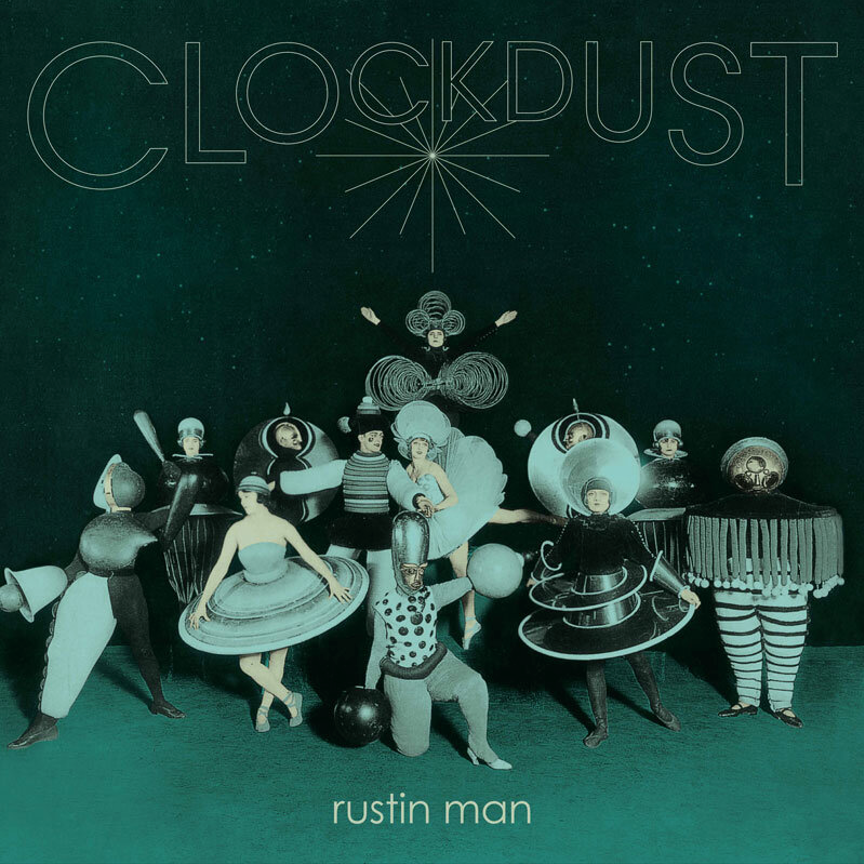
Cover of Rustin Man's "Clockdust" Album
Let’s try something new here: a “mood-scape”, documenting a personal mood/world using words, visuals, and sound. And inviting you to build new worlds by participating on a 1-1 basis. Although “new” is relative: the term moodscape was initially coined in the seventies, and mixing media can hardly be labeled new or novel. But having a “calm” conversation may sound like an anachronism in these times where time itself is collapsing, where time itself has become exponential.
It started with discovering Rustin Man’s new album “Clockdust”. Rustin Man was in a previous life better known as Paul Webb, the bass player of the band Talk Talk. Check out his about page.
Listen to Night In Evening City
I immediately fell in love with the melancholic, nostalgic, slow pace sound of the album, in my opinion, a perfect soundscape for the disorienting times we live in. There is some sort of homesickness here, knowing deep inside that we have already said goodbye to a golden era, and era that I sometimes refer to as the Bowie-Era.
I added a couple of Clockdust songs to my Spotify March 2020 Ride playlist, and one of the songs happened to sit next to David Bowie’s Lazarus song from his Blackstar album. To make a long story short, I created a sub-set of the playlist, containing the songs that I felt best reflected my March 2020 “Mood”. There is one coming for April as well 😉
I suggest you let it play in the background in shuffle-mode whilst reading this blog post, as I believe it may augment what I am trying to share.
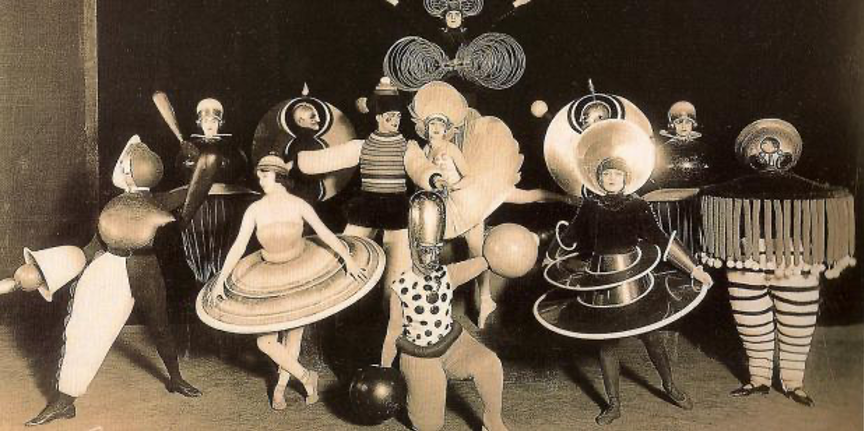
The cover is a picture from Oskar Schlemmer’s Triadisches Ballett (Triadic Ballet), a choreography with costumed actors transformed into geometrical representations of the human body.
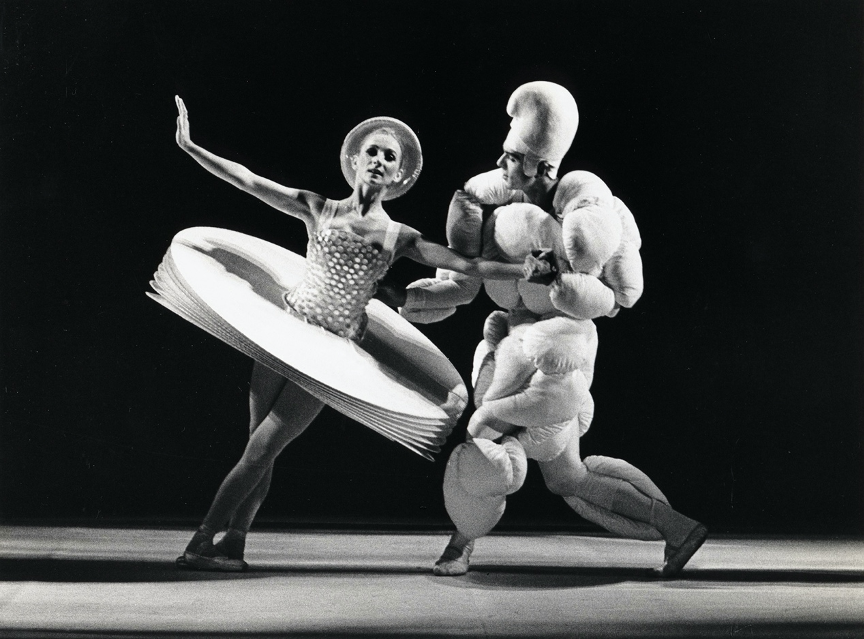
There is also this wonderful video testimony of one of the early performances of that choreography
The video sent me back in time – clockdust time – when I was a 6-year old schoolboy. For the very first time in my life, I stood – proudly – in front of a huge whiteboard in the classroom – it was a blackboard with white chalk – and we were invited by the teacher to properly write the letters of the alphabet with white chalk on this blackboard.
It must have been my early creative juices, but I could not withhold myself drawing big white spirals instead of well-formed a’s and b’s, etc. on that black-black blackboard. Result: punishment and the lesson learned that a classroom is not a place for creativity and imagination.
In vain, the seeds were sown, and spirals, spheres, labyrinths, maps, and foams became – with hindsight – an obsession. I love the endlessness, and the recursiveness of these shapes and forms. Especially double, entangled spirals or labyrinths get me going…
This high-end Balenciaga Summer 2020 production, with music from BFRND, is a perfect timestamp of our times. Grim black coats, at times almost German SS uniform like Arial race,… our sleepwalking into fascism. One thinks The Matrix, hard as stone, sharp as a knife, and greyed out faces. Will we take the Red or Blue pill? Blue for sure is the backdrop for what Balenciaga call “Power Dressing”.
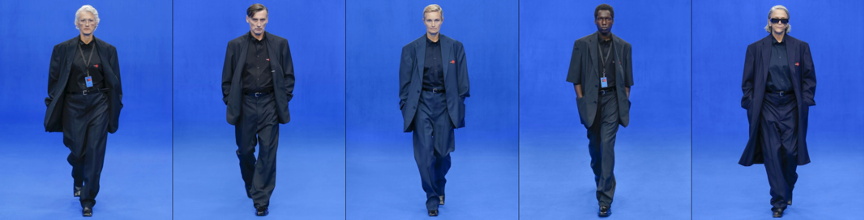
Balenciaga Summer 20 reimagines dressing for work: power dressing, no matter what one does as a job. Looks transform a wearer in the way a uniform can. Unlike their archetypes, though, garments and accessories are made using unconventional processes.
They talk about New Fashion Uniforms, Seamless Tailoring, New Trompe L’oeil, Super Plissé, Pillow Parkas, Fetish Gownsn, and Wearable Ballroom dresses.
Models of various career tracks interpret and play on beauty standards of today, the past, and the future.
Enter Masks, a new book by James Curcio, about Bowie and other artists of artifice. I spotted the book in a guest post by James Curcio on Ribbonfarm’s always excellent blog.
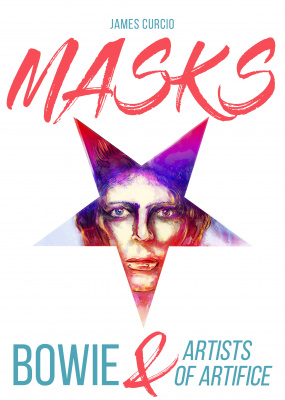
The difference between a king and a beggar, a soldier and a murderer remains in the realm of performance, a kind of farcical mummers trick that we agree to play along with, if often unconsciously.
The bulk of the book is about Bowie’s unique conceptual art, his capability to create new coherent worlds and identities. I miss Bowie.
The post and book also refer to French philosopher Jean Baudrillard’s book Simulacra and Simulation, apparently required reading for the actors of The Matrix before filming. According to Wikipedia, Baudrillard is “best known for his analyses of media, contemporary culture, and technological communication, as well as his formulation of concepts such as simulation and hyperreality.”
It cannot be happenstance that I find a reference to Simulacra and Simulation in “Design Unbound”, fantastic two-volume work on “Designing for Emergence in a White Water World”, by John Seely Brown and Ann M. Pendleton-Jullian, a print-only MIT Press publication. Chapter 14 is about “World Building”: “much more than just the setting for a story, word building creates coherent contexts that stories become to inhabit”
This is very much avant-garde, feels a lot like Cobra world-building practices like New Babylon by Constant Nieuwenhuis.
I feel like I am drifting into a thin timeline, and time is slipping through my fingers like clockdust. A shaken gravity, with no reference framework, unable to make U-turns, and affront reality with an open mind, heart, and will.
I need a new backdrop, a new backstory to make or break sense. I want to liberate myself from the harness of fixed time and space. An opening-up that leads to more vulnerability – and less power dress. With proximity, intimacy, and closeness – like the closeness and blissfulness that is evoked in “Two Sleepy People” in the March 2020 Mini-Ride.
In that sense, the from/to framing of before and after COVID-19 is misleading. I believe we have to start thinking of ourselves as analog/digital assets whose state is updated in real-time ànd asynchronously, our lives continuously evolving through space and time. We are indeed astronauts, in need of coherent world-building and navigating clockdust till eternity.
I have time. You have time. Both clock-time (Chronos) and experienced-time (Kairos). Ping me if you want to continue the conversation. I’d love to hear where your clockdust has settled these days.
This post is a semi-transcript of a fantastic talk “Space in the mind of a machine” by media artist Refik Anadol. My post is not intended as a literal transcript, but rather as a collection of – often poetic – idea clusters of Refik’s talk. None of the ideas are mine, I just tried to condense it and brush some highlights.
The talk was given on 4 December 2019 at the Southern California Institute of Architecture (SCI-ARC). The website of SCI-ARC itself is nirvana for all beauty and art lovers out there, and worth spending a virtual visit of a couple of hours.
The talk was transformative for me, in the sense that it made me realize we truly have entered a new reality and a witnessing the dawn of a new area, full of beauty, poetry, and artistic interventions that create alertness and aliveness similar to the 16th-century renaissance.
After a long intro, his talk starts at 2:46
Criticizing the idea of canvas
Dimensional explorations
Augmented structures
“Design is a solution to a problem; art is a question to a problem” – John Maeda
Humans, Machines, and Environments in a symbiotic relationship
Can a building dream?
“Life can only be understood backward, but it must be lived forward” – Kierkegaard
The data that we leave behind us
Data “dramatization” vs. Data Visualisation
The invisible space of Wi-Fi, 4G, radio signals, etc.
A poetic exploration of invisible datasets
Data Paintings
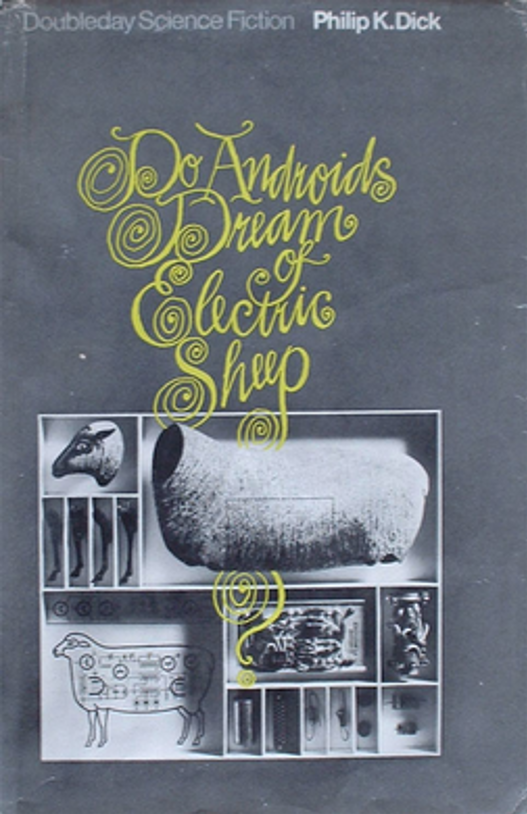
At a certain moment, Refik Anadol quotes Philip K. Dick, author of the 1968 science fiction book “Do Androids Dream of Electric Sheep”, later retitled Blade Runner, and basis for the 1982 initial version of the film.
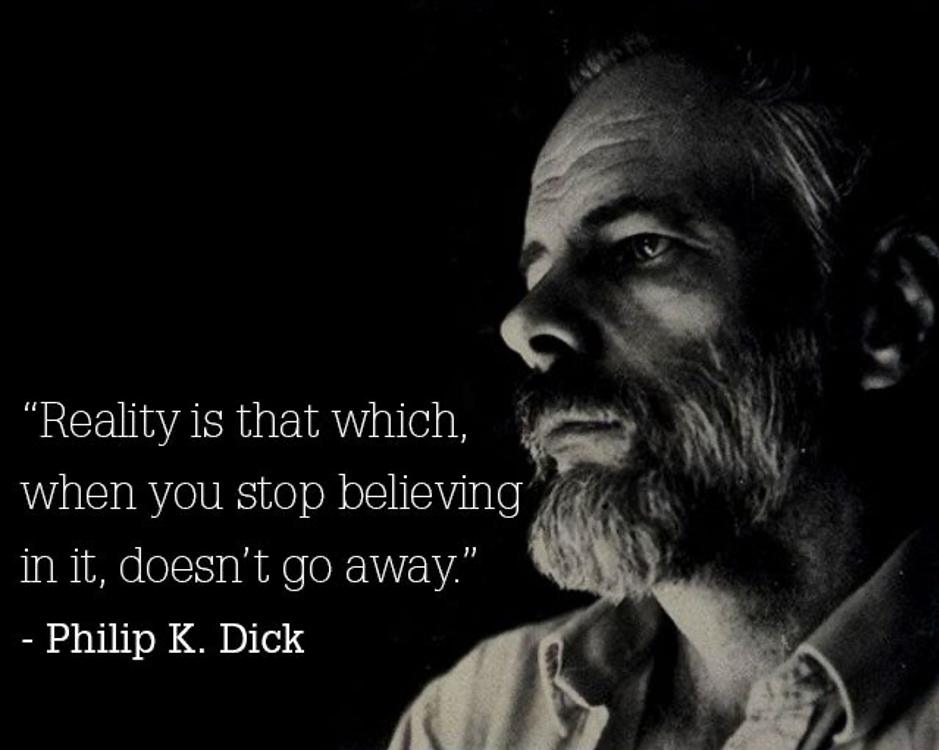
This inspires Refik Anadol to seed the following insight:
A simulation is that which does not stop when the stories go away
Stories are responsible for our human desire for resolution
But the simulation is only responsible for its own laws and initializing conditions
A simulation has no moral, prejudice of meaning
Like nature it just is
There is some poetry hidden in this abstraction of data
Exploring data sets that have this quality of meditation
The architect as an operating systems designer, a beautiful “speculation”
Finding the moment of remembering
Finding the moment of entering a dream state
“Machine Hallucinations”
Collective memories of spaces
To make the invisible visible
Hallucination narrators
Dream narrators
The Selfies of the Earth
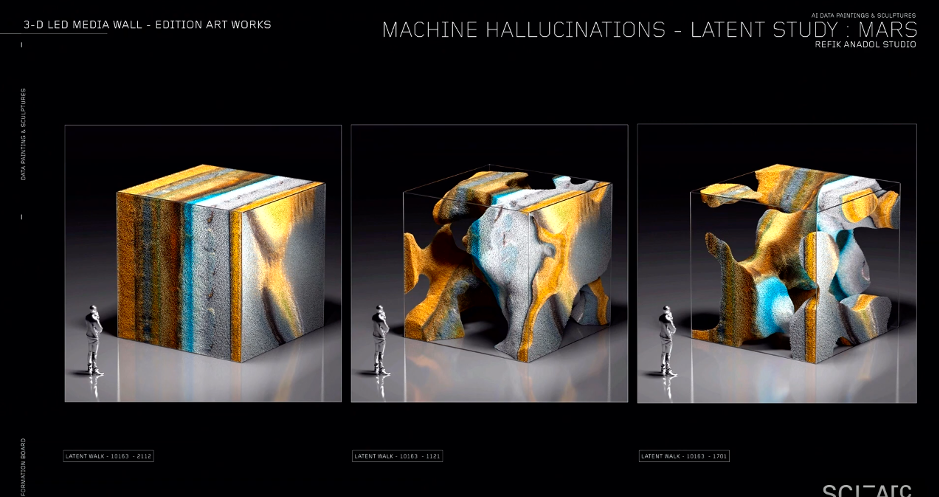
Refik is asking questions that are not just a fancy-fications of a bunch of algorithms
Another rabbit hole bringing together some reflections on creativity, demolition, patrimony, and poetic ruination, as so often in this blog inspired by architectural insights and metaphors.
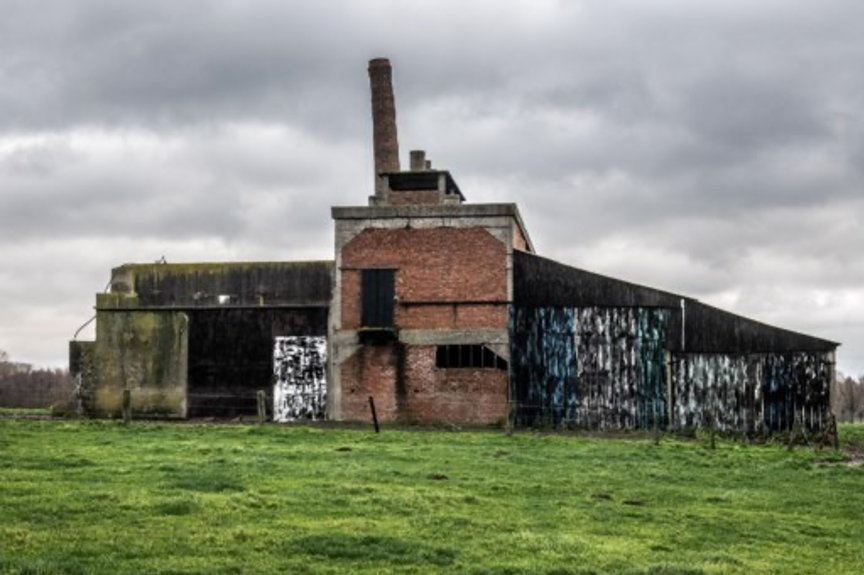
My attention was triggered by an article in the Jan 11, 2020 weekend edition of De Standaard, a Flemish newspaper. The article was about landscaping, and more specifically “ontharding” (I would literally translate it as “softening”). In this case, softening that what was hardened in the first place. Abandoned and neglected residential and industrial sites, where the soil is still covered by the concrete and rubbish of empty buildings.
It was part of a study supported by the “Vlaamse Bouwmeester”. “Bouwmeester” means “master of building”, “bau-meister”. The term is ill-translated into “Flemish Government Architect” on the official website. The full study can be found here (PDF in Dutch).
The core mission of the Flemish Government Architect is to promote the architectural quality of the built environment. The Flemish Government Architect and his team advise public patrons in the design and realization of buildings, public space, landscape and infrastructure. In addition, the Flemish Government Architect stimulates the development of visions and reflection, with an emphasis on interdisciplinary and cross-sectoral initiatives. The Flemish Government Architect acts as an advisor to the entire Flemish Government.
In short, the article and the study plea for restoring public space by the demolition of 1/5th of hardened space/surface in the Flemish landscape by 2050.
I had a flashback to “Cradle to Cradle”, the 2002 book that alerted me for the first time to a possible vision of sustainable production and architecture. The idea at that time was that reducing waste was just not good enough, and to be sustainable we needed to add value back into the system. As an evolution, the article about the softening of landscape goes one step further: from reducing waste to creating open space by the demolition of vacancy.
“Sloop geeft blijk van falen” – “Demolition evidences failure”
It was happenstance that I was reading around the same time Dan Hill’s 2015 book “Dark matter and trojan horses. A strategic design vocabulary”. I will come back to this book in subsequent posts.
Dan Hill was/is looking for (open) spaces as well, quoting ex-FC Barcelona football player and current Al-Sadd (Quatar) football team coach Xavi Hernández:
“Think quickly, look for spaces. That’s what I do: look for spaces. All day. I’m always looking. All day, all day. Here? No. There? No. People who haven’t played don’t always realise how hard that is. Space, space, space. It’s like being on the PlayStation. I think ‘shit, the defender’s here, play it there’. I see the space and pass. That’s what I do.”
Already more than 20 years ago, architect Cedric Price was arguing for demolish-able buildings with open re-usable spaces.
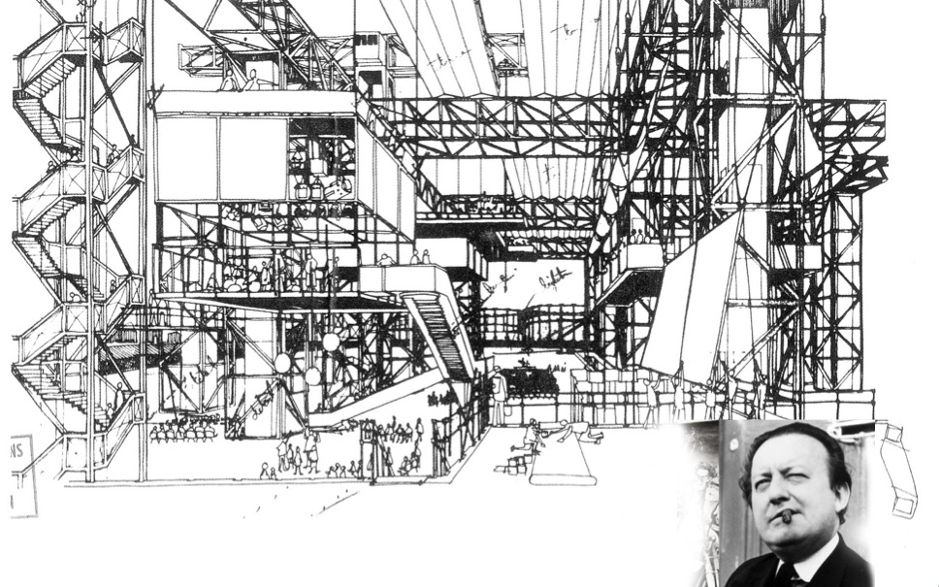
Cedric Price’s Fun Palace – inspiration for Centre Pompidou in Paris
OK – I confess – as from that moment I went down the rabbit hole and saw demolition and abandoned architecture everywhere. Like in this recent Guardian article, arguing the case for fully demountable buildings.
“We have to think of buildings as material depots,” says Thomas Rau , a Dutch architect who has been working to develop a public database of materials in existing buildings and their potential for reuse… He has developed the concept of “material passports”, a digital record of the specific characteristics and value of every material in a construction project, thereby enabling the different parts to be recovered, recycled and reused.
But there is also something poetic about abandonment, up to the point where we could consider keeping these ruins and equipping them with sensors to listen to patrimony.
In his beautifully reflective post “Instrumental Revelation and the Architecture of Abandoned Physics Experiments”, Geoff Manough introduces the concept of “poetic ruination.
Like menhirs, these abandoned seismic sensors could now just stand there, silent in the landscape, awaiting a future photographer such as Grigoryants to capture their poetic ruination.
Lebbeus Woods was inspiration to Geoff Manough and London-based architects Smout Allen for the project L.A. Recalculated:
Woods depicts an entire city designed and built as an inhabitable scientific tool. Everywhere there are “oscilloscopes, refractors, seismometers, interferometers, and other, as yet unknown instruments, measuring light, movement, force, change.” Woods describes how “tools for extending perceptivity to all scales of nature are built spontaneously, playfully, experimentally, continuously modified in home laboratories, in laboratories that are homes.”
Instead of wasting their lives tweeting about celebrity deaths, residents construct and model their own bespoke experiments, exploring seismology, astronomy, electricity, even light itself.
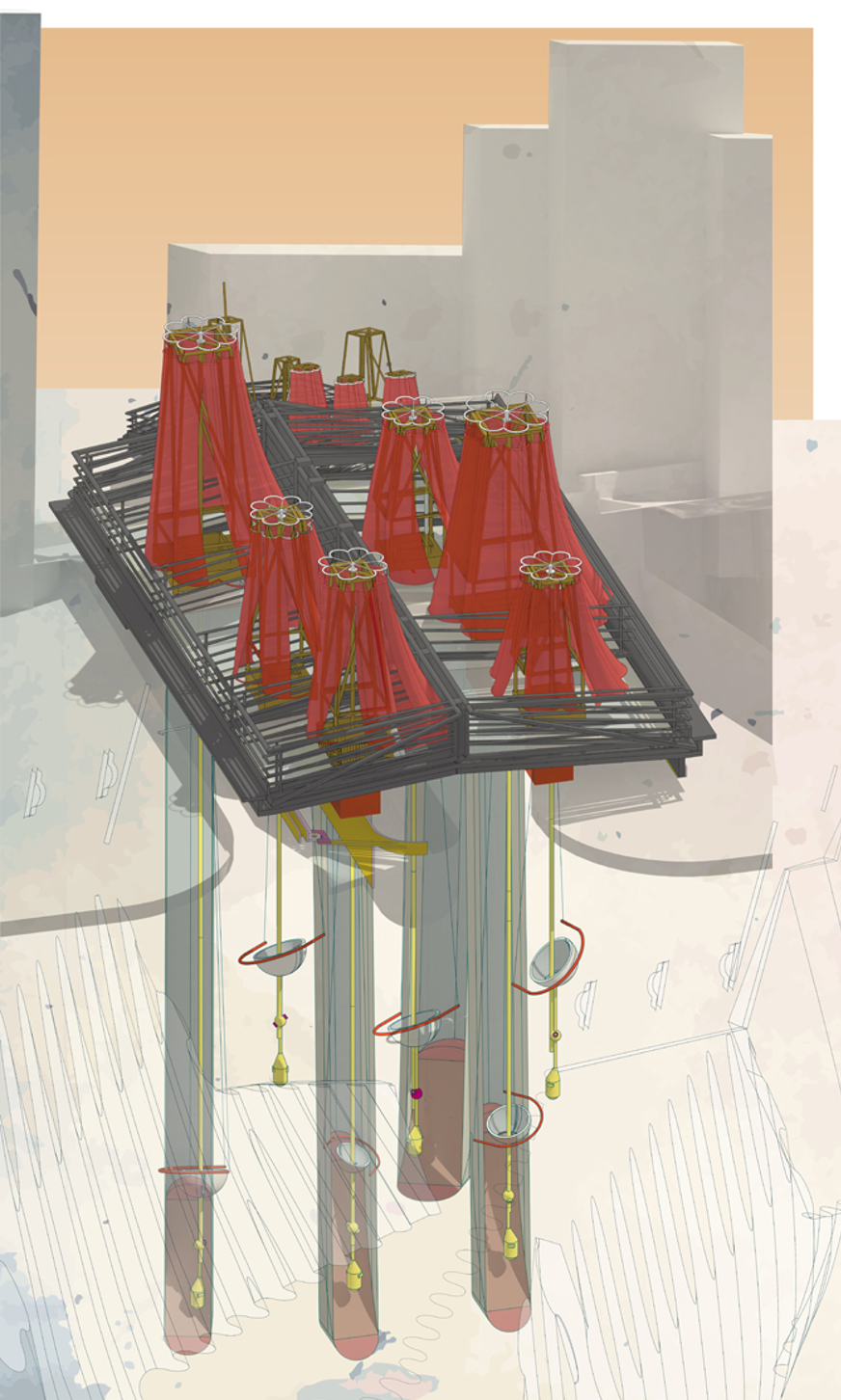
Seismic Counterweights
From L.A. Recalculated by Smout Allen and BLDGBLOG
Like architects think about (industrial) sites listening through sensors to seismic undercurrents, I started wondering whether we could not use this metaphor to reflect about our organizational structures; structures not only as hierarchical structures but the more encompassing set of system rules and patterns of an organization – I referred to it before as organizational patrimony.
How can we listen to and signal about the pulse of this organizational patrimony? How can we be aware of it, appreciate it, respect it, and build upon it in our rebellious acts of creative destruction?
I imagine a cohort of humans – like a colony of ants – having 24/7 sensors and laboratories everywhere in organizations; in every office, cubicle, meeting room, coffee corner, etc. And I don’t mean robotic sterile sensors feeding AI models. I mean real humans, measuring, documenting and signaling patrimonial changes in the structure of corporate structure, so they can send early warnings of experiments that have become useless and therefore have to be ruinated, or – in the worst-case – signal cases of patrimonial breakdown and demolition. In search of the material depot and passport of our organizations.
EX-perience is “out”, IN-tervention is “in”
When I talk about “experience”, I mean:
It is almost always about “entertainment”, easy/easier/more convenient consumption, not forcing you to learn a new (or old/existing) language.

Petervan Artwork © 2020 – Canvas through CycleGAN cloud AI model
When I talk about “intervention”, I mean:
Formats can be analog and digital artwork, performances, events, retreats, writings, poems, blogs, installations, exhibitions, immersions, soundscapes, recordings, documentaries, time capsules, AI warps, and fairy tales 😉
Interventions help us rediscover what is real, what resonates, what makes us go into frequency, what moves us, etc. And all this with a direction, with an intention: to enable spiritual, moral and aesthetical advancement at systems’ scale.
 Petervan Studios