
Fintech 1.0 is dead. Long live Fintech 2.0

There is a great new paper out called “The Fintech 2.0 Paper: rebooting financial services”. You can download it here.

fintech 20

The paper has been created by Santander InnoVentures, in collaboration with its partners Oliver Wyman and Anthemis Group.

It is mandatory reading, and it resets the bar on what innovation in financial services should be all about.

Maybe some history first. Sean Park (@parkparadigm) from the same Anthemis was probably the first who mentioned the idea of Bank as a Platform with a nice Prezi presentation http://www.parkparadigm.com/2009/10/29/platforms-markets-and-bytes/ in september 2009.

Since then we all have seen that story unfolding, up to some months ago where the slides from CB Insights went a bit viral.

Unbundling-of-a-bank-V2 by CB Insights April 2015

This is looking at the home page of Wells Fargo, but i have seen versions for HSBC and others. The message here was that we witness the disaggregation or uberization of financial services and that the new capability is to be able to horizontally source pinpoint functionality and mix and match these into new experiences. That was Fintech 1.0. It’s a vibrant startup space, and for sure full of investment, accelerators and incubators. But it’s boring and missing the big picture.

The new paper helps us seeing the big picture. From the foreword:

“Many fintechs have succeeded but today they are still operating only at the edges of banking. To help engineer more fundamental improvements to the banking industry, they must now be invited inside, to contribute to reinventing our industry’s core infrastructure and processes. That can succeed only as a collaborative endeavour, with banks and fintechs working together as partners.”

There are many examples in the paper that illustrate that. Here is an example of streamlining securities settlement:

Securities

However, many financial institutions are still stuck in the pre-Fintech 1.0 era: they just start to see the light that Sean Park was shining on the vertical disaggregation of financial services. That is seven years after the first signals were clear in the market. They simply have not adjusted their clockspeed to the 21st century economy speed.

Other institutions were more pro-active and created corporate investment funds (some of them 100-200M USD or more) and/or partnered with accelerators and incubators. Probably most of that money is gone now. And to be honest, i don’t see much innovation that is actually shipped into the market. At best we ended up with some well advanced prototypes and we struggle to get them out of the sandbox. To quote myself: “Innovation that does not ship into the hands of a paying customer is fantasy”

The new paper shifts the innovation agenda. All the problems and opportunities in the paper are of a collaborative nature. Maybe not in a way that the authors intended.

  • It looks from the paper that the conversation with startups has moved on from competing with the banks to collaborating with the banks. I can subscribe to that, it’s a clear message i have heard from the startups and the banks during all the startup competitions i have been invited to for coaching and judging.
  • But many of the problems and challenges in the paper can only be solved through a collaborative effort by the industry at large

Just a couple of days ago i was in a meeting with heads of innovation of major financial institutions. One of the messages was that we as an industry have to be more bold, set our competitive agendas asides and join forces to compete with the next generation of competitors that are not the startups at the edges but big technology companies with very deep pockets and with the super disruptive capability of becoming ecosystem/platform orchestrators where banks will rather be the slaves than the masters.

FinTech 1.0 FinTech 2.0
Products Processes
Tactics Strategy
Doing the existing better Do brand new
Efficiency game Value creation game
At the edges At the core infrastructure
Key Performance Indicators Key Capability Indicators
Vertical Horizontal
Competition Collaboration
Prototypes Shipped Products
Transactions Enable Commerce

The new paper inspires me. I got somewhat bored of hearing the startups doing the same standard pitches, and attacking/leveraging/whatever one particular area of financial services. I am hungry to see startups wanting to play the big game. The game of infrastructure. Of re-inventing processes rather and putting lipstick on or around the pig.

In that sense FinTech is dead. The game is up. It is about enabling commerce. It’s about better banks and better banking with a greater societal awareness to enable commerce and supply chain. Not just transactions in the back-office.
Petervan’s Delicacies – Week 8 June 2015

Week-23 of Delicacies: Rich harvest this week. But still max 5 articles that i found interesting and worth re-reading. Handpicked, no robots. Minimalism in curation. Enjoy!

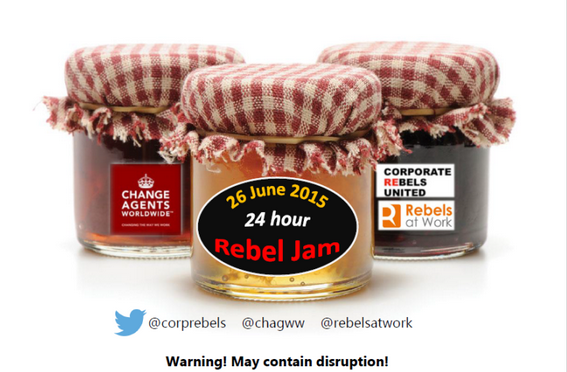
Rebel Jam 2015 on Friday, June 26

RebelJampot

On Friday, June 26at noon Central European Time, we will kick off our 24 hours of speakers sharing stories, observations and emerging practices about creating change and reshaping the future of work.

We will be using WebEx for this on-line event

Log-in information

Link to schedule of speakers and topics

We only have a few speakers slots available. If you are interested to share your change/rebel story, go to the link of the schedule and reserve your 30 minutes, or contact corporaterebelsunited@gmail.com

Kickoff times for 24-hour online event

  • Europe (CEST): noon
  • United States (EDT); 6 a.m.
  • United States (PDT) 3 a.m.
  • Australia (EST): 8 p.m.

Twitter handle: #RebelJam15

Questions?  corporaterebelsunited@gmail.com

Produced by:

Corp Rebels United jpeg

Print

Change Agents Worldwide

Proudly sponsored by RELEVENTS, committed to enacting a movement of positive change in the business community.

Relevents Logo

Mark already your calendars: together with RELEVENTS we will organize our first live event:

Rebel Jam LIVE!

Friday 18 Sep 2015 in Sacramento, California. 

Innovate Relevents

Petervan’s Delicacies – Week 1 June 2015

Week-22 of Delicacies: Max 5 articles that i found interesting and worth re-reading. Handpicked, no robots. Minimalism in curation. Enjoy!

Petervan’s Delicacies – Week 25 May 2015

Week-21 of Delicacies: Max 5 articles that i found interesting and worth re-reading. Handpicked, no robots. Minimalism in curation. Enjoy!

The time to boost innovation capabilities is now

KCIs help organisations to succeed in the 21st century

It’s no secret that many financial services firms struggle with technology and business model innovation.

With a customer base heavily influenced by their interaction with the likes of Amazon, Alibaba and Apple, and a whole range of new FinTech entrants, financial institutions know that they must adapt to changing consumer expectations.

To link company behaviour to outputs, management teams frequently use KPIs —Key Performance Indicators. KPIs help managers to align behaviour and incentivise performance around specific revenue goals.This works very well until an organisation has to change.

Management may then find itself in the unlucky position of incentivising counterproductive behaviour. As employees continue to focus on execution, the organisation runs the risk of becoming captive to its KPI programme.

To counter this, a fresh line of thinking has been developed, promoting a new set of metrics called KCIs, or Key Capability Indicators. The essential benefit of a KCI is that it measures the capability of an organisation to change at a structural level rather than its ability to create new outputs. It is not an output metric. It does not provide an indicator of new products created, increased profits, or improved asset utilisation. Those types of metrics are already in place and can be adapted readily.

For Innotribe at Sibos 2014, Innotribe commissioned Haydn Shaughnessy, an expert on the topic, to produce a financial services specific KCI Index. This resulted in a compelling presentation at Sibos in which Haydn discussed the innovation capabilities needed by organisations to succeed in the 21st century. Based on the positive feedback of our audience, we decided to consolidate Haydn’s findings in a whitepaper – Innovation in Financial Services: The Elastic Innovation Index Report.

The paper highlights that most organisations lack a KCI set which can make change more manageable. KCIs can:

  • help leaders to understand the skills they need to have in place in order to effect change;
  • provide a model for change because capabilities map directly to a future, desired organisational competency;
  • benchmark their organisation against others;
  • apply to investment decisions;
  • be used as a barometer of capability development.

Developing innovation capabilities can prove challenging; however, once they are institutionalised, it has the advantage of strongly embedding innovation within the organisation. The paper asserts that there are a number of key measurements to assess the innovation capability of financial firms: namely content, platform, leadership, strategy and externalisation.

The white paper provides innovation leaders at financial institutions with a useful benchmark, at a time when developing a set of Key Capability Indicators has never been more critical. Download it here.

Petervan’s Delicacies – Week 18 May 2015

Week-20 of Delicacies: Max 5 articles that i found interesting and worth re-reading. Handpicked, no robots. Minimalism in curation. Enjoy!

Petervan’s Delicacies – Week 11 May 2015

Week-19 of Delicacies: Lots to choose from this week. But no mercy: max 5 articles that i found interesting and worth re-reading. Handpicked, no robots. Minimalism in curation. Enjoy!

Petervan’s Delicacies – Week 4 May 2015

Week-18 of Delicacies: max 5 articles that i found interesting and worth re-reading. Handpicked, no robots. Minimalism in curation. Enjoy!

Petervan’s Delicacies – Week 27 Apr 2015

Week-17 of Delicacies: max 5 articles that i found interesting and worth re-reading. Handpicked, no robots. Minimalism in curation. Enjoy!