Petervan Delicacies – 18 Feb 2020

delicacies

An irregular, unpredictable, incoherent, unfocused set of mind-sparks that got me thinking. Irregular it is: just one week since the previous edition, but this week was, well… special. Handpicked, no robots. Minimalism in curation. Enjoy!

  • About doppelgänger and digital twins, urban glimpses and drawing data. The broader context of data about cities, models of cities, and understanding and visualizing cities.
  • About 2038, an international team of architects, artists, ecologists, economists, scientists, politicians, and writers, initiated in 2019, aiming to tell a (hi)story that today we call future > très spéciale 😉
  • About The Everything Manifesto, a thought experiment for the next billion seconds and an introduction to ‘The Weirdness of Interdependencies’
  • Venkatesh Rao freewheeling on narrative as a road in time, and stories as particular journeys taken along that road. Big fan.
  • Amber Case explains: what looks cool in a science fiction film is frequently frustrating, distracting, and convoluted to use in real life.

If you can’t get enough of these and want more than 5 articles, you can hang on to the firehose, the extended version of Petervan’s Delicacies in REVUE. Subscribe here: https://www.getrevue.co/profile/petervan

Refik Anadol – Beautiful Speculations and Data Dramatisations

This post is a semi-transcript of a fantastic talk “Space in the mind of a machine” by media artist Refik Anadol. My post is not intended as a literal transcript, but rather as a collection of – often poetic – idea clusters of Refik’s talk. None of the ideas are mine, I just tried to condense it and brush some highlights.

The talk was given on 4 December 2019 at the Southern California Institute of Architecture (SCI-ARC). The website of SCI-ARC itself is nirvana for all beauty and art lovers out there, and worth spending a virtual visit of a couple of hours.

The talk was transformative for me, in the sense that it made me realize we truly have entered a new reality and a witnessing the dawn of a new area, full of beauty, poetry, and artistic interventions that create alertness and aliveness similar to the 16th-century renaissance.

After a long intro, his talk starts at 2:46


Criticizing the idea of canvas

Dimensional explorations

Augmented structures

“Design is a solution to a problem; art is a question to a problem” – John Maeda

Humans, Machines, and Environments in a symbiotic relationship

Can a building dream?

“Life can only be understood backward, but it must be lived forward” – Kierkegaard

The data that we leave behind us

Data “dramatization” vs. Data Visualisation

The invisible space of Wi-Fi, 4G, radio signals, etc.

A poetic exploration of invisible datasets

Data Paintings

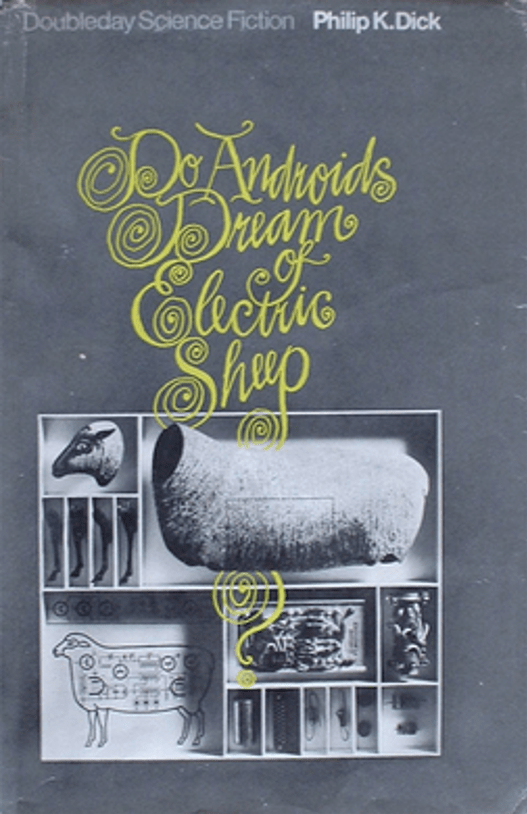
At a certain moment, Refik Anadol quotes Philip K. Dick, author of the 1968 science fiction book “Do Androids Dream of Electric Sheep”, later retitled Blade Runner, and basis for the 1982 initial version of the film.

Electric Sheep

Quote Philip Dick

This inspires Refik Anadol to seed the following insight:

A simulation is that which does not stop when the stories go away

Stories are responsible for our human desire for resolution

But the simulation is only responsible for its own laws and initializing conditions

A simulation has no moral, prejudice of meaning

Like nature it just is

There is some poetry hidden in this abstraction of data

Exploring data sets that have this quality of meditation

The architect as an operating systems designer, a beautiful “speculation”

Quote Blaise

Finding the moment of remembering

Finding the moment of entering a dream state

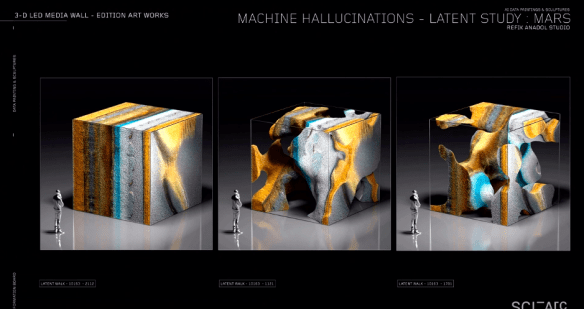
“Machine Hallucinations”

Collective memories of spaces

To make the invisible visible

Hallucination narrators

Dream narrators

The Selfies of the Earth

Machine Hallucinations

Refik is asking questions that are not just a fancy-fications of a bunch of algorithms

petervan-signature


Petervan’s Delicacies – 12 Feb 2020

delicacies

An irregular, unpredictable, incoherent, unfocused set of mind-sparks that got me thinking. A quite eclectic harvest this time. From solid internet cultural insights to visual art experiments powered by AI. Handpicked, no robots. Minimalism in curation. Enjoy!

If you can’t get enough of these and want more than 5 articles, you can hang on to the firehose, the extended version of Petervan’s Delicacies in REVUE. Subscribe here: https://www.getrevue.co/profile/petervan

Spacial Trash and Patrimony

Another rabbit hole bringing together some reflections on creativity, demolition, patrimony, and poetic ruination, as so often in this blog inspired by architectural insights and metaphors.

bouwmeester

My attention was triggered by an article in the Jan 11, 2020 weekend edition of De Standaard, a Flemish newspaper. The article was about landscaping, and more specifically “ontharding” (I would literally translate it as “softening”). In this case, softening that what was hardened in the first place. Abandoned and neglected residential and industrial sites, where the soil is still covered by the concrete and rubbish of empty buildings.

It was part of a study supported by the “Vlaamse Bouwmeester”. “Bouwmeester” means “master of building”, “bau-meister”. The term is ill-translated into “Flemish Government Architect” on the official website. The full study can be found here (PDF in Dutch).

The core mission of the Flemish Government Architect is to promote the architectural quality of the built environment. The Flemish Government Architect and his team advise public patrons in the design and realization of buildings, public space, landscape and infrastructure. In addition, the Flemish Government Architect stimulates the development of visions and reflection, with an emphasis on interdisciplinary and cross-sectoral initiatives. The Flemish Government Architect acts as an advisor to the entire Flemish Government.

In short, the article and the study plea for restoring public space by the demolition of 1/5th of hardened space/surface in the Flemish landscape by 2050.

I had a flashback to “Cradle to Cradle”, the 2002 book that alerted me for the first time to a possible vision of sustainable production and architecture. The idea at that time was that reducing waste was just not good enough, and to be sustainable we needed to add value back into the system. As an evolution, the article about the softening of landscape goes one step further: from reducing waste to creating open space by the demolition of vacancy.

“Sloop geeft blijk van falen” – “Demolition evidences failure”

It was happenstance that I was reading around the same time Dan Hill’s 2015 book “Dark matter and trojan horses. A strategic design vocabulary”. I will come back to this book in subsequent posts.

Dan Hill was/is looking for (open) spaces as well, quoting ex-FC Barcelona football player and current Al-Sadd (Quatar) football team coach Xavi Hernández:

 “Think quickly, look for spaces. That’s what I do: look for spaces. All day. I’m always looking. All day, all day. Here? No. There? No. People who haven’t played don’t always realise how hard that is. Space, space, space. It’s like being on the PlayStation. I think ‘shit, the defender’s here, play it there’. I see the space and pass. That’s what I do.”

Already more than 20 years ago, architect Cedric Price was arguing for demolish-able buildings with open re-usable spaces.

fun palace

Cedric Price’s Fun Palace – inspiration for Centre Pompidou in Paris

OK – I confess – as from that moment I went down the rabbit hole and saw demolition and abandoned architecture everywhere. Like in this recent Guardian article, arguing the case for fully demountable buildings.

“We have to think of buildings as material depots,” says Thomas Rau , a Dutch architect who has been working to develop a public database of materials in existing buildings and their potential for reuse… He has developed the concept of “material passports”, a digital record of the specific characteristics and value of every material in a construction project, thereby enabling the different parts to be recovered, recycled and reused.

But there is also something poetic about abandonment, up to the point where we could consider keeping these ruins and equipping them with sensors to listen to patrimony.

In his beautifully reflective post “Instrumental Revelation and the Architecture of Abandoned Physics Experiments”, Geoff Manough introduces the concept of “poetic ruination.

Like menhirs, these abandoned seismic sensors could now just stand there, silent in the landscape, awaiting a future photographer such as Grigoryants to capture their poetic ruination.

Lebbeus Woods was inspiration to Geoff Manough and London-based architects Smout Allen for the project L.A. Recalculated:

Woods depicts an entire city designed and built as an inhabitable scientific tool. Everywhere there are “oscilloscopes, refractors, seismometers, interferometers, and other, as yet unknown instruments, measuring light, movement, force, change.” Woods describes how “tools for extending perceptivity to all scales of nature are built spontaneously, playfully, experimentally, continuously modified in home laboratories, in laboratories that are homes.”

Instead of wasting their lives tweeting about celebrity deaths, residents construct and model their own bespoke experiments, exploring seismology, astronomy, electricity, even light itself.
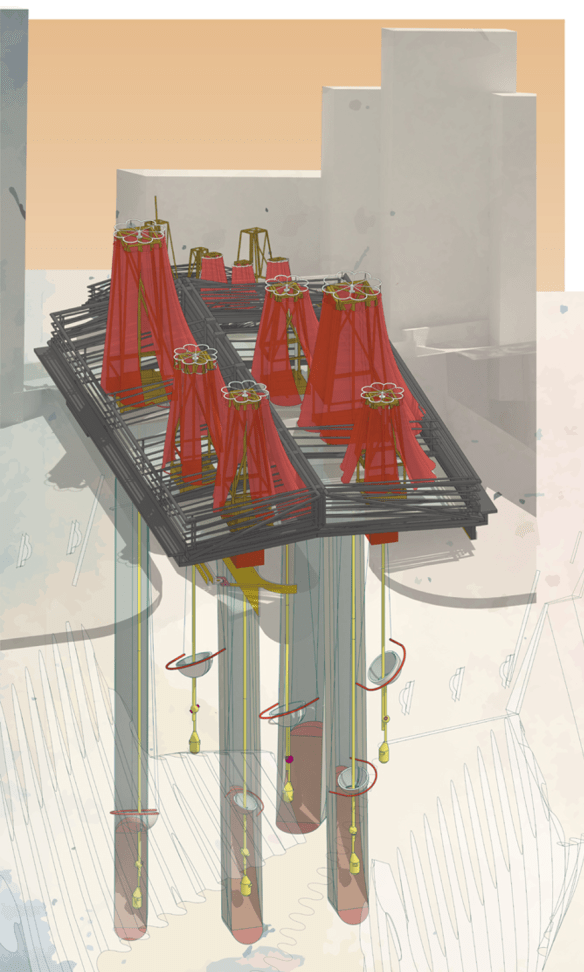
seismic sensors

Seismic Counterweights
From L.A. Recalculated by Smout Allen and BLDGBLOG

Like architects think about (industrial) sites listening through sensors to seismic undercurrents, I started wondering whether we could not use this metaphor to reflect about our organizational structures; structures not only as hierarchical structures but the more encompassing set of system rules and patterns of an organization – I referred to it before as organizational patrimony.

How can we listen to and signal about the pulse of this organizational patrimony? How can we be aware of it, appreciate it, respect it, and build upon it in our rebellious acts of creative destruction?

I imagine a cohort of humans – like a colony of ants – having 24/7 sensors and laboratories everywhere in organizations; in every office, cubicle, meeting room, coffee corner, etc. And I don’t mean robotic sterile sensors feeding AI models. I mean real humans, measuring, documenting and signaling patrimonial changes in the structure of corporate structure, so they can send early warnings of experiments that have become useless and therefore have to be ruinated, or – in the worst-case – signal cases of patrimonial breakdown and demolition. In search of the material depot and passport of our organizations.

petervan-signature


The End of Experience

EX-perience is “out”, IN-tervention is “in”

When I talk about “experience”, I mean:

  • The new hype of artistic “experiences” at art exhibits
  • “Experiences” at events
  • The “experience” of driving a car
  • The “experience” in whatever, like tasting chocolate, as promoted in advertisements

It is almost always about “entertainment”, easy/easier/more convenient consumption, not forcing you to learn a new (or old/existing) language.

CycleGAN - December 22nd 2019 at 3.16.22 PM

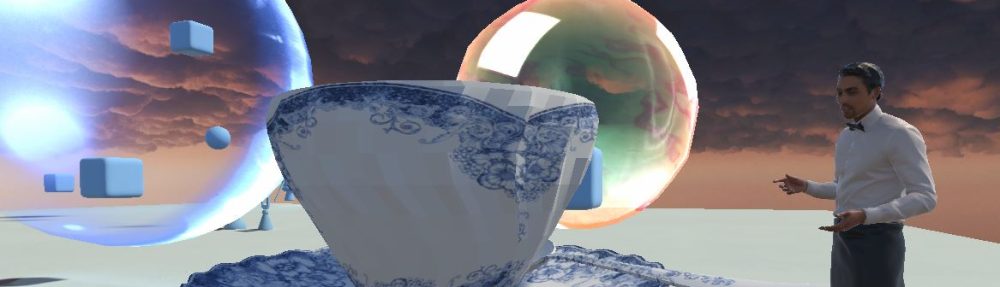
Petervan Artwork © 2020 – Canvas through CycleGAN cloud AI model


When I talk about “intervention”, I mean:

  • Provoking
  • Asking questions
  • Challenging assumptions
  • Planting speculations
  • Through visceral (sensorial) triggers
  • Creating better “resonances”
  • Playing your harmonics, like harmonics in music
  • Hearing the real-real sound (like in Neil Young Archives)

Formats can be analog and digital artwork, performances, events, retreats, writings, poems, blogs, installations, exhibitions, immersions, soundscapes, recordings, documentaries, time capsules, AI warps, and fairy tales 😉

Interventions help us rediscover what is real, what resonates, what makes us go into frequency, what moves us, etc. And all this with a direction, with an intention: to enable spiritual, moral and aesthetical advancement at systems’ scale.

petervan-signature

Petervan’s Delicacies – 9 Jan 2020

delicacies

An irregular, unpredictable, incoherent, unfocused set of mind-sparks that got me thinking. Handpicked, no robots. Minimalism in curation. Enjoy!

If you can’t get enough of these and want more than 5 articles, you can hang on to the firehose, the extended version of Petervan’s Delicacies in REVUE. Subscribe here: https://www.getrevue.co/profile/petervan