Corporate Radicalism

As mentioned in my recent inspiration post, this is the book that Nick Ervinck suggested to get me going on professionalizing my art practice. But it clearly also had an effect on my other practices.

Michael Craig-Martin is often described as the godfather of the Young British Artists (YBA) of the 1980s and 1990s. Shame on me that I knew little about YBA and even less about Michael Craig-Martin. That ignorance was also an advantage, as I could read the book without prejudice. 

The book is a series of short stories and episodes on the many ideas, events, and people that have influenced Craig-Martin during his rich artistic life. 

I really liked the book, and I liked the cut-the-crap approach of all the things you are supposed to do or not do as an aspiring artist.

For this post, I picked the story ”On the three stages of twentieth-century art”, and gave it a twist that relates more to my Scaffold practice than to my art practice.

Craig-Marting described in that story the three stages of RADICALIZATION of art:

Radicalization of Form

Radicalization of Materials

Radicalization of Content

Together these three radicalizations lead to:

“A vast EXPANSION in the scope of what art can look like, be made of, and be about”

One could say this expansion formed the foundation for “contemporary” art.

I feel attracted to the words “contemporary” and “avant-garde”. 

Probably because they seem to suggest novelty, modernity, and some level of gentle subversive aesthetic, less prone to the temporalities of fashions or trends.

It seems that art movements could also be considered precursors of business movements, and how we can and have to recalibrate our insights (or lack thereof) in innovation in corporate environments.

The quote above smells a lot like what many spontaneous and enthusiastic people feel and experience when they want to enable positive change in the corporate environment. I have come across that resistance many times in my corporate career. And it breaks my heart to see how again today, many organizations smell a conservative ambiance and favor moderation rather than radicalism, caution rather than risk. 

How can we create an environment where these young, bright enthusiasts can thrive and not be suffocated in their endeavors by non-contemporary organizations and teams?

What would be the radicalizations that lead to a contemporary business, an avant-garde business, or some form of corporate radicalism?

Take a quote again from Craig-Martin’s book (my emphasis):

“Taking an interest in contemporary art, the art of one’s own time as it is being made, is quite different from having an interest in the past, even the recent past. It involves a sense of participation, a pleasure in uncertainty, a willingness to have one’s assumptions challenged, a desire to be unsettled. Art holds a unique and critically important place in modern life precisely because it has not been afraid to take on board all the diverse and dangerously unpredictable creative activities rejected by the other arts. In a world where everyone and everything has to be accounted for, isn’t it of immense intellectual, aesthetic, social, and political importance that art provides a context for those creative activities that do not easily fit the system?”

A DESIRE TO BE UNSETTLED! 

Imagine that!

I tried to re-write and adapt this paragraph for a contemporary corporate spring:

“Taking an interest in contemporary business, the business of one’s own time as it is being made, is quite different from having an interest in the past, even the recent past. It involves a sense of participation, a pleasure in uncertainty, a willingness to have one’s assumptions challenged, a desire to be unsettled. Radical organizations and teams hold a unique and critically important place in modern life precisely because they are not afraid to take on board all the diverse and dangerously unpredictable creative activities rejected by the conservative ambiance. In a world where everyone and everything has to be accounted for, isn’t it of immense intellectual, aesthetic, social, and political importance that organizations provide a context for those creative activities that do not easily fit the system?”

I believe corporate radicalism and corporate radicalists are something quite different than the romanticized and heroic take on misfits, dreamers, rebels, etc. We have to move way beyond corporate rebellion. 

We need corporate radicalism in:

Form

Materials

Content

What are the corporate forms, materials, and content that need expansion?

We need contemporary, avant-garde, radical businesses that account for the intended and unintended consequences ànd opportunities. Organizations that are inclusive in all aspects. Companies that desire to be unsettled. Institutions that desire societal, moral, and aesthetic advancement.

This will require a different type of learning, formation, education, or training. Not only exploring the STEM (Science, Technology, Engineering, Mathematics) and Production dimensions of their business, but also daring to (re)compose and live out loud new exciting and daring narratives, set high ethical and moral standards, and embrace new aesthetics.

That new type of learning must resemble what Michael Craig-Marting describes as an ideal art school. Just drop the word art, and you may get an idea of what 21st-century corporate education and formation may look like.

We need to radically rethink corporate business schools.

We need radical schools for radical times.

We need to train, form, and build radical organizations. 

How can we scaffold such a school? 

What is needed to take the leap of faith for being re-trained like that again?
Petervan’s Delicacies – 20 Nov 2022

As usual, an incoherent, irregular, unpredictable collection of interesting sparks. Handpicked, no robots. Minimalism in curation. Enjoy!

If you can’t get enough of these and want more, you can hang on to the firehose, the extended version of Petervan’s Delicacies in REVUE with loads of videos. Subscribe here: https://www.getrevue.co/profile/petervan

Inspiration: Nick Ervinck

Some years ago, I discovered the magical art world of Flemish artist Nick Ervinck.

I subscribed to his newsletter and was inspired by his ongoing progress.

If you want to get a good sense of what drives Nick and what his artwork is all about, here is a great video:

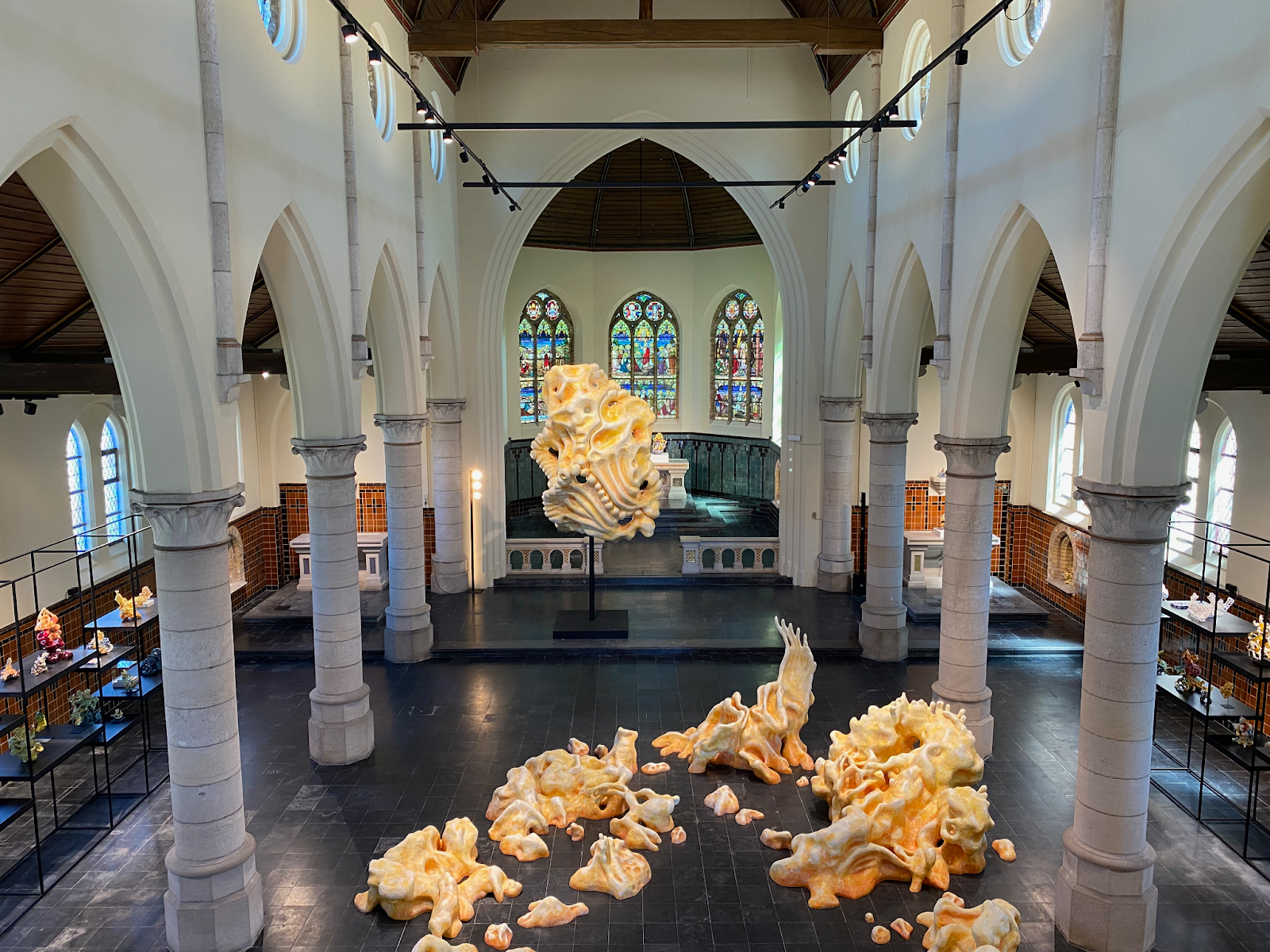
Nick has a church (The Dutch word for church is “kerk”). 

Nick’s church is branded “K.E.R.K.” standing for Kunsthalle ERvickK” and is located in the tiny village of Sint-Pieters-Kapelle, a township part of Middelkerke, a mall town at the Belgian North Sea coast. Last summer, I combined a bike ride with a visit to K.E.R.K. on a very hot 10 July 2022. The exhibition “SKIN WORKS” displayed recent work by Nick Ervinck.

I was impressed and inspired. I wanted to meet Nick one day, and if possible visit his studio. At the reception, there was a young student, and I asked whether the artist was present in the church. He was not, but she gave me a business card with his email address and phone number, suggesting that I would ask for a studio visit.

Here is the mail that I wrote to Nick:

Hello Nick,

I’ve been following you for a while and I’m a fan. Yesterday I visited K.E.R.K. (GNI-RI JUL2022 SKIN WORKS) and the friendly young woman at the entrance said it was possible to visit your studio.

I do a number of artistic experiments myself, and I recently hired Kurt Vanbelleghem to help me professionalize my practice. Besides the art, I work on a project “The Scaffold”, where I bring artists, entrepreneurs, and engineers together in residencies for corporate clients.

I would love to have a conversation with you, preferably in your studio, or else in K.E.R.K. or any other location of your choice.

Interested?

Here is Nick’s answer:

Hey peter,

Nice to hear from you.

It is not possible to receive each person individually.

I normally only open the studio for group visits.

But your email has caught my interest. What you are doing is of course not clear to me.

Bringing artists, entrepreneurs, engineers, and companies together sounds like music to my ears.

I am someone who likes to work goal and result oriented. And many of these initiatives do not succeed in this.

I will be happy to receive you in my studio/atelier to exchange thoughts.

Fits for you possibly Tuesday evening August 9 or Wednesday evening August 10.

Or feel free to make some suggestions and I’ll check my agenda.

Artistic greetings

Nick

We settled for 9 August, also a very hot summer day. 

There I stood in front of his studio, with no agenda, but with a quite detailed concept of what The Scaffold had to become.

I did not know what to expect. Maybe he would kick me out after ½ hour? No worries: I got a really warm welcome. Nick was very approachable, and as would show quickly, a real professional in all senses. There was a click: we spent 4 hours together. 

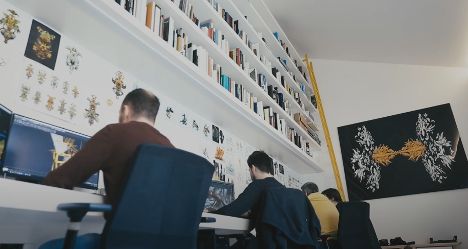
Above the working desk was a huge library of more than a thousand artbooks. 

Nick is also a big fan of Henry Moore, a British artist mainly known for his sculptures. Moore can be said to have caused a British sculptural renaissance. Nick’s Henry Moore book collection encompasses more than 300 books! The biggest private collection in the world: the only place in the world where you can find more is in the Henry Moore Foundation itself!

Nick also built his own virtual museum “MOUSEION” and his own “NIKIPEDIA” landing page:

The visit and the conversation were super inspiring for me. His work and attitude influence me in many ways:

His Focus

He is an artist entrepreneur and focuses exclusively on that

His Professionalism

Both as an artist and as an entrepreneur. 

Everything exudes attention to detail and perfectionism in everything: 

Archiving and documenting

High-quality printing, framing, book printing

Business cards

Website

Respect for own work

Cleanness and order in the studio

His Sharing

Links to books, his own manuals for art photography, bookbinding, framing, transport boxes, software, high-quality art print shops, etc, etc

His Erudition

He is very well-read, has a pluralistic view of things, and is able to express himself very well orally and in writing

I invited Nick to be part of the non-conformist tribes I am curating for The Scaffold learning experiences.

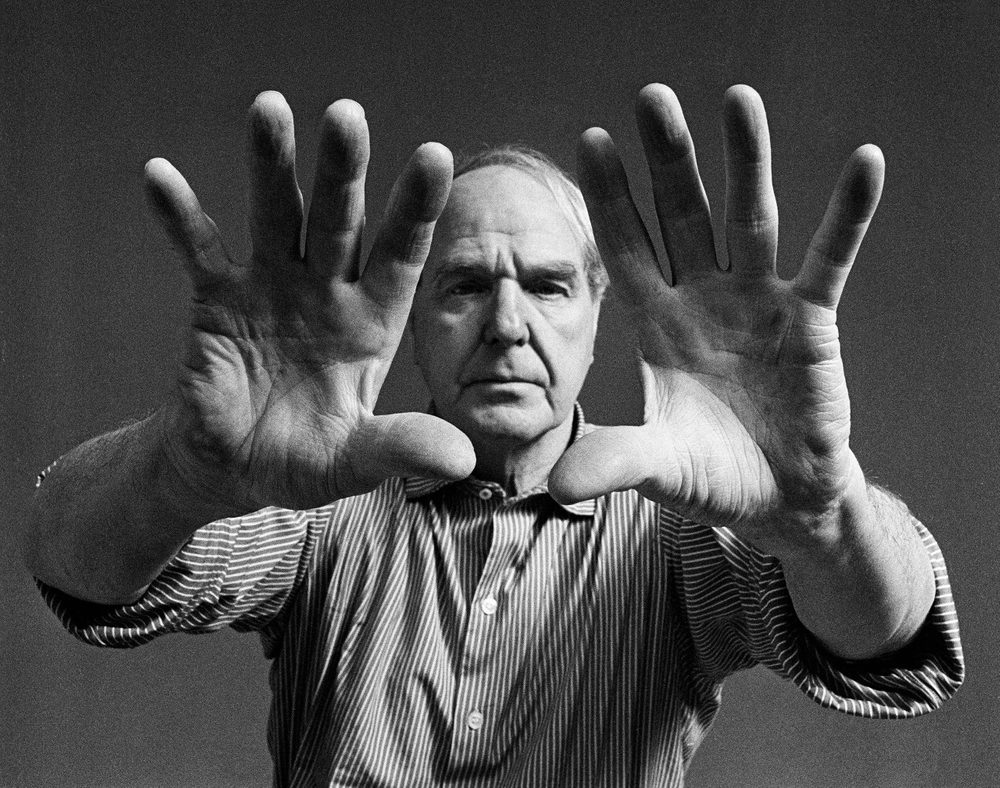
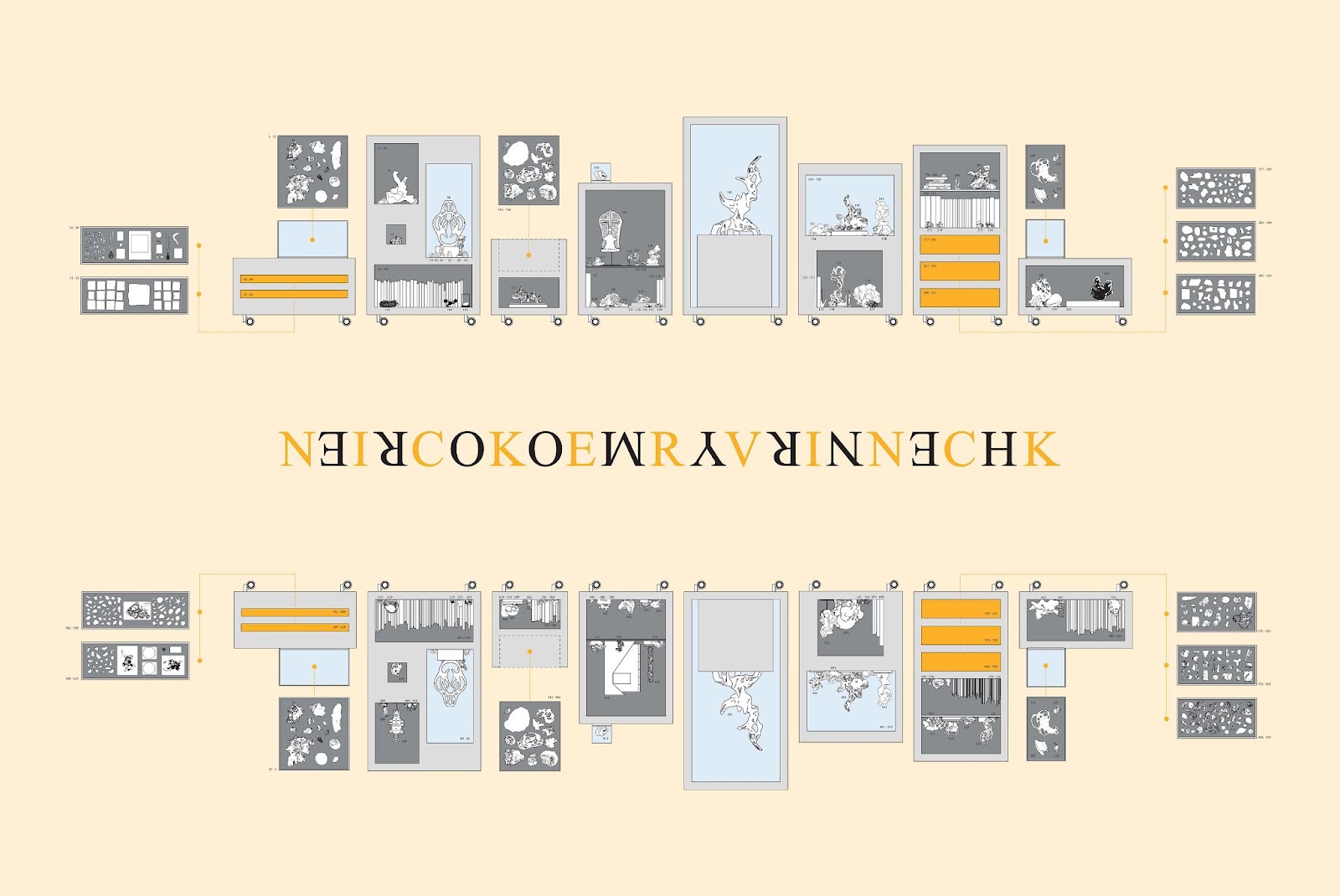
When leaving the studio, he left me with some of his own art books as a present, a poster of his Henry Moore cabinet show (see the above picture, where Nick Ervinck and Henry Moore are interwoven), and a recommendation for the book “On Being An Artist” by Michael Craig-Martin.

He must have read my mind, as the book proved to be another big inspiration for my practice (and the subject of my next blog post).

When I walked towards my car in the warm evening sun, I felt like coming out of a movie.

This is the thank you letter I sent:

Dear Nick

Do you recognize the feeling when you’ve been to a good movie, and you come out, and the world feels different? That’s the feeling I had yesterday when I came out of your studio and on my ride back home.

Thank you very much for the generosity of time (more than three hours!) and the quality of your input and feedback. Thanks also for the MOUSEION book, the poster, the flyers, and the book suggestions. The poster is now right in front of me.

Thank you also for the confidence in showing your management software, the guided tour in your studio, and sharing successful projects, but also projects that just didn’t make it. 

Warm artistic greetings,

Petervan’s Ride – October 2022

Petervan’s Music Ride October 2022 > almost 70 songs this time, most new releases, but also some classics > EOL, ENO, Charlotte de Witte, and even some country > play in shuffle mode to increase the surprise factor. Enjoy!

A Scaffold for an Avant-Garde Business

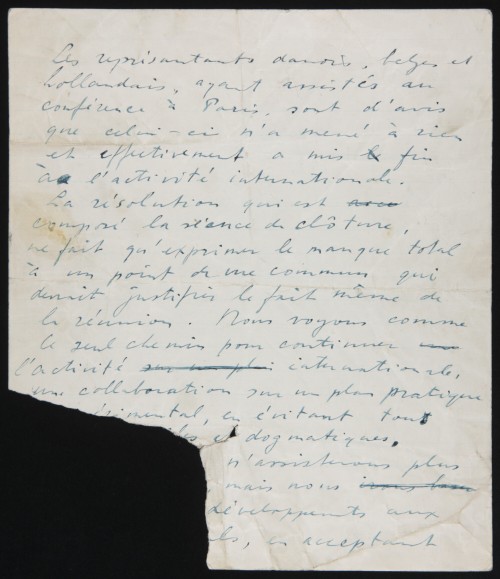
Cobra Manifesto page-1

Cobra Manifesto – Image from Beinecke Digital Collections

As many of you know, I am a big fan of Cobra, the avant-garde art movement established in 1948. The movement only existed for three years, but forever changed the landscape of postwar European art. 

What would an avant-garde business movement look like? 

How could we scaffold that?

In my Sep 2022 update, I briefly introduced The Scaffold. 

Today, I would like to share some more details about The Scaffold

The Scaffold is a brand-new transdisciplinary learning studio for the never-normal

A Scaffold: a temporary structure to let emerge something new

Transdisciplinary: for each client project, we curate a transdisciplinary tribe of entrepreneurs, engineers, scientists, artists, and philosophers to reflect and speculate about your better futures

Learning: this is not learning by teaching, but learning through conversations, acting, and doing

Studio: the keyword here is critique: individual, group, and formal critique

The Never Normal: the ever faster changing environment we operate in. The best metaphor is that of the kayaker in wild water.

Older metaphors like the speedboat (brute force), tacking the sails to the wind (adapting with the destination in focus), and surfing the waves of change (staying before the tsunami of disruption) don’t serve us anymore. 

Today you are in the water. 

You have to sense faster and better what is, sense faster and better what can become, and take action – right there – in the middle of a system in full motion. 

I often hear that we need more data, data is the new oil, and we need powerful AI and Machine Learning to discover patterns in the data, so we can make better and faster decisions. 

But data will bring us only so far. 

Data tell us something about correlation. 

Correlation is not the same as causation.

And also rational cause-and-effect thinking and planning are only part of the story. 

The Scaffold is imagination in full play: not knowing all the dots, and having to keep multiple lines of inquiry open at the same time, without coming to a conclusion, ànd feeling comfortable with that.

Orchestrating and activating collective intelligence (both human and non-human intelligence)

WHAT DO WE HAVE?

WHERE ARE WE GOING?

WHY ARE WE GOING THERE?

HOW DO WE GET THERE?

WHAT RULES DO WE FOLLOW?

WHAT IS FORBIDDEN?

HOW DO WE SPEAK TO EACH OTHER?

WHAT WORLD ARE WE PLAYING IN?

WHAT DO WE REALLY WANT?

The Scaffold asks questions related to the narratives that motivate individuals and organizations from the inside. These motivations have nothing to do with marketing from the outside. These motivations share the desire for societal, moral, and aesthetic advancement. 

The experiences that we design can be in-person, and others are 100% online or virtual, or a combination thereof. Our experiences are high-touch and highly facilitated. We use world-class facilitators. We apply live scribing, live video editing, and live note-taking. We use technology in support of the content, not to impress nor to create a spectacle. We challenge each other through individual and group critique. We experiment, explore, tinker, and dare to change in flight. We use physical and virtual channels/containers of experimentation & distribution 

We believe in the long format. Transdisciplinary impact groups learn by working, doing, and acting together during an extended period of time. This approach increases trust, bonding, candor, the release of real or perceived vulnerabilities, and the discovery of unintended opportunities.

The Scaffold is your PEPA

Play – Experimentation – Participation – Activation

The Scaffold is about dreaming & imagining big with your eyes wide open for reality. 

More inspiring quotes are here

More details at https://petervanstudios.com/the-scaffold/ 

The Scaffold is made possible through strategic partnerships with https://www.nexxworks.com/ and https://collectivenext.com/

Powered by a coalition of exceptional individuals as advisors for The Scaffold. A unique mix of strategists, futurists, engineers, entrepreneurs, experts in classic and contemporary arts, masters in narrative environments, philosophers, and a licensed architect and VR developer.

We are very curious about how this resonates with you. 

Who could be interested in such an offering? 

What is great, mediocre, or missing? 

Let’s chat

Hope to welcome you soon!

Warmest,

Inspiration – Peter Cook – Utopian or Real?

From time to time, I discover an interview, an artist, a dreamer, or another non-conformist take on reality that I find worthwhile transcribing. 

I prefer to make such transcripts manually, by listening, pausing, and reflecting. Like drawing by hand. 

And also in the resulting text, it is possible to give some sense to that rhythm of reflection. 

In this post, a transcript of the conversation with artist/architect Peter Cook on the benefits of drawing by hand, on buildable or non-buildable ideas, on utopia or reality. I started transcribing around 11:15 in this video which also contains beautiful artwork. 

Somehow, I would like to grow old like Peter Cook…

In drawing

You can decide upon almost anything

How to make a building that can go from solid to transparent without a window?

From solid 

to slightly permeable 

and then translucent 

More translucent

Completely transparent

And then back again

I don’t think any of the work is utopian

The notion of utopia, the notion of the ideal perfect objective is not in my mind

I think that a lot of these drawings are buildable

they may not be a hundred percent buildable 

but they are more buildable

than they’re unbuildable

so what i’m saying is

to answer the question is it utopic 

No, it’s not utopian 

I even balk at the idea

if it’s huge you see

what happens is

the critical observer will say 

Ah! that stuff is utopian

what we do down the road is real

and it delights me to say that

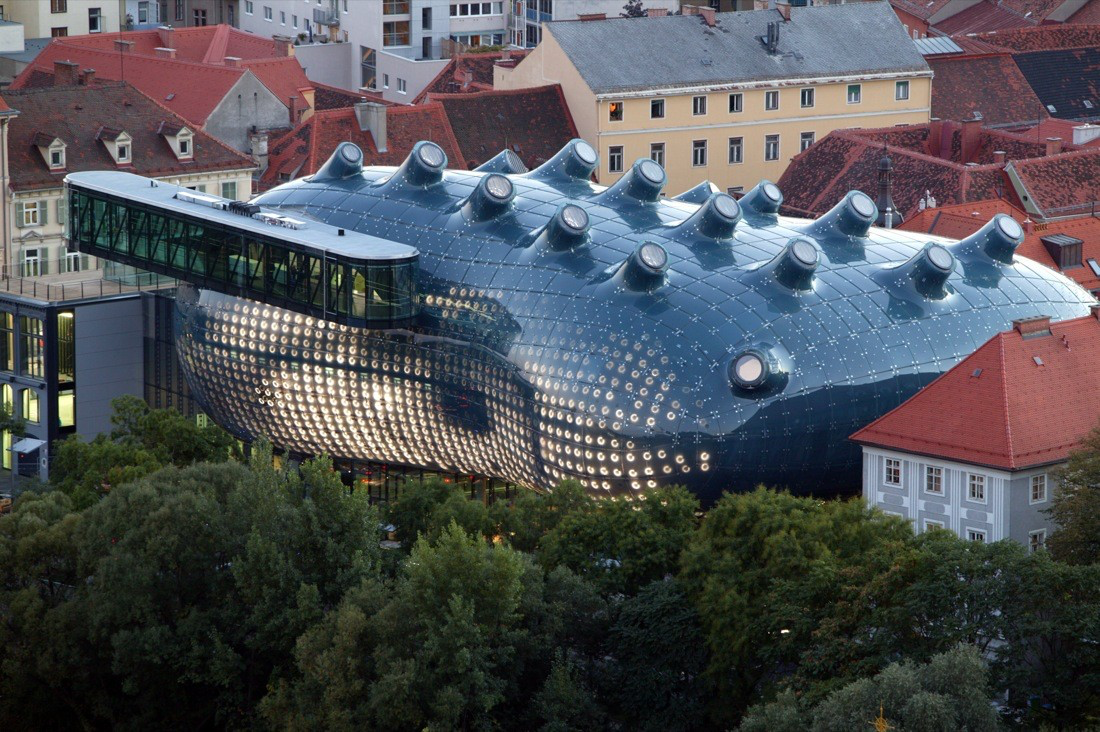
we did build The Kunsthaus in Graz

which could have been one of these drawings

but it’s there 

you can go inside 

it is still working 20 years down the line

and agreeably 

The Kunsthaus in Graz, by Peter Cook

and so then I say 

hey hold it

if you say that this stuff is utopian

what about Graz  

it’s built

if you can

build Graz 

aha you guys

you can build 80% of this stuff 

it’s just that you obey by the critics and the

regular people saying it’s utopian 

You put it aside 

you put it into a kind of

you put it into a pigeon hole that says

oh those sort of architects are utopian

and we architects are normal

the delight I get out of doing some buildings 

it’s to say

screw you 

it can be built

so then i say

I do not want to be a utopian architect

i’m not interested in utopia 

I’m interested in architecture 

I’m interested in the drawings 

contributing towards 

the discussion and language 

of architecture 

and thank you very much 

I wouldn’t mind building some of it

Below are some images of the hand-drawn city landscapes by Peter Cook. From the Louisiana Museum of Modern Art

Obviously all images are courtesy of the artist. 

A lot of Peter Cooke’s work and insights throw me back to my own architecture studies in the 70ies when we were allowed to design buildings that did not have to be buildable.

In the same way, his utopian/reality paradox is central to the ideas I developed as part of The Scaffold, a transdisciplinary learning studio for the Never Normal. The studio gives permission to play with ideas that are not necessarily buildable but that unlock some other kind of less cognitive insight.

Hope you stay on board

Warmest

Petervan’s Delicacies – 11 Oct 2022

As usual, an incoherent, irregular, unpredictable collection of interesting sparks. Handpicked, no robots. Minimalism in curation. Enjoy!

If you can’t get enough of these and want more, you can hang on to the firehose, the extended version of Petervan’s Delicacies in REVUE with loads of videos. Subscribe here: https://www.getrevue.co/profile/petervan

Petervan’s Ride – September 2022

Petervan’s Music Ride September 2022 > almost 90 songs, most new releases, but also some classics > from Ozzy Osbourne to Tamino and everything in between > play in shuffle mode to increase the surprise factor. Enjoy!

Petervan Studios – Update Sep 2022 – Other news

© 2022 Petervan Artworks – Artist and Engineer – created with MidJourney

Here is the latest update on Petervan Studios. The previous update already goes back to February 2022

Professionalization of Petervan Studios Practice

Some days ago, I published a post about this and the launch of my new website and The Scaffold.

As I was very focused on professionalizing my art practice, I did not produce much artwork during that time. On the website, you can discover some of my existing work by selecting a method, dynamic, and outcome. You can of course also sort per container: canvas, video, audio, etc.

As part of the inventory work, I stumbled upon some older works and played around with DALL-E

© 2022 Petervan Artworks – made with DALL-E

© 2022 Petervan Artworks – Prison cell in ProCreate

IN OTHER NEWS…

Exhibitions

Since the last update, I visited the following art exhibitions:

Dhondt Dhaenens, Deurle, April 2022

Berlinde De Bruyckere, Studio visit, Ghent, April 2022

Castle of Laarne, Laarne, May 2022

Storycon, BOZAR Brussels, May 2022

Nick Ervinck, Skins, K.E.R.K., Middelkerke, July 2022

8th Biennial of Painting, Dhondt Dhaenens, Deurle, July 2022

8th Biennial of Painting, Mudel, Deinze, July 2022

8th Biennial of Painting, Raveem Museum, Zulte, July 2022

Jonas Gekhiere, MUSEE, Oostende, July 2022

Christian Dotremont, KMSKB, Brussels, August 2022

Tanya Goelen, KMSKB, Brussels, August 2022

(Un)Common Values, National Bank Belgium, Brussels, August 2022

Nick Ervinck, Studio Visit, Lichtervelde, August 2022

Wim Opbrouck Open Hart, Dr. Ghislain Museum, Ghent, August 2022

Splendid Isolation, S.M.A.K., Ghent, August 2022

Outdoors

We had a fantastic spring and summer. We basically had sunny weather from March till August. At least that is how I recall it. 

Spent quite some time outdoors: some gardening, some walking, some bicycling, some doing nothing. Got a nice tan, and people asked me where I spent my holidays. At home, but many don’t seem to believe me 😉

I have not traveled abroad since October 2019. Cannot say I miss it.

Books

Check out my GoodReads: https://www.goodreads.com/user/show/3085594-peter-auwera

Some highlights:

Ways of Being: Beyond Human Intelligence by James Bridle

Reality+: Virtual Worlds and the Problems of Philosophy by David Chalmers

De Avond is Ongemak by Marieke Lucas Reineveld

And for the artists in this community:

On Being an Artist by Michal Craig-Martin

Art/Work by Heather Darcy Bhandari and Jonathan Melber

Making It in the Art World: Strategies for Exhibitions and Funding

Petervan Rides

Since July 2019, I have published every month a Spotify List with new releases combined with some oldies from the 60ies, 70ies, and beyond. Search for “Petervan Ride” and select “playlists”. Selection is driven only by my personal taste (or lack thereof). 

In July 2022, we entered the fourth year of this experiment. Here is the latest Ride from September 2022

I suggest you play it in shuffle mode, it enhances the surprise experience.

Family

The most important news is that Astrid passed and is now starting her last year in high school! Where has the time gone? 

What else?

Horses

Astrid is still enjoying horse riding very much. And so do I!

I have three roles in the horse riding adventure: being her All Bundy, her taxi driver, and her photographer

Astrid with Cienta

So, in summary, what’s next?

The plan for the next mile is to work/play on:

Support Astrid in her last year at high school

Professionalizing my art practice

Pitch and realize my project “The Scaffold”

So, that’s it for this edition. 

If there is something worth reporting, the next update is for Feb 2023. 

Warmest, 

Petervan Studios – New Website – Launch The Scaffold

© 2022 Petervan Artworks – The Scaffold – created with Stable Diffusion

Since March 2022, I have focused on the professionalization of my art practice. As part of a grant for the innovation of cultural business models, I invited Kurt Vanbelleghem from Amy-Art and Present Future to be my coach in that endeavor.

Kurt is a curator, critic, and publisher specializing in the field of contemporary artistic practices. He received a MA in Psychological Sciences and a MA in Art History from the University of Ghent, Belgium, and a Master in Visual Arts Administration from The Royal College of Art, London, UK. 

Whereas we initially started looking at my artwork only, Kurt was great at pointing out that the output of my artwork was less important than the methods and dynamics applied. And that these methods were also underpinning my other work in the area of interventions, provocations, and interruptions. In other words, all my work was about similar forms of artistic and aesthetic expression and experience. Kurt set me on a path of better articulation of my ambitions and offerings. It also led to a new vocabulary and a new set of aesthetics to describe and share what I do and why I do it.   

I have now consolidated my creative undertakings into Petervan StudioS (plural). 

Petervan Studios is the melting pot of three studios: The Art Studio, The Interventions Studio, and The Scaffold Studio. The Studios have the following methods, dynamics, and outcomes in common:

Methods: Collisions – Layering – Activations – Speculations

Dynamics: Translating – Unsnapping – Reframing

Outcomes: Provocations – Experimentations – Collaborations

The three studios share the motivation and desire for societal, moral, and aesthetic advancement. 

I just launched a brand new website with all details about the three studios: www.petervanstudios.com

The Website is designed by WebIt. Thanks, Ruben, Joke, and team for your patience. Thanks also to Peter, Kurt, Janne, and Tijana from Amy-Art for help with the archiving and API integration.

Below is a quick summary of the three studios

Studio-1 Artworks

This studio is the home of Petervan’s art experiments: a mix of analog and digital artwork and productions, writings, poems, installations, video scapes, soundscapes, recordings, documentaries, and time capsules.

Studio-2 Interventions

These interventions build upon my experience and capability as a translator/interpreter of your specific challenges and designer/architect of intellectual collisions. Most of the interventions involve private or semi-private tailor-made provocations and include: Conversations, keynotes, performances, and curations

Studio-3 The Scaffold

The Scaffold is a brand-new transdisciplinary learning studio for the never normal. This unusual learning studio invites participants into a fresh break from the day-to-day. It allows participants to think, sense, learn, ànd act together with a brilliant, curated non-conformist tribe about a specific collective challenge. Not to solve the challenge, but to identify pivotal insights and a new way to position it.

The Scaffold is made possible through strategic partnerships with nexxworks and Collective Next

We also brought together a coalition of exceptional individuals as advisors for The Scaffold. A unique mix of strategists, futurists, engineers, entrepreneurs, experts in classic and contemporary arts, masters in narrative environments, philosophers, licensed architects, and VR developers.

Please let me know what resonates.

Warmest,