Breaking Hierarchies

Following my post “Who is the composer?”, I got the opportunity to have a conversation with the man himself: Ozark. He told me the story of what happened when he tried to conduct a philharmonic orchestra for a film soundtrack he had written. I did not know he wrote a score for a film, but he did. It is the score for the film Crusade in Jeans and the music is performed by with the Metropole Orchestra from The Netherlands. All professional musicians used to work with artists in residence.

Film_poster_Crusade_in_Jeans

There is some real classical music stuff going on here

As a composer, he knew exactly what needed to be played when and how. He could as well conduct the orchestra himself, no? Or so he thought… But he learned the hard way that doing so was breaking hierarchies. He stepped out of his role as the composer when he tried to be the conductor of the orchestra.

An orchestra is like a ministry. Every unit has a role. The conductor does not communicate directly with the violist, no he/she speaks to the lead of the violin ensemble who speaks to the violist. Ozark brought also copies of the score with him, ignoring that copying the score was the job of somebody from the orchestra team. He could as well have said: “You know what? I found this great tribe of horn players, so they will play the horns this time.” Basically putting the original team in unemployment.

In a reaction of self-defense, the orchestra started playing – well-intentioned – games, sabotaging what Ozark tried to achieve. These games were well-intentioned because the intention was the care of the team.

In Dutch, there is a word “bezorgdheid” usually translated into “concern”, mostly an anxious type of concern. In my sense of Dutch language (my mother tongue), there is also an almost “mother-care” type of concern encapsulated in that word. A team-mother-care about what the orchestra is concerned about, the cohesion they wish to protect. This is not about care for the team, but care/bezorgheid of the team.

I often think back to the old Innotribe days, where we had a fantastic team. In my 2013 post Breaking and Making Teams, I described with quite some cynicism the recipe for breaking successful teams successfully. Remember: cynicism is a knot in the heart.

knot-tree-trunk-84928768

It is a paradox: to innovate, one must have the courage to challenge the status quo, the existing processes, and hierarchies. But on the other hand, a team and a hierarchy have a built-in DNA-like patrimony of craftmanship and care-manship. Breaking that patrimony is a recipe for failure.

One can cut-and-paste the breaking hierarchies metaphor straight into corporate mergers and acquisition scenarios, for example when a successful team is acquired into a new company. Instead of looking how the strengths of an acquired team and its internal language, proceedings, and patrimony can help to imagine new worlds – in other words, making the team even more successful in its new environment – in many cases the CEO is only interested in how that team can help him/her be more successful.

In such cases, we wonder why the team is not willing to share its secrets, wondering why the best folks leave, wondering why there is no team left at all after 1-2 years. We shouldn’t be surprised: we just broke the team hierarchies.

petervan-signature


Design used to be about sensitivity, beauty, and taste

As part of my search for a new job, I was introduced to an organisation focusing on using design-led engagements to support innovation and understanding customer needs (needs, not problems, see my previous post on the tyranny of the problem solver)

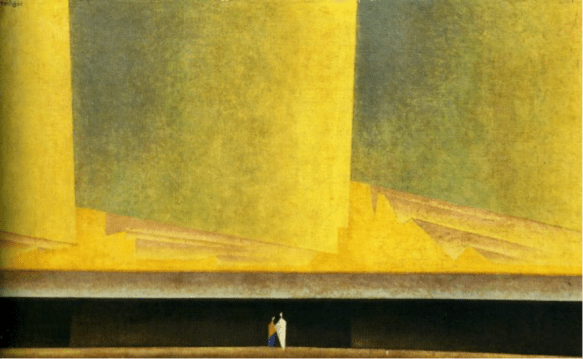
Clouds above the sea

Lyonel Feininger - Clouds above the sea - 1923 - Oil on Canvas

Steve Jobs used to say “it doesn’t make sense to hire smart people and tell them what to do; we hire smart people so they can tell us what to do.”

So, in preparation for the job interview, and to know what to tell the recruiter what to do, I started diving a bit into design-thinking and design-led engagement.

I believe that these approaches are great to create high quality information flows, but that something else is needed than noise-free rapid information transfer.

My good friend and ex-Innotriber Nektarios Liolios kindly pointed out to me during a recent chat that “noise free is not the same as conflict free”.

  • We indeed do need conflict, tension, etc to create flow, movement, change, advancement.
  • But we do need to get rid of the noisy primary motivations of prestige, status, tic-for-tac reciprocity, etc .

I think the key element missing in existing design-led engagements is (great) aesthetics.

As I said some time ago: there should be some ambition of advancement in aesthetics, morality, and spirituality.

I that context I found this great article about aesthetics:

Design used to be about sensitivity, beauty, and taste

The key performance indicator for design has changed from beauty to profit. Measuring design has transformed a handicraft into an engineering job. 

Google, Facebook, and Amazon are optimizing their products for us, as they are optimizing our minds, bodies and our kids for their profit. Humans are slowly adapting to that labyrinth, becoming lab rats of an omniscient industry that adapts to our needs as it is adapting us to theirs.

Labyrinth small V1

Petervan Artwork ©2018 - Hand drawn labyrinth 

Many labyrinths are “meandering”. We need similar meandering in design-led engagements.

We need to bolt-on something upfront that unites, aligns, encourages, and motivates teams at a level beyond the cognitive.

I think I know how to do that.

petervan-signature

The myth of getting out of your comfort zone

I am going to do some shorter, snappier posts, just seeding an idea or an interesting (as in A.F.E.A.R.) point of view.

Google “Get out of your comfort zone” and you will get about 160,000,000 results. That’s solid framing!

comfort zone

But is it true?

My cousin – yes, the senior curator of the Royal Museums of Fine Arts in Belgium – surprised me the other day by stating the opposite: he performs (as in doing his best work) best when he is IN his comfort zone.

Just a couple of days later, I see this Tweet from Niels Pflaeging:

niels tweet

Niels is a management exorcist and a real myth-buster. I always listen to him.

So maybe the trick to do your best work is to find your comfort zone? Or is it all apeshit – or pop psychology – as Niels suggests above?

Let me know what you think.

petervan-signature


The tyranny of the problem solver

still life Song Han

Still life by Song Han

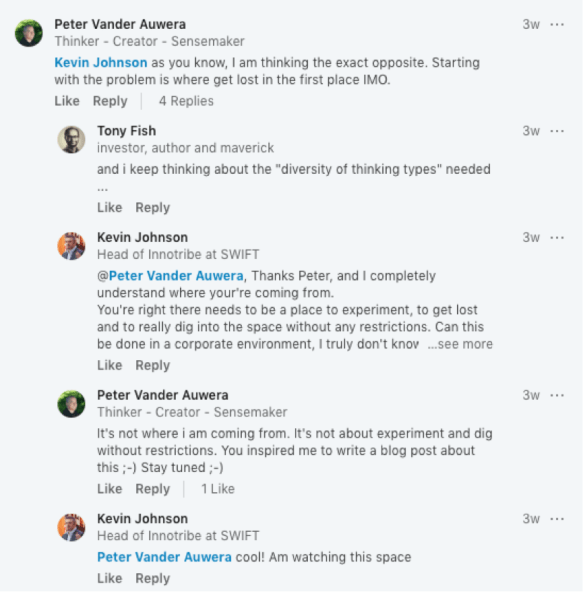
The trigger for this post was an article on the nexxworks site about right & wrong in corporate innovation. The first paragraph focuses on the need to obsess on solving a customer problem. My friend and ex-colleague Kevin commented via LinkedIn:

“Fantastic article! I’ve been banging on for years about starting with the problem, that people care about but this is so much more articulate than me.”

We started a quick exchange on LinkedIn:

linkedin with kevin

The nexxworks article is about much more than problem solving, but problem-solving is what I will be focusing on in this pamphlet/manifesto for creating what you want. As that is where I am coming from.

Not being problem focused seems almost a blasphemy these days. But we don’t realise we have been mis-framed for decades to be problem solvers and solutionists (“there is an app for that”).

It already happens in start-up pitches to start with. Start-ups are coached to pitch in a standard way. It goes back to Guy Kawasaki’s 10 slides to pitch: start with the problem, what is the solution, the team, the business model, etc, etc.

There are the Maddlibs to perfect your one-sentence-pitch. There even are Maddlibs to generate your strategy statement, based on a collection of blah-words (Thx to @swardley).

containers

Everything is “modelled” and vocabulary is standardised: we need MVP’s, lean start-ups, scale-ups, etc. It’s cool, but you then have to explain this new vocabulary to the rest of your troops.

Everything is “role-modelled”. And we get inspired by always the same use cases: Haier, Semco, Apple, Amazon, Uber, etc. We don’t seem to realise that these are exceptions. Only exceptions make the news. The exceptional is normalised, check out hyper-normalisation of Adam Curtis, albeit in another context.

“In the film, Curtis argues that since the 1970s, governments, financiers, and technological utopians have given up on the complex “real world” and built a simple “fake world” that is run by corporations and kept stable by politicians.”

Everything is based on a Silicon Valley solutionist style, a reactive/responsive orientation, something our MBA’s and entre/intra-preneurs and leaders/managers have been trained for at nauseum: define the problem, articulate the solution, make a plan to execute, execute the plan with rigor, and be effective and efficient in doing so.

It may be a style semantic. Ex-Trump-PR-guy Sarramuci said: “you may dislike his (Trump’s) style, but he is very effective.” But one can be very effective at doing the wrong thing. One can be very effective at being a problem solver.

I think it’s more than about style. We have become so politically correct. To please everybody, we say things like “It’s probably a bit of both”. That way, confusion about the real intention creeps in. I say we must be opinionated, and we must be judgemental, we must choose sides.

taleb skin

We say those politically correct things because we don’t have skin in the game. Read Nicholas Taleb’s latest on that subject. For that reason Taleb hates consultants, professors at high schools, some managers and executives, and by extension heads/consultants of innovation. They can say whatever they want, it has no consequences, at least not for their existence or that of the organisation they represent.

I recently heard Nektarios Liolios from Startupbootcamp venting his frustrations on stage, as all the innovation efforts of the last decade have apparently not changed much, or at least not shipped anything substantial. They even start bypassing heads of innovation and innovation teams in general, as they are more and more seen as barriers between customers and the business units. They want to solve real business problems.

Innovation-powerhouse-eindhoven-janne-van-berlo_dezeen_2364_col_4

Innovation Powerhouse Philips Eindhoven – Architect Janne van Berlo
A renovation respecting the building's patrimonial structure.

But I am afraid that a focus on real business problems won’t help. The only way to enable real change and lasting innovation is changing the structure of an organisation.

Structure is about more than reporting lines and P&L units. Structure is about the coherence of narrative, motives, and governance.

  • The narrative is about purpose, about patrimony (tacit knowledge), “just-do-it” kind of mantra, action oriented. A narrative is rallying the troops to play the game in a certain way, in a certain context. In war, the game is to win. In business, I would hope it’s about more than winning a finite game, and there is some sense of moral, aesthetical and spiritual advancement, an infinite game across generations.
  • Motives are about why we are doing this. There are primary/primal motives like prestige, promotion, reciprocity and tic-for-tac rewards/punishments. Once you add moral, aesthetical, and spiritual advancement, you are driven by second level motivations that have to do with care, tradition, craftsmanship, beauty, proportion, etc. In that sense, I believe that problem solving is a primal motivation. A more advanced intention of creating something great is a second level motivation. So the question should not be “what problem are you trying to solve?” but “what do you truly want to create?” If not, “solving problems” becomes a doctrine, just like “customer first” is a doctrine, or “FNAO”, or “Lean” or “Agile”. Applied across the board without thinking whether it makes sense. Being effective at doing the wrong thing.
  • Governance is about how you organise and coordinate high quality flows to play the game in context. This is what real leadership is about. In that sense, innovation is a discipline. And there is nothing wrong with discipline. All great things/products/artworks have been a result of discipline. It is about “getting things done”. Jan Chipchase has an awesome fieldbook and practice for revealing – usually in plain sight – real customer needs. He articulates these needs as “desires on getting things done”. “Getting things done” is something quite different than “solving a problem”.

Artists don’t solve problems. Neither do real innovators. Did the iPhone start with solving a problem? Did Amazon ? Did Facebook? I don’t think so. They started with what they wanted to be, and what they wanted to create. They started with structure, if anywhere at all. But not with the problem.

A customer is IMO not looking for a problem to be solved. A customer is looking for a superior experience.

With that perspective, one could ask “Can organisations change?” to make that happen?  Or “Can people change?” and the more critical question, “Why would people change?”

sheep

Sheep in boxes - drone photograph by Dean Lewins

The answer again is structure. Change the structure, and change will not be hard, it will be natural.

That’s why the whole idea of the dual approach (separation castle/sandbox, or core/innovation) is flawed. It is the wrong structure.

The preferred structure would probably more resemble a Khasbah or Souks, an open city plan with many innovation cells/areas with maximum transparency for all, so that everybody is inspired and motivated to join those projects too. And “brutal force” (see below).

It’s a paradox of course. Already in 2002, Storey & Salaman said in their Theories about Process of Innovation:

“paradox is at the heart of innovation. The pressing need for survival in the short term requires efficient exploration of current competencies and requires ‘coherence, coordination and stability’; whereas exploration / innovation requires the discovery and development of new competencies and this requires the loosening and replacement of these erstwhile virtues”

Problem-solving is like design thinking: it is fundamentally conservative and preserving the status quo.

“Rational-experimental problem solving begins with a presumption that the search for a solution starts by relying on existing data about the problem. Design thinking, in a slight divergence from the original model, suggests instead that the designer herself should generate information about the problem, by drawing on her experience of the people who will be affected by the design through the empathetic connection that she forges with them”

Remains the question: can it be done in a big or conservative organisation? Yes, of course. And it is done through what I would call the “brutal force attack”. It is the only thing I have seen working in a bigger organisation to actually SHIP innovation into the market and seeing it picked-up by a substantial part of the target customer base.

The brutal force attack requires two things:

  • A visionary that is able to articulate in a compelling way what he/she wants to create (and it does NOT start with the problem to be solved). Often this person is somewhat hidden in the fabric/structure of the organisation
  • A CxO, usually a CEO with metaphorical balls who will do whatever it takes to make the vision happen. With skin-in-the-game. Even against some part of his/her executive team and/or against part of the Board. His/her position may be at risk. He/she is committed like a pig. (For an omelet with bacon, the chicken is involved, but the pig is committed)

You then build a team to make this happen. A squad of the best of best in your company. And the project lead has a direct red telephone line to the CEO to call in case somebody puts barriers or antibodies to make the vision happen. Usually, it suffices just to threaten to pick up the red phone…

It can be as simple as that: just do it. Just build and ship what you want to create.

If you want to have some romanticised innovation story to go with it, sure, go ahead and organise start-up competitions, create innovation labs, bootcamps, accelerate, incubate, and make a lot of noise and corporate communication about it. Just be aware they are a lot of fun, give a lot of exposure, prestige, and status, but are not needed.

That’s why my mantra is “To inspire other people to dream”. To dream and imagine what they truly want to create.

Like in this Nike promo:

Don’t ask if your dreams are crazy. Ask if they’re crazy enough.

Don’t buy the tyranny of the problem solver. Don’t settle to be a problem solver.

Create what you really want.

petervan-signature


Get out of your prison cell!

magritte behind bars

Magritte behind bars – Digital Mix - © Petervan Artwork 2018

On 12 Sep 2018, I will do a live performance at the Finnovista Summit in Mexico-City. The theme of this year’s event is “Listen, Learn, Lead” and the title of my performance is “Get out of your prison cell! – An artistic reflection on listening, learning, and leading”

UPDATE: here is a link to the slide-deck I used during the performance: https://www.slideshare.net/thepierre/finnosummit-mexico-2018-petervan

Manoeuvring through this theme, I have prepared a new performance, recuperating some older material, but also with new elements from my artwork series “Prison Window” and other metaphors capturing more recent reflections and insights. From a stage-crafting perspective, I use a multi-media approach, including props on stage, a live camera feed, some vestimentary attributes like hats and masks and drums, and a lightning script for the light technician.

This post is however NOT about the stage experience, which is rather artistic with self-created visuals, soundscapes and poems, hopefully resonating beyond the cognitive. This post is about the underlying thoughts, messages and insights. Preparing a talk, a blog, or a presentation forces you to get your ideas together and structured. And as usual, by refining and experimenting, I sort of stumbled upon most of these insights.

Otto Scharmer meets Simon Wardley

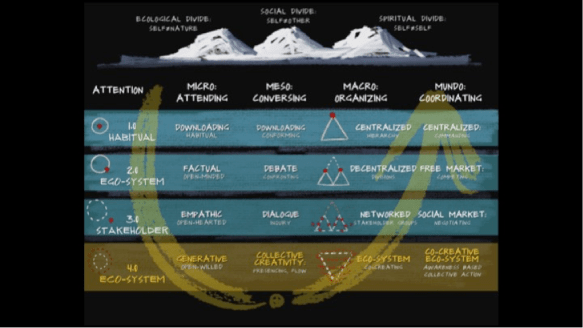
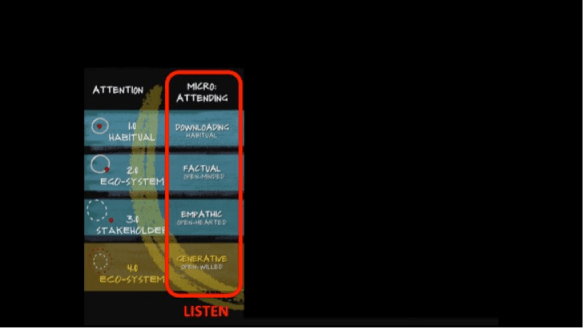
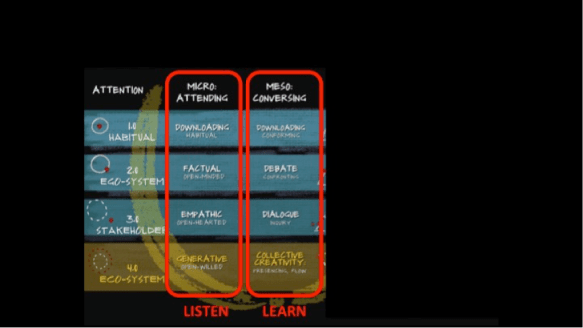
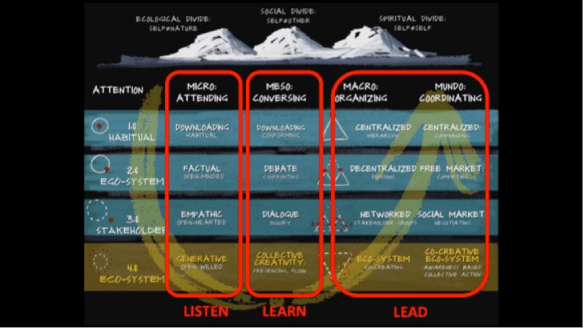
As many of you know, I am a fan of Otto Scharmer’s work on Theory-U and the accompanying ideas in his book “Leading from the Emerging Future: From Ego-System to Eco-System Economies”.

otto clean

Key image from Leading from the Emerging Future – Otto Scharmer

In essence, Otto Sharmer’s model is about increasing the levels of quality of attention in attending, conversing, organizing and coordinating. It is about getting better at these along higher levels of consciousness. For example, attending at the 3.0 Stakeholder Level is of a higher quality than attending at the 1.0 Habitual Level.

That’s a mouthful, and although we don’t have time here to go into any depth into Theory-U (read the book), it is about letting emerge your future state from being your true self.

I combined this with the insights of Simon Wardley, who – if we discount several thousand years of military history – I would label as the godfather of situational awareness and the accompanying situational awareness maps.

wardley tweet

He labels them as “topographical intelligence in business”. Simon positions his work in the “observing position and movement” part of John Boyd’s OODA model

Wardley circle

Sun Tsu meets John Boyd – courtesy Simon Wardley 

Except for Magritte-behind-bars, none of these visuals are used during my performance, but my metaphorical narrative on stage is in essence about getting better. But getting better at what? And along which dimensions? In what direction?

  • It is about letting emerge a better way of listening, learning and leading.
  • It is about letting emerge a better way of observing, game-play, deciding.
  • It is about letting emerge a better way of attending, conversing, organizing and coordinating

Let me guide you through this forest.

Listening

“If you are very very quiet you can hear the clouds rub against the sky”

Raul Gutierrez, Poet

Listening is usually about hearing sound, spoken words, music. In my performance, I expand listening to observing in general. Observing sound, time, location, movement, structure, memory, and patrimony.

listen

Listening is about observing and attending. Getting better at that is making progress along the levels of quality of attention. Open willed listening is better than habitual listening.

Learning

“Assume that the person you are listening to might know something you don’t”

Jordan Peterson

Learning is usually associated with studying, going to a course or training, follow a workshop. It is usually associated with downloading or acquiring new information, knowledge.

In my performance I share the ladder of learning, from innocent to mentor to expert to… God! I talk about learning in the wild, natural emerging apprenticeship, and evolution with/without skin in the game. John Hagel refers to some of this as “scalable learning and tacit knowledge.”

“Tacit knowledge trumps explicit knowledge. The latter can be articulated and written down and it usually takes time before it can be expressed clearly and coherently to others. Tacit knowledge is within our heads and we have a hard time even expressing it to ourselves, much less to anyone else. Because tacit knowledge is generally newer knowledge, emerging from new experiences that we’ve encountered, it’s often the most valuable knowledge, providing us with insight into how to act in a rapidly evolving environment. Tacit knowledge becomes accessible through shared practice

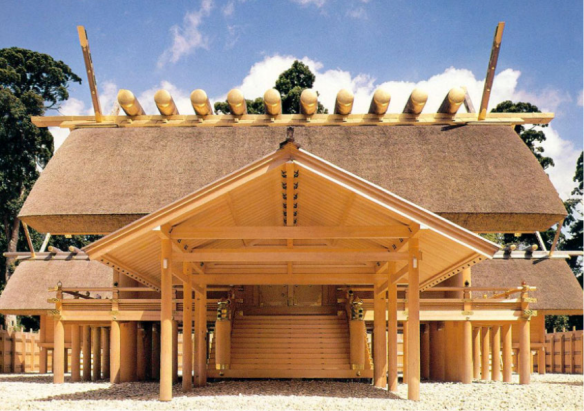
Ise Shinto

Ise Shinto shrine in Japan

In my performance, I metaphorically refer to the Ise Shinto shrine in Japan, which is rebuilt every 20 years for around 1,300 years as a way to preserve process knowledge aka tacit knowledge.

learn

Learning is about game-play and conversing. Getting better at that is making progress along the levels of quality of attention. Learning through doing in the flow is better than learning through downloading information.

Leading

The first job of a leader is to learn. Only then can a leader do their second and third jobs — care and love ”

Umair Haque

Leading is usually associated with leaders and followers. I wrote a post about “The End of Leadership” long time ago.

In my performance, I focus on different types of archetypes of change agents, and the evolution from the forbidden, through the rebellion into creation. I talk about the coherence of narrative, motives, and governance. All addressed in previous posts on this blog.

lead

What is new is that I could now map “leading” to the “organising & coordinating” columns of Otto Scharmer’s model or to the “leadership” quadrant in Simon Wardley’s circle.

Leading is about deciding, organizing and coordinating coherence of narrative, motives and governance. Getting better at that is making progress along the levels of quality of attention. Leading in awareness-based-collective-action is better than leading in command-and-control.

Personal reflection

During my performance, I am inviting the audience for a moment of personal reflection after each chapter, with the explicit instruction that they will NOT be asked to report back.

This is about personalized learning, letting humans internalize with attention for privacy and intimacy. Learning as a personal secret.

“All our choices are among life stories that end with our individual deaths.”

Venkatesh Rao

Every reflection moment also challenges the audience in taking personal leadership for stepping out of the prison cell, hopefully in a series of choices among life stories. Every choice is a choice between inside or outside of the prison cell.

So, please, get out of your prison cell!

Warm regards,

petervan-signature

Innovation Apes**t

Holiday is almost over, and soon the corporate machinery will kick-in again in full swing, with plenty of exciting announcements about new innovation initiatives, conferences, books, accelerators, startups, scale-ups, and what have you.

“How serious is your innovation?” is the title of a panel I will moderate at the Finnosummit 2018 on 12-13 Sep 2018. I identified a couple of angles for discussion that you might use yourself in assessing your own innovation efforts. Self-assessment of innovation is of course not new, and I already wrote several posts on this topic before:

But in this post, I would like to go beyond the tactics and the aesthetics.

The aesthetics in the video are great, and the background of the Louvre museum gives it some extra credibility, but from a historical point of view, it is all plain wrong and misleading. S**t sold as culture.

If you are a regular reader of the awesome blog of Leda Glyptis about innovation in financial services, you will soon get depressed, but what she describes is unfortunately reality in most organisations. The essence is that most innovation in bigger organisations is just Apes**t: it is not about getting good new stuff into the market, but it is all about looking good and ticking the box during annual reports and annual events. It’s marketing, and that is fine, as long as you know it and don’t deceit yourself that you are doing the real thing.

In this Apes**t world, innovation is a Brand Of Smiling Young Successful Energetic Good Looking People reflecting sentiments of cool, hip, young, dynamic, agile, fast moving, energetic, smiling, fun, and rule breakers.

building-stronger-more-positive-and-effective-teams

This Innovation Apes**t is now almost in the same category as “Fake trumps reality” a.k.a. fantasies to compensate for unfulfilled needs in real life.

Innovation “teams” are often very small teams compared to the rest of the organisation, and deeply buried in its reporting lines. But those very few are able to make a lot of positive and hyped noise, while in reality the rest of the organisation is still in zombie state, refusing at all times to touch (don’t event talk about cutting) the branch they are sitting on or the breast that is feeding them. Why would they? They are in the comfort zone of regular pay-checks, bonuses, perks, etc. And the rare individuals that have the guts to step forward get slashed in annual appraisals because they don’t focus on their objectives which are all focused on the core of the business, or on some vague management/leadership principles that look nice on a slide deck or annual report, but in reality are lip-service at best. It has come to a point where what innovations teams talk about is not what the organisation is focused on.

I have come to distrust anything that looks good, too good/neat to be true. The truth is always messy, and in a corporate environment the good usually hides the ugly.

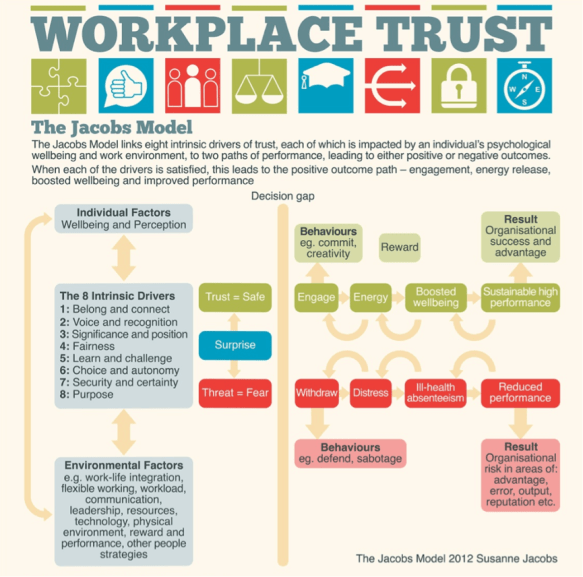
Look at this example about employee motivation, typical HR Apes**t slideware.

Workplace trust hr apeshit

Humans just don’t function this linear/matrix type of flow. Humans are messy, and that is a great thing.

Therefore, distrust anything that fits a 2×2 matrix, because it is an oversimplification of reality, and does not include “movement” and “tempo”, unless you draw an arrow from one quadrant to another 😉

In general, also distrust all consultant models: they also suck because besides the gross simplifications of reality they also don’t take into account humans’ motivations. Most human interactions (words, sounds, tone, dress, posture, etc ) are status transactions, to increase one’s status compared to the other (opponent). Most motivations are about reciprocity, prestige, self-serving biases, power, hypocrisy, arrogance and entitlement.

All those models also suck because they forget about patrimony, organisational memory, and culture being in essence recorded/internalised know-how.

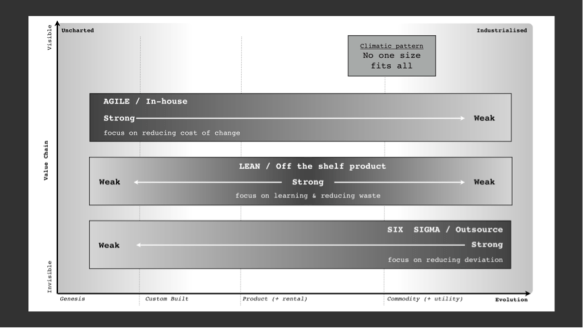
Doctrines are a category in their own right. Lean, Agile, and Six Sigma are in the category of “Doctrines”, so are “Customer first” and “FNAO” (Failure is not an option/Fear is not an option). The big four sign big contracts for rolling out Lean, Agile, and Six Sigma programs in organisations. They have “knowledge transfer methodologies” where they run the program themselves with their junior consultants for the first year, and then transfer the knowledge to in-house “navigators”, “coachers” or other fancy titles to keep the whole organisation busy and in defence mode for another 1-2 years.

Agile swardley

Doctrine One Site Fits All - Courtesy Simon Wardley

The problem is when one or the other becomes a one-size-fits-all doctrine, usually to obfuscate an unspoken organisational objective to do with cost control (by reducing cost of change (agile), by reducing waste (lean), by reducing deviation (six sigma), and sold under the innovation umbrella.

Once these programs come to an end, the focus quickly fades out – because in addition the whole organisation is now exhausted – and another year later, we are back to business as usual. Until the next consultant or management guru/book comes along.

This is the famous oscillating pattern so well described by Robert Fritz who states that structure drives everything and basically that any lasting innovation effort is about changing the structure of the organisation. And structure is not only about organisational structure (like organograms and reporting lines). It is about coherence between narrative, motivations and governance.

Some good dimensions to assess your Innovation Apes**t are:

  • What innovation have you SHIPPED lately (let’s be generous and look at last year, not last weeks)?
  • How did that contribute to the bottom line?
  • Where is the Skin-in-the-Game?
  • What % of your revenue is invested in innovation? If less than 5% you are definitely not serious. Some startups have probably more bootstrap money then your whole innovation budget together.
  • What have you changed at organisational level?

strategyzer

Courtesy Alex Osterwalder - Strategyzer
  • Why is your head of innovation NOT reporting to the Chairman of the Board? Yes, you read that well: Chairman of the Board and not CEO.
  • Why don’t you have a Chief Entrepreneur NEXT to the CEO?
  • What have you changed at Governance level? Have you simplified, or just added yet another layer of control and vetting to make it quasi impossible for your innovators to get anything through the different gating levels?
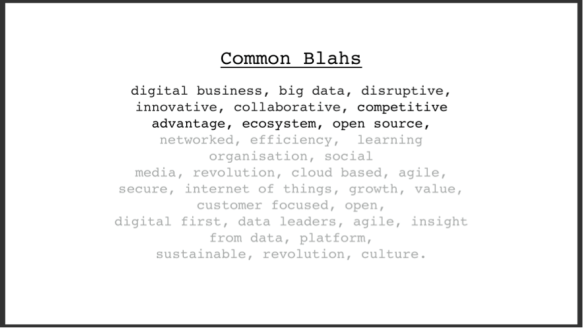
  • What is the name of the (innovation) play you are playing? This is about the clarity of your innovation intention. Describe it in 10 words max without using any of the Blah-words. Are ALL executives and ALL board members 100% aligned on this? Or have you left the doors open for organised sabotage?

blahs

Common Blahs (in strategy) - Courtesy Simon Wardley

For financial services, you can add Blockchain (or whatever semantic variation such as DLT), AI, RegTech and the Data Revolution to that list.

So, what is your innovation about, if you can’t use any of these blah-words? Is there anything tangible or even intangible left when you peal this onion? Curious to hear your thoughts and experiences.

petervan-signature

Petervan Productions – Oct 2017 update

IMG_5093

Bicycle ride Sep 2017 - South of Aalst - Flanders

Summer is over, autumn settles in, leaves are falling but here and there some late sunflowers reminding us of the bright sun and the fertile soils. I am now my last 3 months of my long-term sabbatical as Petervan Productions. If you are interested in my developing journey, my Jan 2017, March 2017 , May 2017 and Aug 2017 updates are still available.

The House project

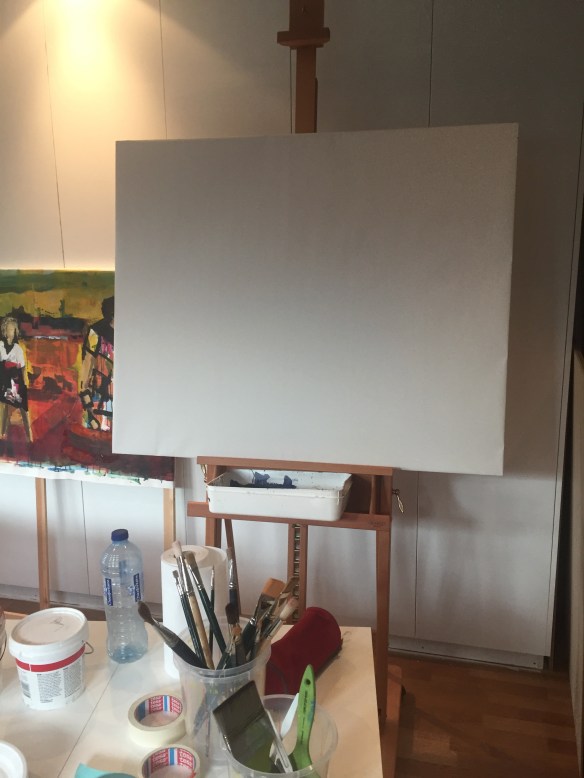
Our house move is now done and we are fully settled. As planned, the art studio is complete now. The easel has landed:

IMG_5031

Spotless easel in Petervan Productions studio

The Artschool project

Initially the plan was to join the art academy of Aalst, only 2 miles away from where I live. But after the first session, it felt like a mismatch: very limited space to work, a quite older population than what I am used to, and I did not feel a click with the coach.

Upon recommendation of my coach of the last two years (Ann Grillet), I decided to do some better homework and I checked out about five other academies. In the end I decided to join the Royal Academy of Fine Arts in Ghent, one of the oldest academies of the Low Countries (South Netherlands and Flanders). The academy was founded in 1741.

On my first day I felt a bit like a Flemish Primitive: I learned BTW that the term Flemish “Primitive” has nothing to do with “basic” or “archaic” but is related to “first” or “early”, because the Flemish Primitives were innovators in finding the right compounds for paint to use on panels and canvas. In other words: how to make innovation stick!

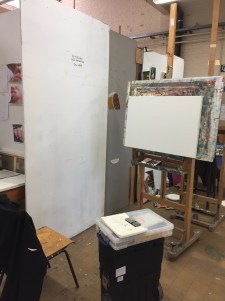
IMG_5145IMG_5150

Royal Academy Ghent painting studio and my blank personal corner

I restarted painting, and upon suggestion of Ioana Guiman from Allevo (thank you, Ioana!), I started experimenting with timelapses of some of my paintings. It is an interesting format: you can pause the video where you like it most and then make a sort of personal still and print-out.

Here is one of the painting “Girl Dancing in Flemish Fields”. I did a quick soundscape for it as well, so volume “on” is recommended.

The falling of the leaves and the autumn humidity of the soil inspired me for a poem:

Herfst

Vervaagd

Het beeld van zondag

Een boomgaard vol fruit

Warmte onderhuids

De zoete hap vergeet de kleur van zon

Vliegensvlugge paardebloemen

Verstrooien nog snel het land met hun laatste zaad

Te laat

We moeten zoeken nu

naar een warm nest

in die berm van oneindige mildheid

Apple trees with red apples

Trees with red apples in an orchard


Autumn

Blurred

The bust of Sunday

An orchard full of fruit

Warmth under my skin

The sweet mouthful forgets the color sun

Speedy dandelions

Spawn brisk the land with their last seeds

Too late

We have to find a warm nest now

In that soft shoulder of endless indulgence


And here is another new poem “Horse Riding without Bridles” . In essence, the poem is about personal freedom.

IMG_5144

Quote by Kurt Vonnegut - Found in Royal Academy studio on kitchen wall

The Performance project

As mentioned in my August update, I was invited for a gig at FinnoSummit in September in Mexico . Some sort of  keynote, including some elements of my performance “Tin Drum is Back”. The talk is about structural change and archetypes of change agents. It is very much related to my research about Good Change – Bad Change (more about that later).

FinnoSummit was scheduled as a two-day event on 19-20 Sep 2017, but at 13:14pm on day one, the 7,1 magnitude earthquake hit, and in the end the whole event was cancelled as the venue could not get clearance from the authorities to re-open before the appropriate stability checks of the meeting location.

Although experiencing a 7,1 quake is quite an experience in itself – I was sitting in the top of the 1000 PAX concert hall shaking at least 50cm from left to right –  I was most struck by the huge wave of solidarity throughout the city by all layers of the population, helping the rescuers and the victims with food, water, blankets, etc…

It made me think of “The Intensity to action of the Positive Archetype” in the nice post about systems thinking by @LeylaAcaroglu

This occurs when agents are motivated to take action for the collective benefits due to an intensely focused experience, as was the case in Mexico City after the earthquake last week. The focused intensity of the need to act and the physical actions of many agents create a reinforcing feedback loop of contribution, all dedicated to the collective whole.

The talk also went into the topic of patrimony and spaces of memory, and I will update the talk with the earthquake experience of damaged patrimony, the emergence of commons, self formed solidarity brigades, and “moles” (the name of the special rescue forces that start digging into the rubble of the quake.

The organisers of FinnoSummit have kindly re-invited me to do the premiere of this performance at their Miami event on 9 Oct 2017. The venue is again stunning: they selected a place called “The Sacred Space”.

Sacred space Miami

The Sacred Space in Miami

The Deep Change project

Patrimony is one of the components of a research I started some months ago on “deep” change. Check out the previous posts here, here and this one where I highlighted the importance of patrimony and its combination with contemporary. Or the respect of the memory of an organisation and its combination with the DNA of innovation.

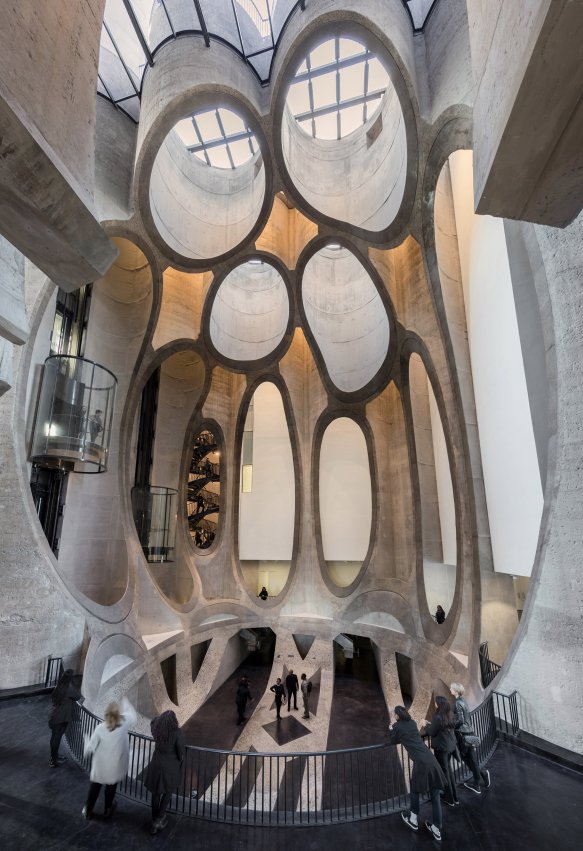
heatherwick-architecture-cultural-galleries-v-and-a-south-africa-interior_dezeen_2364_col_0

Zeitz Museum of Contemporary Art Africa, by Thomas Heatherwick Studio

Although the term “deep” is a somewhat glorifying term – as glorifying as “meaningful” or “authentic” – it has some meaning as the change I am trying to describe probably has its source in the more deeply wired connections in our brains and being fully conscious.

The plan is to come up with a body of work, describing what is deep change, to articulate the levers to accelerate deep change, and a more tactical set of recommendations on how to get started and keep going. The format of that body of work is not decided yet, but it could go from anything like a publication up to a performance and/or experience expedition, as I believe learning happens best through experience and not through teaching.

For this project – funding permitted – I intend to do 10 “in residence” immersions, complemented with additional interviews with a collective of leaders, visionaries, artists, craftsmen, designers and producers.

In essence this is a sensemaking expedition on the what and the how of high quality connections and long lasting cross-generational structural change that goes beyond innovation tactics such as bootcamps, start-up competitions, accelerators, incubators or whatever these concepts are called these days.

I have by now a quite solid outline in place and feel ready to get this one going.

Sponsorships

There are different kinds of sponsorship available for the Deep Change project. Please contact me in private if interested.

techonomy 2017

On a separate note, I would love to combine my FinnoSummit Miami trip in November with one of the best conferences in the world: Techonomy. I believe many of the topics on this year’s agenda could be solid anchor points for the Deep Change project as well. It would be great if somebody would be willing to sponsor my attendance. Let’s discuss what sort of deliverable you’d like in return. Please contact me in private if interested.

What’s next?

During Oct – Dec 2017, the plan is to work on:

  • FinnoSummit Miami keynote/performance on 9 Nov 2017
  • Covering Techonomy (pending sponsorship)
  • Continue the research on deep change
  • Get some blogs and reflections published
  • More disciplined agenda again

Permeke - De Vespers - Cropped

Permeke – De Vespers – 1927 - Oil on Canvas – 128x149cm

That’s about it for this edition. If there is something worth reporting, next update is for Dec 2017. Looking forward to hearing from your latest adventures as well.

As I have increased my social media activity, some folks think I am back at work. I am not. I enjoy the silence, and try to focus on my 4 priorities: Deep change research project, performance, artwork, and experience expeditions (events). If you have anything interesting or related to one of these domains, please contact me.

Warmest,

petervan-signature

I am in the business of cultivating high quality connections and flows to create immersive learning experiences and structural change. Check out: https://petervanproductions.com/


Patrimony, Spaces of memory, and Memory palaces

Musikheim, main hall, Frankfurt:Oder, 1929 He befriended fellow modernist Walter Gropius, and helped draw up the curriculum for Gropius_s design school, the Bauhaus Photograph- © Ate

Musikheim, main hall, Frankfurt/Oder, 1929
The Bauhaus Photograph- © Atelier Leopold Haase & Co

A couple of months ago a started a research on “deep” change. Check out the previous posts here and also this one where I highlighted the importance of patrimony and its combination with contemporary. Or the combination of the core organisational DNA with the DNA of innovation.

Although the term “deep” is a somewhat glorifying term – as glorifying as “meaningful” or “authentic” – it has some meaning as the change I am trying to describe probably has its source in the more deeply wired connections in our brains and being fully conscious, as opposed to the western consciousness – starting more or less with Pythagoras – which is anchored in a two dimensional, linear either/or Boolean consciousness.

With my background training as an architect, I have probably developed a greater multi-dimensional sensitivity about spaces, and I stumbled by accident on the notion of space and/or structure as a store for memories, or wisdom if you want.

Lately, I am noticing plenty of videos that use connected particles moving around in some kind of grid, creating patterns of movement.

Here is one video by futurist Gerd Leonhard about the tension Technology vs. Humanity and the connectedness or over-connectedness of humans and things.

The moving grid/nodes representations made me think of some artwork I discovered lately by visual artist Simone Reuss on spacial relations. The original post and background is here, but I made my own little animation with it and added a self-composed soundtrack. I made it as part of a brand new presentation/performance on the topic of “deep” change.


Spacial relationships may be one of the aspects of being human that we are losing by using too augmented reality. Like you loose your physical orientation skills by driving/walking around all the time with Google Maps or GPS driving.

I like the idea of human movements creating invisible spaces of memory. Leaving traces of flows and movements.

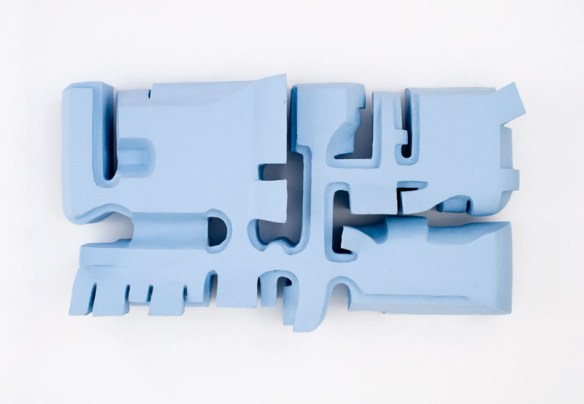
In the second part of my short movie, you will see a drawing documenting human flows in an office building. How humans cut corners, how their movements are dictated by the structure/floor plan of the office. What I really like is how the artist made 3D prints in silicone of these patterns. It is as if the 3D print object is a store of memory of the movements and the structure.

02_plocka_movementspace_simoneruess_2012

Movement Spaces - Silicone 3R print - Simone Reuss - 2012

One can of course question what came or should come first: the structure influencing the flow, or the flow influencing the structure? I remember some Californian University experimenting with spaces with no walls, and let the users define “as-they-flow” where the separations should be.

Fluidity seems to always find its best structure

Flow happens first, it influences the structure and determines the capacity of the structure to further enable connections.

But that structure in its own terms then also becomes patrimony. A memory space. A tool to memorise and remember the patrimony memory of a talk, a plot, a corporate narrative, or a corporate DNA.

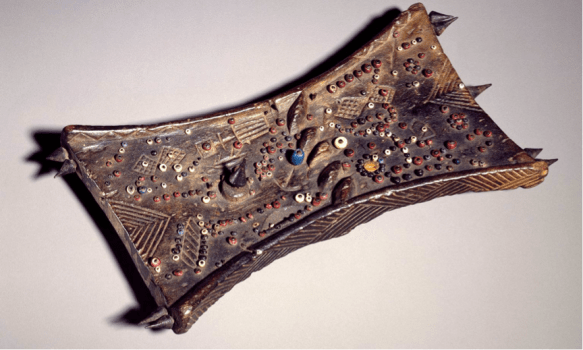
memory spaces

lukasa memory board. Courtesy Brooklyn Museum/Wikimedia

I learned that “Memory Palaces” are indeed an old mnemonic technique to build places of memory. Check out this great post about “Memory Palaces”.

Cultures without writing are referred to as ‘non-literate’, but their identity should not be associated with what they don’t do, but rather with what they do from necessity when there is no writing to record their knowledge. Cultures without writing employ the most intriguing range of memory technologies often linked under the academic term ‘primary orality’, including song, dance, rhyme and rhythm, and story and mythology. Physical memory devices, though, are less often included in this list. The most universal of these is the landscape itself.

It is about recording knowledge, or even better know-how, through experience, and not because being told/teached to do so.

Culture is recorded know-how.

Is there a way to “design” the such spaces of memory? Joe Brewer has done some solid work with his Culture Design Labs, laying the groundwork for a design science of intentional social change to rapidly evolve our systems of government, the practices and structures of market economies, pathways through educational institutions, and journalism models in the media. 

1-3UloFel_nyidL8w-feEsCw

Not as some loose theory of change, but by creating a rigorous scientific model. That’s interesting and refreshing: looking at change as a science, not as a theory.

Every story, every organisation has structure. How did that structure come into being? How do we change structure? How do we change flows influencing that structure? Or as Jean Russell says: how do we cultivate flows?

Hope it sparks something 😉 Cheers!

petervan-signature

I am in the business of cultivating high quality connections and flows to create immersive learning experiences and structural change. Check out: https://petervanproductions.com/


No innovation without the connection with the world of art

storyclub petervan


In June of this year, Raf Stevens (RS) invited me for an interview as part of his StoryClub Podcast series. The interview was in Dutch but i made this English transcript out if it. For those interested, it’s a good summary of my thinking and mood halfway my sabbatical. The different rhythm of the sabbatical has also softened my voice. And I like how Raf kept the silences in the interview. Emptiness is sometimes the platform for resonating content… Enjoy or start crying ;-).

Part of these reflections will be integrated in my mid-Sep keynote/performance at the Finnovate FinnoSummit in Mexico City.

PV: If there is any form of consistency in my story, that would be in the word “rhythm”.

RS: I spoke with Peter Vander Auwera (PV)

PV: I have to be very careful that I am not creating a story – which also would be ok – but I just want to indicate that I have the sensitivity not to invent a story just to make the whole thing make sense. In English there is a term for this: confabulating a story. To make – with hindsight – sense of and for myself and others.

RS: Peter Vander Auwera is a thinker. He has been thinking a lot about innovation and change. But he is also a creative doer. He makes paintings and writes poems. At first sight a strange combination. But then you don’t know Peter.

PV: I am in a sabbatical right now. Before this, I was enjoying lots, lots of freedom to create – together with others – a community. We called it a “tribe”. An “Innotribe”. A tribe of innovators in the financial industry. And throughout that journey my focus has become more and more on the creation of a sort of events where people come together in a coherent setting around some content themes. In fact, that has become my main expertise. I rolled into it, and it has become the place where I was meant to be.

RS: Peter works with SWIFT. An international financial services organisation. Within this company, Peter co-founded a very inspiring initiative: Innotribe. A community where financial leaders and big thinkers of today gather to explore how they can create a better world. With Innotribe, Peter brought together these people in what he calls “high quality meeting platforms”. To learn from each other, to start conversations, to dare dreaming again.

(Music)

RS: Peter lives and works on the intersection of business transformation and art. Since begin 2017, he is on sabbatical, a period to disconnect, and to take distance from his day-job at Swift and Innotribe.

RS: Welcome at the Story Club Podcast, with Peter Vander Auwera.

PV: Sometimes I think I pushed the bar quite a lot with the work I am doing so far, but in reality I just scratched the surface. I got a lot of freedom, I mean a LOT of freedom at SWIFT. I can say for sure that I got 95% freedom to do what I thought should be done, what content to bring, how the production should feel like etc, etc… But still, I felt I was hitting some cultural ceiling within the organisation. That is not a criticism, it is what it is.

I want a much bigger contribution of artists, of art in the creation of this sort of rhythms, this sort of experiences. What I want, I want to resonate with the audience and the guests at a level “beyond the cognitive”. Not only leave a message between the ears, but also touch the heart, the soul, and the human. I want that what we make that it enter your unconscious. I want to create magic and put a spell on you.

In the events, especially the bigger ones, I use artists in support of the content, so not as entertainment, but as underpinning for the content. In the smaller events, these feel more like a retreat and therefore only target small highly curated groups of twelve people, I use artists not so much in support of the content, but to let them inspire the guests by sharing the intensity of their work.

(Music)

I was trained as an architect. At Saint-Lucas in Brussels and Ghent. So not the engineering architecture, but more the artistic side of it. I usually say with a prank: “We were permissioned to draw buildings that never needed to be built”. And that is an enormous freedom of expression. That started itching again. Three years ago, I went back to art academy. The first year was drawing, especially drawing of life models… with my architecture background of straight lines – in that era – it was a real stretch for me to deal with the organic shapes of the human body. I even felt that in my hands: they never had internalised the drawing of a curved line, it was not natural for me.

But I also learned to observe. So not drawing what you think but drawing what you see. Same for painting: painting the colour you see not the colours you think you see.

After the first year of drawing, I did two years of painting. And now and then I post some work on my Facebook page, and to my surprise there are a number of people asking me if I sell my work. Selling my work? Hmmm… never thought about that.

(Music)

And just like you, I got the chance and opportunity to talk in front of audiences. I do my best to illustrate my “talks” or “stories” with good visual material, and I also already use some soundscapes and even silence….

RS: Yes, I saw your nice TED talk of 2-3 years ago.

PV: Yes, Thank you… I now start playing with the idea to evolve those talks in some sort of “performance”, almost “conférencier” style of keynote.

RS: An “experience” ?

PV: Yes, an experience indeed. I want to tell a narrative – at another occasion we can discuss the difference between a story and a narrative – a narrative about maturity levels of change agents in organisations. I defined 3 phases, and each phase is documented by four archetypes of change agents. And for each archetype there is a narrative, a visual, a soundscape, a scene setting, a prop on stage. I have not decided yet whether I will deliver this as one big performance of 12 archetypes, of maybe an episode per phase, or maybe an episode per archetype.

I believe there are a couple of interesting findings in there. Phase 1 for example is about “The Forbidden”, that what was suppressed, the forbidden fruit. And Phase 2 is about protest and rebellion. And Phase 3 about daring to stand fully in your own creativity. And I illustrate all that exclusively with my own artwork, my self-composed soundscapes, my self-written poetry and “bring it live” on stage. And only once.

RS: Heh… only once?

PV: Only once.

RS: Why only once?

PV: Because I am attracted by ephemeral experiences. A good metaphor is drawing or writing on a sandy beach. The waves come and it’s all gone. You were there to witness it, or not. One can of course make a video testimonial of that, but that’s not the same experience as when you were there live. The idea emerged – maybe a strange connection here – when I looked and watched over and over again the reunion concert of Led Zeppelin in the London O2 arena a couple of years ago. That concert only happened once. You can’t repeat that sort of concert ten times in a row. Not possible.

(Music)

Then you encounter yourself. In your own emptiness, your own… the aspects of yourself that you don’t want others to know about. The so-called shadow side. A good way to pinpoint your shadow is to ask yourself what you absolutely would HATE that people say about yourself. What would hurt you badly? That could for example be: you are stupid, or you are a liar, or you are a manipulator, or you are a psychopath.

RS: An interesting word in that list is “manipulator”

PV: Yes. I got in contact with Leading By Being via Andre, Andre Pelgrims who was in one of your previous StoryClub stories. I know Andre already from my Microsoft period (2001-2005): Andre was offering a couple of workshops about people coaching. To make a long story short, one of the workshops was a role-play, and in the play Andre was my counterparty, the guy that needed to be coached by me. After the game, when Andre was back in his role of facilitator, he told me: “My feedback to you Peter is that I never would want to work for you. You are the biggest manipulator I ever met!” BANG! That is something Andre is really good at: he only needs 5 minutes to scan you, laser-sharp, make the diagnose, you are dissected…

RS: Do you think that was part of the game?

PV: I don’t believe Andre is a manipulator at all. That this is part of his game. On the contrary. I really think he is laser-sharp, in the sense of a scalpel, tjack – and be ultra precise in “this is your problem, man. “

I have tried to take that feedback with me very consciously in the rest of my career: make sure that I am not manipulating when I do something. And that is also part of the design and the delivery of the sort of events I am trying to create. You told me before this interview that you were planning to follow a workshop on “the art of facilitating”? I will send you a link – and please remind me when I forget – of a book by Dan Newman “From the front of the room” (Amazon Link), a sort of the Art of Facilitating for advanced etc etc … Dan is founder/director I believe of an organisation called The Value Web http://thevalueweb.org/ and amongst many other engagements they do the facilitation for the WEF in Davos. With big whiteboards, and live scribing, and – it is much more than scribing, it is based on the MG Taylor methodology – with a lot of preparation, a lot of solid framing, very very professional.

But when I was reading Dan’s book, at some moments I felt the facilitator became a manipulator. Using tricks that I would not feel good with and who make me think of what you read and hear about Trump. It was in that election debate with Hillary: at a certain moment Trump stands right behind Hillary, where he basically manipulates with his body energy how she feels. Not that I am worried that Hillary has not yet developed a thick skin against these tricks but anyway… In his book, Dan describes a couple of other subtle and not so subtle ways to facilitate groups and use your physical presence/position to deal with for example saboteurs in the group, by standing very close to them, or by ignoring them, or… The art of facilitating is a fine art. At what moment does it become manipulation and when is it authentic?

Another example: when we – I always say “we” because I never could make these events happen without other professionals, you need a production team for this – when we you work all the time in co-creation mode, I am basically the composer, the architect, like you ask your architect “I need a home”, I try as an architect to get a clue – or rather a pretty sharp understanding – of what you really want of a home.

RS: Also the storyline of an event

PV: And thus, what we do with our facilitators: we cut the content of the “speaker” in chunks, and after each chunk we give an exercise to internalise the content just given. Starters, main course, dessert. Whatever the number of servings you need… And the invitation process to move the audience into active assignment mode can be quite diverse. I will make a caricature of it now, but one way would be by announcing “Guys, we now have some work for you!” I can guarantee that 25% of your audience chickens out, especially an audience of people from the financial industry feeling already uncomfortable as they come into an experience space that does not exactly mimic their bank branch. Another way of moving your guests in action mode is to day “We have a present for you” and the assignment is wrapped in an envelope of a present box, or something they discover themselves, but there the line is very thin…

RS: Yes, is it manipulation or facilitation?

PV: Exactly. To come back to the beginning of this interview, I am very sensitive to this; it has to be “right”.

(Music)

RS: When I hear you talking, Peter, you know what I am thinking about? Maybe it is linked to your sabbatical, but maybe you went deeper then ever, not only in theory but also in art, in poetry – thinking about deep change some moments ago – but has all this created a deep change in yourself, that will maybe enrich you if you ever go back to a corporate world? Or will it rather be an obstruction; because of lot of what you do is a mile away of what happens in most companies? Will it be enrichment or rather a frustration?

PV: Yes, but it also has to do – and I come back to the aspect of maturity, the maturity of a change agent – with moments of powerlessness. The realisation that I have reached an age where I will never be capable anymore to become fully what I could become, and will not be able to realise my dreams to the fullest.

RS: Not anymore? That is quite fatalistic…

PV: Not anymore, or for sure not anymore in a corporate environment because I believe it is – and that is not a matter of laziness of fatalism – I believe it is a big stretch for a corporation to get inspired by these sort of ideas, let alone to do something with them. And it is very easy for me to shout something about architectural metaphors and blah blah blah, but in all these models – and they are just models – what is always missing is the noise inherent to the system. The noise of the human being. The noise of the human as manipulator, the noise of trying to take space from the other, the noise of not willing to make the other win, the career noise of wanting to be the next CEO, etc… all this is noise in the system that makes you live in a big illusion that you have a new skeleton, a new perspective, etc – in that sense most change programs are bullshit. As long as you don’t bring together people together in high quality connections, you have to get on with the old crocodiles that are polluted anyway.

(Music)

RS: May I ask you two things to end? One is a citation, from the editor of WIRED Magazine Kevin Kelly, also found on your blog. And the second thing… that is still a secret, won’t tell you now…. The citation goes: “Your job in life is to discover your job, and it usually takes you a whole life to figure this out”. How far are you with that?

PV: If zero is nowhere and 10 is everything…. I feel I am somewhere around 3

RS: Ouch! That’s sharp!

PV: Yes, but on the other hand, what you get from Leading by Being, at least in my case – it’s different per person – in my case – and I still don’t succeed in doing that – it is to build in mildness for yourself.

RS: So it is ok it is a 3?

PV: You say, “That is sharp”… What I realise more and more the last months – not sure you call this mid-life or late-life or whatever-life – a year or so ago I started realising that if I would like to stay active professionally till the age of 70, I only have 10 years left to do what I want to do. So the clock is ticking. And that is also the main reason for my sabbatical. If I don’t do it now, I will never.

(Music)

RS: Do you need appreciation? – everybody needs appreciation, let’s put that down as a certainty. With your blog posts and a quite different rhythm of life and the things you share with the world, it must be pleasing to get reactions/feedback, or does that not keep you awake?

PV: In honesty, yes, it is very pleasant to get these reactions, but it does not keep me awake.

RS: And not only reactions to your paintings and poetry, but also on your vision of the world?

PV: The really good question is – all your questions are ok – the really critical question is “what’s your intention in doing that?”. Is the intention to get reaction and attention, or is the intention “I have a reflection I want to share, I really want to know how you think about this”. I want reaction. To complement that idea, to challenge it, etc.?

RS: Is that something you question? Do you know the answer?

PV: Well, no. I don’t know the answer yet. But I hope that with my current writings about “being normal, being special” I will find some answers to that, I am asking myself… Sometimes I would like to disappear in anonymity, almost like a monk, without all this twittering, facebooking, blogging: phew … gone. And being normal again.

RS: Is there not some pressure like “I can’t do that because I have to earn a living for the next 10 years”?

PV: No, I don’t feel that pressure

RS: I have to throw my vision into the world, I must share it, I must continue building reputation so I can get back in corporate life late this year?

PV: No. Reputation is not something I worry about. I am in fact sharing and publishing less than before. I only want to publish if I really have to say something. And not when I am looking for attention. When I have a new insight – and that is not that often, but maybe… something of a higher quality? QWAN (the quality without a name)?

RS: But my spouse would say: “But how are you then going to make a living, Raf?”

PV: I am not worried about that. Because I really believe that there is a need for this sort of high quality meeting platforms, and if I keep focussing on what I am focussing on right now, some day something will emerge. I do have confidence in that. I have now somebody from the FinTech network asking me whether I would be willing to do the opening keynote at an event in September in Mexico City… Yes, by all means, but only in the way, in the direction I have set out for myself right now.

RS: One more. What are “Strillingen” ?

PV: Hah! I wrote a poem about that, a play of words…

RS: Can I read it out?

PV: Yeah, of course

RS: Or do you want to read it out? I will let you do that. I found it very beautiful.


PV: Thank you.

PV: Strillingen https://petervan.wordpress.com/2017/06/04/strillingen-poem/ (poorly translated by myself into English as “Hidrations”

Hidrations

Still vibrations

Cold and chilling

Perditions

Explorations of dangerous awareness, beyond the shame

A dog inspects her dung, rattle, and drivel

Nothing is worth what it seems

The silencing humming of tires on asphalt

Only the heat of tarmac is left

Air vibrations and fata morganas

Warm shivers of pleasance

A hideaway too far

Buried masks and hidden cuddles

Hidrations

RS: What does this mean for you?

PV: All sorts of things of course. This sort of poems emerge – I will give you an answer on what it means – this sort of things emerge, suddenly there is a piece of inspiration, and I start writing, just writing what comes, without thinking what the next sentence is going to be, an then scratching a bit here and there, just a little bit… It means, it stands for… euh… observation? In the following sense: I wrote this very early in the morning, at sunrise, when the house is still silent, and when you hear – just like now – when you hear far away cars on the highway, and you consciously hear it. Like right now, I hear the wind, I also feel the wind, and am willing to pause for a fraction of a second and realise that.

On the other hand this is of course also a reflection of the eternal fight, the eternal search for who I am, and what and when I am hiding and when I dare to stand fully in the fire, and when I will start doing, instead of telling stories of what I am doing or what I am planning to do. All that is buried in “perditions”, and in “buried masks and hidden cuddles”. Hidrations is about by soft side, my suppressed side, and the side I was not allowed to show. There is a post somewhere in the queue – more a poem than a post – that I have titled “The Touch”. Maybe I publish it some day, if I have the courage. So if I would go back to a corporate environment with this state of mind, mind-set, mind-state, I don’t believe I will survive. Of course I will survive physically, but not mentally. I am at a point that when I get into a corporate building, I almost feel a visceral disgust of “what a fake world!”

PV: Not so long ago – I am now 9 months into my sabbatical – in June that was, I travelled for the first time since 8 months. At Swift I was traveling almost every week, or at least once every month. So it was 8 months since I saw a plane from the inside. I can assure you they still look the same… A very big company invited me – I can’t say whom, as I had to sign an NDA – a very big company with a formidable brand new research site in the middle of nature. OMG, what a possibilities they have! My host was global responsible for their research for that organisation, and they have something like 1,500 researchers on that site. Stunning! Everything you can dream of. But the exciting part was that she – because my host was a woman – she had created a very intense collaboration with an art academy and they brought in artists into their research projects. That also where we connected. Where we resonated. They are convinced that artists can offer a different perspective to their researchers who have a more engineering training. In the sense like philosophy and art can offer a different perspective, ask different questions. So they don’t use artists in an “artists in residence” program to let artist do their artwork. No, the artists are integral part of their research projects as “interrupt-stations”, as” other-insight-stations”. And all this is executed at scale and very professionally by an international jury of art curators etc. PS: in the meantime I did a post on this: https://petervan.wordpress.com/2017/09/02/research-is-not-about-search-but-about-finding/

RS: If you could choose, would you prefer to be the artist that gets invited, or would you like to be the organiser?

PV: The organiser. Although I appreciate very much when people like my artwork, I fully realise I am just an enthusiastic amateur.

(Music)

RS: You listened to the StoryClub podcast with Peter Vander Auwera.
petervan-signature_transparent_black_version2

I am in the business of cultivating high quality connections and flows to create immersive learning experiences and structural change. Check out: https://petervanproductions.com/

Research is not about search but about finding

Tom Cruise

Tom Cruise in Minority Report – 2002

I had the opportunity to visit the R&D facilities of a big company, big like in 100K+ employees. I was invited to their brand new R&D site housing 1,500 researchers in brand new fully sustainable buildings (solar panels, recycles water, etc.) in the middle of nature. I was the guest of the Global Innovation Manager.

I have seen this mix/blur of innovation and R&D elsewhere and I had in my career many discussions about where innovation sits on the spectrum from pure R&D work to pure enabling unit. I have also seen several “oscillating patterns” where a company starts at the R&D end, swings to the enabling end, swings back again to the R&D end and so forth. I have written many times before on these and other oscillating patterns, that are in essence caused by structural conflict (with a big shout out here to Robert Fritz, see previous posts).

To be precise the R&D site of big company was a pure R-site. Pure research, no development. Often structural conflicts arise when R is reporting into the marketing department, which is more about the D (product Definition and product Development). The R is a different animal than the D. Or when R sits with IT and D with marketing and the structure of the company obstructs high quality flows between the two groups, instead of cultivating them.

But that was not the case at big company. Being an R-site, the site was full of R-people, most of them engineers. But the R-site of company was making use extensively of artists are part of their R-projects.

2017_Studiovisites_RinusvdVelde48-398x600

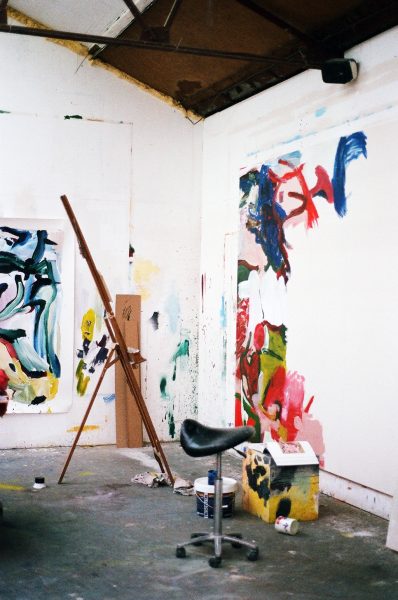
Studio/Atelier Rinus Van de Velde – picture by Joke De Wilde

This was not an “artists in residence” program where the company sponsors an artist to do their artwork. Or where business executives are invited into an artist’s studio for a one-day workshop in the mess of the artist’s working environment, hoping the creative virus would infect them.

No, this was about deeply integrating artists within the R-teams of the company. And they were doing this at scale, in collaboration with a world-renowned academy, changing artists every month, and an international art curation and selection panel.

In part this was inspired by the lateral thinking of Edward De Bono, inventor of the term “lateral thinking”.

This was indeed all about creating collisions between the creative orientation of the artists and the reactive/responsive orientation of the engineer who is looking how to best solve a problem.

In setting up these collisions, the innovation manager was in fact what I would call an “Architect of Accidents”. It suddenly hit me that research was not about searching but about finding.

Research is not about searching but about finding.

The role of the R-teams was to see what they could FIND when they collided. Nobody said: “Let’s find a balloon”. The mission was “what can you find?” if you collide these elements.

This is in big contrast with what I have seen in other R&D/Innovation teams where challenges are set up to solve a particular problem (a problem in search for a solution). A whole “search”-process is then set-up to capture the ideas/solutions, plus some stage gating to further filter (read frame to the be liked by the decision makers), and the end result is that after a while everybody feels like they are fulfilling the system vs. creating what they want. No wonder the change agents get frustrated!

Robert Fritz compromise

It reminded me of Jean Russell’s four types of inquiry, so nicely illustrated in the concentric circles of Jay Standish at OpenDoor (#gratitude):

strategic_cosmology_four_realms_450 (1) croppedstrategic_cosmology_450_px cropped

Indeed, this was a story of continuous learning, from what is imaginable, what is possible, what is testable, and what is provable.

Research with artists at big company was about finding what is imaginable.

And different practices have different preferences. Good artists are more than just good craftsmen; they let you see/find/discover something that was always there but that you would not find without their help. They let you find what is imaginable. Most engineers can probably be mapped to the science or math circle, with a preference to test and prove things are true, can work.

And different practices have different methods. As you can see from the concentric circles second picture, the philosophy circle is more about theories of change, where as the scientists want to test the assumptions of these theories and reduce the set op options that can be proven to be true.

What the R-team at big company was doing was an effort of being open to new (or existing) insights. In that sense, learning is about letting go of ego. Finding is about being open for the unexpected, the un-searched.

In that sense, my initial spectrum from R&D to Enabling was probably the wrong framing. I tend to prefer these days the concentric circles.

To open the nut, to find the crack inside, one must integrate artists in the innovation flows, especially to help find what is imaginable.

petervan-signature_transparent_black_version2

I am in the business of cultivating high quality connections and flows to create immersive learning experiences and structural change. Check out: https://petervanproductions.com/