How to avoid simplistic conversations on disruption?

This post is about some of the myopic views on disruption in financial services (or any other vertical for that argument), and why I am getting a bit tired of FinTech, RegTech, InsurTech, or whatever AbcTech you may come up with.

Petervan Abstrakt Motiv 390a detail b+

Disrupted - Petervan Artwork - Acryl on Paper format A1


Most of the discussions in FinTech are about the (by now outdated) “unbundling” of highly vertical integrated organizations like banks. Everybody recalls the famous CB-Insight slides on how all functions on the website of HSBC, Wells Fargo, or fill in your <Bank Name> here, will be replaced by better offerings of startups or scale-ups: “everything gets fragmented”, you know 😉

It even leads to a “Re-bundling” of financial services, as what was once unbundled needs now to be re-bundled by “banking-as-a-platform” or “Fintegration”, just to throw another buzzword into the mix.

This is in my opinion a highly simplistic view on disruption. It is a fragmented view on disruption. The disruption view is fragmented: each little function on its own is subject of a fragmented disruption debate. We are missing the holistic view of what is going on.

What I would like to bring into the conversation is the “inter-connectedness” of everything, or the “entanglement” of everything.

For payments, the conversation is usually about how many and which intermediaries are part of a payment transaction from the payer to the payee, and how they add value, friction and costs into the system: one can indeed draw disintermediation maps and articulate how the different new entrants attack the different pieces of the end-to-end transaction. But it is piecemealed view, as if the sum of the atomic transactions is an exact equation of the value created in those ecosystem value chains.

The same reflections can be made on the securities business, where many different players (exchanges, central counterparties (CCPs), central securities depositories (CSDs), brokers, custodians and investment managers) are part of the end-to-end flow of atomic transactions between the issuer of a security and the consumer of that security. See also recent comprehensive post by Let’s Talk Payments.

The point I am trying to make here is that what needs to be solved, re-thought and re-designed is a deep ecosystem entanglement. What are really needed are a fundamental process redesign and process innovation and that is not an easy undertaking with all the network effects that are inherent in these ecosystems.

The other point I am trying to make is nobody – not the incumbents, nor the startups/scale-ups – is in a position to solve this on their own.

I believe we have to evolve from platform capitalism to platform cooperation or even platform co-operativism.

  • Instead of talking about optimized correspondent banking, the conversation should be one of collaborative/cooperative banking.
  • Instead of talking about optimized securities lifecycles and settlement, the conversation should be one of collaborative/cooperative securities markets.

The system is not broken. It works very well for what it was designed for. It does not need to be fixed. It needs to be re-thought. What we are witnessing is the need for a fundamental re-thinking of our assumptions. The financial system is part of a broader system of capitalism based on neoliberalism. That system is broken.

Paul Mason – who wrote the book “Post-Capitalism” – was very clear in his recent keynote to the Glasgow Economic Forum: “Neoliberalism is broken”. And he goes on:

  • information technology has paralysed capitalism’s capacity to adapt
  • information technology creates a short-cut to abundance
  • the root cause of the boom-bust cycles, collapsing productivity, stagnation and policy paralysis is that the markets are sending us a signal that there’s not enough value in a high-tech economy to justify current valuations — of debt, equities or derivatives
  • we are in a long transition beyond capitalism, in which the state, the market and a non-market sector based on collaborative production will jostle and coexist
  • and that the only theory that can encompass all of these facts is the one originated by the man quoted on the poster behind me [Adam Smith] — a modernised form of the labour theory of value.

That is the first simplification in the current mainstream thinking about disruption.

As a start, one should start looking at the symptoms of that broken system (as very well articulated in Otto Scharmer’s work at the MIT U.Lab). These symptoms are:

  • An Ecological divide
  • A Social divide
  • A Spiritual divide

otto

The second simplification of the disruption discourse is the lack of inclusion of the macro-forces. Some of the macro-forces deeply driving what’s going on are:

  • Technology macro-force. Here is where inter-connectedness hits hardest. However, this is probably the easiest macro-force to deal with, as technology will take care of itself, as it always has. Open source and other collaborative models will only speed-up that self-care of technology: standards will emerge almost naturally, by natural selection, or my monopolistic interventions.
  • Regulatory macro-force. Regulation is still very high on the agenda of financial institutions, and one can only expect that more is to come, especially on the area of data capitalism, handling of personal and corporate data, and even data ethics. After having digested the regulatory impact of the 2008 financial crisis, many are tempted and seduced to jump back with relief into innovation. The blockchain hype is a great excuse for claiming one is busy with the future state of things. Nothing could be further from the truth
  • Geo-political macro-force: Grexit, Brexit, Terrorism, War, Surveillance, climate, and other crisis that can pop-up at any moment in time, with their potential of killing overnight all the innovation plans and ambitions.
  • Eco macro-force: the acknowledgement that our organizations don’t operate in isolation, that we have to evolve from ego-businesses to eco-businesses, not only extracting value out of the ecosystem for our sole and own benefit, but that we are part of a reciprocal non-zero-sum game with an unspoken desire to save humanity.

The third simplification is the omission of the time component of evolution. I strongly recommend you discovering the work of Simon Wardley and his “situational awareness maps”.


Different values are created by different versions of different technologies and value engines, each of them evolving at their own pace on the lifecycle of emerging to commodity/utility. For big organizations – like financial institutions – it is extremely difficult to map out the current state, let’s not even mention the ability to strategically decide where one wants to head for in different time horizons in the future.

The same situational awareness is not only needed for (existing) and new technologies, but also for existing and new regulations, geo- and eco- events and ambitions.

In the past many have been concerned with the “backward compatibility” of new services and solutions. Backwards compatibility with the existing footprint and practices in the market that is.

I believe there is room today to start thinking in terms of “Forward Compatibility”.

What is Forward Compatibility? It is a capability to plan ahead for gradual adoption by the ecosystem, taking into account the different barriers mentioned above. This is about knowing HOW to get at the new destination:

  • How you rally the main stakeholders of the ecosystem into a rigorous system and process innovation? Process innovation is different from process-, datamodel-, or messaging standardization. It is not about standardizing the existing and guaranteeing backwards compatibility with the existing. It is about co-creating a new reality.
  • How you promote the evolution from the current model to the future model? In the case of distributed ledger technologies for example, it is not about a tabula rasa that will eradicate the existing, but how one evolves from for example a messaging hub-and-spoke paradigm towards business objects and lifecycles in the cloud, initially probably in one central database (one node), and then evolve to a peer-to-peer networks of many distributed databases or nodes (remember the Digital Asset Grid?)
  • How to bootstrap this new reality taking into account the network effects to be created and promoted in the new P2P reality.

No disruption will happen without fundamental re-design – or better re-invention – of the end-to-end business processes:

  • Organizations knowing where they want to get and defining and leading that journey;
  • De-risking change throughout this journey;
  • Making trade-offs in the breadth ànd depth of the destination;
  • Moving beyond the atomic nature of the transaction. As mentioned an nausea in previous posts, it is not good enough anymore to enable (atomic) transactions, the challenge is to enable commerce, as an end-to-end process

Startups/Scale-ups who want to be part of this endeavor, will need to know how to “scale”: they will need to learn to appreciate the mechanics of growing a startup into a corporate. This growth process (and its associated growth pains) is very well described in the post “Go Corporate or go home” around the concept of legibility of on organization. The startup organizations – whether they like it or not – will need to become more legible, more predictable. The author makes a very solid argument why hierarchies are needed.

“The smaller a company is, the less they need to formalize anything, and the less the three levels — chain of command, business process, and culture — differ.”

 As they grow, they will have to synchronize how they transform these three levels (chain of command, business process, and culture). It’s not only from small self-sufficient team into hierarchies; it is also growing into professional business processes, and evolving the social fabric and conventions.

Although startups, scale-ups, and corporate innovation sandboxes mimicking the startup culture “love to have and keep the flexibility, the cost of growth is scale, integration, and profitability.”

In this context, it is probably worth having a look at the post about the Transferwise culture (I could have taken any other scale-up for that matter) “We inspire smart people and we trust them”, and especially the comment on that post that talks about KPIs, product-level empowerment, about focusing on growth more holistically, actually removing bottlenecks and silos, empowering teams at the product level, and instrumenting themselves to be able to actually get granular feedback.

If possible – assuming you want to spend some quality time – read that post and comment after you have read “Go corporate of go home”.

So next time, when you pitch about disruption, about the end of banks/banking, about collaboration/co-operation, or about any other technology solving world hunger, please make sure you have an answer on how to get to your new destination. I would suggest you keep forward compatibility in mind.

Ceci n’est pas un blockchain


Is there really nothing else to talk about? The intensity of the hype is getting to a point where conference organizers put a blockchain session onto their program “just to get people in”, in many cases because they have nothing else valuable to say. So they sell hype instead of substance.

ceci no blockchain

Magritte’s painting, freely adapted by Petervan


You know when you are at the top of the hype-cycle, when the topic hits the WEF agenda as a cure for “The 4th Industrial Revolution”.

David Birch nailed it this week in Finextra when he wrote:

“It seems to me that in a relatively short time the word blockchain has become detached from its technological roots and from its location in the spectrum of shared ledger implementation options to become one of those almost generic chromewash terms, like “big data” or “cloud” (there is no cloud, remember, it’s just somebody else’s computer) to deliver a superficial veneer of futurism.”

path

In the “Path of least resistance” (Amazon Affiliates link), Robert Fritz says:

We live in an era of platitudes and mottos. Many of them are designed to manipulate people into action: If you’re not part of the solution, you’re part of the problem”. This one, popular in he late sixties and late seventies, was clever. No matter what you did, you were involved in the conflict. And if you happened not to be directly involved, you were the cause of the conflict

And later;

So many of the notions in human growth are filled with these kinds of conflict manipulation. I suppose it is considered good marketing. Create a perceived need in the prospective client. Encourage a sense of urgency. Make it seem as if there is no choice. But conflict manipulation has a structure that cannot lead to growth just to more extreme oscillation. Thus many of the people who attempt to cause change, often with real sincerity, do not change and do not grow. The structure of conflict manipulation does not support change.

Blockchain is nothing else than code that seems applicable in many use cases. Code is language. Code is culture. The only way to understand and learn code, culture or language is to practice it. That’s exactly what many of our institutions do, and i think that is great.

But let’s not confuse symptom and cause.

As already mentioned in my blog post on Magritte and The Ages of Machines, the image of the pipe is not a pipe. The picture of the pipe stands for the hype. The hype is not the real world, not the real pipe. The hype hides reality. What is it hiding?

It hides the underlying structural changes. Robert Fritz said :

“A change of underlying structure will lead to a change of behavior. Not your good intentions, your sincerity, your hopes, your goodness, or how much you care”

Structure drives behavior, and behavior drives culture.

The pendulum oscillates:

Capitalism > Postcapitalism

Platform Capitalism > Platform Co-operatism

Collaborative > Autonomous

Internet of Things > Interest of Things

But that underlying structural and hence cultural change is caused by ecological, social and spiritual divide (the three big divides in Otto Scharmer’s work).

That structural change becomes more and more visible in the evolution from centralized to de-centralized to fully distributed systems.

ottoFrom Otto Scharmer’s U.Lab

The above structural changes deeply impact our quality of attending, conversing, organizing and coordination.

These are the things we should discuss. How we participate, how we organize, how we coordinate, how we set norms and governance to tackle the three big divides.

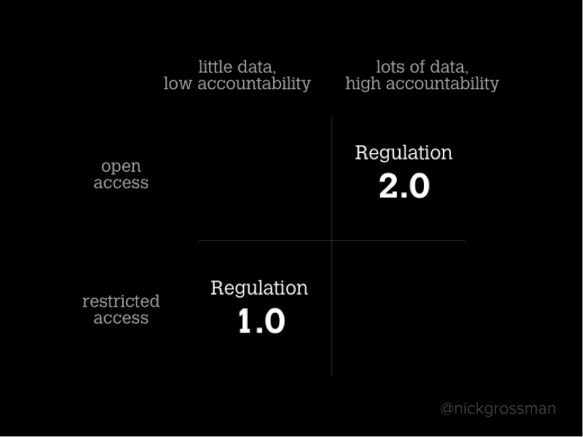
On the governance and regulation of “centralized networks” and “distributed systems”, there was recently a great post by @nickgrossman GM of Union Square Ventures, referring to his great Regulation 2.0 Whitepaper

regulation 2.0

Figure by @nickgrossman

“This is a fundamentally different regulatory model than what we have in the real world. On the internet, the model is “go ahead and do — but we’ll track it and your reputation will be affected if you’re a bad actor”, whereas with real-world government, the model is more “get our permission first, then go do”. I’ve described this before as “regulation 1.0” vs. “regulation 2.0”

The point I am trying to make with this post is that the pipe is a big distraction for the real work that needs to be done.

The real work and our bigger themes of discussion should be (for example):

  • How to become better banks, better in the sense of better for the world
  • How to deal with the power shift resulting from the structural changes
  • How to move from platform capitalism to platform co-operatism
  • How we attend, converse, organize, and coordinate in this new medium

This is post-platform thinking. Where centralized networks (like Uber, AirBnB, etc) could/can/should get replaced by fully distributed P2P systems.

The market that can be addressed is huge. The frictions to be sorted out immense. This attracts entrepreneurship and investment.

But we risk having the same wet dream of freedom and self-realization as we had with the Internet.

In the end, powerful players stand up and try to control the market, trying to get a grip on it through monopolistic and hyper-libertarian behavior. Who will be the Amazon, Google, Facebook, Apple, Samsung, or Alibaba of this new monopolistic distributed nirvana?

The image of that pipe may create a big illusion of perceived freedom.

Innovation: from tactics to strategy

I was invited at the 7th Banking Innovation Forum in Vienna to speak on Innovation. The title of my talk was “Innovation: from tactics to strategy”

I have posted the deck on Slideshare

http://www.slideshare.net/thepierre/innovation-from-tactics-to-strategy

It was an interesting audience, with most people coming from Central and Eastern Europe, with some interesting case studies from Paolo Barbesino from UniCredit in Italy, Carlos Gomez from Activo bank in Portugal, Marcel Gajdos from Visa Europe Czech Republic/Slovakia, Efigence in Poland, and Wojciech Bolanowski from PKO Bank Polski. I made quite some notes, and if i find the time to make a post on it, i will.

Luckily, my fans are out there to help me. I planned write something about my talk as well, but Wojciech Bolanowski already did that in his great LinkedIn Post here. I have cut and pasted his post in its entirety, as it captures well what i was trying to convey in that presentation. Thank you so much, Wojciech, much appreciated 😉

+++ Start post Wojciech

Inspire other people, think differently, create spaces where people come alive, ship to customers; as well as bravery, prototyping, events, capabilities and clarity – these are ingredients for successful innovation within big organization; at least according to excellent speaker and Innotribe Co-founder Peter Vander Auwera.

How to innovate in the shadow of behemoth?

marriott

Peter spoke on the first day of 7th Annual Banking Innovation Forum by Uniglobal in Vienna Marriott Hotel (as pictured above). He was keeping the audience extremely focused and interested. The subject was complex and of great importance: how to make really BIG organization innovative. As Peter put it in an outstanding rethoric figure: “how to make babies”. I would like to add: how to make the babies when you are well-known, established, serious and successful one with huge legacy and obliging history.

The questions are (usually) much more important than particular answers, so there is not my goal to report Peters’s solution in details. What I would like to point out is the question itself. Today, in the fast-running world of fin-tech start-ups and quasi-banking innovators almost every bank is big enough to raise this question to itself. Is it enough to inspire other people with your disrutptive ideas? Is such inspiring even possible in organization too big to change itself spontaneously? What could possibly happen if you think differently from dominant thinking styles?

Obviously, being innovative within mammoth-size organization is a big challenge and requires specific attitude and social skills. As I understood one of the Peter’s suggestion is to create appropriate team which become the centre and engine of the process. The brave, capable team with clearly set culture of “rather be failing frequently than never trying new things” to quote Peter’s presentation. Some important tools to do so are special workspaces, integrating events and ways of building true alignment.

Bravery – the slide of the presentation. Source: Uniglobal

How to gain executives’ support?

The presentation was full of insider stories with some of them concerning interactions between innovators and the board members. Those were a great lesson of struggle which, I think, at least to some extend, any innovator should expect and be prepared for. The very useful take-out was about prototyping and commercial launching of innovative products. The prototype should be, according to Peter’s best practice, as vivid and identical with the final product as possible. No more “Power Point Prototypes” unless you would like to fail. What’s even more – prototyping is just a step to the real strategic goal – to deliver real, commercial product and give it to customers. “Go out of the sandbox” is another great statement I heard from the speaker. Indeed, today environment of fast growing and alternating product propositions demand being “on market”. The Grand Jury of customers has no time to screen through pilots or prototypes; every company should be ready to risk and show its innovation as soon as it is delivered. In my opinion this is extremely important to realize. Shipment to customers what is already prototyped is the crucial part of execution process in innovation. I feel it is striking and true, therefore I tweeted this immediately with hashtag #BAIF2015!

What about the reluctant middle-level-managers?

The next splendid remark is about mid-level managers’ attitude toward change. For them the main goal is “too keep any changes far away of the plan”. It is understandable and rational. For manager’s KPIs are target-related, they try to keep organization on the course to achieve them. However, any innovation process within organization creates the risk of change, which, possibly, could alternate plans and goals. This is the real challenge – to execute innovation in organization which mainly consists of medium-level managers. And execution itself is much more difficult and lasts much longer than whole creative process of gathering ideas, evangelization, internal promotion etc. What Peter stressed, and I agree fully, is thatin context of big organizations idea management process is easier and shorter than its incubation and implementation. In start-ups world there is exactly the opposite relation.

Start-ups as indicators

Start-ups in financial sector (dubbed fintech recently) occupied a lot of Peter’s presentation as he is involved in the well-known Innotribe@Sibos program. The event has attracted more than 340 participants this year. It is quite nice sample to show what’s going on in innovation. With four continental semi-finals (NYC, London, Cape Town and Singapore) it gives global overview and prime selection of activities. This could be a useful indicator for big companies to track the start-up trends and pick up something valuable from. For example in 2014 the leading areas of start-up activity were (despite a broad category of corporates/business services) investment management, lending, big data and personal financial management. It is a clear message to banks: there is innovation coming to your core businesses and it is technology-driven.

This post is inspired by presentation shown on of 7th Annual Banking Innovation Forum ; there is another one of this category, in case you are interested:

Collateral damage of 2008 – card revenues in CEE

Peter Vander Auwera on stage in Vienna. Source: Uniglobal

Linguistic disclaimer

I have written this text in English and I know my limitations. It is possible you find this post illogical, offending, unclear or too simplistic. It does not mean to be that way, so please blame it to my imperfect English skills. I am neither native nor perfect English speaking person . If you want to be helpful, do share your grammar, spelling, style and any other remarks with me. I would appreciate any contributing comment, especially if it came from native speakers.

+++ End post Wojciech