Fintech 2017- Quo Vadis?

rt6517

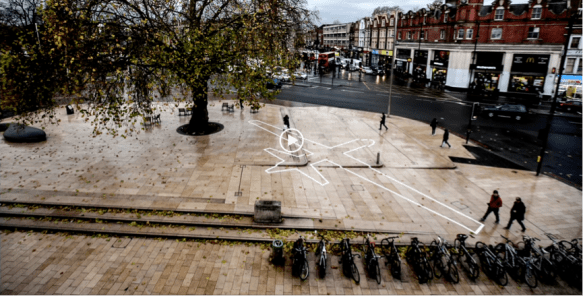
Deborah Kerr and Robert Taylor on the Quo Vadis filmset

Every year Jim Marous publishes the Top banking trends and predictions. On 21 Dec 2016, Jim published the sixth edition with predictions for 2017.

My input was a “pick-and-choose” list of bullet points. You can find the full list below. My input date was 27 Nov 2016. We are now two months later, and I captured some articles/announcements related to some these bullet points. And I added at the end some additional observations. All of this should be taken with more than a grain of salt, as I dimmed my focus on FinTech since starting my Petervan Productions sabbatical on 1 Nov 2016, and don’t read/research as much as before.

As always, these are 100% my personal opinions. Sometimes provocative, sometimes innocent, sometimes the cynical view of a 60 year old incumbent, but hopefully at times contrarian and inspiring. Here we go:

+++ start 27 Nov 2016 input

  • In general, 2017 will be the year of illusion, delusion, and distraction for and by FinTech.
  • Blockchain/DLT/etc will prove itself as one of the biggest distractions of this era in that it does not solve any existing problem, maybe it solves some future problems to be identified, but with a price to pay: the price of fundamental process re-engineering. Very few will be up to this task which involves community management and regulation.
  • In 2017, subject to pressures on the bottom-line and macro-political forces, banks will witness massive lay-offs and disinvestments in FinTech innovation labs and initiatives. These initiatives will be re-branded as research efforts, focused solely on incremental improvements in the core business lines.
  • FinTech will manifest itself as a techno fantasy, drawing attention away from the real problems to be tackled: cyber-security, trust and identity, which only can be solved through laser focused industry and government efforts. No single company can solve these on their own, and self-serving patenting will be counterproductive to industry-wide success.
  • In the US, the Trump administration will out-regulate innovation to protect the financial institutions fiefdoms and their control of money. But despite the Trumpian rhetoric and “opportunities” for financial institutions to start playing their old extraction-value games, financial institutions will be challenged by citizen uproar to give back to society.
  • Despite all these negative predictions, volume and frequency of FinTech investments will dramatically increase. Like in other industries, a 100M$ Fund will be considered as peanuts. Like in traffic jams, investments become bigger and last longer. Like traffic jams, ROI will be difficult to impossible to resolve.

+++ end 27 Nov 2016 input

What I am missing in many predictions is that most are just extrapolations of existing trends. They ignore the fact that the trend can just die or become a commodity where prices trend towards zero.

What I am missing is the creative/opportunity orientation (what do you want) vs. the reactive/responsive orientation (what problem are you trying to solve).

The way we think about change, disruption, and transformation) or whatever you want to call it) is going to be completely different in 5 years time. The speed of change is so big that our thinking is getting disrupted. The underestimated and ignored exponential power in all of this is the “power of networks”. I have another post in preparation for that, but in the meantime I would invite you to get familiar with following books and thinkers:

  • The Seventh Sense: Power, Fortune, and Survival in the Age of Networks, by Joshua Cooper Ramo
  • Whiplash: How to Survive Our Faster Future, by Joi Ito
  • The Inevitable: Understanding the 12 Technological Forces That Will Shape Our Future, by Kevin Kelly
  • “I wasn’t expecting that” from Simon Wardley’s upcoming book
  • Cloud wars by Simone Brunozzi
  • The end of cloud by Peter Levine from Andreesen Horovitz
  • Trillions: Thriving in the Emerging Information Ecology, by Peter Lucas, Joe Ballay and Mickey McManus (already from 2012, but so advanced in its thinking)

Rebelliously yours,

petervan-signature

Innotribe Sibos 2016 – Day4 – Platform Cooperation

platform

Four weeks ago, I shared with you a high level preview of the Innotribe Sibos 2016 programme.

As promised, I have revealed more details for each day in some subsequent blog posts leading up to Sibos week 26-29 Sep 2016 . Today – 15 days before D-day – this post is the last in that series, and I will be looking into day-4.

We are now in the phase where all the artwork, design, session facilitation props, staging, lightning and special effects are coming together. We are now in nonstop back-to-back joint speaker calls to make sure our session cast, our speakers, our instigators, our producers, designers, and facilitators are full aligned. Some of the material we are producing for the big LED screen is of a beauty we have rarely seen in other event environments.

Yes, we try very hard to beat last year’s edition 😉

The structure of the week program is fairly straightforward:

  • We start every day with an opening of the day
  • We close every day with a closing of the day
  • Over lunch time, we have spotlight sessions by several FinTech hubs: one day for Switzerland, one for EMEA, one for the AMERICA, one of APAC.

For the opening session of day-4, the Innotribe team will welcome you, and will zoom in into our Innotribe Industry Challenge on Compliance/KYC.

Our day anchor will then walk you through the plan of the day. Given that our day-4 is about the platform cooperation, our day anchor is Leda Glyptis, Director, Sapient Global Markets. She will stir the pot where needed during the day and she will come back at the end to wrap up the learnings of the day.

In between opening and closing, we have several Innotribe sessions. We don’t do anything during the plenary big issue debate so you have the time to enjoy that session as well.

The main theme of Innotribe day-4 is “Platform Cooperation”. In addition of the Opening and Closing sessions, we have four sessions:

  • Forward compatibility
  • FinTech Hubs session – APAC
  • DLT and cybersecurity: Sibos week wrap-up
  • Innotribe closing keynote: Platform Cooperation

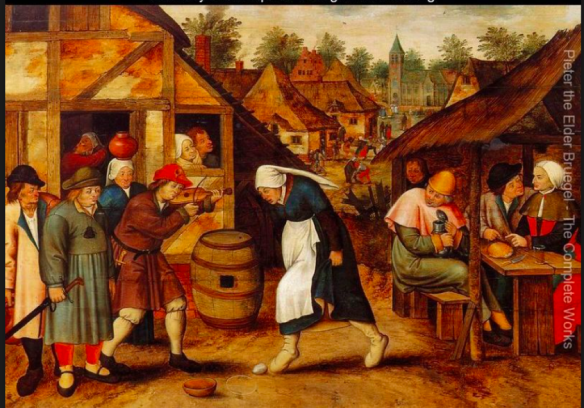
This is a consolidation day – where it all comes together – and we will use a lot of metaphors and medieval painting examples to contextualise these rich topics, and to guide you through the disruptive complexity of our times

breughel

Pieter Breughel the Elder - The Blind Lead The Blind

Forward compatibility

I wrote a blog post about “forward compatibility” in March 2016, about how to avoid simplistic conversations on disruption.

That post was inspired by two conversations.

  • One conversation was in January 2016, with Angus Scott from Euroclear, and his key insight was that no disruption will happen without fundamental re-invention of the end-to-end business processes, and that requires what I now call “forward compatibility”, looking into big large scale experiments with real customers, real regulators, and real ecosystem stakeholders, aka not just in a Lab. Angus also injected the concept of broad macro-forces that drive change.
  • The other conversation was in March 2016 with Valerio Roncone and Tomas Kindler from SIX. They explained me how they were looking far ahead. Asking questions such a “what happens after T2S?”, or “what happens if DLT would fulfil its promise, and disinter-mediate existing players in the industry?”. How does the new landscape look like? Can we create “situational awareness” that can inform our strategy? They called this “impact oriented thinking” and “innovation through evolution”

The seeds were planted, and that was the embryo for this session.

red-line


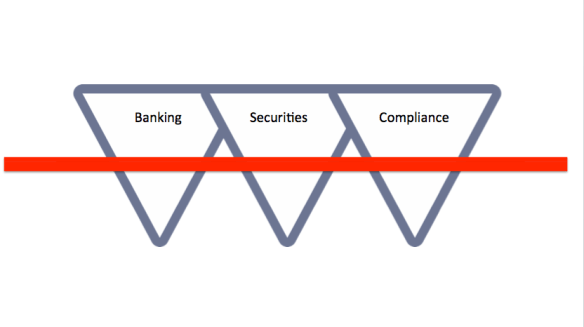
I started playing around with this, and came up with the concept of “above and below the red-line”:

  • Below the red-line is what needs be be solved as a collective, as a community, as a platform. It’s stuff that no single company can really solve on it’s own. It’s things like DLT, Cybersecurity, Digital identity, etc
  • Above the red-line is where you partner with others, FinTech startups, established vendors, etc through JV’s, Partnerships, API’s, etc. It’s where you “complement” the platform under the red line

Throughout the week, we will have done some exercises, where we internalise the content from the speakers by mapping them above and below the red line, and see how they are relevant for banking, securities, and compliance.

This session is NOT a technical session for geeks. This session is a session for business strategists that are interested having a conversation on how we can move the collective forward from here to “there”, wherever and however the “there”emerges.


We have a BIG cast for this session, complemented by instigators, DLT/Cyber anchors and rapporteurs. This is the only session where I will be on stage as your moderator. The speakers and instigators for this session:

  • Angus Scott, Euroclear
  • Valerio Roncone, SIX
  • Tomas Kindler, SIX
  • Patrick Havander, Nordea
  • Paul McKeown, Nasdaq Financial Framework
  • Saket Sharma, BNY Mellon
  • Brian Behlendorf, Hyperledger Linux Foundation


FinTech Hubs session – APAC – over lunch time

Building upon the success of last year’s session “Why banks need FinTech hubs?”, we wanted to go create more air-time for FinTech Hubs from different regions of the world.

We’ll have 6 speakers in one hour. That’s 10 minutes each to share their ambitions and plans. With our designers we are looking how we can make this an engaging experience and avoid having a series of 6 commercials. Like for all FinTech Hub sessions this session is full house.

The “6 from APAC” are (in order of appearance):

  • James Lloyd, Asia-Pacific FinTech Leader, E&Y
  • Markus Gnirck, Tryb
  • Sopnendu Mohanty, MAS
  • Zennon Kapron, FinTech China
  • Janos Barberis, FinTech HK
  • Asad Naqvi, Apis Partners

Almost all of the hubs presenting at Innotribe Sibos during these hub sessions are now part of the Global FinTech Hub Federation (GFHF) announced three weeks ago. See press-release here.

TheGFHF-Branding-Logo-Non-HD

The GFHF will premier their latest FinTech Hub Index (A benchmark of 20+ FinTech Hubs) at Innotribe Sibos 2016. I have seen the design and infographics for this Index, and they just look awesome. We will use some of them as backdrop for this session.

Sandwiches and soft drinks will be served in the Innotribe space.

DLT and cybersecurity: Sibos week wrap-up

johan_zoffany_-_tribuna_of_the_uffizi_-_google_art_project

The Tribuna of the Uffizi, by Johan Zoffany, 1772-8
A collection of paintings
Royal Collection, Windsor

As you for sure have noticed, we don’t have any DLT/Blockchain sessions in this year’s Innotribe Sibos programme. We did this on purpose for two reasons:

  • There are already a lot of DLT/Blockchain sessions in the main conference sessions of Sibos
  • We sense a certain fatigue on the topic

We set ourselves the challenge to create ONE session where you get an overview, a collection of insights from ALL the sessions related to DLT during the whole of Sibos.

So if you don’t have time to go to all of them, or you prefer to stay in the Innotribe space for the week, we’ll make sure you get the key learnings in this single wrap-up session.

And as we were at it, why not do the same with Cybersecurity? OK, let’s do that too.

agenda-4-days

General overview of the Innotribe Sibos 2016 programme

In the general overview of Innotribe sessions above, you will see some sessions marked with the “B” sign (Blockchain) and some others marked with the “lock” sign (Cybersecurity). It means these sessions have some DLT/Cyber flavour to them.

To create a coherent summary during this Thursday wrap-up, we have appointed “Transversal DLT/Cyber anchors”. They stay in the Innotribe space for the whole week, and will report back their findings:

  • Our DLT transversal anchor is Andrew Davis, advisor from Sydney
  • Our Cyber transversal anchor is Bart Preneel, University of Leuven

To cover DLT and Cyber from the other non-Innotribe sessions (aka the main Sibos sessions, Swift Lab, workshops etc, we are sending out our “rapporteurs”. Our Rapporteurs are:

  • Our DLT rapporteur is Oliver Bussmann, ex-CIO UBS
  • Our Cyber rapporteur is Assaf Egozi, CEO Kidronim, Israel

Our DLT/Cyber anchors and rapporteurs will have a special lanyards so you can recognise them easily.


Innotribe closing keynote: Platform Cooperation

After a short wrap up of the Innotribe week presenting the key findings of our programme, our closing keynote speaker Dr. Douglas Rushkoff will provoke and challenge all your assumptions.

Douglas

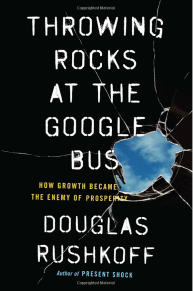
Rushkoff is a renown lecturer on media, technology, culture and economics around the world. His new book “Throwing Rocks at the Google Bus: How Growth Became the Enemy of Prosperity” (Amazon Affiliates link) argues that we have failed to build the distributed economy that digital networks are capable of fostering, and instead doubled down on the industrial age mandate of growth above all.

rushkoff-book-cover

“Every great advance begins when someone sees that what everyone else takes for granted may not actually be true. Douglas Rushkoff questions the deepest assumptions of the modern economy, and blazes a path towards a more human centred world.”–Tim O’Reilly, founder of O’Reilly Media about Rushkoff’s latest book.

Marketplaces in medieval times were far more human centred, fairer environments that the so called P2P sharing economy of Uber and AirBnB, which all have little to with sharing but much more with an extraction value economy where only a few (monopolies) take it all.

breugel-mideval-markets

A Medieval marketplace scene from Pieter Breughel the Elder.


After his talk, Doug will stay on our stand and take some time to do some book signings. He’ll have a couple of free books with him.

Rushkoff is one of those rare thinkers and speakers that challenge all your assumptions. We did something similar last year with Andrew Keen with his talk “The Internet is NOT the answer”. Many of you loved his energy as the Anti-Christ of Silicon Valley.

Think of Rushkoff as Andrew Keen on steroids. Not to be missed if you like to be inspired, if you like to be provoked.


teamhuman_redlogoname

Since publishing Throwing Rocks at the Google Bus, Rushkoff has answered more than 20,000 emails from his readers, one by one, individually. People, companies, mayors, cooperatives, towns and big corporations, all looking for ways to distribute prosperity more widely, start local currencies, build platform cooperatives, convert to employee ownership, offer dividends instead of capital gains, or crowdfund a bookstore.

Rushkoff realised it was not about him but about you and last week he launched Team Human, a weekly postcast on radio. “An intervention by people, on behalf of people”. All in delightful audio – perhaps the most intimate, enveloping medium yet developed.

Douglas Rushkoff looks deep into the question of reprogramming society to better serve humans. Rushkoff grapples with complex issues of agency, social justice, and all those quirky non-binary corners of life.

We are also  bit quirky, non-binary. That’s why we designed the Innotribe stand with a very industrial look on the outside but as a very human and welcoming space on the inside. We believe on the synergising effect of emotional and physical space.

  • That’s why the overarching theme of this year’s Innotribe Sibos is about the tension between technology and humanism in this fast changing and disruptive environment.
  • That’s why we use a lot of art, as art can help making sense beyond the tactics and the cognitive.
  • That’s why we have throughout our four days the concept of “above and below the red line”, as below the red line is what we need to solve as a collective, as a community, as an ecosystem.

It’s going back to the original intention of the not-for-profit cooperative structure, but mixed with some healthy activism. Ruskhoff calls this “Platform Cooperativism”

Hope the architecture of our Innotribe Sibos 2016 programme all starts making sense now?

img_5481-1-1

I will leave you with this painting/collage by Yasumasa Morimura “Blinded by the Light” from 1991. It’s a picture from a reproduction, discovered in the lobby of Le Meridien Hotel in Minneapolis, Minnesota, US, during my presence at the SparkCamp conference in 2015.

It is a modern interpretation of Breughel’s “The Blind lead the Blind” from 1568. See start of this post.

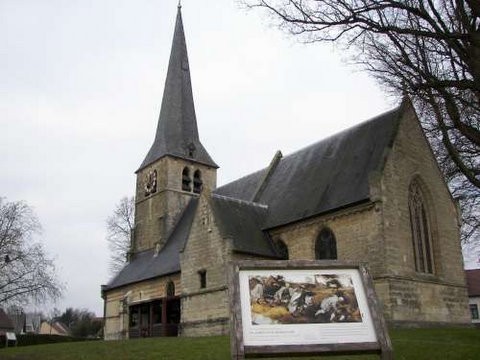
The landscape of both paintings is from a really nice area west of Brussels – an area named “Pajottenland” – and the chapel in the back of the paintings exists in a little village called “Sint-Anna-Pede“.

sint-anna-pede

It happens to be the place where I grew up the first 20 years of my life. I was living literately 200 metres from this chapel. So the Innotribe journey sort of brought be back to my roots. More about that after Sibos.

General

All sessions are designed to maximise the immersive learning experiences of our guests. We use professional facilitators and designers to enable great group interactions. And we have an amazing audio/visual kit and production team to make the content come alive.

The pepper and salt comes from our “instigators” who have a designed role to provoke the critical discussion.

Resources:

Follow us on Twitter: for the latest announcements: @Innotribe, #Innotribe,@Sibos, #Sibos

We are looking forward to meeting you all again at this year’s Innotribe Sibos 2016 from 26-29 Sep 2016 in PalExpo, Geneva.

Deeply grateful,

Your architect and content curator for Innotribe@Sibos, @petervan

Innotribe Logo

Innotribe Sibos 2016 – Day3 – Man/Machine Convergence

man machine theme

Four weeks ago, I shared with you a high level preview of the Innotribe Sibos 2016 programme.

As promised, I will reveal more details for each day in some subsequent blog posts leading up to Sibos week 26-29 Sep 2016 (21 days left at the time of this writing).

Our preparations are in full swing. The first visual materials are coming in, and our designers have produced some very cool animations for the big LED screen. And we put a lot of effort to keep the architectural integrity  of the programme and the focus on intense learning experiences.

General structure:

agenda-4-days

General overview of the Innotribe Sibos 2016 programme


The structure of the week program is fairly straightforward:

  • We start every day with an opening of the day
  • We close every day with a closing of the day
  • Over lunch time, we have spotlight sessions by several FinTech hubs: one day for Switzerland, one for EMEA, one for the AMERICA, one of APAC.

For the opening session, the Innotribe team will welcome you, and for the Wednesday opening, we will zoom in into some of the startups from our  Innotribe Startup Challenge Latam.

Our day anchor will then walk you through the plan of the day. Given that our day-3 is about the man-machine convergence, our day anchor is Anju Patwardhan, Fulbright Visiting Scholar at Stanford University, and ex-Chief Innovation Office of Standard Chartered Bank, where she was looking into AI and other FinTech innovations.She will come back in the day closing to wrap up the learning of the day.

In between opening and closing, we have several Innotribe sessions. We don’t do anything during the plenary big issue debates so you have the time to enjoy those as well.

The main theme of Innotribe day-3 is “Man-Machine Convergence”. This is going to be a super packed day. In addition of the Opening and Closing sessions, we have six sessions:

  • The Future Show Live
  • Digital Ethics
  • FinTech Hubs session – AMERICAS
  • AI for Financial Services
  • Innovation in cyber-security: Innovative defences to innovative attacks
  • Thingclash

The Future Show Live

Experience the future like never before with this innovative event concept designed for challenging decision makers.

Technology is changing our world exponentially and humanity will change more in the next 20 years than in the previous 300 years. Topics such as cloud/data security and privacy, automation and a potentially exponential technological unemployment, (very) big data, artificial intelligence and cognitive computing, robotics, self-driving cars, drones and the Internet of Things are popping up everywhere, and the public interest (consumers as well as businesses) in ‘the future’ has never been higher. This session will show how exponential technological advancements will radically alter and re-boot the way we experience the world and interact with each other. Both consumers and businesses, organisations and governments will be strongly interested in this.

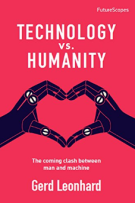
The Future Show Live is a live, multimedia and interactive format that presents ‘the future’ key challenges and opportunities. Designed and delivered by Europe’s leading futurist and author Gerd Leonhard, and produced by art director and film-maker Jean-Francois Cardella. This session will flow seamlessly into the session/conversation on digital ethics. To find more about Gerd, his work and his latest provocative book  “Technology vs. Humanity: The coming clash between man and machine” (Amazon Affiliated link), check out my blog post of a couple of weeks ago.

This will be very special. To put it in Gerd’s own words in his weekly newsletter:

Second, just in case you are close-by, the world premier of my new interactive live program (finally, sans clicker and the conventional slide-deck marathon) called The Future Show Live will happen at SIBOS / Innotribe 2016 in Geneva, on September 28 – watch out for the video recording soon afterwards. With TFSLive we will attempt nothing less than to redefine the very meaning of ‘keynote presentation’.

The Future Show Live will have its world premier at Innotribe Sibos! The show starts at 09:30am sharp and flows directly without break into Digital Ethics. Be sure to reserve your seat. No hotel bath-towels allowed.

Digital Ethics

Whereas Gerd’s session will picture in broad brush stroked the tension between technology and humanity, in this session we will do a deep dive into the digital ethics that should underpin this man-machine convergence.

We believe these digital ethics are very relevant for financial services, and have fields of application in analytics, robo-advisors, financial apps, Ethereum DOA fork, chatbots, upto the respect for human attention in the design of non-intrusive applications.

The speakers for this session:

  • John Havens, Executive Director, The Global Initiative for Ethical Considerations in the Design of Autonomous Systems
  • Amber Case, Cyborg Anthropologist, and Fellow at Harvard Berkman Klein Center
  • Aurélie Pols, Data Governance & Privacy Advocate, and advisor to the Ethics Data Group EDPS (European Data Protection Supervisor)

The three  speakers will each take a different angle at the topic. From “value sensitive design”, to the respect of our human attention, into data governance, who sets the norms, how polices them, and how will good ethical behaviour be rewarded, or harmful applications be penalised. This may be a next area for regulation, not only in financial industry.

Coexisting safely and ethically with intelligent machines is one of the central challenges of the 21st Century. It demonstrates and strengthen the need to establish ethical standards for Artificial Intelligence to help us preserve the values we cherish the most.

To get yourself prepared for this session, you can start experimenting with The Moral Machine of MIT.


The session will be immediately followed by book signings by Gerd Leonhard, John Havens and Amber Case

Book gerdAmber bookHavens book

FinTech Hubs session – EMEA – over lunch time

Building upon the success of last year’s session “Why banks need FinTech hubs?”, we wanted to go create more air-time for FinTech Hubs from different regions of the world.

Each hub will get 10 min to share their ambitions and plans. With our designers we are looking how we can make this an engaging experience and avoid having a series of 6 commercials. Like for all FinTech Hub sessions this session is full house.

The “6 from the AMERICAS” are (alphabetical order):

  • 500 Startups
  • Digital Finance Institute and FinTech Association of Canada
  • FinTech Mexico
  • FinTech Forum Germany*
  • MaRS Discovery District
  • Partnership Fund for New York City

We have a waiting list for all FinTech Hubs sessions from most regions. That’s why we added *Germany to this group. They took the last remaining slot;-)

It is interesting to see how some of our sessions (like last year’s FinTech Hub session) or some of our research papers (like last year’s Powerwomen in FinTech) are growing into movements like www.femtechleaders.com or to new initiatives like the Global FinTech Hub Federation (GFHF) announced two weeks ago. See press-release here.

TheGFHF-Branding-Logo-Non-HD

We are happy to announce the GFHF will premier their latest FinTech Hub Index (A benchmark of 20+ FinTech Hubs) at Innotribe Sibos 2016.

Sandwiches and soft drinks will be served in the Innotribe space.

AI for Financial Services

AI for financial services is usually associated with robo-advisors. But AI for financial services also includes pattern recognition software and algorithms to detect fraud patterns and other financial anomalies.

This demo-packed session will showcase examples in fraud detection, cyber security,  compliance, natural language processing for AIFMD reporting (The Alternative Investment Fund Managers Directive), and machine learning from customer behaviour for robo-advisory.

The cast of this session:

  • Eric Rosenblum, Executive, Palantir
  • Edouard D’Archimbaud, Head of AI Lab CIB, BNP Paribas Securities Services

  • Lisa Huang, Head of Quantitative Analysis Research, Betterment

This session will be moderated by Nicolas Mackel, CEO of Luxembourg for Finance.

Innovation in cyber-security: Innovative defences to innovative attacks

This session will highlight some of the latest innovative cyber-security attacks, and investigate how to address them with the most innovative defence strategies that mitigate the risks going forward.

We have an absolute rock-star for this session, nobody else than Bruce Schneier!

Bruce Schneier is an internationally renowned security technologist, called a “security guru” by the Economist. He is best known as a refreshingly candid and lucid security critic and commentator. When people want to know how security really works, they turn to Schneier.

In his usual high-energy style, Bruce will start with a TED-like talk, and the quickly open for an intense audience Q&A.

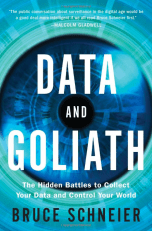
His latest book “Data and Goliath” (Amazon Affiliate link), is an absolute bestseller.

data and goliath

Clay Shirky said about the book: “Bruce Schneier’s amazing book is the best overview of privacy and security ever written.”

After this session, you’ll never look at cyber-security in the same way again. It is very rare to have the occasion to be face to face with this caliber of security expert, so be there in time!


Thingclash

Thingclash is a framework for considering cross-impacts and implications of colliding technologies, systems, cultures and values around the Internet of Things.

We’ll be specifically looking at frictions that emerge in both existing IoT categories with transactional capabilities (such as chip cards and smart watches) and emerging ones (like drones, self-driving cars, and multi-purpose connected buttons). With new IoT interfaces proliferating in banking and financial services, there hasn’t been a better time to examine how we design for transactions in a way that protects usability, privacy, and security.

The session is designed as an interactive card-game, combining things, personas and contexts.

things 2

This workshop will be delivered by

  • Scott Smith, Founder and Principal, Changeist
  • Susan Cox-Smith, Partner & Creative Strategist, Changeist

Changeist is a post-national research, consulting and creative group that helps organisations navigate complex futures.


Networking Event

Last year we experimented with an informal networking event for anybody who feels connected to the FinTech ecosystem, and you seemed to have liked it. The Innotribe Networking event is back this year on Wednesday 28 Sep 2016, starting at 7pm in the Salle Communale des Délices – 20 Route de Colovrex, 1218 Le Grand-Saconnex, Switzerland –View Map. This is only a 10 min walk from the Sibos PalExpo conference center.

Agenda

19:00          Event Opens

19:00          Welcome speech by Brian Behlendorf, Executive Director the Linux Foundations Hyperledger Project

19:10          Bar & Buffet Opens, music provided by Beatie Wolfe and her band

IMG_0163

Sponsor

We are delighted that the Linux Foundation’s Hyperledger project is sponsoring the 2016 Innotribe Networking event

Linux Foundation Hyperledger Project

Partners

2016sponsors

This is an free networking event. Anybody who smells FinTech is welcome, but to help us plan for the catering and drinks, we’d like you to register on our registration site.

General

All sessions are designed to maximise the immersive learning experiences of our guests. We use professional facilitators and designers to enable great group interactions. And we have an amazing audio/visual kit and production team to make the content come alive.

The pepper and salt comes from our “instigators” who have a designed role to provoke the critical discussion.

For the sessions where it makes sense, we also have a transversal anchor for Cyber-security and one for DLT. They stay in the Innotribe space for the week, and will report back at the end of the week:

  • Our Cyber transversal anchor is Bart Preneel, University of Leuven
  • Our DLT transversal anchor is Andrew Davis, advisor from Sydney

Next week, we will cover the themes and sessions of day-3 of Innotribe Sibos 2016.

Resources:

Follow us on Twitter: for the latest announcements: @Innotribe, #Innotribe,@Sibos, #Sibos

We are looking forward to meeting you all again at this year’s Innotribe Sibos 2016 from 26-29 Sep 2016 in PalExpo, Geneva.

Deeply grateful,

Your architect and content curator for Innotribe@Sibos, @petervan

Innotribe Logo

Innotribe Sibos 2016 – Day2 – Modern Organisation

Modern organisation

Three weeks ago, I shared with you a high level preview of the Innotribe Sibos 2016 programme.

As promised, I will reveal more details for each day in some subsequent blog posts leading up to Sibos week 26-29 Sep 2016 (29 days left at the time of this writing).

Our preparations are in full swing. We are in the midst of a series of intense prep calls with all speakers, together with our production teams and our facilitators and designers. All engines are on!

It has always been our intention to build a program with architectural integrity and a week of intense learning experiences. This year is no different.

General structure:

agenda-4-days

General overview of the Innotribe Sibos 2016 programme


The structure of the week program is fairly straightforward:

  • We start every day with an opening of the day
  • We close every day with a closing of the day
  • Over lunch time, we have spotlight sessions by several FinTech hubs: one day for Switzerland, one for EMEA, one for the AMERICA, one of APAC.

For the opening session, the Innotribe team will welcome you, and for the Tuesday opening, we will zoom in into some highlights of our Innotribe Startup Africa.

Our day anchor will then walk you through the plan of the day. Given that our day-2 is about the modern organisation, our day anchor is Louise Coster, Head of Human Resources at SWIFT. She will come back in the day closing to wrap up the learning of the day.

In between we have several Innotribe sessions. We don’t do anything during the plenary big issue debates so you have the time to enjoy those as well.

The main theme of Innotribe day-2 is “The Modern Organization”. In addition of the Opening and Closing sessions, we have three sessions:

  • Organise for complexity
  • FinTech Hubs session – EMEA
  • Situational awareness maps

Organise for complexity

This session is about leadership principles for a high performing modern organisation operating in a highly complex environment and how to deal with both in a productive way.

After a condensed introduction on the theory and practice of organisational high performance, we will move into an interactive discussion on contemporary leadership and profound transformation in organisations of all kinds.

Our speaker will dissect classic management theory and in a well-humored manner, and offer coherent alternatives that are a welcome addition to management thinking and align with the principles of wirearchy and connected leadership.

Pflaeging


Some of the session’s learning objectives are:

  • Complicated and complex are different, both exist in work – Complexity means: surprise
  • Every org has three structures, not one; they can be in conflict
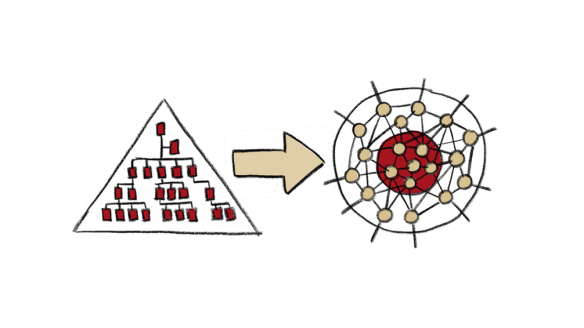
  • Orgs are not pyramids, but peaches; Decentralization is a must, not an option in complexity
  • Orgs can move through different phases. Most have transformed at least once! Differentiation is toxic now, due to complexity
  • In order to transform an org, you must fix Human Nature assumptions and rid orgs of outdated practices and method
  • Change is easy if you work the system, not the people! People will adapt
  • We already have the right people, we just force them into the wrong kind of organisational model.

Our  rock-star for this session:

  • Niels Pflaeging, Co-founder and associate of the BetaCode Network


I was following Niels’ blog and tweets for quite a while, and when i discovered almost by accident his talk for the Deutsche Telekom leadership in Bonn, 2015, I knew Niels had to become a speaker at Innotribe Sibos.


This is a highly interactive session, with assignments for the audience, to help you internalise the knowledge you picked up from our speakers. At the end of the session, there will be a “gift” to take with you.

Niels book

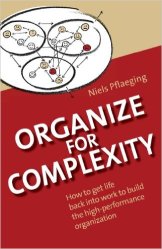
After the session we will have a book signing by Niels of his latest book “Organize for Complexity: How to Get Life Back Into Work to Build the High-Performance Organization” (Amazon Affiliates link)

FinTech Hubs session – EMEA – over lunch time

Building upon the success of last year’s session “Why banks need FinTech hubs?”, we wanted to go create more air-time for FinTech Hubs from different regions of the world.

Each hub will get 10 min to share their ambitions and plans. With our designers we are looking how we can make this an engaging experience and avoid having a series of 6 commercials. Like for all FinTech Hub sessions this session is full house.

The “6 from EMEA” are (alphabetical order):

  • EggSplore
  • Financial Conduct Authority (FCA)
  • Holland FinTech
  • ING FinTech Village
  • Innovate Finance
  • Luxembourg for Finance

We have a waiting list for all FinTech Hubs sessions from all regions.

It is interesting so see how some of our sessions (like last year’s FinTech Hub session) or some of our research papers (like last year’s Powerwomen in FinTech) are growing into movements like www.femtechleaders.com or to new initiatives like the Global FinTech Hub Federation (GFHF) announced earlier this week. See press-release here.

TheGFHF-Branding-Logo-Non-HD


Sandwiches and soft drinks will be served in the Innotribe space.

Situational awareness maps

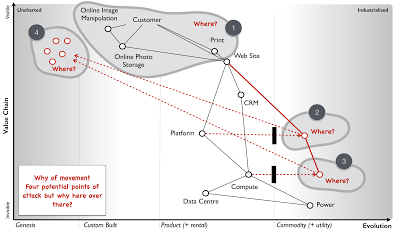
In this session you will learn how to avoid creating a “me too” strategy. “me too” strategies sound like “let’s Uberise everything”, “let’s Platform everything”, etc. Most of these strategies are copy-cats of successful models for one company, but rarely apply in other contexts.

It is like playing chess on a linux command line without seeing the chessboard.

What is missing is situational awareness of the battlefield. Both positional and movement awareness of the enemy and the different technologies that each move at their own pace through their maturity cycle.

fig43

This highly interactive exercise will immerse you in the principles of situational awareness mapping, and will help you understand where the different methods like R&D, Agile, Scrum, Lean, and SixSigma each have their role to play.

The man:

  • Simon Wardley, Industry and technology mapper, destroyer of undeserved value, CSC Leading Edge Forum

This session is absolute brainfood with British humor guaranteed. Check him out at his 2015 Oscon talk or spend some quality time on his awesome blog:  http://blog.gardeviance.org/

We have designed also this session as an immersive learning experience, seats and limited, be sure to be there in time and don’t put your beach towel on your chair two hours before the session 😉

General

All sessions are designed to maximise the immersive learning experiences of our guests. We use professional facilitators and designers to enable great group interactions. And we have an amazing audio/visual kit and production team to make the content come alive.

The pepper and salt comes from our “instigators” who have a designed role to provoke the critical discussion. The “instigators” of day-2 are:

  • Patrik Havander, Nordea
  • Anthony Brady, BNYM
  • Saket Sharma, BNYM

For the sessions where it makes sense, we also have a transversal anchor for Cyber-security and one for DLT. They stay in the Innotribe space for the week, and will report back at the end of the week:

  • Our Cyber transversal anchor is Bart Preneel, University of Leuven
  • Our DLT transversal anchor is Andrew Davis, advisor from Sydney

Next week, we will cover the themes and sessions of day-3 of Innotribe Sibos 2016.

Resources:

Follow us on Twitter: for the latest announcements: @Innotribe, #Innotribe,@Sibos, #Sibos

We are looking forward to meeting you all again at this year’s Innotribe Sibos 2016 from 26-29 Sep 2016 in PalExpo, Geneva.

Deeply grateful,

Your architect and content curator for Innotribe@Sibos, @petervan

Innotribe Logo

Team Human

Web

Artificial intelligence. Cognitive computing. The Singularity. Digital obesity. Printed food. The Internet of Things. The death of privacy. The end of work-as-we-know-it, and radical longevity: The imminent clash between technology and humanity is already rushing towards us. What moral values are you prepared to stand up for—before being human alters its meaning forever?

This is not me saying this. This is Gerd Leonhard a new kind of futurist schooled in the humanities as much as in technology. A musician by origin, Gerd connects left and right brains for a 360-degree coverage of the multiple futures that present themselves at any one time. In 2015, Wired Magazine listed Gerd as one of the top 100 most influential people in Europe.

In his most provocative book to date “Technology vs. Humanity: The coming clash between man and machine” (Amazon Affiliated link), he explores the exponential changes swamping our societies, providing rich insights and deep wisdom for business leaders, professionals and anyone with decisions to make in this new era.

If you take being human for granted, check-out this trailer for a movie he made with Jean-François Cardella, his film producer.


Gerd has a new book out and it is and i recommend it strongly, and i am not alone.


“Gerd Leonhard is most definitely a member of Team Human. Here’s his convincing and heartfelt call for the reinstatement of people and purpose into the technology program.” – Douglas Rushkoff, Author of ‘Throwing Rocks at the Google Bus’, host of the ‘TeamHuman’ podcast

“Gerd Leonhard provides a fascinating look at the impact of exponential technologies and the dilemmas we will face in adapting to—or being adapted by—these. His book really makes you worry—and think.” – Vivek Wadhwa, Academic, Researcher, Writer, and Entrepreneur.


A good overview of the book can be found in Forbes’ recent interview with Gerd Leonhard and his reflections on digital ethics:

“Like sustainability, ethics is often thought of as a nice to have, a thing to consider when you have time, a luxury, non-monetizable. But now it is becoming clear that those distinctly human things that are not measurable (I call them the “androrithms” – as opposed to algorithms) such as emotions, intuition, beliefs and ethics are what sets us apart from machines.”

Gerd’s thinking is of great relevance to financial services. Because the whole value proposition of the financial services industry is about to change, it needs to reinvent itself in order to discover and grow new values and revenue streams.


Gerd_illustrations_27_5_16_v3


“In general you can say the financial industry has been asleep at the wheel for the past ten years, but it has woken up with a start,” says Leonhard, and

“The Darwinian megashifts of exponential technologies eventually challenge most of our assumptions, meaning somebody is going to reinvent the way we think about stock markets and what a stock-market actually is. After we get the blockchain and a global digital currency, the next step is to revamp the entire logic of the stock market. And that is imminent.”

In addition of the book and the film, Gerd has created a unique experience called The Future Show Live. The Future Show Live will demonstrate what exponential technologies are doing to our world of business and society and will create a context around financial services, pointing people towards how they can innovate from inside an organisation and not rest on outmoded systems.

We will need to embrace technology – but not become it. We will need to find ways that technology will actually serve humanity (i.e. support human flourishing and contentment) not vice versa.

Gerd Leonhard will be hosting The Future Show Live at Sibos at the Innotribe stand next to the main Sibos stand on Wednesday, 28th September from 9:30-10:15am.

55x19copy  All illustrations are by Gerd Leonhard and are licensed under a Creative Commons Attribution-NonCommercial 4.0 International License.


Platform Capitalism or Platform Cooperativism

Douglas

Headshot - Douglas Rushkoff

The first time I heard the term “Platform Cooperativism” was when listening to a talk by Douglas Rushkoff (www.rushkoff.com) on 15 Nov 2015 at the Internet Society.

video

Just a couple of weeks before, Doug had sent me a manuscript version of his new upcoming book “Throwing Rocks at the Google Bus: How Growth became the enemy of prosperity” (Amazon Associates link), planned for release in two weeks or so. I recall the working title of the book was “The end of growth”.

book

As usual – when listening to an interesting talk – I scribble notes on my notepad, pausing the video after every interesting sentence, and end up with some sort of transcript, somewhat personalized because using my own sense-making lens and bias.

Some snapshots:

  • Before the law enforced monopoly, now technology enforces monopoly
  • From creative destruction to destructive destruction
  • A software company is a company extracting value from the working economy (transactions between people) and converts it into capital (static bags of shares and stock prices), converting land and labor into capital.
  • Creating real value, that’s the suckers’ place (of being gamed). Playing the game is the place where you want to be
  • Central currency is the embedded operating system
  • Should we optimize for growth or optimize for humans?
  • Jobs!, Jobs!, Jobs! Let’s pretend we are on acid for a minute ;-). Who really wants a “job”?
  • Most companies, after reaching max growth, go for steady state, the flow of money
  • Uber drivers are doing R&D for automatic cars. They don’t have a platform cooperative
  • Family businesses are focused on the long term, are generational, are even willing to help other create value.
  • From a growth model of business to a flow model of business
  • Optimize for the velocity of money (not for being static, stocked in troves)
  • We don’t need banks to authenticate
  • The bank was made to extract value out of our transactions
  • About Bitcoin/Blockchain (at minute 37): “what are they programming for?” Bitcoin creates trust? No, Bitcoin SUBSTITUTES trust
  • In the end, we have to re-program the social expectations of each other
  • There is some chance that the P2P economy may happen, that the extraction economy comes to its end, with interesting experiments
    • We see hybrid models to fund pizzeria, 50% Crowd, 50% bank
    • The bank as facilitator of local community development
  • From platform monopolies to platform cooperatives
  • Facilitating exchange of value between people instead of extracting value from people’s labor.
  • We need a full-blown renaissance, and we are in it…
    • From Perspective painting to the hologram and the fractal
    • From the individual hero to collectivism
    • From the printing press to the computer
    • From enclosing the commons to retrieving the commons
    • From divisional science to the science of whole-ism
  • Land, Labor, and Capital as PARTNERS in an economy
    • Today, capital is extracting from Land and Labor

The comments right after Douglas’ talk by Astra Taylor, author of the book: “The Peoples’ Platform: And Other Digital Dilusions” are interesting:

  • I want (platform) cooperatism to be confrontational, it has to make a difference in the world
  • How different is the current moment? If different at all….
  • The key for cooperatives success is access to capital

Platform Cooperativism is possibly an answer to Platform Capitalism. Harold Jarche recently articulated very well what platform capitalism is really about: the extraction of value from many for the benefit of a few.

“The emerging economy of platform capitalism includes companies like Amazon, Facebook, Google, and Apple. These giants combined do not employ as many people as General Motors did. But the money accrued by them is enormous and remains in a few hands.”

And just a couple of days ago, David Bollier had a great post pointing to a new report on Platform Cooperativism by Trebor Scholz, one of the organizers of the Nov 2015 conference where Rushkoff spoke. Full report (PDF) report here.

“In the report, Scholz notes that the gig economy financializes resources that were previously outside of the market.  Our cars, our apartments, our private time – all can now be monetized through corporate platforms and made subordinate to market forces.  In effect, this new system is “embedding extractive processes into social interactions” and “extending the deregulated free market into previously private areas of our lives,” writes Scholz.”

Platform Cooperativism is a choice we have in the Industrial-Human Paradox. The WEF makes a lot of noise about “The 4th Industrial Revolution”, semi celebrating forms platform capitalism like the Uberization of everything, and robots eating our jobs.

It feels to me that sort of thinking starts feeling more as entertainment rather than independent thinking and provocation.

As Douglas Rushkoff said and provoked elsewhere: we don’t need to fix the system. The system just works fine for what it was designed for: extracting value.

scharmer

Otto Scharmer articulated very well the symptoms of the broken system:

  • Ecological divide
  • Social divide
  • Spiritual divide

We don’t need to fix the existing system, we need another system. We need radical ideas for the new century: platform cooperatism could be the answer. But a lot needs to change.

Still inspired by Scharmer, we need to improve the quality of how we engage with each other, the way we debate, dialogue, coordinate, organize. We need to take into account the quality of the context. We need to go from experiments and prototypes to models that can scale and be transformative. And that needs to happen at an institutional level.

In his ULabs, Otto Scharmer has identified two missing conditions for this to happen:

  • Enabling infrastructures that bring together the right set of players into a system
  • Move from abstract coordination mechanisms (like hierarchy, markets or organized interest groups) to co-creating ecosystems

In the middle of the great transition from centralized to decentralized to fully distributed systems, we have a choice: we can copycat the models of platform capitalism leading almost by nature to a few monopolists who take it all, or we can choose for a construct that has in mind the flourishing of the whole, of the cooperative.

Somebody has to take up the role of the commons for financial services, where the end-goal is not to maximize profit and shareholders value, but the interest of the community and the maximalisation of flow between all the stakeholders.

Don’t let me entertain you, let me provoke you

Way back in 2010, I wrote a post “Let me entertain you” inspired by one of Robbie Williams’ biggest hits. Some extract of the lyrics below:

Hell is gone and heaven’s here
There’s nothing left for you to fear
Shake your arse come over here
Now scream
I’m a burning effigy
Of everything I used to be
You’re my rock of empathy, my dear
So come on let me entertain you
Let me entertain you

Lyrics of "Let me entertain you" - Robbie Williams

I have evolved since then. The title of this post is inspired by a quote by Brian Eno in an interview in December 2015 with Steven Johnson about art, music, punch lines, and culture in general I would say.


“I don’t want to be entertained,

I want to be provoked.”


Here is the video on punch lines.

When I first read that interview, there was no transcript, so I transcribed it all myself (so I did not cut and paste from the site, and everything in this post is my own crunching through the story ;-). Now it’s all for grabs on Steven’s post.

I think Eno’s quote could be a great tagline for the way I think about “events”. I could do my Magritte trick here again and say “Ceci n’est pas un event”. As I have said so many times in the past:

“I am not in the events business. I am in the business of creating high quality feedback loops to enable immersive learning experiences”.

It’s about creating spaces and environments where people want to be provoked, not feeling comfortable, not being entertained. At the edge, but not beyond.


Exactly what architect Clive Wilkinson refers to in his talk “Designing The Theatre of Work”. There is indeed something (un)wise in this notion of “Theater of Work” or “Theatre of Change”. At min 11:30 of this video, he quotes:

“I don’t want people to feel comfortable, I want them to be provoked. I am not going to get great work out of people who are comfortable”

and also

“The architecture and the language of space is not something that is meant to make you go to sleep”

It’s only very recently that I realized the “creating high feedback loops and immersive learning thing” was only about the “how” and not about the “why” and “what” this is supposed to achieve.

I think I have a better hunch about that now: I believe it is about creating high quality change. Deep change. Not the Theatre of Change. Change that is in the first place based on high quality human alignment. Beyond the cognitive, and beyond the tactics of processes and governance. Beyond the illusion and entertainment of the innovation theatre.

I recently bumped into a colleague that is doing innovation work – or should I say theatre – for a big international automotive company. She was asked to give support in the design of a “disruption tour” that was organized for the members of the board in Silicon Valley.

I think we have all seen those disruption tours, where execs are flown into sunny California, get a week immersion, come back all excited as part of this elite club that got to see one or the other hotshot in the valley, and where the initial momentum ebbs away very quickly, usually already after two weeks, when we all go back to business as usual.

But the briefing for this tour was a bit different. She learned that the tour should not challenge any of the “what” and only focus on the “how”. So in other words: avoid in all circumstances that anything they will see and hear would challenge or disrupt their existing automotive strategy. What was asked for was “disruption without disrupting”. Or “Safe Innovation” as I read somewhere else this week.

In Hollywood this is called “entertainment”.

I kept delving in the Brian Eno’s story about entertainment vs. provocation, and found this audio ànd the transcript of the 27th Sep 2015 BBC John Peel Lectures with Brian Eno.

I am very much inspired by both Peel, who has this art of giving others “airplay” and Brian Eno, who really is a “curator d’excellence”, if you look back at what sort of magic mix of artists he brought together in his life, always remaining a “vanguard”, and his restless desire for discovering new places and more:

vanguard

“Vanguard” means forefront, advance guard, avant-garde. Has to do with seeing early signals, making sense of them. Not only seeing. Also building. Building something new. “World Building”.

World building, like the places children imagine. Like the emotional places where children imagine: who would not crave to be in that state all the time? In that sense, I believe my curation and events work is more and more about painting and architecting “states of mind”.

Happenstance that just this week @ribbonfarm had a fantastic post on this topic of “states of mind” titled “Productivity for precious snowflakes”

snowflakes

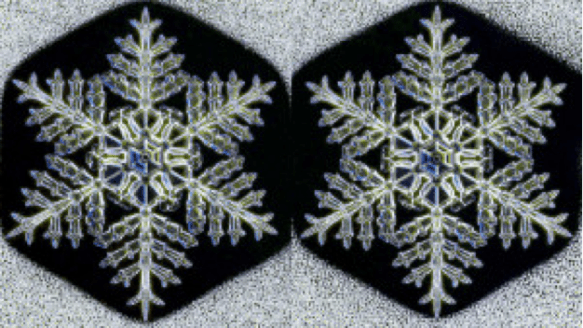
Two identical snowflakes, via NYT

He is talking about multi-finality (and not multi-tasking) and about the interest in the quality of the experience (and not the mere outcome), and about the source of creative being in the past.

It’s encouraging to realize that many of the states of mind we seek are not “out there” somewhere, to be hunted down and consumed. They are states of mind belonging to our past selves — we wouldn’t crave it if we had never experienced it. We have to go backwards and remember what we once knew, not forwards to some perfected version of ourselves. What would you pay to experience child-like wonder for a day? To watch Star Wars Episode IV for the first time again? To have the ability to snap your fingers at any time and see your writing, your painting, your app with the fresh eyes of a novice?

“Flexing our mental muscles” by imagining new worlds, and “when people synchronize themselves together”, says Eno.

He also introduces the topic of “exhaustion”. I will come back to the theme of exhaustion in another post, as I think it is key to the kind of problems we try to tackle today.

14th century

“We need ways to keep in synch, to keep coherent. That is what culture is doing for us.”

and

“Culture as a set of collective rituals to keep coherent, collective rituals that we are all engaged in”

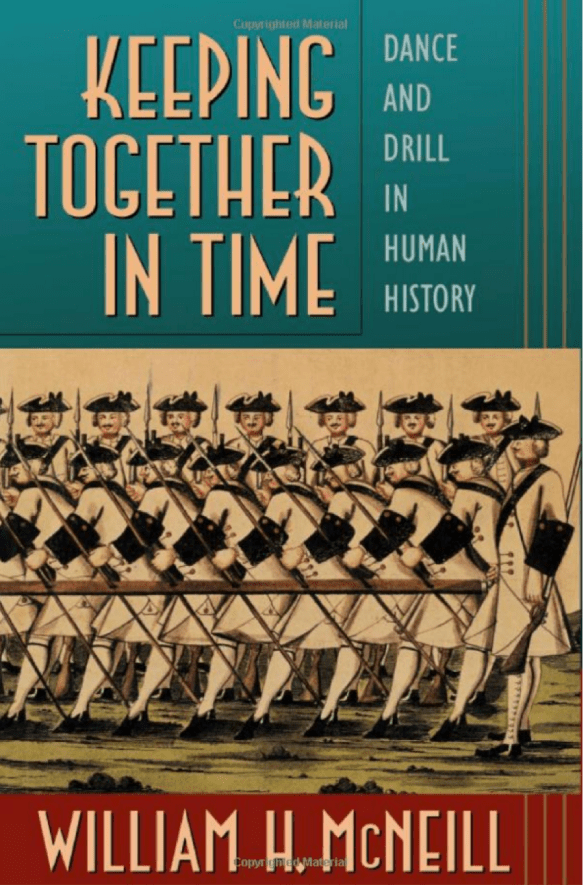
book keeping together

Brian refers to the book “Keeping Together” by William Hardy. In that book, one of the most widely read and respected historians in America pursues the possibility that coordinated rhythmic movement – and the shared feelings it evokes – has been a powerful force in holding human groups together.

As an ex-DJ, I think my work is about creating rhythms. Architecting these “coordinated rhythmic movements and rituals” for “state of minds” and “states of intentions”.

Way beyond the entertainment. This is about “Creating scenius together”. Scenius is the talent of whole communities. Bringing them in contact with their talent, their potential.

“You simply can’t absorb this (change and exhaustion). You just have to do it collectively. Nobody’s going to be able to do it individually”.

These interviews with Brian Eno are from last year. Before Bowie sent us Lazarus and left us all alone on 10 Jan 2016.


My good friend Gary Thompson also leveraged Bowie’s death into an intimate and very inspiring blog post about “being provoked” and “being at a trailhead, at the start of a new year and being on a journey without a map”.

Tony Visconti, who produced several of Bowie’s albums, acclaimed Bowie’s visionary status.

“He always did what he wanted to do,” and “And he wanted to do it his way and he wanted to do it the best way. His death was no different from his life – a work of art.”

Bowie and Eno are not entertainment. They are provoking art. Work becomes art. The essence of work is art.

“Art is everything

that you don’t have to do”

Brian Eno

At a reception earlier this week, I bumped into a friend who follows my blogs, tweets, and artwork.

She basically asked me “Quo Vadis, Peter?” and “What direction are you going with all this?” It’s a great question I am struggling with on an almost daily basis.

I will answer cryptically with the title of Otto Sharmer’s latest book “Leading from the Emerging Future: From Ego-System to Eco-System Economies”and with the last verse of Bowie’s Lazarus:

This way or no way
You know I’ll be free
Just like that bluebird
Now, ain’t that just like me?

Oh, I’ll be free
Just like that bluebird
Oh, I’ll be free
Ain’t that just like me?

Enjoy!


Ceci n’est pas un blockchain


Is there really nothing else to talk about? The intensity of the hype is getting to a point where conference organizers put a blockchain session onto their program “just to get people in”, in many cases because they have nothing else valuable to say. So they sell hype instead of substance.

ceci no blockchain

Magritte’s painting, freely adapted by Petervan


You know when you are at the top of the hype-cycle, when the topic hits the WEF agenda as a cure for “The 4th Industrial Revolution”.

David Birch nailed it this week in Finextra when he wrote:

“It seems to me that in a relatively short time the word blockchain has become detached from its technological roots and from its location in the spectrum of shared ledger implementation options to become one of those almost generic chromewash terms, like “big data” or “cloud” (there is no cloud, remember, it’s just somebody else’s computer) to deliver a superficial veneer of futurism.”

path

In the “Path of least resistance” (Amazon Affiliates link), Robert Fritz says:

We live in an era of platitudes and mottos. Many of them are designed to manipulate people into action: If you’re not part of the solution, you’re part of the problem”. This one, popular in he late sixties and late seventies, was clever. No matter what you did, you were involved in the conflict. And if you happened not to be directly involved, you were the cause of the conflict

And later;

So many of the notions in human growth are filled with these kinds of conflict manipulation. I suppose it is considered good marketing. Create a perceived need in the prospective client. Encourage a sense of urgency. Make it seem as if there is no choice. But conflict manipulation has a structure that cannot lead to growth just to more extreme oscillation. Thus many of the people who attempt to cause change, often with real sincerity, do not change and do not grow. The structure of conflict manipulation does not support change.

Blockchain is nothing else than code that seems applicable in many use cases. Code is language. Code is culture. The only way to understand and learn code, culture or language is to practice it. That’s exactly what many of our institutions do, and i think that is great.

But let’s not confuse symptom and cause.

As already mentioned in my blog post on Magritte and The Ages of Machines, the image of the pipe is not a pipe. The picture of the pipe stands for the hype. The hype is not the real world, not the real pipe. The hype hides reality. What is it hiding?

It hides the underlying structural changes. Robert Fritz said :

“A change of underlying structure will lead to a change of behavior. Not your good intentions, your sincerity, your hopes, your goodness, or how much you care”

Structure drives behavior, and behavior drives culture.

The pendulum oscillates:

Capitalism > Postcapitalism

Platform Capitalism > Platform Co-operatism

Collaborative > Autonomous

Internet of Things > Interest of Things

But that underlying structural and hence cultural change is caused by ecological, social and spiritual divide (the three big divides in Otto Scharmer’s work).

That structural change becomes more and more visible in the evolution from centralized to de-centralized to fully distributed systems.

ottoFrom Otto Scharmer’s U.Lab

The above structural changes deeply impact our quality of attending, conversing, organizing and coordination.

These are the things we should discuss. How we participate, how we organize, how we coordinate, how we set norms and governance to tackle the three big divides.

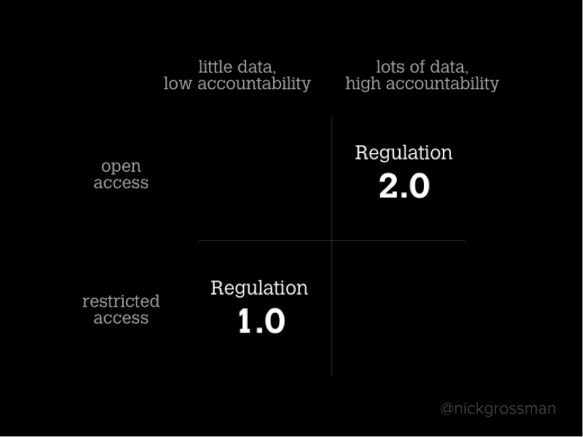
On the governance and regulation of “centralized networks” and “distributed systems”, there was recently a great post by @nickgrossman GM of Union Square Ventures, referring to his great Regulation 2.0 Whitepaper

regulation 2.0

Figure by @nickgrossman

“This is a fundamentally different regulatory model than what we have in the real world. On the internet, the model is “go ahead and do — but we’ll track it and your reputation will be affected if you’re a bad actor”, whereas with real-world government, the model is more “get our permission first, then go do”. I’ve described this before as “regulation 1.0” vs. “regulation 2.0”

The point I am trying to make with this post is that the pipe is a big distraction for the real work that needs to be done.

The real work and our bigger themes of discussion should be (for example):

  • How to become better banks, better in the sense of better for the world
  • How to deal with the power shift resulting from the structural changes
  • How to move from platform capitalism to platform co-operatism
  • How we attend, converse, organize, and coordinate in this new medium

This is post-platform thinking. Where centralized networks (like Uber, AirBnB, etc) could/can/should get replaced by fully distributed P2P systems.

The market that can be addressed is huge. The frictions to be sorted out immense. This attracts entrepreneurship and investment.

But we risk having the same wet dream of freedom and self-realization as we had with the Internet.

In the end, powerful players stand up and try to control the market, trying to get a grip on it through monopolistic and hyper-libertarian behavior. Who will be the Amazon, Google, Facebook, Apple, Samsung, or Alibaba of this new monopolistic distributed nirvana?

The image of that pipe may create a big illusion of perceived freedom.

Magritte and the Age of Machines

This is my first post of the year, and I don’t believe I properly closed the previous year.

fleches bxl

Surreal traffic sign in Belgium

On the last day of 2015 I paid a visit to the Magritte Museum in Brussels. It was one of those surrealist days, when the Brussels mayor has just announced the cancellation of the new-year fireworks, and the city was still under terror alert level-3, meaning that a threat is “possible and likely.”

magritte logo

I was early – just before the opening of the museum – and the city had something unreal. The air was fresh, the light was bright, everything was peaceful, and mainly Japanese and American tourists were hanging around enjoying the square.
The entrance of the museum also was surreal: visitors now had to go through a x-ray scanner, like in airports. I am pretty sure the place must be full of CCTV cameras, whose output is possibly most of the time ignored by human or more advanced computer vision systems.

I think we are overreacting here, and that it will get worse. There is a big disconnect between the reality and the perceptions created. And it changes my behaviour. Already now, I notice how I change my behaviour when entering in surveyed territories like airports (and now also musea): I don’t try to look into the eyes of the guard, maybe I dress more conforming, become submissive, and become more careful in the wordings and subjects of my posts and tweets.

I have become submissive.

Luckily, the queue at the museum was not long yet, and I could shrug off the defeat and start enjoying the museum tour.

The Magritte museum is part of a the complex of the Royal Museums of Fine Arts of Belgium, located in the heart of Brussels at the Place Royale. It is housed in the neo-classical landmark Altenloh Hotel, superbly restored in 1984. I had visited the Royal Museums complex before, but never the wing where Magritte is hosted.

The main entrance of the museum is via a big elevator (the museum is spread over three floors, and the tour starts on the 3rd floor). I go quite frequently to an exhibition and one immediately notices when you are entering a league in its own right. This is an absolute world-class collection and museum, I recommend it to anybody who visits our city and has a couple of hours to spare.

“The museum’s multi-disciplinary collection is unrivalled. It contains more than 200 works consisting of oils on canvas, gouaches, drawings, sculptures and painted objects as well as advertising posters, musical scores, vintage photographs and films produced by the artist.”

magritte headshot

Headshot René Magritte

René Magritte was a Belgian surrealist artist. He became well known for a number of witty and thought-provoking images that fall under the umbrella of surrealism. His work is known for challenging observers’ preconditioned perceptions of reality. (from Wikipedia).

I believe that the skill to “challenge observers’ preconditioned perceptions of reality” – in other words curating, creating, and making sense – is becoming more and more important is this age of rapid change, where shortcuts and platitudes are rather the norm, in stead of depth in our reflections about cultural change.

Robert Fritz said: “Structure determines behaviour, and behaviour drives culture”.

book marvelous clouds

In that context, I highly recommend the book “The Marvelous Clouds” by John Durham Peters, who starts where Marshall McLuhan left it in 1964 (that is now more that 50 years ago), when he coined the phrase “The Medium is the message” in his most widely known book, Understanding Media: The Extensions of Man.

McLuhan proposed that a medium itself, not the content it carries, should be the focus of study. He said that a medium affects the society in which it plays a role not only by the content delivered over the medium, but also by the characteristics of the medium itself.

When I start playing and mixing with Fritz and McLuhan, I get to something like:

“The medium informs the structure,

Structure informs behaviour,

Behaviour informs culture”

A significant part of the structure we operate in is made of media. Media as in plural of medium.

The air is medium, water is medium, the Internet is medium.

But like Magritte, we are unaware how easily the medium can be tricked. Is what we see real, unreal, surreal, or pure illusion?

Check out this great post about Adversarial Machines by Sanim on how easy our machines can get fooled by adversarial robots.

“At the heart of many modern computer vision systems are Convolutional Neural Networks. On some vision tasks, CNNs have surpassed human performance. Industries such as Web-Services, Research, Transport, Medical, Manufacturing, Defence and Intelligence rely on them every day.”

And

“Adversarial Examples are a fascinating area of ongoing research. They highlight limitations of current systems and raise a number of interesting questions. While industries are racing to include visual intelligence systems in mission-critical infrastructure, looking at edge-cases and exploring solutions is a productive path. 

The discussion in that post – and especially the part on generating adversarial images and “mangas” – is fascinating. And should us make think very carefully how all this can be used and misused in a medium of networks, CCTV cameras, and online and offline surveillance.

airport

trump

In other words, the image of the reality is not the reality.

The map is not the territory (Alfred Korzybski in 1931), meaning:

  • A map may have a structure similar or dissimilar to the structure of the territory…
  • A map is not the territory.

In The Medium Is the MassageMarshall McLuhan expanded this argument to electronic media. Media representations, especially on screens, are abstractions; are virtual “extensions” of what our sensory channels, bodies, thinking and feeling do for us in real life (Source: Wikipedia)

Which brings us full circle back to our friend Magritte who hits the nail – or should I say pipe – in many of his paintings, the most famous work entitled The Treachery of Images, which consists of a drawing of a pipe with the caption, Ceci n’est pas une pipe (“This is not a pipe“).

pipe

The spirit if Magritte is still very much alive. In true surreal traditions, Belgians started posting pictures of cats during threat level-4 in November 2015.

cats

These are deeply human and intended reactions to ever more chaotic environments and media.

I believe it is very important to nurture these human intentions, and the arts of humor, surrealism, and deeper languages than pure digital representations of reality.

Yes, we are talking here about the language of art.

Brian Eno recently defined art as:

“Everything that you don’t have to do

In that spirit, I leave you with some quotes from Magritte. They are displayed across the three floors of the museum in the same typography of “Ceci n’est pas une pipe.” All quotations are consolidated in a nice PDF that you can find on the museum’s website, with the original French version, and translations in Dutch, English, German and Spanish.

quotes

Many of the quotes are very powerful. Here a selection of my personal favorites. I hope you enjoy them as much as I do.

I wish for real love, the impossible and the utopian. I fear knowledge of my exact limits.

To be surrealist is to banish the notion of ‘déjà vu’ and seek out the not yet seen. By this I mean this moment of clarity that no method can reveal.

The real value of art is measured by its capacity for liberating revelation.

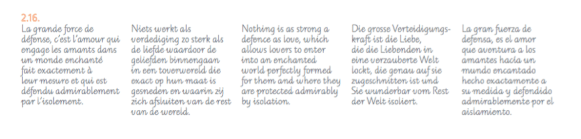
Nothing is as strong a defense as love, which allows lovers to enter into an enchanted world perfectly formed for them and where they are protected admirably by isolation.

Rebellion is a reflex of the living man.

Liberty is the possibility of being and not the obligation to be

All that I desire is to be enriched by intensely exciting new thoughts

Please do share with me your intensely exciting new thoughts. Onwards for a fantastic 2016. Happy new year !

The Essence of Work – Part-3 – Values and Needs

This post is part-3 of a series of ten essays on the essence of work. For an introduction, check here.

Alexa Meade Art-1 - Aligned with Alexa (2010)

Artwork by Alexa Meade - Aligned with Alexa (2010)

In Part-1, we learned how my needs inform my beliefs. My beliefs inform my actions. My actions result in effects. And those effects confirm or adjust my needs. We ended Part-1 with the promise to dive deeper into values and needs and how they are the fundamental building blocks of the essence of good work.

There is much taxonomy of needs, and I just picked this one by Shasta Nelson in Huffington Post some years ago. The needs are nicely grouped in the following categories: Connection, Physical Well-Being, Honesty, Play, Peace, Autonomy, Meaning.

How does your work allow you to progress on these dimensions? I tried to highlight below for myself some of the needs that are not fully met, where I could use some stretch, where there is room for progression and growth.

  • Connection: affection, appreciation, belonging, intimacy, safety, warmth
  • Physical well-being: air, shelter, touch
  • Honesty: presence
  • Play: joy
  • Peace: beauty, harmony
  • Autonomy: space
  • Meaning: awareness, clarity, discovery, self-expression, to matter

This list I share here is not an exhaustive list of my met or unmet needs. They are just some examples. There are other ones that are too personal, and don’t feel right to share on a public blog.

The bottom-line is that we have to be honest and sincere about our needs, and definitely not try to change them, or to lie to yourself about them, as Dave Gray suggests in Liminal Thinking:

“There is nothing you can’t lie to yourself about very convincingly, including covering up that you are lying. You do this naturally and unconsciously.”

“This is self-sealing logic at work. New information from outside the bubble of belief is discounted, or is distorted, because it conflicts with the version of reality that exists inside the bubble.”

So what is inside/outside of our bubble?

I believe it is common knowledge that happiness at/in work happens when your personal values and the values of your employer/customer are aligned. Values are part of the bubble.

The areas of alignment are much broader and diverse than just “values”. We have to align at the level of beliefs; and because our beliefs are informed by our needs, we have to look into whether your “job” is satisfying your needs.

There was a great paragraph 6) in James Altucher’s 2013 post “10 reasons why you have to quit your job this year”:

I will define “needs” the way I always do, via the four legs of what I call “the daily practice”. Are your physical needs, your emotional needs, your mental needs, and your spiritual needs being satisfied?

The only time I’ve had a job that did was when I had to do little work so that I had time on the side to either write, or start a business, or have fun, or spend time with friends. The times when I haven’t is when I was working too hard, dealing with people I didn’t like, getting my creativity crushed over and over, and so on. When you are in those situations you need to plot out your exit strategy.

Your hands are not made to type out memos. Or put paper through fax machines. Or hold a phone up while you talk to people you dislike. 100 years from now your hands will rot like dust in your grave. You have to make wonderful use of those hands now. Kiss your hands so they can make magic.

One can argue, “not everyone is entitled to have all of those needs satisfied at a job.” That’s true. But since we already know that the salary of a job won’t make you happy, you can easily modify lifestyle and work to at least satisfy more of your needs. And the more these needs are satisfied the more you will create the conditions for true abundance to come into your life.

Your life is a house. Abundance is the roof. But the foundation and the plumbing need to be in there first or the roof will fall down, the house will be unlivable. You create the foundation by following the Daily Practice.

Aha! The Daily Practice! James must have been reading Integral Life Practice 😉

IFL Book cover

A good starting point indeed to look further into our needs – starting point is a little bit of an understatement here – is the work of Ken Wilber on Integral Life and the use of the AQAL (All Quadrants, All Levels) model for personal growth.

ILF the 4 AQAL quadrants 2

From Ken Wilber’s Integral Life Practice

And within each quadrant, you have many lines of growth possible. Let’s have a look where Ken Wilber puts “needs”:

IFL needs in quadrant

From Ken Wilber’s Integral Life Practice

The curvy lines/arrows labeled “needs”, “values”, etc are specific areas in which growth can occur.

Levels are higher-order structures that reflect different altitudes of consciousness. In the quadrant above, the concentric circles give an indication of those different levels growth. The more to the outside of the quadrant, the more you have progressed. Sometimes those levels of progression are indicated in colors (more on that later in this post).

The point I am trying to make here in the context of the “essence of work” is that alignment of personal values (the “I” quadrant) with the values of the organization (the “Its” quadrant) is limiting our experience.

For work being rewarding, satisfying, and meaningful, we have to do the same mapping/alignment between the “I” quadrant and “Its” quadrant for other lines of growth such as needs, but also morals, cognition, self-identity, interpersonal relating, emotions, aesthetics, kinesthetics, and spirituality.

Each line is unique in that it can develop relatively independently from each other. In other words, you can have progressed a lot on the interpersonal relation line, but be mediocre on your needs- or value-consciousness. This is very similar to the work on multiple intelligences by Howard Gardner at Harvard University and his work on Project Zero. From Wikipedia:

The goal of his research is to determine what it means to achieve work that is at once excellent, engaging, and carried out in an ethical way.

Project Zero’s mission is to understand and enhance learning, thinking, and creativity in the arts, as well as humanistic and scientific disciplines at the individual and institutional levels.

Alexa Meade Art-5 - Hesitate (2012)

Artwork by Alexa Meade - Hesitate (2012)

In that sense, the well-known Maslow’s Hierarchy of Needs is just one particular lens on our needs, and only on our needs.

Wilber’s book does a great job in putting Maslow in context, and comparing different lines of development and related models and research.

ILF levels together

From Ken Wilber’s Integral Life Practice

Across the different lines of development, the levels of consciousness/awareness are indicated in colors of the rainbow, from infrared at the bottom up to ultraviolet and clear light at the top. Most readers will recognize the color code from Spiral Dynamics, the Teal Organization, etc.

Picturing your own more integral self-image of yourself is called a psychograph. Here is an example of a partial psychograph an Environmental Activist.

Psychograph example

From Ken Wilber’s Integral Life Practice

You can decide to focus on your strength-lines or your weakness-lines of growth.

Good work – not only the end result, but also the journey of making/creating it – is work that allows you to stretch your lines of development and to become an integral human being.

The essence of work goes beyond fulfilling your needs. The essence of work is to inspire yourself and others to produce work that has those eternal qualities of life.

The essence of work is about systems alignment.