Petervan Studios Artworks © 2023 – iPad study seaside – inspired by Jan De Vliegher
It is rare that I read a book twice. “Making Art Work” by Patrick McCray is one of them. A book that sends you back to the future of the 50ies, a period in some sense similar to today, where we are again in a cold/warm war context, but where interesting collaborations between art, engineers, scientists, entrepreneurs, and technologists make their appearance as well. Fortunately, it was not all doom then, and neither is it today.
The book is also a huge inspiration for The Scaffold, the transdisciplinary learning studio for the never-normal that I am trying to give birth in different constellations.
In the book, the author Patrick McGray looks at artists-engineers collaborations with a very specific lens: where usually art books glorify the artists, Making Art Work looks at the engineers that made the transdisciplinary artworks work. Hence the title “Making Art Work”.
One of the key insights in these transdisciplinary collaborations is the evolution from “What do I want?” to “What do we have?” Usually, the artist comes in with what she/he wants and asks the engineers to make that happen. This approach leads to a lot of misunderstandings and frustrations. A better take is to start with the question to the engineers “What do you have?” and let the artists play and be creative with what is already there.
The book is a treasure of other gems, anecdotes, and more in-depth research of the life and work of folks like Frank Malina (rocket engineer turned artist), Billy Klüver (laser-beam engineer turned curator/impresario), Jean Tingeley (artwork/machined that destroyed itself). These were also crazy times with Andy Warhol, John Cage, Robert Rauschenberg, Marcel Duchamp, and many others.
Jean Tingeley – Hommage to New York, 1960 – The New York Times – Photographer unknown
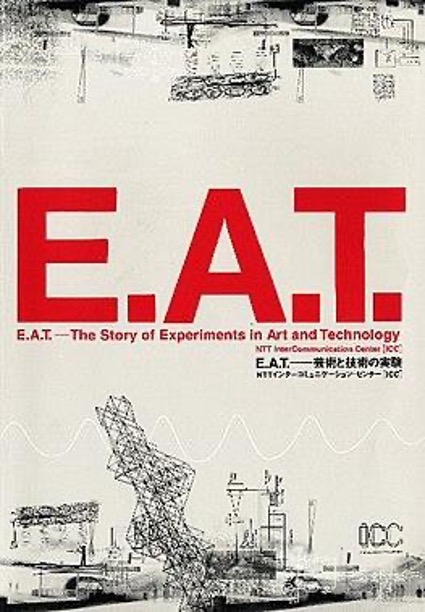
One of the initiatives described is the E.A.T. Experiments in Art and Technology, driven by curator/experimentalist/impresario Billy Klüver.
There was so much going on at E.A.T. and the best way to get a sense of the depth and breadth of their work is by reading the book, or sitting down, relaxing, and enjoying this +1hour video about the initiative, narrated by Julie Martin, at that time “Director of Experiments” at E.A.T., and in this video really charming and full of humor.
Not only is her title cool, but the title reflects the core E.A.T. ethos which was all about experiments. The outcome was deemed less important than the journey of the experiment.
The becoming is more important that the state of the thing.
In my earlier post “Apple Just Upgraded the Illusion”, I already touched upon process philosophy as “a way out of what is today seen as overly deterministic thinking about technology and time, and clears the road for thinking about digital technologies and digital selves not as objects but as processes and becoming“
“Projects that did not get realized are as interesting as projects that are”
Julie Martin talks about reverberating beyond careers and personal lives, cultivating a sense of play, disciplinary hybrids, “artrapreneurship”, and taking purposeful risks in order to explore new boundaries in both art and science. How cool is that!
The precursor of E.A.T. was an amazing one-time event “9 Evenings: Theatre and Engineering” one of the first large-scale collaborations between artists and engineers and scientists, held in the 69th Regiment Armory in New York, a huge empty space that was transformed into a theatrical performance space in five days.
E.A.T. was also the main contractor/curator for the content at the PepsiCo Pavillion at the World Fair Japan in 1970.
Here is an excellent article in IEEE Spectrum Magazine of Feb 2020 by the author of Making Art Work, Patrick McCray.
I love the subtitle “50 years on, artists and engineers staged one of the most ambitious and expensive multimedia events – and infuriated their corporate backers”
Here are some pictures from that article:
Both “9 Weeks” and the “Pepsi Pavillion” highlight the importance of space in orchestrating new skills and behaviors. Space as a language. Space as in spatial computing. Space as in spatial thinking, spatial creation.
In re-reading the book “Making Art Work” and writing this post, I suddenly realized that most of my work is about “Making Space Work”, or even better “Making Content Work”. A practice where most of the work is an experiment. Where the becoming and the performance in space are more important than the resulting artifacts.
Performance by the performers on-stage, but also by the participants. Their journey becomes an experiment as well, a curious meandering through an endless labyrinth, letting them connect the dots and do the meaning-making, rather than considering the audience as passive consumers of content that need to be hand-held, directed, and manipulated by and in a scripted non-malleable “show”.
As I mentioned several times before, my practice is not in the entertainment business, my practice is in the learning “bildung” process. These methods are underpinning my work in the area of interventions, provocations, and interruptions. In other words, all my work is about similar forms of artistic and aesthetic expression and experience in the co-creation of content. These methods also led to a new vocabulary and a new set of aesthetics to describe and share what I do and why I do it.
I feel like I am painting with content. Making content work. I am hungry to unleash this creative energy in some big space, together with technologists, scientists, artists, and entrepreneurs.
Warmest
I always felt restricted by the real world. But now, I’ve found my true calling in the virtual world of New New Babylon.

As I explore this world, I’m constantly amazed by the endless possibilities it offers. The colors are vibrant, the sounds are unique, and the technology is incredible. It’s a place where artists and experimentalists like myself can pursue our passions without any restrictions.
I made the life-changing decision to leave the real world behind and make a living as an artist and experimentalist in New New Babylon. I sold everything I had, bought the necessary equipment, and dived headfirst into this new world.
At first, it wasn’t easy. I struggled to make ends meet and had to work long hours to create my art and experiment with new techniques. But I’m determined to make it work, and I collaborate with other artists to create some of the most stunning works of art that New New Babylon has ever seen.
As my reputation grows, so does my income. I’m able to live a comfortable life in the virtual world, and I feel more fulfilled than I ever have in the real world. I know that this is where I truly belong.
But even with my success, I never forget my roots. I miss my family and friends, but I know that I could never go back to the real world. New New Babylon is my home now, and I’m content creating and experimenting in this vibrant world.
Years will pass, and I hope that my art will become more and more famous. I want to become a household name in New New Babylon and inspire a new generation of artists and experimentalists. I’m happy and content, knowing that I’ve made the right decision.

In the end, I realize that sometimes, the things we need the most are not in the world around us, but within us. I’ve found my true calling in the virtual world, and I know that I’ll spend the rest of my life creating and experimenting, surrounded by the vibrant colors and unique sounds of New New Babylon.
Warmest
Created by ChatGPT on 1 April 2023
As mentioned in my recent inspiration post, this is the book that Nick Ervinck suggested to get me going on professionalizing my art practice. But it clearly also had an effect on my other practices.
Michael Craig-Martin is often described as the godfather of the Young British Artists (YBA) of the 1980s and 1990s. Shame on me that I knew little about YBA and even less about Michael Craig-Martin. That ignorance was also an advantage, as I could read the book without prejudice.
The book is a series of short stories and episodes on the many ideas, events, and people that have influenced Craig-Martin during his rich artistic life.
I really liked the book, and I liked the cut-the-crap approach of all the things you are supposed to do or not do as an aspiring artist.
For this post, I picked the story ”On the three stages of twentieth-century art”, and gave it a twist that relates more to my Scaffold practice than to my art practice.
Craig-Marting described in that story the three stages of RADICALIZATION of art:
Radicalization of Form
Radicalization of Materials
Radicalization of Content
Together these three radicalizations lead to:
“A vast EXPANSION in the scope of what art can look like, be made of, and be about”
One could say this expansion formed the foundation for “contemporary” art.
I feel attracted to the words “contemporary” and “avant-garde”.
Probably because they seem to suggest novelty, modernity, and some level of gentle subversive aesthetic, less prone to the temporalities of fashions or trends.
It seems that art movements could also be considered precursors of business movements, and how we can and have to recalibrate our insights (or lack thereof) in innovation in corporate environments.
The quote above smells a lot like what many spontaneous and enthusiastic people feel and experience when they want to enable positive change in the corporate environment. I have come across that resistance many times in my corporate career. And it breaks my heart to see how again today, many organizations smell a conservative ambiance and favor moderation rather than radicalism, caution rather than risk.
How can we create an environment where these young, bright enthusiasts can thrive and not be suffocated in their endeavors by non-contemporary organizations and teams?
What would be the radicalizations that lead to a contemporary business, an avant-garde business, or some form of corporate radicalism?
Take a quote again from Craig-Martin’s book (my emphasis):
“Taking an interest in contemporary art, the art of one’s own time as it is being made, is quite different from having an interest in the past, even the recent past. It involves a sense of participation, a pleasure in uncertainty, a willingness to have one’s assumptions challenged, a desire to be unsettled. Art holds a unique and critically important place in modern life precisely because it has not been afraid to take on board all the diverse and dangerously unpredictable creative activities rejected by the other arts. In a world where everyone and everything has to be accounted for, isn’t it of immense intellectual, aesthetic, social, and political importance that art provides a context for those creative activities that do not easily fit the system?”
A DESIRE TO BE UNSETTLED!
Imagine that!
I tried to re-write and adapt this paragraph for a contemporary corporate spring:
“Taking an interest in contemporary business, the business of one’s own time as it is being made, is quite different from having an interest in the past, even the recent past. It involves a sense of participation, a pleasure in uncertainty, a willingness to have one’s assumptions challenged, a desire to be unsettled. Radical organizations and teams hold a unique and critically important place in modern life precisely because they are not afraid to take on board all the diverse and dangerously unpredictable creative activities rejected by the conservative ambiance. In a world where everyone and everything has to be accounted for, isn’t it of immense intellectual, aesthetic, social, and political importance that organizations provide a context for those creative activities that do not easily fit the system?”
I believe corporate radicalism and corporate radicalists are something quite different than the romanticized and heroic take on misfits, dreamers, rebels, etc. We have to move way beyond corporate rebellion.
We need corporate radicalism in:
Form
Materials
Content
What are the corporate forms, materials, and content that need expansion?
We need contemporary, avant-garde, radical businesses that account for the intended and unintended consequences ànd opportunities. Organizations that are inclusive in all aspects. Companies that desire to be unsettled. Institutions that desire societal, moral, and aesthetic advancement.
This will require a different type of learning, formation, education, or training. Not only exploring the STEM (Science, Technology, Engineering, Mathematics) and Production dimensions of their business, but also daring to (re)compose and live out loud new exciting and daring narratives, set high ethical and moral standards, and embrace new aesthetics.
That new type of learning must resemble what Michael Craig-Marting describes as an ideal art school. Just drop the word art, and you may get an idea of what 21st-century corporate education and formation may look like.
We need to radically rethink corporate business schools.
We need radical schools for radical times.
We need to train, form, and build radical organizations.
How can we scaffold such a school?
What is needed to take the leap of faith for being re-trained like that again?
Some years ago, I discovered the magical art world of Flemish artist Nick Ervinck.
I subscribed to his newsletter and was inspired by his ongoing progress.
If you want to get a good sense of what drives Nick and what his artwork is all about, here is a great video:
Nick has a church (The Dutch word for church is “kerk”).
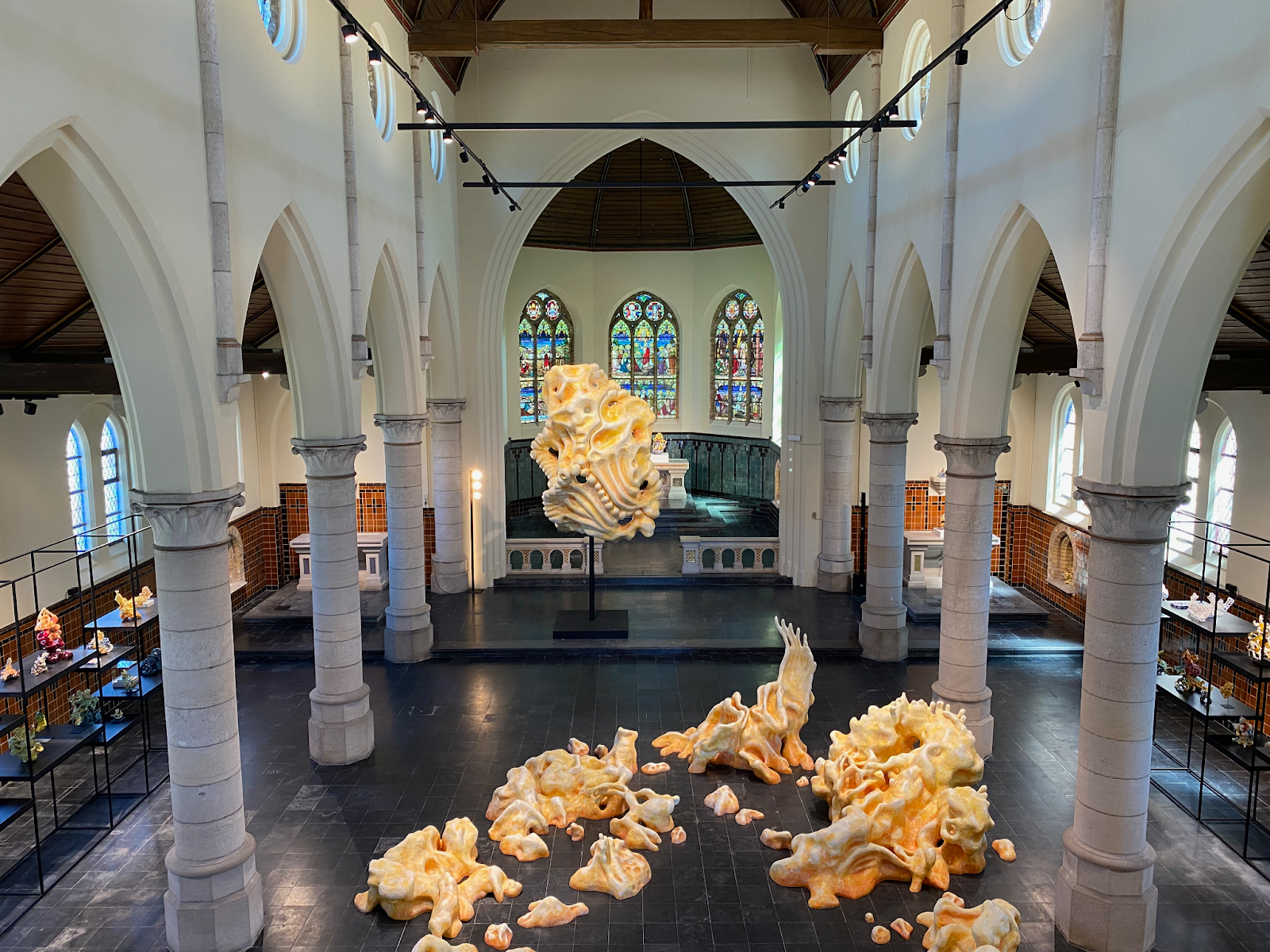
Nick’s church is branded “K.E.R.K.” standing for Kunsthalle ERvickK” and is located in the tiny village of Sint-Pieters-Kapelle, a township part of Middelkerke, a mall town at the Belgian North Sea coast. Last summer, I combined a bike ride with a visit to K.E.R.K. on a very hot 10 July 2022. The exhibition “SKIN WORKS” displayed recent work by Nick Ervinck.
I was impressed and inspired. I wanted to meet Nick one day, and if possible visit his studio. At the reception, there was a young student, and I asked whether the artist was present in the church. He was not, but she gave me a business card with his email address and phone number, suggesting that I would ask for a studio visit.
Here is the mail that I wrote to Nick:
Hello Nick,
I’ve been following you for a while and I’m a fan. Yesterday I visited K.E.R.K. (GNI-RI JUL2022 SKIN WORKS) and the friendly young woman at the entrance said it was possible to visit your studio.
I do a number of artistic experiments myself, and I recently hired Kurt Vanbelleghem to help me professionalize my practice. Besides the art, I work on a project “The Scaffold”, where I bring artists, entrepreneurs, and engineers together in residencies for corporate clients.
I would love to have a conversation with you, preferably in your studio, or else in K.E.R.K. or any other location of your choice.
Interested?
Here is Nick’s answer:
Hey peter,
Nice to hear from you.
It is not possible to receive each person individually.
I normally only open the studio for group visits.
But your email has caught my interest. What you are doing is of course not clear to me.
Bringing artists, entrepreneurs, engineers, and companies together sounds like music to my ears.
I am someone who likes to work goal and result oriented. And many of these initiatives do not succeed in this.
I will be happy to receive you in my studio/atelier to exchange thoughts.
Fits for you possibly Tuesday evening August 9 or Wednesday evening August 10.
Or feel free to make some suggestions and I’ll check my agenda.
Artistic greetings
Nick
We settled for 9 August, also a very hot summer day.
There I stood in front of his studio, with no agenda, but with a quite detailed concept of what The Scaffold had to become.
I did not know what to expect. Maybe he would kick me out after ½ hour? No worries: I got a really warm welcome. Nick was very approachable, and as would show quickly, a real professional in all senses. There was a click: we spent 4 hours together.
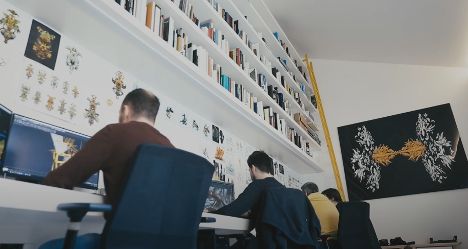
Above the working desk was a huge library of more than a thousand artbooks.
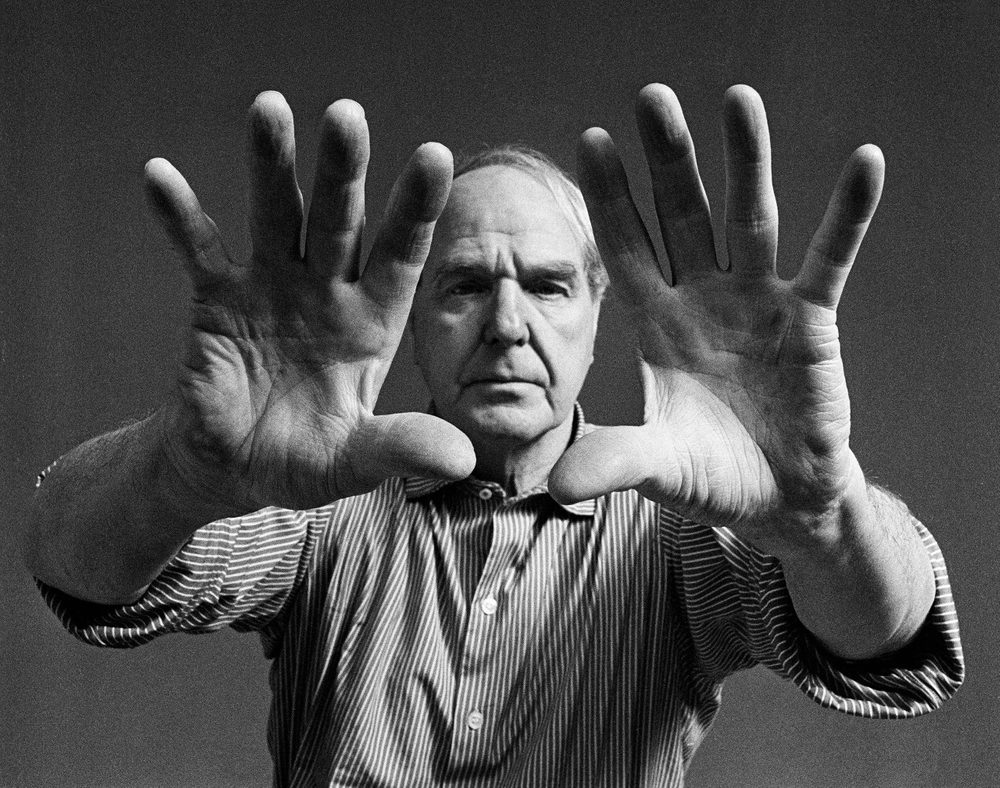
Nick is also a big fan of Henry Moore, a British artist mainly known for his sculptures. Moore can be said to have caused a British sculptural renaissance. Nick’s Henry Moore book collection encompasses more than 300 books! The biggest private collection in the world: the only place in the world where you can find more is in the Henry Moore Foundation itself!
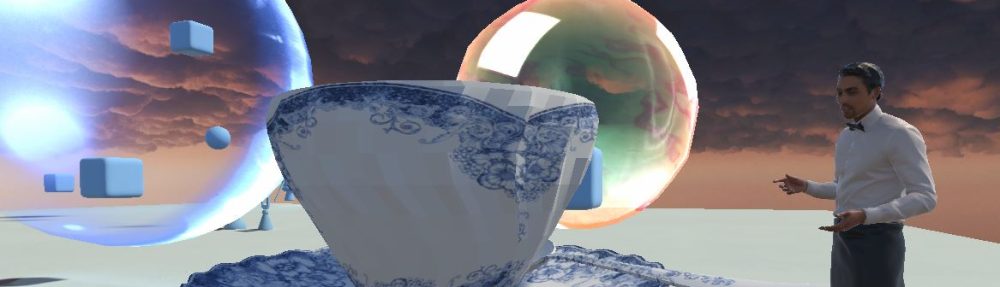
Nick also built his own virtual museum “MOUSEION” and his own “NIKIPEDIA” landing page:
The visit and the conversation were super inspiring for me. His work and attitude influence me in many ways:
His Focus
He is an artist entrepreneur and focuses exclusively on that
His Professionalism
Both as an artist and as an entrepreneur.
Everything exudes attention to detail and perfectionism in everything:
Archiving and documenting
High-quality printing, framing, book printing
Business cards
Website
Respect for own work
Cleanness and order in the studio
His Sharing
Links to books, his own manuals for art photography, bookbinding, framing, transport boxes, software, high-quality art print shops, etc, etc
His Erudition
He is very well-read, has a pluralistic view of things, and is able to express himself very well orally and in writing
I invited Nick to be part of the non-conformist tribes I am curating for The Scaffold learning experiences.
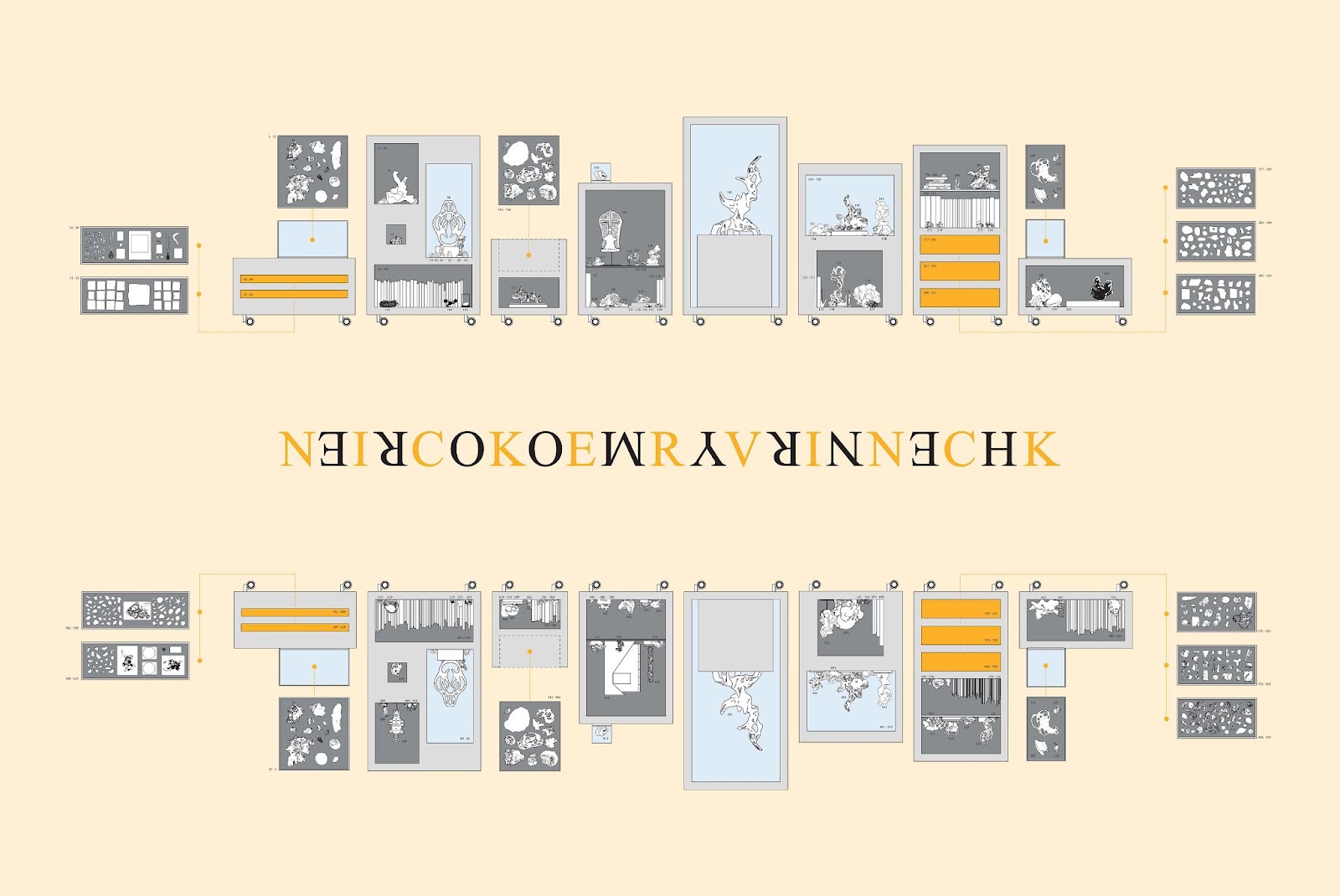
When leaving the studio, he left me with some of his own art books as a present, a poster of his Henry Moore cabinet show (see the above picture, where Nick Ervinck and Henry Moore are interwoven), and a recommendation for the book “On Being An Artist” by Michael Craig-Martin.
He must have read my mind, as the book proved to be another big inspiration for my practice (and the subject of my next blog post).

When I walked towards my car in the warm evening sun, I felt like coming out of a movie.
This is the thank you letter I sent:
Dear Nick
Do you recognize the feeling when you’ve been to a good movie, and you come out, and the world feels different? That’s the feeling I had yesterday when I came out of your studio and on my ride back home.
Thank you very much for the generosity of time (more than three hours!) and the quality of your input and feedback. Thanks also for the MOUSEION book, the poster, the flyers, and the book suggestions. The poster is now right in front of me.
Thank you also for the confidence in showing your management software, the guided tour in your studio, and sharing successful projects, but also projects that just didn’t make it.
Warm artistic greetings,
From time to time, I discover an interview, an artist, a dreamer, or another non-conformist take on reality that I find worthwhile transcribing.
I prefer to make such transcripts manually, by listening, pausing, and reflecting. Like drawing by hand.
And also in the resulting text, it is possible to give some sense to that rhythm of reflection.
In this post, a transcript of the conversation with artist/architect Peter Cook on the benefits of drawing by hand, on buildable or non-buildable ideas, on utopia or reality. I started transcribing around 11:15 in this video which also contains beautiful artwork.
Somehow, I would like to grow old like Peter Cook…
In drawing
You can decide upon almost anything
How to make a building that can go from solid to transparent without a window?
From solid
to slightly permeable
and then translucent
More translucent
Completely transparent
And then back again
I don’t think any of the work is utopian
The notion of utopia, the notion of the ideal perfect objective is not in my mind
I think that a lot of these drawings are buildable
they may not be a hundred percent buildable
but they are more buildable
than they’re unbuildable
so what i’m saying is
to answer the question is it utopic
No, it’s not utopian
I even balk at the idea
if it’s huge you see
what happens is
the critical observer will say
Ah! that stuff is utopian
what we do down the road is real
and it delights me to say that
we did build The Kunsthaus in Graz
which could have been one of these drawings
but it’s there
you can go inside
it is still working 20 years down the line
and agreeably
The Kunsthaus in Graz, by Peter Cook
and so then I say
hey hold it
if you say that this stuff is utopian
what about Graz
it’s built
if you can
build Graz
aha you guys
you can build 80% of this stuff
it’s just that you obey by the critics and the
regular people saying it’s utopian
You put it aside
you put it into a kind of
you put it into a pigeon hole that says
oh those sort of architects are utopian
and we architects are normal
the delight I get out of doing some buildings
it’s to say
screw you
it can be built
so then i say
I do not want to be a utopian architect
i’m not interested in utopia
I’m interested in architecture
I’m interested in the drawings
contributing towards
the discussion and language
of architecture
and thank you very much
I wouldn’t mind building some of it
Below are some images of the hand-drawn city landscapes by Peter Cook. From the Louisiana Museum of Modern Art.
Obviously all images are courtesy of the artist.
A lot of Peter Cooke’s work and insights throw me back to my own architecture studies in the 70ies when we were allowed to design buildings that did not have to be buildable.
In the same way, his utopian/reality paradox is central to the ideas I developed as part of The Scaffold, a transdisciplinary learning studio for the Never Normal. The studio gives permission to play with ideas that are not necessarily buildable but that unlock some other kind of less cognitive insight.
Hope you stay on board
Warmest
© 2022 Petervan Artworks – Artist and Engineer – created with MidJourney
Here is the latest update on Petervan Studios. The previous update already goes back to February 2022
Professionalization of Petervan Studios Practice
Some days ago, I published a post about this and the launch of my new website and The Scaffold.
As I was very focused on professionalizing my art practice, I did not produce much artwork during that time. On the website, you can discover some of my existing work by selecting a method, dynamic, and outcome. You can of course also sort per container: canvas, video, audio, etc.
As part of the inventory work, I stumbled upon some older works and played around with DALL-E
© 2022 Petervan Artworks – made with DALL-E
© 2022 Petervan Artworks – Prison cell in ProCreate
Exhibitions
Since the last update, I visited the following art exhibitions:
Dhondt Dhaenens, Deurle, April 2022
Berlinde De Bruyckere, Studio visit, Ghent, April 2022
Castle of Laarne, Laarne, May 2022
Storycon, BOZAR Brussels, May 2022
Nick Ervinck, Skins, K.E.R.K., Middelkerke, July 2022
8th Biennial of Painting, Dhondt Dhaenens, Deurle, July 2022
8th Biennial of Painting, Mudel, Deinze, July 2022
8th Biennial of Painting, Raveem Museum, Zulte, July 2022
Jonas Gekhiere, MUSEE, Oostende, July 2022
Christian Dotremont, KMSKB, Brussels, August 2022
Tanya Goelen, KMSKB, Brussels, August 2022
(Un)Common Values, National Bank Belgium, Brussels, August 2022
Nick Ervinck, Studio Visit, Lichtervelde, August 2022
Wim Opbrouck Open Hart, Dr. Ghislain Museum, Ghent, August 2022
Splendid Isolation, S.M.A.K., Ghent, August 2022
Outdoors
We had a fantastic spring and summer. We basically had sunny weather from March till August. At least that is how I recall it.
Spent quite some time outdoors: some gardening, some walking, some bicycling, some doing nothing. Got a nice tan, and people asked me where I spent my holidays. At home, but many don’t seem to believe me 😉
I have not traveled abroad since October 2019. Cannot say I miss it.
Books
Check out my GoodReads: https://www.goodreads.com/user/show/3085594-peter-auwera
Some highlights:
Ways of Being: Beyond Human Intelligence by James Bridle
Reality+: Virtual Worlds and the Problems of Philosophy by David Chalmers
De Avond is Ongemak by Marieke Lucas Reineveld
And for the artists in this community:
On Being an Artist by Michal Craig-Martin
Art/Work by Heather Darcy Bhandari and Jonathan Melber
Making It in the Art World: Strategies for Exhibitions and Funding
Petervan Rides
Since July 2019, I have published every month a Spotify List with new releases combined with some oldies from the 60ies, 70ies, and beyond. Search for “Petervan Ride” and select “playlists”. Selection is driven only by my personal taste (or lack thereof).
In July 2022, we entered the fourth year of this experiment. Here is the latest Ride from September 2022
I suggest you play it in shuffle mode, it enhances the surprise experience.
Family
The most important news is that Astrid passed and is now starting her last year in high school! Where has the time gone?
What else?
Horses
Astrid is still enjoying horse riding very much. And so do I!
I have three roles in the horse riding adventure: being her All Bundy, her taxi driver, and her photographer
Astrid with Cienta
So, in summary, what’s next?
The plan for the next mile is to work/play on:
Support Astrid in her last year at high school
Professionalizing my art practice
Pitch and realize my project “The Scaffold”
So, that’s it for this edition.
If there is something worth reporting, the next update is for Feb 2023.
Warmest,
© 2022 Petervan Artworks – The Scaffold – created with Stable Diffusion
Since March 2022, I have focused on the professionalization of my art practice. As part of a grant for the innovation of cultural business models, I invited Kurt Vanbelleghem from Amy-Art and Present Future to be my coach in that endeavor.
Kurt is a curator, critic, and publisher specializing in the field of contemporary artistic practices. He received a MA in Psychological Sciences and a MA in Art History from the University of Ghent, Belgium, and a Master in Visual Arts Administration from The Royal College of Art, London, UK.
Whereas we initially started looking at my artwork only, Kurt was great at pointing out that the output of my artwork was less important than the methods and dynamics applied. And that these methods were also underpinning my other work in the area of interventions, provocations, and interruptions. In other words, all my work was about similar forms of artistic and aesthetic expression and experience. Kurt set me on a path of better articulation of my ambitions and offerings. It also led to a new vocabulary and a new set of aesthetics to describe and share what I do and why I do it.
I have now consolidated my creative undertakings into Petervan StudioS (plural).
Petervan Studios is the melting pot of three studios: The Art Studio, The Interventions Studio, and The Scaffold Studio. The Studios have the following methods, dynamics, and outcomes in common:
Methods: Collisions – Layering – Activations – Speculations
Dynamics: Translating – Unsnapping – Reframing
Outcomes: Provocations – Experimentations – Collaborations
The three studios share the motivation and desire for societal, moral, and aesthetic advancement.
I just launched a brand new website with all details about the three studios: www.petervanstudios.com .
The Website is designed by WebIt. Thanks, Ruben, Joke, and team for your patience. Thanks also to Peter, Kurt, Janne, and Tijana from Amy-Art for help with the archiving and API integration.
Below is a quick summary of the three studios
Studio-1 Artworks
This studio is the home of Petervan’s art experiments: a mix of analog and digital artwork and productions, writings, poems, installations, video scapes, soundscapes, recordings, documentaries, and time capsules.
Studio-2 Interventions
These interventions build upon my experience and capability as a translator/interpreter of your specific challenges and designer/architect of intellectual collisions. Most of the interventions involve private or semi-private tailor-made provocations and include: Conversations, keynotes, performances, and curations
Studio-3 The Scaffold
The Scaffold is a brand-new transdisciplinary learning studio for the never normal. This unusual learning studio invites participants into a fresh break from the day-to-day. It allows participants to think, sense, learn, ànd act together with a brilliant, curated non-conformist tribe about a specific collective challenge. Not to solve the challenge, but to identify pivotal insights and a new way to position it.
The Scaffold is made possible through strategic partnerships with nexxworks and Collective Next
We also brought together a coalition of exceptional individuals as advisors for The Scaffold. A unique mix of strategists, futurists, engineers, entrepreneurs, experts in classic and contemporary arts, masters in narrative environments, philosophers, licensed architects, and VR developers.
Please let me know what resonates.
Warmest,