“Delicacies” is my incoherent, irregular, unpredictable collection of interesting sparks I came across online. Handpicked by a human, no robots, no AI. A form of tripping, wandering, dérivé, with some loosely undefined theme holding them together. Delicacies have no fixed frequency: I hit the publish button when there is enough material. That can be after a week or after 3 months. No pressure, literally. Enjoy!
Some highlights from this edition:
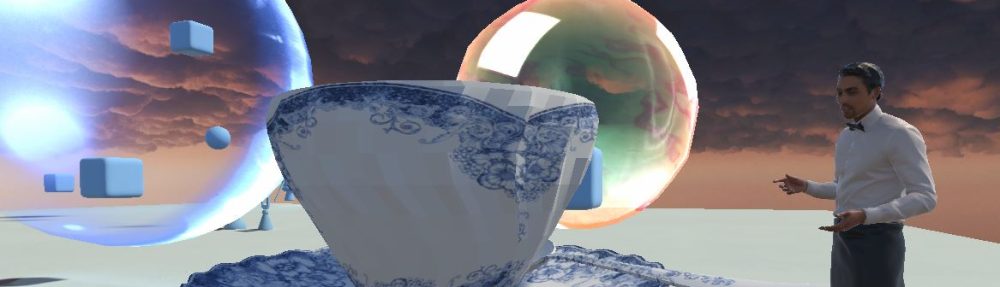
ARTEFACT — a collaboration between Neal Stephenson, Joe Lubin (Ethereum co-founder), and Rebecca Barcin (LAMANA1).
Petervan’s Musical Ride October 2025 – 40+ songs. As usual, we have a lot of recent releases, including The Charlatans, Monza, and Brandi Carlile. Oldies from Rhythm & Sound, Patti Smith, and Norman Greenbaum. Play in shuffle mode to increase the surprise factor. Enjoy!
As already mentioned in my September 2025 Delicacies, I got a crush on the latest album by “Mister Dub” Adrian Sherwood, and went down the Dub Techno rabbit hole.
From the review in De Standaard newspaper (Google Translate and highlights by myself):
“With his label On-U Sound, Adrian Sherwood has created a unique musical universe over the past half century, rooted in Jamaican dub but with tentacles reaching out to punk, funk, and psychedelia, peppered with samples, echoes, and sound effects. His new album features only one track with a recognizable reggae rhythm; the others are driven by slow bass lines and stimulating drum patterns. Many of these tracks are played by real musicians, just like the cinematic fragments of flute, saxophone, organ, cello, trumpet, percussion, piano, Roland 60, and harmonica (“Spaghetti Best Western” exudes Ennio Morricone). Sherwood can call upon a host of loyal musicians (including Brian Eno and hip-hop legends Doug Wimbish and Keith LeBlanc) who add color and human warmth to his boundless imagination as a studio wizard. In an interview, Sherwood did admit that this was the first time he’d used AI to create a record. It seems like a logical evolution for a man who has spent his life innovating and experimenting with new equipment.“ (km in The Standaard)
Here is some older material from Adrian Sherwood. Watch his body language while performing 😉
And the song “Trapped Here” from his previous album, Survival & Resistance
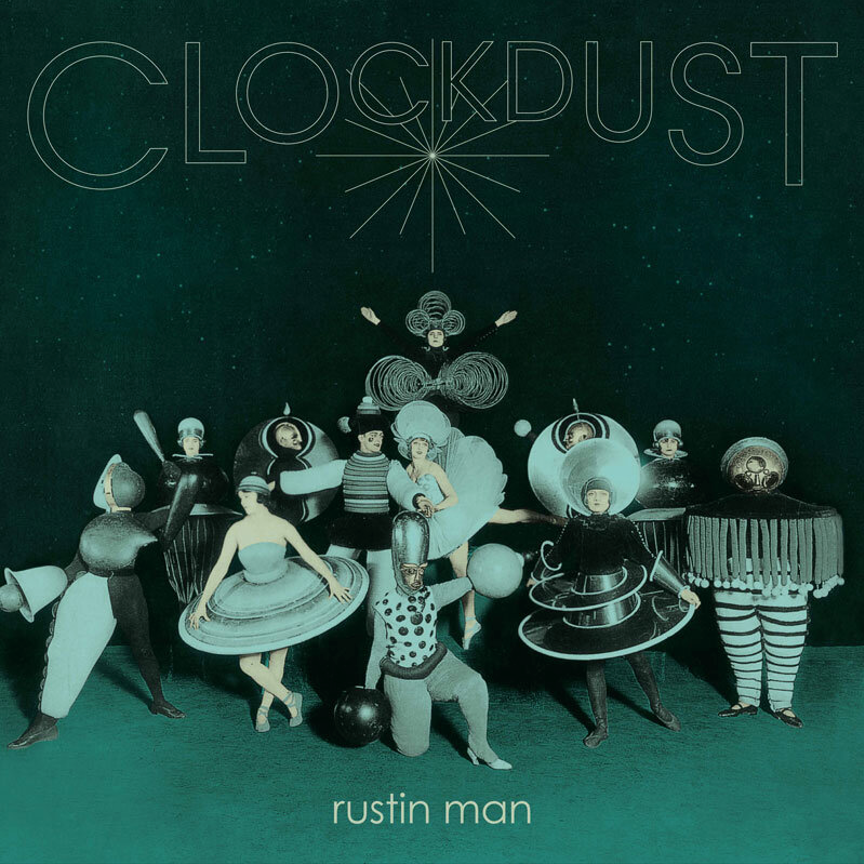
The album comes with a beautiful cover (designed by Peter Harris). The cover and the album’s atmosphere remind me of Rustin Man’s 2020 album ClockDust (I wrote a post about that one in 2020). It’s no surprise: after playing bass in a local reggae band in Southend, Rustin Man (Paul Webb) and his schoolmate, drummer Lee Harris, went on to form the rhythm section and become founding members of Talk Talk, alongside the exceptionally talented Mark Hollis and Simon Brenner.
The covers of Adrian Sherwood and Rustin Man respectively
So the starting point is dub reggae, which these days has evolved into a genre called “Dub Techno”. There is something melancholic about both albums, in sound, lyrics, artwork, and, at times, kinky living.
I don’t have real musicians available in my studio, and I’m hesitant to rely on AI. I’ve experimented with AI-generated music before, but it doesn’t bring me the same joy or sense of satisfaction as creating it myself. So I started studying and exploring the Dub Techno style, and found this book, “Dub Techno – The Orphic Experience of Sound” by Bahadırhan Koçer.
On page 56, Koçer begins discussing the concept of the riddim—Jamaican patois for “rhythm”—first examining drum patterns, and later turning to bass lines and melodic structures.
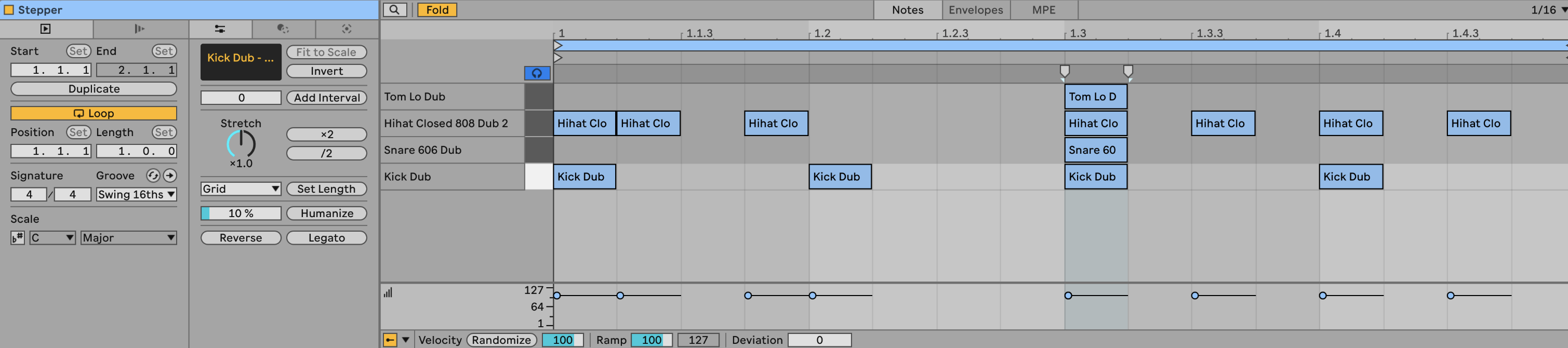
I started implementing them into Ableton Live. Here is an example of the “stepper” variant on a 64 Pads Dub Techno Kit.
Ableton Live 12.1 implementation “Stepper” by the author
That was easy. Then I tried to build a song using other out-of-the-box and/or free devices, clips, and samples in Ableton Live 12.1 and Logic Pro 11.2.2 (btw, the new bass and keyboard session-players, and the new studio piano and studio bass in Logic are amazing).
The new Studio Bass in Logic Pro 11.2
Creating a song was more of a challenge. What Adrian Sherwood and his real musicians were doing was not so simple after all. Although all the individual clips sounded simple, the art is in being subtle and sophisticated in launching clips and echo/delay effects.
As with writing, the real effort lay in removing the superfluous rather than adding more to the mix. Still, to make it a bit more my own, I included a few AI voice clips from the New New Babylon performance.
Short experiment by the author
But I am an amateur/bricoleur after all. No way I will ever get close to Adrian Sherwood and his musicians, at least not as a musician. But maybe in real life? Adrian and the band are touring North America and Europe in 1Q 2026. They will perform in Wintercircus Ghent on 6 Feb 2026. See/hear you there?
Sometimes, the silence of the sacred and the touch of chance awaken something deep within.
This is what happened to me when I once again found myself confused by beauty, when visiting the Stefan Vanfleteren exhibition “Transcripts of a Sea” in the Museum of Fine Arts in Ghent.
“In 2020, photographer Stephan Vanfleteren embarked on a challenging project that culminates in the exhibition Stephan Vanfleteren. Transcripts of a Sea at the MSK Ghent, during autumn and winter 2025. The exhibition is the conclusion of a long quest, not only into the depths of a body of water, but also into the essence of artistry – Vanfleteren’s answer to what complete artistic freedom can mean.”
You can find good-quality pictures on Stefan Vanfleteren’s website. That page also includes some paragraphs about Vanfleteren’s practice and his approach to this project. But the experience in the museum is way superior.
First, there is the silence. When you close the door between the entrance hall and the exhibition space, the noise of the city is cancelled, and it feels like you are entering a sacred space. The silence also slows you down. Your steps are more measured, respectful. Your breathing adapts.
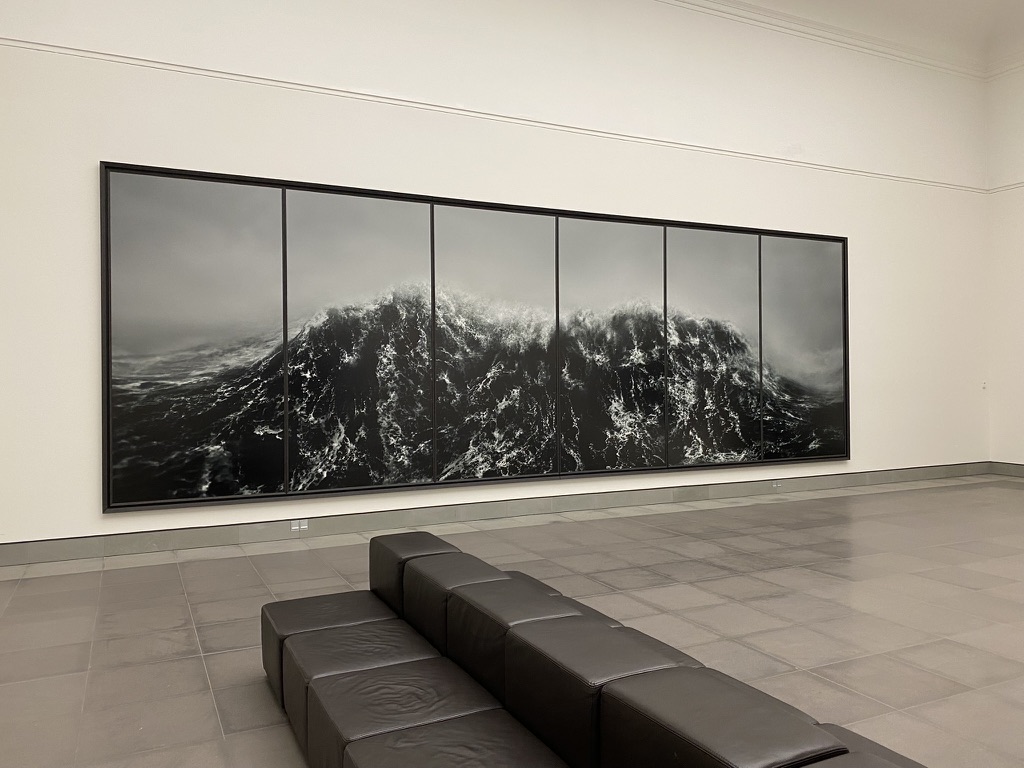
Second, there are the artworks. Huge, super high-quality photographs of the North Sea. Most black and white. They radiate the same sacredness as the paintings of Gerhard Richter. They incentivize introspection. The artworks are positioned in conversation with actual sea paintings of famous painters. The difference between painting and photography blurs completely.
I begin to wonder, leaning in to scan some of the photographs up close. It feels as if I’m standing in the sea. It’s something I have done before, with paintings, sculptures, and bodies. This close-by scanning is a different eye-set that adds a new aspect to my artistic practice. Here is a “scan” of one of the paintings…
Third, there are the information panels—their texts are as beautiful and inspiring as the paintings themselves.
Here is an example of the panel poetry:
“The North Sea is not azure blue, but rather a medley of grey, green, and brown hues, shifting with the mood of the weather. Through those muted, muddied, and sullied reflections, the white foam crashes in the surf – boiling with fury or dripping with desire between land and water. Even the tallest wave eventually lands flat on its stomach. The surf as a postscript of a long journey.“
“At first, I sought to capture the sea as faithfully as possible. But gradually, I realized it could never be truly reproduced. It is precisely the art of letting go that has led to fascinating and challenging results. Chance, failure, and experiment became ever more important. embraced the unexpected quirks of my camera: motion blur, miscalculations in focus distance, and unforeseen colour casts.“
“The absolute freedom found in a confused autofocus, incorrect exposure, or unintended framing became a blessing. And I allowed the scratches, mist, droplets, and salt stains on the camera’s protective glass to remain, trusting in the unexpected. In fact, I chased my own delightful failure.“
I am reminded by this Gerhard Richter quote:
When I walk out, I am overwhelmed by the sheer effort and attention to detail it took the artist to land an exhibition like this. Just watch the logbooks at the end of the expo.
Picture by author
There is also a film screening of “The Tide Will Bring You Home” by Basile Rabaey, who followed Vanfleteren during his five-year sea expedition. But the small film Black Box was too crowded to make this a joyful experience. So, I skipped that, hoping the film will appear sooner or later on the Internet.
Basile Rabaey
A tapestry of slowness, silence, and chance. “Transcripts of a Sea” runs till 4 January 2026 at the MSK in Ghent.










 Petervan Studios