

Windows at Brussels Airport after suicide bombings on 22 March 2016. CreditPool photo by Frederic Sierakowski, in NYT article “Je Suis Sick of This”
In the aftermath of the terrible Brussels terrorists attacks, I encourage you to watch the full 1h50m LiveStream of the “A Conversation on Privacy” of just a couple of days ago.
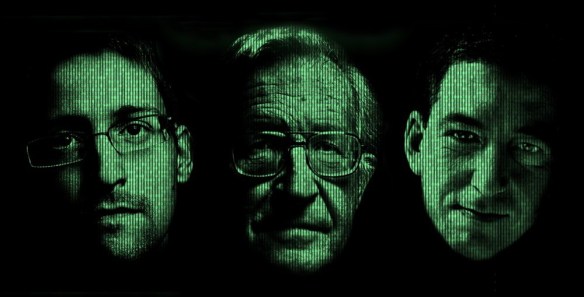
The conversation was positioned/framed as “The balance between national security and government intrusion on the rights of private citizens” and featured renowned linguist and MIT professor Noam Chomsky, NSA whistleblower Edward Snowden, and Intercept co-founding editor Glenn Greenwald. Nuala O’Connor, president and CEO of the Center for Democracy and Technology, was the moderator.
It is clear from the reactions of the public in a full house Centennial Hall of the University of Arizona College of Social and Behavioural Sciences in Tucson Arizona that Chomsky, Greenwald and Snowden were playing a home match, but that should not underplay some of the key points they were making.
There are basically four big chapters in this conversation:
- What is privacy, and the effects of mass surveillance (nobody in its right mind is questioning targeted surveillance)
- The Brussels and other attacks and the (in)-efficacy of mass surveillance
- The FBI – Apple case
- The role of journalism
I am looking forward to a full transcript of this conversation, in the meantime I made the following bulleted notes:
- On privacy
- When discussing privacy and security, are we discussing security of State, Corporations, or Citizens?
- The statement “if you don’t have anything to hide, you have nothing to fear” does not cut it at all:
- Everybody needs to be able to think and explore in a space where you are not subject to other people’s judgment, where you can make decisions as result of your own agency
- People are starting to self-sensor, curtailing their own speech
- Privacy is the right to enjoy the products of our own intellect
- Privacy is the fountainhead of all other rights
- Privacy is the right to a free mind, without having your ideas being pre-judged before they are fully formed
- If no privacy, you live as a collective, in a state of reaction to your environment
- “I don’t care about privacy because I have nothing to hide, is about the same as saying I don’t care about freedom of speech because I have nothing to say”
- Rights are designed for those who are vulnerable. “Not caring about a right (because it does not apply to you) is probably the most anti-social thing I can imagine.”
- Rights exist to protect the minority against the majority. Even if the majority does not care about privacy (or any other right), that majority view is irrelevant
- Silicon Valley companies still don’t care about your privacy. What they fear is users would give their data to somebody else
- The “Digital Self” is unhealthy, creates a sense of intimacy that is fraudulent, leads to very superficial interactions amongst people
- Should there be state secrets at all? Governments classify EVERYTHING as Secret or Top Secret, because of their unwillingness for transparency
- The elites decides on our behalf.
- The elites change as quickly as possible the conversation to the theoretical risk of having a free press
- Almost NOTHING is concerned with the security of the population; the population is the enemy, and they are not supposed to know what the government or corporates are doing
- The (US) does not want you to know that the real battle is about world domination of the US doctrine
- The trade off between security and privacy is is a false dichotomy
- It leads to the illusion of democracy
- On the European attacks:
- Mass surveillance does not have ANY concrete results against terrorism
- “When you collect everything, you understand nothing”, “you are blinded by the noise”
- But if mass surveillance does not work for terrorism, it must work for something… What is it good for then? It is about setting and policing our policies and marking anything that is not conforming as suspicious
- The resources are misallocated to mass surveillance in stead of addressing the route causes
- On the Apple – FBI case
- The FBI “wants it all” – all communications between human beings – in other words “wants to kill privacy”. They want access to everything, even your private conversations in between the safe four walls of your home.
- Orwell interpretation “if you live in a society where you are always being watched, you loose freedom”. But that was an interpretation. What Orwell really wrote was “… a world where we COULD be watched at any moment…”
- In such a world, you have to act AS IF you were being watched all the time, not knowing of the surveillance device is operating, watching you, or if somebody on the other side is doing something with the information collected
- Who should be permitted to hold secrets: The citizens ? The governments? The corporations?
- The content of San Bernardino calls already HAVE been given to the authorities (through the service providers)
- By unlocking the phone, they would now also have access to the metadata
- “Private citizens” should have full transparency on “Public officials”
- The emerging culture is the opposite: Public officials’ activities becoming more and more opaque, and Private citizens’ activities becoming more public
- On Journalism
- “What is non-objective is significant” with respect to journalism and framing
- A lot of journalistic framing follows from their own obedience to the framework of conformity that they learned at our best schools in the world (Oxford, Cambridge, etc.)
- We have to continue to reveal things that should never have been concealed in the first place
On the same day of the Conversation on Privacy in Tucson, there was an interview with US Secretary of State John Kerry on Canvas (Flemish Television).
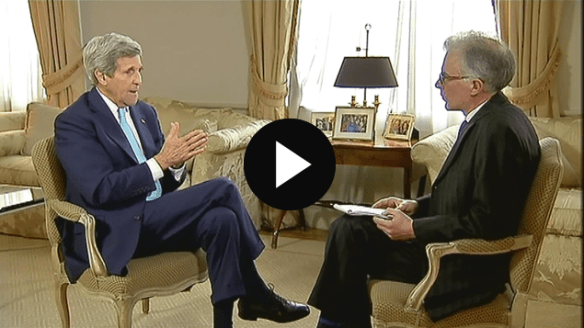
The theme of that interview was “the need for an integrated system of information exchange to increase security”, and that some countries have reservations to such systems – specifically referring in to Edward Snowden.
Some extracts of what John Kerry said (i tried hard not to put things out of context):
“It is fair to say that in a number of countries, partly because of mister Edward Snowden, and the history, people had a reservation about doing some of these things, because they felt that might be an invasion of privacy”.
“I don’t worry about my privacy. The fact that I am getting on an airplane – if I were not flying in a military airplane now, but if I am flying in a civilian airplane which I was doing as a senator – I don’t care if they know if I am on that plane; because I am obeying the law.”
“So I think people have to relax a little bit and understand that there are plenty of ways to protect your privacy without creating greater danger in society at large.”
“I do know that you (Belgium) have a federal system, I know you have a fairly decentralized system,…. And I remember the difficulties we had in the US between federal authority, state authority, and local authority and the movement of information. So, we’ve streamlined much of that now.”
“It is up to Belgium to decide what it should do, but I would urge Belgium and all European countries to create a more integrated flow of information so that we can protect ourselves more effectively”
“And I would say to every citizen that there is a way to do that and still protect people’s legitimate privacy. There is absolutely a way to do that, and we’ve proven it and we’ve lived with it.”
To be honest, I could not believe my ears when watching this interview. If you have done a little bit of homework on the topic of privacy, you would also revolt against some of these platitudes which are in the same category as “If you have nothing to hide, you have nothing to fear”. The journalist in case missed the opportunity to give pushback to Kerry and to offer a more comprehensive framing of the issues on the table.
It seems to me that the underlying theme in all of this is a cultural tipping point from “when public controls private” to “when private controls public”.
Which of course stands in stark contrast with the idealistic visions of a fully distributed society: also that is a big illusion, because in any system where there is power to be re-distributed, some bigger players like governments and corporations will try to take advantage and create monopolies.
One could discuss what “control” means in this context, and I believe it is related to setting, dictating, manipulating and policing our set of norms and behaviours.
Although the conversation in Tucson is addressing mainly the way western (read US) politics are ran, the whole reasoning is applicable to any other belief system that evolves towards totalitarianism.
Evgeny Morozov was razor sharp is this week’s “The state has lost control: tech firms now run western politics“:
The only solution that seems plausible is by having our political leaders transfer even more responsibility for problem-solving, from matters of welfare to matters of warfare, to Silicon Valley.
This might produce immense gains in efficiency but would this also not aggravate the democratic deficit that already plagues our public institutions? Sure, it would – but the crisis of democratic capitalism seems so acute that it has dropped any pretension to being democratic; hence the proliferation of euphemisms to describe the new normal (with Angela Merkel’s “market-conformed democracy” probably being the most popular one).
The “need for an integrated system of information exchange to increase security” leads to a corporate and government surveillance state. Artificial intelligence tech firms and powerhouses start penetrating every segment of industry, also financial services.
@suitpossum was spot on with his great post this week on “The dark side of digital finance: On financial machines, financial robots & financial AI”, about machines controlling the “body” of the organization. @suitpossum has a great way to articulate how AI and robots are gradually robbing us from our personal agency.
The issue is whether they collectively imprison people in digital infrastructures that increasingly undermine personal agency and replace it with coded, inflexible bureaucracy; or whether they truly offer forms of ‘democratisation’.
I start calling this “The Illusion of Agency” and it will be the topic of one of my upcoming talks and associated blog posts.
There are several ways our policy makers can react to the attacks:
- One way is to chose for confrontation: to step up reaction and retaliation, enforcing this way the agenda set by the attackers to undermine our way of living. Hitting back includes these “integrated systems” and the access to encrypted data as suggested in the British Investigatory Powers Bill. See also great NYT article on this topic
- Another way is to use our resources to address the route causes of all this: the disrespect and straight military attacks by the western powers on non-western cultures and economies, not in the interest of the security of their populations but in an attempt to protect the economical and power interests of an elite.
But as public becomes more and more private, and private becomes public, and knowing who is in power, I am rather pessimistic and afraid that they – not we – will chose for the confrontation.
In the meantime – as I said in the beginning of this post – I invite you to listen to the full conversation on privacy, so you get some other perspectives than the obvious and populist ones you can pick up in the mainstream press and television news programs.






 Petervan Studios