
Petervan Artwork © 2020 - Boxer Final - Acryl on Canvas - 50 x 50 cm

Petervan Artwork © 2020 - Boxer Final - Acryl on Canvas - 50 x 50 cm

Petervan Artwork © 2020 - Yellow Speed - Acryl on Canvas - 50 x 50 cm
I recently had a number of conversations on “Virtual Meetings” or “Virtual Events”. The briefing boils down to the following two questions:
I am surprised how often the initial briefings immediately jump into the aspects of production and tools. A sort of fear of missing out on the latest coolest online tool or platform. There is a deeper fear of missing the virtual boat, and fear of overnight irrelevance.
A production themed briefing is usually a sign that the client is looking for some quick and dirty quick wins (the lipstick on the pig), is not clear about the different dimensions at play when architecting an on-line (or off-line) event, and has even less clarity on their ambition levels.
In those conversations, I love to do some live (virtual) whiteboarding. By doing so, I stumbled upon a framework that seems to resonate with many people.
During some Zoom meetings, I could literally hear the clicking of the screen pictures while I was drawing.
So I decided to make a bit cleaner version of it and just put it on my blog. I call it Petervan’s Ambition Cube for Virtual Meetings © 2020 ;-).
I have certainly learned one thing in the last couple of weeks: the more I share it, the more feedback I get. The story becomes more coherent, and the network helps me identifying the blind spots.

There are 3 axes:
On the Duration/Interactivity pane, one can start plotting different types and formats of events. From simple 5 min one-way pitches and introductions to deep immersive games and workshops.
The PAX dimension is an interesting one. If we maintain our physical event vocabulary, we can plot some meetings styles from Private Groups, over Breakout Rooms to Plenary sessions. But it is a physical vocabulary.
I started wondering what a truly virtual vocabulary would look like:
The Ambition Cube then looks like this:
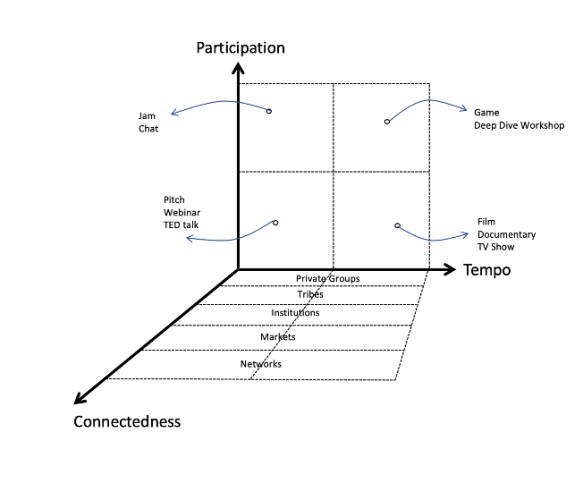
It becomes really interesting when I start mixing The Tribes – Institutions – Markets – Networks (TIMN) framework of David Ronfeldt‘s (TIMN was defined in 1996 already. Link to the PDF here). I started reflecting on how these groups communicated and what they enable:

Now, we are getting somewhere. It becomes clear that the challenge is not to virtualize the existing. I believe the right questions are:

We can now use the Ambition Cube to define our “virtual” ambitions. Plotting where we are today, and where we want to be in n-number of days, weeks, or months. Once you know this, you can start looking into the many tools that exist to make the magic happen and start looking for architects, curators, and production companies that can help you with the coherence of content and experience.
To close, I also made a “clean” 3D version of the cube in a 3D drawing tool called Blender:

I am working out loud here: please give feedback, help me identifying the blind spots, share your experience when using this with your clients.
The Ambition Cube is licensed CC BY-SA 4.0, as are all materials found on this site.
Enjoy!

Cover of Rustin Man's "Clockdust" Album
Let’s try something new here: a “mood-scape”, documenting a personal mood/world using words, visuals, and sound. And inviting you to build new worlds by participating on a 1-1 basis. Although “new” is relative: the term moodscape was initially coined in the seventies, and mixing media can hardly be labeled new or novel. But having a “calm” conversation may sound like an anachronism in these times where time itself is collapsing, where time itself has become exponential.
It started with discovering Rustin Man’s new album “Clockdust”. Rustin Man was in a previous life better known as Paul Webb, the bass player of the band Talk Talk. Check out his about page.
Listen to Night In Evening City
I immediately fell in love with the melancholic, nostalgic, slow pace sound of the album, in my opinion, a perfect soundscape for the disorienting times we live in. There is some sort of homesickness here, knowing deep inside that we have already said goodbye to a golden era, and era that I sometimes refer to as the Bowie-Era.
I added a couple of Clockdust songs to my Spotify March 2020 Ride playlist, and one of the songs happened to sit next to David Bowie’s Lazarus song from his Blackstar album. To make a long story short, I created a sub-set of the playlist, containing the songs that I felt best reflected my March 2020 “Mood”. There is one coming for April as well 😉
I suggest you let it play in the background in shuffle-mode whilst reading this blog post, as I believe it may augment what I am trying to share.
The cover is a picture from Oskar Schlemmer’s Triadisches Ballett (Triadic Ballet), a choreography with costumed actors transformed into geometrical representations of the human body.

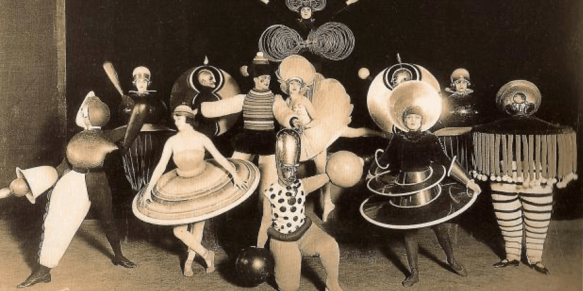
There is also this wonderful video testimony of one of the early performances of that choreography
The video sent me back in time – clockdust time – when I was a 6-year old schoolboy. For the very first time in my life, I stood – proudly – in front of a huge whiteboard in the classroom – it was a blackboard with white chalk – and we were invited by the teacher to properly write the letters of the alphabet with white chalk on this blackboard.
It must have been my early creative juices, but I could not withhold myself drawing big white spirals instead of well-formed a’s and b’s, etc. on that black-black blackboard. Result: punishment and the lesson learned that a classroom is not a place for creativity and imagination.
In vain, the seeds were sown, and spirals, spheres, labyrinths, maps, and foams became – with hindsight – an obsession. I love the endlessness, and the recursiveness of these shapes and forms. Especially double, entangled spirals or labyrinths get me going…
This high-end Balenciaga Summer 2020 production, with music from BFRND, is a perfect timestamp of our times. Grim black coats, at times almost German SS uniform like Arial race,… our sleepwalking into fascism. One thinks The Matrix, hard as stone, sharp as a knife, and greyed out faces. Will we take the Red or Blue pill? Blue for sure is the backdrop for what Balenciaga call “Power Dressing”.
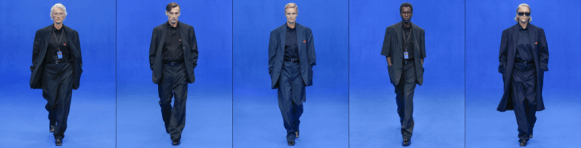
Balenciaga Summer 20 reimagines dressing for work: power dressing, no matter what one does as a job. Looks transform a wearer in the way a uniform can. Unlike their archetypes, though, garments and accessories are made using unconventional processes.
They talk about New Fashion Uniforms, Seamless Tailoring, New Trompe L’oeil, Super Plissé, Pillow Parkas, Fetish Gownsn, and Wearable Ballroom dresses.
Models of various career tracks interpret and play on beauty standards of today, the past, and the future.
Enter Masks, a new book by James Curcio, about Bowie and other artists of artifice. I spotted the book in a guest post by James Curcio on Ribbonfarm’s always excellent blog.

The difference between a king and a beggar, a soldier and a murderer remains in the realm of performance, a kind of farcical mummers trick that we agree to play along with, if often unconsciously.
The bulk of the book is about Bowie’s unique conceptual art, his capability to create new coherent worlds and identities. I miss Bowie.
The post and book also refer to French philosopher Jean Baudrillard’s book Simulacra and Simulation, apparently required reading for the actors of The Matrix before filming. According to Wikipedia, Baudrillard is “best known for his analyses of media, contemporary culture, and technological communication, as well as his formulation of concepts such as simulation and hyperreality.”
It cannot be happenstance that I find a reference to Simulacra and Simulation in “Design Unbound”, fantastic two-volume work on “Designing for Emergence in a White Water World”, by John Seely Brown and Ann M. Pendleton-Jullian, a print-only MIT Press publication. Chapter 14 is about “World Building”: “much more than just the setting for a story, word building creates coherent contexts that stories become to inhabit”
This is very much avant-garde, feels a lot like Cobra world-building practices like New Babylon by Constant Nieuwenhuis.
I feel like I am drifting into a thin timeline, and time is slipping through my fingers like clockdust. A shaken gravity, with no reference framework, unable to make U-turns, and affront reality with an open mind, heart, and will.
I need a new backdrop, a new backstory to make or break sense. I want to liberate myself from the harness of fixed time and space. An opening-up that leads to more vulnerability – and less power dress. With proximity, intimacy, and closeness – like the closeness and blissfulness that is evoked in “Two Sleepy People” in the March 2020 Mini-Ride.
In that sense, the from/to framing of before and after COVID-19 is misleading. I believe we have to start thinking of ourselves as analog/digital assets whose state is updated in real-time ànd asynchronously, our lives continuously evolving through space and time. We are indeed astronauts, in need of coherent world-building and navigating clockdust till eternity.
I have time. You have time. Both clock-time (Chronos) and experienced-time (Kairos). Ping me if you want to continue the conversation. I’d love to hear where your clockdust has settled these days.

Most (95%) are March 2020 releases, here and there some classics from BC. Works best if you play in shuffle mode. Enjoy!
Petervan Artwork ©2020 - The Real Virus Does Not Look That Nice
3D Sculpture in Putty 3D - Soundtrack

Petervan Artwork ©2020 - Seaside Tribe - Acryl on canvas - 120x100cm

Bomen spreiden hun vingers uit
Hun handen wuiven van weerbarstigheid
Botten water zuigend
Uit zompige aarde
Onhoudbaar vitaal elan
Eieren van nieuwe stokken
Kikkers een verse dril
Mollen leven op hoop
Wolken schuiven de hemel open
De drang dreigt te verzuipen
In een tsunami van nieuw leven
Ik ruik nu al
De appeloogst van de boomgaard
De geur van vers gemaaid gras
Citroen op sla van albast
Er zit een kraai
Hoog in de populier
Een reservatie van een nest
Voor de zomer
Hoog in de boom
Zit ook ik
Ik geef me bloot
En durf te dromen
+++ rough translation +++
Springdreaming
Trees spreading out their fingers
Unrelentless waving hands
Buds soaking water
From swampy soil
Untenable élan vital
Rebooted ovaries
And fresh frogspawn
Molehills of hope
Fluffy clouds slide open in heaven
The risk of drawing the vital urge
In a tsunami of renewed being
I smell now already
An orchard of the apple harvest
The tickle of freshly mowed grass
Citrus on a salad of alabaster
There is a crow
High in the poplar
A reservation for a nest
For the summer
High in that tree
I expose myself
And dare to dream
Petervan Artwork © 2020 - 3D Mask Experiment in 3D Putty

Petervan Artwork © 2020 - Collage Canvas on Canvas - 120x52cm
 Petervan Studios