Petervan’s Ride – November 2025

Petervan’s Musical Ride November 2025 – 60+ songs. As usual, mostly several recent releases, including those by Rosalia, Portland, and Ozark Henry. Oldies from Toni Di Bart, Jimmy Cliff, and Brutus. Play in shuffle mode to increase the surprise factor. Enjoy!

Petervan’s Ride – October 2025

Petervan’s Musical Ride October 2025 – 40+ songs. As usual, we have a lot of recent releases, including The Charlatans, Monza, and Brandi Carlile. Oldies from Rhythm & Sound, Patti Smith, and Norman Greenbaum. Play in shuffle mode to increase the surprise factor. Enjoy!

Inspiration: Adrian Sherwood

Adrian Sherwood behind the mixing console

As already mentioned in my September 2025 Delicacies, I got a crush on the latest album by “Mister Dub” Adrian Sherwood, and went down the Dub Techno rabbit hole.

From the review in De Standaard newspaper (Google Translate and highlights by myself):

“With his label On-U Sound, Adrian Sherwood has created a unique musical universe over the past half century, rooted in Jamaican dub but with tentacles reaching out to punk, funk, and psychedelia, peppered with samples, echoes, and sound effects. His new album features only one track with a recognizable reggae rhythm; the others are driven by slow bass lines and stimulating drum patterns. Many of these tracks are played by real musicians, just like the cinematic fragments of flute, saxophone, organ, cello, trumpet, percussion, piano, Roland 60, and harmonica (“Spaghetti Best Western” exudes Ennio Morricone). Sherwood can call upon a host of loyal musicians (including Brian Eno and hip-hop legends Doug Wimbish and Keith LeBlanc) who add color and human warmth to his boundless imagination as a studio wizard. In an interview, Sherwood did admit that this was the first time he’d used AI to create a record. It seems like a logical evolution for a man who has spent his life innovating and experimenting with new equipment. (km in The Standaard)

Here is some older material from Adrian Sherwood. Watch his body language while performing 😉

And the song “Trapped Here” from his previous album, Survival & Resistance

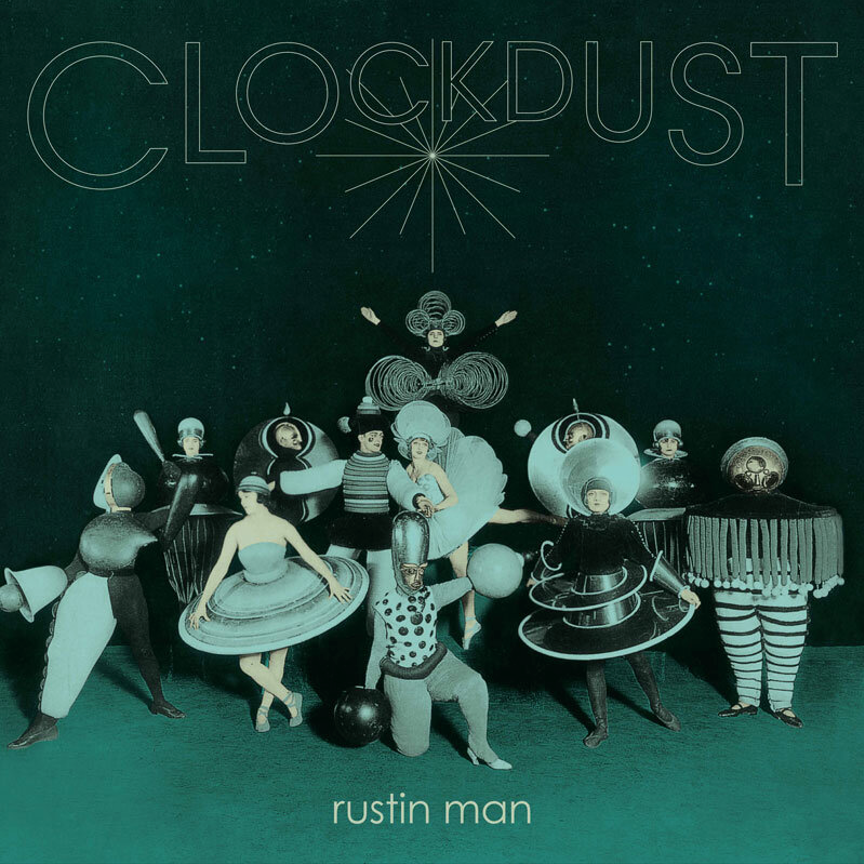
The album comes with a beautiful cover (designed by Peter Harris). The cover and the album’s atmosphere remind me of Rustin Man’s 2020 album ClockDust (I wrote a post about that one in 2020). It’s no surprise: after playing bass in a local reggae band in Southend, Rustin Man (Paul Webb) and his schoolmate, drummer Lee Harris, went on to form the rhythm section and become founding members of Talk Talk, alongside the exceptionally talented Mark Hollis and Simon Brenner.

The covers of Adrian Sherwood and Rustin Man respectively

So the starting point is dub reggae, which these days has evolved into a genre called “Dub Techno”. There is something melancholic about both albums, in sound, lyrics, artwork, and, at times, kinky living.

I don’t have real musicians available in my studio, and I’m hesitant to rely on AI. I’ve experimented with AI-generated music before, but it doesn’t bring me the same joy or sense of satisfaction as creating it myself. So I started studying and exploring the Dub Techno style, and found this book, “Dub Techno – The Orphic Experience of Sound” by Bahadırhan Koçer.

I will write another blog on the topic of “Orphic Experience”, but today, we focus on the music analysis part.

On page 56, Koçer begins discussing the concept of the riddim—Jamaican patois for “rhythm”—first examining drum patterns, and later turning to bass lines and melodic structures.

From the Bahadırhan Koçer book

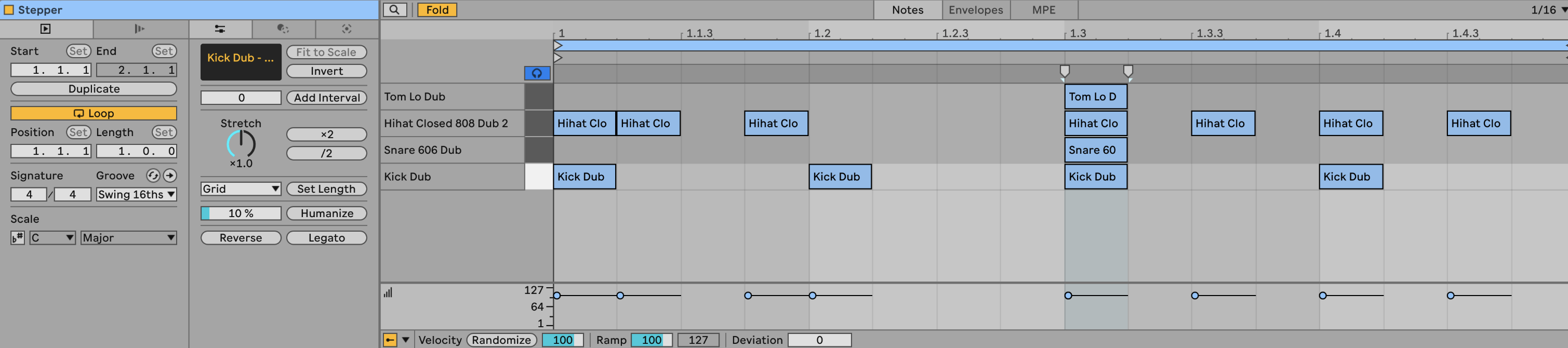
I started implementing them into Ableton Live. Here is an example of the “stepper” variant on a 64 Pads Dub Techno Kit.

Ableton Live 12.1 implementation “Stepper” by the author

That was easy. Then I tried to build a song using other out-of-the-box and/or free devices, clips, and samples in Ableton Live 12.1 and Logic Pro 11.2.2 (btw, the new bass and keyboard session-players, and the new studio piano and studio bass in Logic are amazing).

The new Studio Bass in Logic Pro 11.2

Creating a song was more of a challenge. What Adrian Sherwood and his real musicians were doing was not so simple after all. Although all the individual clips sounded simple, the art is in being subtle and sophisticated in launching clips and echo/delay effects.

As with writing, the real effort lay in removing the superfluous rather than adding more to the mix. Still, to make it a bit more my own, I included a few AI voice clips from the New New Babylon performance.

Short experiment by the author

But I am an amateur/bricoleur after all. No way I will ever get close to Adrian Sherwood and his musicians, at least not as a musician. But maybe in real life? Adrian and the band are touring North America and Europe in 1Q 2026. They will perform in Wintercircus Ghent on 6 Feb 2026. See/hear you there?

Petervan’s Ride – September 2025

Petervan’s Musical Ride September 2025– 55 songs. For this episode, I got caught up in a Dub Techno rabbit hole. This includes discovering the new album by “Mister Dub” Adrian Sherwood, and the book “Dub Techno: The Orphic Experience of Sound“. But as usual, we have a lot of recent releases, including Mark William Lewis, Lucrecia Dalt, and Chantal Acda. Oldies from David Bowie, Deee-Lite, and keiyiA. Play in shuffle mode to increase the surprise factor. Enjoy!

Petervan’s Ride – August 2025

Petervan’s Musical Ride August 2025– 70+ songs. Recent releases include Ethel Cain, The Black Keys, and yingtuitve. Oldies from Sammy Virji, Marc Moulin, and Pretenders. Play in shuffle mode to increase the surprise factor. Enjoy!

Petervan’s Ride – July 2025

Petervan’s Musical Ride July 2025– 50+ songs. Recent releases include Rival Consoles, Ozark Henry, and Wet Leg. Oldies from Eric Clapton, Black Sabbath, and Grace Jones. Play in shuffle mode to increase the surprise factor. Enjoy!
Petervan’s Ride – June 2025

Petervan’s Musical Ride June 2025– 50 songs. Recent releases include Turnstile, Kathryn Joseph, and HAIM. Oldies from Soulwax, Roisin Murphy, and The Beach Boys. Play in shuffle mode to increase the surprise factor. Enjoy!

Petervan’s Ride – May 2025

Petervan’s Musical Ride May 2025– 50 songs. Recent releases include Kae Tempest, Froid Dub, and Saint Etienne. This time, there are many oldies, such as Roy Orbison, Cher, The Who, and many others. Play in shuffle mode to increase the surprise factor. Enjoy!
Petervan’s Ride – April 2025

Petervan’s Musical Ride April 2025– 56 songs. Recent releases include Mauro Pawlowski, Pomrad, and Lorde > Oldies from Sly & Robbie, Alanis Morissette, and Netsky > Play in shuffle mode to increase the surprise factor. Enjoy!

PXL Immersive Music Day 24 Apr 2025 – Conference notes

As part of the research for my immersive projects and performances, I am trying to better understand the visual and audio aspects of XR experiences. In that context, I attended the Immersive Music Day at PXL in Hasselt, Belgium, organized by the PXL Music Research team. The full program, schedule, and lineup are here.

It is a relatively small-scale event (I guess about 100 PAX), which is great as it enables networking with the participants and the speakers. The event was held at a location with great immersive audio infrastructure (3 rooms with full 360 sound set-up). For the rest, it was a no-frills event with super-friendly staff and good food at breakfast and lunch.

Example of an immersive music room set-up

I was also pleasantly surprised by the mix of ages, ranging from fresh-faced high school students to seasoned audio veterans and legends, plus corporate fossils like myself. That kind of diversity usually signals that something truly interesting is about to unfold.

But the best part was the content and the speakers.

If there was an intended or unintended theme, it would be the subjective aspects of the immersive experience (how sound “feels”, or about the experiential coherence of auditive, visual, and spatial input) vs. the technological aspects of immersive sound (like precise localisation of sound in space). But I am sure that in some other sessions, the content was quite nerdy, up to the detailed coded and mathematical aspects of encoders/decoders.

Here are a few notes and reflections from the sessions I attended.

Immersive Space – An Agent for Creating and Experiencing Music

Speaker: Wieslaw Woszczyk, Director of the McGill Recording Studios and the Laboratory of Virtual Acoustics Technology at the Schulich School of Music of McGill University.

Program synopsis: Humans have sensory capabilities for recognizing their presence and immersion in space. Music ideally matches these capabilities by presenting dynamic, tonal, harmonic, and rhythmic structures in sound. Musicians use space to generate and blend sounds of ensemble, to hide and reveal musical voices, to dramatize perspectives, and to harness emotion in music making and listening. The talk explores immersive space as a modern technological tool for augmenting people’s experience of music

CIRMMT Dome with 32 speakers

Notes:

I had never considered immersive sound as a medium for live music performance—being physically present in one space while listening to live musicians through a 360° sound system that simulates the acoustics of an entirely different environment. Wieslaw talked about auditory “fingerprints” of spaces. This goes way beyond sound effects like reverb that simulate the reverb of a cathedral. No, this fingerprint captures the full acoustic character of a space—every corner, every height, every nuance. And there are plug-ins available that let you import this detailed acoustic profile directly into consumer-level digital audio workstations like Logic Pro and others.

This allows performing artists to shape and test their artistic expression for a specific space, like the San Francisco Cathedral, or lets the audience experience the music as if they were actually there, immersed in that very acoustic environment.

Altering the Immersive Potential: The Case of the Heilung Concert at Roskilde Festival

Speakers: Birgitte Folmann, Head of Research, Sonic College, and Lars Tirsbæk, Consultant in Sound & Emerging Technologies, Educator 3D audio, Sonic College

Program synopsis: Immersive concert experiences are often described as specific, emotionally moving, dynamic, and complex – qualities that require experimental and interdisciplinary methods to be meaningfully understood. In this talk, we explore the immersive and engaging potential of live concerts through the lens of the Heilung performance at Roskilde Festival. Drawing on anthropological fieldwork and insights into the technical systems that supported the experience, we discuss how a deeper understanding of immersion can inform both artistic and technological development to enhance future audience experiences 

Notes:

The talk was about the Heilung Concert at Roskilde Festival in 2024, in a festival tent holding about 17,000 people. Details about the technical set-up by Meyer Sound here.

What struck me was that the concert wasn’t branded as an “immersive” experience—there was no expectation set in advance. Yet, the immersion began the moment people entered the tent: birdsong filled the air, subtly blurring the line between environment and performance. It reminded me of my Innotribe days, where we also paid close attention to how people entered a space. After all, arrival and departure are integral parts of both the performance and the scenography.

The first part of the talk by Lars was about the technical challenges of delivering a 360 immersive sound experience in such a huge space. The second part by Birgitte was about the anthropological and subjective aesthetic experience of immersive music by the audience. Her slogan, “Aesthetics is a Verb” is great t-shirt material. They also talked about the “attunement” of the audience to the experience, and that you can’t fight the visuals: for example, when the drums play on the front stage, having the 360 sound coming from behind you does not work for the human brain.

Their team is now starting to document the findings of their field research. More to come.

Designing the Live Immersive Music Experience

Speaker: Paul Geluso, Music Assistant Professor, Director of the Music Technology Program – NYU Steinhardt University

Program synopsis: Paul Geluso’s work simultaneously encompasses theoretical, practical, and artistic dimensions of immersive sound recording and reproduction. His first book, “Immersive Sound: The Art and Science of Binaural and Multi-channel Audio,” published by Focal Press-Routledge, has become a standard textbook in its field. Geluso will share his research experience while providing exclusive previews of interviews and insights with featured immersive audio masters from his forthcoming book, “Immersive Sound II: the Design and Practice of Binaural and Multi-Channel Experiences” set to be published in fall of 2025. This presentation will also included discussions on his 3DCC microphone technique, a 3D Sound Object speaker design capable of holophonic sound playback, and his work on in-air sound synthesis and other site-specific immersive sound experience building techniques. 

Notes:

Paul Geluso is God. Some years ago, he published “Immersive Sound: The Art and Science of Binaural and Multi-channel Audio,” considered by audiophiles as “The Bible”. He is also good friends with Flanders’ best artist, Piet Goddaer aka Ozark Henry, who specializes in immersive sound and music.

Ozark Henry in his studio

Paul took us on a journey of his research on immersive recording (making custom made 3D microphones and codes) and playback (making his own “Ambi-Speaker Objects”.

Paul Geluso’s immersive 3D Sound Object (Ambi-Speaker)

This was more of a backdrop for his upcoming book. While his first book was more about the how – the technology to record and playback immersive music – his new book will focus on the why – in essence, about leading with the story and the artistic intent. He hopes the new book will be out in 2025.

I had the chance to have a short 1-1 conversation with Paul, who seemed interested in our immersive performance ideas, which was exciting to know.

Subjective Evaluation of Immersive Microphone Techniques for Drums

Speaker: Arthur Moelants, Researcher PXL-Music

Program synopsis: When presenting a group of listeners with four immersive microphone techniques in two songs, will they always choose the most objectively correct one? An experiment with drum recordings in different acoustics and musical contexts challenges the assumption that objective parameters like ICTD and ICLD should always determine the best choice. While non-coincident techniques often score better in these metrics, listener preferences can shift depending on the musical context, as other techniques offer different sonic and practical qualities that might benefit the production more.

A microphone set-up for drums

Notes:

Arthur is part of my team for our immersive performances, like The New New Babylon, where he acts as both a cinematographer and immersive music expert. He is a member of the PXL-Music Research team. I was curious to see how he’d handle public speaking and delivery, and he did not disappoint. I’m always impressed by how some young professionals manage to blend deep, almost nerd-level technical expertise with polished communication and presentation skills.

His talk was about his research on the subjective experience of drums, and how that experience differs depending on the recording technique and on the context of the drums as part of a song. I really like the simple graphics of his slides to explain some quite technical aspects of immersive music. Not an easy talk to deliver as he was also giving live demos on a 360 system to let us hear the subtle differences.

That’s it. Hope you enjoyed these notes

Warmest,