I am going to do some shorter, snappier posts, just seeding an idea or an interesting (as in A.F.E.A.R.) point of view.
Google “Get out of your comfort zone” and you will get about 160,000,000 results. That’s solid framing!
But is it true?
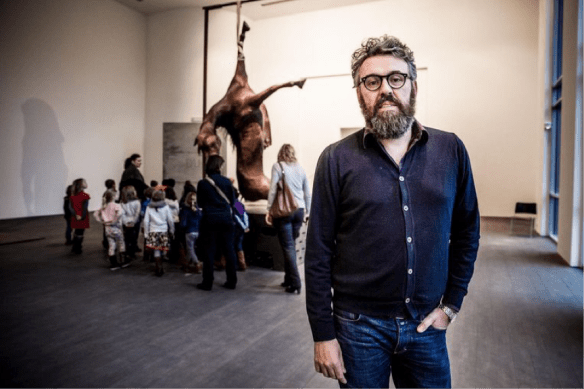
My cousin – yes, the senior curator of the Royal Museums of Fine Arts in Belgium – surprised me the other day by stating the opposite: he performs (as in doing his best work) best when he is IN his comfort zone.
Just a couple of days later, I see this Tweet from Niels Pflaeging:
Niels is a management exorcist and a real myth-buster. I always listen to him.
So maybe the trick to do your best work is to find your comfort zone? Or is it all apeshit – or pop psychology – as Niels suggests above?
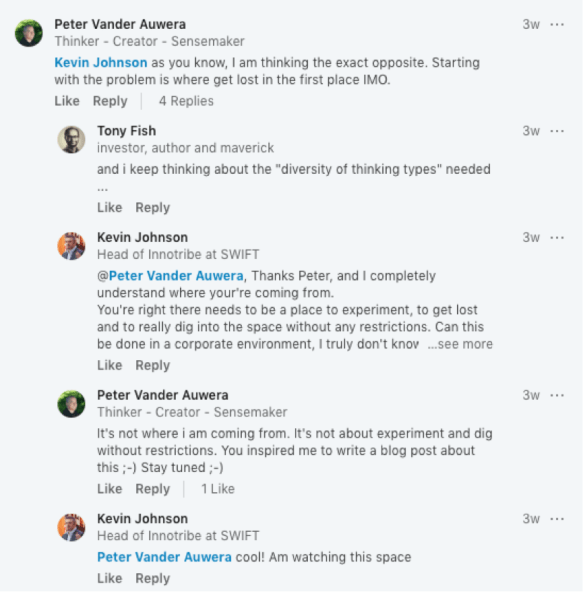
The trigger for this post was an article on the nexxworks site about right & wrong in corporate innovation. The first paragraph focuses on the need to obsess on solving a customer problem. My friend and ex-colleague Kevin commented via LinkedIn:
“Fantastic article! I’ve been banging on for years about starting with the problem, that people care about but this is so much more articulate than me.”
We started a quick exchange on LinkedIn:
The nexxworks article is about much more than problem solving, but problem-solving is what I will be focusing on in this pamphlet/manifesto for creating what you want. As that is where I am coming from.
Not being problem focused seems almost a blasphemy these days. But we don’t realise we have been mis-framed for decades to be problem solvers and solutionists (“there is an app for that”).
It already happens in start-up pitches to start with. Start-ups are coached to pitch in a standard way. It goes back to Guy Kawasaki’s 10 slides to pitch: start with the problem, what is the solution, the team, the business model, etc, etc.
Everything is “modelled” and vocabulary is standardised: we need MVP’s, lean start-ups, scale-ups, etc. It’s cool, but you then have to explain this new vocabulary to the rest of your troops.
Everything is “role-modelled”. And we get inspired by always the same use cases: Haier, Semco, Apple, Amazon, Uber, etc. We don’t seem to realise that these are exceptions. Only exceptions make the news. The exceptional is normalised, check out hyper-normalisation of Adam Curtis, albeit in another context.
“In the film, Curtis argues that since the 1970s, governments, financiers, and technological utopians have given up on the complex “real world” and built a simple “fake world” that is run by corporations and kept stable by politicians.”
Everything is based on a Silicon Valley solutionist style, a reactive/responsive orientation, something our MBA’s and entre/intra-preneurs and leaders/managers have been trained for at nauseum: define the problem, articulate the solution, make a plan to execute, execute the plan with rigor, and be effective and efficient in doing so.
It may be a style semantic. Ex-Trump-PR-guy Sarramuci said: “you may dislike his (Trump’s) style, but he is very effective.” But one can be very effective at doing the wrong thing. One can be very effective at being a problem solver.
I think it’s more than about style. We have become so politically correct. To please everybody, we say things like “It’s probably a bit of both”. That way, confusion about the real intention creeps in. I say we must be opinionated, and we must be judgemental, we must choose sides.
We say those politically correct things because we don’t have skin in the game. Read Nicholas Taleb’s latest on that subject. For that reason Taleb hates consultants, professors at high schools, some managers and executives, and by extension heads/consultants of innovation. They can say whatever they want, it has no consequences, at least not for their existence or that of the organisation they represent.
I recently heard Nektarios Liolios from Startupbootcamp venting his frustrations on stage, as all the innovation efforts of the last decade have apparently not changed much, or at least not shipped anything substantial. They even start bypassing heads of innovation and innovation teams in general, as they are more and more seen as barriers between customers and the business units. They want to solve real business problems.
Innovation Powerhouse Philips Eindhoven – Architect Janne van Berlo
A renovation respecting the building's patrimonial structure.
But I am afraid that a focus on real business problems won’t help. The only way to enable real change and lasting innovation is changing the structure of an organisation.
Structure is about more than reporting lines and P&L units. Structure is about the coherence of narrative, motives, and governance.
The narrative is about purpose, about patrimony (tacit knowledge), “just-do-it” kind of mantra, action oriented. A narrative is rallying the troops to play the game in a certain way, in a certain context. In war, the game is to win. In business, I would hope it’s about more than winning a finite game, and there is some sense of moral, aesthetical and spiritual advancement, an infinite game across generations.
Motives are about why we are doing this. There are primary/primal motives like prestige, promotion, reciprocity and tic-for-tac rewards/punishments. Once you add moral, aesthetical, and spiritual advancement, you are driven by second level motivations that have to do with care, tradition, craftsmanship, beauty, proportion, etc. In that sense, I believe that problem solving is a primal motivation. A more advanced intention of creating something great is a second level motivation. So the question should not be “what problem are you trying to solve?” but “what do you truly want to create?” If not, “solving problems” becomes a doctrine, just like “customer first” is a doctrine, or “FNAO”, or “Lean” or “Agile”. Applied across the board without thinking whether it makes sense. Being effective at doing the wrong thing.
Governance is about how you organise and coordinate high quality flows to play the game in context. This is what real leadership is about. In that sense, innovation is a discipline. And there is nothing wrong with discipline. All great things/products/artworks have been a result of discipline. It is about “getting things done”. Jan Chipchase has an awesome fieldbook and practice for revealing – usually in plain sight – real customer needs. He articulates these needs as “desires on getting things done”. “Getting things done” is something quite different than “solving a problem”.
Artists don’t solve problems. Neither do real innovators. Did the iPhone start with solving a problem? Did Amazon ? Did Facebook? I don’t think so. They started with what they wanted to be, and what they wanted to create. They started with structure, if anywhere at all. But not with the problem.
A customer is IMO not looking for a problem to be solved. A customer is looking for a superior experience.
With that perspective, one could ask “Can organisations change?” to make that happen? Or “Can people change?” and the more critical question, “Why would people change?”
Sheep in boxes - drone photograph by Dean Lewins
The answer again is structure. Change the structure, and change will not be hard, it will be natural.
That’s why the whole idea of the dual approach (separation castle/sandbox, or core/innovation) is flawed. It is the wrong structure.
The preferred structure would probably more resemble a Khasbah or Souks, an open city plan with many innovation cells/areas with maximum transparency for all, so that everybody is inspired and motivated to join those projects too. And “brutal force” (see below).
It’s a paradox of course. Already in 2002, Storey & Salaman said in their Theories about Process of Innovation:
“paradox is at the heart of innovation. The pressing need for survival in the short term requires efficient exploration of current competencies and requires ‘coherence, coordination and stability’; whereas exploration / innovation requires the discovery and development of new competencies and this requires the loosening and replacement of these erstwhile virtues”
“Rational-experimental problem solving begins with a presumption that the search for a solution starts by relying on existing data about the problem. Design thinking, in a slight divergence from the original model, suggests instead that the designer herself should generate information about the problem, by drawing on her experience of the people who will be affected by the design through the empathetic connection that she forges with them”
Remains the question: can it be done in a big or conservative organisation? Yes, of course. And it is done through what I would call the “brutal force attack”. It is the only thing I have seen working in a bigger organisation to actually SHIP innovation into the market and seeing it picked-up by a substantial part of the target customer base.
The brutal force attack requires two things:
A visionary that is able to articulate in a compelling way what he/she wants to create (and it does NOT start with the problem to be solved). Often this person is somewhat hidden in the fabric/structure of the organisation
A CxO, usually a CEO with metaphorical balls who will do whatever it takes to make the vision happen. With skin-in-the-game. Even against some part of his/her executive team and/or against part of the Board. His/her position may be at risk. He/she is committed like a pig. (For an omelet with bacon, the chicken is involved, but the pig is committed)
You then build a team to make this happen. A squad of the best of best in your company. And the project lead has a direct red telephone line to the CEO to call in case somebody puts barriers or antibodies to make the vision happen. Usually, it suffices just to threaten to pick up the red phone…
It can be as simple as that: just do it. Just build and ship what you want to create.
If you want to have some romanticised innovation story to go with it, sure, go ahead and organise start-up competitions, create innovation labs, bootcamps, accelerate, incubate, and make a lot of noise and corporate communication about it. Just be aware they are a lot of fun, give a lot of exposure, prestige, and status, but are not needed.
That’s why my mantra is “To inspire other people to dream”. To dream and imagine what they truly want to create.
Like in this Nike promo:
Don’t ask if your dreams are crazy. Ask if they’re crazy enough.
Don’t buy the tyranny of the problem solver. Don’t settle to be a problem solver.
On 12 Sep 2018, I will do a live performance at the Finnovista Summit in Mexico-City. The theme of this year’s event is “Listen, Learn, Lead” and the title of my performance is “Get out of your prison cell! – An artistic reflection on listening, learning, and leading”
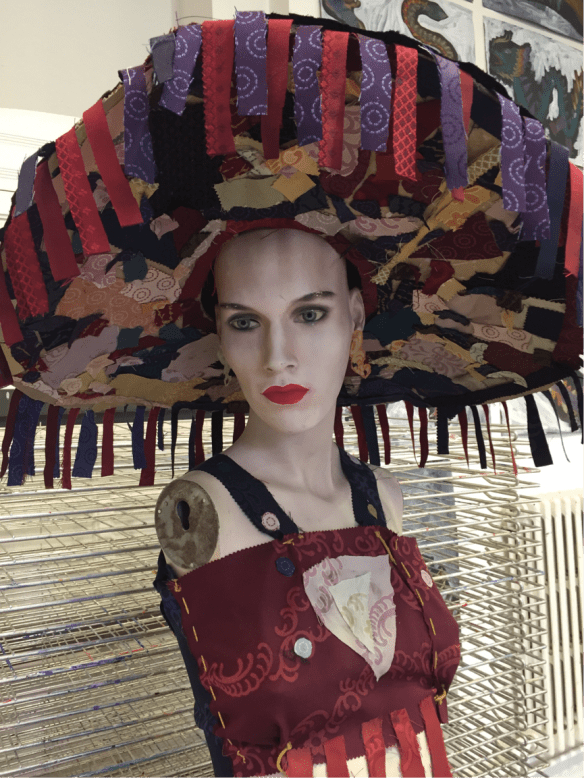
Manoeuvring through this theme, I have prepared a new performance, recuperating some older material, but also with new elements from my artwork series “Prison Window” and other metaphors capturing more recent reflections and insights. From a stage-crafting perspective, I use a multi-media approach, including props on stage, a live camera feed, some vestimentary attributes like hats and masks and drums, and a lightning script for the light technician.
This post is however NOT about the stage experience, which is rather artistic with self-created visuals, soundscapes and poems, hopefully resonating beyond the cognitive. This post is about the underlying thoughts, messages and insights. Preparing a talk, a blog, or a presentation forces you to get your ideas together and structured. And as usual, by refining and experimenting, I sort of stumbled upon most of these insights.
Otto Scharmer meets Simon Wardley
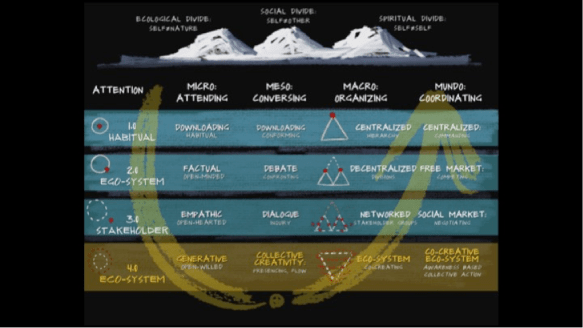
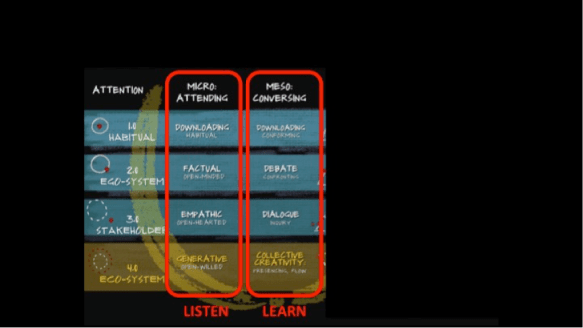
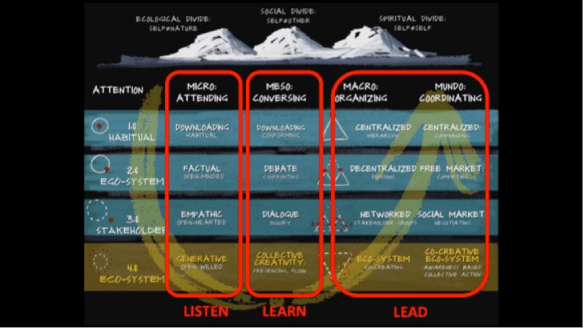
As many of you know, I am a fan of Otto Scharmer’s work on Theory-U and the accompanying ideas in his book “Leading from the Emerging Future: From Ego-System to Eco-System Economies”.
Key image from Leading from the Emerging Future – Otto Scharmer
In essence, Otto Sharmer’s model is about increasing the levels of quality of attention in attending, conversing, organizing and coordinating. It is about getting better at these along higher levels of consciousness. For example, attending at the 3.0 Stakeholder Level is of a higher quality than attending at the 1.0 Habitual Level.
That’s a mouthful, and although we don’t have time here to go into any depth into Theory-U (read the book), it is about letting emerge your future state from being your true self.
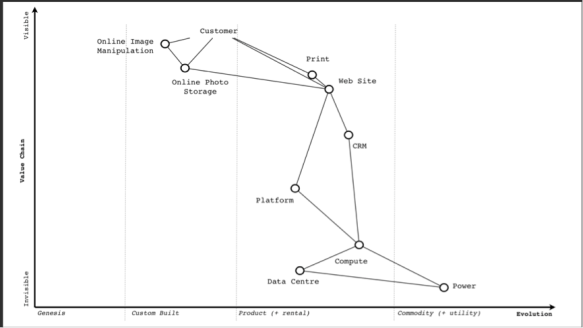
I combined this with the insights of Simon Wardley, who – if we discount several thousand years of military history – I would label as the godfather of situational awareness and the accompanying situational awareness maps.
He labels them as “topographical intelligence in business”. Simon positions his work in the “observing position and movement” part of John Boyd’s OODA model
Sun Tsu meets John Boyd – courtesy Simon Wardley
Except for Magritte-behind-bars, none of these visuals are used during my performance, but my metaphorical narrative on stage is in essence about getting better. But getting better at what? And along which dimensions? In what direction?
It is about letting emerge a better way of listening, learning and leading.
It is about letting emerge a better way of observing, game-play, deciding.
It is about letting emerge a better way of attending, conversing, organizing and coordinating
Let me guide you through this forest.
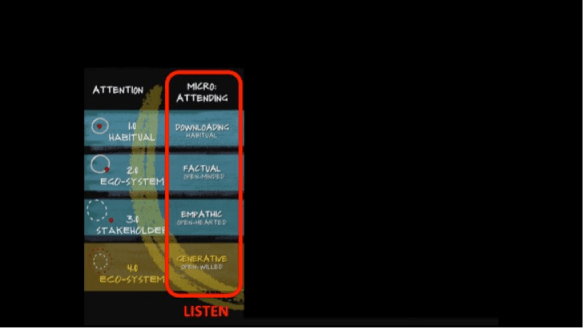
Listening
“If you are very very quiet you can hear the clouds rub against the sky”
Raul Gutierrez, Poet
Listening is usually about hearing sound, spoken words, music. In my performance, I expand listening to observing in general. Observing sound, time, location, movement, structure, memory, and patrimony.
Listening is about observing and attending. Getting better at that is making progress along the levels of quality of attention. Open willed listening is better than habitual listening.
Learning
“Assume that the person you are listening to might know something you don’t”
Jordan Peterson
Learning is usually associated with studying, going to a course or training, follow a workshop. It is usually associated with downloading or acquiring new information, knowledge.
In my performance I share the ladder of learning, from innocent to mentor to expert to… God! I talk about learning in the wild, natural emerging apprenticeship, and evolution with/without skin in the game. John Hagel refers to some of this as “scalable learning and tacit knowledge.”
“Tacit knowledge trumps explicit knowledge. The latter can be articulated and written down and it usually takes time before it can be expressed clearly and coherently to others. Tacit knowledge is within our heads and we have a hard time even expressing it to ourselves, much less to anyone else. Because tacit knowledge is generally newer knowledge, emerging from new experiences that we’ve encountered, it’s often the most valuable knowledge, providing us with insight into how to act in a rapidly evolving environment. Tacit knowledge becomes accessible through shared practice”
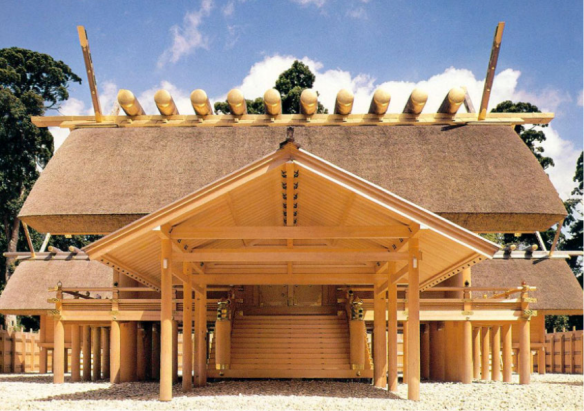
Ise Shinto shrine in Japan
In my performance, I metaphorically refer to the Ise Shinto shrine in Japan, which is rebuilt every 20 years for around 1,300 years as a way to preserve process knowledge aka tacit knowledge.
Learning is about game-play and conversing. Getting better at that is making progress along the levels of quality of attention. Learning through doing in the flow is better than learning through downloading information.
Leading
“The first job of a leader is to learn. Only then can a leader do their second and third jobs — care and love ”
Umair Haque
Leading is usually associated with leaders and followers. I wrote a post about “The End of Leadership” long time ago.
In my performance, I focus on different types of archetypes of change agents, and the evolution from the forbidden, through the rebellion into creation. I talk about the coherence of narrative, motives, and governance. All addressed in previous posts on this blog.
What is new is that I could now map “leading” to the “organising & coordinating” columns of Otto Scharmer’s model or to the “leadership” quadrant in Simon Wardley’s circle.
Leading is about deciding, organizing and coordinating coherence of narrative, motives and governance. Getting better at that is making progress along the levels of quality of attention. Leading in awareness-based-collective-action is better than leading in command-and-control.
Personal reflection
During my performance, I am inviting the audience for a moment of personal reflection after each chapter, with the explicit instruction that they will NOT be asked to report back.
This is about personalized learning, letting humans internalize with attention for privacy and intimacy. Learning as a personal secret.
“All our choices are among life stories that end with our individual deaths.”
Venkatesh Rao
Every reflection moment also challenges the audience in taking personal leadership for stepping out of the prison cell, hopefully in a series of choices among life stories. Every choice is a choice between inside or outside of the prison cell.
This is an essay (longer read) about maps. There is no big message, no purpose, no call for action, none of that. Just recording and documenting of some reflections about maps. I don’t know where it came from. Suddenly I had enough notes to try to make something coherent out of it. Hope you enjoy the trip.
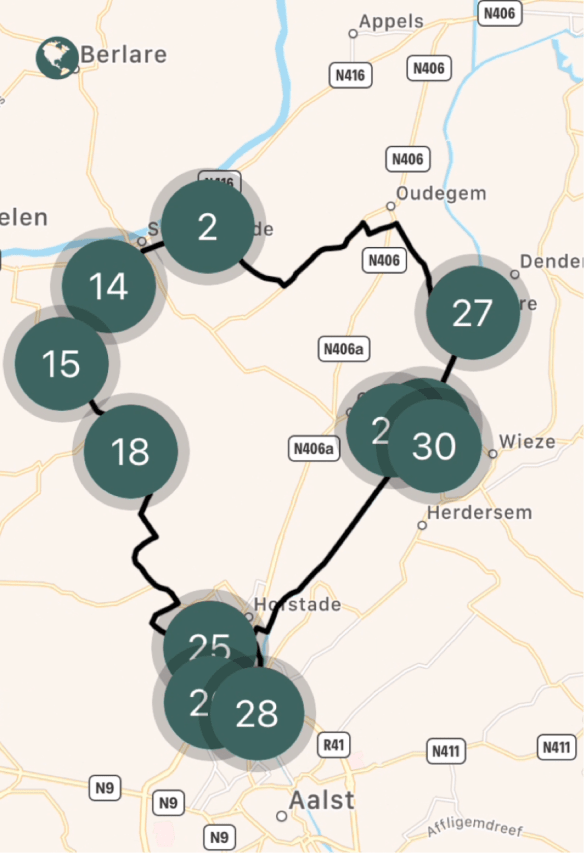
Modern Biking App Map – Notice point #27 – Denderbelle Lock
The theme of maps maybe emerged from my biking tours. Or from my recent tendency to do recordings: soundscapes – of probably better “silence-scapes” – of broken silence in nature. A sort of witnessing and documenting what was at that moment.
Maybe it emerged in preparing my upcoming performance for Finnovista in September: one of the themes is “learning” and I found that quality of observing says more about learning than teaching. So I used maps as a metaphor.
Simon Wardley - example of situational awareness map
Position on a map is often about geographical location and relations. But there is also the position in time: what was, what is, what can be. And like there is position of location, there is also position in time.
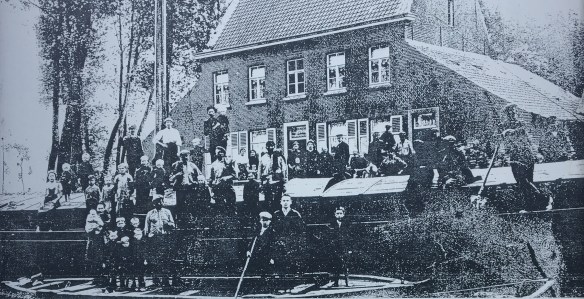
The time element hit me when I was bicycling along the river “Dender” and made a pit stop at the lock of Denderbelle. It’s a relatively small lock, and you can still walk over the doors of the lock to the other side of the river.
There I found this map on a tourism panel:
Old map of the area Aalst-Dendermonde – before 1769
Before 1769, the Dender was a meandering river that was very difficult to manoeuvre for ships. It was Charles de Lorraine – at that time Duchy of Brabant, Austrian Netherlands – who gave the order to straighten the meanders and build two new locks. Today, the river feels more like a canal that goes almost straight from Aalst to Dendermonde. It has a very well maintained towpath along silent borders, which makes it a nice bike trip.
Close to the lock, there is still the old ferry house, now inhabited by an artist. There was a chain pulling the ferry from one side to the other. Even today you can still see the stairs on the shore where people boarded.
Map of Days by Grayson Perry – 2013 – Etching 111.8 × 149.9 cm
Video with the artist Grayson Perry
‘A self-portrait as a fortified town, the wall perhaps my skin. Each day I worked on it I finished by marking the point with the date to highlight the passage of time in the production of art to reflect the forming and reforming of one’s identity. The ‘self’ I think is not a single fixed thing but a lifelong shifting performance. My sense of self is a tiny man kicking a can down the road.’
Grayson Perry
The map is an awesome alternative way to document one’s life. Richard Martin arguments that the question “what is your map” probably gives better answers on who you are than asking “What do you do?” or asking for your linear CV or portfolio:
“In the Map, Perry presents his complex personality and plural identity in the form of a walled city. Streets, buildings and other locales represent personal traits and behaviours, indicating a self-exploration that embraces both the positive and the negative, that poses questions, as well as providing answers, binding together truth and fiction. At the centre of Perry’s map is a labyrinthine garden, in which a figure walks, off-centre, pursuing ‘a sense of self’. Each time I look at the Map, either in a gallery or online, I question how my own version would differ from Perry’s. What words would I choose? What images?”
The same applies with the question “where do you come from?”. Should one say “a Chinese artist” or “an artist from China”? If you say “a Chinese artist” then you place the work of the artist in an ethnographic bubble, a cultural bubble. But when you talk about an artist coming from somewhere, you just connect the artist with a geographical starting point. I prefer the latter.
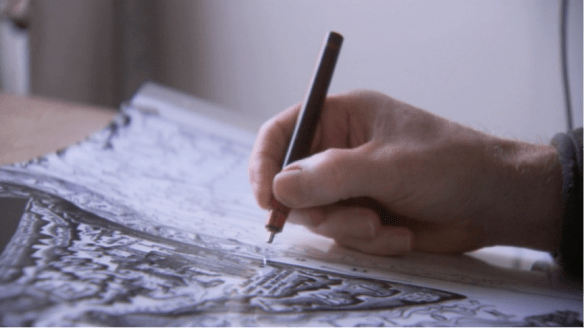
Map of Total Art by Qiu Zhijie – Ink on Paper – c. 5m length!
The work of Qiu Zhijie is fascinating. Check out this video interview with him and curator Davide Quadrio about the exposition ‘Qiu Zhijie: Journeys without Arrivals’ that was shown from 1 april – 24 september 2017 in the Van Abbemuseum in Eindhoven.
One year later, this video still resonates with me, so I made a full transcript of it, some extracts below:
Qiu Zhije is an artist, and he is producer, teacher, student, curator. He is a Master with capital “M” in Calligraphy. He is one of the most respected calligraphers in China.
As from 2010, I started drawing maps. If somebody asks me who I am, I answer I am a cartographer. Drawing maps is close to art, organizing exhibitions, teaching and researching. It is also writing. I feel it is a very multi-faceted way to show my talents as calligrapher.
For me, maps are a source of knowledge at arms’ length distance, knowledge you do not acquire on the field, but from the sky, like a bird’s eye perspective. Then you can move that knowledge on a flat surface, to understand the correlations between what belongs together. Things should not be understood individually, but in the context of their relation to each other. So maps have a lot of influence. Making maps is a way to re-establish the integrity of the world because they illustrate the correlations on how everything relates to each other.
Teaching has always been an important part of my life. By teaching I keep learning. I continue to actualize and renew myself. Although teaching takes a lot of time, it is never a loss of time. On the contrary, it allows me to learn. That’s why I define teachers as those who organize the process of learning”. I like to teach about things I don’t know much about. I like subjects that I am highly interested in, so we can dig deep to know more.
His work is extremely free of themes, but also so encyclopedic. And so easy to connect with the idea of museum as a collection of objects and things. At the same time, his work is also able to crush this idea of objects and really enter into a world of fantasy.
Maps are models. Maps mark the land, they are landmarks. They document the “land-scape”, as a sound-scape documents the sounds.
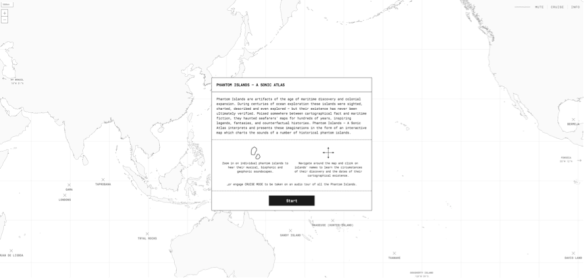
Phantom Islands – By Andrew Pekler – online experience, turn sound “on”
Andrew Pekler explains:
“The sweet spot for me is when a piece I have made can be simultaneously heard as both a field recording and as a completely composed, synthetic construct,”
Making maps is a sort of learning, a form of in-the-field-research and observation. Sharing with others what I am seeing, give context, some sense of coherence of position and direction/movement, and with some suggestions for maneuvering.
But in my case it is making pictures, writing and composing and creating a body of work from each trip. Field recordings, sound- and image-scapes like maps, at times creating a bizarre alienating, almost David Lynch kind of atmosphere, trying to resonate at another and additional level than the pure cognitive.
In that sense, I feel my current (art)work is getting closer to my real self, helps me to untether my soul, act as a witness, getting closer to alertness. With crispness, organic textures, precise rhythms,…
Natures Heartbeat – Online animation of earth’s heartbeat
In that sense, I am still doing the same as during my time as event curator. But the work is becoming more a documentary, a map, a set of interventions, interruptions and provocations that hopefully lead to higher states of alertness and aliveness.
Some kind of heartbeat that maps your open mind, heart, and will into a broader context.
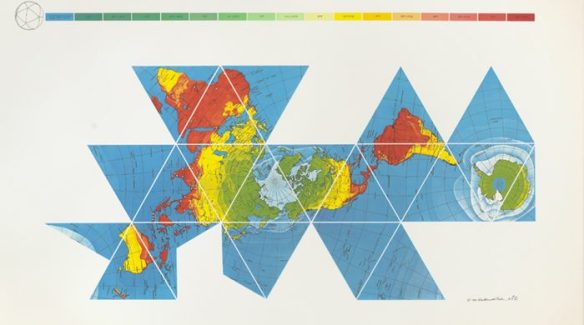
PS: Mark Storm suggested I add the Buckminster Füller Dymaxion Map. He is right! How could I – as a true Bucky fan – have missed this one? 😉
There is nothing to report since my previous update of March 2018. I could have stopped here, but I didn’t and kept going. So, in case anybody would be interested, here we go.
This post is more a snapshot in time, of a period when nothing must or should. Where there are no more bosses, managers, and no deadlines. When time flows like the water of a slow river in its bedding. When there is time to be aware of the silence of the house when the family is still sleeping. When you start noticing the little sounds that break apparent silence. When there is time to notice the growth of the corn on the fields and the grass on the lawn.
The corporate jacket became too small to thrive; I needed the sort of freedom that Venkatesh Rao recently described in his post:
“Freedom lies in the privilege of being able to solve a problem for aliveness, rather than money”
Although problem solving is not good enough. As Nora Batenson wrote:
“The problem with problem-solving is the idea that a solution is an endpoint.”
Problem solving is reactive; creating what you want is pro-active.
It feels like I am pivoting. When time flows well, I create interventions, interruptions and provocations that lead to higher states of alertness and aliveness. Formats can be artwork, installations, performances, immersive learning experiences, writings, soundscapes, recordings, documentaries, or just casual conversations.
I feel privileged to create what I want to create, and to be able to apply the A.F.E.A.R. principles at will.
Family
It’s almost a year now since we settled in our new house, including my little art studio. And it still feels it was the right thing to do.
On May 1, 2018 we celebrated our 25 years of marriage. We went out for dinner with our parents to thank them for giving us birth, care and opportunities. Thank you Mieke for your endless patience with this always-unpredictable guy, your care, and your encouragements when doubt creeps in.
Astrid is doing very well at school. And she is starting to show first signs of her puberty, especially developing her little character 😉
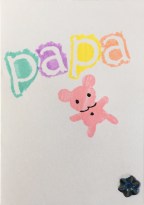
She made this nice little paper rabbit and greeting card for my father’s day:
The Artschool Project
The 2017-2018 Art Academy year has come to an end, and I already blogged about my latest work in The Story of 4 Paintings.
On March 31, 2018 I also participated for the first time in my life in a pre-selection of an art competition. The competition was called “De Curieuze Collectie” (The Strange Collection). My coaches had encouraged all students to participate. Only a few did.
Philippe Van Cauteren – Artistic Director S.M.A.K.
The jury was a quite eclectic mix, and included some people you normally don’t have access to like for example the Artistic Director of S.M.A.K. (Museum for modern art in Ghent). So I though why not, let’s give it a go.
This year’s theme of the collection was “Vox Populi – Populism in times of social media”. I presented some of my “Hot Dogs Tonight – Prison Window” work.
To make a long story short: I did not make it to the last 10 finalists. But it was a good experience to present in front of a select jury and a very diverse group of artists and locals. With hindsight, I feel that I tried to say too much, tried too hard not to be obvious: some level of vanity, which shows also in the background text I submitted to the jury (and a bit embarrassed now…)
“Hot Dogs Tonight” depicts a social media based panopticon, where the citizens are subject to continuous surveillance by governments, organisations and institutions. Attacked in their privacy, the citizen only sees the familiarity of her own cell. The convenience of the social media leads to an illusion of options, limited by the populist discourse of political demagogues. The Vox Populi becomes a Vox Populistus, a myopic view of reality, a fragmentation of time and identity. This lack of protection and security causes eventually a loss of personal leadership, courage and risk.
On June 12, 2018 I presented my Jan-June work for year-end evaluation at the academy: the latest work of The Story of 4 Paintings and some of my “Hot Dogs Tonight – Prison Window” work, especially the World Clock installation (physical version).
Next year, I will probably do some sort of specialisation or crossover, as I very much enjoyed the combination of digital and canvas this year.
About Silence
Some years ago I was diagnosed with auditory hypersensitivity, which in laymen terms means I hear extremely well. I hear for example the blood streaming through my veins in my head. It’s a soft rustling, but not very disturbing, no worries. On the other hand, I can’t stand television sets playing too loud, or the sound of the highway in the distance, or the crowds in subway stations. But I do like a loud rock concert or performance. “Functional loudness” if you want. So let’s say I am hypersensitive to noise pollution.
It dawned to me only recently that I could actually do something with this sensitivity. I started recording silence. Or rather, I started recording the noise pollutions that are disturbing a wonderful silence. Like the sound from a small motorcycle in the distance, passing by, and Doppler effect disappearing on the other end. Same with planes, trains, bicycles, voices, the list goes on.
Like in painting, it feels that this is also about managing contrasts and the spectrum of contrasts: loud/soft conversations, light/dark, calm/wild,….
Some of these recordings include video, some not. I plan to use some of these “silence-scapes” in my upcoming performances and/or installations as well. It’s a bit weird. I may get myself a GoPro camera and some decent audio gear, although my iPhone 6s captures it quite well. For the video below, I was just holding my iPhone in my hand when driving. Simple.
Biking noise and silence.
An 8-minute raw non-edited capture of a bike tour
in the area of Aalst (Belgium), illustrating sound and silence
To be used in some upcoming performances.
About time
My tempo has become so slow and peaceful that it starts to be incompatible and dysfunctional with the rat race of so called “normal” life of deadlines, busyness, and fragmentation of everything.
That’s what I wrote a while ago as some reflections on this theme.
Jan Fabre self-portrait - Part of series "Promises of a Face"
The first occasion where this dysfunction hit me was during a visit to the Museum of Fine Arts in Brussels, where my cousin is senior curator. He just had curated and opened an exposition confronting contemporary multidisciplinary artist Jan Fabre with the (mainly Flemish Primitives) classic artists (see also below). He gave me a quick-guided tour on the latest at the museum. I could not follow him (mentally). In one-hour time he gave me so much information, it seemed to me that I couldn’t process it all anymore, I needed more time to let it fully come in.
Around the same period, I was picking up again my Ableton skills ànd reading Venkatesh Rao’s “Tempo: Timing, Tactics and Strategy in narrative-driven decision making”, describing virtuoso how “tempo” is an always present but less outspoken aspect of our relationships between people, corporations, etc
In that book, he categorised some archetypes of tempo synchronisation. Some examples look very much like Gantt Charts.
Extract book "Tempo" by Venkatesh Rao
The tempo intervals made me associate immediately the visual metaphor of the “Venkatesh Gannt Charts” with the user interface of the music composition software Ableton Live (that I use to compose soundscape for my performances).
Especially the Ableton “session and arrangement view” visualizes in a very similar way the bars, tones, pitches, rhythms, tempos, velocities, automations, and quantizations of an arrangement or musical composition.
Ableton Live music software – arrangement view
One also hears intuitively when the score is right or not so right. When the beats are too digital and lack human variation. Life is more than bits and bites and rhythms in an arrangement…
Again, like in painting, it feels more and more that my work is about managing contrasts and the spectrum of contrasts: loud/soft conversations, light/dark, calm/wild,….
Exhibitions
Still trying to visit an art exhibition once/twice every month. During the last 3 months, I went to see:
“Het Vlot” a multi-location exhibition in Oostende
“My Queens” by multi-disciplinary artist Jan Fabre, honoring the 8 important women in his life in a dialogue with the Flemish artistic tradition (curated by my cousin Joost Vander Auwera). I was very impressed by the monumental Carrara marble bas-reliefs with incredible detail
“Fernard Léger – Beauty is Everywhere”, about one of the best-known modern artists, and a passionate observer of a bustling century, and the Cambrian fragmentation of everything.
Upcoming performance
I am very excited to have been invited again to do a performance at the Finnovista Summit in Mexico-City on 12-13 Sep 2018. I was invited last year, but the event needed to be cancelled halfway due to the 7,4 magnitude earthquake on 19 Sep 2017. So the organisers were so kind to invite me again.
The theme of this year’s event is “Listen, Learn, Lead”. Manoeuvring through this theme, I will make a new performance, recuperating some material from last year, but also with new elements from my artwork series “Prison Window” and other metaphors capturing my reflections and insights of the last year. This time, and in addition of the multi-media approach, I plan to include props on stage, possibly a life camera feed, even some vestimentary attributes, and a lightning script for the light technician.
The venue is indeed fantastic: it is the main concert hall of the Centro Cultural Roberto Cantoral, a real theatre stage with all the audio/lightning whistles and bells one can dream of.
The working title of the performance is “Get out of the prison cell! – An artistic reflection on listening, learning, and leading”
Chickens and Pigs Project
A nickname for our garden and chicken farm.
The chickens are doing fine, thank you. Normally 2-3 fresh eggs everyday, but recently – because of the warm pre-summer here in Flanders – one of my hens is broody. I told you, I have nothing to report 😉
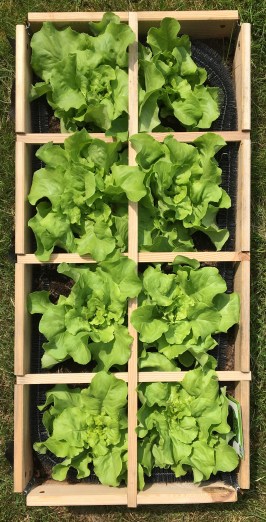
The garden is developing well. We now have different salads, tomatoes, cucumber, zucchini, carrots, paprika, berries and raspberries. And the trees in the orchard start developing apples, pears, cherries, and prunes.
That was just in the garden. Small stuff compared to what my uncle Hubert and son David are doing. They are professional farmers cultivating several hectares of land and keeping a livestock of about 250 cows and sheep.
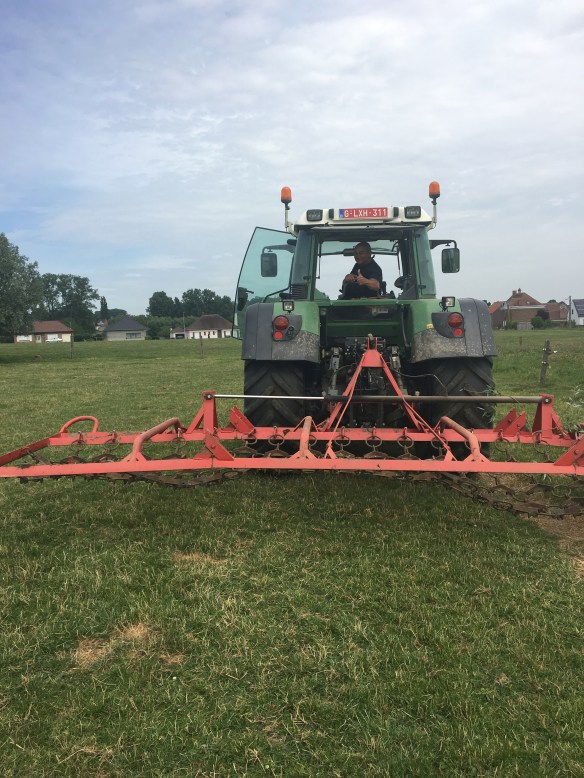
One of my long time bucket list items – driving a tractor through Flanders’ Fields – finally became true. It is an almost Zen-like experience to make nice straight lines in open fields, with just the sound of the tractor and the warm wind blowing through the open window of the machine.
Farmer Petervan on tractor of uncle Hubert, Aspelare, Belgium June 2018
I was impressed by the technology on board of these modern tractors. They have a joystick, auto speed control, airco, etc. and some of them even have GPS to make really straight lines, or to ensure no part of the land is sprayed twice, a matter of efficiency and cost control. Also the seats are awesome, better than in most cars.
I also learned a lot about nature: when cows keep their tail up, it means there’s thunderstorm underway, and when swallows fly low over the pasture, there is a good chance of rain coming. We also saw a lot of hares, and even a fox.
What’s next?
Besides the obvious year-end resolutions (renewed every quarter or so), the plan for July – Sep 2018 is to work on:
V1 of “Casual Conversations” aka Studio Oxygen
Make and publish some more Silence-recordings
Create 1 painting every 2 weeks > 6 paintings in 3 months
Write 1 blogpost per month
Mexico Sep 2018: make and rehearse the new performance
Looks like I am running out of time 😉 So, that’s it for this edition. If there is something worth reporting, next update is for Sep 2018.
My sabbatical has come to an end, and I left SWIFT on amicable terms mid Jan 2018.
I also decided to drop the whole idea of Petervan “Productions” and killed the related website. It just simplifies a lot. The “Productions” branding of my work confused people more than anything. I am not in the event business; my work is more about artistic experiences. I am not running a company. Just a guy on his own, cranking out some stuff that sometimes people find interesting (or not).
I will continue my journey now as a free agent to do “interesting” stuff. Here is an open invitation: let’s talk about what “interesting” means and surprise each other!
“What I want to do is make situations where we’re all slightly at sea because people make their best work when they are alert. I’m now 68, so I might have another 15 to 20 years left – talking about my history. So, given the little time I’ve got left on this planet, I would really love to focus on some of the new things I’m doing.” (Brian Eno)
I am not 68 yet, but I feel the same desire not to talk about the past but to focus on the new things I discovered during my sabbatical, and to help you make your best work.
"Celui qui tombe" by Yoann Bourgeois
Dance performance with music “My Way” by Frank Sinatra
The Artschool project
I am really enjoying my time at the Art Academy in Ghent (KASK), and love the freedom and feedback from my mentors Chris, Koen, Inge, Marie-Ange, and Annique.
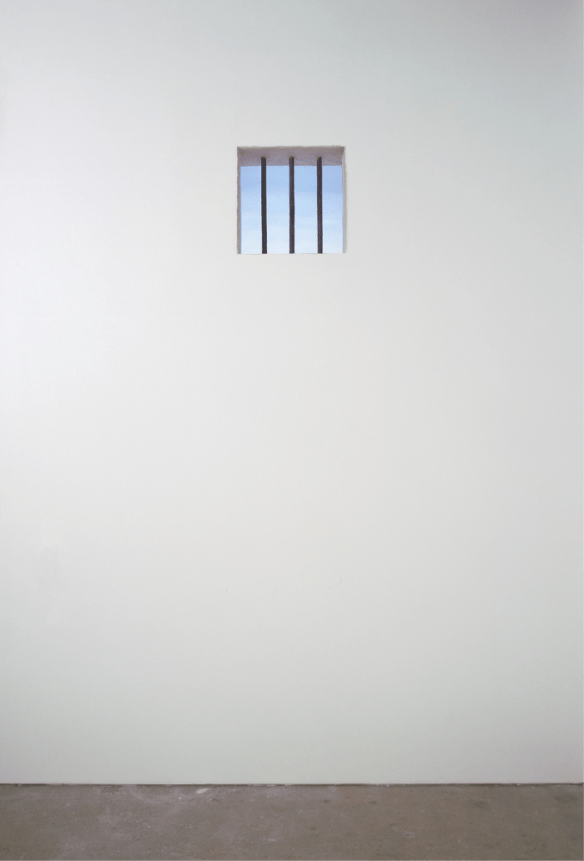
Prison Window – Art installation by Robert Gober - 1992
I also found a theme to work on for the rest of the academy year. The theme is labeled “Hot dogs tonight” and the inspiration was an art installation “Prison Window” by Robert Gober.
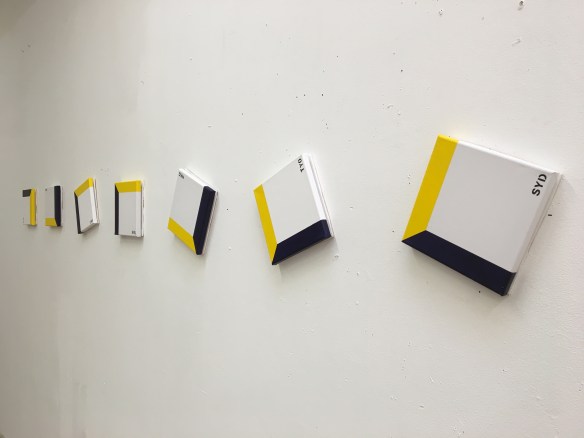
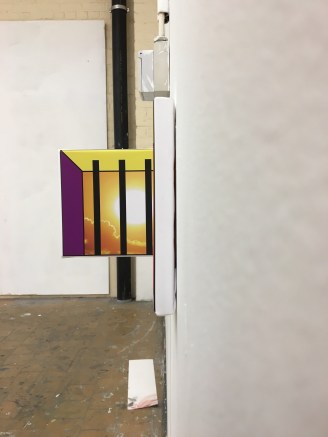
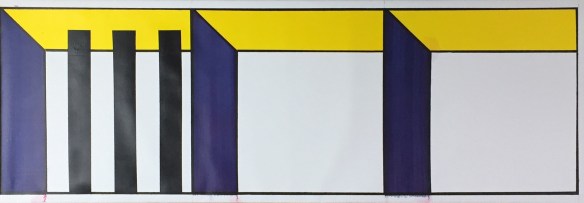
I will work on a series of very abstract artworks and installations based on a minimalistic geometrical interpretation of that window. Here is my basic shape to start from, and a first painting exploring this meme:
Petervan concept interpretation of Prison Window – 2018
Petervan artwork – Hot Dogs Tonight #1 – 2018 – Acryl on canvas – 120x40cm
I did an impromptu Skype presentation about this project to a friend in San-Francisco, and I was amazed how the work seems to be an open invitation to have a conversation about what it means to be a full person and not only a reputation or influence. Ping me if you’d also like a run-through of the plans for “Hot Dogs Tonight”.
This project can keep me busy for quite some time, and to make sure the thing does not become an obsession or pain in the neck, something that I have to do, I will still produce in parallel some more figurative work.
The Poem project
Several poems written over the last couple of months, but for this edition of Petervan’s update, here is a really a short one, just two lines:
I dreamt I was reading a book of dreams,
and forgot where and why I was
Five trends for humanistic advancement
I found it a good moment to condense my sabbatical thinking into a couple of levers that could enable high quality advancement for a humanist future.
Any of the trends described could evolve in a good or bad direction, but as an optimist, I chose for the path of “advancement” vs. the path of decline and degradation.
The Performance project
The organisers of FinnoSummit kindly invited to do the premiere of my performance as the closing keynote for their Miami event on 9 Oct 2017.
To give you an idea of the storyline and subject covered, here is a link to the slides:
The keynote performance also includes self-composed and performed live music, poetry, soundscapes and other artwork. To have an idea about some of the soundscapes, here is a snippet of a very long self-composed ambient that I use while the audience walks into the room, purposefully called “Opening Walkin”: http://soundcloud.com/peter-vander-auwera/opening-walkin The snippet is about 40 seconds long, the real thing lasts for 29 minutes.
Thank you Andres and Fermin for letting me do this.
The Pigs & Chickens Project
This is just a moniker for my garden project. I know of a friend who years ago left corporate life to start a pig farming business. True story 😉 But my wife said no to pigs, so we’ll have chickens instead.
Tatooed Pig Jamie by Belgian artist Wim Delvoye - 2005
Besides spending more time in my kitchen garden and orchard, I plan to be more in nature in general. So expect some more pictures of my bike rides in the country of the Flemish Primitives.
The Studio Oxygen project
Being in nature is also about taking in more oxygen. I am running a small on-line collective that (un)regularly comes together online to discuss a seed that I have planted. Sometimes we’re ten people in the call, sometimes nobody shows up. The conversations are very unstructured and open-ended, like with no agenda, but they generate all sorts of inspiring thoughts and ideas, and people seem to like these sparks of inspiration and refer to them as “oxygen for the mind”.
So I plan to experiment with some formats to create a platform letting people share the interesting stuff and ideas they are up to.
What’s next?
During Jan – Mar 2018, the plan is to work on:
Pigs & Chickens Project
Hot Dogs Tonight
Studio Oxygen
More artwork
Whatever feels interesting and comes naturally into my flow
Petervan artwork – Early pre-study for concert hall – Jan 2017 – Acryl on sketch paper – format A4
That’s it for this edition. If there is something worth reporting, next update is for Apr 2018. Looking forward to hearing from your latest adventures as well.
And if you have an idea to do something interesting together, please contact me.
This trend is part of my five trends for human advancement. For an overview and background, check here:
A lot of change initiatives only scratch the surface of the systems they try to change. They are tactical, short term and full of platitudes. I would like to suggest an almost Jungian analysis of organisations and ecosystems.
Rusty port next to Museum Modern Art Antwerp – Petervan Nov 2017
Trained as an architect, I have been (and still am) seduced by the term “Patrimony” and the respect of patrimony and the ability to combine patrimony with contemporary. Early feedback suggests that the term patrimony may not be the best. It contains the Latin “Pater” and makes people think of something “paternalistic”.
In an earlier post, I already suggested that the Dutch word “Erfgoed” maybe captures it better. “Erf” means inheritance, value that can be transmitted across generations. “Goed” stand for “good”, both as 1) something tangible, an art-i-fact and 2) something good, of value, of worth, wealth and culture to be carried forward.
Patrimony is structural memory carried forward from previous generations. Like Jungian humans, also organisations may have an ego, a conscious, a personal unconscious and a collective unconscious. Patrimony is about the collective unconscious.
To have fully humanistic organisations, we must be prepared to interrogate and influence at the level of patrimony. And combine patrimony with contemporary. Not as a shock or provocation, but more like adding milk to coffee (with thanks to Niels Pflaeging)
Petervan Productions 2017 - Live model - charcoal and acryl on paper
The same applies to straight and curved lines. As a non-practicing architect from the seventies, I was trained in straight lines. That’s what my hand had internalised. When later in art academy I was doing live model drawing, I could sense how unnatural natural curved lines were to my hand, and probably also to my brain. It reminds me of an intro of an art exhibition by art curator and critic Hans Theys, who described the straight lines in coffee bars along a high street in Borgerhout, an area mainly populated by Muslim immigrants: tables, chairs, lights: all were straight, hard, and women de-facto not allowed. What a nightmare it was/would be to live in a world that was only designed by men, without (internalised) curved lines.
Humanistic advancement will flourish only if we develop our ability to see, sense and share the patrimony and curved lines of our organizations, institutions, and ecosystems. It’s Jungian in the sense that the maturation happens when we are able to internalize, accept and incorporate the organizational collective unconscious of cross-generational heritage, symbols, memories and narratives. Including the suppressed shadows, memories, and femininity of our organizational patrimony.
A couple of days ago, I was standing in line in the supermarket. In just five minutes time, the mother in front of me was instructing her two lively kids: “be normal”, “be silent”, “behave”. She probably said it 2-3 times in that short period.
I smiled, but also felt some push-back at the same time: why limiting these kids in their normal expression so early in their life?
My wife also invites me from time to time to “be normal”. That invitation provokes protest in me. I think that is because I associate normal with boring, not exciting, not special.
Do we want to be special because we want attention? Normal does not get attention. Being normal – not special – seems to be an insult/attack for my identity. Maybe it is my shadow. My shadow as in “what I do not want to be”, or “what I do not want to be labeled as”. Like not wanting to be labeled as “stupid”, or “manipulator”, or “dishonest”, etc.
The older I get, the more I become aware how distracted I get by putting energy in ignoring my shadow, in proving that I am not stupid etc. A similar energy loss btw when trying to prove the validity of my non-shadow label, role or title. But that is another post.
How can I integrate normality in my identity? Should I? Should I integrate that normality? Should I even try to focus on my identity? In an interesting podcast with Raf Stevens (in Dutch), André Pelgrims says that:
“Ego is the urge to build up identity”.
Have we spent the majority of our lives in building identity? Have we never matured? Have we not integrated what needs to be integrated? What/why is there to be proven?
Mind you, in all this, the focus is still on ourselves trying to “build identity” (with our without shadow) rather than the motivation to accomplish on the outcomes we wish to create.
The identity builder is a noise generator.
Do we humans create, design, make, blog, tweet, facebook, etc because we are hungry for attention, we want to prove something, or because we have something new to say, a new insight to share, a novel hypothesis to be tested? Or do we just inject noise into the stream to get our part of the attention?
I recently met somebody who planned to hire a cheap student to create and post her regular noise. Her “Professional Noise Creator”. Addicted to attention. Addicted to taking space from others. It’s a power game. As articulated so clearly by André Platteel of Your Lab in this great blog post (in Dutch):
“Often when we try to find space we look for it outside ourselves. Then we are busy creating space outside of ourselves. To check out whether we can create freedom of movement. Whether we can get more space/freedom from others. Whether we can dominate another in a strategic game and lock them in them so we can get more freedom of movement. That whole game is based on the idea that we are independent of others and the world. Where we are fearful all the time that our space is being suffocated or taken. That’s why we tend to take as much space from the other. And have a feeling of freedom and power.
Stairway space in Gaasbeek Castle - June 2017
“I know that game very well” continues Platteel. “Played it so long when I was a marketing advisor. Using smart marketing tricks to make your own commercial space as big as possible at the cost of your competitor’s space, using smart marketing tricks. When all the time you try to be smarter than the others. I started to notice that in the consulting, it is not only about taking as much space as possible, but also to assert power. When it is not about listening to one another, but about being (perceived) smarter, more concise, faster, fitter, stronger. In fact taking more and more space at the cost of others.”
Petervan Productions 2017 – Blue Sky, Parasol, and Flight – June 2017
I believe the desire to be special (and thus not-normal) has to do with the desire to be visible. A lack of visibility seems to give me less power.
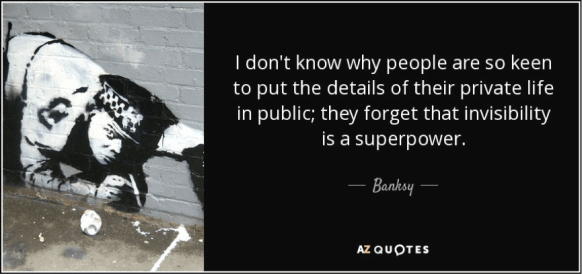
If invisibility is a superpower, than maybe also anonymity. I have these moments where I want to disappear in complete anonymity, like a monk in a monastery, detached from any social contact. The antonym of anonymous is “named”, “known”, “identified”. A desire to be un-named, un-known, un-identified. Without identity. And do-my-thing. Without the need for attention and visibility. But even that is a make-up, a mask.
Just the act of saying “I want to disappear in complete anonymity” is the superego acting in the background. Because it assumes I am special, famous, non-anonymous. And I have to escape it. It’s an “evolved” form of narcissism: feeling superior rather than feeling special.
Narcissicm was well described in a post by Umair Hague about why America can’t learn from the world (be aware I take the sentence out of its original context, which is a bit of manipulating or content-mixing of course):
“Narcissism. The belief not just that one is special — for we all are unique, different, remarkable. The belief that one is superior, above, beyond. Better in fundamental ways. That is never true. Not a single one of us is better in any fundamental way. The genius is poor at loving. The lover is poor at creating. The creator is poor at managing. And so on. We all have flaws. But the greatest flaw of all is to be blind to the grace and beauty of the idea that we all have flaws — and so to believe there is nothing to be learned from anyone else. Trump is a narcissist, sure — but he is only a reflection of American narcissism in this way.”
“The first job of a leader is to learn. Only then can a leader do their second and third jobs — care and love. Leadership is nothing more — and nothing less — than realizing human potential. You can do it as a parent, boss, friend, partner. You probably do. That is what care and love are in concrete human terms. The difference between them is that care brings a person towards their potential, and love expands that potential.”
Art Academy 12 year old kids playing with tissues – June 2017
Feeling special, feeling superior. Being part of the ego-tribe. Even worse is the word contempt: the feeling that a person or a thing is beneath consideration, worthless, or deserving scorn.
In that sense I am also a reflection, a feedback loop of society. It’s the only thing that is great about Trump: he makes you more aware of your own shadows of narcissism, contempt and bullying. The ways you definitely do not want to stay in life. Being aware of these shadows, and finding a way to accept them, to integrate them I your whole being, and focusing on that other – different, better – palette of songs to sing. Breaking out of that rigidity of defence and taking others’ spaces.
To quote André Platteel again:
“Then there is no rigidity anymore of values that we can hang on to. Then there is nothing to be defended anymore causing us to exploit our power in a false way. To make another smaller and feel more free ourselves. Then it is not needed anymore to hide and feel our more expanded selves. Or to blow yourself up to make yourself bigger than you are. But just be, who you are in this moment.”
Maybe that’s when being normal becomes exciting and a source for internal happiness and stillness? When identity is not a burden anymore?
Also surprised what thoughts a simple invite to be normal can provoke? Share your surprises and insights. Please.
I am in the business of cultivating high quality connections and flows to create immersive learning experiences and structural change. Check out: https://petervanproductions.com/
3D Art room by 12 years old at BKO Academy – Feb 2017
I recently realised that it’s almost seven months since I saw an airplane from the inside. That’s indeed the time I am into my long-term sabbatical as Petervan Productions. It also means I am about halfway: another seven months indeed between now and end 2017. If you are interested in my developing story, my Jan 2017 and March 2017 updates are still available.
A quick update:
March-April felt like a period of soul-searching and reflection. I constantly had the impression I was not doing much and progressing very little, but writing this update gave me some comfort: there still is some advancement towards my goal and that of Petervan Productions.
I feel less restless than in the first couple of months, and can accept that a day goes by without any concrete deliverable. I also made some minor changes to my daily schedule, which is now more in synch with nature. For example, when the weather is great, I go outside for a bike ride or some gardening, and that’s why I already got a nice pre-summer tan 😉 And when it rains, it’s time for desk work. As there is enough rain in Belgium, there is enough time for desk work.
Artschool
Artschool continued at +/- 9 hours per week practice in the art studio of the art academy. Got a challenging color-study from my coach, which also led into a remake of “The Drama”. I also started liking the use of many very transparent layers.
Two completely different works
Both acryl on cotton canvas stitched on wooden board
122 x 82 cm
Performance
I had many 1-1 conversations with friends and relatives to collect feedback on the performance “Tin Drum Is Back”. Thank you so much for the very valuable feedback!
Did some site visits to find the ideal location for the performance. Nothing came really close for the final show: some spaces were great, but the acoustics awful. And for some good news I got commitment from two sponsors to use their space for the dry run and Avant-premiere.
I also received some first proposals for the visual identity of the show there is much more, but this would be the main theme:
First mood board for “Tin Drum” performance
Events
Nothing special here. As you know from previous updates, I am not in active prospection mode, and every request is measured against my existing priorities:
There are 1-2 interesting speaking engagements that allow me to test some of the performance and/or structural change concepts.
One promising lead for an immersive learning expedition with artistic performances.
Little progress on the retreat-style event.
Other
I visited some great art exhibitions and had some very pleasant conversations with art curators.
And I also started experimenting with some poems, some out of the blue, others in relation to some of my artwork. A first collection via this link.
So, what’s next?
During May – June 2017, the plan is to work on:
My daughter’s communion is on 14 May 2017. We plan to keep things simple, invite some close family in our garden with a back-up tent in case of rain, and some quality food and drinks brought in by a local caterer.
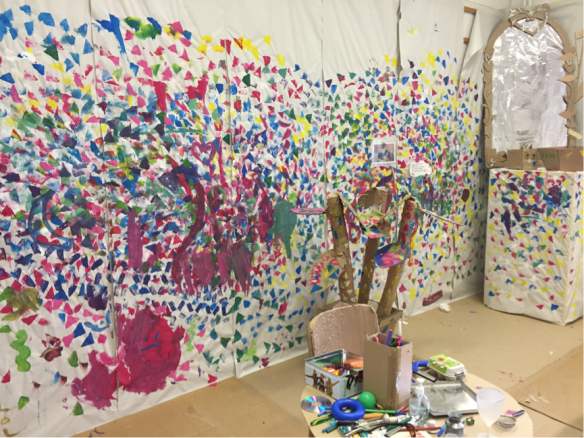
Creating an installation for the June 2017 year end exposition of my art school; the installation will be called “TOKOMA”
A visit to a research facility in Germany that integrates artists in industrial research project work
This year’s summer promises to be different as well. We decided to move houses to be closer to the Flemish Primitives. Emptying the old house, refurbishing the new one, boxing and un-boxing will keep us busy most of the summer. The new house was previously a doctor’s practice, and the plan is to organise one space as an artist’s atelier/production studio where I plan to study, paint, write poems, compose music, and produce experiences.
Detail from Atelier Michael Landy
That’s about it for this edition. If there is something worth reporting, next update is for July 2017. Looking forward to hearing from your latest adventures as well.
Rebelliously yours,
I am in the business of cultivating high quality connections and flows to create immersive learning experiences and structural change. Check out: https://petervanproductions.com/
What touched me was that Madame Butterfly was played by a puppet, directed by three puppet players (visible in black). The effect is mystical. Check out the end of this video (comments in Dutch, but that should not spoil the experience).
Opera Madame Butterfly - De Munt - As from 31 Jan 2017
It made me think about a passage in David Byrne’s wonderful book “How music works” (Amazon Affiliates link). I am reading it in the context of my performance for Petervan Productions.
At a certain moment, David Byrne describes how his thinking about a show – a performance – was influenced by traditional Japanese theater forms such as Kabuki, Noh, and Bunraku.
Example of Japanese Kabuki theatre
“The tour eventually took us to Japan, where I went to see their traditional theater forms: Kabuki, Noh, and Bunraku. These were, compared to Western theater, highly stylized; presentational is the word that is sometimes used, as opposed to the pseudo-naturalistic theater we in the west are more used to.”
“The character had in effect been so fragmented that the words they spoke didn’t come from close to or even behind that puppet. You had to reassemble the character in your head.”
“As in Japanese theater, the performers often wore masks and extreme makeup; their movements, too, were stylized and “unnatural.” It began to sink in that this kind of “presentational” theater had more in common with certain kinds of pop-music performance than traditional Western theater.”
“There was no attempt to formally separate the ritual and the show from the audience. I quickly absorbed that it was all right to make a show that didn’t pretend to be “natural.” To further complicate matters, I decided to make the show completely transparent. I would show how everything was done and how it had been put together.”
Check out the video footage of the resulting “Stop making sense” Tour. The show starts with a heavenly version of the song “Heaven” on an empty stage. At minute 2:30 you will see the first elements of the stage being rolled in.
The whole show is super enjoyable, and if you want to know what “playing tight” means, check this awesome version of “Breaking down the house”, which does exactly what you would expect.
Sometimes I think I have to stop trying to “make sense”. Better would be to “make meaning”.
All these reflections are related to my upcoming performance “Tin Drum is Back” (subtitle: “what is/what could be”): the performance design is evolving well, with detailed script being written as we speak.
Part of the story is looking back into ones youth (5-10 years old), look at what was forbidden then: for some people that is an area of talent they have neglected to develop. In my case, it was a tin drum I got when I was 6 years old, and the story of rhythms in my life and in my work. As the script develops, the narrative arc seems to be about evolving archetypes and levels of maturity.
Scripting is not “only” the storyline, but also the staging, transition, props, lighting, etc… And all visuals, sounds, and word are self-composed, self-created. Should be ready around March, although I may pick up some delay.
It starts feeling like theatre by an amateur 😉 So, performing “tight”, in some theatrical form, with costumes, masks, props, and stage being build-up as the show moves along, is certainly inspirational.
I see “Tin Drum…” as a teaser for a bigger story on multi-media corporate narratives, where – who knows – I create commissioned performances on less tangible topics (less tangible than “what problem are you trying to solve?”). I indeed think that a lot of the work I am preparing is steering away from the problem-solving orientation, and give more room to the creative orientation of “what do I want?”
What do you think? BS? Did I smoke too much ? 😉 Please don’t hesitate to share resources and serendipities that this post may generate.

































 Petervan Studios