Mavericks in a corporate world

On 6 June 2013, I presented “Open Innovation Systems – Maverick Ventures in a Corporate World” during the Amplify Festival in Sydney. The Livestream of the talk is available here:
livestream


This blog post is documenting the genesis of that talk, therefore not really or only a transcript, but passing the same messages through the medium of writing rather than speaking, hopefully even improving the clarity of purpose and intention of the talk.
 

scribe

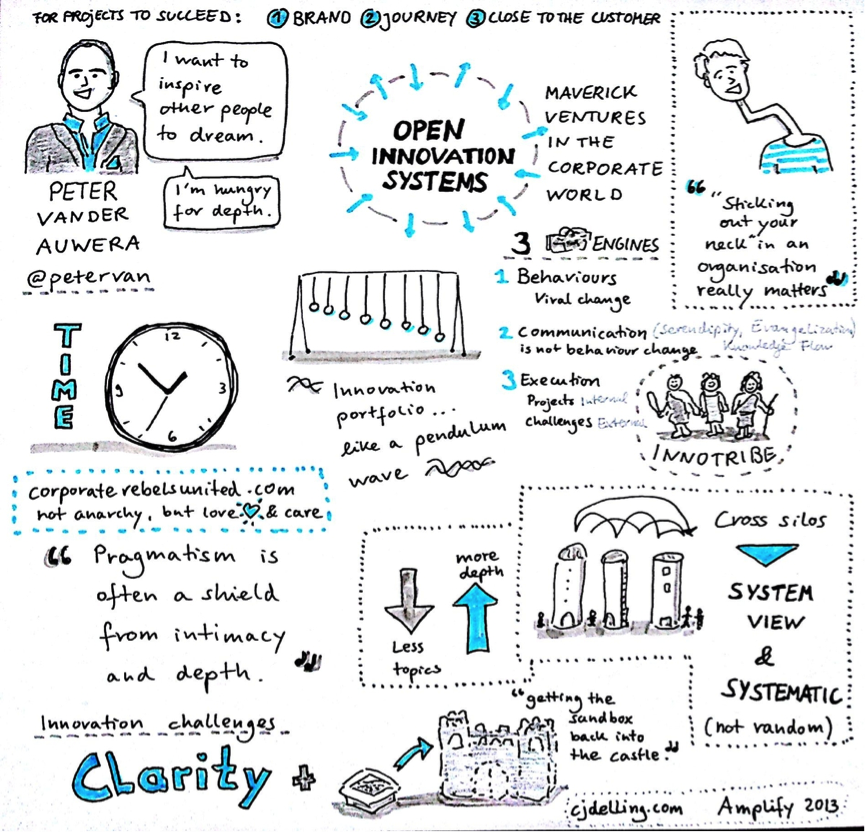
Thanks to @cjdelling for this wonderful scribe, made live during the talk.

There were many triggers for this talk, but the two most important ones were Douglas Rushkoff’s latest book “Present Shock” (Amazon Associates Link) – a book that left a deep impression on me – and a conversation with Haydn Shaughnessy, that I already somewhat documented in my blog post “The Bridge”

digital-human

Rushkoff hits the nail when he says “Time Divides” and “Time is digital in character”. Just try to sense the different human experience when looking at 15 seconds of digital time vs. 15 sec on of analog time. In the analog world, there is flow, continuity, and formation. But we have started to accept a new normal where we have to make choices between extremes: black/white, On/Off, Digital/Human, etc. When being presented with the options left/right, we forget we can also go up and down.

“The lack of options is the opposite of freedom of choice,”

says Rune Kvist Olsen.

In an innovation context the limited choices presented are incremental/disruptive, core/non-core, internal/external, castle/sandbox.

There must be a richer better way to have conversations about innovation. I am getting sick of the 1-2 minute conversations where you have to make your case in a tweet. Sick of the 18 min TED talks, where there is no critical dialogue but only glorification of technology as the sole source for progress.

I am hungry for depth

For intimacy and human connection. I am on a quest for depth. A quality space in time and location where free deep thinking is again appreciated. Where we discuss not in limited silos about limiting options. Where life flows like water in oceans, in currents and rhythms, in waves of pendulums with different amplitudes influencing each other as Perpetua Mobile, spiralling as convergent systems into beauty and harmony with a direction of progress.

A space with doors wide open for new world-views  where we create knowledge and resource flows (are they the same?), with new thinking: visual thinking, design thinking, systems thinking, and scenario thinking.

A space where bravery and maverick behaviour are not merely tolerated but accepted and encouraged as the new norm for deep viral change. You may call them whatever you want: mavericks, outliers, beyonders, rebels, catalysts of change.

With Innotribe we have created an end-to-end framework, based on the Open Innovation principles of Prof. Henry Chesbrough. That it is an end-to-end framework is not always fully appreciated. Sometimes, the work of Innotribe is reduced to its most visible component, the “events”. And also there, the superficial world with lack of depth and intimacy only sees the externalities of the events, the cheerleader-feel of the facilitators and masters of ceremony, thereby completely ignoring the deep immersive learning experiences and techniques applied and intended.

Superficiality kills depth

But even if the full breadth of the Innotribe work would be appreciated, we are not done. There is more, much more to be done. I would like to re-set the bar. I am getting convinced we have to move into systemic and systematic innovation. It was Haydn Shaughnessy who opened my eyes and gave me the first insights that there is an evolution of Open Innovation possible, way beyond corporate garages, towards a model where innovation is deeply baked-in into the fabric of the organization. Haydn has just published a report on this on GigaOm Pro titled “Rethinking innovation: how to manage ideas systematically” (registration required). There, Haydn introduces “lean innovation”, “algorithmic innovation”, and “radical adjacencies”, which we already knew from his book “The Elastic Enterprise”. (Amazon Associates Link). Haydn will be with us at Innotribe Sibos in Dubai in September to share the results of his research in the domain.

Where “systemic” assumes system-wide approach. Not only within the silo of a department, or in non-communicating black/white, internal/external innovations vessels, but across silos, across vessels. If not, failure is almost built-in, because the two camps engage in finite games, whereas we should play infinite games where we do not look for a winner (and by definition also loser), but where the journey of the whole systems towards progress is the goal (read also James Carse’s “Finite and Infinite Games” – Amazon Associates Link).

In the first case – the finite games – we may be seduced by the means, but I am for sure not attracted by the end-game. We have to move across the corporate boundaries, and become “system activists”. My next blog will describe this new form of corporate activism in more detail.

nike launch

A great example is Nike’s Launch2020 Project, creating system wide transformation, in partnership with MIT, NASA, and Government.

Where “systematic” stands for planned, organized, designed, focused, and not random. Repeatable. Scalable. The best example I have seen so far is Vodaphone: they have deeply investigated the trends that impact their business; they have documented the needs (not the asks) or their (potential) customers, and made solid customer segmentation. Then they apply pattern recognition across these three layers, and are hyper-focused on where they want to spend their innovation efforts, resources, and budgets.

In general, it also seems to be that many organizations are very focused on product, service, and process innovation, or the latest buzzword “business model innovation”. Probably because that is what we know, what we feel comfortable with. It’s our comfort zone. We have been trained for years in thinking rationally about our businesses, decomposing, fragmenting every process in sub-tasks that can be mapped, followed, and measured. Up to a level that we don’t see the forest for the trees.
3 engines

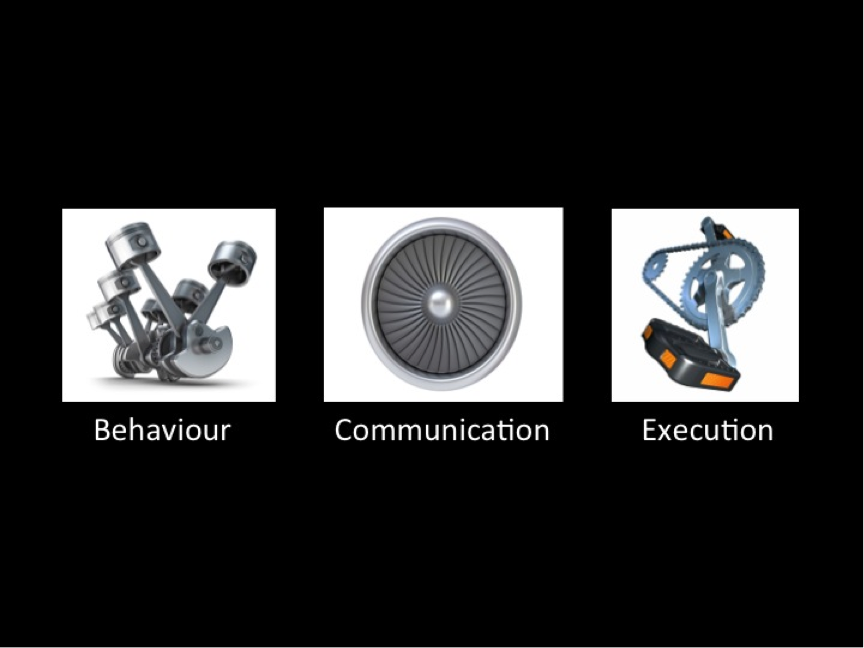
What we need are 3 type of engines:

  • A communication engine, with the ultimate goal of being a serendipity machine, an evangelization machine, and a knowledge flow platform;
  • An execution engine, with a good balance/portfolio/consistency between internal and external innovation
  • But all those changes are lipstick on a pig, if they are not deeply embedded in sustained behavioural change in every vain of the company.

What we really need to focus on is the third engine of behaviour change. Deep viral behaviour change. Because behaviour drives culture and not the other way around. And let that change spread like a virus through our organizations and systems. So it is getting copied and amplified through our hyper-connectivity networks. Where leadership becomes leadingship, and backstage leaders act as distributed coaching nodes in the corporate grid.

In the end, it is about being human and developing and nurturing the capability to be touched by beauty, a picture, by mastery and harmony. And to develop a richer palette of judgment, choice and appreciation.

Yes, there is some form of romanticism here; shall we call ourselves business romantics? It’s the nature of this beast, to be an incurable romantic.

Incurable Romantics

It’s what I am as human. I cannot and do not want to settle for the sterility of digital zeros and ones, for cogs in cubicles executing standard processes that anyway do not match anymore our fast changing world.

I want to send, propel and amplify positive vibes and frequencies to all the nodes in our grids. I want to reverb and resonate, and inspire you all to dream. To dream big and be unreasonable and go for the impossible. I want to me and you to get alive and get a life. I want us to be mavericks and rebels in a corporate world.

10 questions to self-assess your innovation efforts

The fantastic Amplify festival in Sydney has just come to an end. What a week! The curation for this event by Annalie Killian (@maverickwoman) from AMP was just outstanding. It is very rare to such a rich set of speakers coming together for one week.

Amplify logo

This is even more exceptional if you’d know that this is a bi-annual fest exclusively targeted at employees from AMP. What a great innovation effort to bring the outside in, to expose corporate staff to the vibrant world of innovation at the edges of their own ecosystem!

Every company should copy-cat this approach.

As I listened to the different speakers talking about technology breakthroughs, innovation efforts, transformation efforts, and behaviour change programs, i felt a growing discomfort inside myself with the seemingly over-glorification of technology as a cure to solve all world problems, and the un-balance with business humanising insights.

At the same time, I started wondering how much of all this really lead to substantial changes and actual products and services shipped, with real value add reaching the customers on a sustainable basis.

Every time I meet innovators in a corporate environment, I ask the question: “what is your biggest innovation challenge?” Most of the time the initial answer is an embarrassing silence, and at best the answer is foggy and lacking clarity of vision and intention.

It made me think: what is it that makes companies’ innovation real? What is it that lets people with the holy fire flourish or die in our organisations? What is the authenticity of all this innovation work?

authenticity for sale

Illustration by @gapingvoid

With some very rare exceptions, all companies have innovation in their annual reports, part of their corporate branding exercise, even part of their mission. And many companies have actually dedicated central or distributed innovation resources and budgets in place. The happy few have even started or are starting with Corporate Garages (see “The New Corporate Garage” by @scottdanthony).

jobs_and_wozniak_1975

Image courtesy Apple Computer

However, in many cases this is window dressing and innovation seems to be mere “lipstick on a pig”. This creates disappointment, frustration, and a sense of illusion, and leads to disengagement of the staff at large.

In order to help organisations self-assess how real their innovation is, I started pulling together 10 questions. Depending on the number of 1) and 2) answers to the questions below, you will be able to find out for yourself where you stand, and hopefully will allow you to start a “straight talk” conversation within your organisations on the best way forward. The more I think about this, the more i am getting convinced that the key to succes is based on high quality alignement of vision and intention at all levels, and the irradiation of “stories” that seem to perpetuate in corporate environments.

The questions are organised per influence group of your organisation or give some insights in your real appetite for change and experimentation. Just tick 1) or 2) for your answer and add up the numbers at the end of the exercise.

  1. Board level
    1. 80%+ of your Board is really – in a pro-active, visible and public way – supporting innovation, or
    2. 50% of your Board are in essence against innovation and want you to focus on the core and the other 50% just “tolerate it”, close their eyes and trust their CEO not to do too disturbing things that can harm the company’s reputation.
  2. Strategy level
    1. Is innovation a dedicated chapter at the beginning of your strategy documents, or
    2. Is innovation merely a paragraph at the end?
  3. CEO level:
    1. Does your CEO deeply embody the desire to change and disrupt in an integer, consistent and authentic way, or
    2. Do you notice in the tone during the all-hands sessions almost an embarrassment when she takes the word innovation in her mouth?
  4. Executive Committee level: Are your executives aligned on innovation or not? Just do this mind-experiment: What do you really think would happen if you pop-in by surprise at the next Exec Meeting and ask each Exec to list the top-3 alignments on innovation:
    1. Would you hear one strong consistent message of alignment and genuine enthusiasm, or
    2. Many voices of disagreement and vagueness, and an urge to move on to the business of the day?
  5. Level-1 / Level-2  (Senior and Middle Management)
    1. Do they see innovation as the instrument by excellence to make bridges between the edge and the core, to transform your industry, brand, and network with the deep desire to challenge the status quo, or
    2. Do they look at innovation as the people who burn money, travel a lot, do not innovate in the core, a special bunch that never blends in, and is always “out there”?
  6. Your colleagues in general:
    1. Are they looking at the innovation team as a group of people that brings value, creates excitement, infuses new energy, creativity and enthusiasm, or
    2. Are they complaining about having to stay in their cubicles while the innovators have fun?
  7. Sandbox projects
    1. Do you have a process in place to force forward consciously at least 1-2 “big bad ideas” per year into the mainstream business, in other words do you have an innovation portfolio approach, or
    2. Are more than 99% of sandbox projects killed before ever getting a chance to get materialised in real products and services, because not fitting the strategy or no immediate revenue potential?
  8. Sandbox or playground
    1. Is your sandbox considered as a real space for experimentation and organizational learning, or
    2. Is your sandbox just tolerated as a children’s playground as long as it does not disturb the core and does not challenge existing power balances?
  9. When the going gets tough – in time of cost cutting:
    1. Do you observe a conscious choice to remain flat or even further invest in innovation for the long term, or
    2. Do you observe random flat cost cutting across all departments or – even worse – bigger cuts in innovation?
  10. Daring to be great
    1. Is their a process to identify your Corporate Catalysts and to plant them into the fabric of the organization to create viral change from within, or
    2. Have most of those that dared to be great, and had the courage to stick out their necks during the last 2 years been made silent or laid-off as part of cost-cutting, efficiency or other re-organization initiatives?

Let’s be conservative or even kind in your self-assessment:

  • If you have answered more than half of the questions with 1) there is a chance that your innovation is real. Focus on the execution of your innovations, and the shipping of value adding products and services into the marketplace;
  • If you have more 2) answers, you probably live in an innovation illusion and it means you have more work to do in laying a solid foundation of belief across the organisation  Avoid throwing the baby out with the bath water.  Push for clarity in the vision and intention of your innovation efforts, and focus first on deep bottom-up viral behaviour change activities, as behaviour drives culture and not the other way around. And remember; you will need passion, perseverance, and patience to succeed.

In other words, turn on the B.S. detector and ask yourself the question: is your innovation a real strategic choice or just a tick-box to satisfy your feel-good-moments. And plan your actions accordingly.

Disruptive times call for positive, creative disruptors: Rebel Jam Update

UPDATE: you can find the links to the recordings of all the Rebel Jam talks here:

https://docs.google.com/spreadsheet/ccc?key=0At_G3sEqOh0YdFQ1T3ZUYWFUNW1aR1pLN3JNV0pIbUE&usp=sharing

It’s easy to be an innovator and entrepreneur in start-up. Not so inside large organizations — companies, government agencies, healthcare systems.  The competencies and mindset you need to create change and succeed are different for rebels inside the organization.

The good news is that in today’s hyper-connected world we have the possibility to join forces – across distances and time zones – and create a critical mass of change agents capable of accelerating innovation & transformation globally

That’s why we’re holding a free, online 24-hour Rebel Jam with fascinating speakers, inspiring entertainment and provocative discussions every hour, with hosts from Europe, North America and Asia.  Our aim: empower the rebel to be able to create positive change, understanding the considerable risks and challenges that will arise.

On May 30-31, 2013, Rebels at Work and Corporate Rebels United will hold a 24 hour on-line Rebel Jam via WebEx. All you’ll need is to be able to connect to the Internet and clear your calendar.

You can tune in any time – or all 24 hours if you’re one of the crazy ones – to learn from Rebels about:

  • What has helped them to be successful?
  • Setbacks and obstacles they’ve experienced and how they’ve navigated through them.
  • Habits that help them stay creative, positive and respected.

There will be time after each speaker for questions and conversations to encourage as much learning and camaraderie as possible in an online way. We’ll also be inviting performers and artists to share and perform their work with us to fill our rebel spirits, and just have some fun.

The conference kicks off on May 30 at noon in Europe; 6 a.m. North America East Coast; 3 a.m. North America Pacific, and 8 p.m. Sydney. 

Here is the attendee information for the Webcast:

https://ciscosales.webex.com/ciscosales/onstage/g.php?t=a&d=207449320

Event password: rebeljam

You can register via the Rebel Jam Eventbrite site here: http://rebeljam.eventbrite.com/

The online rebel jam is a joint effort of Rebels at Work, and Corporate Rebels United  and being sponsored by Cisco IBSG who is contributing both speakers and the WebEx collaboration and communication platform that enables this global virtual event

The latest program overview is available in the following Google Doc:

https://docs.google.com/spreadsheet/ccc?key=0At_G3sEqOh0YdDIzbTN1M2FSQUxUT2xKOFh6aUNoTVE#gid=0

Some cities are setting up local events to follow and participate in the WebEx Rebel Jam.

–       Brussels:

–       Other cities to be announced

You can tweet about and during the event with Twitter hashtag #rebeljam

For more about corporate rebels, check out some of these posts, research reports, and videos:

Innotribe Workshop “Network Insights for Growth” on 14 May 2013

On 14 May 2013, the Innotribe team is organising an exclusive invitation-only Innotribe Workshop at Level39, Canary Warf, London. The topic of this workshop is “Network Insights for business growth”.

Innotribe_logo

This workshop is targeted at senior strategists who would like to discover how big data and scenario thinking can lead to early warning systems and new network insights to assist in business growth strategies.

Your organisation is indeed hyper-connected with your business partners. You are not alone. Billions of connected business, people, applications and devices and in future far more sensors, and transactions now add up to create unimaginable amounts of information. This new environment will require extraordinary insights and adaptability: It is as if we are a species from dry land that has to learn to live in the ocean. Already now, we swim in a sea of data and the sea level, so to speak, is rising rapidly. This new environment requires a new design for companies and network insights, representing both threats and opportunities.

networks and oceans

The networks that we are part of can be looked at as dynamic fluid systems: the infrastructure of pipes creates a hyper-connected environment. The end-points in networks can be different entities: financial institutions, corporates, and market infrastructures, etc. And physically wired networks can host many different functional sub-ecosystems: some represent major traffic highways, others are more hub-to-hub topologies, others function as pure peer-to-peer exchanges. These different entities and sub-ecosystems also influence each other: they create “ripple effects” up and downstream, as well as “currents” that create significant interdependencies, like ocean currents.

During this exclusive invitation-only Innotribe workshop, we will explore the following topics:


  • What if you could get deep intelligence about what’s going on in these fluid networks in real-time?
  • How could that inform your growth strategies, long term scenario planning and policies?
  • What if you could combine quantitative and qualitative network intelligence streams, and combine them with scenario thinking into real insights and possible early warning systems?
  • How can you use network insights to inform your future scenario planning and strategies for growth?
  • How we use these insights for better informed risk management policies?


“Network Insights for Growth” will be organized in the authentic Innotribe-way. We will bring together thought leaders in highly interactive conversations, facilitated by the renowned Innotribe team. In this year’s Innotribe events and workshops, we also try to limit the number of subjects covered, so we can experience deeper conversations and insights.

Level39 Logo

This “Network Insights for Growth” event will he held at and in collaboration with Level39, Europe’s largest accelerator space, where technology, accelerator and innovation companies are being invited from around the world to come and run their startup and accelerator programs, in one of the most inspiring spaces in London. Situated in the heart of one of the most advanced ‘smart cities’ in Europe, Level39 occupies the entire 39th floor of Canary Wharf’s iconic One Canada Square.

level39 room

We will start at 10:00am UK on 14 May 2013 with planned closure of the workshop around 4pm UK. With plenty of informal networking opportunities and informal conversations during the networking breaks and lunch. This event is free-of-charge.

If you like to attend this exclusive workshop, please contact me and I will get you your personal invitation. Number of seats is limited.

Looking forward to continue our critical dialogue in London on 14 May 2013.

Detailed program:

10:00 – 10:15                       Welcome and Introduction

  • Fabian Vandenreydt – Head of Markets Management and Core Business Development –  SWIFT


10:15 – 11:45                       5 different lenses (15 min talks by)


11:45 – 12:00                       Break

12:00 – 13:00                       Interactive workshop

13:00 – 14:00                       Lunch

14:00 – 14:30                       Taking Stock

14:30 – 15:30                       2nd Interactive Workshop

15:30 – 16:00                       Conclusions, next steps and wrap-up

We plan to continue the conversation on this topic during this year’s Innotribe@sibos in September 2013 in Dubai. During the May workshop in London, we hope to establish a solid baseline as a stepping stone for our in-depth sessions on “Scenario Thinking” and “Network Insights” in Dubai. Earlier this week, i posted a preview of our 2013 Innotribe Sibos program.


Innotribe Sibos Dubai 16 – 19 Sep 2013: preview

This year, our annual flagship event Innotribe@Sibos celebrates its fifth anniversary. Running throughout Sibos week, the event offers a comprehensive programme exploring a range of topics crucial to the financial industry.

Slide32

Innotribe@Sibos in Dubai will once again bring together a powerful combination of world experts to participate in an exciting mix of keynote sessions, case studies, and interactive immersive discussions and learning experiences.

Last year in Osaka, the Innotribe space was a fantastic spacious tent in the middle of the conference patio. It just looked gorgeous! This year, we have a really big conference room accessible from the main conference area through a tunnel. The tunnel will be a magical transition between the more traditional Sibos environment and the subterranean Innotribe Space. The tunnel will also serve as an area for exposition, informal gathering and special multimedia experiences. I have seen some early designs for the space and tunnel, and it all has a very “clubby” feeling to it. It made me think of clubs of the 80’ies with a Vive-la-Fête feeling to it. Just play the video/music below while you read the rest of the post: you’ll get into the rythm 🙂

The space and the tunnel are part of the experience, and therefore the tagline for this year’s Innotribe@Sibos is

“There is light at the end of the tunnel”

creating a positive inspiring environment, looking into the future with a mindset of progress, hope and purpose.

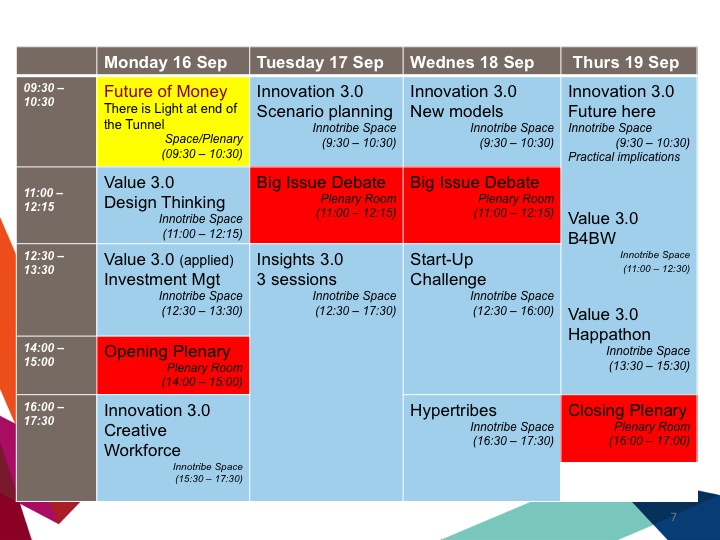
Programme

Building on the feedback we’ve received over the last few years, we have tried to observe the following principles in the design of this year’s programme:

  • Less topics, but more depth;
  • Keep the freshness and relevance of the themes and topics;
  • Keep the uniqueness of the Innotribe format: highly interactive and immersive group learning experiences;
  • Discovery, awareness, future oriented;
  • A healthy mix of technology and non-technology subjects (societal impact);
  • Introducing the concept of “journeys”, so that you can follow a track from A-Z as a learning curve, or pick and choose depending on your familiarity and expertise with the topic;
  • Our ambition remains to co-discover, co-design, co-create and co-deliver.

Slide05

We have selected four major themes that will be:

Value/Wealth 3.0

  • Continuing from previous conversations on The Future of Money, Banks for a Better World, Social Business, and the great re-definition of wealth and well-being. New are topics on Design Thinking, Investment Management 2.0 and Intangible Assets. We have also partnered with www.happathon.com to crowdsource a global measure of well-being versus wealth.

happathon

Innovation 3.0

  • Or the re-invention of innovation. In many organisations, the discussion about innovation is hampered by a low quality and polarizing dialogue; incremental vs disruptive, core vs non-core, internal vs external. We can do better: there is a simple line running from where companies were and the processes they needed thirty years ago to a highly externalized enterprise that carries new rules and needs new processes.
  • We will also discuss new models from other industries and emerging markets – Jugaad, Shanzai, Reverse Innovation – and inject new thinking modes like design thinking, scenario thinking, business model thinking.
  • Last but not least, we will engage you in an interactive game/experience to discover a day in the lifetime of a creative banker.

Start-me-up 3.0

  • Whereas the previous two streams are maybe more conceptual, this stream is all about actual innovations, where the “rubber meets the road”.
  • In “The future is already here”, we have invited some awesome speakers that will shake the tree and showcase some mind-blowing innovations in financial industry.
  • We will also discuss the outcome and ways forward for the “Hypertribes” model, a possible new way to accelerate innovation for the industry at large.
  • This stream culminates in the Grand Finale of the Innotribe Start-Up Challenge 2013.

Network Insights 3.0

  • The networks that we are part of can be looked at as dynamic fluid systems. What if you could tap into the intelligence buried in these data currents?
  • What about combining quantitative and qualitative data streams that lead to early warning systems for growth and resilience that can inform future scenario thinking? Could these new technologies lead to new insights for better informed risk management policies?
  • Topics include network cartography, natural language generation, fraud detection, and pattern recognition.

Throughout the week, we will use the tunnel as a hospitality and exposition zone, with fascinating demos about artificial intelligence, augmented reality and multi-media interactivity. And as usual, the whole program is peppered with a whole range of props, humour and fun.

Slide07

startup

The Innotribe Startup Challenge 2013 introduces the world’s most promising FinTech and financial services start-ups to the global community of financial institutions, venture capitalists, angels and influencers actively investing in innovation. Innotribe@Sibos will host the Grande Finale of the 2013 Challenge, following regional showcases in the America, EMEA and APAC.  From a total of more than 200 candidates, the 15 very best start-ups of 2013 will compete in front of a live audience and professional judge panel for a cash price of 50,000 USD.

ISDC banner Mela white bkg

Who should attend?

Innotribe@Sibos is open to all who come to Dubai. It brings together strategists, business and technology leaders, trend-setters and trend-watchers, and thinkers interested in taking action and shaping the future. In short, anyone keen to find out how the world is changing and what that means for our industry.

Why attend?

Join us to discover new business and technology trends; share and discuss ground-breaking ideas for co-investment; and challenge each other to build theoretical concepts into tangible prototypes in professionally facilitated workshops.

Conclusion

Innotribe at Sibos 2013 will celebrate its fifth edition with four days of intense inspiration and interactive immersive learning experiences. This is the place to get inspired, where you can share and discuss ground-breaking ideas, connect with great people, challenge each other in professionally facilitated workshops, and most of all… have fun.

Innotribe is about being infected

by irresistible contagious enthusiasm

of open-minded, curious

and passionate people

enthusiasm

You can follow the progress of our program on the Sibos website as speaker announcements continue between now and September. Follow our daily tweets at http://twitter.com/innotribe or visit the website to find out more about  all Innotribe-related sessions at Sibos: www.sibos.com

We look forward to seeing you in Dubai!

Slide33

By @petervan from the Innotribe team

Cross-Posted on Innotribe Blog

www.sibos.com

www.innotribe.com

Twitter: @innotribe and @petervan

Amplify Festival 2013: Shift Happened > Transformation Required

Amplify Festival of Innovation & Thought Leadership-powered by AMP and now is Australia’s largest business innovation gathering of world-leading experts, entrepreneurs and thought leaders.

amplify
Theme

Amplify Festival 2013 is themed: Shift Happened > Transformation Required. It will explore the irreversible shifts triggered by the triple revolution of digital, social and mobile technologies and the implications for business models and business transformation, including the Future of Work.


Who attends

Now in its 10th year, Amplify is both AMP’s internal catalyst for change AND open to the public. Already 12 CEOs and 24 C-suite executives from Australia, Singapore, Japan, and China’s leading corporations have snatched up the limited number of tickets (only 80) reserved for business leaders of the Asia-Pacific region.


Please don’t keep this a secret- your clients and friends will love you for passing on this opportunity to deeply engage with today’s business transformation challenges!

International cast of 35

Check out the depth of international thought leaders around Emerging Trends and Disruptive Technologies, Skills for the Future, Business Model Transformation; Enterprise Systems, Multi-channel Immersive experiences and Organisational Change that will be speaking at Amplify Festival.

People like Lucy Marcus ( From Reuters’ “In the Boardroom with Lucy Marcus”); Jason Pontin ( Editor-in-Chief MIT Technology Review); Saul Kaplan ( Founder Business Innovation Factory) , Peter Vander Auwera ( Founder Corporate Rebels and Innovation Catalyst for SWIFT’s Innotribe); Howard Lindzon ( Founder & CEO Stocktwits), JP Rangaswami (Chief Scientist Salesforce) ; Sherwood Neiss (Founder & CEO Crowd Capital); John Heinsen ( Digital Producer OSCARS), Michael Schrage ( MIT Media Lab) , to name but a few of the international cast of 35!
Tickets

The full programme can be viewed and tickets purchased via the website at http://www.amplifyfestival.com.au

The Early Bird (Festival pass) offer closes 15 April. We also offer day passes, breakfasts, workshops, our ever popular $10 event, The Bright Sparks Pitch Night for PhD Students and free access to the EXPO in Sydney on 7 June.

Call to action

This is going to be the biggest ever Amplify! If you are a leader in a large corporation today, can you afford NOT to be there?

Cheers!

Annalie Killian
AMP Director of Innovation & Amplify Festival,
Twitter: @Amplifyfest @Maverickwoman

The Coca-Cola Man

At the Front-End of Innovation conference in Copenhagen this week, there was a fascinating presentation on “Why Companies Can’t Afford Not to be Design-Centric: The Future of Strategic Brand Identity” by Vince Voron @vincevoron from Coca-Cola, North Americas.

vincevoron

Vince has an interesting background: he is former senior designer of Apple where he worked for 16 years, before joining Coca-Cola six years ago.

Vince in essence deconstructed the Apple methodology, so he could teach it and apply it in other companies.

He looked back at the 1998 – 2004 history of innovation at apple, where designers were key to drive innovation for their business and their cultural relevancy. I like that:

for their cultural “relevancy”

In the early days, R&D money was going first into software, hardware engineering and product design; in that order. So the first big insight was where does the money go, and how can you switch the priorities.

Good Design was NOT good brand identity: all products in 1997-1998 looked/felt differently, even though all products were designed by one design company (IDEO). Personal design preferences were not controlled.

Then there was a phase of designing with constraints. Apple identified a geometric shape to be core to visual identity, the lozenge (on oval shape) as a unifying element of design. It was a way for objective, non-confrontational conversations on design.

Apple started designing for all consumer touch-points. Hardware buttons that were touched most were designed like “Jewels” and there was a move towards empowering passion inspired innovation; from functional to emotional experiences.

Apple also was (still is ?) a better integrator than innovator; for example integrating packaging and product design.

The biggest lesson learned however was that packaging was valued and incentivized on productivity and cost containment. And the way to make package creators think like designers was to give credit to those people and let them shine based on their metrics.

Over to Coca-Cola. When arriving at Coca-Cola, the biggest challenge was to develop a culture based on design driven innovation. When Vince started the biggest R&D investments went into liquids/beverages, packaging and equipment; in hat order.

In 2006, Coca-Cola made a huge investment in equipment, integrating people, assets and partners. To sell the idea to finance people to like their models, it was really about using the same language as the CFO.

Vince did an awesome job in decomposing the language used, whether you talk about your innovations to Finance, Marketing or Manufacturing, realizing that this way each of them could be a designer. “Everyone is a designer” and professional designers are best suited to drive innovation to shape ideas and provide tools for x-functional team to achieve success. Designers had to come out of their design studios and into the organization. Designers also need to be trained to understand business jargon like ROI, finance terms, marketers, etc

A great example was to reposition vending machines to marketers as “Consumer Touch points” and “Media Assets”, and to measure success based on the number of “impressions”.


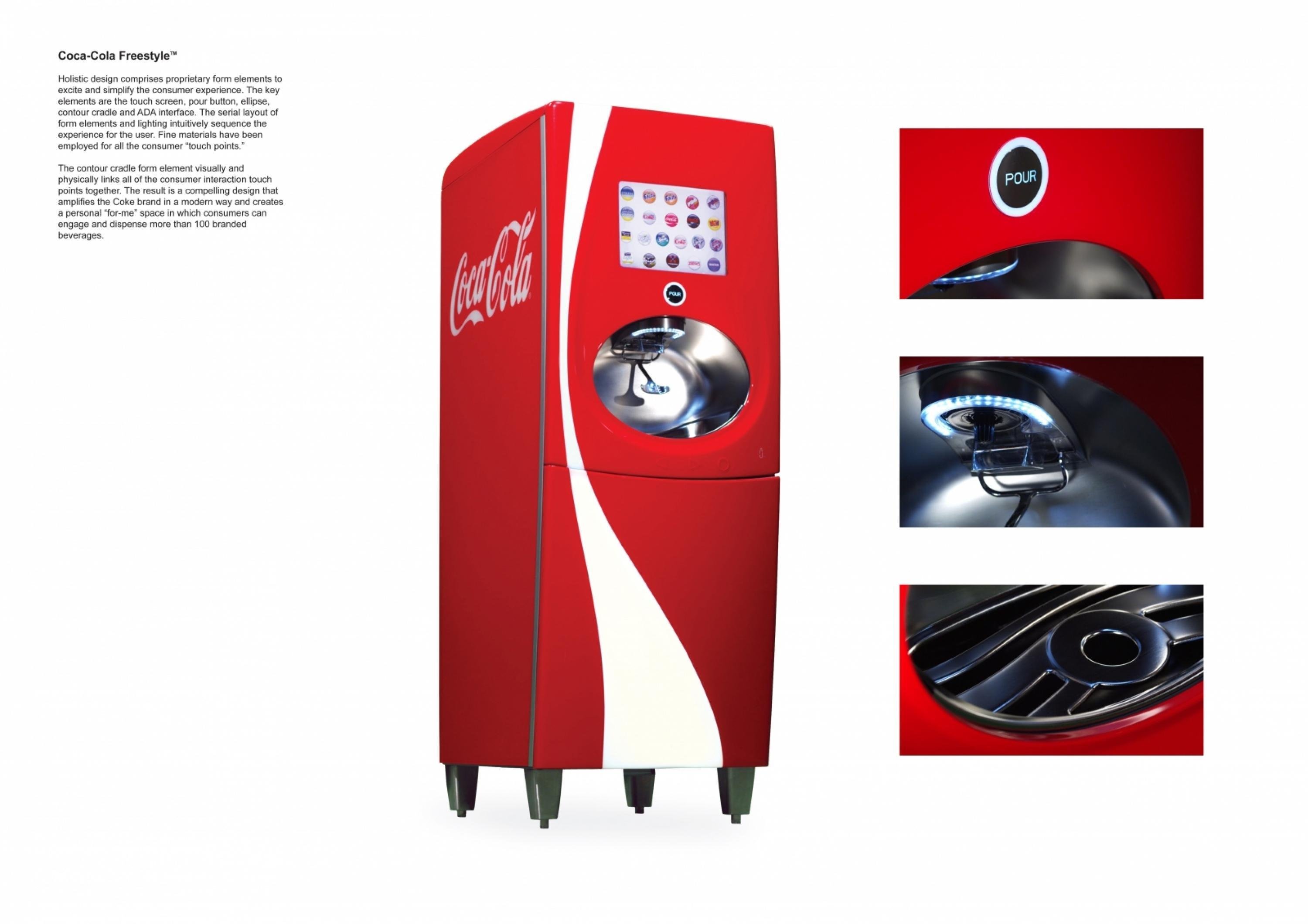
coca-cola-coca-cola-freestyle-2000-70751

Same for manufacturing. Before: it was about design what we could manufacture (vending machines). Now it was about manufacture what we design.

All this lead to the second big insight to “respect your partners in different business units” and make them win on their terms and based on the metrics that they are incentivized on.

The third big insight was about the importance of language and narratives. Vince described this as “Design by Common Nomenclatures for “Inclusivity. Instead of talking about industrial designers, graphical designers, digital designers, it was now about “Media Designers”, “Iconic Assets” Engaging with the equipment (vending machine) and “emotional engagement with the equipment (in this case vending machines).

Not just thinking about the transactional experience of buying a bottle of Coke, but looking what a young person’s first experience was when that person for the very first time in her life decided herself on what machine to put your 1 $. This was about brand love at first retail experience.

Even for vending machines there is a way about thinking in terms of a “3D Visual Identity System”: similar geometric shape, respect the past, sculpted flows, and using on purpose asymmetric design as it was prove to be more attractive. And yes, even in vending machines you can conceive “jewels” for the touch-points, thinking in great detail for example about the shape and look and feel of the refrigerator plate, making sure it is well lit where you serve the ice.

Coca-Cola is now also experimenting with digital consistent user experience. “We are so naïve, we have so much to learn”, said Vince and showed crowdsourcing experiments for creating environments for co-creation: checkout www.unlock.coke.com. They went also so far in integrating new tech on old machines; replacing all refrigerator doors with a new door with Samsung screens (yes, Samsung, not Apple). Results are staggering: +38% brand love, +78% volume lift, +83% media savings.

Integration is also at the level of “Integrated Partnerships”. Coca-Cola partners with all their suppliers on THEIR innovation initiatives. They now operate as a multi-dimensional agency; brokering and bringing together BMW and Coke for example, and make them play in the same Sandbox

Vince was rightfully proud to close his presentation with the reward by Forbes of the iPhone and Coca-Cola listed as the coolest products of the decade. Vince is now in the list of great design thinkers. Checkout this video http://designthinkingmovie.com

The Q&A was fairly interesting as well, and about a theme that I have heard a lot about during this conference. Vince does not really like the term “design thinking”. It was just a term invented by an IDEO guy who wrote about it. In essence the big achievement of design thinking is that it brought together Engineering academics and Business academics to have a conversation and get their act together around “customer driven integrated design”.

I would have loved seeing Vince coming on/off stage with tanned torso, carrying a crate of Coca-Cola on his shoulder, as from a design point of you, he is probably the real Coca-Cola Man 😉

Post originally appeared first on Front-End of Innovation blog

The Bridge

My colleague Ian from South Africa recently wrote me a private mail in reaction to my “Help, I failed” blog post. Below some edited extracts (Ian was happy to let me share from his mail on my blog), as I wanted to share the full picture where Ian is coming from when suggesting the concept of “The Bridge”.

the bridge

Ian writes:

“Your post got me thinking of Kosta’s famous analogy of the Castle and the Sandbox and I wonder if we are missing a “bridge of common understanding and respect” between our Castle and the Sandbox. You are probably thinking by now what is Ian talking about and has he had too many good bottles of South African Red Wine 🙂 Well let me try explaining it in a slightly different way. I have two young kids, aged 7 & 4. We live in in a nicely sized home but it is very clear that we have very different needs in the form of what TV programs I like to watch versus what they like to watch. I like quiet space to read my books and recharge my batteries, where they like a noisy space to play their Wii and play with their friends. So we have created our own Castle and Sandbox so as to speak. The place in the house, called a playroom, for the kids to do what they need to do and a quiet study type den for me to do what I need to do. There is something additional we have in our home, which I believe is missing within the Castle and Sandbox scenario. We have a place where mutual respect prevails. It is called the dinner table. I guess you could also refer to it as a bridge between our diversified needs. We make a conscious effort to sit together during the week where we enjoy dinner together. The rules are simple. No distractions from ‘daily lives’, such as the TV on during dinner or iPods or iPhones at the table. Everyone has a chance to share something uninterrupted, they learnt or enjoyed during the day. Everyone feels included, safe to speak their mind and most importantly respected. So what I am saying is perhaps what we need is to create a ‘bridge’ between our Castle and Sandbox. I am not talking about a gating-process. We need to create a ‘bridge’ where colleagues from the Castle and the Sandbox can come together and feel mutually respected for their views and feel safe and comfortable to engage with one another. No one should feel threatened for questioning the status quo and everyone should feel proud to be a part of our great and diversified organization that makes our company what it is and what it will be irrespective of whether you are in the Castle or Sandbox. I don’t know concretely what this ‘Bridge’ looks like but it should be place for celebrating successes and failures. What do I mean by celebrating failures? We should celebrate that we were bold enough to take the risk and try something that was rebellious and unique and share confidently what we learnt along the way and to proudly say we will continue to walk the edges of corporate accepted behaviours and continue to Innovate.”

Two weeks later, Ian also had a chat with Kosta on this idea of “The Bridge” during our annual sales convention. And another two weeks later I bumped into Haydn Shaughnessy, who gave a whole new dimension to this meme.

Ian’s idea got me thinking. I was already somewhat unsatisfied by existing innovation models. Innovation has become an empty buzzword. Every company is doing open innovation in one size of form. Everybody is doing start-up competitions, VC-funds, prototypes, boot camps, sandboxes, etc. And Kosta has explained at numerous occasions what the Innotribe sandbox is all about. He even wrote a whole book about it (Amazon Associates Link)!

castle and sandbox

The advantage of the “castle and the sandbox” is that is a simple metaphor.

“The sandbox is an “incubator” – a protected place where people with ideas can “play”, or to try out their ideas, without impacting the castle. The “castle” is the metaphor for the mothership, the core of the company. The incubator is the place where you can try, experiment, fail, try again, fail again, and eventually learn and succeed.”

In our incubator sandbox approach, project teams are even located in a separate building. It was an empty platform in one of the side-wings of the campus, and as innovation team we jokingly said that we were going to highjack that space. Which in the end we more or less did 😉 With minimal budget, some paint and beanbags from IKEA, we transformed the office space in a loft-alike start-up garage, where end-to-end project teams were co-located.

With hindsight, the separate building approach may need some fine-tuning. Maybe it needs “The Bridge” that Ian was talking about. Working separately without much transparency creates tensions, suspicion and jealousy. It would probably be better to physically create the sandbox “within” the castle, like a sort of patio, so that people can look over the shoulder, feel confident that real and cool works is being done there, tempting their curiosity so they are looking to join our projects too. Then there may even not be the need for a bridge.

Another disadvantage of the castle-sandbox metaphor is that it polarizes; it creates the perception that the castle is the serious thing, and the sandbox the playground. Innovation projects are just perceived/positioned to the inside/outside world as “Oh, thàt project? Don’t worry, it’s just some experiment/research by the innovation team”.

And before you know it, the problem is becoming one of credibility. The problem is one of execution and scale.

The challenge is NOT to have ideas, or to prototype those ideas, or to incubate those ideas. The real nut to crack is: how do I get projects out of the Sandbox, back into mainstream, back into the castle? As I have already shared many times on my personal blog, this question is for me becoming an existential question. What am I really doing here, if all these great ideas are only play-worthy, but are never allowed to hit the mainstream, the mainstreet?

This is getting into purpose. Personal purpose, team purpose, and company purpose. Purpose and meaning.

“The Bridge” could be one way to tear down the virtual or perceived walls between the castle and the sandbox, and to re-create that meaning.

serendipity machine

“The Bridge” makes me also think of “The Serendipity Machine – a disruptive business model for Society 3.0”. It is the “3rd Space”, where two worlds meet, not only in mutual respect, but also in a gift-economy lifestyle, where our expertise and knowledge becomes an asset to share between equals.

3rd space

But “The Bridge” is in my opinion just the start of a much broader discussion on how we can re-invent innovation.

Haydn Shaughnessy – Forbes/HBR blogger on RE:THINKING INNOVATION, and author of “The Elastic Enterprise – the New Manifesto for Business Revolution” (Amazon Associates Link) for which I wrote a foreword a year ago – has some ideas about this.

Elastic Enterprise

Haydn happened to be in Brussels and invited me for a coffee, as we never met in person before/after the foreword. I shared this idea of The Bridge, and my search and ambition to re-invent innovation. It happened that Haydn was doing a research on a similar topic in preparation of a new book.

The conversation got my head buzzing, and I felt I was onto something: a menu, a mind map, and/or the ingredients of a re-invention of innovation.

  • Lab explosion: the one castle and one sandbox will be replaced by many mini “labs”, at times subversive and in guerilla mode, deeply embedded in the fabric of our organizations, creating a viral effect of systematic and systemic change.
  • The Bridge, or Bridges, or many 3rd Places where we can blend (see above) and respect each other.
  • Integral Innovation: our organizations will require a much bigger focus on external symbiosis and innovation, where we not only suck value out of the system for our own benefit, but we give back to society as equal contributors/fellows, way beyond many master-slave relationships. Focusing only/primarily on the inside or the core will not do it anymore.
  • Functional Integration: In the same realm, check out this article related to the announcement of FastCompany’s 2103 world most innovative companies. The article is titled Death to Core Competency: Lessons from Nike, Apple and Netflix”“In a world of rapid disruption, the idea of having a core competency–an intrinsic set of skills required to thrive in certain markets–is an outmoded principle”. It is very much related to the end of horizontal or vertical integration, and the advent of “functional integration” as wonderfully explained by R/GA CEO and founder, Bob Greenberg, and Barry Wacksman, EVP, Chief Growth Officer, discussing how to grow and thrive amid the chaos and the future of the industry and beyond, and explaining how they re-invent themselves every 9 years (click part-3 under the video stream to get right to the hart of the matter)
  • People Innovation: we need a different type of person, more vulnerable and more human. With other strengths and skills. People with a creative life&work style: people who can experience and digest self-validation, risk and peer rejection, risk and peer validation, failure and triumph.
  • Peer-to-Peer Innovation. P2P is changing everything. Not only technology-wise but also in the way people interact with each other without intermediaries or hierarchies. It even puts in question the need for any form of central organization to filter and dispatch ideas.
  • Uber-Innovation: what if we would apply the Uber-taxi concept to innovation itself? And arm the participants in the innovation demand-and-supply chain with mobile devices, so that ideas can flow freely from the idea-generator straight into the last mile of the one who materializes the idea in a desirable product or service? Is this sort of “Uber-Innovation” just a wet dream, or is it exactly what P&G is doing with P&G-Connect+Develop ™, a first incarnation of this dream becoming reality?

“The Bridge” has also a special meaning in music. There is a whole Wikipedia page about it. I like the description for a “bridge” in a fugue:

“… a short passage at the end of the first entrance of the answer and the beginning of the second entrance of the subject. Its purpose is to modulate back to the tonic key (subject) from the answer (which is in the dominant key). “

But I am not such a classic guy 😉 I lived my youth in the 60ies, and 70ies and 80ies. I could refer to Simon and Garfunkel’s “Bridge over troubled water”, but I don’t want to go there ;-), especially with the people I invite to dance at the end of this post.

Then I prefer from far “Taking them to the Bridge” and shake the tree and the body with the famous James Brown song “Sexmachine”, here in a 1971 version with Fred Wesley.

James Brown and Fred Wesley are “taking you to the bridge” somewhere around minute 1:15. So while you are having fun and shaking your body, try also to think about the bridge and other ingredients for re-inventing innovation.

I also now just realize I made full circle to my blog post “My Boss asked me to dance!”, sharing that way my 2012 company objectives.

But this time, it’s me who is inviting Kosta and Haydn to join me in this dance, and have a collaborative, shared, and joined post on re-inventing innovation.

Let us take you to the bridge!

Innotribe finalist in HBR/McKinsey Challenge

innovating-innovation-finalist-large (1)

The Innotribe team is super thrilled having been selected as finalist for the HBR/McKinsey M-Prize Challenge on “Innovating Innovation”. The judges and the MIX editorial team poured over more than 140 contributions from innovators from around the world and from every kind of organization—looking for depth, boldness, originality, thoroughness, and the ability to inspire and instruct in equal measure.

This is a fantastic recognition of our work of the last 5 years, especially if you look at the high-caliber of the judges of this challenge, a real who’s who of leading management thinkers and progressive practitioners, including:

  • Scott Anthony – Managing Director, Innosight Asia-Pacific; author, The Little Black Book of Innovation
  • Tim Brown – CEO and President, IDEO
  • Henry Chesbrough  – Professor, UC Berkely; author, Open Innovation
  • Jeff DeGraff – Professor, University of Michigan; author, Innovation You
  • Gilberto Garcia – Chief Innovation Officer, CEMEX
  • Gary Hamel – Co-founder of the MIX
  • John Kao – Chairman of the Institute for Large Scale Innovation; author, Innovation Nation
  • Jim Stikeleather – Chief Innovation Officer, Dell Services

Winners will receive significant recognition as management innovators on the MIX, Harvard Business Review and HBR.org, the McKinsey Quarterly and McKinseyQuarterly.com. Winners will also earn the chance to appear at future live events hosted by the MIX and its partners.

UPDATE 20 Feb 2013: we just learned that we did not win. Pity. But still proud to have made it to the last 24 finalists !

UPDATE > PRESS COVERAGE


Help, I failed !

We have all been reading the books and hearing the innovation experts and gurus speak and preach about the need for experimentation and failing wisely in innovation environments. All that is good in theory. What about the real life? What happens in your organization when you fail? How does your leadership assist you in this transition? What happens in the team dynamics? What happens with you?

FALLING_0014

I failed big time recently. And it traumatizes and immobilizes me. It gets me on a rollercoaster of emotions. It’s difficult to deal with the abrupt changes between being celebrated the one day, and being the pariah the other day. Or should I find solace in the fact that at least, I still have highs (and lows) in corporate life?  Some friends and colleagues don’t even have that luxury: they are being beaten up all the time.

It’s not the first time this happens to me: failing big time. Being awarded and congratulated for stellar performance in one fiscal year and then being dropped a couple of days later due to changed priorities in the new fiscal year. So where is the pattern? What can I learn from it? How don’t I get “trapped” in the same mechanism of self-defense over and over again?

When the failing hits, I indeed tend to “protect” my vulnerability and myself by avoiding contact, by being silent, not expressing myself, while at the same time feeling deep anger inside. I am turning in circles, can’t concentrate nor focus, and become cynical. It damages my performance. How can I voice my soul, my emotional state and psychology of failing, the human emotions, and the intimate collateral damage that go with all this? How can I resurrect from failure?

It happens that Adam Dachis (@adachis) just wrote a post about this, titled “The Psychology Behind the Importance of Failure”, and quotes Heidi Grant Halvorson (@hghalvorson), shared with me by Jennifer Sertl (@jennifersertl).

The problem with the Be-Good mindset is that it tends to cause problems when we are faced with something unfamiliar or difficult. We start worrying about making mistakes, because mistakes mean that we lack ability, and this creates a lot of anxiety and frustration. Anxiety and frustration, in turn, undermine performance by compromising our working memory, disrupting the many cognitive processes we rely on for creative and analytical thinking. Also, when we focus too much on doing things perfectly (i.e., being good), we don’t engage in the kind of exploratory thinking and behavior that creates new knowledge and innovation.

So here you are: you have read all the books, seen all the greatest speakers, got the best personal coaches, followed all the personal development journeys you can imagine, you even preached yourself to others the benefits and adrenaline effects of going for your true self. And then you get hit. And you don’t know what to do, how to react, how to stand-up, how to reboot, how to get alive again.

Here are a couple of questions for all you innovators out there. Some areas where I would like to know how YOU coped with that situation, and what we all can learn from it.

  • You have a project of a lifetime. You stick out your neck big time and after lots of blood, sweat and tears, corporate priorities change, and your project is stopped from one day to another. How do you cope with that? Do you have examples of how you turned that sort of failure into a success? A crisis into an opportunity? I don’t know yet a good way how to do this, other than sweating out your time and hoping for the better.
  • Igniting change and innovating also means being a corporate rebel. You walk the edges of corporate accepted behaviors  in 95% of the cases, you succeed keeping that balance. But sometimes you go over the edge. How does that behaviour impact the perception others have of you? Does it impact your performance reviews? How can you avoid paying the price?
  • In innovation, the pedestal of success and the bin of the pariah are oh-so-close. On the pedestal of success, you are full of energy, even arrogant at times, sometimes preaching. But always with your heart at the right place and a deep intention for doing good for your company and the folks who work for it. Some people call it “irresistible enthusiasm”, and get energized when they hear your voice and they see the sparks in your eyes. Others – the criticasters – believe you are member of the “ego-tribe”. You sense jealousy from those who don’t have your opportunities, who don’t have a flexible boss like yours, who don’t enjoy executive sponsorship, some call it executive “protection”. When you fail, all that positive juice flows away. You’re empty handed. It’s time for revenge, for presenting the emotional invoices. Nobody comes to sit at your table at lunch; nobody wants to be seen with the one who just failed. You have been burned. What’s your experience with that? How do you cope with that?
  • What is your experience and reaction with abrupt changes of priorities, change of guards, change of budgets? What do you do when your marching orders change from one day to another? What if you don’t feel aligned with the new directions suggested or imposed? Especially when you just failed and are super vulnerable? Should you just brace for a while and hope for the turn of tides, of keep acting based on what your intimate true self tells you about what is right or wrong for yourself or for the organization you work for and deeply care about? Who has ever done and experienced something like that? Please share your wounds and healings.
  • Corporate world has the reputation of being a world of extroverts. But at least half of the workforce is introvert. I am and never was superman. I am not the vocal extrovert; I am more the reflecting introvert. Many of us are sensitive human beings. Many men have more feminine energy than women and the other way around. Where do you go when you fail? Where do you find a shoulder to cry on? When and how do you deal with pretending to be untouchable in formal settings and/or as team leader? Should you dare to show your vulnerability with trusted colleagues or friends?  Can we look through the crack in you and wonder at the light inside?
  • Is there überhaupt something like trust in business, or is it indeed like one of my first managers in my career told me “never trust anybody in business”. Have I become old and cynical? Judgmental? Control freak? In other words have I become all the things I never wanted to become and ended up on the flip sides of my ideals “Open Heart, Open Mind, Open Will” inspired by Otto Sharmer’s “Theory U”?

The bottom line question really is: how do I keep being present and aligned with my true self, when the going gets though in periods of failure? And who is holding a space for me when I long for help in healing my injuries?

“Life of a frontrunner is hard one; he/she will suffer & many of these injuries will not be accidental” ~ Pele

I know that many Corporate Rebels struggle with this. We can support each other by sharing what works and what does not work in these circumstances. Because I have the deep belief that resurrecting from failure is one of the core elements of creating a practice for value creation.

Credit: Fallen picture by Kerry Skarbakka http://www.skarbakka.com/