Is Being Normal Boring?

Pol Kurucz hr1

Normal-hr-1 From the Normals-series by Pol Kurucz

A couple of days ago, I was standing in line in the supermarket. In just five minutes time, the mother in front of me was instructing her two lively kids: “be normal”, “be silent”, “behave”. She probably said it 2-3 times in that short period.

I smiled, but also felt some push-back at the same time: why limiting these kids in their normal expression so early in their life?

My wife also invites me from time to time to “be normal”. That invitation provokes protest in me. I think that is because I associate normal with boring, not exciting, not special.

Do we want to be special because we want attention? Normal does not get attention. Being normal – not special – seems to be an insult/attack for my identity. Maybe it is my shadow. My shadow as in “what I do not want to be”, or “what I do not want to be labeled as”. Like not wanting to be labeled as “stupid”, or “manipulator”, or “dishonest”, etc.

The older I get, the more I become aware how distracted I get by putting energy in ignoring my shadow, in proving that I am not stupid etc. A similar energy loss btw when trying to prove the validity of my non-shadow label, role or title. But that is another post.

How can I integrate normality in my identity? Should I? Should I integrate that normality? Should I even try to focus on my identity? In an interesting podcast with Raf Stevens (in Dutch), André Pelgrims says that:

“Ego is the urge to build up identity”.

Have we spent the majority of our lives in building identity? Have we never matured? Have we not integrated what needs to be integrated? What/why is there to be proven?

Mind you, in all this, the focus is still on ourselves trying to “build identity” (with our without shadow) rather than the motivation to accomplish on the outcomes we wish to create.

The identity builder is a noise generator.

Do we humans create, design, make, blog, tweet, facebook, etc because we are hungry for attention, we want to prove something, or because we have something new to say, a new insight to share, a novel hypothesis to be tested? Or do we just inject noise into the stream to get our part of the attention?

I recently met somebody who planned to hire a cheap student to create and post her regular noise. Her “Professional Noise Creator”. Addicted to attention. Addicted to taking space from others. It’s a power game. As articulated so clearly by André Platteel of Your Lab in this great blog post (in Dutch):

“Often when we try to find space we look for it outside ourselves. Then we are busy creating space outside of ourselves. To check out whether we can create freedom of movement. Whether we can get more space/freedom from others. Whether we can dominate another in a strategic game and lock them in them so we can get more freedom of movement. That whole game is based on the idea that we are independent of others and the world. Where we are fearful all the time that our space is being suffocated or taken. That’s why we tend to take as much space from the other. And have a feeling of freedom and power.

IMG_4571

Stairway space in Gaasbeek Castle - June 2017

“I know that game very well” continues Platteel.  “Played it so long when I was a marketing advisor. Using smart marketing tricks to make your own commercial space as big as possible at the cost of your competitor’s space, using smart marketing tricks. When all the time you try to be smarter than the others. I started to notice that in the consulting, it is not only about taking as much space as possible, but also to assert power. When it is not about listening to one another, but about being (perceived) smarter, more concise, faster, fitter, stronger. In fact taking more and more space at the cost of others.”

IMG_4649

Petervan Productions 2017 – Blue Sky, Parasol, and Flight – June 2017

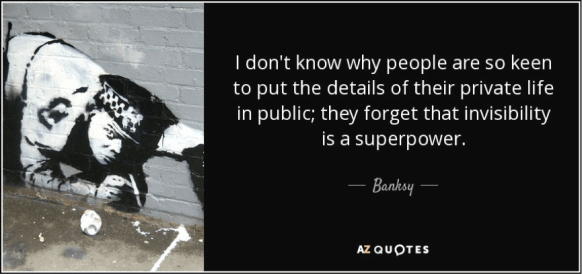
I believe the desire to be special (and thus not-normal) has to do with the desire to be visible. A lack of visibility seems to give me less power.
Banksy

If invisibility is a superpower, than maybe also anonymity. I have these moments where I want to disappear in complete anonymity, like a monk in a monastery, detached from any social contact. The antonym of anonymous is “named”, “known”, “identified”. A desire to be un-named, un-known, un-identified. Without identity. And do-my-thing. Without the need for attention and visibility. But even that is a make-up, a mask.

Just the act of saying “I want to disappear in complete anonymity” is the superego acting in the background. Because it assumes I am special, famous, non-anonymous. And I have to escape it. It’s an “evolved” form of narcissism: feeling superior rather than feeling special.

Narcissicm was well described in a post by Umair Hague about why America can’t learn from the world (be aware I take the sentence out of its original context, which is a bit of manipulating or content-mixing of course):

“Narcissism. The belief not just that one is special — for we all are unique, different, remarkable. The belief that one is superior, above, beyond. Better in fundamental ways. That is never true. Not a single one of us is better in any fundamental way. The genius is poor at loving. The lover is poor at creating. The creator is poor at managing. And so on. We all have flaws. But the greatest flaw of all is to be blind to the grace and beauty of the idea that we all have flaws — and so to believe there is nothing to be learned from anyone else. Trump is a narcissist, sure — but he is only a reflection of American narcissism in this way.”

The first job of a leader is to learn. Only then can a leader do their second and third jobs — care and love. Leadership is nothing more — and nothing less — than realizing human potential. You can do it as a parent, boss, friend, partner. You probably do. That is what care and love are in concrete human terms. The difference between them is that care brings a person towards their potential, and love expands that potential.”
art academy

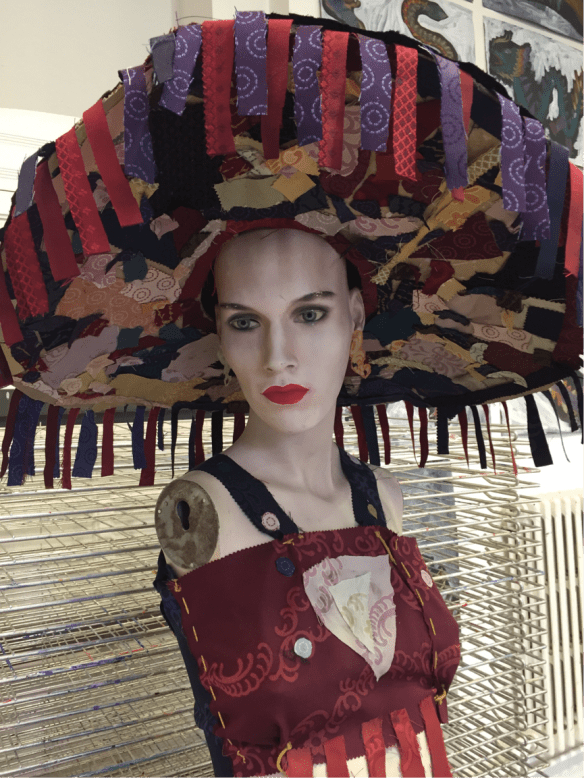
Art Academy 12 year old kids playing with tissues – June 2017

Feeling special, feeling superior. Being part of the ego-tribe. Even worse is the word contempt: the feeling that a person or a thing is beneath consideration, worthless, or deserving scorn.

In that sense I am also a reflection, a feedback loop of society. It’s the only thing that is great about Trump: he makes you more aware of your own shadows of narcissism, contempt and bullying. The ways you definitely do not want to stay in life. Being aware of these shadows, and finding a way to accept them, to integrate them I your whole being, and focusing on that other – different, better – palette of songs to sing. Breaking out of that rigidity of defence and taking others’ spaces.

To quote André Platteel again:

“Then there is no rigidity anymore of values that we can hang on to. Then there is nothing to be defended anymore causing us to exploit our power in a false way. To make another smaller and feel more free ourselves. Then it is not needed anymore to hide and feel our more expanded selves. Or to blow yourself up to make yourself bigger than you are. But just be, who you are in this moment.”

Maybe that’s when being normal becomes exciting and a source for internal happiness and stillness? When identity is not a burden anymore?

Also surprised what thoughts a simple invite to be normal can provoke? Share your surprises and insights. Please.
petervan-signature

I am in the business of cultivating high quality connections and flows to create immersive learning experiences and structural change. Check out: https://petervanproductions.com/

Playing tight: A non-natural show

Yesterday, there was a news item on Flemish Television on the upcoming opera performance of Puccini’s “Madama Butterfly”, that will be performed at the Brussels Federal Opera House De Munt / La Monnaie (31 Jan – 14 Feb 2017).

What touched me was that Madame Butterfly was played by a puppet, directed by three puppet players (visible in black). The effect is mystical. Check out the end of this video (comments in Dutch, but that should not spoil the experience).

puccini-madame-butterfly

Opera Madame Butterfly - De Munt - As from 31 Jan 2017

It made me think about a passage in David Byrne’s wonderful book “How music works” (Amazon Affiliates link). I am reading it in the context of my performance for Petervan Productions.

how-music-works

At a certain moment, David Byrne describes how his thinking about a show – a performance – was influenced by traditional Japanese theater forms such as Kabuki, Noh, and Bunraku.

Example of Japanese Kabuki theatre


“The tour eventually took us to Japan, where I went to see their traditional theater forms: Kabuki, Noh, and Bunraku. These were, compared to Western theater, highly stylized; presentational is the word that is sometimes used, as opposed to the pseudo-naturalistic theater we in the west are more used to.” 

“The character had in effect been so fragmented that the words they spoke didn’t come from close to or even behind that puppet. You had to reassemble the character in your head.

As in Japanese theater, the performers often wore masks and extreme makeup; their movements, too, were stylized and “unnatural.” It began to sink in that this kind of “presentational” theater had more in common with certain kinds of pop-music performance than traditional Western theater.”

“There was no attempt to formally separate the ritual and the show from the audience. I quickly absorbed that it was all right to make a show that didn’t pretend to be “natural.” To further complicate matters, I decided to make the show completely transparent. I would show how everything was done and how it had been put together.”

Check out the video footage of the resulting “Stop making sense” Tour. The show starts with a heavenly version of the song “Heaven” on an empty stage. At minute 2:30 you will see the first elements of the stage being rolled in.

The whole show is super enjoyable, and if you want to know what “playing tight” means, check this awesome version of “Breaking down the house”, which does exactly what you would expect.


Sometimes I think I have to stop trying to “make sense”. Better would be to “make meaning”.

All these reflections are related to my upcoming performance “Tin Drum is Back” (subtitle: “what is/what could be”): the performance design is evolving well, with detailed script being written as we speak.

Part of the story is looking back into ones youth (5-10 years old), look at what was forbidden then: for some people that is an area of talent they have neglected to develop. In my case, it was a tin drum I got when I was 6 years old, and the story of rhythms in my life and in my work. As the script develops, the narrative arc seems to be about evolving archetypes and levels of maturity.

Scripting is not “only” the storyline, but also the staging, transition, props, lighting, etc… And all visuals, sounds, and word are self-composed, self-created. Should be ready around March, although I may pick up some delay.

It starts feeling like theatre by an amateur 😉 So, performing “tight”, in some theatrical form, with costumes, masks, props, and stage being build-up as the show moves along, is certainly inspirational.

I see “Tin Drum…” as a teaser for a bigger story on multi-media corporate narratives, where – who knows – I create commissioned performances on less tangible topics (less tangible than “what problem are you trying to solve?”). I indeed think that a lot of the work I am preparing is steering away from the problem-solving orientation, and give more room to the creative orientation of “what do I want?”

What do you think? BS? Did I smoke too much ? 😉 Please don’t hesitate to share resources and serendipities that this post may generate.

More general Jan 2017 update here:  https://petervan.wordpress.com/2017/01/08/petervan-productions-jan-2017-update/

Rebelliously yours,


petervan-signature_transparent_black_version2

Right spaces for humans

As many of you know, since begin November I am trying to create my own thing called “Petervan Productions”.

The scaffolding is already in the works for many years, and I am still hesitating whether I will once publish the 100+ page reflections on the intentions of all this, what I think this enables, and then working down the tactics such as outcomes and deliverables.

Besides the artwork and the research bit of my activities, I spent quite some time in re-thinking what “events” could be like. And thinking of my customers as “guest”, not consumers. What I am trying to offer is a one-stop-shop for unique immersive learning expeditions in emotionally and physically right spaces for humans.

So anything that gets me back to my architectural roots of “right” spaces for human beings makes me a bit poetic. In this case this very nice article in Aeon about the French architect Jean Nouvel, all about light, geometry and symbolism to re-imagine culture.

The core of the article is a very nice video. As usual, I made the transcript of the video, and added some poetic highlights and typographic reflections by myself. I have stopped adding comments and trying to explain. My guests are smart enough to make up their own minds. Explaining would be an insult.

jean-nouvel1


Each project is an adventure, a passion

The biggest temptation

Is to jump into it

There are solutions that come to you

There are images that spontaneously appear

My method is rather to hold back as long as possible

To really imagine it spatially

So, to be sure that I have something to say

These moments where you understand somebody cared about something

That’s when you feel

 like “oh yes,

this is a human thing,

not some robot that

put something together”

Simply living there is a cultural act

Combine big bold shapes with intricacy and delicacy

The ability to be bold and delicate at the same time

jean-nouvel2

The relation between time and light

The sphere above,

the cupola

As spiritual space

“Perhaps we have to keep dust”

jean-nouvel3

Create a space, no inside, no outside…

jean-nouvel4

“We have principles, and these principles we have to nurture.

We nurture them.

We deepen them.

And with them,

we invent…

something else”

The Illusion of Agency

At this year’s Innotribe Sibos, we have a session about digital ethics. Part of a full day on man-machine convergence.

Some of that conversation will be about the use and control of data. With this post, I would like to add my perspective to that conversation, based on some recent thinking on human agency.

At a recent MyData2016 event in Helsinki, i was surprised how little the thinking about personal data stores has evolved since 2012, when i was myself deeply in the trenches of the topic of distributed data sharing.

It was a really great conference, well organized, cool audience etc, but like many conferences, it was the tribe talking to tribe, believers talking to believers, all thinking that their lens to look at things was the right one, with little or no contrarian view.

I wanted to be that contrarian, and challenge a bit the assumptions.

At the event there was a lot of talk about “PIMS”: Personal Information Management Systems, or personal data stores, or personal data “clouds”. I don’t want to have a discussion about the subtle semantics here.

At one moment, Jamie Smith from Ctrl-Shift – who i respect a lot – said something along the lines of “PIMS are all about giving people agency”.

I think that is a big illusion, and that was what my talk was about. The illusion that the problem is about taking back ownership and control of your data. And that a PIMS is the solution. I believe we are discussing the wrong problem and the wrong solution when talking about managing our own personal data at our terms and conditions.

Owning your own agency is more important than owning your data. That in essence is what my talk was about.

My presentation at #MyData2016 conference

UPDATE: here the link to the Prezi of this presentation. Because there is so much video in this Prezi it takes 2-3 min to load. Be patient 😉

The talk is part of a longer story of more than one hour, wandering through a whole bunch of philosophical, ethical and artistic considerations. At this event, i got only 20 minutes, and i told the moderator he could cut me off, which he did most elegantly (no pun intended) at the end of my presentation.

My agency vs. my data is a pretty big deal.

  • It is not about buying but creating
  • It is not about my data but my agency
  • It is not about privacy but about shelter
  • It is not about power asymmetries but relationship symmetries
  • It is not about MyData but about OurData

In that sense the GDPR (General Data Protection Regulation) is shooting at the wrong problem. In that sense our politicians and leaders in general are again outperforming in solving the problems of the past.

I got some good reactions after this talk, from Doc Searls saying “you gave the talk that i always wanted to give”, to somebody else sending me a tweet and a mail saying “your presentation has changed my life, i decided to leave Facebook after more than 10 years”.

There is such a strong tension between our actual reality and the desired reality that we are currently moving in some form of virtual or surreality. But as Magritte said:

“Surrealism is the immediate knowledge of reality”

And we feel lost. We escape and try to reconnect nostalgically to what was, and are afraid of what going to be. People focus on the surreality of their phones instead of real life.

People believe what is on their phones and PIMS is the reality, and are able to represent us as human beings. But as Markus Sabadello said at this event: “Technology will not be able to represent the full complexity of human beings”

Our devices and apps make us believe we are in control, because we now can “manage” our data and lives. But we are focused on managing life, rather than living it. That is our big illusion.

To summarise, I believe our plan and ambition towards our desired reality must at least have following components:

  • This space needs to be regulated. Regulation means setting ethical and moral norms, AND policing them
  • These norms must be ethical and moral
  • We must decide who sets these norms, who polices them, and who penalises/rewards good behaviour.

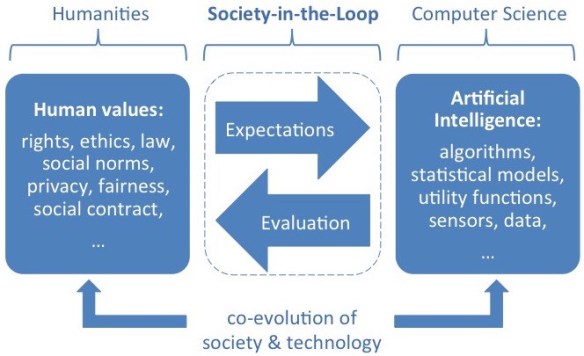
For that we must bring “Society-in-the-loop”, and not let this be decided by governments, corporations, or god forbid, algorithms


society-in-the-loop-iyad-rahwan

Society-in-the-loop by Iyad Rahwan

We must expand ourselves from a problem (efficiency) orientation to a creative (value creating) orientation, because the future is not about solving the past but knowing what you want and use mastery to make that happen.

Last but not least, we must be very much aware of the shallowness of the actual reality, and strive for high quality work with high quality attention and presence and meaning also called “Deep Work”

Maybe next year, they should call the conference #MyAgency2016;

Freed From Desire

cadacut-1080x675

End February, i had the opportunity to attend the “Socratic Design Workshop” in Cadaqués, 1 hour drive north of Barcelona, Spain.

From the Socrates website:

Socratic Design is a new learning method, incubating the generation of the best human future narratives by realising collective wisdom through the art of dialogue.

The exponential technological revolution cannot be incorporated in the old narratives build on coal and steel ideas. Centrality, hierarchy, ownership, secret information and monopolies are no longer guarded in this new tech culture.

The exponential technology era challenges our human creativity in an unseen way. We can only approach this huge potential of power with next level humanity awareness.

We need to reflect profoundly on our values, on our strong and weak points and above all on our implicit and hidden dreams of a human good life; safeguarded in hundreds years of literature, philosophy, human experiences, religions and other narratives.

We can only perform this if we leave behind our old school atomic thinking, using the strength of intense socratic dialogue, using personal experiences, reaching collective intelligence to jump into new frontier of thinking: exponential humanity.

One of the first exercises was to describe your “perfect day” ten years from now. That exercise was more confronting than i thought at first sight. Here is what i came up with. I deleted the detailed daily hour-by-hour agenda of the perfect day, in order not to bother you with too much tactical detail.


In 10 years time…

I will almost be 70

My wife almost 60

My daughter almost 20

Our parents will be gone


I have become a full time artist – creator – sensemaker

I sell my art, creations, sense-makings, and curations

I curate, selectively, choose my clients/guests

I only select/accept commissions that meet my quality standards of intention and intensity and ethics


I am connecting with the experts, the musicians, and artists of all kinds, to bring out the very best in them. I love to work & live with them, to show personal intent and integrity, so that others want to join my projects too.


My work has given room to a Foundation for better work (essence of work and deep change)

My work leads to delight, enjoyment, joy, pleasance, elegance, and maybe epicurism.


Enjoying the silence of the house and the morning

Writing, researching, and sense-making

Creating, scripting, painting, making sound- and word-scapes

Performing, Architecting rythms and connections

Good food and wine

Family time

Reading and sleeping


I am completely disconnected

Only take mails if announced by phone

My mobile can only take calls and sms

I have stopped tweeting, FB-ing,

Enjoying the physical and emotional silence


What I do does not scale

I focus on uniqueness, excellence

The beauty is in the perfection


I live in another house, with plenty of space, and annex atelier, maybe art gallery

On the country side, the humid heavy earth of Flanders,

Or in Spain, Toledo, Sevilla, in the middle of the heat of the plain fields

The crack in me, Dries van Noten, the tones of a Spanish Guitar, the dry hot summer heat and the shadow and olive trees


I have become a hermit

Nothing should or must

There is no time pressure whatsoever

I am in flow

Nothing needs to be proven


I am freed from desire

Dream #1: Breakfast

Some time a ago, i took a “little” break for the rat-race, also know as “sabbatical leave”. It allowed me to find internal rest, and clarity about a lot of things important to life. One of the “plans” was to stick to “the plan of not having plan” and let emerge what comes.

I got back to drawing – yes, i was trained as an architect – and discovered i am still quite good at drawing straight lines, but really challenged by curved lines, like human bodies, faces, hands,… probably a testimony of my inclination to the cognitive, analytic, “straight” thinking patterns that formed the first part of my life.

I also did a little dive in the works of Carl Jung. One of the works i struggled through was “Man and his Symbols“.


Jung Man and his Symbols


I was particularly attracted to the part on dream analysis, and how a dream strictly spoken can only be analysed by the dreamer himself. There is not something like a standard way of analysing dreams. I followed the suggestion to document my dreams. I found this quite confrontational. Very personal. Most of it not really for publication on a public blog.

But i was surprised how some dream transcripts came out in different formats: from films scenarios, to paintings, or even poetry like.

I will start publishing some of these dreams. Here is the first one: i labeled it “breakfast”. Hope you like it.


Warm hands wiping

Caressing the table

Weeping leftovers of the night

Used and worn-out shrapnel

Dispersed sparks amidst breadcrumbs and tears


More to come…

Dystopian Futures

On 10-12 June 2013, I was invited as a panel participant to the ISACA Insights World Congress. It was the second time in two weeks – the previous time was during a session at the Amplify Festival – that the panel was asked by the moderator what the future would look like in 2040. At Amplify the question was around the future of work. At ISACA, the question was even more open ended.

untitled-by-allison-mcd-on-flickr

Although nobody of course knows what the future will hold, and everything I say on this topic is almost wrong by definition, I believe I surprised my audience with my very dystopian view on the future.

Many seem to believe that the future will be “bright”, with lots of possibilities for hyper-collaboration, in open and shared spaces, where serendipities happen every minute, where hierarchies don’t exist anymore, sort of love-and-peace in a sharing collaborative back-to-Woodstock environment.

woodstock-poster-for-sale

That may be the case in 2020, but I think the picture will be less rosy in 2040. Already today, algorithms trade in matter of milliseconds, a real-time world that we as humans can’t even grasp, let only survive. Where those algorithms now work for stock trading companies, by 2040 we will most probably be “augmented” – at best – by our personal algorithms.

It will not be a nice picture to look forward to: by that time, we will be totally ruled by robots and algorithms, and we will have to fight – assisted by our “devices” – for that very last minute of work in a crowded world marketplace where we will have to compete at rates of 1.5$ per hour. And this for probably high-skilled tasks, as the rest will be taken over by robots: a “Present Shock” of technological presence, a world undone of human presence, a very disturbing place where we are ruled by algorithms working on our behalf, where betting on peoples future is the new normal, where siren server masters raise interest fees on the mortgage of the personal success/failure of the data slaves.

The Singularity will have happened, but in quite a different way, in a way that technology owns us, eats us, swallows us, not a singularity of jolly happy people being more intelligent or augmented. A world of technology versus machines, where technology will dictate what it wants from us (See also Kevin Kelly “What Technology Wants” – with Kelly being the technology optimist he is – and Jaron Lanier “Who Owns the Future?”).

What we have witnessed during the last weeks’ revelations represents a true tipping point. Where we still may have had the illusion that we could empower ourselves, take charge, we will be at best be empowered by other powers: a new dystopian world where authoritarian technology rules, an authoritarian singularity, where we are reduced to data slaves of the new data masters.

As part of the Digital Asset Grid (DAG) project (an Innotribe project stopped after its incubation phase, and given back to the community), I have written in the past about the “Catastrophic Complexity” that is emerging right now through the explosion of the number of nodes on the grid, ànd the explosion of data. Where these data are more and more stored by “Siren Servers” – a metaphor used by Jaron Lanier – and where the DAG proposed a 100% distributed model of data storage in personal or corporate clouds, but with a choice of appropriate Trust Models, so that we don’t end up in another worldwide west. Indeed, with the advent of trillions of nodes on the grid, we will require a new kind of species, a new kind of architecture, but more importantly a new type of governance.

camel

I am also getting more and more disturbed by a sort of “over-glorification of technology. This may be surprising as a “Techonomist”, where the belief is that technology will enable a new philosophy for progress – I still believe that – but we need some solid healthy criticism in the debate.

techonomy

When I read this week in The Guardian – a quality newspaper, right? – about the “gadgetry and behavior concepts for the 21 century” and the related comments that these are “super important” new behaviors, I believe we are missing the point; we need to counterbalance all this excitement with way more attention for humanizing our businesses.

I am afraid we are slipping into an “Authoritarian Surveillance State” as described in Washington Post, or even a “Techtarian State” as articulated by Stan Stalnaker in The Huffington Post.

To understand what’s really going on, let’s looks at some understreams that cause the waves of change at the surface. I have split them in technological and more societal changes:

  • Technological:
    • SMAC: Social, Mobile, Analytics, Cloud
    • Platforms and APIs leading towards the end of highly vertically integrated organizations, and where the new skill becomes horizontal sourcing of pin-point functionality
    • Explosion and loss of control of data.
    • Explosion of Cyber-threats
    • Our identity schemes not keeping up with the sheer explosion of nodes, hampering our security, as the internet was never built with identity in mind
    • Disintermediation through hyper-connectivity (example Über)
  • Societal
    • Erosion of Privacy
    • Platform, everything as a service
    • New economies (P2P, Sharing, Reputation,…)
    • New expression of value, currencies, assets, cred, influence, reputation,
    • Crowdsourcing everything (credit cards, funding, investing, lending, mapping, reputation, …)

We probably most underestimate this trend of crowd-everything. There is something deeper going on: this is really about the use of external power to scale; think platform, using crowds as change accelerators, like developers for building on your APIs, but now through users. Google recently acquired Waze for 1B$ !.

waze

The industrial scale application of crowd is very much a “Singularity University Meme”, says Haydn Shaughnessy in Forbes.  Crowd-recording, crowd-sensing, crowd-data collection, more eyes and ears and sensors, through Waze, through Glasses, etc. It’s clear some parties want way more data to be available,  searchable, to be monetized, with us working like slaves to provide all these data for free. We evolve from democracy to “crowdocracy”.

Our near future will witness the “fragmentation of everything”: the fragmentation of work, of applications, of hierarchies, and states giving in to power data houses, data guerillas, pods, and cells.

We will see the “asymmetry of everything”: asymmetry of transparency, of search and computing power, of concentration of data. This will lead to power unbalances, to surveillance mania, to loss of freedom of speech. Already now the recent developments makes me more selective on what I tweet and share. The only way out is a 100% distributed system, but I am afraid that it is already too late for that and that our future is already owned by Jaron Lanier’s “Siren Servers”

We already see the “exceptionalism of everything”, where the exceptions become the norm: events such as stock exchange black swans become the norm. We take for granted the exceptional qualities of uber-people like Marissa Mayer, Zuckerberg, and other “heroes”.

We are “attacked by everything”: our secrecy is attacked by Wikileaks, our privacy by Siren-Servers, our security by cyber-attacks, our value creation by thousands of narrow innovations at the speed of light. All this happens at the speed of light, at “Un-Human” speeds, runs on a different clock, lives in another world.

We seem to live in a “perpetual crisis”, jumping from one incident to another, where there is no room anymore for building a story with a begin, middle, and an end; no room for reflection, no room to assess and scan the waves of change on the surface of the data ocean.

The world enters into a complexity

that cannot be addressed anymore

by conventional binary linear thinking.


We need new tools, capabilities, and ways of thinking, more non-linear, be prepared to open up for more options. These new tools are about forecasting and assessing in different ways (scenario thinking), decide our options in different ways, design thinking in context with intent and within constraints, and richer ways of expressing our options through visual thinking and other techniques more leveraging the human senses of color, sound, smell, trust, sensuality, presence.

We have come at a point where our only options out are a revolution of the data slaves and evolving as a new kind of species in the data ocean, trying to preserve what makes us human.

I have no clue how we can avoid this dystopia, but we will need a new set of practices for value creation; where data slaves dare to stand up and call for a revolution; where value creation and tax declarations go way beyond being compliant with the law; where we see the emergence of ethically responsible individuals and organizations. But it will be very difficult to turn back the wheel that has already been set in motion several decades ago.

The Future is Analogue

Last week, I attended the PurpleBeach launch event (check out the twitter stream at #purplebeachlaunch). It’s one of those events that got me again into hyper-reflection mode.

Purplebeacj

I was not really sure what the launch was about – initially I thought it was about the launch of a new consultancy firm – but once on site, it looked like being an experiment driven by Annemie Ress about “People Innovation”. Annemie had been heading HR and people efforts at eBAY, PayPal and Skype and I think she was not sure yet herself where this happening was going to land. She was maybe taken a bit by surprise by the number of folks who signed up for this invitation-only event – and in some way I liked a lot the authenticity of her and the team, being and staying open and curious about what could emerge from a gathering of about 180 folks of quite diverse “plumage”.

I got invited via MJ Petroni, owner and founder of Causeit.org. I met MJ last year when he and his team coached the Innotribe team on making quality team alignments and intentions. Petroni is mentored by Mark Bonchek, PhD, former SVP of Networks and Communities at Sears, now heading his own consultancy Orbit about pulling customers and communities in “orbit” around your brand. Enough credentials to follow-up on the invitation and checkout the event that took place in Audi Quattro Rooms, West-Side of London.

quattro rooms

Day one started with some strange mix of “quite-ok” talks about mobile, big data, digital identity, trends, leadership, HR, and the blurred zone between HR and Marketing.

In essence, the glue binding the different activities was “business humanization” and “people innovation”. The basic premise that innovation in organizations does not happen without people rediscovering themselves in their full being, a rich combination of left/right brain activities, and greater levels of personal awareness.

And yes, there was some strange Californian “wu-wu”, “mindfulness”, “well-being” and poetry and artistic performance elements as well. After all, we were on the “beach”, a place where you can relax, be idle, and be open to whatever comes your way.

Day one was ok, but not more than that: I was more or less familiar already with the content presented, and was in search for the new insight, the new synthesis, the new “AHA” moment. Alas, I waited in vain for the muse to inspire me.

But Day-2 kicked off by a great discussion about being “on”-line all the time, after a presentation by a trends watcher about future trends, micro work, etc. The presenter was depicting a future of always-on, nowism and “on-ism”, a future where you have to check your smart-device or sensor every second to capture that 5 minute chunk of work on a worldwide marketplace for mechanical turks.

In the following panel, Doug MacCallum (ex eBay but still advisor to the CEO of eBAY and non-executive Director on the board of Ocado) couldn’t hold it anymore:

“What a horror! I don’t want to live in a future like that. People need their time off to reflect and recalibrate. This is a dystopian future”

Doug MacMallum almost got a standing ovation for his intervention, and just the fact he got the ovation is a proof of how deep “presentism” is disturbing our human lives. It was like some sort of relief going through the room.

He went on describing a practice of Executives not sending mails in the weekend, to respect their own free time and that of their collaborators. Great initiative, but I have seen such promises before, and in some occasions the executive is preparing her emails during the weekend, queuing them up, and releasing them on Monday morning, so you have your inbox loaded with fresh instructions and work (sic).

present shock

It made me think of Douglas Rushkoff’s latest book “Present Shock” (Amazon Associates Link), about the fragmentation of everything, including work and value, and the addiction that arises when you are not able anymore to step out of the digital time, back into analog time, where you still have some sense of time fluidity, rhythm, and relative perspective.

Penelope Trunk, co-founder of Brazen Careerist, recently wrote a great article in Quartz. I like the section on refusing to present your-self in a linear way:

Agents represent workers who pick and choose projects that match them rather than signing on for indefinite amounts of time. The Harvard Business Review calls this supertemping. Business Week calls it going Hollywood.

It’s about a deep desire for story and narrative, context, being part of something, being for the long haul.

But unfortunately, we are getting fragmented disassembled

UPDATE: @MayaDroeschler retweeted my post and linked it with metaphysics of pure presence, referring to the the work of the philosopher Jacques Derrida who introduced the concept of deconstructivism, and who also influenced architecture (in the form of deconstructivism). This is the space of famous architects like Peter EisenmanFrank GehryZaha HadidCoop HimmelblauRem KoolhaasDaniel Libeskind, and Bernard Tschumi. Readers who know me, understand that Maya touched my sensitive chord of love for architecture. Picture below from Frank Gehry’s Guggenheim Museum in Bilbao.

gmb_bilbao_690x235

But I got distracted 😉 The Quartz article also mentions new “modern” practices of young people selling stocks in themselves. This is about investing in – or probably better called “betting” on humans.

A “good” example is Upstart, a start-up opening their site with the slogan “The Start-Up is You.’’

Upstart

Upstart was founded by a group of ex-Googlers, including Dave Girouard, who spent 8 years at Google where he was President of Google Enterprise and VP of Apps.

I can’t help it, but this starts smelling like slavery to me. You already knew that you were the “product” of Siren Servers like Facebook, Google, your bank, your insurance company, your health company; they are getting your data for free and can monetize it without compensation of the data originator. It’s getting worse now: we are now entering an era where one owns the life of another human being, worse even, takes options in somebody’s future and betting on it.

Jaron Lanier has recently published a great book about this “Who owns the Future?” (Amazon Associated Link)

Who owns the future

I feel really sorry for otherwise very smart people Eric Schmidt, Peter Thiel, Khosla Ventures, Marc Benioff and other moguls for putting 5.9M USD in the last capital round of Upstart. I believe they are forgetting something very important here. This is in essence a form of digitizing of what it means to be a human being, digitizing the being into binary data blips, forgetting the rich set of emotions, senses and creativity we all can bring to the table. We are more than data present in the moment. We are part of a narrative, a story, an analog context.

Our “presentism”, just having that safety option to do that quick email check in the week-end, to check that Twitter status, the Klout and other scores are probably symptoms of something deeper going on: just having that capability is for some people already reducing the anxiety of loosing out on something.

Somebody shouted from the audience “But we are loosing the obvious!” – meaning loosing of being humans – and then a couple of “minutes” later, the quote of the day:

“The Future is Analogue”

I really believe it’s about loosing or sustaining our analogue human identity. Identity is contextual and one context is the time framework we want to function in. I’d prefer to live in the analogue time context; the way Doug Rushkoff described it: “What do we want: the long now or the short forever?”

This lead to my first “Aha” experience at the event: an experience about identity. As somebody quite active online, I try to be – and believe I am – the same person on-line or off-line. I don’t believe I have a different persona online of off-line. But online, I feel more the need to amplify myself  and my outgoing data streams, and at the same time trying the amplify and maximize the incoming streams of new data. But there is too much info out there, I feel indeed this anxiety to miss out on something. I also sense higher degrees of narcissism on-line, narcissism in the sense of self-amplification and promotion. What does that do with my identity? I think I am pretty the same online as in the real world… But “shaping” my online identity raises deep questions on who I am: as an individual, in a group, in the world at large.

Ron Shevlin @rshevlin, author of Snarketing 2.0 sent out this tweet on 28 Apr 2013:

“If identity is the new money,

schizophrenics have it made.”

It was in this mood of identity reflections when I entered a conversation with another Purplebeach participant: Jefferson Cann from Extraordinary Leadership, a soft-spoken gentleman bringing the topic of intimacy into the debate.

The word “intimacy” worked like a red flag on me. I explained Jeff how I was trying to stabilize/discover/re-discover my identity. His feedback was that he was not sure that one needs to fix/stabilize your identity.

“By fixing, you close yourself for being open to the moment, for the intimacy with the moment. The intimacy of the moment INCLUDES identity, so that the identity can flow, can evolve. In that sense, I hope that your MBTI of 10 years ago is not the same as your MBTI of this year, which would mean you have not evolved.”

This coming together of intimacy and purpose gave lead to my second big insight of the week, the second “Aha” moment.

My readers know that I am sick of the 10 min, 15 min, 18 min pitches and talks. I am hungry for depth, for richness of conversations, for going beyond scratching the surface. One of the reasons why I keep writing these long posts 😉

The insight was that my hunger for depth is really a hunger for intimacy, the hunger for human connection, also on professional environments.

What does it really mean when a manager tells you: “You know, I am a pragmatic man, two feet on the ground, so can you please pitch me your story in one minute, and at the same time tell me what the ROI for the next 2 years will be?”

I suddenly realized that this famous pragmatism and two-feet-on-the-ground is probably a shield to hide from depth, from intimacy. It is a shield against the present that can even be used in Machiavellic ways to include/exclude people from connection. It’s a deep sign of uncertainty and insecurity, the fear of losing control, fear of human contact, the fear of opening up, the fear people will discover there is no substance, and fearing/knowing you cannot compete on content. It’s the fear of having to acknowledge that your leadership power only comes from your position in the hierarchy and not from who you really are.

As Glenn Llopis recently wrote in Forbes about “The 5 Things Leaders are thinking with not talking about”:

Leaders must find a new sense of maturity within themselves to address and navigate these new workplace issues with greater clarity, focus and intention. Leaders must be more proactive in coming to grips with today’s new normal.   In doing so, they must face their greatest fears head-on and get on with the business at hand.  The marketplace, the workplace and those whom they serve demand it.   Until they do, here are five things leaders are thinking, but not talking enough about: 

  • I don’t have all the answers
  • I have difficulty relating to the younger generation
  • Diversity makes me uncomfortable
  • I am uncertain about the future
  • My leadership skills are not relevant


It looks like we are witnessing murder by modernity: murder of the human connectedness through the avoidance of intimacy. It looks like most of us – including our leaders – and not ready from the new normal. We need to send our leaders to “Purplebeaches”, so they find again time to reflect, to enjoy depth, to open up and embrace connections between fellow human beings.

UPDATE: as a real example of synchronicity, Jennifer Sertl just posted this awesome video about being human.


Some interesting insights:

  • There is no off/on button for feeling an emotion
  • How are we teaching people what is human vs. what is technical
  • We have to re-enforce the usefulness of being human
  • You can’t take care of yourself if your are at the same time taking care of a tribe
  • Everything you do becomes part of a data piece
  • Playing a higher personal – private – game
  • Our ability to have empathy is impacted by technology

“We are loosing the obvious: what we are loosing is our ability to scenario plan, our ability to gain perspective, our ability to know ourselves, and our ability to empathise. Those four things is what separates us from the gadgets”

Life is not digital. The future is one of analogue connection.

Who Am I, Really?

This post is an extract from my first guest post on WE THE DATA http://wethedata.org/2013/01/08/who-am-i-really/

We The Data

I have always been intrigued by identity. Physical-world-Identity or Digital-Identity. But “digital” is an outdated adjective, used my pre-millennial friend to make the distinction with the world as they used to know it.

Today, it is ONE environment, blurring the contours of who-I-am as a human being in flesh and blood and with my own mind, thoughts, and consciousness. Both my body and my mind are getting increasingly augmented and complemented by tools, by ecology of machines, networks, and algorithms. That ecology of an emergent self-correcting organism was labeled as “The Technium” by mastermind Kevin Kelly.

We probably have to invent a new word for this “one environment of me”: maybe the word “Dysical” – as a contraction of Digital and Physical – could do the job?  But it is more than one word we need. We need a new language, a new vocabulary, a new grammar; new ways to create the sentences and the narrative that can capture this new form of being. And when we have developed basic literacy in this new language, perfect it like art, like literature, like poetry, for deep and rich self-expressions of the “Dysical-me”.

That rich self-expression will needed a new data order, caused by ubiquitous connectivity and an increasingly pervasive computing environment, and generating two massive transformations: the enablement of peer-to-peer relations, and the explosion of data: big data, small data, augmented data, fast data, real-time data, etc.

I believe it is time to start reflecting on a P2P “Data-Economy”. Thanks to the ubiquitous connectivity, nodes in a grid can now interact and share with each other without central body or governance. The emergence of the Bitcoin currency is a typical example how new and probably more robust and resilient currency exchanges are possible without central banks, central governance.

My “Dysical-Self” is also getting more and more defined by my context and reputation in this new P2P data-economy. My identity not any longer simply equals my identity number or my digital certificate or passport. My identity is deeply correlated with my relationships with other people and other nodes in the grid. Trust suddenly gets defined at the level of the relationship, not at the level of identity.

That sort of trust will also be very much related to our reputation. Whether that reputation is as self experienced with our human antennas, deducted by algorithms (Klout, Peerindex, Kred,…) or Socially Vouched (LinkedIn, Connect.me,…)

It will require some form of Cloud Operating System, where our mobile device becomes the remote control of our personal and interoperable Data Clouds.

But one could go on step further, where we think beyond the device. Dhani Sutandto , Senior Digital Art Director and the creator of the Oyster Card Ring recently indeed quoted in PSFK Magazine:

“There will be mobile devices but they will be something that you would wear discreetly, without making you look out of place. Instead of constantly looking down at a screen, people will wear something discreetly. Your interaction with technology won’t
be gone, but it will be seamlessly integrated and we will therefore look up and interact in a human way with one another.”

Indeed, when trillions of devices are inter-connected, we need to think beyond the context of the “device”. Device is no longer the context. We – the “Data-objects” – are the context, are the interface:

“We are the data”

And we – the data – will need a common interface to deal with our Dysical Identity, to deal with Access, Trust and Grid-Literacy.

There is more context on the WE THE DATA web-site http://wethedata.org/2013/01/08/who-am-i-really/ with thanks to Juliette Powell for giving the opportunity to share these ideas on a broader scale.

Innotribe at Sibos Osaka: Digital Asset Grid

This blog post shares some more details about the Digital Asset Grid session. The session Digital Asset Grid will take place on Wednesday 31 Oct 2012 from 16:00 till 17:30 in the Conference Room-3. It is part of the Main Conference sessions of Sibos. The overall Innotribe Program at Sibos here, and I try to keep that post up-to-date with the very latest speaker and program announcements.

I have written extensively about the Digital Asset Grid in previous blog posts. Most recently in Banks-as-a-Platform and the Cambrian Explosion of Everything, all reflections on what it means to live in a hyper-connected world, to be immersed in the digital age.

We swim in a sea of data and the sea level is rising rapidly. Tens of millions of connected people, billions of sensors, trillions of transactions now work to create unimaginable amounts of information. A new environment requiring a lot of adaptability. We are species from the land that have to learn to live in the ocean. Like camels that used to live in the desert, that now have to survive in the ocean.

A new environment requires a new design.

The digital age and making the new design presents both threats and opportunities for Banks:

  • Dis-intermediation and erosion of market share by new entrants, telco’s and dominant technology companies threaten the position of Banks – and are increasing in velocity – reducing margins and profitability.
  • But there are also opportunities: new sources of rich information are multiplying, and the information that is available is being digitised.

Every business is becoming a digital business,

also banks and financial institutions

However, the potential benefits of the explosion in number of nodes and the data volume explosion are being squandered due to low levels of trust, concerns about security, and barriers to monetisation. The Digital Asset Grid has the ambition to tackle these challenges.

The Digital Asset Grid is a research project by Innotribe, SWIFT’s Innovation initiative for enabling collaborative innovation.

The Digital Asset Grid is probably one of the most forward-looking incubation projects of Innotribe.

The project proposes a new infrastructure

for banks to provide a platform

for secure peer-to-peer data sharing

between trusted people, businesses, and devices

The Digital Asset Grid does for data what SWIFT has already done for payments: providing a new scalable global network that supports “digital data banking”, a trusted peer to peer sharing of any digital asset between two or more nodes on the network. Banks existing qualities in management of de-materialized assets (today this is money but tomorrow this will be data), trust, regulatory compliance, market coverage and risk management puts them in a unique position to assume this role.

Indeed, with the Digital Asset Grid, we believe we are setting the direction for creating an internet-scale digital platform for information logistics.

The Digital Asset Grid acts as a digital map which describes:

  • The location of the data,
  • The trust framework governing access,
  • The digital identities who have access to that data, and
  • The usage rights these identities have under trust frameworks.

It overcomes the “data frictions” such as lack of security and trust and enables data to flow, leading to the creation of a low cost eco-system of revenue generating apps & services.

In addition, the Digital Asset Grid leverages SWIFT’s core skills and competences regarding governance, identity, security and operational excellence, establishing thus a global data-sharing platform as ubiquitous and reliable as today’s global banking network.

As part of the research, we wanted to go beyond mere PowerPoint presentation of a concept. What we have done is building an end-to-end prototype, with working applications and a working back-end infrastructure, together with a solid business story that is the result of a consultation with several banks of our community. In addition we produced a “foresight”-video of possible use cases.

Innotribe and its collaboration partners will present this prototype at Sibos on Wednesday 31 October 2012 from 4pm – 5:30pm in Conference Room 3. The session is part of the Main Conference Sessions of Sibos.

What we will show-case is:

  • A very strong opening with a strategy story by Antonio Benjamin – Global Chief Technology Officer & MD Citi GTS/ICG
  • A exciting intro into the changes in the digital data landscape
  • A brand new HD video – in the style of “Flowers for Grandma” and “Fly me to the Moon”, taking you into a not so far future 2013-2014, and showing in life environment of what is possible with current technology and the apps that we have built as part of the prototype.
  • A working prototype of the Digital Asset Grid server, server code and APIs
  • 4 applications illustrating the power of the Digital Asset Grid; some apps are relevant for the retail space, others are more relevant in a B2B context.
  • A compelling Business Story, where the opportunities are categories in three groups:
    • Creating new revenue streams through monetization of existing and new data assets
    • Doing the same better
    • Delivering New Services

But it would not be Innotribe if we added some elements of performance and interactivity. I can’t reveal everything in this blog post, but the staging of this session will include a motorcycle and smoking server.

Also, we will have facilitated breakout sessions to create an immersive learning experience for the audience. In these breakouts you will have the opportunity to get into person-to-person conversation with the developers of the applications and the back-end infrastructure, and the partners who have built the Business Story.

And at the end, Yobie and senior representatives from two other major banks will wrap-up the sessions with some suggestions on the way forward. And we’ll have some other surprises and some very cool announcements, which of course I cannot share now, if not you would not come to the session 😉

The Digital Asset Grid offers Banks the opportunity to transform their industry, making them and their customers more efficient, generating new value and enabling Banks to launch a range of new services – it is a game changer.

The financial industry has a unique chance to seize this opportunity and position themselves in a very compelling competitive position in a future of real-time information logistics.

I cannot enough emphasise the importance of the Banks-as-a-Platform meme: it means that the value creation moves from the centre to the nodes. The market used to think in monopolistic, silo-ed service providers, that put themselves in the middle of the nodes-universe, leading to non-interoperable silos of data and value creation. By moving from a central to distributed architecture at internet-scale, banks suddenly have the opportunity to be themselves the platform, with SWIFT as a shared beacon of governance and trust.

I believe this is a “good” project. Good for our industry. It comes at the right time and at a tipping point where we see an evolution towards a peer-to-peer economy between trusted nodes in the grid.

It is fantastic that SWIFT – through the Innotribe Incubation Fund – makes this sort of research and experimentation projects possible.

Incubation is in my opinion indeed about “catalysing ideas”: it is about setting waves of thinking into motion, planting seeds in the brain, and getting the chance to develop those ideas in full so that they become foresight scenarios that become in their turn reference points for decision making.

Only when you have some strong foresight scenario/reference in your brain, you can spot and recognise the disruptive change signals from the market and make relevant and inspired decisions on “what would I do if this scenario happens?”

The Digital Asset Grid is one of those foresight scenarios of a catalysed idea, a strong testimony that innovation beyond adjacencies can happen in more traditional environments.

The team has done a great job in depicting the “foresight reference model” of a not-so-far-out possible future. The test for our community will be to validate whether we can rally ourselves to take the foresight model out of its incubation sandbox and move it to the next phase of acceleration and do it for real.

I am very excited to be able to share soon with a wider audience the results of the last couple of months of hard work, and I am very curious to see how and when our industry will seize this opportunity. I feel privileged to witness this turning point, and I am deeply grateful to the team, the customers, and SWIFT who made all this happen.

See you all in Osaka! Wednesday 31 Oct 2012, at 16:00 in Conference Room-3.

By @petervan from the Innotribe team