The question every bank should ask itself is: “Am I a creator or a remover of friction?”
John Hagel hit the nail on the head in a recent Harvard Business Review blog post: “The cost and difficulty of coordinating activities across entities, on a global scale, is far lower now.” Today’s hyper-connectivity not only makes it possible to coordinate across entities in a more efficient way, it also causes a deep disintermediation of players that were able to maintain their monopolies through sheer scale and power.
A really good example of this is Uber.com, the well-publicized peer-to-peer limousine and taxi service directly connecting drivers and customers, disintermediating completely the dispatching taxi companies that proved to be the friction in the system.
The same phenomenon is now happening everywhere, including in banking, as we see the advent of more peer-to-peer (mobile) payment systems.
Besides disintermediation, we have disintegration. What we witness is the end of highly vertically integrated organizations, and the birth of organizations whose chief strength is to pick and choose best-in-class functionality from outsiders and mix and match those with their own internal world-class capabilities. For that to happen, you need a decomposition of previously highly integrated functions into smaller chunks (for example risk management, payments, securities, reference data, even identity and trust) and the ability to expose those functions through application programming interfaces. Externalizing your core competencies has become an economic imperative.
Sean Park from the Anthemis Group suggested all this five years ago. Back then, you still could create a competitive advantage with these methods. Today you are a plain loser if you do not have this in place yet.
So if all this is commonplace, what’s the next big disruption? In my opinion it’s peer-to-peer, the ability of two or more entities to share data and do business without a central orchestrator. P2P changes everything. It changes product and service offerings, it changes how companies are organized; it fundamentally changes the business models we are used to. This is very quickly leading to a “fragmentation of everything”: the fragmentation of work, of applications, of hierarchies, of states.
To illustrate how deep the change is, I’d like to use the metaphor of a camel in the ocean. The camel is the bank, and the water is data. Until now, the camel was carrying its own water through the desert. Now the camel is in the ocean, surrounded by data. We will require a new kind of species that can survive in this data ocean, can cope with the advent of trillions of nodes on the grid, all hyper-connected, hyper-fragmented and 100% distributed.
The world needs a new kind of bank, way beyond a money-bank, probably a “trusted data bank” that can help human beings store, change and transact data, and in doing so create new authentic value. Not just gimmicks, tricks, quick wins, or dirty fixes.
We seem to live in a “perpetual crisis,” jumping from one incident to another, where there is no room anymore for building a story with a beginning, middle, and an end; no room for reflection, no room to assess and, like a surfer, scan the waves of change on the surface of the data ocean. It’s like the camel is under water, drowning in tactics and ad-hoc firefighting, incapable of interpreting the tsunami of change.
The world enters a level of complexity that cannot be addressed anymore by conventional, binary, linear thinking. We need new tools, capabilities, and more non-linear ways of thinking, to be prepared to open up for more options. These new tools are about forecasting and assessing in different ways, deciding our options in different ways, ambitious design thinking with focus on what needs to be achieved versus what is the problem to be solved, and richer ways of expressing our options through visual thinking and other techniques.
This is way beyond the flashy designs of hyper-tech branches and “punchy-music-cool-sexy” apps or product videos.
The bank of the future is a humanizing bank,
where “I am not my device” and where the focus is on relationships, intimacy, depth, and human connection – supported by technology. It’s about deep human behavior, about deep culture change. But that does not happen through top-down instruction. What is needed is viral change at scale of specific behaviors, seeded and nurtured bottom-up from deep within the fabric of the organization.
On 10-12 June 2013, I was invited as a panel participant to the ISACA Insights World Congress. It was the second time in two weeks – the previous time was during a session at the Amplify Festival – that the panel was asked by the moderator what the future would look like in 2040. At Amplify the question was around the future of work. At ISACA, the question was even more open ended.
Although nobody of course knows what the future will hold, and everything I say on this topic is almost wrong by definition, I believe I surprised my audience with my very dystopian view on the future.
Many seem to believe that the future will be “bright”, with lots of possibilities for hyper-collaboration, in open and shared spaces, where serendipities happen every minute, where hierarchies don’t exist anymore, sort of love-and-peace in a sharing collaborative back-to-Woodstock environment.
That may be the case in 2020, but I think the picture will be less rosy in 2040. Already today, algorithms trade in matter of milliseconds, a real-time world that we as humans can’t even grasp, let only survive. Where those algorithms now work for stock trading companies, by 2040 we will most probably be “augmented” – at best – by our personal algorithms.
It will not be a nice picture to look forward to: by that time, we will be totally ruled by robots and algorithms, and we will have to fight – assisted by our “devices” – for that very last minute of work in a crowded world marketplace where we will have to compete at rates of 1.5$ per hour. And this for probably high-skilled tasks, as the rest will be taken over by robots: a “Present Shock” of technological presence, a world undone of human presence, a very disturbing place where we are ruled by algorithms working on our behalf, where betting on peoples future is the new normal, where siren server masters raise interest fees on the mortgage of the personal success/failure of the data slaves.
The Singularity will have happened, but in quite a different way, in a way that technology owns us, eats us, swallows us, not a singularity of jolly happy people being more intelligent or augmented. A world of technology versus machines, where technology will dictate what it wants from us (See also Kevin Kelly “What Technology Wants” – with Kelly being the technology optimist he is – and Jaron Lanier “Who Owns the Future?”).
What we have witnessed during the last weeks’ revelations represents a true tipping point. Where we still may have had the illusion that we could empower ourselves, take charge, we will be at best be empowered by other powers: a new dystopian world where authoritarian technology rules, an authoritarian singularity, where we are reduced to data slaves of the new data masters.
As part of the Digital Asset Grid (DAG) project (an Innotribe project stopped after its incubation phase, and given back to the community), I have written in the past about the “Catastrophic Complexity” that is emerging right now through the explosion of the number of nodes on the grid, ànd the explosion of data. Where these data are more and more stored by “Siren Servers” – a metaphor used by Jaron Lanier – and where the DAG proposed a 100% distributed model of data storage in personal or corporate clouds, but with a choice of appropriate Trust Models, so that we don’t end up in another worldwide west. Indeed, with the advent of trillions of nodes on the grid, we will require a new kind of species, a new kind of architecture, but more importantly a new type of governance.
I am also getting more and more disturbed by a sort of “over-glorification of technology. This may be surprising as a “Techonomist”, where the belief is that technology will enable a new philosophy for progress – I still believe that – but we need some solid healthy criticism in the debate.
When I read this week in The Guardian – a quality newspaper, right? – about the “gadgetry and behavior concepts for the 21 century” and the related comments that these are “super important” new behaviors, I believe we are missing the point; we need to counterbalance all this excitement with way more attention for humanizing our businesses.
I am afraid we are slipping into an “Authoritarian Surveillance State” as described in Washington Post, or even a “Techtarian State” as articulated by Stan Stalnaker in The Huffington Post.
To understand what’s really going on, let’s looks at some understreams that cause the waves of change at the surface. I have split them in technological and more societal changes:
Technological:
SMAC: Social, Mobile, Analytics, Cloud
Platforms and APIs leading towards the end of highly vertically integrated organizations, and where the new skill becomes horizontal sourcing of pin-point functionality
Explosion and loss of control of data.
Explosion of Cyber-threats
Our identity schemes not keeping up with the sheer explosion of nodes, hampering our security, as the internet was never built with identity in mind
Disintermediation through hyper-connectivity (example Über)
Societal
Erosion of Privacy
Platform, everything as a service
New economies (P2P, Sharing, Reputation,…)
New expression of value, currencies, assets, cred, influence, reputation,
We probably most underestimate this trend of crowd-everything. There is something deeper going on: this is really about the use of external power to scale; think platform, using crowds as change accelerators, like developers for building on your APIs, but now through users. Google recently acquired Waze for 1B$ !.
The industrial scale application of crowd is very much a “Singularity University Meme”, says Haydn Shaughnessy in Forbes. Crowd-recording, crowd-sensing, crowd-data collection, more eyes and ears and sensors, through Waze, through Glasses, etc. It’s clear some parties want way more data to be available, searchable, to be monetized, with us working like slaves to provide all these data for free. We evolve from democracy to “crowdocracy”.
Our near future will witness the “fragmentation of everything”: the fragmentation of work, of applications, of hierarchies, and states giving in to power data houses, data guerillas, pods, and cells.
We will see the “asymmetry of everything”: asymmetry of transparency, of search and computing power, of concentration of data. This will lead to power unbalances, to surveillance mania, to loss of freedom of speech. Already now the recent developments makes me more selective on what I tweet and share. The only way out is a 100% distributed system, but I am afraid that it is already too late for that and that our future is already owned by Jaron Lanier’s “Siren Servers”
We already see the “exceptionalism of everything”, where the exceptions become the norm: events such as stock exchange black swans become the norm. We take for granted the exceptional qualities of uber-people like Marissa Mayer, Zuckerberg, and other “heroes”.
We are “attacked by everything”: our secrecy is attacked by Wikileaks, our privacy by Siren-Servers, our security by cyber-attacks, our value creation by thousands of narrow innovations at the speed of light. All this happens at the speed of light, at “Un-Human” speeds, runs on a different clock, lives in another world.
We seem to live in a “perpetual crisis”, jumping from one incident to another, where there is no room anymore for building a story with a begin, middle, and an end; no room for reflection, no room to assess and scan the waves of change on the surface of the data ocean.
The world enters into a complexity
that cannot be addressed anymore
by conventional binary linear thinking.
We need new tools, capabilities, and ways of thinking, more non-linear, be prepared to open up for more options. These new tools are about forecasting and assessing in different ways (scenario thinking), decide our options in different ways, design thinking in context with intent and within constraints, and richer ways of expressing our options through visual thinking and other techniques more leveraging the human senses of color, sound, smell, trust, sensuality, presence.
We have come at a point where our only options out are a revolution of the data slaves and evolving as a new kind of species in the data ocean, trying to preserve what makes us human.
I have no clue how we can avoid this dystopia, but we will need a new set of practices for value creation; where data slaves dare to stand up and call for a revolution; where value creation and tax declarations go way beyond being compliant with the law; where we see the emergence of ethically responsible individuals and organizations. But it will be very difficult to turn back the wheel that has already been set in motion several decades ago.
Some days, stars are perfectly aligned, and sudden insights create these wonderful aha-experiences. A couple of weeks ago, I was sitting together with Philippe Coullomb and Charles Collingwood-boots, co-founders of www.wheretofromhere.asia and initiators of the Sydney chapter of Corporate Rebels United.
They shared their work about “Patches and Nodes”, a G+ Community of change agents determined to nurture and drive systemic transformation in Asia Pacific.
“We aim to inspire inclusive transformation by facilitating the emergence of new models for value creation, new mindsets for doing business, and new behaviors for the workplace”
They had prepared a deck (the same one they used for the Rebel Jam on 30-31 May 2013 > WebEx recording here). The key slide in there is the following:
It’s a fantastic slide that helps us understand that big change in systems requires “systemic innovation” and a sort “graph thinking”. The circle with the colored dots represents your company. Within that company, different silos work together in some form or – in some cases – not at all.
But companies do not operate in isolation. They are part of a system, and when other actors in the system have counterproductive behavior, which may neutralize completely the efforts you are doing in your own box.
My epiphany happened, when I started looking at this drawing not as a “flat” 2D map, but as something 3-dimensional, like a galaxy of stars, where there is no middle. Every point in the graph is the starting point of a journey.
It suddenly reminded me of the great graph thinking we had done during the Digital Asset Grid (DAG) project. It revived the thinking of “We are all nodes in the Grid”.
The lens of the DAG and the lens of Patches and Nodes started to align. Focal lenses getting aligned, like stars line up in a constellation.
Starting to form “formations” and “digital maps”,
almost like network cartography
Where had I heard this sort of things before? Oh yes, it was during our work on “Network Insights”, where Kimmo Soramäki from www.fna.fi showed us another type of network cartography for financial network analytics.
Like in the demo on the FNA site, I imagined how I could zoom in and out of the graph, to get deeper insights and greater levels of detail, like a spiral crawling itself through richer and more complete quality experiences and ambitions. The spiral reminded me of myself as a 7 year old – the same age as my daughter now – drawing of spirals on the chalkboard of my class,…
From the spiral swirl on the chalkboard, via the spiral zooms into 3D graphs, it suddenly felt that I was where I always was meant to be. Not in a fatalistic way, but as a natural evolution and maturing during the different steps of my life.
Spiral Networks, Spiral Dynamics, and Dynamic Fluid Systems were all terms that made me realize that change programs don’t change anything substantial unless it systems change.
With thanks to Fabian Tilmant (@fabnet_be) for pointing me to this video on The Fibonacci Spiral in the song Lateralus by Tool
I had evolved, spiraled out…
…from the polarizing, poor and static discussions of black vs. white into something that felt more like a trajectory, from passively undergoing change to influencing and (co)-creating my own future. I had realized that we needed quality time for reflecting and – like a surfer – scanning coming waves of change and pick the best ones for a great ride. I had realized that to survive in this perpetual crisis, we needed quality time for scenario thinking, where it is about imagining some – not necessarily all – possible futures, hypothesizing, and defining what to do if those futures would happen.
The “Patches and Nodes” drawing suddenly started to make a lot of sense, not only as a way to solve ad-hoc problems in the system, but as a way of making viral change happen system wide and pro-actively, powered by the group pressure of credible and influential system partners.
All sorts of concepts started to spread themselves like viruses through my brain:
Could this be a way
to propel us forward
into a state of collective progress and prosperity?
What if we could seed “activism” into the patches and nodes, a different type of “creators of change”, from solvers of problems and answering known questions to creating a new reality/framework for deep system value creation? Could it lead to “Spiral Network Activists” like agents in “Systems of Endearment”?
Suddenly Corporate Rebels took a whole new dimension of System Rebels, Change agents for society, for systems, System Activists, a powerful group of “Unreasonable people”, together stronger than alone, like the components of Bucky’s geodesic domes.
“How can we catalyse a number of tangible and distinct but yet consistent and convergent initiatives across the board to initiate a self-reinforcing movement?”
I double-checked the “The power of unreasonable people” by Jon Elkington (Amazon Associated Link), and I noticed that that other Corporate Rebel – Laurent Ledoux – had a summary slide of Jon’s “unreasonable people” in his Rebel Jam talk.
But I wanted to go further than trying to measure the un-measurable, and go on a quest of what is worth measuring, measuring that which makes life worthwhile. Like Robert Kennedy 40 years go in his speech about the GDP, that does measure everything but what makes life worthwhile.
To create sustainable deep system change like in Nike’s Launch2020 initiative, using my advocacy and advancement of ideas toward a state of prosperity.
I suddenly realized we could use this model as a way to create deep viral behavior change, not only on companies, but also in systems of patches and nodes.
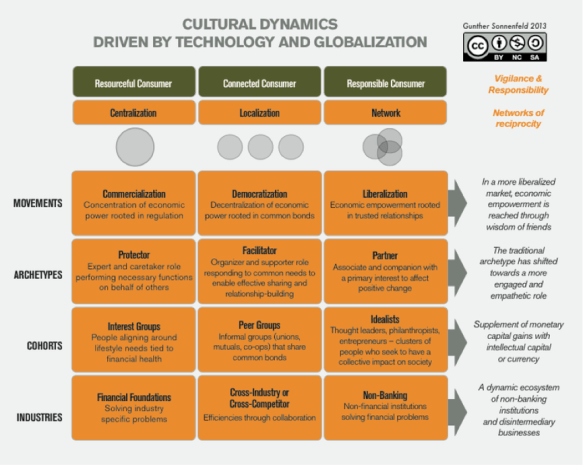
Where we go from spiral dynamics to cultural dynamics, as so magically described in the milestone post about Consumer Activism by Gunter Sonnenfeld (@goonth), describing new types of movements, archetypes, cohorts, and industries. Where Jennifer Sertl added this wonderful dimension of “frequencies” to the mix of nodes on the grid, where each of us is liberated to sing their own song, in our own frequency and at our own rhythm,
to make reverb and resonate the system at large
And where the pleasure comes from pure sharing of your mind-spins, without wanting to make a statement. A form of digital poetry just for the pleasure of play of words; and like in “Mavericks in a corporate world”, finding pleasure in just being human and developing and nurturing the capability to be touched by beauty, a picture, by mastery and harmony; developing a richer palette of responses, judgment, choice and appreciation. And to accept and enjoy that we are incurable romantics, and act from that true self.
Last week, I attended the PurpleBeach launch event (check out the twitter stream at #purplebeachlaunch). It’s one of those events that got me again into hyper-reflection mode.
I was not really sure what the launch was about – initially I thought it was about the launch of a new consultancy firm – but once on site, it looked like being an experiment driven by Annemie Ress about “People Innovation”. Annemie had been heading HR and people efforts at eBAY, PayPal and Skype and I think she was not sure yet herself where this happening was going to land. She was maybe taken a bit by surprise by the number of folks who signed up for this invitation-only event – and in some way I liked a lot the authenticity of her and the team, being and staying open and curious about what could emerge from a gathering of about 180 folks of quite diverse “plumage”.
I got invited via MJ Petroni, owner and founder of Causeit.org. I met MJ last year when he and his team coached the Innotribe team on making quality team alignments and intentions. Petroni is mentored by Mark Bonchek, PhD, former SVP of Networks and Communities at Sears, now heading his own consultancy Orbit about pulling customers and communities in “orbit” around your brand. Enough credentials to follow-up on the invitation and checkout the event that took place in Audi Quattro Rooms, West-Side of London.
Day one started with some strange mix of “quite-ok” talks about mobile, big data, digital identity, trends, leadership, HR, and the blurred zone between HR and Marketing.
In essence, the glue binding the different activities was “business humanization” and “people innovation”. The basic premise that innovation in organizations does not happen without people rediscovering themselves in their full being, a rich combination of left/right brain activities, and greater levels of personal awareness.
And yes, there was some strange Californian “wu-wu”, “mindfulness”, “well-being” and poetry and artistic performance elements as well. After all, we were on the “beach”, a place where you can relax, be idle, and be open to whatever comes your way.
Day one was ok, but not more than that: I was more or less familiar already with the content presented, and was in search for the new insight, the new synthesis, the new “AHA” moment. Alas, I waited in vain for the muse to inspire me.
But Day-2 kicked off by a great discussion about being “on”-line all the time, after a presentation by a trends watcher about future trends, micro work, etc. The presenter was depicting a future of always-on, nowism and “on-ism”, a future where you have to check your smart-device or sensor every second to capture that 5 minute chunk of work on a worldwide marketplace for mechanical turks.
In the following panel, Doug MacCallum (ex eBay but still advisor to the CEO of eBAY and non-executive Director on the board of Ocado) couldn’t hold it anymore:
“What a horror! I don’t want to live in a future like that. People need their time off to reflect and recalibrate. This is a dystopian future”
Doug MacMallum almost got a standing ovation for his intervention, and just the fact he got the ovation is a proof of how deep “presentism” is disturbing our human lives. It was like some sort of relief going through the room.
He went on describing a practice of Executives not sending mails in the weekend, to respect their own free time and that of their collaborators. Great initiative, but I have seen such promises before, and in some occasions the executive is preparing her emails during the weekend, queuing them up, and releasing them on Monday morning, so you have your inbox loaded with fresh instructions and work (sic).
It made me think of Douglas Rushkoff’s latest book “Present Shock” (Amazon Associates Link), about the fragmentation of everything, including work and value, and the addiction that arises when you are not able anymore to step out of the digital time, back into analog time, where you still have some sense of time fluidity, rhythm, and relative perspective.
Penelope Trunk, co-founder of Brazen Careerist, recently wrote a great article in Quartz. I like the section on refusing to present your-self in a linear way:
Agents represent workers who pick and choose projects that match them rather than signing on for indefinite amounts of time. The Harvard Business Review calls this supertemping. Business Week calls it going Hollywood.
It’s about a deep desire for story and narrative, context, being part of something, being for the long haul.
But unfortunately, we are getting fragmented disassembled
But I got distracted 😉 The Quartz article also mentions new “modern” practices of young people selling stocks in themselves. This is about investing in – or probably better called “betting” on humans.
A “good” example is Upstart, a start-up opening their site with the slogan “The Start-Up is You.’’
Upstart was founded by a group of ex-Googlers, including Dave Girouard, who spent 8 years at Google where he was President of Google Enterprise and VP of Apps.
I can’t help it, but this starts smelling like slavery to me. You already knew that you were the “product” of Siren Servers like Facebook, Google, your bank, your insurance company, your health company; they are getting your data for free and can monetize it without compensation of the data originator. It’s getting worse now: we are now entering an era where one owns the life of another human being, worse even, takes options in somebody’s future and betting on it.
Jaron Lanier has recently published a great book about this “Who owns the Future?” (Amazon Associated Link)
I feel really sorry for otherwise very smart people Eric Schmidt, Peter Thiel, Khosla Ventures, Marc Benioff and other moguls for putting 5.9M USD in the last capital round of Upstart. I believe they are forgetting something very important here. This is in essence a form of digitizing of what it means to be a human being, digitizing the being into binary data blips, forgetting the rich set of emotions, senses and creativity we all can bring to the table. We are more than data present in the moment. We are part of a narrative, a story, an analog context.
Our “presentism”, just having that safety option to do that quick email check in the week-end, to check that Twitter status, the Klout and other scores are probably symptoms of something deeper going on: just having that capability is for some people already reducing the anxiety of loosing out on something.
Somebody shouted from the audience “But we are loosing the obvious!” – meaning loosing of being humans – and then a couple of “minutes” later, the quote of the day:
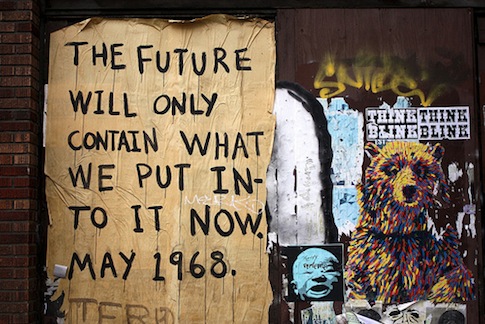
“The Future is Analogue”
I really believe it’s about loosing or sustaining our analogue human identity. Identity is contextual and one context is the time framework we want to function in. I’d prefer to live in the analogue time context; the way Doug Rushkoff described it: “What do we want: the long now or the short forever?”
This lead to my first “Aha” experience at the event: an experience about identity. As somebody quite active online, I try to be – and believe I am – the same person on-line or off-line. I don’t believe I have a different persona online of off-line. But online, I feel more the need to amplify myself and my outgoing data streams, and at the same time trying the amplify and maximize the incoming streams of new data. But there is too much info out there, I feel indeed this anxiety to miss out on something. I also sense higher degrees of narcissism on-line, narcissism in the sense of self-amplification and promotion. What does that do with my identity? I think I am pretty the same online as in the real world… But “shaping” my online identity raises deep questions on who I am: as an individual, in a group, in the world at large.
It was in this mood of identity reflections when I entered a conversation with another Purplebeach participant: Jefferson Cann from Extraordinary Leadership, a soft-spoken gentleman bringing the topic of intimacy into the debate.
The word “intimacy” worked like a red flag on me. I explained Jeff how I was trying to stabilize/discover/re-discover my identity. His feedback was that he was not sure that one needs to fix/stabilize your identity.
“By fixing, you close yourself for being open to the moment, for the intimacy with the moment. The intimacy of the moment INCLUDES identity, so that the identity can flow, can evolve. In that sense, I hope that your MBTI of 10 years ago is not the same as your MBTI of this year, which would mean you have not evolved.”
This coming together of intimacy and purpose gave lead to my second big insight of the week, the second “Aha” moment.
My readers know that I am sick of the 10 min, 15 min, 18 min pitches and talks. I am hungry for depth, for richness of conversations, for going beyond scratching the surface. One of the reasons why I keep writing these long posts 😉
The insight was that my hunger for depth is really a hunger for intimacy, the hunger for human connection, also on professional environments.
What does it really mean when a manager tells you: “You know, I am a pragmatic man, two feet on the ground, so can you please pitch me your story in one minute, and at the same time tell me what the ROI for the next 2 years will be?”
I suddenly realized that this famous pragmatism and two-feet-on-the-ground is probably a shield to hide from depth, from intimacy. It is a shield against the present that can even be used in Machiavellic ways to include/exclude people from connection. It’s a deep sign of uncertainty and insecurity, the fear of losing control, fear of human contact, the fear of opening up, the fear people will discover there is no substance, and fearing/knowing you cannot compete on content. It’s the fear of having to acknowledge that your leadership power only comes from your position in the hierarchy and not from who you really are.
Leaders must find a new sense of maturity within themselves to address and navigate these new workplace issues with greater clarity, focus and intention. Leaders must be more proactive in coming to grips with today’s new normal. In doing so, they must face their greatest fears head-onand get on with the business at hand. The marketplace, the workplace and those whom they serve demand it. Until they do, here are five things leaders are thinking, but not talking enough about:
I don’t have all the answers
I have difficulty relating to the younger generation
Diversity makes me uncomfortable
I am uncertain about the future
My leadership skills are not relevant
It looks like we are witnessing murder by modernity: murder of the human connectedness through the avoidance of intimacy. It looks like most of us – including our leaders – and not ready from the new normal. We need to send our leaders to “Purplebeaches”, so they find again time to reflect, to enjoy depth, to open up and embrace connections between fellow human beings.
UPDATE: as a real example of synchronicity, Jennifer Sertl just posted this awesome video about being human.
Some interesting insights:
There is no off/on button for feeling an emotion
How are we teaching people what is human vs. what is technical
We have to re-enforce the usefulness of being human
You can’t take care of yourself if your are at the same time taking care of a tribe
Everything you do becomes part of a data piece
Playing a higher personal – private – game
Our ability to have empathy is impacted by technology
“We are loosing the obvious: what we are loosing is our ability to scenario plan, our ability to gain perspective, our ability to know ourselves, and our ability to empathise. Those four things is what separates us from the gadgets”
Life is not digital. The future is one of analogue connection.
On 14 May 2013, the Innotribe team is organising an exclusive invitation-only Innotribe Workshop at Level39, Canary Warf, London. The topic of this workshop is “Network Insights for business growth”.
This workshop is targeted at senior strategists who would like to discover how big data and scenario thinking can lead to early warning systems and new network insights to assist in business growth strategies.
Your organisation is indeed hyper-connected with your business partners. You are not alone. Billions of connected business, people, applications and devices and in future far more sensors, and transactions now add up to create unimaginable amounts of information. This new environment will require extraordinary insights and adaptability: It is as if we are a species from dry land that has to learn to live in the ocean. Already now, we swim in a sea of data and the sea level, so to speak, is rising rapidly. This new environment requires a new design for companies and network insights, representing both threats and opportunities.
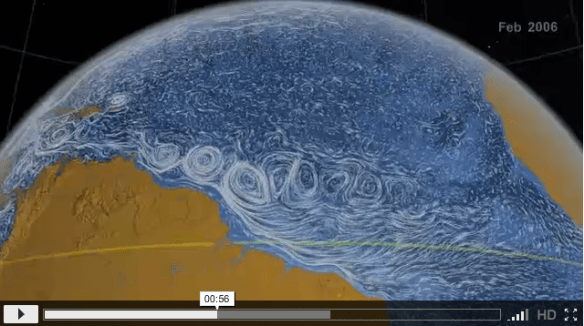
The networks that we are part of can be looked at as dynamic fluid systems: the infrastructure of pipes creates a hyper-connected environment. The end-points in networks can be different entities: financial institutions, corporates, and market infrastructures, etc. And physically wired networks can host many different functional sub-ecosystems: some represent major traffic highways, others are more hub-to-hub topologies, others function as pure peer-to-peer exchanges. These different entities and sub-ecosystems also influence each other: they create “ripple effects” up and downstream, as well as “currents” that create significant interdependencies, like ocean currents.
During this exclusive invitation-only Innotribe workshop, we will explore the following topics:
What if you could get deep intelligence about what’s going on in these fluid networks in real-time?
How could that inform your growth strategies, long term scenario planning and policies?
What if you could combine quantitative and qualitative network intelligence streams, and combine them with scenario thinking into real insights and possible early warning systems?
How can you use network insights to inform your future scenario planning and strategies for growth?
How we use these insights for better informed risk management policies?
“Network Insights for Growth” will be organized in the authentic Innotribe-way. We will bring together thought leaders in highly interactive conversations, facilitated by the renowned Innotribe team. In this year’s Innotribe events and workshops, we also try to limit the number of subjects covered, so we can experience deeper conversations and insights.
This “Network Insights for Growth” event will he held at and in collaboration with Level39, Europe’s largest accelerator space, where technology, accelerator and innovation companies are being invited from around the world to come and run their startup and accelerator programs, in one of the most inspiring spaces in London. Situated in the heart of one of the most advanced ‘smart cities’ in Europe, Level39 occupies the entire 39th floor of Canary Wharf’s iconic One Canada Square.
We will start at 10:00am UK on 14 May 2013 with planned closure of the workshop around 4pm UK. With plenty of informal networking opportunities and informal conversations during the networking breaks and lunch. This event is free-of-charge.
If you like to attend this exclusive workshop, please contact me and I will get you your personal invitation. Number of seats is limited.
Looking forward to continue our critical dialogue in London on 14 May 2013.
Detailed program:
10:00 – 10:15 Welcome and Introduction
Fabian Vandenreydt – Head of Markets Management and Core Business Development – SWIFT
10:15 – 11:45 5 different lenses (15 min talks by)
Walid Jelassi – Transformation consultant information management and analytics – Hewlett Packard
Anant Jhingran – VP Data Strategy – Apigee (tentative)
11:45 – 12:00 Break
12:00 – 13:00 Interactive workshop
13:00 – 14:00 Lunch
14:00 – 14:30 Taking Stock
14:30 – 15:30 2nd Interactive Workshop
15:30 – 16:00 Conclusions, next steps and wrap-up
We plan to continue the conversation on this topic during this year’s Innotribe@sibos in September 2013 in Dubai. During the May workshop in London, we hope to establish a solid baseline as a stepping stone for our in-depth sessions on “Scenario Thinking” and “Network Insights” in Dubai. Earlier this week, i posted a preview of our 2013 Innotribe Sibos program.
This blog post shares some more details about the Future of Big and Small Data session. This session will take place on Wednesday 31 Oct 2012 from 12:30 till 15:30 in the Innotribe Space. This Future of Data session is leading into the next session on Digital Asset Grid. The overall Innotribe Program at Sibos is here, and I try to keep that post up-to-date with the very latest speaker and program announcements.
Picking up where we left off last year with Big Data, this session will de-mystify what we think we know about data. We will hear opinions of different experts and judge together what are the hard facts, half-truths and complete unknowns about data today: big, small, broad, real time. We will dive into artificial intelligence, augmented reality and algorithms and how they impact our analysis and use of data.
This will be one of those Innotribe sessions, where we go “all the way” with super igniters (that’s how we call our speakers) and the amazing group techniques from Innotribster Mariella Atanassova and her team of designers and facilitators.
We will indeed design this session
as architects of serendipity,
creating collisions of ideas,
leading into
immersive learning experiences
The high-level design of the session is organized around debunking the myths that exist about data. We will look at this from different angles:
Who is consuming the data: people, business, devices, applications, API’s (Application Program Interfaces)
Technical and human aspects of data creation, data usage and data management
The different lenses offered by our igniters
I would like to share a bit more about our igniters for this session and why we have invited them:
For the more “technical” angle on the subject:
Sean Gourley, CTO, from Quid.
Sean Gourley is originally from New Zealand and now based in San Francisco where he splits his time between Mathematical research and his venture backed startup Quid.
He has a PhD in physics from Oxford, and his academic research has taken him from Nanotechnology to Complex Systems and the Mathematics of War. Prior to Quid he worked at NASA Ames in Mountain View, Exclusive Analysis in London, and a (very) brief stint as a consultant at BCG in Chicago.
Sean started Quid back in Dec 2009, and they are doing some pretty amazing things with data, mathematics and visualization. They are building a global intelligence platform, a place where open source intelligence is collected, structured and visualized to help people understand and make better decisions about the complex world we live in.
Sean is currently CTO of Quid. Their corporate slogan of Quid is “Augmenting Our Ability to Perceive this Complex World™ ”
Sean will talk about the war of algorithms, a world of machines where black-swans almost become the norm. I have already mentioned this fantastic talk in my blog post about “The Cambrian Explosion of Everything”
Amir Halfon, CTO for Financial Services , MarkLogic
It is Amir’s fourth Innotribe at Sibos.
Before Amir recently joined MarkLogic, he was with Sun/Oracle for more than 12 years, where his last position was Chief Technologist specialized in Financial Services. MarkLogic offers next-generation database technology capable of handling any data, at any volume, in any structure. So, Amir brings the enterprise perspective.
This will not be a product pitch. We specifically invited Amir for his rich background in financial services and his familiarity with the Innotribe-way of doing things, so we can tap into his broad experience to map the generic big data concepts to our specific market.
Anant Jhingran, VP, Data, Apigee
I met Anant for the first time last year during Defrag 2011, where we had breakfast with Sam Ramji, Head of Strategy at Apigee.
Anant is VP of Data at Apigee. Before he 21 years with IBM where he was VP and CTO for IBM’s Information Management Division, Co-Chair of IBM wide Cloud Computing Architecture Board and one of the “IBM Fellows”.
He is our ideal igniter to talk about data as seen by API’s. However, in the session preparation talk I had with Anant, he already highlighted that discussions about APIs are very people centric in the enterprise:
“What is the governance for publishing the APIs? Some enterprises insist on a central gatekeeper for APIs, others believe in a decentralised Darwinian model.”
Anant blogs regularly. Check-out here how his new start-up life changed his thinking. I love his quote:
“Coding is liberating”
Alexander D. Wissner-Gross, Institute Fellow, Harvard University Institute
Alex is an award-winning scientist, inventor, and entrepreneur. He serves as an Institute Fellow at the Harvard University Institute for Applied Computational Science and as a Research Affiliate at the MIT Media Laboratory.
He has received 107 major distinctions, authored 13 publications, been granted 16 issued, pending, and provisional patents, and founded, managed, and advised 4 technology companies, 1 of which has been acquired. In 1998 and 1999, respectively, he won the U.S.A. Computer Olympiad and the Intel Science Talent Search.
In 2003, he became the last person in MIT history to receive a triple major, with bachelors in Physics, Electrical Science and Engineering, and Mathematics, while graduating first in his class from the MIT School of Engineering. In 2007, he completed his Ph.D. in Physics at Harvard, where his research on smart matter, pervasive computing, and machine learning was awarded the Hertz Doctoral Thesis Prize.
His work has been featured in over 100 news outlets worldwide including The New York Times, CNN, USA Today, the Wall Street Journal, and BusinessWeek.
Alex will share how HFT is driving a latency arms race. He has a fascinating story about “Sea-Steading”, where financial institutions start building operating centers in the middle of the ocean, just to win a couple of mille-seconds in latency.
He has developed an algorithm that calculates the best geographical spot for an operating center, based on a number of criteria given by the customer.
For the more “human” angle on the subject:
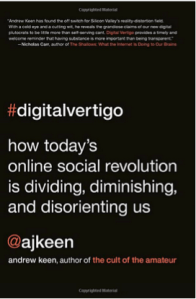
Andrew Keen, Author, Andrew Keen Productions, Author Digital Vertigo
I am very proud to have Andrew Keen on board. Andrew Keen is an Anglo-American entrepreneur, writer, broadcaster and public speaker. He is particularly known for his view that the current Internet culture and the trend may be debasing culture, an opinion he shares with Jaron Lanier and Nicholas G. Carr among others.
Keen is especially concerned about the way that the current Internet culture undermines the authority of learned experts and the work of professionals.
He is sometimes called “The Anti-Christ of Silicon Valley”. He is the author of the international hit “Cult of the Amateur: How the Internet is Killing our Culture” which has been published in 17 different languages and was short-listed for the Higham’s Business Technology Book of the Year award.
Andrew just published his new book about the social media revolution, “Digital Vertigo” (Amazon Affiliates Link), a book I highly recommend, and the thinking developed in this book is the main reason why I invited Andrew to Innotribe at Sibos.
Following extract is typical Keen-speak:
“I am dreaming of a Web that caters to a person who no longer exists. A private person, a person who is a mystery, to the world and—which is more important—to herself. Person as mystery: This idea of personhood is certainly changing, perhaps has already changed.”
He is a real “contrarian” and therefore our ideal igniter to challenge all your assumptions on data and social media. The myth he would like to challenge is:
“the myth that social media
brings us closer together
and unites the human race”
Daniel Erasmus, Owner, The Digital Thinking Network
I was introduced to Daniel Erasmus by Brewster Kahle (who was critical for the Google’s book digitization) during Jerry Michalski’s retreat when he heard about the Digital Asset Grid. Because Daniel was doing some really advance scenario thinking for some clients in the financial industry, Brewster thought i should meet him.
Since then, I enjoyed numerous calls with Daniel on the importance of scenario thinking, and it was almost by accident we stumbled upon his start-up NewsConsole™, which is all about big data and the co-existence of man and machine and the world of augmented reality, in the sense of augmented information reality.
“Every day, an exabyte of information is created – an amount equivalent to half of all information created up to 2001. You will not read it, nor will any other individual, but some of it will be critical to your business.”
NewsConsole™ reads more than a million news articles per day to give its clients strategic overview of today and tomorrow’s news. The Console is in use in the Financial Services, Governmental, the Energy and other sectors.
I love the way he talks about big data:
“Big data sells the story of “the eyes of god”: sometimes it is there, sometimes is not. It’s about sort of half-truths, I would call them contingent-truths, as half-truths” has something negative”
and
“We see a computation a-symmetry. Google (for example) can do calculations on my data, but I cannot. This a-symmetry will have stunning implications on the power balances in the world. 20th century is all about “mass”. The 21st century is about the interface of one”
Daniel is a very erudite and versatile international businessman. In his scenario thinking work, he uses similar facilitation techniques as the Innotribe team, so Daniel will move between the spaces of advocacy and facilitation.
As for the other Innotribe session, you see that we put quite some effort in architecting, content curating, designing and facilitating our sessions.
We want to do more than just “events”
and listing some speakers.
We’d like to offer you
a memorable experience
In summary, this session is about debunking myths about data. What is the myth YOU would like to debunk?Let me know via the comments option of this blog post.
See you all in Osaka! Wednesday 31 Oct 2012, at 12:30 in the Innotribe Space.














 Petervan Studios