Innotribe Workshop “Network Insights for Growth” on 14 May 2013

On 14 May 2013, the Innotribe team is organising an exclusive invitation-only Innotribe Workshop at Level39, Canary Warf, London. The topic of this workshop is “Network Insights for business growth”.

Innotribe_logo

This workshop is targeted at senior strategists who would like to discover how big data and scenario thinking can lead to early warning systems and new network insights to assist in business growth strategies.

Your organisation is indeed hyper-connected with your business partners. You are not alone. Billions of connected business, people, applications and devices and in future far more sensors, and transactions now add up to create unimaginable amounts of information. This new environment will require extraordinary insights and adaptability: It is as if we are a species from dry land that has to learn to live in the ocean. Already now, we swim in a sea of data and the sea level, so to speak, is rising rapidly. This new environment requires a new design for companies and network insights, representing both threats and opportunities.
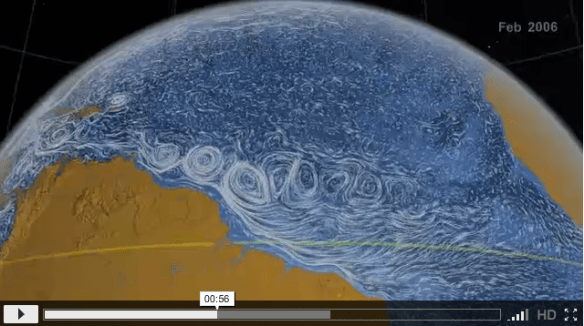
networks and oceans

The networks that we are part of can be looked at as dynamic fluid systems: the infrastructure of pipes creates a hyper-connected environment. The end-points in networks can be different entities: financial institutions, corporates, and market infrastructures, etc. And physically wired networks can host many different functional sub-ecosystems: some represent major traffic highways, others are more hub-to-hub topologies, others function as pure peer-to-peer exchanges. These different entities and sub-ecosystems also influence each other: they create “ripple effects” up and downstream, as well as “currents” that create significant interdependencies, like ocean currents.

During this exclusive invitation-only Innotribe workshop, we will explore the following topics:


  • What if you could get deep intelligence about what’s going on in these fluid networks in real-time?
  • How could that inform your growth strategies, long term scenario planning and policies?
  • What if you could combine quantitative and qualitative network intelligence streams, and combine them with scenario thinking into real insights and possible early warning systems?
  • How can you use network insights to inform your future scenario planning and strategies for growth?
  • How we use these insights for better informed risk management policies?


“Network Insights for Growth” will be organized in the authentic Innotribe-way. We will bring together thought leaders in highly interactive conversations, facilitated by the renowned Innotribe team. In this year’s Innotribe events and workshops, we also try to limit the number of subjects covered, so we can experience deeper conversations and insights.
Level39 Logo

This “Network Insights for Growth” event will he held at and in collaboration with Level39, Europe’s largest accelerator space, where technology, accelerator and innovation companies are being invited from around the world to come and run their startup and accelerator programs, in one of the most inspiring spaces in London. Situated in the heart of one of the most advanced ‘smart cities’ in Europe, Level39 occupies the entire 39th floor of Canary Wharf’s iconic One Canada Square.

level39 room

We will start at 10:00am UK on 14 May 2013 with planned closure of the workshop around 4pm UK. With plenty of informal networking opportunities and informal conversations during the networking breaks and lunch. This event is free-of-charge.

If you like to attend this exclusive workshop, please contact me and I will get you your personal invitation. Number of seats is limited.

Looking forward to continue our critical dialogue in London on 14 May 2013.

Detailed program:

10:00 – 10:15                       Welcome and Introduction

  • Fabian Vandenreydt – Head of Markets Management and Core Business Development –  SWIFT


10:15 – 11:45                       5 different lenses (15 min talks by)


11:45 – 12:00                       Break

12:00 – 13:00                       Interactive workshop

13:00 – 14:00                       Lunch

14:00 – 14:30                       Taking Stock

14:30 – 15:30                       2nd Interactive Workshop

15:30 – 16:00                       Conclusions, next steps and wrap-up

We plan to continue the conversation on this topic during this year’s Innotribe@sibos in September 2013 in Dubai. During the May workshop in London, we hope to establish a solid baseline as a stepping stone for our in-depth sessions on “Scenario Thinking” and “Network Insights” in Dubai. Earlier this week, i posted a preview of our 2013 Innotribe Sibos program.
 

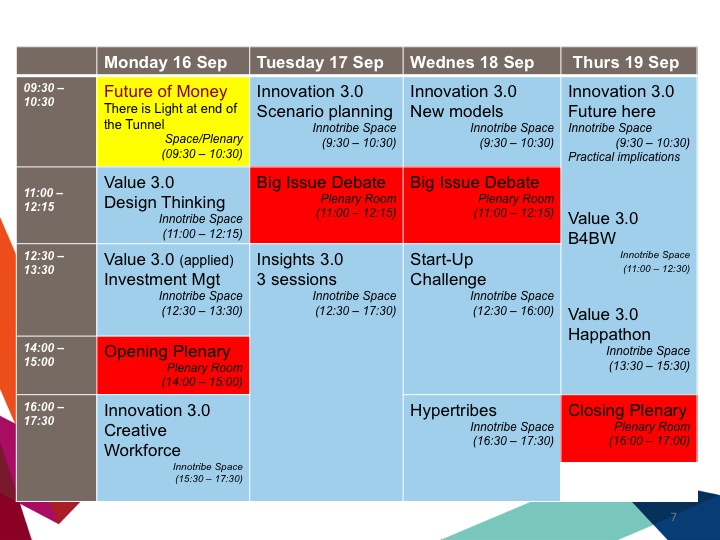
Innotribe Sibos Dubai 16 – 19 Sep 2013: preview

This year, our annual flagship event Innotribe@Sibos celebrates its fifth anniversary. Running throughout Sibos week, the event offers a comprehensive programme exploring a range of topics crucial to the financial industry.

Slide32

Innotribe@Sibos in Dubai will once again bring together a powerful combination of world experts to participate in an exciting mix of keynote sessions, case studies, and interactive immersive discussions and learning experiences.

Last year in Osaka, the Innotribe space was a fantastic spacious tent in the middle of the conference patio. It just looked gorgeous! This year, we have a really big conference room accessible from the main conference area through a tunnel. The tunnel will be a magical transition between the more traditional Sibos environment and the subterranean Innotribe Space. The tunnel will also serve as an area for exposition, informal gathering and special multimedia experiences. I have seen some early designs for the space and tunnel, and it all has a very “clubby” feeling to it. It made me think of clubs of the 80’ies with a Vive-la-Fête feeling to it. Just play the video/music below while you read the rest of the post: you’ll get into the rythm 🙂

The space and the tunnel are part of the experience, and therefore the tagline for this year’s Innotribe@Sibos is

“There is light at the end of the tunnel”

creating a positive inspiring environment, looking into the future with a mindset of progress, hope and purpose.

Programme

Building on the feedback we’ve received over the last few years, we have tried to observe the following principles in the design of this year’s programme:

  • Less topics, but more depth;
  • Keep the freshness and relevance of the themes and topics;
  • Keep the uniqueness of the Innotribe format: highly interactive and immersive group learning experiences;
  • Discovery, awareness, future oriented;
  • A healthy mix of technology and non-technology subjects (societal impact);
  • Introducing the concept of “journeys”, so that you can follow a track from A-Z as a learning curve, or pick and choose depending on your familiarity and expertise with the topic;
  • Our ambition remains to co-discover, co-design, co-create and co-deliver.

Slide05

We have selected four major themes that will be:

Value/Wealth 3.0

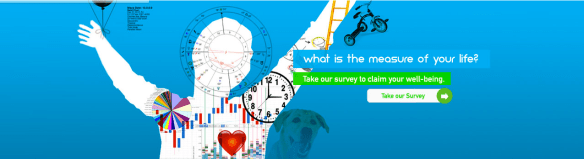
  • Continuing from previous conversations on The Future of Money, Banks for a Better World, Social Business, and the great re-definition of wealth and well-being. New are topics on Design Thinking, Investment Management 2.0 and Intangible Assets. We have also partnered with www.happathon.com to crowdsource a global measure of well-being versus wealth.

happathon

Innovation 3.0

  • Or the re-invention of innovation. In many organisations, the discussion about innovation is hampered by a low quality and polarizing dialogue; incremental vs disruptive, core vs non-core, internal vs external. We can do better: there is a simple line running from where companies were and the processes they needed thirty years ago to a highly externalized enterprise that carries new rules and needs new processes.
  • We will also discuss new models from other industries and emerging markets – Jugaad, Shanzai, Reverse Innovation – and inject new thinking modes like design thinking, scenario thinking, business model thinking.
  • Last but not least, we will engage you in an interactive game/experience to discover a day in the lifetime of a creative banker.

Start-me-up 3.0

  • Whereas the previous two streams are maybe more conceptual, this stream is all about actual innovations, where the “rubber meets the road”.
  • In “The future is already here”, we have invited some awesome speakers that will shake the tree and showcase some mind-blowing innovations in financial industry.
  • We will also discuss the outcome and ways forward for the “Hypertribes” model, a possible new way to accelerate innovation for the industry at large.
  • This stream culminates in the Grand Finale of the Innotribe Start-Up Challenge 2013.

Network Insights 3.0

  • The networks that we are part of can be looked at as dynamic fluid systems. What if you could tap into the intelligence buried in these data currents?
  • What about combining quantitative and qualitative data streams that lead to early warning systems for growth and resilience that can inform future scenario thinking? Could these new technologies lead to new insights for better informed risk management policies?
  • Topics include network cartography, natural language generation, fraud detection, and pattern recognition.

Throughout the week, we will use the tunnel as a hospitality and exposition zone, with fascinating demos about artificial intelligence, augmented reality and multi-media interactivity. And as usual, the whole program is peppered with a whole range of props, humour and fun.

Slide07

startup

The Innotribe Startup Challenge 2013 introduces the world’s most promising FinTech and financial services start-ups to the global community of financial institutions, venture capitalists, angels and influencers actively investing in innovation. Innotribe@Sibos will host the Grande Finale of the 2013 Challenge, following regional showcases in the America, EMEA and APAC.  From a total of more than 200 candidates, the 15 very best start-ups of 2013 will compete in front of a live audience and professional judge panel for a cash price of 50,000 USD.

ISDC banner Mela white bkg

Who should attend?

Innotribe@Sibos is open to all who come to Dubai. It brings together strategists, business and technology leaders, trend-setters and trend-watchers, and thinkers interested in taking action and shaping the future. In short, anyone keen to find out how the world is changing and what that means for our industry.

Why attend?

Join us to discover new business and technology trends; share and discuss ground-breaking ideas for co-investment; and challenge each other to build theoretical concepts into tangible prototypes in professionally facilitated workshops.

Conclusion

Innotribe at Sibos 2013 will celebrate its fifth edition with four days of intense inspiration and interactive immersive learning experiences. This is the place to get inspired, where you can share and discuss ground-breaking ideas, connect with great people, challenge each other in professionally facilitated workshops, and most of all… have fun.

Innotribe is about being infected

by irresistible contagious enthusiasm

of open-minded, curious

and passionate people

enthusiasm

You can follow the progress of our program on the Sibos website as speaker announcements continue between now and September. Follow our daily tweets at http://twitter.com/innotribe or visit the website to find out more about  all Innotribe-related sessions at Sibos: www.sibos.com

We look forward to seeing you in Dubai!

Slide33

By @petervan from the Innotribe team

Cross-Posted on Innotribe Blog

www.sibos.com

www.innotribe.com

Twitter: @innotribe and @petervan

Leading from the Edge

My post “The End of Leadership” was one of the most read posts on my blog ever. But i owe the spark and the essence for this post to Rune Kvist Olsen, who keeps fine-tuning the concept by sending regular comments to that post. Here is one of these comments

As individual human beings we must learn to practise our free will in taking and making personal choices, and practise responsibility towards our self and each other as trustworthy, dignified, reliable and accountable humans.

tumblr_md1jsakdvx1rrsl5ho1_250

The post also triggers comments in Google+ communities like this one by Leland LeCuyer:

Leader-ship puts the emphasis on the person, in particular upon the role that person is playing. Thus the title and the office give an individual certain powers, prerogatives, and duties. Certain other individuals are subordinate to the leader and are expected to execute what the leader commands.

Leading-ship emphasizes the action that is taken. It requires initiative mixed with talent, skill, and commitment. Instead of issuing orders to be carried out, it draws upon the ability of the person who is leading to inspire, teach, and motivate others to join her or him in acting. Most important of all, it doesn’t require an office or a title, just talent, skill and a commitment to act.

The differences are night and day. Carpe diem!

For others to join her or him in acting. That ties in wonderful with my updated “about” where i suggest:

“I love connecting with the experts,

the musicians, and artists of all kinds,

to bring out the very best in them,

to love to work & live with them

to show personal intent and integrity,

so that others want to join our projects too.”

But nothing better than the master himself 😉 Just a couple of days ago, Rune sent me his February update, and asked me to share it with my community and followers. It’s wonderful and deeply enlightening. Highlights are by your humble servant. Enjoy!

+++ Start Rune’s February 2012 update +++

1. Understanding the conceptualization of “Leadingship”

The ultimate core in the vision of “Leadingship” is the principle of self-determination at work. Subsequent that the individual human being is self-deciding within a defined area and field of work based on her or his individual competence. This principle should be the natural and self-evident choice in designing organizations regarding managing and leading working processes. “Leadingship” is a substantial humanistic principle by design and is stating the value of “Leadingship for Everyone”.

The contracting principle to “Leadingship” is that someone is leading and deciding over others and someone is led and decided over by others. The superior authority in subjugating people to subordination is designed by position and rank (contrary to competence). The design principle of “Leadership” authorizing the superior person in charge, is depriving the persons below their innate sense of being personal responsible of one owns contribution and performance of work. The relationship between superior people and subordinate people is legitimating the design of someone above who is worthy trust and responsibility and others below that is unworthy the dignity as equals and peers in the workplace. “Leadership” is definitive an anti-humanistic principle by design and is stating the value of “Leadership for Someone”.

In sum the natural design principle at work is to grant competent people their human right of self-decision. Depriving people their right of self-determination, is to devaluate their competence as authorities within their personal field of expertise. And that choice is both unnatural and anti-human.

2. Understanding the incomprehensibility and unintelligibility of the unknown matter of reality, through our adapted perceptions of beliefs and values.

To become able of understanding and learning anything that comes to us as a matter of something unknown, strange, different and perhaps controversial in challenging our ingrained beliefs and truths, we are dependent of an ability and a will force to think the unthinkable in understanding the unbelievable substance of the unknown matter at hand.

Unless our capacity of transgression beyond our force and power of mind exist, we will surely be stuck with our old beliefs and truths surrounded by ignorance, prejudice and convictions – as protective shields against challenges perceived as threats to our known measures of reality.

The journey of mind from Leadership to Leadingship, is an example of such a provocative, controversial and challenging test for our ability and will to move beyond the unthinkable of the common reality of theory and practice in organizations to day.

3. The pedagogical core of Leadingship

  • As individual human beings we must learn to become independent responsible human entities interacting with each other on mutual and equal ground.
  • As individual human beings we must learn to practice our free will in taking and making personal choices, and practice responsibility towards our self and each other as trustworthy, dignified, reliable and accountable humans.
  • As individual human beings we must learn to convert our learning’s to personal competence by practicing our independence and responsibility through the adaption and application of our learning’s in real life.
  • Being independent and responsible human beings at work. When we have become truly independent and responsible individual human beings at work by taking care of our self and each other, we have gained the personal ability to practice Leadingship in the process of leading our self together with others based on our competence and enabled by mutual trust and personal freedom.

4. Fear based relationship powered by Leadership versus trust based relationship powered by Leadingship

A relationship based on fear (of rejection, exclusion, punishment etc.) and managed by control, command and domination over other people in the organization, is an expression of a deep and intrinsic personal need, urge and desire of being in charge as a superior person ranked above others as subordinates ranked below. By being in charge the person has gained the superiority and the enforcing power over others. The nature of Leadership is to lead others by deciding over them and by subjugating others to be led through obedience and loyalty. The notion of being subjected to others mercy, is in it self a source of the threatening emergency of fear.

A relationship based on trust (of appreciation, recognition, acknowledgement etc) and managed by personal freedom, mutual respect and social responsibility, is an innate expression of a devoted and compassionate engagement between people who are regarding themselves as equal, peers and partners in either working alone or together. The social mutuality is practiced through the respect and appreciation of each person as a worthy, competent and valuable contributor in the integration and coordination of work. The nature of Leadingship is to lead one self together with others in taking personal responsibility for decisions within one owns field of work based on the shared trust in performing independence and responsible actions.

+++ End Rune’s February 2012 update +++

It should make us think deeply what we do with our organizations and the people working in it, for it, or even better from it. The “organization” is not anymore a objective in itself, but rather a tool, a platform for moving the needle of progress in the world. As mentioned before in this blog, I strongly believe that “Organizations are becoming Movements for Greatness”.

The old model has failed and is obsolete.

But we keep on training our young potentials based on the old-style model. Like the overall financial system has failed and is obsolete by only taking value out of the system but never giving back. The old model showcases perseverance in repeating the same greed errors over and over again. The old model fails to see the deeper ecological values beyond transactional relations based on raw power and money. The old model has failed because the power of leaders is based on hierarchical position, title and entitlement.

bucky

The old model has failed, and a new generation of leaders is standing up, protesting against the end-less and clueless forms of (re)organizations where people are still considered by “leaders” as pieces on a chessboard that can be moved as resources that are owned in a slavery type of relation, a power by leaders exercised on “subordinates”. These organizations are becoming toxic environments, where people are getting mentally and even physically sick, because they are deprived of genuine sharing and leadingship oxygen.

1671908-slide-airwaves

These new empowered employees are making a big plea for a more humanized workplace and call for actionable movements for greatness and inspiration. For a place where they are no longer seen as cogs in a machine, doing mindless repetitive work, soon to be taken over by machines

Ross Dawson and John Hagel recently elaborated in “Our future depends on the humanization of work“:

However perhaps the most important perspective is that work must be humanized.

As Hagel eloquently described, the problems we face have largely arisen because of the dehumanization of work. As we have built processes and structures that have made people into cogs in machines, it has indeed made them eminently replaceable.

In fact one of the great promises of the increased mechanization of work is that in a way it it forces us to be more human.

We are continually being pushed into the territory that distinguishes us from machines: emotion, relationships, synthesis, abstraction, beauty, art, meaning, and more.

Part of this is in designing jobs that draw on our uniquely human skills, and for all of us to bring our humanity to bear in our work.

Yet the broader frame is an economic structure that has made work inhuman and readily replaced by machines. We need to fundamentally change the nature of organizations and how we work together to create value. The systems must be humanized in order to allow the work to be humanized.

That is our challenge, our task, indeed our imperative if we wish our collective future to be happy and prosperous. Let us work hard to humanize work.

There is a huge role for independent and inter-dependent leadingship grounded employees to virally change the system from deep within, sticking out their neck for this good cause and leading from the edge.

living on the edge

I look forward hearing your comments. Have an inspiring day!

Innotribe finalist in HBR/McKinsey Challenge

innovating-innovation-finalist-large (1)

The Innotribe team is super thrilled having been selected as finalist for the HBR/McKinsey M-Prize Challenge on “Innovating Innovation”. The judges and the MIX editorial team poured over more than 140 contributions from innovators from around the world and from every kind of organization—looking for depth, boldness, originality, thoroughness, and the ability to inspire and instruct in equal measure.

This is a fantastic recognition of our work of the last 5 years, especially if you look at the high-caliber of the judges of this challenge, a real who’s who of leading management thinkers and progressive practitioners, including:

  • Scott Anthony – Managing Director, Innosight Asia-Pacific; author, The Little Black Book of Innovation
  • Tim Brown – CEO and President, IDEO
  • Henry Chesbrough  – Professor, UC Berkely; author, Open Innovation
  • Jeff DeGraff – Professor, University of Michigan; author, Innovation You
  • Gilberto Garcia – Chief Innovation Officer, CEMEX
  • Gary Hamel – Co-founder of the MIX
  • John Kao – Chairman of the Institute for Large Scale Innovation; author, Innovation Nation
  • Jim Stikeleather – Chief Innovation Officer, Dell Services

Winners will receive significant recognition as management innovators on the MIX, Harvard Business Review and HBR.org, the McKinsey Quarterly and McKinseyQuarterly.com. Winners will also earn the chance to appear at future live events hosted by the MIX and its partners.

UPDATE 20 Feb 2013: we just learned that we did not win. Pity. But still proud to have made it to the last 24 finalists !

UPDATE > PRESS COVERAGE


Innotribe at Sibos Osaka: Innotribe Health Index

This blog post shares some more details about the Innotribe Health Index. This session will take place on Monday 29 Oct 2012 from 11:00 till 12:15 in the Innotribe Space. The overall Innotribe Program at Sibos is here, and I try to keep that post up-to-date with the very latest speaker and program announcements.

Whereas we are sure that the main conference will cover main topic areas and trends such as Global Shifts in Economic Power, Regulation, and the financial crisis, Innotribe would like to propose some alternative lenses based on New Economies and New Values thinking, aimed at accelerating a positive re-balancing.

The Innotribe Health Index is a brand new Innotribe initiative. Through six different lenses (Reputation and Sentiment, Social Data Capital, Big Shift Readiness, Technology Readiness, Urbanization and Inequality, and Agility), we will try to give an alternative ‘health check’ of the financial system.

The intention is that the Innotribe Index is an annual checkpoint, where this year we establish the baseline, and in subsequent years we look at the progress we make versus this baseline.

The effect we want to create is a bit like the famous “state of the union” update on Internet trends by Mary Meeker (who moved last year from Morgan Stanley to Kleiner Perkins Caufield Beyers).

Here is the data-avalanche presentation by Mary Meeker of last year at Web 2.0 Summit in San Francisco:

That went fast? Yes, indeed. Like a jet-airliner flying through your living room!

We will at least go as fast, if not faster. Indeed, this session is designed as a “high-speed” session.

Each igniter (that’s how we call our speakers) will give a power talk on their specific lens, and where possible come-up with a readiness index score from 1 – 10, giving a sense of the readiness of our community for that particular challenge. That’s six lenses in one hour!

Some background on our igniters for this session, and why we invited them to be part of this session:

Julius O. Akinyemi

Julius is the initiator of Unleashing the Wealth of Nations project and the Resident Entrepreneur at MIT Media Lab in Cambridge, Massachusetts.

The objective of this initiative is to effect a sea-change, a quantum leap for ordinary citizens of developing economies to move from day-to-day survival mode to a personal wealth creation and growth via asset ownership, registry, and mobilization.

To unlock the wealth of nations, we aim to provide practical solutions tailored to the local environment that leverages the convergence of existing technologies. By registering people, their assets, and life events in an eRegistry, and through economic modeling, we will work to mobilize the currently dormant trillions of dollars in local assets in developing nations in order to generate local capital that fuels the economy via asset securitization.

Julius will come with a “Social Data Readiness Index”, as we see the availability of people’s social and identity data as one way to create financial inclusion. This topic will also be covered during one of the breakouts of the Digital Asset Grid session to showcase that unlocking data assets has an important role for the bottom of the pyramid.

Wouter De Ploey

Wouter is Director in Business Technology Office, McKinsey & Company.

He will present results of research done by the McKinsey Global Institute on global economic trends, including urbanization, resource markets, capital markets, and productivity and growth, with a focus on Asia.

  • The landscape for supply/demand of labor is changing dramatically: where are the jobs for skilled/unskilled workers? Is the inequality in wages going up/down?
  • More and more people live in cities. Urbanization is driving a lot of growth. McKinsey identified 450 emerging market cities. Capital follows activity. Access to capital gets tighter and more localized. Do banks have the right local footprint?

“What’s the readiness of banks to confront these meta-challenges?” is the subject of this lens.

John Hagel

John is Co-chairman, Deloitte Centre of the Edge. He very much supports out-of-the-box and catalyst new ways of thinking. That is for sure one of the many reasons why John is one of the enablers for the Innotribe incubation activities.

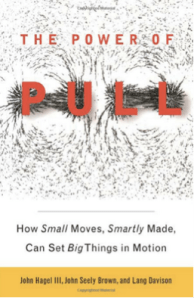
John writes regular for HBR, on his own blog, and has published several book. His latest “The Power of Pull” (Amazon Affiliates link) has become a business classic, where John highlights how we move from Knowledge Stocks to Knowledge Flows.

This shift is also at the basis of the Big Shift Index that Deloitte’s Center for the Edge has developed to provide a clear, comprehensive, and sustained view of the deep dynamics changing our world, and what companies can do to address them.

The Big Shift Index consists of 3 indices and 25 metrics designed to make longer-term performance trends more visible and actionable. You can download the Big Shift Index here (PDF file)

We are very proud of having such a thought leader as John Hagel with us at Innotribe Sibos to present the Big Shift Index. You don’t want to miss John’s authentic take on this fascinating subject.

Michael Jones

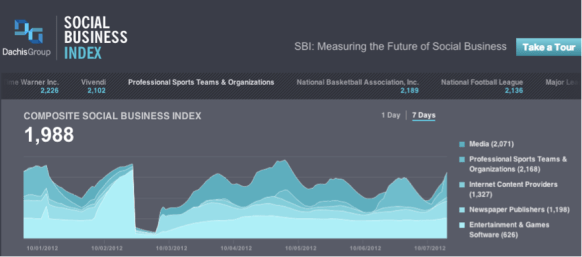
Michael is VP of Technology, Dachis Group. We have invited Michael to present the Social Business Index.

This index is built on top of Dachis Group’s Social Business Intelligence Insight Platform, analyzes the effectiveness of strategies and tactics organizations employ to engage the market through social channels.

The Social Business Index analyzes signals from over one hundred million social sources globally and analyzes the performance of the largest global companies and thousands of those companies’ brands. The Index is generated through the use of natural language processing, semantic analysis, and machine learning algorithms.

Think about it as a machine learning engine.

Michael will do a drill down on the data they have available on financial institutions.

William Saito

William is Founder & CEO, InTecur, K.K.

He is an entrepreneur, venture capitalist, public policy consultant and educator who has founded start-ups, managed corporations and worked on global information security policy over the past two decades.

To build entrepreneurial spirit in Japan, Saito also acts as CEO for the Innovation Platform Technology Fund (IPTF), a venture capital fund established by ex-Sony CEO Nobuyuki Idei and Kazuhiko Toyama, the former COO of the Industrial Revitalization Corporation of Japan (IRCJ). The IPTF seeks to produce more successful global ventures in Japan by creating a genuine venture environment.

Saito is active in several roles with the World Economic Forum (WEF). In 2011, he was named a Young Global Leader.

He is also Chief Technology Officer (CTO) of the Fukushima Nuclear Accident Independent Investigation Commission, the first such commission ever appointed by Japan’s national legislature.

With his strong entrepreneur role and his extra-ordinary international perspective, we have asked William – who now lives in Japan – to come up with “The William Saito Index”, an index reflecting agility readiness in financial services.

It will be a very personal take reflecting on entre- and intra-preneurship, in Japan and globally.

Michell Zappa

Michell Zappa is a Berlin-based technology futurist who has spent part of his life between London, São Paulo, Stockholm & Amsterdam.

His work, called Envisioning Technology, focuses on explaining where society is heading in the near future by extrapolating on current technological developments.

His research facilitates understanding the field for those who work in technology by painting a bigger picture of where the landscape is heading. In this, he tries to guide both corporations and public institutions in making better decisions about their (and society’s) future.

I met Michell through a tweet that was forwarded by one of my followers. Once we connected, we immediately spotted a fantastic opportunity to describe the readiness of financial institutions through an amazing interactive infographic. As we get closer to Sibos, we’ll release some pre-views of these amazing insights.

Coming soon: previews of Michell Zappa’s infographic on technology readiness of banks: short, medium and long term.

Michell has really surprised me with his fresh take on technology readiness, and I am very excited by the work-in-progress that I have seen from him in preparation for this session. Next year, I would love to give him a full hour.

So, in summary, fasten your seatbelts for this “faster-than-light” session, were you will be immersed in the readiness of financial institutions based on six different alternative lenses.

See you all in Osaka! Monday 29 Oct 2012 from 11:00 till 12:15 in the Innotribe Space.

By @petervan from the Innotribe team

Innotribe at Sibos Osaka: Hyper-Economies

I blogged about the overall Innotribe Program at Sibos here. That post is kept up-to-date with the latest announcements and program changes. The Innotribe program is also available here on the Sibos website.

This blog post shares some more details about the Hyper-Economies session. The session Hyper-Economies will take place on Tuesday 30 Oct 2012 from 12:30 till 14:30 in the Innotribe Space (the special tent in the middle of the conference centre).

We live in a hyper-connected world. The speed of change is increasing exponentially. Information has become abundant, versus scarce in the past, and change is happening in real-time.

This session will focus on the major cultural tectonic shifts that are underpinning and driving the hyper-connected economy and are the under-stream of deep organizational changes. We are witnessing the birth of
new economies based on hyper-connected organizations, exposure of core competence through APIs, horizontal sourcing versus vertical integration, Peer-To-Peer (P2P) sharing of data and Open Source developments, that lead to a new practice for value creation.

We have brought together an eclectic set of igniters (our name for “speakers”) to have a healthy interactive debate on the challenges and opportunities these changes represent for our financial industry.

Mark Pesce

Mark Pesce is Founder of Future Street Consulting, based in Sydney. He is currently publishing a book on the topic, titled “The Next Billion Seconds”. Mark was already with during the Innotribe Bangkok event in April of this year.

Every company should assess whether it is reducing frictions, or whether it is introducing frictions. This friction (less)-rule not only applies to organizations and functions but also to people and events.

But be aware, there are some “irreducible” frictions. Mark Pesce identifies 6 of them, all starting with a “T”. Here is how Mark Pesce describes the 6 “Ts”:

No matter how ‘smooth’ and frictionless hyper-connected commerce becomes, certain frictions in the business world will persist.  These represent both speed humps and opportunities.  The businesses of the 21st century will find leverage and differentiation by identifying and exploiting them.


  1. Time – If it were done when it were done, they’re well done quickly;
  2. Territory – you can’t be everywhere at once;
  3. Talent – some people are naturally better at it than others;
  4. Trust – is rarely immediately conferred, instead growing from a continuing relationship, and must exist for commerce to succeed;
  5. Tongue – language barriers persist until we all speak Globish.
  6. Tension – frictions in teams between humans

The topics that Mark addresses are very relevant to the evolution towards Banks-as-a-Platform and the Cambrian Explosion of Everything.

Michel Bauwens

Michel Bauwens is in my opinion the absolute “guru” for the P2P Economy, the thinking behind the Commons and the role of Open Source in software and other collaborative approaches.

He is the founder of the Peer-to-Peer Foundation and works in collaboration with a global group of researchers in the exploration of peer production, governance, and property. Michel currently lives in Chiang Mai, Thailand, has taught at Payap University and Dhurakij Pandit University’s International College. He is a founding member of the Commons Strategies Group.

The Hyper-Connected economy leads to new models of co-operation, and value production in highly connected P2P networks. Michel describes this as “Commons-Oriented Peer Production”

To get a deeper understanding of Michel’s work, check-out this fantastic report “The Synthetic Overview of the Collaborative Economy” (link to PDF file)

Allevo

Allevo’s presence at Sibos will be under the signs of Innovation and Open Source.

Their project FinTP gravitates around the bold idea of developing an open source application for financial transactions processing and a creative community around it.

FinTP is an open distributed application for processing financial transactions and it is based on the 7 years practice proven solution Allevo has successfully deployed at its customers.

Covering the entire life cycle of financial transactions, FinTP intends to create a widespread financial transactions processing platform, an alternative for an industry common solution. The hope is this will evolve into a new standardization layer – a single financial dialect comprehensible for any party involved from individuals, SMSs, to corporates and financial institutions.

We believe this represents in fact the acceptance of the commoditization of the payments processing arena.

The format from this session will be a facilitated conversation. Like in Bangkok, we will help the audience identifying friction points in their value chains, and assess how the concepts of the Hyper-Economies, P2P and Collaborative Economy, and Open Source can give rise to a rich eco-system of parties building added value on top of Open Source platforms in financial services.

The session Hyper-Economies will take place on Tuesday 30 Oct 2012 from 12:30 till 14:30 in the Innotribe Space (the special tent in the middle of the conference centre)

This session is a meta-story for the session “Future of Organizations”, that follows right after this Hyper-Economies session.

By @petervan of the Innotribe Team.

Bank(s) As A Platform

I am just coming out of 3 fantastic and super-intense days with the team that is working on the prototype for the Digital Asset Grid (DAG). The DAG is a SWIFT Innotribe’s incubation project; we are really in research mode. Acting as a catalyzer, putting a big bold vision on the radar-screen of our community. Our plan is to show the results of our work during the upcoming Sibos in Osaka. Our session is planned on 31 October 2012 at 4pm in Conference Room 3.

Just last week, there were a couple of really interesting articles in press about the Digital Asset Grid project:

Click on image to launch video

At the end of the video, Marc says:

“If you can give the consumer more control over day-to-day commerce and greater privacy, that would be a reason to actually like your bank, rather than being resigned to deal with your bank”

So it looks like the huge opportunity is in the apps. True, but there is more.

And that only became apparent last week when we were together with the FULL team:

  • We took stock of the draft presentations, demo-scripts and video material that we will be showcasing in Osaka
  • We had some great and very intense interactions with customers, management and staff
  • We completed the last bits of the video, and we taped the last video interviews that will lead to a mini documentary on the topic
  • We articulated the key messages to be used on our communications plan leading up to Sibos

But last but not least, we created a platform of intensity where ideas could flow freely, leading to the most formidable insights.

One of those insights came during the playful key-messages-exercise, where we nailed down our key concepts by imagining what would be printed on the imaginary “product box” of the Digital Asset Grid (thanks to Martine Deweirdt of the Innotribe team to facilitate this exercise).

It was the moment where the word “platform” was deeply debated.

Is “platform” like Windows (or for the sake of the argument any PC-era operating system), or did we mean something else?

The owner of the platform really owns 90% of the market. Not only the OS market but also the ecosystem of applications and application developers that create a business on top of the platform.

The platform that is most loved by developers and that gives most value for the business decision makers/owners of the application companies ultimately wins. But we have evolved quite a bit since the early PC days.

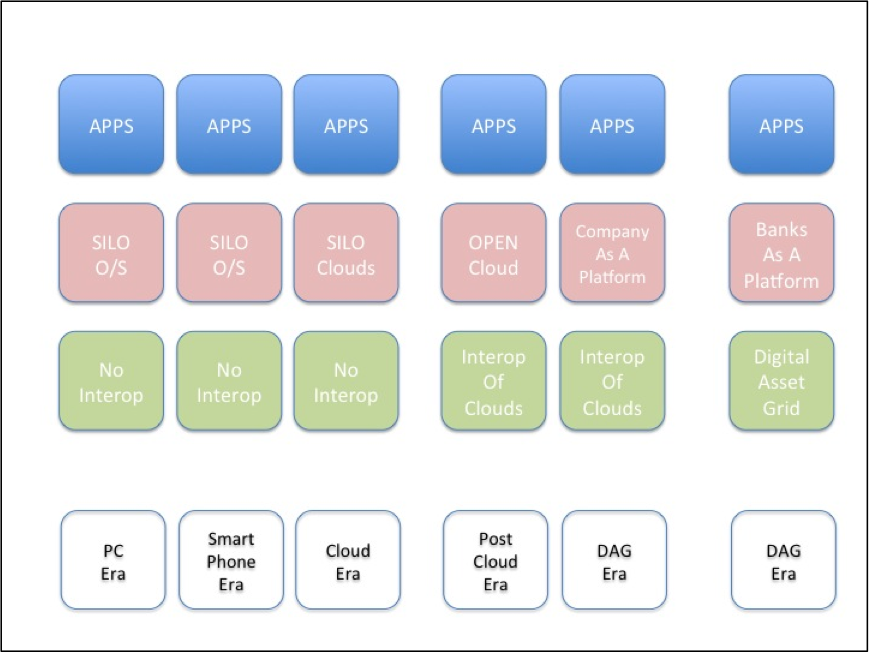
  • In the PC-era, we had really one dominant Operating System. But it was a siloed OS.
  • In the SmartPhone Era, Steve Jobs and Apple reinvented the space and created the Application Store, a disruptive channel for apps. But still built on top of a highly closed and proprietary OS and ecosystem
  • More or less same happens with clouds. They become more and more proprietary. iCloud, DropBox, G-Drive, Skydrive, etc All living in their own silo. All these examples are very consumer oriented, but usually B2B follows the slipstream of retail customer, and it can be expected the same happens with B2B cloud offerings.
  • Add to this mess the blurring lines and confusions between all sorts of clouds: private clouds, public clouds, hybrid clouds, community clouds, personal clouds, device clouds, etc, etc

In the end, every entity (people, business, device, program, etc) will have its own cloud and its own APIs

  • What has to come next in this evolution is an interoperability of clouds, a layer of almost Kernel level services, protocols and standards that let the Cambrian Explosion of Everything share data in real time, securely and with the appropriate governance and trust per interest-domain.
  • This is the bottom-layer in the diagram above
  • This is what the infrastructure-layer of the DAG is trying to address. We base ourselves on open standards XDI/XRI which are going through their approval process at OASIS.

Phil Windley described the vision of the Personal Cloud Operating system in his blog “The Layers and Components in a Cloud OS

Image courtesy Phil Windley

So far, we are thinking about companies (banks) hosting apps that run on top of this Customer Cloud Operating System. I use the more generic term “customer” in stead of “personal” Cloud Operation System, as the “customer” can be both the person, a corporate, or even a device or program.

In all our discussions, we have been so tempted to say that the value is in the apps (upper layer of this diagram). Whether that is in providing those apps as service providers (the bank as a data service provider), or as a consumer of data-services (in that case the bank acts as a “vendor” of financial services, trying to leverage the information from the direct channel with the customer (whether that customer is a retail or wholesale customer)

But that’s “only” the temptation.

The Holy Grail

is to be able to position your company

as the “platform”

on which others can build apps and create value.

Like Amazon (not the bookshop but Amazon Web Services). To make yourself so indispensable as a platform, that even your competitors start building on top of your company platform.

And suddenly the “gem” was there:

Bank(s)-as-a-platform

It is apparently a new meme (I Googled it, and did not get any hits ;-), and so I trademarked it 😉

Update: the meme “Bank as a Platform” is not new. Nicolas Debock (@ndebock) kindly pointed out to me that:

Anyway, “Bank(s) as a Platform” is what the DAG really enables. A new interoperability layer for people-, business- and device-clouds, creating a value and reputation system leveraging the existing KYC and digital slipstream information of customers with full respect of privacy and empowerment.

The real question is whether banks will see and grab this enormous opportunity, or whether they will satisfy themselves with copycats of outworn 20th century business models, and narrow down a great vision into adjacent banality.

Maybe we all can get inspired by two of my heroes:

Jeff Bezos (Founder and CEO of Amazon) said last week in an interview with @triciad in All Things Digital

“we don’t ask why do this, we ask why NOT do this?”

Click on image to launch video

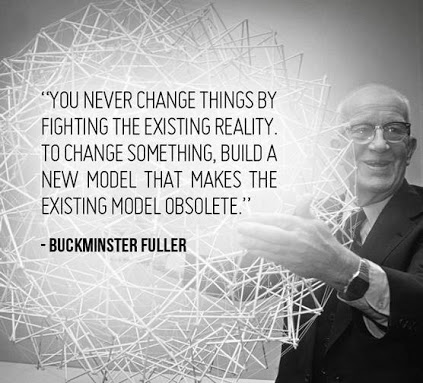
And Buckminster Fuller said:

“You never change things by fighting the existing reality. To change something, build a new model that makes the existing model obsolete.”

and

“There is nothing in a caterpillar that tells you its going to be a butterfly”.

The opportunity for banks is indeed to position themselves as data-platforms for value creation by a formidable ecosystem of third parties, so that every customer – from the Bottom of the Pyramid to the Top of the Pyramid and every customer in between – appreciates their bank as their own private wealth manager.

“Wealth” not necessarily exclusively expressed as “Money”, but as a richer an broader concept including social data capital for financial inclusion, reputation, trust, ethics, and integrity. Roger Hamilton nailed it when he said “Wealth is what you have left when you have lost all your money” 

This sort of wealth is enabling empowered customers with agency. The origin of the word “bank” was “bench”, a place where two people meet and create a relationship.

The deep meaning behind the DAG beyond its technical innovation is that it creates Relationship-as-a-Service (a term coined and trademarked by Respect Network). The realisation of this Relationship Economy will change the love/hate relationship with banks:  instead of being criticised for their past behaviorthey can be loved like the Googles, Amazons, and other great platform companies of this era.

97% owned: Democratizing the money supply

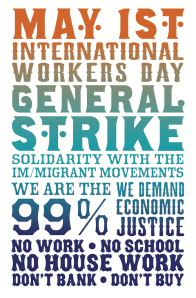
Tomorrow is May 1st, 2012: International Worker’s Day.

And unless you have been living in a cage or other planet, tomorrow is also the day where the Occupy movement is organizing a general strike action across the 125 cities in the USA.

This is organized by the 99%. In the UK however, the “97% Owned” investigates behind the scenes of the ever changing financial system, to uncover how the monetary system provides the foundations for international dominance and national control. Fresh thinking, new ideas and answers to simple questions are squeezed into this 2hr 10minute expose.

Due for release May 1st it features frank interviews and comments from Positive Money, The New Economics Foundation, PRIME, Paul Moore HBOS Whistle Blower, Simon Dixon of Bank to the Future and Nick Dearden from Jubliee Debt Campaign.

97% owned is from the creative team behind Generation OS13: The New Culture of resistance, continuing the distinctive ‘tour de force’ style and artistic interpretation.

Not that i subscribe everything that is said in this video – but i want you to sense the intensity and aggressivity of this movement. It reminds me a lot of what happened in 1977 with the punk movement, or the Flower Power 60’ies, but these were softer more “Peace no War”. This is getting much more confrontational. Check also the comments, as clearly not everybody agrees with the content, the quite tendentious language and music.

Also check-out Simon Dixon (@SimonDixonTwitt), CEO of BankoftheFuture.com, starting off his TEDx talk with some musings on leadership:

“figuring out what you were brought on this earth to do, and then do it”

This resonates strongly in me, see also my latest posts, many of them related to my reflections on what i was meant to be in this world.

Simon explains:

  • Why we need to change the rules of banking
  • What will happen if we don’t change the rules of banking
  • How we can change the rules of banking
His thinking about value is very close to Art Brock‘s ideas on the Living Ecosystem of Wealth (check out www.metacurrency.org). In Art’s model, it’s becoming crystal clear that the majority of investments are purely speculative in nature, and don’t return any value back into the economic system.
Simon is doing a call for:
  • equality
  • sustainability
  • stability
At the end, he also talks on how to change the rules, in essence by training and planting change agents virally in all financial institutions. Sounds familiar to our Corporate Rebels approach where we’d like “to ensure that true change happens virally”, although we are not targeting any specific industry.
Starts crystalizing for me that what Corporate Rebels needs to change is to make our organizations more agile, more fit, more vital, more resilient in creating value rather than extracting value. Now i know why i once read Cradle to Cradle by William A. McDonough (Amazon Affiliates Link) why once again it’s an architect who inspires me. Because it and i was meant to be.

Simon Dixon will launch his own initiative “Banks To The Future” in 30 days or so, as an alternative to bring money to the business without venture capitalists and banks involved.

Another example of “First they ignore you, then they laugh at you, then they fight you, then you win” (Mahatma Ghandi), our theme for last week’s Innotribe in Bangkok.

Simon Dixon looks to me a as good candidate for #innotribe #sibos for the session on “Future of Money”, don’t you think so ? And maybe we should be re-baptise that session into “Future of Value” ?

TEDxNewWallStreet

On March 11th, 400 people will gather in Mountain View, CA, to map out a new banking system fit for the Information Age, with new technologies, transparencies and values… at TEDxNewWallStreet.

Just down the street from Google, some of the brightest minds locally and internationally are coming together at the famed Computer History Museum to re-imagine banking for the Information Age at TEDxNewWallStreet on March 11, 2012. This audience routinely disrupts Industrial Age paradigms, and will be encouraged to do so for banking, by inventing new technologies and processes that make banking a game that people can win.

Mobile deposits and bill pay, online stock market quotes and trades show people will use technology to do the banking they used to do, faster. Re-imagining banking changes the guts of how money is created, priced, moved, saved and transparently tracked to its impacts.

More than 400 venture capitalists, serial entrepreneurs, technologists, inspired bankers, Stanford faculty and students, politicians from the San Francisco Bay Area and Pacific Northwest, and a global online live-stream audience in the thousands using Facebook, Google and Twitter are expected to attend TEDxNewWallStreet. Speakers will give talks on a number of topics, including:

  • banking as a facet of civil rights so as to raise personal wealth,
  • virtual/peer-to-peer banking,
  • how bank technologies can protect customer identity and increase global sustainability,
  • reframing how banks use customer data to price credit and investments, and
  • how public finance accounting and bond offerings can evolve to value what matters to people and community in an economy.

Speakers on the day include Silicon Valley industry leaders and upstarts, venture capitalists (VCs) and serial entrepreneurs like Bill Harris, formerly of Intuit and now of Personal Capital; Joe Lonsdale and Rosco Hill of Palantir; Macarthur Fellow and European accountancy historian Jacob SollPeter Vander Auwera at SWIFT Innotribe and startup micro-investment entrepreneur Shivani Siroya of InVenture. Many more speakers will outline their “wish lists” for Information Age banks and banking, and how to build it now.

TEDxNewWallStreet is organized by Bruce Cahan, an Ashoka Fellow and Stanford University Engineering Visiting Scholar. Bruce is creating a new bank paradigm through his high-transparency, impacts-aware bank project, known as GoodBank™(IO). Living in Palo Alto, Bruce saw that as disruptive as Silicon Valley is, it was missing a huge opportunity to move banking from its Industrial Age camouflage to the Information Age paradigm for user experience, transparency and social media.  “Banking should be what customers co-create for their own needs, not the ‘one size fits all’ take it or leave it choices most banks today offer.  Given how iTunes® and Spotify® reimagined music distribution, how Netflix® and Hulu® changed movies and television, and how digital and subscription libraries are reducing the cost of knowledge sharing, banking creates frictions transactionally, regionally, environmentally and socially that no longer are justifiable, safe or inevitable.  We have an Internet of Things, let’s use it to re-imagine banks built in and for the Information Age.”

Business reporter Camilla Webster will serve as event moderator. Camilla is a seasoned, business journalist, writing for Forbes and Huffington Post, and is co-author of The Seven Pearls of Wisdom: A Woman’s Guide to Enjoying Wealth and Power.  “TEDxNewWallStreet is a solution-based, engaging, idea-generating conversation during a historic time in the finance industry” says Camilla, who as MC will guide speakers and audience on a novel journey.

This event is about financial innovation beyond the next cool mobile app. We will be looking for deep innovations that may dramatically impact the way we think about the function of a bank. It is an honor for the Innotribe team to be invited as speaker at TEDxNewWallStreet. It is a reflection of the Innotribe reputation and brand. My presentation is combining material from “How to make Babies” and “The Soul of Innovation”, complemented with brand new material on our research project “Digital Asset Grid”, and some new insights on innovation disruption levels. Just last week, I gave Bruce Cahan a preview of the draft presentation, and Bruce’s reaction was: “you’ll blow a few circuits with this one!”. Looking forward to this event with all my heart and in full support for Bruce Cahan’s cause.

The future rarely arrives when planned

The title for this blog post comes from a 2010 talk by Mark Pesce. He adds to it:

it rarely arrives in the form that we expect

it is too hard to grasp, a bridge too far

the seeds of the future are always with us in the present

I have referred many times already to Mark Pesce in my previous posts:

He keeps inspiring me, by the challenging content and his oratory skills. And yes, I am trying very hard to get Mark to one or more of our main Innotribe events as core anchor/igniter of some of our conversations.

I also recommend my readers to have a look at some of his recent work, especially about “hypereconomics”, Flexible Futures, and last but not least his upcoming book “The Next Billion Seconds”. The chapters of the books are being released now on an almost weekly basis, and here are some of the catchy titles with associated content:

  • Initiation
  • Introduction
  • Articulation
  • Replication
  • Duration
  • Revelation
  • Revolution
  • Origin

It reads like an “Origin of Species”, looking back and projecting us in the future of the Next Billion Seconds, aka the next several ten thousand of years. A fascinating read indeed.

But I wanted to use his 2010 talk as guidance to some of the work our Innotribe team is doing in our incubation project called the “Digital Asset Grid” (DAG)

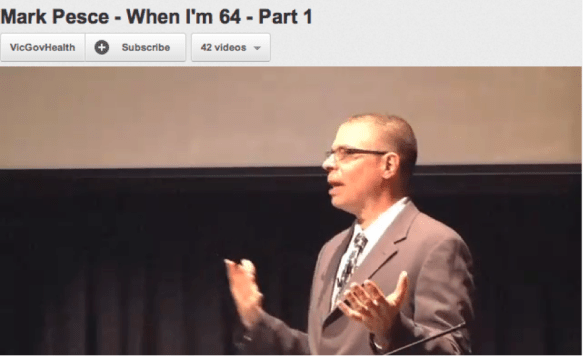
In this talk, Mark Pesce talks to  a group of Human Service folks and Health officials. Although it is about health, I encourage you to listen with holistic ears, as everything he says is applicable for any vertical.

The talk is titled “When I am 64” and is looking forward 17 years from 2010. The “64” is a wordplay on the famous Beatles song.

Here is the link to the first part of the talk. The talk was split into 3 separate videos.

I will avoid the temptation to do an ad-verbatim transcript, and will just use a couple of quotes to illustrate my own points.

Highlights first video

Somewhere half-way, Mark Pesce mentions how his team went open source with their 3D Mark Up language and how surprised they were with the amazing ideas people came up with on what they could do with it.

  • He mentions and Austrian project that made a 3D encyclopedia, like a tree of knowledge, and
  • a 3D visualization of NYSE stock data.

The latter one makes it possible to see 5,000 times more information than on could see with the standard flatlanders’ Bloomberg terminal. Mind you, this was in 1997, that now 15 years ago.

My lessons learned for DAG:

  • The DAG story is a story of value propositions. That is what the prototype we are building will focus on. It is NOT a technology showcase.
  • We play with the idea of an open source DAG server. There is some hesitation. We should not hesitate. We should look at it like IBM looked at Apache Server at the time. Our core competence is to operate a high-available, secure and resilient infrastructure. Probably less in building server software. We know more than me.
  • There is so much innovation in the ecosystem. Our current thinking is to bring the APIs of the infrastructure in a controlled open. So that Banks and other 3rd parties can be on the bleeding edge of innovation.
  • On the longer term, this whole concept of stream-servers makes me think a lot about the Metacurrency.org software project of Art Brock and Eric Harris-Braun. The idea is to build a basic communication later to be able to deal with stream-scapes.

I can assure you that “streams” and “scapes” will be commongood in some years time. Another very cool initiative in this space is Nova Spivack’s latest start-up BottleNose.

Highlights second video

It really gets interesting when Mark Pesce starts unfolding how the power of our communities shape our behavior. Somewhere at minute 09:10, Mark develops an extremely interesting banking scenario:

  • Imagine someone steals your identity, walks into bank, and takes a loan in your name (if they are able to present the proper documentation)
  • The problem is that once you present stolen proof documents at the entry of the process, the process usually kicks off perfectly and delivers the programmed results
  • Better would be to be proofed by others, by your community. “An identity that is confined and constrained by those you are connected to”, by your on-line context
  • At minute 10:35, Mark suggest

that you should be able to handing the bank your social graph!

You really would expect your bank to be able to write some piece of software which could confirm your identity

Bank validating your identity strength based on who vouched for you !!!

This really comes very-very close to some of the use cases we have in mind for DAG.

This would result in a system with greater resilience, much harder to fool, because:

  • Identity is a function of community
  • And not just identity > even TALENT is a function of and a recognized value of a community
  • The social graph is the foundation of identity

In my opinion, all this is leading towards “interest based connections”.

The relationship economy, the reason why REXpedition is so important, is the next battlefield of competition; after most organizations squeezed all the juice out of SixSigma, Lean, and similar programs for increasing productivity and efficiency.

  • The focus of these programs was on doing better what we already did (sometimes doing bad things better)
  • Now its’ about doing new things, the right things. And those right things have all to do with better managing our trustful relationships

Therefore, Mark’s thesis that “a group of well connected highly empowered individuals is a force to be reckoned with” is one of the biggest forces in place. It has always been, but now returning in force thanks to our hyper-connectivity and information abundance.

Highlights third video

This part, entitled “Senior Concessions” really got my attention when Mark Pesce starts talking about “Personal Broadcasting”, networks of trust and sharing of social graphs.

Sharing of social graphs will enable us to identify who brings real value, who brings insight, who bring wisdom. And also those who seek to confuse, who are confused, or who are self-seeking.

This smells very much like reputation and influence like:

  • the reputation score in eBay
  • the thinking of Andreas Weigend’s from the Stanford Social Data Lab
  • Doc Searls VRM (Vendor Relationship Management) thinking
  • Drummond Reed’s Social Vouching start-up connect.me with its underlying Respect Trust Framework.

Mark continues how boundaries of expertise are becoming more and more fuzzy. The patient now often knows more than the specialist. The student knows more than the teacher. It reminded me to one of the first books I read about fuzzy logic by Bart Kosko in 1994. “The new science of fuzzy logic

Reading that book so very early in my career was probably meant to be part of my life and my purpose.

Anyway, Pesce puts the patient in the center, like Doc Searls put the user in the center of his user-centric intention economy.

In my opinion, banks have a similar huge opportunity to put the customer back in the center and offer unprecedented high-quality data services.

And Mark Pesce goes on:

  • This is about user centric “social” graph
  • Knowledge will pass from one user to another (similar to John Hagel’s knowledge flows)
  • As knowledge is passed on to the community, the community empowers itself
  • Person as agency of his own data, deciding who gets access
  • Privacy of medical data is about making these data freely available to those who need it in context, but make them secret to those who do not need those data
  • Only if person has agency for his data and authorizing access to his (medical) records, and tools to track that access (and give/release access)
  • Without those tools we will loose track of who owns what etc and becomes easier for those who shouldn’t to have a look in
  • As our medical records spread through our networks of medical expertise, we will feel less fear, and more to surrender our privacy
  • There is power in releasing our privacy because we gain connections

It’s almost going back to Doc Searls (and others’) 1999 ClueTrain Manifesto where the authors declare in one of their 95 thesis that “Markets are Conversations”.

It’s also going back to Buckminster Fuller’s geodesic domes, where the each element is weak, but where the combined structure is stable.

As a matter of fact, the 3D space of the geodesic dome perfectly illustrates what the DAG is all about. Look at it as a certified map of where the data are located with their associated usage rights. Sharing as utility. P2P sharing with certified pointing infrastructure. It’s moving us from a Flatlanders 2D thinking of the physical world to a 3D thinking of the graph. That is what the DAG is really all about.

I put this blog together during one of my weeks off, weeks that are completely un-planned and un-structured. For me these are weeks where I refresh my brain, new ideas pop-up during moments of organized boredom. You could call it my Boredom Weeks.

It can therefore not be a co-incidence that Mark Pesce ends with a referral to Genevieve Bell, Intel Fellow and director of the Interaction and Experience Research Group within the Intel Labs. Just on that same day, I received a tweet from one of my followers referring to Genevieve Bell’s TEDxSydney 2011 talk on boredom.

The video basically illustrates that ideas come in moments you don’t expect, when you are not focused, when you have this blissful moments of boredom. Its back to the start and title of this blog post: “The future rarely arrives when planned and it rarely arrives in the form that we expect”

I can already see now how DAG will take off from and into un-expected directions. And we are just at the start of the prototype phase. Exciting times

@petervan from the #innotribe team