
I am just coming out of 3 fantastic and super-intense days with the team that is working on the prototype for the Digital Asset Grid (DAG). The DAG is a SWIFT Innotribe’s incubation project; we are really in research mode. Acting as a catalyzer, putting a big bold vision on the radar-screen of our community. Our plan is to show the results of our work during the upcoming Sibos in Osaka. Our session is planned on 31 October 2012 at 4pm in Conference Room 3.
Just last week, there were a couple of really interesting articles in press about the Digital Asset Grid project:
- First there was my boss Kosta Peric’s (@copernicc) Forbes article “Trust on the Internet: The solution is ahead”
- And then there was Marc Hochstein’s (@MarcHochstein) excellent coverage in American Banker titled “SWIFT Reimagines Banks’ Role for a Data-Driven Future”. It’s really a great article and there is an excellent video coming with it where Marc positions the DAG as it should be positioned: a unique opportunity for banks to offer a whole new series of Data-Driven applications.

Click on image to launch video
At the end of the video, Marc says:
“If you can give the consumer more control over day-to-day commerce and greater privacy, that would be a reason to actually like your bank, rather than being resigned to deal with your bank”
So it looks like the huge opportunity is in the apps. True, but there is more.
And that only became apparent last week when we were together with the FULL team:
- We took stock of the draft presentations, demo-scripts and video material that we will be showcasing in Osaka
- We had some great and very intense interactions with customers, management and staff
- We completed the last bits of the video, and we taped the last video interviews that will lead to a mini documentary on the topic
- We articulated the key messages to be used on our communications plan leading up to Sibos
But last but not least, we created a platform of intensity where ideas could flow freely, leading to the most formidable insights.
One of those insights came during the playful key-messages-exercise, where we nailed down our key concepts by imagining what would be printed on the imaginary “product box” of the Digital Asset Grid (thanks to Martine Deweirdt of the Innotribe team to facilitate this exercise).

It was the moment where the word “platform” was deeply debated.
Is “platform” like Windows (or for the sake of the argument any PC-era operating system), or did we mean something else?
The owner of the platform really owns 90% of the market. Not only the OS market but also the ecosystem of applications and application developers that create a business on top of the platform.
The platform that is most loved by developers and that gives most value for the business decision makers/owners of the application companies ultimately wins. But we have evolved quite a bit since the early PC days.
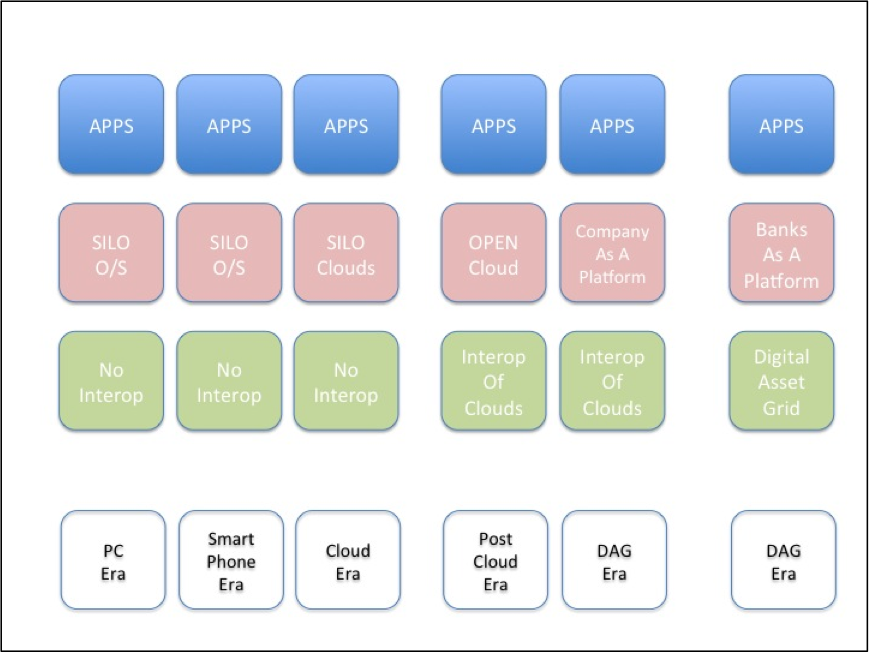
- In the PC-era, we had really one dominant Operating System. But it was a siloed OS.
- In the SmartPhone Era, Steve Jobs and Apple reinvented the space and created the Application Store, a disruptive channel for apps. But still built on top of a highly closed and proprietary OS and ecosystem
- More or less same happens with clouds. They become more and more proprietary. iCloud, DropBox, G-Drive, Skydrive, etc All living in their own silo. All these examples are very consumer oriented, but usually B2B follows the slipstream of retail customer, and it can be expected the same happens with B2B cloud offerings.
- Add to this mess the blurring lines and confusions between all sorts of clouds: private clouds, public clouds, hybrid clouds, community clouds, personal clouds, device clouds, etc, etc
In the end, every entity (people, business, device, program, etc) will have its own cloud and its own APIs
- What has to come next in this evolution is an interoperability of clouds, a layer of almost Kernel level services, protocols and standards that let the Cambrian Explosion of Everything share data in real time, securely and with the appropriate governance and trust per interest-domain.
- This is the bottom-layer in the diagram above
- This is what the infrastructure-layer of the DAG is trying to address. We base ourselves on open standards XDI/XRI which are going through their approval process at OASIS.
Phil Windley described the vision of the Personal Cloud Operating system in his blog “The Layers and Components in a Cloud OS”

Image courtesy Phil Windley
So far, we are thinking about companies (banks) hosting apps that run on top of this Customer Cloud Operating System. I use the more generic term “customer” in stead of “personal” Cloud Operation System, as the “customer” can be both the person, a corporate, or even a device or program.
In all our discussions, we have been so tempted to say that the value is in the apps (upper layer of this diagram). Whether that is in providing those apps as service providers (the bank as a data service provider), or as a consumer of data-services (in that case the bank acts as a “vendor” of financial services, trying to leverage the information from the direct channel with the customer (whether that customer is a retail or wholesale customer)
But that’s “only” the temptation.
The Holy Grail
is to be able to position your company
as the “platform”
on which others can build apps and create value.
Like Amazon (not the bookshop but Amazon Web Services). To make yourself so indispensable as a platform, that even your competitors start building on top of your company platform.
And suddenly the “gem” was there:
Bank(s)-as-a-platform
It is apparently a new meme (I Googled it, and did not get any hits ;-), and so I trademarked it 😉
Update: the meme “Bank as a Platform” is not new. Nicolas Debock (@ndebock) kindly pointed out to me that:
- Sean Park (@parkparadigm) from Anthemis was probably the first who mentioned the idea of Bank as a Platform with a nice prezi presentation http://www.parkparadigm.com/2009/10/29/platforms-markets-and-bytes/ in september 2009.
- Also Chris Skinner (@chris_skinner) aka TheFinanser in a february 2009 blog post http://thefinanser.co.uk/fsclub/2009/02/baas-banking-as-a-service.html and more recently
- in august 2010 Yann aka (@tek_Fin) http://tekfin.com/2010/08/16/banking-as-a-platform-coming-soon-with-banksimple/ and
- Nicolas himself in French in September 2010 http://www.wiseweb.fr/2010/09/bank-as-a-platform/
Anyway, “Bank(s) as a Platform” is what the DAG really enables. A new interoperability layer for people-, business- and device-clouds, creating a value and reputation system leveraging the existing KYC and digital slipstream information of customers with full respect of privacy and empowerment.
The real question is whether banks will see and grab this enormous opportunity, or whether they will satisfy themselves with copycats of outworn 20th century business models, and narrow down a great vision into adjacent banality.
Maybe we all can get inspired by two of my heroes:
Jeff Bezos (Founder and CEO of Amazon) said last week in an interview with @triciad in All Things Digital
“we don’t ask why do this, we ask why NOT do this?”
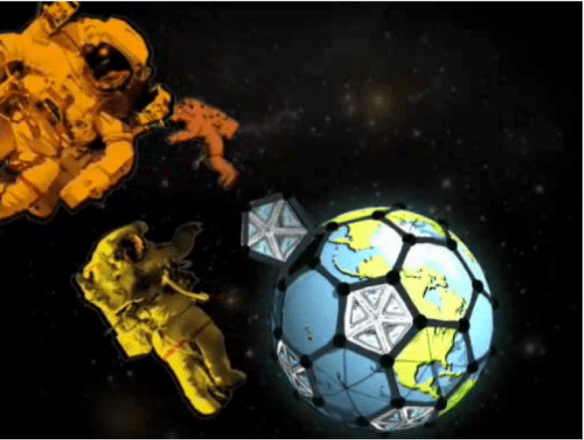
Click on image to launch video
And Buckminster Fuller said:
“You never change things by fighting the existing reality. To change something, build a new model that makes the existing model obsolete.”
and
“There is nothing in a caterpillar that tells you its going to be a butterfly”.
The opportunity for banks is indeed to position themselves as data-platforms for value creation by a formidable ecosystem of third parties, so that every customer – from the Bottom of the Pyramid to the Top of the Pyramid and every customer in between – appreciates their bank as their own private wealth manager.
“Wealth” not necessarily exclusively expressed as “Money”, but as a richer an broader concept including social data capital for financial inclusion, reputation, trust, ethics, and integrity. Roger Hamilton nailed it when he said “Wealth is what you have left when you have lost all your money”
This sort of wealth is enabling empowered customers with agency. The origin of the word “bank” was “bench”, a place where two people meet and create a relationship.
The deep meaning behind the DAG beyond its technical innovation is that it creates Relationship-as-a-Service (a term coined and trademarked by Respect Network). The realisation of this Relationship Economy will change the love/hate relationship with banks: instead of being criticised for their past behavior, they can be loved like the Googles, Amazons, and other great platform companies of this era.


FYI, some conceptual parallels re: (Medical) Banking as platform – John Casillas, http://www.himss.org/ASP/topics_medicalbanking.asp Case studies that show the emergence of bank-driven community care platforms and more. google: platform site:edodds.blogs.com/mblog/
Will be interesting to see if Internet2 NET+ services, GENI, US-Ignite, the OpenFlow/Software Defined networking community, global national educational and research networks (NRENs), gloriad, etc. and peer2 to peer2 folks come up with IP endpoints (a la Verifone terminals), which enable mobile bitcoin, complemetary currencies (project,cyclos.org), etc.
Thank you Peter for this great post! I could not agree more with your post and I really like the quality content you share on twitter or on this blog. Moreover the DAG project by SWIFT sounds great, a true VRM stratégy taking place.
I just want to be a little “troll” here and set the record straight :
I think that the first that mentionned the idea of Bank as a platform is Sean Park from anthemis with a nice prezi prensetation http://www.parkparadigm.com/2009/10/29/platforms-markets-and-bytes/ in september 2009, also Chris Skinner aka TheFinanser in a february 2009 blog post http://thefinanser.co.uk/fsclub/2009/02/baas-banking-as-a-service.html and more recently in august 2010 Yann aka @tek_Fin http://tekfin.com/2010/08/16/banking-as-a-platform-coming-soon-with-banksimple/ and myself in French in September 2010 http://www.wiseweb.fr/2010/09/bank-as-a-platform/
I am sure there were some other posts around this idea during that periood so I am surprised you did not see anything show up on Google. I also know you know that as you exchange a lot with the anthemis crew.
Maybe the difference is with the Bank(s) “s” and that is what you trademarked?
Anyway that was just a comment to regroup the Bank as a platform post I liked in the past. Thanks again for sharing your nice content.
Hi Nicolas,
I did a search on Bank as a Platform, and nothing came up. Obviously, i am aware of and deeply inspired by the work of Sean Park and Anthemis (Sean will be our Keynote speaker at Sibos Osaka). I was the more surprised the search did not give me hits. Maybe i did a typo. Anyway, enough evidence here that the term was coined some time ago by smarter people than myself 😉
Kind Regards
Petervan
Pingback: Innotribe at Sibos Osaka: Hyper-Economies « Petervan's Blog
Pingback: Innotribe at Sibos Osaka: Hyper-Economies « Innotribe
Pingback: Better Bank Systems - Ivan Schneider - Grid Iron Banks: Evaluating a Grand Vision
Pingback: Innotribe at Sibos Osaka: Digital Asset Grid « Petervan's Blog
Why would we the people trust you the banks to build own and operate a platform like the one you suggest?
We’ll build our own data-cooperative thank-you very much, and sell you access to it.
When people write “banks” they mean third party vendors with banks as underwriters. Could just as easily be telcos… or closed-loop prepaid card networks (according to digitaltransactions.net a lot of US fedgov and States activity moving off of checks to cards). Or funeral directors. Or dentists. or research universities via Internet2 NET + services. Conversely, I suspect an unprecedented rise in the cash-based (illegally avoiding taxation) economy in the US while airtime as currency is beginning to take off where mobile carriers are active (Africa). This of course in addition to the growth in local, alternative, complementary currencies and the digcash like bitcoin, dwolla and paypal.