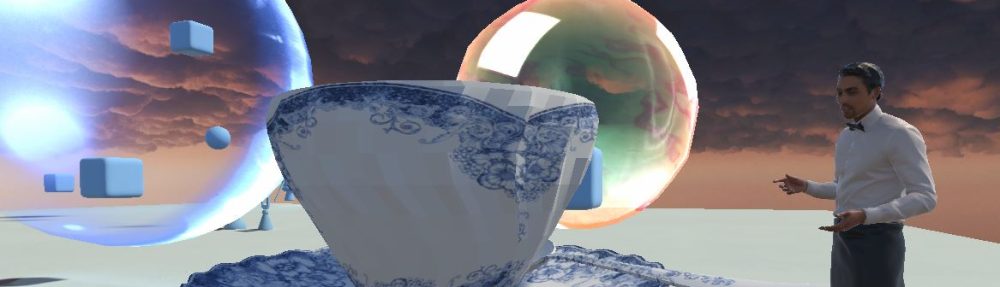
The “collapse of time” was an important meme in the Techonomy 2019 session on Super-Evolution, the idea that startups can now harness rapid prototyping and vast pools of data to develop radically new business models quickly and at scale (video here)

Super-Evolution is about creating more – dramatically more – options. Invented by AI, aka non-human logic. (see also Haydn Shaughnessy on the importance of maximizing options and radical adjacencies vs. core competency in innovation)
“Leave behind the myth of the grand plan and create the conditions for optionality and just-in-time strategy.”(Haydn Shaughnessy)
The first time I felt that sensation of collapsing time was when viewing Elon Musk’s Tesla 2019 update. I felt beaten by algorithms. The Tesla is now/then learning from (data) from human behavior and driving like a human, but ultimately will EXCEED their behavior” (at 01:48:15)
There you have it: gradually, but suddenly we have a singularity. Gradually but suddenly, all jobs are doomed. We are not going to stop this with an ethics council or with regulation. The train has left the station, the genie is out of the bottle.
“The fleet wakes up with an over the air update”
PR or product? The same question was asked some months later by Jean-Louis Gassée regarding the Cybertruck launch:
“Elon Musk forces us to be of two minds. On one side, we have Musk the Mountebank; on the other, a Captain of Industry.”
I had the same feeling of time-space collapse and irrelevance when watching this awesome interview with Rahul Sonnad, CEO/Co-Founder of Tesloop, explaining how “Robo-Mobility is a hospitality service” and “Once cars are appliances”
Are we toast? And/or do we need to reboot, reskill, etc if we don’t want to become irrelevant? Venkatesh Rao gives his perspective when reflecting on Inventing Time, and playing on Alan Kay’s “It is easier to invent the future than to predict it” and William Gibson’s “The future is already here, it is just unevenly distributed.”
“Riding in a Tesla made the electric vehicle future seem utterly inevitable in a way that kinda killed the present for me. Suddenly I could no longer look at gasoline cars the same way. Driving in my own car felt different like I was stuck in the past, waiting for the price of the future to come down to the point where I could afford to live in it. So a Tesla creates the future in the sense of both the Alan Kay and William Gibson quotes. It makes the future real in a deep way that is like making time itself real. And you know this because the feel of the present feels different like you’re heading down a dead-end, a lame-duck future. You’ll have to either abandon it as soon as you can or end up dying with it.”

Around the same time, I was lurking in Simon Ferdinand’s Mapping Beyond Measure: Art, Cartography, and the Space of Global Modernity. He could have added the Time of Global Modernity, as he writes about spatial (spheres) and temporal (time collapse) ruptures.
“Often map artworks recapitulate the narratives of rupture (spatial as well as temporal) through which global modernity differentiates itself from inherited pasts and surroundings.”
And;
“Maps have proven integral… to the experience of “time-space compression”

It made me think of Peter Greenaway’s film ‘A walk through H: The Reincarnation of an Ornithologist’ (1978) and “A Walk through a Thousand Plateaus”, an homage to that film.
It is probably a sign of the times that in the preparation of his new book “Agency” also the great William Gibson lost a sense of how weird the world has become, up to the point of the present bypassing his future sci-fi scripts – “His future had to catch up with the present”– and “stubs”: alternative timeline in which technologists (and, more tellingly, hobbyists) of the future are able to meddle.

Hobbyists and meddling, the right words probably for not getting alienated. I would call it “tinkering” by maximizing options that human logic not necessary can spot or generate in time.





 Petervan Studios