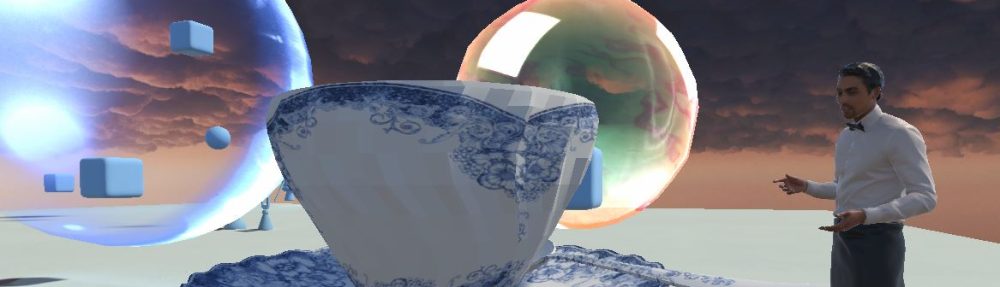

For the past few months, I’ve been co-working on a new, still embryonic project—co-written and co-directed with Andreea Ion Cojocaru, enriched by the expertise of my cousin Joost, a PhD art historian, and further shaped through the collaboration of several contributing artists.
Until now, I have only shared this project with a few people. Many of them suggested that I start documenting “the making of” our project, so this blog post will serve as the first episode.
Our project takes the form of an experimental alternate reality experience that explores the nature of flesh, human suffering, and the role of technology. At its core lies a question both ancient and urgent: Who are the new gods that might deliver us from suffering?
The project ultimately strives toward the organization of a Third Council on this topic, which we call simply: 3C
Our approach weaves together mysterious, multi-layered storytelling and conspiracies across several digital and non-digital platforms. Different strands and overlapping narratives unfold in various locations—one of them being Ghent.
This Ghent storyline begins with the renowned Mystic Lamb Altarpiece by the brothers Van Eyck. Commissioned by the Vijd family, the altarpiece was unveiled on 6 May 1432, coinciding with the baptism of Philip the Good’s son. Countless volumes have been written about this extraordinary work. An accessible introduction can be found on The Ghent Altarpiece site. For deeper study, Closer to Van Eyck offers breathtaking HD detail and analysis, and of course, there is always the comprehensive overview on Wikipedia.
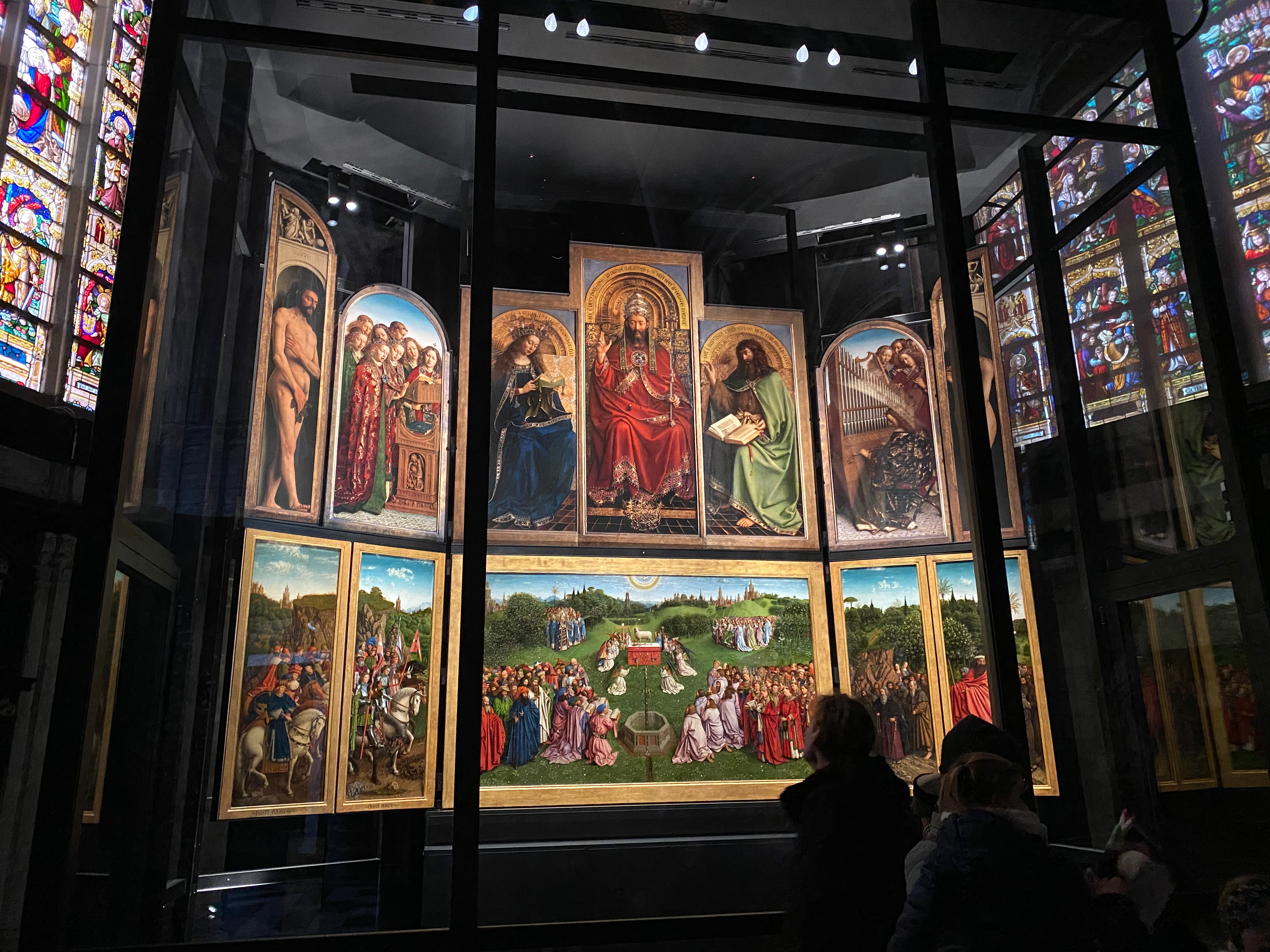
After a meticulous and highly professional restoration, conservators peeled away later layers of paint to reveal the original brilliance of the Van Eyck brothers. Today, the restored masterpiece can be admired behind bulletproof glass in Saint Bavo Cathedral, Ghent.
At a certain stage of our project, we began to wonder: was there ever an actual altar placed in front of the painting? I turned to my cousin, the art historian, and he replied:
“There has already much research been done on the original disposition of the Ghent Altarpiece e.g. by Dr. Elisabeth Dhanens and even considering the combination of that polyptich with sculpture, but non of the hypotheses has completely convinced the specialists. The oldest existing images of the chapel are too young to obtain a precise idea of the original situation. As in such chapels it was the rule that a yearly mass for the souls of the deceased and portrayed patrons was said by a chaplan, normally (a altar focs chapel being smaller than a main altar in the main church building) would have been foreseen. But we do not have an idea how it looked like.”
I wanted to buy the book by Dr. Elisabeth Dhanens, but like many art publications, it was prohibitively expensive, so I went instead to the Arts Library at the University of Ghent and borrowed a copy there.

In our project, the peeling away of layers from the Mystic Lamb becomes a metaphor for a deeper, more abstract process: the peeling away of layers of reality itself.
The Altarpiece also carries a built-in narrative advantage—its own entanglement in conspiracy. On 11 April 1934, one of its twelve panels, The Righteous Judges, was stolen and has never been recovered. This theft has inspired countless books, theories, and websites. Among them, the Righteous Judges site offers both a clear overview and an excellent timeline of the events.

On June 3, 2025, I undertook a short trip to Ghent, exploring the neighborhood in search of clues about the lost panel. Along the way, I recorded a compact photo-video documentary to capture my findings.
Here is one of the pictures: a café next to the cathedral called “De Rechters/The Judges”

Our project is multi-dimensional and undeniably ambitious. We’ve prepared a solid funding pitch, but if we wait for financial backing before taking any action, nothing may ever materialize. So instead, we’ve decided to start sharing small glimpses of the project—a slow drip-feed—and watch to see what resonates and what gets picked up.
But is there an audience for this? We hope, but don’t know. Perhaps only an audience of one. Kevin Kelly recently wrote an insightful piece on that very idea.
“From now on, the default destiny for most art will be for an audience of one, and it will abide in the memory of those who generate it. While some of this co-generated work might find its larger audience and some very tiny fraction of it might even become a popular hit, its chief value will be in the direct, naked pleasure of co-making of it.”
That’s very much our mindset—our “eye-set” too: as long as we enjoy creating, we’ll keep going.
On the more playful side, Ghent offers several signposted bicycle tours inspired by the Mystic Lamb Altarpiece and the story of the stolen panel. One of them is intriguingly titled “VermoedelEyck daar / Probably ThEyck” I plan to try it out soon and capture some photos and videos to share later.

 Petervan Studios