Emotional Zombies

Great post on “Who needs employees anyway ?”. Discovered via Fred Zimny’s Blog.

This is based on a recent “Global Workforce Survey” conducted by Towers Perrin, an HR consultancy. In an attempt to measure the extent of employee engagement around the world, the company polled more than 90,000 workers in 18 countries. The survey covered many of the key factors that determine workplace engagement, including: the ability to participate in decision-making, the encouragement given for innovative thinking, the availability of skill-enhancing job assignments and the interest shown by senior executives in employee well-being.

Barely 21%

of employees are truly engaged in their work, in the sense that they would “go the extra mile” for their employer.


Nearly 38%

are mostly or entirely disengaged, while the rest are in the tepid middle.


Surprisingly, 86%

of the employees in the Towers Perrin study said they loved or liked their job.


So, next time you evaluate your yearly employee satisfaction survey, beware of the numbers saying that the majority of employees is happy. Even if you sense in every office, corridor and corner that is not true.


Anyway, why these rather shocking results ? The article suggests a number of reasons:


Ignorance

It may be that managers don’t actually realize that most of their employees are emotional zombies

Indifference

Another explanation: managers know that a lot of employees are flatlining at work, but maybe they simply don’t care

Impotence

It could be that managers do care, but can’t imagine how they could change things for the better. After all, a lot of jobs are just plain boring.

Reputation

The company’s reputation and its commitment to making a difference in the world—is this a company that deserves the best efforts of its people;

Leaders’ Trust

Are the behaviors and values of the organization’s leaders—are they people employees respect and want to follow?


Anybody who has ever read a Dilbert strip knows that cynicism and passivity are endemic in large organizations.


image


However – in my opinion – we too easily get away with joking about cynicism. In my opinion, it is the cancer of today’s organizations that seem great at the outside, but grim at the inside. They look like golden cages. They offer all the perks possible, but they ignore 3 basic attitudes for any human being to function well.

#1: To have an open mind. Companies/People who do not have an open mind tend to retract into highly judgmental.

#2: To have an open heart. The next level is that of the heart. People who do not have an open heart have developed cynicism as a defense. They have learned NOT to show their heart.

#3: To have an open will. Last but not least, when there is no room for open will, we become control freaks.

In today’s society, driven more and more by openness and transparency, these “tricks” of judging, being cynical and control don’t work anymore.

It all boils down to 3 fundamental needs for every human being:


image


People who are not able to express themselves (anymore), position themselves as “invulnerable”. In stead of being able to receive love, they compromise on getting appreciation. And in stead of giving love, the defense mechanism becomes one of taking power. As long as we have power games between the silos, the CEO can shout “change” and “innovation” as long as he wants, at the bottom of the pyramid nothing will change.

Surprisingly, the origins of these needs – and their fulfillment or not – is formed during the first 1-3 years of your life. In other words beyond the control of the organization you work for today.

But organizations should be conscious about these facts, and offer their employees probably the most interesting perk they can give: to follow a personal development program that lets the employee explore it’s true self.

  • Who am I ?
  • Who am I in a group ?
  • Who am I in the world ?
  • Finding your true passion.
  • Finding your true purpose in life.

And hopefully finding (or founding) a company that welcomes you respectfully as an employee, and gives you the chances to develop your true potential in line with your purpose.

It reminds me of Jim Collins and a 2003 blog post found back earlier today.

The start of the New Year is a perfect time to start a stop doing list and to make this the cornerstone of your New Year resolutions, be it for your company, your family or yourself. It also is a perfect time to clarify your three circles, mirroring at a personal level the three questions asked by Smith:

1) What are you deeply passionate about?
2) What are you are genetically encoded for — what activities do you feel just "made to do"?
3) What makes economic sense — what can you make a living at?

Those fortunate enough to find or create a practical intersection of the three circles have the basis for a great work life.

An to come back to the Global Workforce Survey:

  • In every industry, there are huge swathes of critical knowledge that have been commoditized—and what hasn’t yet been commoditized soon will be.
  • Given that, we have to wave goodbye to the “knowledge economy” and say hello to the “creative economy.”
  • What matters today is how fast a company can generate new insights and build new knowledge—of the sort that enhances customer value.
  • To escape the curse of commoditization, a company has to be a game-changer, and that requires employees who are proactive, inventive and zealous.
  • Problem is, you can’t command people to be enthusiastic, creative and passionate.
  • These critical ingredients for success in the creative economy are gifts that people will bring to work each day only if they’re truly engaged. (Eric Raymond made this point way back in 2001 when he argued that in the new economy, “enjoyment predicts productivity.”)

For passionate readers, i can recommend in this context Eric Raymond’s book The Cathedral and the Bazaar.

Or a bit an older – but still very relevant book – “The Cultural Creatives


Must be that I am some sort of +


positive guy when i turn a title like Emotional Zombies” into something positive like “The cultural creatives”

As Seth Godin was saying in his today’s blog:


One of the most common things I hear is, "I’d like to do something remarkable like that, but my xyz won’t let me." Where xyz = my boss, my publisher, my partner, my licensor, my franchisor, etc.

Well, you can fail by going along with that and not doing it, or you can do it, cause a ruckus and work things out later.

In my experience, once it’s clear you’re willing (not just willing, but itching, moving, and yes, implementing) without them, things start to happen. People are rarely willing to step up and stop you, and often just waiting to follow someone crazy enough to actually do something.

I’m going

Come along if you like


Reblog this post [with Zemanta]

Blogging Innovation’s Top Ten Innovation Articles of 2009

Hurray !

I am one of the 3 winners of Blogging Innovation’s contest to identify the Blogging Innovation’s Top Ten Innovation Articles of 2009.

Good start of the year: I will get a copy of Gary Hamel‘s latest book "The Future of Management" 😉


Thanks Guys !


The least i can do is share with you the results of the vote for the best articles, and once more recommend you to subscribe to this great innovation blog.

image

Here in no particular order are Blogging Innovation’s Top Ten Innovation Articles of 2009:

Happy reading and innovating in 2010 !

Reblog this post [with Zemanta]

Sean Park’s Sixth Paradigm

As preparation of 2010, i very strongly recommend to get familiar with Sean Park’s The Sixth Paradigm post of 28 Dec 2009.

I am a big fan of Sean and his site the Park Paradigm. He was the guy who made the famous AmazonBay2015 video.

image

That was 2006.

Since a couple of days the video of his Oct 2009 presentation at Amsterdam eComm Europe is available on his post above and also the Prezi presentation is here.

The video of his presentation is 20 min. It’s worth your time.

Two extracts of this presentation should get your attention, and incentivize you to read on:

– What is the difference between a bank and a telecom company really ?

– The difference between bank messaging and telcos is disappearing.

image


image

I believe this presentation is VERY VERY relevant to financial services and concepts such a marketplaces for financial services.

This presentation gives you an absolute macro-evolution view on why this is a bound to be happen, and why the inherent structures of our current – usually vertical integrated – behemoth companies will struggle very hard to get their arms around this if they even ever succeed it spotting this as a HUGE opportunity.


The essence of the story is that those

vertically integrated companies

will be replaced/challenged

by horizontally connected entities

offering themselves

to the marketplace

via APIs


The innovation will happen

at the edges of the marketplace.

The marketplace is not even

innovative anymore.

It’s an essential piece of

the plumbing.

A lot of Sean’s thinking is based on the work of Carlota Perez and her book “Technological Revolutions and Financial Capital: The Dynamics of Bubbles and Golden Ages”

Professor Carlota Perez is a Venezuelan scholar and expert on technology and socio-economic development most famous for her concept of Techno-Economic Paradigm Shifts and her theory of great surges, a further development of the Kondratieff waves.

Carlota Perez Recurring Phases


Carlota Perez the 5 previous paradigms

Courtesy The Park Paradigm & Carlota Perez book.


Sean Park’s claim is that we are  now getting into the 6th paradigm, and this is also a switching point between 2 phases.


image


Sean Park believes the drivers will be 3-fold:

1) Cloud computing, with EVERYTHING as a Service

2) Exchange Ubiquity. The marketplace as plumbing, i would call this

3) Digitization

The last one “Digitization” seems “obvious”, unless you push this to the limits, as Sean Park does:


image


He takes the example of ISBN numbers as one of the success factors of Amazon’s book shop. Sure, there is big logistical tail to the book shop, the the core of the Amazon model is digitized, i.e the ISBN is just an identifier, linked to plenty of content and metadata, that can be accessed by an eco-system through APIs.

Where it even becomes more interesting, is where Sean mixes this up with theories of complex adaptive systems. It’s basically saying that


those horizontally integrated value chains

are chains of nearly decomposable services

And please read this in the context of nearly decomposable

financial services


And (traditional) vertically integrated companies (offering financial services) will not be able to compete successfully in rate of adaptation and fitness with these horizontally integrated “engines” or “eco-systems”.


image


Sean asks the question:

Where is the AppStore for Financial Services ?

here is the digital platform + API’s for the financial industry ?

Where are the decomposable financial services that can thrive on such marketplace ?


image


Sean has some other great disruptive statements. Like this one:


image


Its about the shift


from

image   To

image


It looks like Sean’s company is looking to invest in companies that understand how to build and offer these decomposable services.


But who should invest in the marketplace,

the plumbing,

the “dumb” but highly secure pipes

for the financial industry ?


We could let every Bank behemoth have it’s chance at it. That may be great for lock in. But in the long term, we will need something that is highly interoperable.


With interoperability

built-in

into the DNA

of this Digital Platform.


That is run as a service for the community. And to be the “invisible engine” for financial services cloud computing.

Invisible Engines: How Software Platforms Drive Innovation and Transform Industries


It’s only a very personal opinion, but i believe SWIFT is quite uniquely positioned to play this role.


Print


We are already in full prep for our 2010 SWIFT Innovation activities. It should be obvious from the above that we have Sean Park on our list of speakers to be contacted for our Innotribe event series, and who know at Sibos 2010 in Amsterdam ?

Zemanta – Part 2 – The API

My previous post on Zemanta got quite some traction 😉

image

I even got a comment from Jim Hirshfield, VP of Biz Dev at Zemanta. He sent me a link to a demo of their API. Here is what he sent me:

Peter – What a great write up on Zemanta. Thanks.

If you’re interested in the underlying technology of Zemanta and structured data, then I think you might find this demonstration interesting as well:

http://test.infoblow.zemanta.com/infoblow/galaxy/

This shows what can be done with our API when combined with other players in the space.

Regards,
Jim Hirshfield
VP of Biz Dev at Zemanta

So, obviously, i had to try it out… If you click the link above, you get this:

image

And Hudson River leads you here:

image

Yep, we get close to real-time object modeling.

For those who do not know what this is about, here is once more the video animation of what happened.

image

Have fun !

Avatar

Went to see Avatar this afternoon. Here is the link to the official website, which is an experience on itself: put the audio ON please. Have also a look at the Wikipedia site about the film.

avatar-poster

And i was lucky to see it in 3D. What an experience! First of all, it was quite some time since i ever went to the “cinéma”, and this was also my first 3D movie ever. I was absolutely surprised by the quality of it.

For me, this movie had the same impact as 1968 ! movie “2001: A Space Odyssey”

Without telling too much about the story and the plot, how i would like to fly that chopper !

And how i’d wish that the tablet PC in the movie is what Apple is going to release in Jan 2010 ! Or to have one of those fantastic displays 😉

You will also recognize music that makes you think of the final sequence of Titanic.

It’s mind-blowing. In the beginning of the film, you feel really surprised how real the characters, and the fauna and flora are. That’s ok for 5 min, but then you start realizing this goes on for about 2 hours, and the makers of the film immerse you in some semi-real environment, and you feel as being part of it, and you feel part of the story and engaged. A masterpiece.

You have to see it. Don’t compromise on a non-3D version.

And stay till the end, and have a look at the credits. An endless list of specialists that have contributed to the movie. A true 2010 Enterprise.

And to close, here is a quiz: at the end of the film, the main character Jake Sully does his last “videolog”. What is the exact date that is shown on the videolog display ?

HR and Innovation

In my previous blog “Brand, Workforce and Innovation”, i started making a case for a leadership role for HR in Innovation.

I wrote:

I’d love to see more HR in a true leadership role. Leadership as opposite to management in its narrow definition of executing a course set out by somebody else. See also below the very important message about the role for HR in creating the eminence of our workforce.

Checkout my previous post on what is meant with “eminence of our workforce”.

Rowan-blue-background124

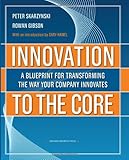
I would like to mix this with some thoughts from Rowan Gibson recently on Blogging Innovation. His full posting can be found here but i will explore some key findings below. Rowan Gibson is the author of “Innovation to the Core”.

UPDATE: what a co-incidence. Just today, Rowan Gibson did a new post in essence giving a one-page summary of his book. Here is the link to “Do you have a Corporate Innovation System?”


Innovation to the core” is about putting

radical innovation in the core of

your organization 


and is not to be confused with the discussing

Innovation in the core or beyond the core

of your product portfolio

UPDATE: “Beyond the Core” is a book by Chris Zook, and is based on the principle of adjacencies. It seems to be the bible for anybody not wanting to do anything beyond the core. It dates back from begin 2005, and is in my opinion completely outdated as a guide for innovation.

Rowan says in his blog:

In essence, that means developing a particular mix of resources, processes and values that makes it hard for rivals to match what the company does.

This has to do – amongst others – to create this eminence in the work-force.

But it is much more.

Lastly, i was attending one of our company meetings, and our CEO was doing a pitch on the focus of innovation in 2010. Great to have your CEO on board to get innovation rolling ! Really, it makes a big difference. But at the same time, the company runs a 2-year lean-program to build greater efficiencies in the company processes.

In French, we call this “Le grand écart”.

kim

It’s difficult, but not impossible if you’re fit and trained.

People do not understand this, cannot digest, don’t see the big picture, as the efficiency programs are much closer to their daily lives and – most of all – their jobs.

You could see the glaze in the eyes of some folks when we were talking innovation after having explained the lean-part.


As long as we do not succeed as positioning innovation as “buying our future”, as essential to building the greatest workforce on earth and giving the people the possibility of being part of that – with reward mechanisms – we won’t succeed in those apparent conflicting objectives.


Rowan Gibson goes on:

Making innovation a systemic organizational capability is a complex and multifaceted challenge. It simply cannot be solved with some Band-Aid or silver bullet. Instead, it requires deep and enduring changes to leadership focus, performance metrics, organization charts, management processes, IT systems, training programs, incentive and reward structures, cultural environment and values.

It’s not “good enough” to have your CEO on board. You need the full buy-in of your full Executive Committee, and – in a more complex co-operative organization like SWIFT – the buy-in of your Members, represented by the Board. We still have a lot of work to do, but i believe we are getting there. Innovation is now getting at the agenda of those deciding constituencies.

What i have not yet seen is a focus on how HR can help and be instrumental for innovation.

What companies need is not merely a pro-innovation mindset, or better brainstorming techniques, or "hot teams". It’s about making innovation a new organizational way of life; something that permeates everything a company does, in every corner of its business, every single day. It’s about infusing the entire lifeblood of an organization with the tools, skills, methods and processes of radical innovation. That’s the true imperative for rethinking the role of Human Resources. As soon as we recognize the strategic value and the immense organizational transition that’s involved in building a corporate-wide innovation capability, HR automatically moves to center stage.

And what would be the role of HR in such an Innovation context ?

Who else but HR leaders would be capable of turning a company’s strategic intent with regard to innovation into tangible everyday action? Who else could make the necessary changes to executive roles and goals, political infrastructures, recruitment strategy, broad-based training, performance appraisals, awards and incentives, employee contribution and commitment, value systems, and so on? Who else could build and foster the cultural and constitutional conditions – such as a discretionary time allowance for innovation projects, maximum diversity in the composition of innovation teams, and rampant connection and conversation across the organization – that serve as catalysts for breakthrough innovation? Who else could ensure that each employee understands the link between his or her own performance (as well as compensation) and the attainment of the company’s innovation strategy?

In short, who else but HR

leaders could create a company

where everyone, everywhere,

is responsible for innovation

every day whether as an

innovator, mentor, manager, or

team member?


I have become a big believer that companies need an innovation system where


everybody in the company

becomes an innovator


It’s almost a human right of any employee in a company, i would even venture it is a moral obligation for any employee in a company to be an innovator himself. It is NOT the sole privilege of the innovation team to come up with ideas, on the contrary. See in this context my previous blog on The Holy Fire.

Rowan Gibson has a great closing in his blog post:

The sad reality is that too many CEOs overlook HR’s potential in this regard. They still think of HR solely in terms of regulatory compliance, hiring and firing, employee comfort, compensation and benefits. Notably, Jack Welch, illustrious ex-CEO of GE and arguably one of the greatest corporate leaders of our times, sees things differently. In a recent column in BusinessWeek, he writes that


"every CEO should elevate his

head of HR to the same stature

as the CFO."


Hope somebody reads this.

Need for a new currency based on abundancy

Thanks to my subscription to Fredzimmy’s blog, I found this wonderful blog from Esko Kilpi.

image

I really recommend you to explore this site from A to Z.

  • Look at the wonderful slidedeck on Slideshare
  • Have a look at the Flickr photos
  • Have a look at the Bookmarks

image

MIT Media Lab Human Dynamics Group, Howard Rheingold (one of the first ever “internet”-books i ever bought,…, Barbarian Blog.

Yummy, Yummy. This is great stuff for a Sunday afternoon. So inspiring. Delicious 😉

This way, i discovered the FANTASTIC Web 2.0 Expo speech of Douglas Rushkoff about Radical Abundance.

It is a 15 min video, and worth every minute:

Not sure if the video embed worked, so in any case you can find it here by clicking the below image.

image


Some mind-blowing quotes (in 140 characters ;-):

  • The operating system for money is obsolete…
  • Abundance based currencies and monopoly based currencies…
  • Central Bank Monarch imprinted currencies are scarcity based currencies…
  • The money we use today was created so that rich people to stay rich by being rich (and lending) rather than doing anything…


google-coin

  • Our economy is based on the growth of interest
  • The people lending money get richer, the people creating value are getting poorer
  • But, what happens if you get something that’s abundant ? That you can’t make scarce.
  • The computers and networks change the “centrality” of value creation
  • You are now able to exchange value directly between one another rather than through a centralized currency
  • Optimize human beings to technology
  • Technology is more compatible with the values of efficiency than with all the other human values
  • Now you’re open and free to Google-Ads
  • Web³ will be won by the power of those who can index and aggregate. Is that what we want ?
  • Open Source and Crowdsourcing are not the same things
  • This notion of “free” leads to a society of copying, to no creativity, to no originality, to DJ’ing of culture
  • The abundance of genuinely creative output is declining
  • What we need is the development of a digital culture that respects the labor of individuals
  • What we need is the creation of new modes of currency based on abundance rather than scarcity.
  • I am talking about the original PayPal dream before banks asked them to be regulated like… banks
  • The next BIG thing are from people who will create genuine alternative electronic currencies and P2P exchange that do not involve cash.
  • I am talking about primitive local currencies such as Timebanks, Itex, Superfluid’s Quids
  • Cash has already lost its utility value, as it has been sucked out into investment capital, in the speculative marketplace
  • The only real competition against a Google universe (and their ideas of openness – see last weeks Google Blog post about openness btw) would be peer to peer exchange
  • We are not suffering from an abundance of creativity, just from an abundance of productivity, efficiency and openness.
  • If Web² leads to aggregation and indexers, then genuine P2P will lead to bottom-up value creation.
  • The next era is not about scaling-up anymore, it’s about figuring out how to exchange value, in stead of extracting value.
  • We are at a crossroads: right now we have the opportunity to optimize our systems, technologies, currencies to humans in stead of optimizing humans to them.


Reblog this post [with Zemanta]

Education, Elites and Bologna

I was watching this morning a television program with Christine Van Den Wyngaert.

christine

The program was in essence about her views and role in the Criminal Tribunal for the former Yugoslavia, but mu attention was triggered by something she said in the introductory part of the interview.

She was referring to the dramatic decrease of the quality of our education, mainly due to the Bologna Treaty. Just have a look at the Wikipedia link or do a google on Bologna Treaty. Or have a look at the Europa site. The first sentence on that site reads:

The Bologna process aims inter alia at making divergent higher education systems converge towards a more transparent system by 2010, based on three cycles: Degree/Bachelor – Master – Doctorate.

I always get irritated when people talk about “convergence” or “consensus” or “compromise”. For me these terms have a built-in notion of quality-loss.

Indeed, Christine Van Den Wyngaert explains that “thanks” to this treaty it was not possible anymore – no, even forbidden – to offer education with the same high quality standards as we used to have.

All this in the name of democratization of education and to give everybody access to higher education.


She went on by stating that many base foundation courses of general knowledge were being reduced to the level of “kindergarten”.

And that for some professions – definitely for a judge or a lawyer – good solid foundation education about history, society, etc are quite fundamental for doing the profession.

It is getting pedantic in a sense that even talking about creating an “elite” of scientists, judges, of whatever profession starts being banned straight-away.


I do not want my child being educated in mediocrity.


It made me think of the book “The Five Minds of the Future” by Howard Gardner.

21E fDecyLL._SL160_AA115_

I am reading it on my Kindle as we speak.

In that book, Howard Gardner arguments that education should not only be based on memorizing lots of information, but that education (whether at school or at home) should more focus on some essential skills that will be needed in the future (of real-time, high-information-based-society).

He calls these the 5 “minds” for the future. They are:

  • The disciplined mind
  • The Synthesizing mind
  • The Creating mind
  • The Respectful mind
  • The Ethical mind

About these “minds”, Gardner says:

Any individual with a deep understanding of a topic or method can think about it in a variety of ways. Conversely, an individual exhibits her current limitations when she can only conceptualize her topic in a single way.

This is very similar to having a very limited palette of ways to express yourself. Sometimes you hear somebody saying “I cannot dance on this or that sort of music. If i have to dance to that music, i cannot be myself (in an authentic way")”.

That’s pretty poor, if you ask me.

The art is to expand your palette of ways of being yourself in different situations.

Having the right to (the old) high standards of education, being trained in the 5 minds of the future, learning to be authentic in many different ways: all this should be part of the educational package of any young person having some ambitions for the longer term future.

I have come to a point where i do NOT believe anymore that our politicians and the whole system of lobby groups will help us getting there.

I was making the same reflection some weeks ago, when we were having our meeting of the Think Tank on Long Term Future, when i heard my friends complaining on how bad is it is getting in Flanders with respect to getting innovation on the political or any other agenda.


The innovation and education and

cultural agenda

get drowned into a political swamp

of consensus and power games


The end result is often or nothing, or something very grey (because of the consensus), or something very Kafkaesque.


I am getting convinced we have to do it


ourselves

Bring together some smart people in our think tank, and get private funding for the innovation, education and cultural development of the Generation-M.

Because they are looking for the things that really matter.


Reblog this post [with Zemanta]