A little bit of heaven

We are having some fantastic spring weather here in Belgium. Almost summer time with blue skies and temperatures of 25° C. But it is still spring. End April 2011.

On top of it, I took some days off during this week. I am usually very lucky when planning my days off: the weather gods are with me. So a good-weather forecast may be to check my calendar.

clip_image002

However, this blog is about some of my strong up-downs during this week.

Earlier this week, there was something work-related that really made me very angry. But angry like in furious, raging, rabid. I could – and did – slam doors and that sort of stuff. Not really a proof of emotional intelligence, but anyway. I am not aware, present when I am in this state.

clip_image004

And afterwards, I always try to spot what triggered this emotion, what need was not fulfilled, what request I can make to the person triggering all this. What made me awake/aware was a remark from my 5 year old daughter.

She saw I was angry and said:


“Daddy, first you have to calm down”


My wife told me this was something little Astrid picked up watching the television program Ni Hoa, Kai-Lan, a children’s television show. There is a great section about social-emotional learning.


clip_image006


My daughter is such a source of authenticity. I envy her openness to the world. Always curious, discovering, eyes wide open, giggling through every day. Where have we adults lost that feeling ?

Which experiences in life made me suspicious?

Where did I lose myself in personal drama?

Why is that ugly ego-monster visiting me so often?

What happened?

The angriness is now over, I have internalized what happened, and have mentally forgiven the author of the crime. And for this blog story, it is absolutely irrelevant who and what caused the emotion.

I just want to contrast it with my feeling yesterday, which almost presented itself to me as a perfect day.

Our little daughter was on holidays (this is not the reason why it was a perfect day) on the farm with my parents in law.

So the house was – everything compared – quite silent that morning. I went out for getting some fresh bread for breakfast. Wow ! The sky was already as blue as it could get, and I could smell the last drops of dew on the grass and the leaves. There is also a great sense of purity in the early mornings: not only smell, but also silence, and a general sense of peace.


A bit the same purity

as my daughter.


Back home, the smell of freshly baked bread, the toaster, fresh strong coffee, the soft light, the Sunday-lazy flipping through some papers and magazines, made it a start of what one usually experiences in a luxury hotel at some exotic destination.

But this was home


The day continued with some further hanging around, some contemplating, some shopping (bought a new grid for the BBQ), and then later in the day a nice bike ride or 2 hours. Really relax ride, not forcing anything, enjoying the soft warmth of the sun on my skin, and wandering and wondering around the landscape with all trees, and leaves, and plants in their freshest brightest spring green.

By the time I got home, it was about time to light the barbeque.

My barbeque is a very simple one. Not any fancy one. Just some charcoal and my brand new barbeque grid.

clip_image009

All the time, no rush.

First surprise my wife with a glass of cool sparkling wine. She was relaxing in the lounge, enjoying the soft evening sunshine. I said to her: “hey there, listen”. She asked me “to what?”.

I just wanted her to listen to the silence of birds, the crackling fire, some far away farmer on his tractor, an airliner at 33,000 feet tracking its stripes in the sky.


She laughed and said

the sun was feeling

like a soft and pleasant shower

of light and warmth


The menu was super simple. I am getting here is some minimalist mode. Just a nice piece of loin, well-seasoned with some salt and black pepper, and rubbed in some fine virgin olive oil. I served it with really fresh salad and tomatoes from the garden, some boiled eggs. And last not least – and this may sound arrogant – my world best French fries. All cooked to perfection. The pepper, salt, olive oil on the table under the parasol. A really good bottle of Spanish Rioja, in promotion at 4€/bottle and very good.

After dinner – fully satisfied – laid down myself in the lounge having a cigarette and a last glass of wine.

A little bit of heaven, I said to myself. I made a note, and put it next to my pc to write a blog the next morning.

Innotribe Mumbai: Newsflash #1

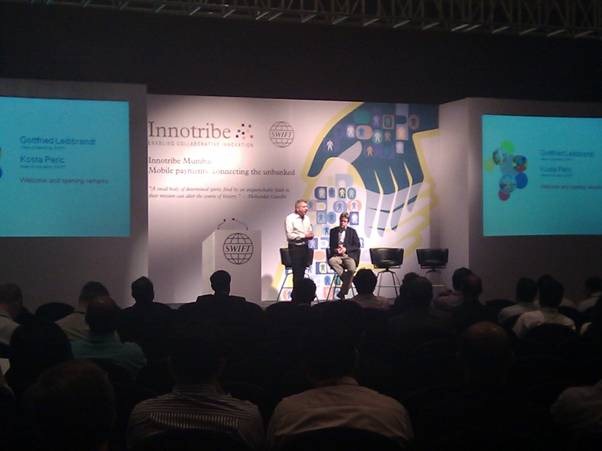
By now, you should know that on June 1-2 2011, Innotribe will host its first standalone event in Mumbai.


Print


Innotribe Mumbai – Mobile payments: Connecting the unbanked will focus on the opportunities that high mobile penetration presents to take banking services to the historically ‘unbanked’ communities – and explore the ways in which mobile technologies are being used today and can be exploited in the future to enable greater financial inclusion.

Yesterday, we pumped out our first world-wide press-release and we updated the event site with the latest and greatest speakers confirmed. You can also follow latest additions to the program via the Innotribe twitter.

Today, I would like to share some insights in the interactive sessions, the so called “Innotribe Labs”, famous from Innotribe at Sibos.

We have three Innotribe Labs:

  • On at the end of day-1 on banked-unbanked
  • Two in the afternoon of day-2: one called “The Mixer” and one called “Mobile Arena”

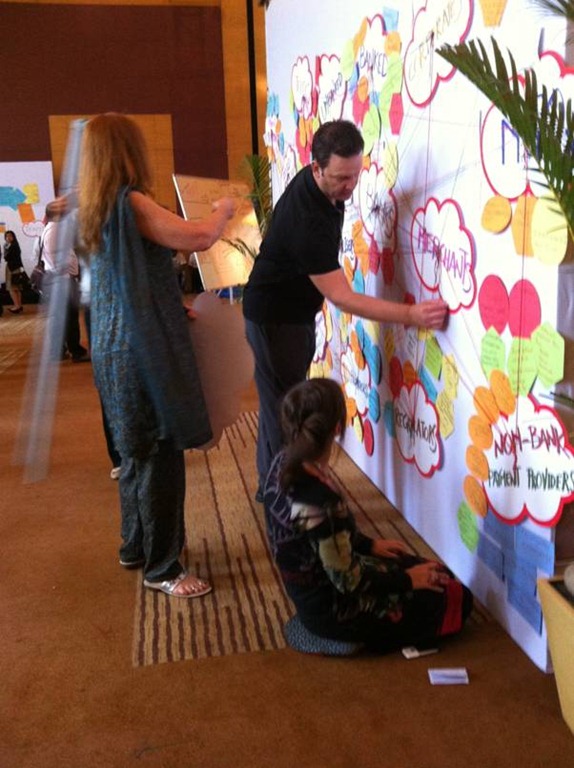
Innotribe Labs are highly interactive workshops, very well pre-designed and executed by our innovation team under the facilitation leadership of Mariela Atanassova. Whereas the Labs are still under design – trying to leverage the speakers and experts that have committed for these Labs – I can already give you a flavor of what’s going to happen on 1-2 June 2011.

1 June 2011 – 15:30 -17:00 Innotribe Lab “Banked – Unbanked

  • If we can pull it off logistically, we plan to take those interested by bus to the slumps, 2 miles away from the luxury hotel where we hold Innotribe Mumbai. Our plan B is to use video material. It seemed to us that only if you have seen the slumps, you can have a discussion about banked – unbanked.

slump

  • Nokia will set up a live environment of one their latest project with UBI targeting more than 30,000 villages in rural India. You will be able to experience hands-on what banking the unbanked using cheap mobile device means.

Nokia

  • That will be followed by a Lab immersive experience, designed by Innotribe Facilitation Studios.

2 June 2011 – 13:30 – 15:00 Innotribe Lab “The Mixer”

  • We have the ambition to create “serendipity” or (un)planned encounters. We want to “mix” local and international entrepreneurs in the mobile space and exchange experiences. What works, what not ? What can we learn from each other ? Where does the investment money go ?
  • We are proud to collaborate with Ashoka. Ashoka is the global association of the world’s leading social entrepreneurs—men and women with system changing solutions for the world’s most urgent social problems. Since 1981, they have elected over 2,500 leading social entrepreneurs as Ashoka Fellows, providing them with living stipends, professional support, and access to a global network of peers in 70 countries.

ashoka

  • I have seen the pre-selection of Ashoka Fellows that we’ll have the pleasure to welcome in Mumbai. This will be an awesome experience

2 June 2011 – 15:30 – 17:00 Innotribe Lab “Mobile Arena”

  • We will indeed ask all participants to sit in a big circle, forming a real “arena” discussing mobile payments.
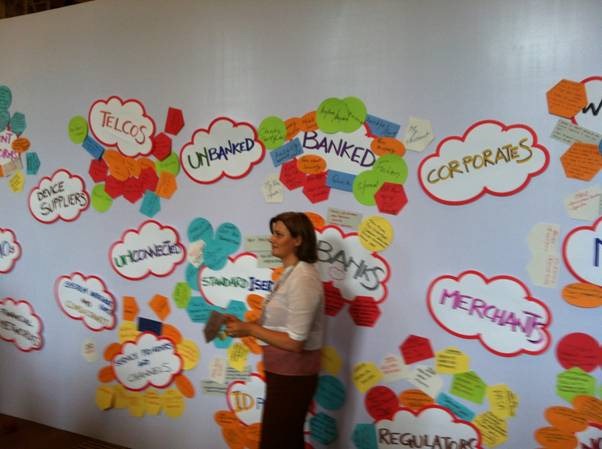
  • The circle will be segmented in different groups representing banks, unbanked, telcos, platform providers, etc, etc

arena

  • Each segment or slice will be represented by a pre-assigned spokesman.
  • The spokesmen will fight in the middle of the arena, in the “snake pit” in the middle of the arena.
  • The ambition of this session is to come to some recommendation on how to create synergies in this space, to avoid that all parties try to re-invent the wheel, and to see if SWIFT Innotribe can play a role in enabling collaborative innovation.

You got it: Innotribe Mumbai will be a unique experience. Combining an impressive set of speakers with our proven interactive Innotribe Lab format.

As somebody said after our Innotribe Lab at SOFA begin March 2011: “I will never look to SWIFT in the same way, you guys are much more that a network, a BIC code and standards. You are a true innovation community”.

Oh yes, there is one more thing: I have 5 free passes for this event. Send me an e-mail (peter dot vanderauwera at swift dot com) if you want one. They will be given on a first in first out basis. So, you have to be fast !

See you in Mumbai on 1-2 June 2011. May the Innotribe vibe be with you.

Cross-posted as well on the swiftcommunity.net blog at the innotribe twitter account

Bring Jack Back (Update: Jack IS back)

Update: just minutes after posting by blog, it was announced that Jack IS back at Twitter, now as “Executive Chairman”. Check-out the news everywhere or here at ReadWriteWeb.

I am getting so inspired by the fabulous Jack Dorsey from Square. Watch this video and the full transcript on Techcrunch. Read David Kirkpatrick’s article in Vanity Fair with the title “Twitter Was Act One”

He makes me think of Liam Gallagher from Oasis. He has something “very British”. He is stylish. The same arrogance. The same pureness. The same design and drive for perfection. And skimming down until only the essence is left over.


One comment reads: “you know what ? Maybe it’s too sounding like the beatles or John Lennon (that was my first reaction). But as a great beatles fan, i’m just glad to see some guys carrying the torch and able to do great music”


beadyeye1stpiconline (1)


And have you seen the interview over the week-end (I think it was BBC) with Liam as part of the launch of the new post-Oasis band Beady Eye ? It seems that the voice of Liam was recorded without any effect, no echo, nothing (not the case in above video).


Pure

The essence

The minimalism of Twitter


Which brings us back to Jack. I believe Jack is the John Lennon of Payments. That Square means for payments what The Beatles mean for music.

Back to the video.


image


Some quotes from the different articles and transcripts, to get you a good idea how genius this guy is.

  • “Little Jack Dorsey was obsessed with maps of cities”. Read my recent posts and thinking about the connected economy, the connected company, the connected team and the connected value. They happen also to be the big trusts for our Innotribe at Sibos 2011 in Toronto, later this year
  • he studied for a year to become a certified massage therapist (Martine will love this)


“Payment is another form of communication,” he says, “but it’s never been treated as such. It’s never been designed. It’s never felt magical. We’re the only payments company in the world that’s concerned with design,”

  • So the architects designed this gorgeous bridge, but the problem with the Golden Gate is that this is an extremely tumultuous area, if you’ve ever sailed through this or taken a boat through this, the waves are immense. Or surfed through it, which is more dangerous. It’s a disaster, I mean all the weather of the Bay is being forced through this one single point. So, all these elements create this perfect storm of turbulence. It’s extremely deep in the middle and it’s an epic span, so this was not an easy challenge.
  • And a lot of people think of design, when they hear the word design as visual, something that looks pretty.


Design is not just visual, design is

efficiency

Design is making something simple

Design is epic

Design is making it easy for a user to

get from point A to point B


Reliability is a feature. This is what Brian said earlier, availability, reliability, and staying up, that’s a feature and that’s a product, and it has to be well-designed and thought after and considered, and that’s what we’re doing.

I think I’m just an editor, and I think every CEO is an editor. I think every leader in any company is an editor. Taking all of these ideas and you’re editing them down to one cohesive story, and in my case, my job is to edit the team, so we have a great team that can produce the great work and that means bringing people on and in some cases having to let people go.

This is the bridge I want to cross. [Shows Golden Gate]


This is how I want to arrive at a destination:


This is classy

This is limitless

This is inspiring

This is gorgeous


My dream is to have him at Innotribe Mumbai, where we’ll talk and discuss about Mobile Payments, connecting the un-banked and financial inclusion.

Would really like to hear Jack’s view on design and perfection for that.

Bring Jack Back. To be classy, limitless, inspiring and gorgeous.

Innotribe Mumbai: Mobile Payments–connecting the unbanked

Innotribe at Sibos 2010 in Amsterdam was such a success that we decided to start running stand-alone Innotribe events. The first event in its kind is Innotribe Mumbai on 1-2 June 2011. It’s not an or/or story. We keep on organizing Innotribe at Sibos.

At Sibos this year, we will have 3 technology inspired topics: Big Data, Digital Identity and Social. We will also have 3 non-technology inspired topics: Corporate Culture, Where does the investment money go for innovation, and New Capitalism.

Some of the Innotribe themes of 2010 will go mainstream at Sibos Toronto: Cloud computing and Mobile are two excellent examples. Other new topics will be introduced: they have the potential to go mainstream in 2012 or 2013.

As you can see, the stand-alone Innotribe events are part of our build-up towards Sibos Toronto.

What we try to do at those stand-alone events ànd Sibos is 3-fold:

  • Extend the type of audience for our events: more innovators, movers and shakers and local entrepreneurs
  • Extend the type of content. Mobile, big data, social, digital identity. Not necessarily that SWIFT wants always to play an active role in these, but to create an active and collaborative conversation with the financial industry on these topics
  • Extend the brand of SWIFT into a brand that relates to innovation

SWIFT is therefore pleased to invite you to attend Innotribe Mumbai, a two-day event that will bring together a powerful combination of people from banks, carriers and mobile device, platform and service providers – as well as local and international entrepreneurs – to explore the ways in which mobile technology are enabling greater financial inclusion. What will the financial and telecoms industries look like in the future, and what can you do to help shape them?

Mobile paymentsInnotribe events are built around an energising mix of education, new perspectives, collaboration and facilitation. Innotribe Mumbai participants will be able to learn from each others’ opinions, ideas and business models. Also expect exposure to longer-term perspectives through discussions about the future of money and the dramatic business model shifts market participants will likely undergo as that future becomes a reality.

The detailed agenda is shaping up, and we have already confirmed the participation of some of the most influential innovators in our industry and beyond.

Mark the date in your calendar and follow us on Twitter. We just published a very tentative program for this event, and registration will formally open on 21 March 2011.

Hope to see many of you there.

May the Innotribe vibe be with you.

How to create deep sustainable change

iStock_000011991468Medium

In my job, I hear many executives asking “to shake the tree”. What does that mean ? The temptation to just “Pump-up-the-volume” or let the innovation engine run “red hot” is just around the corner. “Let’s come up with a list of hundreds of initiatives and “tricks”, and we’re done.”

Tick ? Don’t think so.

Before discussing the “how”, any organization should first have a look at the “why”.

Usually, the why has to do with creating a more agile organization, waking up the entrepreneurial spirit, in other words to “un-trap” the creative juices.

And to do so, work is needed at the foundations. It’s about making the organization healthy, fit and un-trapped. This has nothing to do with six-sigma, lean, or other way to improve the efficiency of the organization, the efficiency of the organizational “body”.

What we are talking about here is


the fitness

of the organizational “mind”


iStock_000007248761Medium


The expected outcome of pumping up the volume and the fitness of the organizational mind is a


connected organization,

connected teams,

connected people,

connected values.


With connected healthy internal and external primary and secondary circuits.

In between the “why” and the “outcome” is the “how”: the set of tricks, tools, and processes that enable a connected and innovative organization.

As mentioned above, I can easily produce a list of hundreds of new or enhanced innovation initiatives and that set of “hows” will be the subject of one of my next blog posts called “Pump up the (innovation) volume”.

But first, we must focus on the “why”.

We must make sure

that the roots

of the mind-tree to be shaken

are healthy


Make sure that the “connections” between the people of the organization are open and healthy. That the rotten apples – both people and processes and cultural dysfunctions – are eradicated. That the connections are such that they encourage acceptance.


Acceptance at several levels


Let’s look at a framework for these connections, the circle of acceptance.

image

All credits for this framework go to André Pelgrims, who is our team coach for team-dynamics. You can read more about André here. Every organization should hire one or more “André’s” to make their culture programs real. (Disclosure: I have no shares or business relation with André, but he was one of the coaches of the Leading  by Being (LBB) program I already mentioned so many times on my blog; stronger, LBB was the reason to start this blog)

The first level of acceptance is being accepted as a person. In our full authenticity. Watch carefully yourself when you meet a person for the first time. What is your screening mechanism: is it respect, space, trust, or something else ? And how much are you trapped in this specific mechanism ? A person that “passes” this initial 15 sec check will be accepted by you as a person. The effect is that person will give you energy.

However, if that person pumps-up its space, trust etc, then that person will start being an energy drain for her colleagues. It happens when people bring into the team the baggage that is not related to work. They don’t even have to talk about it, they bring it unconsciously with them. The art is to be aware of it, in the present moment. And not let it develop as the personal drama. Then it becomes an energy drain. Personally, I need space and silence. If not, I get drained.

“Energy Drains”

The second level of acceptance is being accepted in your role. Only then you can create impact. When people make themselves (ie. their role) look bigger than they are, then we enter the space of

“Power Games”

The third level of acceptance is being accepted as a change agent. Only then you can create a new type of dynamics, only then you have the right to shake the tree. It’s the moment where you don’t have to sell yourself anymore, you are being called. Again, when one tries to show bigger than one is, one ends up with

“Illusion Building”


The awareness of these circles of acceptance are particularly important for innovation teams, who are supposed to keep the fire of innovation burning throughout the organization. Not only the innovation team must maintain healthy connections within the team, but especially in all its relations with its stakeholders. You can shout “change” as much as you want in an organization, if you are not accepted as a person, in your role as innovator, and genuinely being called, you can forget about all the “tricks” you have in your pocket. They remain what they are. Tricks.

Therefore, I prefer to being called as-a-person. The tricks are a bonus. Some people think they have no tricks. I don’t believe that. But even in the hypothetical case that you don’t have tricks, you can still give energy, have impact and being called as a change agent IF you are accepted as a person.


I want to be called as a person

I want to be loved


Recognition is not good enough. Recognition is like a compromise: if I am not capable of receiving love, I compromise on recognition. That’s why a tap on a shoulder, a holding arm, a hug are only relevant if they are real. The animal in us just senses when these are un-real.


So, what does it take to be real ?


In addition of having acceptance at all levels, what else is required ? For me what makes the real difference is the way a person approaches me with a healthy mix of love and courage, combined with an equally healthy balance of guilt, shame, and vulnerability. With respect for primary and secondary circuits.


The Love/Courage mix:

image

  • I may have a lot of courage when giving feedback to a colleague, a partner, a business partner, etc. But if this courage is not rooted in a feeling of love for that other person, then I end up with “active destruction”, the effect of a dirty forward tackle in football. Many companies have unfortunately a culture of forward tackle.
  • On the other hand, when I approach the person with love but without courage, then the effect of my intervention is one of “passive destruction”, unaware of the emotion

The Guilt/Shame mix

image


In a very similar way, guilt and shame go together. Guilt without shame is inwards focus. It leads to depression, in a slow and creepy way. Leading to aggression against yourself. On the other hand, shame without guilt is again like the forward-tackle. Not creepy, but blow in the face, active aggression against yourself.

Vulnerability. I have already very often mentioned vulnerability in my blog posts. Suffice to say here that showing vulnerability in the safe primary circuit should be ok. Only works of course if the connections in that primary circuit are healthy.

canv-09-314x400

Illustration by Hugh MacLeod

Secondary circuits. Last but not least, let’s pay some attention to secondary circuits. There is nothing wrong with secondary circuits. On the contrary, they need to exists to feed a healthy primary circuit, to be supportive of the primary circuit. The problem starts with secondary circuits that are NOT supportive to the primary, and even are counter-productive. Those are the rotten apples. But the secondary circuits need to be made explicit. And for a really healthy system, it would be better that many of the secondary circuits’ discussions are held in the primary circuit for the benefit of the whole team.


Our goal should be

to make the primary circuit stronger

than the secondary circuits


and not the other way around in many organizations.

What happens a lot in “shake the tree” experiments, is that one or more levels of acceptance are skipped. Or that awareness about the effects of energy drains, power games, and illusion building are being denied. Or that we don’t expose the right mix of love/courage, of guilt/shame, of vulnerability in our day to day connections. That we start jumping into the “how” before questioning the “why” and the desired outcome.

Therefore, let’s first check if our connections are pure, healthy and real. This is the only possible foundation for a deep change that is sustainable on the long term.

Digital Identity Tour Part-4: Austin–Munich–Toronto

This post is a fourth in a series on personal digital identity. Part-1 “The unpolished diamond was published here in August 2010 and Part-2 ‘The Digital Identity Tuner” was published here in September 2010. Part-3 “Personal Data Something” was published here in December 2010.

The journey continues. Now we move into Austin for TEDxAustin and SXSW Interactive.

You can follow the livestream here. It’s a fascinating way to spend your week-end and get inspired.

image

Gary from CLOUD is on stage today 19 Feb 2011 at 4pm Austin time.

Some time ago, I teamed up with the folks of CLOUD, Inc. (www.cloudinc.org), a non-profit technology standard consortia founded in March 2009 and based in Austin, Texas. “CLOUD” stands for Consortium for Local Ownership of Use of Data. I am on their Strategic Advisory Board, together with Charlie Hoffman, Director of Innovation, UBMatrix, a leading provider of XBRL software, Anthony J. Barrett, Senior Vice President, Integration, Walgreens, and Dan Walker, former Chief Talent Officer for Apple and GAP.

image

The power of people. Connected.

If you have read my previous post on team dynamics, then you may have noticed a pattern developing in my thinking. With kudos to co-thinkers Verna Allee from Valuenetworks.com and Mela from the SWIFT Innovation Team. We had a great synchronicity chat in London, and what emerged was a model for organizing our thinking for Innotribe at Sibos 2011 along the theme of the Connected Economy.

album_large_3991397

Suddenly, it all made sense. One could zoom into the Connected Economy into different facets such as:

  • our connected companies: this is where we could talk about company culture and new organizational models that do away with the silo construction of most companies
  • our connected teams: how we create healthy team dynamics, how we collaborate, how we realize full potential with social cognition
  • our connected self: acting from our authentic strong self, this is more about personal and corporate values for the next decades. This is also about our Digital Identity/Footprint. The power of people. Connected. What CLOUD is all about.
  • our connected value: new thinking about capitalism, social currencies, financial inclusion, P2P networking, money vs. value, the accounting for intangibles

What we want to do at Sibos and our Innotribe Events is to create ongoing conversations, with the rigor around these conversations, focused around sense-making. But let the future emerge.


The art of the half finished


Where the event is the middle of a process, not the end-point. Leaving enough room for others to fill in, for ideas having sex. Where humans can get inspired by something else than logic.

CLOUD has been featured as a keynote speaker at SWIFT’s annual Sibos conference in October 2010 in Amsterdam and will be speaking at TEDxAustin on February 19, SXSW Interactive on March 14 and leading a panel at XBRL22 in Brussels the week following the European Identity Conference.

image

For the Munich KuppingerCole conference, Gary submitted a speaking slot by CLOUD and Co, and we just got the news that the proposal was accepted. I let you enjoy what Gary put together:

In March of 2010, SWIFT’s Innotribe hosted last year’s European eID Interoperability Conference. Peter Vander Auwera, Innovation Leader at SWIFT, and former colleague of Kim Cameron has said this about CLOUD, Inc. in his post on Identity Rights 3.0: "I repeat myself by saying that this CLOUD vision goes way beyond the web of pages, goes way beyond the early thinking on Semantic Web. It is in essence proposing an identity architecture for the Internet. Because the internet is broken. It was never designed with identity in mind."

CLOUD sees the issue of identity as one that goes far beyond log-ins and enterprise management. The issues of identity, privacy, security, data portability and governance are not separate issues but simply separate axes of the same problem.

CLOUD sees the answer to these issues coming from a new language for the Internet, so as to extend the revolution started by TCP/IP and accelerated by HTML. CLOUD’s CTML (contextual markup language) is a language for people. however and not another language for web pages, like HTML.

CLOUD also sees the answer going beyond current approaches like OpenID, which assumes the web paradigm in its log-in approach. Even with the same log-in, my ‘identity’ could change over time.

CLOUD also believes that a multi-dimensional approach is vital. WHO I Am™, WHAT I Am™, WHEN I Am™ and WHERE I Am™ are all axes of my identity and vital to a new language for people and "the identity architecture for the Internet" as Peter said about CLOUD.

Our goal is not to replace other standards nor displace for-profit initiatives but to instead put a new foundation in place for the Internet that makes the approaches to privacy, security, data and identity consistent and architecturally-driven.

We would see our thought leadership keynote (and/or panel) outlining what this paradigm would mean to the future of the Internet and how this new language would not only change the approach to identity but will transform industries from banking to health to education. Our recent post on the WHO I Am™ dimension would provide the foundation for our comments and panel: http://cloudinc.org/?/ecosystems/article/cloud-dimensions-who-i-am.

Suggested Panelists:

  • Gary Thompson, CEO CLOUD
  • Peter Vander Auwera, Innovation Leader, SWIFT
  • Kaliya Hamlin (@Identitywoman), Founder Internet Identity Workshops
  • Kim Cameron, Microsoft Distinguished Engineer and Chief Architect Identity 
  • Vint Cerf or Bob Kahn, Founders of TCP/IP

Some people say we try to boil the ocean. I don’t think so. Why would we limit ourselves to a narrowly defined vision of identity being a federated authentication issue ? Identity and Digital Footprint are much more than that and so important for our being as human beings in a permanent digital reality.

n06_freddy-cerdeira

That’s why I am so proud that this advanced vision now get exposure at TEDx Austin, at SWSX Austin, at the European Identity conference, at XBRL, at the KuppingerCole conference in Munich. And we will bring it back to Innotribe at Sibos 2011 as part of the connected self. As part of some new work we just kicked off last week in London.

Some folks give me pushback. They are warned: I am at my best when constrained. My innovation juices then flow at full debit. Then I want to think and work out-of-the-box, no – even better – I want to burn the box.


the optimist in me


The times of being mister nice guy are over. Of being a mediocre optimist, or pessimist, or realist.

We can’t live

with mediocrity

anymore


Who is going to stop us ? The better question is: who is a believer and wants to support us? Are you ? Then join is on this digital identity journey and


be your digital self !

Enhanced by Zemanta

Team dynamics and the fiction of friendship

Check out this wonderful RSA animation about Steven Pinker’s “Language as a Window into Human Nature”

image

Steven Pinker shows us how the mind turns the finite building blocks of language into infinite meanings.

But I looked at this animation and was triggered by how much this relates to how our economies, companies, teams, ourselves and even exchange of value between these entities are fueled by the relationship mechanisms described in this animation.

In essence, Steven Pinker describes 3 relationship types:

  • Dominance relationships. Pretty self-explanatory and what used to be used by primates, but still existing in some companies
  • Communality relationships. The mode is “You share and I share alike”, for example in a couple or between friends
  • Reciprocity relationships. Business like tit for tat exchanges of goods or services that characterizes reciprocal altruism. This is what we do in commerce. Exchanging money or to a larger extent exchanging of value.

But by not saying the things as they are, and mixing up the conventions that apply to each of these relationships, you end of with…


awkwardness


Awkwardness in the relation, in the team culture, in the team dynamics and illusions of friendship and love. In dating – see my prezi on how to make babies – this awkwardness leads to “the anxieties of dating”.

And it really feels awkward when the confused give a tap on the shoulder or hold an arm, skimming the borderlines of trust.


album_large_3992338


But saying things “as they are”

also means

taking risk,

getting naked with no defense

or fall-back position

in case it goes wrong


That’s why you best do these things with the guidance of an experimented coach. Somebody who can guide and learn you to take personal leadership, daring to step forward, and daring to take care of expressing our own needs. It’s carving in the underlying energy streams under the table, where emotions such as anger, joy, hate, rejection, love, etc live. To discover and get rid of the hidden agreements and closed circles of the past. Nobody likes being rejected or worse being ignored.


6a00d8345189aa69e20148c85f6601970c-320wi


Instead of “getting used to it”, we could develop an emotionally intellectual language for expressing our needs. Something like:

  • Trigger: “this specific behavior causes an emotion with myself”
  • Emotion: “it makes me sad” or “I feel hurt”
  • Underlying need that is not fulfilled: “the need to fully contribute value” or “the need for a unique learning experience” or “the need to be respected” or “the need of not being ignored” etc, etc
  • And attaching to this need a “request”, an “invitation”: like “I invite you to fully include me next time”

All this in full authenticity, without manipulation, hidden agendas, power games, and other sorts of obfuscation of the reality.


EGYPT-POLITICS-UNREST


But something fundamental can change when people meet, when they group in crowds. When they can look each other in the eyes. On a broader scale, think Egypt, Tunesia, Bahrein, etc: when people get together at one place, everyone in that crowd knows that everybody knows that everybody knows.


It leads to the collective power

to challenge

the authority

of the dictator


It’s the story of the emperor’s cloths. And explicit language is an excellent way of creating mutual knowledge.


What if we would start applying

these relationship principles

to our connected economy,

to our connected companies,

to our connected teams,

to our connected self,

or even to our connected value?


This would btw be a great way to organize and thinking and collaborations for Innotribe at Sibos 2011 on 19-23 September 2011 in Toronto.

  • Using the theme of the connected “something”, we could bring in technology topics like Digital Identity, Social Cognition, Big Data.
  • We could also experiment with some non-technology trends related to Social Capitalism, Future of Money/Value, Corporate culture, Where companies invest long term.

But to come back to the main flow of this post: the Egypt principle of mutual knowledge in a crowd also plays at a smaller level like a team.

But here is the paradox and at the same time the risk and opportunity:


No mutual knowledge

=

maintaining the fiction

of friendship and love.


However, with mutual knowledge and using an overt language you create the potential of having true team-ship and love. But using overt language also means you can’t take it back when it is out there. We don’t have a fall-back position, we are vulnerable.


1 (3)


But sometimes, one needs to pull a tooth. Pulling the tooth hurts, but you’re happy when it’s gone. Likewise, tapping blood may show black blood, and the tapping may hurt, but once the blood had been rinsed, you’re fit again.


When you let go the masks,

show your authentic self,

only and only then

will we be able

to realize

the full team potential


That’s why next week, our team goes on off-site to work on team dynamics. To discover and become fully aware and conscious of relationship types and dynamics, and to double-check whether here or there we don’t need to pull a tooth or to let go some black blood. We probably won’t find anything, but who knows ;^)

Farsight 2011 Highlights: what explosion of information really means

Have a look at a couple of the excellent videos on this wrap-up site about Farsight2011.

image

I could spent days and days in this space. All my favorites, including Hedge Fund Manager and PayPal co-founder Peter Thiel, Recorded Future co-founder and CEO Chris Ahlberg, journalist entrepreneur Esther Dyson, and many more in one big long session about long term future. Yammy – Yammy !

Search is no longer the simple act of typing words into a text box. New user interfaces and mobile devices are expanding the web into all aspects of daily life, and even changing the way we think. An explosion of innovation has allowed us to dream big about the role of robotics and Artificial Intelligence. And yet the future of search is fraught with challenges. The stakes can’t be higher. Is the search industry locked in a race to the bottom or are conditions ripe for a breakthrough? This question took center stage at a gathering in San Francisco on February 1, 2011 which was streamed live on BigThink.com.


image

(Peter Thiel at Farsight 2011 in “How to end the Google monopoly”)

Some quotes from Thiel:

  • You need a 35% market share in search to make break-even
  • The core problem is how to cut down the massive fixed costs
  • Until you solve the fixed cost problem, you have a natural monopoly
  • Underestimating fixed costs is a mistake that I intend not to make twice
  • I am not so much focused on the revenue side, as I am on the cost side
  • Everybody can do the front-end and the revenue with it
  • 5-10B$ yearly cost is the barrier to entry
  • Microsoft is probably the only company with the capital resources that can compete with Google at this moment in time.

Or have a look at Salim Ismail, Executive Director, Global Partnerships, Singularity University, talking about The Future of Privacy.

image

  • Computing is getting exponentially faster, smaller, cheaper, better
  • Our assumption is that these new technologies can scale at global level
  • Turning our lives more and more into an information property
  • From Discover to Aggregate to Process
  • Retrospective vs. Prospective search
  • Quantified self, Health Data, Sensor Networks, Internet of Things
  • Total explosion of information

About total explosion of information: I also invite you to watch the video of Hasan Elahi’s talk at the Lift11 Conference this Feb 2011 in Geneva, at about the same time as this BigThink Farsight 2011 Summit. The title of his talk is “Giving away your privacy to escape the US Terrorist watch list”;

he is in essence explaining that

by releasing

an explosion of information

about his where-abouts

he makes it impossible

for these authorities

to make sense

out of this massive set of data


image

The intro is a bit long (but worthwhile to set the scene) but if you are short in time, jump in as from minute 8’30…

  • To be formally cleared, you need to be formally charged
  • A very unbalanced relationship: I give and I give and I give, and I don’t get anything in return
  • They have the ultimate authority, I knew who was in power, and you turn to very animal primal instincts of survival
  • And in my case, survival meant co-operate
  • And I decided to put everything public

Here is where the video gets mind-blowing: as from minute 12’30

  • I wrote a little code that would track me all the time
  • It’s kinda bizar seeying yourself as a pixel
  • Every flight I have been on since birth
  • I am ok with giving you every bit of my data, but you have to do some work to digest it
  • My financial records are public
  • All my calls
  • There is an independent party (bank, phone company, etc) that is verifying that yes indeed I was there…
  • I have taken this to a level of absurdity, of detail, that I leave such level of detail about my life, that I live a rather private life.
  • After you do the analysis of all this detail, you actually get very little in return.
  • Having a little information about somebody is very dangerous as it can be mis-contextualized
  • You can’t delete, but you can bury it in an explosion of information
  • Or to conclude:

This is another way

of getting back into control

of your identity

Innotribe Special Session at SOFA: The new thinkers

SOFA stands for SWIFT Operational Forum Americas, a yearly event targeted at a typical operational audience. This year’s SOFA is on 8-9 March 2011 in NYC. The theme for SOFA 2011 is “Defining the next generation of financial services”.


marriot marquis NY


Innotribe is SWIFT’s innovation initiative. Innotribe’s mission is ‘Enabling Collaborative Innovation’. Part of our activities includes events: existing SWIFT events like Sibos and SOFA, third party events like CPA in Canada and EPCA in Europe last year. It usually translated into a “special” session, with lots of professionally facilitated interactivity.


Print


With Innotribe events we have the ambition to “unpack” stereotypes, myths and hypes. These Innotribe Events are an energizing mix of education, perspective, collaboration and facilitation. Our success factors for this new type event are organized along the following three axes of “opening-up” our traditional ecosystem: audience, content and brand recognition.

So, what’s up at SOFA this year ? We have two things going on:

  • At the end of day-1, yours truly will give the presentation “How to make babies” a strong metaphor for SWIFT’s Innovation Framework. Prezi version of this presentation is here. Tip: set sound “on”
  • At the end of day-2, our innovation team will animate a Special Session “The New Thinkers”

Building on the Innotribe @ Sibos tradition of exploring “Tectonic Shifts”, this Special Session will be an energizing mix of education, new perspectives, collaboration and facilitation.

Our goal is to stimulate the generation of new ideas by bringing together a powerful mixture of audience members and by enabling freedom of discussion – allowing the conversation to take the participants into any and all areas that open up on the day.


We believe strongly in the potential

of unexpected encounters,

and the magic that can happen

when people from

different background

are brought together


So the innovators and change agents of our industry will be invited to join the SOFA audience (and also to join us in Toronto for Sibos 2011 in September), and we hope this will foster exciting new discussions between them and the traditional SOFA attendees.


skyscraper lunch


Ideas do not typically come out of the blue. Rather, they are usually variations of existing ideas. Sometimes, simply looking at a familiar idea from a different perspective can spark a new idea or the combination of existing ideas to achieve new goals and create radically different value propositions. All the topics we propose to discuss during this Innotribe Special Session at SOFA are also potential subjects to explore in Toronto – but we are looking for your feedback to tell us if these are the right ideas to stimulate your creative thinking!

Presentations from five great modern thinkers will culminate in an interactive exchange between the SOFA audience and the speakers, led by Innotribe facilitation champ Mariela Atanassova. The audience will be able to drive the discussion according to the themes that most interest them – ensuring everyone will have an opportunity to collaborate in the innovation we hope this session will stimulate.

Here are The new thinkers:

introducing_miemis
Venessa Miemis
(http://emergentbydesign.com/about/): Free agent, Master in Media Studies at the New School, NYC, futurist and digital ethnographer, researching the impacts of social technologies on society and culture and designing systems to facilitate innovation and the evolution of consciousness. Venessa will update us on The Future of Money project (world premiere at Sibos 2010) and The Future of Facebook, a new research project sponsored by Innotribe as Corporate Patron.


rushkoffbiosm

Douglas Rushkoff (http://rushkoff.com/bio/): thought leader and provocateur. Author of best selling books Cyberia : Life in the Trenches of HyperspaceLife, Inc, and Program or be Programmed (all Amazon Affiliate links). Doug will give a talk about New Capitalism, and introduce his latest project on a Summit he is organizing in NYC on 20 October 2011 called “Contact”. Contact Summit will seek to explore and realize the greater promise of social media to promote new forms of culture, commerce, collective action and creativity.


brianzisk

Brian Zisk: organizer of the Future of Money & Technology Summit in San-Francisco (www.futureofmoney.com). Brian will summarise the findings of the Summit that took place on 28 Feb 2011. Psssst ! If you still want to go to Brian’s event, go the the registration page at ttp://futureofmoney.eventbrite.com/ and use the discount code “Innotribe”.


stoweboyd

Stowe Boyd (http://www.stoweboyd.com/ ): probably THE authority on Social media, Stowe is a Social Philosopher and Webthropologist from NY. His work focuses on social tools and their impact on media, business, and society. In 2011, Stowe is focused on a new line of research: Social Cognition. This research is co-sponsored by Innotribe, and we hope to share the final results at Sibos 2011 in Toronto.


kevinslavin

Kevin Slavin (http://about.me/slavin): also from NY, Kevin is founder of AreaCodeInc (recently acquired by Zygna, the undisputed leader of Social Games). Kevin will talk about the New Future and “Those algorithms that govern our lives” – including our personal finances!


5429335705_93ef6aa3cb

(picture from Dave Gray’s blog)

For the interactive part, we will organise the session around the organic growth aspects of cities. I have written about this before in my post “How to make babies”, and recently there was a fantastic post by Dave Gray on “The Connected Company”.  We invited Dave to SOFA as well, but he unfortunately could not make it.

Dave’s post is a fantastic post – and as far as I am concerned – one of those game changing post already for 2011, and I will definitely come back to it later.

Dave for example says:

And today, thanks to social technologies, we finally have the tools to manage companies like the complex organisms they are. Social Business Design is design for companies that are made out of people. It’s design for complexity, for productivity, and for longevity. It’s not design by division but design by connection.

He is also author of “Gamestorming, A Playbook for Innovators, Rulebrakers, and Changemakers” (Amazon Associate Link)


Looks like the book is very much about the principles that our team applies for interactive session design.

And gamestorming

is exactly what we’re going to do

at SOFA

during this special session


What: Innotribe Special Session at SOFA 2011, NYC

When: From 2-5 pm on 9 March 2011 at SOFA (http://www.swift.com/events/2011/SOFA/index.page

Location: Marriott Marquis, Broadway, NYC

Future of Money and/or Value

If you’re interested in discounted tickets for one of the coolest Future of Money conferences of Q1 2011, bear with me and read till the end of this post.

Print

As most of you will remember, SWIFT’s innovation initiative “Innotribe” was one of the Executive Sponsors of Future of Money video production.

image

The Future of Money from KS12 on Vimeo.

The video is in my opinion a milestone. Not only for it’s content and the way it was produced (co-funding), but the whole movement that followed.

It is only now that it became clear to me that the event – in this case Sibos – is not the end-point in a process, but the middle. The post-event discussions and dynamics are at least as important, if not more important. Just check-out for example the animated discussion on Chris Skinner’s blog in November 2010 on “Why banks and socials agree to disagree”.

“Social” – as in Social tools, Social Currencies and Social Capitalism – is in my opinion a very strong force to take into account in our long-term thinking about financial services. It is one of the suggested topics we have in mind for Innotribe at Sibos 2011.

  • I am preparing another blog post “The Long Direction” on this subject and some other deep understreams that are going to change fundamentally how we think about corporations, banks and economy and corporate culture in general.
  • With Innotribe will sponsor a new research on Social Cognition by Stowe Boyd, the most important Social Philosopher and Webthropologist at this moment.

The Future Of Money crew produced post-event the following interesting infographic. I love the sharpness and detail of their analysis. In one view, you see how Creation, Storage and Access of VALUE intersect and how these intersections are each interesting opportunities to be taken up by start-ups or modern capitalists. Some indeed have taken their chances already: see the bottom of the chart with a number of start-ups in this space.

I would like to emphasize that the intersections in the infographic do NOT talk about the Future of MONEY, but about the Future of VALUE. More about this as well in the upcoming “The Long Direction” post. At this stage it’s enough to point you to Umair Hague’s latest book “The New Capitalist Manifesto: Building a Disruptively Better Business” (AmazonAssociates Link).

But I divert… Here is the Future of Money infographic (you can also download a nice PDF version of this by clicking on the graph below).

FOM_infographic_540x764

What an impressive list of start-ups and new contacts ! Indeed,  one of the biggest wins of our Innotribe initiative is the network of people we connect with.

This network is a very powerful force. Here is another example of this network-effect:

Given our work on Future of Money at Sibos, Mike Sigal  – Founder and CEO of Guidewire Group and part of our start-up judge panel at Sibos – introduced me recently to Brian Zisk, founder and organizer of the Future of Money and Technology conference in San-Francisco on 28 Feb 2011.

image

When looking at the conference program and the list of confirmed speakers, I thought “Wow” and two days later I was on a confcall with Brian. Besides being the Executive Producer of this Future of Money & Technology conference, Brian Zisk is a serial entrepreneur and technology industry consultant specializing in digital media, web broadcasting and distribution technologies.

brianzisk

Brian wanted us to speak about Innotribe and Future of Money at Sibos 2010, but unfortunately, given to some other commitments and plans, none of our team could make it to San Francisco on that day.

But we both quickly spotted the possible synergies – wouldn’t it be great to get a subset of these speakers to Sibos into the Innotribe stream for example – and we came to the following pragmatic agreement.

  • I was going to write a blog about his event, and in return my readers could get some discounted tickets for his show. And he would promote our Mumbai and Toronto events later that year. Yes, it can be that dead-easy. No strings attached, pragmatic. Piece of cake if you share the same passion. If you want such a discounted ticket, see the end of this post.
  • But we kept on talking… It suddenly crossed my mind that only 2 weeks later, SWIFT was organizing its SWIFT Operational Forum Americas on 8-9 March 2011 (SOFA). As we had an Innovation slot in the Special Session on day-2 of that event, why not ask Brian to come over and give a wrap-up of his conference ? Btw, watch this space on the Innotribe activities at SOFA: we are working on an impressive list of speakers for this Innovation Slot on 9 March 2011. Will be subject of another post.
  • And why not continue in this direction and see what we can do together for the first stand-alone Innotribe event in Mumbai, later this year on 1-2 June 2011 ? This event – hopefully a first in a long series, will be titled “Unpacked” and this Mumbai edition will focus on Mobile Payments. More on that later as well.
  • And then let the whole movement culminate to a climax at Sibos Toronto from 19-23 Sep 2011 ? I have a first meeting with the Sibos 2011 organizing committee in 2 weeks. Yes, we start early °-)

So how to get a discounted ticket for the Future of Money & Technology conference on 28 Feb 2011 in San-Francisco ?

Enhanced by Zemanta