Edition-83 of Delicacies: as usual, max 5 articles that i found interesting and worth re-reading. Handpicked, no robots. Minimalism in curation. Enjoy! Much more of this in my weekly Revue summary. Subscribe at bottom of this post.
About the absolutely must see new documentary by Adam Curtis > a very grim view on where we are, what and who got us here and the blurring of fact and fiction: https://www.youtube.com/watch?v=dZ9DridFLCE
If you can’t get enough of these and want more than 5 articles, I have created an extended version of Petervan’s Delicacies in REVUE. If you want more than 5 links, you can subscribe here: https://www.getrevue.co/profile/petervan
“Métier” is usually defined as: profession, craft, craftsmanship, and workmanship. I already touched on this in my blog post on Craftmanship (Sep 2015).
Craftsmanship, Historical Coherence, Musicality, Authentic Observation, and Creating The Dance between host and guest are critical components of the Essence of Work.
Tradition is about building on the shoulders of giants, to “craft” deep into the meaning of tradition, to internalize tradition, and to pass it on in your work and onto next generations.
Tradition is not seen as non-authentic, but a source for energized work.
What is driving these people to strive for unconditional excellence?
I was reminded of this when discovering last week’s edition of the Belgian TV Art programme “Tout le Baz-Art” on the RTBF Channel that focused on evolution, tradition and art that is “academically right”. The programme was curated around Belgian super-star musician Ozark Henry.
Ozark Henry – cover of his album “Stay Gold”
One of Ozark’s guests was my good friend Peter Hinssen, as apparently Hinssen introduced Ozark Henry to 3D as an additional dimension to his superb musical expression. But the other guests included Sam Dillemans – one of the recent hypes (well, since 2010 or even before) on the Belgian art scene. Sam’s discourse also made me think about the essence of work of Michaël Borremans, the other big name in contemporary Belgian art.
All three have to say a lot about their “Métier” – their profession – and the intensity and clarity they have in creating extraordinary art-work. I found it highly inspiring: the way they stand in life and the mystical qualities they aim for.
Below some extracts/transcripts of what they shared in different videos:
Sam Dillemans
“I’ve always compared myself to the great artists. I’ve always done that. I am constantly healthily frustrated. That’s why I will always continue to work. Compared to modern artists… Victory is easy if you have an eye for it. You have to compete with the greats. That’s why I always work like crazy”
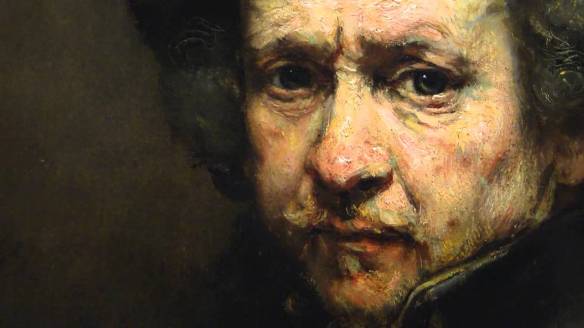
Rembrandt – Self Portrait – 1659
“If you show me Rembrandt, I panic because there’s still so much work. They say Rembrandt was before. He is tomorrow. That’s the difference. Rembrandt wasn’t before, he is tomorrow.
“A white canvas is the worst thing an artist can face. I did not say that. Picasso did. And if he says so… you can imagine what that means for us.”
“I have the ambition to continue painting till I’m 90. I still have so much work to do. If Picasso painted for 80 years, I’ll need 320 years. I don’t think I’ll succeed.”
“It’s my ambition to grow as old as possible. I don’t want to see others growing old and decaying with me.”
“But I’d like to realize my plastic dream as much as possible.
I’d like to get as far as possible.”
Eddy Merckx – most successful cyclist ever
“The thing people lack nowadays in my opinion is veneration. People don’t often see others as gods anymore. They do like to idolize them. Merckx is a better cyclist than Sam Dillemans. I won’t point out the weak points of a god. To say he’s as small as I am because of his human side. The distance isn’t that great.
“Michelangelo also had to go to the bathroom. But put us in the Sistine Chapel and we don’t make it up the scaffolding.”
“That’s what’s important.
We have to be able to be in awe.
Of something or someone”
“Everything is fragmented. Everyone does everything, but nothing well. Everybody is an artist. If you ask someone on the street what he or she does in their spare time – apart from a lot of rubbish – one bakes pottery, another one paints, a third one plays guitar. We’re all wonderfully creative.”
“A lot of people are creative,
but not many are artists”
“I don’t mind. I support that democratic system. This is the problem: this 93-year-old crone, who baked two pots, wants twenty exhibits. That’s tiresome.”
“A part-time painter is the worst. People who are partly something are the worst. You have to try to be whole. That demands sacrifice. The worst sacrifice is being half.”
“Many people choose it freely. They compromise.
“Life is full of compromises, but art is not”
“You always have to question yourself during your ongoing studies. You don’t need to become self-centered, but you discover your inner self. Without psychedelics and philosophies.”
“We have lots of possibilities, but hardly anyone stops to look at a tree and to admire it and say “That tree is beautiful!” That is over. It happens but rarely, and even then only on Sunday, with the kids, and a giant buggy. “Today we will watch trees”.
“They go to Walibi (a sort of Belgian Disney Land), or to an exhibition of modern art, as modern as possible. Then they are hip and trendy. They don’t want to seem old fags. But of course they are. A young fag would look at the world like Jacques Brel, eyes wide open. They are obsolete. But they think they are trendy.”
“Being trendy is dying a little.”
“You don’t have to be hip, you have to know poetry or anything which is not influenced by time. Then you have a chance to approach godliness. In conclusion, what do people do with their free time?”
“They fuck it up.”
Michaël Borremans
Jan Hoet, who was the founder of the Museum of Modern Art in Ghent (SMAK) said about Borremans:
“Studious, pleasingly, nicely painted, it all looks so perfect. On the other side he is a bit unruly, recalcitrant, also a bit morbid, a little austere…” and Ann Demeester commented: “Michaël’s works is very subdued, mysterious, vs. bombastic.”
His paintings are cinematographic. He also launched himself into video and cinema. Using all senses to resonate with his audience at some many additional levels beyond the pure cognitive. Borremans continues:
“My work has no documentary value whatsoever. It is all imagination. That’s why I am painting. Cinema also has a lot of this. But a film is not my sole merit, you work with other people, who each have their own contribution”
Michaël is a difficult person, rigorous and strict for himself, with a greater technical maturity then many of the other contemporary painters.
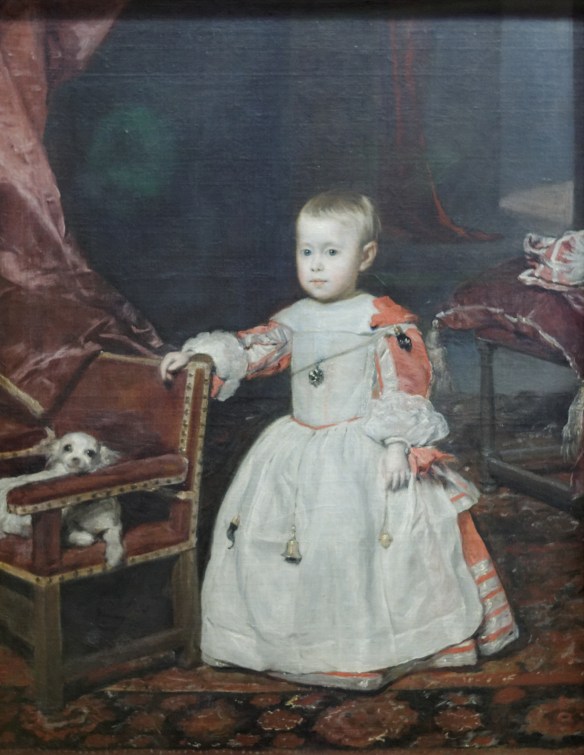
Prince Philippe Prosper by Diego Velasquez - 1659
You really have to listen to Michaël Borremans explanation of the above painting at minute 33 of the documentary.
“The resounding “éclatant” aspect of Velasquez’ work, it always remains fresh.
“The accents being made, the structures,
almost like notes and chords in music,
a very sensual pleasure”
“Painting with a long stick, to keep the spontaneity. Unrivalled technical virtuosity”
“I want to stay professionally focused, and remain faithful to what in want (in the artwork). A painting is a suggestive construction. Getting better, and more sophisticated in the painterly technique. Capacitate myself to make the best paintings. It is not pleasant to make so many paintings that are almost ok”
Back to the RTBF TV programme. Sam Dillemans continues here:
Embracing Rubens – Leaving Rubens – by Sam Dillemans
“That’s where I left Rubens. Most important is that you first embrace Rubens, you get deep under his skin, and you study him. That’s what I did when I was young: the thigh muscles, the calf muscles, the calf bones, the ankle joints, etc.”
“I was drawing like crazy on Rubens, and Holbein, and all old masters, to be able to leave them when I really knew them.”
“The most important is how you paint, not what you paint (Jesus or Maria, etc). You can do the same with apples or radishes. Cézanne changed the history of art with just some apples. “
“For me form is the most important.”
“I started very realistically, and ended in a very abstract way. I have the tendency to always start very faithfully to reality. Not goody-goody realistic, but very recognizable. But always with a certain “schwung”, my own “schwung”, my own signature.”
“And then I leave that realism. After five years that then ends in structured chaos. It ends in calculated arbitrariness, quite chaotic. And that happens in a very natural way. I never have to force myself. I just follow my nature.”
Then Ozark and Sam in a conversation on trends:
“These days, you don’t need to be able to read musical notes. You don’t need to know anything. You make music by intuition.”
“You have to be creative as from the age of seven. How can one be creative without “métier”? It is métier that makes you free. If you have a lot of métier, and you have suddenly an idea, then you don’t need to think “how do I make this?” or “What am I doing?”.
“Métier makes it possible to follow your impulse. Because your whole body is trained for it.”
“Métier is the great luxury
to be a free human being.”
“When Picasso draws seven lines at the age of 85, then those lines are building on 75 years of study and knowledge”. If we draw those lines, we risk missing the ball.”
“The three great artists are Dostojewski for literature, Van Gogh for painting, Mozart for music. But Mozart can again be considered as cliché, and that’s not considered alright anymore.”
“These days, you have to come up with a strange name from Georgia or whatever, somebody nobody ever heard about. You are not allowed anymore to be normal in your taste or preferences.”
The programme ends with a musical pairing with the famous Krug champagne.
Kruge Champagne cellars
“The creation of Krug is very musical. It is a house where the founder had a dream. He wanted to create every year the richest symphony of champagnes. The approach of the house is a musical approach. We listen to each little vineyard, like a musical director listens to the orchestra.”
“A grand cuvée is like a music score”
“The art is in the experience: you enter the ballroom, the orchestra is getting installed and starts to play, everything is there, and there it is, and you live the moment. Like Tsjaikowski’s 6th symphony in b-minor: the way the music score opens all the colors of the orchestra and you discover. Like a room that opens, and you discover all the colors, all the nuances, and a total experience.”
It made me think about a comment by Fabian about the last Innotribe Sibos edition: “Peter created his 9th Symphony, and day-1 was his Allegro”. But creating one’s 9th symphony is at time a lonely place.
“But what makes you lonely,
makes you radical.”
What if in our professions, in our “Métiers”, we would all adhere to these highest standards? And be radical in the quality and total experience we aim for?
What if we would always compare ourselves to the great artists, and get motivated through a constant healthily frustration?
Instead of putting the bar of mediocrity to the best common denominator, as illustrated in so many industry “benchmarks”.
What would happen then?
We would delight the customer with mastery and mystery.
Edition-82 of Delicacies: as usual, max 5 articles that i found interesting and worth re-reading. Handpicked, no robots. Minimalism in curation. Enjoy! Much more of this in my weekly Revue summary. Subscribe at bottom of this post.
If you can’t get enough of these and want more than 5 articles, I have created an extended version of Petervan’s Delicacies in REVUE. If you want more than 5 links, you can subscribe here: https://www.getrevue.co/profile/petervan
Edition-81 of Delicacies: as usual, max 5 articles that i found interesting and worth re-reading. Handpicked, no robots. Minimalism in curation. Enjoy! Much more of this in my weekly Revue summary. Subscribe at bottom of this post.
If you can’t get enough of these and want more than 5 articles, I have created an extended version of Petervan’s Delicacies in REVUE. If you want more than 5 links, you can subscribe here: https://www.getrevue.co/profile/petervan
Edition-80 of Delicacies: as usual, max 5 articles that i found interesting and worth re-reading. Handpicked, no robots. Minimalism in curation. Enjoy! Much more of this in my weekly Revue summary. Subscribe at bottom of this post.
If you can’t get enough of these and want more than 5 articles, I have created an extended version of Petervan’s Delicacies in REVUE. If you want more than 5 links, you can subscribe here: https://www.getrevue.co/profile/petervan
Edition-79 of Delicacies: as usual, max 5 articles that i found interesting and worth re-reading. Handpicked, no robots. Minimalism in curation. Enjoy! Much more of this in my weekly Revue summary. Subscribe at bottom of this post.
If you can’t get enough of these and want more than 5 articles, I have created an extended version of Petervan’s Delicacies in REVUE. If you want more than 5 links, you can subscribe here: https://www.getrevue.co/profile/petervan
At this year’s Innotribe Sibos, we have a session about digital ethics. Part of a full day on man-machine convergence.
Some of that conversation will be about the use and control of data. With this post, I would like to add my perspective to that conversation, based on some recent thinking on human agency.
At a recent MyData2016 event in Helsinki, i was surprised how little the thinking about personal data stores has evolved since 2012, when i was myself deeply in the trenches of the topic of distributed data sharing.
It was a really great conference, well organized, cool audience etc, but like many conferences, it was the tribe talking to tribe, believers talking to believers, all thinking that their lens to look at things was the right one, with little or no contrarian view.
I wanted to be that contrarian, and challenge a bit the assumptions.
At the event there was a lot of talk about “PIMS”: Personal Information Management Systems, or personal data stores, or personal data “clouds”. I don’t want to have a discussion about the subtle semantics here.
At one moment, Jamie Smith from Ctrl-Shift – who i respect a lot – said something along the lines of “PIMS are all about giving people agency”.
I think that is a big illusion, and that was what my talk was about. The illusion that the problem is about taking back ownership and control of your data. And that a PIMS is the solution. I believe we are discussing the wrong problem and the wrong solution when talking about managing our own personal data at our terms and conditions.
Owning your own agency is more important than owning your data. That in essence is what my talk was about.
My presentation at #MyData2016 conference
UPDATE: here the link to the Prezi of this presentation. Because there is so much video in this Prezi it takes 2-3 min to load. Be patient 😉
The talk is part of a longer story of more than one hour, wandering through a whole bunch of philosophical, ethical and artistic considerations. At this event, i got only 20 minutes, and i told the moderator he could cut me off, which he did most elegantly (no pun intended) at the end of my presentation.
My agency vs. my data is a pretty big deal.
It is not about buying but creating
It is not about my data but my agency
It is not about privacy but about shelter
It is not about power asymmetries but relationship symmetries
It is not about MyData but about OurData
In that sense the GDPR (General Data Protection Regulation) is shooting at the wrong problem. In that sense our politicians and leaders in general are again outperforming in solving the problems of the past.
I got some good reactions after this talk, from Doc Searls saying “you gave the talk that i always wanted to give”, to somebody else sending me a tweet and a mail saying “your presentation has changed my life, i decided to leave Facebook after more than 10 years”.
There is such a strong tension between our actual reality and the desired reality that we are currently moving in some form of virtual or surreality. But as Magritte said:
“Surrealism is the immediate knowledge of reality”
And we feel lost. We escape and try to reconnect nostalgically to what was, and are afraid of what going to be. People focus on the surreality of their phones instead of real life.
People believe what is on their phones and PIMS is the reality, and are able to represent us as human beings. But as Markus Sabadello said at this event: “Technology will not be able to represent the full complexity of human beings”
Our devices and apps make us believe we are in control, because we now can “manage” our data and lives. But we are focused on managing life, rather than living it. That is our big illusion.
To summarise, I believe our plan and ambition towards our desired reality must at least have following components:
This space needs to be regulated. Regulation means setting ethical and moral norms, AND policing them
These norms must be ethical and moral
We must decide who sets these norms, who polices them, and who penalises/rewards good behaviour.
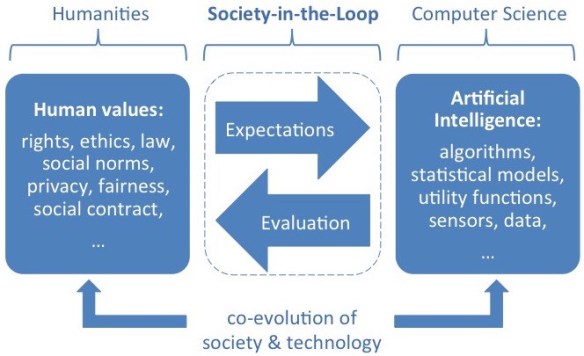
For that we must bring “Society-in-the-loop”, and not let this be decided by governments, corporations, or god forbid, algorithms
Society-in-the-loop by Iyad Rahwan
We must expand ourselves from a problem (efficiency) orientation to a creative (value creating) orientation, because the future is not about solving the past but knowing what you want and use mastery to make that happen.
Last but not least, we must be very much aware of the shallowness of the actual reality, and strive for high quality work with high quality attention and presence and meaning also called “Deep Work”
Maybe next year, they should call the conference #MyAgency2016;
Edition-78 of Delicacies: as usual, max 5 articles that i found interesting and worth re-reading. Handpicked, no robots. Minimalism in curation. Enjoy! Much more of this in my weekly Revue summary. Subscribe at bottom of this post.
If you can’t get enough of these and want more than 5 articles, I have created an extended version of Petervan’s Delicacies in REVUE. If you want more than 5 links, you can subscribe here: https://www.getrevue.co/profile/petervan
Four weeks ago, I shared with you a high level preview of the Innotribe Sibos 2016 programme.
As promised, I have revealed more details for each day in some subsequent blog posts leading up to Sibos week 26-29 Sep 2016 . Today – 15 days before D-day – this post is the last in that series, and I will be looking into day-4.
We are now in the phase where all the artwork, design, session facilitation props, staging, lightning and special effects are coming together. We are now in nonstop back-to-back joint speaker calls to make sure our session cast, our speakers, our instigators, our producers, designers, and facilitators are full aligned. Some of the material we are producing for the big LED screen is of a beauty we have rarely seen in other event environments.
Yes, we try very hard to beat last year’s edition 😉
The structure of the week program is fairly straightforward:
We start every day with an opening of the day
We close every day with a closing of the day
Over lunch time, we have spotlight sessions by several FinTech hubs: one day for Switzerland, one for EMEA, one for the AMERICA, one of APAC.
For the opening session of day-4, the Innotribe team will welcome you, and will zoom in into our Innotribe Industry Challenge on Compliance/KYC.
Our day anchor will then walk you through the plan of the day. Given that our day-4 is about the platform cooperation, our day anchor is Leda Glyptis, Director, Sapient Global Markets. She will stir the pot where needed during the day and she will come back at the end to wrap up the learnings of the day.
In between opening and closing, we have several Innotribe sessions. We don’t do anything during the plenary big issue debate so you have the time to enjoy that session as well.
The main theme of Innotribe day-4 is “Platform Cooperation”. In addition of the Opening and Closing sessions, we have four sessions:
Forward compatibility
FinTech Hubs session – APAC
DLT and cybersecurity: Sibos week wrap-up
Innotribe closing keynote: Platform Cooperation
This is a consolidation day – where it all comes together – and we will use a lot of metaphors and medieval painting examples to contextualise these rich topics, and to guide you through the disruptive complexity of our times
Pieter Breughel the Elder - The Blind Lead The Blind
One conversation was in January 2016, with Angus Scott from Euroclear, and his key insight was that no disruption will happen without fundamental re-invention of the end-to-end business processes, and that requires what I now call “forward compatibility”, looking into big large scale experiments with real customers, real regulators, and real ecosystem stakeholders, aka not just in a Lab. Angus also injected the concept of broad macro-forces that drive change.
The other conversation was in March 2016 with Valerio Roncone and Tomas Kindler from SIX. They explained me how they were looking far ahead. Asking questions such a “what happens after T2S?”, or “what happens if DLT would fulfil its promise, and disinter-mediate existing players in the industry?”. How does the new landscape look like? Can we create “situational awareness” that can inform our strategy? They called this “impact oriented thinking” and “innovation through evolution”
The seeds were planted, and that was the embryo for this session.
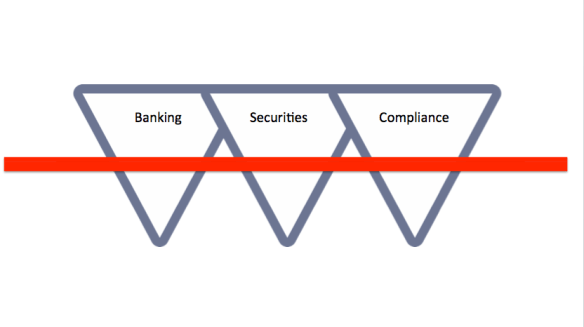
I started playing around with this, and came up with the concept of “above and below the red-line”:
Below the red-line is what needs be be solved as a collective, as a community, as a platform. It’s stuff that no single company can really solve on it’s own. It’s things like DLT, Cybersecurity, Digital identity, etc
Above the red-line is where you partner with others, FinTech startups, established vendors, etc through JV’s, Partnerships, API’s, etc. It’s where you “complement” the platform under the red line
Throughout the week, we will have done some exercises, where we internalise the content from the speakers by mapping them above and below the red line, and see how they are relevant for banking, securities, and compliance.
This session is NOT a technical session for geeks. This session is a session for business strategists that are interested having a conversation on how we can move the collective forward from here to “there”, wherever and however the “there”emerges.
We have a BIG cast for this session, complemented by instigators, DLT/Cyber anchors and rapporteurs. This is the only session where I will be on stage as your moderator. The speakers and instigators for this session:
Angus Scott, Euroclear
Valerio Roncone, SIX
Tomas Kindler, SIX
Patrick Havander, Nordea
Paul McKeown, Nasdaq Financial Framework
Saket Sharma, BNY Mellon
Brian Behlendorf, Hyperledger Linux Foundation
FinTech Hubs session – APAC – over lunch time
Building upon the success of last year’s session “Why banks need FinTech hubs?”, we wanted to go create more air-time for FinTech Hubs from different regions of the world.
We’ll have 6 speakers in one hour. That’s 10 minutes each to share their ambitions and plans. With our designers we are looking how we can make this an engaging experience and avoid having a series of 6 commercials. Like for all FinTech Hub sessions this session is full house.
The “6 from APAC” are (in order of appearance):
James Lloyd, Asia-Pacific FinTech Leader, E&Y
Markus Gnirck, Tryb
Sopnendu Mohanty, MAS
Zennon Kapron, FinTech China
Janos Barberis, FinTech HK
Asad Naqvi, Apis Partners
Almost all of the hubs presenting at Innotribe Sibos during these hub sessions are now part of the Global FinTech Hub Federation (GFHF) announced three weeks ago. See press-release here.
The GFHF will premier their latest FinTech Hub Index (A benchmark of 20+ FinTech Hubs) at Innotribe Sibos 2016. I have seen the design and infographics for this Index, and they just look awesome. We will use some of them as backdrop for this session.
Sandwiches and soft drinks will be served in the Innotribe space.
DLT and cybersecurity: Sibos week wrap-up
The Tribuna of the Uffizi, by Johan Zoffany, 1772-8
A collection of paintings
Royal Collection, Windsor
As you for sure have noticed, we don’t have any DLT/Blockchain sessions in this year’s Innotribe Sibos programme. We did this on purpose for two reasons:
There are already a lot of DLT/Blockchain sessions in the main conference sessions of Sibos
We sense a certain fatigue on the topic
We set ourselves the challenge to create ONE session where you get an overview, a collection of insights from ALL the sessions related to DLT during the whole of Sibos.
So if you don’t have time to go to all of them, or you prefer to stay in the Innotribe space for the week, we’ll make sure you get the key learnings in this single wrap-up session.
And as we were at it, why not do the same with Cybersecurity? OK, let’s do that too.
General overview of the Innotribe Sibos 2016 programme
In the general overview of Innotribe sessions above, you will see some sessions marked with the “B” sign (Blockchain) and some others marked with the “lock” sign (Cybersecurity). It means these sessions have some DLT/Cyber flavour to them.
To create a coherent summary during this Thursday wrap-up, we have appointed “Transversal DLT/Cyber anchors”. They stay in the Innotribe space for the whole week, and will report back their findings:
Our DLT transversal anchor is Andrew Davis, advisor from Sydney
Our Cyber transversal anchor is Bart Preneel, University of Leuven
To cover DLT and Cyber from the other non-Innotribe sessions (aka the main Sibos sessions, Swift Lab, workshops etc, we are sending out our “rapporteurs”. Our Rapporteurs are:
Our DLT rapporteur is Oliver Bussmann, ex-CIO UBS
Our Cyber rapporteur is Assaf Egozi, CEO Kidronim, Israel
Our DLT/Cyber anchors and rapporteurs will have a special lanyards so you can recognise them easily.
Innotribe closing keynote: Platform Cooperation
After a short wrap up of the Innotribe week presenting the key findings of our programme, our closing keynote speaker Dr. Douglas Rushkoff will provoke and challenge all your assumptions.
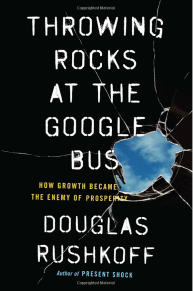
Rushkoff is a renown lecturer on media, technology, culture and economics around the world. His new book “Throwing Rocks at the Google Bus: How Growth Became the Enemy of Prosperity” (Amazon Affiliates link) argues that we have failed to build the distributed economy that digital networks are capable of fostering, and instead doubled down on the industrial age mandate of growth above all.
“Every great advance begins when someone sees that what everyone else takes for granted may not actually be true. Douglas Rushkoff questions the deepest assumptions of the modern economy, and blazes a path towards a more human centred world.”–Tim O’Reilly, founder of O’Reilly Media about Rushkoff’s latest book.
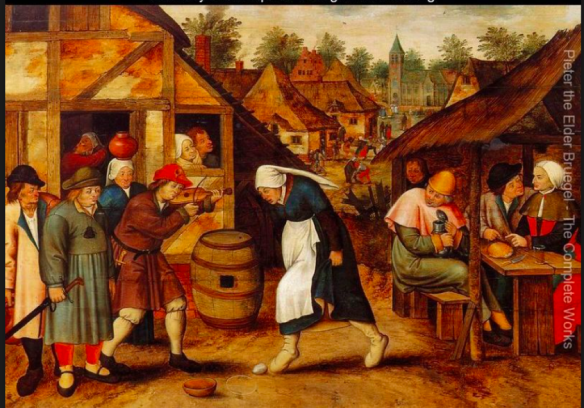
Marketplaces in medieval times were far more human centred, fairer environments that the so called P2P sharing economy of Uber and AirBnB, which all have little to with sharing but much more with an extraction value economy where only a few (monopolies) take it all.
A Medieval marketplace scene from Pieter Breughel the Elder.
After his talk, Doug will stay on our stand and take some time to do some book signings. He’ll have a couple of free books with him.
Rushkoff is one of those rare thinkers and speakers that challenge all your assumptions. We did something similar last year with Andrew Keen with his talk “The Internet is NOT the answer”. Many of you loved his energy as the Anti-Christ of Silicon Valley.
Think of Rushkoff as Andrew Keen on steroids. Not to be missed if you like to be inspired, if you like to be provoked.
Since publishing Throwing Rocks at the Google Bus, Rushkoff has answered more than 20,000 emails from his readers, one by one, individually. People, companies, mayors, cooperatives, towns and big corporations, all looking for ways to distribute prosperity more widely, start local currencies, build platform cooperatives, convert to employee ownership, offer dividends instead of capital gains, or crowdfund a bookstore.
Rushkoff realised it was not about him but about you and last week he launched Team Human, a weekly postcast on radio. “An intervention by people, on behalf of people”. All in delightful audio – perhaps the most intimate, enveloping medium yet developed.
Douglas Rushkoff looks deep into the question of reprogramming society to better serve humans. Rushkoff grapples with complex issues of agency, social justice, and all those quirky non-binary corners of life.
We are also bit quirky, non-binary. That’s why we designed the Innotribe stand with a very industrial look on the outside but as a very human and welcoming space on the inside. We believe on the synergising effect of emotional and physical space.
That’s why the overarching theme of this year’s Innotribe Sibos is about the tension between technology and humanism in this fast changing and disruptive environment.
That’s why we use a lot of art, as art can help making sense beyond the tactics and the cognitive.
That’s why we have throughout our four days the concept of “above and below the red line”, as below the red line is what we need to solve as a collective, as a community, as an ecosystem.
It’s going back to the original intention of the not-for-profit cooperative structure, but mixed with some healthy activism. Ruskhoff calls this “Platform Cooperativism”
Hope the architecture of our Innotribe Sibos 2016 programme all starts making sense now?
I will leave you with this painting/collage by Yasumasa Morimura “Blinded by the Light” from 1991. It’s a picture from a reproduction, discovered in the lobby of Le Meridien Hotel in Minneapolis, Minnesota, US, during my presence at the SparkCamp conference in 2015.
It is a modern interpretation of Breughel’s “The Blind lead the Blind” from 1568. See start of this post.
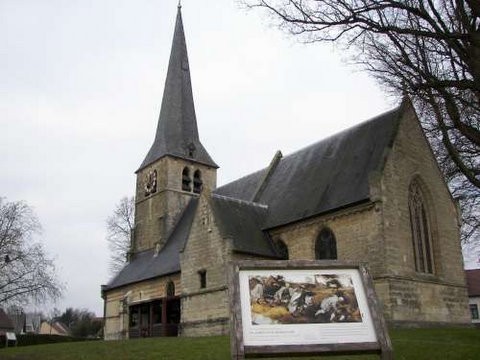
The landscape of both paintings is from a really nice area west of Brussels – an area named “Pajottenland” – and the chapel in the back of the paintings exists in a little village called “Sint-Anna-Pede“.
It happens to be the place where I grew up the first 20 years of my life. I was living literately 200 metres from this chapel. So the Innotribe journey sort of brought be back to my roots. More about that after Sibos.
General
All sessions are designed to maximise the immersive learning experiences of our guests. We use professional facilitators and designers to enable great group interactions. And we have an amazing audio/visual kit and production team to make the content come alive.
The pepper and salt comes from our “instigators” who have a designed role to provoke the critical discussion.















 Petervan Studios