In June of this year, Raf Stevens (RS) invited me for an interview as part of his StoryClub Podcast series. The interview was in Dutch but i made this English transcript out if it. For those interested, it’s a good summary of my thinking and mood halfway my sabbatical. The different rhythm of the sabbatical has also softened my voice. And I like how Raf kept the silences in the interview. Emptiness is sometimes the platform for resonating content… Enjoy or start crying ;-).
Part of these reflections will be integrated in my mid-Sep keynote/performance at the Finnovate FinnoSummit in Mexico City.
PV: If there is any form of consistency in my story, that would be in the word “rhythm”.
RS: I spoke with Peter Vander Auwera (PV)
PV: I have to be very careful that I am not creating a story – which also would be ok – but I just want to indicate that I have the sensitivity not to invent a story just to make the whole thing make sense. In English there is a term for this: confabulating a story. To make – with hindsight – sense of and for myself and others.
RS: Peter Vander Auwera is a thinker. He has been thinking a lot about innovation and change. But he is also a creative doer. He makes paintings and writes poems. At first sight a strange combination. But then you don’t know Peter.
PV: I am in a sabbatical right now. Before this, I was enjoying lots, lots of freedom to create – together with others – a community. We called it a “tribe”. An “Innotribe”. A tribe of innovators in the financial industry. And throughout that journey my focus has become more and more on the creation of a sort of events where people come together in a coherent setting around some content themes. In fact, that has become my main expertise. I rolled into it, and it has become the place where I was meant to be.
RS: Peter works with SWIFT. An international financial services organisation. Within this company, Peter co-founded a very inspiring initiative: Innotribe. A community where financial leaders and big thinkers of today gather to explore how they can create a better world. With Innotribe, Peter brought together these people in what he calls “high quality meeting platforms”. To learn from each other, to start conversations, to dare dreaming again.
(Music)
RS: Peter lives and works on the intersection of business transformation and art. Since begin 2017, he is on sabbatical, a period to disconnect, and to take distance from his day-job at Swift and Innotribe.
RS: Welcome at the Story Club Podcast, with Peter Vander Auwera.
PV: Sometimes I think I pushed the bar quite a lot with the work I am doing so far, but in reality I just scratched the surface. I got a lot of freedom, I mean a LOT of freedom at SWIFT. I can say for sure that I got 95% freedom to do what I thought should be done, what content to bring, how the production should feel like etc, etc… But still, I felt I was hitting some cultural ceiling within the organisation. That is not a criticism, it is what it is.
I want a much bigger contribution of artists, of art in the creation of this sort of rhythms, this sort of experiences. What I want, I want to resonate with the audience and the guests at a level “beyond the cognitive”. Not only leave a message between the ears, but also touch the heart, the soul, and the human. I want that what we make that it enter your unconscious. I want to create magic and put a spell on you.
In the events, especially the bigger ones, I use artists in support of the content, so not as entertainment, but as underpinning for the content. In the smaller events, these feel more like a retreat and therefore only target small highly curated groups of twelve people, I use artists not so much in support of the content, but to let them inspire the guests by sharing the intensity of their work.
(Music)
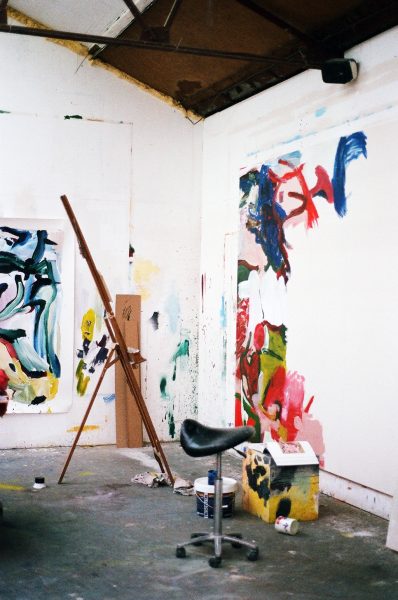
I was trained as an architect. At Saint-Lucas in Brussels and Ghent. So not the engineering architecture, but more the artistic side of it. I usually say with a prank: “We were permissioned to draw buildings that never needed to be built”. And that is an enormous freedom of expression. That started itching again. Three years ago, I went back to art academy. The first year was drawing, especially drawing of life models… with my architecture background of straight lines – in that era – it was a real stretch for me to deal with the organic shapes of the human body. I even felt that in my hands: they never had internalised the drawing of a curved line, it was not natural for me.
But I also learned to observe. So not drawing what you think but drawing what you see. Same for painting: painting the colour you see not the colours you think you see.
After the first year of drawing, I did two years of painting. And now and then I post some work on my Facebook page, and to my surprise there are a number of people asking me if I sell my work. Selling my work? Hmmm… never thought about that.
(Music)
And just like you, I got the chance and opportunity to talk in front of audiences. I do my best to illustrate my “talks” or “stories” with good visual material, and I also already use some soundscapes and even silence….
RS: Yes, I saw your nice TED talk of 2-3 years ago.
PV: Yes, Thank you… I now start playing with the idea to evolve those talks in some sort of “performance”, almost “conférencier” style of keynote.
RS: An “experience” ?
PV: Yes, an experience indeed. I want to tell a narrative – at another occasion we can discuss the difference between a story and a narrative – a narrative about maturity levels of change agents in organisations. I defined 3 phases, and each phase is documented by four archetypes of change agents. And for each archetype there is a narrative, a visual, a soundscape, a scene setting, a prop on stage. I have not decided yet whether I will deliver this as one big performance of 12 archetypes, of maybe an episode per phase, or maybe an episode per archetype.
I believe there are a couple of interesting findings in there. Phase 1 for example is about “The Forbidden”, that what was suppressed, the forbidden fruit. And Phase 2 is about protest and rebellion. And Phase 3 about daring to stand fully in your own creativity. And I illustrate all that exclusively with my own artwork, my self-composed soundscapes, my self-written poetry and “bring it live” on stage. And only once.
RS: Heh… only once?
PV: Only once.
RS: Why only once?
PV: Because I am attracted by ephemeral experiences. A good metaphor is drawing or writing on a sandy beach. The waves come and it’s all gone. You were there to witness it, or not. One can of course make a video testimonial of that, but that’s not the same experience as when you were there live. The idea emerged – maybe a strange connection here – when I looked and watched over and over again the reunion concert of Led Zeppelin in the London O2 arena a couple of years ago. That concert only happened once. You can’t repeat that sort of concert ten times in a row. Not possible.
(Music)
Then you encounter yourself. In your own emptiness, your own… the aspects of yourself that you don’t want others to know about. The so-called shadow side. A good way to pinpoint your shadow is to ask yourself what you absolutely would HATE that people say about yourself. What would hurt you badly? That could for example be: you are stupid, or you are a liar, or you are a manipulator, or you are a psychopath.
RS: An interesting word in that list is “manipulator”
PV: Yes. I got in contact with Leading By Being via Andre, Andre Pelgrims who was in one of your previous StoryClub stories. I know Andre already from my Microsoft period (2001-2005): Andre was offering a couple of workshops about people coaching. To make a long story short, one of the workshops was a role-play, and in the play Andre was my counterparty, the guy that needed to be coached by me. After the game, when Andre was back in his role of facilitator, he told me: “My feedback to you Peter is that I never would want to work for you. You are the biggest manipulator I ever met!” BANG! That is something Andre is really good at: he only needs 5 minutes to scan you, laser-sharp, make the diagnose, you are dissected…
RS: Do you think that was part of the game?
PV: I don’t believe Andre is a manipulator at all. That this is part of his game. On the contrary. I really think he is laser-sharp, in the sense of a scalpel, tjack – and be ultra precise in “this is your problem, man. “
I have tried to take that feedback with me very consciously in the rest of my career: make sure that I am not manipulating when I do something. And that is also part of the design and the delivery of the sort of events I am trying to create. You told me before this interview that you were planning to follow a workshop on “the art of facilitating”? I will send you a link – and please remind me when I forget – of a book by Dan Newman “From the front of the room” (Amazon Link), a sort of the Art of Facilitating for advanced etc etc … Dan is founder/director I believe of an organisation called The Value Web http://thevalueweb.org/ and amongst many other engagements they do the facilitation for the WEF in Davos. With big whiteboards, and live scribing, and – it is much more than scribing, it is based on the MG Taylor methodology – with a lot of preparation, a lot of solid framing, very very professional.
But when I was reading Dan’s book, at some moments I felt the facilitator became a manipulator. Using tricks that I would not feel good with and who make me think of what you read and hear about Trump. It was in that election debate with Hillary: at a certain moment Trump stands right behind Hillary, where he basically manipulates with his body energy how she feels. Not that I am worried that Hillary has not yet developed a thick skin against these tricks but anyway… In his book, Dan describes a couple of other subtle and not so subtle ways to facilitate groups and use your physical presence/position to deal with for example saboteurs in the group, by standing very close to them, or by ignoring them, or… The art of facilitating is a fine art. At what moment does it become manipulation and when is it authentic?
Another example: when we – I always say “we” because I never could make these events happen without other professionals, you need a production team for this – when we you work all the time in co-creation mode, I am basically the composer, the architect, like you ask your architect “I need a home”, I try as an architect to get a clue – or rather a pretty sharp understanding – of what you really want of a home.
RS: Also the storyline of an event
PV: And thus, what we do with our facilitators: we cut the content of the “speaker” in chunks, and after each chunk we give an exercise to internalise the content just given. Starters, main course, dessert. Whatever the number of servings you need… And the invitation process to move the audience into active assignment mode can be quite diverse. I will make a caricature of it now, but one way would be by announcing “Guys, we now have some work for you!” I can guarantee that 25% of your audience chickens out, especially an audience of people from the financial industry feeling already uncomfortable as they come into an experience space that does not exactly mimic their bank branch. Another way of moving your guests in action mode is to day “We have a present for you” and the assignment is wrapped in an envelope of a present box, or something they discover themselves, but there the line is very thin…
RS: Yes, is it manipulation or facilitation?
PV: Exactly. To come back to the beginning of this interview, I am very sensitive to this; it has to be “right”.
(Music)
RS: When I hear you talking, Peter, you know what I am thinking about? Maybe it is linked to your sabbatical, but maybe you went deeper then ever, not only in theory but also in art, in poetry – thinking about deep change some moments ago – but has all this created a deep change in yourself, that will maybe enrich you if you ever go back to a corporate world? Or will it rather be an obstruction; because of lot of what you do is a mile away of what happens in most companies? Will it be enrichment or rather a frustration?
PV: Yes, but it also has to do – and I come back to the aspect of maturity, the maturity of a change agent – with moments of powerlessness. The realisation that I have reached an age where I will never be capable anymore to become fully what I could become, and will not be able to realise my dreams to the fullest.
RS: Not anymore? That is quite fatalistic…
PV: Not anymore, or for sure not anymore in a corporate environment because I believe it is – and that is not a matter of laziness of fatalism – I believe it is a big stretch for a corporation to get inspired by these sort of ideas, let alone to do something with them. And it is very easy for me to shout something about architectural metaphors and blah blah blah, but in all these models – and they are just models – what is always missing is the noise inherent to the system. The noise of the human being. The noise of the human as manipulator, the noise of trying to take space from the other, the noise of not willing to make the other win, the career noise of wanting to be the next CEO, etc… all this is noise in the system that makes you live in a big illusion that you have a new skeleton, a new perspective, etc – in that sense most change programs are bullshit. As long as you don’t bring together people together in high quality connections, you have to get on with the old crocodiles that are polluted anyway.
(Music)
RS: May I ask you two things to end? One is a citation, from the editor of WIRED Magazine Kevin Kelly, also found on your blog. And the second thing… that is still a secret, won’t tell you now…. The citation goes: “Your job in life is to discover your job, and it usually takes you a whole life to figure this out”. How far are you with that?
PV: If zero is nowhere and 10 is everything…. I feel I am somewhere around 3
RS: Ouch! That’s sharp!
PV: Yes, but on the other hand, what you get from Leading by Being, at least in my case – it’s different per person – in my case – and I still don’t succeed in doing that – it is to build in mildness for yourself.
RS: So it is ok it is a 3?
PV: You say, “That is sharp”… What I realise more and more the last months – not sure you call this mid-life or late-life or whatever-life – a year or so ago I started realising that if I would like to stay active professionally till the age of 70, I only have 10 years left to do what I want to do. So the clock is ticking. And that is also the main reason for my sabbatical. If I don’t do it now, I will never.
(Music)
RS: Do you need appreciation? – everybody needs appreciation, let’s put that down as a certainty. With your blog posts and a quite different rhythm of life and the things you share with the world, it must be pleasing to get reactions/feedback, or does that not keep you awake?
PV: In honesty, yes, it is very pleasant to get these reactions, but it does not keep me awake.
RS: And not only reactions to your paintings and poetry, but also on your vision of the world?
PV: The really good question is – all your questions are ok – the really critical question is “what’s your intention in doing that?”. Is the intention to get reaction and attention, or is the intention “I have a reflection I want to share, I really want to know how you think about this”. I want reaction. To complement that idea, to challenge it, etc.?
RS: Is that something you question? Do you know the answer?
PV: Well, no. I don’t know the answer yet. But I hope that with my current writings about “being normal, being special” I will find some answers to that, I am asking myself… Sometimes I would like to disappear in anonymity, almost like a monk, without all this twittering, facebooking, blogging: phew … gone. And being normal again.
RS: Is there not some pressure like “I can’t do that because I have to earn a living for the next 10 years”?
PV: No, I don’t feel that pressure
RS: I have to throw my vision into the world, I must share it, I must continue building reputation so I can get back in corporate life late this year?
PV: No. Reputation is not something I worry about. I am in fact sharing and publishing less than before. I only want to publish if I really have to say something. And not when I am looking for attention. When I have a new insight – and that is not that often, but maybe… something of a higher quality? QWAN (the quality without a name)?
RS: But my spouse would say: “But how are you then going to make a living, Raf?”
PV: I am not worried about that. Because I really believe that there is a need for this sort of high quality meeting platforms, and if I keep focussing on what I am focussing on right now, some day something will emerge. I do have confidence in that. I have now somebody from the FinTech network asking me whether I would be willing to do the opening keynote at an event in September in Mexico City… Yes, by all means, but only in the way, in the direction I have set out for myself right now.
RS: One more. What are “Strillingen” ?
PV: Hah! I wrote a poem about that, a play of words…
RS: Can I read it out?
PV: Yeah, of course
RS: Or do you want to read it out? I will let you do that. I found it very beautiful.
PV: Thank you.
PV: Strillingen https://petervan.wordpress.com/2017/06/04/strillingen-poem/ (poorly translated by myself into English as “Hidrations”
Hidrations
Still vibrations
Cold and chilling
Perditions
Explorations of dangerous awareness, beyond the shame
A dog inspects her dung, rattle, and drivel
Nothing is worth what it seems
The silencing humming of tires on asphalt
Only the heat of tarmac is left
Air vibrations and fata morganas
Warm shivers of pleasance
A hideaway too far
Buried masks and hidden cuddles
Hidrations
RS: What does this mean for you?
PV: All sorts of things of course. This sort of poems emerge – I will give you an answer on what it means – this sort of things emerge, suddenly there is a piece of inspiration, and I start writing, just writing what comes, without thinking what the next sentence is going to be, an then scratching a bit here and there, just a little bit… It means, it stands for… euh… observation? In the following sense: I wrote this very early in the morning, at sunrise, when the house is still silent, and when you hear – just like now – when you hear far away cars on the highway, and you consciously hear it. Like right now, I hear the wind, I also feel the wind, and am willing to pause for a fraction of a second and realise that.
On the other hand this is of course also a reflection of the eternal fight, the eternal search for who I am, and what and when I am hiding and when I dare to stand fully in the fire, and when I will start doing, instead of telling stories of what I am doing or what I am planning to do. All that is buried in “perditions”, and in “buried masks and hidden cuddles”. Hidrations is about by soft side, my suppressed side, and the side I was not allowed to show. There is a post somewhere in the queue – more a poem than a post – that I have titled “The Touch”. Maybe I publish it some day, if I have the courage. So if I would go back to a corporate environment with this state of mind, mind-set, mind-state, I don’t believe I will survive. Of course I will survive physically, but not mentally. I am at a point that when I get into a corporate building, I almost feel a visceral disgust of “what a fake world!”
PV: Not so long ago – I am now 9 months into my sabbatical – in June that was, I travelled for the first time since 8 months. At Swift I was traveling almost every week, or at least once every month. So it was 8 months since I saw a plane from the inside. I can assure you they still look the same… A very big company invited me – I can’t say whom, as I had to sign an NDA – a very big company with a formidable brand new research site in the middle of nature. OMG, what a possibilities they have! My host was global responsible for their research for that organisation, and they have something like 1,500 researchers on that site. Stunning! Everything you can dream of. But the exciting part was that she – because my host was a woman – she had created a very intense collaboration with an art academy and they brought in artists into their research projects. That also where we connected. Where we resonated. They are convinced that artists can offer a different perspective to their researchers who have a more engineering training. In the sense like philosophy and art can offer a different perspective, ask different questions. So they don’t use artists in an “artists in residence” program to let artist do their artwork. No, the artists are integral part of their research projects as “interrupt-stations”, as” other-insight-stations”. And all this is executed at scale and very professionally by an international jury of art curators etc. PS: in the meantime I did a post on this: https://petervan.wordpress.com/2017/09/02/research-is-not-about-search-but-about-finding/
RS: If you could choose, would you prefer to be the artist that gets invited, or would you like to be the organiser?
PV: The organiser. Although I appreciate very much when people like my artwork, I fully realise I am just an enthusiastic amateur.
(Music)
RS: You listened to the StoryClub podcast with Peter Vander Auwera.
I am in the business of cultivating high quality connections and flows to create immersive learning experiences and structural change. Check out: https://petervanproductions.com/