![]()
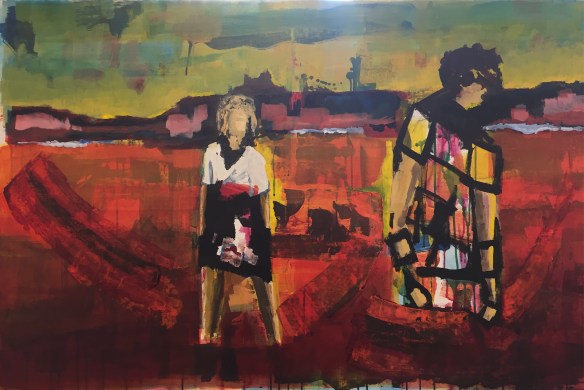
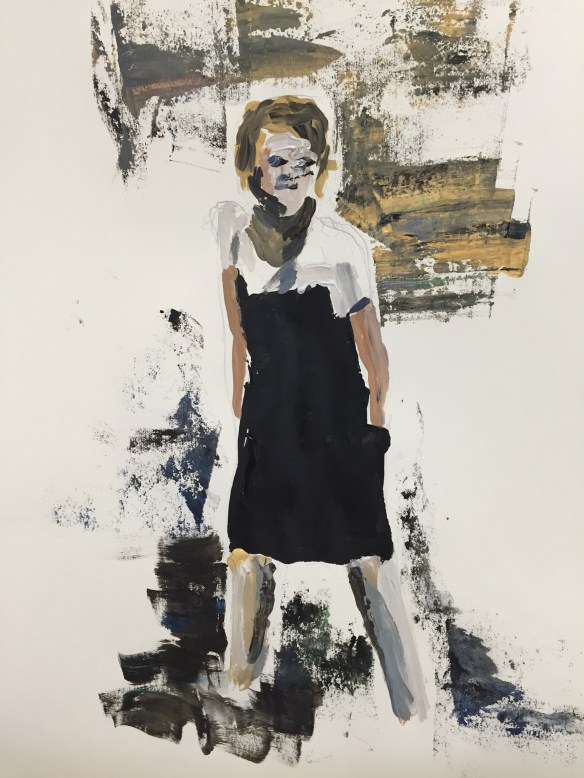
Artschool 2017: 4 week colour study
Original by Oskar Kokoschka “Girl with doll” and
Pixel painting by Peter
All colours are self-mixed.
Handmade.
No computers.
Acryl on cotton canvas stitched on wooden panel.
About 90x100cm

![]()
Artschool 2017: 4 week colour study
Original by Oskar Kokoschka “Girl with doll” and
Pixel painting by Peter
All colours are self-mixed.
Handmade.
No computers.
Acryl on cotton canvas stitched on wooden panel.
About 90x100cm
Greetings to you, your friends and your family! Hope you are doing well. It’s about four months already since I started my long-term sabbatical as Petervan Productions.

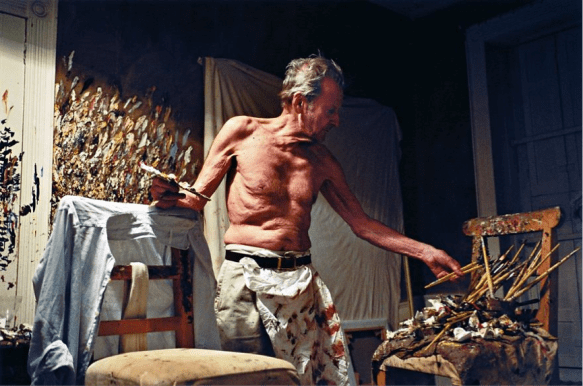
Lucian Freud Working at Night, 2005 Photo by David Dawson/ Private Collection


The Containers” and “The Drama” – Petervan artwork Acryl on cotton canvas stitched on wooden board – 122 x 82 cm

Imagery from Günter Grass film “The Tin Drum” Used as part of the briefing for designers

Scouting - La Fabricà – Refurbished cement factory by Ricardo Bofill
I have fine-tuned a bit the ambition of Petervan Productions from “to architect and create high quality feedback loops to enable immersive learning experiences and deep change” into “to architect and cultivate high quality feedback flows to enable immersive learning expeditions and deep humanistic change”.
That may feel like semantic detail, but I think it is not. It is the result of an iterative process:
During March – April 2017, the plan is to work on:
As you can notice, I am still relatively well focused. One of the tricks is to use the Morning Monk Style:
Between when you wake up and noon:
no meetings, no calls, no texts, no email, no Slack, no Internet.
You instead work deeply on something (or some things) that matter.
In the meantime, I kindly reject any requests for consultancy, speaking engagements, etc. I have 1-2 leads that want to work with me as their architect for immersive learning experience events. But I am not in active prospection mode.
If there is something worth reporting, next update is for May 2017. Looking forward to hearing from your latest adventures as well.
Rebelliously yours,


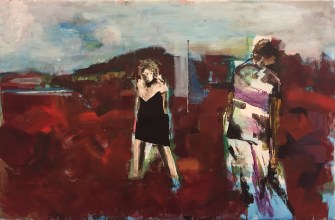
Artschool 2017: V1 of new painting “The Drama”. Acryl on cotton canvas stitched on wooden board – 122 x 82 cm.
The way we think about change, disruption, and transformation (or whatever you want to call it) is going to be completely different in 5 years time. The speed of change is so big that our thinking itself is getting disrupted. The underestimated and ignored exponential power in all of this is the “power of networks”. This post is a follow of the post “Fintech 2017 – Quo Vadis?”
I think we are in the middle of a network blitzkrieg, a big shift driven by network powers.

WW-II Blitzkrieg Stuka airplanes
But instead of the medium being the air and the devices the Stuka airplanes piloted by humans, the medium today is made of networks and the Stukas are replaced by hyper-connected computers driven my algorithms.
A lot of the reflection in this post are based on the following books and thinkers:
Kevin Kelly’s latest opus grande The Inevitable describes the 12 Inevitable Technological Forces That Will Shape Our Future:
In The Seventh Sense, Joshua Cooper Ramo talks about a “connected-age sensibility” to be able to read and understand networks:
The Seventh Sense, in short, is the ability to look at any object and see the way in which it is changed by connection
Even as this new age advances, most of our leaders still think in terms of disconnected dangers
We have to cultivate a new instinct, one intended to make us more human, in a sense, not only more technical
Think of how often, at moments of anguish or revolution, it is the fragile-looking bubbles of philosophy or art or science that endure.
And in Whiplash, Joi Ito explains how “Change doesn’t care if you’re ready”.
This is the power of pull over push—it leverages modern communications technologies and the decreased cost of innovation to move power from the core to the edges, enabling serendipitous discoveries and providing opportunities for innovators to mine their own passions.
All these insights are of course based on big theme of “we are interconnected”. In other words, new network rules of power apply in the “we are connected” era and our leaders are not prepared for it. That became even more apparent during the main WEF Davos session on the Global Economic Outlook. I watched it live after just having read the Seventh Sense.
These leaders offer a lot of lip service to the “we are interconnected” meme, but keep on playing the old zero-sum finite games and wars. Witness Fink from Blackrock at min 11:46 when he almost joyful says:
“regulation inhibits new entrants and that is not a bad thing”
But networks come with their own dynamics. In his yearly situational awareness post, Jordan Greenhall goes deep on “Deep Code”, and “Deep State”, and describes very well what I have labeled here as “Network Blitzkrieg”:
“The Deep State developed in and for the 20th Century. You might say that they are experts at fighting Trench Warfare.
But this is the 21st Century and the Insurgency has innovated Blitzkrieg.”
Jordan is describing a blitzkrieg for Collective Intelligence, being fought on four fronts:
The main point Jordan is making is that the Deep State is fragmented, and so far not efficient in responding adequately to the network blitzkrieg of the Trump cohort. A lot of the challenges of the Deep State seem to be related to the problem of not being able to shift to a network blitzkrieg mode, from tight synchronisation to loose synchronization.
Last year, Venkatesh Rao (aka Ribbonfarm) did a great tweet-storm-like-post on this topic of synchronisation. He calls our age the age of atemporality.

Illustration by Venkatesh Rao
“In tight synchronization, you’re on the same clock as everybody else, fit yourself into the same templates, report up the same chain, and communicate via standard protocols.
Welcome to atemporality. So long as you thrive on loose coordination rather than tight synchronization, it’s a beautiful thing.”
In previous posts and essays, Ribbonfarm even had a series on “Blitzkrieg”, where he described four categories of Blitzkrieg attributes:
In The Future of Tipping, http://www.ribbonfarm.com/2014/12/02/the-future-of-tipping/,(a post about authoritarian command-and-control models to control the customer’s relationship to the brand, and hence tipping), he the four describes blitzkrieg attributes in John Boyd’s philosophy of warfare applied to business:
CEO sets clear intent (Schwerpunkt); HR develops strong trust culture (Einheit); operations focuses on developing strong, instinctive skills culture through tacit learning (Fingerspitzengehful); everybody manages/is managed through a cascade of mutually negotiated “contracts” that devolve as much autonomy as possible to lower layers (Auftragstaktik); the business relies on loose and agile coordination rather than tight synchronization/command-and-control.
Ribbonfarm, Jordan Greenhall, and Simon Wardley all focus on situational awareness, strategy, tactics, operations and doctrine. It would be great to have them together one day in one of Petervan Productions’ events 😉
Add to all this the lack of trust and Bruce Scheier’s insight that we are moving from the Internet of things (with a build-in computer) to Internet of Computers (with things attached to it), and you get a pretty dystopian but probably very realistic picture of the future something that James Bridle coined “A new dark age”.
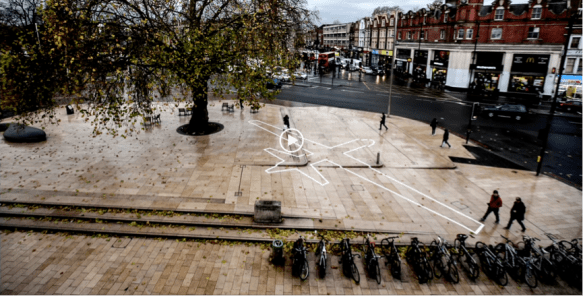
Drone shadow by James Bridle
James Bridle is a British writer and artist living in Greece. His work explores the impact of technology on society, law, geography, politics, and culture. His Drone Shadow installations have appeared on city streets worldwide, he has mapped deportation centres with CGI, designed new kinds of citizenship based on online behaviour. and used neural networks and satellite images to predict election results. A New Dark Age is an exploration of what we can no longer know about the world, and what we can do about it.
It is a “great” talk about Turbulence, Big Data, AI, Fake News, and Peak Knowledge, and like many if the authors mentioned above, he is alluding to a new digital literacy and legibility. A literacy that acknowledges that in our digital state, everything can be copied, except…. Trust.
Kevin Kelly asks, “What can not be copied?” and his answer is “Trust. Trust must be earned. It cannot be faked”. Our hope is in what Kelly beautifully described as “generative qualities”.
These are qualities that are “better than free”. Qualities generated at the time of the transaction aka it is all about the experience what people pay for. In Kelly’s view, there are 8 generative qualities:

Saruman uses a palantir in Lord of the Rings
So what would be the defences against such network blitzkrieg?
One strategy would be to try to defeat the enemy with the same weapons. But that assumes we are playing finite games, and I feel we only can win this battle by playing infinite games.
We should not be naïve, and drop all our common-sense defences against data-, privacy-, surveillance- and cybersecurity attacks with state of the art defense mechanisms and tools, but another strategy in defending our humanity in the long term may come from those infinite games.
Or maybe our defense in this move from enlightenment to entanglement is in dropping the separation of body and mind, feeling and ratio, form and content.

“Fame and success” by Hilde Overbergh – 2016 Part of expo “REFRAME” in The White House Gallery
Art may be inspiring here. In a recent conversation between art curator Hans Theys and artist Hilde Overbergh in the context of the expo “REFRAMED”, Hans arguments that form and content are inseparable, and that his sole criteria for assessing art are:
Very much like Kevin Kelly, this is about what cannot be measured, what cannot be represented in numbers, big data, and algorithms.
In a very recent post Kyle Eschenroeder (also on Ribbonfarm) said:
The confidence created by our palantír-ish technologies is a confidence in our measurements, not in ourselves. The more minutiae we measure, the less respect we have for taste or experience
Caring puts us in the posture of playing an infinite game rather than a finite one. This means favoring “improvisation over fixed rules, internal sensibilities over imposed morals, and playfulness over seriousness.”
So our defense against a Network Bliztkrieg may be in the subconscious, where we don’t care about the fakeness our realness of the news and our reality, but more about what makes us unique as human beings: the ability to play infinite games and truly care.


Artschool 2017: another study sketch for a new painting. Small format 20x30cm, Acryl on cheap paper

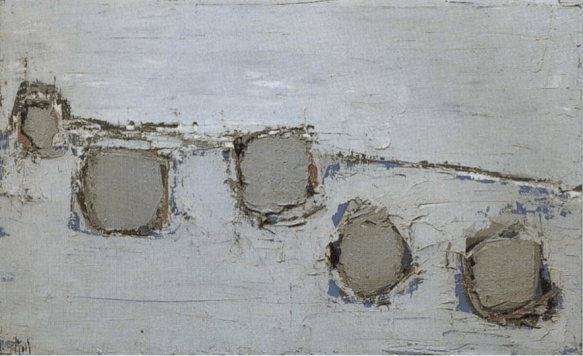
Nicolas de Staël – Five Apples – 1952
I am now one month into detailed scripting of my upcoming performance “Tin Drum is Back”. As mentioned in my last post, the narrative arc seems to be about evolving archetypes and levels of maturity.
In 2015, I was struck by lightning, by the work of fashion designer Dries Van Nooten. I wrote extensively about that experience here. It was the start of a more intense journey to let myself get touched by beauty, and to start experimenting with the creative orientation myself (Art academy, etc.)
Two years later, this 2015 expo is still resonating with me, and every time I tell the story of that experience, I get emotional, emotional like in tears of happiness and beauty. Happiness and bliss like a warm jelly feeling down your spine. I started paying attention to this emotion, opening myself to it, and wondering and exploring how it cracked me open (and very closed at other moments…)
Obviously, first thing that goes through mind, is the famous Leonard Cohen song “Anthem”, with the famous phrase:
Ring the bells that still can ring
Forget your perfect offering
There is a crack, a crack in everything
That’s how the light gets in.
How the light gets in…. But I started wondering how the light gets OUT… Like my skin would be lattice. Like the skin of this musallah.

King Abdullah Petroleum Studies and Research Center (KAPSARC) Riyadh / Saudi Arabia. Architect’s rendering of the musallah. Image Credit: Zaha Hadid Architects
What is needed for somebody to crack open like this? To get rid of all the ballast, and to stand in full onlyness ànd vulnerability ànd feeling happy with the way that is?
Another more recent moment when the lightning stroke was on a Saturday morning, where by full coincidence I hit the video of “Wild is the Wind” by David Bowie as part of the “David Bowie last 5 years” BBC documentary:
Wild is the Wind” is the first song of this amazing concert that is worth watching every of its 60 minutes. However, when he sings and smiles “you’re life itself” (at 2:40 and 4:10) that’s when shivers go down my spine and tears start rolling. Every time again.
Why is this? What is happening to me? Is Tin Drum about finally daring to stand in fire and vulnerability? Of letting my “onlyness” coming OUT through the crack(s)? Instead of hiding in a Hannibal-like shadow of complexity and impenetrability?

Film posters and book covers of Günther Grass' The Tin Drum
Cracking open seems to be about daring to stand in the fire, allowing the truth to come in and out, and allowing to loose myself and letting myself getting overwhelmed. It is about letting go of my masks, my defences.
Khurshed Dehnugara recently (my highlights) wrote about being overwhelmed in “cracking open”:
Being overwhelmed is something we are fearful of and at the same time can be helpful as we transition from one age to the next.
If our defenses are always solid, never breached, then the possibility of anything novel emerging is reduced. It often takes a moment of being overwhelmed before that part of us that we are defending can be seen. In the moment of being hurt, overloaded, caught out, tripped up or humiliated – we get a chance in those moments to see and work with the part of ourselves we spend the rest of our time enclosing in a protective shell.
As we spend time at the edges of what we know and can cope with, the container is strengthened. When we can’t cope, the cracks can allow us to integrate an experience that has been shielded for a lifetime; but refuses to go away or stop causing problems in the rest of our lives.
During my sabbatical, I am indeed spending time at the edges of what I don’t know and what I don’t know to cope with. At the edges of my existing communities, at the edges of new – more artistic – communities.
Also, the painting lets me re-discover the true meaning of being in the flow. But I have to get more clarity. Tell the story with fewer words, less images, less brush strokes, less gimmicks. I am trying to say too much. I am still trying too much to impress, not express.
“The more easy gimmicks, the more solid the content needs to be”, says my paint-coach Ann.

Extract of Petervan painting “The Containers” in process – Feb 2017
So many metaphors between paint and real life. The longing for clarity of touch, pitch, colours, harmonies, and chords. But for now, still too much noise, both physically and mentally.
The sweet spot is where the crack is
where frequencies and overtones create the mystic.
What are your cracks? When was the last time you built defences against standing in the fire? When was the last time you put up a wall and defences against it? When was the last time you allowed the crack to put a spell on you to get in touch with your true self?


Artschool 2017: V1 of new painting. Acryl on canvas stitched on wooden board. Bigger format: 125cm * 82 cm
Yesterday, there was a news item on Flemish Television on the upcoming opera performance of Puccini’s “Madama Butterfly”, that will be performed at the Brussels Federal Opera House De Munt / La Monnaie (31 Jan – 14 Feb 2017).
What touched me was that Madame Butterfly was played by a puppet, directed by three puppet players (visible in black). The effect is mystical. Check out the end of this video (comments in Dutch, but that should not spoil the experience).

Opera Madame Butterfly - De Munt - As from 31 Jan 2017
It made me think about a passage in David Byrne’s wonderful book “How music works” (Amazon Affiliates link). I am reading it in the context of my performance for Petervan Productions.
At a certain moment, David Byrne describes how his thinking about a show – a performance – was influenced by traditional Japanese theater forms such as Kabuki, Noh, and Bunraku.
Example of Japanese Kabuki theatre
“The tour eventually took us to Japan, where I went to see their traditional theater forms: Kabuki, Noh, and Bunraku. These were, compared to Western theater, highly stylized; presentational is the word that is sometimes used, as opposed to the pseudo-naturalistic theater we in the west are more used to.”
“The character had in effect been so fragmented that the words they spoke didn’t come from close to or even behind that puppet. You had to reassemble the character in your head.”
“As in Japanese theater, the performers often wore masks and extreme makeup; their movements, too, were stylized and “unnatural.” It began to sink in that this kind of “presentational” theater had more in common with certain kinds of pop-music performance than traditional Western theater.”
“There was no attempt to formally separate the ritual and the show from the audience. I quickly absorbed that it was all right to make a show that didn’t pretend to be “natural.” To further complicate matters, I decided to make the show completely transparent. I would show how everything was done and how it had been put together.”
Check out the video footage of the resulting “Stop making sense” Tour. The show starts with a heavenly version of the song “Heaven” on an empty stage. At minute 2:30 you will see the first elements of the stage being rolled in.
The whole show is super enjoyable, and if you want to know what “playing tight” means, check this awesome version of “Breaking down the house”, which does exactly what you would expect.
Sometimes I think I have to stop trying to “make sense”. Better would be to “make meaning”.
All these reflections are related to my upcoming performance “Tin Drum is Back” (subtitle: “what is/what could be”): the performance design is evolving well, with detailed script being written as we speak.
Part of the story is looking back into ones youth (5-10 years old), look at what was forbidden then: for some people that is an area of talent they have neglected to develop. In my case, it was a tin drum I got when I was 6 years old, and the story of rhythms in my life and in my work. As the script develops, the narrative arc seems to be about evolving archetypes and levels of maturity.
Scripting is not “only” the storyline, but also the staging, transition, props, lighting, etc… And all visuals, sounds, and word are self-composed, self-created. Should be ready around March, although I may pick up some delay.
It starts feeling like theatre by an amateur 😉 So, performing “tight”, in some theatrical form, with costumes, masks, props, and stage being build-up as the show moves along, is certainly inspirational.
I see “Tin Drum…” as a teaser for a bigger story on multi-media corporate narratives, where – who knows – I create commissioned performances on less tangible topics (less tangible than “what problem are you trying to solve?”). I indeed think that a lot of the work I am preparing is steering away from the problem-solving orientation, and give more room to the creative orientation of “what do I want?”
What do you think? BS? Did I smoke too much ? 😉 Please don’t hesitate to share resources and serendipities that this post may generate.
More general Jan 2017 update here: https://petervan.wordpress.com/2017/01/08/petervan-productions-jan-2017-update/
Rebelliously yours,


Edition-92 of Delicacies: as usual, max 5 articles that i found interesting and worth re-reading. Handpicked, no robots. Minimalism in curation. Enjoy! Much more of this in my regular Revue summary. Subscribe at bottom of this post.
If you can’t get enough of these and want more than 5 articles, I have created an extended version of Petervan’s Delicacies in REVUE. If you want more than 5 links, you can subscribe here: https://www.getrevue.co/profile/petervan

Artschool 2017: Petervan Doig trees on top of Zaha Hadid MAXXI space Rome. Acryl on cotton canvas, 90*90cm