Edition-93 of Delicacies: after a long interruption, I have resumed my curation. In this issue you’ll find some older and newer articles collected over the last months. As the summer holiday period comes to an end, I will try to resume my weekly publishing rhythm. Onwards! As usual, max 5 articles that I found interesting and worth re-reading. Handpicked, no robots. Minimalism in curation. Enjoy!
If you can’t get enough of these and want more than 5 articles, I have created an extended version of Petervan’s Delicacies in REVUE. If you want more than 5 links, you can subscribe here: https://www.getrevue.co/profile/petervan
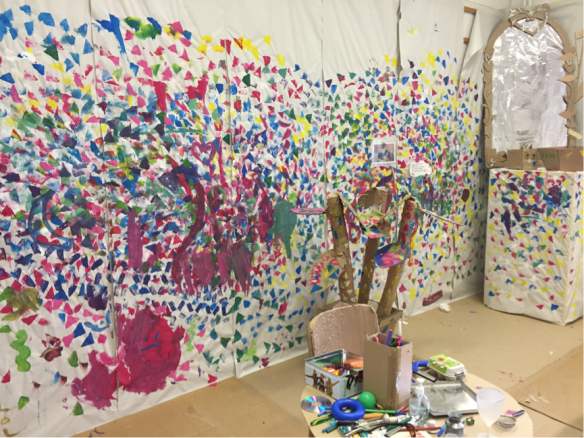
3D Art room by 12 years old at BKO Academy – Feb 2017
I recently realised that it’s almost seven months since I saw an airplane from the inside. That’s indeed the time I am into my long-term sabbatical as Petervan Productions. It also means I am about halfway: another seven months indeed between now and end 2017. If you are interested in my developing story, my Jan 2017 and March 2017 updates are still available.
A quick update:
March-April felt like a period of soul-searching and reflection. I constantly had the impression I was not doing much and progressing very little, but writing this update gave me some comfort: there still is some advancement towards my goal and that of Petervan Productions.
I feel less restless than in the first couple of months, and can accept that a day goes by without any concrete deliverable. I also made some minor changes to my daily schedule, which is now more in synch with nature. For example, when the weather is great, I go outside for a bike ride or some gardening, and that’s why I already got a nice pre-summer tan 😉 And when it rains, it’s time for desk work. As there is enough rain in Belgium, there is enough time for desk work.
Artschool
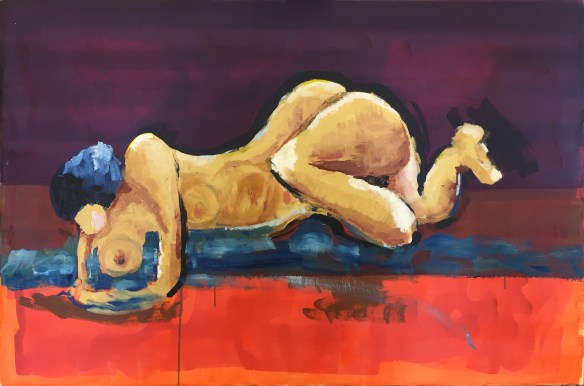
Artschool continued at +/- 9 hours per week practice in the art studio of the art academy. Got a challenging color-study from my coach, which also led into a remake of “The Drama”. I also started liking the use of many very transparent layers.
Two completely different works
Both acryl on cotton canvas stitched on wooden board
122 x 82 cm
Performance
I had many 1-1 conversations with friends and relatives to collect feedback on the performance “Tin Drum Is Back”. Thank you so much for the very valuable feedback!
Did some site visits to find the ideal location for the performance. Nothing came really close for the final show: some spaces were great, but the acoustics awful. And for some good news I got commitment from two sponsors to use their space for the dry run and Avant-premiere.
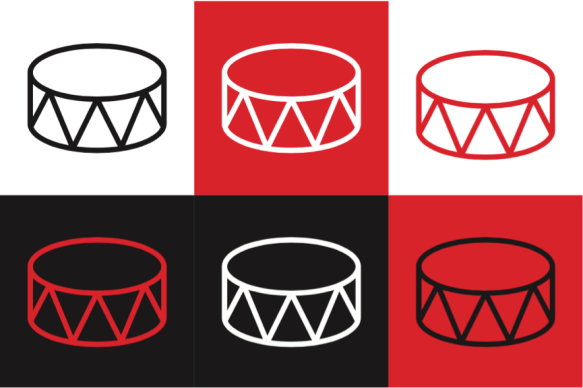
I also received some first proposals for the visual identity of the show there is much more, but this would be the main theme:
First mood board for “Tin Drum” performance
Events
Nothing special here. As you know from previous updates, I am not in active prospection mode, and every request is measured against my existing priorities:
There are 1-2 interesting speaking engagements that allow me to test some of the performance and/or structural change concepts.
One promising lead for an immersive learning expedition with artistic performances.
Little progress on the retreat-style event.
Other
I visited some great art exhibitions and had some very pleasant conversations with art curators.
And I also started experimenting with some poems, some out of the blue, others in relation to some of my artwork. A first collection via this link.
So, what’s next?
During May – June 2017, the plan is to work on:
My daughter’s communion is on 14 May 2017. We plan to keep things simple, invite some close family in our garden with a back-up tent in case of rain, and some quality food and drinks brought in by a local caterer.
Creating an installation for the June 2017 year end exposition of my art school; the installation will be called “TOKOMA”
A visit to a research facility in Germany that integrates artists in industrial research project work
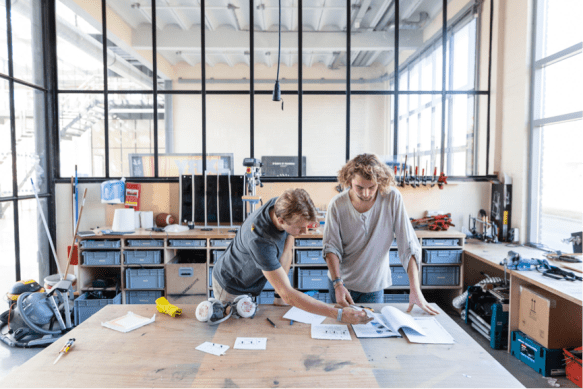
This year’s summer promises to be different as well. We decided to move houses to be closer to the Flemish Primitives. Emptying the old house, refurbishing the new one, boxing and un-boxing will keep us busy most of the summer. The new house was previously a doctor’s practice, and the plan is to organise one space as an artist’s atelier/production studio where I plan to study, paint, write poems, compose music, and produce experiences.
Detail from Atelier Michael Landy
That’s about it for this edition. If there is something worth reporting, next update is for July 2017. Looking forward to hearing from your latest adventures as well.
Rebelliously yours,
I am in the business of cultivating high quality connections and flows to create immersive learning experiences and structural change. Check out: https://petervanproductions.com/
Een snapshot van oranje over groen
Lente-veld over zomerse zindering
Een verploegde voor tussenin
Overlap van ophitsend en verzengend vuur
Verenigde staten van koud en warm
Verenigd verkoold vloeiende warmte
Vervreemd versteend ijzige vrieskou
Vertederd weelderig stoeien
Contreien, vleien, vrijen
In een huis van stoffen plannen en marijnblauwe inkt
Wervelend in de wind
En happend naar lucht
(Rough translation)
Snapshot of green over orange
Spring-field over shimmer summer
A plowed furrow in between
Overlap of steamy torrid fire
United states of cold and warmth
United fluid hot and carbon
Alien fossils of freezing cold
Tender lushes frolicking
Flattering vicinities of love
In a house of clothy plans and blue-marine ink
Whirling winds
And gasping for air
Roozegaarde architecture studio – picture via Dezeen
Some time ago, I initiated a conversation with some folks on “deep change”. What is it? What are the leverage points in organisations to make it happen? What are accelerators for deep change etc? One of my questions was “Can organisations change?”
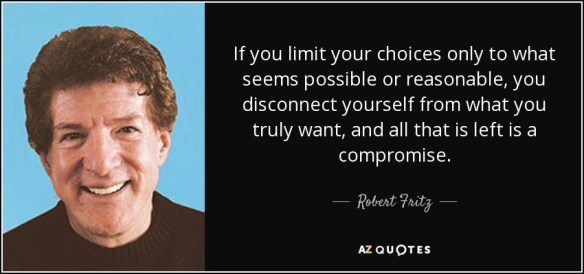
I received plenty of interesting feedback, including some challenging insights by Robert Fritz himself. As I am a big fan of Robert’s work, I was very eager to listen.
Robert and I had some contacts back and forward over mail, and this blog post is a summary of our conversations. Italic paragraphs are direct quotes from Robert’s mails. Highlights, emphasis, non-italics and picture/video curation by myself.
“I don’t like the notion of “deep” change. It’s the word “deep” that seems incorrect as an accurate description of what it takes to change and organization or a person’s life.
Of course organizations can change if, and it seems to me only if, there is a change in the underlying structure. Without a change of structure, the organization will reject change the same way the body rejects an implanted organ. With a change of underlying structure, change is not only possible but probable.
In my new edition of The Path of Least Resistance for Managers (2011 edition) I updated the book, putting more focus on the leadership dimension. Over the years, we have seen that without the support and even demand of leadership, change will not be sustainable. Change within the organisation is not a grass roots movement.
Why would people change? People say that change is hard. But when it is well motivated it is not hard. That is why people moved from mechanical typewriters to word processors. Why people now are more likely to listen to music from streaming sties than CDs. Why people use email rather than write old fashion letters – snail mail. Etc.
So, the question of why would people change is critical. Even before we ask that question, we need to understand why people act the ways they do in the current situation. We then to have the predisposition of trying to change things before we understand what gives rise to the current behaviour. Also, too often, change is motivated by a problem orientation rather than an outcome orientation that would lead to a true creative process….”
There are a lot of management theories that suggest a kind of grass roots movement within organizations. Sounds very nice. But, in my experience, if leadership is not behind any endeavor, it is not going to happen. There may be a few exceptions to this, but none that are major.
Among the many things it is, leadership is a position. Like the drummer in a band, it is a job within a group. Now there are good drummers and bad drummers and all those on the continuum between great and terrible. All of them are authentic drummers. I’ve never heard someone say, “Hey, I see you’ve gotten an authentic drummer in the band tonight.”
The same holds true for leadership. Good, bad, all the degrees in-between. All of them leaders. If you mean to separate the good ones from the not so good ones, don’t use the term “authentic leadership.” Call it what it is: good or bad or whatever describes it.
And recently, a group of folks have been writing their ideas about “deep change.” Lots of theories, opinions, etc. What makes a change “deep?” When we understand the structural dynamics involved, this is the key:
THE UNDERLYING STRUCTURE OF ANYTHING WILL DETERMINE ITS BEHAVIOUR
Most of the theories have no idea about this. They are thinking in terms of situations and circumstances.
They come up with tortured proposals that have the subtext that change is hard.
Change, when it is well motivated structurally, is easy for people.
Of course in our society, there is the tendency to try to glorify things we like. This reflects a social trend to express things in the extreme. The best or the worst. It was the best of times; the worst of times.
So, the next time you find yourself saying things like, “this is an authentic hamburger,” or, “this hamburger is really deep,” know that the modern world has slipped into your subconscious without you being aware of it.
I buy that. Let’s call it what it is, without glorified terms like “authentic”, or “meaningful”, or “deep”.
Let’s call it “good” or “bad” change, and what is in between.
Bad change is the opposite good change. It does not include progress. I found quite some inspiration in Jeff Bezos’ latest letter to Amazon shareholders.
Jeff Bezos - picture via Forbes
“Day 2 is stasis. Followed by irrelevance. Followed by excruciating, painful decline. Followed by death. And that is why it is always Day 1.”
“I’m interested in the question, how do you fend off Day 2? What are the techniques and tactics? How do you keep the vitality of Day 1, even inside a large organisation?”
“Here’s a starter pack of essentials for Day 1 defence: Customer obsession, a skeptical view of proxies, the eager adoption of external trends, and high-velocity decision making.”
The Bezos starter pack is about structure. Structure that drives behaviour.
“Bad” change is not about advancement, but degradation. Like a building (see my post “Can organisations change?” No maintenance, no refurbishment, no respect for patrimony.
Abandoned asylum – Matt Vandervelde – via Dezeen
Neglecting: Keep the windows open, so the wind and rain get in, and kill the building from within. A structure of neglecting that drives behaviour.
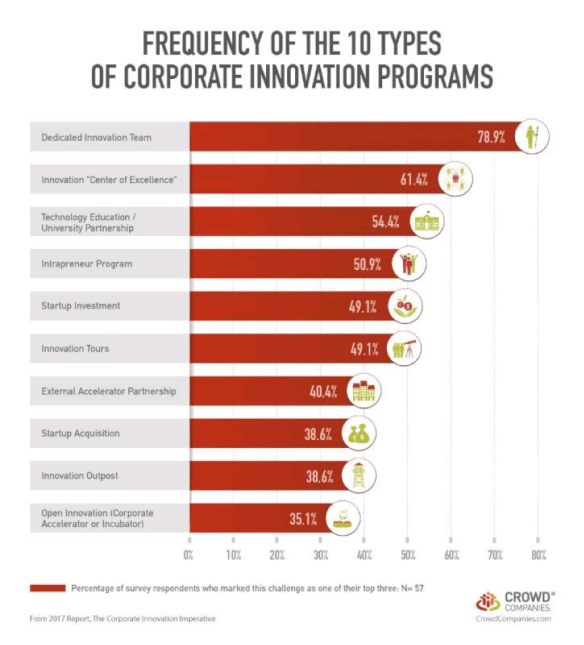
Other “bad” change is just plain “fake” change. Many organisations get new boards, new executive teams, have re-orgs. Some satisfy themselves (mostly unconsciously) with innovation theatre and the tactics of startup challenges, innovation sandboxes, accelerators, incubators and what have you. Below yet another list of 10 types of corporate innovation programs. The real question is: do they work, do they deliver structural change?
Some are champions at designing and getting excited by the illusion of change. Most of this change is motivated by problem solving rather than what organisations and people really want. Like pimping your house, car, etc. This bad/fake change leads to the oscillating patterns so well described by Robert Fritz. Because of the wrong structure, the organisation oscillates back to its initial state.
What we are after is “good” change, which is related to “progress” and “advancement”.
For Robert Fritz it is about advancement towards the desired “outcome”, and filtering all the noise that distracts from this outcome. In my opinion, “good”, “progress” and “advancement” also have to do with high quality connections for something else than speed and noise-free. As indicated in my post “Cogs in networks”, there should be some dimension/ambition/alignment of “spiritual, moral and aesthetical advancement”.
People in organisations can work with Mother Nature or Mother Structure on behalf of their goals. The question is what is the overall structure of the organisation?
"Heroes" and others by Ozark Henry and National Orchestra of Belgium
In an orchestra, it is not the conductor or individual musicians who control this. It is the composer. The composer’s job is to make sure that the parts fit together. Too often, no one is actually composing the organisation, and it leaves one of two bad choices: command and control or organising systems. Much has been made in the last 20 years, glorifying organising systems, but, what happens over time is that these systems self-organise into structural conflicts, which lead to oscillating patterns.
That’s why a “composed” system can lead to advancement and forward movement toward building the company but the other alternatives do not live up to their promise.
As an accomplished composer, filmmaker, and writer, Robert Fritz likes the orchestra metaphor and the role of the composer. Given my background, I like the building-metaphor and the role of the architect.
Ricardo Bofill – La Fabrica – Living room – Old cement factory
But structure is not a metaphor, it is a dynamic.
The cause of it, as part of physics, has to do with how structure works. A tension, any tension, will lead to a dynamic, which is to move toward resolution. We call this a structural tendency. The reason it does has to do with the principle of equilibrium. Nature strives for equilibrium. It wants to end all tensions, all differences. A state of “non-equilibrium” (purists would say “degrees removed from equilibrium because it is a perfect state) generates movement. Sometimes this can be accomplished, such as in the design of airplanes wings, sometimes not, as in an oscillating structure in which, as you move toward resolution of one tension resolution system, generates more tension in its contrasting system.
We can use this principle to our advantage through structural tension in which we set up a state of non-equilibrium to resolve on behalf of a specific goal.
That is the reason that the two data points of structural tension need to be clear: desired state in relationship to the actual state. Once formed, that tension strives to resolve.
Like an archer’s bow, aiming an arrow. In the arts, tension resolution system cause movement. In music, in screenplays, in painting, etc. Most artists, and all composers (the most technical of the arts) understand this principle and use it quite consciously.
When will you revisit the structure and dynamics of your innovation efforts? When will you go beyond the role of change agent, and create good change as a composer or architect? When will you design a structure that leads to good change?
I am in the business of cultivating high quality connections and flows to create immersive learning experiences and structural change. Check out: https://petervanproductions.com/
De lome ochtendsluimer
Kijkt in mij binnen
En raakt een snaar van stilte
Welzijn, wel te zijn, zijn
De irissen sissen fluisterend weg
Verdacht
Tussen de stenen
Glimmende kikkers
Kwakend van verstand
Morning (rough translation)
The lazy morning slumber
Looks inside me
And touches a chord of silence
Well-being, be well, be
The irises sizzle away in whispers
Suspicious
Between the boulders
Shiny frogs
Quaking minds














 Petervan Studios