No innovation without the connection with the world of art

storyclub petervan


In June of this year, Raf Stevens (RS) invited me for an interview as part of his StoryClub Podcast series. The interview was in Dutch but i made this English transcript out if it. For those interested, it’s a good summary of my thinking and mood halfway my sabbatical. The different rhythm of the sabbatical has also softened my voice. And I like how Raf kept the silences in the interview. Emptiness is sometimes the platform for resonating content… Enjoy or start crying ;-).

Part of these reflections will be integrated in my mid-Sep keynote/performance at the Finnovate FinnoSummit in Mexico City.

PV: If there is any form of consistency in my story, that would be in the word “rhythm”.

RS: I spoke with Peter Vander Auwera (PV)

PV: I have to be very careful that I am not creating a story – which also would be ok – but I just want to indicate that I have the sensitivity not to invent a story just to make the whole thing make sense. In English there is a term for this: confabulating a story. To make – with hindsight – sense of and for myself and others.

RS: Peter Vander Auwera is a thinker. He has been thinking a lot about innovation and change. But he is also a creative doer. He makes paintings and writes poems. At first sight a strange combination. But then you don’t know Peter.

PV: I am in a sabbatical right now. Before this, I was enjoying lots, lots of freedom to create – together with others – a community. We called it a “tribe”. An “Innotribe”. A tribe of innovators in the financial industry. And throughout that journey my focus has become more and more on the creation of a sort of events where people come together in a coherent setting around some content themes. In fact, that has become my main expertise. I rolled into it, and it has become the place where I was meant to be.

RS: Peter works with SWIFT. An international financial services organisation. Within this company, Peter co-founded a very inspiring initiative: Innotribe. A community where financial leaders and big thinkers of today gather to explore how they can create a better world. With Innotribe, Peter brought together these people in what he calls “high quality meeting platforms”. To learn from each other, to start conversations, to dare dreaming again.

(Music)

RS: Peter lives and works on the intersection of business transformation and art. Since begin 2017, he is on sabbatical, a period to disconnect, and to take distance from his day-job at Swift and Innotribe.

RS: Welcome at the Story Club Podcast, with Peter Vander Auwera.

PV: Sometimes I think I pushed the bar quite a lot with the work I am doing so far, but in reality I just scratched the surface. I got a lot of freedom, I mean a LOT of freedom at SWIFT. I can say for sure that I got 95% freedom to do what I thought should be done, what content to bring, how the production should feel like etc, etc… But still, I felt I was hitting some cultural ceiling within the organisation. That is not a criticism, it is what it is.

I want a much bigger contribution of artists, of art in the creation of this sort of rhythms, this sort of experiences. What I want, I want to resonate with the audience and the guests at a level “beyond the cognitive”. Not only leave a message between the ears, but also touch the heart, the soul, and the human. I want that what we make that it enter your unconscious. I want to create magic and put a spell on you.

In the events, especially the bigger ones, I use artists in support of the content, so not as entertainment, but as underpinning for the content. In the smaller events, these feel more like a retreat and therefore only target small highly curated groups of twelve people, I use artists not so much in support of the content, but to let them inspire the guests by sharing the intensity of their work.

(Music)

I was trained as an architect. At Saint-Lucas in Brussels and Ghent. So not the engineering architecture, but more the artistic side of it. I usually say with a prank: “We were permissioned to draw buildings that never needed to be built”. And that is an enormous freedom of expression. That started itching again. Three years ago, I went back to art academy. The first year was drawing, especially drawing of life models… with my architecture background of straight lines – in that era – it was a real stretch for me to deal with the organic shapes of the human body. I even felt that in my hands: they never had internalised the drawing of a curved line, it was not natural for me.

But I also learned to observe. So not drawing what you think but drawing what you see. Same for painting: painting the colour you see not the colours you think you see.

After the first year of drawing, I did two years of painting. And now and then I post some work on my Facebook page, and to my surprise there are a number of people asking me if I sell my work. Selling my work? Hmmm… never thought about that.

(Music)

And just like you, I got the chance and opportunity to talk in front of audiences. I do my best to illustrate my “talks” or “stories” with good visual material, and I also already use some soundscapes and even silence….

RS: Yes, I saw your nice TED talk of 2-3 years ago.

PV: Yes, Thank you… I now start playing with the idea to evolve those talks in some sort of “performance”, almost “conférencier” style of keynote.

RS: An “experience” ?

PV: Yes, an experience indeed. I want to tell a narrative – at another occasion we can discuss the difference between a story and a narrative – a narrative about maturity levels of change agents in organisations. I defined 3 phases, and each phase is documented by four archetypes of change agents. And for each archetype there is a narrative, a visual, a soundscape, a scene setting, a prop on stage. I have not decided yet whether I will deliver this as one big performance of 12 archetypes, of maybe an episode per phase, or maybe an episode per archetype.

I believe there are a couple of interesting findings in there. Phase 1 for example is about “The Forbidden”, that what was suppressed, the forbidden fruit. And Phase 2 is about protest and rebellion. And Phase 3 about daring to stand fully in your own creativity. And I illustrate all that exclusively with my own artwork, my self-composed soundscapes, my self-written poetry and “bring it live” on stage. And only once.

RS: Heh… only once?

PV: Only once.

RS: Why only once?

PV: Because I am attracted by ephemeral experiences. A good metaphor is drawing or writing on a sandy beach. The waves come and it’s all gone. You were there to witness it, or not. One can of course make a video testimonial of that, but that’s not the same experience as when you were there live. The idea emerged – maybe a strange connection here – when I looked and watched over and over again the reunion concert of Led Zeppelin in the London O2 arena a couple of years ago. That concert only happened once. You can’t repeat that sort of concert ten times in a row. Not possible.

(Music)

Then you encounter yourself. In your own emptiness, your own… the aspects of yourself that you don’t want others to know about. The so-called shadow side. A good way to pinpoint your shadow is to ask yourself what you absolutely would HATE that people say about yourself. What would hurt you badly? That could for example be: you are stupid, or you are a liar, or you are a manipulator, or you are a psychopath.

RS: An interesting word in that list is “manipulator”

PV: Yes. I got in contact with Leading By Being via Andre, Andre Pelgrims who was in one of your previous StoryClub stories. I know Andre already from my Microsoft period (2001-2005): Andre was offering a couple of workshops about people coaching. To make a long story short, one of the workshops was a role-play, and in the play Andre was my counterparty, the guy that needed to be coached by me. After the game, when Andre was back in his role of facilitator, he told me: “My feedback to you Peter is that I never would want to work for you. You are the biggest manipulator I ever met!” BANG! That is something Andre is really good at: he only needs 5 minutes to scan you, laser-sharp, make the diagnose, you are dissected…

RS: Do you think that was part of the game?

PV: I don’t believe Andre is a manipulator at all. That this is part of his game. On the contrary. I really think he is laser-sharp, in the sense of a scalpel, tjack – and be ultra precise in “this is your problem, man. “

I have tried to take that feedback with me very consciously in the rest of my career: make sure that I am not manipulating when I do something. And that is also part of the design and the delivery of the sort of events I am trying to create. You told me before this interview that you were planning to follow a workshop on “the art of facilitating”? I will send you a link – and please remind me when I forget – of a book by Dan Newman “From the front of the room” (Amazon Link), a sort of the Art of Facilitating for advanced etc etc … Dan is founder/director I believe of an organisation called The Value Web http://thevalueweb.org/ and amongst many other engagements they do the facilitation for the WEF in Davos. With big whiteboards, and live scribing, and – it is much more than scribing, it is based on the MG Taylor methodology – with a lot of preparation, a lot of solid framing, very very professional.

But when I was reading Dan’s book, at some moments I felt the facilitator became a manipulator. Using tricks that I would not feel good with and who make me think of what you read and hear about Trump. It was in that election debate with Hillary: at a certain moment Trump stands right behind Hillary, where he basically manipulates with his body energy how she feels. Not that I am worried that Hillary has not yet developed a thick skin against these tricks but anyway… In his book, Dan describes a couple of other subtle and not so subtle ways to facilitate groups and use your physical presence/position to deal with for example saboteurs in the group, by standing very close to them, or by ignoring them, or… The art of facilitating is a fine art. At what moment does it become manipulation and when is it authentic?

Another example: when we – I always say “we” because I never could make these events happen without other professionals, you need a production team for this – when we you work all the time in co-creation mode, I am basically the composer, the architect, like you ask your architect “I need a home”, I try as an architect to get a clue – or rather a pretty sharp understanding – of what you really want of a home.

RS: Also the storyline of an event

PV: And thus, what we do with our facilitators: we cut the content of the “speaker” in chunks, and after each chunk we give an exercise to internalise the content just given. Starters, main course, dessert. Whatever the number of servings you need… And the invitation process to move the audience into active assignment mode can be quite diverse. I will make a caricature of it now, but one way would be by announcing “Guys, we now have some work for you!” I can guarantee that 25% of your audience chickens out, especially an audience of people from the financial industry feeling already uncomfortable as they come into an experience space that does not exactly mimic their bank branch. Another way of moving your guests in action mode is to day “We have a present for you” and the assignment is wrapped in an envelope of a present box, or something they discover themselves, but there the line is very thin…

RS: Yes, is it manipulation or facilitation?

PV: Exactly. To come back to the beginning of this interview, I am very sensitive to this; it has to be “right”.

(Music)

RS: When I hear you talking, Peter, you know what I am thinking about? Maybe it is linked to your sabbatical, but maybe you went deeper then ever, not only in theory but also in art, in poetry – thinking about deep change some moments ago – but has all this created a deep change in yourself, that will maybe enrich you if you ever go back to a corporate world? Or will it rather be an obstruction; because of lot of what you do is a mile away of what happens in most companies? Will it be enrichment or rather a frustration?

PV: Yes, but it also has to do – and I come back to the aspect of maturity, the maturity of a change agent – with moments of powerlessness. The realisation that I have reached an age where I will never be capable anymore to become fully what I could become, and will not be able to realise my dreams to the fullest.

RS: Not anymore? That is quite fatalistic…

PV: Not anymore, or for sure not anymore in a corporate environment because I believe it is – and that is not a matter of laziness of fatalism – I believe it is a big stretch for a corporation to get inspired by these sort of ideas, let alone to do something with them. And it is very easy for me to shout something about architectural metaphors and blah blah blah, but in all these models – and they are just models – what is always missing is the noise inherent to the system. The noise of the human being. The noise of the human as manipulator, the noise of trying to take space from the other, the noise of not willing to make the other win, the career noise of wanting to be the next CEO, etc… all this is noise in the system that makes you live in a big illusion that you have a new skeleton, a new perspective, etc – in that sense most change programs are bullshit. As long as you don’t bring together people together in high quality connections, you have to get on with the old crocodiles that are polluted anyway.

(Music)

RS: May I ask you two things to end? One is a citation, from the editor of WIRED Magazine Kevin Kelly, also found on your blog. And the second thing… that is still a secret, won’t tell you now…. The citation goes: “Your job in life is to discover your job, and it usually takes you a whole life to figure this out”. How far are you with that?

PV: If zero is nowhere and 10 is everything…. I feel I am somewhere around 3

RS: Ouch! That’s sharp!

PV: Yes, but on the other hand, what you get from Leading by Being, at least in my case – it’s different per person – in my case – and I still don’t succeed in doing that – it is to build in mildness for yourself.

RS: So it is ok it is a 3?

PV: You say, “That is sharp”… What I realise more and more the last months – not sure you call this mid-life or late-life or whatever-life – a year or so ago I started realising that if I would like to stay active professionally till the age of 70, I only have 10 years left to do what I want to do. So the clock is ticking. And that is also the main reason for my sabbatical. If I don’t do it now, I will never.

(Music)

RS: Do you need appreciation? – everybody needs appreciation, let’s put that down as a certainty. With your blog posts and a quite different rhythm of life and the things you share with the world, it must be pleasing to get reactions/feedback, or does that not keep you awake?

PV: In honesty, yes, it is very pleasant to get these reactions, but it does not keep me awake.

RS: And not only reactions to your paintings and poetry, but also on your vision of the world?

PV: The really good question is – all your questions are ok – the really critical question is “what’s your intention in doing that?”. Is the intention to get reaction and attention, or is the intention “I have a reflection I want to share, I really want to know how you think about this”. I want reaction. To complement that idea, to challenge it, etc.?

RS: Is that something you question? Do you know the answer?

PV: Well, no. I don’t know the answer yet. But I hope that with my current writings about “being normal, being special” I will find some answers to that, I am asking myself… Sometimes I would like to disappear in anonymity, almost like a monk, without all this twittering, facebooking, blogging: phew … gone. And being normal again.

RS: Is there not some pressure like “I can’t do that because I have to earn a living for the next 10 years”?

PV: No, I don’t feel that pressure

RS: I have to throw my vision into the world, I must share it, I must continue building reputation so I can get back in corporate life late this year?

PV: No. Reputation is not something I worry about. I am in fact sharing and publishing less than before. I only want to publish if I really have to say something. And not when I am looking for attention. When I have a new insight – and that is not that often, but maybe… something of a higher quality? QWAN (the quality without a name)?

RS: But my spouse would say: “But how are you then going to make a living, Raf?”

PV: I am not worried about that. Because I really believe that there is a need for this sort of high quality meeting platforms, and if I keep focussing on what I am focussing on right now, some day something will emerge. I do have confidence in that. I have now somebody from the FinTech network asking me whether I would be willing to do the opening keynote at an event in September in Mexico City… Yes, by all means, but only in the way, in the direction I have set out for myself right now.

RS: One more. What are “Strillingen” ?

PV: Hah! I wrote a poem about that, a play of words…

RS: Can I read it out?

PV: Yeah, of course

RS: Or do you want to read it out? I will let you do that. I found it very beautiful.


PV: Thank you.

PV: Strillingen https://petervan.wordpress.com/2017/06/04/strillingen-poem/ (poorly translated by myself into English as “Hidrations”

Hidrations

Still vibrations

Cold and chilling

Perditions

Explorations of dangerous awareness, beyond the shame

A dog inspects her dung, rattle, and drivel

Nothing is worth what it seems

The silencing humming of tires on asphalt

Only the heat of tarmac is left

Air vibrations and fata morganas

Warm shivers of pleasance

A hideaway too far

Buried masks and hidden cuddles

Hidrations

RS: What does this mean for you?

PV: All sorts of things of course. This sort of poems emerge – I will give you an answer on what it means – this sort of things emerge, suddenly there is a piece of inspiration, and I start writing, just writing what comes, without thinking what the next sentence is going to be, an then scratching a bit here and there, just a little bit… It means, it stands for… euh… observation? In the following sense: I wrote this very early in the morning, at sunrise, when the house is still silent, and when you hear – just like now – when you hear far away cars on the highway, and you consciously hear it. Like right now, I hear the wind, I also feel the wind, and am willing to pause for a fraction of a second and realise that.

On the other hand this is of course also a reflection of the eternal fight, the eternal search for who I am, and what and when I am hiding and when I dare to stand fully in the fire, and when I will start doing, instead of telling stories of what I am doing or what I am planning to do. All that is buried in “perditions”, and in “buried masks and hidden cuddles”. Hidrations is about by soft side, my suppressed side, and the side I was not allowed to show. There is a post somewhere in the queue – more a poem than a post – that I have titled “The Touch”. Maybe I publish it some day, if I have the courage. So if I would go back to a corporate environment with this state of mind, mind-set, mind-state, I don’t believe I will survive. Of course I will survive physically, but not mentally. I am at a point that when I get into a corporate building, I almost feel a visceral disgust of “what a fake world!”

PV: Not so long ago – I am now 9 months into my sabbatical – in June that was, I travelled for the first time since 8 months. At Swift I was traveling almost every week, or at least once every month. So it was 8 months since I saw a plane from the inside. I can assure you they still look the same… A very big company invited me – I can’t say whom, as I had to sign an NDA – a very big company with a formidable brand new research site in the middle of nature. OMG, what a possibilities they have! My host was global responsible for their research for that organisation, and they have something like 1,500 researchers on that site. Stunning! Everything you can dream of. But the exciting part was that she – because my host was a woman – she had created a very intense collaboration with an art academy and they brought in artists into their research projects. That also where we connected. Where we resonated. They are convinced that artists can offer a different perspective to their researchers who have a more engineering training. In the sense like philosophy and art can offer a different perspective, ask different questions. So they don’t use artists in an “artists in residence” program to let artist do their artwork. No, the artists are integral part of their research projects as “interrupt-stations”, as” other-insight-stations”. And all this is executed at scale and very professionally by an international jury of art curators etc. PS: in the meantime I did a post on this: https://petervan.wordpress.com/2017/09/02/research-is-not-about-search-but-about-finding/

RS: If you could choose, would you prefer to be the artist that gets invited, or would you like to be the organiser?

PV: The organiser. Although I appreciate very much when people like my artwork, I fully realise I am just an enthusiastic amateur.

(Music)

RS: You listened to the StoryClub podcast with Peter Vander Auwera.
petervan-signature_transparent_black_version2

I am in the business of cultivating high quality connections and flows to create immersive learning experiences and structural change. Check out: https://petervanproductions.com/

Petervan’s Delicacies – Week 28 Aug 2017

delicacies

Edition-96 of Delicacies: As usual, max 5 articles that I found interesting and worth re-reading. Handpicked, no robots. Minimalism in curation. Enjoy!

If you can’t get enough of these and want more than 5 articles, I have created an extended version of Petervan’s Delicacies in REVUE. If you want more than 5 links, you can subscribe here: https://www.getrevue.co/profile/petervan

Research is not about search but about finding

Tom Cruise

Tom Cruise in Minority Report – 2002

I had the opportunity to visit the R&D facilities of a big company, big like in 100K+ employees. I was invited to their brand new R&D site housing 1,500 researchers in brand new fully sustainable buildings (solar panels, recycles water, etc.) in the middle of nature. I was the guest of the Global Innovation Manager.

I have seen this mix/blur of innovation and R&D elsewhere and I had in my career many discussions about where innovation sits on the spectrum from pure R&D work to pure enabling unit. I have also seen several “oscillating patterns” where a company starts at the R&D end, swings to the enabling end, swings back again to the R&D end and so forth. I have written many times before on these and other oscillating patterns, that are in essence caused by structural conflict (with a big shout out here to Robert Fritz, see previous posts).

To be precise the R&D site of big company was a pure R-site. Pure research, no development. Often structural conflicts arise when R is reporting into the marketing department, which is more about the D (product Definition and product Development). The R is a different animal than the D. Or when R sits with IT and D with marketing and the structure of the company obstructs high quality flows between the two groups, instead of cultivating them.

But that was not the case at big company. Being an R-site, the site was full of R-people, most of them engineers. But the R-site of company was making use extensively of artists are part of their R-projects.

2017_Studiovisites_RinusvdVelde48-398x600

Studio/Atelier Rinus Van de Velde – picture by Joke De Wilde

This was not an “artists in residence” program where the company sponsors an artist to do their artwork. Or where business executives are invited into an artist’s studio for a one-day workshop in the mess of the artist’s working environment, hoping the creative virus would infect them.

No, this was about deeply integrating artists within the R-teams of the company. And they were doing this at scale, in collaboration with a world-renowned academy, changing artists every month, and an international art curation and selection panel.

In part this was inspired by the lateral thinking of Edward De Bono, inventor of the term “lateral thinking”.

This was indeed all about creating collisions between the creative orientation of the artists and the reactive/responsive orientation of the engineer who is looking how to best solve a problem.

In setting up these collisions, the innovation manager was in fact what I would call an “Architect of Accidents”. It suddenly hit me that research was not about searching but about finding.

Research is not about searching but about finding.

The role of the R-teams was to see what they could FIND when they collided. Nobody said: “Let’s find a balloon”. The mission was “what can you find?” if you collide these elements.

This is in big contrast with what I have seen in other R&D/Innovation teams where challenges are set up to solve a particular problem (a problem in search for a solution). A whole “search”-process is then set-up to capture the ideas/solutions, plus some stage gating to further filter (read frame to the be liked by the decision makers), and the end result is that after a while everybody feels like they are fulfilling the system vs. creating what they want. No wonder the change agents get frustrated!

Robert Fritz compromise

It reminded me of Jean Russell’s four types of inquiry, so nicely illustrated in the concentric circles of Jay Standish at OpenDoor (#gratitude):

strategic_cosmology_four_realms_450 (1) croppedstrategic_cosmology_450_px cropped

Indeed, this was a story of continuous learning, from what is imaginable, what is possible, what is testable, and what is provable.

Research with artists at big company was about finding what is imaginable.

And different practices have different preferences. Good artists are more than just good craftsmen; they let you see/find/discover something that was always there but that you would not find without their help. They let you find what is imaginable. Most engineers can probably be mapped to the science or math circle, with a preference to test and prove things are true, can work.

And different practices have different methods. As you can see from the concentric circles second picture, the philosophy circle is more about theories of change, where as the scientists want to test the assumptions of these theories and reduce the set op options that can be proven to be true.

What the R-team at big company was doing was an effort of being open to new (or existing) insights. In that sense, learning is about letting go of ego. Finding is about being open for the unexpected, the un-searched.

In that sense, my initial spectrum from R&D to Enabling was probably the wrong framing. I tend to prefer these days the concentric circles.

To open the nut, to find the crack inside, one must integrate artists in the innovation flows, especially to help find what is imaginable.

petervan-signature_transparent_black_version2

I am in the business of cultivating high quality connections and flows to create immersive learning experiences and structural change. Check out: https://petervanproductions.com/


Paardrijden zonder teugels (poem)

A close view of the face of Hungarian race horse Overdose is seen in Dunakeszi, Hungary on September 10, 2008. (REUTERS:Laszlo Balogh)

Haar lichaam staat strak als dat van een zwetend renpaard

Haar veulens zijn los,

Haar beminnen voelt als paardrijden zonder teugels

Het schuim op de mond

Een steeplechase tot aan de einder

Nog een laatste bocht

De aankomst van een winnaar

Rough translation


Horse riding without bridles

Her body toned like that of a sweating racehorse

Her foals let go

Caressing feels like horse riding without bridles

Foaming at the mouth

A steeplechase till the horizon

Heading for the final turn

The finish line of a winner

Is Being Normal Boring?

Pol Kurucz hr1

Normal-hr-1 From the Normals-series by Pol Kurucz

A couple of days ago, I was standing in line in the supermarket. In just five minutes time, the mother in front of me was instructing her two lively kids: “be normal”, “be silent”, “behave”. She probably said it 2-3 times in that short period.

I smiled, but also felt some push-back at the same time: why limiting these kids in their normal expression so early in their life?

My wife also invites me from time to time to “be normal”. That invitation provokes protest in me. I think that is because I associate normal with boring, not exciting, not special.

Do we want to be special because we want attention? Normal does not get attention. Being normal – not special – seems to be an insult/attack for my identity. Maybe it is my shadow. My shadow as in “what I do not want to be”, or “what I do not want to be labeled as”. Like not wanting to be labeled as “stupid”, or “manipulator”, or “dishonest”, etc.

The older I get, the more I become aware how distracted I get by putting energy in ignoring my shadow, in proving that I am not stupid etc. A similar energy loss btw when trying to prove the validity of my non-shadow label, role or title. But that is another post.

How can I integrate normality in my identity? Should I? Should I integrate that normality? Should I even try to focus on my identity? In an interesting podcast with Raf Stevens (in Dutch), André Pelgrims says that:

“Ego is the urge to build up identity”.

Have we spent the majority of our lives in building identity? Have we never matured? Have we not integrated what needs to be integrated? What/why is there to be proven?

Mind you, in all this, the focus is still on ourselves trying to “build identity” (with our without shadow) rather than the motivation to accomplish on the outcomes we wish to create.

The identity builder is a noise generator.

Do we humans create, design, make, blog, tweet, facebook, etc because we are hungry for attention, we want to prove something, or because we have something new to say, a new insight to share, a novel hypothesis to be tested? Or do we just inject noise into the stream to get our part of the attention?

I recently met somebody who planned to hire a cheap student to create and post her regular noise. Her “Professional Noise Creator”. Addicted to attention. Addicted to taking space from others. It’s a power game. As articulated so clearly by André Platteel of Your Lab in this great blog post (in Dutch):

“Often when we try to find space we look for it outside ourselves. Then we are busy creating space outside of ourselves. To check out whether we can create freedom of movement. Whether we can get more space/freedom from others. Whether we can dominate another in a strategic game and lock them in them so we can get more freedom of movement. That whole game is based on the idea that we are independent of others and the world. Where we are fearful all the time that our space is being suffocated or taken. That’s why we tend to take as much space from the other. And have a feeling of freedom and power.

IMG_4571

Stairway space in Gaasbeek Castle - June 2017

“I know that game very well” continues Platteel.  “Played it so long when I was a marketing advisor. Using smart marketing tricks to make your own commercial space as big as possible at the cost of your competitor’s space, using smart marketing tricks. When all the time you try to be smarter than the others. I started to notice that in the consulting, it is not only about taking as much space as possible, but also to assert power. When it is not about listening to one another, but about being (perceived) smarter, more concise, faster, fitter, stronger. In fact taking more and more space at the cost of others.”

IMG_4649

Petervan Productions 2017 – Blue Sky, Parasol, and Flight – June 2017

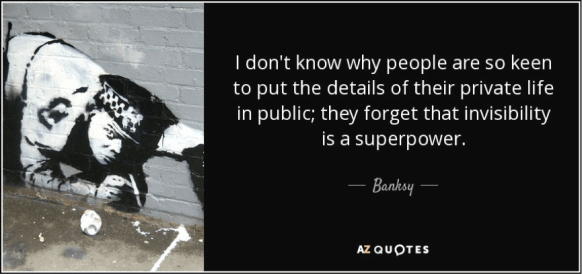
I believe the desire to be special (and thus not-normal) has to do with the desire to be visible. A lack of visibility seems to give me less power.

Banksy

If invisibility is a superpower, than maybe also anonymity. I have these moments where I want to disappear in complete anonymity, like a monk in a monastery, detached from any social contact. The antonym of anonymous is “named”, “known”, “identified”. A desire to be un-named, un-known, un-identified. Without identity. And do-my-thing. Without the need for attention and visibility. But even that is a make-up, a mask.

Just the act of saying “I want to disappear in complete anonymity” is the superego acting in the background. Because it assumes I am special, famous, non-anonymous. And I have to escape it. It’s an “evolved” form of narcissism: feeling superior rather than feeling special.

Narcissicm was well described in a post by Umair Hague about why America can’t learn from the world (be aware I take the sentence out of its original context, which is a bit of manipulating or content-mixing of course):

“Narcissism. The belief not just that one is special — for we all are unique, different, remarkable. The belief that one is superior, above, beyond. Better in fundamental ways. That is never true. Not a single one of us is better in any fundamental way. The genius is poor at loving. The lover is poor at creating. The creator is poor at managing. And so on. We all have flaws. But the greatest flaw of all is to be blind to the grace and beauty of the idea that we all have flaws — and so to believe there is nothing to be learned from anyone else. Trump is a narcissist, sure — but he is only a reflection of American narcissism in this way.”

The first job of a leader is to learn. Only then can a leader do their second and third jobs — care and love. Leadership is nothing more — and nothing less — than realizing human potential. You can do it as a parent, boss, friend, partner. You probably do. That is what care and love are in concrete human terms. The difference between them is that care brings a person towards their potential, and love expands that potential.”

art academy

Art Academy 12 year old kids playing with tissues – June 2017

Feeling special, feeling superior. Being part of the ego-tribe. Even worse is the word contempt: the feeling that a person or a thing is beneath consideration, worthless, or deserving scorn.

In that sense I am also a reflection, a feedback loop of society. It’s the only thing that is great about Trump: he makes you more aware of your own shadows of narcissism, contempt and bullying. The ways you definitely do not want to stay in life. Being aware of these shadows, and finding a way to accept them, to integrate them I your whole being, and focusing on that other – different, better – palette of songs to sing. Breaking out of that rigidity of defence and taking others’ spaces.

To quote André Platteel again:

“Then there is no rigidity anymore of values that we can hang on to. Then there is nothing to be defended anymore causing us to exploit our power in a false way. To make another smaller and feel more free ourselves. Then it is not needed anymore to hide and feel our more expanded selves. Or to blow yourself up to make yourself bigger than you are. But just be, who you are in this moment.”

Maybe that’s when being normal becomes exciting and a source for internal happiness and stillness? When identity is not a burden anymore?

Also surprised what thoughts a simple invite to be normal can provoke? Share your surprises and insights. Please.

petervan-signature

I am in the business of cultivating high quality connections and flows to create immersive learning experiences and structural change. Check out: https://petervanproductions.com/

Petervan’s Delicacies – Week 21 Aug 2017

delicacies

Edition-95 of Delicacies: As usual, max 5 articles that I found interesting and worth re-reading. Handpicked, no robots. Minimalism in curation. Enjoy!

If you can’t get enough of these and want more than 5 articles, I have created an extended version of Petervan’s Delicacies in REVUE. If you want more than 5 links, you can subscribe here: https://www.getrevue.co/profile/petervan

Petervan’s Delicacies – Week 14 Aug 2017

delicacies

Edition-94 of Delicacies: As usual, max 5 articles that I found interesting and worth re-reading. Handpicked, no robots. Minimalism in curation. Enjoy!

If you can’t get enough of these and want more than 5 articles, I have created an extended version of Petervan’s Delicacies in REVUE. If you want more than 5 links, you can subscribe here: https://www.getrevue.co/profile/petervan

Petervan Productions – August 2017 update

Image-1

Petervan Productions 2017
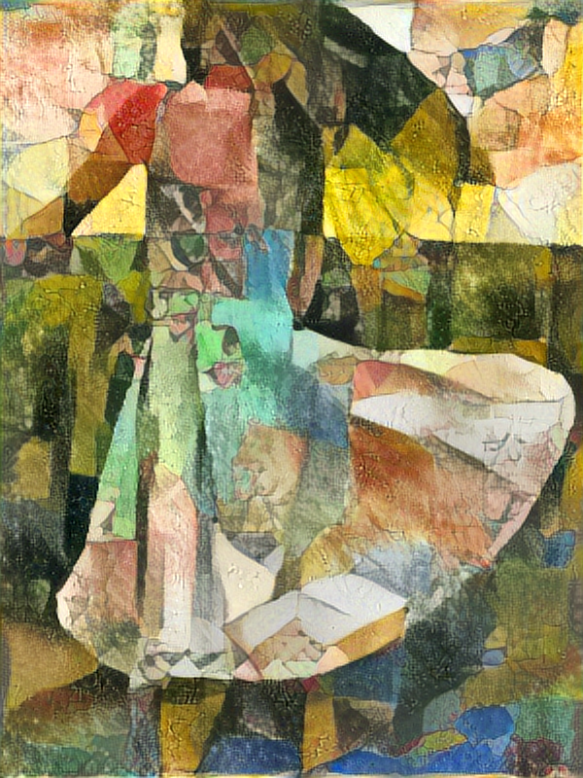
My own painting “Dancing Girl in Flemish Fields”
Through a Pikazo Van Klee filter

The summer slowly comes to an end. It is now almost ten months (!) since the start of my long-term sabbatical as Petervan Productions. It also means only four months to go. If you are interested in my developing story, my Jan 2017, March 2017 and May 2017 updates are still available.

A quick update:

Last months I have not been productive at all, at least not from a “work” point of view: begin May, I loosened up a bit my strict work schedule and decided to let my day agenda dictate by the weather – if good weather go out, if rainy do focused work – and since then we mostly only had sunny days 😉 So indeed, I did a reasonable amount of cycling (nothing excessive, short trips, 1-2 per week), and a lot of BBQ and wine in my garden to keep the balance right.

IMG_4639 (1)

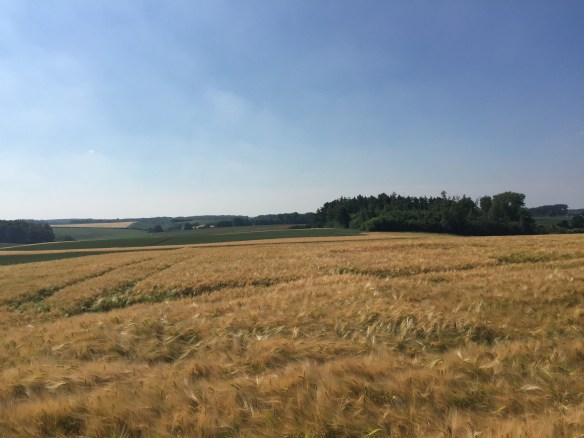
Bike ride: Corn fields south of Brussels – June 2017

The biggest distraction from “work” was our house move on 7 August, with significant prep work, and still now a number of boxes to be unpacked. So don’t expect too much from me for the remainder of the summer either. I did very little on the performance, but I have composed the music for the opening part of it.

Artschool

For the end of the academic year, I created an installation called “TOKOMA”. Here is the video and a link to the poem that goes with it. Everything is self-made, including the music and the poem.

Art school is now closed for the summer holidays. As we moved places, I have subscribed for next year in the academy of Aalst. But I will miss my friends at the academy in Overijse and especially my teacher Ann Grillet.

Globe3 croppedIMG_3945IMG_4612 cropped

Some recent Petervan Productions: Globe3, Yellow Ball, Dancing Girl

I also created another poem “Strillingen”, very clumsy translated (by myself) into “Hidrations”.

Performance

I accepted a gig for FinnoSummit in September in Mexico to do their opening keynote, which should include some elements of my performance “Tin Drum is Back”. The working title for the keynote is “Deep Change in Organizations”, and is currently scheduled at the start of day-2 of the summit. We’ll probably change the word “deep” into “structural”: see my post on Good Change – Bad Change.

The event will take place in Centro Cultural Roberto Cantoral, a fantastic building designed by architect Gerardo Broissin.

centro-cultural-roberto-cantoral-9

sala-cantoral-800-x-532_1

Centro Cultural Roberto Cantoral in Mexico City

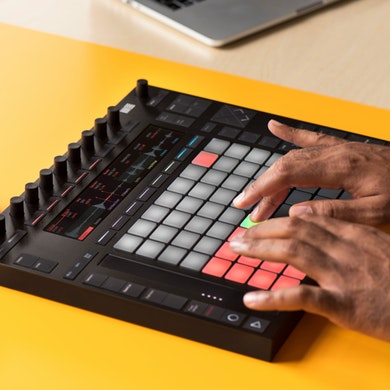
The venue comes with a concert hall with all possible A/V whistles and bells, so if everything goes to plan, I will bring with me this awesome Ableton Push device and illustrate the story with own artwork and soundscapes.

header-making-beats

Ableton Push Device

The House Project

As mentioned above, we moved houses. We moved to a place close to Aalst. It’s a quite recent house (20 years old) and used to be a practice of a physiotherapist, so I am in full progress to transform the practice into some sort of atelier/studio, my sacred secret temple 😉

garden

The house also comes with a huge garden (25 acres) so I am afraid that will need some of my attention too. And my daughter wants chickens, and my wife wants a kitchen garden. I have also noticed spectacular changes in light intensity in the garden, and I can’t wait to capture some of that in one of my upcoming paintings.

Astrid

Some great milestones for my almost 12-year old daughter Astrid:

Mid May, she did her solemn communion, and she was ravishing. A proud father and mother indeed 😉

IMG_4355

Ravishing Astrid – May 2017

End June she ended primary school and now moves to secondary school. A new school, a new city, saying good-bye to her dear friends in Overijse, and making plenty of new friends in this brand new environment. A lot of change for my big girl! She will need my and mom’s attention 😉

Other

I have written and reflected a lot, read some really good books and got some new insights.

I also got invited to a huge research centre of a very big company (can’t say who, I am under a very strict NDA – no pics etc that sort of thing, but it’s not in Fintech or anything). I was blown away how they integrate artists in their work.

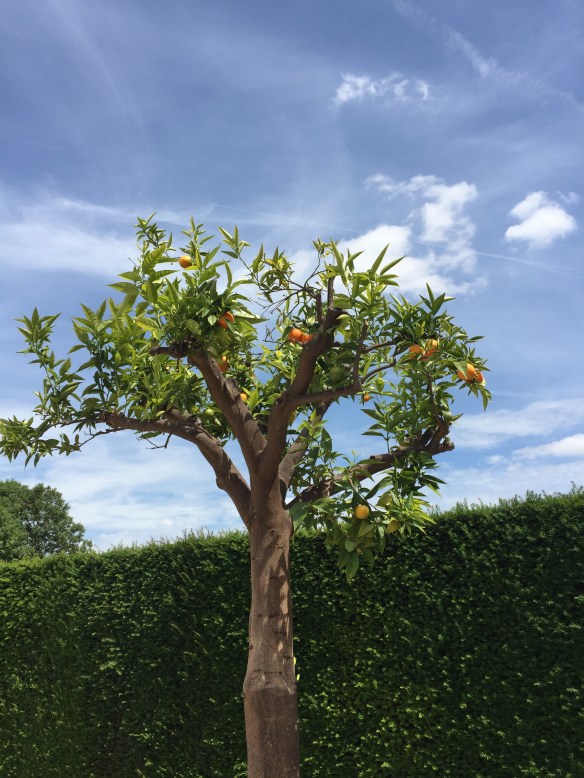
And there was this wonderful visit to the Gaasbeek Castle, with a very well curated expo named “Kairos Castle. The Art of the Moment”. I was however most impressed with the botanic garden of the castle, and took this nice picture of an orange tree in open air.

IMG_4593 (1)

Orange tree in open air in the Orangerie of the Gaasbeek Castle

And somewhere end May, I decided to put myself on a Twitter, FB and LinkedIn diet. I wanted to know what happens if I don’t tweet etc for at least a month (spoiler: not much, but some followers kindly asking if everything was ok, thanks for that). The social media just felt very distracting and most of the time full of emptiness (“full-of-emptiness”).

I have BTW a blog post in the queue about that emptiness, about being normal/special and about titles, roles, attention, the call for anonymity etc. You see, I did not change that much ;-). Now that the move is over, a will increase again my stream rhythm and publishing sequence

So, what’s next?

During Aug –Sep 2017, the plan is to work on:

  • The house project. I want to have the studio fully ready and operational by end September
  • Produce the opening keynote for the FinnoSummit
  • Continue the research on structural change (previously “deep” change)
  • Get some blogs and reflections published

kenny scharf

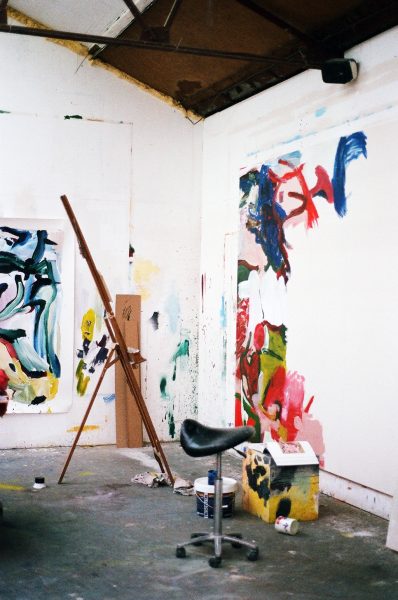
Kenny Scharf Art Studio

That’s about it for this edition. If there is something worth reporting, next update is for Oct 2017. Looking forward to hearing from your latest adventures as well.

Rebelliously yours,

petervan-signature

I am in the business of cultivating high quality connections and flows to create immersive learning experiences and structural change. Check out: https://petervanproductions.com/
Petervan’s Delicacies – Period Feb-Aug 2017

delicacies

Edition-93 of Delicacies: after a long interruption, I have resumed my curation. In this issue you’ll find some older and newer articles collected over the last months. As the summer holiday period comes to an end, I will try to resume my weekly publishing rhythm. Onwards! As usual, max 5 articles that I found interesting and worth re-reading. Handpicked, no robots. Minimalism in curation. Enjoy!

If you can’t get enough of these and want more than 5 articles, I have created an extended version of Petervan’s Delicacies in REVUE. If you want more than 5 links, you can subscribe here: https://www.getrevue.co/profile/petervan