The (ir)relevance of the desktop


How relevant will the desktop be in the next 5 years ? I don’t know about you, but I do more an more in online tools such as hotmail, gmail, googledocs, etc

I want to offer you 3 perspectives to this trend:

– A business to business point of view (Salesforce)

– A 2007 (!) vision by Aza Raskin from Mozilla Labs

– The announcement of Google Wave and OS

I have included 3 video is this post. The first one is short (1:54), the others are longer (1 hour 20 min) and (1 hour 20 min) respectively. But i can assure you they are worth every minute.

Let’s start with Salesforce. On 9 June 2009, I attended the free Salesforce-event “CloudTour 2009” in Eindhoven, Netherlands.


This was a very, very professionally run event with very professional speakers (drilled like an army). They flew over a number of hotshots from San Francisco for this event.

Some key facts about Salesforce:

  • 1,2 Billion $ revenue in FY 2009
  • 59,000+ customers
  • 1,5 Million users
  • 100 Million API transactions per day
  • Average response time: 300 Milliseconds
  • 3 releases per year, without any disruption for customers
  • Customers: big to small. Some examples: Solvay, VUM, Polycom, DELL, Corporate Express

All this to say this is not Mickey Mouse business: these folks exist for 10 years. This is mature business.

Their tag-line is: NO SOFTWARE.

Everything runs in the cloud.

There was a great demo on deep integration in Services Cloud of Twitter, Facebook discussions in Salesforce app, direct visibility in Google search. All in real-time.

Another demo was about “Building an app in 30 minutes”. They built in essence an expense report app like most companies have. Built and on-line in 30 minutes: With currency conversions, linked to accounts for which the expenses are incurred, with approval workflow, access management etc. All this was point and click. Not one single line of coding.

Peter Coffee, Director Platform Research had some strong messages about the economics of cloud. He stated that all of the following is commodity and does not add business value, and is ready to go to the cloud: Email, twitter, backup, security, virtualization, OS patches, running an Operating Centre, messaging. He also stated that SaaS, IaaS, PaaS are not relevant in itself. It’s about the apps and the business value add you create with that. And that cloud is NOT about IT budget cost reduction !

It is about moving from “less low level people on less value tasks” to “high value level people on high value tasks”

Your IT budget may go UP over the years, as you spent more on high value tasks

Beware of the expectation it is easy or cheap

When strolling through the exhibitor space, picked up a comment from a customer:

Now that I have this, I never want to go back to on-premise. This works. Never any probs of crashes and alike or things that do not work. Unbelievable I ever accepted doing business the old way.

Let’s have a  look at what Aza Raskin had to say about the desktop.

“Had” because this is dated May 2007, more than 2 years ago.

I am a big fan of Aza. See also my post on Mash-ups and Cloud and Semantic Web.

His bio is fantastic:

Aza is currently the Head of User Experience for Mozilla Labs, where he works on crafting the future of the web. He’s led projects ranging from semantic language-based interfaces (Ubiquity), to redesigning the Firefox extension platform (Jetpack). Aza gave his first talk on user interface at age 10 and got hooked. At 17, he was talking and consulting internationally; at 19, he coauthored a physics textbook because he was too young to buy alcohol; at 21, he started drinking alcohol and co-founded Humanized. Two years later, Aza founded Songza.com, a minimalist music search engine that had over a million song plays during it’s first week of operation. In another life, Aza has done Dark Matter research at both Tokyo University and the University of Chicago, from where he graduated with degrees in math and physics.

His GoogleTalk in 2007 was titled “Away with Applications: The Death of the Desktop”. On the opening picture, he looks even a bit like the very young Bill Gates ;-). Aza was born in 1984. So 25 years old now !

And it is NOT about bashing on Microsoft. He is explaining why it does not make sense anymore to follow what has been.

He is using some pretty powerful metaphors: the shovel analogy, “it’s not Microsoft’s fault”, Analog vs. Digital watch, “Start with the manual”.

If you don’t have the time to view the full video, go straight to minute 21 or so. In essence most user interfaces force the user to adhere to the program hierarchy of the developer.

He goes on with seeing natural language as a universal access to application: like you search the web, you could also search services. Basically, there are 4 “do this” commands: create, select, navigate, and transform.

Aza will this week also speak at TEDGlobal 2009 in the Connected Consequences track. I have also invited Aza to speak at SWIFT’s Sibos 2009, in the Innotribe track for which i am the overall content owner.

Enjoy Aza !

The other announcement that created a twitter & blog storm on the internet was Google Wave. Just google “Google Wave” and you will see what i mean 😉

I don’t get all the criticasters. This is really very cool stuff and it is going to change fundamentally how we think of online communication. I strongly recommend to watch every minute of this launch event video.

On May 29, a couple of days after the announcement, i spotted a Facebook comment from a person with a quite high-level position in the Belux Microsoft organization: "Not impressed by Google Wave. More of the same in a different jacket. Ever watched conversations in Outlook 2010 ?"

As i am an ex-Microsoft employee, and still have some friendly contacts there, i wrote him an e-mail and explained that i was soon going to write something on my blog on this and the relevance of the desktop.

I asked to share some links to Outlook 2010 to be able to link my readers to what Microsoft has to offer in this area so that my readers can make up their own mind ? This is the answer i got: “Outlook 2010 is in Technical Preview – we cannot show outside. But if you look on the web you will find a couple of things about it.”

So it’s “help yourself” at http://www.microsoft.com/office/2010/. Oh yeah, you probably will have to pay for Office 2010. Last week, Microsoft also announced they will offer a FREE on-line version of Office as part of the upcoming Microsoft Office 2010 release.

To close this post, a really good opinion on this in Hutch Carpenter’s blog “I’m actually not a geek”. One of his latest posts relate to SaaS and also relates to Google’s more recent announcement of the Chrome OS.

He positions all this in the context of Clayton Christensen’s “disruptive innovation” model, and goes on:

Which brings us to the PCs of today. They are marvels, providing a slick experience for users and able to accommodate a host of new applications. But if I were a betting man, I’d say the most common activities people do with their computers are:

  • Surf the web, engage in social media
  • Email
  • Write documents
  • Build spreadsheets
  • Create presentations
  • Consume and work with media (video, music, graphics)
  • Use web-based business apps

Among those activities, what’s the magic of client-based computing? The media-related activities perhaps require the horsepower of a client app. But even those are getting better with web apps.

I recently decided to switch from hotmail to gmail.

Competition is good.
Think Tank


The title of my very first post in April was inspired by an personal development course i followed in 2007-2009. The course was titled “Leading by Being”. For myself, i discovered my purpose in life as “Inspiring other people to dream”.

I can do this in many different authentic ways: in my family, at work, with friends, in communities, on-line.

Based on some initial ideas created during Leading by Being, i started putting together some ideas on what is little by little becoming a think tank looking at long term future.

My Pamphlet posting of last month was basically the first part of the executive summary for this think tank.

image

Since then, we have been sitting together last month with 10 captains of industry of the Flanders region, where the idea was floated and generated a lot of interest. We will have a follow-up meeting after the summer holidays, where we will invite co-thinkers and enthusiasts.

I would like to go faster, but would like things happen at their natural pace, as the subtitle of this blog suggests: “Let the future emerge”.

I will keep you updated as this project/movement emerges.

To keep the subject warm, I am happy to share the 2nd part of the executive summary in its original form, hopefully to generate some on-line discussion:

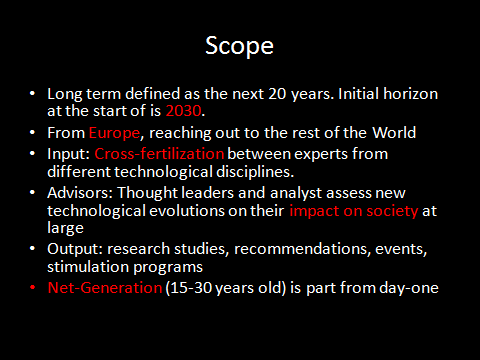
We want to create a “think-tank/foundation” on long term future. Long term defined as 2030. A place where “smart people” can meet. Where experts from different technological domains share their insights for 2030. Cross-fertilizing each other’s disciplines. With “smart people” from different contexts & worldviews that can act as our “eyes” and offer a perspective on how we will live, work in 2030. On how our education is best organized. On what our ideal value kit for that era should be, beyond traditional corporate culture. A culture of sharing and exploring, where we live intensely in teams, groups, regions, countries and communities and with deep respect for the individual humanistic identity of all those forming part of it.

Similar think-tanks of course already exist. But many look at these subjects from an US-perspective only. Or only bringing together technology experts. Few or none do this from our cultural rich and diverse European heritage.

We believe that from Flanders we can make a difference. Flanders is ideally placed: it’s highly appreciated and most productive multilingual multi-cultural workforce is operating from the cross-road of Europe and fleeing out to all countries in the world. As our interdependency from other countries, regions and continents will become even more important in the years ahead, we believe we have a unique opportunity to forecast together these exciting future scenarios and possibly even lead several of these technological revolutions.

We also want to make a difference by the inclusion up-front of the Net-Generation in our thinking. We want to give the opportunity to high-potential young adults between 15-30 years to co-create this future. Mentored by those who were part of the Internet revolution 20 years ago, and who are now 35-45 years old. Vice-Versa, we also want to offer reverse-mentorship by Net-Generation high-potentials.

image

These new models and scenarios will demand speed, creativity, dynamism, perseverance, courage, knowledge and working together in a multi-cultural context. This new society is – together with the movement of TransHumanists – making a plea for respect for individuality, freedom, mobility and quality of life.

This work and endeavor is all about designing, exploring and organizing change, learning and fine-tuning as we go. Giving guidance to teams, organizations and leaders on how to surf these waves. Missing the first technology wave of speed and creativity will result in loss of economic relevance. Missing the wave of the new value kit will result in losing our Net-Generation, our brains for the future.

Who wants to join this movement ?

Pamphlet

I started this blog on 7 April 2009. It may look as a very diverse set of blog-posts, but there is plan behind all this.

As a teaser, i am publishing today my Pamphlet. More to follow in the days/weeks to follow. Let me know what you think.

“Over the last 20 years we have witnessed a fantastic growth of wealth and technologies. ICT technologies have started permeating our daily lives. Medical sciences and biotechnologies have increased the average age significantly. Other technologies (Nanotechnologies, AI, Robotics, etc) have kick-started. “

But, since the last couple of years, we witness the breakdown of a number of core systems:

– Our worldwide Financial system is going through a “meltdown”. The old game of greed is coming to an end. Trust is becoming value number 1.

– Ecological, ethnological and demographical shocks are turning our systems upside-down. Green and Energy are now in the mainstream

– The East/West shock: economic powers shifting from the Western world to the new economies of APAC and BRIC+ countries.

– New forms of communication via the internet (blogs, wikis, social networks such as Facebook, Twitter, Netlog, etc) propose a new paradigm with respect of privacy.

“All this fundamental changes give us a feeling of discomfort, disorientation, confusion, loss of control. Although our “collective intelligence” indicates that our old models do not apply anymore, our “hardware” seems not to have followed. We have not adapted the way how we are organized hierarchically, how we look at governance. Our traditional “system”-thinking got stuck and did not follow our “collective intelligence”

On the other hand a set of new systems and tools are building up:

– Barack Obama describes it as the ‘audacity of hope’; innovators, planners, academics and authors are referring to dreamtelligence as a new, vital, and visionary way to use play, fantasy, dream-thinking and innovation to kick-start ideas and stimulate community engagement.

– A fantastic call for and revival of authenticity for ourselves and our leaders. Having true leaders: with charisma, attraction, integrity, and authenticity.

– The Net.Generation (now young adults between 15-30 years old) have grown up as digital natives. They will be tomorrow’s leaders. What THEY think will co-form our future. Future will not be invented by today’s generation. This Net-Generation lives differently. They are “wired” differently. For them multitasking (multi-window chatting, gaming at the same time while listening music, looking up information on the internet, being mobile, etc are very common. They also think differently (deeper and more authentic): they have a very strong sense of the common good and of collective and civic responsibility

– Our technological revolution has just started.

o Today our technologists are capable of breeding a human ear in their labs. We are now in a position to create and grow cells, tissues and bodies.

o Artificial Intelligence is back: by 2030 our computers will be able to think, be self-learning, self-healing , some will be able to have a consciousness.

o Self-learning robots will soon go mainstream. Mercedes and BMW have already now cars in the pipeline for 2012 that can drive fully automatically, better than a human being

o The emergence of Google and the “Global Brain”. The internet today is already a tremendous source of information. Today’s search experience will pale compared to the mechanisms we’ll have in 20 years. All knowledge will be available anywhere, anytime, wireless, via brain-implants.

o Social networking is already revolutionalizing the way people and companies are communicating. Interesting to note that these Technologies let us evolve again from a system-to-system communication towards human-human communication.

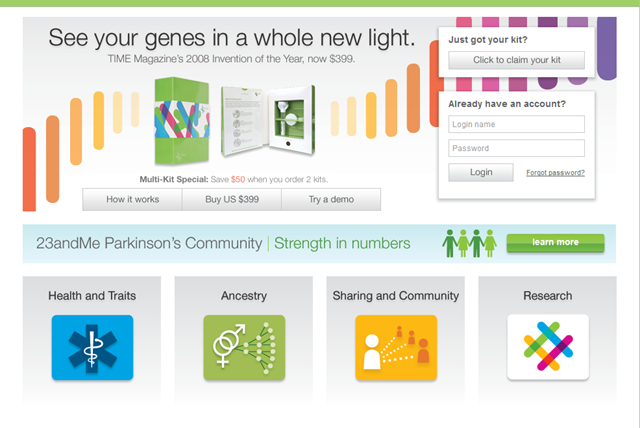
o Today you can order your personal DNA Gnome sequence in the USA for only 399$. The company doing this is a Google backed start-up. Think DNA in the cloud, with DNA comparisons between ancestors, relationships, etc.

o Brain-wave helmets and chip-implants will give humans better sensors. By 2030 we will see the emergence of “superhumans”. In such dramatically changed context, what will make us “human” ?

o A lot of these future scenarios are described in Ray Kurzweil’s “Singularity” concept. This is the moment when man and machine will truly blend. Kurzweil claims this will happen around the year 2030.

And the pace of all these technological innovations just goes on in a very exponential way. In the next 20 years we will witness technology breakthroughs that will mean the tenfold of what we have seen the last 20 years.

“All these evolutions call for a re-thinking of our value-compass for the future. We must carefully analyze and think-through on how all this will influence the way we will and want to live and work in the future. What sort of life-quality we aim for. What the socio-economic impact of all this may be. How we want education to be organized. Where we still can and want to influence. “

Consumer Genetics Show


Found this link about the Consumer Genetics Show via a tweet from Tom Hague of the Open Calais project. Tom tweets that he never expected to see the words “Genetics”, “Consumer”, and “Show” to come together.

Coincidently, at about the same time, i am reading the following paragraph in chapter XV – Time Warp in the book “As the future catches you” by Juan Enriquez.

“Almost any species can be cloned today…

“In the United States, it is illegal to use federal funds to clone humans…

“But it is not illegal to clone a human… (except in California, Louisiana, Michigan, and Rhode Island.)

“Nor is it illegal in Singapore, Russia, Brazil, China.

“And if you combine desperate customers…

“Rapidly evolving and highly decentralized technology…

“And the moniker of “the first scientist to clone a human”…

“The incentives are too great to stop this from happening.

Juan Enriquez also had a great speech at TED 2009:

I am a big believer that we will see the biggest breakthroughs and innovations on the cross-roads of ICT and Bio-engineering.

And i would like to add one more dimension to it: the Global Brain or the Semantic Web.

Example ?

One of the companies mentioned in the article on the Consumer Genetics Show is 23andMe.

image

A customer of the Web-based service 23andMe sends in a sample of spit and receives a genome-wide analysis of nearly 600,000 genetic variations. The results include an estimate of genetic risk for various diseases, along with other personal information, such as where the customer’s ancient ancestors might have come from. Price tag ? 399$

Sergey Brin, the billionaire co-founder of Google plans to contribute money and his DNA to a large study intended to reveal the genetic underpinnings of Parkinson’s disease. See also this article in the New Your Times dated March 2009.

23andMe is co-founded and co-managed by Mr. Brin’s wife, Anne Wojcicki. The company offers a personal genomics service, in which it scans the DNA submitted by its customers and provides information on their health risks, ancestry and other traits. Esther Dyson is a Board member.

Start thinking DNA and gnome in the cloud.

“Getting a genome sequence has never been an end … just a start” -  Craig Venter

NUI, XUI, TUI ?

No, this is not the name of the latest song i have been teaching to my 3 1/2 year old daughter.

I am just going completely crazy these days about touch-driven devices, and found some new acronyms in this space:

  1. NUI: Natural User Interface. Examples are Surface and Jeff Han’s touch interfaces
  2. XUI: XML User Interface

So, i decided to invent my own. TUI: “Touch User Interfaces”, but a check in Wikipedia revealed somebody else already coined that acronym. I just wanted to add more touch or even no-touch as in gestures.

As i have some days off this week, I have some extra time to introduce the topic with some parodies on well know advertisements. This will also please my readers who ask me questions such as “why do we need all these computers ?”

Please enjoy the advantages of the Mac Air:

Why spent 300 € on a Wii Fit, if 3 € would give you the real thing ?

Surface on its best:

Or this one: Put a Surface in your pocket:

But seriously, how could these devices used in Business ? Let’s have a look at what Barclays is doing with it:

Or at Identity Mine: a Touch-catalogue and Blackberry becomes check-out for Elektra, a big electro-shop in South-America (sorry did not succeed to embed that video).

Or let’s throw in some “gestures” at GestureTek:

And from the same GestureTek: full body Avatar control. Check out this link with plenty of other demos.

But what if real and virtual get really mixed together. Have a look at the concept videos below:

XUI/NUI/TUI at Home

XUI/NUI/YUI at Work:

Or get completely immersed. Check out how EonReality is pushing the limits. Here on their homepage and here in this video. It’s getting so real that you almost get sea-sick.

Amazing 3D immersion technology from IDEO Labs on Vimeo.

Who said that singularity (the moment man & machine truly blend together) will happen in 2030 ?

I think it will be much sooner.

In 2030, having a brain implant will be as cool as having an iPhone today. Who in his right mind would have predicted in 1990 more than one cell phone per person ? That’s also only 20 years ago.

Smart Data go mainstream

Smart Data are the promise of the Semantic Web.

And yes, i heard the pitches from Tim-Berners Lee. But that sounded all so far away and abstract, and i could not imagine what it would give me as added value.

But the video & site below put this into a competitive advantage context and that’s where it gets interesting.


Check out the OpenCalais project: fantastic site with many interesting other links to semantic web related sites, blogs, etc. This will take me week to digest.

And these are not some geeks putting together something. This is an initiative powered by Thomson Reuters: “The Calais initiative supports the interoperability of content and advances Thomson Reuters mission to deliver pervasive, intelligent information. It builds on the company’s investment in semantic technologies and Natural Language Processing to offer free metadata generation services, developer tools and an open standard for the generation of semantic content. It also provides publishers with an automatic connection to the Linked Data cloud and introduces a global metadata transport layer that helps them leverage content consumers like search engines to reach more downstream readers.”

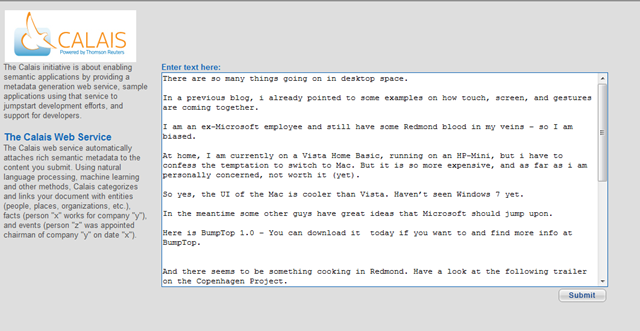
I decided to try the DocViewer at http://viewer.opencalais.com/ and i cut & pasted the full text of my recent blog on “My new desktop: touch and 3D of course” and hit the submit button:

image

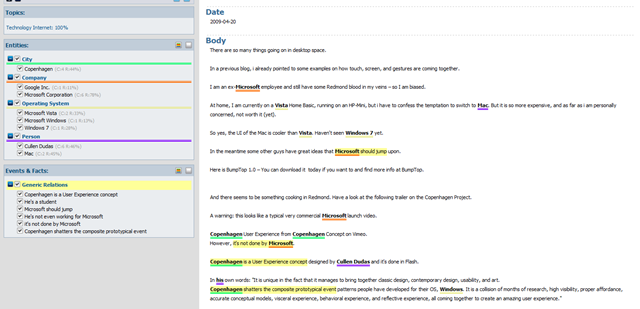
What i get back is amazing:

image

The unstructured data of my blog are parsed, patterns are recognized and semantic data is added. All this can now programmatically exploited as the APIs are published.

Imagine combining this power with drag & drop mash-up techniques such as Yahoo Pipes or similar.

Or imagine using this to feed info from financial data reference sources into your financial planning or even trading rooms. I recently have seen a similar demo, with very powerful multilingual parsing and pattern recognition of unstructured data, but this is the first time i see something that has the potential to go mainstream very fast.

PS: some folks ask me where i find these interesting links. Well, i spent quite some time researching on the web of course. But i also have some friendly secret sources. Friends that just share a link via Twitter or mail, and who themselves have no time or appetite to make a blog out of it. The subject for this post was kindly provided “xstof”

Fasten your Seatbelts for a trip to AlloSphere


Stunning data visualization.

JoAnn Kuchera-Morin demos the AlloSphere, an entirely new way to see and interpret scientific data, in full color and surround sound inside a massive metal sphere. Dive into the brain, feel electron spin, hear the music of the elements …

Pizzled: 1 Brain = 1 Dollar

There is a great presentation by Nova Spivack on the future of the web, the emergence of collective intelligence and the global brain.

Nova Spivack has been in space, has a great blog/news site, and has recently created Twine.com. I strongly recommend you to subscribe to Twine. It’s one of my great sources of information.

Nova is also a Tibetan Buddhist, which is not irrelevant in this context.

The presentation he delivered at the Singularity Summit Dec 2008 gives a longer term perspective beyond Web 2.0. Btw: all the key presentations of that Summit are now online.

Just to set the scene: by 2030 you will be able to buy the power of the human brain for 1 dollar. By 2040, machine intelligence will be one billion TIMES greater than all human intelligence together.

The presentation starts with a list of great thinkers: first of all this is a very humbling experience, and secondly a great shopping list for my next pile of books. It makes me so hungry to know more, which illustrates my oral character structure.

Quiz: in that list of great thinkers, Nova mentions 2 Flemish researchers/thinkers: if you spot their names, let me know via the comment of this post.  Prize ? Eternal Fame in my blog.

Then he leads you through concepts such as Web 4.0, the Web Wide World (not the World Wide Web), the evolution of crowds, groups, and meta-selves. This would be a great subject for my friend André Pelgrims, who specializes in group dynamics of people in flesh & blood (people like you and me 😉 and to see whether André’s model on group evolution with 4 phases would apply to the online world as well. The 4 phases André defines are:

  1. Forming & dependency. The individual is part of the group but with loss of his identity
  2. Storming & counter-dependency: scapegoating and the innocent gets all the shit.
  3. Independency. Expansion of the individual, helping/caring for others takes central stage
  4. Inter-Dependency: blend in the group without loss of identity. Genuinely sharing is key, nothings needs care or help.

You can find Nova’s presentation here. Enjoy.

This of course raises a lot of questions on our personal and corporate value kit for the future, and what it will mean to be a human, when indeed machine intelligence will be dramatically more powerful then our collective intelligence.

As some sort of counterbalance, i would also like to point you to a older (2007) TED presentation by Daniel Coleman (Emotional Intelligence) on Compassion by Daniel Coleman 2007. Thanks to my friend Sven for sharing this one.

All this technological evolutions still make us search & reach for REAL contact between people. Coleman describes the feeling of NOT getting attention when somebody uses his Blackberry/iPhone/whatever during a meeting or conversation: you feel “pizzled”, a combination of puzzled and pissed-off.

That’s because the other person does not give you real attention.

Coleman’s recommendation is to turn off your PDA’s, close your laptop, end your daydreams, and pay full attention to the other. And about the art of balancing between the self and the other selves, and the meta-selves of Nova Spivack. And so we are back to the Tibetan Buddhist.

Tom Cruise Wall

Who has the real Tom Cruise touch-screen wall of Minority Report ?

Recently i had the chance to see ànd touch ànd play-around with Microsoft’s Surface Table. That was fun. Made me think of the video wall in Minority Report ;-).

Microsoft already showed some wall like this from their R&D group back in 2006

But what’s next ? Is the Tom Cruise Wall reality or still in the R&D labs ? Or is our vision of User Interface (UI) getting even better or fundamentally different ? Found in the meantime following cool stuff:

  1. Jeff Han’s http://www.perceptivepixel.com/ company. Jeff created havoc  at TED 2007
  2. Pattie Maes’ TED 2009 appearance without screen and based on gestures:
  3. More gestures: the QB1 computer from OZWE: http://www.ozwe.com/
  4. In stead of flat screens and Tablet PC’s, check out the Pulse Smartpen at http://www.livescribe.com/
  5. Or throw into this things like PopFly, Yahoo Pipes, Adobe AIR, Silverlight, etc

In other words: how will we interface with the computer in 5 years ? In 10 years ? Will we all have at home a 15 m³ wall-screen in our living room, connected to a Terabit Internet Connection ?

This must be fun: let’s share what other Tom Cruise Walls are available in the market today, or that you have seen on the web or in R&D labs.

Singularity: Web² and augmented First Life

I am a big fan of Ray Kurzweil.

Too make a long story short, he is predicting that man & machine will blend together around 2030, and that is not so far away !

It’s about augmented human beings. And superhumans. And what the impact on society of all that is.

A must read from Ray is his latest (already out there for 2 years or so) book: “The singularity is near

And have in this context also a look at the Singularity University. Not only the subject and idea of building a dedicated university for his is cool in itself (I enlisted for the 3 day program in Fall 2009, and i am anxiously waiting whether i will be accepted 😉 but have a look at who was there at their founding conference !

This is top-notch “crème de la crème” set of folks: Chris Anderson, Robert Freitas, Larry Page and a lot of other Google & NASA brains.

This is just going to happen. And it’s going to get in mainstream faster then we believe. Ray is even preparing a movie to get these thought permeated into mainstream thinking.

Talking about mainstream. I am again referring to my previous post on Tim O’Reilly’s keynote at WebExpo 2.0 earlier this month.

Free interpretation: forget about Second Life, it’s all about First Life augmented with stuff in the cloud.

In my opinion we are witnessing the singularity in some form already now in what Tim O’Reilly calls Web² (yep, you got it: not Web 2.0 but Web²): World + Web 2.0 = Web².

A human being augmented with sensors in the cloud and in the body, tapping the collective intelligence in this global brain that the web is becoming, sharing & collaborating in ways we never thought possible 5 years ago.

Or is all this too much SF to you ? Have i been reading to many Asimov ?

For the fun of it, i just remind you the 3 Asimov Laws of Robotics:

  • A robot may not injure a human being or, through inaction, allow a human being to come to harm.
  • A robot must obey orders given to it by human beings, except where such orders would conflict with the First Law.
  • A robot must protect its own existence as long as such protection does not conflict with the First or Second Law.

    I would be interested to hear from you on whether you believe this will happen or not. And all the above is very much inspired by things and folks working from Silicon Valley. Any cool similar things going on in the rest of the world ?