Petervan’s Musical Ride August 2023 – 50 songs, 95% new releases. Some oldies from Burial, Joey Beltram, and De Staat > Play in shuffle mode to increase the surprise factor. Enjoy!
Category Archives: Petervan Studios
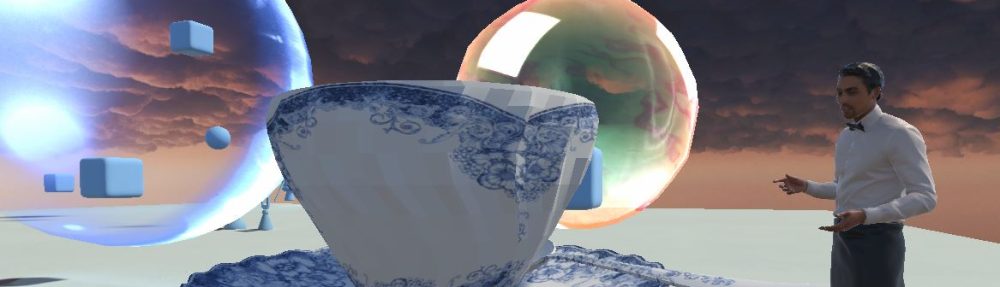
Virtual Cube (poem)

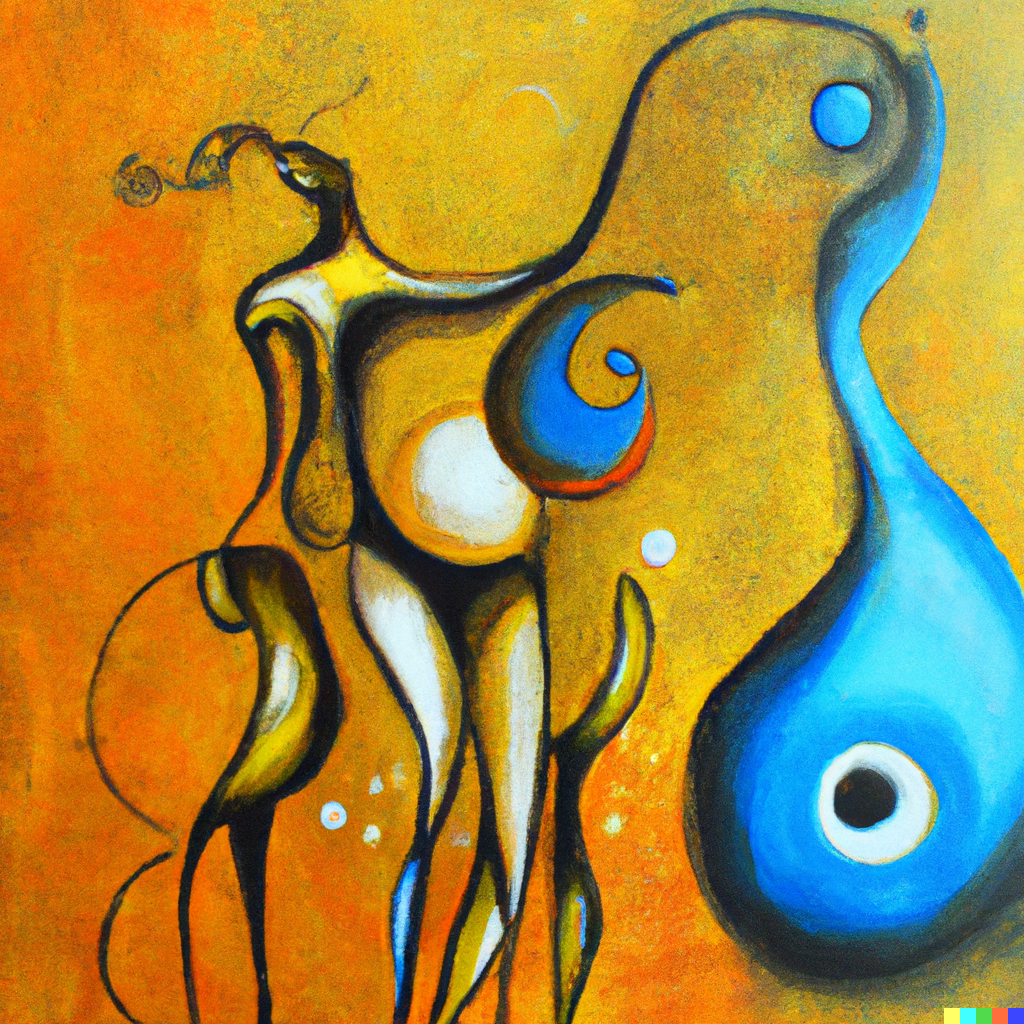
Petervan Studios © 2023 – Generated by DALL-E
Het wordt stil.
Ik kijk naar de virtuele kubus waarin ik mij bevind.
Een zwerm vogels vliegt diagonaal voorbij van links naar rechts in het kubistische veld.
Bomen in de wind.
Muren van gouden licht temperen de zachtheid van de achtergrond.
De lucht indigoblauw.
De orchideeën en de rododendrons klaar om te gaan slapen.
Ze buigen nog eenmaal kun kopje voor ze hun knoppen sluiten.
De komende nacht zal rustig en zacht zijn.
De storm in mijn hoofd is verdwenen.
De wind blaast mijn laatste adem uit.
Ik ben vrij om te doen en te zijn.
+++
Google translation:
+++
It’s getting quiet.
I look at the virtual cube in which I am.
A flock of birds flies diagonally past from left to right in the cubist field.
Trees in the wind.
Walls of golden light temper the softness of the background.
The sky indigo blue.
The orchids and the rhododendrons ready to go to sleep.
They bend their head once more before closing their buds.
The coming night will be quiet and gentle.
The storm in my head is gone.
The wind blows my last breath.
I am free to do and be.
Petervan’s Ride – July 2023
Petervan’s Musical Ride July 2023 – 50 songs, 95% new releases. Some oldies from Gainsbourg, Deus, Pink Floyd, and Zappa > Play in shuffle mode to increase the surprise factor. Enjoy!
Making Content Work
It is rare that I read a book twice. “Making Art Work” by Patrick McCray is one of them. A book that sends you back to the future of the 50ies, a period in some sense similar to today, where we are again in a cold/warm war context, but where interesting collaborations between art, engineers, scientists, entrepreneurs, and technologists make their appearance as well. Fortunately, it was not all doom then, and neither is it today.
The book is also a huge inspiration for The Scaffold, the transdisciplinary learning studio for the never-normal that I am trying to give birth in different constellations.
In the book, the author Patrick McGray looks at artists-engineers collaborations with a very specific lens: where usually art books glorify the artists, Making Art Work looks at the engineers that made the transdisciplinary artworks work. Hence the title “Making Art Work”.
One of the key insights in these transdisciplinary collaborations is the evolution from “What do I want?” to “What do we have?” Usually, the artist comes in with what she/he wants and asks the engineers to make that happen. This approach leads to a lot of misunderstandings and frustrations. A better take is to start with the question to the engineers “What do you have?” and let the artists play and be creative with what is already there.
The book is a treasure of other gems, anecdotes, and more in-depth research of the life and work of folks like Frank Malina (rocket engineer turned artist), Billy Klüver (laser-beam engineer turned curator/impresario), Jean Tingeley (artwork/machined that destroyed itself). These were also crazy times with Andy Warhol, John Cage, Robert Rauschenberg, Marcel Duchamp, and many others.
Jean Tingeley – Hommage to New York, 1960 – The New York Times – Photographer unknown
One of the initiatives described is the E.A.T. Experiments in Art and Technology, driven by curator/experimentalist/impresario Billy Klüver.
There was so much going on at E.A.T. and the best way to get a sense of the depth and breadth of their work is by reading the book, or sitting down, relaxing, and enjoying this +1hour video about the initiative, narrated by Julie Martin, at that time “Director of Experiments” at E.A.T., and in this video really charming and full of humor.
Not only is her title cool, but the title reflects the core E.A.T. ethos which was all about experiments. The outcome was deemed less important than the journey of the experiment.
The becoming is more important that the state of the thing.
In my earlier post “Apple Just Upgraded the Illusion”, I already touched upon process philosophy as “a way out of what is today seen as overly deterministic thinking about technology and time, and clears the road for thinking about digital technologies and digital selves not as objects but as processes and becoming“
“Projects that did not get realized are as interesting as projects that are”
Julie Martin talks about reverberating beyond careers and personal lives, cultivating a sense of play, disciplinary hybrids, “artrapreneurship”, and taking purposeful risks in order to explore new boundaries in both art and science. How cool is that!
The precursor of E.A.T. was an amazing one-time event “9 Evenings: Theatre and Engineering” one of the first large-scale collaborations between artists and engineers and scientists, held in the 69th Regiment Armory in New York, a huge empty space that was transformed into a theatrical performance space in five days.
E.A.T. was also the main contractor/curator for the content at the PepsiCo Pavillion at the World Fair Japan in 1970.
Here is an excellent article in IEEE Spectrum Magazine of Feb 2020 by the author of Making Art Work, Patrick McCray.
I love the subtitle “50 years on, artists and engineers staged one of the most ambitious and expensive multimedia events – and infuriated their corporate backers”
Here are some pictures from that article:
Both “9 Weeks” and the “Pepsi Pavillion” highlight the importance of space in orchestrating new skills and behaviors. Space as a language. Space as in spatial computing. Space as in spatial thinking, spatial creation.
In re-reading the book “Making Art Work” and writing this post, I suddenly realized that most of my work is about “Making Space Work”, or even better “Making Content Work”. A practice where most of the work is an experiment. Where the becoming and the performance in space are more important than the resulting artifacts.
Performance by the performers on-stage, but also by the participants. Their journey becomes an experiment as well, a curious meandering through an endless labyrinth, letting them connect the dots and do the meaning-making, rather than considering the audience as passive consumers of content that need to be hand-held, directed, and manipulated by and in a scripted non-malleable “show”.
As I mentioned several times before, my practice is not in the entertainment business, my practice is in the learning “bildung” process. These methods are underpinning my work in the area of interventions, provocations, and interruptions. In other words, all my work is about similar forms of artistic and aesthetic expression and experience in the co-creation of content. These methods also led to a new vocabulary and a new set of aesthetics to describe and share what I do and why I do it.
I feel like I am painting with content. Making content work. I am hungry to unleash this creative energy in some big space, together with technologists, scientists, artists, and entrepreneurs.
Warmest
Petervan’s Ride – June 2023
Petervan’s Musical Ride June 2023 – Entering the fifth year of monthly rides! This month we curated almost 100 songs, 95% new releases. Some oldies from Alice Cooper, CCR, Herp Albert, and even Yasmine! > Play in shuffle mode to increase the surprise factor. Enjoy!
Sine Parole – 16 June 2023
Apple just upgraded the illusion

Picture by Apple
The initial title of this post was “Let’s upgrade the illusion”, but that’s what Apple just did with the announcement of the Vision Pro. And I mean that in the positive sense, not as a criticism.
The quote “Let’s upgrade the illusion” comes from a keynote by Deepak Chopra during the December 2022 retreat of Nishith Desai Associates (NDA), a leading Legal & Tax Consulting company from India, with offices worldwide. It is in itself interesting to see a Legal & Tax Consulting company exclusively focused on new technologies like AI, XR, Nano, Bio, etc.
The event was hosted in NDA’s gorgeous campus “The Imaginarium”, a true infrastructure for imagination, pitched by the CEO as a “private infrastructure for the public good”. How cool is that?
But back to that keynote titled “The nature of reality, what is real?” – We jump in after 2 min:
Deepak kicks off by stating that everything is real if you are truly immersed in it: whatever you experience is an illusion. If everything is an illusion anyway, let’s then upgrade the illusion. To do so, says Deepak, ideas have to manifest. Therefore we need imagination.
Imagination is about EVERY experience, all senses, not only visual, Deepak goes on. And then he really got me when he explained:
“That what imagineS is consciousness, awareness, soul. That what imagineS has no form, no location in time or space, no boundary, and therefore is infinite. That what is imagineD has form, has location.”
This opens a field of possibilities, or better, a field of what can be imagined.
I agree with Peter Hinssen when he says that the Vision Pro is not an iPhone moment but an Apple LISA moment:
“I don’t agree with those who say that the Apple Vision Pro launch is a new iPhone moment. I believe it’s an Apple Lisa moment. The Apple Lisa was a true milestone in the history of personal computing. Just like the Lisa, the Apple Vision Pro is a technological marvel that is too expensive (for now) to join the mainstream but is setting completely new standards for the industry.”
Back to Deepak. In a second talk at the same event about “The Future of Wellbeing”, he kindly notices that scientists measure experiences, and artists have experiences. That scientists identify with Quanta, and artists with Qualia. “Qualia is a unit of experience”.
What if we would measure the success of the Vision Pro on its potential to dramatically increase our units of experience, expanding our notions and understandings of what is real.
This reminds me of David Chalmers’ book “REALITY+”, a philosophical masterpiece that basically states that any good illusion is indistinguishable from real.
Let’s mix this with the insights of another philosopher Mark Coeckelbergh in his new book “Digital Technologies, Temporality, and the Politics of Co-Existence”, a mouthful, I know. Prof. Dr. Mark Coeckelbergh is a full Professor of Philosophy of Media and Technology at the Philosophy of Department of the University of Vienna.
In this book, Coeckelbergh makes a plea for process philosophy:
“Process philosophy shows a way out of what is today seen as overly deterministic thinking about technology and time, and clears the road for thinking about digital technologies and digital selves not as objects but as processes and becoming“
He also introduces the concepts of embodied technologies and “technoperformances.”
Performances emphasize the role of humans and the social but also bodily and kinetic character of our (co-)existence with digital technologies… As I have proposed in Moved by Machines and related work, the term performance can be used to conceptualize our dealings with technologies, including digital technologies. As we use digital technologies and are involved in technoperformances, we move and are choreographed, we act and are directed. To conceptualize the important role technologies and media play, we can say that we do not only use technologies in order to move, but that technologies also move us and direct us. The medium is not only the message but also the performance.
This brings me to the excellent interview of Kent Bye with Andreea Ion Cojocura during SXSW 2023 titled “Defining Process-Relational Architecture with Andreea Ion CojoCaru: Spatial Design as a Participatory Improv Performance”
Andreea passionately talks about the potential of XR to instigate and discover emergent behaviours, about rubbery environments in continuous change, putting change at the heart of everything. And also about performance, like in art performance, a live creative process that takes you on an embodied, visceral journey with direct interaction with public. A process relational approach: me and the building (the environment) going dancing for a while. Love that – dancing with your spacial environment: where the end result is less important than the process, the experience itself.
Ken Bye has btw very deep thoughts about the impact of AR/VR/XR on presence, immersive storytelling, and experiential design. Watch his May 2022 Brussels talk on YouTube here. I encourage you to watch the whole thing, it will reset your assumptions about virtual reality.
The core of his talk is about this quadrant, looking at AR/VR/XR in terms of four types of presences.

One could also say the four types of “illusions” of what is real and what creates and influences your learnings and behaviors.
Let”s get out of this rabbit hole with Andreea in her recent LinkedIn post:
“Apple DID debut a killer app. It’s embodied interaction *done well*. It doesn’t matter how simple it is. Experiencing space smoothlessly react to you in any form is exhilarating, addictive magic. The killer app is spatial UX as its own content. The novelty resides at the neural level, where a tiny delay or flicker makes a world of difference in how information is processed, and when and how the feeling of magic and awe is released.”
Besides the fact that the Vision Pro and anything related to it is just a gorgeous piece of technological perfection – “you can lick it” would Steve Jobs say – it deeply integrates spacial vision and embodied experience. That’s why I belief Apple just upgraded the illusion.
Update: I added a link to @BrettKing’s The Futurist Podcast on the Apple Vision Pro with @missmetaverse @Scobleizer, and @BrianRoemmele . This Podcast gives you a really good sense of the revolutionary aspects of the Apple Vision Pro. Enjoy!
Warmest
Petervan’s Ride – May 2023
Petervan’s Music Ride May 2023 > about 80 songs, mostly new releases > and some oldies from Al Stewart, Fleetwood Mac, Tina Turner > play in shuffle mode to increase the surprise factor. Enjoy!
Petervan’s Ride – April 2023
Petervan’s Music Ride April 2023 > 95% new releases > and some tribute to Ryuichi Sakamoto > also: notice the similarities between Blondshell and K’s Choice > play in shuffle mode to increase the surprise factor. Enjoy!
That’s it, I am leaving the real world
I always felt restricted by the real world. But now, I’ve found my true calling in the virtual world of New New Babylon.

As I explore this world, I’m constantly amazed by the endless possibilities it offers. The colors are vibrant, the sounds are unique, and the technology is incredible. It’s a place where artists and experimentalists like myself can pursue our passions without any restrictions.
I made the life-changing decision to leave the real world behind and make a living as an artist and experimentalist in New New Babylon. I sold everything I had, bought the necessary equipment, and dived headfirst into this new world.
At first, it wasn’t easy. I struggled to make ends meet and had to work long hours to create my art and experiment with new techniques. But I’m determined to make it work, and I collaborate with other artists to create some of the most stunning works of art that New New Babylon has ever seen.
As my reputation grows, so does my income. I’m able to live a comfortable life in the virtual world, and I feel more fulfilled than I ever have in the real world. I know that this is where I truly belong.
But even with my success, I never forget my roots. I miss my family and friends, but I know that I could never go back to the real world. New New Babylon is my home now, and I’m content creating and experimenting in this vibrant world.
Years will pass, and I hope that my art will become more and more famous. I want to become a household name in New New Babylon and inspire a new generation of artists and experimentalists. I’m happy and content, knowing that I’ve made the right decision.

In the end, I realize that sometimes, the things we need the most are not in the world around us, but within us. I’ve found my true calling in the virtual world, and I know that I’ll spend the rest of my life creating and experimenting, surrounded by the vibrant colors and unique sounds of New New Babylon.
Warmest
Created by ChatGPT on 1 April 2023