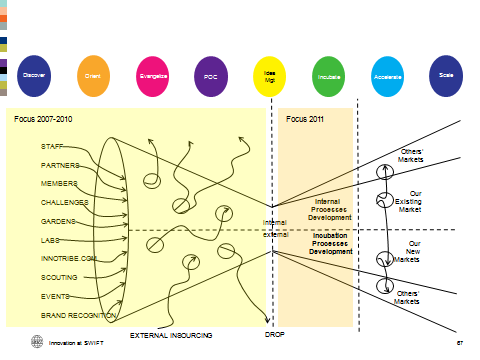
I would like to start with one of the slides of the innovation framework presented in “How to make babies?”.
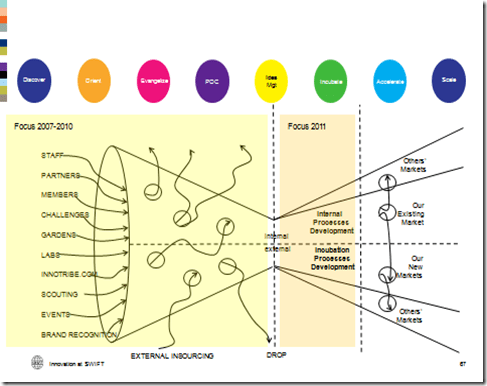
The graphic and model is of course based on – but adapted to the specific SWIFT environment – the work of on Henry Chesbrough, the godfather of the concept of “Open Innovation”, and author of the 2003 book “Open Innovation: The new imperative for creating and profiting from technology” (Amazon Affiliates Link)

Chesbrough says:
Open innovation is a paradigm that assumes that firms can and should use external ideas as well as internal ideas, and internal and external paths to market, as the firms look to advance their technology”. The boundaries between a firm and its environment have become more permeable; innovations can easily transfer inward and outward. The central idea behind open innovation is that in a world of widely distributed knowledge, companies cannot afford to rely entirely on their own research, but should instead buy or license processes or inventions (i.e. patents) from other companies. In addition, internal inventions not being used in a firm’s business should be taken outside the company (e.g., through licensing, joint ventures, spin-offs)
Innovation Framework
The graph above illustrates an innovation framework:
- With lots of idea generation tools on the left side of the graph
- An innovation funnel, progressing the ideas from left to right, and making healthy adults from incubated babies
- A north and a south side, where “north” stands for a traditional gating process product evolution for the core activities of a company, and where “south” stands for any innovation that basically does not fit the blueprint of the core.
In my blog post “How to create deep sustainable change”, I discussed the “Why” and the “expected outcome” of deep change and innovation.
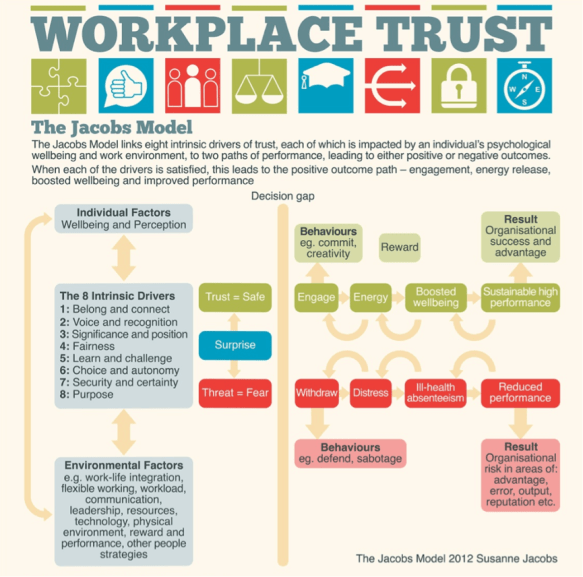
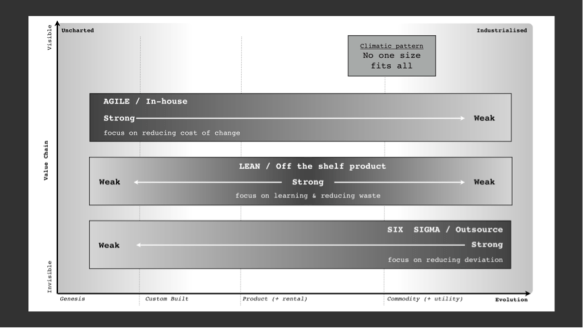
- The “why” has to do with creating a more agile organization, waking up the entrepreneurial spirit, in other words to “un-trap” the creative juices. And to do so, work is needed at the foundations: the roots of a tree. It’s about making the organization healthy, fit and un-trapped. This has nothing to do with six-sigma, lean, or other way to improve the efficiency of the organization, the efficiency of the organizational “body”. What we are talking about here is the fitness of the organizational “mind”.
- The expected outcome of pumping up the volume and the fitness of the organizational mind is a connected organization, connected teams, connected people, connected values, operating in a connected economy.
Pump up the Volume
What follows is a personal interpretation of a team brainstorm we did in February 2011. So, it’s collective wisdom that I happen to be able to put in a format that’s more or less readable. Thank you team !
In this blog post, I will talk about the “How”, the set of tools that an organization can use to achieve the why and the desired outcome.
“Tools” can be actual tools such as an idea generation portal, but it can be other techniques at the front-end of innovation (the ideation), as well as processes and governance for moving ideas from ideation, via proof-of-concept, incubation, acceleration, and scale to full fruition.
What follows is also a model that can be used to underpin a strategy of “shake the tree” or – what I prefer – to “Pump up the (innovation) Volume”.
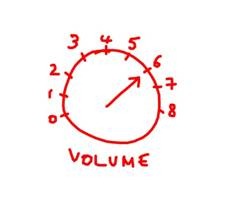
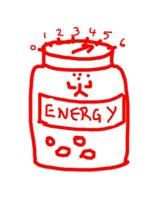
The volume knob is another metaphor to help us gauge our innovation focus, efforts and investments. What is important? What is nice to have?
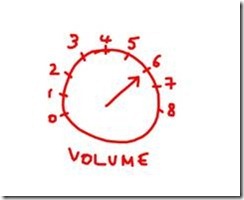
Turning the knob to the max is what I would call being serious about innovation. But you have to start somewhere.
The Rose of Innovation
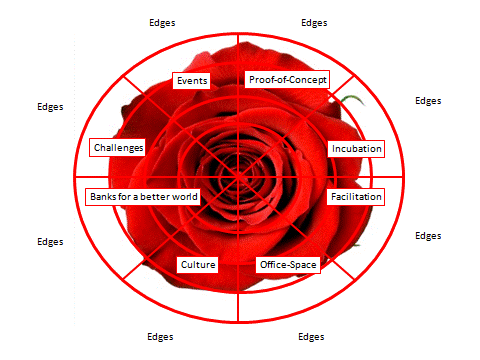
So, let me introduce you to the “Rose of Innovation”. Somebody has to give the romantic spin in all of this.
And let me mix it with the epicenter of an earthquake.


Indeed, “Shaking the Tree” is like starting a quake from the middle, and the seismic innovation waves swarm to the edges of the system, where in the end they cause “Fault Lines”. You “feel” the move.
You know that inertia has been broken
You know you have crossed the chasm

And let’s segment the rose or the epicenter in different slices. Each slice is a cluster of innovation tools. You can have as many slices as you want, but I suggest to limit it to six in this case, merely to keep the overview and the focus.
For each slice, one has to decide how far to the right you want to turn the volume knob. Do you want to move from 2 this year to 8 next year? Probably, you want a multi-year perspective on this: from 2 to 4 next year, 4 to 6 in two years, towards 8 in 2015 ?
Let me walk you through the different slices.
Challenges
We already do internal and sometimes external – with customers – innovation challenges. It’s a call for teams and ideas around a pre-defined topic. What could be our ambition level if we pump up the volume to 8 by 2015?
- Our ambition should be to be seen as one of the Top-10 innovation companies in financial industry. Long way to go, but possible with focus and will.
- Build a real “Exchange” of ideas, competences, teams,…
- Make a real competition of if. Like Cisco’s X-Prize. And with real money, I mean indeed a 250K EUR price for the champ of the year to help her incubate the idea of the challenge.
- Open up the Incubation Centre, not only for incubation projects, but also for challenges. The cocktail of innovators in Building 8 will be irresistible.
- Start-up something like frequent flyer pass. A frequent innovator pass. Points gathered this way add to your annual appraisal points, and reward repetitive innovators.
- We should become so good we are being “called”: by other companies, at conferences, etc So good that people see the value and want to pay us for this.
- Launch internal SWIFT “bucks”. Innovators can invest “bucks” in their projects. Later, when the project incubates these “bucks” get converted in actual shares in the project-company. These ideas are not new: ideation tools like Spigit and Brightidea already implement this. We just have to turn on the feature.
Events
This is more or less my shop today: let’s call it “Petervan Productions” Our events even more become “immersive experiences”. This unique mix of high-quality matter experts and speakers, together with our facilitation techniques. We could do much much more in this space. What about:
- 8 Innovation events per year like Innotribe Mumbai ?
- 1 Partner innovation event of 3 days
- 1 Customer innovation event of 3 days
- Deep conversations with: 3 days off-site with a guru on a topic and a select group of top-15 Heads of Innovations of banks
- 4 hackatons per year where we ask developers to code/hack together an application in 2 days
- More study tours, not only for the executive or L1/L2 level but accessible for all staff
- The frequent innovator pass should help us identity who can go on such a tour
- More gamification of our events: work with game experts such as Jane McGonical from Reality is Broken (latest book), Dave Gray from XPLANE and Gamestorming, and Verna Allee from Value Networks


From left to right: Jane McGonical, Dave Gray, Verna Allee
- Have a 3 day SWIFT employee festival? Like AMPlify.
- Do sort of Woodstock at Sibos. Like Pirate Ship. With concerts
- Sponsor other innovation events
- Embed and sell our techniques to third-party event organizers
The overall objective is to create serendipity. To reach other audiences, bring other content, start exploring the edges, create brand recognition. For SWIFT. For Innotribe.

We also should more and more look at our events as something that is the middle of the process, not the end-game. Usually we come out of an event, exhausted, as we build up all the energy towards that one day, one week. But then it only starts: the event is only the place where the connected community meets for the first time, gets initially built.
Proof-of-Concept
Again, we already do this. We have a yearly budget that lets us invest moderate amounts of money in proof-of-concepts: these can be prototypes, animations, whitepapers, etc
- Turning up the volume in this space is merely doing more: more prototypes, hence more budget and resources
Incubation
We just started this year. See also the “Babies” presentation. Initiated by Matteo, and now with the help from Cathal as program manager, this is our “Mathal Productions”. Their projects are located in Building 8.
Turning up the volume would mean:
- Team with Silicon Valley incubators
- Team with Incubators in Eastern Europe, APAC, South America. The example of Solkovo in Russia comes to mind
- We could do much much more in bringing young entrepreneurs and start-ups together. You can create a marketplace of start-ups, accessible by the SWIFT community.
- You could create – together with the 9,000+ banks on SWIFT – an alternative start-up funding and loan model. With better rates for those who have a good standardize Innotribe quality score.
Facilitation
This is what Mariela and team already do. For fun, let’s call it “Mela Productions”. Why for fun? Or “Innotribe Facilitation Studios”
- Mela should make a business out of it. Think big. A worldwide team of 50-60 facilitators. Why not. If we were able to deploy similar numbers of lean navigators for cost reduction and efficiency, why can’t we do something like this for value creation?
- This is also something we could start selling. This is an area where we are being “called”. Internal business units, but also banks from our ecosystem already now ask Mela to run facilitated workshops. Even from outside or our industry. We should charge for it.
Office Space
This is about having a critical look at our office space and the – communication – tools we have. On one hand we are spoiled. If you have ever been to the SWIFT HQ, you will for sure have been impressed by the main building and campus surroundings.
But the main building inside sometimes feels like a temple or a castle, with long corridors and closed doors that not really incentivize for cross-collaboration and sharing. I know there is a big project started to look deeply into this.
But also office-tools should be looked at. Today we have something called “Internet on the desktop”. It is a Citrix implementation of your browser.
- We should turn it 100% upside down. Internet should be the default, and we should have a “SWIFT on the desktop” for the couple of apps that require tighter security or access control. It’s inevitable. It’s part of the movement towards cloud.
- Skype, Drop-Box, Google Docs, etc should be our standard tools. Complemented by Salesforce, Chatter, Twitter, Quora. We should all be equipped with iPADs, Androids, etc. We never should have to use a PC anymore.
- This modernization will also have a major impact in image and brand.
Culture
I have been quite deeply involved in an effort to look at company culture, and those who follow my blog know that I have something to say in this space.
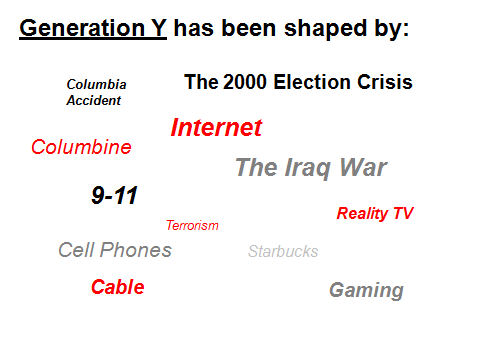
- Lately, the culture team was re-organized, and volunteers from GEN-Y and GEN-X were called upon. I applied for GEN-X (those born in 1961 and beyond)
- Great was my astonishment that I was considered “too old to innovate”. I am born in 1957 so indeed, strictly to the letter, I am not GEN-X anymore. But I am lucky, I still get “copied” on the stuff (sic)
Any pump-up-the-volume in his space
will be worthless
as long as we do not
apply a strategy of “seed and infect”
- If not, what we will end-up with are loads of powerpoint slides, processes etc. It will show great in an annual report or so, and it’s a bit the same as “how real is your innovation?”. Ask yourself the question “How real is your culture change”.
What we need is
a viral infection of the company
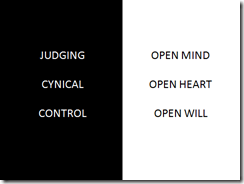
- 40 people in 2011 should get the chance to follow a personal discovery journey like Leading by Being, so that they lead from their open mind, open heart, and open will.
- In 2012 another 100 people. And in 2013 another 100.
- That’s 240 folks. Deeply passionate about changing the company. That’s more than 10% of the workforce. That will change the culture for sure.
And have a look what companies like J&J do. They have in a couple of years a group of more than 750 change agents. They can be flown-in or video-conferenced at any moment to form tiger teams.
Banks for a better world
This is a big bad new idea. It must be possible to have a deep merge between Innovation, Talent Management and CSR.
Think big, really big
I think it must be possible to create
a 1 Billion $ Fund
that invests in financial inclusion
Why can’t we pool together
funds and resources as an industry?
Would that not be
immensely more powerful?
- That would be quite a different story than what you hear/read these days about “too big to fail”, greed, lack of trust, etc
It would also lead and propel the community into a modern thinking about capitalism, rethinking value, and waste that we produce for the next one in the value chain (for ex bail outs) or even pushing debt towards future generations.
Studios and Production Houses
I am getting convinced that for each of these slices, we have to start thinking in terms of independent and complementary “Studios”. Like the studios of Pixar, Dreamworks, etc

Or in terms of <name> “productions”. For example for facilitation, you could pitch the “SWIFT Facilitation Studios” or “Mela Productions”. Events could be “Petervan Productions”, etc.
I like somehow the personalization aspect of this, as usually these teams are geared around a particular person with specific strengths.
If you like it or not, organizations are – or should be – built around people.
It’s indeed some sort of
strengths-based
studio or production environment
The Studio or Production metaphor also works well: you could consider the Head of Innovation as the “impresario”, and the studios the teams that collectively deliver a streamlined total experience. Or you could – like in big Hollywood studios – talk about “Building 123”, or like “Building 20” which is the innovation building of MIT.
At SWIFT, the incubation building is referred to as “Building 8”.
Budget
- What does it take in monetary investment
- Additional resources
- This is reality check. Where the CEO mantra “I want you guys to shake the tree” is tested with reality. This is where people get scared. This is where you hear: “I know him/her (the CEO), and we can’t go with such an ambitious plan and attached budget”.
This is the real test
- Here you will find out how real is your innovation. Or is it just a window-dress because innovation is fashionable and always works well in front of a board of directors or in an annual report.
You will probably end up somewhere between the window-dress and the edge-nirvana. And that is fine. The important thing is that you gauge it. Use it as a baseline. And don’t accept less when entering the next budget round.
Step by Step vs. not knowing what end result is
The challenge with all this is that
innovation
can not managed like the core
The core is – and should be – managed as the optimization engine. In this space you know where you want to end-up over a given period of time. You make a phased project plan, allocate the budgets and resources, put a project manager on it, and you execute as planned. It’s Failure is not an Option. It’s highly predictable, with yearly budget cycles, than in essence most of the time built upon last year budget models. It’s a stepped approach.

The challenge with innovations is that they are not planned. You usually know the “direction”, but you’re not sure where you land. It’s like Christopher Columbus heading West to discover India, but he found America. It’s like a (pirate?) ship meandering. It’s Failure IS an option. It’s unpredictable. It’s a meander approach.
Conclusion
That’s what I wanted to say today. It’s a blog post that was cooking for several weeks. Happy it’s done. It’s a long post, I know. And maybe next, I should put all these blog piece together in a book. Who knows, maybe I’ll do that one day.
But one thing is sure: The combination of “How to create deep sustainable change”, “Pirates, Rebels, Mercenaries and Innovators”, and this post “Pump up the Volume” will form the basis of a brand new Innotribe presentation, the follow-up of “How to make babies”. I will let you know when it is ready.
All for the same purpose: the fitness of the organizational “mind”. And a deeply changed organization, connected and full of energy!

Let’s Pump-of-the-Volume!
Let’s take those innovation energy pills!
Let’s shake the tree!

























 Petervan Studios