
Artschool 2017: first evolution of painting with Zaha Hadid space
as inspiration - Acryl on cotton canvas, 90*90cm
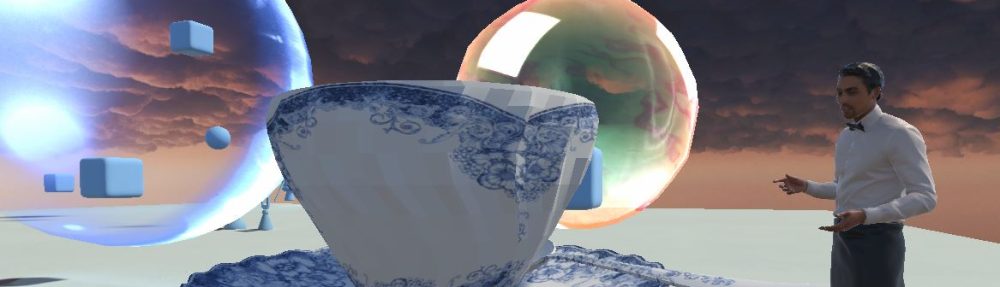
Artschool 2017: first evolution of painting with Zaha Hadid space as inspiration - Acryl on cotton canvas, 90*90cm
I recently had some conversations with prospective clients on the need for alignment and coherence of physical and emotional space when trying to create great experiences. I started to call them “sacred spaces”.
As you know by now, I am not in the events business. I am in the business of creating high quality feedback loops to enable immersive learning expeditions and deep change. In essence, I want to resonate with my client’s guests at another (additional) level than the pure cognitive. I believe this ambition also requires its own awareness and vocabulary, but more about that in some later posts.
One aspect of that vocabulary is our expression of sacred spaces. What first comes to mind is a church, a cathedral, some religious building of some sort.

Sagrada Familia – Barcelona – 31 Oct 2014
In the best cases, the moment you come in, you are struck by a lightning of beauty, awe, stillness, and grandeur. The entry into the space feels almost ceremonial. You cross the entry, the line between outside and inside. The experience of the space sends vibrations down your spine. You feel suddenly whole and small at the same time.
This whole- and small-ness creates some kind of safety; some form of familiarity that this space is the right space, that this space is right. Just right for what it was designed for.
I think in similar terms about the spaces for our experiences.
Our spaces must be safe spaces. Closed as with an entry door. The entry into the space is a ritual moment. The coming out as well. It must be a physical experience: guests have to walk through the “arc of change”. They must do this in a “communion” style, as a collective, creating a visceral experience of the collectivism in their change process.
The space is about “roundness”, round as in circle, but also round as in generative, coming back to the starting point with new insights.
The space becomes a pulsing “egg”, a “womb” that will be our “nest” for a couple of days. It has of course to do a lot with right spaces for humans, and Jean Nouvel’s views (video here) on architecture. The video is also called “Reflections”, just like the latest from Brian Eno, one ambient song of 54 minutes (interview here)

“Combining big bold shapes with intricacy and delicacy. The ability to be bold and delicate at the same time. The relation between time and light. The sphere above, the cupola. A spiritual space.”
I love the idea of the cupola. In my opinion, the closed space described above needs a roof – like a cupola – with some lattice membrane. But at the same time, the space needs to be “porous”, with light (the crack) coming in through the lattice, and light (enlightenment) coming out to inspire others. Or even better, some form of post-enlightenment as in Danny Hillis’ entanglement.
And light itself can also be the “roof” and the trees of the space forest. Check out this wonderful video of Fujimoto’s light forest:

I shared the video with my good friend Marti Spiegelman, who replied:
“Thanks for the link – this is extraordinary. It reminds me that sometimes the light itself is the sacred space – I’m thinking of the light beam on the floor, when one of the walkers stands in the light – and sometimes the light creates the boundaries, or defines the edges, of the space – as in a forest when there is a small round clearing, it’s traditionally considered to be a ‘power spot’’ [another name for sacred space] where you can call in greater powers of nature and the universe to create change.”
I was looking for some good description of sacred and sacredness. I think I found it in an article about a fashion book by Belgian fashion designer Ann Demeulemeester.

“It looks and feels almost sacred, with pages so thin the images can be seen on both sides of each sheet; it’s a truly delicate beauty. For this reason, every single page is printed only on one side, creating a uniquely singular reading experience. The size and weight of the book gently contrasts with the fragility and smoothness of the paper, while the almost total white of the inside is in opposition with the blackness of the sides and the linen cover. Text is kept to the essentials, limited to an introduction by Patti Smith (Demeulemeester’s longtime muse) and a short final dedication by the designer herself. The book was designed by Victor Robyn, a Belgian graphic designer who has been in charge of realizing Demeulemeester’s graphics for years—from show invitations to printed fabrics. The art direction is curated by Victor Robyn, Demeulemeester herself and Patrick Robin, her life and business partner.”
Happenstance that I visited this week Casa Argentaurum, an art gallery in Ghent run by Caroline De Wolf, who kindly opened her space for me. It was one of the last days of the exposition about Ann Demeulemeester’s jewellery.

Necklace – Ann Demeulemeester – Casa Argentaurum
At the end of our conversation, Caroline gave me a copy of the catalogue of the 2010 exposition “Things, Thoughts, and Territorities”.

The book has some great design drawings by Andrea Branzi, and also a wonderful testimony of the artists’s love relation with Belgium (mostly Flanders btw). Somewhere half way, there is this superb quote:
“Architecture is not the art of building, it is a very complex discipline,
interpreting history, technology and the changes in society.”
It could have been the tag-line for Petervan Productions, as I see myself as the architect who conceives, gives birth to the vision together with the client, and then pulls together and orchestrates the resources, experts, and artists to create a unique experience in search for the secrets of life.
But “you can’t find secrets without looking or them” (quote by Peter Thiel in his book “From Zero to One”), so I am looking for your views on what you would expect from a sacred space.
I am looking for architects, space- and stage-designers to be part of our collective of leaders, visionaries, artists, craftsmen, designers and producers.
If you are interested to be part of that calling and dialogue, you can just leave a comment on this post.
Rebelliously yours,

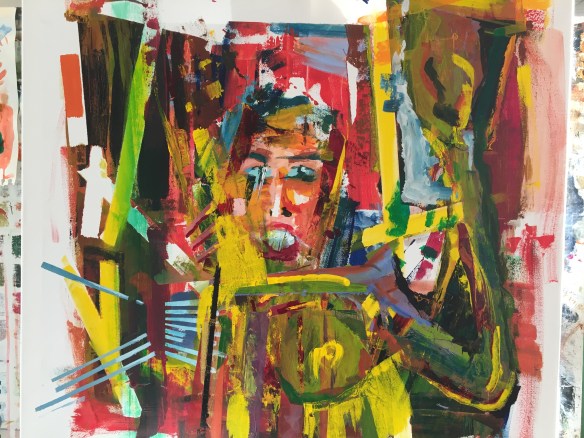


Artschool 2016. Study on Magnus Plessen.
1) V4 of painting based on collage 2), 3) and 4) some details.
Expect to finish next week. Acryl on cotton canvas 80x80cm, brush, spatula, kleenex.
With thanks to my coach Ann Grillet
As many of you know, since begin November I am trying to create my own thing called “Petervan Productions”.
The scaffolding is already in the works for many years, and I am still hesitating whether I will once publish the 100+ page reflections on the intentions of all this, what I think this enables, and then working down the tactics such as outcomes and deliverables.
Besides the artwork and the research bit of my activities, I spent quite some time in re-thinking what “events” could be like. And thinking of my customers as “guest”, not consumers. What I am trying to offer is a one-stop-shop for unique immersive learning expeditions in emotionally and physically right spaces for humans.
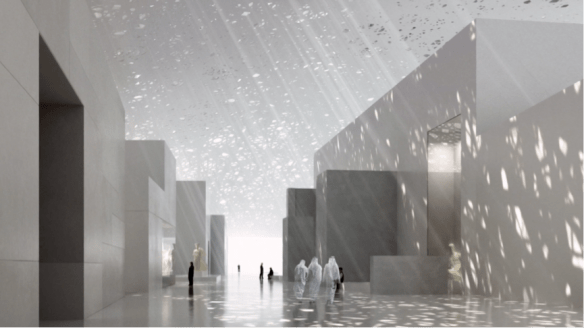
So anything that gets me back to my architectural roots of “right” spaces for human beings makes me a bit poetic. In this case this very nice article in Aeon about the French architect Jean Nouvel, all about light, geometry and symbolism to re-imagine culture.
The core of the article is a very nice video. As usual, I made the transcript of the video, and added some poetic highlights and typographic reflections by myself. I have stopped adding comments and trying to explain. My guests are smart enough to make up their own minds. Explaining would be an insult.

Each project is an adventure, a passion
The biggest temptation
Is to jump into it
There are solutions that come to you
There are images that spontaneously appear
To really imagine it spatially
So, to be sure that I have something to say
These moments where you understand somebody cared about something
like “oh yes,
this is a human thing,
not some robot that
put something together”
Combine big bold shapes with intricacy and delicacy
The ability to be bold and delicate at the same time
The relation between time and light
The sphere above,
As spiritual space
“Perhaps we have to keep dust”

Create a space, no inside, no outside…
“We have principles, and these principles we have to nurture.
We nurture them.
We deepen them.
And with them,
we invent…
something else”
Hello Tribe,
This is a post to share that I’m taking an extended sabbatical from Innotribe and Swift after some of the most amazing years of my career so far. It has been such an exciting journey working with many of you creating and enabling Innotribe to grow. Thank you for letting me being part of that journey.

Quote by Abel Morales (Oscar Isaac) in “A most violent year”.

Poster copyright: Lessons Learned in Life
Now the time has come for my next phase as an independent thinker, creator and sense-maker, as from 1 November 2016.
I will concentrate my – limited – professional activities under “Petervan Productions”. In the first instance I will create art, performances, and invitation-only retreat expeditions.

I believe there is room for a new kind of experiences that resonate with your and my guests at another level than the pure cognitive. Holding a space to connect thought leaders, experts, and artists of all kinds, and to bring out the very best in you and them. The art of creating high quality feedback loops to enable immersive learning experiences and deep authentic change.
Mastery and excellence will be my guidance, but mystery is what I aim for.
Focus means deep work without distractions. Focus also means saying “no”. For the next couple of weeks/months, I will live under a rock. I will dramatically reduce my social media presence and activity. But will keep blogging and writing occasionally.
+++
“Creative work needs solitude.
It needs concentration, without interruptions.
It needs the whole sky to fly in, and no eye watching
until it comes to that certainty which it aspires to,
but does not necessarily have at once.
Privacy, then. A place apart
to pace, to chew pencils,
to scribble and erase and scribble again.”
Mary Oliver in “On Power and Time”
+++
It’s a jump into the unknown. It is a fork from the responsive/reactive orientation to solve problems to the creative orientation to architect, design, and produce what I really want. It is tapping into what Nilofer Merchant calls my “onlyness”, when my edge becomes the core.
I’d love to keep in touch with you all, so if you would like to connect please do so via my personal email or the usual social channels. You can also subscribe to the Petervan Productions Newsletter here.
See you on the other side. Onwards.
Rebelliously yours,

Blogging and writing:
Mantra: “Imagine the kindest, most positive response to whatever comes your way” – Chade-Meng Tan
“Métier” is usually defined as: profession, craft, craftsmanship, and workmanship. I already touched on this in my blog post on Craftmanship (Sep 2015).
Craftsmanship, Historical Coherence, Musicality, Authentic Observation, and Creating The Dance between host and guest are critical components of the Essence of Work.
Tradition is about building on the shoulders of giants, to “craft” deep into the meaning of tradition, to internalize tradition, and to pass it on in your work and onto next generations.
Tradition is not seen as non-authentic, but a source for energized work.
What is driving these people to strive for unconditional excellence?
I was reminded of this when discovering last week’s edition of the Belgian TV Art programme “Tout le Baz-Art” on the RTBF Channel that focused on evolution, tradition and art that is “academically right”. The programme was curated around Belgian super-star musician Ozark Henry.

Ozark Henry – cover of his album “Stay Gold”
One of Ozark’s guests was my good friend Peter Hinssen, as apparently Hinssen introduced Ozark Henry to 3D as an additional dimension to his superb musical expression. But the other guests included Sam Dillemans – one of the recent hypes (well, since 2010 or even before) on the Belgian art scene. Sam’s discourse also made me think about the essence of work of Michaël Borremans, the other big name in contemporary Belgian art.
All three have to say a lot about their “Métier” – their profession – and the intensity and clarity they have in creating extraordinary art-work. I found it highly inspiring: the way they stand in life and the mystical qualities they aim for.
Below some extracts/transcripts of what they shared in different videos:
Sam Dillemans
“I’ve always compared myself to the great artists. I’ve always done that. I am constantly healthily frustrated. That’s why I will always continue to work. Compared to modern artists… Victory is easy if you have an eye for it. You have to compete with the greats. That’s why I always work like crazy”
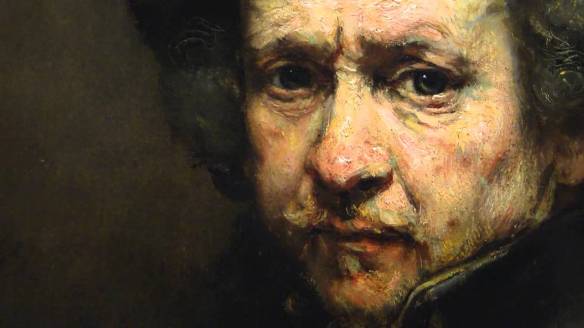
Rembrandt – Self Portrait – 1659
“If you show me Rembrandt, I panic because there’s still so much work. They say Rembrandt was before. He is tomorrow. That’s the difference. Rembrandt wasn’t before, he is tomorrow.
“A white canvas is the worst thing an artist can face. I did not say that. Picasso did. And if he says so… you can imagine what that means for us.”
“I have the ambition to continue painting till I’m 90. I still have so much work to do. If Picasso painted for 80 years, I’ll need 320 years. I don’t think I’ll succeed.”
“It’s my ambition to grow as old as possible. I don’t want to see others growing old and decaying with me.”
I’d like to get as far as possible.”

Eddy Merckx – most successful cyclist ever
“The thing people lack nowadays in my opinion is veneration. People don’t often see others as gods anymore. They do like to idolize them. Merckx is a better cyclist than Sam Dillemans. I won’t point out the weak points of a god. To say he’s as small as I am because of his human side. The distance isn’t that great.
“Michelangelo also had to go to the bathroom. But put us in the Sistine Chapel and we don’t make it up the scaffolding.”
“Everything is fragmented. Everyone does everything, but nothing well. Everybody is an artist. If you ask someone on the street what he or she does in their spare time – apart from a lot of rubbish – one bakes pottery, another one paints, a third one plays guitar. We’re all wonderfully creative.”
“I don’t mind. I support that democratic system. This is the problem: this 93-year-old crone, who baked two pots, wants twenty exhibits. That’s tiresome.”
“A part-time painter is the worst. People who are partly something are the worst. You have to try to be whole. That demands sacrifice. The worst sacrifice is being half.”
“Many people choose it freely. They compromise.
“You always have to question yourself during your ongoing studies. You don’t need to become self-centered, but you discover your inner self. Without psychedelics and philosophies.”
“We have lots of possibilities, but hardly anyone stops to look at a tree and to admire it and say “That tree is beautiful!” That is over. It happens but rarely, and even then only on Sunday, with the kids, and a giant buggy. “Today we will watch trees”.
“They go to Walibi (a sort of Belgian Disney Land), or to an exhibition of modern art, as modern as possible. Then they are hip and trendy. They don’t want to seem old fags. But of course they are. A young fag would look at the world like Jacques Brel, eyes wide open. They are obsolete. But they think they are trendy.”
“You don’t have to be hip, you have to know poetry or anything which is not influenced by time. Then you have a chance to approach godliness. In conclusion, what do people do with their free time?”
“They fuck it up.”
Michaël Borremans
Jan Hoet, who was the founder of the Museum of Modern Art in Ghent (SMAK) said about Borremans:
“Studious, pleasingly, nicely painted, it all looks so perfect. On the other side he is a bit unruly, recalcitrant, also a bit morbid, a little austere…” and Ann Demeester commented: “Michaël’s works is very subdued, mysterious, vs. bombastic.”
His paintings are cinematographic. He also launched himself into video and cinema. Using all senses to resonate with his audience at some many additional levels beyond the pure cognitive. Borremans continues:
“My work has no documentary value whatsoever. It is all imagination. That’s why I am painting. Cinema also has a lot of this. But a film is not my sole merit, you work with other people, who each have their own contribution”
Michaël is a difficult person, rigorous and strict for himself, with a greater technical maturity then many of the other contemporary painters.
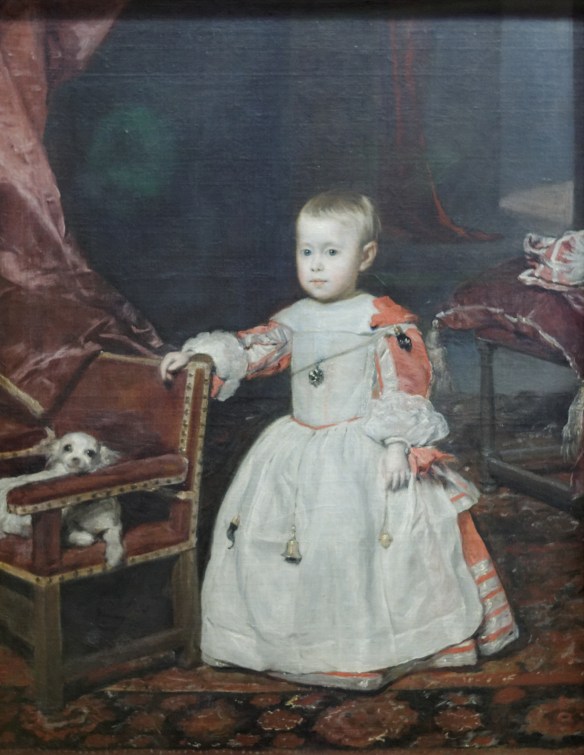
Prince Philippe Prosper by Diego Velasquez - 1659
You really have to listen to Michaël Borremans explanation of the above painting at minute 33 of the documentary.
“The resounding “éclatant” aspect of Velasquez’ work, it always remains fresh.
“Painting with a long stick, to keep the spontaneity. Unrivalled technical virtuosity”
“I want to stay professionally focused, and remain faithful to what in want (in the artwork). A painting is a suggestive construction. Getting better, and more sophisticated in the painterly technique. Capacitate myself to make the best paintings. It is not pleasant to make so many paintings that are almost ok”
Back to the RTBF TV programme. Sam Dillemans continues here:


Embracing Rubens – Leaving Rubens – by Sam Dillemans
“That’s where I left Rubens. Most important is that you first embrace Rubens, you get deep under his skin, and you study him. That’s what I did when I was young: the thigh muscles, the calf muscles, the calf bones, the ankle joints, etc.”
“I was drawing like crazy on Rubens, and Holbein, and all old masters, to be able to leave them when I really knew them.”
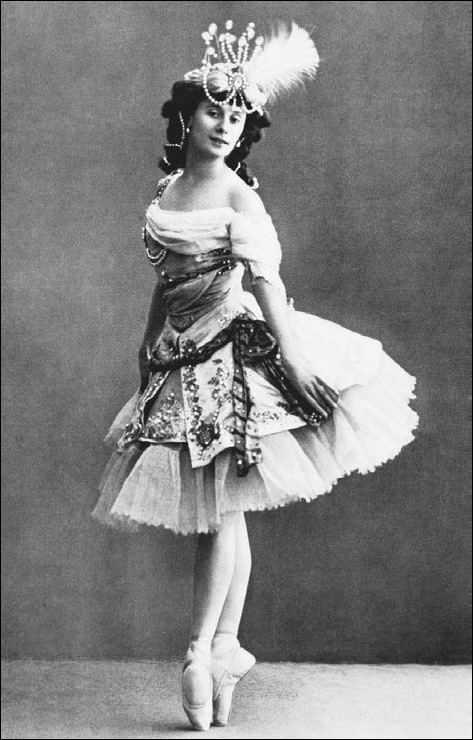
“Like Anna Poplova – the great dancer – said:

Paul Cézanne – Still life with apples
“The most important is how you paint, not what you paint (Jesus or Maria, etc). You can do the same with apples or radishes. Cézanne changed the history of art with just some apples. “
“I started very realistically, and ended in a very abstract way. I have the tendency to always start very faithfully to reality. Not goody-goody realistic, but very recognizable. But always with a certain “schwung”, my own “schwung”, my own signature.”
“And then I leave that realism. After five years that then ends in structured chaos. It ends in calculated arbitrariness, quite chaotic. And that happens in a very natural way. I never have to force myself. I just follow my nature.”
Then Ozark and Sam in a conversation on trends:
“These days, you don’t need to be able to read musical notes. You don’t need to know anything. You make music by intuition.”
“You have to be creative as from the age of seven. How can one be creative without “métier”? It is métier that makes you free. If you have a lot of métier, and you have suddenly an idea, then you don’t need to think “how do I make this?” or “What am I doing?”.
“Métier makes it possible to follow your impulse. Because your whole body is trained for it.”
“When Picasso draws seven lines at the age of 85, then those lines are building on 75 years of study and knowledge”. If we draw those lines, we risk missing the ball.”
“The three great artists are Dostojewski for literature, Van Gogh for painting, Mozart for music. But Mozart can again be considered as cliché, and that’s not considered alright anymore.”
“These days, you have to come up with a strange name from Georgia or whatever, somebody nobody ever heard about. You are not allowed anymore to be normal in your taste or preferences.”
The programme ends with a musical pairing with the famous Krug champagne.

Kruge Champagne cellars
“The creation of Krug is very musical. It is a house where the founder had a dream. He wanted to create every year the richest symphony of champagnes. The approach of the house is a musical approach. We listen to each little vineyard, like a musical director listens to the orchestra.”
“The art is in the experience: you enter the ballroom, the orchestra is getting installed and starts to play, everything is there, and there it is, and you live the moment. Like Tsjaikowski’s 6th symphony in b-minor: the way the music score opens all the colors of the orchestra and you discover. Like a room that opens, and you discover all the colors, all the nuances, and a total experience.”
It made me think about a comment by Fabian about the last Innotribe Sibos edition: “Peter created his 9th Symphony, and day-1 was his Allegro”. But creating one’s 9th symphony is at time a lonely place.
What if in our professions, in our “Métiers”, we would all adhere to these highest standards? And be radical in the quality and total experience we aim for?
What if we would always compare ourselves to the great artists, and get motivated through a constant healthily frustration?
Instead of putting the bar of mediocrity to the best common denominator, as illustrated in so many industry “benchmarks”.
What would happen then?
We would delight the customer with mastery and mystery.
Like great art can put a knife in the eye.
Building on the shoulders of giants,
With your own signature.

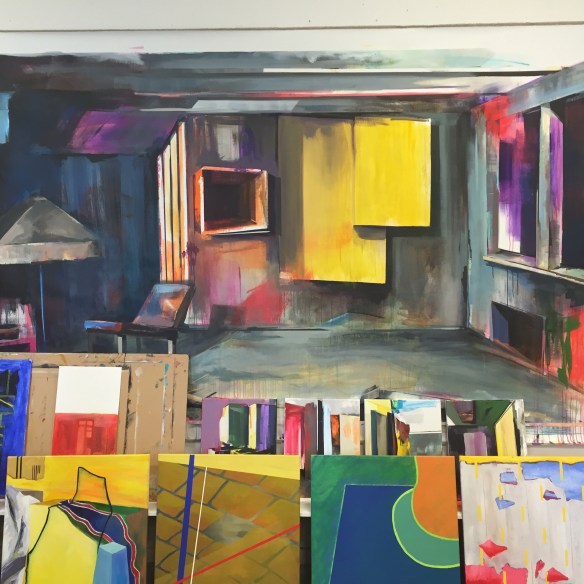
Collection of artworks from my fellow students of the 2016 Art class
My good friend Alan Moore (@alansmlxl) from the flatlands of Cambridge recently published a great book on “Why beauty is key to everything” (Amazon Affiliates link).
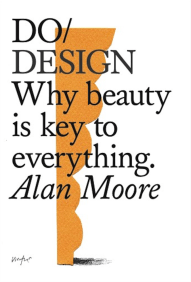
It’s a great book, and as a teaser, here are some of my highlights out of the book:
Harmony, symmetry and maths all point to this atomic elegance.
A job well done is not based upon watching the clock or fighting time – but in giving oneself to the task
Their work transformed common objects into works of uncommon grace
I believe great work comes from a place of stillness where one’s focus is total on the action in hand, directed fully by the heart.
We need to open our senses to all that surrounds us
To be and to remain deeply intensely curious about our world is vital to original thinking, whereas the incurious face a rather dim future. To have a hungry heart and mind determines what it is we create
The interface with design is humanity
I don’t need to draw conclusions, I am happy for the thoughts to be half-formed but present
Do not work with people who don’t want beautiful, who wish to cut corners to increase profitability. Who, more dangerously, bring neither elegance nor grace to their work and their working environment, but the opposite.
The danger for the leader comes if you cannot truly love yourself. If you are at war with yourself then you will be unable to lead others with empathy and compassion. You may pretend – but you will always be found out
If you want more of this, Alan is organising on 27 Sep 2016 a workshop in London around the idea of, what would your business look like were it to be more beautiful?
Why should you come? You might be stuck in working out what direction to go in. Or seeking a more inspiring vision. Or trying to find new ways to make money. Or working out what your new technology can truly give to the world. You might be launching a precious new business, or working to rebuild an old one. Or a thousand other things besides. We will help you to:
The gathering in a beautiful old church in Bishopsgate, London. A remarkable space in the centre of skyscrapers.

I read the book, and if the workshop is as good as the book, I strongly recommend it. More info about the event here. Enjoy
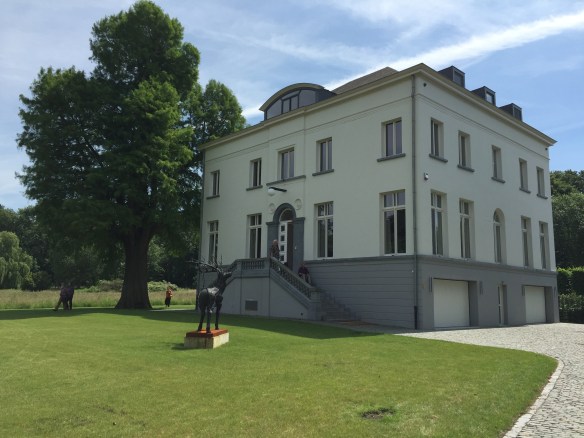
The White House Gallery in Lovenjoel - Belgium
Last friday was the last official school day of this season’s art school. On this wonderful summer afternoon, we went for an excursion to the exhibition of the work of Greet Van Autgaerden, in the White House Gallery.
The white villa used to be part of the complex “Groot Park”, initially a holiday property of the family de Spoelberch , one of the richest families of Belgium, and currently main shareholder of the InBev brewery imperium.
Maximiliaan de Spoelberch had a passion for dendrology (the scientific study of trees) – everybody needs a hobby – and create on the site one of the most unique collections of exotic trees in Europe.
In 1915, the land and property was gifted to KUL (University of Leuven), who rented it to the “Sisters of Love” in 1926, who set up a psychiatric hospital for women “Salve Mater”.
End of the 90’ies most hospital units were integrated into the University Hospital of Leuven. These days, real estate developers are transforming the main buildings into luxury apartments.
The white villa, was the residence of the Sisters of Love, and it was sold together with 11 hectacres of land to the current owners of the White House, who completely restored it and created a fantastic art gallery (RSVP only).

Point of View #10 - Greet Van Autgaerden - Oil/Canvas - 200*130cm - 2016
I was not only baffled by the great artwork of Greet Van Autgaerden – exposed over four different floors – but also by the stillness of the building, the great care of the restoration, and the hospitality of the owners Bert & Elly.
The title of the expo was “Point of View” as most of the works from Greet Van Autgaerden are landscapes. There was a great welcome-text by Hans Martens describing her work (abstract below):
Greet Van Autgaerden knows that a good painting is always kind of an ambush, and she enjoys luring us, as viewers, into her trap. I cannot shake off the impression that she too perceives the canvas as a “battlefield”, an arena in which she wrestles with the demons of painting – not in a romantic, tormented way, but in one that is analytical and acute, and which takes careful account of the various possibilities of an image. It reminds me more of the British approach, as exemplified by Constable, than the Germanic Sturm und Drang.
The visit made me reflect about what i want, in the true artistic creative-orientation sense, not in the BAU daily reactive/responsive tactics on how to solve a particular problem, which more and more drives us collectively into a solutionalist society, with superficial contacts and interventions, never even coming close to deep and inspired work.
In the middle of these first world reflections, I bumped into this wonderful object:

Christoph Fink, The Montreal Walks (12 254,94 km, 195 h 30’51"),
space and time disc, 2008. Ceramics, diameter 47cm.
+++ text by Joëlle Tuerlinckx – artist +++
While journeying by foot, bike and aeroplane, Christoph Fink gathers and transforms precise data through a unique notation system, and his clay and ceramic discs spring from this process. This study is sustained by research into the different periods of earth’s evolution, its ecosystem and geography as shaped by the political. It leads to a representation of the globe, or, more precisely, a representation of the globe’s space-time (the central void embodies space-time to come). The clay ball is fashioned according to detailed calculations, and engraved with ‘moments of knowledge’. I’m amazed by the way Fink manages to convey his vast research and his exceptionally rich understanding of the world with such minimal means. Like me, he’s fascinated by the complexity of reality, in which he finds beauty and rebellion.
Fink’s works defy categorisation, they stand somewhere between cartography, music, sculpture, drawing, and evoke a time where painter and geographer were one and the same person (the geographer’s job was still be invented). The amount of work that forms the basis of his practice is truly admirable, because so rare today. His numerous studies, sketches, researches and notations demonstrate a total commitment, every day renewed, and miles away from the art world system, with its fairs, galleries, museums … Fink builds his own vision of the world, one which is radically ethical, political, poetical, and directed only towards more freedom. This artist was for me an obvious choice because of his ethics, so urgently needed. May they inspire many others to find and further their own artistic journeys.
+++ text by Joëlle Tuerlinckx – artist +++
I found many more images of Christoph Fink’s work by a simple google search. If you do so as well, you will find many field notations like the one below.

Christoph Fink notations of a field trip
I love the concept of “field notations”, and never realised you could push the concept so far and in so much detail. And it is not about the destination, but the journey itself. Also labelled “trajectories” by Kevin Kelly in his latest book “The Inevitable: Understanding the 12 Technological Forces That Will Shape Our Future”, when describing “Protopia”, the mild process and progress, as opposed to Utopia and Dystopia.
It also made me think of a quote by Kristien van Looveren from 2009 (seen at the expo about architect Christian Kieckens, i just got in the last day last week in De Singel in Antwerp):
The works of Greet Van Autgaerden, Christoph Flink, Kevin Kelly, and my teacher Ann Grillet are ongoing inspirations in my quest for purpose and what i will do next.
Compared to those masters, I am such a newbie. Which also gives me the right and freedom to not knowing the norms, and therefor not even knowing how to respect them. That’s of course a false excuse for having a year-end academy scratch book, that not even gets close to any of the beauty I could witness this week-end.

My scratch-book with "extensions"
at the end of the first year art-academy painting

In the aftermath of the Scientology trial in Brussels last month, senior representatives of the six Belgian governments have initiated exploratory talks with Scientology to assess the creation of a blockchain-based venture for the relationship economy.

In a joint press release, they announced today the launch of DAG (“Digital Asset Goldings”), a new blockchain consortium headed by Bitalik Vuterin. The project uses a brand new fork of the blockchain protocol called “Ethereal”: a permissioned mutual distributed ledger protocol, underpinned by its own ether-cryptocurrency “Real”.
DAG has been set up as a non-profit cooperative, and has already collected more that 500M USD in equity funding, rocketing it into the first blockchain unicorn in history.
DAG will be governed by G4S (Governance For Securities), a governance body made of 45 major financial institutions, and several of the RegTech sandboxes, that tested the technology in Q1 of 2016.
The funding round was lead by FISH (Flanders International Securities Holdings), fully owned in open source by five of the six Belgian Governments (Brussels does not participate: as the home of the European Union, the Commission does not permit hosting regions to participate in ventures promoting non-fiat currencies).

Flanders International Securities Holdings holds 51% of the shares of DAG, 29% is owned by G4S, and the remaining 20% is reserved for future crowd sourced citizen participation, based on simple bonds that will be issued in the Real open source currency on the DAG shared ledger.
Ethereal leverages the findings of the Digital Asset Grid project, an incubation project that was set on hold in 2012 by lack of interest and investment, probably because to novel at its time. Digital Asset Goldings will use the same principles of governance, trust, resilience and availability as the DAG-project, but the implementation is based on a brand new revolutionary protocol “Ethereal”, using modern breakthrough encryption technology based on Quasars.
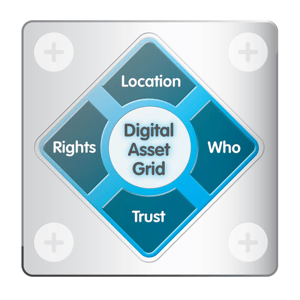
“With Ethereal, we have solved the scalability problem of the blockchain”, says Vuterin; “We can scale to more that 1 Trillion nodes on the grid, and all the atomic transactions can be executed in milliseconds. We can do this thanks to our quantum computer “StockGold”, mining Reals at the nanoscale and nanosecond.”
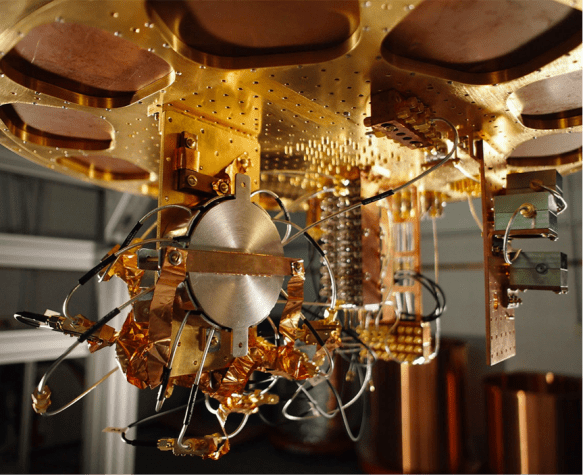
Quantum Computer running StockGold
Adriano Selinky – Head of BancoVentures, the investment arm of BancoBlanco and one of the 45 banks backing the project – raves: “We believe there are about 20B USD in yearly savings in direct settlement of Scientology fees: the business case was a no brainer for us, and we are eager to invest in more Ethereal-based projects and startups. DAG will revolutionize financial services, and will deeply disrupt the economic fabric of our economies. We see many more use cases, but it will take a couple of years before we will see the full impact of this.”
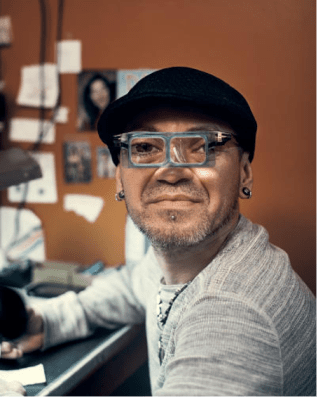
Adriano Selinky – Head of BancoVentures
The Scientology trials will be labeled “TrustWeb” and will be led by Neil Sinner, as a competitor to his brother’s “DataWeb”. “Kris has been instrumental in setting up DataWeb, but this technology space is moving so fast that DataWeb is already an outdated technology before its first implementation. TrustWeb is just offering superior relationship experiences”
The promise of superior relationship experiences did not go unnoticed to the 6 Belgian Governments, who consider the DAG and the Ethereal G4S governance model ready to revolutionize their own move from centralized to decentralized to fully distributed peer-to-peer government.
DAG will have its international headquarter in Blocke-Heist, a little town on the Belgian coast. The little town is renowned for its elite public, attracted by art galleries, fashion shops, exclusive restaurants and bars, and a vibrant nightlife.
Baron Clipckens – Mayor of Blocke-Heist – was very bullish: “I was myself hit very hard during the 2008 crisis as an investor, and I am convinced that transparency and traceability of financial transactions are the best guarantee for the long- and short term savings of our citizens. We welcome all FinTech Hubs to join us in this effort, and we hope that Blocke-Heist can become the Blocke-Valley and Davos of the Relationship Economy.”
Together with Scientology, DAG has also acquired its HQ real estate in Blocke-Heist: “La Réserve”, a 3-star Michelin restaurant and conference center.
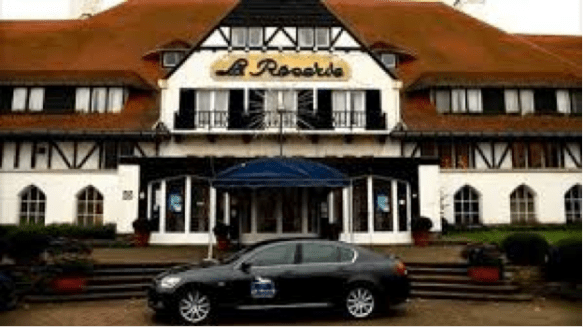
La Réserve in Blocke-Heist, Flanders, Belgium
It comes with an 18 Hole Golf course to facilitate high quality relationships and connections. Close to the seaside, this will guarantee DAG with a daily fresh supply of fish and seafood, and is ideally positioned as a high-end executive meeting and event center.
DAG also attracted @petervan (one of the Co-Founders of Innotribe) as their Artistic Director. “There is indeed room to rethink the way events are organized, using more participatory Ethereal concepts that will guarantee advanced collaborative learning beyond the pure cognitive. La Réserve is an outstanding location where physical and emotional space blend into unique immersive experiences”; said Petervan.
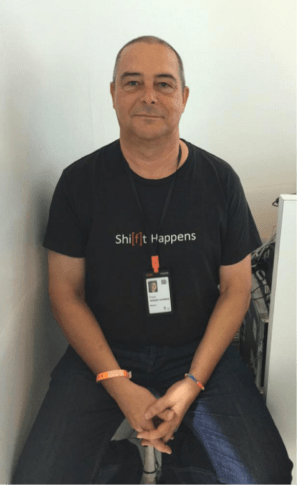
@petervan, in his black T-Shirt “SHIFT HAPPENS”, at Innotribe Sibos last year
(black T-Shirts seem to be the standard uniform of Innotribe Co-Founders)
DAG seems to be a marriage in heaven and possibly the singularity moment for financial services: the future of decentralized governance combined with the relationship economy of Scientology.

Blocke-Heist Casino – Magritte Biennale
The DAG opening gala party – Tuxedo and Magritte Bowler Hat only for men, ladies in Gala Dress – will be held tonight in the Grand Salon of the Casino of Blocke-Heist, starting at 11pm with Champagne and genuine Russian caviar, followed by a standing dinner, and Belgian Top House-DJ’s animating the dance floor till early in the morning. The event is sponsored by Veuve Wickcot Champagnes and BancoBlanco. For those with more artistic interests, there is also a Biennale running in the Casino, of Belgian surrealist artist Magritte. See you all there!

Artschool 2016: Exercise in layering. Acryl on plastered cardboard A1 format.
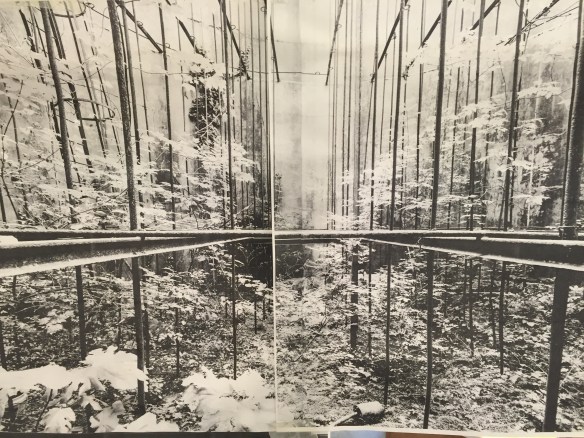
Source picture for the exercise
 Petervan Studios