This post is a semi-transcript of a fantastic talk “Space in the mind of a machine” by media artist Refik Anadol. My post is not intended as a literal transcript, but rather as a collection of – often poetic – idea clusters of Refik’s talk. None of the ideas are mine, I just tried to condense it and brush some highlights.
The talk was given on 4 December 2019 at the Southern California Institute of Architecture (SCI-ARC). The website of SCI-ARC itself is nirvana for all beauty and art lovers out there, and worth spending a virtual visit of a couple of hours.
The talk was transformative for me, in the sense that it made me realize we truly have entered a new reality and a witnessing the dawn of a new area, full of beauty, poetry, and artistic interventions that create alertness and aliveness similar to the 16th-century renaissance.
After a long intro, his talk starts at 2:46
Criticizing the idea of canvas
Dimensional explorations
Augmented structures
“Design is a solution to a problem; art is a question to a problem” – John Maeda
Humans, Machines, and Environments in a symbiotic relationship
Can a building dream?
“Life can only be understood backward, but it must be lived forward” – Kierkegaard
The data that we leave behind us
Data “dramatization” vs. Data Visualisation
The invisible space of Wi-Fi, 4G, radio signals, etc.
A poetic exploration of invisible datasets
Data Paintings
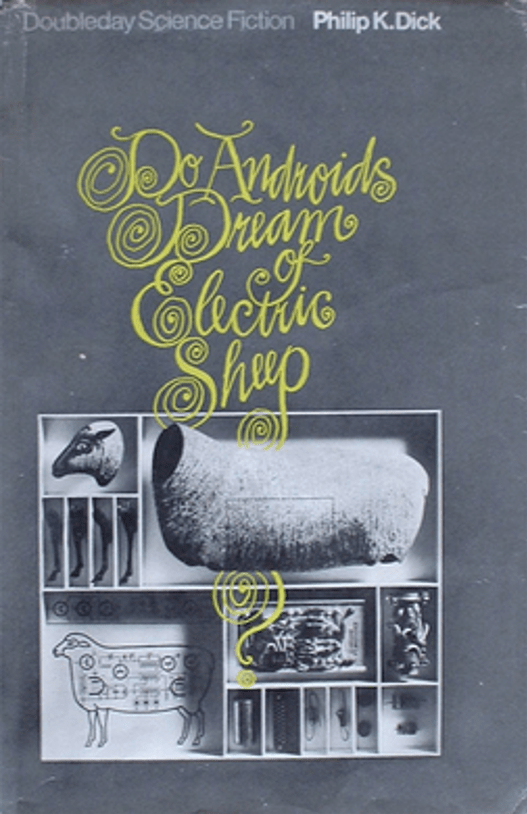
At a certain moment, Refik Anadol quotes Philip K. Dick, author of the 1968 science fiction book “Do Androids Dream of Electric Sheep”, later retitled Blade Runner, and basis for the 1982 initial version of the film.
This inspires Refik Anadol to seed the following insight:
A simulation is that which does not stop when the stories go away
Stories are responsible for our human desire for resolution
But the simulation is only responsible for its own laws and initializing conditions
A simulation has no moral, prejudice of meaning
Like nature it just is
There is some poetry hidden in this abstraction of data
Exploring data sets that have this quality of meditation
The architect as an operating systems designer, a beautiful “speculation”
Finding the moment of remembering
Finding the moment of entering a dream state
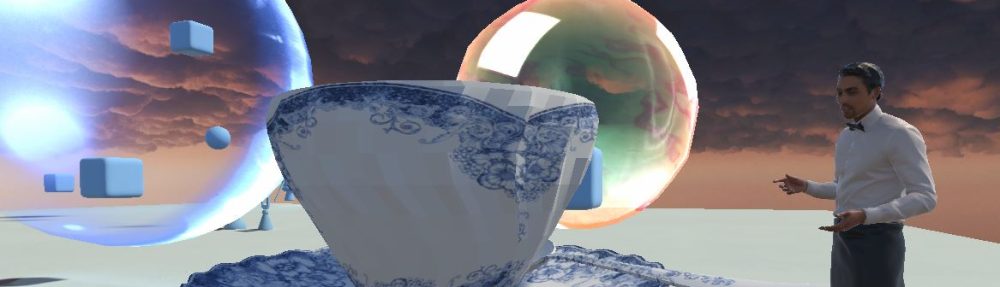
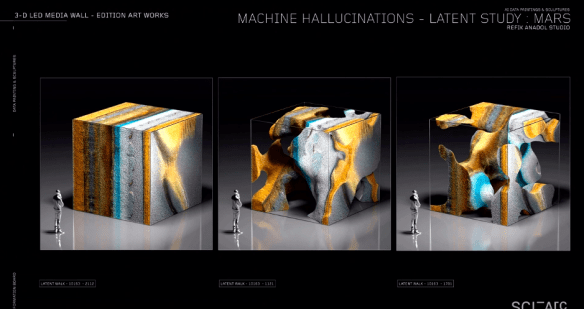
“Machine Hallucinations”
Collective memories of spaces
To make the invisible visible
Hallucination narrators
Dream narrators
The Selfies of the Earth
Refik is asking questions that are not just a fancy-fications of a bunch of algorithms
Another rabbit hole bringing together some reflections on creativity, demolition, patrimony, and poetic ruination, as so often in this blog inspired by architectural insights and metaphors.
My attention was triggered by an article in the Jan 11, 2020 weekend edition of De Standaard, a Flemish newspaper. The article was about landscaping, and more specifically “ontharding” (I would literally translate it as “softening”). In this case, softening that what was hardened in the first place. Abandoned and neglected residential and industrial sites, where the soil is still covered by the concrete and rubbish of empty buildings.
It was part of a study supported by the “Vlaamse Bouwmeester”. “Bouwmeester” means “master of building”, “bau-meister”. The term is ill-translated into “Flemish Government Architect” on the official website. The full study can be found here (PDF in Dutch).
The core mission of the Flemish Government Architect is to promote the architectural quality of the built environment. The Flemish Government Architect and his team advise public patrons in the design and realization of buildings, public space, landscape and infrastructure. In addition, the Flemish Government Architect stimulates the development of visions and reflection, with an emphasis on interdisciplinary and cross-sectoral initiatives. The Flemish Government Architect acts as an advisor to the entire Flemish Government.
In short, the article and the study plea for restoring public space by the demolition of 1/5th of hardened space/surface in the Flemish landscape by 2050.
I had a flashback to “Cradle to Cradle”, the 2002 book that alerted me for the first time to a possible vision of sustainable production and architecture. The idea at that time was that reducing waste was just not good enough, and to be sustainable we needed to add value back into the system. As an evolution, the article about the softening of landscape goes one step further: from reducing waste to creating open space by the demolition of vacancy.
“Sloop geeft blijk van falen” – “Demolition evidences failure”
Dan Hill was/is looking for (open) spaces as well, quoting ex-FC Barcelona football player and current Al-Sadd (Quatar) football team coach Xavi Hernández:
“Think quickly, look for spaces. That’s what I do: look for spaces. All day. I’m always looking. All day, all day. Here? No. There? No. People who haven’t played don’t always realise how hard that is. Space, space, space. It’s like being on the PlayStation. I think ‘shit, the defender’s here, play it there’. I see the space and pass. That’s what I do.”
Already more than 20 years ago, architect Cedric Price was arguing for demolish-able buildings with open re-usable spaces.
Cedric Price’s Fun Palace – inspiration for Centre Pompidou in Paris
OK – I confess – as from that moment I went down the rabbit hole and saw demolition and abandoned architecture everywhere. Like in this recent Guardian article, arguing the case for fully demountable buildings.
“We have to think of buildings as material depots,” says Thomas Rau , a Dutch architect who has been working to develop a public database of materials in existing buildings and their potential for reuse… He has developed the concept of “material passports”, a digital record of the specific characteristics and value of every material in a construction project, thereby enabling the different parts to be recovered, recycled and reused.
But there is also something poetic about abandonment, up to the point where we could consider keeping these ruins and equipping them with sensors to listen to patrimony.
Like menhirs, these abandoned seismic sensors could now just stand there, silent in the landscape, awaiting a future photographer such as Grigoryants to capture their poetic ruination.
Lebbeus Woods was inspiration to Geoff Manough and London-based architects Smout Allen for the project L.A. Recalculated:
Woods depicts an entire city designed and built as an inhabitable scientific tool. Everywhere there are “oscilloscopes, refractors, seismometers, interferometers, and other, as yet unknown instruments, measuring light, movement, force, change.” Woods describes how “tools for extending perceptivity to all scales of nature are built spontaneously, playfully, experimentally, continuously modified in home laboratories, in laboratories that are homes.”
Instead of wasting their lives tweeting about celebrity deaths, residents construct and model their own bespoke experiments, exploring seismology, astronomy, electricity, even light itself.
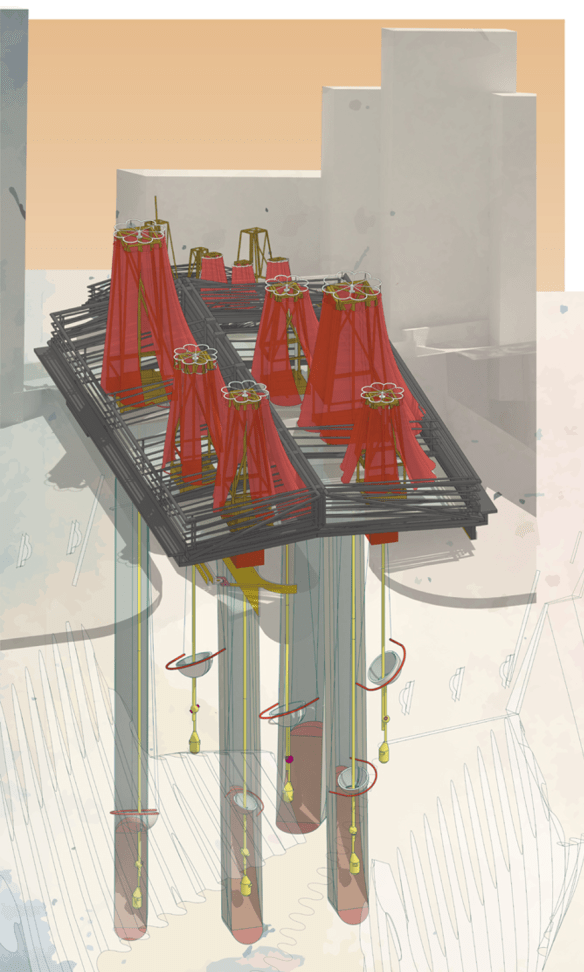
Seismic Counterweights
From L.A. Recalculated by Smout Allen and BLDGBLOG
Like architects think about (industrial) sites listening through sensors to seismic undercurrents, I started wondering whether we could not use this metaphor to reflect about our organizational structures; structures not only as hierarchical structures but the more encompassing set of system rules and patterns of an organization – I referred to it before as organizational patrimony.
How can we listen to and signal about the pulse of this organizational patrimony? How can we be aware of it, appreciate it, respect it, and build upon it in our rebellious acts of creative destruction?
I imagine a cohort of humans – like a colony of ants – having 24/7 sensors and laboratories everywhere in organizations; in every office, cubicle, meeting room, coffee corner, etc. And I don’t mean robotic sterile sensors feeding AI models. I mean real humans, measuring, documenting and signaling patrimonial changes in the structure of corporate structure, so they can send early warnings of experiments that have become useless and therefore have to be ruinated, or – in the worst-case – signal cases of patrimonial breakdown and demolition. In search of the material depot and passport of our organizations.
During my visit to SFMOMA on 15 Nov 2019, I was standing on the terrace of the 7th Floor looking North-East into Natoma Street, and wondering what the curved-walled building on the left was about.
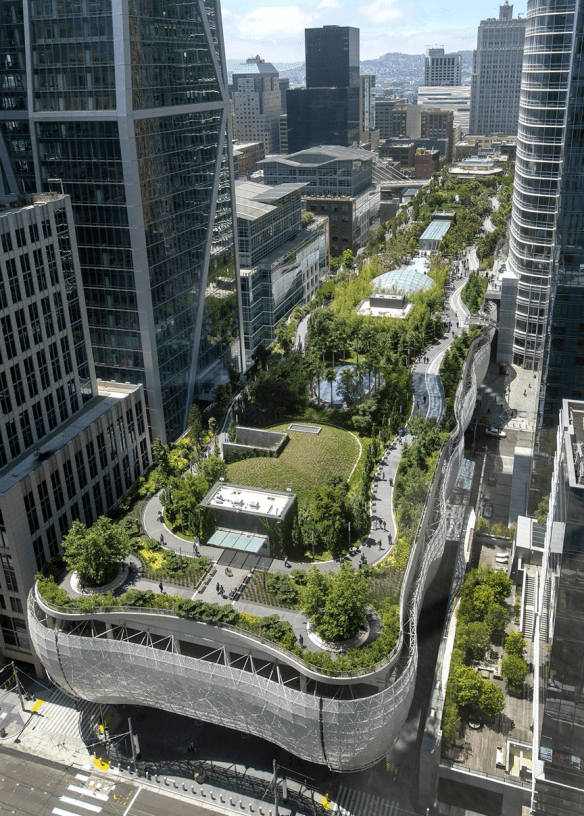
I did not pay much attention until I was reminded of this view in this article about floating utopias in The New-Yorker of 11 Dec 2019. Below is a view from the other side, probably taken from the Providian Financial rooftop on Beale Street, looking South-West. At the far end, you may recognize the SFMOMA building. The building in the front is Salesforce Park, a lush rooftop arcadia of rolling meadows.
Salesforce Park.Photograph by Karl Mondon / The Mercury News / Getty
The article in The New-Yorker is about the utopian, surveilled and orchestrated architecture in the middle of the astonishing inequality of homeless people in all the other streets of San Francisco:
Taxpayer-funded, corporately branded, suspended above the homeless, the park is an irresistible metaphor for the city’s socioeconomic tensions. It also feels like a bid, or a prayer, for a certain vision of its future.
Salesforce Park as a model for the rest of San Francisco—vertical, expansive, ecologically minded, expensive, sponsored, and surveilled.
“I feel totally orchestrated,” Cranz said, placing her hand on the railing separating us from the plant life. “I’m acutely aware of how managed everything is.”
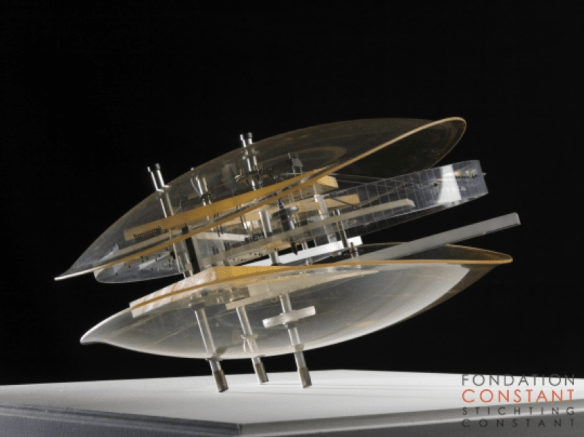
Two days later, I bumped on-line into the magical world of the Dutch artist Constant Nieuwenhuis and especially his Magnus opus “New Babylon”, another utopia, a city designed to respond to Homo Ludens’ need for playing, for adventure, and for mobility.
In New Babylon there are no single houses
The whole city is one immense covered collective house
A house with countless rooms, halls and corridors,
In which one can roam for days or weeks,
But where one can also find
Small spaces for privacy
New Babylon is a labyrinth
Inexhaustible in its variations
A palace with a thousand rooms
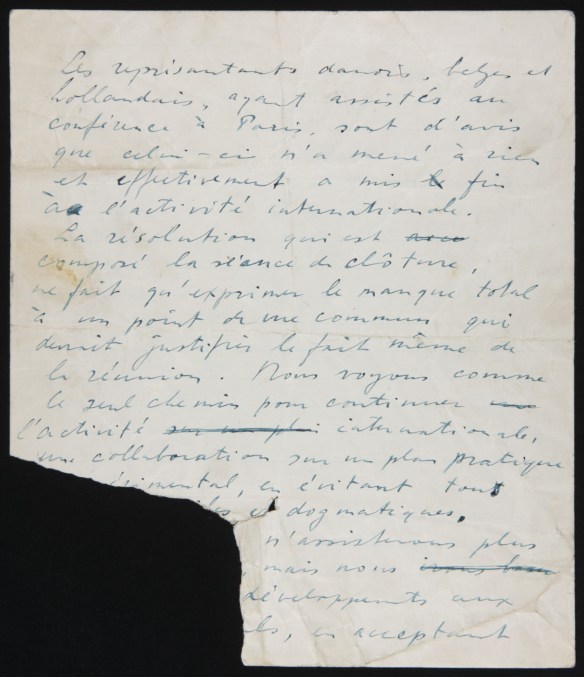
Constant was one of the founders of Cobra, an avant-garde art movement established on 8 Nov 1948. The movement only existed for three years, but forever changed the landscape of postwar European art. Cobra was perhaps the last avant-garde movement of the twentieth century. Constant was the author and co-signee of the initial COBRA Manifesto “La Cause était entendue” – “The Case was Settled”.
Les représentants belges, danois et hollandais à la conférence du Centre Internatiopnal de Documentation sur l’Art d’Avant-Garde à Paris jugent que celle-ci n’a mené à rien.
La résolution qui a été votée à la séance de cloture ne fait qu’exprimer le manque total d’un accord suffisant pour justifier le fait même de la réunion.
Nous voyons comme le seul chemin pour continuer l’activité internationale une collaboration organique expérimentale qui évite toute théorie stérile et dogmatique.
Aussi décidons-nous de ne plus assister aux conférences dont le programme et l’atmosphère ne sont pas favorable à un développement de notre travail.
Nous avons pu constater, nous, que nos façons de vivre, de travailler, de sentir étaient communes ; nous nous entendons sur le plan pratique et nous refusons de nous embrigader dans une unité théorique artificielle. Nous travaillons ensemble, nous travaillerons ensemble.
C’est dans un esprit d’efficacité que nous ajoutons à nos expériences nationales une expérience dialectique entre nos groupes. Si, actuellement, nous ne voyons pas ailleurs qu’entre nous d’activité internationale, nous faisons appel cependant aux artistes de n’importe quel pays qui puissent travailler – qui puissent travailler dans notre sens.
After reading “Homo Ludens – A Study of the Play-Element in Culture” by Johan Huizinga, Constant develops the idea for a futuristic city. He develops this idea by drawing maps, writing texts, building constructions, and models.
Constant worked for almost 20 years on New Babylon (1959-1974). Today, there is a foundation to preserve and promote the art collection and intellectual legacy of the artist.
From Wikipedia:
The goal was the creating of alternative life experiences, called ‘situations’
Perched above ground, Constant’s megastructures would literally leave the bourgeois metropolis below and would be populated by homo ludens–man at play.
In the New Babylon, the bourgeois shackles of work, family life, and civic responsibility would be discarded. The post-revolutionary individual would wander from one leisure environment to another in search of new sensations. Beholden to no one, he would sleep, eat, recreate, and procreate where and when he wanted. Self-fulfillment and self-satisfaction were Constant’s social goals. Deductive reasoning, goal-oriented production, the construction and betterment of a political community–all these were eschewed.
It is obvious that a person free to use his time for the whole of his life, free to go where he wants, when he wants, cannot make the greatest use of his freedom in a world ruled by the clock and the imperative of a fixed abode. As a way of life Homo Ludens will demand, firstly, that he responds to his need for playing, for adventure, for mobility, as well as all the conditions that facilitate the free creation of his own life.
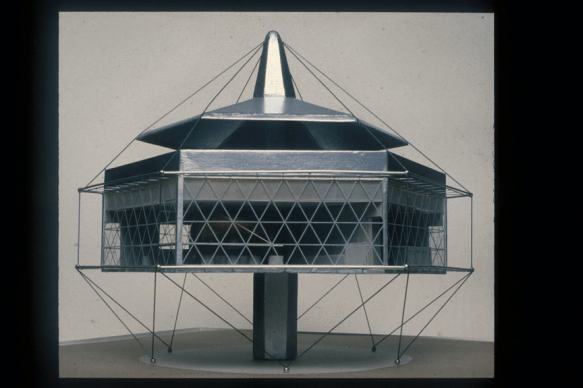
Some of the constructs in Constant’s vision reminded me of the sketches and models of Buckminster Fuller’s Dimaxyon House of 30 years earlier).
Buckminster Fuller, Dimaxyon House, Chicago, USA, 1927
Constant passes away in Utrecht on August 1st, 2005, at home with his wife Trudy van der Horst. He is buried at Zorgvlied in Amstelveen on August 6th. On his grave:
In art freedom manifests itself in its highest form. The creative imagination. Art creates an image of the world that didn’t exist before. No. More than that. An image that was unthinkable before.
I’d love to see a 21st-century version of Cobra, a collective of artists, thinkers, creators, tinkerers, and experimentalists, leading into a movement of fresh thinking. Not necessarily and exclusively an art-movement, but an all-encompassing societal-movement, with more time and air and oxygen for our children to play, where they naturally can grow into what they are best at, with a renewed freshness and renaissance, a new corporate and societal spring, celebrating the power of imagination and creativity, as a response to our dull political landscape of non-zero games.
A new New Babylon, a new city to play, a new avant-garde propelling us into the highest forms of freedom.
We use models and metaphors to make sense of our organisational structures, understand them, make predictions, apply change.
Bee hive - via Bridging the Gap
Some well known models are:
Ants in colonies
Bees in hives
Apes in jungles
Humans in neural networks
Organisations as machines
Hierarchies, wierarchies, holocracies
Models are not reality. Models are an abstraction of reality. Same for metaphors. They help us tell and understand a narrative.
We are not apes, ants, or bees. We are humans. As Jonathan Haidt explains at length in his book “The Happiness Hypothesis: Finding Modern Truth in Ancient Wisdom”, I am struck by all the noise humans put on the system: “We are all hypocrites” and “We are the rider (the conscious/the ratio) ànd the elephant (the unconscious, feelings, instincts, genes). Most models assume the rider is in charge. The rider is not in charge.”
Structural change leads to structural behaviour change. Structural change needs high quality connections and flows.
“A high quality connection is one where information transfer is rapid, reliable, and noise free” says Tom LaForge.
But in real life, this information transfer is NOT noise free. Maybe in some nirvana love relation, but usually not at/for/within work.
Noise comes from the motivations of the elephant (the unconscious), some examples:
Reciprocity
Prestige
Self serving biases
Power
Hypocrisy
Arrogance and entitlement
In most re-orgs, people look at the motivations and incentives for the ratio, the rider. They ignore the elephant. They forget the rider is not in charge.
High quality connections need something else than speed, reliability of noise-freedom.
There should be some dimension/ambition/alignment of “Spiritual, moral and aesthetical advancement”.
In this category, we find standards and appreciation for:
The simplicity of the hierarchy works well on a slide or a hand-out. You can document it in a spreadsheet, or box-diagram and so on. But all these representations do is framing the conversation in an illusion of simplistic 2-dimensional structures. It’s the specialty of management consultants to think and present in two dimensions. It’s making it easy for executives to understand.
But if you are used to a 3-dimensional view of reality, you can’t understand why the flatlanders don’t see what you see. As long as you are primed in 2D you won’t see what the other dimension sees.
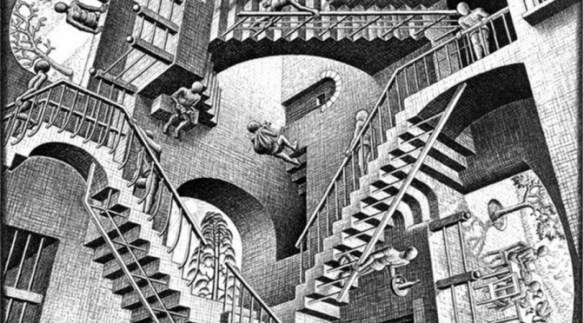
A better picture/metaphor for an organisational structure would be something like this.
Relativity – 1953 Lithograph by M.C. Escher – 294mm x 282mm
Ricardo Bofill – La Fabrica – Old cement factory – Barcelona, Spain
It’s messy. At many moments you don’t know anymore where you stand. The perspective changes all the time. You get disoriented.
There is somewhere a general definition for Robots:
Robot = sensors + mind/computer/algorithm + body (hardware).
But humans are not just: senses + brains + body.
Computers are not like brains. Brains are not like computers. Our human models are different from machine models. Machine understanding is different from human understanding.
Humans are not just nodes on a network/grid that can be governed by coded social contracts, blockchains and AI. If you do that, humans are just cogs in another machine. Humans become cogs in a network.
The obvious case is of course Uber, which is an economy of extracting value vs. the so-called sharing economy. For Uber, all the drivers are already cogs in a network for the sole benefit of the monopoly.
Being cogs in networks is an insult for humans. But we are just getting started:
But does it still matter at all these days? We already are in a new world of “Alien knowledge, when machines justify knowledge”. Check out this fantastic long read by David Weinberger
Via David Weinberger - Illustrations by Todd Proctor / YouWorkForThem
“The paradigmatic failures seem to be ones in which the machine justification has not escaped its human origins enough.”
Organisations are not models/buildings/boxes. They are like rivers with information flows. Building skeletons, where the structure of the building guides traffic and connections.
David Weinberger talks about models created by machines. Models that machines can understand and we don’t. It is very much as he concludes:
“It has taken a network of machines that we ourselves created to let us see that we are the aliens.”
If we don’t want to end up as cogs in networks, we need to aim for structural advancement at a spiritual, moral, and aesthetical dimension.
I am in the business of cultivating high quality connections and flows to create immersive learning experiences and structural change. Check out: https://petervanproductions.com/
I ask myself often whether organisations can change – really change – at all. I recently spoke to an HR person of a big worldwide corporation, and her answer was a strong “yes”. I am not so sure. Or maybe I am confused.
As organisations are made of people (humans), would you have the change the people in order to change the organisation? Is there another way? Some people say “you can’t change people, but you can change their behaviour”. Are we fooling ourselves with such statements?
There are plenty of metaphors to illustrate the relationship between structure and behaviour. From race cars, the team and the driver, to heroes hacking their way through forests (My friend Leda Glyptis wrote this excellent piece on the oscillating patterns – “Acts” in her post – that innovation heroes have to go through).
I am starting to think about a metaphor based on architecture, and the notion of “patrimony” of a building, which has to do a lot with knowledge stored as inheritance material in physical objects (Thanks, Tom Laforge for the insight).
Kanaal Site – Axel Vervoordt – Old malt factory - Wijnegem, Belgium
Ricardo Bofill – The Cathedral – Old cement factory – Barcelona, Spain
“Patrimony” is an interesting term. The Dutch word “Erfgoed” maybe captures it better. “Erf” means inheritance, value that can be transmitted across generations. “Goed” stand for “good”, both as 1) something tangible, an art-i-fact and 2) something good, of value/worth/wealth/culture/DNA to be carried forward.
The architects decided to respect the patrimony, strip it to its essence – its skeleton – and create new perspectives and flows. They did not decide for “disruption”, aka breaking down the building and creating something completely new. They combine old and new, they combine tradition/patrimony/erfgoed with new flows, new structures.
The structure is not only the brick and mortar building itself, but includes the whole site, the landscape, the empty spaces, the social contracts, the tacit and non-tacit agreements of flow.
The structure comes alive when people live in it, add furniture, decoration, color, organise their areas for work, for creativity, for reflection.
What is the skeleton structure of the building, what do we need to keep, where do we need to create new perspectives to cultivate new flows of water, traffic, connections?
The metaphor building/organisation – like any metaphor – works only to a certain extent.
“The elephant (the unconscious) is not motivated by happiness but by prestige.
“Most stories/narratives are confabulated after the facts”
So back to my initial question: can organisations change? Maybe the better question is: what quality of change are we aiming for? Or the more critical question may be: why would people change?”
Fritz’ suggestion is that if you have the right structure, people will naturally change their behaviour and the flows of information.
What are your thoughts?
I am in the business of cultivating high quality connections and flows to create immersive learning experiences and structural change. Check out: https://petervanproductions.com/
I recently had some conversations with prospective clients on the need for alignment and coherence of physical and emotional space when trying to create great experiences. I started to call them “sacred spaces”.
As you know by now, I am not in the events business. I am in the business of creating high quality feedback loops to enable immersive learning expeditions and deep change. In essence, I want to resonate with my client’s guests at another (additional) level than the pure cognitive. I believe this ambition also requires its own awareness and vocabulary, but more about that in some later posts.
One aspect of that vocabulary is our expression of sacred spaces. What first comes to mind is a church, a cathedral, some religious building of some sort.
Sagrada Familia – Barcelona – 31 Oct 2014
In the best cases, the moment you come in, you are struck by a lightning of beauty, awe, stillness, and grandeur. The entry into the space feels almost ceremonial. You cross the entry, the line between outside and inside. The experience of the space sends vibrations down your spine. You feel suddenly whole and small at the same time.
This whole- and small-ness creates some kind of safety; some form of familiarity that this space is the right space, that this space is right. Just right for what it was designed for.
I think in similar terms about the spaces for our experiences.
Our spaces must be safe spaces. Closed as with an entry door. The entry into the space is a ritual moment. The coming out as well. It must be a physical experience: guests have to walk through the “arc of change”. They must do this in a “communion” style, as a collective, creating a visceral experience of the collectivism in their change process.
The space is about “roundness”, round as in circle, but also round as in generative, coming back to the starting point with new insights.
The space becomes a pulsing “egg”, a “womb” that will be our “nest” for a couple of days. It has of course to do a lot with right spaces for humans, and Jean Nouvel’s views (video here) on architecture. The video is also called “Reflections”, just like the latest from Brian Eno, one ambient song of 54 minutes (interview here)
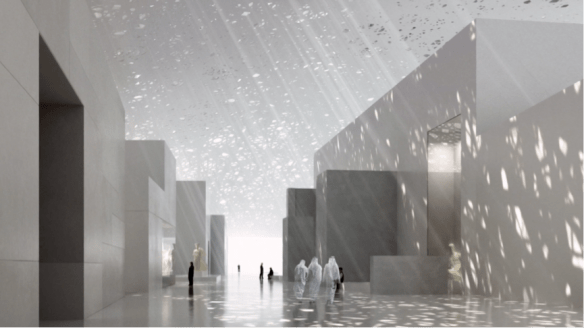
“Combining big bold shapes with intricacy and delicacy. The ability to be bold and delicate at the same time. The relation between time and light. The sphere above, the cupola. A spiritual space.”
I love the idea of the cupola. In my opinion, the closed space described above needs a roof – like a cupola – with some lattice membrane. But at the same time, the space needs to be “porous”, with light (the crack) coming in through the lattice, and light (enlightenment) coming out to inspire others. Or even better, some form of post-enlightenment as in Danny Hillis’ entanglement.
And light itself can also be the “roof” and the trees of the space forest. Check out this wonderful video of Fujimoto’s light forest:
I shared the video with my good friend Marti Spiegelman, who replied:
“Thanks for the link – this is extraordinary. It reminds me that sometimes the light itself is the sacred space – I’m thinking of the light beam on the floor, when one of the walkers stands in the light – and sometimes the light creates the boundaries, or defines the edges, of the space – as in a forest when there is a small round clearing, it’s traditionally considered to be a ‘power spot’’ [another name for sacred space] where you can call in greater powers of nature and the universe to create change.”
I was looking for some good description of sacred and sacredness. I think I found it in an article about a fashion book by Belgian fashion designer Ann Demeulemeester.
“It looks and feels almost sacred, with pages so thin the images can be seen on both sides of each sheet; it’s a truly delicate beauty. For this reason, every single page is printed only on one side, creating a uniquely singular reading experience. The size and weight of the book gently contrasts with the fragility and smoothness of the paper, while the almost total white of the inside is in opposition with the blackness of the sides and the linen cover. Text is kept to the essentials, limited to an introduction by Patti Smith (Demeulemeester’s longtime muse) and a short final dedication by the designer herself. The book was designed by Victor Robyn, a Belgian graphic designer who has been in charge of realizing Demeulemeester’s graphics for years—from show invitations to printed fabrics. The art direction is curated by Victor Robyn, Demeulemeester herself and Patrick Robin, her life and business partner.”
Happenstance that I visited this week Casa Argentaurum, an art gallery in Ghent run by Caroline De Wolf, who kindly opened her space for me. It was one of the last days of the exposition about Ann Demeulemeester’s jewellery.
Necklace – Ann Demeulemeester – Casa Argentaurum
At the end of our conversation, Caroline gave me a copy of the catalogue of the 2010 exposition “Things, Thoughts, and Territorities”.
The book has some great design drawings by Andrea Branzi, and also a wonderful testimony of the artists’s love relation with Belgium (mostly Flanders btw). Somewhere half way, there is this superb quote:
“Architecture is not the art of building, it is a very complex discipline,
interpreting history, technology and the changes in society.”
It could have been the tag-line for Petervan Productions, as I see myself as the architect who conceives, gives birth to the vision together with the client, and then pulls together and orchestrates the resources, experts, and artists to create a unique experience in search for the secrets of life.
But “you can’t find secrets without looking or them” (quote by Peter Thiel in his book “From Zero to One”), so I am looking for your views on what you would expect from a sacred space.
I am looking for architects, space- and stage-designers to be part of our collective of leaders, visionaries, artists, craftsmen, designers and producers.
If you are interested to be part of that calling and dialogue, you can just leave a comment on this post.
As many of you know, since begin November I am trying to create my own thing called “Petervan Productions”.
The scaffolding is already in the works for many years, and I am still hesitating whether I will once publish the 100+ page reflections on the intentions of all this, what I think this enables, and then working down the tactics such as outcomes and deliverables.
Besides the artwork and the research bit of my activities, I spent quite some time in re-thinking what “events” could be like. And thinking of my customers as “guest”, not consumers. What I am trying to offer is a one-stop-shop for unique immersive learning expeditions in emotionally and physically right spaces for humans.
The core of the article is a very nice video. As usual, I made the transcript of the video, and added some poetic highlights and typographic reflections by myself. I have stopped adding comments and trying to explain. My guests are smart enough to make up their own minds. Explaining would be an insult.
Each project is an adventure, a passion
The biggest temptation
Is to jump into it
There are solutions that come to you
There are images that spontaneously appear
My method is rather to hold back as long as possible
To really imagine it spatially
So, to be sure that I have something to say
These moments where you understand somebody cared about something
That’s when you feel
like “oh yes,
this is a human thing,
not some robot that
put something together”
Simply living there is a cultural act
Combine big bold shapes with intricacy and delicacy
The ability to be bold and delicate at the same time
The relation between time and light
The sphere above,
the cupola
As spiritual space
“Perhaps we have to keep dust”
Create a space, no inside, no outside…
“We have principles, and these principles we have to nurture.












 Petervan Studios